Kurt Vonnegut inherited his unbelief from a line of German-American freethinkers, beginning with a great-grandfather who asked for no prayers at his coffin. He never had a faith to lose, and found his unbelief confirmed by war and anthropology. In later life he turned not toward God but toward the ethics of the Sermon on the Mount. He called himself a Christ-loving atheist, and a humanist in honour of his parents.
The belief timeline
- Inheritance (1873 (Clemens); 1922 (Kurt's birth)) — The family's freethought on paper: Clemens's declaration "I believe in honour, truth and love of humanity"; the novelist's later account of a Catholic immigrant family that "read Darwin... So they left the church" (a family tradition, not a dated event) [11][1][29]
- Confirmation (1945–47 (his own dating of "after the war")) — University of Chicago anthropology: "confirmed my atheism, which was the faith of my fathers anyway"; religions seen as "Rube Goldberg inventions" [34]
- Declaration (1973 (Playboy); 1976 (Short)) — Public statements that his ancestors were atheists and that he never had organized religion; the family goal "to behave virtuously" [30][46]
- Revision (1980 and after) — Not a change of mind about God. "Christ-worshipping agnostic" (1980 sermon), the 1985–88 Requiem and its Unitarian Universalist premiere, "Christ-loving atheist" (UUA talk, undated), AHA honorary president (after Asimov), "humanist or freethinker... honoring my mother and father" (1999) [36][37][42][44][40]
Notes to the timeline (11)
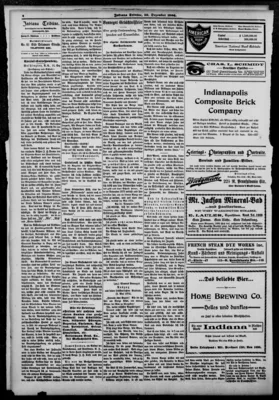
- [11] He wrote a declaration on 16 Nov. 1873 for his burial or cremation and a funeral address dated 3 May 1874, both read at the 1906 memorial — "Vonnegut-Gedächtnißfeier," Indiana Tribüne (Indianapolis), 20 Dec. 1906, p. 4, col. 3: the full text of Clemens Vonnegut's two self-written funeral statements (16 Nov. 1873; 3 May 1874) and the eulogy. Library of Congress, Chronicling America, LCCN sn83045241, ed. 1, seq. 4 (public domain, published 1906), p. 4.
- [1] Clemens Vonnegut was born 20 Nov. 1824 in Münster, Westphalia; his father was a tax official; he attended school irregularly because of weak health and eyes — "Clemens Vonnegut Sr. — Eine segensreiche Laufbahn beschlossen," Indiana Tribüne, 13 Dec. 1906, p. 1 (obituary), plus death notices on p. 8 of 13 and 14 Dec. 1906. LCCN sn83045241.
tribune-1906-12-13-p1.txt,-p8.txt,tribune-1906-12-14-p8.txt, 13 Dec. 1906, p. 1. - [29] 1989 interview (Ábádi-Nagy, Manhattan, 8 Aug. 1989): asked about his "religious heritage", he said it is freethinking and that he is "what used to be called a freethinker"; the idea began largely in Germany; his ancestors came as Catholics before the Civil War, read Darwin, concluded the Bible could not be true and "left the church"; he accepts that there is probably no afterlife and thinks reward or punishment after death absurd; God, by definition, needs nothing, so "the highest service is to the community" — Peter J. Reed and Marc Leeds, eds., The Vonnegut Chronicles: Interviews and Essays (Westport, CT: Greenwood Press, 1996; Contributions to the Study of World Literature no. 65), p. 18 (interview), 8 Aug. 1989 per the interview's headnote.
- [34] At the University of Chicago (anthropology, from December 1945) he saw religions "exhibited and studied as the Rube Goldberg inventions I'd always thought they were"; it "confirmed my atheism, which was the faith of my fathers anyway" (Paris Review self-interview, 1977, reprinted in *Palm Sunday*, p. 101) — Reed, Vonnegut Chronicles, p. 146 (Freese, citing Palm Sunday p. 101); Reed, Vonnegut Chronicles, p. xxii (enrolment). Reported at second hand; the original has not been seen.
- [30] In the Playboy interview he said his ancestors "were atheists", he never had organized religion, and he learned his opinions at his mother's knee — Reed, Vonnegut Chronicles, p. 146 (Freese); p. 74 (Merrill).
- [46] In an interview with Robert Short (Chicago, 8 June 1976) he described the goal of his family's atheist tradition as "to behave virtuously within the biological limits of being human beings" — Reed, Vonnegut Chronicles, p. 56 (Reed, citing Short, Something to Believe In, 1978, p. 289).
- [36] In a Palm Sunday sermon at St. Clement's Episcopal Church, New York, in 1980 he called himself "a Christ-worshipping agnostic" (printed in *Palm Sunday*, 1981, p. 327), saying he was "enchanted by the Sermon on the Mount. Being merciful, it seems to me, is the only good idea we have received so far" — Reed, Vonnegut Chronicles, p. 146 (Freese, citing Palm Sunday p. 327); Dan Wakefield, "Kurt Vonnegut, Christ-Loving Atheist," Image no. 82 (2014), pp. 67–75 (the journal's web copy, imagejournal.org/article/kurt-vonnegut/;
texts/wakefield-image.txt; the web copy has no page numbers and is cited by passage). Wakefield, a friend and a Christian, assembled Vonnegut's Letters (2012) and quotes from them, from Timequake and from speeches. In copyright; read and paraphrased, not quoted in the Quotations table, (the year 1980 and the Sermon quotation). - [37] Speaking to a General Assembly of the Unitarian Universalist Association he called himself a "Christ-loving atheist" and said that to avoid seeming "a spiritual paraplegic" he sometimes says he is a Unitarian Universalist; Wakefield stresses he belonged to no church and was not a Christian — Wakefield, Image, (no year or city for the General Assembly is given in any source read).
- [42] He succeeded Isaac Asimov as honorary president of the American Humanist Association and, at the memorial service for Asimov, joked "Isaac is up in Heaven now", "the funniest thing I could have said to an audience of humanists" — Wakefield, Image, (retelling Timequake); Wikiquote (map, citing God Bless You, Dr. Kevorkian); American Humanist Association, "Annual Humanist Awards" page (americanhumanist.org/awardees/),
texts/aha-awardees.txt: Humanist of the Year 1992: Kurt Vonnegut, awardees page (1992 Humanist of the Year). - [44] After hearing Lloyd Webber's Requiem at St. Thomas Church (1985, aged 62–63) he found its English text sadistic, wrote his own Requiem (Jesus: "my wild and loving brother"; "let not light disturb their sleep"), had it translated into Latin and set to music; it was published as "Requiem: The Hocus Pocus Laundromat" (*North American Review* 271, Dec. 1986), and premiered in Buffalo, 4 March 1988 (the talk before it was on 3 March), by the Buffalo Symphony and a Unitarian Universalist church choir — Wakefield, Image; Reed, Vonnegut Chronicles, pp. 66–67 (Klinkowitz: talk on 3 Mar. 1988, premiere "the next day"; the Dec. 1986 publication from Klinkowitz's bibliography).
- [40] Agnes Scott College commencement address, 1999: "a humanist or freethinker as were my parents and grandparents and great-grandparents and ancestors—and so not a Christian. By being a humanist, I am honoring my mother and father"; and, with his "American ancestors", that if Jesus's words were good "what does it matter if he was God or not?" — Wakefield, Image; the same passage appears, per Wikiquote (map), in God Bless You, Dr. Kevorkian (1999) and, in a variant, A Man Without a Country pp. 80–81.
The Faith of His Fathers
On the evening of 19 December 1906, in the auditorium of the German House in Indianapolis, the German community gathered to remember an old hardware merchant who had died the week before. At his own direction there had been no flowers and no prayers, and his body had gone to the crematorium. Now his friends read aloud the statement he had written for his funeral thirty-three years earlier:
Ich glaube an Ehre, Wahrheit und Menschenliebe.1
"I believe in honour, truth and love of humanity." And: "Ich glaube weder an einen persönlichen Gott, noch an einen persönlichen Teufel": "I believe neither in a personal God nor in a personal Devil."2345
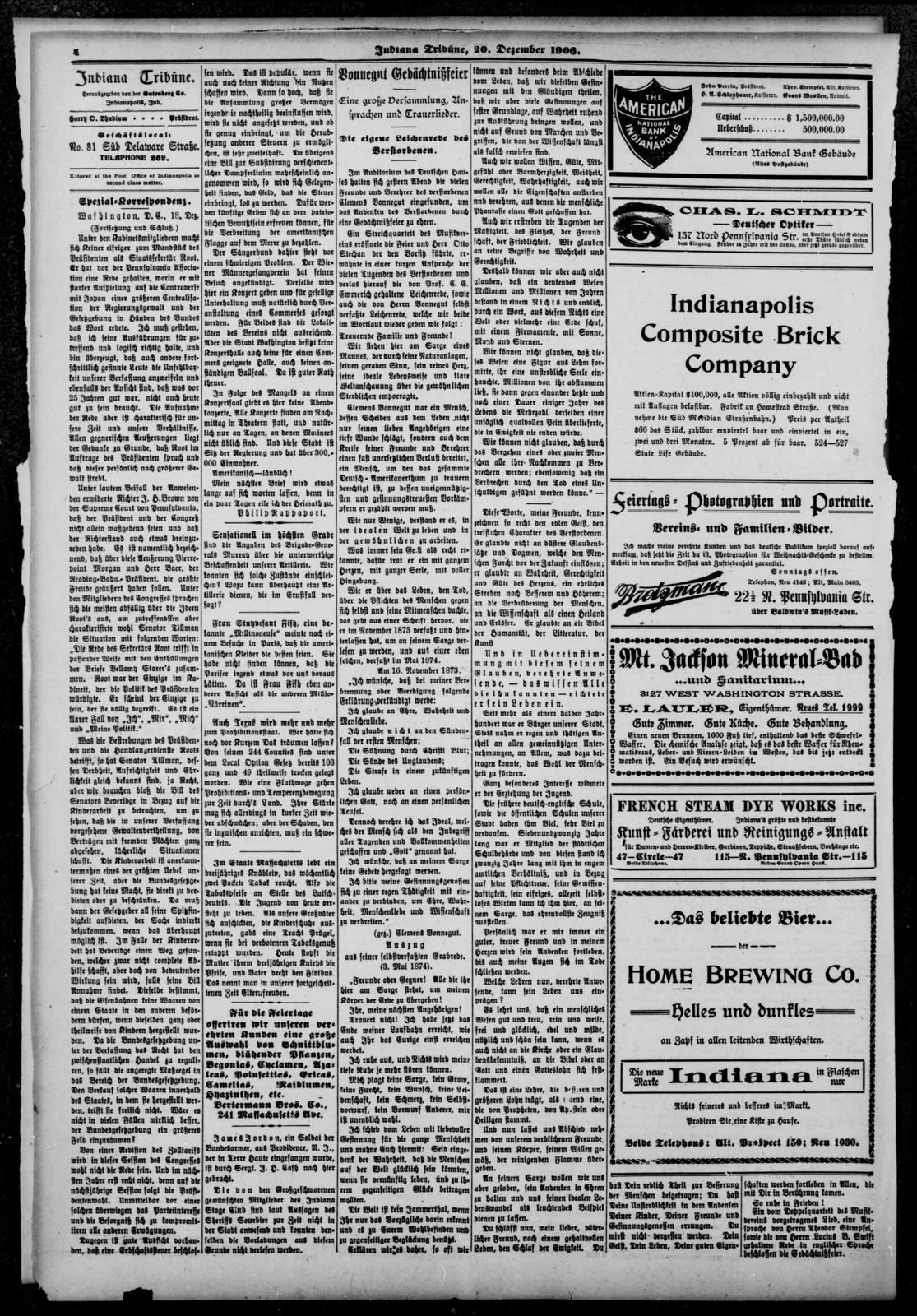
The merchant was Clemens Vonnegut, and the German House had been designed by his son. His great-grandson, born sixteen years later, would become the novelist Kurt Vonnegut, who said his religion was the freethinking of his ancestors. This chapter asks what it means to inherit unbelief, and how a man who never had a faith to lose came, late in life, to love the Sermon on the Mount.
The freethinkers of Indianapolis
Clemens Vonnegut was born in Münster in 1824, came to America around 1850, and founded a hardware business in Indianapolis.678 He helped found the city's Turnverein, its German-English School and a society of freethinkers.9 The school grew out of a Thomas Paine celebration in 1859, and its society pledged, in a contemporary translation, "independent of all sectarian influences," to "secure the education of free, moral men, in the principles of humanity."1011 He wrote an anonymous guide to moral instruction "in the freethinking sense."12
His funeral statement of 1873 listed what he did not believe: the Fall, atonement by Christ's blood, the sin of unbelief, and punishment in a life to come. He asked that no prayers be said at his coffin: "Ich wünsche, daß an meinem Sarge keine Gebete hergesagt werden."1314 Yet he was no scoffer. He honoured, he wrote, the ideal that people had made for themselves as the sum of all virtues and called God.15 A second address, of 1874, said that the world is no vale of tears if one sees what is excellent in it and uses it for one another's happiness, and that freethinkers share the believers' sentiments but want to rest them on truth, "und nicht auf Grund von Märchen," not on fairy tales that science had long since shown to be false.1617 His son Bernard, the novelist's grandfather, was the architect of the German House where that memorial was held.18
Learned at his mother's knee
Kurt Vonnegut was born in Indianapolis on 11 November 1922, the youngest of three children of an architect and the daughter of a brewing family.19 He grew up, by his own account, without any religion to rebel against. His ancestors, he told an interviewer in 1973, were atheists; he had never had organised religion, and he had learned his outrageous opinions at his mother's knee.20 In 1989 he said his religious heritage was freethinking: his forebears had come to America as Catholics, read Darwin, decided the Bible could not be true, and left the church.21 He called that family tradition the most corrosive sort of agnosticism, or worse.22 No source records a childhood faith or a moment of doubt. On his timeline, the first mark is inheritance.
What he did not inherit was the German language. His parents, shamed by anti-German feeling during the First World War, taught him nothing of the family's German past, so that the freethinking reached him without its language or its culture.23 He went to Shortridge High School and then to Cornell to study biochemistry.2425
Dresden
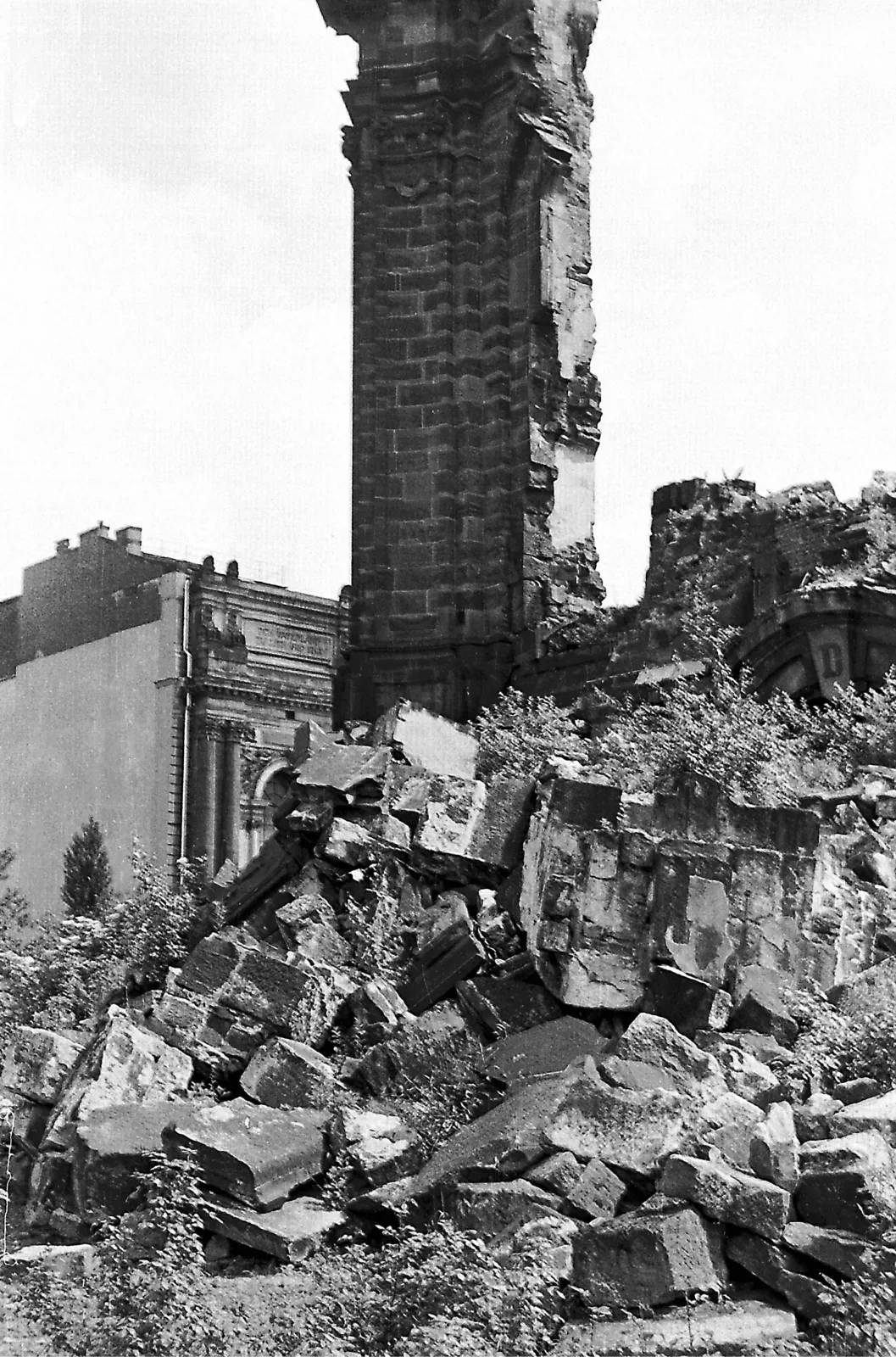
In March 1943 he enlisted as a private. In May 1944 his mother died by suicide.2426 That December, as a battalion scout of the 106th Infantry Division, he was captured in the Ardennes after wandering behind the German lines for several days.2728 He was taken to Dresden as a prisoner of war and was sheltering in an underground meat locker beneath a slaughterhouse when British and American bombers destroyed the city on 13 and 14 February 1945; estimates of the dead differ widely.293031 He would make the slaughterhouse the title of his most famous novel.
He later said that the bombing of Hiroshima showed him how vile his family's only real religion, technology, could be; the remark was about faith in machines, not about God.32 After the war he studied anthropology at the University of Chicago, where, he said, the religions he saw exhibited and studied looked like the absurd contraptions he had always thought they were. It confirmed his atheism, he wrote, which was the faith of his fathers anyway.33 On the belief timeline, this is where his unbelief is confirmed.
The Sermon on the Mount
In July 1945, back in Indianapolis, he had lunch with his father, an uncle and the labour organiser Powers Hapgood, who told them how a judge had once asked him why he lived as he did. Because of the Sermon on the Mount, Hapgood had answered.34 Vonnegut never joined a church. But from about 1980 the Sermon on the Mount and the Beatitudes became a centre of his speeches. In a Palm Sunday sermon at an Episcopal church in New York in 1980 he called himself a Christ-worshipping agnostic, and said that mercy seemed to him the only good idea humanity had yet received.35 Speaking to the Unitarian Universalists, he called himself a Christ-loving atheist.36 Offended by the threats in the traditional requiem mass, he wrote a requiem of his own, had it put into Latin, and heard it performed in Buffalo in 1988 by a symphony orchestra and a Unitarian Universalist choir.37 He advised a lonely ex-prisoner to join a church, because a congregation could be an extended family.38
None of this was belief. He told his daughter in 1979 that he was not a Christian of any kind, and in 1999 that he wanted no Christian funeral.39 He described the goal of his family's atheist tradition as behaving virtuously within the limits of being human.40 His humanists, he wrote in 1997, were people who tried to behave decently without expecting reward or punishment after death, serving the community.41 On his timeline, the revision is this turn, not toward God but toward the ethics of Jesus, held by a man who did not think Jesus divine. In a commencement address in 1999 he called himself a humanist or freethinker like his parents, grandparents and great-grandparents, and said that by being one he honoured his mother and father.42
The opposition
His books met believers' anger. In 1976 a school board on Long Island removed Slaughterhouse-Five and eight other books from its libraries, calling them, in a press release the Supreme Court later quoted, "anti-American, anti-Christian, anti-Sem[i]tic, and just plain filthy."43 His friend Dan Wakefield, who had returned to Christianity, teased him affectionately about his humanism and wrote the warmest account of his fascination with Jesus.3436
He was named Humanist of the Year by the American Humanist Association in 1992 and succeeded Isaac Asimov as its honorary president; at Asimov's memorial, he said, he joked that Isaac was up in Heaven now, the funniest thing he could have said to a room of humanists.4445 He died in New York in April 2007, at eighty-four.46 His great-grandfather had asked for no prayers at his coffin. The great-grandson asked for no Christian funeral, and spent his last decades preaching mercy.
Mark Twain, who Vonnegut said confirmed his scepticism about the divinity of Christ in his formative years, has his own chapter in this book.
Footnotes
-
Clemens Vonnegut, 16 Nov. 1873: "Vonnegut-Gedächtnißfeier," Indiana Tribüne (Indianapolis), 20 Dec. 1906, p. 4, col. 3: the full text of Clemens Vonnegut's two self-written funeral statements (16 Nov. 1873; 3 May 1874) and the eulogy. Library of Congress, Chronicling America, LCCN sn83045241, ed. 1, seq. 4 (public domain, published 1906), p. 4. ↩
-
Clemens Vonnegut, 16 Nov. 1873: Indiana Tribüne, p. 4. ↩
-
Indiana Tribüne, p. 4. ↩
-
Tribüne 13 Dec. 1906 p. 8; 14 Dec. 1906 p. 8 (death notices). ↩
-
Indiana Tribüne, p. 4. ↩
-
"Clemens Vonnegut Sr. — Eine segensreiche Laufbahn beschlossen," Indiana Tribüne, 13 Dec. 1906, p. 1 (obituary), plus death notices on p. 8 of 13 and 14 Dec. 1906. LCCN sn83045241.
tribune-1906-12-13-p1.txt,-p8.txt,tribune-1906-12-14-p8.txt, 13 Dec. 1906, p. 1. ↩ -
Indiana Tribüne, p. 1. Accounts differ; see the disputed points. ↩
-
Indiana Tribüne, p. 1; "Vonnegut Firm's Diamond Jubilee Here Week," Indianapolis Times, 20 May 1927, p. 2, LCCN sn82015313 (public domain, published 1927; the text was read from the loc.gov full-text service and is not saved in
texts/), 20 May 1927, p. 2 (the 1927 article says Vollmer and Vonnegut separated in 1857). ↩ -
Indiana Tribüne, p. 1. Obituary is the only source for this, as for the other details in this chapter cited to that source alone. ↩
-
Jacob Piatt Dunn, Greater Indianapolis (Chicago: Lewis, 1910), vol. 1, p. 209. ↩
-
German-English School Society, 1859 (as translated in Dunn): Dunn, Greater Indianapolis, vol. I, p. 209. ↩
-
Indiana Tribüne, p. 1; Peter J. Reed and Marc Leeds, eds., The Vonnegut Chronicles: Interviews and Essays (Westport, CT: Greenwood Press, 1996; Contributions to the Study of World Literature no. 65), pp. 66–67; Open Library record (Tier 4). Reported at second hand; the original has not been seen. ↩
-
Clemens Vonnegut, 16 Nov. 1873: Indiana Tribüne, p. 4. ↩
-
Clemens Vonnegut, 16 Nov. 1873: Indiana Tribüne, p. 4. ↩
-
Clemens Vonnegut, 16 Nov. 1873: Indiana Tribüne, p. 4. ↩
-
Clemens Vonnegut, 3 May 1874: Indiana Tribüne, p. 4. ↩
-
Clemens Vonnegut, 3 May 1874: Indiana Tribüne, p. 4. ↩
-
same, vol. 2, pp. 965–966. ↩
-
Reed, Vonnegut Chronicles, p. xxii (11 Nov. 1922; siblings Bernard b. 1914, Alice b. 1917); Dinitia Smith, "Kurt Vonnegut, Counterculture's Novelist, Dies," New York Times, 13 Apr. 2007 (archive.nytimes.com copy),
texts/nyt-obit-2007.txt, ("youngest of three children ... father, Kurt Sr., was an architect ... mother, Edith, came from a wealthy brewery family"). ↩ -
Reed, Vonnegut Chronicles, p. 146 (Freese); p. 74 (Merrill). ↩
-
Reed, Vonnegut Chronicles, p. 18 (interview), 8 Aug. 1989 per the interview's headnote. ↩
-
Reed, Vonnegut Chronicles, p. 146 (Freese, citing Palm Sunday pp. 214–215). ↩
-
Reed, Vonnegut Chronicles, p. 75 (Merrill, citing Palm Sunday pp. 20–21, 88). ↩
-
Reed, Vonnegut Chronicles, p. 54 (Reed); p. xxii. ↩
-
Reed, Vonnegut Chronicles, p. xxii ("May 14. Mother commits suicide"); Wikipedia (Tier 4, citing Farrell and Marvin) adds Mother's Day weekend, the night before. ↩
-
Reed, Vonnegut Chronicles, p. xxii; Smith, New York Times; Wikipedia (Tier 4) also gives 22 Dec.. ↩
-
The Cadre Division Concept: The 106th Infantry Division Revisited, DTIC ADA251307 (1992, US government), p. 5. ↩
-
Smith, New York Times; Reed, Vonnegut Chronicles, p. xxii ("35,000 inhabitants killed"; "underground meatlocker"). ↩
-
Joseph P. Tustin, Why Dresden Was Bombed: A Review of the Reasons and Reactions, USAFE Historical Division, 11 Dec. 1954 (US government work; IA marks it PDM), pp. 15–16, 28–30 (page markers in OCR); Reed, Vonnegut Chronicles, p. xxii gives "35,000 inhabitants killed". ↩
-
Kurt Vonnegut, Slaughterhouse-Five, or The Children's Crusade (1969; in copyright). Read in an amateur e-text of the Panther 1972 UK reprint, IA
slaughterhousefiveorthechildrenscrusade_202003,texts/slaughterhouse-five.txt. The e-text has no page numbers; it is cited by chapter ("ch. 1") or by passage. Its provenance is unclear: check wording against a printed copy before any quotation (none is used), ch. 1 ("the slaughterhouse where we had been locked up at night as prisoner of war"); Vonnegut, Slaughterhouse-Five, later chapters (meat locker; "Schlachthof-funf"). ↩ -
Reed, Vonnegut Chronicles, pp. 74–75 (Merrill). ↩
-
Reed, Vonnegut Chronicles, p. 146 (Freese, citing Palm Sunday p. 101); Reed, Vonnegut Chronicles, p. xxii (enrolment). ↩
-
Dan Wakefield, "Kurt Vonnegut, Christ-Loving Atheist," Image no. 82 (2014), pp. 67–75 (the journal's web copy, imagejournal.org/article/kurt-vonnegut/;
texts/wakefield-image.txt; the web copy has no page numbers and is cited by passage). Wakefield, a friend and a Christian, assembled Vonnegut's Letters (2012) and quotes from them, from Timequake and from speeches. In copyright; read and paraphrased, not quoted in the Quotations table. ↩ ↩2 -
Reed, Vonnegut Chronicles, p. 146 (Freese, citing Palm Sunday p. 327); Wakefield, Image, (the year 1980 and the Sermon quotation). ↩
-
Wakefield, Image, (no year or city for the General Assembly is given in any source read). ↩ ↩2
-
Wakefield, Image; Reed, Vonnegut Chronicles, pp. 66–67 (Klinkowitz: talk on 3 Mar. 1988, premiere "the next day"; the Dec. 1986 publication from Klinkowitz's bibliography). ↩
-
Wakefield, Image, (quoting Letters and Playboy). ↩
-
Wakefield, Image, (quoting Letters, 2012). ↩
-
Reed, Vonnegut Chronicles, p. 56 (Reed, citing Short, Something to Believe In, 1978, p. 289). ↩
-
Wakefield, Image, (quoting Timequake). ↩
-
Wakefield, Image; the same passage appears, per Wikiquote (map), in God Bless You, Dr. Kevorkian (1999) and, in a variant, A Man Without a Country pp. 80–81. ↩
-
The school board of Island Trees Union Free School District No. 26 (Long Island, New York), in its 1976 press release on removing nine library books, among them Slaughterhouse-Five; quoted by the U.S. Supreme Court: Board of Education, Island Trees Union Free School District No. 26 v. Pico, 457 U.S. 853 (1982) (a US court opinion: public domain), as reproduced by Cornell Legal Information Institute,
texts/pico-1982.txt. The LII text has no U.S. Reports page numbers, 457 U.S. 853 (1982), Part I and syllabus (LII text; no U.S. Reports page markers). ↩ -
American Humanist Association, "Annual Humanist Awards" page (americanhumanist.org/awardees/),
texts/aha-awardees.txt: Humanist of the Year 1992: Kurt Vonnegut, awardees page; Vonnegut's own words (via Wikiquote, map, citing God Bless You, Dr. Kevorkian, 1999); Wakefield, Image, (retelling Timequake). ↩ -
Wakefield, Image, (retelling Timequake); Wikiquote (map, citing God Bless You, Dr. Kevorkian); Association, "Annual Humanist Awards", awardees page (1992 Humanist of the Year). ↩
-
Smith, New York Times, ("died last night in Manhattan ... 84 ... irreversible brain injuries as a result of a fall several weeks ago"); the day is from Tier 4. ↩
tribune-1906-12-13-p1.txt, -p8.txt, tribune-1906-12-14-p8.txt.; "Vonnegut Firm's Diamond Jubilee Here Week," Indianapolis Times, 20 May 1927, p. 2, LCCN sn82015313 (public domain, published 1927; the text was read from the loc.gov full-text service and is not saved in texts/).; Jacob Piatt Dunn, Greater Indianapolis (Chicago: Lewis, 1910), vol. 1.; Peter J. Reed and Marc Leeds, eds., The Vonnegut Chronicles: Interviews and Essays (Westport, CT: Greenwood Press, 1996; Contributions to the Study of World Literature no. 65); same, vol. 2.; Dinitia Smith, "Kurt Vonnegut, Counterculture's Novelist, Dies," New York Times, 13 Apr. 2007 (archive.nytimes.com copy), texts/nyt-obit-2007.txt.; The Cadre Division Concept: The 106th Infantry Division Revisited, DTIC ADA251307 (1992, US government); Joseph P. Tustin, Why Dresden Was Bombed: A Review of the Reasons and Reactions, USAFE Historical Division, 11 Dec. 1954 (US government work; IA marks it PDM); Kurt Vonnegut, Slaughterhouse-Five, or The Children's Crusade (1969; in copyright). Read in an amateur e-text of the Panther 1972 UK reprint, IA slaughterhousefiveorthechildrenscrusade_202003, texts/slaughterhouse-five.txt. The e-text has no page numbers; it is cited by chapter ("ch. 1") or by passage. Its provenance is unclear: check wording against a printed copy before any quotation (none is used).; Dan Wakefield, "Kurt Vonnegut, Christ-Loving Atheist," Image no. 82 (2014), pp. 67–75 (the journal's web copy, imagejournal.org/article/kurt-vonnegut/; texts/wakefield-image.txt; the web copy has no page numbers and is cited by passage). Wakefield, a friend and a Christian, assembled Vonnegut's Letters (2012) and quotes from them, from Timequake and from speeches. In copyright; read and paraphrased, not quoted in the Quotations table.; Board of Education, Island Trees Union Free School District No. 26 v. Pico, 457 U.S. 853 (1982) (a US court opinion: public domain), as reproduced by Cornell Legal Information Institute, texts/pico-1982.txt. The LII text has no U.S. Reports page numbers.; American Humanist Association, "Annual Humanist Awards" page (americanhumanist.org/awardees/), texts/aha-awardees.txt: Humanist of the Year 1992: Kurt Vonnegut.In their own words
Ich glaube an Ehre, Wahrheit und Menschenliebe.
Ich glaube weder an einen persönlichen Gott, noch an einen persönlichen Teufel.
Dennoch verehre ich das Ideal, welches der Mensch sich als den Inbegriff aller Tugenden und Vollkommenheiten geschaffen und Gott genannt hat.
Ich wünsche, daß an meinem Sarge keine Gebete hergesagt werden.
Ich glaube nicht an den Sündenfall der ersten Menschen; Die Sühnung durch Christi Blut; Die Sünde des Unglaubens; Die Strafe in einem zukünftigen Leben.
Die Welt ist kein Jammerthal, wenn Ihr nur das Vorzügliche darin erkennt und es zu Eurem Wohlbefinden und zu gegenseitiger Beglückung benützt.
Wir können nicht glauben, daß durch das Vergehen eines oder zweier Menschen alle ihre Nachkommen zu Verbrechern werden; ebensowenig daß ein Verbrechen durch den Tod eines Unschuldigen gesühnt werden könne.
Erklären wir es daher, so oft wir können und besonders beim Abschiede vom Leben, daß wir dieselben Gesinnungen mit den Gläubigen theilen, daß wir aber diese Gesinnungen auf fester Grundlage, auf Wahrheit ruhend zur Ausführung bringen wollen, und nicht auf Grund von Märchen und Begriffen, die von der Wissenschaft längst als falsch erwiesen sind.
independent of all sectarian influences should secure the education of free, moral men, in the principles of humanity
The "free thinkers" were putting freedom of thought behind the bars.
The other side
the introduction and maintenance of the bible in the public schools
Trotz heftigster Opposition, den seine Agitation für den deutschen Unterricht hervorrief, wurde er immer wieder in den Schulrath erwählt
anti-American, anti-Christian, anti-Sem[i]tic, and just plain filthy
Where accounts differ
| Point | One account | Another | How the page handles it |
|---|---|---|---|
| When Clemens reached America / became a founder of the Turngemeinde | Chronicles p. xxii: arrives in the U.S. in 1848; Dunn I p. 202: the Turngemeinde was established 28 July 1851 and Clemens Vonnegut was among its founders | Tribüne-13: he was sent to New York in 1851 and reached Indianapolis only in December 1851 | Say "accounts differ" or say only that he came in the late 1840s or early 1850s; ask David before using a year |
| Years on the school board | Tribüne-13: 27 years | Dunn I pp. 274–275: a school commissioner on the first board, replaced in 1869 | Use "served on the school board for years" unless a third source gives the terms |
| Date of Vonnegut's capture | DTIC 106th: regiments surrendered 19 Dec. 1944 | Chronicles p. xxii and Wikipedia (Tier 4): Vonnegut captured 22 Dec. 1944; NYT-2007: he wandered behind the lines several days | Resolved: say he was captured on 22 December, three days after the two regiments surrendered, after wandering behind the lines |
| Dresden death toll | Soviet estimates 25,000–32,000 (Tustin); Chronicles p. xxii: 35,000 | Higher German estimates (Tustin: some "greatly exaggerated") | Say "estimates differ widely"; do not use 135,000 (the figure in the novel's narrator) |
| Who wrote "If what Jesus said was good, what can it matter whether he was God or not?" | The novelist credits his great-grandfather Clemens (1999 address, per Wikiquote) | Not in the three texts printed in Tribüne-20 (the 1873 and 1874 statements and Emmerich's eulogy) | Do not script it as Clemens's words; say "he said his great-grandfather wrote" only after the *Leitfaden* is seen |
| Darwin and the family's loss of faith | Vonnegut (1989): his ancestors, Catholic immigrants before the Civil War, "read Darwin, who was published over here in about 1870 ... So they left the church" (Chronicles p. 18) | Clemens's own statement is dated 1873 and says nothing of Darwin; the Origin of Species dates from 1859; Dunn shows a Paine celebration in 1859 | Treat it as the novelist's family story, not a dated event; say "he told it this way" |
| First American ancestor "atheistic merchant from Münster" a Forty-Eighter | Freese, citing *Palm Sunday*: Forty-Eighter | Chronicles chronology p. xxii: arrives 1848 (consistent); Tribüne-13: 1851 | See the first row |
List of illustrations
This page uses only public-domain and Creative Commons images; each is credited with its source and licence.
- Indiana Tribüne, 20 Dec. 1906, p. 4: Vonnegut-Gedächtnißfeier — Indiana Tribüne (Indianapolis); digitised by the Indiana State Library for Chronicling America, 1906-12-20 · Library of Congress, Chronicling America (Indiana State Library), Indiana Tribüne, 20 Dec. 1906 · Public domain (published 1906; Chronicling America, Library of Congress)
- Das Deutsche Haus, 401 East Michigan Street, Indianapolis (HABS IN-63): architects' rendering (photocopy), Vonnegut & Bohn, c. 1896 — Historic American Buildings Survey; building designed by Bernard Vonnegut and Arthur Bohn, Built 1893-98; documentation compiled after 1933 · Library of Congress, Prints and Photographs Division, Historic American Buildings Survey (HABS IN-63) · HABS/HAER/HALS record, Library of Congress Prints and Photographs Division (US federal government work; no rights statement on the item beyond LoC's general notice). Treated as public domain.
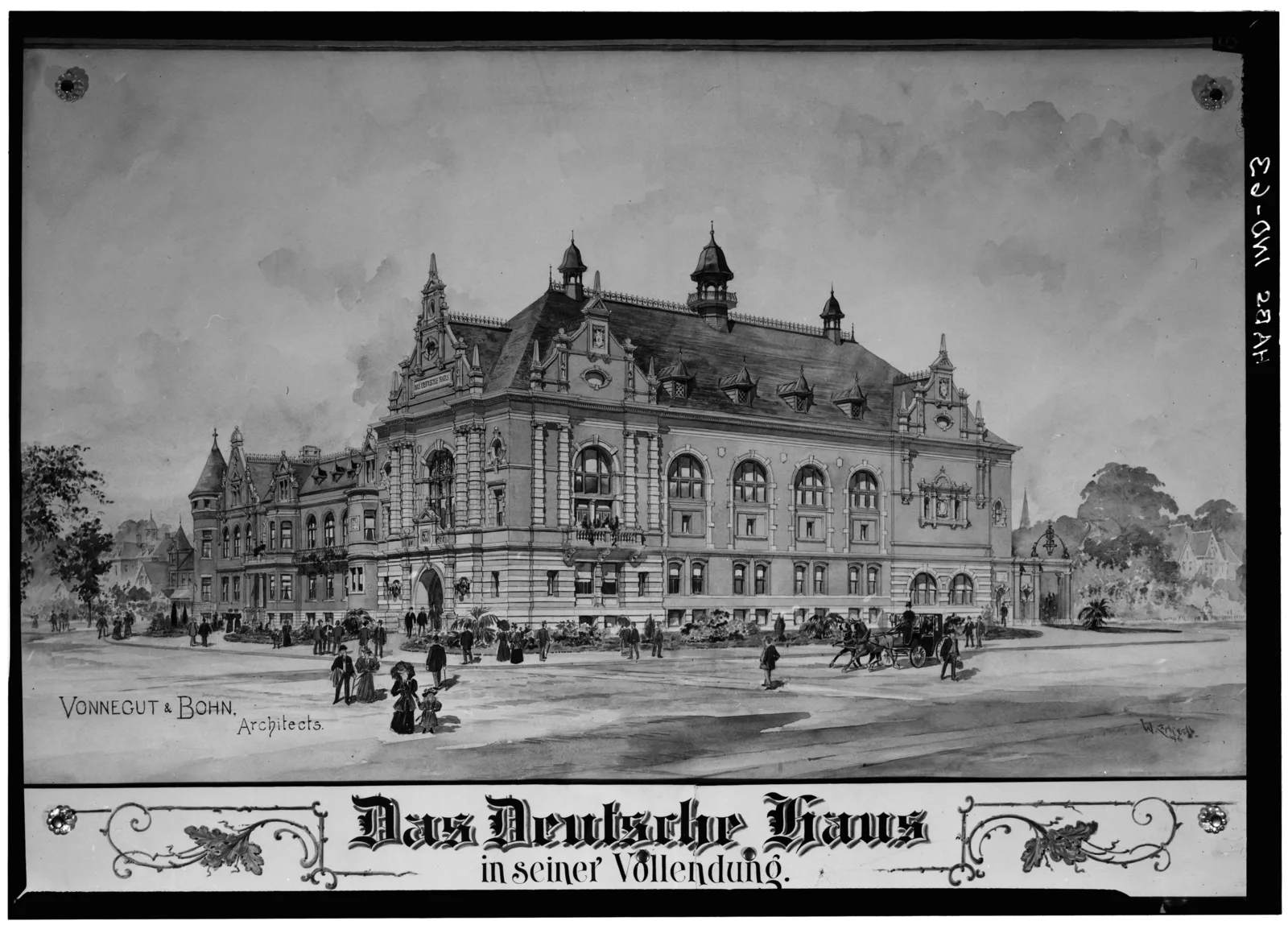
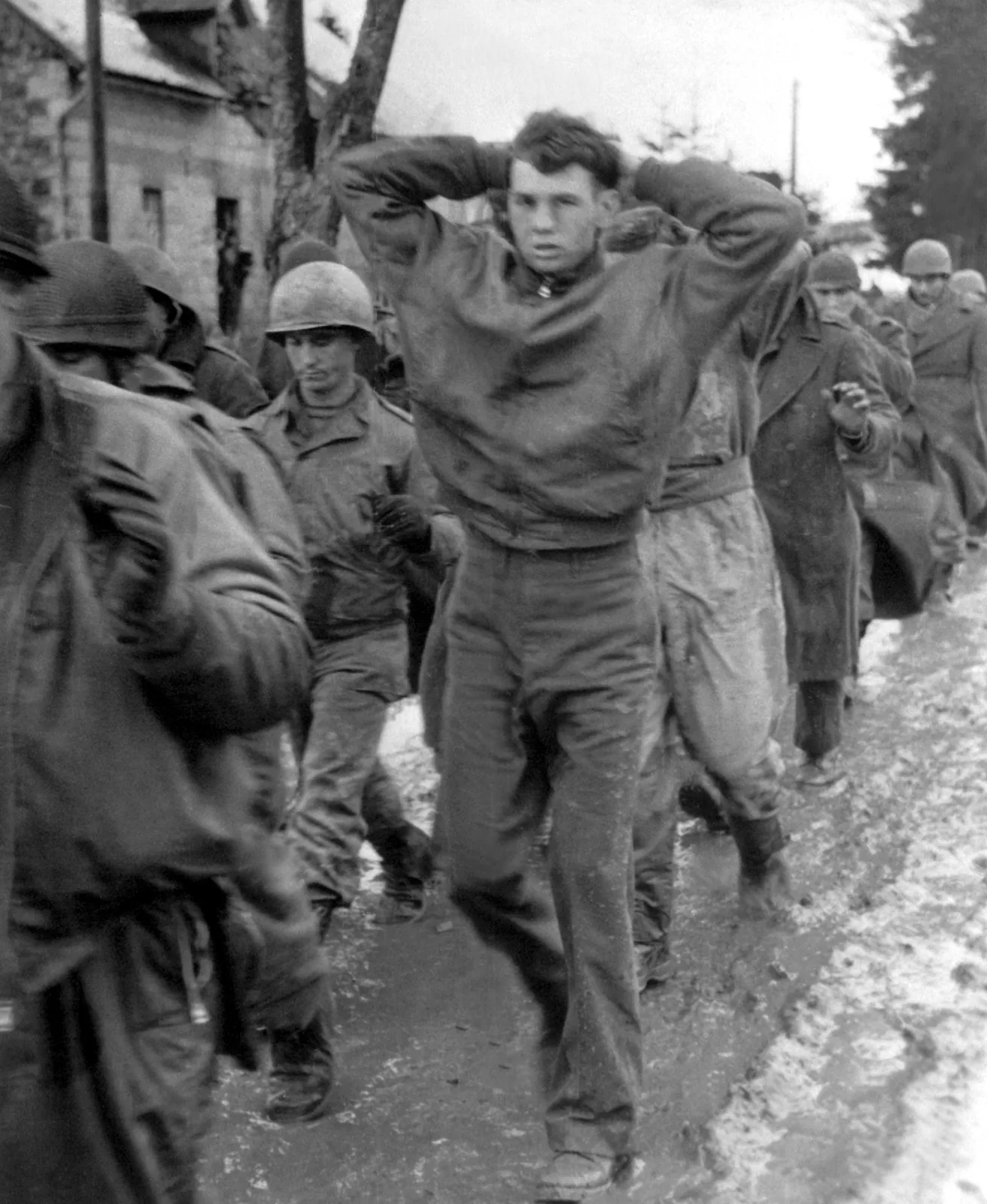
- American prisoners marching on a road on the western front, captured in the German drive, December 1944 — Unknown (US Army; NARA 111-SC-198240; DoD HD-SN-99-02730), 1944-12 · US Army, National Archives (111-SC-198240), via Wikimedia Commons / Defense Imagery · Public domain (Commons licence field: 'Public domain'; US Army / Department of Defense image HD-SN-99-02730)
- Dresden Neumarkt: ruin of the Frauenkirche, destroyed by air raid in February 1945 — Jörg Blobelt, 1968-05-31 · Jörg Blobelt, CC BY-SA 4.0, via Wikimedia Commons · CC BY-SA 4.0
Sources
Tier 1 — the subject's own words (and his family's)
- [Tribüne-20] "Vonnegut-Gedächtnißfeier," Indiana Tribüne (Indianapolis), 20 Dec. 1906, p. 4, col. 3: the full text of Clemens Vonnegut's two self-written funeral statements (16 Nov. 1873; 3 May 1874) and the eulogy. Library of Congress, Chronicling America, LCCN sn83045241, ed. 1, seq. 4 (public domain, published 1906). OCR in
research/texts/tribune-1906-12-20-p4.txt; page image checked by eye. - [Tribüne-13] "Clemens Vonnegut Sr. — Eine segensreiche Laufbahn beschlossen," Indiana Tribüne, 13 Dec. 1906, p. 1 (obituary), plus death notices on p. 8 of 13 and 14 Dec. 1906. LCCN sn83045241.
tribune-1906-12-13-p1.txt,-p8.txt,tribune-1906-12-14-p8.txt. - [Times 1927] "Vonnegut Firm's Diamond Jubilee Here Week," Indianapolis Times, 20 May 1927, p. 2, LCCN sn82015313 (public domain, published 1927; the text was read from the loc.gov full-text service and is not saved in
texts/). - [Tribüne-20p1] Indiana Tribüne, 20 Dec. 1906, p. 1, "Nachlaßenschafts-Gericht": his will and codicils (seq. 1).
tribune-1906-12-20-p1.txt. - [Echo] Shortridge Daily Echo, Indianapolis, 1937–1940, as collected in "High School Journalist, Promoter, Jester: Kurt Vonnegut in the Shortridge Daily Echo, 1937–1940" (Digital Indy, the Kurt Vonnegut Museum & Library; ed. M. André Z. Eckenrode, Christina Jarvis, Daniel Crocker). IA
kurtvonnegutshortridgeecho; the item's own notice licenses it CC BY 3.0.texts/shortridge-echo.txt. Searched for religion, God, Bible, church: nothing relevant (the masthead and jokes only). - [S5] Kurt Vonnegut, Slaughterhouse-Five, or The Children's Crusade (1969; in copyright). Read in an amateur e-text of the Panther 1972 UK reprint, IA
slaughterhousefiveorthechildrenscrusade_202003,texts/slaughterhouse-five.txt. The e-text has no page numbers; it is cited by chapter ("ch. 1") or by passage. Its provenance is unclear: check wording against a printed copy before any quotation (none is used). - [Schramm] The Schramm Letters: Written by Jacob Schramm and members of his family from Indiana to Germany in the year 1836, translated and edited by Emma S. Vonnegut (Indianapolis: Indiana Historical Society, 1935). IA
schrammletters114schr;texts/schramm-letters.txt. Copyright status uncertain (1935; renewal unchecked): paraphrase only. Pages are inferred from the running head "SCHRAMM LETTERS N" and may be off by one. - The novelist's other books and interviews are in copyright, and the borrowed copies on the Internet Archive could not be opened (see notes/second-pass-hits.md for the identifiers): Palm Sunday (1981), A Man Without a Country (2005), Fates Worse Than Death (1991), Wampeters, Foma & Granfalloons (1974; the Playboy interview, July 1973), Timequake (1997), Letters (2012). Their wording reaches this sheet only through [Chronicles] and [Wakefield], as quotation inside those texts.
Tier 2 — scholarly or official reference
- [Chronicles] Peter J. Reed and Marc Leeds, eds., The Vonnegut Chronicles: Interviews and Essays (Westport, CT: Greenwood Press, 1996; Contributions to the Study of World Literature no. 65). IA
vonnegut_202312;texts/vonnegut-chronicles.txt(an open full-text file). Contains the Chronology (pp. xxii–xxiii), three interviews (1982 Reed; 8 Aug. 1989 Ábádi-Nagy; 31 Oct. 1993) and essays by Reed ("The Responsive Shaman", pp. 47–57), Klinkowitz ("Kurt Vonnegut: Public Spokesman", pp. 59–71), Merrill ("Kurt Vonnegut as a German American", pp. 73–83) and Freese ("Vonnegut's Invented Religions as Sense-Making Systems", pp. 145–). Page numbers are inferred from the running heads in the OCR. - [Dunn I] Jacob Piatt Dunn, Greater Indianapolis (Chicago: Lewis, 1910), vol. 1. IA
greaterindianapo01dunn.texts/dunn1.txt. - [Dunn II] same, vol. 2. IA
greaterindianapo02dunn.texts/dunn2.txt. - [Tustin] Joseph P. Tustin, Why Dresden Was Bombed: A Review of the Reasons and Reactions, USAFE Historical Division, 11 Dec. 1954 (US government work; IA marks it PDM). IA
WhyDresdenWasBombed.texts/tustin-dresden.txt. - [DTIC 106th] The Cadre Division Concept: The 106th Infantry Division Revisited, DTIC ADA251307 (1992, US government). IA
DTIC_ADA251307.texts/dtic-106th.txt. - [Pico] Board of Education, Island Trees Union Free School District No. 26 v. Pico, 457 U.S. 853 (1982) (a US court opinion: public domain), as reproduced by Cornell Legal Information Institute,
texts/pico-1982.txt. The LII text has no U.S. Reports page numbers. - [AHA] American Humanist Association, "Annual Humanist Awards" page (americanhumanist.org/awardees/),
texts/aha-awardees.txt: Humanist of the Year 1992: Kurt Vonnegut.
Tier 3 — popular biographies and journalism
- [Wakefield] Dan Wakefield, "Kurt Vonnegut, Christ-Loving Atheist," Image no. 82 (2014), pp. 67–75 (the journal's web copy, imagejournal.org/article/kurt-vonnegut/;
texts/wakefield-image.txt; the web copy has no page numbers and is cited by passage). Wakefield, a friend and a Christian, assembled Vonnegut's Letters (2012) and quotes from them, from Timequake and from speeches. In copyright; read and paraphrased, not quoted in the Quotations table. - [NYT-2007] Dinitia Smith, "Kurt Vonnegut, Counterculture's Novelist, Dies," New York Times, 13 Apr. 2007 (archive.nytimes.com copy),
texts/nyt-obit-2007.txt. - [Shields] Charles J. Shields, And So It Goes: Kurt Vonnegut, a Life (2011) and [Sumner] Gregory D. Sumner, Unstuck in Time (2011): both are borrowable-only on the Internet Archive; not read.
- [Standish] David Standish, "Playboy Interview: Kurt Vonnegut," Playboy, July 1973: not reachable (playboy.com archive URL returns 404); read through Freese's quotation of the book reprint, Wampeters, p. 240.
Tier 4 — maps to other sources only (never cited in the script)
- Wikipedia, "Kurt Vonnegut" (map: its religion section cites Palm Sunday, Leeds 1995 The Vonnegut Encyclopedia p. 480, Marvin 2002 pp. 4, 10, Wakefield 2014 and the 22 Dec. 1944 capture); Wikiquote, "Kurt Vonnegut" (map: gives A Man Without a Country pp. 80–81 and the 1999 NPR collection God Bless You, Dr. Kevorkian for the humanist-and-Jesus passage and the Asimov joke),
notes/wikiquote-clean.txt. - Open Library record: Clemens Vonnegut, Versuch eines Leitfadens zum Unterricht in der Sittenlehre im freidenkerischen Sinne für Erwachsene von einem Dilettanten (reprint 1989, R. C. Vonnegut) and an English translation (1987); Klinkowitz in [Chronicles] calls the English title "An Instruction in Morals from the Standpoint of a Free Thinker".
Opposition sources
- [Dunn I] pp. 209–210 on the Know-Nothing agitation against German immigrants and for the Bible in the public schools; p. 215 on the Turnverein expulsion.
- [Pico] The Island Trees school board's 1976 press release, quoted in the Supreme Court's opinion, on the books it removed (including Slaughterhouse-Five).
- Dan Wakefield's own gibes at Vonnegut's humanism (Wakefield became a Christian again in 1985) are in the copyrighted essay: paraphrase only.
Related lives
Isaac Asimov (1920–1992), whom Vonnegut succeeded as honorary president of the American Humanist Association (his own account); or Mark Twain, whom Vonnegut said confirmed his skepticism of the divinity of Christ "in my formative years".
José Saramago
José Saramago never had a faith to lose, so his unbelief is the story of where he aimed it. He aimed it at a Church allied with the landlords (1980), and at the God of the Gospels after what he called "the lesson of doubt" (1991). When the Portuguese government kept his Gospel from a European prize in 1992, it became a public quarrel, and he left for Lanzarote. In 2001 he signed his own word, "atheism". In 2009, while attacking the God of the Bible in Caim, he admitted that "atheist" was only a word, that he was steeped in Christian values, and that there are no absolute atheists.
Barbara Smoker
Barbara Smoker was a convent child who wanted to be a Carmelite, and saw no halfway house between the Church and atheism. The war in Ceylon, a confessor's charge of intellectual pride and a reading programme meant to save her faith wore it down, until on 5 November 1949, at a library's philosophy shelves, she found she was no longer a theist of any kind. She never doubted again. She spent the rest of her life on the unbelief in public, at the head of the National Secular Society, at thousands of secular funerals and beside the 1989 march against Rushdie, insisting that atheists had not lost their faith but outgrown it.
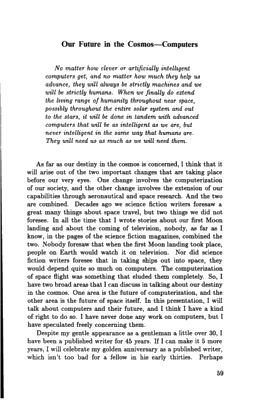
Isaac Asimov
Isaac Asimov was raised in Brooklyn by Orthodox parents who, by his memoirs' account, did not press their religion on him. He was an atheist for years before he would use the word, holding to "humanist" and "agnostic" as the honest labels. In 1982 he declared himself an atheist outright. In his last essay, with death close, he thanked atheism for taking away his fear of it.
Madalyn Murray O'Hair
Madalyn Murray O'Hair was baptised a Presbyterian. In her own later telling she dated her unbelief to a weekend reading of the Bible in grade school. She declared it in 1960 by petitioning Baltimore's schools with her son, and won the 1963 Supreme Court case against required Bible reading. She spent the rest of her life in confrontation as "the Atheist", never revising her unbelief but paying for it with flight, an estranged son and, in the end, a murder that had nothing to do with it.