Albert Camus was raised in a household that was Catholic only by custom, and never lost a faith he never held. The absence of God became his starting point in the essays of 1936 and The Myth of Sisyphus in 1942. From 1944 he turned that unbelief from opposition into alliance. He told the Dominicans in 1948 that he could not accept their truth but would not call it an illusion, and asked Christians to remain Christians and speak out against evil.
The belief timeline
- Faith (c. 1924 (year unverified)) — Catechism and first communion, done to the grandmother's rule; in the novel a "mystery without a name" in the church music, but "the divine persons... had nothing to do with it"; the family's religion was "social life and only that" (novel, via critic) [5][6]
- Doubt (1930–36) — Illness at 17 (1930), Grenier's class (1932), and a thesis that studies Christian metaphysics sympathetically while the essays of 1936 move away from it [9][10][11][12]
- Declaration (1936–42) — "Summer in Algiers" (1936; *Noces* 1938) calls hope of another life a sin against life; *The Myth of Sisyphus* (1942) puts "the absurd" at the centre and says "the absurd is sin without God" [12][13]
- Revision (1944–48) — April/July 1944: "not a heart given over to God", yet the world "has no ultimate meaning" but man does; 1947 *The Plague* gives the believer a serious portrait; 1948 he admits publicly that Mauriac "and not I" was right on the fundamentals of their quarrel and asks Christians to stay Christians and speak out [14][16][17][18]
Notes to the timeline (11)
- [5] The family's religion in the novel: religion "held no place in the family"; no one went to Mass, invoked or taught divine commandments, or alluded to rewards and punishments beyond death (p. 181); they were Catholic "as one is French", with exactly four rites (baptism, first communion, marriage if any, last rites), the rest of life being given to survival (p. 183); the mother never spoke of God and the hero never heard the word in childhood (p. 183); when told the father was dead the curé said she must pray, but prayer would not have occurred to her (p. 81); she wears a small gold medal of the Virgin (p. 273); the narrator calls the settlers "ignorant of God", under "the indifferent divinities of the sun, the sea or poverty" (p. 227) — An unsigned study of Le Premier Homme (1994, 330 pp.) on comptoirlitteraire.com ("Le premier homme" (1994), roman de 330 pages d'Albert Camus), saved as
research/texts/premier-homme-999.txt(IA999-camus-le-premier-homme). It quotes the novel and its Annexes with the Gallimard 1994 page numbers; used as a secondhand route to the childhood passages. The hero is Jacques Cormery, a fictionalised self, ] quoting Le Premier Homme (Gallimard 1994) pp. 81, 181–183, 227, 273. Reported at second hand; the original has not been seen. - [6] Catechism and first communion in the novel: the grandmother, remembering that communion needs catechism, obtains from the curé "accelerated religious instruction" from a severe priest who makes him learn questions and answers and slaps him (pp. 184–188); the church is "ugly and cold" (p. 188); the hero is "indifferent to the catechism" and takes refuge "a hundred leagues" from where he recites (p. 188); he is moved by the organ to "a warm, inward, indistinct mystery" that is "a mystery without a name" to which the "divine persons" defined by the catechism "had nothing to do" (p. 188); the confession is satirical, he cannot find sinful thoughts (p. 189); on the day the thunder of music "chilled him, filled him with dread and an extraordinary exaltation" in which he first felt his "strength, his infinite capacity for triumph and life" (pp. 189–190). The commentator reads it as Camus's own childhood — of, Le Premier Homme, ] quoting Le Premier Homme pp. 184–190.
- [9] Dec 1930: spitting of blood and tuberculosis; brief hospital stay; the end of football; lodges with his uncle and aunt Acault 1931–33; Acault anarchist, Voltairean, freemason, a butcher with a library. The commentator reads the novel's passage on the hero's grave illness (p. 52) as this episode — English Wikipedia "Albert Camus" (
research/notes/wikipedia-map.txt) and French Wikipedia "Albert Camus" (raw wikitext fetched 2026-10-14; not saved). The French article cites Todd (1996) p. 16, Grenier (1982) p. 9 and 17, and the Camus–Grenier Correspondance (1981), letter 106 of 20 Feb 1946, p. 117. Never cited in the script, ] fr (citing Todd 1996, Camus–Grenier Correspondance 1981, letter 106, p. 117); of, Le Premier Homme. - [10] Grenier taught him philosophy (the critic says 1932; Camus himself, quoted in fr.wikipedia, says at 17), awakened doubt, unease, a sense of mystery and the sacred, gravely sceptical irony, and became a lifelong friend (correspondence 1932–1960); Camus dedicated *L'Envers et l'Endroit* and *L'Homme révolté* to him (the critic also lists "La Mort dans l'âme", apparently an error, and it is left out) — of, Le Premier Homme, ]; Wikipedia, Correspondance, ] fr.
- [11] His graduate thesis at the University of Algiers sympathetically explored the relationship of Greek philosophy and Christianity, specifically Plotinus and Augustine; title "Christian Metaphysics and Neoplatonism", year 1936; the Stanford entry adds that his philosophy nonetheless explicitly rejects religion as a foundation — Ronald Aronson, "Albert Camus," Stanford Encyclopedia of Philosophy (2011; rev. 2021), ] sections 1–2 (citing Camus 1992); year from [WP] fr (diploma, 1936).
- [12] "Summer in Algiers" (printed in the 1955 Knopf *Myth of Sisyphus* with the date 1936; the Algiers book *Noces* followed in 1938): he finds no meaning in "the happiness of angels", asks what eternity is "except what will continue after my death", says the sin against life may lie less in despairing of life than "in hoping for another life", and that the Greeks drew hope last out of Pandora's box as the most dreadful of ills, because "hope equals resignation". Stanford adds that in *Noces* he opposes religion-based fears (pride, concern for an immortal soul, hope of an afterlife) to the plain fact of death, and traces the rejection of hope to Nietzsche (N 74, 76, 90, 103) — Camus, The Myth of Sisyphus and Other Essays, trans. Justin O'Brien (New York: Knopf, 1955; Vintage International reprint 1991). Internet Archive
CamusMythOfSisyphusAndOtherReadings(complete, including "Summer in Algiers", the Minotaur, "Helen's Exile", "Return to Tipasa"), plusAlbertCamusTheMythOfSisyphusandalbert-camus-the-myth-of-sisyphus-vintage-2018, ] "Summer in Algiers" (no printed page in the OCR); Aronson, Stanford Encyclopedia of Philosophy, ] section 2. - [13] *The Myth of Sisyphus* (1942) takes "the absurd" as a starting point rather than a conclusion and says the only serious philosophical problem is suicide (p. 3 of the O'Brien text). It says existential thinkers (Chestov, Kierkegaard, Jaspers) "deify what crushes them" and that "forced hope is religious" (MS 24 in Stanford's edition); the "leap" is "philosophical suicide"; the absurd is "sin without God" and "does not lead to God"; the one moral code the absurd man could accept is "the one that is not separated from God", but "he lives outside that God"; the "certainty of a God giving a meaning to life" would be more attractive than the freedom to behave badly, "but there is no choice, and that is where the bitterness comes in". The 1955 Preface says: "even if one does not believe in God, suicide is not legitimate", that the book is "an invitation to live and to create", and that "after fifteen years I have progressed beyond several of the positions which are set down here" — Camus, Myth of Sisyphus and Other Essays, ] Preface (March 1955); "Absurdity and Suicide"; "Philosophical Suicide"; "The Absurd Man"; Aronson, Stanford Encyclopedia of Philosophy, ] MS 24.
- [14] *Letters to a German Friend* (letters dated July 1943, Dec 1943, April 1944, July 1944): Third Letter says he will not use "the Christian tradition" against the German, that it is one tradition among those that made Europe, and that defending it "would require the instinct and inclination of a heart given over to God. You know this is not the case with me" (p. 17); Fourth Letter: "I continue to believe that this world has no ultimate meaning", but man has, "because he is the only creature to insist on having one" (p. 21); "Even now I expect nothing from heaven" (p. 24) — Camus, Resistance, Rebellion, and Death, trans. Justin O'Brien (London: Hamish Hamilton; the Knopf edition is 1961; the OCR shows no year). Internet Archive
dli.ernet.449375(Digital Library of India scan; the catalogue date "1948" is wrong), ] pp. 17, 21, 24. - [16] In December 1948 Camus said that "three years ago" a controversy made him argue against one of the Dominicans' circle, that "despite some excessive expressions on the part of Francis Mauriac" he had "not ceased meditating on what he said", and that "regarding the fundamentals and on the precise point of our controversy, François Mauriac, and not I, was right"; the controversy (the Combat–Figaro exchange on justice and charity after the Liberation) is not named in the text — Camus, Resistance, ] pp. 49–50; the identification with 1944–45 Combat from memory and not found in a text read. Not verified.
- [17] *La Peste* (1947): Father Paneloux is "un jésuite érudit et militant" (Part I) whose work on Saint Augustine and the African Church earned him a place apart in his order (Part II); he preaches a first sermon at a week of prayer ending in a Mass to Saint Roch (Part II); after the death of a child (Part IV) Rieux tells him he will refuse "until death" to love a creation in which children are tortured, Paneloux answers that he has just understood what grace is; Paneloux then preaches that one must "believe everything or deny everything" (Part IV), joins the sanitary teams (SEP), and dies with a chart marked "doubtful case" (Part IV); Tarrou, told "you do not believe in God", answers "Precisely. Can one be a saint without God, that is the one concrete problem I know today" (Part IV). Dr Rieux's care of the sick is revolt against an absurd world (Nobel) — Camus, La Peste (Paris: Gallimard, NRF, 1947; 332 pp., imp. 1955), French text as digitised by "Les classiques des sciences sociales" (UQAC). Internet Archive
camus-albert-la-peste_202405(alsolapestealbertcamus,albert-camus-la-peste-1947-fr), ] Parts II and IV (French, 1947); Aronson, Stanford Encyclopedia of Philosophy; "Albert Camus – Biographical," Nobel Lectures, Literature 1901–1967 (Elsevier, 1969).research/texts/nobel-bio.txt. - [18] "The Unbeliever and Christians", "fragments of a talk given at the Dominican Monastery of Latour-Maubourg in 1948" (month unverified): he sets out three principles (no "lay pharisaism"; he does not hold an absolute truth and will not assume Christian truth is illusory, only that he "could not accept it"; no reconciliation by blurring differences: the world needs "Christians who remain Christians"); concedes Mauriac was right (pp. 49–50); "I share with you the same revulsion from evil. But I do not share your hope and I continue to struggle against this universe in which children suffer and die" (p. 50); "I, an unbeliever? Precisely" in explaining why he waited for a great voice from Rome during the war (p. 50); asks Christians to condemn evil "loud and clear" (pp. 50–51) and names a Spanish bishop blessing executions (p. 51); denies that he is a pessimist ("pessimistic as to human destiny, I am optimistic as to man", "in the name of an ignorance that tries to negate nothing", pp. 51–52); quotes Augustine's "I tried to find the source of evil and I got nowhere" (p. 52); closes by asking whether Christians will leave Socrates alone and says that if Christians were to join the appeal this "sometimes creates a deep longing in me" (p. 52) — Camus, Resistance, ] pp. 49–53.
An Ignorance That Negates Nothing
In 1948 the Dominican friars of the priory of Latour-Maubourg in Paris invited a guest to speak to them about what unbelievers expected of Christians. He was Albert Camus, a novelist known for The Stranger and The Plague and a philosopher of what he called the absurd. He told them he would not pretend to a truth he did not have, nor claim that theirs was an illusion; he could only say that he could not accept it. He shared their revulsion from evil, he said, but not their hope, and he would go on struggling against a world in which children suffer and die. What he asked of them was that they stay Christians, and speak out.1
This chapter asks how a boy from a poor quarter of Algiers came to unbelief without ever, as far as the sources show, losing a faith, and how he became the unbeliever who argued with Christians as equals.
Catholic as one is French
He was born on 7 November 1913 at Mondovi in French Algeria. His father was killed in the First World War the next year, and he grew up in a crowded flat in the working-class quarter of Belcourt in Algiers, with his nearly deaf mother, his grandmother and his uncles.23 His primary-school teacher, Louis Germain, coached him for the scholarship that took him to the lycée.4
Camus told this childhood in the novel he was writing when he died, The First Man, through a hero called Jacques Cormery. In that book religion had no place in the family. No one went to Mass, spoke of God's commandments, or mentioned rewards and punishments after death. They were Catholic, he wrote, the way one is French, and kept exactly four rites: baptism, first communion, marriage and the last rites. The rest of life was taken up with surviving. The mother never spoke of God, and the boy never heard the word at home.5 It was the grandmother who remembered that a boy must make his first communion, and she arranged hurried lessons in the catechism from a stern priest who slapped him. The boy was bored by the questions and answers, but the organ music moved him to a nameless mystery that, the novel says, had nothing to do with the divine persons of the catechism.6 At the lycée he passed as a non-practising Catholic.7 On the belief timeline, his faith stands for that custom, which was never, on this evidence, belief.
A sin against life
At seventeen, in December 1930, he began to cough blood and was found to have tuberculosis; he went to live with an uncle, a butcher with a library, whom the biographers describe as an anarchist and a freemason.8 At the lycée his philosophy teacher, Jean Grenier, became a lifelong friend and, by one critic's account, woke in him both doubt and a sense of the sacred.9 At the University of Algiers he wrote his thesis on the meeting of Greek philosophy and Christianity in Plotinus and Augustine, a sympathetic study of a faith he did not hold.10
In an essay of 1936, "Summer in Algiers," he wrote that if there is a sin against life it lies less in despairing of life than in hoping for another one, and that hope, which the Greeks had left last in Pandora's box as the worst of evils, amounts to resignation.11 The Myth of Sisyphus (1942) began from the absurd, the clash between the human need for meaning and a silent world. The absurd man, he wrote, lives outside God; a God who gave life meaning would be more attractive, but there is no such choice, and that is the bitterness of it.12 On the timeline, his doubt and declaration both fall in these years, from 1930 to 1942; no source gives a moment of loss, only an absence becoming a position.
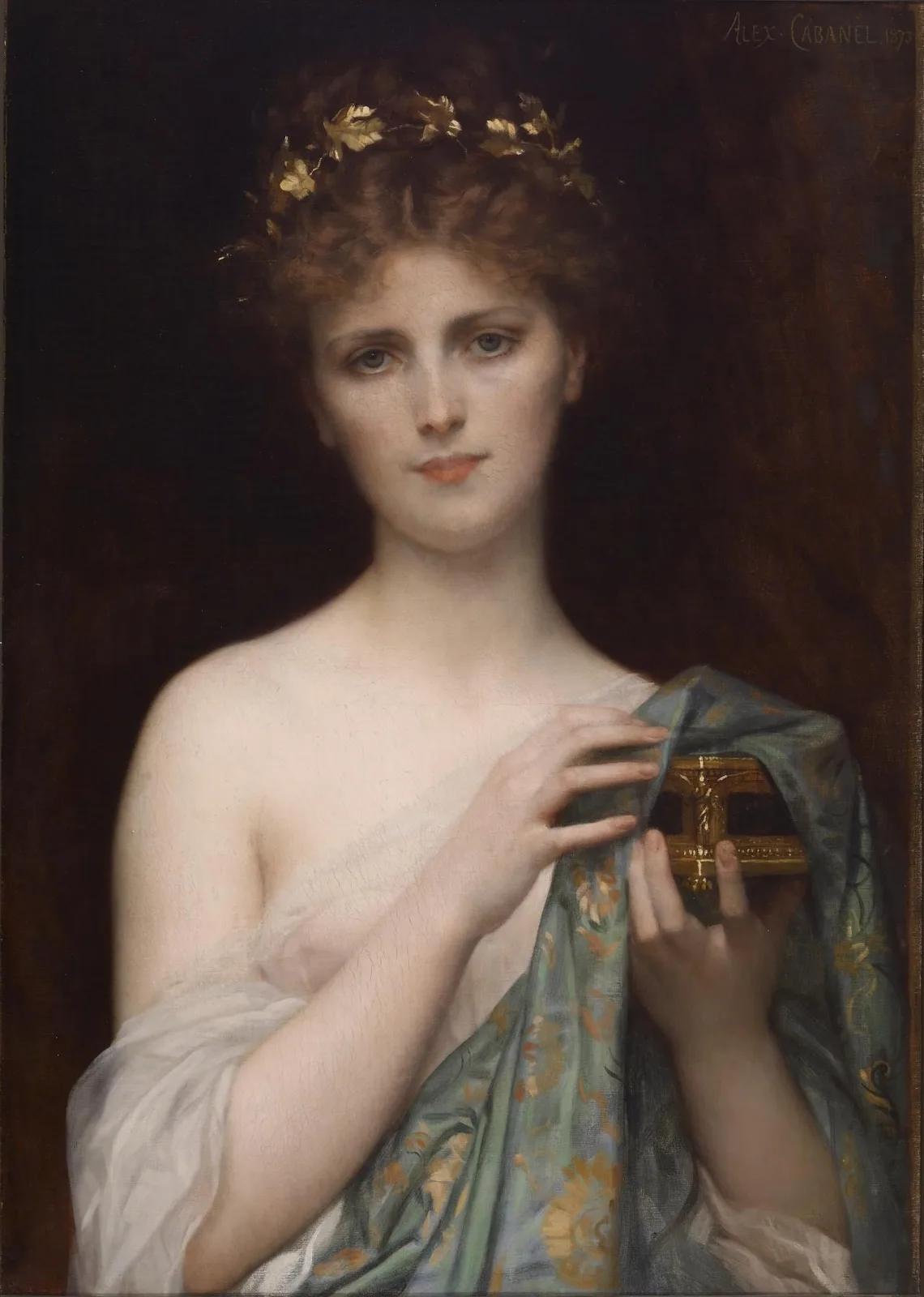
A heart not given over to God
In the Letters to a German Friend, written under the Occupation, he told an imagined German that he would not defend Europe in the name of the Christian tradition, because that would need a heart given over to God, and that was not his. In July 1944 he wrote that he still believed the world had no ultimate meaning, but that man did, because man alone insists on having one; he expected nothing from heaven.13 A year earlier he had written to the poet Francis Ponge that, though Catholic philosophy was not his and he could argue against it, he attributed no contemptible motives to it.14
In The Plague (1947) the believer is a learned Jesuit, Father Paneloux, a student of Augustine. After a child's slow death the unbelieving doctor, Rieux, tells him he will refuse to the death to love a creation in which children are tortured. Paneloux preaches that one must believe everything or deny everything, works beside the doctors, and dies. His friend Tarrou asks whether one can be a saint without God.15 The believer is given a serious portrait.
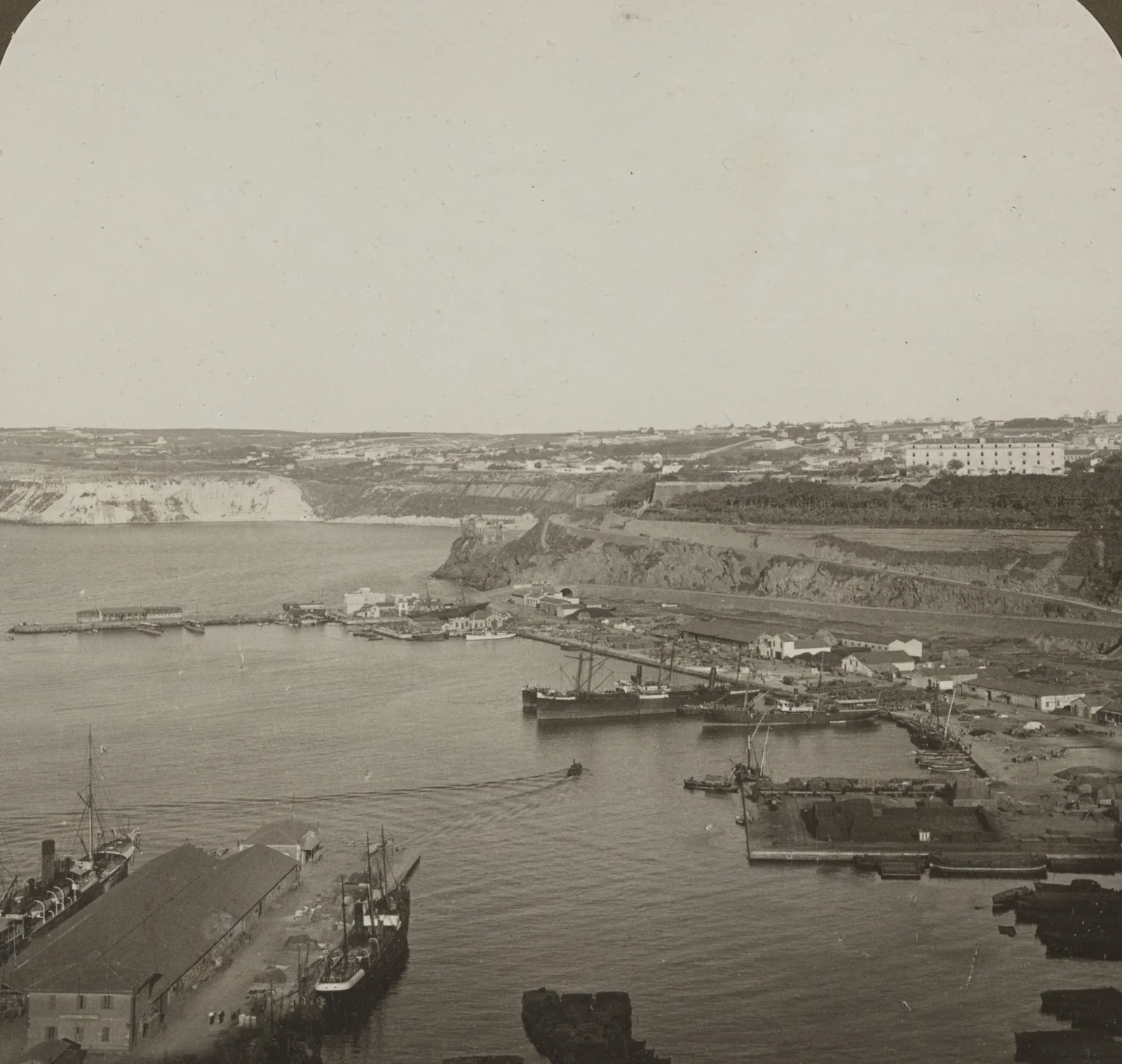
The unbeliever and the Christians
At Latour-Maubourg he went further. A few years earlier he had quarrelled in print with the Catholic novelist François Mauriac; now he told the friars that on the point of that quarrel Mauriac, not he, had been right.16 When they asked why he, an unbeliever, had waited during the war for a great voice from Rome to condemn the crimes, he said that was precisely why: he had needed Christians to speak. He denied that he was a pessimist. He was pessimistic about human destiny, he said, but optimistic about human beings, in the name of an ignorance that tries to negate nothing.1 He even confessed that the thought of Christians joining in the protest against evil sometimes stirred a deep longing in him.1 On the timeline, his revision stands for this, from 1944 to 1948, and it was not a return to faith but a turn from opposition to alliance.
In December 1948 he answered the Catholic philosopher Gabriel Marcel, who had attacked his play State of Siege; Camus wrote that he had done justice to his Christian friends of the Occupation in his novel, but would not keep silent about the Spanish Church's part in Franco's repression.17 His break with his friend Jean-Paul Sartre, over The Rebel, followed in 1951 and 1952.18
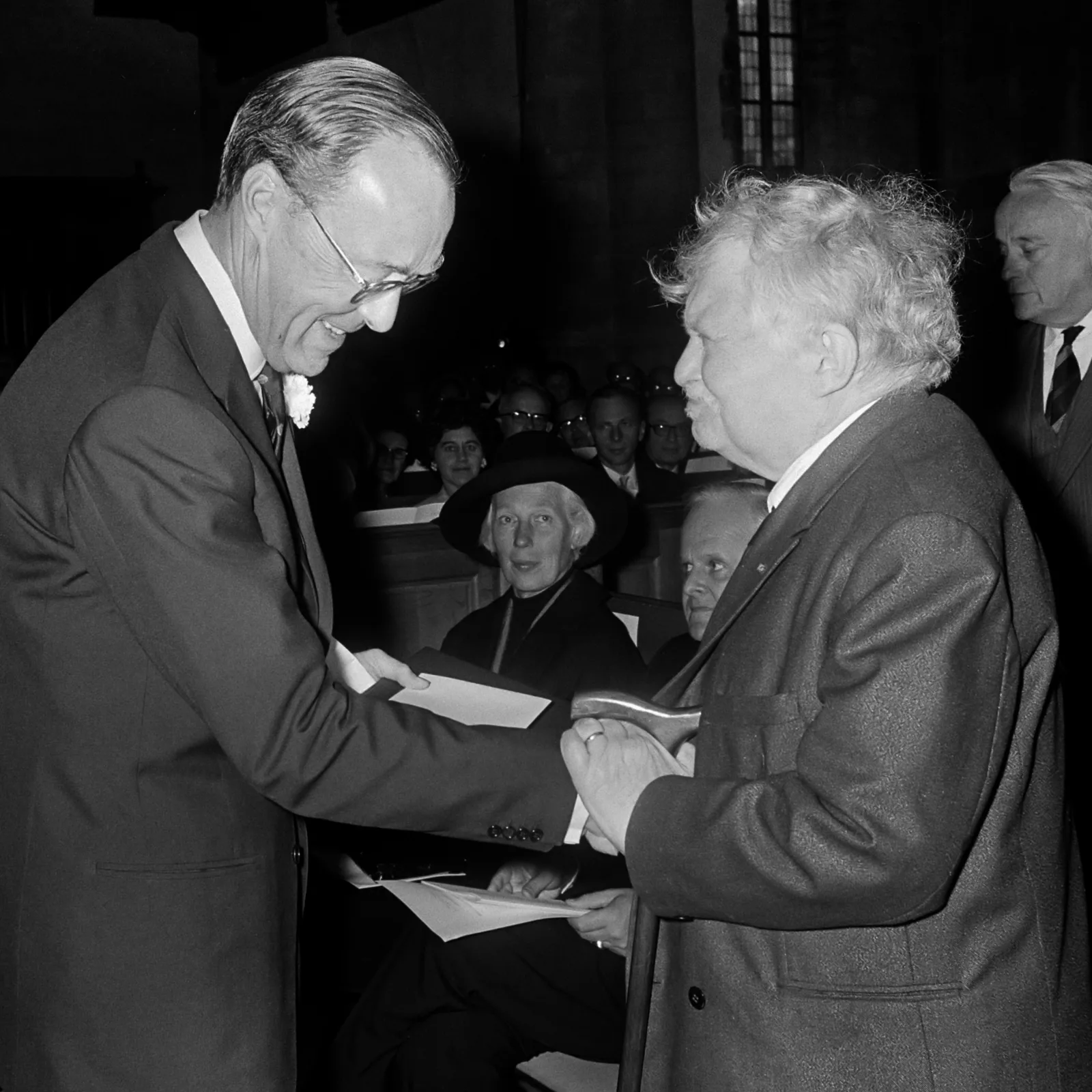
Not militant
He won the Nobel Prize in Literature in 1957.19 In his essay against the guillotine he wrote as "the unbeliever," arguing that Christians whose faith centres on the victim of a judicial error ought at least to hesitate before legal killing, and that a judge who no longer believed in God had no right to a definitive punishment.20 A modern scholar has written that, unlike the new atheists, Camus was never sure enough to declare that God does not exist and was never militantly against belief.21 The word "atheist" is the one others used for him; his own was "unbeliever."22 He died in a car accident at Villeblevin on 4 January 1960, at forty-six.2
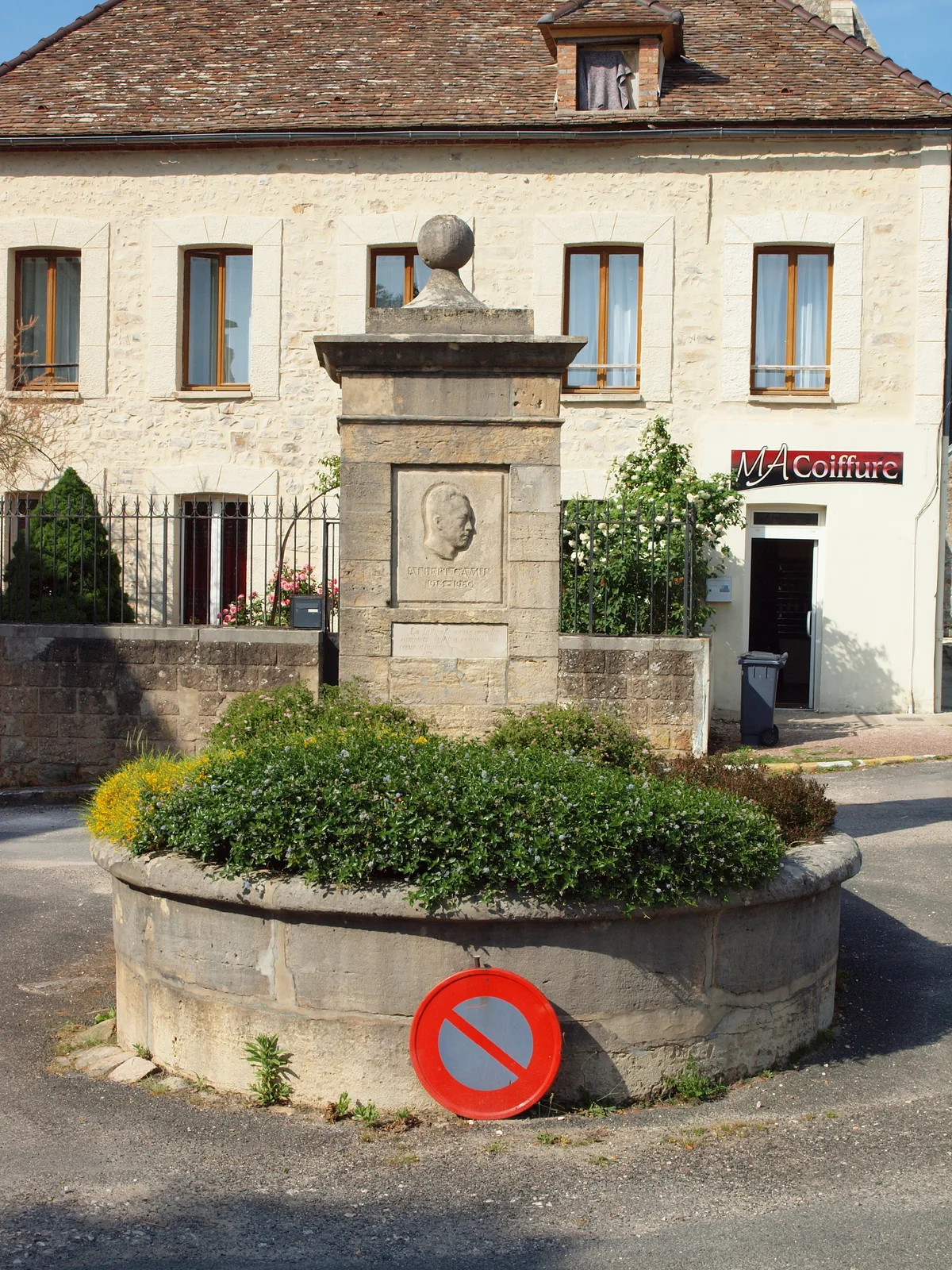
Jean-Paul Sartre, his friend and then his opponent, who made atheism the premise of his philosophy, has his own chapter in this book.
Footnotes
-
Camus, Resistance, Rebellion, and Death, trans. Justin O'Brien (London: Hamish Hamilton; the Knopf edition is 1961; the OCR shows no year). Internet Archive
dli.ernet.449375(Digital Library of India scan; the catalogue date "1948" is wrong), ] pp. 49–53. Not verified. ↩ ↩2 ↩3 -
"Albert Camus – Biographical," Nobel Lectures, Literature 1901–1967 (Elsevier, 1969).
research/texts/nobel-bio.txt, ] (1913–1960; death 4 Jan 1960); Ronald Aronson, "Albert Camus," Stanford Encyclopedia of Philosophy (2011; rev. 2021), ] intro (46); place and birth day: [WP] (fr and en). ↩ ↩2 -
Nobel Lectures; the family details from [WP] fr (citing Grenier 1982 p. 17 and Todd 1996 p. 16, unread). ↩
-
An unsigned study of Le Premier Homme (1994, 330 pp.) on comptoirlitteraire.com ("Le premier homme" (1994), roman de 330 pages d'Albert Camus), saved as
research/texts/premier-homme-999.txt(IA999-camus-le-premier-homme). It quotes the novel and its Annexes with the Gallimard 1994 page numbers; used as a secondhand route to the childhood passages. The hero is Jacques Cormery, a fictionalised self, ] (quoting the novel, Gallimard 1994, pp. 164, 186, 190, 371–377); English Wikipedia "Albert Camus" (research/notes/wikipedia-map.txt) and French Wikipedia "Albert Camus" (raw wikitext fetched 2026-10-14; not saved). The French article cites Todd (1996) p. 16, Grenier (1982) p. 9 and 17, and the Camus–Grenier Correspondance (1981), letter 106 of 20 Feb 1946, p. 117. Never cited in the script, ] fr. Reported at second hand; the original has not been seen. ↩ -
of, Le Premier Homme, ] quoting Le Premier Homme (Gallimard 1994) pp. 81, 181–183, 227, 273. ↩
-
of, Le Premier Homme, ] quoting Le Premier Homme pp. 184–190. ↩
-
of, Le Premier Homme, ] quoting Le Premier Homme pp. 223, 226, 228. ↩
-
Wikipedia, Correspondance, ] fr (citing Todd 1996, Camus–Grenier Correspondance 1981, letter 106, p. 117); of, Le Premier Homme. ↩
-
of, Le Premier Homme, ]; Wikipedia, Correspondance, ] fr. ↩
-
Aronson, Stanford Encyclopedia of Philosophy, ] sections 1–2 (citing Camus 1992); year from [WP] fr (diploma, 1936). ↩
-
Camus, The Myth of Sisyphus and Other Essays, trans. Justin O'Brien (New York: Knopf, 1955; Vintage International reprint 1991). Internet Archive
CamusMythOfSisyphusAndOtherReadings(complete, including "Summer in Algiers", the Minotaur, "Helen's Exile", "Return to Tipasa"), plusAlbertCamusTheMythOfSisyphusandalbert-camus-the-myth-of-sisyphus-vintage-2018, ] "Summer in Algiers" (no printed page in the OCR); Aronson, Stanford Encyclopedia of Philosophy, ] section 2. ↩ -
Camus, Myth of Sisyphus and Other Essays, ] Preface (March 1955); "Absurdity and Suicide"; "Philosophical Suicide"; "The Absurd Man"; Aronson, Stanford Encyclopedia of Philosophy, ] MS 24. ↩
-
Camus, Resistance, ] pp. 17, 21, 24. ↩
-
Juliette Rabat, "Albert Camus, le penseur athée qui parlait aux chrétiens," La Vie, 7 Nov 2013 (paywalled after the first paragraphs).
research/texts/lavie-2013.txt. Quotes Camus's 21 Aug 1943 letter to Francis Ponge, ] (quoting the letter; original unread). ↩ -
Camus, La Peste (Paris: Gallimard, NRF, 1947; 332 pp., imp. 1955), French text as digitised by "Les classiques des sciences sociales" (UQAC). Internet Archive
camus-albert-la-peste_202405(alsolapestealbertcamus,albert-camus-la-peste-1947-fr), ] Parts II and IV (French, 1947); Aronson, Stanford Encyclopedia of Philosophy; Nobel Lectures. ↩ -
Camus, Resistance, ] pp. 49–50; the identification with 1944–45 Combat from memory and not found in a text read. ↩
-
Camus, Resistance, ] pp. 51, 55–61 ("Combat, December 1948" is printed at the end of the essay itself, about p. 61). ↩
-
Aronson, Stanford Encyclopedia of Philosophy, ] sections 4–5; the break date from [WP. ↩
-
Nobel Lectures. ↩
-
Camus, Resistance, ] pp. 159–160; year of the essay from the book's Nobel-era grouping, unchecked. ↩
-
Aronson, Stanford Encyclopedia of Philosophy, ] final and second sections. ↩
-
Rabat, La Vie, ] first paragraphs (rest paywalled). ↩
dli.ernet.449375 (Digital Library of India scan; the catalogue date "1948" is wrong); "Albert Camus – Biographical," Nobel Lectures, Literature 1901–1967 (Elsevier, 1969). research/texts/nobel-bio.txt.; Ronald Aronson, "Albert Camus," Stanford Encyclopedia of Philosophy (2011; rev. 2021).; An unsigned study of Le Premier Homme (1994, 330 pp.) on comptoirlitteraire.com ("Le premier homme" (1994), roman de 330 pages d'Albert Camus), saved as research/texts/premier-homme-999.txt (IA 999-camus-le-premier-homme). It quotes the novel and its Annexes with the Gallimard 1994 page numbers; used as a secondhand route to the childhood passages. The hero is Jacques Cormery, a fictionalised self.; English Wikipedia "Albert Camus" (research/notes/wikipedia-map.txt) and French Wikipedia "Albert Camus" (raw wikitext fetched 2026-10-14; not saved). The French article cites Todd (1996) p. 16, Grenier (1982) p. 9 and 17, and the Camus–Grenier Correspondance (1981), letter 106 of 20 Feb 1946, p. 117. Never cited in the script.; Camus, The Myth of Sisyphus and Other Essays, trans. Justin O'Brien (New York: Knopf, 1955; Vintage International reprint 1991). Internet Archive CamusMythOfSisyphusAndOtherReadings (complete, including "Summer in Algiers", the Minotaur, "Helen's Exile", "Return to Tipasa"), plus AlbertCamusTheMythOfSisyphus and albert-camus-the-myth-of-sisyphus-vintage-2018.; Juliette Rabat, "Albert Camus, le penseur athée qui parlait aux chrétiens," La Vie, 7 Nov 2013 (paywalled after the first paragraphs). research/texts/lavie-2013.txt. Quotes Camus's 21 Aug 1943 letter to Francis Ponge.; Camus, La Peste (Paris: Gallimard, NRF, 1947; 332 pp., imp. 1955), French text as digitised by "Les classiques des sciences sociales" (UQAC). Internet Archive camus-albert-la-peste_202405 (also lapestealbertcamus, albert-camus-la-peste-1947-fr)In their own words
(paraphrase only) the one really serious philosophical problem is suicide
(paraphrase only) it is not hope but resignation: the Greeks took hope from Pandora's box last and called it the worst of evils
(paraphrase only) he finds no meaning in the happiness of angels and calls eternity only what continues after his death
(paraphrase only) the absurd is sin without God
(paraphrase only) with Christians he shares the revulsion at evil but not the hope, and goes on struggling against a universe where children suffer and die
(paraphrase only) "We refuse to despair of mankind. Without having the unreasonable ambition to save men, we still want to serve them"
(paraphrase only) "I do not believe in God and I am not an atheist"
(paraphrase only) he admits publicly that on the fundamentals of their controversy Mauriac, and not he, was right
(paraphrase only) defending the Christian tradition would take a heart given over to God, "you know this is not the case with me"
The other side
(paraphrase only) Paneloux first preaches the plague as punishment for sin, then, after a child's long death, that one must believe everything or deny everything, and he joins the sanitary squads; to Rieux he concedes he has just understood what grace is
(paraphrase only) Mauriac's "excessive expressions" in the 1944–45 controversy, which Camus says he kept "meditating on", and on whose fundamentals he concedes Mauriac was right
(paraphrase only) Marcel criticised the setting of *State of Siege* in Spain and the play's treatment of the Church; Camus quotes him as writing that "for the well informed, Spain is not now the source of the news most likely to spread despair among men who respect human dignity"
(not found) Bruckberger or others on the 1948 address
Where accounts differ
| Point | One account | Another | How the page handles it |
|---|---|---|---|
| What label Camus accepted | "unbeliever" and "man who does not share your convictions" in his own 1948 speech ([RRD] pp. 49–50); the Stanford entry: not assured enough to declare God does not exist ([SEP]) | "athée" in La Vie ([LaVie]); atheist in popular and roster usage | Say that he called himself an unbeliever and that "atheist" is the label others gave him; do not attribute "atheist" to him; Q7 stays out |
| How religious his childhood was | In the novel religion "held no place in the family" and Catholic only "as one is French" ([PH-C] pp. 181–183) | The same novel shows a grandmother who insists on catechism and first communion, and a hero moved and frightened by the church music ([PH-C] pp. 184–190) | Not a dispute but a tension: Catholic by custom, believing by none; flag that the source is a novel and a critic until Todd is read |
| Year Camus met Grenier | 1932, "première supérieure" ([PH-C]) | "at 17" (Camus quoted in [WP] fr; i.e. 1930–31); philosophy class entered autumn 1930 per [WP] fr | Say "as a teenager at the lycée"; check Todd |
| Date of the thesis | 1936 ([WP] fr) | not in [SEP] | Check Todd or the McBride volume |
| Month of the Dominican address | "1948" only ([RRD] p. 49) | "December 1948" (earlier lead, not found in a text read) | Say "in 1948" |
| Paneloux's order | "jésuite" ([Peste] Part II) | the address was to Dominicans ([RRD]); some summaries say Paneloux is a Dominican or a "priest" | Say Jesuit; the friars he addressed in 1948 were Dominicans |
| "I believe in God" in the Gallows essay | Literal reading | Idiom introducing a political sentence ([RRD] p. 123) | Never use it as a statement of belief |
List of illustrations
This page uses only public-domain and Creative Commons images; each is credited with its source and licence.
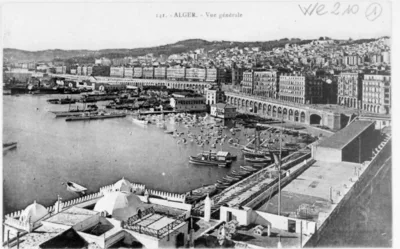
- Alger postcards from the album of A.-L. Leroy, letter dated 7 May 1921 (BnF btv1b77021988): "Alger. Vue générale" (card no. 141) — Unknown postcard publisher; album donated by Adolphe-Louis Leroy (1847-1928), 1921 (album; card undated, earlier) · Bibliothèque nationale de France, Société de Géographie (SGE SG WE-210), via Gallica and Wikimedia Commons · Public domain (published before 1931); Commons: Public domain
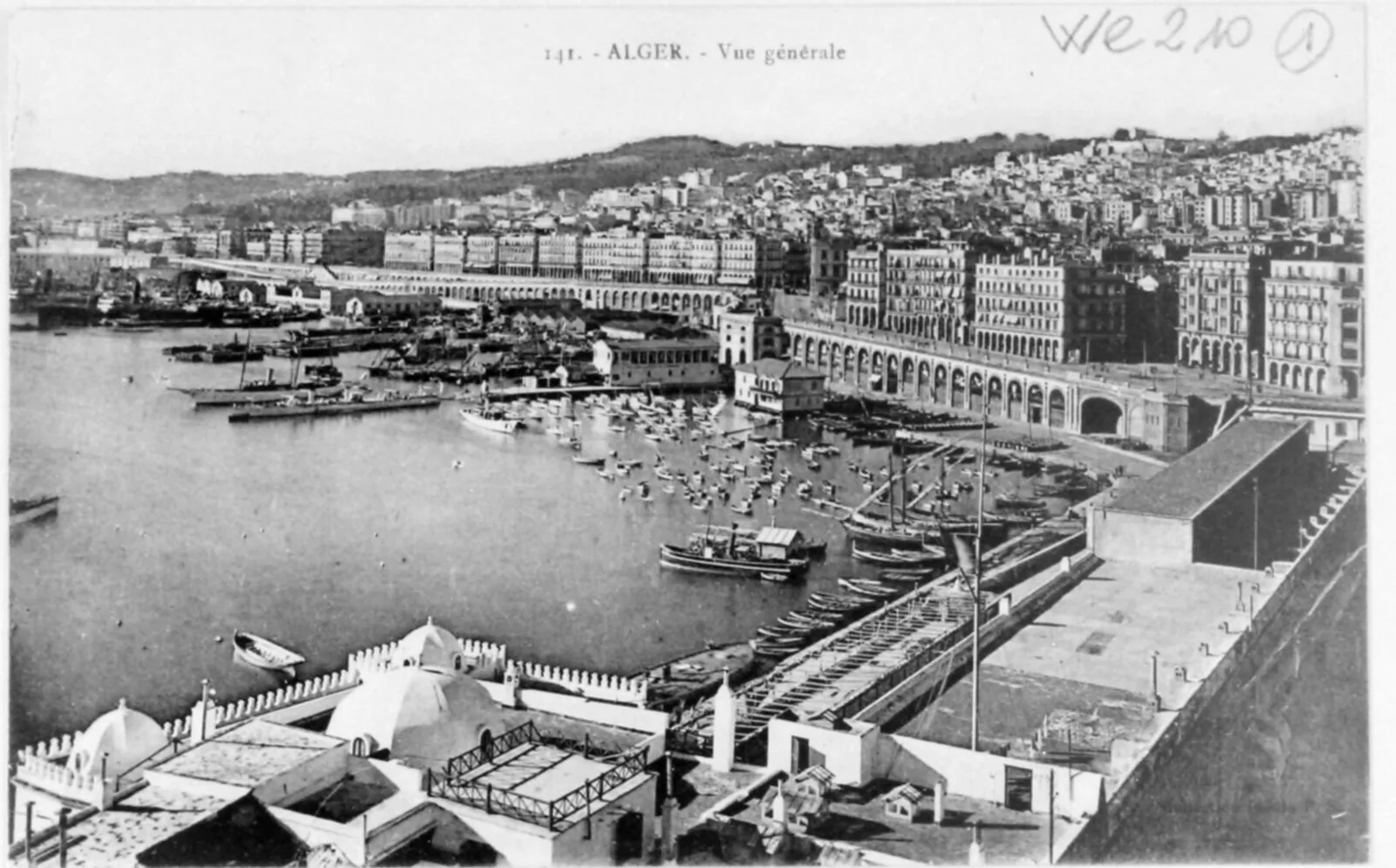
- Wharf at Algiers — Bain News Service, 1915 · Library of Congress, Prints & Photographs Division, George Grantham Bain Collection (LC-DIG-ggbain-27101) · Public domain (published before 1931). Library of Congress: "No known restrictions on publication."
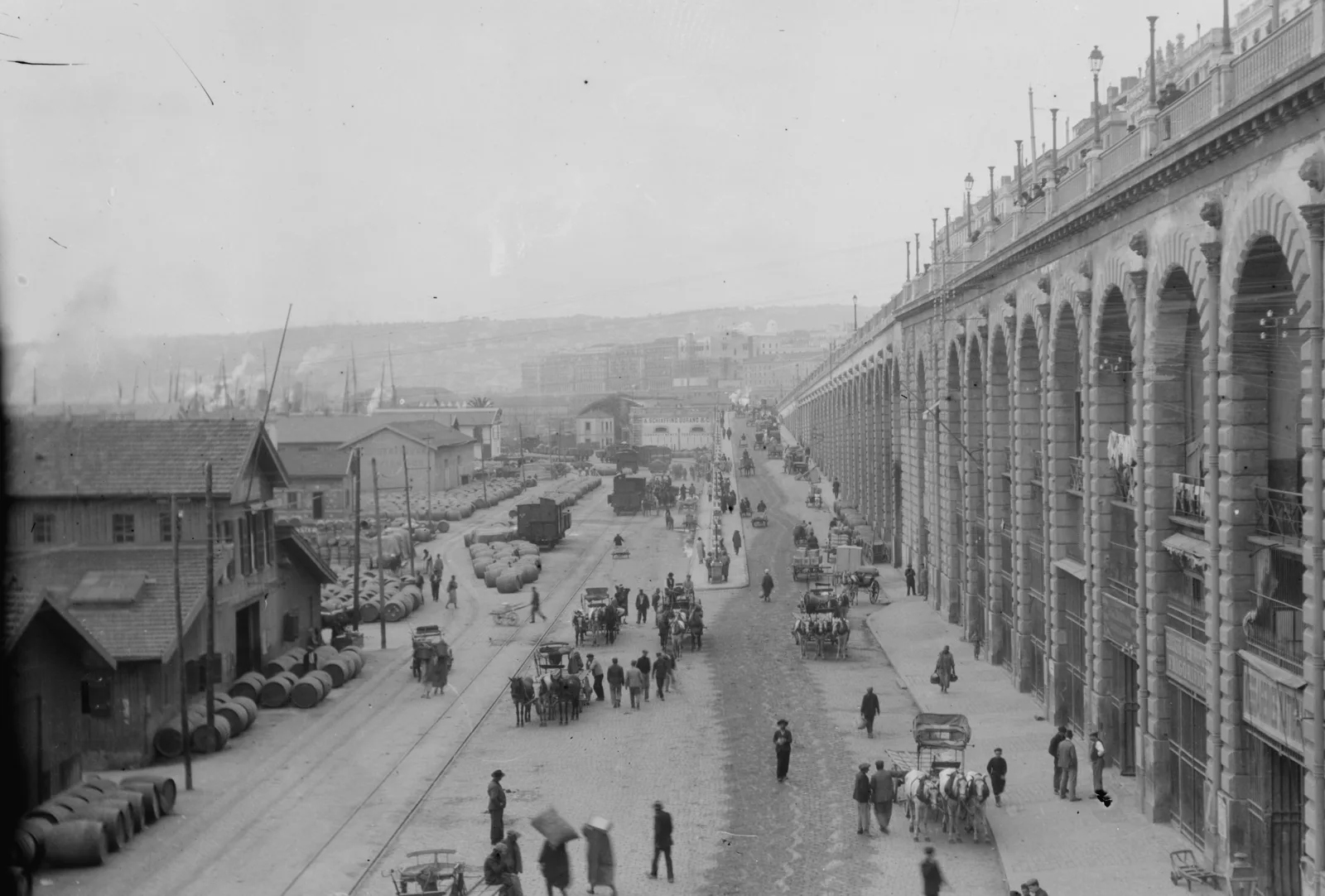
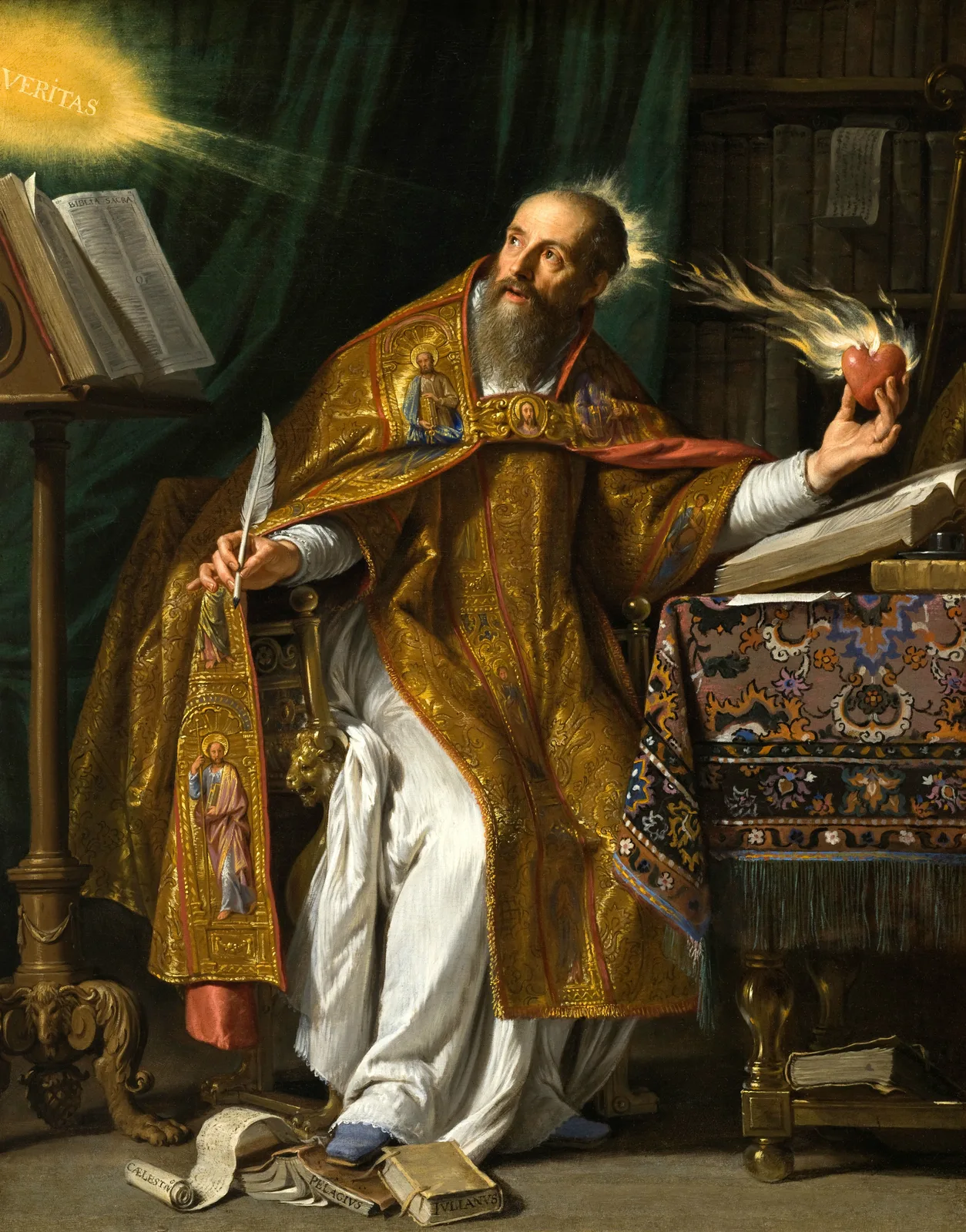
- Saint Augustine — Philippe de Champaigne, c. 1645-1650 · Philippe de Champaigne, via Wikimedia Commons · Public domain
- Pandora — Alexandre Cabanel, 1873 · Walters Art Museum, Baltimore (3799), via Wikimedia Commons · Public domain
- The harbor of Oran from Fort Santa Cruz, Algeria (stereograph no. 16401) — H. C. White Co., 1907 · Library of Congress, Prints & Photographs Division, Stereograph Cards (LC-DIG-stereo-1s16876) · Public domain (published before 1931). Library of Congress: "No known restrictions on publication."
- Gabriel Marcel (1969) — Eric Koch for Anefo, 1969-10-27 · Nationaal Archief, Fotocollectie Anefo (via Wikimedia Commons) · CC0
- Villeblevin-FR-89-mémorial Albert Camus-a1 — François Goglins, 2022-05-18 · François Goglins, via Wikimedia Commons; CC BY-SA 4.0 (web only, not the book) · CC BY-SA 4.0
Sources
Tier 1 — the subject's own words
- [RRD] Camus, Resistance, Rebellion, and Death, trans. Justin O'Brien (London: Hamish Hamilton; the Knopf edition is 1961; the OCR shows no year). Internet Archive
dli.ernet.449375(Digital Library of India scan; the catalogue date "1948" is wrong). OCR inresearch/texts/rrd-dli.txt. Printed page numbers read from the running heads. Contains "The Unbeliever and Christians" (pp. 47–53), "Why Spain?" (pp. 55–61), Letters to a German Friend (pp. 1–24), "Reflections on the Guillotine" (pp. 125–65 per the contents). - [MS] Camus, The Myth of Sisyphus and Other Essays, trans. Justin O'Brien (New York: Knopf, 1955; Vintage International reprint 1991). Internet Archive
CamusMythOfSisyphusAndOtherReadings(complete, including "Summer in Algiers", the Minotaur, "Helen's Exile", "Return to Tipasa"), plusAlbertCamusTheMythOfSisyphusandalbert-camus-the-myth-of-sisyphus-vintage-2018. OCR inresearch/texts/mos-readings.txt,sisyphus.txt,mos-vintage.txt. The OCR carries almost no page numbers, so citations are by essay and section; where the Stanford entry gives a page (MS 24, from its edition) it is noted. - [Peste] Camus, La Peste (Paris: Gallimard, NRF, 1947; 332 pp., imp. 1955), French text as digitised by "Les classiques des sciences sociales" (UQAC). Internet Archive
camus-albert-la-peste_202405(alsolapestealbertcamus,albert-camus-la-peste-1947-fr). OCR inresearch/texts/peste-fr2.txt,peste-fr1.txt,peste-fr4.txt. No page numbers; cited by Part (II–IV). The English translation (Gilbert) is lending-locked. - [Noces] Noces (Algiers: Charlot, 1938); English in Lyrical and Critical Essays (Knopf, 1968), cited by Stanford as N with pages 74, 76, 90, 103. The Knopf 1968 volume is lending-locked; the 1936 essay "Summer in Algiers" was read in [MS].
- Unread, locked: Notebooks 1935–1942 and 1942–1951 (all IA copies 401/403); Le Premier Homme (1994) itself (IA copies locked; read only through [PH-C]); The Rebel; Lyrical and Critical Essays; the Camus–Grenier Correspondance (1981); the Camus–Pia Correspondance.
- [Nobel] Camus's Nobel speech (1957), in the appendix of [RRD]; not used here.
Tier 2 — scholarly biographies and encyclopedias
- [SEP] Ronald Aronson, "Albert Camus," Stanford Encyclopedia of Philosophy (2011; rev. 2021). https://plato.stanford.edu/entries/camus/ .
research/texts/sep-camus.txt. - [NobelBio] "Albert Camus – Biographical," Nobel Lectures, Literature 1901–1967 (Elsevier, 1969).
research/texts/nobel-bio.txt. - Not readable (IA lending-locked, the downloads return 401/403, the search-inside call 403, Google Books API down): Olivier Todd, Albert Camus: A Life (Knopf, 1997; IA
albertcamuslife0000todd,albertcamuslife00todd; French Albert Camus, une vie,albertcamusunevi0000todd); Herbert Lottman, Albert Camus: A Biography (1979; IAalbertcamus00herb,albertcamusbiogr0000lott); Aronson, Camus & Sartre (2004;camussartrestory0000aron); Aronson, "Camus the Unbeliever" (2011); Zaretsky (2013; no IA item).
Tier 3 — popular biographies and journalism
- [PH-C] An unsigned study of Le Premier Homme (1994, 330 pp.) on comptoirlitteraire.com ("Le premier homme" (1994), roman de 330 pages d'Albert Camus), saved as
research/texts/premier-homme-999.txt(IA999-camus-le-premier-homme). It quotes the novel and its Annexes with the Gallimard 1994 page numbers; used as a secondhand route to the childhood passages. The hero is Jacques Cormery, a fictionalised self. - [LaVie] Juliette Rabat, "Albert Camus, le penseur athée qui parlait aux chrétiens," La Vie, 7 Nov 2013 (paywalled after the first paragraphs).
research/texts/lavie-2013.txt. Quotes Camus's 21 Aug 1943 letter to Francis Ponge.
Tier 4 — maps to other sources only
- [WP] English Wikipedia "Albert Camus" (
research/notes/wikipedia-map.txt) and French Wikipedia "Albert Camus" (raw wikitext fetched 2026-10-14; not saved). The French article cites Todd (1996) p. 16, Grenier (1982) p. 9 and 17, and the Camus–Grenier Correspondance (1981), letter 106 of 20 Feb 1946, p. 117. Never cited in the script.
Context texts that are lawfully free (what the 1936 thesis was about; not Camus's words)
- [Aug] Augustine, The Confessions, Pusey translation (Oxford: Parker, 1876). IA
confessionsrevfr00auguuoft;research/texts/augustine-confessions-pusey-1876.txt. - [Plot] Plotinus, The Ethical Treatises, tr. MacKenna (1918). IA
plotinustheethic00plotiuoft;research/texts/plotinus-ethical-treatises-mackenna-1918.txt.
Opposition sources — contemporary critics and religious responses
- Camus's own report of Mauriac in [RRD] pp. 49–50 and of Gabriel Marcel in [RRD] pp. 51, 55–61 (Camus's words, not theirs). Paneloux in [Peste] (fiction). Mauriac's and Marcel's own articles are in copyright and unread. Bruckberger's recollections: lead only.
Related lives
Jean-Paul Sartre — the friend whose break with him in 1952 (over The Rebel) is the other half of the story. (suggestion only)
Alan Turing
Alan Turing was a confirmed Anglican schoolboy at Sherborne. He met the death of his friend Christopher Morcom in 1930 not with lost faith but with a deeper hope that the spirit survives, and worked that hope out through Eddington's physics in "Nature of Spirit" (1932). At some undated point before the end of the war he gave it up for what his biographer calls a determinist and atheistic view. In 1950 he answered the soul argument against thinking machines with a theologian's joke. In nothing read did he give his unbelief a name.
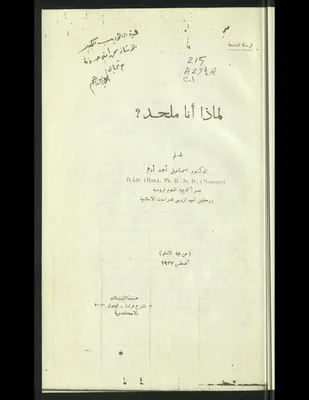
Ismail Adham
Ismail Adham was raised, by his own account, between a father who forced Islam on him and sisters who mocked miracles, and told his father at thirteen that he was a Darwinian. In 1937 he published in Arabic, under his own name, an essay defining atheism as the positive belief that nothing lies beyond the universe, and arguing it from a mathematics of chance. He was answered courteously by al-Azhar's editor and harshly by others. He died at twenty-nine without retracting it, leaving a life story that rested largely on his own word and an essay that does not depend on it.
Simone de Beauvoir
Simone de Beauvoir was raised by a devout mother and an unbelieving father as an exalted Catholic girl who thought of becoming a nun. She lost her faith gradually at about fourteen, and at eighteen felt its meaning as the word "alone". She did not campaign against belief but built an ethics on its absence (1944–47), arguing that without God we are wholly responsible, and wrote The Second Sex (1949), which the Vatican banned. She held to the position through the death of her believing mother (1963) and what she saw as Sartre's last turn toward religious language (1980).
Richard Feynman
Richard Feynman was raised in a Reform Jewish community by an unbelieving father who taught him that names and uniforms are not knowledge. He left Sunday school at almost thirteen because its history mixed fiction with fact, and refused his father's Kaddish in 1946. In 1956 he argued that science turns "Is there a God?" into "How sure is it?", and in 1967 he refused to be counted among Jewish Nobel winners. Late in life he called himself as strong an atheist as anyone was likely to find, at ease with doubt and not knowing.