Ayn Rand was born Alisa Rosenbaum in St Petersburg, and left no account of a childhood faith or its loss. From her first philosophic journal in 1934 she made the rejection of faith the foundation of a philosophy of reason, and said so plainly from the 1940s to the 1960s. Late in life she changed only the label ("Objectivist") and the tone ("intransigent, though not militant"), never the position.
The belief timeline
- Faith (none documented) — Jewish bourgeois family, observance unclear; no source read describes any belief of hers [3]
- Doubt (by c. 1917-18 (biographers, unread)) — Unbelief already formed by her teens; the story of the break is in Branden/Heller, lending-only; Peikoff says that from her early teens she saw Communism as secularised religion [4][27]
- Declaration (1934 private; 1943-64 public) — Journal 9 Apr 1934 and letter 23 Oct 1934; then novels, Wallace 1959, Faith and Force 1960, Playboy 1964 [23][25][35][36][34]
- Revision (1948-65 (refinement only)) — Hardening toward the Catholic Church (1948), the label "Objectivist" over "Atheist" (1960), "intransigent but not militant" (1963-65), respect for religion as early philosophy (1965); Nietzsche dropped by her early thirties per the editors [37][31][32][33][42]
Notes to the timeline (13)
- [3] The family was Jewish, bourgeois and, on the biographers' reports, not strongly religious; how much religious instruction she received is not established here — Barbara Branden, The Passion of Ayn Rand (Doubleday, 1986), Heller 2009, Burns 2009. Not verified.
- [4] She concluded at about thirteen that God does not exist and has described herself as an atheist since then — Branden, Passion of Ayn Rand (1986), (lending-only, still unread); NOT in any Rand text read [40] [46.
- [27] Peikoff writes that from her early teens Rand saw that Communism is not the alternative to religion but a secularised version of it, the state taking the place of the supernatural (in his preface to the 1932 story Red Pawn) — Leonard Peikoff (ed.), The Early Ayn Rand (revised ed. 2005 with Ralston's preface, Penguin eISBN text), same IA item,
research/texts/early.txt. Peikoff's prefaces are the source of [27], Peikoff preface to "Red Pawn". Reported at second hand; the original has not been seen. - [23] Her first philosophic-journal entry, 9 April 1934 (she was 29), resolves to fight religion "as the root of all human lying and the only excuse for suffering"; says faith is the enemy of thought and that the church teaches men not to think; says religion breaks a child's character by teaching lies before he knows what a lie is — David Harriman (ed.), Journals of Ayn Rand (Dutton, 1997; text read is the Plume paperback, catalogued 1999). Read in the OCR of an unauthorised upload,
research/texts/journals.txt(file "journals of ayn rand - ayn rand_djvu.txt" inside IA itemletters-of-ayn-rand-ayn-rand-1; read for checking under the 2026-10-14 rule). The OCR has no printed folios, so entries are cited by their date heading, not by page. In copyright: paraphrase only, entry 9 Apr 1934 (no folio in scan). - [25] 23 Oct 1934, letter to the actor Colin Clive: "I am an atheist and I have only one religion: the sublime in human nature"; the Letters editor quotes it in the preface as characterising her — Michael S. Berliner (ed.), Letters of Ayn Rand (Dutton, 1995; Plume paperback text), same IA item,
research/texts/letters.txt. Cited by recipient and date; no folios in the OCR. In copyright: paraphrase only, to Colin Clive, 23 Oct 1934 (ch. 1). - [35] Wallace interview, 1959: Wallace says reviewers claim she scorns churches and the concept of God; she agrees with the fact but not the estimate, since she challenges the moral code of altruism; "I have no faith at all. I only hold convictions"; acknowledges a debt only to Aristotle; says she has no way of finding out whether her parents are alive — "Mike Wallace Interviews Ayn Rand: A Transcript (1959)," transcribed by Henry Imler, IA
MikeWallaceInterviewsAynRand,research/texts/wallace.txt. Broadcast day not given in the transcript, transcript. - [36] "Faith and Force" (Yale, 17 Feb 1960 and twice more): reason and freedom are corollaries, faith and force their antagonists; mysticism leads to rule by force; reprinted 1982. Her Feb 1960 lecture notes call religion "canned philosophy" — Ayn Rand, Philosophy: Who Needs It (Bobbs-Merrill, 1982), same IA item,
research/texts/pwni.txt; ch. 7 "Faith and Force: The Destroyers of the Modern World" (lecture, Yale 17 Feb 1960, Brooklyn College 4 Apr 1960, Columbia 5 May 1960). Cited by chapter, ch. 7; Harriman, Journals of Ayn Rand, Feb 1960 entry. - [34] Playboy, March 1964: asked "Do you believe in God?" she answers "Certainly not" (p. 39); on the cross, she objects to the sacrifice of the ideal to the nonideal and denies saying she prefers the dollar sign (pp. 39-40); religion has no value "qua religion", faith is detrimental, though religion was an early philosophy; "As a human being, one chooses reason" (p. 40) — Alvin Toffler, "Playboy Interview: Ayn Rand," Playboy, March 1964, pp. 35ff, pp. 39-40.
- [37] 24 Apr 1948, to Isabel Paterson: Paterson's account of Church doctrine sank "the last shred of philosophical respect" Rand had for the Catholic Church, and "supports me in my hatred for those premises"; in 1965 she calls Aquinas the greatest philosopher after Aristotle on non-theological grounds: tone varies, the position does not — Berliner, Letters of Ayn Rand, ch. 5, 24 Apr 1948 (recipient from the chapter title, "Dear Pat").
- [31] 15 July 1960, to Martin Larson, a humanist: she does not call herself an "Atheist" as an identification of her metaphysical position; she calls herself an "Objectivist", but uses "Atheist" in context, e.g. to religionists — Berliner, Letters of Ayn Rand, to Martin Larson, 15 Jul 1960.
- [32] 4 Feb 1963, to Rep. Bruce Alger, answering his study that said atheism is "illegal": she is "an intransigent atheist, though not a militant one"; fights for reason, not against religion; the First Amendment bars government from either side — Berliner, Letters of Ayn Rand, to Bruce Alger, 4 Feb 1963.
- [33] 20 Mar 1965, to an anonymous Catholic priest: repeats "intransigent atheist, but not a militant one"; respects religion as an early form of philosophy; calls Aquinas the greatest philosopher after Aristotle in the philosophical, not theological, aspects, and the best attempt to reconcile reason and religion, though one that cannot succeed; defends her Playboy answer — Berliner, Letters of Ayn Rand, to a Catholic priest, 20 Mar 1965.
- [42] The Journals' editor writes that her first notes show Nietzsche's influence, which she shed: "By her early thirties" she had thought herself out of every Nietzschean element; with The Fountainhead only a trace remained in Dominique and Wynand — Harriman, Journals of Ayn Rand, editor's preface.
An Intransigent Atheist, Though Not a Militant One
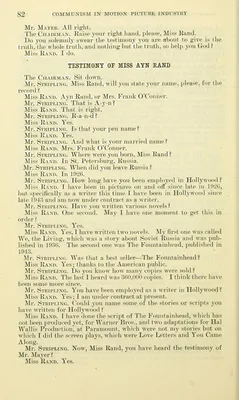
On 20 October 1947 a novelist with a Russian accent sat before the House Committee on Un-American Activities in Washington. The committee was looking for Communist influence in Hollywood, and it had asked her to review Song of Russia, a wartime film about an American conductor who falls in love in the Soviet Union. She told the committee she had been born in St Petersburg and had lived in Russia until 1926, and that the film was false to everything she had seen. In the film there were church weddings and priests. In her Russia, she said, "for a Communist Party member to have anything to do with religion means expulsion from the party," and ordinary believers "had to keep it secret, if they went to church."123456 She described the Russia she had left as a country of "nothing but food and fear."7
She was Ayn Rand, author of The Fountainhead, and she did not use the word "atheist" once in her testimony.8 Yet she had been calling herself one in private for thirteen years, and she would soon build a whole philosophy in which faith of any kind was the enemy of reason. This chapter asks what can be known of how she came to unbelief, and what she did with it.
A childhood she would not tell
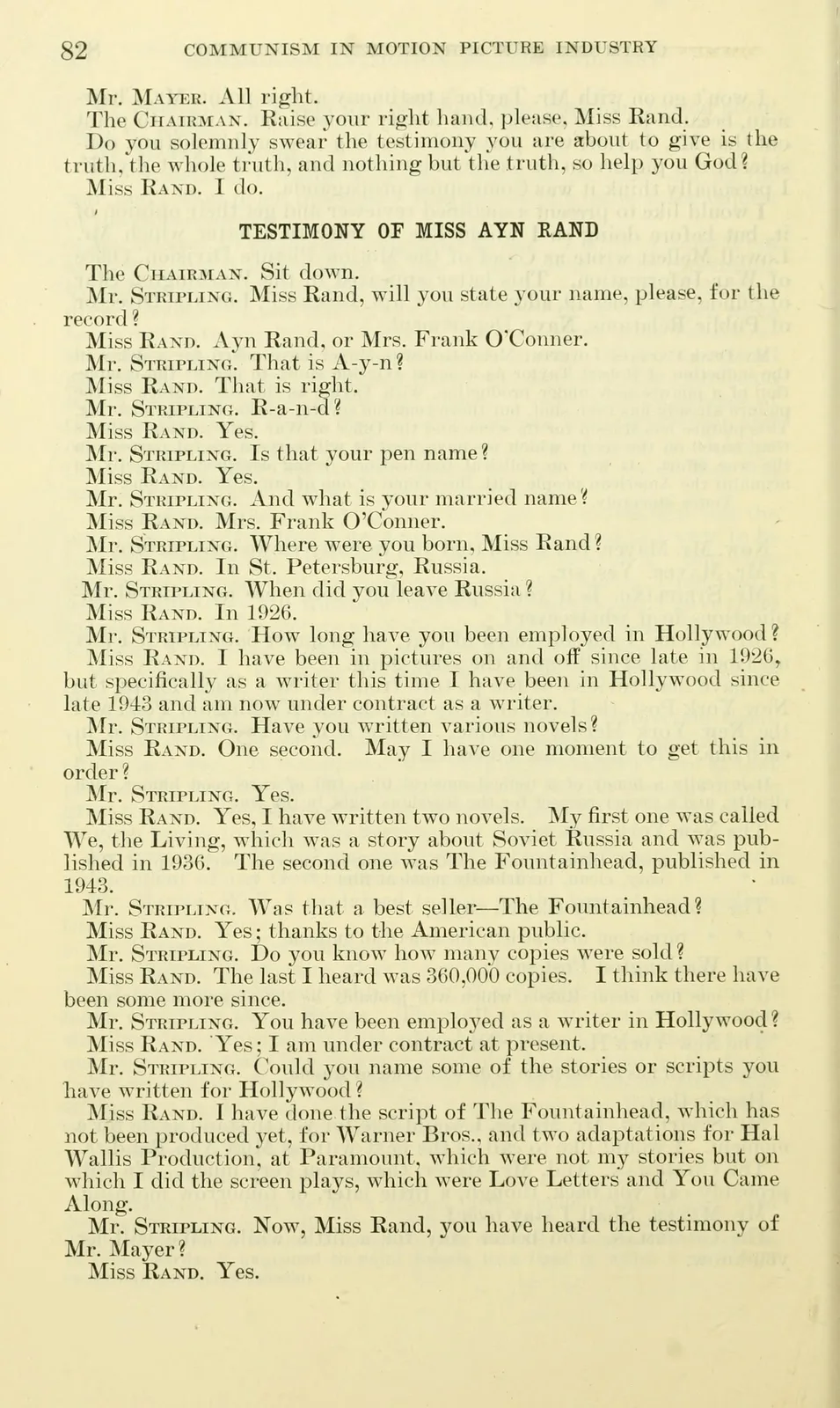
She was born Alisa Rosenbaum in St Petersburg on 2 February 1905 (20 January by the Russian calendar of the time), the eldest of three daughters of Zinovy Rosenbaum, a pharmacist, and Anna Kaplan.9 The family was Jewish and middle-class. In 1912 they moved to an apartment on the Nevsky Prospekt, the city's grand avenue.10 How observant the family was, and what religion she was taught, is a question this chapter cannot answer from the sources read for it.11
Rand herself made the question hard. In 1946 she refused to give a reference book the details of her family, because she feared for relatives still in Russia, and in 1968, asked to name a memorable day of her childhood, she replied that what mattered were her intellectual developments, not events.12 Her biographers, whose books could not be read for this chapter, put her break with God in her early teens; nothing she wrote that has been read tells that story.1314 The nearest authorised account is a remark by her heir, Leonard Peikoff, that from her early teens she saw Communism not as the alternative to religion but as a secular version of it, with the state in the place of God.15 Her timeline therefore has no mark for faith, and the mark for her doubt rests only on that later report.
Revolution and departure
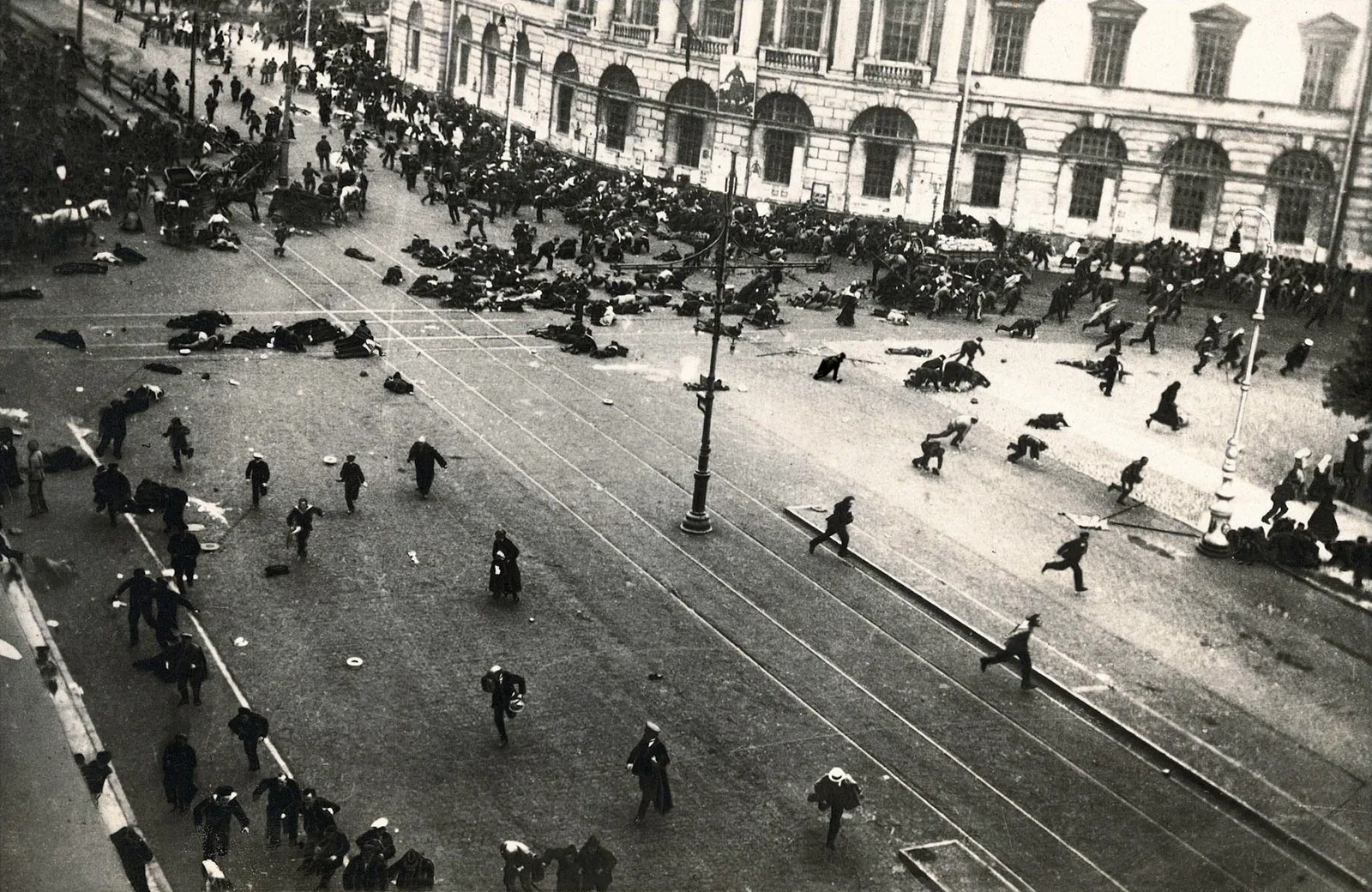
The revolution of 1917 took her father's pharmacy. The family went south to Crimea in the Civil War, and she finished school at Yevpatoria in 1921 before coming back to study at the university in Petrograd.1610 By her own later account she discovered Aristotle in high school, and for a while in her university years she was drawn to Nietzsche, whose influence, her journals' editor says, she had thought her way out of by her early thirties.1017 She graduated in 1924.10
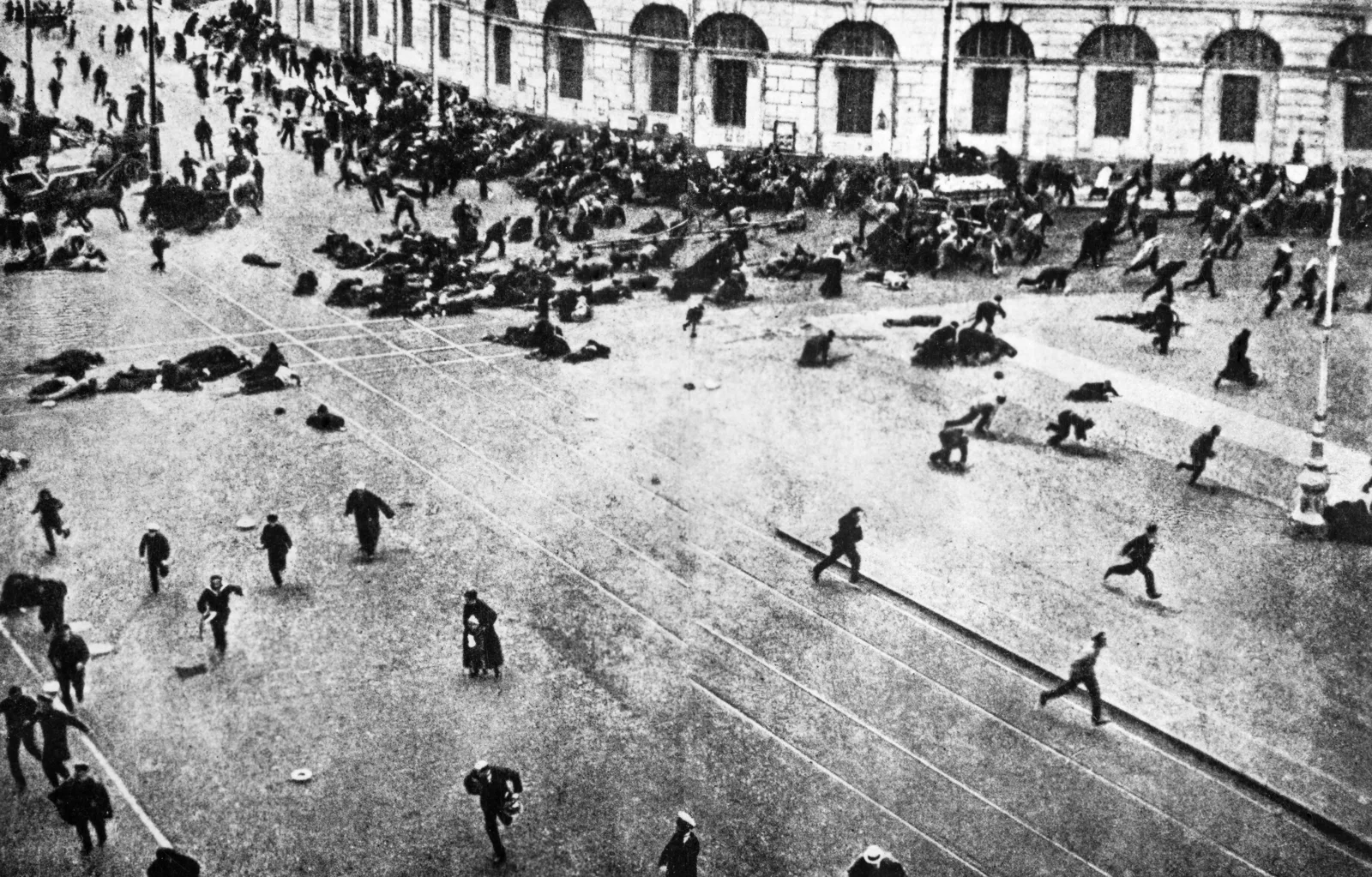

In January 1926 she left Leningrad, and on 19 February she reached New York. In 1959 she said she had no way of finding out whether her parents were still alive.1018 Twenty-one years later she summed up what she had left in her testimony to Congress: "In my time we were a bunch of ragged, starved, dirty, miserable people who had only two thoughts in our mind."19

She went to Hollywood, arriving in September 1926, and found work as an extra for Cecil B. DeMille. On the set of his life of Christ, The King of Kings, she met an actor named Frank O'Connor, whom she married in April 1929.102021 She became an American citizen in March 1931.22
The private declaration
The first dated record of her unbelief comes when she was twenty-nine. On 9 April 1934 she opened a philosophic journal, and its first entry resolved to fight religion, which she called the root of human lying and the only excuse for suffering. Faith, she wrote, was the enemy of thought; the church taught men not to think; and religion broke a child's character by teaching it lies before it could know what a lie was.23 A month later she wrote that a man who is convinced religion is wrong must be an atheist and say so, and she despised those who went to church to win favour with the crowd.24 In October 1934 she wrote to the English actor Colin Clive that she was an atheist whose only religion was the sublime in human nature. It is the earliest letter found in which she gives herself the label.25
The novels took up the same idea. In her notes for Howard Roark, the architect hero of The Fountainhead, she wrote under the heading of religion that he had none.26 Peikoff, introducing her early play Ideal (1934), says that her journal of the period singled out religion as the main cause of men's lack of integrity.27 That private year, 1934, is where the timeline places her declaration.
Unbelief in public
We the Living, her novel of Soviet Russia, appeared in 1936, and The Fountainhead in 1943.28 She allowed herself a believer's vocabulary in her own sense: in 1943 she told a correspondent she was not religious in the conventional way and still wished him God's blessing, and she later called The Fountainhead a religious novel in the sense that it gave readers faith, courage and moral uplift.29 To others she was blunter. In 1946 the writer Rose Wilder Lane argued that a finite world implies a creator; Rand replied that she was an atheist and could not follow her there.30 In 1948 she told her friend the novelist Isabel Paterson that an account of Catholic doctrine had destroyed the last of her philosophical respect for the Church.31
Atlas Shrugged was published in 1957, and with it the philosophy she called Objectivism, which held that reason is the only means of knowledge and rejected faith and the supernatural.3210 In a television interview with Mike Wallace in 1959, she agreed that she rejected the churches and the idea of God, but disputed that it was mere scorn; she said she had no faith at all, only convictions.18 In "Faith and Force," a lecture she gave at Yale in February 1960 and twice more that spring, she argued that reason and freedom go together, and that faith and force are their joint enemies, since mysticism ends in rule by force.33 When Playboy asked her in 1964 whether she believed in God, she said certainly not.34
The critic who heard a command
The review that stung most came from the right. In December 1957 Whittaker Chambers, a former Communist turned conservative editor, reviewed Atlas Shrugged in National Review. He called its atheism aggressive, but said that it was only a ripple on the surface of a deeper materialism, that Rand's ideal man stood, like Marx's, at the centre of a godless world, and that the book's tone was dictatorial: from almost any page, he wrote, one could hear a voice ordering readers to the gas chamber.3536 Rand told Senator Barry Goldwater in 1960 that she had not read the review, on principle; she had been told it accused her of advocating dictatorship.37
The revision that was not a change of mind
Her later letters show a change of label and of tone, but not of belief, and that is what the timeline records as her revision. In July 1960 she told a humanist correspondent that she did not call herself an atheist as a description of her philosophy; she was an Objectivist, and used "atheist" only in context, as when talking to the religious.38 In 1963 a Texas congressman, Bruce Alger, sent her a study claiming that atheism was contrary to American law. She replied that she was an intransigent atheist, though not a militant one: she fought for reason, not against religion, and the First Amendment kept government out of the question on either side.3940 Writing to Goldwater in 1960, she had put it another way: a nonreligious person like herself could not crusade for religion, and she was not asking him to campaign against it either.37
In 1965 she answered a Catholic priest in the same words. She respected religion as an early form of philosophy, she wrote, and thought Thomas Aquinas the greatest philosopher after Aristotle in the philosophical, not the theological, part of his work. His attempt to reconcile reason with faith was the best ever made, she said, and it could not succeed.41 The tone had softened since 1934, when she resolved to fight religion. The position had not moved at all.
She died in New York on 6 March 1982.42
Emma Goldman, another Russian-born Jewish unbeliever who reached America and made her unbelief part of a politics, with the opposite conclusion about the state, has her own chapter in this book.
Footnotes
-
United States Congress, House Committee on Un-American Activities, Hearings regarding the communist infiltration of the motion picture industry (Government Printing Office, 1947), Rand's testimony 20 Oct 1947, pp. 82-96 or so. Internet Archive
hearingsregardin1947aunit, OCR inresearch/texts/huac1947.txt. A US federal publication, public domain. WARNING: the OCR misreads the collectivization figures on p. 84 ("1938", "8,000,000"); the page image (leaf 94) reads "1933" and "3,000,000". Verified by eye, saved inresearch/notes/huac-p84.jpg, p. 82. ↩ -
Congress, Hearings regarding the communist infiltration… (1947), pp. 82, 84. ↩
-
Congress, Hearings regarding the communist infiltration… (1947), pp. 82-83. ↩
-
Congress, Hearings regarding the communist infiltration… (1947), p. 85. ↩
-
Ayn Rand: Congress, Hearings regarding the communist infiltration… (1947), p. 85. ↩
-
Ayn Rand: Congress, Hearings regarding the communist infiltration… (1947), p. 85. ↩
-
Ayn Rand: Congress, Hearings regarding the communist infiltration… (1947), p. 84. ↩
-
Congress, Hearings regarding the communist infiltration… (1947); Wikisource transcription of the same testimony ("Ayn Rand's testimony before the House of Representatives Committee on Un-American Activities"),
research/texts/huac-ws.txt. Agrees with the page image; a convenience copy, cite [HUAC 1947]. ↩ -
Wikipedia map; Barbara Branden, The Passion of Ayn Rand (Doubleday, 1986), Heller 2009. Not verified. ↩
-
Ayn Rand Institute, "Timeline," aynrandlexicon.com/about-ayn-rand/timeline.html and bio.html (read 2026-10-14),
research/texts/lexicon-timeline.txt,lexicon-bio.txt. Institutional and partisan; used for dates only, Tier 3. Partisan institutional source; dates is the only source for this, as for the other details in this chapter cited to that source alone. ↩ ↩2 ↩3 ↩4 ↩5 ↩6 ↩7 -
Branden, Passion of Ayn Rand (1986), Heller 2009, Burns 2009. ↩
-
Michael S. Berliner (ed.), Letters of Ayn Rand (Dutton, 1995; Plume paperback text), same IA item,
research/texts/letters.txt. Cited by recipient and date; no folios in the OCR. In copyright: paraphrase only, to Anna Rothe 21 Mar 1946; to Gene Shalit 27 Sep 1968. ↩ -
Branden, Passion of Ayn Rand (1986), (lending-only, still unread); NOT in any Rand text read [40] [46. ↩
-
ARI bio; the texts above (searches for "thirteen", "childhood", "synagogue", "Jew"). ↩
-
Leonard Peikoff (ed.), The Early Ayn Rand (revised ed. 2005 with Ralston's preface, Penguin eISBN text), same IA item,
research/texts/early.txt. Peikoff's prefaces are the source of [27], Peikoff preface to "Red Pawn". Reported at second hand; the original has not been seen. ↩ -
Wikipedia map. ↩
-
David Harriman (ed.), Journals of Ayn Rand (Dutton, 1997; text read is the Plume paperback, catalogued 1999). Read in the OCR of an unauthorised upload,
research/texts/journals.txt(file "journals of ayn rand - ayn rand_djvu.txt" inside IA itemletters-of-ayn-rand-ayn-rand-1; read for checking under the 2026-10-14 rule). The OCR has no printed folios, so entries are cited by their date heading, not by page. In copyright: paraphrase only, editor's preface. ↩ -
"Mike Wallace Interviews Ayn Rand: A Transcript (1959)," transcribed by Henry Imler, IA
MikeWallaceInterviewsAynRand,research/texts/wallace.txt. Broadcast day not given in the transcript, transcript. ↩ ↩2 -
Ayn Rand: Congress, Hearings regarding the communist infiltration… (1947), p. 84. ↩
-
Wikipedia map. ↩
-
Congress, Hearings regarding the communist infiltration… (1947), p. 82 for the name; marriage date from Wikipedia map. ↩
-
Congress, Hearings regarding the communist infiltration… (1947), p. 83 (naturalized only); date Wikipedia map. ↩
-
Harriman, Journals of Ayn Rand, entry 9 Apr 1934 (no folio in scan). ↩
-
Harriman, Journals of Ayn Rand, entry 15 May 1934. ↩
-
Berliner, Letters of Ayn Rand, to Colin Clive, 23 Oct 1934 (ch. 1). ↩
-
Harriman, Journals of Ayn Rand, entries 9 and 12 Feb 1936. ↩
-
Peikoff, Early Ayn Rand, Peikoff preface to the play. ↩
-
Congress, Hearings regarding the communist infiltration… (1947), p. 82. ↩
-
Berliner, Letters of Ayn Rand, to Monroe Shakespeare, 10 Oct 1943; to Ross Baker, 11 Dec 1945. ↩
-
Berliner, Letters of Ayn Rand, to Rose Wilder Lane, 2 Dec 1946. ↩
-
Berliner, Letters of Ayn Rand, ch. 5, 24 Apr 1948 (recipient from the chapter title, "Dear Pat"). ↩
-
Atlas Shrugged / essays (copyrighted); FBI, "Ayn Rand" Freedom of Information release 1347931-0, Internet Archive
AynRand(rights marked Public Domain Mark; US federal record). Texts inresearch/texts/fbi-file1..4.txt. Mostly a 1969 extortion-letter case and citizen correspondence; contains the 1961 Saturday Evening Post exchange [15]. Thin on biography, 4 quotes the formula "intuition, emotion, faith have no validity as paths to knowledge" from the Post article. ↩ -
Ayn Rand, Philosophy: Who Needs It (Bobbs-Merrill, 1982), same IA item,
research/texts/pwni.txt; ch. 7 "Faith and Force: The Destroyers of the Modern World" (lecture, Yale 17 Feb 1960, Brooklyn College 4 Apr 1960, Columbia 5 May 1960). Cited by chapter, ch. 7; Harriman, Journals of Ayn Rand, Feb 1960 entry. ↩ -
Alvin Toffler, "Playboy Interview: Ayn Rand," Playboy, March 1964, pp. 35ff, pp. 39-40. ↩
-
Whittaker Chambers, "Big Sister Is Watching You," National Review 4:25, 28 Dec 1957, pp. 594-596, pp. 595 (atheism, page image seen) and 596 (gas chamber; placed on p. 596 by the contents and the columns, page image not viewed). ↩
-
Whittaker Chambers, senior editor, National Review: Chambers, National Review (1957), pp. 594-596. Not checked against the original (read in scan 2026-10-14; not quoted until copyright status is known). ↩
-
Berliner, Letters of Ayn Rand, to Sen. Barry Goldwater, 4 Jun 1960. ↩ ↩2
-
Berliner, Letters of Ayn Rand, to Martin Larson, 15 Jul 1960. ↩
-
Berliner, Letters of Ayn Rand, to Bruce Alger, 4 Feb 1963. ↩
-
Anonymous priest, 1965; Bruce Alger, 1963: Berliner, Letters of Ayn Rand. Not checked against the original (read; paraphrase only). ↩
-
Berliner, Letters of Ayn Rand, to a Catholic priest, 20 Mar 1965. ↩
-
Wikipedia map. ↩
hearingsregardin1947aunit, OCR in research/texts/huac1947.txt. A US federal publication, public domain. WARNING: the OCR misreads the collectivization figures on p. 84 ("1938", "8,000,000"); the page image (leaf 94) reads "1933" and "3,000,000". Verified by eye, saved in research/notes/huac-p84.jpg.; Wikisource transcription of the same testimony ("Ayn Rand's testimony before the House of Representatives Committee on Un-American Activities"), research/texts/huac-ws.txt. Agrees with the page image; a convenience copy, cite [HUAC 1947].; Barbara Branden, The Passion of Ayn Rand (Doubleday, 1986); Ayn Rand Institute, "Timeline," aynrandlexicon.com/about-ayn-rand/timeline.html and bio.html (read 2026-10-14), research/texts/lexicon-timeline.txt, lexicon-bio.txt. Institutional and partisan; used for dates only, Tier 3.; Michael S. Berliner (ed.), Letters of Ayn Rand (Dutton, 1995; Plume paperback text), same IA item, research/texts/letters.txt. Cited by recipient and date; no folios in the OCR. In copyright: paraphrase only.; Leonard Peikoff (ed.), The Early Ayn Rand (revised ed. 2005 with Ralston's preface, Penguin eISBN text), same IA item, research/texts/early.txt. Peikoff's prefaces are the source of [27].; David Harriman (ed.), Journals of Ayn Rand (Dutton, 1997; text read is the Plume paperback, catalogued 1999). Read in the OCR of an unauthorised upload, research/texts/journals.txt (file "journals of ayn rand - ayn rand_djvu.txt" inside IA item letters-of-ayn-rand-ayn-rand-1; read for checking under the 2026-10-14 rule). The OCR has no printed folios, so entries are cited by their date heading, not by page. In copyright: paraphrase only.; "Mike Wallace Interviews Ayn Rand: A Transcript (1959)," transcribed by Henry Imler, IA MikeWallaceInterviewsAynRand, research/texts/wallace.txt. Broadcast day not given in the transcript.; FBI, "Ayn Rand" Freedom of Information release 1347931-0, Internet Archive AynRand (rights marked Public Domain Mark; US federal record). Texts in research/texts/fbi-file1..4.txt. Mostly a 1969 extortion-letter case and citizen correspondence; contains the 1961 Saturday Evening Post exchange [15]. Thin on biography.; Ayn Rand, Philosophy: Who Needs It (Bobbs-Merrill, 1982), same IA item, research/texts/pwni.txt; ch. 7 "Faith and Force: The Destroyers of the Modern World" (lecture, Yale 17 Feb 1960, Brooklyn College 4 Apr 1960, Columbia 5 May 1960). Cited by chapter.; Alvin Toffler, "Playboy Interview: Ayn Rand," Playboy, March 1964, pp. 35ff.; Whittaker Chambers, "Big Sister Is Watching You," National Review 4:25, 28 Dec 1957, pp. 594-596.In their own words
In my time we were a bunch of ragged, starved, dirty, miserable people who had only two thoughts in our mind.
nothing but food and fear
for a Communist Party member to have anything to do with religion means expulsion from the party
had to keep it secret, if they went to church
I am only a naturalized American.
Yes; thanks to the American public.
It is almost impossible to convey to a free people what it is like to live in a totalitarian dictatorship.
The other side
See above (paraphrase only; no quotation, see claim 38) Chambers, a former Communist turned conservative editor, reviewed Atlas Shrugged in National Review, called its atheism "aggressive" but "secondary" to a philosophic materialism that, he argued, leads to dictatorship [38]
See above (paraphrase only, see claims 32-33) A Catholic priest (anonymous) and Rep. Bruce Alger argued, respectively, that God is not a blind force and that atheism and agnosticism are contrary to the spirit of US law; their words survive only inside Rand's replies [32] [33]
Where accounts differ
| Point | One account | Another | How the page handles it |
|---|---|---|---|
| Soviet collectivization deaths figure in her 1947 testimony | OCR of the Internet Archive text reads "1938" and "8,000,000" (huac1947.txt) | Printed page image and Wikisource read "1933" and "3,000,000" (page 84, leaf 94) | Use the page image: 1933, 3,000,000. The OCR is wrong. Historians' own figures are much higher and are a separate matter |
| Strength of the household's Jewish observance, and what in it she rejected at thirteen | Biographers differ in emphasis (to check in Branden, Heller, Burns) | Rand herself later stressed reason over any religious or ethnic identity | Say "accounts differ" once the books are read |
| How firm the "atheist by thirteen" date is | Branden and Rand's later retellings (not read) | Her contemporaneous record of that age is not known to exist | Narrate as "by her own later account" |
| Birth date | 2 Feb 1905 (Gregorian) | 20 Jan 1905 (Julian, as then used in Russia); ARI timeline gives both | Give both once |
| US citizenship date | 3 March 1931 (Wikipedia map, claim 9) | 13 March 1931 (ARI timeline [41]) | Say "March 1931" unless a naturalisation record is found |
| Whether she ever believed, and when the break came | Branden (unread): atheist by about thirteen | No text she wrote or authorised gives this; Peikoff says only "from her early teens" she saw Communism as secularised religion [27]; she refused to discuss childhood [40] | Narrate the break as "by her own later account, as her biographers tell it" only if Branden is read; otherwise begin the unbelief at the documents, 1934 |
| Her label | "Atheist" (letters 1934-1965, Playboy 1964) | "Objectivist" in place of "Atheist" as identification (Larson, July 1960) [31]; "not a militant one" [32] | Show both; the shift is of emphasis, not of belief |
| Nietzsche's influence | Journals' editor and Peikoff: shed by her early thirties [42] | Burns/Sciabarra: real and lasting early influence (via Wikipedia map, unread) | Say "accounts differ" |
List of illustrations
This page uses only public-domain and Creative Commons images; each is credited with its source and licence.
- Testimony of Miss Ayn Rand, Hearings regarding the communist infiltration of the motion picture industry, p. 82 — US Congress, House Committee on Un-American Activities, 1947-10-20 · US House of Representatives, Committee on Un-American Activities, Hearings regarding the communist infiltration of the motion picture industry (GPO, 1947), via Internet Archive · Public domain (US federal government publication, 1947)
- Street demonstration on Nevsky Prospekt, Petrograd, 4 July 1917 (Julian), just after troops opened fire — Viktor Bulla, 1917-07-17 · Viktor Bulla, Petrograd, July 1917 (David King Collection), via Wikimedia Commons · Public domain (published 1917; Commons: Public domain)
- A street battle on Nevsky Prospect in Petrograd, 1917 — Karl Karlovitsh Bulla, 1917 · Karl Karlovitsh Bulla, 1917; Finnish Heritage Agency (Museovirasto), CC BY 4.0, via Wikimedia Commons (https://finna.fi/Record/museovirasto.fbf4a172-7a55-4821-ab1c-3e984c39029e) · CC BY 4.0
- Building of the Twelve Collegia, St Petersburg State University (Mendeleevskaya line 2-4), seen from the university grounds — Vityavo, 2024-11-11 · Vityavo, own work, CC0, via Wikimedia Commons · CC0
- Cover of Pola Negri, Ayn Rand's first book (Moscow, 1925) — Unknown (published in Moscow), 1925 · Cover of Pola Negri, Moscow 1925, via Wikimedia Commons (from the archived Productive Arts website) · Public domain (published 1925; Commons: Public domain)
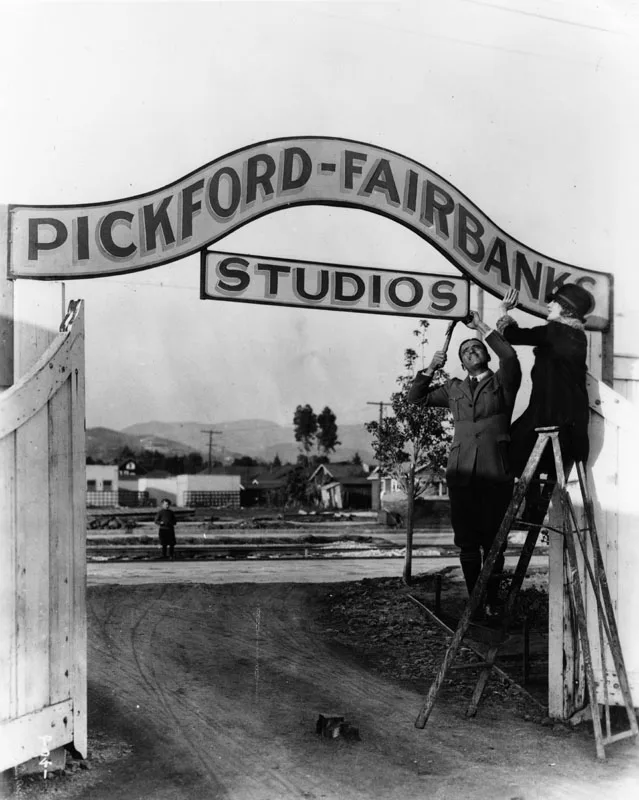
- Mary Pickford and Douglas Fairbanks hang the entrance signs of the Pickford-Fairbanks Studios, Hollywood — Unknown (Los Angeles Public Library), 1922 · Los Angeles Public Library Photo Collection (https://tessa.lapl.org/cdm/search/searchterm/00069488), via Wikimedia Commons · Public domain (1922; Commons: Public domain)
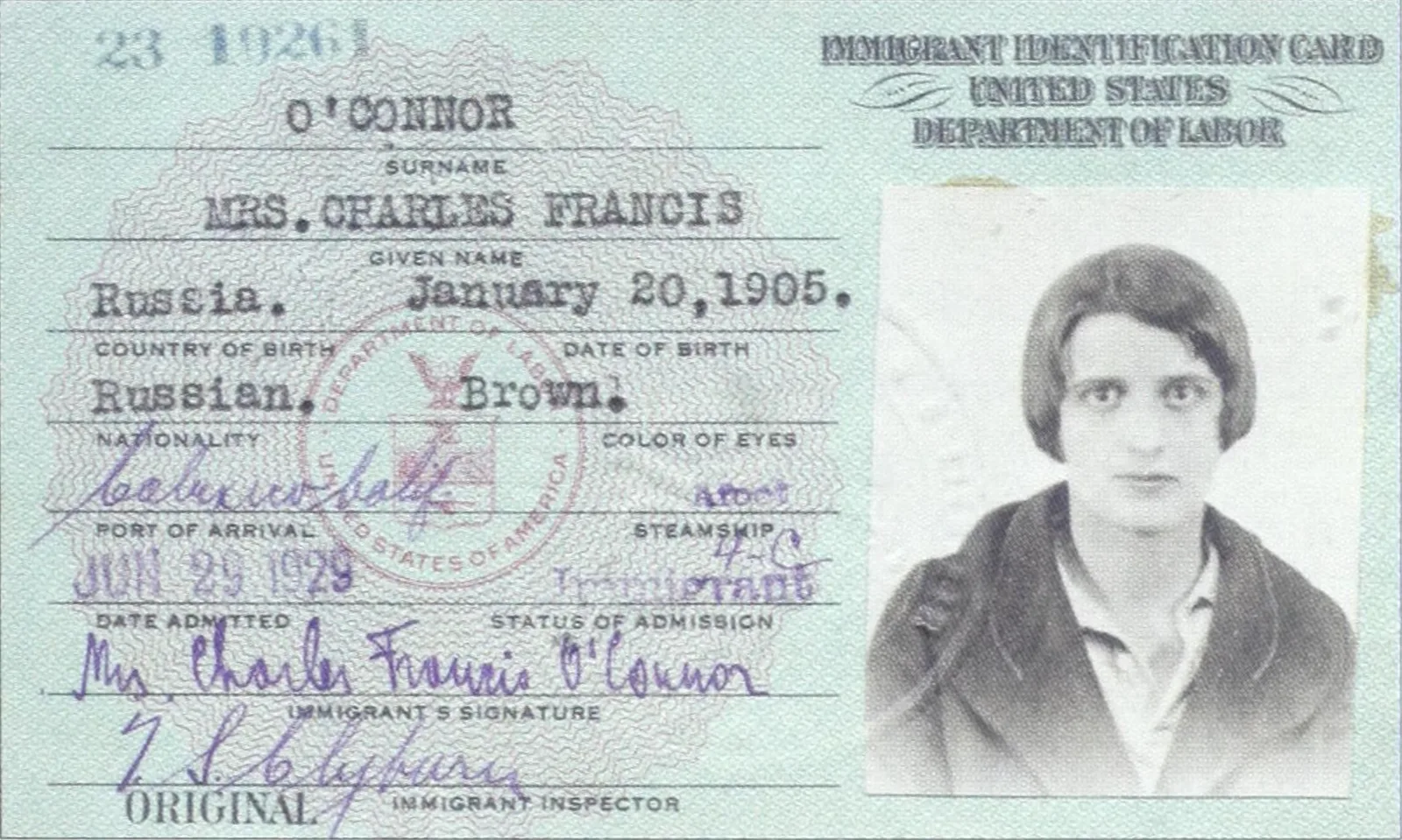
- Ayn Rand's immigration card, registered as Mrs. Charles Francis O'Connor — United States Department of Labor, 1929-06-29 · US Department of Labor, 29 June 1929, via Wikimedia Commons (reproduced in Britting, Ayn Rand, 2004) · Public domain (US federal government work, 1929; Commons: Public domain)
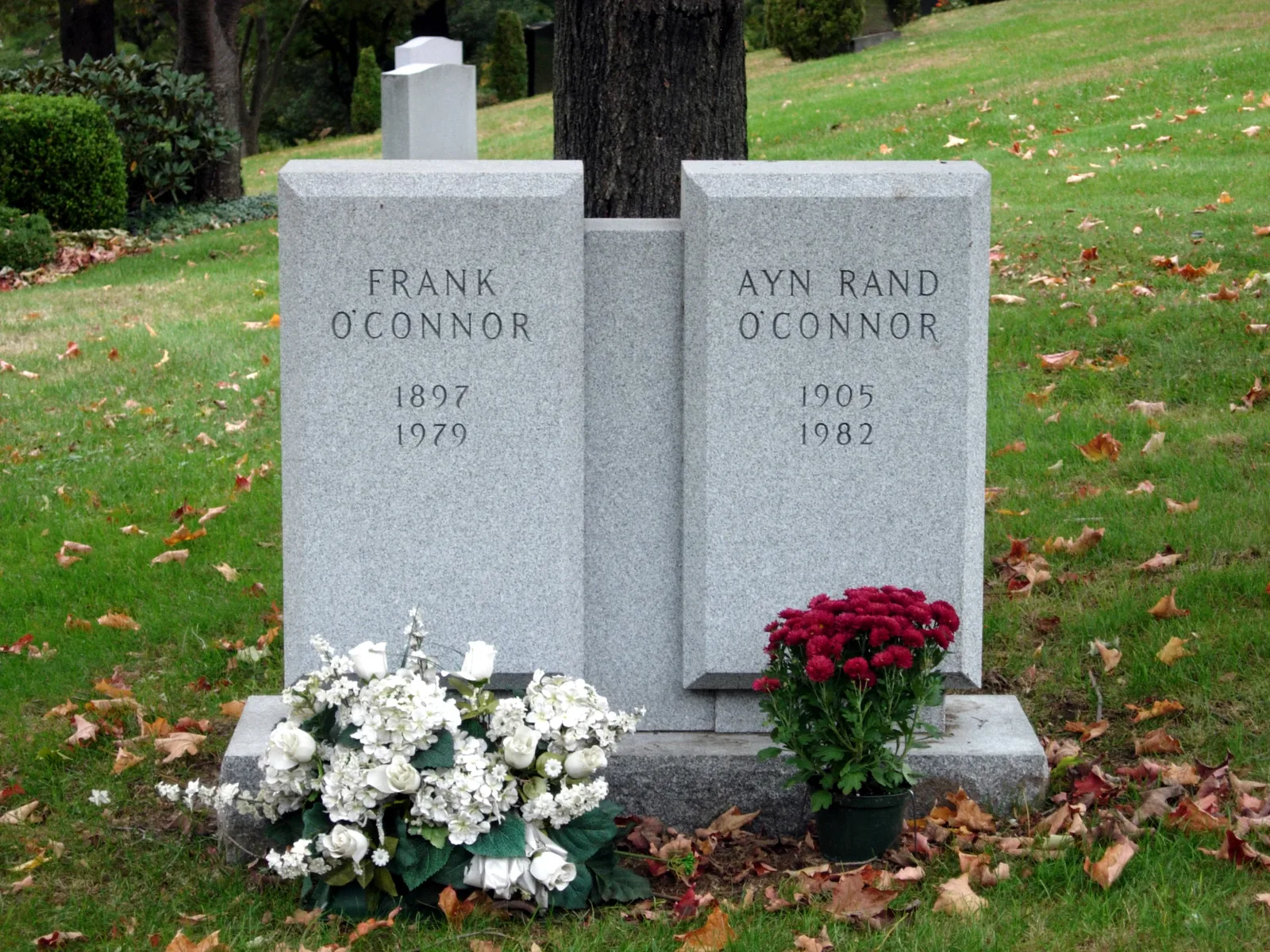
- Grave marker of Frank O'Connor and Ayn Rand — Mark Paulin, 2005-10-21 · Mark Paulin, 2005, via Wikimedia Commons (own work, released to the public domain) · Public domain (released by the photographer; Commons: Public domain)
Sources
Tier 1 — the subject's own words (writings, letters, diaries, trial records)
- [HUAC 1947] United States Congress, House Committee on Un-American Activities, Hearings regarding the communist infiltration of the motion picture industry (Government Printing Office, 1947), Rand's testimony 20 Oct 1947, pp. 82-96 or so. Internet Archive
hearingsregardin1947aunit, OCR inresearch/texts/huac1947.txt. A US federal publication, public domain. WARNING: the OCR misreads the collectivization figures on p. 84 ("1938", "8,000,000"); the page image (leaf 94) reads "1933" and "3,000,000". Verified by eye, saved inresearch/notes/huac-p84.jpg. - [HUAC-WS] Wikisource transcription of the same testimony ("Ayn Rand's testimony before the House of Representatives Committee on Un-American Activities"),
research/texts/huac-ws.txt. Agrees with the page image; a convenience copy, cite [HUAC 1947]. - Everything else she wrote is in US copyright: We the Living (1936, renewed), The Fountainhead (1943, renewed), Atlas Shrugged (until 2052), Letters of Ayn Rand (1995), Journals of Ayn Rand (1997), Russian Writings on Hollywood (1999), the 1964 Playboy interview, her 1959 Mike Wallace interview. Anthem (1938 England) is listed on Wikisource without a renewal note, but its US status was not settled here; do not quote it until checked.
- Unauthorised full-text uploads on the Internet Archive (
letters-of-ayn-rand-ayn-rand-1,in.ernet.dli.2015.458873for Atlas Shrugged,rand-ayn-the-fountainhead,fountainhead0000aynr) were NOT opened or downloaded, per the project rule. - [Journals] David Harriman (ed.), Journals of Ayn Rand (Dutton, 1997; text read is the Plume paperback, catalogued 1999). Read in the OCR of an unauthorised upload,
research/texts/journals.txt(file "journals of ayn rand - ayn rand_djvu.txt" inside IA itemletters-of-ayn-rand-ayn-rand-1; read for checking under the 2026-10-14 rule). The OCR has no printed folios, so entries are cited by their date heading, not by page. In copyright: paraphrase only. - [Letters] Michael S. Berliner (ed.), Letters of Ayn Rand (Dutton, 1995; Plume paperback text), same IA item,
research/texts/letters.txt. Cited by recipient and date; no folios in the OCR. In copyright: paraphrase only. - [PWNI] Ayn Rand, Philosophy: Who Needs It (Bobbs-Merrill, 1982), same IA item,
research/texts/pwni.txt; ch. 7 "Faith and Force: The Destroyers of the Modern World" (lecture, Yale 17 Feb 1960, Brooklyn College 4 Apr 1960, Columbia 5 May 1960). Cited by chapter. - [Answers] Robert Mayhew (ed.), Ayn Rand Answers (2005), same item,
research/texts/answers.txt. Q&A answers, cited by topic only. - [Playboy 1964] Alvin Toffler, "Playboy Interview: Ayn Rand," Playboy, March 1964, pp. 35ff. IA item
playboy-1964(issue 3),research/texts/playboy-1964-03.txt; OCR is poor but page-checked (leaf 40 = printed p. 39, leaf 41 = p. 40). In copyright. - [Wallace 1959] "Mike Wallace Interviews Ayn Rand: A Transcript (1959)," transcribed by Henry Imler, IA
MikeWallaceInterviewsAynRand,research/texts/wallace.txt. Broadcast day not given in the transcript. - [Early] Leonard Peikoff (ed.), The Early Ayn Rand (revised ed. 2005 with Ralston's preface, Penguin eISBN text), same IA item,
research/texts/early.txt. Peikoff's prefaces are the source of [27]. - [Lexicon timeline] Ayn Rand Institute, "Timeline," aynrandlexicon.com/about-ayn-rand/timeline.html and bio.html (read 2026-10-14),
research/texts/lexicon-timeline.txt,lexicon-bio.txt. Institutional and partisan; used for dates only, Tier 3. - [OP] Leonard Peikoff, Objectivism: The Philosophy of Ayn Rand (1991), IA
leonard-peikoff-objectivism-the-philosophy-of-a-book-fi.org,research/texts/peikoff-op.txt(agnosticism pp. 169-171). - [NR 1957] Whittaker Chambers, "Big Sister Is Watching You," National Review 4:25, 28 Dec 1957, pp. 594-596. IA
sim_national-review-1955_1957-12-28_4_25,research/texts/nr-1957-12-28.txt; p. 595 page image read (research/notes/nr-p595.jpg). Copyright and renewal status not checked, so paraphrase only; if the 1957 issue proves unrenewed, quotations become usable.
Tier 2 — scholarly biographies and encyclopedias (all in copyright). SECOND PASS: every one tried and NOT readable; IA returns 401/403 (lending-only) and no open mirror exists. Still leads only.
- [Branden 1986] Barbara Branden, The Passion of Ayn Rand (Doubleday, 1986). IA lending identifiers
passionofaynrand0000bran_a0l8,passionofaynrand0000bran_z0w4(borrow only). The main account of her childhood and of the break with faith; by a disciple, later estranged. Triedia-texton both identifiers 2026-10-14: 403. Pages not found. - [Heller 2009] Anne C. Heller, Ayn Rand and the World She Made (Nan A. Talese, 2009). IA lending
aynrandworldshem0000hell_z6q4,aynrandworldshem0000hell_a4h9. - [Burns 2009] Jennifer Burns, Goddess of the Market: Ayn Rand and the American Right (Oxford, 2009). No IA identifier found; library copy.
- [Sciabarra 1995] Chris Matthew Sciabarra, Ayn Rand: The Russian Radical (Penn State, 1995). Not located on IA; library copy. Best on the St Petersburg intellectual setting (Lossky and the university).
Tier 3 — popular biographies and journalism
- [FBI file] FBI, "Ayn Rand" Freedom of Information release 1347931-0, Internet Archive
AynRand(rights marked Public Domain Mark; US federal record). Texts inresearch/texts/fbi-file1..4.txt. Mostly a 1969 extortion-letter case and citizen correspondence; contains the 1961 Saturday Evening Post exchange [15]. Thin on biography.
Tier 4 — maps to other sources only (Wikipedia and similar). Never cited in the script.
- English Wikipedia "Ayn Rand" (extract read 2026-10-14): source of every date marked T4 above. It is silent on her loss of faith at thirteen; the only sentence on the subject is "Rand advocated reason and rejected faith and religion."
Opposition sources — contemporary critics and religious responses
- [Chambers 1957] = [NR 1957] above, now read in full.
- [SEP letter 1961] A private citizen's letter to the Saturday Evening Post, 5 Nov 1961, inside [FBI file],
research/texts/fbi-file4.txt. Author unidentified and unpublished; copyright held by an unknown writer, so paraphrased only.
Related lives
Emma Goldman (episode 10), the other Russian-Jewish-born unbeliever who reached America and made her unbelief a politics, with the opposite conclusion about the state; or Ayn Rand's near-contemporary Albert Camus. (Draft; the expensive model decides.)
Jean-Paul Sartre
Jean-Paul Sartre was baptised into a family whose faith was more form than conviction. By his own account the belief never took root: it went first through his grandparents' indifference, and then, one morning at La Rochelle in 1917, in a single thought that God did not exist. He made that absence the premise of a philosophy of freedom, and spent years expelling the substitute faith of writing as salvation. In old age he admitted that traces of the idea of God remained in him.
Margaret Knight
Margaret Knight had a nominally Christian education and a quiet loss of belief at Cambridge in the mid-1920s. In January 1955 she said on the BBC Home Service, carefully and for doubting parents, that children need not be taught a God any more than Santa Claus, and that Scientific Humanism could ground morals. The national uproar sent her, at her critics' urging, to the Bible and church history. In 1975 she judged Christianity far more harshly than she had on the radio.
Bhagat Singh
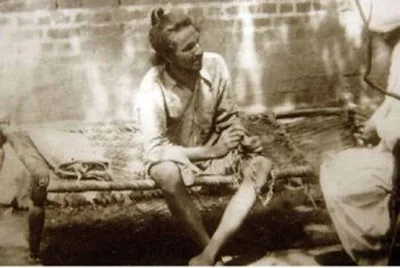
Bhagat Singh was an Arya Samaj schoolboy who prayed for hours. He read his way out of belief in God during a crisis in his revolutionary party in 1925–26, and in 1927 refused prayer when the police offered it as a way out. In the condemned cell in 1930 he answered the charge that his atheism was vanity. What he revised in his last months was the bomb, not the unbelief.
Katharine Hepburn
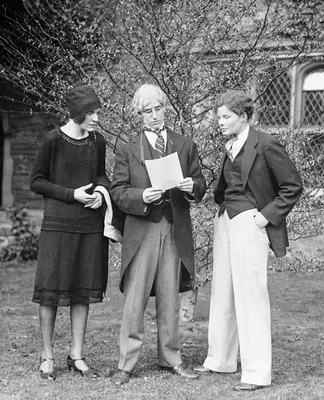
Katharine Hepburn did not lose a faith but inherited an unbelief, from Ingersoll-going grandparents and a father who called Christianity bunk. She held it through her brother's death when she was thirteen. She stated it plainly only once, at eighty-four, in 1991. In her last talks she softened the word to a "higher power", while keeping the same creed of kindness without heaven or hell.