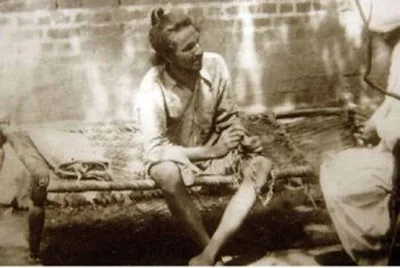
Bhagat Singh was an Arya Samaj schoolboy who prayed for hours. He read his way out of belief in God during a crisis in his revolutionary party in 1925–26, and in 1927 refused prayer when the police offered it as a way out. In the condemned cell in 1930 he answered the charge that his atheism was vanity. What he revised in his last months was the bomb, not the unbelief.
The belief timeline
- Faith (c. 1916–1922) — Arya Samaj grandfather, D.A.V. school, Gayatri Mantra for hours, "a perfect devotee"; father a "firm believer" [3]
- Doubt (1926 (end)) — The first crack came c. 1923 at the National College: he criticised religion and rejected Sikh mythology but kept "a firm faith in God's existence". The real turning point is the study of 1925–26, prompted by the party's crisis and by comrades who prayed; by the end of 1926 he is "convinced" [4][7][8]
- Test (1927-05) — Arrested; police urge him to pray; he refuses: "the real test" [10]
- Declaration (1930-10-05/06 (published 1931-09-27)) — Writes "Why I Am an Atheist" in the condemned cell, answering a charge of vanity; it reaches print six months after his death [7][30]
- Revision (1931-02-02) — Not of his unbelief, which never moved (he refuses prayer to the last), but of his method: "I am not a terrorist"; mass organisation over "mere bomb-throwing" [32]
Notes to the timeline (7)
- [3] In his own account: brought up under an orthodox Arya Samajist grandfather; after primary school a boarder for a full year at the D.A.V. School in Lahore, reciting prayers morning and evening and the Gayatri Mantra "for hours and hours", "a perfect devotee"; later lived with his father, "a liberal in as much as the orthodoxy of religions is concerned", but "a firm believer" who encouraged daily prayer and through whose teachings he came to aspire to freedom — Bhagat Singh, "Why I Am an Atheist", written in Lahore Central Jail, 5–6 October 1930; first published in The People (Lahore), 27 September 1931, pp. 195–201 (English). Text: Marxists Internet Archive, HTML proofread by Juan Fajardo, September 2020, from images of the 1931 pages supplied by Prof. Chaman Lal; MIA states "The text itself is in the public domain" (MIA's own markup is CC BY-SA 2.0), paragraph 3 (from "My atheism is not of so recent origin").
- [4] In the Non-Cooperation days he joined the National College, Lahore, where he "began to think liberally and discuss and criticise all the religious problem, even about God. But still I was a devout believer"; by then he kept his hair unshorn and unclipped, but "could never believe in the mythology and doctrines of Sikhism or any other religion. But I had a firm faith in God's existence" — Singh, People, paragraph 3.
- [7] The revolutionary party he joined was not unbelieving. The first leader he met "could not dare to deny the existence of God" ("Pray whenever you want to"). The second, Sachindra Nath Sanyal, a firm believer, praised God in his book Bandi Jivan; the 1925 revolutionary leaflet was said by the prosecution to be his work. The four Kakori men "passed their last days in prayers"; Ram Prasad Bismil was an orthodox Arya Samajist and Rajen Lahiri recited the Upanishads and the Gita; he saw only one comrade who never prayed ("Philosophy is the outcome of human weakness or limitation of knowledge") and even he "never dared to deny the existence of God" — Singh, People, paragraphs 4.
- [8] "By the end of 1926" he was convinced there was no almighty supreme being; he gave out his disbelief, discussed it with friends and "had become a pronounced atheist" — Singh, People, paragraph 5.
- [10] Arrested at Lahore in May 1927 ("while passing through a garden"); held a month in the Railway Police lock-up; officials said they knew of his Kakori links and the Dussehra 1926 bomb, offered him release and reward for a statement, threatened trial for waging war and murder, and "certain police officials began to persuade me to offer my prayers to God regularly, both the times"; after "great consideration" he decided he "could not lead myself to believe in and pray to God. No, I never did. That was the real test and I came out successful" — Singh, People, paragraph 6.
- [30] The Tribunal sentenced him, Sukhdev and Rajguru to death on 7 October 1930; its "300-page judgement" per Wikipedia — "Last Petition", undated, addressed in the MIA text to "The Punjab Governor", ("sentenced to death on 7th October 1930"); "Bhagat Singh" (extract saved as
research/notes/wikipedia-map.txt), "Bradlaugh Hall"; Wikidata for coordinates. Used as a map for the dates marked "Wikipedia only" below. Reported at second hand; the original has not been seen. - [32] On 2 February 1931 he wrote: "Apparently I have acted like a terrorist. But I am not a terrorist" and that "mere bomb-throwing is not only useless but sometimes harmful"; the programme "requires at least twenty years" — "To Young Political Workers", 2 February 1931.
Is This Vanity?
In the first days of October 1930 a prisoner in the Central Jail at Lahore sat down to answer a question his friends had been asking about him. He was twenty-three. Within a week a special tribunal would give its verdict in the case against him, and he expected it to be death. Some of the people who visited him thought that his refusal to believe in God came from pride, and that the fame of his trials had gone to his head. He began his answer with their question. "A new question has cropped up. Is it due to vanity that I do not believe in the existence of an omnipotent, omnipresent and omniscient God?"123
The essay he wrote, "Why I Am an Atheist," was published in a Lahore weekly in September 1931, six months after he was hanged.3 It was written by a young man who believed that force used in a just cause was morally justified, and who did not ask anyone to forgive him for what he had done. This chapter follows Bhagat Singh from a boyhood of hours-long prayer to that cell, and asks the question he asked himself: where did his unbelief come from, and did it hold?
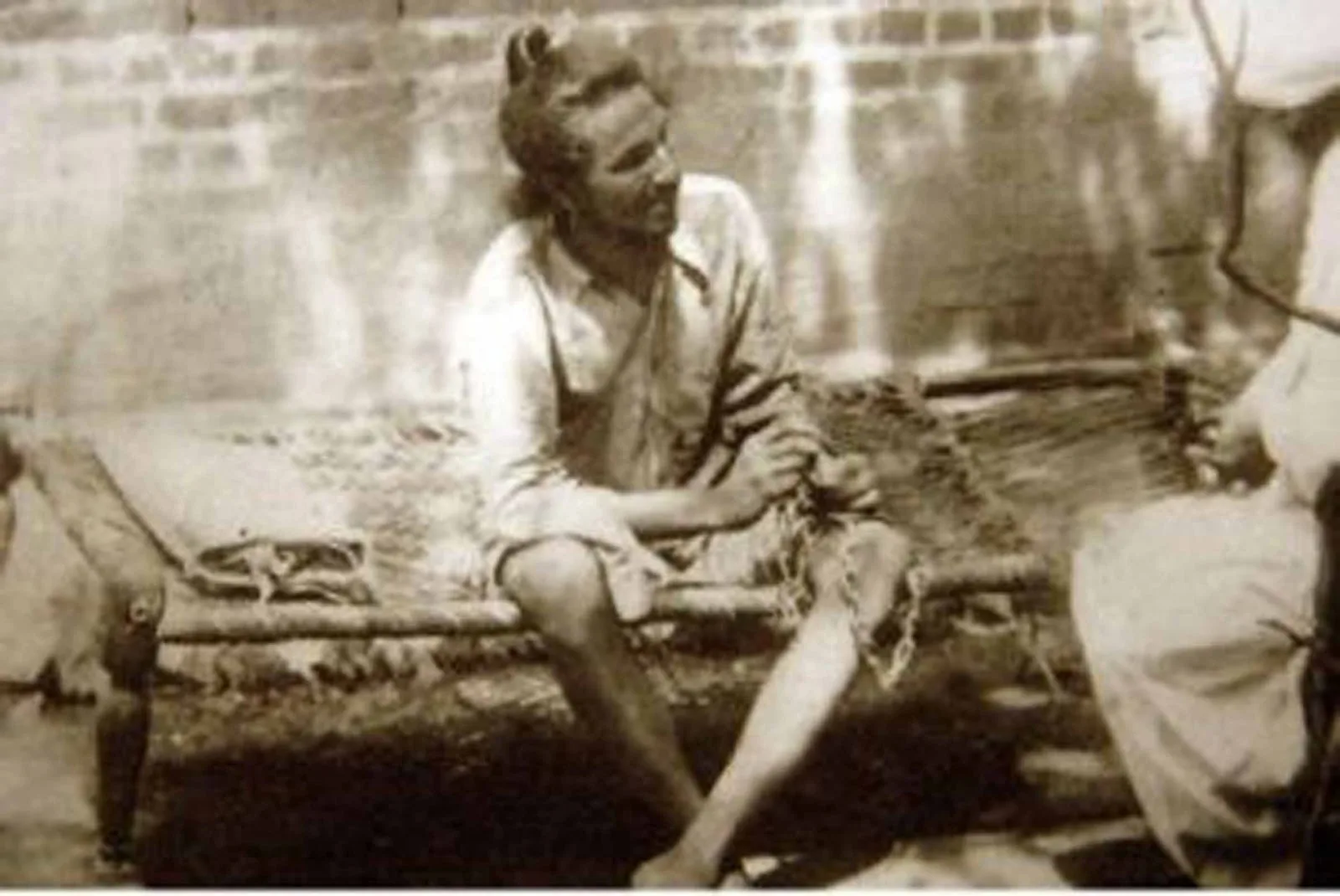
A perfect devotee
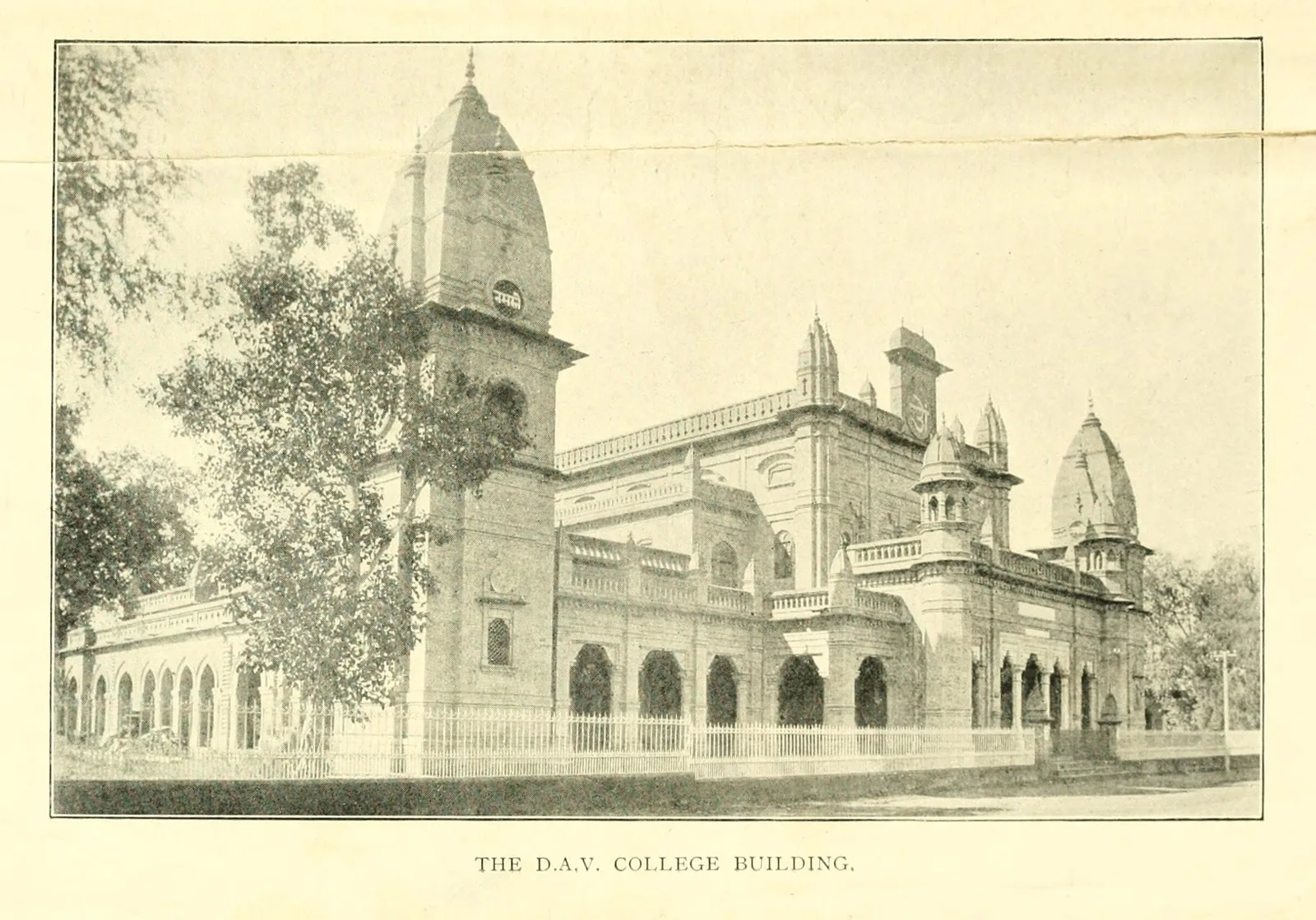
He was born in September 1907 in the canal colonies of the Punjab, at Banga in Lyallpur district, in what is now Pakistan, into a Sikh family that had already been in trouble with the government; accounts differ on whether the day was the 27th or the 28th.45 He described his own upbringing exactly. "My grandfather under whose influence I was brought up is an orthodox Arya Samajist. An Arya Samajist is anything but an atheist."6 The Arya Samaj was a Hindu reform movement, and it ran its own schools, the D.A.V. schools. After his primary schooling the boy spent a full year as a boarder there. "There, apart from morning and evening prayers, I used to recite 'Gayatri Mantra' for hours and hours. I was perfect devotee in those days."78
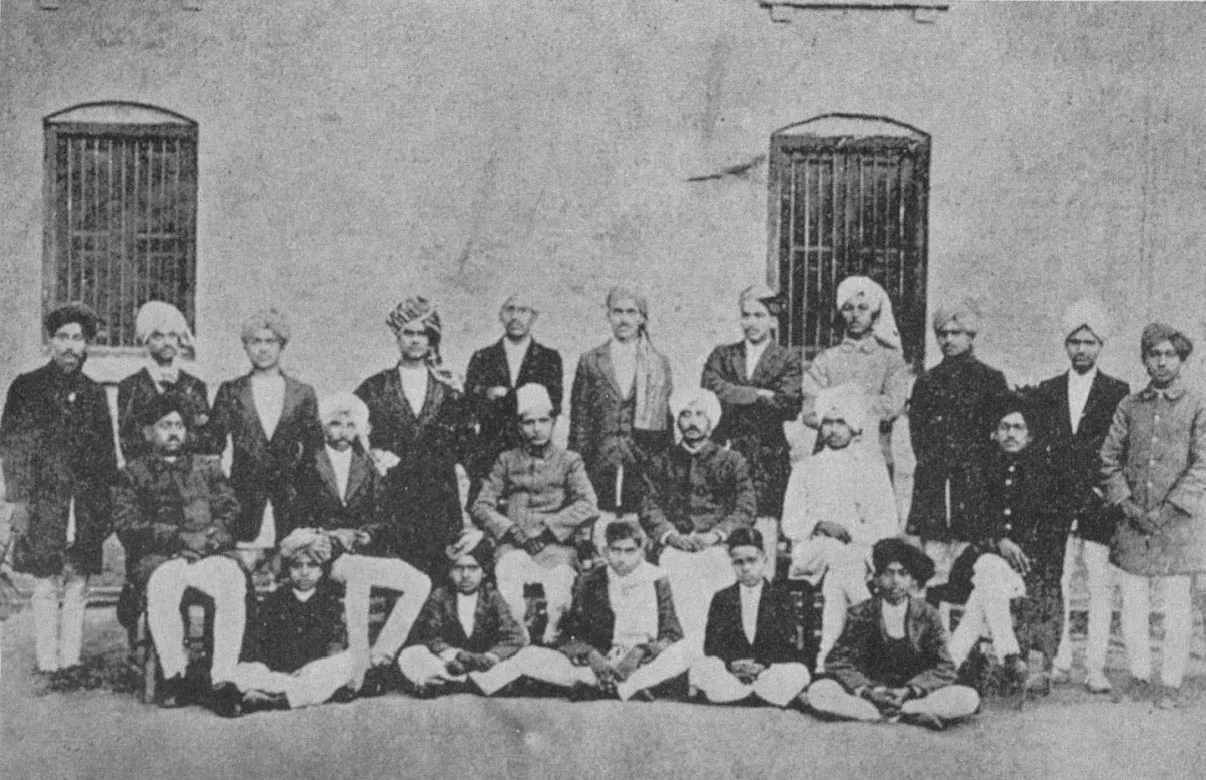
Later he lived with his father, Kishan Singh, whom he called "a liberal in as much as the orthodoxy of religions is concerned" but "a firm believer," a man who encouraged him to pray every day and through whose teaching, he said, he first came to want freedom for his country.8 The first crack came in his teens, when he joined the National College at Lahore, during the campaign of non-cooperation with British rule. "It was there that I began to think liberally and discuss and criticise all the religious problem, even about God. But still I was a devout believer." He kept his hair uncut, as a Sikh, but he wrote that "I could never believe in the mythology and doctrines of Sikhism or any other religion. But I had a firm faith in God's existence."91011 Accounts differ on the year he entered the college; he says only that it was "in the Non-Cooperation days."12
Study
The revolutionaries he joined in the mid-1920s were not unbelievers, and he was careful to say so. The first leader he met "could not dare to deny the existence of God." The second, Sachindra Nath Sanyal, sang the glory of God in his book Bandi Jivan. The men of the Kakori conspiracy who went to the gallows spent their last days in prayer: Ram Prasad Bismil was an orthodox Arya Samajist, and Rajen Lahiri recited the Upanishads and the Gita. Bhagat Singh knew only one comrade who never prayed, and even he "never dared to deny the existence of God."13
What changed his mind, by his own account, was not a loss or a quarrel but a crisis in the movement. In 1925 and 1926 the party was close to breaking up, and he was afraid that he too might lose faith in its programme. "That was a turning point in my revolutionary career. 'Study' was the cry that reverberated in the corridors of my mind. Study to arm yourself with arguments in favour of your cult. I began to study."1415 What he read was the literature of the European left. "I studied Bakunin, the anarchist leader, something of Marx, the father of communism, and much of Lenin, Trotsky and others—the men who had successfully carried out a revolution in their country. They were all atheists." He also read a book called Common Sense by a writer he called Nirlamba Swami, which he described as "a sort of mystic atheism."1614 By the end of 1926 he was sure. "By the end of 1926 I had been convinced as to the baselessness of the theory of existence of an almighty supreme being who created, guided and controlled the universe." He told his friends so, and became, as he put it, "a pronounced atheist."1718
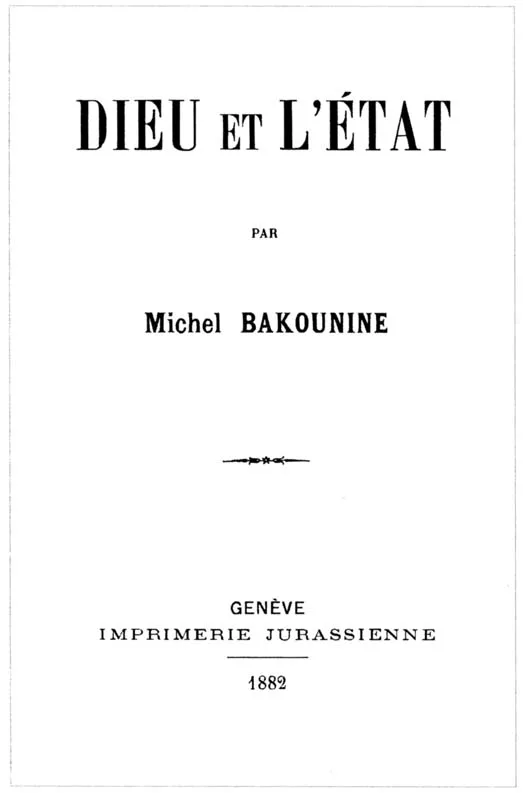
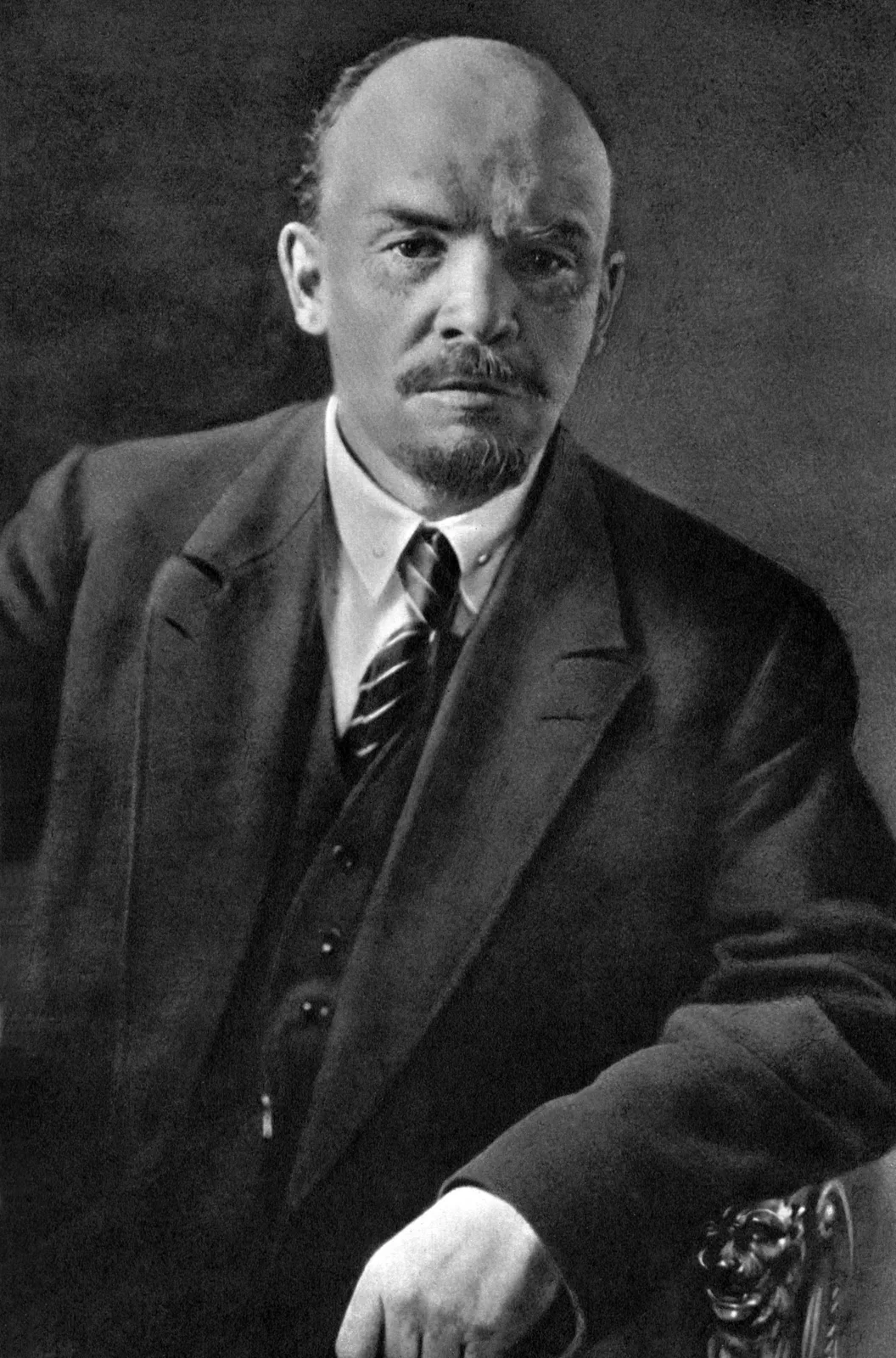
Some modern accounts say that his questioning began earlier, with the riots between Hindus and Muslims that followed the end of non-cooperation. His essay does not mention them; it names study.19 On the timeline, his doubt sits at the end of 1926 for that reason: the college years loosened his religion, but by his own testimony he still believed in God until he had read his way out.
The real test
In May 1927 the police arrested him in Lahore and held him for a month. They told him they knew of his links with the Kakori men, offered him release and a reward if he would make a statement, and threatened him with a trial for murder. And, he wrote, "certain police officials began to persuade me to offer my prayers to God regularly, both the times." He thought about it seriously. "After great consideration I decided that I could not lead myself to believe in and pray to God. No, I never did. That was the real test and I came out successful."2021 It is his account; the police version is not known.
Lahore and Delhi
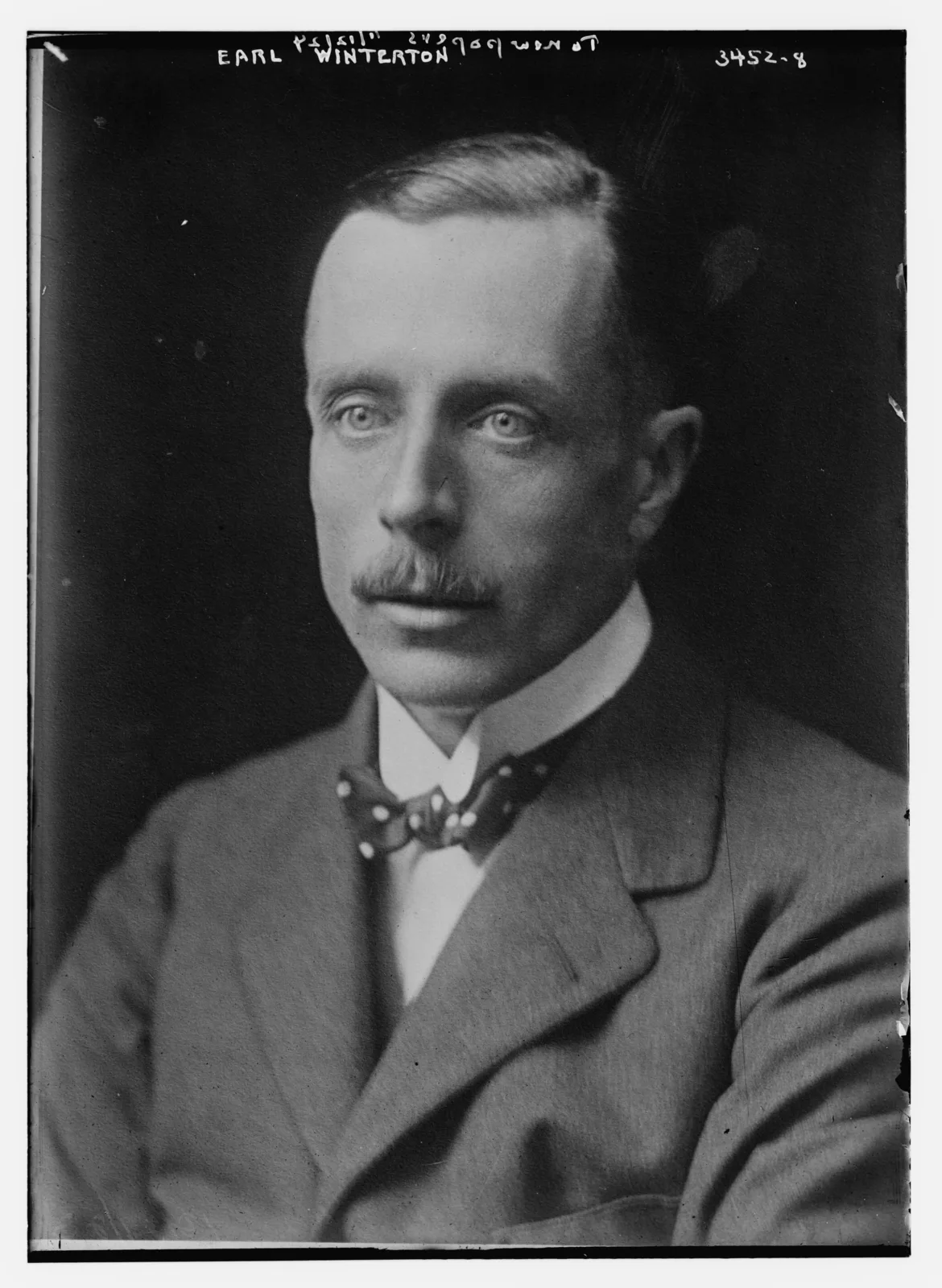
On 30 October 1928 Lala Lajpat Rai led a protest in Lahore against the Simon Commission and said he had been struck by a police officer. He died a few weeks later.22 In the House of Commons the government's spokesman, Earl Winterton, answered that "no evidence has been produced to show that the death of Lala Lajpat Rai was due to blows received on that occasion," and that "there was no deliberate or unprovoked attack by the police."2324
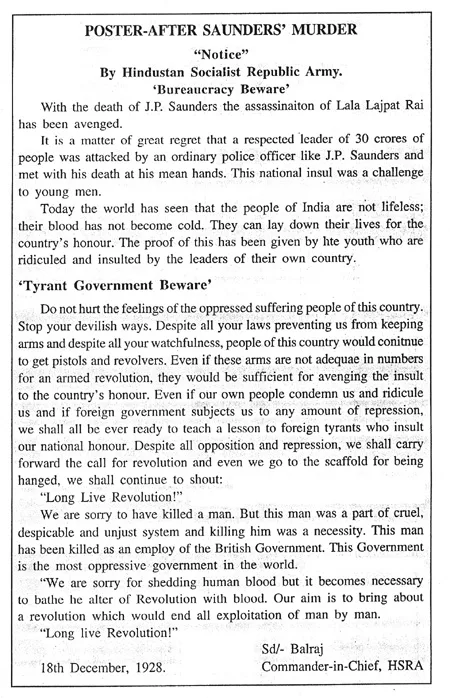
On 17 December 1928 a young assistant superintendent of police, J. P. Saunders, was shot dead in Lahore.25 That night a notice signed "Balraj" for the Hindustan Socialist Republican Association was posted in Lahore: "J.P. Sunders is dead; Lala Lajpat Rai is avenged." It said the dead man was "an agent of the British authority in India," and it did not pretend that nothing had been lost: "Sorry for the death of a man. But in this man has died the representative of an institution which is so cruel, lowly and so base that it must be abolished."2627 A copy of the notice in Bhagat Singh's handwriting was later used in evidence against him.26 The only motive his writings give for the killing is the death of Lajpat Rai.28
On 8 April 1929 he and Batukeshwar Dutt threw two bombs into the Central Legislative Assembly in New Delhi, scattered another notice from the gallery, and waited to be arrested.29 By their own account the bombs fell in empty spaces, damaged a bench and caused "some slight abrasions in less than half a dozen cases"; other accounts say some members were hurt.30 In court on 6 June their statement was read for them by their lawyer, Asaf Ali. "We are next to none in our love for humanity. Far from having any malice against any individual, we hold human life sacred beyond words." Their purpose, they said, had been "to make the deaf hear." And they set out their creed against Gandhi's: "Force when aggressively applied is 'violence' and is, therefore, morally unjustifiable, but when it is used in the furtherance of a legitimate cause, it has its moral justification."31323334 They were sentenced to transportation for life.35
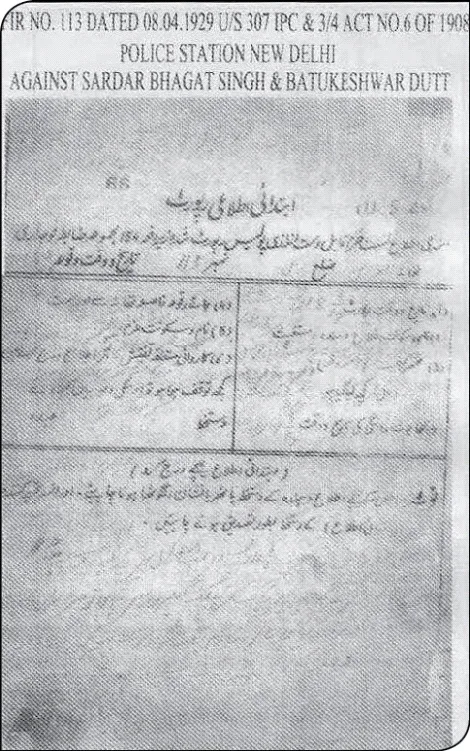
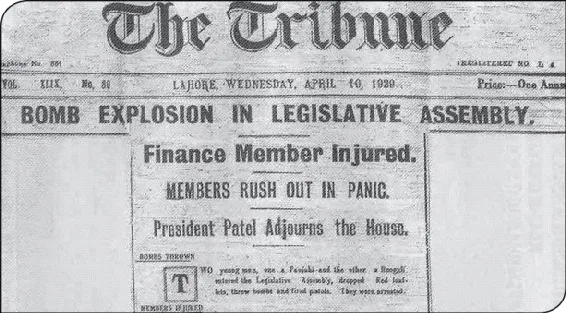
Gandhi was not persuaded. In a private letter to Jawaharlal Nehru that summer he wrote that he understood the statement had been drafted by the prisoners' lawyer, and that it was not the sincere outpouring he and Nehru had taken it for.3637 In jail the prisoners went on hunger strike for the treatment of political prisoners; one of them, Jatindra Nath Das, died of it in September 1929. Gandhi explained in print why he had kept silent.3839
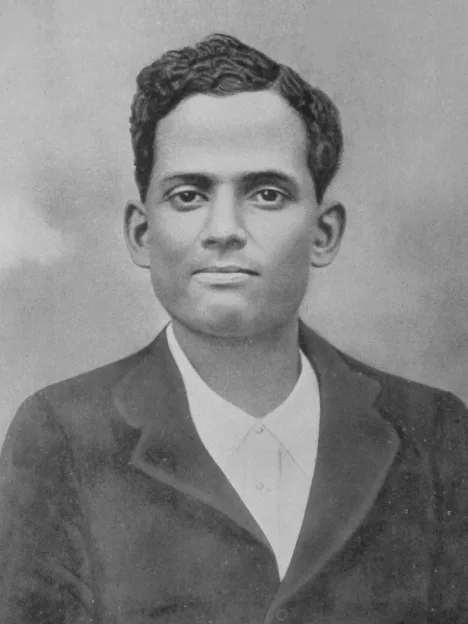
The condemned cell
The trial for the Lahore conspiracy went before a special tribunal created by the Viceroy's ordinance, which Bhagat Singh and his co-accused refused to recognise.40 In July 1930 he wrote from the jail asking a friend for books: Liebknecht, Russell's Why Men Fight, Kropotkin's Mutual Aid, Marx, Upton Sinclair, Bukharin.41 On 4 October he wrote to his father, who had petitioned the tribunal in his defence, that he felt stabbed in the back, that his life was not worth buying at the price of his principles, and that he wanted the letter published.424344
The next two days he wrote "Why I Am an Atheist."3 He did not deny that he could be vain; his comrades, he admitted, had called him an autocrat.45 But he had stopped believing, he said, long before anyone knew his name. "My atheism is not of so recent origin. I had stopped believing in God when I was an obscure young man, of whose existence my above-mentioned friends were not even aware."46 He did not think religion was simply a priests' fraud. Belief in God, he argued, was "almost universal" and its philosophy well developed, and men had needed it: "In God man can find very strong consolation and support. Without Him man has to depend upon himself."4748 His case against it came from the world he saw: the suffering God would have had to create, and the poverty that the doctrine of rebirth called a punishment for sin.49 And he would not let God take the credit, or the blame, for the empire. "Let me tell you, British rule is here not because God wills it, but because they possess power and we do not dare to oppose them."50
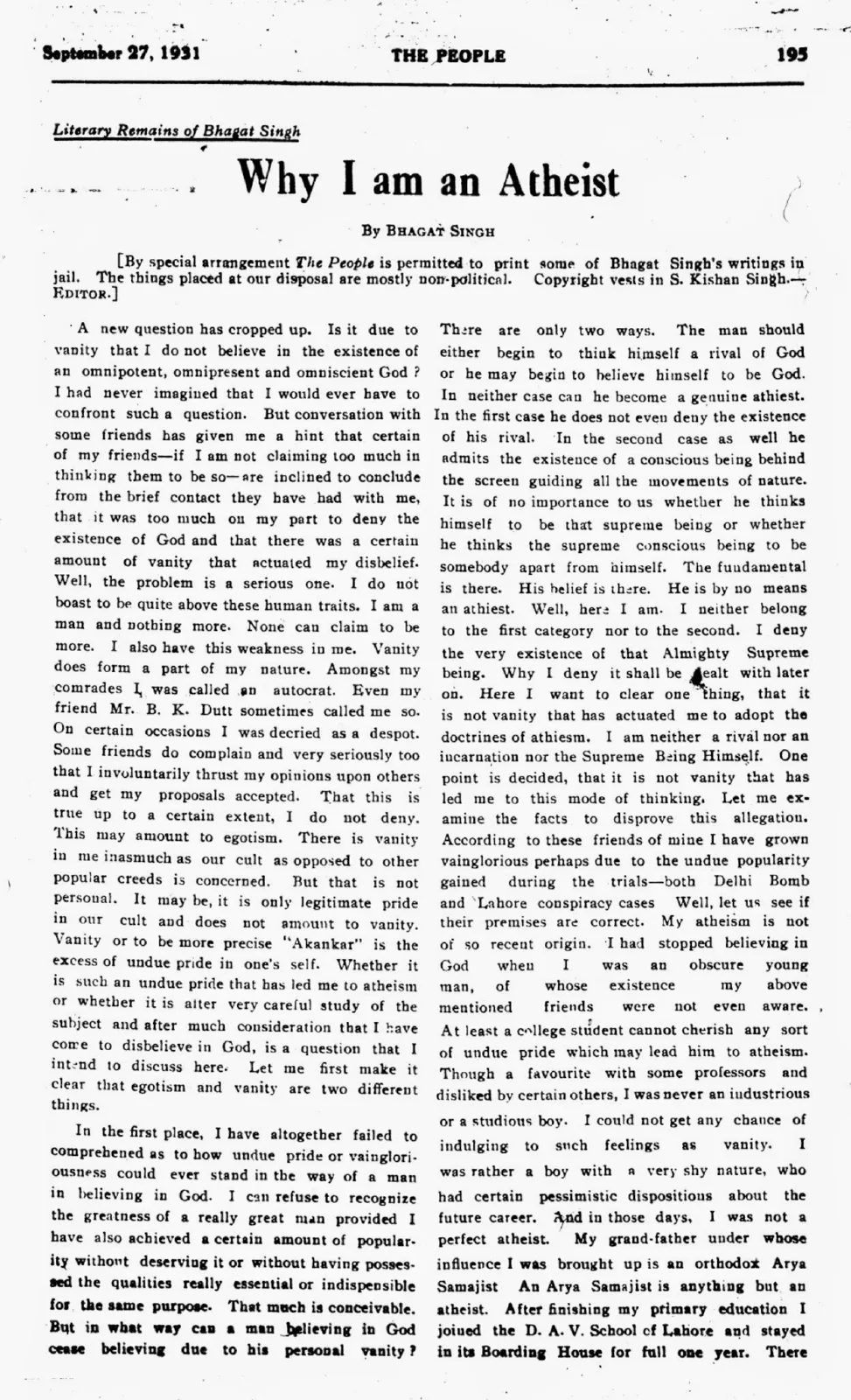
Then he wrote about the gallows. "I know the moment the rope is fitted around my neck and rafters removed under my feet, that will be the final moment." He did not want comfort. "But I do not want the help of any intoxication to meet my fate. I am a realist."5152 And he ended with a conversation. "One friend asked me to pray. When informed of my atheism, he said, During your last days you will begin to believe! I said, No, dear Sir, it shall not be." To pray now, he wrote, would be an act of degradation; "Is this vanity?" If it is, "I stand for it."53
On 7 October 1930 the tribunal sentenced him, Sukhdev Thapar and Shivaram Rajguru to death.54
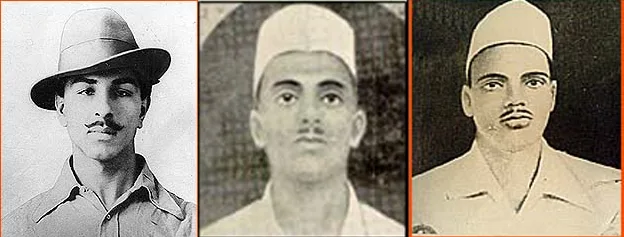
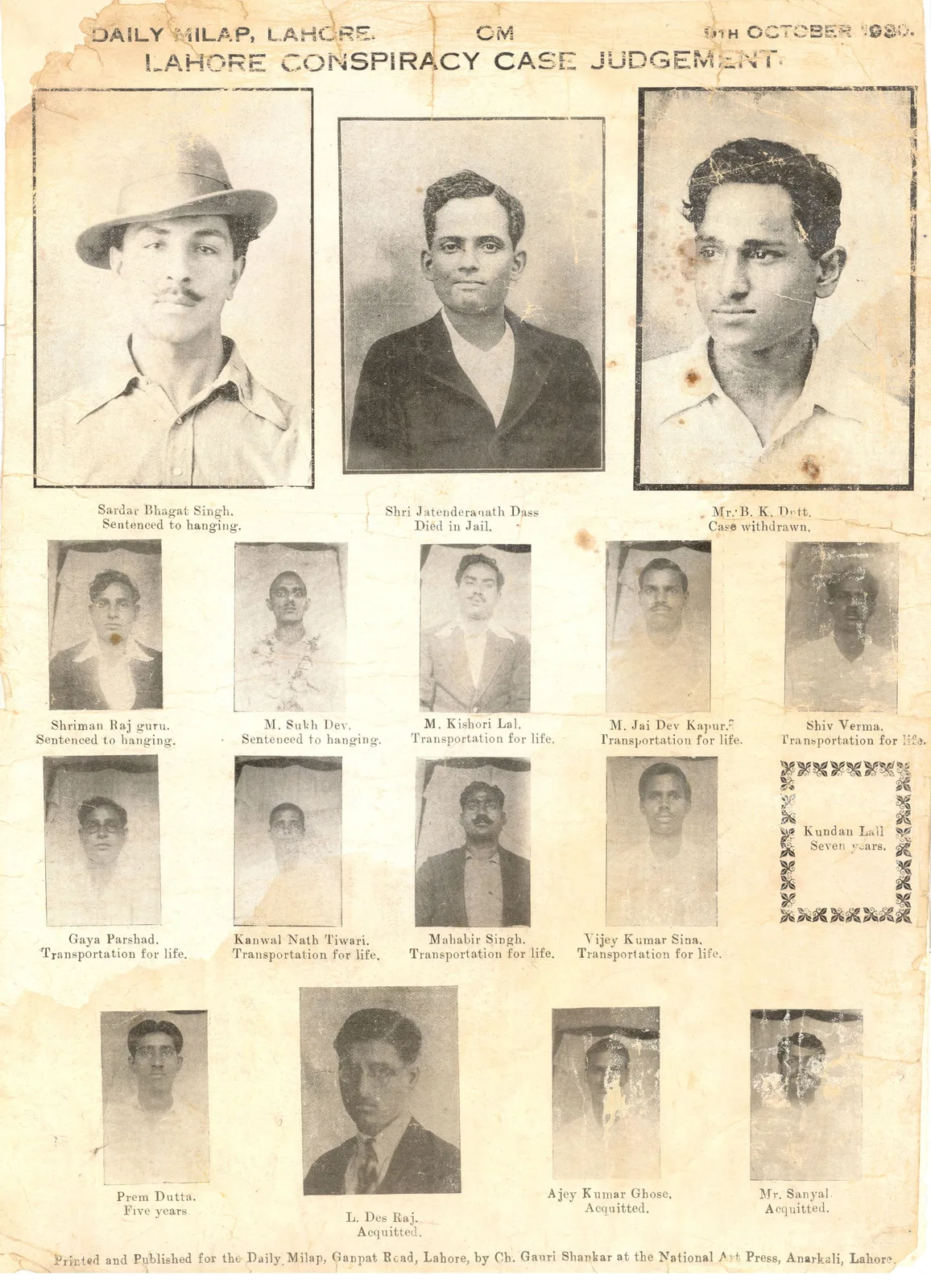
Not a terrorist
His unbelief did not move in the months that were left, but his view of his own method did. In November he wrote to Dutt, who would live, that he himself would go to the gallows gladly, and that Dutt must show the world that revolutionaries could bear anything.5556 In February 1931, in an address to young political workers, he said that he had apparently acted like a terrorist but was not one, that "mere bomb-throwing" was useless and sometimes harmful, and that the work ahead was the slow organising of a mass movement that would take at least twenty years.575859 That is the revision on his timeline, and it concerns the bomb, not his atheism. In a last petition he asked that, since the tribunal had found him guilty of waging war, he be treated as a prisoner of war and shot rather than hanged.6061
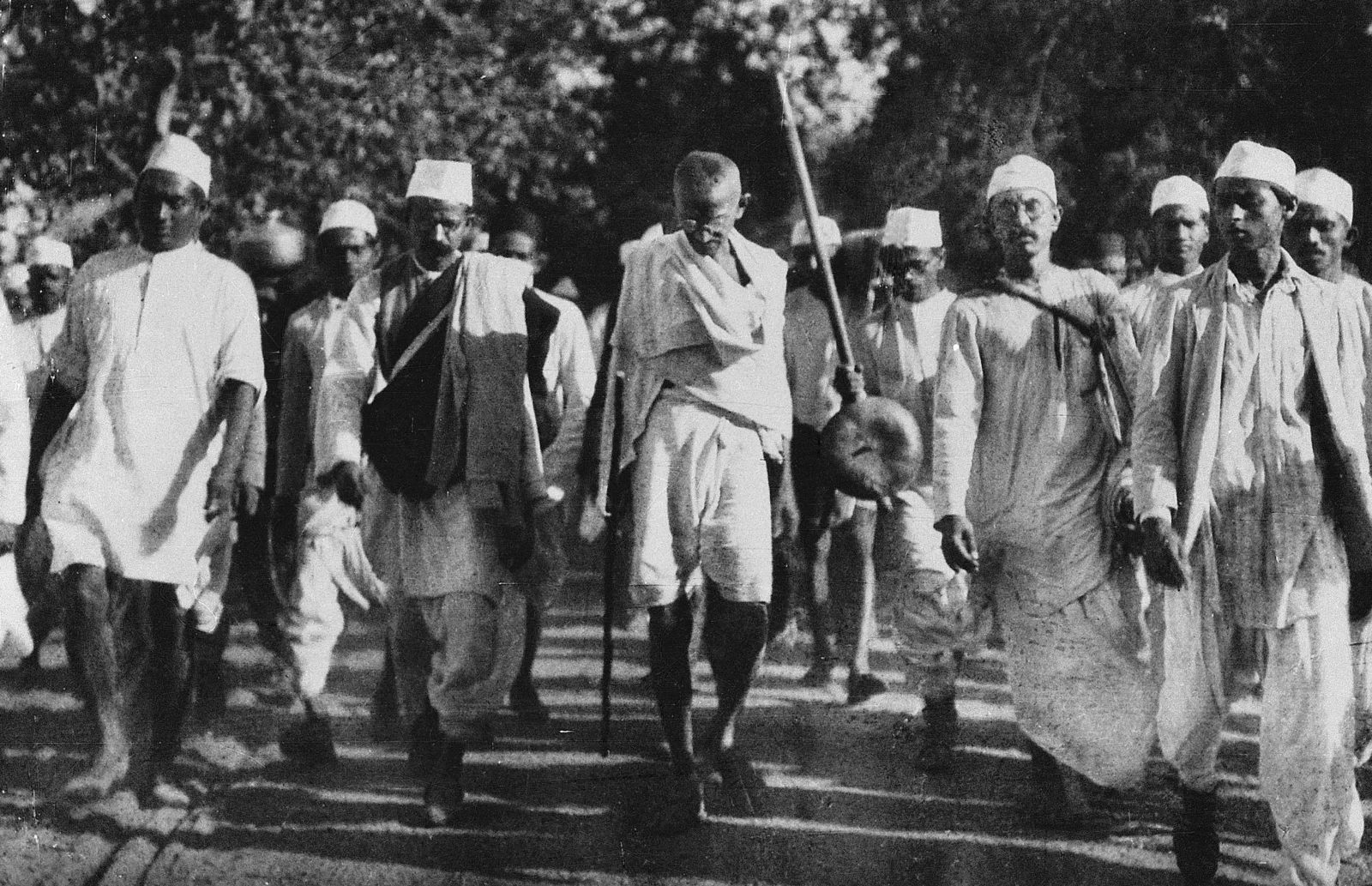
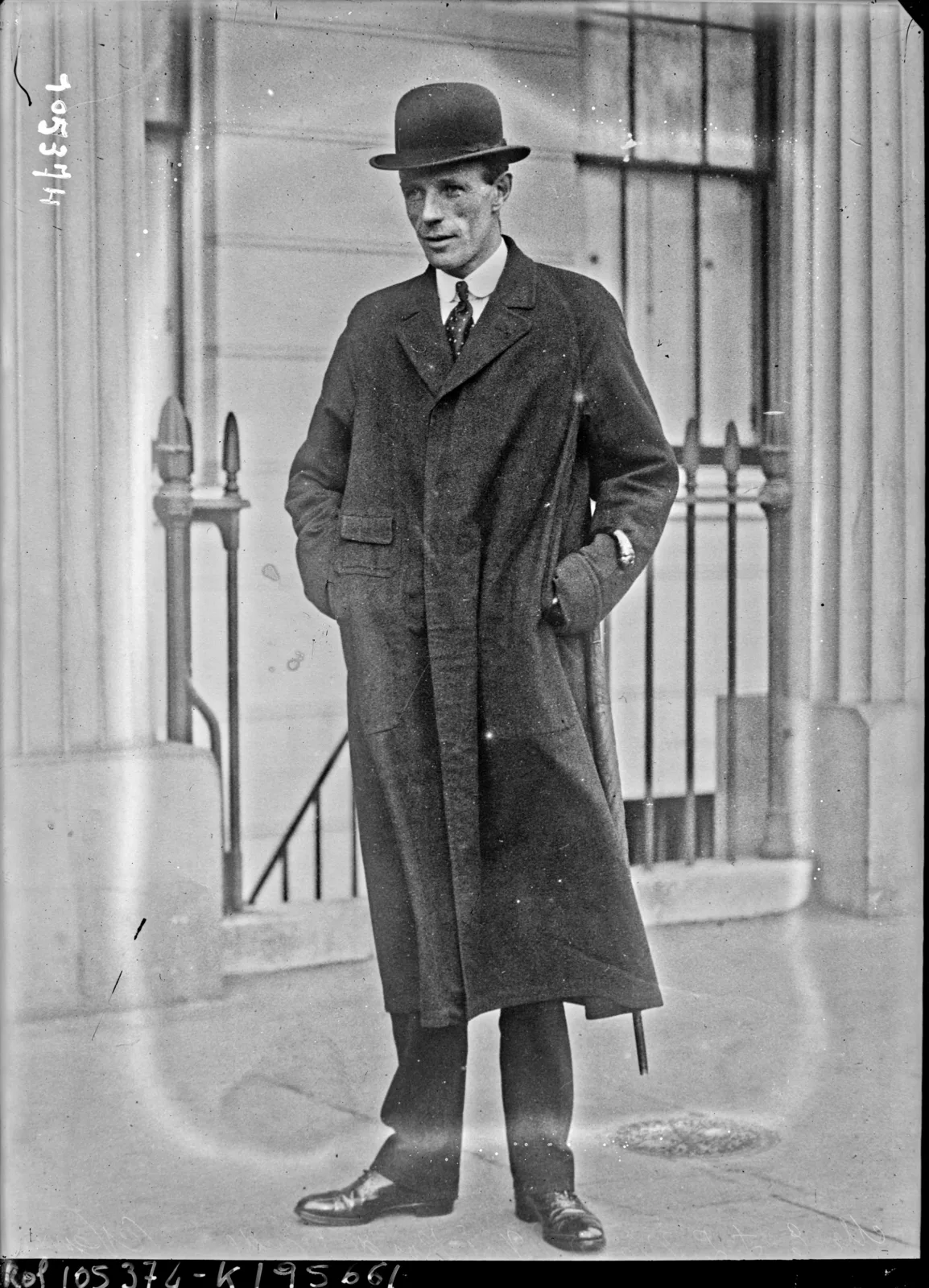
His most important critic was also his last advocate. Gandhi raised the case with the Viceroy, Lord Irwin, in February 1931; Irwin replied that he could see no ground for commutation that would not apply equally to any other violent crime. Gandhi's own report of the meeting says he called Bhagat Singh a brave man but not in his right mind.626364 On 23 March he wrote to the Viceroy once more, arguing that an execution could not be undone and that the revolutionaries had promised to hold their hands if the lives were spared.6566 The three were hanged at Lahore that evening.67
Gandhi spent the following week defending non-violence to crowds who blamed him. At Karachi young men met him with black flags, and American wire reports said they accused him of co-operating with the government that had hanged Bhagat Singh.68 Gandhi called their anger legitimate.69 He said that his head bowed before Bhagat Singh's bravery, but that he wanted a greater bravery, the kind that would mount the gallows without injuring anyone, and he warned the young against following the three men's example.7071 In his own paper he wrote that Bhagat Singh was not a devotee of non-violence but did not subscribe to the religion of violence, and he condemned the government for the hangings.727374 The Congress, meeting at Karachi, disowned political violence "in any shape or form" and in the same resolution recorded "its admiration of the bravery and sacrifice" of the three.75
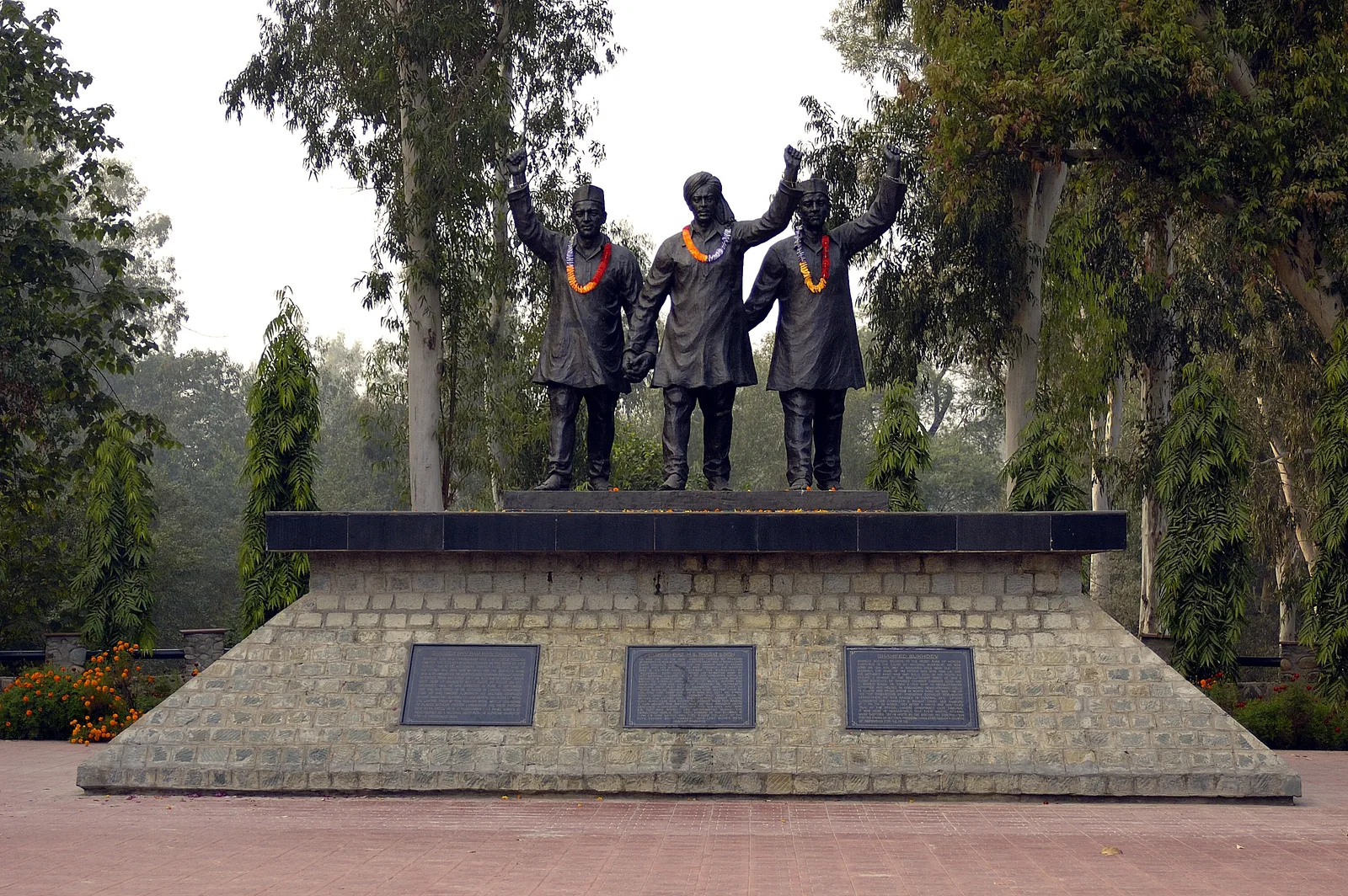
Did his unbelief change shape?
It did not have time to. Bhagat Singh was a devout schoolboy, a doubter in his teens, an atheist by nineteen, and dead at twenty-three. What is remarkable is how little his unbelief bent under the two pressures that test it most. The police offered him prayer as a road to safety in 1927, and he refused it. The gallows offered him prayer as comfort in 1930, and he refused that too, while admitting freely that God gives men a strength they must otherwise find in themselves. The change he did make in his last months was to his politics: he came to think that bombs had been a mistake of method, and said so. His unbelief came, as he told it, from reading: from a crisis in his movement that sent him to Bakunin and Marx for arguments, and from a habit of mind that would not accept on faith what it had not reasoned through. It was the same habit that made him answer his friends' charge of vanity with an essay rather than a denial.
Charles Bradlaugh, the English atheist who was called the Member for India, has his own chapter in this book.
Footnotes
-
Bhagat Singh: Bhagat Singh, "Why I Am an Atheist", written in Lahore Central Jail, 5–6 October 1930; first published in The People (Lahore), 27 September 1931, pp. 195–201 (English). Text: Marxists Internet Archive, HTML proofread by Juan Fajardo, September 2020, from images of the 1931 pages supplied by Prof. Chaman Lal; MIA states "The text itself is in the public domain" (MIA's own markup is CC BY-SA 2.0), opening sentences (The People, 27 Sept 1931, pp. 195–201; MIA 2020). ↩
-
Singh, People, paragraph 1. ↩
-
"Bhagat Singh" (extract saved as
research/notes/wikipedia-map.txt), "Bradlaugh Hall"; Wikidata for coordinates. Used as a map for the dates marked "Wikipedia only" below, "Bhagat Singh", Early life. Accounts differ; see the disputed points. ↩ -
"Bhagat Singh", "Bhagat Singh", Early life. Reported at second hand; the original has not been seen. ↩
-
Bhagat Singh: Singh, People, paragraph 1. ↩
-
Bhagat Singh: Singh, People, paragraph 1. ↩
-
Singh, People, paragraph 3 (from "My atheism is not of so recent origin"). ↩ ↩2
-
Bhagat Singh: Singh, People, paragraph 1. ↩
-
Bhagat Singh: Singh, People, paragraph 1. ↩
-
Singh, People, paragraph 3. ↩
-
"Bhagat Singh", "Bhagat Singh", Early life. ↩
-
Singh, People, paragraphs 4. ↩
-
Bhagat Singh: Singh, People. ↩
-
Bhagat Singh: Singh, People, paragraph 3 of the narrative section. ↩
-
Bhagat Singh: Singh, People. ↩
-
Singh, People, paragraph 5. ↩
-
"Bhagat Singh", "Bhagat Singh", Atheism; Singh, People. ↩
-
Singh, People, paragraph 6. ↩
-
Bhagat Singh: Singh, People. ↩
-
HC Deb 26 November 1928 vol 223 cc5–8, "Late Lala Lajpat Rai" (https://api.parliament.uk/historic-hansard/commons/1928/nov/26/late-lala-lajpat-rai); local
hansard-1928-11-26-lajpat-rai.txt, cc5–8; death date Wikipedia. ↩ -
Earl Winterton, Under-Secretary of State for India, in the Commons, 26 November 1928: Hansard1928, vol 223 cc5–8. ↩
-
Earl Winterton, same answer: Hansard1928, vol 223 cc5–8. ↩
-
HC Deb 22 April 1929 vol 227 cc599–600, "Murder of Mr. J. P. Saunders" (https://api.parliament.uk/historic-hansard/commons/1929/apr/22/murder-of-mr-j-p-saunders); local
hansard-1929-04-22-saunders.txt, cc599–600. ↩ -
HSRA handwritten notice "Beware, Ye Bureaucracy", 18 December 1928, posted in Lahore that night; a copy in his hand was an exhibit in the Lahore Conspiracy Case (MIA note). ↩ ↩2
-
Bhagat Singh (HSRA notice, signed Balraj): notice, "Beware, Ye Bureaucracy". ↩
-
notice, "Beware, Ye Bureaucracy"; "The Red Pamphlet", HSRA notice scattered in the Assembly on 8 April 1929, ("the callous murder of Lala Lajpat Rai"). ↩
-
"The Red Pamphlet", (with MIA transcriber's note); "Joint Statement" of Bhagat Singh and B. K. Dutt in the Assembly Bomb Case, read in court on 6 June 1929 by Asaf Ali (MIA gives the heading date 8 June; its own text says 6 June). ↩
-
"Joint Statement". ↩
-
"Joint Statement". ↩
-
Bhagat Singh and B. K. Dutt: "Joint Statement". ↩
-
Bhagat Singh and B. K. Dutt: "Joint Statement". ↩
-
Bhagat Singh and B. K. Dutt: "Joint Statement". ↩
-
The Collected Works of Mahatma Gandhi, vol. 41 (Publications Division, Government of India, Navajivan Trust copyright by permission; the OCR does not show the year), Internet Archive
TheCollectedWorksOfMahatmaGandhiVolXLI; localresearch/texts/cwmg41.txt, Chronology (June 1 – October 15, 1929). ↩ -
Collected Works of Mahatma Gandhi, pp. 152–3 (Letter to Jawaharlal Nehru, after July 1929). ↩
-
M. K. Gandhi to Jawaharlal Nehru, after July 1929, on the Assembly statement: Collected Works of Mahatma Gandhi, p. 152. ↩
-
MIA 1929-06-17 and 1929-06-24 (headings); same series, vol. 42, id
TheCollectedWorksOfMahatmaGandhiVolXLII; localcwmg42.txt, pp. 6–7 (Young India 17-10-1929, "My Silence"). ↩ -
"Bhagat Singh", "Bhagat Singh", Hunger strike. ↩
-
"Statement of the Undefended Accused", 5 May 1930, written by Bhagat Singh and read by J. N. Sanyal before the Special Tribunal; "Last Petition", undated, addressed in the MIA text to "The Punjab Governor"; "Letter to Father", 4 October 1930 (MIA 2007 from shahidbhagatsingh.org). ↩
-
Letter to Jaidev Gupta, Lahore Central Jail, 24 July 1930 (book list). ↩
-
"Letter to Father". ↩
-
Bhagat Singh: "Letter to Father". ↩
-
Bhagat Singh: "Letter to Father". ↩
-
Singh, People, paragraph 1. ↩
-
Bhagat Singh: Singh, People, paragraph 1. ↩
-
Singh, People, later paragraphs. ↩
-
Bhagat Singh: Singh, People. ↩
-
Singh, People, middle paragraphs. ↩
-
Bhagat Singh: Singh, People. ↩
-
Bhagat Singh: Singh, People. ↩
-
Bhagat Singh: Singh, People. ↩
-
Bhagat Singh: Singh, People, last paragraph. ↩
-
"Last Petition", ("sentenced to death on 7th October 1930"); "Bhagat Singh". ↩
-
Letter to B. K. Dutt, November 1930. ↩
-
Bhagat Singh: DuttLtr. ↩
-
"To Young Political Workers", 2 February 1931. ↩
-
Bhagat Singh: "To Young Political Workers". ↩
-
Bhagat Singh: "To Young Political Workers". ↩
-
"Last Petition". ↩
-
Bhagat Singh: "Last Petition". ↩
-
same series, vol. 45 (December 1930 – April 1931), Publications Division, July 1971, id
HindSwaraj-CWMG-045; localcwmg45.txt, pp. 196–7 (Viceroy's version); pp. 200–1 (Gandhiji's report). ↩ -
Lord Irwin, Viceroy, report of the interview of 18 February 1931: CWMG-45, p. 196. ↩
-
M. K. Gandhi, as he reports telling the Viceroy on 18 February 1931 (private account to G. D. Birla): CWMG-45, pp. 200–1. ↩
-
CWMG-45, pp. 333–4. ↩
-
M. K. Gandhi to the Viceroy, 23 March 1931 (an appeal for mercy by his chief critic): CWMG-45, p. 333. ↩
-
CWMG-45, pp. 335–6; "Bhagat Singh". ↩
-
United Press report, The Milwaukee Leader, 25 March 1931, p. 1 ("Save Gandhi from attack at Karachi" and "Report 20 killed in India rioting"), Chronicling America / Library of Congress, LCCN sn83045293; local
research/texts/ca-milwaukee-leader-1931-03-25-p1.json(JSON text, not .txt, so verify-quotes does not read it). Other LoC newspaper hits for 1931-03-20 to 27 (Washington Daily News, Daily Worker, Indianapolis Times, Milwaukee Leader 26 March p. 6) and for 25 June 1929 (Milwaukee Leader p. 6) are listed in Open questions, p. 1 (25 March 1931). ↩ -
CWMG-45, pp. 344–5 (press interview, Karachi, 26 March 1931). ↩
-
M. K. Gandhi, Congress leader, to the press at Karachi, 26 March 1931: CWMG-45, p. 344. ↩
-
M. K. Gandhi, statement on the execution, New Delhi, 23 March 1931: CWMG-45, p. 335. ↩
-
CWMG-45, pp. 359–61. ↩
-
CWMG-45, p. 360. ↩
-
M. K. Gandhi, Navajivan, 29 March 1931: CWMG-45, p. 359. ↩
-
CWMG-45, p. 363 (Resolution on Bhagat Singh and comrades). ↩
research/notes/wikipedia-map.txt), "Bradlaugh Hall"; Wikidata for coordinates. Used as a map for the dates marked "Wikipedia only" below.; HC Deb 26 November 1928 vol 223 cc5–8, "Late Lala Lajpat Rai" (https://api.parliament.uk/historic-hansard/commons/1928/nov/26/late-lala-lajpat-rai); local hansard-1928-11-26-lajpat-rai.txt.; HC Deb 22 April 1929 vol 227 cc599–600, "Murder of Mr. J. P. Saunders" (https://api.parliament.uk/historic-hansard/commons/1929/apr/22/murder-of-mr-j-p-saunders); local hansard-1929-04-22-saunders.txt.; HSRA handwritten notice "Beware, Ye Bureaucracy", 18 December 1928, posted in Lahore that night; a copy in his hand was an exhibit in the Lahore Conspiracy Case (MIA note).; "The Red Pamphlet", HSRA notice scattered in the Assembly on 8 April 1929.; "Joint Statement" of Bhagat Singh and B. K. Dutt in the Assembly Bomb Case, read in court on 6 June 1929 by Asaf Ali (MIA gives the heading date 8 June; its own text says 6 June).; The Collected Works of Mahatma Gandhi, vol. 41 (Publications Division, Government of India, Navajivan Trust copyright by permission; the OCR does not show the year), Internet Archive TheCollectedWorksOfMahatmaGandhiVolXLI; local research/texts/cwmg41.txt.; same series, vol. 42, id TheCollectedWorksOfMahatmaGandhiVolXLII; local cwmg42.txt.; "Statement of the Undefended Accused", 5 May 1930, written by Bhagat Singh and read by J. N. Sanyal before the Special Tribunal.; "Last Petition", undated, addressed in the MIA text to "The Punjab Governor".; "Letter to Father", 4 October 1930 (MIA 2007 from shahidbhagatsingh.org).; Letter to Jaidev Gupta, Lahore Central Jail, 24 July 1930 (book list).; Letter to B. K. Dutt, November 1930.; "To Young Political Workers", 2 February 1931.; same series, vol. 45 (December 1930 – April 1931), Publications Division, July 1971, id HindSwaraj-CWMG-045; local cwmg45.txt.; United Press report, The Milwaukee Leader, 25 March 1931, p. 1 ("Save Gandhi from attack at Karachi" and "Report 20 killed in India rioting"), Chronicling America / Library of Congress, LCCN sn83045293; local research/texts/ca-milwaukee-leader-1931-03-25-p1.json (JSON text, not .txt, so verify-quotes does not read it). Other LoC newspaper hits for 1931-03-20 to 27 (Washington Daily News, Daily Worker, Indianapolis Times, Milwaukee Leader 26 March p. 6) and for 25 June 1929 (Milwaukee Leader p. 6) are listed in Open questions.In their own words
A new question has cropped up. Is it due to vanity that I do not believe in the existence of an omnipotent, omnipresent and omniscient God?
My atheism is not of so recent origin. I had stopped believing in God when I was an obscure young man, of whose existence my above-mentioned friends were not even aware.
My grandfather under whose influence I was brought up is an orthodox Arya Samajist. An Arya Samajist is anything but an atheist.
There, apart from morning and evening prayers, I used to recite "Gayatri Mantra" for hours and hours. I was perfect devotee in those days.
It was there that I began to think liberally and discuss and criticise all the religious problem, even about God. But still I was a devout believer.
I could never believe in the mythology and doctrines of Sikhism or any other religion. But I had a firm faith in God's existence.
I studied Bakunin, the anarchist leader, something of Marx, the father of communism, and much of Lenin, Trotsky and others-the men who had successfully carried out a revolution in their country. They were all atheists.
"Study" was the cry that reverberated in the corridors of my mind. Study to arm yourself with arguments in favour of your cult. I began to study.
By the end of 1926 I had been convinced as to the baselessness of the theory of existence of an almighty supreme being who created, guided and controlled the universe.
After great consideration I decided that I could not lead myself to believe in and pray to God. No, I never did. That was the real test and I came out successful.
In God man can find very strong consolation and support. Without Him man has to depend upon himself.
I know the moment the rope is fitted around my neck and rafters removed under my feet, that will be the final moment
Let me tell you, British rule is here not because God wills it, but because they possess power and we do not dare to oppose them.
But I do not want the help of any intoxication to meet my fate. I am a realist.
One friend asked me to pray. When informed of my atheism, he said, During your last days you will begin to believe! I said, No, dear Sir, it shall not be.
My life is not so precious, at least to me, as you may probably think it to be. It is not at all worth buying at the cost of my principles.
I feel as though I have been stabbed at the back.
We are next to none in our love for humanity. Far from having any malice against any individual, we hold human life sacred beyond words.
Force when aggressively applied is "violence" and is, therefore, morally unjustifiable, but when it is used in the furtherance of a legitimate cause, it has its moral justification.
Our sole purpose was "to make the deaf hear" and to give the heedless a timely warning.
Sorry for the death of a man. But in this man has died the representative of an institution which is so cruel, lowly and so base that it must be abolished.
Apparently I have acted like a terrorist. But I am not a terrorist. I am a revolutionary who has got such definite ideas of a lengthy programme as is being discussed here.
I do not mean that bombs and pistols are useless, rather the contrary. But I mean to say that mere bomb-throwing is not only useless but sometimes harmful.
Perhaps I am the only man amongst them who is anxiously waiting for the day when I will be fortunate enough to embrace the gallows for my ideal.
we claim to be shot dead instead of to be hanged. It rests with you to prove that you really meant what your court has said.
If the revolutionaries take to bombs and pistols, it is only as a measure of terrible necessity, as a last recourse.
We have only marked the end of an era of Utopian non-violence, of whose futility the rising generation has been convinced beyond the shadow of doubt.
It is easy to kill individuals but you cannot kill the ideas.
we in spite of all radical ideas that we cherish, have not been able to do away with the overidealistic Arya Samajist conception of morality.
The other side
One's head bends before Bhagat Singh's bravery and sacrifice. But I want the greater bravery, if I might say so without offending my young friends, of the meek, the gentle and the non-violent, the bravery that will mount the gallows without injuring, or harbouring any thought of injury to a single soul.
Whatever may be true of other countries, in this country which is teeming with famished millions the cult of violence can have no meaning.
And yet I must warn the youth of the country against following their example.
Bhagat Singh was not a devotee of non-violence, but he did not subscribe to the religion of violence
I am not prepared to believe that the country has benefited by their action. I can see only the harm that has been done.
On merits too I understand that it was prepared by their counsel. It is not the outpourings of earnest souls as you and I thought it was.
Political murders have been condoned before now. It is worth while saving these lives, if thereby many other innocent lives are likely to be saved and maybe even revolutionary crime almost stamped out.
I could not think there was any case for commutation which might not be made with equal force in the case of any other violent crime.
No evidence has been produced to show that the death of Lala Lajpat Rai was due to blows received on that occasion
there was no deliberate or unprovoked attack by the police, and no individual was singled out for assault.
He is undoubtedly a brave man but I would certainly say that he is not in his right mind.
Where accounts differ
| Point | One account | Another | How the page handles it |
|---|---|---|---|
| Date of birth | 27 September 1907 (Wikipedia, body text) | 28 September (the Supreme Court exhibition opened "on 28 September 2007, on the centenary" per Wikipedia; widely given in India) | Say "in September 1907" |
| When he joined the National College | "In the Non-Cooperation days" (Atheist) | 1923 (Wikipedia); Non-Cooperation was withdrawn in February 1922 | Say "in the early 1920s" and quote his phrase; resolve in Maclean or Nayar |
| What first loosened belief | His own account: study of Bakunin, Marx, Lenin and others after the party's crisis of 1925–26 (Atheist) | Disillusion with religion after the Hindu–Muslim riots that followed Non-Cooperation (Wikipedia, unsourced here) | Use his words; add "biographers also point to the riots" only after checking Maclean/Chaman Lal |
| Date and hour of the execution | 23 March 1931, 7:30 pm, hurried forward from 24 March (Wikipedia); Gandhi's statement is dated New Delhi, 23 March | The Milwaukee Leader of 25 March says "yesterday" (the 24th local) | Say "on the evening of 23 March 1931"; keep the United Press wording out of the script |
| The last petition's addressee and date | Addressed to the Punjab Governor, undated (MIA) | A letter to Lord Irwin asking to be treated as a prisoner of war (Wikipedia) | Say "a last petition" and do not name the addressee |
| Wording of his "last letter" | "we claim to be shot dead instead of to be hanged" (Petition, MIA) | "Put me into the mouth of a cannon and blow me off" (as Gandhi quotes it, Navajivan 29 March 1931) | Quote the petition; note that Gandhi quoted a different wording |
| Casualties at Jallianwala Bagh | At least 379 killed, about 1,200 wounded (Hunter, minority section) | Indian estimates were higher (not checked here) | Say "the official count was 379 dead; Indian accounts say far more" only after one Indian estimate is sourced |
| Injuries from the Assembly bombs | "slight abrasions in less than half a dozen cases" (Statement, their account) | Wikipedia says some members, including Sir George Schuster, were injured | Say "no one was killed; a few were slightly hurt" (check a contemporary report) |
| Who "Balraj" was | Used on Bhagat Singh's notices (the notices say he wrote them: MIA note on 1929 notice) | MIA transcriber: pen name of Azad as commander | Say "signed with the name Balraj" |
| Date of the Joint Statement | Read in court 6 June 1929 (Statement text) | MIA heading date 8 June 1929 | Say "on 6 June 1929" |
| Name of the book on atheism | "Nirlamba Swami" (first mention) | "Soham Swami's 'Common Sense'" (later in the same essay) | Say "a book called Common Sense" |
List of illustrations
This page uses only public-domain and Creative Commons images; each is credited with its source and licence.
- Bhagat Singh in prison (Commons date: between 1927 and 1929) — Unknown author, between 1927 and 1929 · Photograph of Bhagat Singh in prison, c. 1927-29, via Wikimedia Commons (Public domain) · Commons licence box {{PD-India}}: "This work is in the public domain in India because its term of copyright has expired or it is ineligible for copyright" (photographs: 60 years after first publication); also {{PD-1996}} (public domain in India on the URAA date, so not restored in the US)
- D.A.V. schools system, Lahore (plate from The Arya Samaj, 1915) — Lala Lajpat Rai (book author); photograph unknown, 1915 · Plate in Lajpat Rai, The Arya Samaj (London: Longmans, 1915), via Wikimedia Commons (Public domain) · Public domain (published before 1931). Commons licence box {{PD-old-70}} (published 1915)
- National College drama club, Lahore, 1924 (Bhagat Singh fourth from right per Commons) — Unknown author, 1924-09-11 · Drama club photograph, National College, Lahore, 1924, via Wikimedia Commons (Public domain) · Commons licence box {{PD-India}}: "This work is in the public domain in India because its term of copyright has expired or it is ineligible for copyright" (photographs: 60 years after first publication)
- Title page, Bakunin, Dieu et l'Etat, first printing — Mikhail Bakunin (www.bibliothekderfreien.de scan), first edition (year not stated on Commons; 2007-01-17 is the upload date) · Bakunin, Dieu et l'Etat, first print, via Wikimedia Commons (Public domain) · Public domain (published before 1931). Commons licence box {{PD-old}}
- Vladimir Lenin, 1920 — Unknown photographer, 1920 · Lenin, 1920, via Wikimedia Commons (Public domain) · Public domain (published before 1931). Commons licence box {{PD-Russia}} (1920 photograph)
- Earl Winterton (Bain News Service) — Bain News Service, publisher, 1923 · Bain News Service, Library of Congress Prints and Photographs Division (LCCN 2014698871) via Wikimedia Commons (Public domain) · Public domain (published before 1931). Commons licence box {{PD-Bain}} {{PD-US-no notice}}; Library of Congress Bain collection, LCCN 2014698871
- HSRA notice posted after the Saunders shooting, December 1928 — Chandrashekhar Azad (signed 'Balraj'); scan from The Tribune (2008), 1928-12 · HSRA notice, December 1928, via Wikimedia Commons (Public domain) · Public domain (published before 1931). Commons licence box {{PD-India}}; Commons description: "Copyright expired in India, as the author of this pamphlet died in 1931. Pamphlet was published in December 1928."
- First Information Report no. 113, New Delhi Police Station, 8 April 1929 — Delhi police (unknown photographer of the scan), 1929-04-08 · FIR no. 113, New Delhi Police Station, 8 April 1929, via Wikimedia Commons (Public domain) · Commons licence box {{PD-scan}}: a mere mechanical scan of a public domain original (an official record of 1929)
- The Tribune, 10 April 1929: front-page headline on the bombing of the Central Legislative Assembly — The Tribune (Lahore); scan from a 2020 book, 1929-04-10 · The Tribune, 10 April 1929, via Wikimedia Commons (Public domain) · Commons licence box {{PD-scan}}: mere mechanical scan of a public domain original; the 1929 newspaper is public domain in India (60 years) and in the US (published before 1931)
- Jatindra Nath Das, c. 1929 (Krishna Printing House, Lahore) — Unknown author; published by Krishna Printing House, Lahore, c. 1929 · Jatindra Nath Das, published by Krishna Printing House, Lahore, c. 1929, via Wikimedia Commons (Public domain) · Commons licence box {{PD-India}}: "This work is in the public domain in India because its term of copyright has expired or it is ineligible for copyright" (photographs: 60 years after first publication) (Commons permission box; published c. 1929 so US-expired too)
- 'Why I Am an Atheist', The People (Lahore), 27 September 1931, pp. 195-201: page image 1 of 5 in the MIA PDF — Bhagat Singh (author); The People, Lahore (publisher); page images supplied to MIA by Prof. Chaman Lal, 1931-09-27 · life+60) expired 1 Jan 1992 The essay was written 5-6 October 1930; author died 23 March 1931, so public domain in India (life+60); US: published 1931, enters the public domain 1 Jan 2027 (UNCERTAIN until then; see fact sheet copyright note). MIA claims CC BY-SA 2.0 only for its own HTML document; its claim over the page scans is not stated · MIA page statement: "Source: Images of pages 195-201 of the 27 September 1931 edition of The People, provided by Prof. Chaman Lal ... CopyLeft: Creative Commons Attribution-Share Alike license 2.0, by Marxists Internet Archive, 2020, on this document. The text itself is in the public domain. BUT the page itself carries the 1931 editor's note (viewed on page 1): [By special arrangement The People is permitted to print some of Bhagat Singh's writings in jail ... Copyright vests in S. Kishan Singh.-- EDITOR.] - a 1931 copyright claim by his father Kishan Singh; Indian term (author d. 1931
- Bhagat Singh, Sukhdev Thapar and Shivaram Rajguru (composite portrait) — Uploaded by Susnigdh; photographs unknown, before 1931 · Bhagat Singh, Sukhdev, Rajguru, composite, before 1931, via Wikimedia Commons (Public domain) · Commons licence box {{PD-India-photo-1958}}: "This photograph is currently in the public domain in India because ... it was created before 1958 (as per the S.21 of Copyright Act 1911)"; and {{PD-1996}}
- Lahore Conspiracy Case poster, 9 October 1930 — Unknown, 1930-10-09 (filename) · Lahore Conspiracy Case poster, October 1930, via Wikimedia Commons (Public domain) · Commons licence box {{PD-India}}: "This work is in the public domain in India because its term of copyright has expired or it is ineligible for copyright" (photographs: 60 years after first publication). Published 1930, so also US-expired as of 1 Jan 2026
- Gandhi during the Salt March, March 1930 — Unknown author, 1930-03 · Gandhi during the Salt March, 1930, via Wikimedia Commons (Public domain) · Commons licence box {{PD-India}}: "This work is in the public domain in India because its term of copyright has expired or it is ineligible for copyright" (photographs: 60 years after first publication); also {{PD-India-URAA}} (public domain in India on the URAA date, so not restored in the US). Published 1930, so US-expired as of 1 Jan 2026
- Mr E. F. L. Wood (Lord Irwin), Viceroy of India, press photograph, 1925 — Agence Rol (Bibliotheque nationale de France, Gallica ark:/12148/btv1b531553378), 1925 · Agence Rol, Bibliotheque nationale de France via Wikimedia Commons (Public domain) · Public domain (published before 1931). Commons licence box {{PD-France}} {{PD-1996}} {{PD-US-expired}} (1925 photograph, BnF Rol collection)
- National Martyrs Memorial, Hussainiwala (2007) — Giridhar Appaji Nag Y (Flickr 'appaji'), 2007-11-27 · National Martyrs Memorial, Hussainiwala, Giridhar Appaji Nag Y via Wikimedia Commons (CC BY 2.0) · Commons licence box {{cc-by-2.0}}, Flickr licence review passed 30 August 2011 (FlickreviewR)
Sources
Tier 1 — the subject's own words (writings, letters, diaries, trial records)
- [Atheist] Bhagat Singh, "Why I Am an Atheist", written in Lahore Central Jail, 5–6 October 1930; first published in The People (Lahore), 27 September 1931, pp. 195–201 (English). Text: Marxists Internet Archive, HTML proofread by Juan Fajardo, September 2020, from images of the 1931 pages supplied by Prof. Chaman Lal; MIA states "The text itself is in the public domain" (MIA's own markup is CC BY-SA 2.0). https://www.marxists.org/archive/bhagat-singh/1930/10/05.htm. Local copy
research/texts/mia-1930-10-05.txt(and HTMLessay-mia.html). Cited by paragraph order (paragraph 1 = "A new question has cropped up"), since the MIA text does not give the 1931 page for each passage. An earlier MIA version (2006) was translated from Urdu and is not used. - [Father] "Letter to Father", 4 October 1930 (MIA 2007 from shahidbhagatsingh.org). https://www.marxists.org/archive/bhagat-singh/1930/10/04.htm. Language of original not stated.
- [Statement] "Joint Statement" of Bhagat Singh and B. K. Dutt in the Assembly Bomb Case, read in court on 6 June 1929 by Asaf Ali (MIA gives the heading date 8 June; its own text says 6 June). https://www.marxists.org/archive/bhagat-singh/1929/06/06.htm.
- [Notice1928] HSRA handwritten notice "Beware, Ye Bureaucracy", 18 December 1928, posted in Lahore that night; a copy in his hand was an exhibit in the Lahore Conspiracy Case (MIA note). https://www.marxists.org/archive/bhagat-singh/1928/12/18.htm.
- [Notice1929] "The Red Pamphlet", HSRA notice scattered in the Assembly on 8 April 1929. https://www.marxists.org/archive/bhagat-singh/1929/04/08.htm.
- [Sukhdev] "Letter to Shaheed Sukhdev", 5 April 1929 (recovered from Sukhdev at his arrest on 13 April and used as an exhibit, per MIA note). https://www.marxists.org/archive/bhagat-singh/1929/04/05.htm. Translated? Unknown.
- [Suicide] "Regarding Suicide", letter to Sukhdev, 1930 (MIA). https://www.marxists.org/archive/bhagat-singh/1930/x01/x02.htm. The English reads as a modern translation; lead only for quotation.
- [Undefended] "Statement of the Undefended Accused", 5 May 1930, written by Bhagat Singh and read by J. N. Sanyal before the Special Tribunal. https://www.marxists.org/archive/bhagat-singh/1930/05/05.htm.
- [Refusal] "Reasons for Refusing to Attend the Court" (MIA heading: January 1930; the text refers to an order of 4 February 1930 and a boycott begun 29 January 1930, so the heading date is doubtful). https://www.marxists.org/archive/bhagat-singh/1930/01/x01.htm.
- [DuttLtr] Letter to B. K. Dutt, November 1930. https://www.marxists.org/archive/bhagat-singh/1930/11/x01.htm.
- [YPW] "To Young Political Workers", 2 February 1931. https://www.marxists.org/archive/bhagat-singh/1931/02/02.htm.
- [Petition] "Last Petition", undated, addressed in the MIA text to "The Punjab Governor". https://www.marxists.org/archive/bhagat-singh/1931/x01/x01.htm.
- [Jaidev] Letter to Jaidev Gupta, Lahore Central Jail, 24 July 1930 (book list). https://www.marxists.org/archive/bhagat-singh/1930/07/24.htm.
- [Telegram] "Telegram on Lenin's Death Anniversary", 21 January 1930 (MIA note describes the red scarves). https://www.marxists.org/archive/bhagat-singh/1930/01/21.htm.
- Other MIA texts saved in
research/texts/(mia-*.txt) but not yet cited: the 1923 language-and-script essay, 1925 Babbar Akali article, the 1929 hunger-strikers' demands and letter to the I.G. Prisons, the Modern Review letter of 24 December 1929, the Lahore High Court statement, the 2 May 1930 ordinance protest, the 25 June 1930 "Justice Hilton" piece, the June 1931 Hari Kishan note.
Tier 2 — scholarly biographies and encyclopedias
- [Hunter] Report of the Committee Appointed by the Government of India to Investigate the Disturbances in the Punjab etc. (Cmd. 681, HMSO 1920), Internet Archive id
report-disturbances-punjab; localresearch/texts/hunter1920.txt. - No scholarly biography of Singh is freely scanned (see the copyright note). Leads to buy or borrow: Kama Maclean, A Revolutionary History of Interwar India (Hurst/Penguin 2015); A. G. Noorani, The Trial of Bhagat Singh (1996); Kuldip Nayar, Without Fear (2007); S. Irfan Habib, To Make the Deaf Hear (2007); Chaman Lal (ed.), The Bhagat Singh Reader and Jail Notebook; Shiv Verma (ed.), Selected Writings of Shaheed Bhagat Singh (1986).
Tier 3 — popular biographies and journalism
- [MilLeader] United Press report, The Milwaukee Leader, 25 March 1931, p. 1 ("Save Gandhi from attack at Karachi" and "Report 20 killed in India rioting"), Chronicling America / Library of Congress, LCCN sn83045293; local
research/texts/ca-milwaukee-leader-1931-03-25-p1.json(JSON text, not .txt, so verify-quotes does not read it). Other LoC newspaper hits for 1931-03-20 to 27 (Washington Daily News, Daily Worker, Indianapolis Times, Milwaukee Leader 26 March p. 6) and for 25 June 1929 (Milwaukee Leader p. 6) are listed in Open questions.
Tier 4 — maps to other sources only (Wikipedia and similar). Never cited in the script.
- [Wikipedia] "Bhagat Singh" (extract saved as
research/notes/wikipedia-map.txt), "Bradlaugh Hall"; Wikidata for coordinates. Used as a map for the dates marked "Wikipedia only" below.
Opposition sources — contemporary critics and religious responses
- [CWMG-41] The Collected Works of Mahatma Gandhi, vol. 41 (Publications Division, Government of India, Navajivan Trust copyright by permission; the OCR does not show the year), Internet Archive
TheCollectedWorksOfMahatmaGandhiVolXLI; localresearch/texts/cwmg41.txt. - [CWMG-42] same series, vol. 42, id
TheCollectedWorksOfMahatmaGandhiVolXLII; localcwmg42.txt. - [CWMG-45] same series, vol. 45 (December 1930 – April 1931), Publications Division, July 1971, id
HindSwaraj-CWMG-045; localcwmg45.txt. - [Hansard1928] HC Deb 26 November 1928 vol 223 cc5–8, "Late Lala Lajpat Rai" (https://api.parliament.uk/historic-hansard/commons/1928/nov/26/late-lala-lajpat-rai); local
hansard-1928-11-26-lajpat-rai.txt. - [Hansard1929] HC Deb 22 April 1929 vol 227 cc599–600, "Murder of Mr. J. P. Saunders" (https://api.parliament.uk/historic-hansard/commons/1929/apr/22/murder-of-mr-j-p-saunders); local
hansard-1929-04-22-saunders.txt.
Related lives
Charles Bradlaugh (episode 02): Bradlaugh Hall in Lahore (built c. 1900, named after him; Indian National Congress venue) stands in the city where Singh studied, was tried and was hanged; Bradlaugh sat as "the Member for India" and died in 1891 (fact sheet 02, claim). Whether Singh or the Naujawan Bharat Sabha used Bradlaugh Hall is NOT verified (see Open questions); do not claim it. Alternative: Robert G. Ingersoll or Emma Goldman (anarchism and deportation).
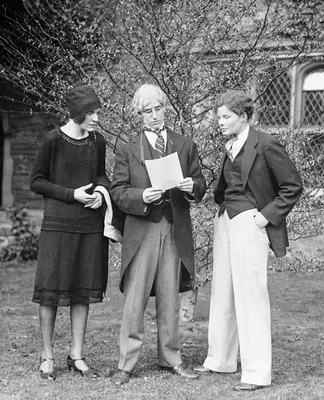
Katharine Hepburn
Katharine Hepburn did not lose a faith but inherited an unbelief, from Ingersoll-going grandparents and a father who called Christianity bunk. She held it through her brother's death when she was thirteen. She stated it plainly only once, at eighty-four, in 1991. In her last talks she softened the word to a "higher power", while keeping the same creed of kindness without heaven or hell.
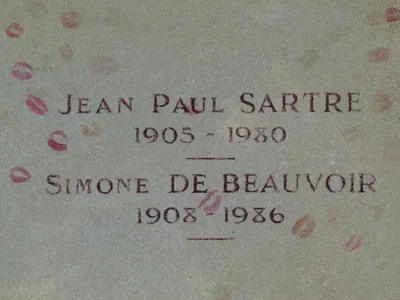
Simone de Beauvoir
Simone de Beauvoir was raised by a devout mother and an unbelieving father as an exalted Catholic girl who thought of becoming a nun. She lost her faith gradually at about fourteen, and at eighteen felt its meaning as the word "alone". She did not campaign against belief but built an ethics on its absence (1944–47), arguing that without God we are wholly responsible, and wrote The Second Sex (1949), which the Vatican banned. She held to the position through the death of her believing mother (1963) and what she saw as Sartre's last turn toward religious language (1980).
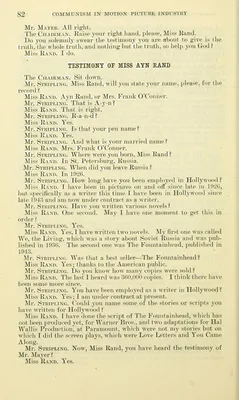
Ayn Rand
Ayn Rand was born Alisa Rosenbaum in St Petersburg, and left no account of a childhood faith or its loss. From her first philosophic journal in 1934 she made the rejection of faith the foundation of a philosophy of reason, and said so plainly from the 1940s to the 1960s. Late in life she changed only the label ("Objectivist") and the tone ("intransigent, though not militant"), never the position.
Jean-Paul Sartre
Jean-Paul Sartre was baptised into a family whose faith was more form than conviction. By his own account the belief never took root: it went first through his grandparents' indifference, and then, one morning at La Rochelle in 1917, in a single thought that God did not exist. He made that absence the premise of a philosophy of freedom, and spent years expelling the substitute faith of writing as salvation. In old age he admitted that traces of the idea of God remained in him.