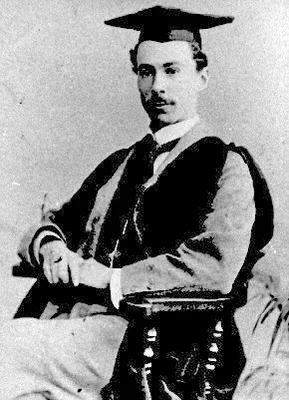
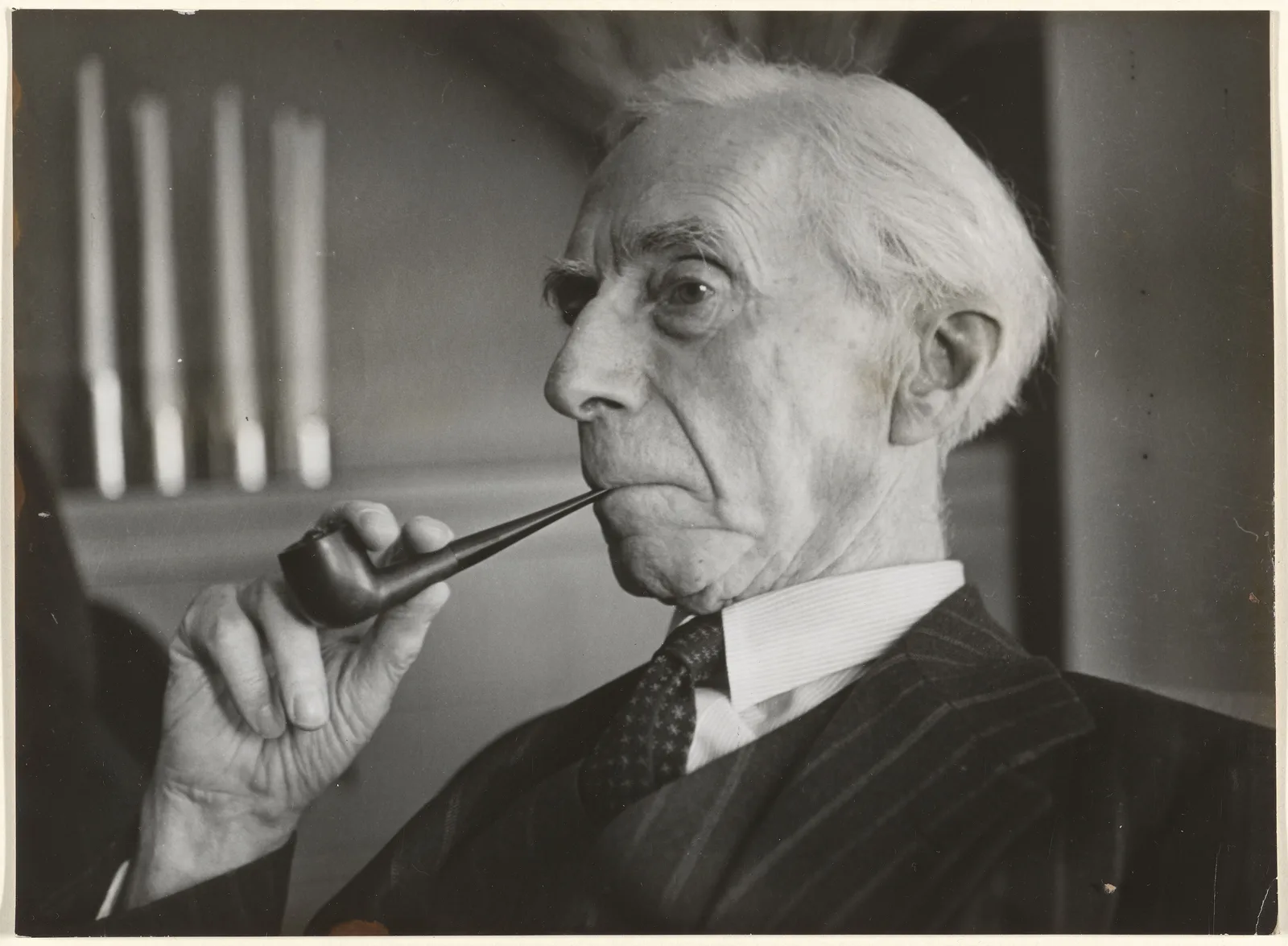
Bertrand Russell was raised in his grandmother's devout Unitarian household after his freethinking parents died. At eighteen he gave up the First Cause over a sentence of Mill's. He tried for twenty years to keep a religion without God, then declared himself a dissenter from all religions, and paid for it in 1940. He never claimed more than that there was no evidence for God.
The belief timeline
- Faith (1876–1888) — Raised at Pembroke Lodge in his grandmother's Presbyterian, later Unitarian, faith [7][11]
- Doubt (1888–1890) — Secret Greek-letter journal (lead); at eighteen Mill's sentence breaks the First Cause argument [14][17]
- Declaration (1903) — "A Free Man's Worship": worship only the God created by our own love of the good; the world of science is purposeless [23][24]
- Cost (1940) — City College appointment voided in Kay v. Board of Higher Education [55][57]
- Revision (1912–1927) — Religion without dogma (1912), "less convinced" of objective good (1917), cannot prove no God (1925), against dogmatic negations (1928) [26][29][39][48]
Notes to the timeline (12)
- [7] Lady Russell's family, the Mintos, belonged to the Presbyterian Church of Scotland; "In the latter half of her life she came gradually to a Unitarian faith, which she held with earnestness to the last" — Desmond MacCarthy and Agatha Russell, eds., Lady John Russell: A Memoir (New York: John Lane, 1911), pp. 8–9.
- [11] In 1928 he said "I had all the benefits of a Christian education" — Bertrand Russell, Why I Am Not a Christian (Little Blue Book No. 1372, Girard, Kansas: Haldeman-Julius, 1929), the 1927 Battersea lecture plus a second address, "Why I Am a Rationalist.", p. 29.
- [14] In 1888–89 he kept a secret journal in Greek letters recording doubts about free will, immortality and God — Autobiography vol. 1 (1967) ch. "Adolescence"; not read, copyrighted. Not verified.
- [17] Russell: he long accepted the First Cause argument until, at eighteen, he read Mill's Autobiography — Russell, Why I Am Not a Christian, p. 7.
- [23] "A Free Man's Worship" was written in 1902 and printed in the Independent Review, December 1903 — Bertrand Russell, Mysticism and Logic and Other Essays (London: Allen & Unwin, 1917 text; the scan is the 1959 impression, page numbers as 1917), pp. v, 46 note.
- [24] The essay pictures a world "even more purposeless, more void of meaning," builds the soul's home on "unyielding despair," and says man's freedom is to "worship only the God created by our own love of the good" — Russell, Mysticism and Logic and Other Essays, pp. 47–50.
- [55] In 1940 the Board of Higher Education appointed him to the chair of philosophy at City College, New York; protests followed — Matter of Kay v. Board of Higher Education, 173 Misc. 943 (N.Y. Sup. Ct., N.Y. County, 30 March 1940), McGeehan, J.; [Kay AD] 260 App. Div. 9 (1st Dept, 19 June 1940); [Kay CA] 284 N.Y. 578 (8 October 1940). Harvard Caselaw Access Project,, p. 1 of opinion; Andrew David Irvine, "Bertrand Russell," Stanford Encyclopedia of Philosophy (rev. 15 October 2024), §1.
- [57] McGeehan, 30 March 1940: "I am completely dismissing any question of Mr. Russell's attacks upon religion," but held the appointment void — Matter of Kay v. Board….
- [26] In 1917 he wrote that the essay's ethical position "is not quite identical with that which I hold now," yet its attitude is "the one which must be adopted... by those who have no dogmatic religious beliefs" — Russell, Mysticism and Logic and Other Essays, p. v.
- [29] Its argument: religion survives "the decay of traditional religious beliefs"; "Such a life in the whole is possible without dogma"; "the religion which has no dogma is greater and more religious"; "The essence of religion, then, lies in subordination of the finite part of our life to the infinite part" — Bertrand Russell, "The Essence of Religion," Hibbert Journal, vol. XI no. 1 (October 1912), pp. 46–62, pp. 46, 51, 60.
- [39] "God and immortality... find no support in science"; "I do not pretend to be able to prove that there is no God. I equally cannot prove that Satan is a fiction" — Bertrand Russell, What I Believe (London: Kegan Paul; New York: Dutton, 1925; Today and Tomorrow series), p. 12.
- [48] Rationalism: "we ought not to commit ourselves to dogmatic negations any more than to dogmatic affirmations" — Russell, Why I Am Not a Christian, p. 28.
Who Made God?
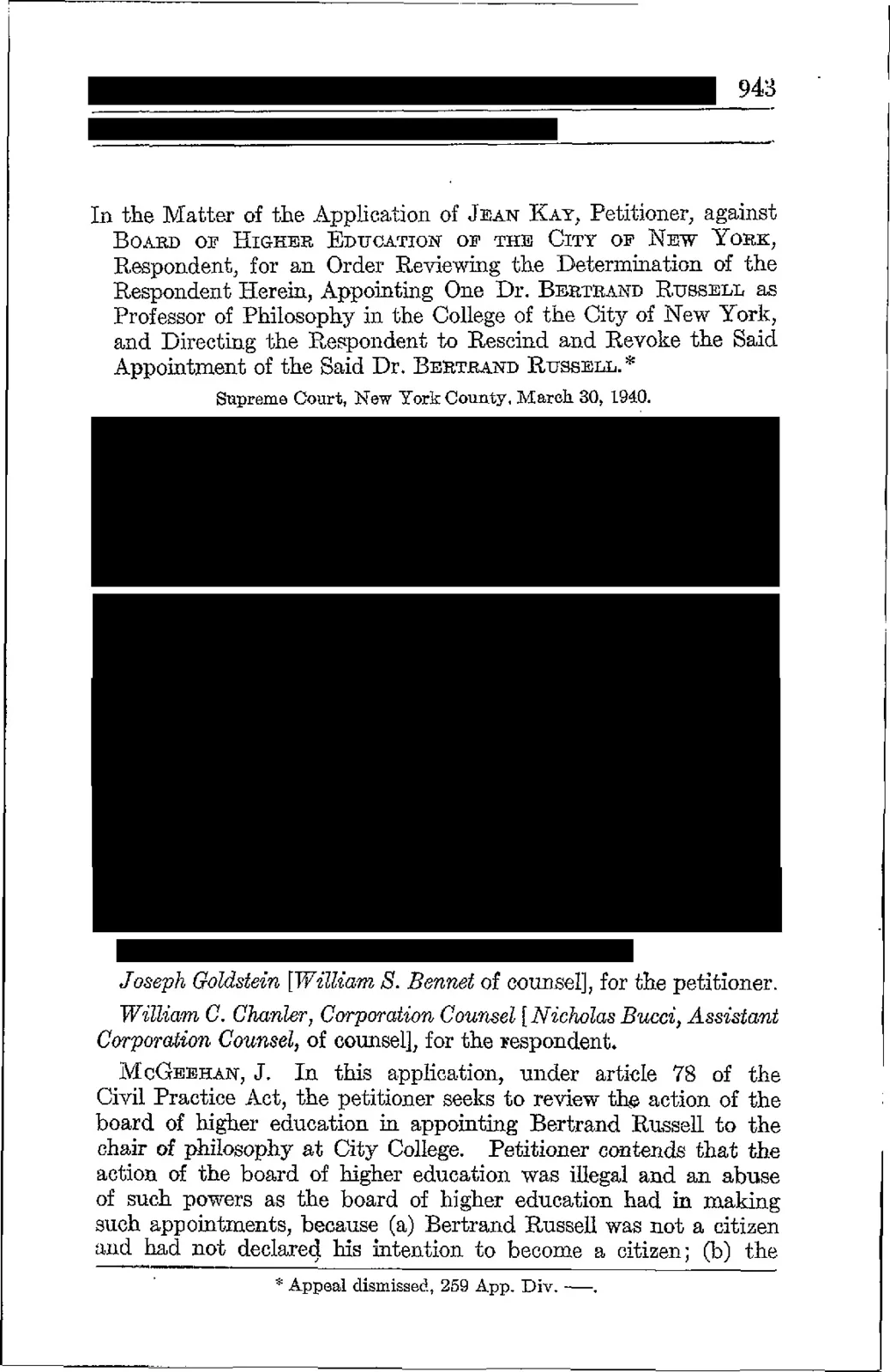
On 30 March 1940 a judge of the Supreme Court of New York County decided that one of the best-known philosophers in the world could not teach philosophy at the City College of New York. The case had been brought by a taxpayer, Jean Kay, who argued that the appointment of the Englishman Bertrand Russell "was against public policy because of the teachings of Bertrand Russell and his immoral character."1 Justice John McGeehan agreed. He quoted passages from Russell's books on marriage and education, said that appointing him would be "in effect establishing a chair of indecency," and added that "academic freedom does not mean academic license."23 He was careful to say one more thing: "I am completely dismissing any question of Mr. Russell's attacks upon religion."4
Not everyone believed him. A modern encyclopedia of philosophy says plainly that the decision was "based partly on Russell's atheism," and accounts of the case still differ on what really moved it.5 What is certain is that by 1940 Russell had spent almost forty years saying in public what he thought about God, and that by his own account his doubts went back to a book he read at eighteen. This chapter follows him from a pious grandmother's house in Richmond Park to that courtroom, and asks what his unbelief became.
Pembroke Lodge
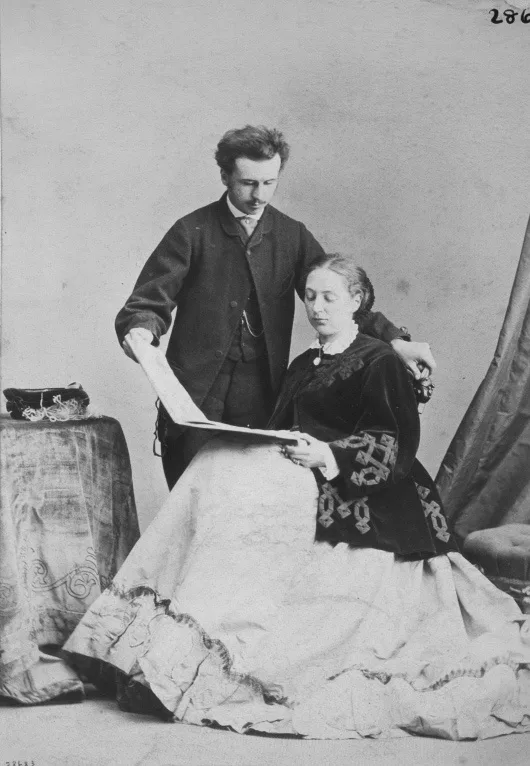
He was born on 18 May 1872 at Ravenscroft, near Trellech in Monmouthshire, into the family of the statesman Lord John Russell.6 His parents, Viscount and Viscountess Amberley, were freethinkers. His mother and his six-year-old sister Rachel died of diphtheria within days of each other in the summer of 1874, and his father died in January 1876, at thirty-three.78 The scholar Benjamin Jowett, writing to the boys' grandmother, said that some people grieved that the Amberleys "had not the ordinary hopes and consolations of religion," and answered them himself: "God does not regard men with reference to their opinion about Himself or about a future world, but with reference to what they really are."910 Amberley had wanted his sons raised as freethinkers. Their grandparents, the modern account says, overturned his will to prevent it.11
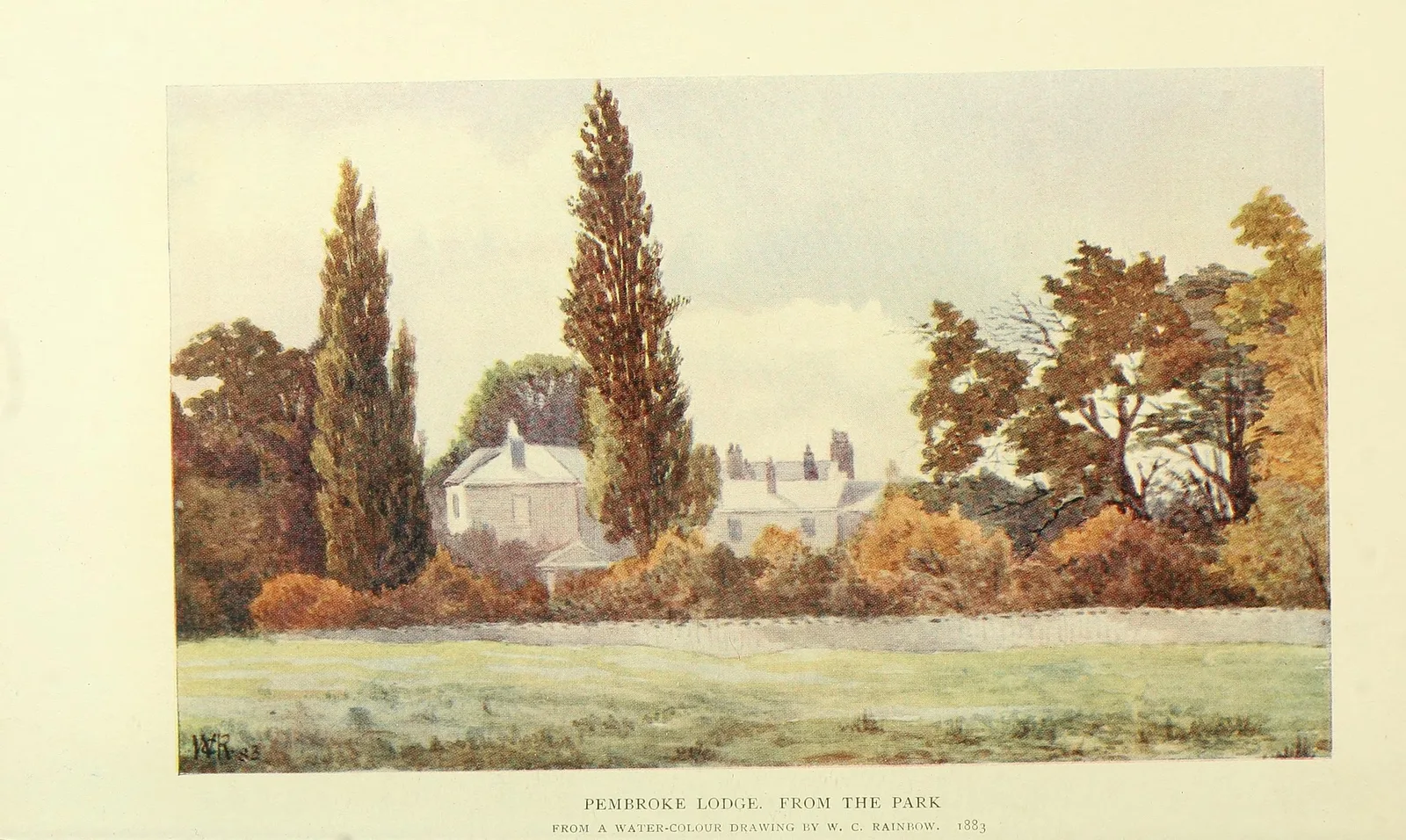
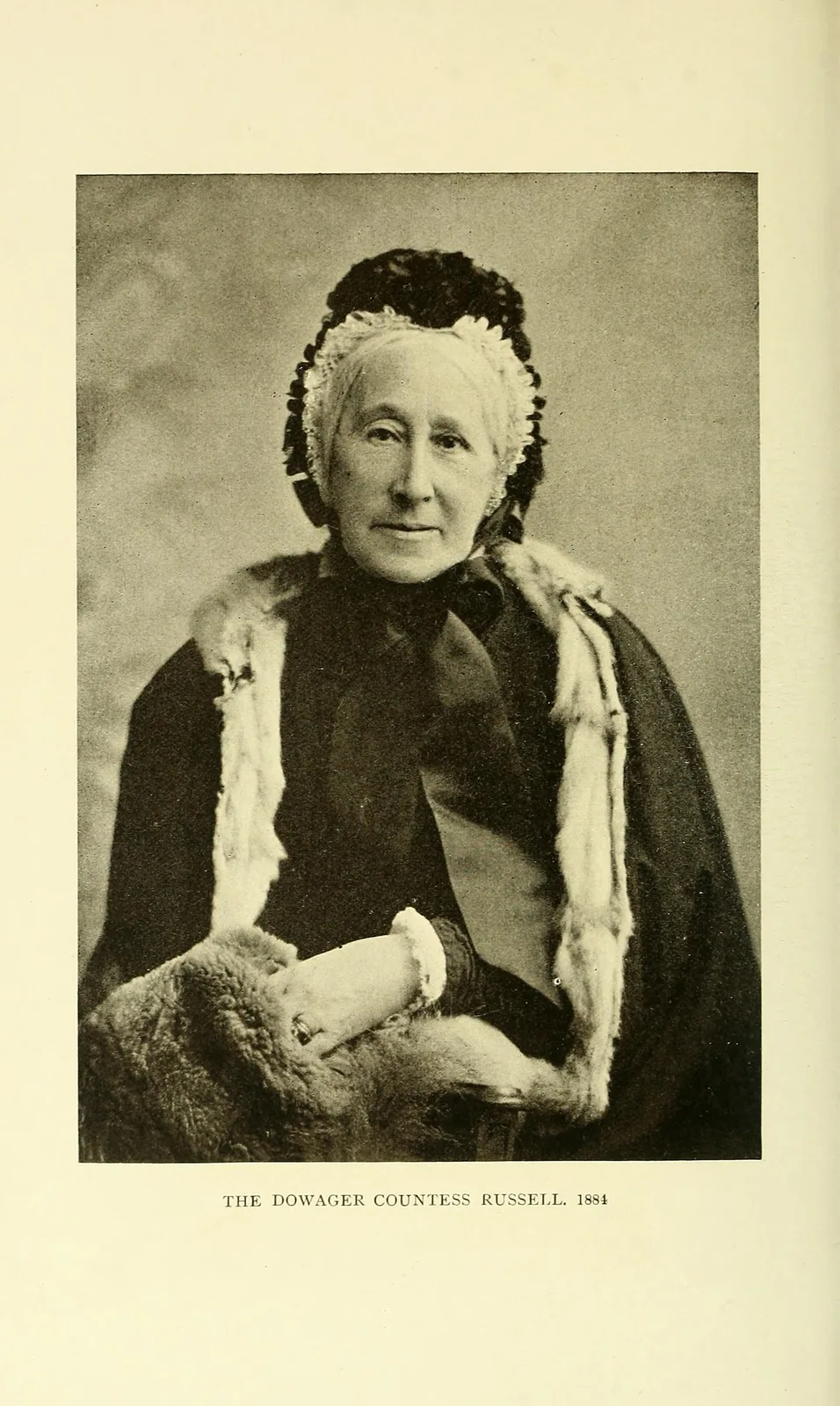
So the two boys, Frank and Bertrand, came to live at Pembroke Lodge in Richmond Park, the house Queen Victoria had given for life to their grandfather, Lord John Russell. He died in 1878, and their grandmother raised them.812 Lady Russell had been brought up in the Presbyterian Church of Scotland, and in the second half of her life she came gradually to a Unitarian faith, "which she held with earnestness to the last."13 She did not hate unbelievers, but she grieved over them. Writing to her younger son in 1870, she called those who "dance on the ruins of all that has hitherto sustained their fellow-creatures" woefully wrong, and added a sentence that is both a reproach and a hope: "I believe that many of those who deem themselves sceptics or atheists retain, after all, enough of the divine element within them practically to refute their own words."1415 Russell himself said later that he "had all the benefits of a Christian education."16
Who made God?
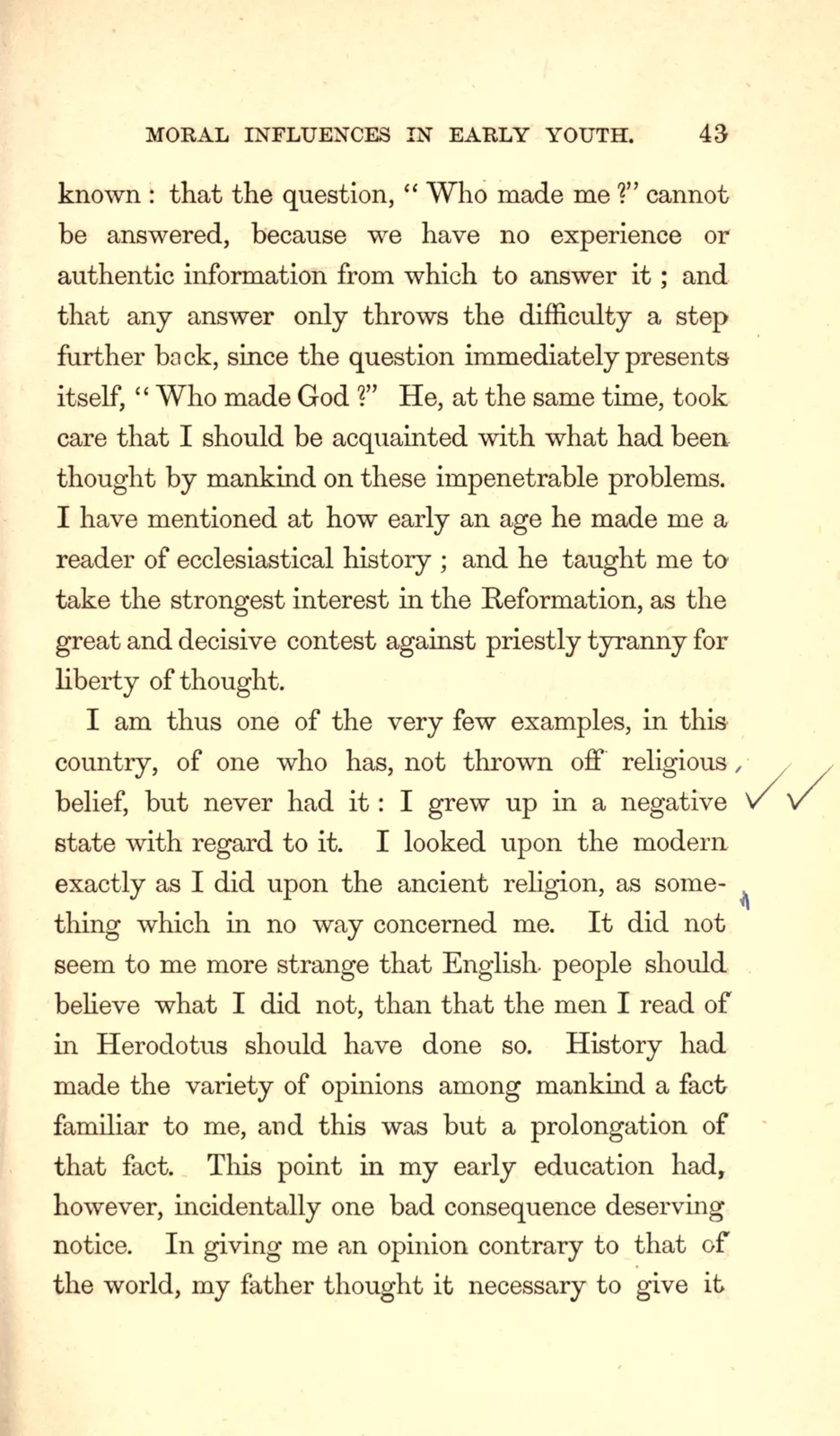
How he left that faith he described in his most famous lecture, many years later. "I for a long time accepted the argument of the First Cause," he said, "until one day, at the age of eighteen, I read John Stuart Mill's Autobiography, and I there found this sentence: 'My father taught me that the question, Who made me? cannot be answered, since it immediately suggests the further question, Who made God?'"17 The sentence he quoted is not quite Mill's. What Mill actually wrote is longer: his father had taught him "that the question, 'Who made me?' cannot be answered, because we have no experience or authentic information from which to answer it; and that any answer only throws the difficulty a step further back, since the question immediately presents itself, 'Who made God?'"1819 Russell remembered the point, not the words, which is what memory usually keeps.
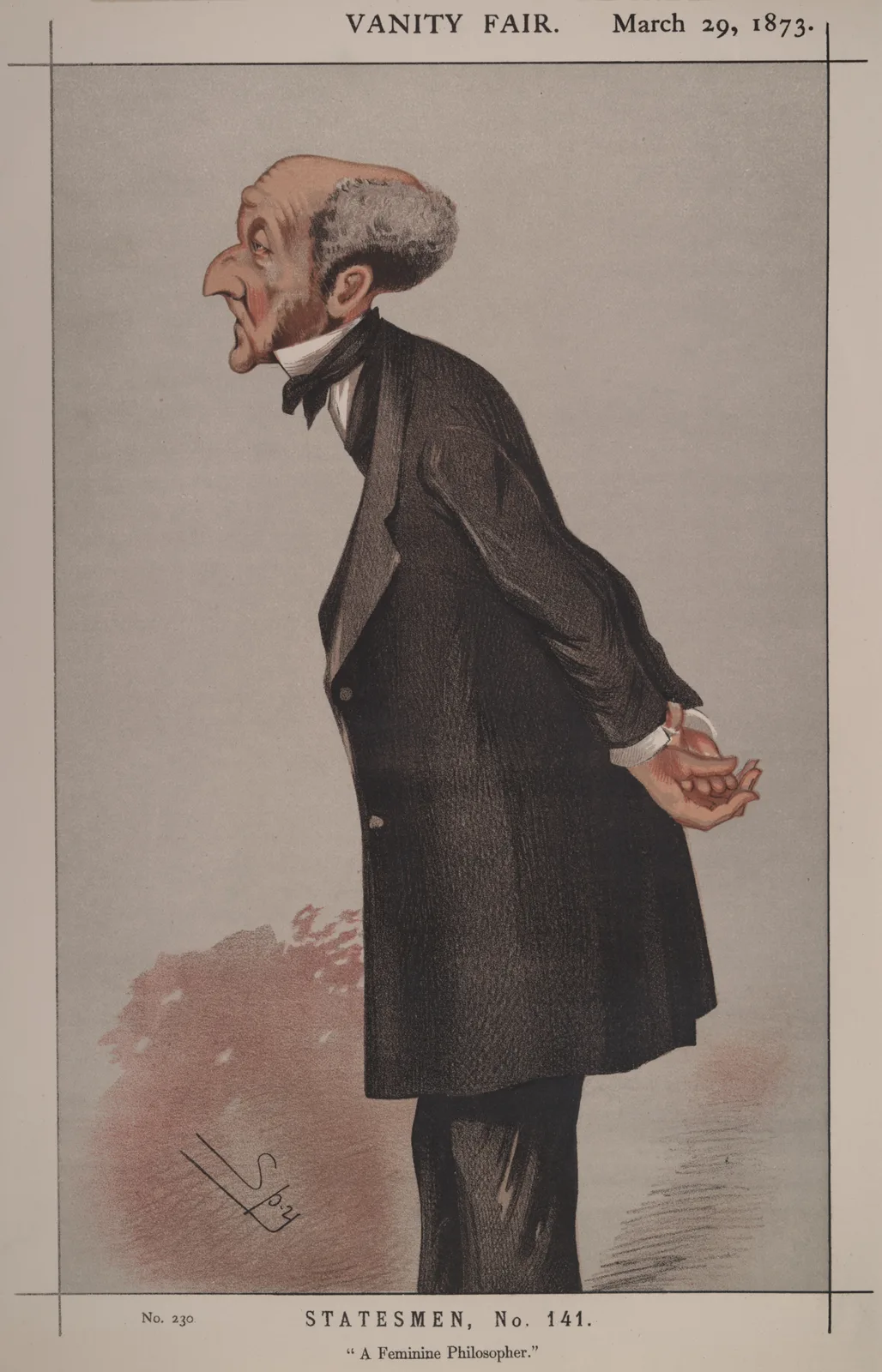
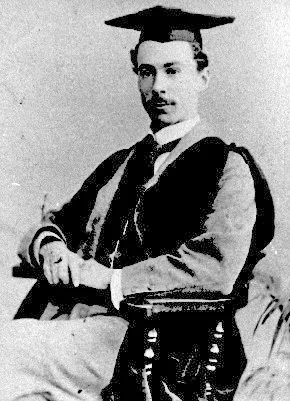
His own later account of how belief is made explains why he never thought the change mysterious. People believe what they are taught as children: Kant, he wrote, kept "the maxims that he had imbibed at his mother's knee," and conscience is mostly "vague reminiscences of precepts heard in early youth, so that it is never wiser than its possessor's nurse or mother."2021 He was a boy raised on his grandmother's precepts who met, at eighteen, a better argument. In 1890 he went up to Trinity College, Cambridge, where he met the mathematician Alfred North Whitehead, his future collaborator.22
A free man's worship
His grandmother died in January 1898.23 Four years later he wrote the essay that first set out his outlook in public, "A Free Man's Worship," published in December 1903.24 It is not an argument against God so much as a picture of a world without one: a world, he said, "even more purposeless, more void of meaning" than the one science had already revealed. "Only within the scaffolding of these truths, only on the firm foundation of unyielding despair, can the soul's habitation henceforth be safely built."25 And yet the essay ends in something like devotion. "In this lies Man's true freedom: in determination to worship only the God created by our own love of the good, to respect only the heaven which inspires the insight of our best moments."26 "To abandon the struggle for private happiness, to expel all eagerness of temporary desire, to burn with passion for eternal things — this is emancipation, and this is the free man's worship."27
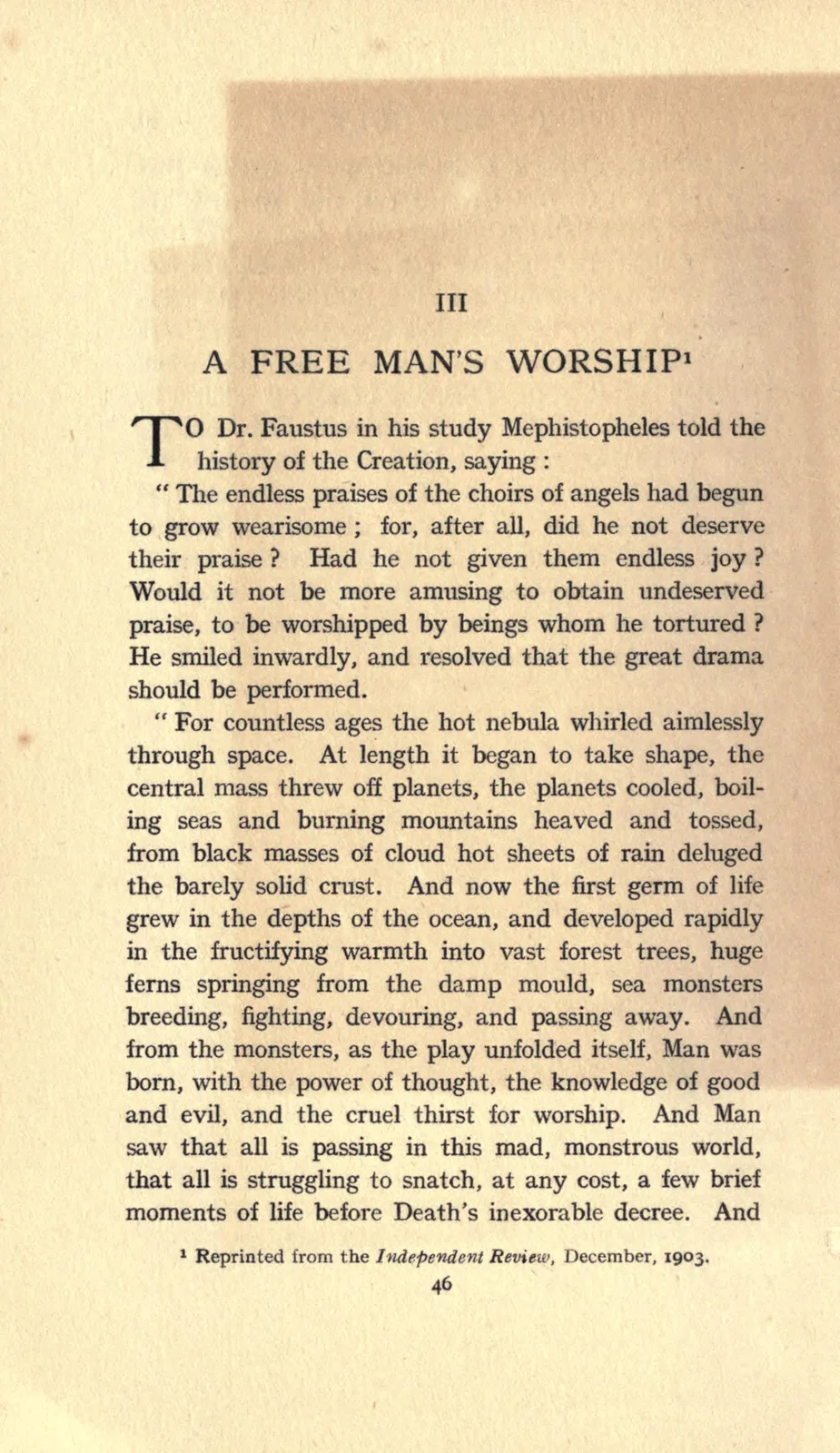
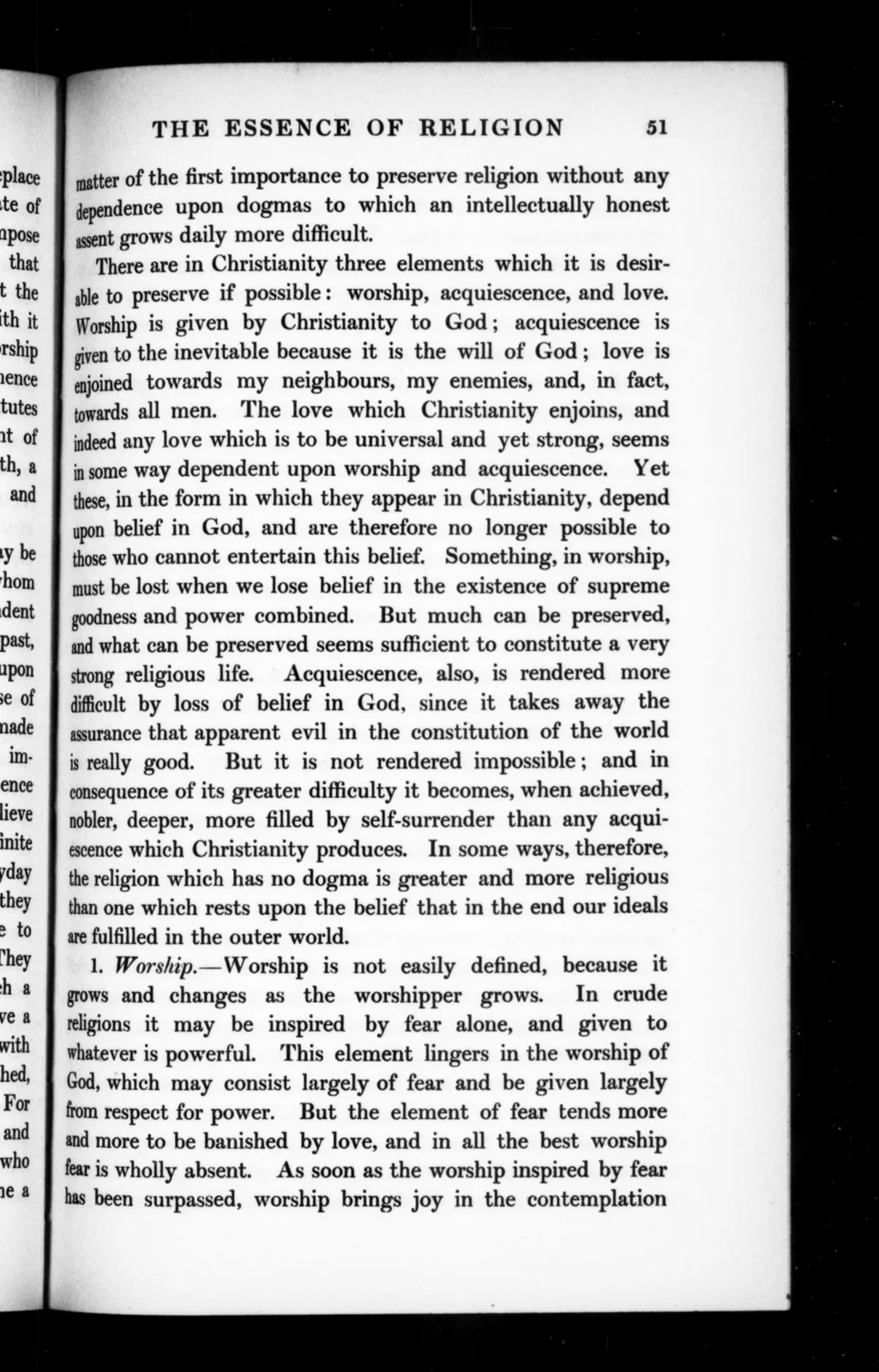
He kept looking for a religion that did not need a God. In 1912, in a theological quarterly, he argued that religion could survive "the decay of traditional religious beliefs,"28 that "the religion which has no dogma is greater and more religious than one which rests upon the belief that in the end our ideals are fulfilled in the outer world,"29 and that "the essence of religion, then, lies in subordination of the finite part of our life to the infinite part."30 By 1917 he was less sure even of this. Reprinting "A Free Man's Worship," he wrote that its ethics was "not quite identical with that which I hold now: I feel less convinced than I did then of the objectivity of good and evil," though its attitude, he said, was still the one that must be taken "by those who have no dogmatic religious beliefs."3132 On his timeline, this is the first revision: not a return to faith, but a stripping away of the last thing that had stood in its place.
Prison and plain speech
His unbelief was already costing him. In 1910, a modern account says, he failed to win a Liberal nomination for Parliament because of his atheism.33 In 1916 he was fined £100 and dismissed from his lectureship at Trinity for a pamphlet against the war, and in 1918 he served five months in Brixton prison, where he wrote a book on the foundations of mathematics.343536 Asked his religion when he arrived, he is said to have answered "agnostic," a story that comes from his own later autobiography.37
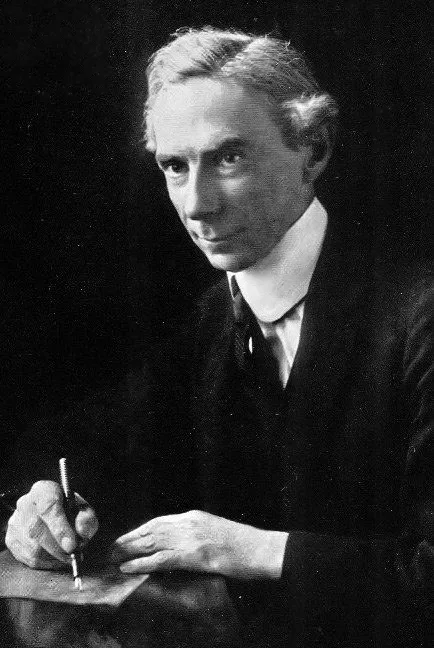
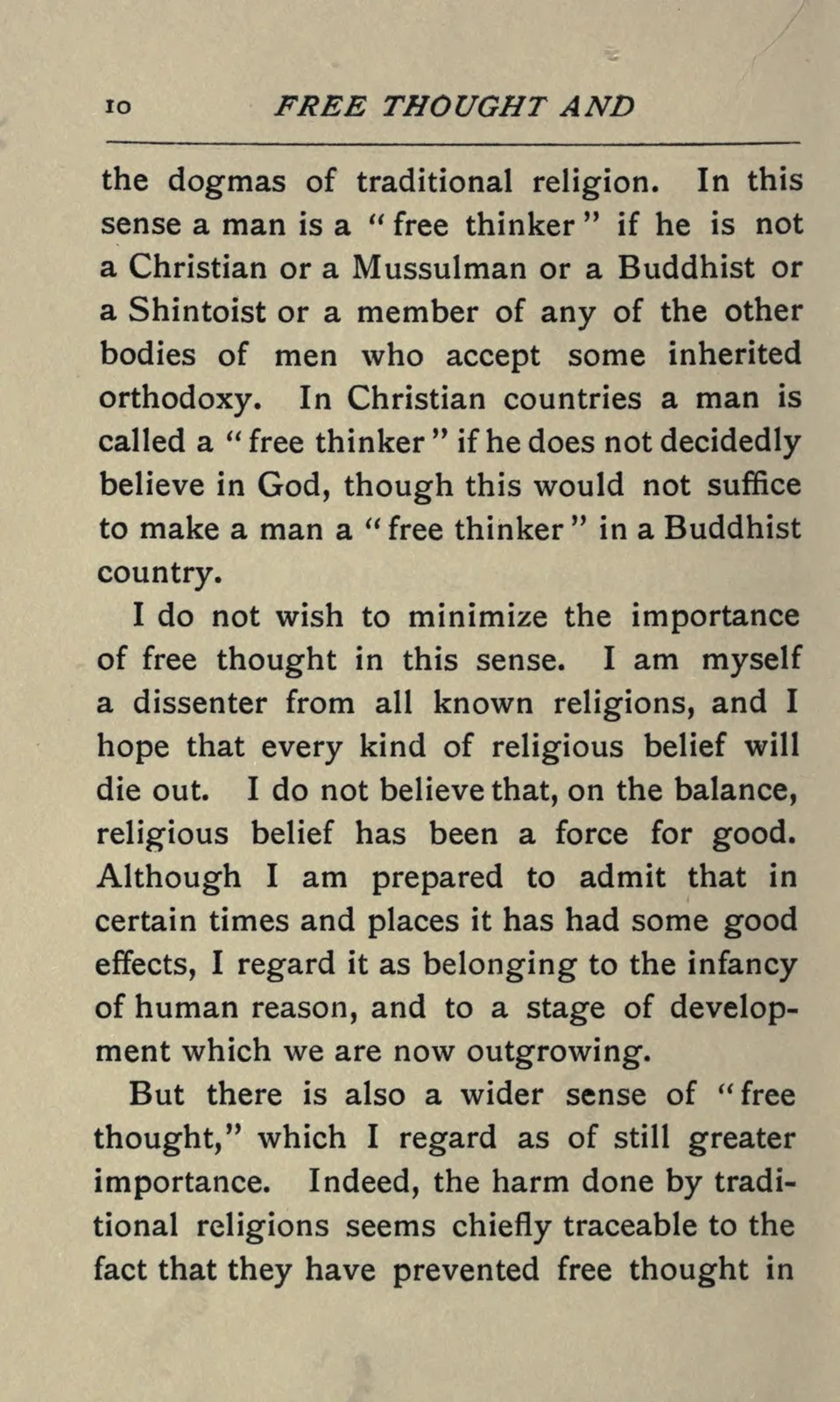
After the war he said what he thought without softening it. In 1922, giving a memorial lecture on free thought, he said: "I am myself a dissenter from all known religions, and I hope that every kind of religious belief will die out."38 In 1925, in a short book called What I Believe, he wrote that "God and immortality, the central dogmas of the Christian religion, find no support in science," but added a qualification he kept for the rest of his life: "I do not pretend to be able to prove that there is no God. I equally cannot prove that Satan is a fiction."3940 In their place he put a sentence that summed up his ethics: "The good life is one inspired by love and guided by knowledge."41
Why I Am Not a Christian
In March 1927 he gave a lecture at Battersea Town Hall for the South London branch of the National Secular Society, the society Charles Bradlaugh had led half a century before.42 He called it "Why I Am Not a Christian," and it is his declaration. "I have to tell you two different things," he began: "first, why I do not believe in God and in immortality; and, secondly, why I do not think that Christ was the best and wisest of men, although I grant him a very high degree of moral goodness."43 He went through the arguments for God and found them wanting, beginning with the First Cause and Mill's sentence. He said why most people believe: "Most people believe in God because they have been taught from early infancy to do it, and that is the main reason."44 And he said what he thought lay underneath: "Religion is based, I think, primarily and mainly upon fear."45
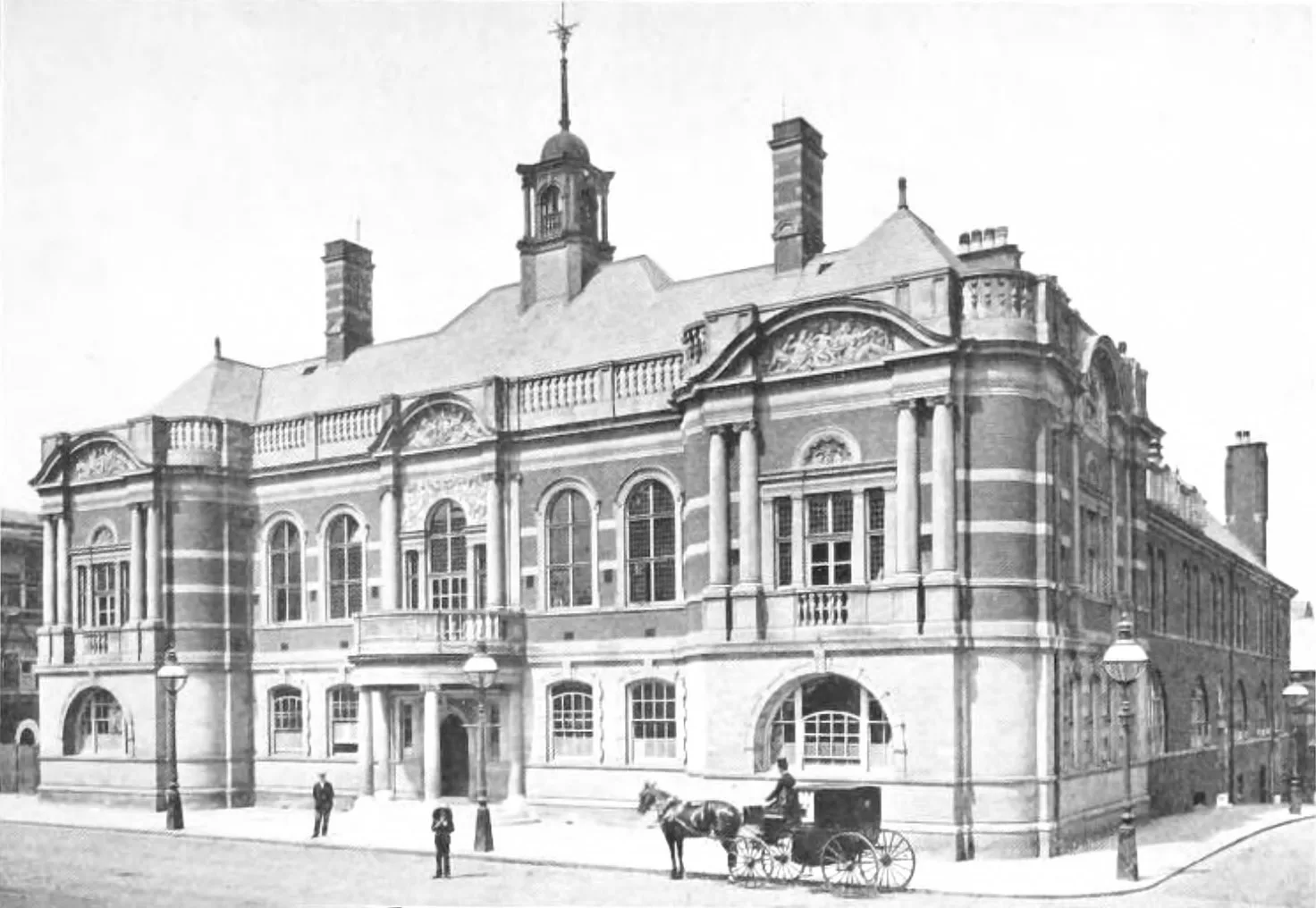
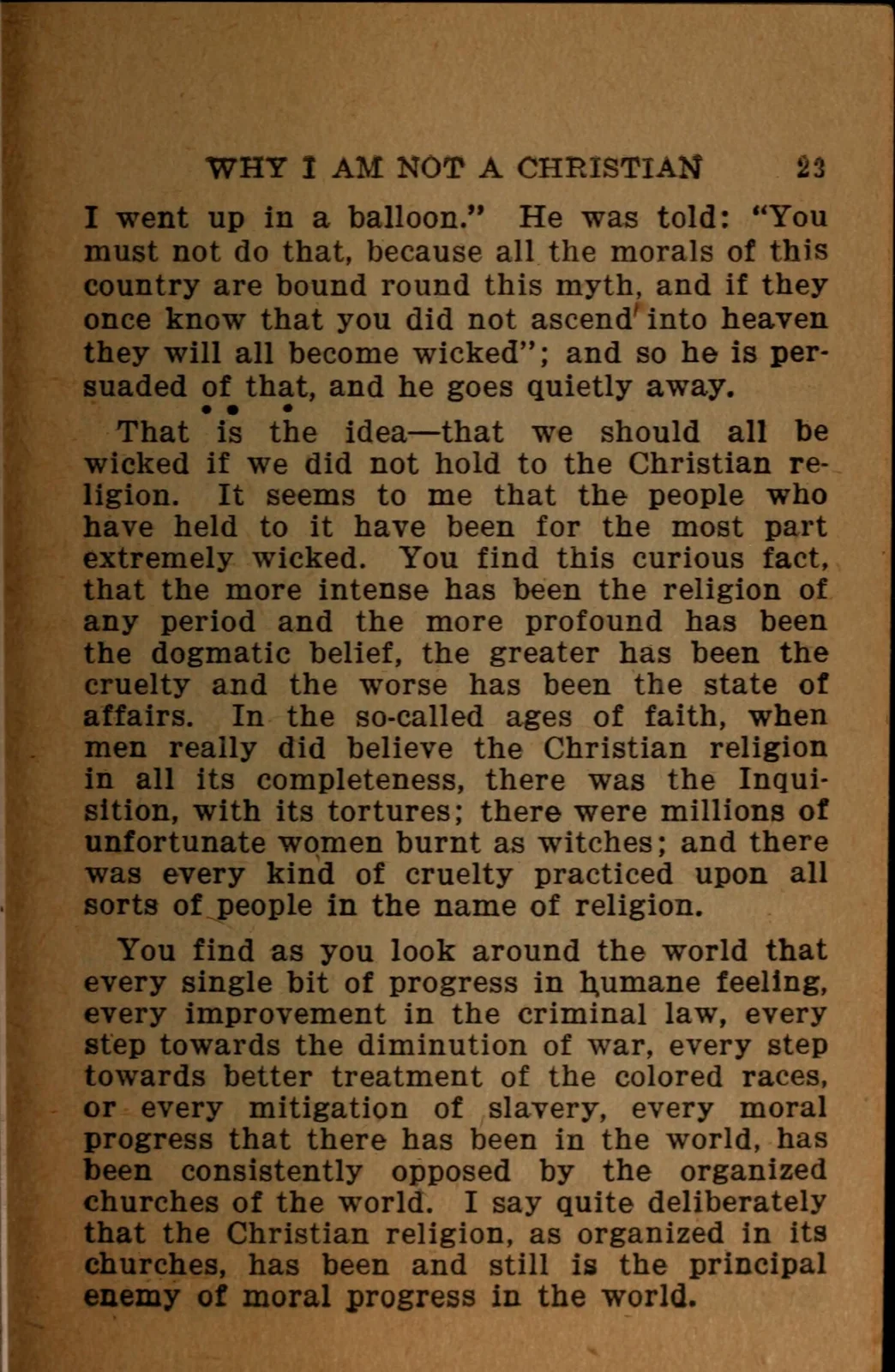
He was harder on the churches than on Christ. "I think that there are a good many points upon which I agree with Christ a great deal more than the professing Christians do."46 But "I say quite deliberately that the Christian religion, as organized in its churches, has been and still is the principal enemy of moral progress in the world."47 And he ended with the hope that ran through all his writing: "A good world needs knowledge, kindliness, and courage; it does not need a regretful hankering after the past, or a fettering of the free intelligence by the words uttered long ago by ignorant men."48
The fairest reply came from a Quaker lecturer at the Selly Oak Colleges in Birmingham, H. G. Wood, who published a book in 1928 called Why Mr Bertrand Russell Is Not a Christian. "The main reason why he is not a Christian," Wood wrote, "is that he simply does not know what religion is."49 He admired his opponent: "Mr Russell is an intellectual Alexander the Great," and "I cannot forget the stand that he took during the War for justice and peace."5051 The poet T. S. Eliot reviewed the lecture under the title "Why Mr Bertrand Russell is a Christian," according to Wood; Eliot's own text has not been found for this chapter.52
Russell answered Wood in a second address, printed with the first. "After all, I had all the benefits of a Christian education, and he did not have the benefits of an Agnostic education; so that possibly the argument might be considered two-edged."16 He called himself "a Rationalist ever since I can remember," and stated his rule of belief: "we ought not to believe, and we ought not to try to cause others to believe, any proposition for which there is no evidence whatever." But he would not claim more than that. "We ought not to commit ourselves to dogmatic negations any more than to dogmatic affirmations."535455
The cost
His books on marriage and morals, which said that sexual relations "which do not involve children should be regarded as a purely private affair," were among those the judge would quote against him.56 When the Board of Higher Education appointed him to teach philosophy at City College in 1940, protests followed, and Jean Kay's petition went to Justice McGeehan.57 The judge quoted What I Believe and Marriage and Morals against him; when he quoted the line that "the peculiar importance attached, at present, to adultery is quite irrational," he added commas and gave a different page number, perhaps from another edition.58 The city's lawyers would not appeal, the higher courts would not hear Russell's own motion, and the appointment was void.59 His timeline records that as the cost. The judge said religion had nothing to do with it. Whether it did is a question the sources still answer differently.605
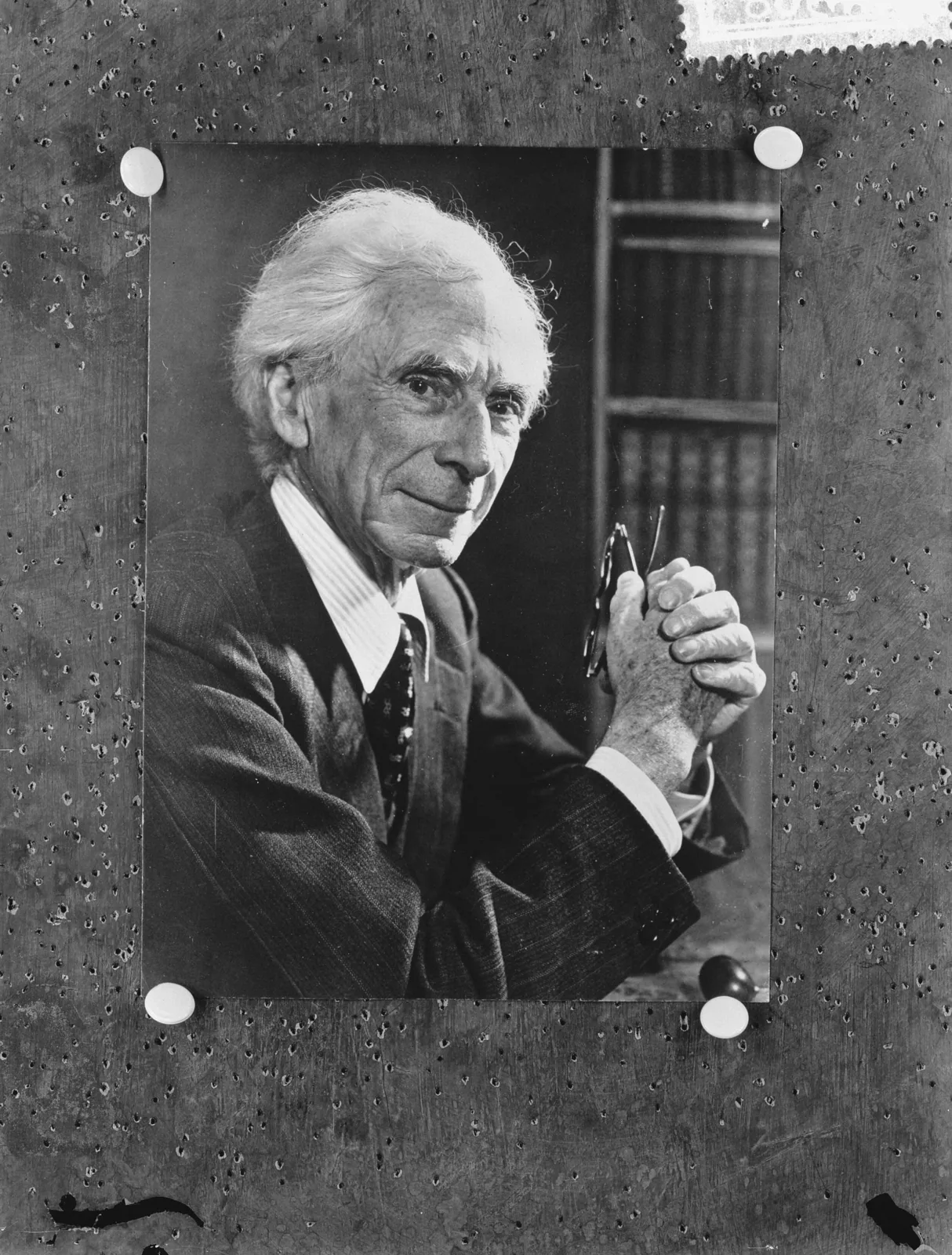
He was not silenced. In 1950 he won the Nobel Prize in Literature "in recognition of his varied and significant writings in which he champions humanitarian ideals and freedom of thought."6162 He spent his last decades campaigning against nuclear weapons, and served a week in prison for it at eighty-nine.63 A modern encyclopedia quotes him from those years: "My own view on religion is that of Lucretius. I regard it as a disease born of fear."64 He died at Penrhyndeudraeth in north Wales on 2 February 1970, aged ninety-seven.65
Did his unbelief change shape?
It changed less than the man who held it. Russell left his grandmother's faith at eighteen, by his own account, over one sentence about who made God, and he never went back. What changed was what he put in its place. At thirty he offered a worship without God, built on "unyielding despair" and a love of the good. At forty he looked for a religion without dogma. By forty-five he was no longer sure that good and evil were facts about the world at all. In middle age he said plainly that religion rests on fear and that the churches had hindered moral progress, but he refused to claim that he could prove there was no God, and he would not commit himself to dogmatic negations any more than to dogmatic affirmations. His grandmother had hoped that unbelievers kept enough of the divine in them to refute their own words. Her grandson would have said that what he kept was the conviction that the good life is one inspired by love and guided by knowledge.
Charles Bradlaugh, who led the society Russell addressed at Battersea, and Lucretius, whose view of religion Russell said was his own, each have a chapter in this book.
Footnotes
-
Matter of Kay v. Board of Higher Education, 173 Misc. 943 (N.Y. Sup. Ct., N.Y. County, 30 March 1940), McGeehan, J.; [Kay AD] 260 App. Div. 9 (1st Dept, 19 June 1940); [Kay CA] 284 N.Y. 578 (8 October 1940). Harvard Caselaw Access Project,. ↩
-
Justice McGeehan: Matter of Kay v. Board…, 173 Misc. 943. ↩
-
Justice McGeehan: Matter of Kay v. Board…, 173 Misc. 943. ↩
-
Justice McGeehan, N.Y. Supreme Court, 30 March 1940: Matter of Kay v. Board…, 173 Misc. 943. ↩
-
Andrew David Irvine, "Bertrand Russell," Stanford Encyclopedia of Philosophy (rev. 15 October 2024), §1. Accounts differ; see the disputed points. ↩ ↩2
-
Irvine, "Bertrand Russell,", §1; NobelPrize.org, "Bertrand Russell – Facts," Literature 1950, (Trelleck, 18 May 1872). ↩
-
Desmond MacCarthy and Agatha Russell, eds., Lady John Russell: A Memoir (New York: John Lane, 1911), pp. 242–43; Irvine, "Bertrand Russell,", §1. ↩
-
MacCarthy, Lady John Russell, p. 248. ↩
-
Benjamin Jowett, on Russell's father, to Lady Russell, 14 Jan. 1876: MacCarthy, Lady John Russell, p. 248. ↩
-
Irvine, "Bertrand Russell,", §1. Reported at second hand; the original has not been seen. ↩
-
MacCarthy, Lady John Russell, pp. 91–92, 252; Irvine, "Bertrand Russell,", §1. ↩
-
MacCarthy, Lady John Russell, pp. 8–9. ↩
-
MacCarthy, Lady John Russell, p. 231. ↩
-
Lady Russell, his grandmother and guardian, to her son Rollo, 3 Nov. 1870: MacCarthy, Lady John Russell, p. 231. ↩
-
Bertrand Russell, Why I Am Not a Christian (Little Blue Book No. 1372, Girard, Kansas: Haldeman-Julius, 1929), the 1927 Battersea lecture plus a second address, "Why I Am a Rationalist.", p. 29. ↩ ↩2
-
Russell, Why I Am Not a Christian, p. 7. ↩
-
John Stuart Mill: John Stuart Mill, Autobiography (London: Longmans, 1873), Autobiography (1873), p. 43. ↩
-
Russell, Why I Am Not a Christian, p. 7 against Mill p. 43. ↩
-
Russell, Why I Am Not a Christian, p. 13; Bertrand Russell, What I Believe (London: Kegan Paul; New York: Dutton, 1925; Today and Tomorrow series), p. 67. ↩
-
Russell, What I Believe, p. 67. ↩
-
Irvine, "Bertrand Russell,", §1. ↩
-
MacCarthy, Lady John Russell, pp. 289–90. ↩
-
Bertrand Russell, Mysticism and Logic and Other Essays (London: Allen & Unwin, 1917 text; the scan is the 1959 impression, page numbers as 1917), pp. v, 46 note. ↩
-
Russell, Mysticism and Logic and Other Essays, p. 48 ("A Free Man's Worship"). ↩
-
Russell, Mysticism and Logic and Other Essays, p. 50. ↩
-
Russell, Mysticism and Logic and Other Essays, p. 55. ↩
-
Bertrand Russell, "The Essence of Religion," Hibbert Journal, vol. XI no. 1 (October 1912), pp. 46–62, pp. 46, 51, 60. ↩
-
Russell, Hibbert Journal, Oct. 1912, p. 51. ↩
-
Russell, Hibbert Journal, Oct. 1912, p. 60. ↩
-
Russell, Mysticism and Logic and Other Essays, Preface p. v. ↩
-
Russell, Mysticism and Logic and Other Essays, p. v. ↩
-
Irvine, "Bertrand Russell,", §1. ↩
-
Irvine, "Bertrand Russell,", §1 and §2. ↩
-
Irvine, "Bertrand Russell,", §2 (citing Clark 1975, 337–39). ↩
-
Bertrand Russell, Introduction to Mathematical Philosophy (London: Allen & Unwin, 1919), ch. XVI p. 167; Irvine, "Bertrand Russell,", §3. ↩
-
Autobiography vol. 2 (1968), p. 34, quoted in SEP §6. ↩
-
Bertrand Russell, Free Thought and Official Propaganda (London: Watts, 1922), Conway Memorial Lecture, South Place Institute, 24 March 1922, (Watts 1922), p. 10. ↩
-
Russell, What I Believe, p. 12. ↩
-
Russell, What I Believe, p. 12. ↩
-
Russell, What I Believe, p. 27. ↩
-
Russell, Why I Am Not a Christian, headnote p. 3; wianac-1927.txt. ↩
-
Russell, Why I Am Not a Christian, p. 5. ↩
-
Russell, Why I Am Not a Christian, p. 15. ↩
-
Russell, Why I Am Not a Christian, p. 25. ↩
-
Russell, Why I Am Not a Christian, p. 16. ↩
-
Russell, Why I Am Not a Christian, p. 23. ↩
-
Russell, Why I Am Not a Christian, p. 26. ↩
-
H. G. Wood, Quaker, New Testament lecturer, Selly Oak Colleges, Birmingham: H. G. Wood, Why Mr Bertrand Russell Is Not a Christian: An Essay in Controversy (London: Student Christian Movement, April 1928), (1928), p. 31; quoted by Russell, WIANAC pp. 28–29. ↩
-
H. G. Wood: Wood, Why Mr Bertrand Russell Is…, p. 33. ↩
-
H. G. Wood: Wood, Why Mr Bertrand Russell Is…, p. 156. ↩
-
Wood, Why Mr Bertrand Russell Is…, pp. 37–38. ↩
-
Russell, Why I Am Not a Christian, p. 27. ↩
-
Russell, Why I Am Not a Christian, p. 28. ↩
-
Russell, Why I Am Not a Christian, p. 28. ↩
-
Bertrand Russell, Marriage and Morals (New York: Horace Liveright, 1929), (Liveright 1929) pp. 164–65. ↩
-
Matter of Kay v. Board…, p. 1 of opinion; Irvine, "Bertrand Russell,", §1. ↩
-
Matter of Kay v. Board…, against WIB p. 57. ↩
-
Matter of Kay v. Board…, AD; Matter of Kay v. Board…, CA. ↩
-
Matter of Kay v. Board…. ↩
-
Nobel Prize committee: NobelPrize.org, "Bertrand Russell – Facts,", facts page. ↩
-
Irvine, "Bertrand Russell,", §1; NobelPrize.org, "Bertrand Russell – Facts,". ↩
-
Irvine, "Bertrand Russell,", §1. ↩
-
Irvine, "Bertrand Russell,", §6. ↩
-
Irvine, "Bertrand Russell,", §1; NobelPrize.org, "Bertrand Russell – Facts,". ↩
In their own words
that the question, "Who made me?" cannot be answered, because we have no experience or authentic information from which to answer it; and that any answer only throws the difficulty a step further back, since the question immediately presents itself, "Who made God?"
I for a long time accepted the argument of the First Cause, until one day, at the age of eighteen, I read John Stuart Mill's Autobiography, and I there found this sentence: "My father taught me that the question, Who made me? cannot be answered, since it immediately suggests the further question, Who made God?"
I have to tell you two different things: first, why I do not believe in God and in immortality; and, secondly, why I do not think that Christ was the best and wisest of men, although I grant him a very high degree of moral goodness.
Most people believe in God because they have been taught from early infancy to do it, and that is the main reason.
I say quite deliberately that the Christian religion, as organized in its churches, has been and still is the principal enemy of moral progress in the world.
Religion is based, I think, primarily and mainly upon fear.
A good world needs knowledge, kindliness, and courage; it does not need a regretful hankering after the past, or a fettering of the free intelligence by the words uttered long ago by ignorant men.
I think that there are a good many points upon which I agree with Christ a great deal more than the professing Christians do.
we ought not to believe, and we ought not to try to cause others to believe, any proposition for which there is no evidence whatever.
We ought not to commit ourselves to dogmatic negations any more than to dogmatic affirmations
After all, I had all the benefits of a Christian education, and he did not have the benefits of an Agnostic education; so that possibly the argument might be considered two-edged.
I have been a Rationalist ever since I can remember, and I do not propose to cease to be so whatever appeals to unreason may be made.
Only within the scaffolding of these truths, only on the firm foundation of unyielding despair, can the soul's habitation henceforth be safely built.
In this lies Man's true freedom: in determination to worship only the God created by our own love of the good, to respect only the heaven which inspires the insight of our best moments.
To abandon the struggle for private happiness, to expel all eagerness of temporary desire, to burn with passion for eternal things — this is emancipation, and this is the free man's worship.
In theoretical Ethics, the position advocated in "The Free Man's Worship" is not quite identical with that which I hold now: I feel less convinced than I did then of the objectivity of good and evil.
The essence of religion, then, lies in subordination of the finite part of our life to the infinite part.
In some ways, therefore, the religion which has no dogma is greater and more religious than one which rests upon the belief that in the end our ideals are fulfilled in the outer world.
God and immortality, the central dogmas of the Christian religion, find no support in science.
I do not pretend to be able to prove that there is no God. I equally cannot prove that Satan is a fiction.
The good life is one inspired by love and guided by knowledge.
conscience is a most fallacious guide, since it consists of vague reminiscences of precepts heard in early youth, so that it is never wiser than its possessor's nurse or mother.
The peculiar importance attached, at present, to adultery is quite irrational.
I think that all sex relations which do not involve children should be regarded as a purely private affair, and that if a man and a woman choose to live together without having children, that should be no one's business but their own.
I am myself a dissenter from all known religions, and I hope that every kind of religious belief will die out.
that it is undesirable to believe a proposition when there is no ground whatever for supposing it true.
in recognition of his varied and significant writings in which he champions humanitarian ideals and freedom of thought
The other side
The main reason why he is not a Christian is that he simply does not know what religion is.
I cannot forget the stand that he took during the War for justice and peace.
Mr Russell is an intellectual Alexander the Great.
I believe that many of those who deem themselves sceptics or atheists retain, after all, enough of the divine element within them practically to refute their own words.
God does not regard men with reference to their opinion about Himself or about a future world, but with reference to what they really are.
I am completely dismissing any question of Mr. Russell's attacks upon religion
Academic freedom does not mean academic license.
in effect establishing a chair of indecency
Where accounts differ
| Point | One account | Another | How the page handles it |
|---|---|---|---|
| Date of the Battersea lecture | 6 March 1927, a Sunday (editor's bracket in the web edition of the Little Blue Book) | 7 March 1927 (the brief; a Monday) | Say "March 1927" until the Watts pamphlet or a National Secular Society notice is checked |
| What the 1940 ruling rested on | The court "completely dismissing" his attacks on religion; it rested on citizenship, no examination, and "immoral and salacious teachings" (Kay) | "based partly on Russell's atheism" (SEP) | Say the judge disclaimed religion as a ground, and that critics saw his unbelief behind the case |
| Age at the Mill reading | "at the age of eighteen" (WIANAC p. 7) | an earlier date reported for the journal and the doubts (Autobiography, not read) | Use "at eighteen, by his own later account" and say accounts of the order of the doubts rest on his memory |
| Russell's wording of Mill | Russell's quoted sentence (WIANAC p. 7) | Mill's longer sentence (Mill p. 43) | Show Mill's words on screen, Russell's paraphrase in narration |
| McGeehan's quotation of What I Believe | "attached, at the present, to adultery, is quite irrational," p. 50 (Kay) | "attached, at present, to adultery is quite irrational," p. 57 (WIB 1925) | Quote the 1925 text; do not charge the judge with altering it, the edition may differ |
| Did the unbelief come early? | "a Rationalist ever since I can remember" (1928) | the journal puts the doubt at 1888–90 and the household was devout (LJR) | Tell the childhood faith and the teenage doubt apart and say why 1888–90 is the Doubt mark |
List of illustrations
This page uses only public-domain and Creative Commons images; each is credited with its source and licence.
- Bertrand Russell at a press conference, New York, 1950 — Anefo (Dutch press agency), Rijksmuseum, 1950 · Bertrand Russell at a press conference, New York, 1950, Anefo (Dutch press agency), Rijksmuseum, via Wikimedia Commons (CC0) · CC0 (Wikimedia Commons licence label)
- Viscount and Viscountess Amberley, 1867 — William Notman, 1867 · Viscount and Viscountess Amberley, 1867, William Notman, via Wikimedia Commons (Public domain) · Public domain (Wikimedia Commons licence label)
- Pembroke Lodge, east side, from the park, water-colour by W. C. Rainbow, 1883 (plate) — W. C. Rainbow, 1883 · Desmond MacCarthy and Agatha Russell, eds., Lady John Russell: A Memoir (London: Methuen, 1911 / New York: John Lane, 1911), scan via Internet Archive (ladyjohnrussellm00macc) · Public domain (published 1911 (the plate; drawing of 1883))
- The Dowager Countess Russell, photograph, 1884 (plate) — Unknown photographer, 1884 · Desmond MacCarthy and Agatha Russell, eds., Lady John Russell: A Memoir (London: Methuen, 1911 / New York: John Lane, 1911), scan via Internet Archive (ladyjohnrussellm00macc) · Public domain (published 1911 (the plate; photograph of 1884))
- John Stuart Mill, Autobiography, p. 43: 'Who made me?' ... 'Who made God?' — John Stuart Mill, 1873 · John Stuart Mill, Autobiography (London: Longmans, Green, Reader and Dyer, 1873), scan via Internet Archive (autobiographymil00milluoft) · Public domain (published 1873)
- John Stuart Mill, Vanity Fair, 29 March 1873 — Leslie Ward ('Spy'), 1873-03-29 · John Stuart Mill, Vanity Fair, 29 March 1873, Leslie Ward ('Spy'), via Wikimedia Commons (Public domain) · Public domain (Wikimedia Commons licence label)
- Bertrand Russell, 1893 — Unknown author, 1893 · Bertrand Russell, 1893, Unknown author, via Wikimedia Commons (Public domain) · Public domain (Wikimedia Commons licence label)
- 'A Free Man's Worship', opening page (p. 46), Mysticism and Logic — Bertrand Russell, 1918 · Bertrand Russell, Mysticism and Logic and Other Essays (London: Longmans, Green, 1918), scan via Internet Archive (mysticismlogicot00russiala) · Public domain (published 1918)
- 'The Essence of Religion', p. 51: 'the religion which has no dogma is greater' — Bertrand Russell, 1912-10 · The Hibbert Journal, vol. XI no. 1, October 1912, scan via Internet Archive (sim_the-hibbert-journal-a-quarterly-review-of-religion_1912-1913_11_1) · Public domain (published 1912)
- Bertrand Russell in 1916 — Unknown author, 2013-02-13 19:50:42 · Bertrand Russell in 1916, Unknown author, via Wikimedia Commons (Public domain) · Public domain (Wikimedia Commons licence label)
- Free Thought and Official Propaganda, p. 10: 'a dissenter from all known religions' — Bertrand Russell, 1922 · Bertrand Russell, Free Thought and Official Propaganda (London: Watts, 1922; Conway Memorial Lecture), scan via Internet Archive (freethoughtoffic00russuoft) · Public domain (published 1922)
- Battersea Town Hall, photograph c. 1893 — unknown; probably the office of E. Mountford, or else the Battersea Vestry, 1893 · Battersea Town Hall, photograph c. 1893, unknown; probably the office of E. Mountford, or else the Battersea Vestry, via Wikimedia Commons (Public domain) · Public domain (Wikimedia Commons licence label)
- Why I Am Not a Christian, p. 23: 'the principal enemy of moral progress in the world' — Bertrand Russell, 1929 · Bertrand Russell, Why I Am Not a Christian (Girard, Kansas: Haldeman-Julius, Little Blue Book no. 1372, 1929), scan via Internet Archive (whyiamnotchristi1372russ) · Public domain (published 1929)
- Kay v. Board of Higher Education, 173 Misc. 943, first page of the opinion (30 March 1940) — New York Supreme Court, New York County (McGeehan, J.), reported in Miscellaneous Reports vol. 173, 1940-03-30 · Kay v. Board of Higher Education, 173 Misc. 943 (N.Y. Sup. Ct. 1940), scan from the Caselaw Access Project, Harvard Law School Library · Public domain (judicial opinion, a work of a state court; scan from Harvard Law School Library's Caselaw Access Project, static.case.law, which blacks out copyrighted editorial headnotes)
- De Britse filosoof Bertrand Russell (the British philosopher Bertrand Russell), 28 November 1957 — Fotograaf onbekend / Anefo, 1957-11-28 · Fotograaf onbekend / Anefo, Fotocollectie Anefo, Nationaal Archief, Public Domain Mark, via Europeana · Public Domain Mark 1.0 (Nationaal Archief, Fotocollectie Anefo, via Europeana)
Sources
Tier 1 — the subject's own words
- [WIANAC] Bertrand Russell, Why I Am Not a Christian (Little Blue Book No. 1372, Girard, Kansas: Haldeman-Julius, 1929), the 1927 Battersea lecture plus a second address, "Why I Am a Rationalist." https://archive.org/details/whyiamnotchristi1372russ . Text in research/texts/wianac-watts-1929.txt; a web copy is wianac-1927.txt. Page numbers are the Little Blue Book's.
- [WIB] Bertrand Russell, What I Believe (London: Kegan Paul; New York: Dutton, 1925; Today and Tomorrow series). https://archive.org/details/whatibelieve0000russ . Text in what-i-believe-1925.txt.
- [M&L] Bertrand Russell, Mysticism and Logic and Other Essays (London: Allen & Unwin, 1917 text; the scan is the 1959 impression, page numbers as 1917). https://archive.org/details/mysticism00russuoft . "A Free Man's Worship" is pp. 46–57. Text in mysticism-logic-1917.txt.
- [PhilEss] Bertrand Russell, Philosophical Essays (London: Longmans, Green, 1910), first book printing of "A Free Man's Worship." https://archive.org/details/philosophicaless00russ . Text in philosophical-essays-1910.txt.
- [Hibbert] Bertrand Russell, "The Essence of Religion," Hibbert Journal, vol. XI no. 1 (October 1912), pp. 46–62. https://archive.org/details/sim_the-hibbert-journal-a-quarterly-review-of-religion_1912-1913_11_1 . Text in hibbert-1912-oct.txt (OCR damaged in places).
- [FTOP] Bertrand Russell, Free Thought and Official Propaganda (London: Watts, 1922), Conway Memorial Lecture, South Place Institute, 24 March 1922. https://archive.org/details/freethoughtoffic00russuoft . Text in free-thought-official-propaganda-1922.txt.
- [Sceptical] Bertrand Russell, Sceptical Essays (London: Allen & Unwin, 1928). https://archive.org/details/in.ernet.dli.2015.222966 . Text in sceptical-essays-1928.txt.
- [MM] Bertrand Russell, Marriage and Morals (New York: Horace Liveright, 1929). https://archive.org/details/marriagemorals00russ_0 . Text in marriage-morals-1929.txt.
- [IMP] Bertrand Russell, Introduction to Mathematical Philosophy (London: Allen & Unwin, 1919). https://archive.org/details/introductiontoma00russuoft . Text in intro-math-phil-1919.txt.
- [Mill] John Stuart Mill, Autobiography (London: Longmans, 1873). https://archive.org/details/autobiographymil00milluoft . Text in mill-autobiography-1873.txt.
- [Kay] Matter of Kay v. Board of Higher Education, 173 Misc. 943 (N.Y. Sup. Ct., N.Y. County, 30 March 1940), McGeehan, J.; [Kay AD] 260 App. Div. 9 (1st Dept, 19 June 1940); [Kay CA] 284 N.Y. 578 (8 October 1940). Harvard Caselaw Access Project, https://static.case.law/misc/173/cases/0943-01.json . Texts in kay-v-board-1940-*.txt. Court records; the Harvard text carries no page breaks inside the opinion.
- [Nobel] NobelPrize.org, "Bertrand Russell – Facts," Literature 1950. https://www.nobelprize.org/prizes/literature/1950/russell/facts/ . Text in nobel-1950-facts.txt. © Nobel Prize Outreach; prize motivation quoted as a short factual citation only.
Tier 2 — scholarly biographies and encyclopedias
- [SEP] Andrew David Irvine, "Bertrand Russell," Stanford Encyclopedia of Philosophy (rev. 15 October 2024). https://plato.stanford.edu/entries/russell/ . Text in sep-russell.txt. Free to read; cited for the chronology and for quotations from copyrighted works, all of which count as secondhand.
- [LJR] Desmond MacCarthy and Agatha Russell, eds., Lady John Russell: A Memoir (New York: John Lane, 1911). https://archive.org/details/ladyjohnrussellm00macc . Text in lady-john-russell-1911.txt.
Tier 3 — popular biographies and journalism
- None used. The 1967–69 Autobiography and Clark's 1975 biography are in copyright and were not read.
Tier 4 — maps to other sources only (Wikipedia and similar). Never cited in the script.
- Wikipedia, "Bertrand Russell"; "Why I Am Not a Christian." Not consulted for facts.
Opposition sources — contemporary critics and religious responses
- [Wood] H. G. Wood, Why Mr Bertrand Russell Is Not a Christian: An Essay in Controversy (London: Student Christian Movement, April 1928). https://archive.org/details/whymrbertrandrus0000hgwo . Text in wood-1928-why-mr-russell-not-christian.txt.
- [Kay], [Kay AD], [LJR] as above (McGeehan; Lady Russell; Jowett).
- Eliot's review and Bishop Manning's letters: not found, see claims 50 and 62.
Related lives
Clarence Darrow (episode 09) — the other great fight over what a teacher may say about religion (suggestion only; the close names no "next", the end screen carries the link).
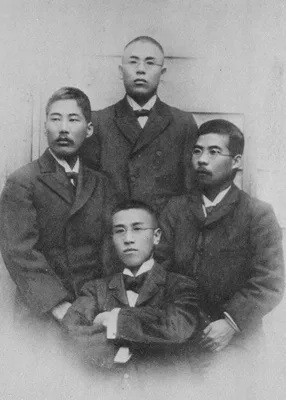
Kōtoku Shūsui
Kōtoku Shūsui was schooled in the Confucian classics and formed as the pupil of Nakae Chōmin, whose last book denied God and the soul. In 1901 he refused his Christian friend Uchimura's God, for a morality without fear or future judgment. In politics he moved from socialism to anarchism. He spent his last months in Tokyo Prison writing a book to obliterate Christ from history, and went to the gallows in 1911 having, as his last poem says, prayed to no god.
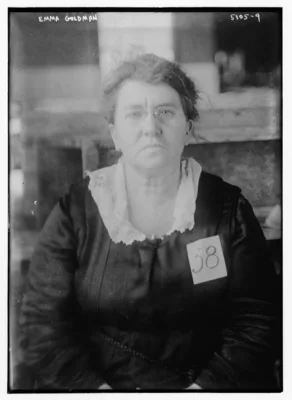
Emma Goldman
Emma Goldman had no faith to lose, only a religion she met as discipline in a Jewish childhood. Her atheism grew out of her pity for the hanged and out of her anarchism, and by 1893 it was a flat public statement. In 1913 and 1916 it became an argument for the earth over heaven. In Soviet Russia it turned on the revolution's own church.
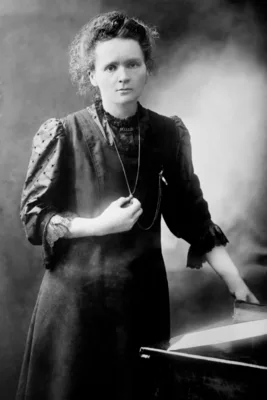
Marie Curie
Marie Curie was a devout Catholic girl in Russian-ruled Warsaw who lost her eldest sister and then her mother. By her daughter's account she felt revolt against the God she had prayed to. She let her faith lapse among the Warsaw positivists while keeping up appearances. From 1895 she declared her unbelief by acts rather than words: a civil marriage, unbaptised daughters and funerals without ceremony. She left only one published sentence of her own: "I myself did not practice any."
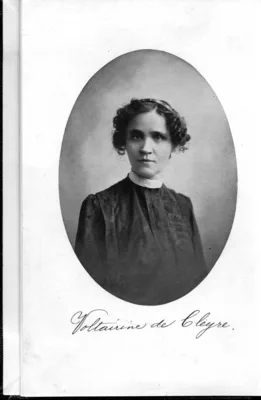
Voltairine de Cleyre
Voltairine de Cleyre was named for Voltaire by a freethinking father who then returned to the church and put her in a convent. She came out "a freethinker" after refusing to say what she did not feel. She lectured a nature-theist freethought until the Chicago hangings of 1887 turned it against the state. In her last years she held that belief in God had little to do with freedom, while her own view stayed "no God in the soul or out of it". The refusal to lie held the whole life together.