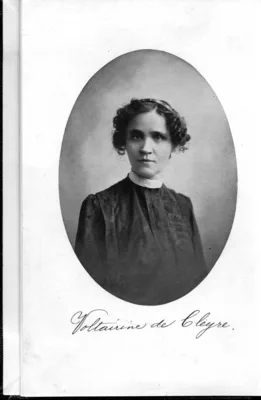
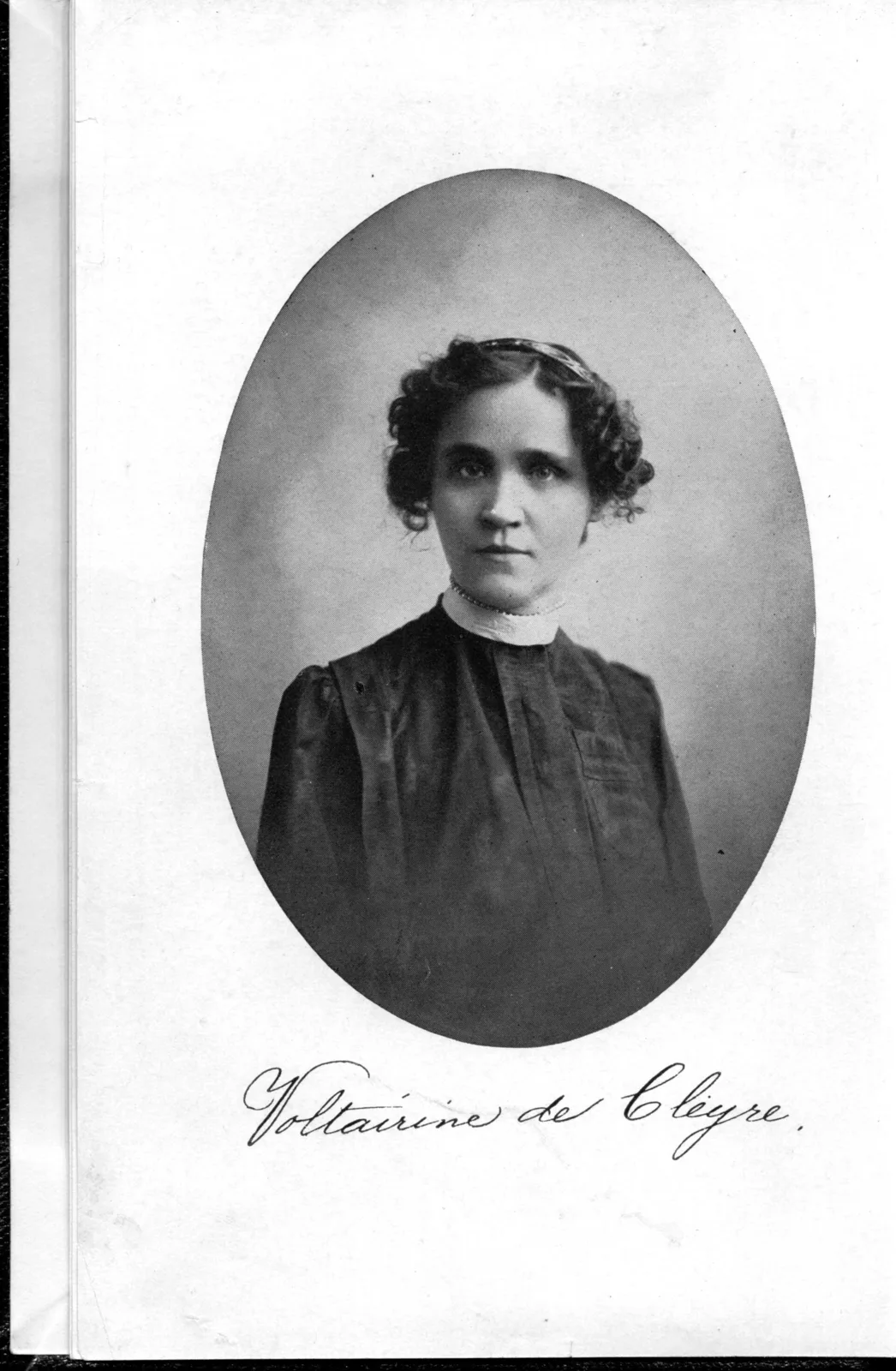
Voltairine de Cleyre was named for Voltaire by a freethinking father who then returned to the church and put her in a convent. She came out "a freethinker" after refusing to say what she did not feel. She lectured a nature-theist freethought until the Chicago hangings of 1887 turned it against the state. In her last years she held that belief in God had little to do with freedom, while her own view stayed "no God in the soul or out of it". The refusal to lie held the whole life together.
The belief timeline
- Faith (c. 1880–83) — A child who wrote verses of heaven is put by her father into a convent where she is "unable to believe and yet in hourly fear of damnation" [7][8][15]
- Doubt (c. 1881–84, settled by 1887) — The teacher's rule "it is always necessary that we obey our superiors" meets "I will not lie"; she leaves "a freethinker"; the God question is "recently settled" only by April 1887 (see Open questions on why the mark sits here) [9][10][16]
- Declaration (1887) — A "freethought lecturer", speaking on Paine at a convention; Nature's God and "the world's our church" in "The Freethinker's Plea" [17][18]
- Turn (1887–c. 1890) — After the Chicago hangings she studies socialism and anarchism and carries freethought into politics: Church and State as twin instruments of the "God-idea" [21][22][28][29]
- Revision (c. 1900–03) — God and anarchism are compatible ("very little to do with the matter"); religion's "devotion to something greater than Self" honoured in Lum; yet a note says she herself had "no God in the soul or out of it"; non-resistance (1902) then direct action [26][30][32][37]
Notes to the timeline (16)
- [7] She was sent to the Convent of Our Lady of Lake Huron at Sarnia, Ontario; she says her "ancestral spirit of rebellion" asserted itself "while I was yet fourteen" there; her schoolmates were in the Order of the Holy Names of Jesus and Mary. — Voltairine de Cleyre, Selected Works of Voltairine de Cleyre, ed. Alexander Berkman, Introduction by Hippolyte Havel (New York: Mother Earth Publishing Association, 1914), p. 155 ("The Making of an Anarchist"); Hippolyte Havel, Introduction to [SW], pp. 5–14: the only life of her that is free to scan. A comrade's sketch, with a letter from her mother, p. 8.
- [8] Her own account of the convent: "unable to believe and yet in hourly fear of damnation." — Cleyre, Selected Works of Voltairine de Cleyre, pp. 155–156.
- [15] Poem "The Burial of My Past Self," dated Greenville, Mich., 1885, ends "And now, Humanity, I turn to you; I consecrate my service to the world!" Havel reads it as her dedication "at the age of nineteen." — Cleyre, Selected Works of Voltairine de Cleyre, p. 17; Havel, pp. 11–12.
- [9] The teacher told her "it is always necessary that we obey our superiors"; she answered "I will not lie." — Cleyre, Selected Works of Voltairine de Cleyre, p. 156.
- [10] She "struggled my way out at last, and was a freethinker when I left the institution, three years later, though I had never seen a book or heard a word to help me in my loneliness." — Cleyre, Selected Works of Voltairine de Cleyre, p. 156. Accounts differ; see the disputed points.
- [16] She prefaces "The Christian's Faith" (dated St. Johns, Mich., April 1887) and "The Freethinker's Plea" (St. Johns, 1887) with a note that they were written when the questions of the existence of God and the divinity of Jesus "had but recently been settled" and that the pros and cons "had been repeating themselves over and over again in my brain for some years." — Cleyre, Selected Works of Voltairine de Cleyre, p. 18; pp. 22–26.
- [17] "The Freethinker's Plea" tells believers to leave temples for nature ("the world's our church, to do good is our creed") but speaks of "Nature's God" and "love is Nature's God": her 1887 freethought is a nature-theism, not atheism. — Cleyre, Selected Works of Voltairine de Cleyre, pp. 22–26.
- [18] In 1887 she was "a freethought lecturer": she spoke on Paine's lifework at a Paine Memorial Convention "among the mountains and the snow-drifts of Pennsylvania," and that evening heard Clarence Darrow on Socialism: "my first introduction to any plan for bettering the condition of the working-classes." She quickly took and dropped the label "Socialist." — Cleyre, Selected Works of Voltairine de Cleyre, pp. 156–157; Havel, p. 12 ("1887").
- [21] On the Haymarket bomb of May 1886, "the credulous and brutal," she cried "They ought to be hung," though she had never believed in capital punishment for ordinary criminals; she never forgave herself. Havel says she was then a freethought lecturer and "shouted" it. — Cleyre, Selected Works of Voltairine de Cleyre, pp. 164–165; Havel, p. 11.
- [22] She came to think the trial a farce "long and long before" the hanging and distrusted "law and lawyers, judges and governors alike"; she "was no Anarchist at the time of the execution." — Cleyre, Selected Works of Voltairine de Cleyre, pp. 165–166.
- [28] "The Economic Tendency of Freethought," a lecture to the Boston Secular Society reprinted from Tucker's *Liberty*, argues that the seventeenth-century fight for freedom of thought was "anarchism in the realm of thought" and that liberty is "the mother, not the daughter, of Order." Internal reckoning ("two hundred and eighty-nine years ago" Bruno was burned) points to 1889 or early 1890. — de Cleyre, "The Economic Tendency of Freethought," a lecture to the Boston Secular Society reprinted in Tucker's Liberty (periodical issue not located); text as reposted by The Anarchist Library,, text; editor's note (Wendy McElroy, modern). Reported at second hand; the original has not been seen.
- [29] In "Sex Slavery" she traces woman's subjection to "the authoritarian, supreme-power, God-idea, and its two instruments, the Church... and the State." Undated; its opening scene is Moses Harman's five-year imprisonment (c. 1890). — Cleyre, Selected Works of Voltairine de Cleyre, p. 349. Not verified.
- [26] In her Lum lecture, given a year after his death, she writes: "My own conversion from orthodoxy to freethought... I never dared God; I always tried to propitiate him with prayers and tears even while I was doubting his existence; I suffered hell a thousand times while I was wondering where it was located." She also says "the spirit of devotion to something greater than Self... will be found as the kernel of every religion." — Cleyre, Selected Works of Voltairine de Cleyre, pp. 284–290 (quotes pp. 289, 289–290).
- [30] In "Anarchism": "Myself at one time asserted very stoutly that no one could be an Anarchist and believe in God at the same time... At present I hold with C. L. James... that one's metaphysical system has very little to do with the matter," citing Tolstoy. — Cleyre, Selected Works of Voltairine de Cleyre, p. 97.
- [32] Of an undated "Hymn" she wrote that it "did not represent my beliefs either then or since, but rather what I wish might be my beliefs, had I not an inexorable capacity for seeing things as they are,--a vast scheme of mutual murder, with no justice anywhere, and no God in the soul or out of it." — Cleyre, Selected Works of Voltairine de Cleyre, p. 42.
- [37] Havel: her "views on the sex-question, on agnosticism and free-thought, on individualism and communism, on non-resistance and direct action, underwent many changes"; in 1902 she wrote "I can see no end of retaliations unless someone ceases to retaliate"; her last years were "filled with the spirit of direct action" for the Mexican Revolution. — Havel, p. 13; Cleyre, Selected Works of Voltairine de Cleyre, p. 163.
I Will Not Lie
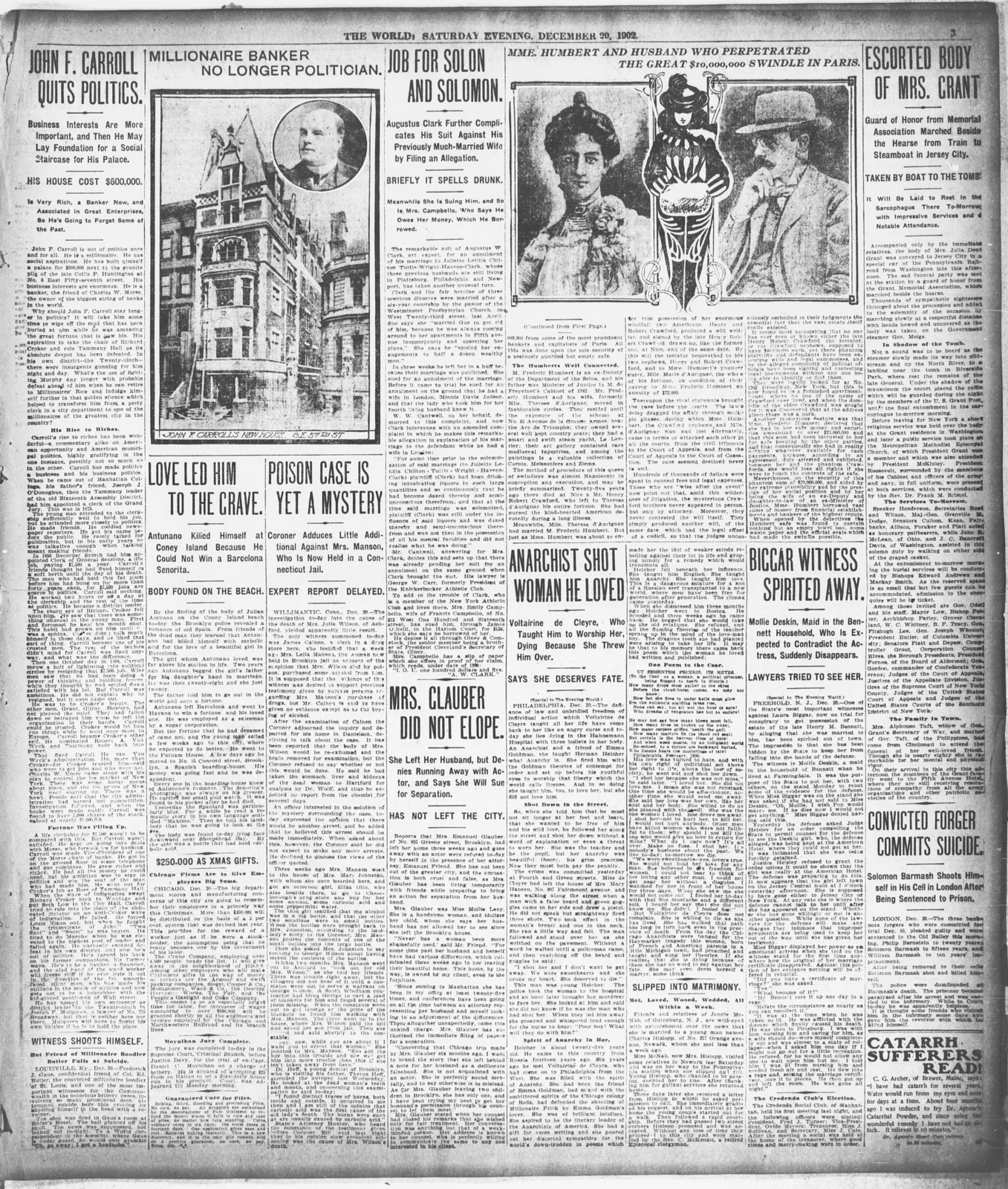
In December 1902 a young man who had been her pupil shot Voltairine de Cleyre three times on a Philadelphia street. She was taken to hospital believing she was dying. When the man was brought before her she declined to accuse him, and when she recovered and was called to court, she was asked what charge she had to make against the prisoner. "I have none," she said.12 She explained herself to the press: "In my opinion punishment is illogical, brutal, stupid and cowardly. All so-called criminal acts are in my opinion manifestations of disease, either in society or in the individual."34
The newspapers called her an anarchist and an atheist. She had been both, in her way. She had also been a frightened girl in a Catholic convent, sent there by a father who had once named her after Voltaire. This chapter follows her from that convent to the anarchist movement, and asks how a girl who would not say what she did not feel became a woman who would not prosecute the man who shot her.
Named for Voltaire
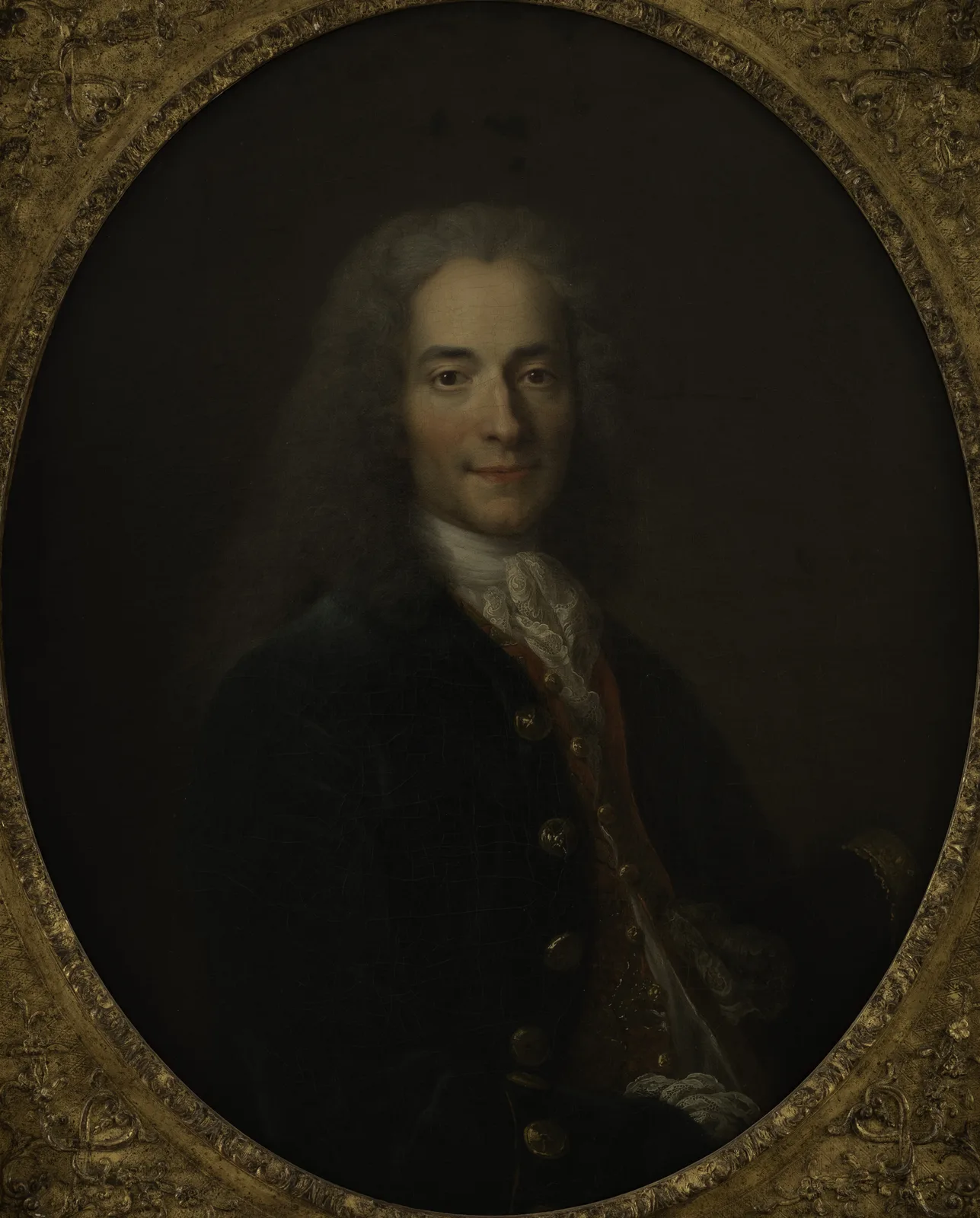
She was born on 17 November 1866 at Leslie, Michigan, and grew up in poverty in the small town of St. Johns.56 Her father, Auguste de Cleyre, had come from Flanders; her mother was a Presbyterian of Puritan descent.7 He was "a freethinker and a great admirer of Voltaire," and on the day she was born he insisted that she be called Voltairine.89
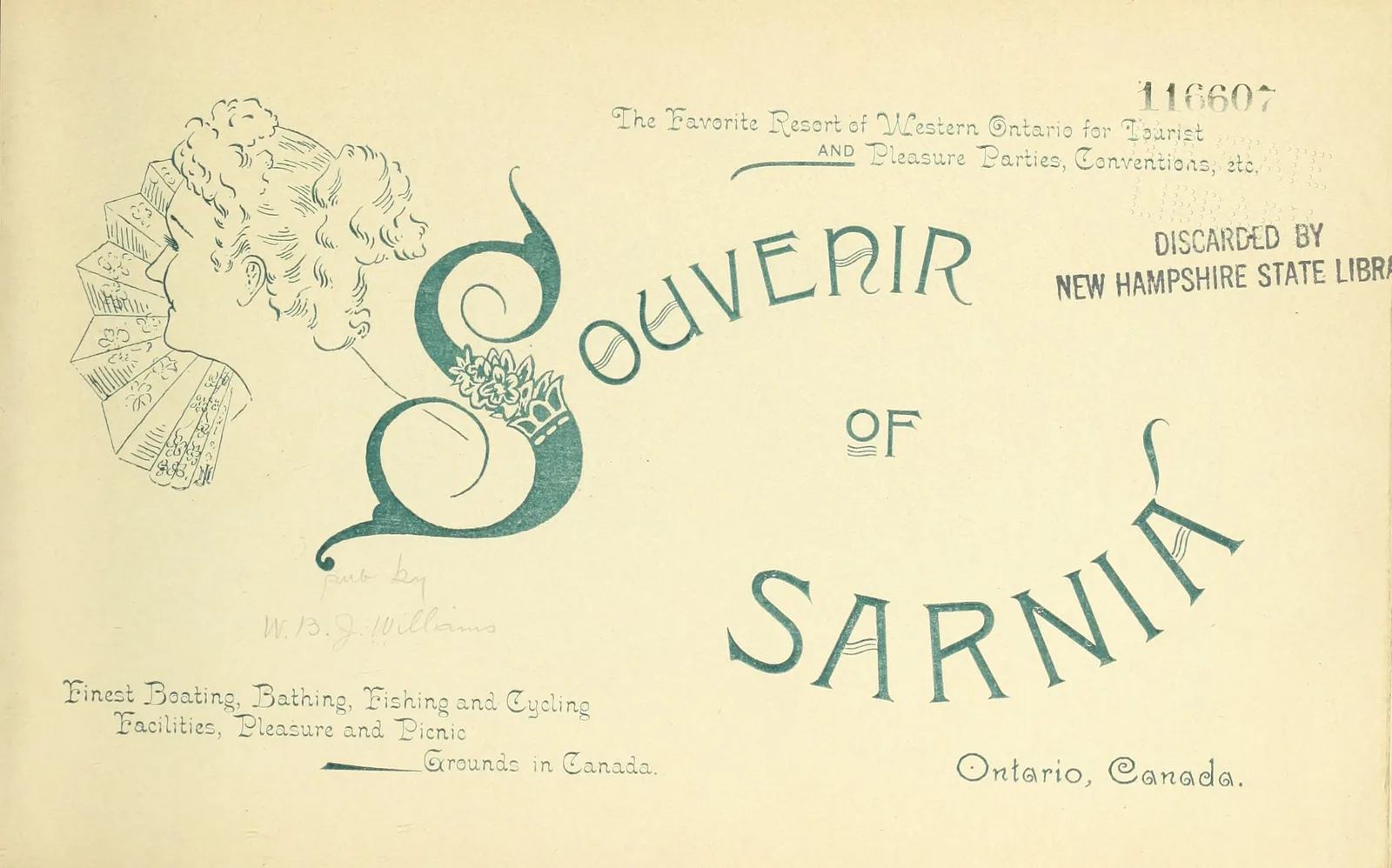
Then he changed his mind about religion. He "recanted his libertarian ideas, returned to the fold of the church," and decided that the highest calling for a woman was to be a nun. Her mother opposed it "with all her strength, but in vain."10 Some time after she finished grammar school at twelve, he sent her across the St. Clair River to the Convent of Our Lady of Lake Huron at Sarnia, Ontario.1112
The convent
She hated it. Her mother wrote that after a few weeks the girl ran away, crossed to Port Huron on the American side, and walked seventeen miles before she turned back; her father brought her to the convent again.13 Years later she described her state of mind: "How I pity myself now, when I remember it, poor lonesome little soul, battling solitary in the murk of religious superstition, unable to believe and yet in hourly fear of damnation, hot, savage, and eternal, if I do not instantly confess and profess!"1415
The break came in one exchange. A teacher told her that it was not necessary to feel what one said, only to obey. "'It is not necessary,' said she, 'that we should feel what we say, but it is always necessary that we obey our superiors.' 'I will not lie,' I answered hotly."161718 She never forgot it. "I struggled my way out at last, and was a freethinker when I left the institution, three years later, though I had never seen a book or heard a word to help me in my loneliness."1920 (Her friend and first biographer, Hippolyte Havel, said four years.)19 Havel thought the discipline of the Church "helped to develop" her freethought.21
Later, writing of her teacher Dyer Lum, she described what that doubt had cost her: "My own conversion from orthodoxy to freethought was of this latter sort. I never dared God; I always tried to propitiate him with prayers and tears even while I was doubting his existence; I suffered hell a thousand times while I was wondering where it was located."2223
A freethought lecturer
The questions took years to settle. Two poems she wrote in 1887, she said later, came "at that period of my life when the questions of the existence of God and the divinity of Jesus had but recently been settled," after the arguments had been "repeating themselves over and over again in my brain for some years."2425 Her freethought then was not atheism. "The Freethinker's Plea" told believers to leave their temples for nature: "Be filled with love, for love is Nature's God," and "The world's our church, to do good is our creed."262728 At eighteen she had already written a poem dedicating her life: "And now, Humanity, I turn to you; I consecrate my service to the world!"2930
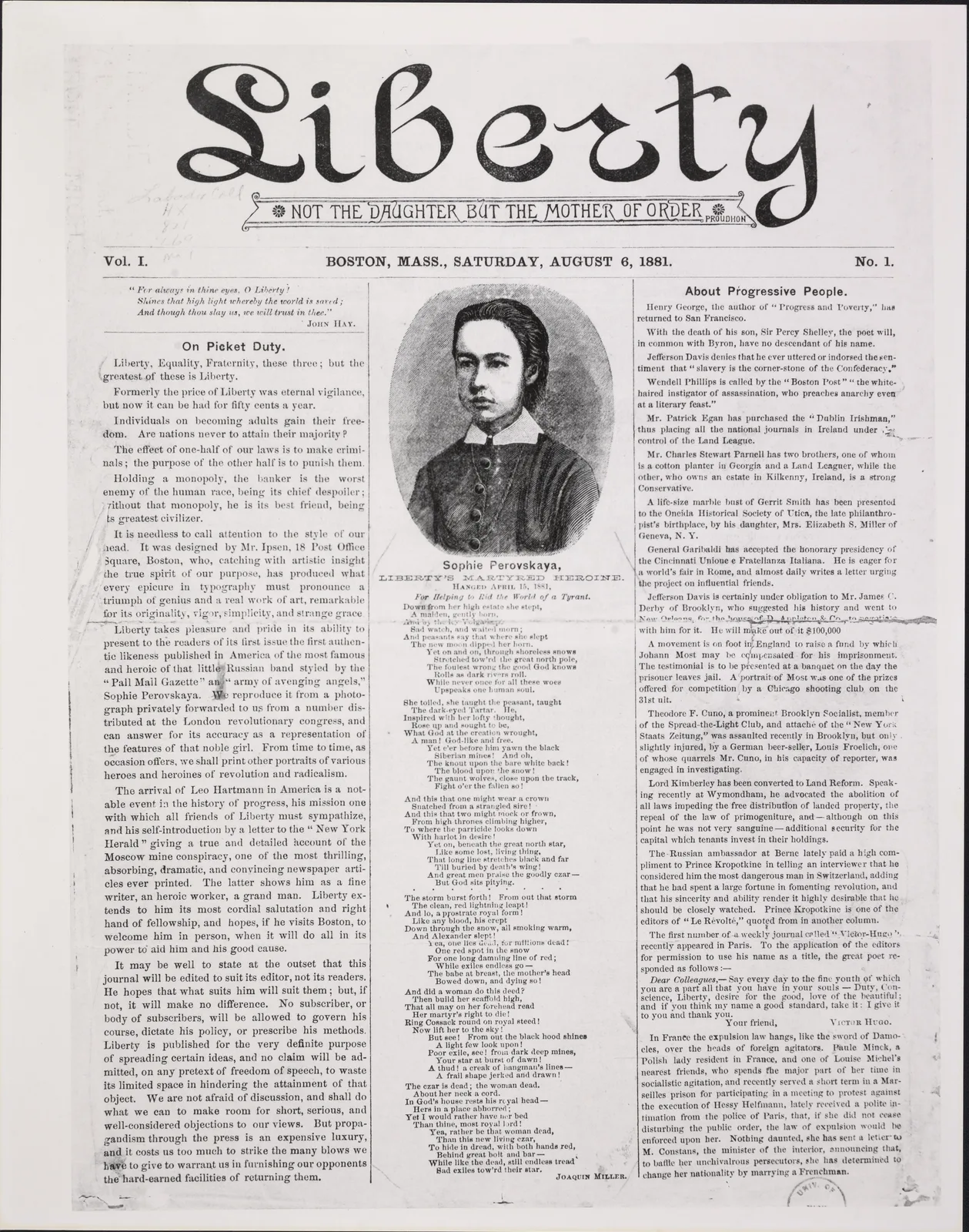
In 1887 she was, in her own words, "a freethought lecturer." At a Paine memorial convention in the mountains of Pennsylvania she spoke in the afternoon "on the lifework of Paine," and in the evening heard Clarence Darrow speak on socialism: "my first introduction to any plan for bettering the condition of the working-classes."3132 She took up socialism and dropped it in six weeks, after a Russian anarchist in a Pittsburgh debating club "questioned ... into all kinds of holes" her arguments; then Benjamin Tucker's paper Liberty "finally convinced me that 'Liberty is not the Daughter but the Mother of Order.'"3334
The Chicago hangings
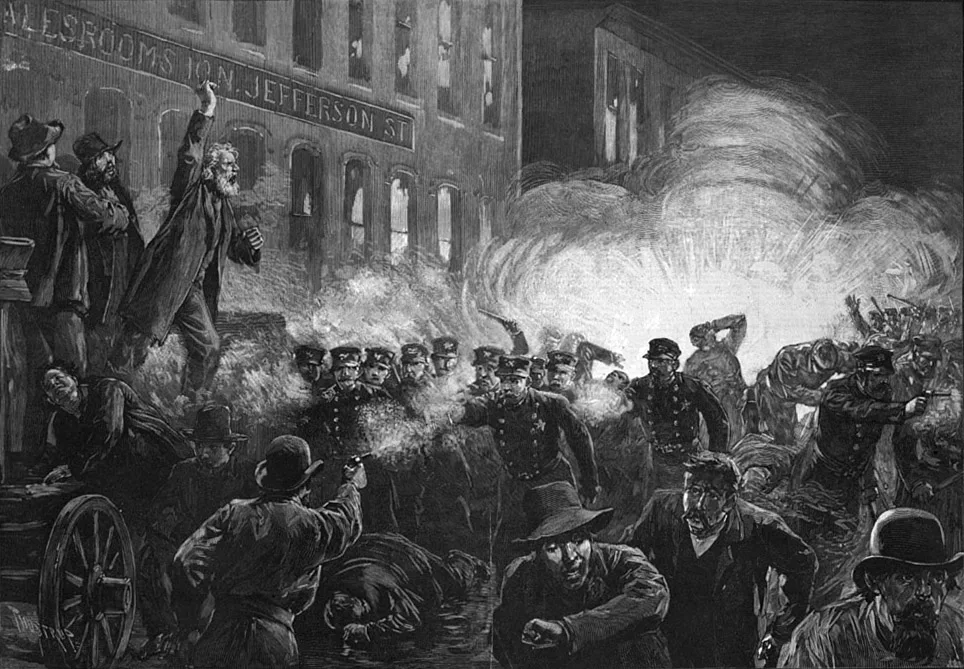
The event that made her an anarchist had already happened. In May 1886 a bomb exploded at a meeting in Chicago's Haymarket Square, and anarchists were tried for it. She remembered reading "one lying newspaper headline" in a Michigan village and crying out, "They ought to be hung." Fifteen years later she said, "For that ignorant, outrageous, blood-thirsty sentence I shall never forgive myself."3536 "I did not know what Anarchism was," she explained. "I believed the newspapers."37 She came to think the trial a farce, and when the Chicago men were hanged in November 1887, she was not yet an anarchist, but "till then I believed in the essential justice of the American law and trial by jury. After that I never could."3839
She put the two causes in order herself. The convent fight for her own will was "the ultimate reason for my acceptance of Anarchism, though the specific occasion which ripened tendencies to definition was the affair of 1886-7."4041 Havel judged that after Chicago, "the pure and simple free-thought agitation in its narrow circle could not suffice her."42
Philadelphia
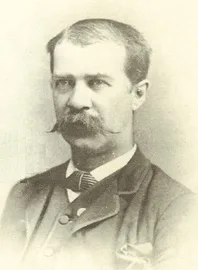
She moved to Philadelphia, where she lived for most of her life, teaching English to Russian Jewish immigrant workers, more than a thousand of them in twelve years, and earning a poor living.43 The anarchist Dyer Lum became "her teacher, her confidant, and comrade," and his death in 1893 was a terrible blow.44 Of Lum she wrote a line that shows she never despised what religion meant to people: "the spirit of devotion to something greater than Self, which will be found as the kernel of every religion."2245
Her unbelief became political. In "Sex Slavery" she traced the subjection of women to "the authoritarian, supreme-power, God-idea, and its two instruments, the Church—that is, the priests—and the State—that is, the legislators."4647 In a poem she asked, "What have you done, O Church, That the weary should bless your name?"4849 She lectured in England and Scotland in 1897.50
Anarchist simply
Then, around the turn of the century, she let go of the link between anarchism and atheism. "Myself at one time asserted very stoutly that no one could be an Anarchist and believe in God at the same time," she wrote. "At present I hold with C. L. James, the most learned of American Anarchists, that one's metaphysical system has very little to do with the matter."515253 Tolstoy, a believer, was her example. Anarchism itself was "a sort of Protestantism," whose followers agreed only "that all forms of external authority must disappear to be replaced by self-control only," and she would no longer call herself anything but "'Anarchist' simply."545556
Her own beliefs stayed bleak. Of a hymn she had written for a friend, she said it "did not represent my beliefs either then or since, but rather what I wish might be my beliefs, had I not an inexorable capacity for seeing things as they are,—a vast scheme of mutual murder, with no justice anywhere, and no God in the soul or out of it."5758 Havel said her views "on agnosticism and free-thought" changed many times.59
Forgiveness
The press hated her. When she was shot in 1902, the New York Evening World said that "the defiance of law and unbridled freedom of individual action which Voltairine de Cleyre taught all her life have come back to her like an angry curse."160 When she refused to testify, the Louisville Courier-Journal predicted that "justice law and order will triumph despite Voltairine de Cleyre over anarchy and rebellion against the laws of God and man," though it granted that she wished only "to be true to her pernicious creed."26162 The same paper reported that "according to her own statement she is an atheist"; no text of hers confirms the word.63 By 1902 she had written, "I can see no end of retaliations unless someone ceases to retaliate."5964 She worked, a friend said, for her assailant's release.265
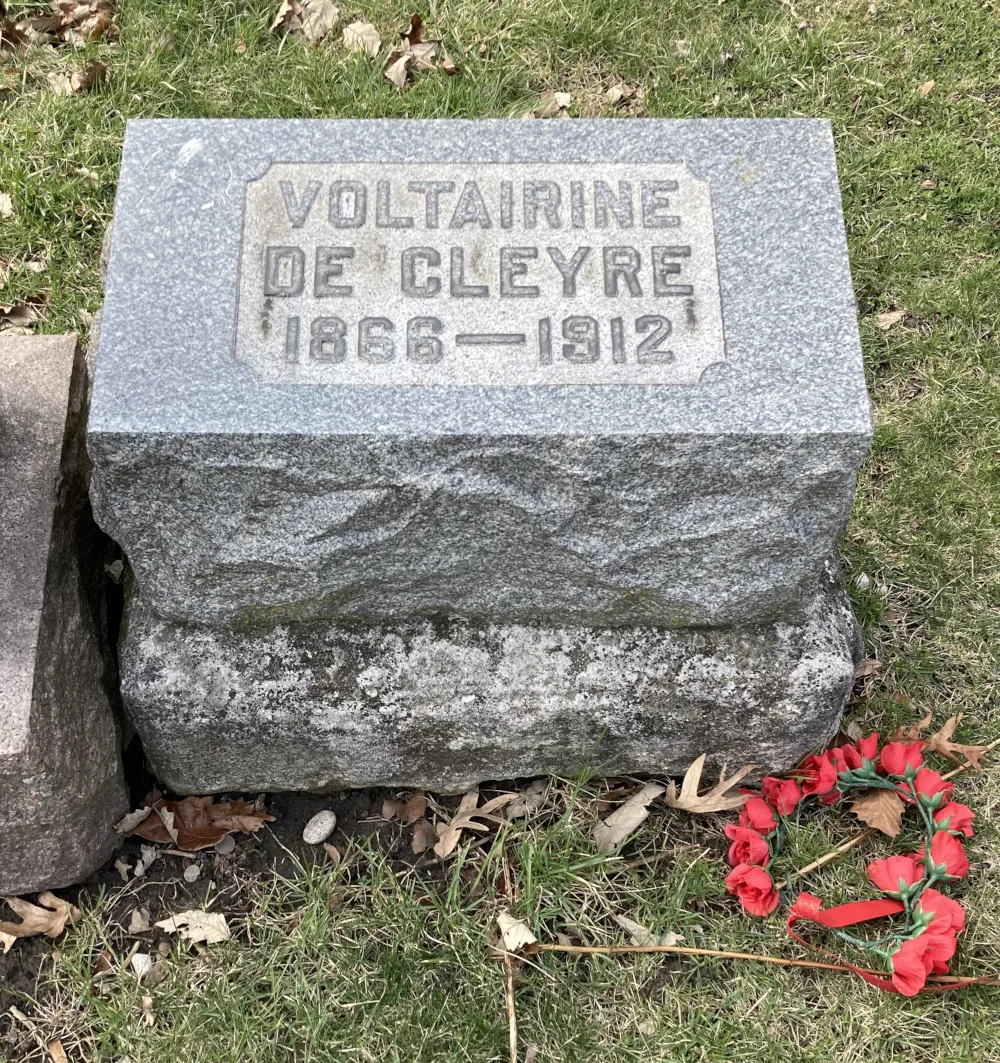
She recovered in Norway and lectured in London.66 In 1908 Philadelphia police blamed her for a march of the unemployed.6768 She died in Chicago on 20 June 1912, after operations for an abscess on the brain, and was buried at Waldheim Cemetery, near the graves of the Haymarket men.6970 Emma Goldman went to see the grave and "found her grave within the shadow of those who had inspired Voltairine's soul."7071
What she left
De Cleyre's unbelief changed shape more than once. A girl who could not believe and could not stop fearing hell refused to say what she did not feel; a young freethinker preached a "Nature's God" and Paine; the Chicago hangings turned her freethought against the state; and in her last years she decided that a person's beliefs about God had little to do with freedom, while her own private view remained "no God in the soul or out of it." What held it together was the first refusal, "I will not lie," and the conviction that authority, heavenly or earthly, must give way to self-control. Emma Goldman, the anarchist who stood at her grave, has her own chapter in this book.
Footnotes
-
The Evening World (New York), 20 Dec 1902, p. 3, "Anarchist Shot by Woman He Loved." sn83030193. (research/texts/ca-eveningworld-1902-12-20-p3.txt), p. 3; Topeka State Journal, 20 Dec 1902, p. 1, "Noted Woman Shot." sn82016014. (ca-topeka-1902-12-20-p1.txt), p. 1 (both dated 20 Dec, "yesterday"). ↩ ↩2
-
Topeka State Journal (1902), p. 1; The Courier-Journal (Louisville), 1 Feb 1903, section 4 (image 31), feature on her refusal to testify. sn83045188. (ca-courierjournal-1903-02-01.txt); Mother Earth vol. VII no. 5 (July 1912), memorial pages: Harry Kelly (pp. 146–148), George Brown (pp. 148–151), Mary Hansen (pp. 151–152), Alexander Berkman (pp. 152–154), "Voltairine de Cleyre Memorial" (pp. 154–155), p. 146. ↩ ↩2 ↩3
-
New-York Tribune, 2 Feb 1903, p. 4, "Won't Appear Against Assailant." sn83030214. (ca-nytribune-1903-02-02.txt), p. 4; Courier-Journal (1903). ↩
-
de Cleyre as quoted in the press, Feb 1903: New-York Tribune (1903), p. 4. ↩
-
Hippolyte Havel, Introduction to [SW], pp. 5–14: the only life of her that is free to scan. A comrade's sketch, with a letter from her mother, p. 7. ↩
-
Havel, p. 7. ↩
-
Havel, pp. 7–8. ↩
-
Havel, p. 7. ↩
-
Hippolyte Havel: Voltairine de Cleyre, Selected Works of Voltairine de Cleyre, ed. Alexander Berkman, Introduction by Hippolyte Havel (New York: Mother Earth Publishing Association, 1914), p. 7. ↩
-
Havel, p. 8. ↩
-
Havel, p. 7. ↩
-
Cleyre, Selected Works of Voltairine de Cleyre, p. 155 ("The Making of an Anarchist"); Havel, p. 8. ↩
-
Havel, p. 9. Reported at second hand; the original has not been seen. ↩
-
Cleyre, Selected Works of Voltairine de Cleyre, pp. 155–156. ↩
-
de Cleyre, "The Making of an Anarchist": Cleyre, Selected Works of Voltairine de Cleyre, p. 155. ↩
-
Cleyre, Selected Works of Voltairine de Cleyre, p. 156. ↩
-
de Cleyre reporting her convent teacher and herself: Cleyre, Selected Works of Voltairine de Cleyre, p. 156. ↩
-
Her convent teacher, a nun of the Holy Names order, as de Cleyre recalls: Cleyre, Selected Works of Voltairine de Cleyre, p. 156. ↩
-
Cleyre, Selected Works of Voltairine de Cleyre, p. 156. Accounts differ; see the disputed points. ↩ ↩2
-
de Cleyre, "The Making of an Anarchist": Cleyre, Selected Works of Voltairine de Cleyre, p. 156. ↩
-
Havel, pp. 10–11. ↩
-
Cleyre, Selected Works of Voltairine de Cleyre, pp. 284–290 (quotes pp. 289, 289–290). ↩ ↩2
-
de Cleyre, "Dyer D. Lum": Cleyre, Selected Works of Voltairine de Cleyre, p. 289. ↩
-
Cleyre, Selected Works of Voltairine de Cleyre, p. 18; pp. 22–26. ↩
-
de Cleyre, note to "The Christian's Faith": Cleyre, Selected Works of Voltairine de Cleyre, p. 18. ↩
-
Cleyre, Selected Works of Voltairine de Cleyre, pp. 22–26. ↩
-
de Cleyre, "The Freethinker's Plea": Cleyre, Selected Works of Voltairine de Cleyre, p. 25. ↩
-
de Cleyre, "The Freethinker's Plea," St. Johns, 1887: Cleyre, Selected Works of Voltairine de Cleyre, pp. 25–26. ↩
-
Cleyre, Selected Works of Voltairine de Cleyre, p. 17; Havel, pp. 11–12. ↩
-
de Cleyre, "The Burial of My Past Self," Greenville, Mich., 1885: Cleyre, Selected Works of Voltairine de Cleyre, p. 17. ↩
-
Cleyre, Selected Works of Voltairine de Cleyre, pp. 156–157; Havel, p. 12 ("1887"). ↩
-
de Cleyre: Cleyre, Selected Works of Voltairine de Cleyre, p. 157. ↩
-
Cleyre, Selected Works of Voltairine de Cleyre, p. 157. ↩
-
de Cleyre: Cleyre, Selected Works of Voltairine de Cleyre, p. 157. ↩
-
Cleyre, Selected Works of Voltairine de Cleyre, pp. 164–165; Havel, p. 11. ↩
-
de Cleyre, Chicago, 11 Nov 1901: Cleyre, Selected Works of Voltairine de Cleyre, pp. 164–165. ↩
-
de Cleyre, Chicago, 11 Nov 1901: Cleyre, Selected Works of Voltairine de Cleyre, p. 165. ↩
-
Cleyre, Selected Works of Voltairine de Cleyre, pp. 165–166. ↩
-
de Cleyre: Cleyre, Selected Works of Voltairine de Cleyre, p. 156. ↩
-
Cleyre, Selected Works of Voltairine de Cleyre, p. 156. ↩
-
de Cleyre: Cleyre, Selected Works of Voltairine de Cleyre, p. 156. ↩
-
Havel, pp. 11–12. ↩
-
Cleyre, Selected Works of Voltairine de Cleyre, pp. 158–159; Havel, p. 12; Mother Earth, pp. 146–149. ↩
-
Havel, p. 12; Cleyre, Selected Works of Voltairine de Cleyre, p. 284 (dates); poem "In Memoriam" p. 45. ↩
-
de Cleyre on Lum: Cleyre, Selected Works of Voltairine de Cleyre, p. 289. ↩
-
Cleyre, Selected Works of Voltairine de Cleyre, p. 349. Not verified. ↩
-
de Cleyre, "Sex Slavery": Cleyre, Selected Works of Voltairine de Cleyre, p. 349. ↩
-
Cleyre, Selected Works of Voltairine de Cleyre, pp. 50–55. ↩
-
de Cleyre, "The Gods and the People": Cleyre, Selected Works of Voltairine de Cleyre, p. 51. ↩
-
Havel, p. 12; Cleyre, Selected Works of Voltairine de Cleyre, p. 161. ↩
-
Cleyre, Selected Works of Voltairine de Cleyre, p. 97. ↩
-
de Cleyre, "Anarchism": Cleyre, Selected Works of Voltairine de Cleyre, p. 97. ↩
-
de Cleyre, "Anarchism": Cleyre, Selected Works of Voltairine de Cleyre, p. 97. ↩
-
Cleyre, Selected Works of Voltairine de Cleyre, pp. 157–158, 163. ↩
-
de Cleyre, "The Making of an Anarchist": Cleyre, Selected Works of Voltairine de Cleyre, pp. 157–158. ↩
-
de Cleyre, "The Making of an Anarchist": Cleyre, Selected Works of Voltairine de Cleyre, p. 158. ↩
-
Cleyre, Selected Works of Voltairine de Cleyre, p. 42. ↩
-
de Cleyre, note to "Hymn": Cleyre, Selected Works of Voltairine de Cleyre, p. 42. ↩
-
Havel, p. 13; Cleyre, Selected Works of Voltairine de Cleyre, p. 163. ↩ ↩2
-
The Evening World, a New York evening daily, 20 Dec 1902, on the shooting: Evening World (1902), p. 3. ↩
-
The Courier-Journal, Louisville daily, 1 Feb 1903, on her refusal to testify (the paper's punctuation is lost in OCR): Courier-Journal (1903). ↩
-
same article; the paper goes on to say the police think her "quite sincere": Courier-Journal (1903). ↩
-
Courier-Journal (1903). ↩
-
de Cleyre, "The Making of an Anarchist": Cleyre, Selected Works of Voltairine de Cleyre, p. 163. ↩
-
Harry Kelly: Mother Earth, p. 146. ↩
-
Kelly in ME 1912-07 p. 146; Havel, p. 12. ↩
-
The Washington Times, 21 Feb 1908, p. 1, on the Philadelphia riot. sn84026749. (ca-washtimes-1908-02-21-p1.txt), p. 1. ↩
-
The Washington Times, 21 Feb 1908, on the Philadelphia unemployed march: Washington Times (1908), p. 1. ↩
-
Vorwärts (Milwaukee, German), 29 Jun 1912, p. 1, obituary quoting the Chicagoer Arbeiter-Zeitung. sn83045812. (ca-vorwaerts-1912-06-29.txt), p. 1; The Washington Herald, 22 Jun 1912, p. 5, obituary. sn83045433. (ca-washingtonherald-1912-06-22-p5.txt), p. 5; Emma Goldman, "The Power of the Ideal," Mother Earth vol. VII no. 6 (August 1912), pp. 191–193, on visiting the grave. (research/texts/motherearth-1912-08.txt). Not Goldman's 1932 essay, which is in copyright (lead only), p. 192. ↩
-
Emma Goldman, Aug 1912: Goldman, Mother Earth, p. 192. ↩
In their own words
"How I pity myself now, when I remember it, poor lonesome little soul, battling solitary in the murk of religious superstition, unable to believe and yet in hourly fear of damnation, hot, savage, and eternal, if I do not instantly confess and profess!"
"I struggled my way out at last, and was a freethinker when I left the institution, three years later, though I had never seen a book or heard a word to help me in my loneliness."
"It is not necessary," said she, "that we should feel what we say, but it is always necessary that we obey our superiors." "I will not lie," I answered hotly
"This, I am sure, is the ultimate reason for my acceptance of Anarchism, though the specific occasion which ripened tendencies to definition was the affair of 1886-7, when five innocent men were hanged in Chicago for the act of one guilty who still remains unknown."
"Till then I believed in the essential justice of the American law and trial by jury. After that I never could."
"I was a freethought lecturer at this time, and had spoken in the afternoon on the lifework of Paine; in the evening I sat in the audience to hear Clarence Darrow deliver an address on Socialism."
"It was Benjamin Tucker's Liberty, the exponent of Individualist Anarchism, which finally convinced me that 'Liberty is not the Daughter but the Mother of Order.'"
"For that ignorant, outrageous, blood-thirsty sentence I shall never forgive myself"
"I did not know what Anarchism was. I had never seen it used save in histories, and there it was always synonymous with social confusion and murder. I believed the newspapers."
"My own conversion from orthodoxy to freethought was of this latter sort. I never dared God; I always tried to propitiate him with prayers and tears even while I was doubting his existence; I suffered hell a thousand times while I was wondering where it was located."
"the spirit of devotion to something greater than Self, which will be found as the kernel of every religion"
"Myself at one time asserted very stoutly that no one could be an Anarchist and believe in God at the same time."
"At present I hold with C. L. James, the most learned of American Anarchists, that one's metaphysical system has very little to do with the matter."
"Anarchism is, in truth, a sort of Protestantism, whose adherents are a unit in the great essential belief that all forms of external authority must disappear to be replaced by self-control only"
"I no longer label myself otherwise than as 'Anarchist' simply."
"It did not represent my beliefs either then or since, but rather what I wish might be my beliefs, had I not an inexorable capacity for seeing things as they are,--a vast scheme of mutual murder, with no justice anywhere, and no God in the soul or out of it."
"The two following poems were written at that period of my life when the questions of the existence of God and the divinity of Jesus had but recently been settled, and they present the pros and cons which had been repeating themselves over and over again in my brain for some years."
"The world's our church, to do good is our creed."
"Be filled with love, for love is Nature's God"
"And now, Humanity, I turn to you; I consecrate my service to the world!"
"What have you done, O Church, That the weary should bless your name?"
"the authoritarian, supreme-power, God-idea, and its two instruments, the Church--that is, the priests--and the State--that is, the legislators."
"Did we like Paine believe in God, we might say 'Pray God it may not be far away.'"
"I can see no end of retaliations unless someone ceases to retaliate."
"Because a crazy youth had tried to kill her, and she, believing herself near death, had refused to identify the man and later on had worked for his release"
"In my opinion punishment is illogical, brutal, stupid and cowardly. All so-called criminal acts are in my opinion manifestations of disease, either in society or in the individual."
"It was at a free thought congress, held for the most part in Madison Street Theatre. She was then a young girl, queerly dressed and with two long thick plaits of hair hanging down her back."
"I went to Waldheim and found her grave within the shadow of those who had inspired Voltairine's soul"
"Being a freethinker and a great admirer of Voltaire, he insisted on the birthday of the child that the new member of the family should be called Voltairine."
The other side
"The defiance of law and unbridled freedom of individual action which Voltairine de Cleyre taught all her life have come back to her like an angry curse"
"justice law and order will triumph despite Voltairine de Cleyre over anarchy and rebellion against the laws of God and man"
"she claims that her sole motive is her wish to be true to her pernicious creed"
"Voltairine de Cleyre, a noted young woman anarchist, is held responsible for the whole disturbance."
"It is not necessary that we should feel what we say, but it is always necessary that we obey our superiors."
Where accounts differ
| Point | One account | Another | How the page handles it |
|---|---|---|---|
| Years at the convent | "three years later" she left (SW p. 156, her own) | "four years of terrible ordeal" (Havel p. 8) | "about three years, by her own count" |
| Date of death | 6 June 1912 (Havel, SW p. 7, printed introduction) | 20 June 1912 (Vorw 1912 p. 1); the Washington Herald reports the death on 22 June (WH 1912 p. 5), which fits the 20th and not the 6th | 20 June 1912, noting Havel's volume prints June 6 |
| Place of death | in a hospital after several operations (WH 1912) | "in der Wohnung" (in the home of a Mr. [name unclear in OCR], 2038 Potomac Ave., Chicago) (Vorw 1912, quoting the Arbeiter-Zeitung) | "in Chicago" |
| When she heard Darrow at the Paine convention | 1887 (Havel p. 12) | her own account puts it after the Haymarket trial and before the hangings, and gives no date (SW pp. 156–157) | "in 1887"; check whether Paine's birthday, 29 January, makes it January 1887 |
| How many men were hanged | "five innocent men were hanged" (SW p. 156; Havel "five-fold murder," p. 11) | The historical record, to be checked in a Tier 2 source (Avrich, *The Haymarket Tragedy*, in copyright), is that four were hanged on 11 Nov 1887 and a fifth, Lingg, died in his cell the day before | Say "the Chicago men were hanged," or give the count from a Tier 2 source; do not repeat "five hanged" |
| Month of the shooting | 19 December 1902 (EW, TSJ, both of 20 Dec) | "In September last" (NYTrib 1903) | 19 December 1902 |
| The 1908 march | 20 Feb 1908 (WT 1908, "yesterday's street riot") | "It was in 1906 that she came into considerable prominence" (WH 1912) | 1908 |
| Birthplace | Leslie (Havel p. 7) | "born in St. John" (WH 1912); "born in Michigan" (CJ 1903) | Leslie, with the move to St. Johns a year later |
| Was she an atheist? | "according to her own statement she is an atheist" (CJ 1903, a reporter) | Havel: her views on "agnosticism and free-thought" changed (p. 13); 1887 poems speak of "Nature's God" (SW p. 25); a note says "no God in the soul or out of it" (SW p. 42, undated) | Let her own words in each period speak; do not label her "atheist" or "agnostic" on narration authority |
List of illustrations
This page uses only public-domain and Creative Commons images; each is credited with its source and licence.
- Voltairine de Cleyre, frontispiece of Selected Works (1914) — Unknown (frontispiece photograph), Book published in 1914 · Wikimedia Commons (Frontispiece: (1914) Selected works of Voltairine de Cleyre, Category:New York: ); Public domain · Public domain
- Portrait of Voltaire (1694-1778) in 1718, by Nicolas de Largillière (musée Carnavalet) — Nicolas de Largillière, 1718-1724 · Musée Carnavalet - Histoire de Paris, via Wikimedia Commons; CC0 · CC0
- Souvenir of Sarnia, Ontario, Canada (1894), title page — W.B.J. Williams (publisher), 1894 · Internet Archive, Souvenir of Sarnia (Sarnia: W.B.J. Williams, 1894); digitised from Queen's University / University of Toronto Libraries copy · Public domain (published 1894; pre-1931, US)
- Liberty: Not the Daughter but the Mother of Order (Benjamin Tucker's paper, 1881 issue) — Benjamin R. Tucker, 1881 · Wikimedia Commons (Liberty, ed. Benjamin Tucker); Public domain · Public domain
- The Haymarket Riot, Harper's Weekly, 15 May 1886 — Harper's Weekly (T. de Thulstrup), 1886-05-15 · Wikimedia Commons (de Thulstrup, Thure (May 15, 1886). "The Anarchist riot in Chicago: a dynamite b); Public domain · Public domain
- Dyer D. Lum — Unknown authorUnknown author, Taken in 1876. · Wikimedia Commons (Sharon Presley and Crispin Sartwell. Exquisite Rebel: The Essays of Voltairine D); Public domain · Public domain
- Selected Works (1914), 'The Making of an Anarchist', p. 154 — Voltairine de Cleyre, 1914 · Internet Archive, Mother Earth Publishing Association, 1914; UC Santa Cruz copy · Public domain (published 1914; pre-1931, US)
- The Evening World (New York), 20 Dec 1902, p. 3 (Night Edition) — Library of Congress, Chronicling America (newspaper), 1902-12-20 · Library of Congress, Chronicling America: Historic American Newspapers · Public domain (published before 1931); LoC: no known restrictions on publication, Chronicling America
- Grave of Voltairine de Cleyre (1866-1912) at Forest Home Cemetery, Forest Park, IL — Nick Number, 2022-04-03 · Nick Number, CC BY 4.0, via Wikimedia Commons · CC BY 4.0
Sources
Tier 1 — the subject's own words
- [SW] Voltairine de Cleyre, Selected Works of Voltairine de Cleyre, ed. Alexander Berkman, Introduction by Hippolyte Havel (New York: Mother Earth Publishing Association, 1914). https://archive.org/details/selectedworksvo00havegoog (OCR: research/texts/selected.txt). Transcription: Project Gutenberg #43098, https://archive.org/details/selectedworksofv43098gut (research/texts/gutenberg.txt). Contains "The Making of an Anarchist" (p. 154), "The Eleventh of November, 1887" (p. 164, delivered 11 Nov 1901 in Chicago), "Anarchism" (p. 96), "Dyer D. Lum" (p. 284), "Thomas Paine" (p. 276), "Sex Slavery" (p. 342), the poems. Pre-1931 publication, public domain.
- [ETF] de Cleyre, "The Economic Tendency of Freethought," a lecture to the Boston Secular Society reprinted in Tucker's Liberty (periodical issue not located); text as reposted by The Anarchist Library, https://archive.org/details/al_Voltairine_de_Cleyre_The_Economic_Tendency_of_Freethought_a4 (research/texts/econ-tendency-anarchistlibrary.txt). Publication date stated as "Unknown"; use as a pointer until the Liberty issue is found.
Tier 2 — biographies and tributes by those who knew her
- [Havel] Hippolyte Havel, Introduction to [SW], pp. 5–14: the only life of her that is free to scan. A comrade's sketch, with a letter from her mother.
- [ME 1912-07] Mother Earth vol. VII no. 5 (July 1912), memorial pages: Harry Kelly (pp. 146–148), George Brown (pp. 148–151), Mary Hansen (pp. 151–152), Alexander Berkman (pp. 152–154), "Voltairine de Cleyre Memorial" (pp. 154–155). https://archive.org/details/mother-earth (research/texts/motherearth-1912-07.txt).
- [ME 1912-08] Emma Goldman, "The Power of the Ideal," Mother Earth vol. VII no. 6 (August 1912), pp. 191–193, on visiting the grave. (research/texts/motherearth-1912-08.txt). Not Goldman's 1932 essay, which is in copyright (lead only).
Tier 3 — newspapers of the day (Library of Congress, Chronicling America)
- [EW 1902] The Evening World (New York), 20 Dec 1902, p. 3, "Anarchist Shot by Woman He Loved." sn83030193. (research/texts/ca-eveningworld-1902-12-20-p3.txt)
- [TSJ 1902] Topeka State Journal, 20 Dec 1902, p. 1, "Noted Woman Shot." sn82016014. (ca-topeka-1902-12-20-p1.txt)
- [CJ 1903] The Courier-Journal (Louisville), 1 Feb 1903, section 4 (image 31), feature on her refusal to testify. sn83045188. (ca-courierjournal-1903-02-01.txt)
- [NYTrib 1903] New-York Tribune, 2 Feb 1903, p. 4, "Won't Appear Against Assailant." sn83030214. (ca-nytribune-1903-02-02.txt)
- [WT 1908] The Washington Times, 21 Feb 1908, p. 1, on the Philadelphia riot. sn84026749. (ca-washtimes-1908-02-21-p1.txt)
- [BGB 1910] Blue Grass Blade (Lexington, Ky., a freethought weekly), 30 Jan 1910, p. 3, notice of the Paine Banquet Association dinner. sn86069867. (ca-bluegrassblade-1910-01-30.txt)
- [WH 1912] The Washington Herald, 22 Jun 1912, p. 5, obituary. sn83045433. (ca-washingtonherald-1912-06-22-p5.txt)
- [Vorw 1912] Vorwärts (Milwaukee, German), 29 Jun 1912, p. 1, obituary quoting the Chicagoer Arbeiter-Zeitung. sn83045812. (ca-vorwaerts-1912-06-29.txt)
- (Also saved for reading, not cited: ca-washtimes-1906-06-24-p19.txt, a hostile feature on "prominent anarchists.")
Tier 4 — maps to other sources only
- Wikipedia, "Voltairine de Cleyre"; Anarchist Library biographical notes; LibriVox listings. Not cited. Leads for the next pass, none read: Paul Avrich, An American Anarchist: The Life of Voltairine de Cleyre (Princeton, 1978, in copyright; borrow, do not use an unauthorised upload); Emma Goldman, Voltairine de Cleyre (1932, in copyright until 1 Jan 2028 at earliest; lead only).
Opposition sources
- [EW 1902], [CJ 1903], [WT 1908] above: hostile press, the Courier-Journal also granting her sincerity.
- The convent teacher's rule, as de Cleyre reports it, in [SW] p. 156.
- Not found: a clerical critic of her lectures. Havel p. 10–11 mentions a polemic with the editor of the Catholic Buffalo Union and Times; the paper was not found in any open scan.
Related lives
Emma Goldman (episode 10) — fellow anarchist whom de Cleyre defended in print and whom the 1902 press tied to her; or Clarence Darrow (episode 09), whose 1887 address on Socialism started her political road. The expensive model chooses; the close names no "next".
Marie Curie
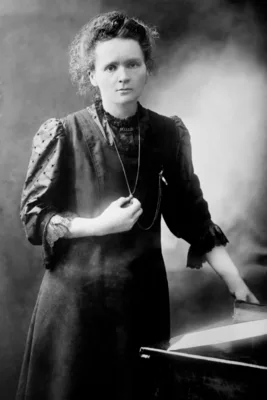
Marie Curie was a devout Catholic girl in Russian-ruled Warsaw who lost her eldest sister and then her mother. By her daughter's account she felt revolt against the God she had prayed to. She let her faith lapse among the Warsaw positivists while keeping up appearances. From 1895 she declared her unbelief by acts rather than words: a civil marriage, unbaptised daughters and funerals without ceremony. She left only one published sentence of her own: "I myself did not practice any."
Emma Goldman
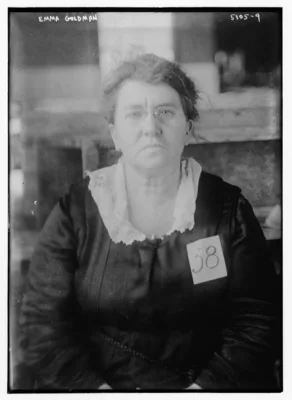
Emma Goldman had no faith to lose, only a religion she met as discipline in a Jewish childhood. Her atheism grew out of her pity for the hanged and out of her anarchism, and by 1893 it was a flat public statement. In 1913 and 1916 it became an argument for the earth over heaven. In Soviet Russia it turned on the revolution's own church.
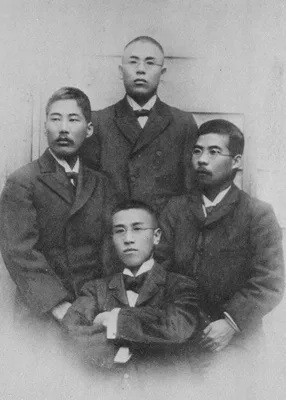
Kōtoku Shūsui
Kōtoku Shūsui was schooled in the Confucian classics and formed as the pupil of Nakae Chōmin, whose last book denied God and the soul. In 1901 he refused his Christian friend Uchimura's God, for a morality without fear or future judgment. In politics he moved from socialism to anarchism. He spent his last months in Tokyo Prison writing a book to obliterate Christ from history, and went to the gallows in 1911 having, as his last poem says, prayed to no god.
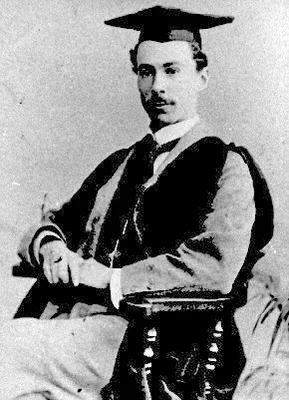
Bertrand Russell
Bertrand Russell was raised in his grandmother's devout Unitarian household after his freethinking parents died. At eighteen he gave up the First Cause over a sentence of Mill's. He tried for twenty years to keep a religion without God, then declared himself a dissenter from all religions, and paid for it in 1940. He never claimed more than that there was no evidence for God.