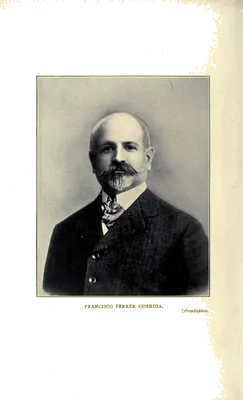
Francisco Ferrer was raised by devout Catholic farmers at Alella, and broke with their faith and politics as a young Republican. In his Paris years he called himself "a convinced atheist". He spent a Catholic pupil's legacy on a Barcelona school meant to banish religion from children's minds. He was acquitted once, and then shot at Montjuïc in 1909 as "author and chief" of a rising no single act of his was shown to have caused. He refused the priests to the last, and forbade any cult, even of himself.
The belief timeline
- Faith (1859-1872 (inferred)) — Baptised and raised in a household of "believing and practising Catholics"; village school with crucifix and saints' pictures. His own childhood belief is not documented; his own 1908 note stresses politics, not religion. [3][4][5][6]
- Doubt (c. 1872 (inferred)) — At thirteen in Barcelona under an ardent anticlerical employer, with a freethinking brother and uncle; by about twenty openly Republican and estranged from the family. Archer doubts the employer was the first cause: the seeds were sown before he left Alella. [6][7][8][79]
- Declaration (1900-09 to 1901-09) — Writes that the school will "banish from the brain that which divides men (religion)" (1900, as quoted by the prosecution); opens the Escuela Moderna on 8 September 1901; in 1908 calls himself "a convinced atheist" of the earlier years. (He had attended the Freethinkers' Congress in 1892.) [22][25][26][27][24]
- Revision (1906-1909 (inferred; of method, not of unbelief)) — His unbelief never wavers in the sources; what changes is method. After 1906 he disowns party labels, writes "neither dogmas nor systems", edits references to Christ out of English books for "laic teaching", and on the last night refuses priests and forbids any religious or political cult over his remains. Whether this is revision or tactics is disputed. [40][44][45][46][53][55][56]
Notes to the timeline (19)
- [3] Baptised 16 January 1859 in the church of Sant Feliu, Alella, with the names Francisco, Joan and Ramon — "Francisco Ferrer Guardia", Spanish Wikipedia, revision 175760921 (2026-10-10). Used for the baptism date, rev. 175760921, citing Albadalejo 2021. Reported at second hand; the original has not been seen.
- [4] His parents were fairly well-to-do farmers and "believing and practising Catholics"; McCabe calls the household one of "fanatical orthodoxy" that "shrank closer to their church" — William Archer, The Life, Trial and Death of Francisco Ferrer (New York: Moffat, Yard, 1911; London, 1911), p. 3; Joseph McCabe, The Martyrdom of Ferrer, being a true account of his life and work (London: Watts, 1909), pp. 11-13.
- [5] He attended the municipal school at Alella to age ten and one at Teia for two years; schooldays ended at twelve. Archer, visiting in 1910, found a crucifix and pictures of saints on the schoolroom walls — Archer, Life, pp. 3-4.
- [6] In his 1908 autobiographical note for the Almanach of the International Freethought Federation Ferrer recalled his uncle's stories of General Prim's conspiracies and joining in the rejoicing at Isabella II's fall in 1868; Archer concludes the "seeds of revolt" were sown before he left Alella — Archer, Life, p. 4-5 (Archer's translation of the note).
- [7] At thirteen he was employed by a corn-and-seed merchant (some say a draper) in San Martin de Provensals; "it is usually said" that this anticlerical employer undermined the orthodoxy he brought from home — Archer, Life, p. 5; McCabe, Martyrdom of Ferrer, p. 13.
- [8] McCabe: his brother Jose was "a young iconoclast"; Francisco "quiet and respectful"; in his twentieth year he openly declared himself Republican and "the family link was broken"; "a few years later he joined the Freemasons" — McCabe, Martyrdom of Ferrer, p. 13.
- [79] Wikipedia (citing Avrich 1980 p. 3) says he drew independent and anticlerical convictions from a freethinker uncle and a "militant atheist" first employer, and (p. 8) calls him "a fervent atheist" in 1901 — "Francisco Ferrer", English Wikipedia, revision 1347520650 (2026-04-07). Used for pointers to Avrich, Avilés Farré, the Masonic initiation and the 14 January birth date, rev. 1347520650. Not verified.
- [22] In the manuscript of 1908 Ferrer wrote that the efforts to convert him made her see "the error of thinking that every unbeliever was perverse and every atheist a hardened criminal, since I, a convinced atheist, manifested symptoms very different from those which her religious prejudice had led her to expect" — Francisco Ferrer, The Origin and Ideals of the Modern School, trans. Joseph McCabe (New York and London: G. P. Putnam's Sons, 1913), p. 10.
- [25] Letter of 29 September 1900 to Jose Prats: "it is my intention to found in this town an emancipatory school, whose business shall be to banish from the brain that which divides men (religion), the false ideas of property, of country and of family" — The official trial documents (Prosecutor, Assessor, Auditor-General, sentence) in William Archer's English translation, Appendix pp. 255-321 of [Archer]. Archer says it is a literal translation of the government's own pamphlet. Ferrer's letters, will and last letter are quoted in Archer's chapters in English translation; the Spanish originals were not seen except where [Proceso] reproduces them, p. 307 (from the Auditor's dictamen).
- [26] Letter of 6 December 1900 to Prats: all the school's acts "shall be internally libertarian, but without making a show of this externally, because otherwise we should not be able to live" — Archer-App, p. 307.
- [27] The first public programme (1901) promised that "the rational method of the natural sciences will be substituted for the old dogmatic teaching" and Sunday classes on human suffering and on "men and women who have distinguished themselves in science, art, or the fight for progress" — Ferrer, Origin and Ideals of the…, pp. 20-21.
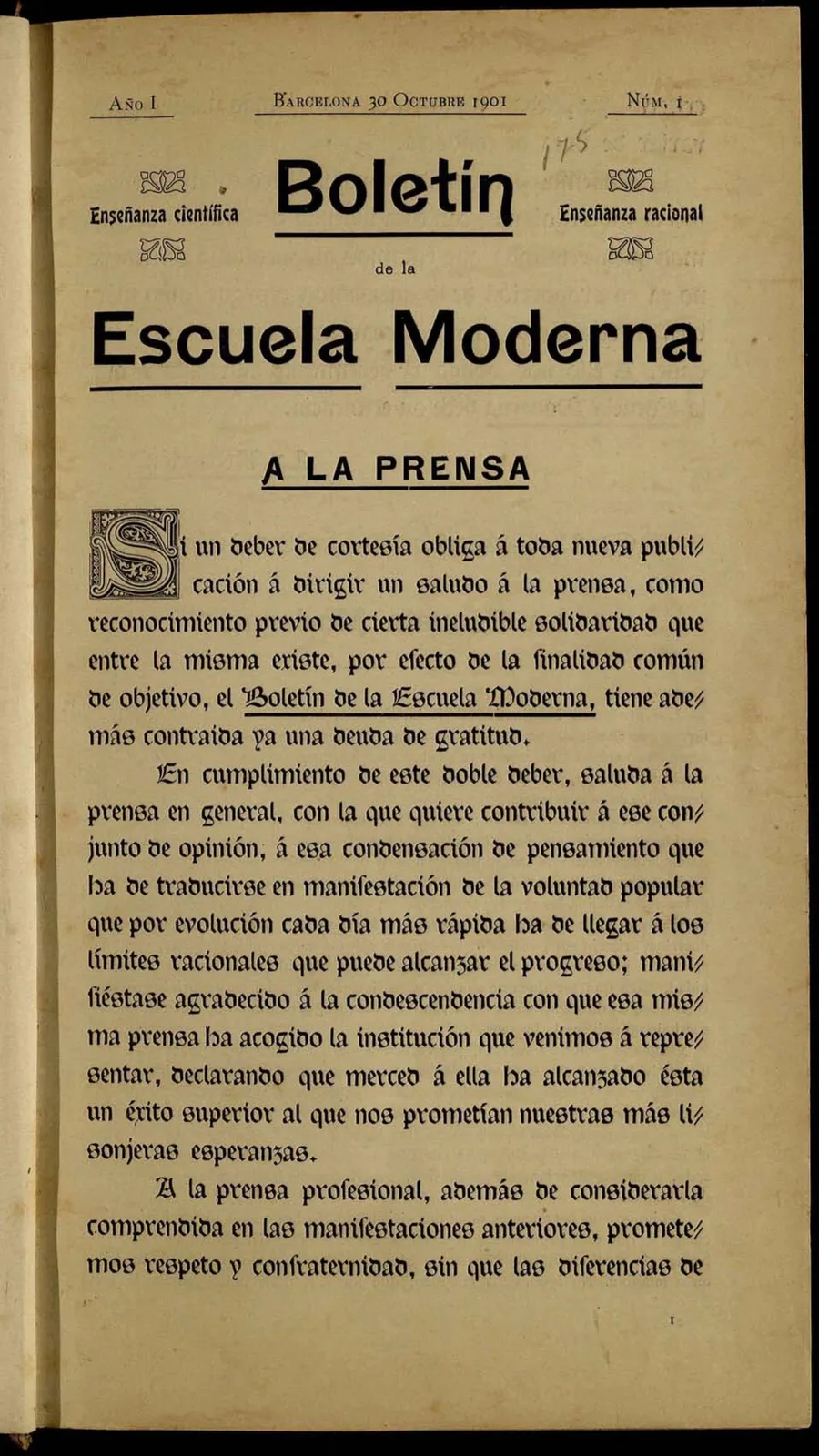
- [24] The Escuela Moderna opened on 8 September 1901 at 56 Calle Bailen, Barcelona, with 30 pupils (12 girls) — Archer, Life, pp. 28, 59; Boletin de la Escuela Moderna, ano I (1901-02), p. 4.
- [40] In November 1906 he wrote in Espana Nueva: "I detest all party names, from that of anarchist to that of Carlist" and "I have always denied to the Court that I am an anarchist" — Archer, Life, p. 38.
- [44] Ferrer wrote the manuscript of the Origin in summer 1908 at the Pyrenees after his 1906-07 imprisonment; for the 1903-04 programme he wrote "Neither dogmas nor systems... will be taught" — McCabe's introduction (roman pages iii-xi) and epilogue (pp. 145-147) in [Origin], p. vi; Ferrer, Origin and Ideals of the…, p. 108.
- [45] In a letter to Heaford from the Barcelona prison, October 1909, he said an English book of moral lessons by F. J. Gould was good "except where he speaks of Christ, very little, which I should simply suppress", and that a tale about Santa Claus should be dropped — Archer, Life, p. 112.
- [46] Renato Rugieres recalled Ferrer on 3 July 1909 telling him to take out passages marked in the same book: "they touch upon religious matters, and our books are for laic teaching" — Archer, Life, p. 115.
- [53] The Auditor-General wrote a 7,500-word report in one day (Sunday 10 October) — Archer, Life, p. 235 and note.
- [55] In the improvised chapel he asked that the image of the Virgin be removed (refused) and declined the ministrations of the priests "firmly but without asperity" through the night — Archer, Life, p. 239.
- [56] He dictated a will for about seven hours, protesting "total innocence" and forbidding "any religious or political manifestations or observances over his remains" and asking friends to "speak little of me, or not at all"; executors Cristobal Litran and William Heaford — Archer, Life, pp. 239-240.
Separated from Faith
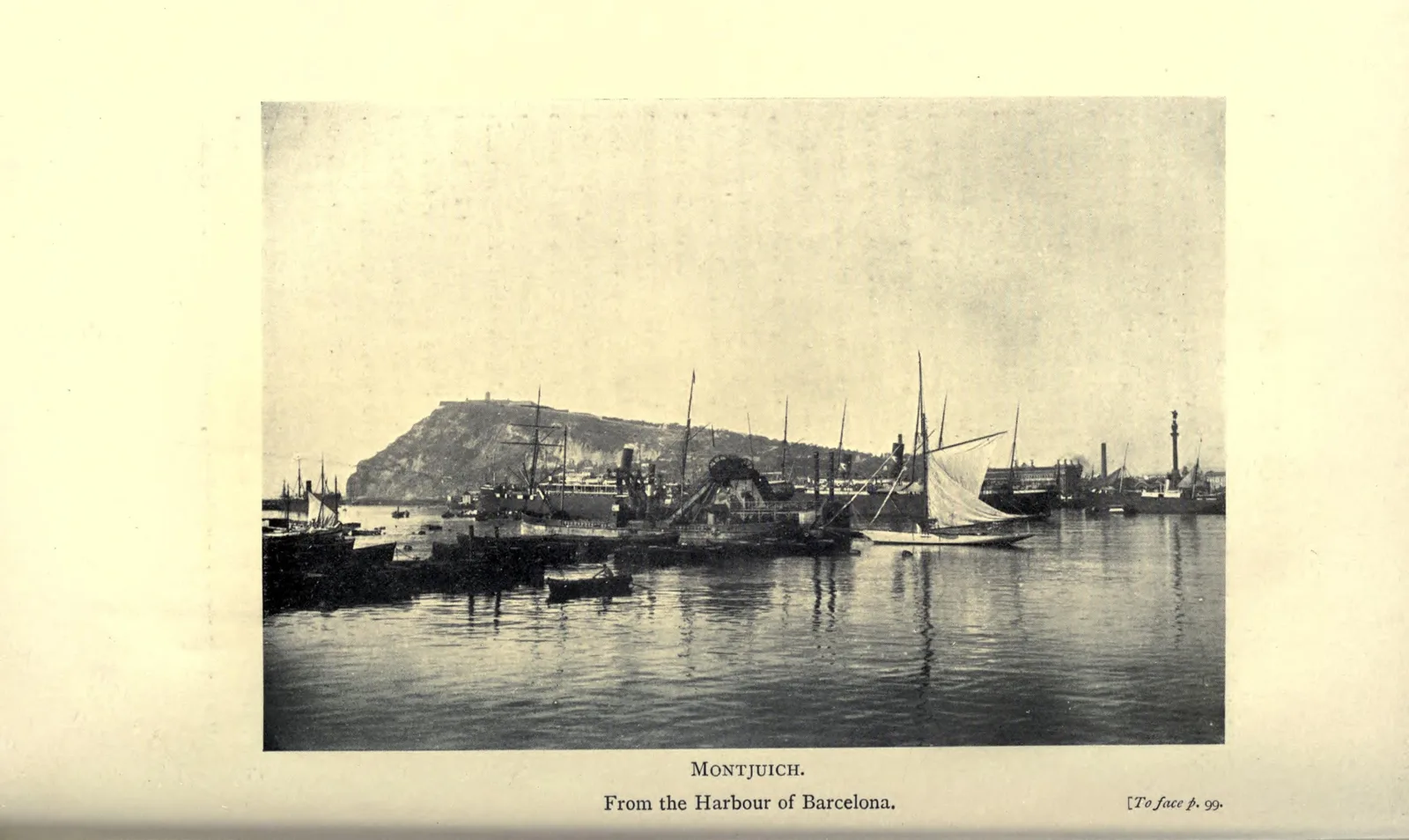
At about nine o'clock on the morning of 13 October 1909, in a trench of the fortress of Montjuïc above Barcelona, a fifty-year-old schoolmaster faced a firing squad. He had asked not to be blindfolded and been refused. His last words, as they were reported, were "Aim well, my sons! It is not your fault. I am innocent. Long live the Escuela", and the volley cut the sentence off.12 Through the night before, in the chapel of the fortress, he had asked for the image of the Virgin to be taken away and, "firmly but without asperity", refused the priests.3 In his will he forbade "any religious or political manifestations or observances over his remains".4
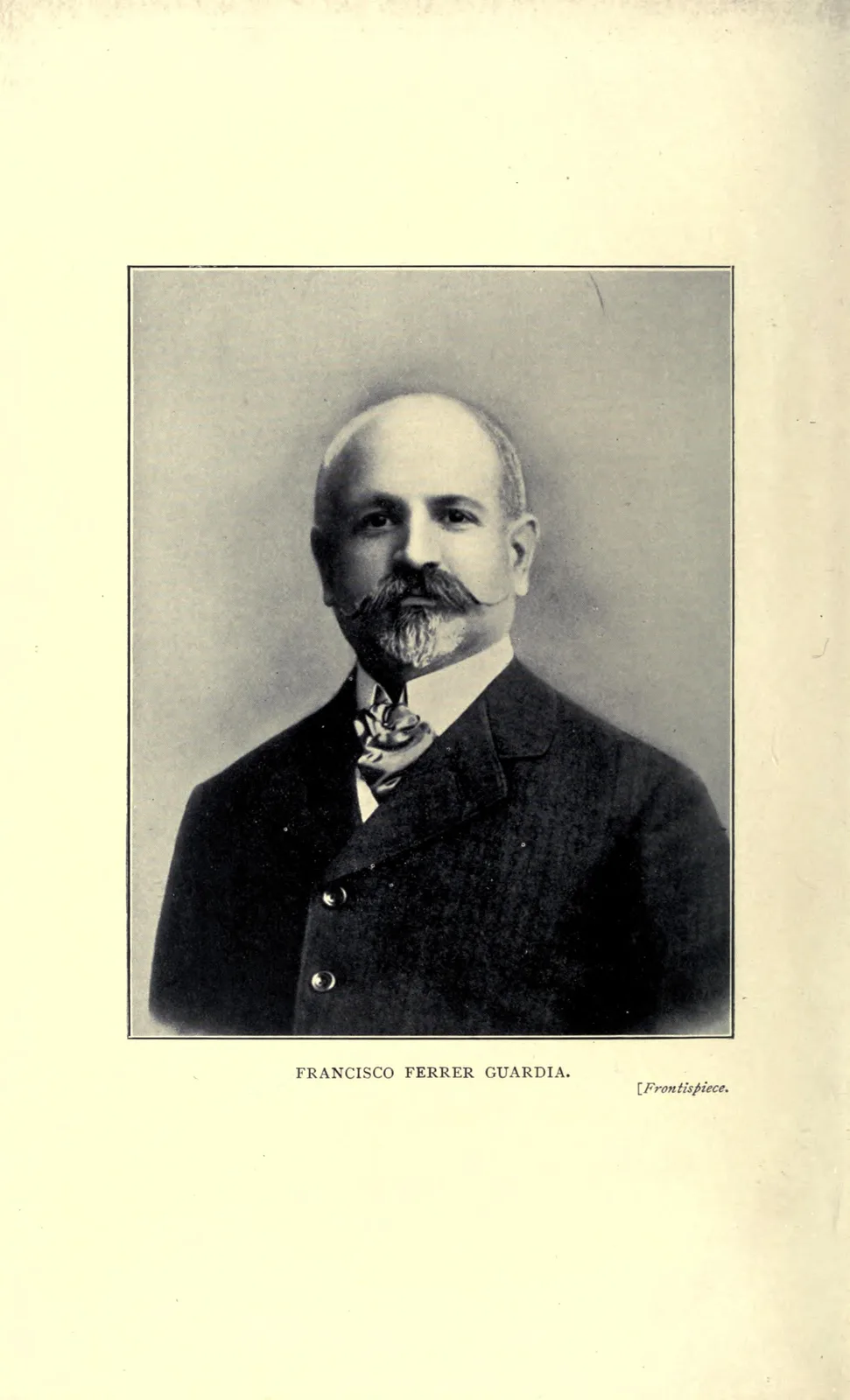
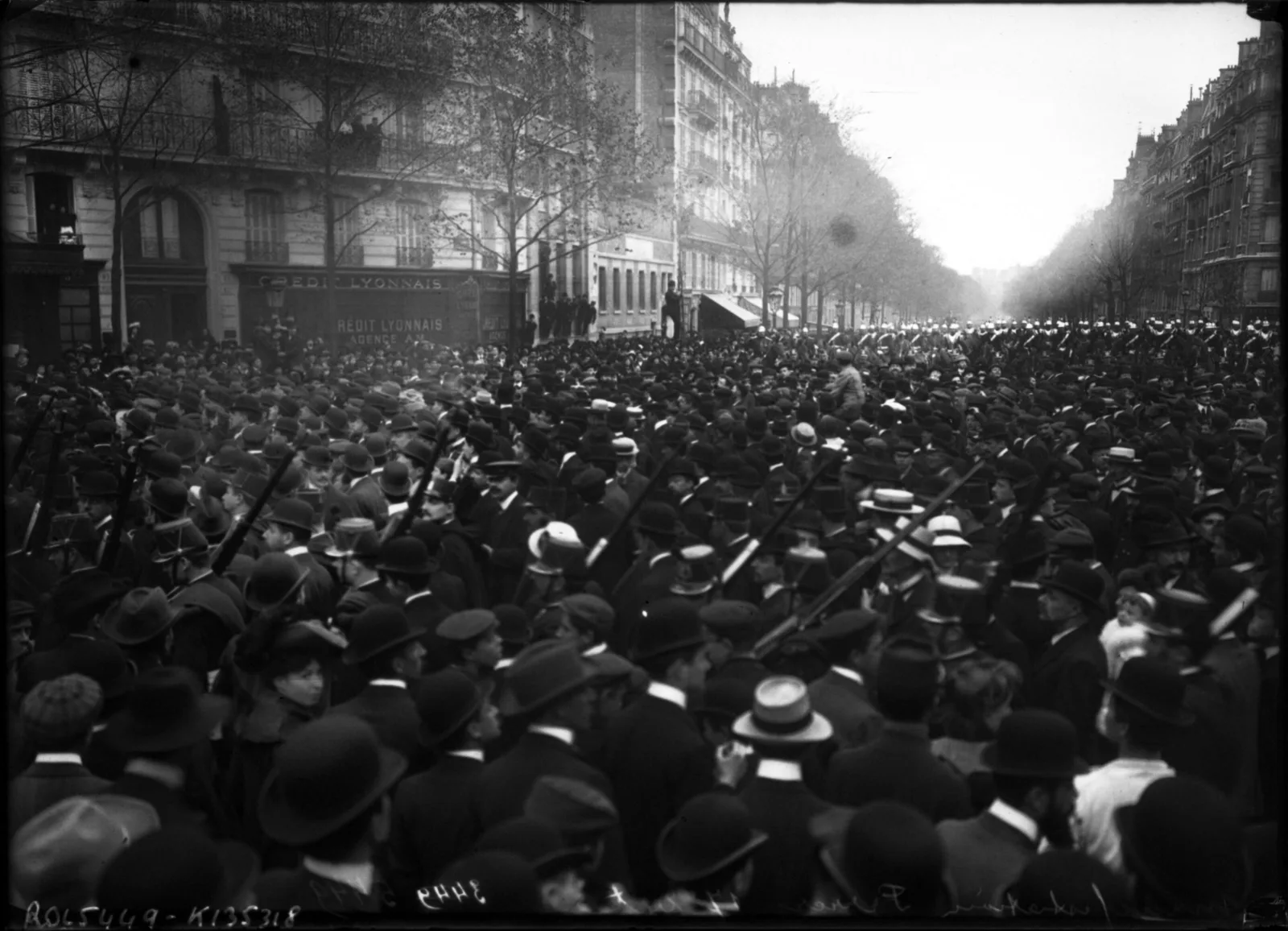
Within days there was rioting in Paris and protest in London, Rome, Berlin, Brussels, Lisbon and a dozen other cities, and on 21 October the Spanish government fell.56 The man they mourned was Francisco Ferrer i Guàrdia, founder of the Escuela Moderna, the Modern School, a school without God. This chapter asks how the son of a devout Catalan farming family came to found it, why Spain shot him, and what his unbelief had to do with either.
Alella
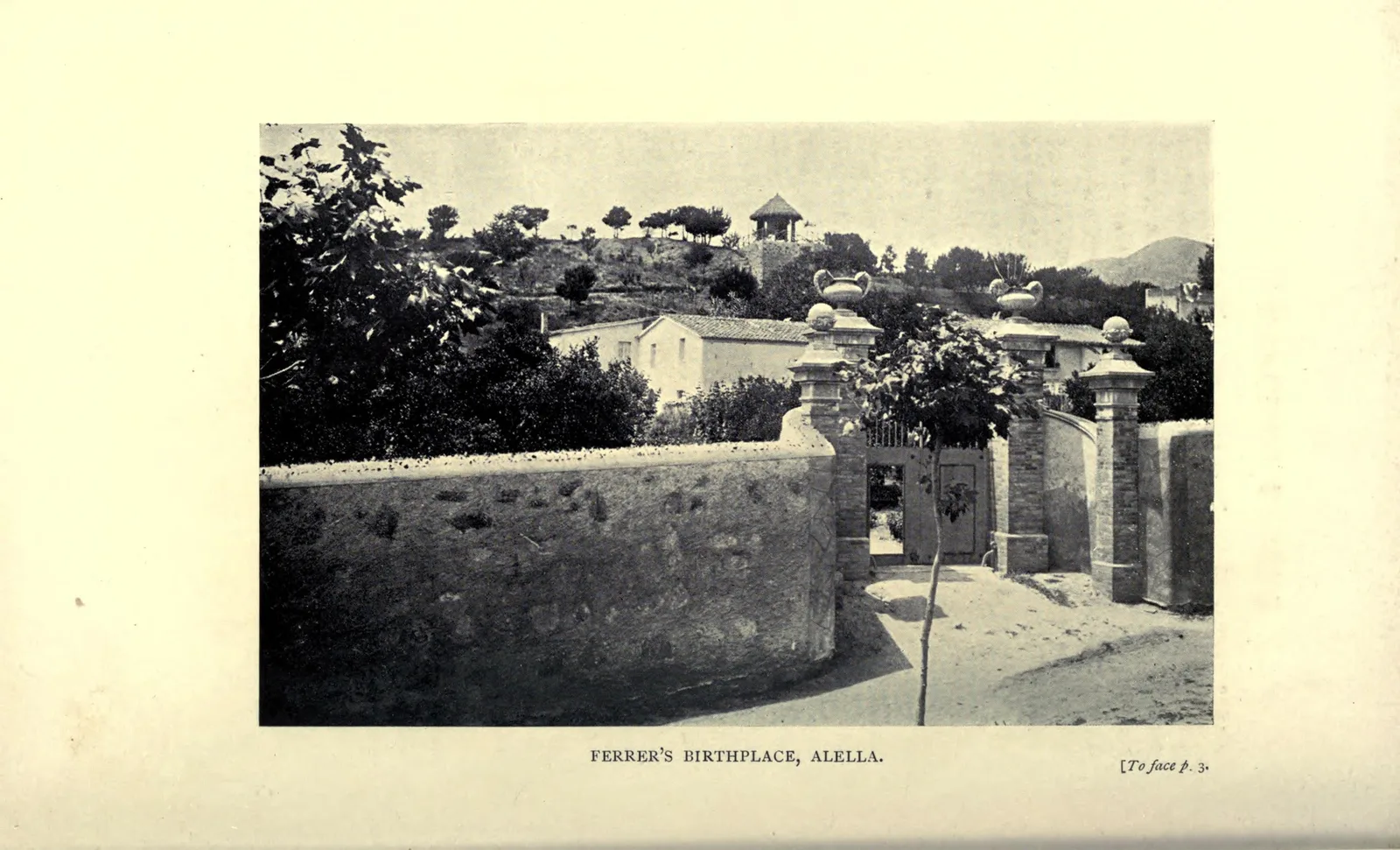
He was born at Alella, a village about twelve miles from Barcelona, in January 1859; the day is given as the 10th, and the parish register reportedly says the 14th.78 His parents were fairly well-to-do farmers and "believing and practising Catholics".9 When William Archer visited his village school in 1910 he found a crucifix and pictures of saints on the walls.10 Ferrer himself remembered his uncle's tales of revolutionary conspiracies, and the rejoicing in 1868 when Queen Isabella II was driven out.11 On his timeline, his faith is placed in that household and that school; no word of his own about a childhood belief survives.
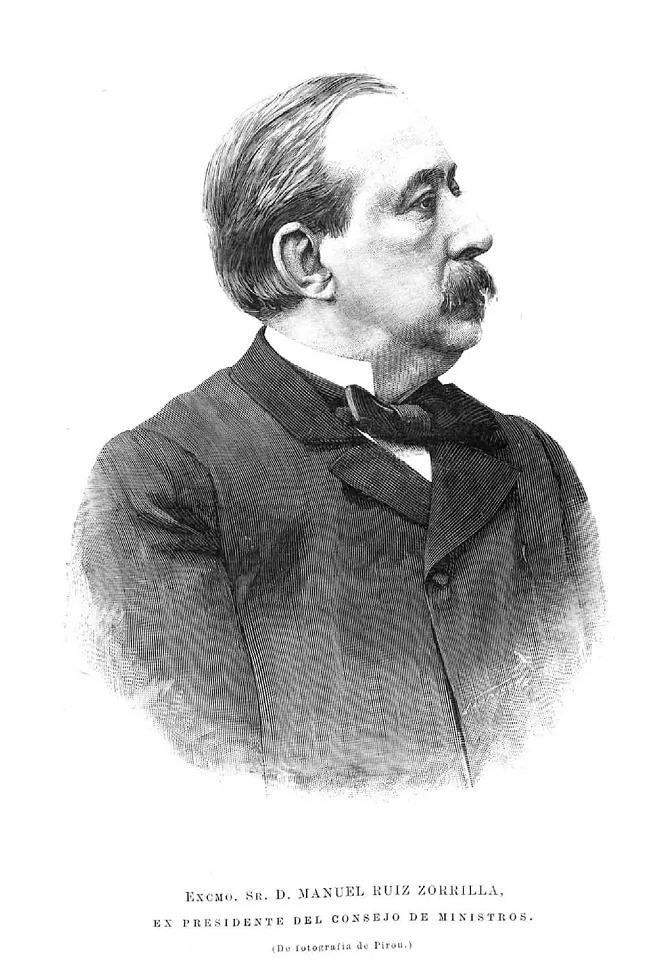
At thirteen he went to work for a merchant near Barcelona who was, "it is usually said", an ardent anticlerical; Archer thought the seeds had been sown before he left home.1112 His brother José was "a young iconoclast", and around his twentieth year Francisco declared himself a Republican, and "the family link was broken".13 The timeline puts his doubt here, but that is an inference: no source records the day his faith went. As a railway ticket inspector he carried messages for the exiled Republican leader Ruiz Zorrilla, and after a failed rising in 1885 or 1886 he settled in Paris.1415
A convinced atheist
In Paris he worked as a wine broker, ran a small restaurant, taught Spanish, and served Zorrilla as unpaid secretary; fifteen years there, through the Boulanger and Dreyfus affairs, convinced him, he wrote, that popular education was the unsolved problem.1617 In 1892 he went to a congress of freethinkers in Madrid.18 From 1894 one of his Spanish pupils was Ernestine Meunier, a wealthy and devout Catholic. "I cannot conceive life without propaganda," he later wrote; it took him more than a year to speak to her of religion, and she burned a book he gave her before she came back.192021 In 1899 she wrote to him that her reverence for the clergy was "dead", "But there is a Supreme Being, a God, the God of my mother."222324 He admitted that she accepted his views on the Church and the priests but still feared "to cut herself loose from the ideas of the soul, of a life beyond the grave, and of God".25 In his own account of those years he called himself "a convinced atheist" whose conduct showed her that not every unbeliever was perverse.262728
In August 1900 at Geneva he told her he wanted to found a school, and she agreed to help. When she died in April 1901 her will left him a house in Paris, without conditions, and asked that she "die in the bosom of my Holy Mother the Church".293031 Her confessor said he had feigned piety to win her; Archer found her own letter disproved it.32
The Modern School
He had written to a friend in September 1900 that the school's business would be "to banish from the brain that which divides men (religion), the false ideas of property, of country and of family". In December he added that its acts should be "internally libertarian, but without making a show of this externally, because otherwise we should not be able to live".33343536 The prosecution later read those letters as proof of concealment; Archer called them invaluable to the defence. The Escuela Moderna opened at 56 Calle Bailén in Barcelona on 8 September 1901, with thirty pupils, twelve of them girls.37 The timeline treats that founding, together with the letter of 1900, as his declaration.
The school replaced "the old dogmatic teaching" with the methods of the natural sciences.38 If matter was uncreated and eternal, Ferrer wrote, there was no excuse for teaching children "that God made the world out of nothing in six days".3940 Rational education "has, in the first place, no regard to religious education, because science has shown that the story of creation is a myth and the gods legendary"; "We will not, therefore, lose our time praying to an imaginary God."414243 Yet he also wrote that "Neither dogmas nor systems" would be taught.44 Archer, who admired him, admitted that "his teaching was not merely anti-clerical but anti-religious".4546 Some of the school's books were hard on Christianity; Archer sampled forty and found no "unseemly scoffing or vulgar scurrility".47 On Good Friday 1906, 1,700 pupils of the free schools gathered at a festival in Barcelona, on a date chosen to offend.48
The bomb and the trial
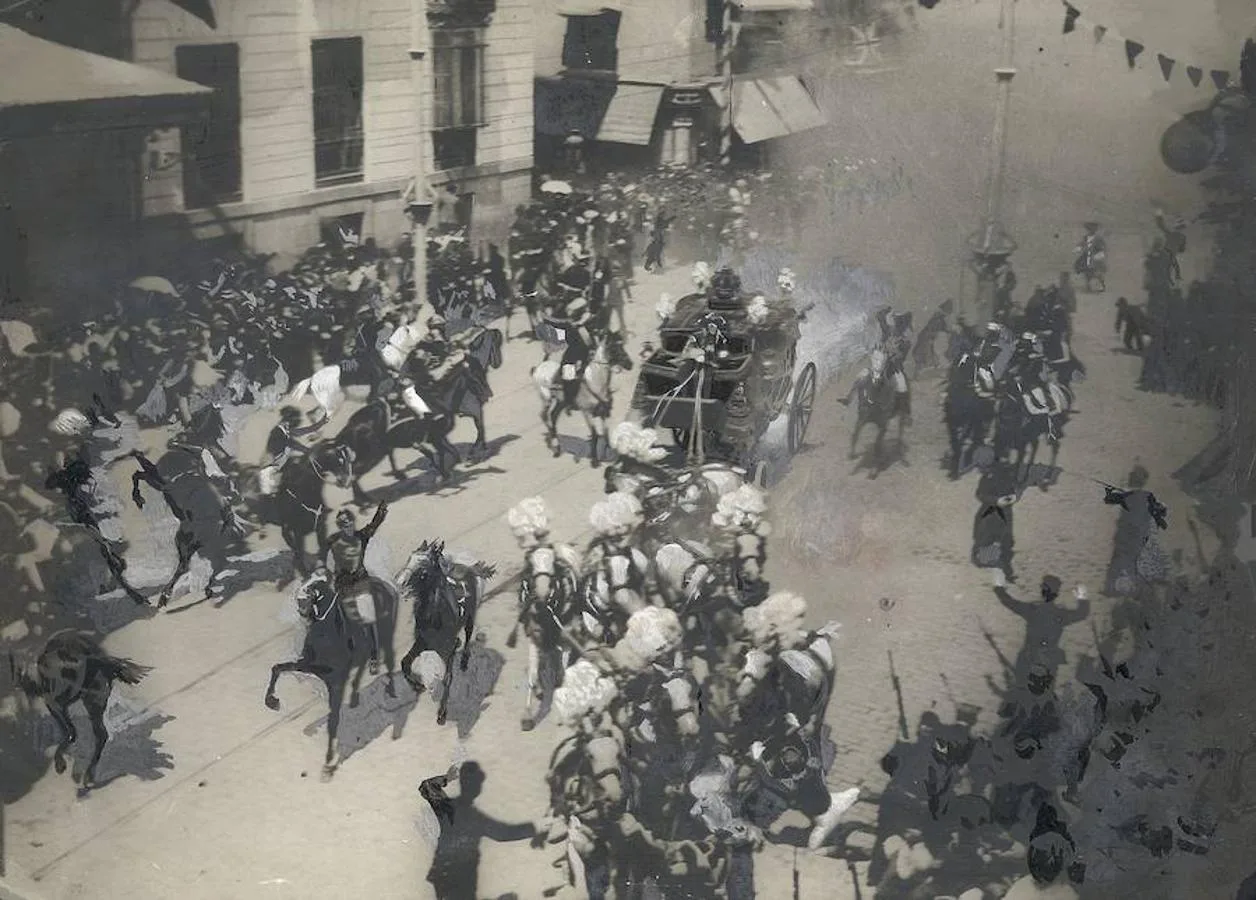
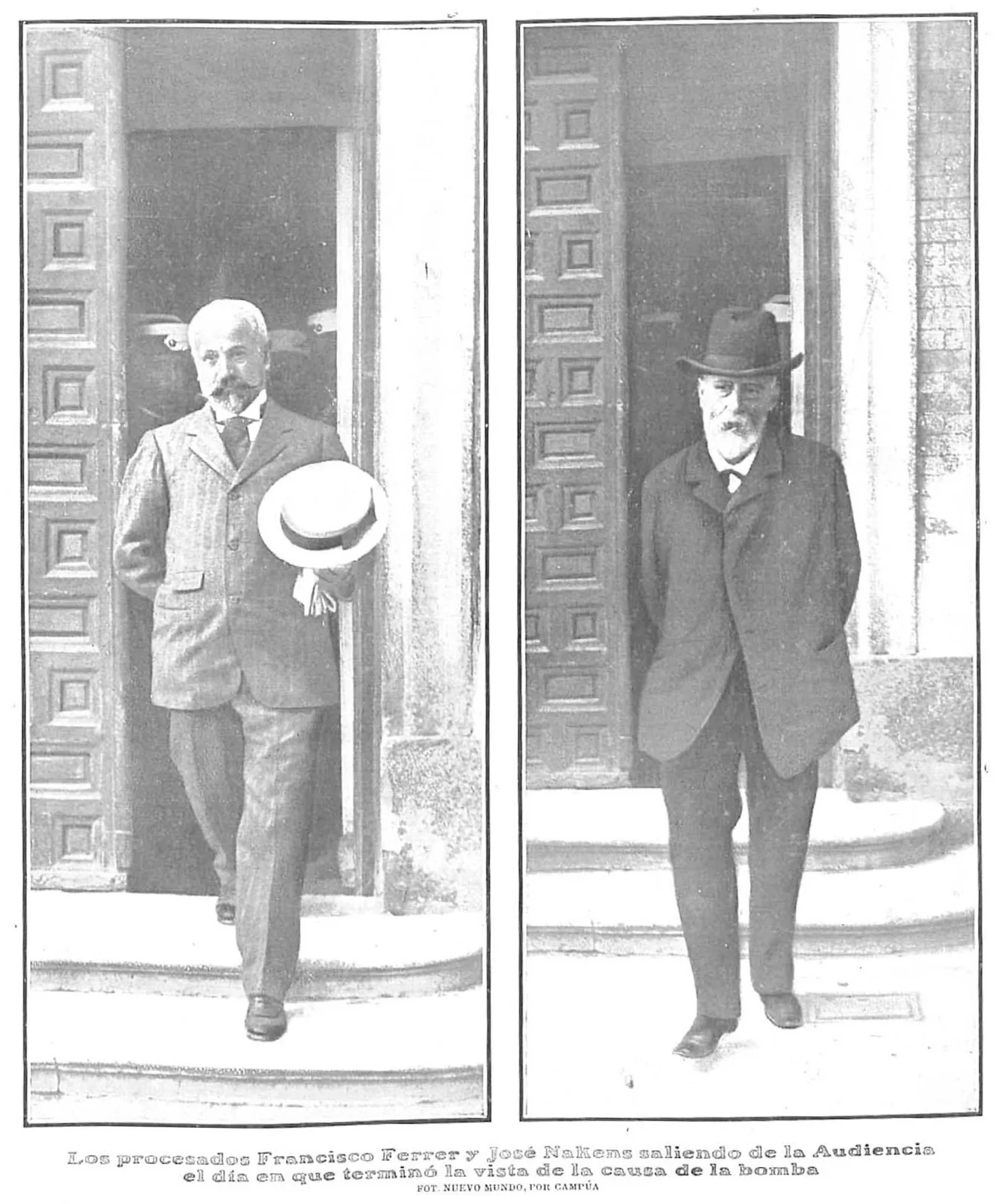
On 31 May 1906 the school's librarian, Mateo Morral, threw a bomb at the wedding procession of King Alfonso XIII in Madrid and killed fifteen people. Ferrer was arrested and the school closed.49 He was tried in 1907 and acquitted: the court found no link between his opinions and the crime.50 Historians still disagree about how much he knew.51 From prison he wrote that he detested "all party names, from that of anarchist to that of Carlist", and on his cell wall: "No more let gods or exploiters be adored or served."525354
The Tragic Week
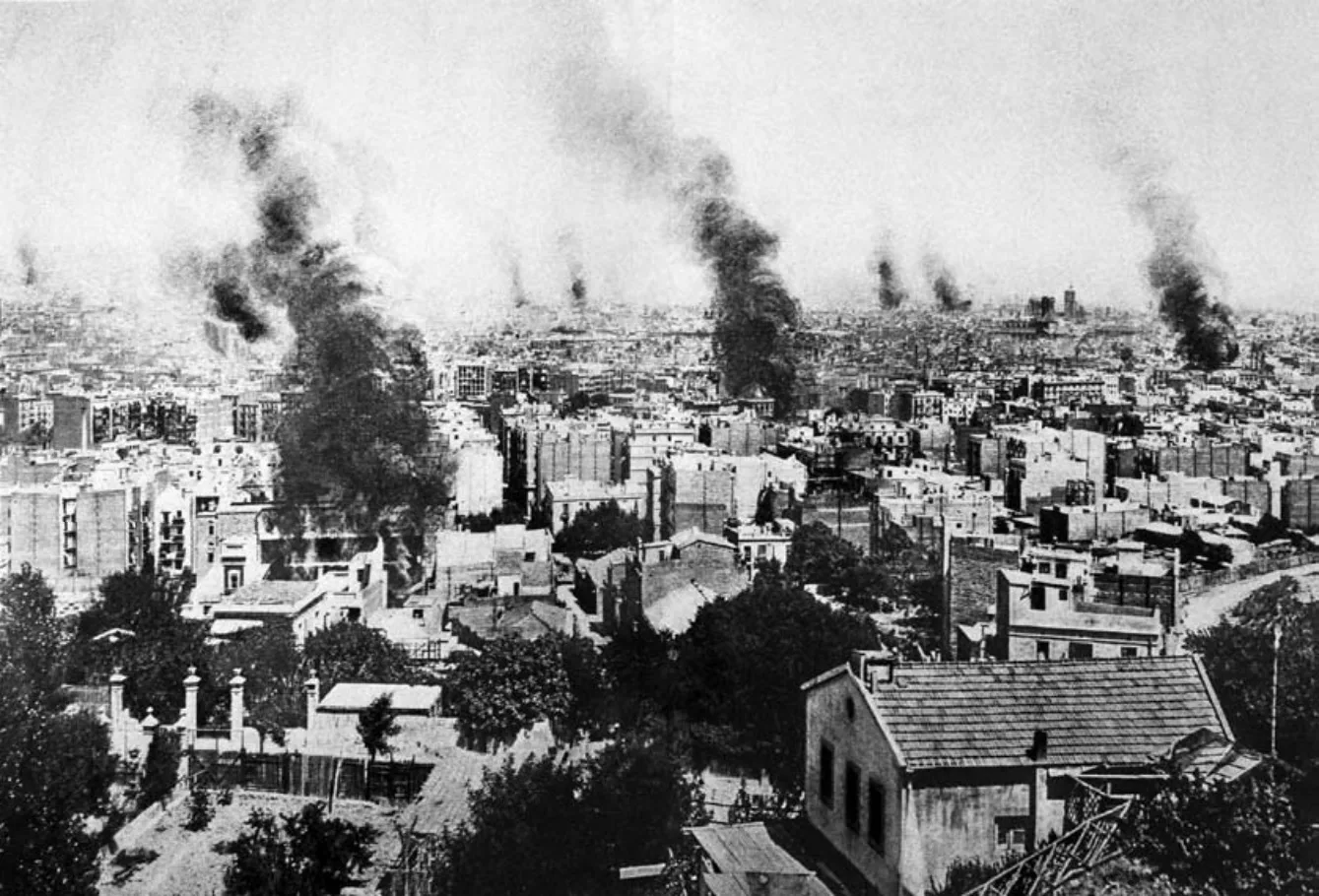
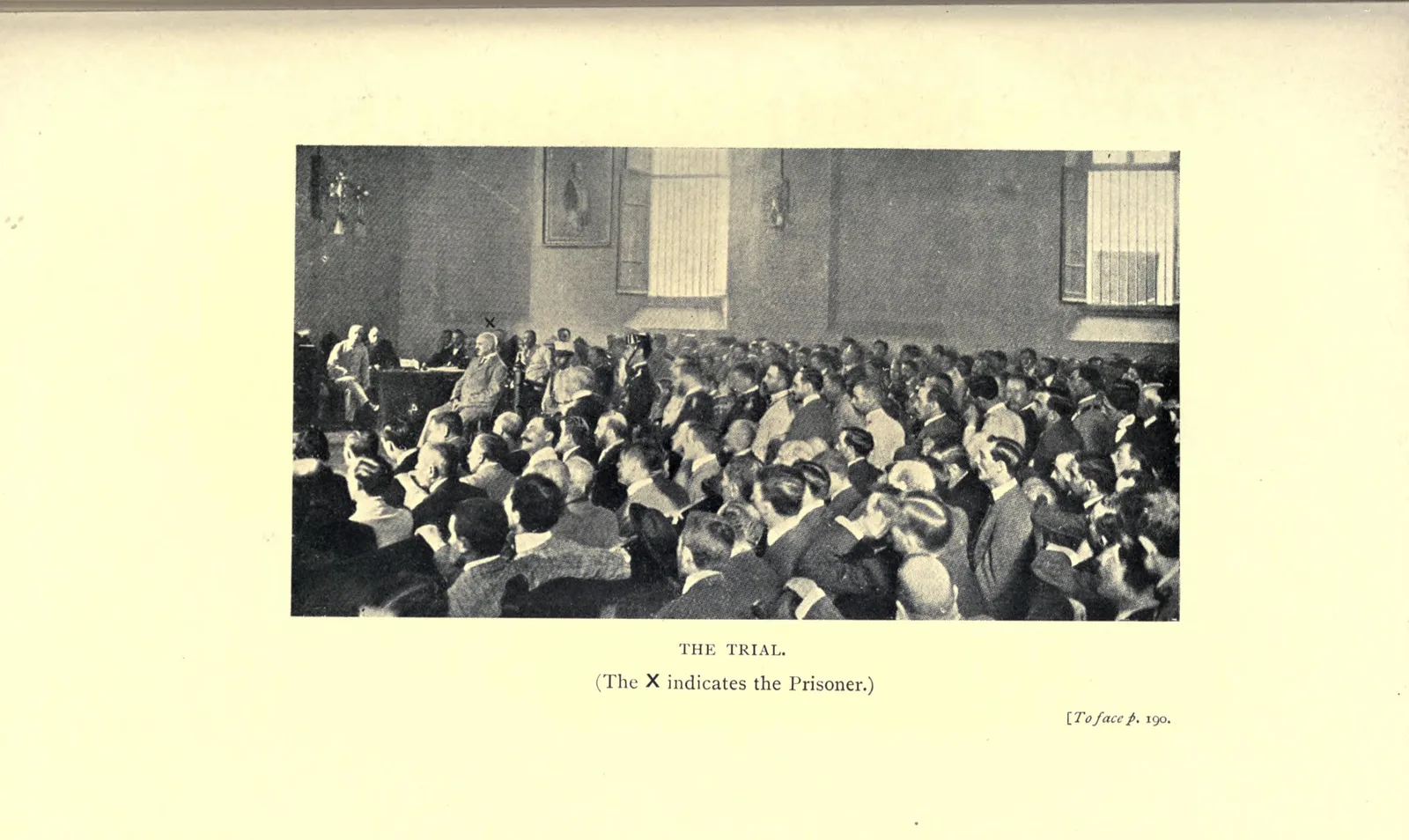
In July 1909 the government called up reservists for the war in Morocco. A general strike in Barcelona on 26 July became an insurrection the next day, and in the following nights about fifty churches, convents and other religious buildings were burned.55 Ferrer was at his house in the country under police watch; Archer found no evidence that he wrote to or saw anyone involved.56 He was arrested near his birthplace on 31 August and tried by court-martial as "author and chief" of the rebellion. The prosecution claimed no single act of violence by him.5758 On 9 October the court sentenced him to death.59 The Auditor-General's report called him "the MORAL AUTHOR AND CHIEF of the anarchist revolutionary movement in Catalonia".60
Catholic writers defended the verdict. A Catalan count told a newspaper that when Ferrer "opens his mouth, Freemasonry and international anarchism open their hand and their purse".6162 The American priest John A. Ryan argued in 1911 that the trial was fair, that Ferrer's "sole aim as a teacher and publicist was to make revolutionists and anarchists", and that even if he had been shot for his opinions it "would not have been wrong in principle".63646566 Ryan also stated the believer's case for education fairly: the better a mind is trained, "the more nearly does it become the image and likeness of its Creator".67 In 1912, McCabe reported, the Supreme Military Council found that no single act of violence could be traced to him.68
Think only of life
His unbelief did not change in prison; what changed, if anything, was his method. In his last months he was editing references to Christ out of English moral readers "for laic teaching".69707172 To Soledad Villafranca he wrote on the eve of his death: "I have no time to think of death; I will think only of life."7374 And in his will: "I desire that my friends shall speak little of me, or not at all; since in eulogizing men we create a sort of idol."475 The timeline places his revision here, and it is a refusal of every cult, his own included.
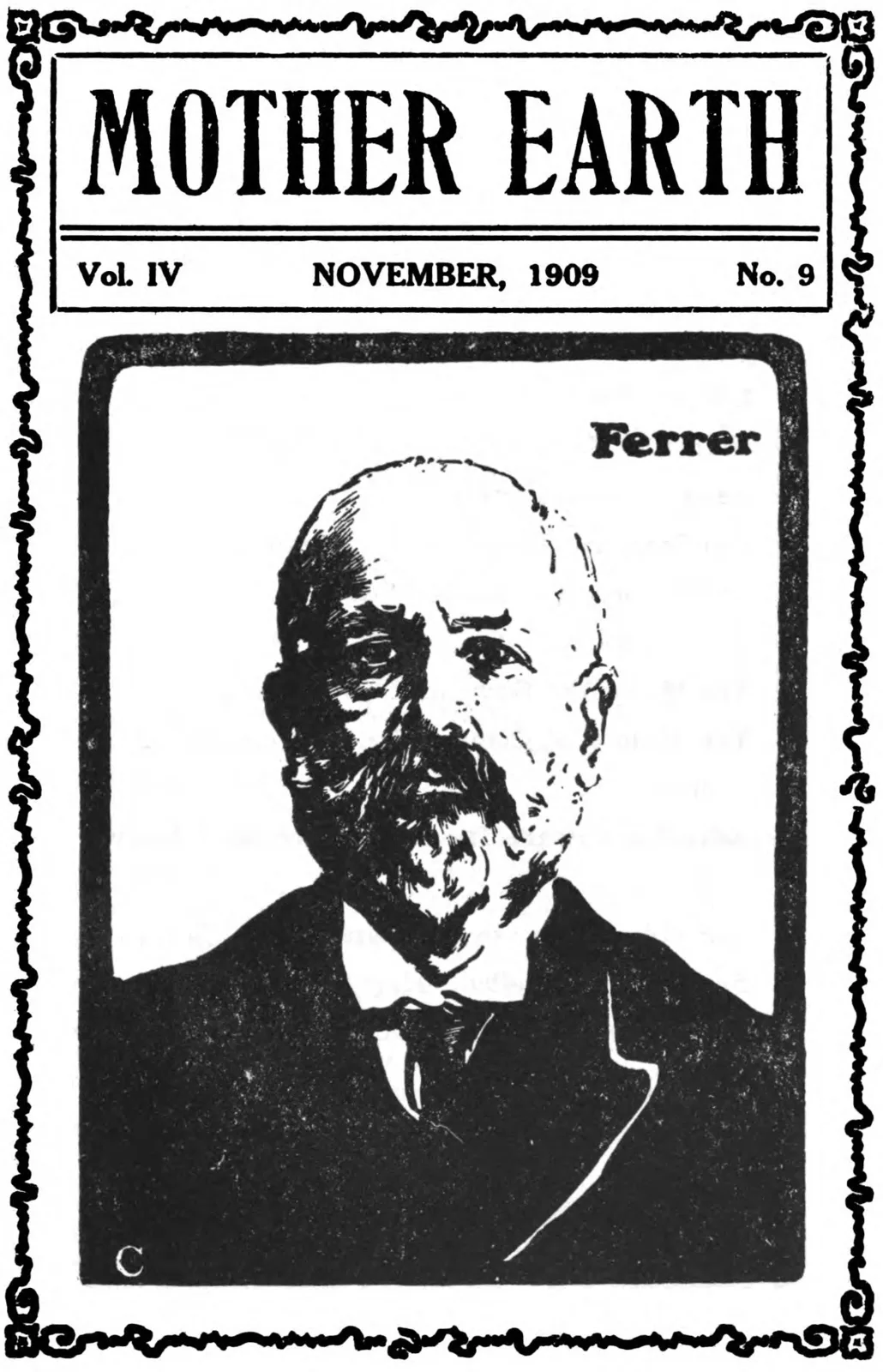
His daughter Paz stayed a Catholic and said so: "He did not get angry; he smiled, and that was all."7677 In New York a Ferrer Center later took his name. Emma Goldman, whose paper put him on its cover that November, has her own chapter in this book.
Footnotes
-
William Archer, The Life, Trial and Death of Francisco Ferrer (New York: Moffat, Yard, 1911; London, 1911), pp. 1, 241. ↩
-
Archer, Life, p. 241. ↩
-
Archer, Life, p. 239. ↩
-
Archer, Life, p. 1. ↩
-
Archer, Life, pp. 243-244. ↩
-
Archer, Life, p. 3; Joseph McCabe, The Martyrdom of Ferrer, being a true account of his life and work (London: Watts, 1909), p. 11. Accounts differ; see the disputed points. ↩
-
Jordi Albadalejo's article on Ferrer's parish register, Revista d'Alella, Nov-Dec 2021, as summarised in "La Viquipedia i l'Enciclopedia Catalana rectifiquen la data de naixement de Ferrer i Guardia...", Revista Alella, 20 Jan 2022,, (20 Jan 2022 summary page); "Francisco Ferrer", English Wikipedia, revision 1347520650 (2026-04-07). Used for pointers to Avrich, Avilés Farré, the Masonic initiation and the 14 January birth date, rev. 1347520650 note; Archer, Life, p. 4 note. Reported at second hand; the original has not been seen. ↩
-
Archer, Life, p. 3; McCabe, Martyrdom of Ferrer, pp. 11-13. ↩
-
Archer, Life, pp. 3-4. ↩
-
Archer, Life, p. 4-5 (Archer's translation of the note). ↩ ↩2
-
Archer, Life, p. 5; McCabe, Martyrdom of Ferrer, p. 13. ↩
-
McCabe, Martyrdom of Ferrer, p. 13. ↩
-
Archer, Life, p. 5; McCabe, Martyrdom of Ferrer, p. 14. ↩
-
Archer, Life, p. 5; McCabe, Martyrdom of Ferrer, p. 14; "Francisco Ferrer Guardia", Spanish Wikipedia, revision 175760921 (2026-10-10). Used for the baptism date. ↩
-
Archer, Life, p. 7; Francisco Ferrer, The Origin and Ideals of the Modern School, trans. Joseph McCabe (New York and London: G. P. Putnam's Sons, 1913), p. 4. ↩
-
Ferrer, Origin and Ideals of the…, pp. 1-3. ↩
-
Archer, Life, pp. 222-227. ↩
-
Archer, Life, pp. 19-20. ↩
-
Archer, Life, pp. 20-22. ↩
-
Archer, Life, p. 20. ↩
-
Archer, Life, pp. 25-26; The official trial documents (Prosecutor, Assessor, Auditor-General, sentence) in William Archer's English translation, Appendix pp. 255-321 of [Archer]. Archer says it is a literal translation of the government's own pamphlet. Ferrer's letters, will and last letter are quoted in Archer's chapters in English translation; the Spanish originals were not seen except where [Proceso] reproduces them, p. 305. ↩
-
Ernestine Meunier, Ferrer's pupil and benefactress, a Catholic believer, letter of 2 Nov 1899: Archer, Life, p. 26. ↩
-
Ernestine Meunier, same letter: Archer, Life, p. 26. ↩
-
Archer, Life, pp. 21-22. ↩
-
Ferrer, Origin and Ideals of the…, p. 10. ↩
-
Francisco Ferrer Guardia, La Escuela Moderna: postuma explicacion y alcance de la ensenanza racionalista (Barcelona: Imprenta Elzeviriana, 1912), p. 30. ↩
-
Ferrer, Origin and Ideals of the…, p. 10 (McCabe trans., 1913); Spanish: Escuela1912 p. 30. ↩
-
Archer, Life, p. 22. ↩
-
Archer, Life, pp. 25, 28. ↩
-
Ernestine Meunier, will of 20 Jan 1901: Archer, Life, p. 25. ↩
-
Archer, Life, pp. 25-26. ↩
-
Archer-App, p. 307 (from the Auditor's dictamen). ↩
-
Archer-App, p. 307. ↩
-
Archer-App, p. 307 (Archer's translation of the Auditor's quotation). ↩
-
Archer-App, p. 307. ↩
-
Archer, Life, pp. 28, 59; Boletin de la Escuela Moderna, ano I (1901-02), p. 4. ↩
-
Ferrer, Origin and Ideals of the…, pp. 20-21. ↩
-
Ferrer, Origin and Ideals of the…, p. 19. ↩
-
Ferrer, Origin and Ideals of the…, p. 19. ↩
-
Ferrer, Origin and Ideals of the…, pp. 86-88. ↩
-
Ferrer, Origin and Ideals of the…, pp. 86-87. ↩
-
Ferrer, Origin and Ideals of the…, p. 87. ↩
-
McCabe's introduction (roman pages iii-xi) and epilogue (pp. 145-147) in [Origin], p. vi; Ferrer, Origin and Ideals of the…, p. 108. ↩
-
Archer, Life, pp. 32-33, 37. ↩
-
William Archer: Archer, Life, p. 32 (1911). ↩
-
Archer, Life, pp. 39, 49-50; Ferrer, Origin and Ideals of the…, p. 83. ↩
-
Archer, Life, p. 61. ↩
-
Archer, Life, pp. 61, 66-67, 75. ↩
-
Archer, Life, pp. 65-66, 79-80. ↩
-
"Francisco Ferrer", rev. 1347520650. Not verified. ↩
-
Archer, Life, p. 38. ↩
-
Archer, Life, p. 38. ↩
-
Archer, Life, p. 64. ↩
-
Archer, Life, pp. 121-132. ↩
-
Archer, Life, pp. 125-126, 143 ff.. ↩
-
Archer, Life, p. 3. ↩
-
Archer, Life, pp. 2, 259-260, 297. ↩
-
Luis Simarro (ed.), El proceso Ferrer y la opinion europea, vol. 1 (Madrid, 1910), pp. 590-591; Archer-App, p. 297. ↩
-
The Auditor-General of the 4th region, whose report the Captain-General and Government accepted (Spanish government's case, 10 Oct 1909): Archer-App, p. 312 (Archer's literal translation). ↩
-
Archer, Life, pp. 165-166. ↩
-
Count of Santa Maria de Pomes, "Pontifical Count" and member of the Committee of Social Defence, to El Universo, 18 Aug 1909 (as quoted by Archer): Archer, Life, p. 165. ↩
-
John A. Ryan, D.D., Francisco Ferrer, Criminal Conspirator: a reply to the articles by William Archer in McClure's Magazine (St. Louis: B. Herder, 1911; nihil obstat 28 Feb 1911), pp. 60-64. ↩
-
Ryan, Francisco Ferrer, pp. 70-71, 78, 82. ↩
-
Rev. John A. Ryan, D.D., Catholic priest and economist, with nihil obstat and imprimatur of the Archbishop of St. Louis (1911): Ryan, Francisco Ferrer, p. 82. ↩
-
Ryan: Ryan, Francisco Ferrer, p. 78. ↩
-
Ryan, stating the Catholic case for education (before arguing Ferrer's was a false one): Ryan, Francisco Ferrer, pp. 69-70. ↩
-
McCabe-Intro, p. v. ↩
-
Archer, Life, p. 112. ↩
-
Archer, Life, p. 115. ↩
-
Archer, Life, p. 112. ↩
-
Archer, Life, p. 115. ↩
-
Archer, Life, pp. 237-239. ↩
-
Archer, Life, p. 238. ↩
-
Archer, Life, pp. 239-240. ↩
-
Archer, Life, p. 16; McCabe, Martyrdom of Ferrer, p. 21. ↩
-
Paz Ferrer, his daughter, an actress and Catholic, to Gil Blas, 16 Nov 1909: Archer, Life, p. 16. ↩
In their own words
My conduct and our constant conversation compelled her to recognise the error of thinking that every unbeliever was perverse and every atheist a hardened criminal, since I, a convinced atheist, manifested symptoms very different from those which her religious prejudice had led her to expect.
we have no right to teach, and no excuse for teaching, in the primary schools to which the people go when they have the opportunity, that God made the world out of nothing in six days, and all the other absurdities of the ancient legends. Truth is universal, and we owe it to everybody.
Rational education is lifted above these illiberal forms. It has, in the first place, no regard to religious education, because science has shown that the story of creation is a myth and the gods legendary; and therefore religious education takes advantage of the credulity of the parents and the ignorance of the children
We will not, therefore, lose our time praying to an imaginary God for things which our own exertions alone can procure.
the era of general happiness will be the more sure to dawn when they have discarded all religious and other superstitions, which have up to the present done so much harm.
The individual, reared in a family circle, with its inveterate atavism and its traditional illusions maintained by ignorant mothers, and in the school with something worse than error — the sacramental untruth imposed by men who spoke in the name of a divine revelation — was deformed and degenerate at his entrance into society
Real education, separated from faith — education that illumines the mind with the light of evidence — is the creation of the Modern School.
it is my intention to found in this town an emancipatory school, whose business shall be to banish from the brain that which divides men (religion), the false ideas of property, of country and of family, etc.
We must so contrive that all the acts of the School — its books, its practices, etc. — shall be internally libertarian, but without making a show of this externally, because otherwise we should not be able to live.
I detest all party names, from that of anarchist to that of Carlist, for they are all obstacles to the educational work undertaken by the Escuela Moderna.
I cannot conceive life without propaganda. Wherever I may be — in the street, in public places, in the tramway, in the train — with whomsoever I may find myself in company, I cannot but try to make a convert.
She ended by accepting my views in all that concerned the church (el culto) and the priests; but she still feared to cut herself loose from the ideas of the soul, of a life beyond the grave, and of God.
Then the first and second series of Gould's Moral Lessons, which are also very good, except where he speaks of Christ, very little, which I should simply suppress.
The passages marked with blue pencil, and others with ink, you may take out; they touch upon religious matters, and our books are for laic teaching.
No more let gods or exploiters be adored or served; let us all live like good comrades in mutual affection and respect.
I desire that my friends shall speak little of me, or not at all; since in eulogizing men we create a sort of idol, which is a practice hurtful to the future of humanity.
No, I have no time to think of death; I will think only of life, of the life which we shall live anew when I have obtained justice
Aim well, my sons! It is not your fault. I am innocent. Long live the Escuela
Ferrer was what we should call in England an Agnostic.
There is not the least doubt that his teaching was not merely anti-clerical but anti-religious.
The other side
Francisco Ferrer Guardia was the MORAL AUTHOR AND CHIEF of the anarchist revolutionary movement in Catalonia, realizing in it the dreams of his whole existence
over her Ferrer exercised during six years a veritable fascination, directed towards her conversion to anarchism.
Even if the Spanish military court had sentenced Ferrer to death because of his opinions and propaganda, it would not have been wrong in principle, nor punished him too severely, nor impeded genuine progress.
Now Ferrer's sole aim as a teacher and publicist was to make revolutionists and anarchists.
it is a better thing to have a better mind, that is, a trained mind. And the better a mind is trained, the more nearly does it become the image and likeness of its Creator
When Ferrer was shot mobs in France and Italy acted precisely like the mobs in Barcelona whom Ferrer is said to have inspired
It was not for nothing that Ferrer, the most ill-omened Ferrer, passed near Barcelona during the week previous to the first days of the impious revolution. When he opens his mouth, Freemasonry and international anarchism open their hand and their purse. The books of the Escuela Moderna could not but produce their deleterious fruits, and have produced them.
They said that he taught bomb-making in his school, and placarded on its walls an exhortation to regicide.
I used to cherish an admiring reverence for the clergy: it is dead.
But there is a Supreme Being, a God, the God of my mother, the God whom she adored, who made her happy, and to whom she owed her sweet and tranquil end.
I desire to die in the bosom of my Holy Mother the Church.
A Spaniard by birth, I remain entirely a Spaniard, and respect the religious and political institutions of my country. I have often told my father so. He did not get angry; he smiled, and that was all.
Where accounts differ
| Point | One account | Another | How the page handles it |
|---|---|---|---|
| Date of birth | 10 January 1859 (Archer p. 3; McCabe p. 11) | 14 January 1859, from the parish register (Revista Alella 2022; WP-en) | Say "mid-January 1859"; settle after the Albadalejo article is read. |
| Date of death | Shot 13 October 1909 (Archer pp. 1, 241) | 12 October (McCabe-Intro p. iii) | Use 13 October; the sentence was read on the evening of the 12th. |
| When and why he stopped believing | Employer's anticlerical influence at 13 (Archer p. 5, McCabe p. 13) | Seeds sown before he left Alella (Archer p. 5); freethinker uncle (WP-en, Avrich, unread) | "Accounts differ": no document records the moment; say the evidence is thin. |
| Whether his unbelief was neutral teaching or propaganda | "Neither dogmas nor systems will be taught" (Origin p. 108) | Archer: "impossible not to smile at Ferrer's assumption that dogmatism is foreign to the... Escuela Moderna" (pp. 53-54); McCabe-Intro p. viii: "It was not, and cannot be in any school, free from dogmas" | Quote Ferrer's claim and both critics; the school was openly rationalist. |
| Guilt for the Tragic Week | Condemned as "author and chief" (sentence, Archer-App p. 297); Ryan pp. 60-66: evidence of five Premia witnesses | Archer pp. 125-126, 243-249: no evidence of any act or order; 1912 Supreme Council (McCabe-Intro p. v) | Say the court convicted him on witnesses who placed him in two villages on 26-28 July; most later historians (via Wikipedia, Avrich unread) say he did not direct it. |
| Whether he was an anarchist | "I detest all party names" (Q10) | Avrich (via WP-en) calls his anarchist affiliation indisputable; the prosecution calls him chief of anarchists (OQ1) | Say he denied the label; note books and friends were anarchist. |
| Freemasonry | Initiated 1883, name "Cero", 32nd degree (WP-en citing Aviles Farre, unread); McCabe p. 13, 21 says he was a Freemason; the Auditor p. 311 says he held "a high place" | Archer never denies it but treats the charge as a legend of the Church; Ferrer's own 1908 text mentions Masonic lodges only in passing (Origin p. 3) | Membership is not in dispute; its meaning (a conspiracy of masonry and anarchism) is. Verify the lodge date before using. |
| The Morral bombing of 1906 | Acquitted in 1907 for lack of evidence; "the bare fact that the two men knew each other" (Archer p. 73) | Romero Maura credits him with funds and bombs (WP-en, unread); Avrich: role "indeterminate" | Say acquitted; mention the historians' doubts only if the book is read. |
| The 1892 proclamation | Genuine, written for the Freethinkers' Congress and never issued (Archer pp. 222-227) | Parentheses and two paragraphs possibly interpolated (Archer p. 223-226) | Do not quote the 1892 text on screen. |
| Typed circulars | Found at Mas Germinal in 1909 (prosecution) | Dated 1900-02 by Simarro, disowned by Ferrer (Archer p. 233; Proceso pp. 457-458) | Not used. |
| Meunier's religion and whether he deceived her | Coppola, Belloc: he feigned piety (Archer pp. 25-26; Belloc p. 26 note) | Her own 1899 letter and Ferrer's own account (Archer pp. 20-26) | Letter shows she knew his views; she kept her God. |
| When Villacampa's rising happened | 1885 (McCabe p. 14; Auditor in Archer p. 5, his Paris move 19 May 1885) | 1886 (WP-es) | Say "the mid-1880s"; check a dated source. |
| Ferrer's last words | "Aim well, my sons!... Long live the Escuela" (Archer p. 241) | "Aim well, my friends... Long live the Modern School!" (Avrich, via WP-en) | Quote Archer; note that accounts differ. |
List of illustrations
This page uses only public-domain and Creative Commons images; each is credited with its source and licence.
- Francisco Ferrer Guardia (frontispiece) — Photographer not named; plate in William Archer's book, 1911 · Internet Archive scan of William Archer, The Life, Trial and Death of Francisco Ferrer (Moffat, Yard, 1911) · Public domain (book published 1911, before 1931; Internet Archive rights field not stated)
- Ferrer's birthplace, Alella — Photographer not named; plate in Archer 1911 (facing p. 3), 1911 · Internet Archive scan of William Archer, The Life, Trial and Death of Francisco Ferrer (Moffat, Yard, 1911) · Public domain (book published 1911, before 1931; Internet Archive rights field not stated)
- Excmo. Sr. D. Manuel Ruiz Zorrilla (engraving after a Pirou photograph) — Eugene Pirou (photographer); La Ilustracion Espanola y Americana 39 no. 7, p. 109, 1895-02-22 · La Ilustracion Espanola y Americana (Madrid), 22 Feb 1895, via Wikimedia Commons · Public domain (Wikimedia Commons file page licence field: "Public domain"; published 1895-02-22, before 1931)
- The Origin and Ideals of the Modern School, title page — Francisco Ferrer; translated by Joseph McCabe (G. P. Putnam's Sons, New York and London), 1913 · Internet Archive scan of Ferrer, The Origin and Ideals of the Modern School (Putnam, 1913), University of Toronto copy · Public domain (book published 1913, before 1931; Internet Archive rights field not stated)
- Boletin de la Escuela Moderna, ano I no. 1 (October 1901), first page — Escuela Moderna, Barcelona (ed. Francisco Ferrer), 1901-10 · Internet Archive scan of Boletin de la Escuela Moderna, ano I-II (1901-02) · Public domain (published in Barcelona 1901, before 1931; Internet Archive rights field not stated)
- Facsimile of Ferrer's letter to Mlle Henriette Meyer, 11 May 1902 — Francisco Ferrer (letter); facsimile plate in Archer 1911, 1902-05-11 · Internet Archive scan of William Archer, The Life, Trial and Death of Francisco Ferrer (Moffat, Yard, 1911) · Public domain (book published 1911, before 1931; Internet Archive rights field not stated)
- La Escuela Moderna: postuma explicacion y alcance de la ensenanza racionalista, title page — Francisco Ferrer Guardia (Imprenta Elzeviriana, Barcelona), 1912 · Internet Archive scan of Ferrer Guardia, La Escuela Moderna (Barcelona, 1912) · Public domain (book published 1912, before 1931; Internet Archive rights field not stated)
- Attempt on King Alfonso XIII and Queen Victoria Eugenia at the moment of the bomb's explosion, Calle Mayor, Madrid — Eugenio Mesonero Romanos; first published Blanco y Negro no. 787, 2 June 1906, and Illustrated London News 9 June 1906, 1906-05-31 · Blanco y Negro (Madrid) / Illustrated London News 1906, via Wikimedia Commons · Public domain (Wikimedia Commons file page licence field: "Public domain"; published 1906-05-31, before 1931)
- Ferrer and Jose Nakens leaving the Audiencia on the last day of the hearing of the bomb case — Jose Demaria Lopez (Campua), Nuevo Mundo no. 701, 1907-06-13 · Nuevo Mundo (Madrid), 13 June 1907, via Wikimedia Commons · Public domain (Wikimedia Commons file page licence field: "Public domain"; published 1907-06-13, before 1931)
- Semana Tragica en Barcelona: smoke rising from burning buildings — Enrique Castella, 1909-07-28 · Photograph by Enrique Castella (source named on Commons: 'La premsa i els fotografs de la Setmana Tragica'), via Wikimedia Commons · Public domain (Wikimedia Commons file page licence field: "Public domain"; published 1909-07-28, before 1931)
- The trial (the X indicates the prisoner) — Photographer not named; plate in Archer 1911 (facing p. 190), 1909-10-09 · Internet Archive scan of William Archer, The Life, Trial and Death of Francisco Ferrer (Moffat, Yard, 1911) · Public domain (book published 1911, before 1931; Internet Archive rights field not stated)
- Montjuich, from the harbour of Barcelona — Photographer not named; plate in Archer 1911 (facing p. 99), 1911 · Internet Archive scan of William Archer, The Life, Trial and Death of Francisco Ferrer (Moffat, Yard, 1911) · Public domain (book published 1911, before 1931; Internet Archive rights field not stated)
- Manifestation Ferrer, 17 octobre 1909, Paris, after the execution — Agence Rol (press photograph), Bibliotheque nationale de France, Rol 5449, 1909-10-17 · Agence Rol, Bibliotheque nationale de France (Gallica ark btv1b6912519k), via Wikimedia Commons · Public domain (Wikimedia Commons file page licence field: "Public domain"; published 1909-10-17, before 1931)
- Mother Earth, vol. IV no. 9 (November 1909), cover with portrait of Ferrer — Mother Earth Publishing Association (Emma Goldman, ed.), New York; HathiTrust scan, 1909-11 · Mother Earth vol. IV no. 9 (HathiTrust mdp.39015081709548, seq. 297), via Wikimedia Commons · Public domain (Wikimedia Commons file page licence field: "Public domain"; published 1909-11, before 1931)
Sources
Tier 1 — the subject's own words (writings, letters, trial records)
- [Origin] Francisco Ferrer, The Origin and Ideals of the Modern School, trans. Joseph McCabe (New York and London: G. P. Putnam's Sons, 1913). IA originidealsofmo00ferruoft. Manuscript written summer 1908; published after his death. Public domain (US, 1913). Text saved as origin.txt. Page numbers are the printed English pages.
- [Escuela1912] Francisco Ferrer Guardia, La Escuela Moderna: postuma explicacion y alcance de la ensenanza racionalista (Barcelona: Imprenta Elzeviriana, 1912). IA ferrerguardia_laescuelamoderna_1912. The Spanish original of Origin; text saved as escuela-moderna-1912.txt. Page numbers appear in the OCR as footers.
- [Boletin] Boletin de la Escuela Moderna, ano I (1901-02). IA boletin-de-la-escuela-moderna-i-ii. The school's own bulletin; text saved as boletin.txt. Editorial "La Escuela Moderna" is unsigned (pp. 2-3); the opening report is on pp. 4-5 (page numbers read from the scan, leaves 7 and 9). Authorship of the Memoria on pp. 46-47 is not confirmed.
- [Proceso] Luis Simarro (ed.), El proceso Ferrer y la opinion europea, vol. 1 (Madrid, 1910). IA elprocesoferrery01ferr. Reproduces the Spanish trial documents, the sentence (pp. 590-591) and Ferrer's own letters. Text saved as proceso.txt (about 1 MB; printed page numbers appear as "- 375 -" headers).
- [Archer-App] The official trial documents (Prosecutor, Assessor, Auditor-General, sentence) in William Archer's English translation, Appendix pp. 255-321 of [Archer]. Archer says it is a literal translation of the government's own pamphlet. Ferrer's letters, will and last letter are quoted in Archer's chapters in English translation; the Spanish originals were not seen except where [Proceso] reproduces them.
Tier 2 — scholarly biographies and contemporary investigations (free scans)
- [Archer] William Archer, The Life, Trial and Death of Francisco Ferrer (New York: Moffat, Yard, 1911; London, 1911). IA lifetrialdeathof00archuoft. Text saved as archer.txt. Printed page numbers from the running heads. Archer was sent to Spain by McClure's, shows sympathy for Ferrer, and relied on Ferrer's friends; Ryan charges bias. Treat as an informed advocate.
- [McCabe] Joseph McCabe, The Martyrdom of Ferrer, being a true account of his life and work (London: Watts, 1909). IA martyrdomofferre00mccaiala. Text saved as mccabe.txt. McCabe is a former Catholic priest and a rationalist writer; the book is an indictment of the Spanish Church and State as well as a biography. Not neutral.
- [McCabe-Intro] McCabe's introduction (roman pages iii-xi) and epilogue (pp. 145-147) in [Origin].
- Not read (copyrighted; borrow): Paul Avrich, The Modern School Movement (Princeton, 1980); Pere Sola / Avilés Farré's biography (Avilés Farré, Francisco Ferrer y Guardia, 2006); Joaquin Romero Maura, La rosa de fuego (1975, IA larosadefuegorep0000rome, lending copy).
Tier 3 — journalism and local scholarship
- [Revista Alella] Jordi Albadalejo's article on Ferrer's parish register, Revista d'Alella, Nov-Dec 2021, as summarised in "La Viquipedia i l'Enciclopedia Catalana rectifiquen la data de naixement de Ferrer i Guardia...", Revista Alella, 20 Jan 2022, https://www.revistaalella.cat/noticia/147268/ . Only the summary page was read; the article was not.
Tier 4 — Wikipedia (citable; map only)
- [WP-en] "Francisco Ferrer", English Wikipedia, revision 1347520650 (2026-04-07). Used for pointers to Avrich, Avilés Farré, the Masonic initiation and the 14 January birth date.
- [WP-es] "Francisco Ferrer Guardia", Spanish Wikipedia, revision 175760921 (2026-10-10). Used for the baptism date.
Opposition sources — contemporary critics and religious responses
- [Ryan] John A. Ryan, D.D., Francisco Ferrer, Criminal Conspirator: a reply to the articles by William Archer in McClure's Magazine (St. Louis: B. Herder, 1911; nihil obstat 28 Feb 1911). IA FranciscoFerrerCriminalConspirator. Text saved as ryan.txt. Printed page numbers.
- [IntCath] "Ferrer the Martyr of Anarchy", The Intermountain Catholic (Salt Lake City), 30 October 1909, p. 1, Library of Congress Chronicling America sn93062856. OCR via the tile.loc.gov full-text service, saved as intermountain-catholic-1909-10-30-p1.txt. The OCR has no punctuation.
- Catholic voices quoted second-hand inside [Archer]: the Count of Santa Maria de Pomes in El Universo (p. 165), Hilaire Belloc in the Dublin Review, January 1910 (pp. 26, 61, 90), Mlle. Meunier's letters and will (pp. 25-26). Belloc's article was not found in a scan.
Related lives
Emma Goldman (episode 10) is the natural pointer: she wrote on Ferrer in 1910 (*Anarchism and Other Essays*, IA anarchismandoth00havegoog, not yet read) and the American Ferrer Center took his name. Alternatives: Bhagat Singh (a freethinker facing a gallows after a contested trial) or Vanini (a capital charge of unbelief). Decide when the thesis is written.
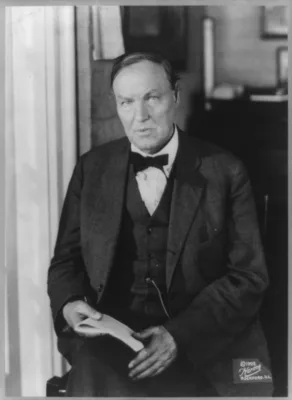
Clarence Darrow
Clarence Darrow was raised by a doubting father in a churchgoing village. He came to unbelief through a philosophy of pity, the view that every person is made by heredity and circumstance, and he gave up the hope of immortality reluctantly. At Dayton in 1925 he accepted the word agnostic as a compliment, while cross-examining the Bible's most famous defender.
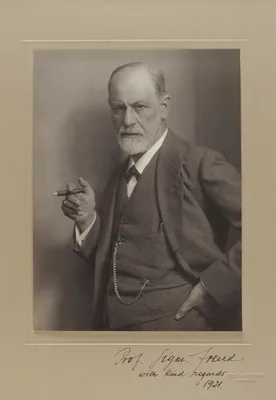
Sigmund Freud
Sigmund Freud was a Jewish boy in Catholic Vienna, turned to science by Goethe and trained in Brücke's laboratory. He left no public-domain account of losing a faith. From 1907 he made unbelief clinical, treating religion as a wish-fulfilment rooted in the child's longing for a father: an "illusion" in 1927 that was not necessarily an error, and a "mass-delusion" by 1930. He kept a pastor as a friend, and granted religion's history respect.
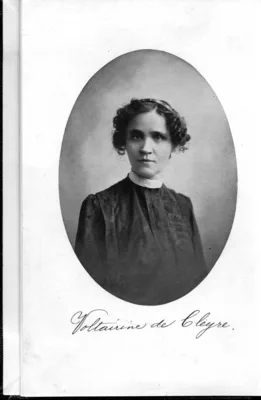
Voltairine de Cleyre
Voltairine de Cleyre was named for Voltaire by a freethinking father who then returned to the church and put her in a convent. She came out "a freethinker" after refusing to say what she did not feel. She lectured a nature-theist freethought until the Chicago hangings of 1887 turned it against the state. In her last years she held that belief in God had little to do with freedom, while her own view stayed "no God in the soul or out of it". The refusal to lie held the whole life together.
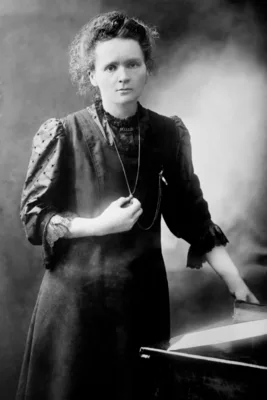
Marie Curie
Marie Curie was a devout Catholic girl in Russian-ruled Warsaw who lost her eldest sister and then her mother. By her daughter's account she felt revolt against the God she had prayed to. She let her faith lapse among the Warsaw positivists while keeping up appearances. From 1895 she declared her unbelief by acts rather than words: a civil marriage, unbaptised daughters and funerals without ceremony. She left only one published sentence of her own: "I myself did not practice any."