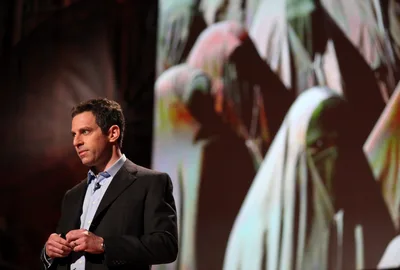
Sam Harris was raised with no religion to rebel against. At thirteen, after a friend's death, he went looking for what religion said about death, and then for spiritual experience, through drugs and years of meditation in India and Nepal. The attacks of 11 September 2001 turned that private seeking into a public argument against religious certainty, in The End of Faith (2004). Waking Up (2014) brought the contemplative interest, which had come first, back to the centre: a change of emphasis rather than a reversal.
The belief timeline
- Question (c. 1980 (age 13)) — His best friend dies; he reads about death and the occult; no religion in the house to consult (declined Sunday school at nine or ten) [31][32]
- Seeking (c. 1985–1997) — At eighteen, a "very rich intellectual life" but little introspection; MDMA, then psychedelics, then meditation at nineteen; leaves Stanford for India and Nepal and about a decade of study; spiritual experience sought without a creed [6][34][35][37][7][28]
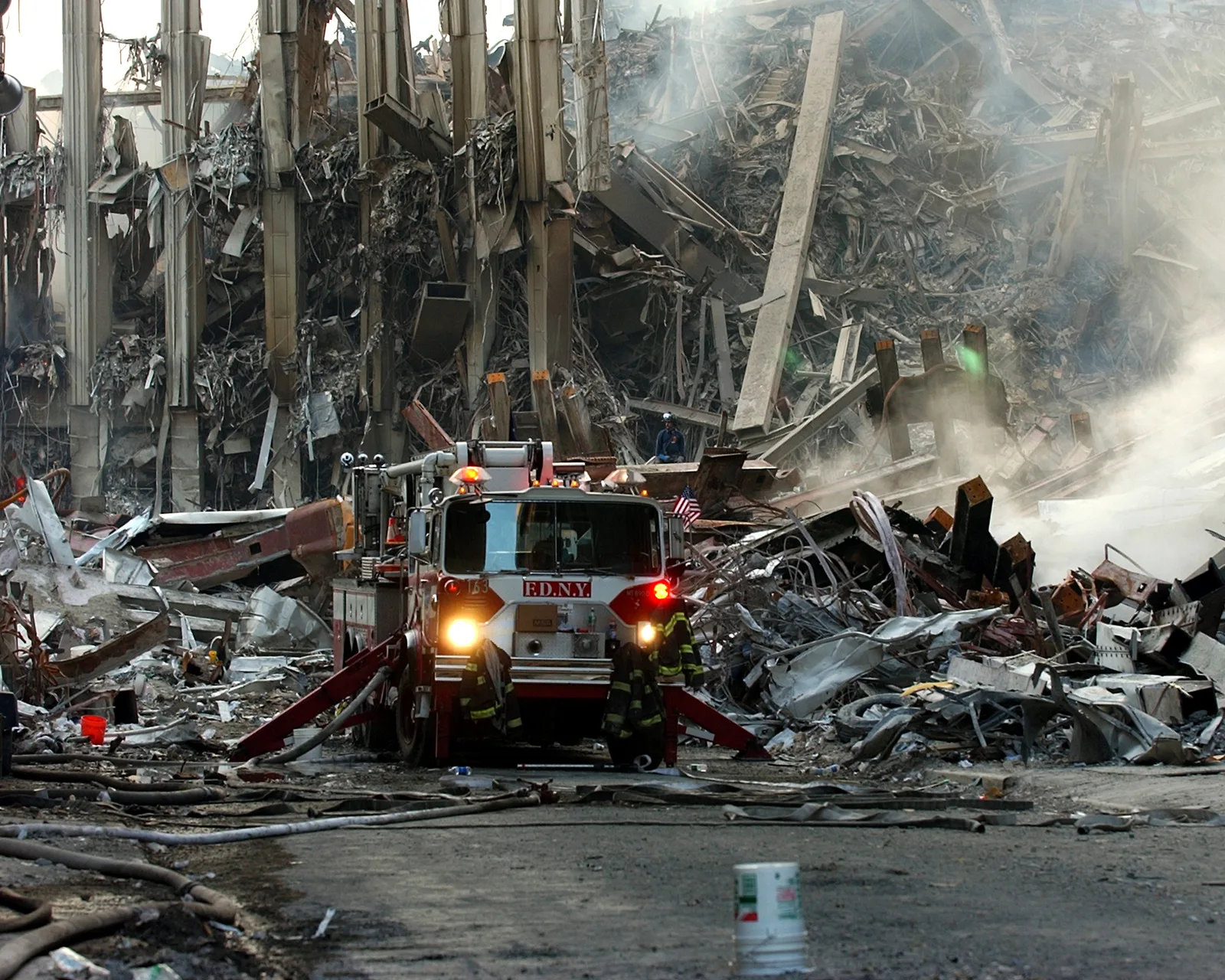
- Declaration (12 Sept. 2001 – Aug. 2004) — 9/11 "woke me up" to the danger of unchallenged religious certainty; he begins *The End of Faith* the next day and publishes it in 2004 [11][39][12]
- Revision (2006–2014) — The contemplative interest he had always had comes to the front: "Killing the Buddha" (March 2006), the 2007 remark that he parts company with atheists in being interested in spiritual experience, *Waking Up* (2014) and the app (2018); in his own words he had waited more than a decade to write *Waking Up* and the interest preceded his criticism of religion [40][41][25][26][27]
Notes to the timeline (16)
- [31] At about nine or ten he was asked whether he wanted to go to Sunday school like his friends, said no, and that was "the choice point" for not having a bar mitzvah. — David Samuels, "Q&A: Sam Harris," Tablet, 29 May 2012 (Wayback copy of 27 Jan. 2023 of, Harris's answer.
- [32] At thirteen his best friend died in a bicycle accident, the first person really close to him to die; from then on he read about the religious understanding of death, from Elisabeth Kübler-Ross to Colin Wilson's books on the occult; he was a thirteen-year-old interested in psychic phenomena. Samuels's introduction says the same. — Samuels, Tablet (2012), (Harris's answer and intro).
- [6] At eighteen he had a rich intellectual life, was already very sceptical but not introspective, and says Ecstasy (MDMA) was "probably indispensable" for someone as hard-headed as he was. — Patt Morrison, "No God? No problem, says god-free thinker Sam Harris," Los Angeles Times, 24 Sept. 2014 (with the printed correction on Nepal), answer on Ecstasy.
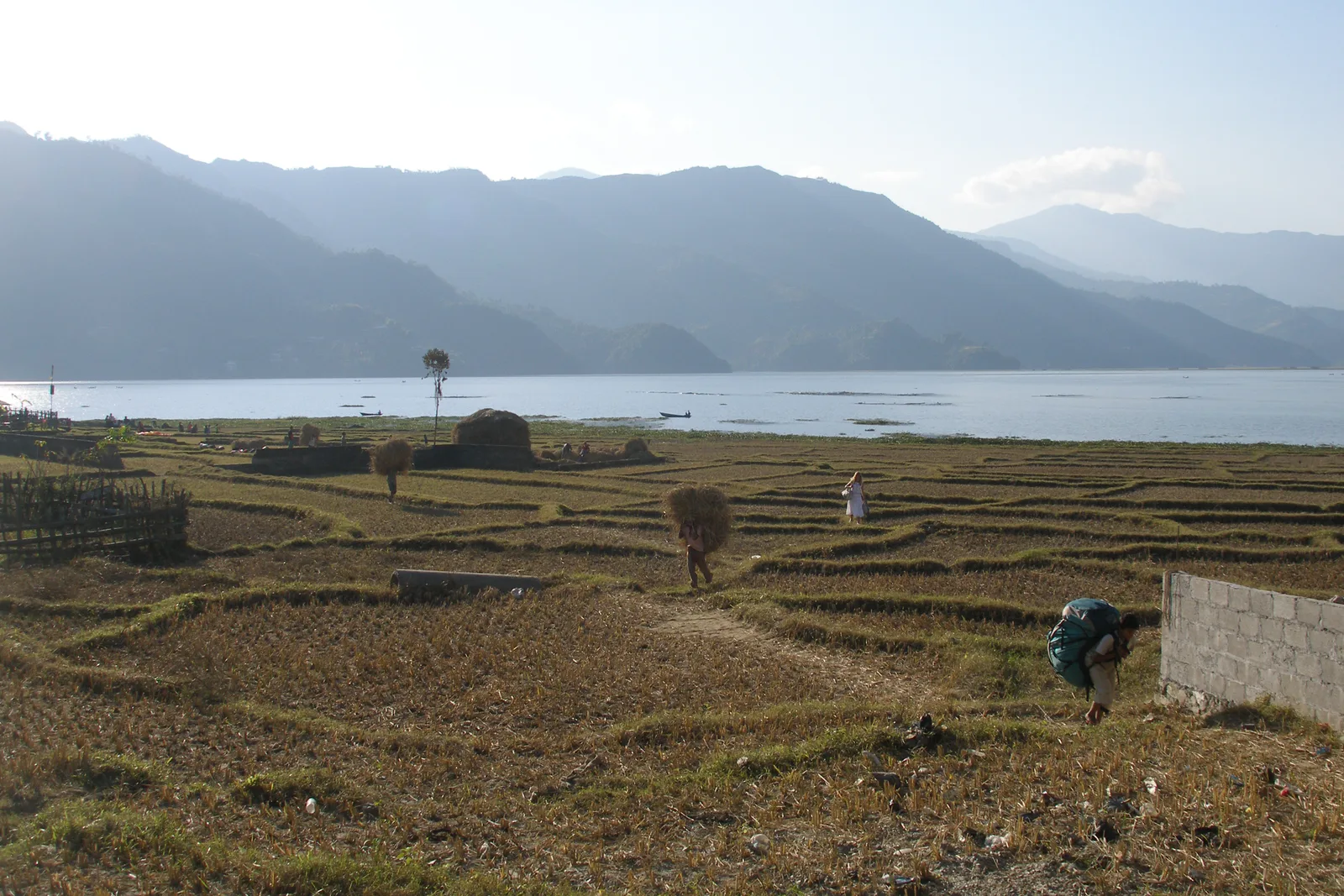
- [34] On his first trip to Nepal, aged twenty, he took 400 micrograms of LSD on Phewa Lake, Pokhara, having taken the drug at least ten times before, and had hours of terror. In his early twenties psilocybin and LSD were "indispensable tools" without which he "might never have discovered that there was an inner landscape of mind worth exploring"; he later stopped, citing the risks, and says psychedelic experience is no proof of anything about the cosmos. — Sam Harris, "Drugs and the Meaning of Life," samharris.org (4 July 2011 per the site's own list). Wayback snapshot of 24 Sept. 2015 of.
- [35] In a 2014 conversation with Dan Harris he says he "became interested in meditation relatively early in life," when he was "only 19," sceptical but without a career or settled reasons for scepticism. He describes spending weeks or months on retreat practising mindfulness of the breath and sense objects, with occasional breakthroughs he could not repeat, until he found a way to look directly at consciousness itself (the "self is an illusion"). Dan Harris is the "agnostic" in the introduction. — "Taming the Mind: A Conversation with Dan Harris," samharris.org, 17 Sept. 2014 (
research/texts/taming-mind.txt). Copyright; paraphrase only. - [37] He studied English at Stanford for two years, then "stopped out" and returned at thirty to major in philosophy; during the eleven years away his parents supported him ("a blessing and a curse," he says, since he did not build a career). Wikipedia, citing Newsweek 2010 (not seen), says he left a quarter after his MDMA experience. — Lewis I. Rice, "The Iconoclast: Sam Harris wants believers to stop believing," Stanford magazine, July/Aug. 2005; Andrew Anthony, "Sam Harris, the new atheist with a spiritual side," The Observer/Guardian, 16 Feb. 2019; Wikipedia (map) for the Newsweek claim. Not verified.
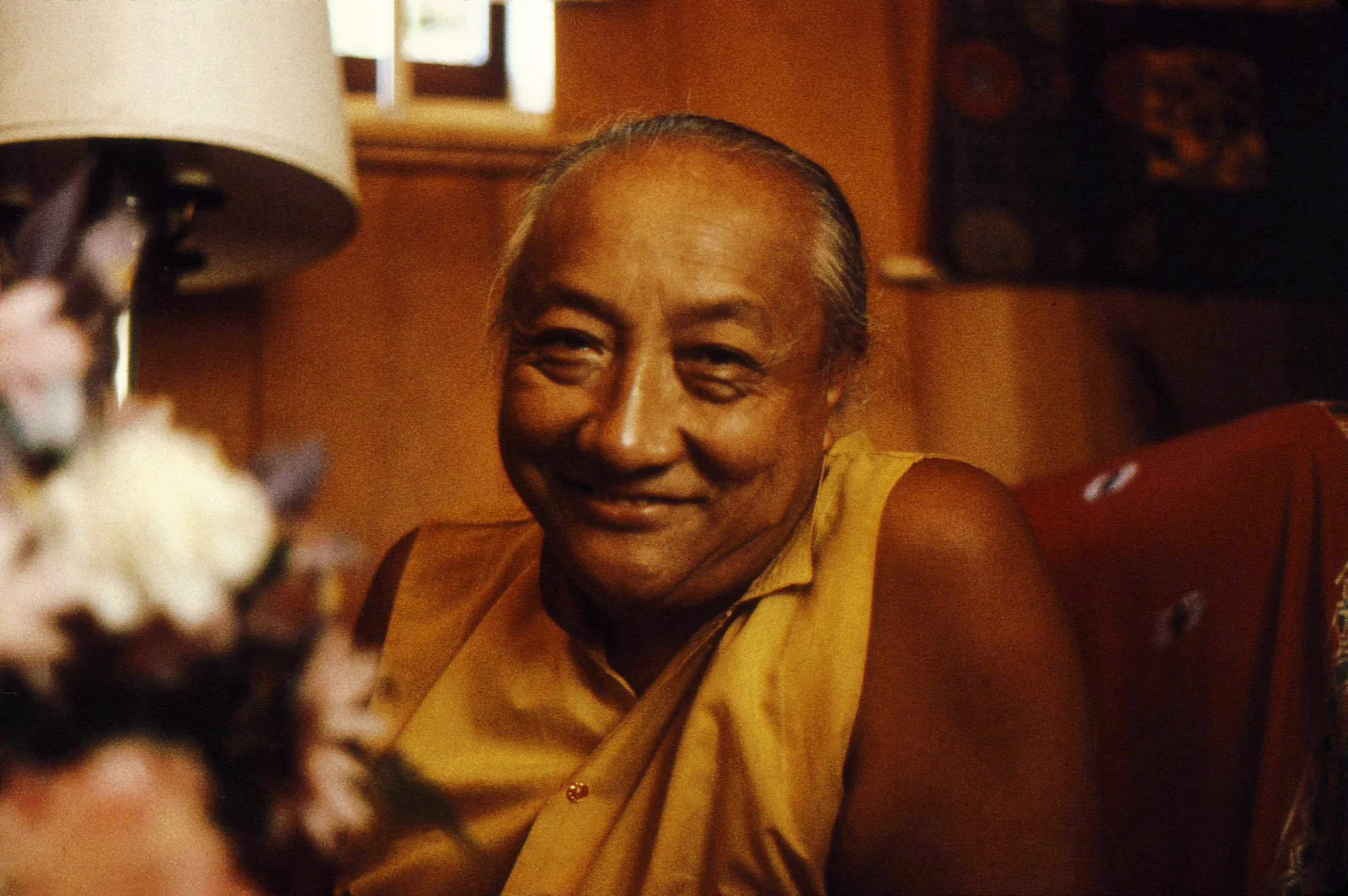
- [7] He studied meditation with Buddhist and Hindu teachers in India and Nepal; in Nepal he studied with the Tibetan lama Dilgo Khyentse Rinpoche. — Sam Harris, "Science on the Brink of Death," samharris.org, 11 Nov. 2012 (Wayback snapshot of 2014). Copyright; read in full (
research/texts/brink-of-death.txt); paraphrase only. Later reused in Waking Up, (Khyentse in Nepal, Harris's own account); Morrison, Los Angeles Times (2014), (Nepal, from the printed correction; "India"); Anthony, Observer/Guardian (2019), (India and Nepal); About page (many Tibetan, Indian, Burmese and Western teachers); Samuels, Tablet (2012), (twenties spent going to India and Nepal). - [28] By 2007 he said he had spent "a lot of time" in meditation, probably two years on silent retreats, and had organised week-long retreats for neuroscientists. In 2019 the Guardian reported two years on silent retreat "in one-week to three-month increments." — "Sam Harris – Extended Interview," PBS Religion & Ethics Newsweekly, 5 Jan. 2007; Anthony, Observer/Guardian (2019).
- [11] He began writing *The End of Faith* the day after 9/11 (Stanford Mag: "the next day"); Harris to the Guardian: "I literally began writing it on 9/12 or 9/13. The moment it became clear what had happened, it was clear that I needed to write that book." In 2007 he said it was 9/11 that "woke me up" to the liabilities of not challenging religious certainties that are "active in the world." — Rice, Stanford (2005); Anthony, Observer/Guardian (2019); Religion & Ethics Newsweekly (2007).
- [39] In 2005 he told Stanford Magazine that what became immediately motivating after 9/11 was that an event caused by the religious convictions of its perpetrators "simply redoubled our commitment to faith-based talk and thinking," driving us into the arms of what motivated our enemies. The magazine says he was raised in a secular West Coast environment where the Bible was read as literature like the Iliad, though his family was interested in spiritual experience and the mysteries of the world. Harris says he gets letters assuring him of hell and many applauding his views. — Rice, Stanford (2005), (journalist's paraphrase and brief quotation).
- [12] *The End of Faith* (Norton, August 2004) won the 2005 PEN Award (first nonfiction). — samharris.org book page (Aug. 2004; "winner of the 2005 PEN Award for Nonfiction"); Rice, Stanford (2005), ("2005 PEN award for first nonfiction"); Edge.org member biography (
research/texts/edge-bio.txt). - [40] In "Killing the Buddha" (*Shambhala Sun*, March 2006) he argues that "the wisdom of the Buddha" is trapped inside the religion of Buddhism, that Buddhists should dispense with Buddhism, that the Buddha's methods (ethics, meditation) are like science and could ground a "contemplative science" of well-being, and that the same essay says the God of Abraham is "unworthy even of man." So the contemplative-without-religion programme is public eight years before *Waking Up*. — Sam Harris, "Killing the Buddha," Shambhala Sun, March 2006; page on samharris.org dated 19 March 2006 (https://www.samharris.org/blog/killing-the-buddha). Copyright; read in full (
research/texts/killing-buddha.txt); paraphrase only. - [41] At a debate with Rabbi David Wolpe (American Jewish University, Nov. 2007, about 500 people; LA Times, 29 Dec. 2007) Harris argued that the dialogue between science and religion has been one of "relentless and one-directional erosion of religious authority," asked Wolpe for his evidence for God, and said he "part[s] company with many atheists in that I'm interested in spiritual experience," taking the contemplative literature seriously but finding it "riddled with religious superstition and dogma." Wolpe, a rabbi of Sinai Temple, replied that religion is something "that's lived and is bred in you, and if it works well produces magnificent human beings," that science is "powerful, but it's narrow," and that God is not a scientific claim. — Los Angeles Times staff writer (byline name not in the saved text), report on the Harris–Wolpe debate, 29 Dec. 2007.
- [25] *Waking Up* (Simon & Schuster, Sept. 2014) is, by Harris's own description quoted by Kirkus, "a seeker's memoir, an introduction to the brain, a manual of contemplative instruction, and a philosophical unraveling" of the sense of self; it argues that the conventional sense of self is an illusion and that spirituality largely consists of realising this. In his "Dear Reader" note he says he had been "waiting for more than a decade to write" it and that, long before he saw reason to criticise religion or to link moral and scientific truths, he was interested in consciousness and the possibility of spiritual experience. Reviews: memoir of meditation and psychedelics (Kirkus); "studied under several teachers" (WIR). Dzogchen and H. W. L. Poonja are among its index terms (Google Books). — samharris.org pages for The End of Faith (Aug. 2004; PEN 2005), Letter to a Christian Nation (Sept. 2006) and Waking Up (Sept. 2014, with Harris's "Dear Reader" note), saved in
research/notes/sh-*-page.txt; and the About page (research/texts/about.txt). Copyright; paraphrase only, (Waking Up, Sept. 2014); Kirkus review of Waking Up (research/texts/kirkus-waking.txt); [NR 2014] The New Republic review (research/texts/newrepublic-waking.txt); [WIR] Washington Independent Review of Books review (research/texts/wir-waking.txt); NR 2014; WIR; Google Books common terms. - [26] Podcast *Waking Up* began Sept. 2013 (later *Making Sense*); the Waking Up app was released Sept. 2018. — Wikipedia (map) for both dates; Anthony, Observer/Guardian (2019), confirms the app was newly released in Feb. 2019 and the podcast's rename ("previously called Waking Up").
- [27] In 2014 he said "spirituality" is the phenomenon of self-transcendence, that introspection is a domain of real discovery, that he is uncomfortable with the word, and that Hitchens and Sagan also wanted to reclaim it. — Morrison, Los Angeles Times (2014).
Spirituality Without Religion
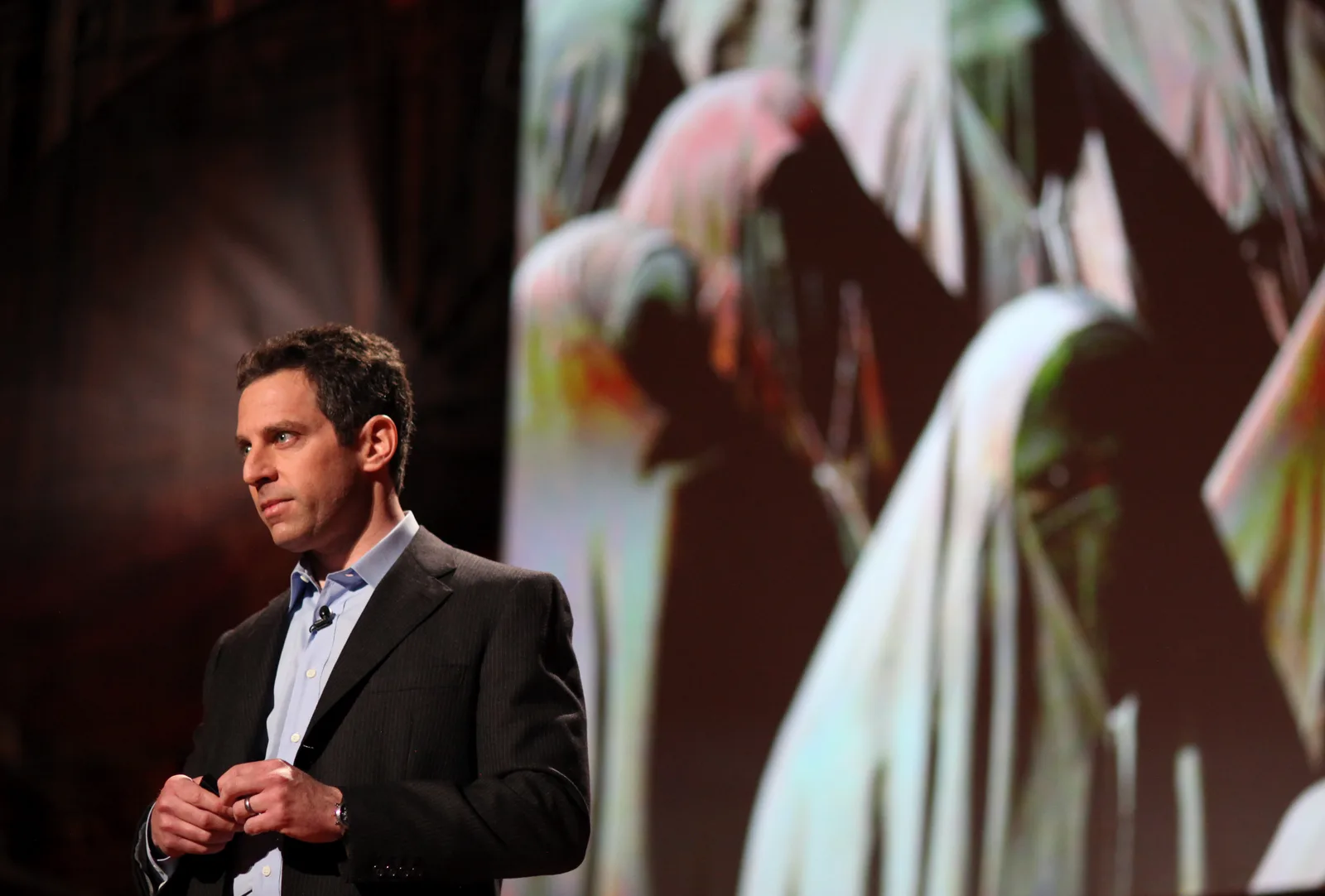
On 12 September 2001, by his own later account, or perhaps the day after, a recent philosophy graduate of Stanford began writing a book. The attacks of the day before, he said, had woken him up to the danger of leaving religious certainty unchallenged when it was active in the world.1 That book, The End of Faith (2004), made Sam Harris a public critic of religion. Ten years later he published Waking Up, a guide to what he called spirituality without religion.
This chapter asks how a man who was never religious came to spend his twenties among meditation teachers in India and Nepal, how he became one of the "New Atheists," and whether the turn to meditation was a revision of his unbelief or the thing that had been there all along.
Nothing to rebel against
According to Wikipedia he was born in Los Angeles on 9 April 1967.2 His father was an actor, his mother a television writer and producer who created The Golden Girls; they divorced when he was two.3 His mother was Jewish, but neither she nor her parents were religious, and he was never a religious Jew.4 At nine or ten he was asked whether he wanted to go to Sunday school like his friends; he said no, and that, he said later, was the end of any bar mitzvah.5 His upbringing, he said in 2007, was wholly secular: he was not raised an atheist as opposed to a believer; religion was simply not an issue, and there was nothing to rebel against.6 On his timeline there is no faith to mark.
At thirteen his best friend was killed in a bicycle accident, the first death of someone close to him. From then on he read about death, from the psychiatrist Elisabeth Kübler-Ross to Colin Wilson's books on the occult, and became, he said, a thirteen-year-old interested in psychic phenomena.7 The first mark on his timeline is a question, not a doubt.
Seeking
By eighteen, he said, he had a rich intellectual life and was already sceptical, but he was not introspective, and for someone so hard-headed, he said in 2014, the drug Ecstasy had probably been indispensable.8 He began to meditate at nineteen.9 At college he became interested in religion as such: whether its claims about mystical experience matched experiences he had with psychedelic drugs, which in his early twenties were, he wrote, tools without which he might never have found that there was an inner landscape of mind worth exploring. He later stopped taking them, citing the risks, and said that such experiences prove nothing about the cosmos.1011 On his first trip to Nepal, at twenty, he took a large dose of LSD on Phewa Lake at Pokhara and had hours of terror.11
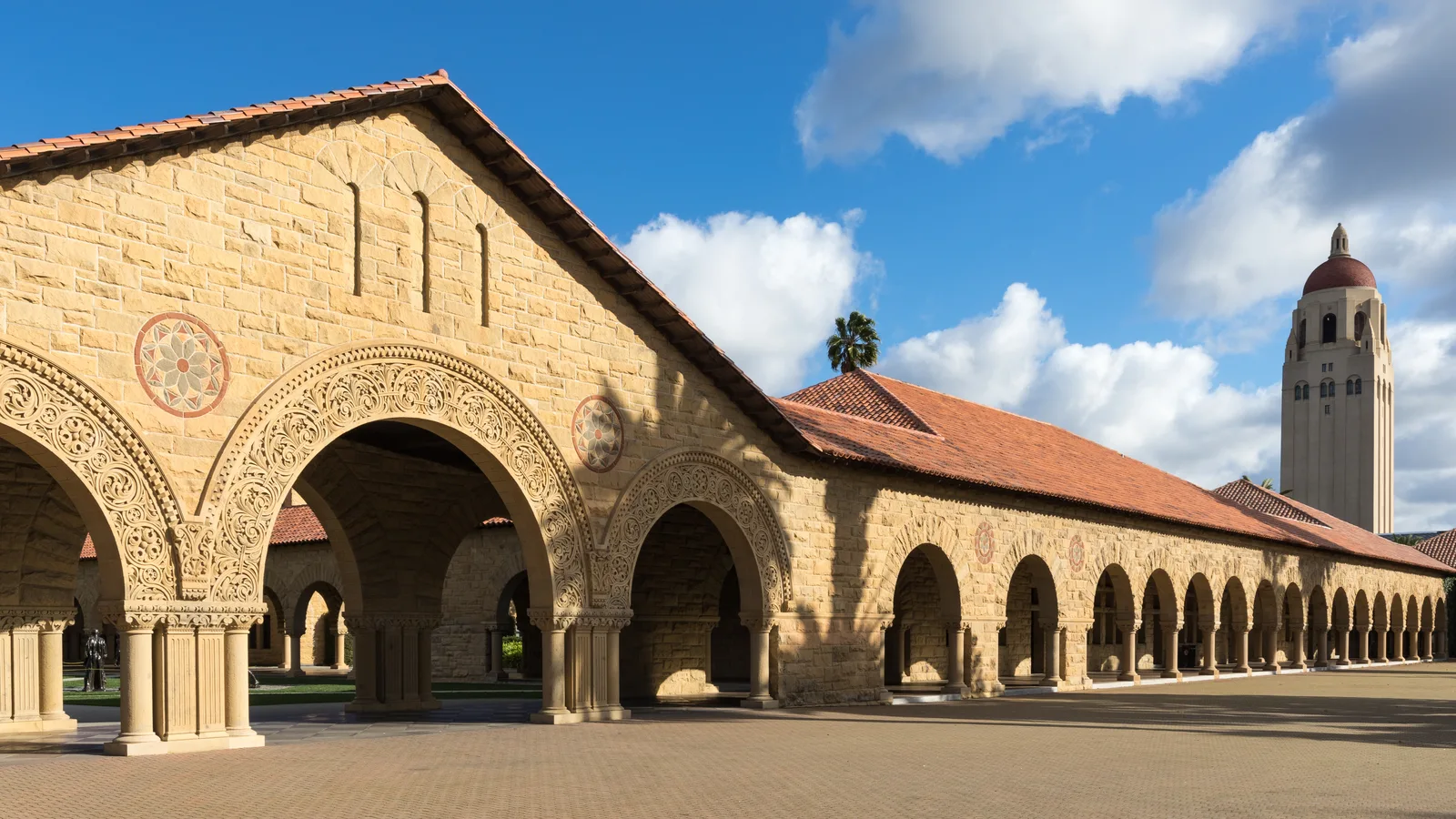
He left his English studies at Stanford after two years, and in the eleven years before he returned, supported by his parents, he travelled to India and Nepal and studied with Buddhist and Hindu teachers, among them the Tibetan lama Dilgo Khyentse Rinpoche.1213 He spent, he said in 2007, about two years in all on silent retreats.14 He studied Western and Eastern religion, but above all the Eastern.10 He came back to Stanford at thirty and took a degree in philosophy in 2000.1516 The timeline marks these years as a time of seeking: spiritual experience sought without a creed.
The End of Faith
He began The End of Faith the day after the attacks of 11 September, or the day after that.1 What moved him, he told his college magazine in 2005, was that an event caused by its perpetrators' religious convictions had only redoubled the country's commitment to faith-based talk and thinking.17 The book appeared in August 2004 and won the PEN award for a first work of non-fiction in 2005.18 The Observer's reviewer found its central argument sound and called it a sensible rallying cry for a more ruthless secularisation, while warning that its anger and sarcasm could alienate the readers who most needed persuading.19 The timeline puts his declaration here.
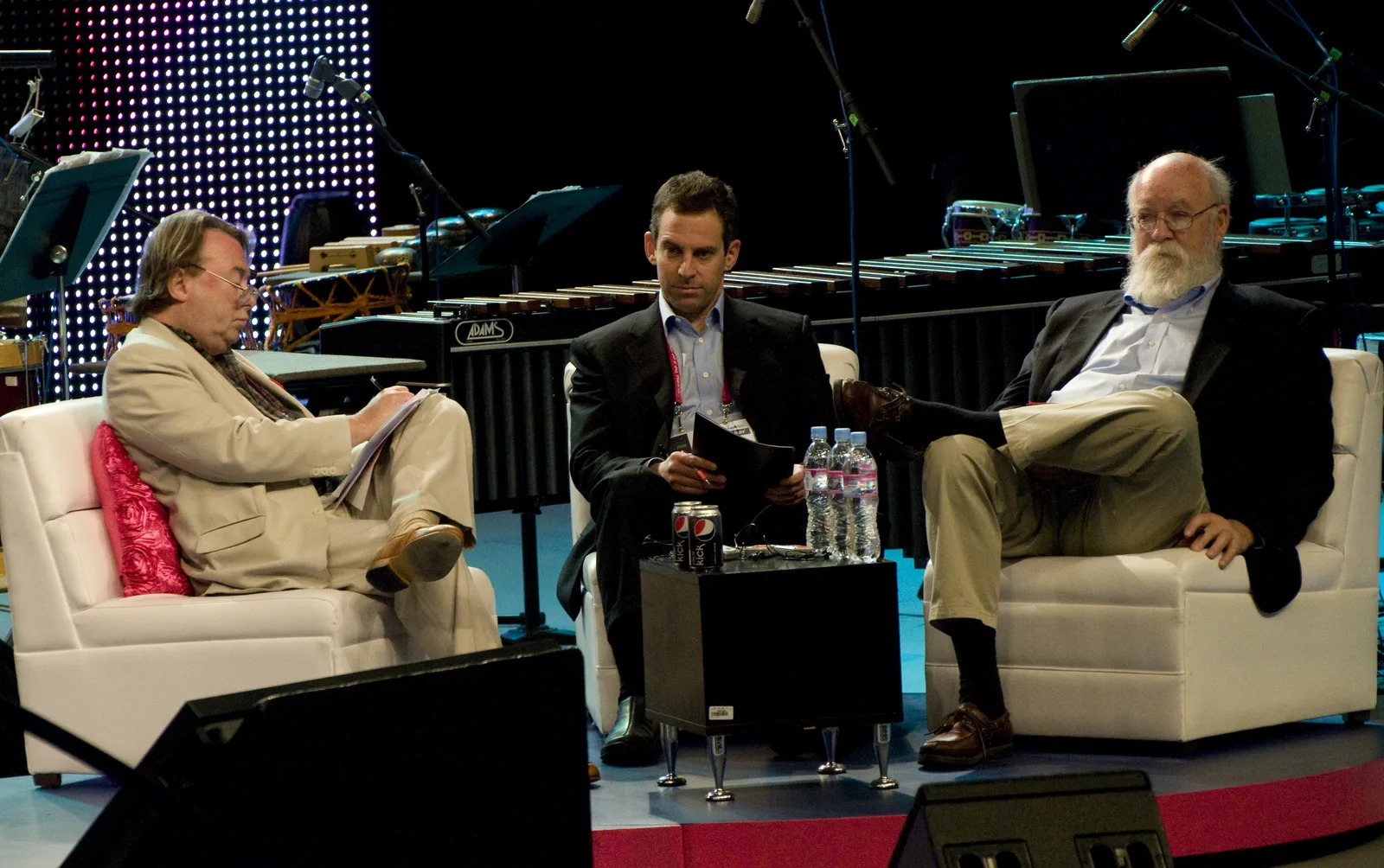
Thousands of Christians wrote to him, many to tell him he was wrong not to believe, and in 2006 he answered them with Letter to a Christian Nation.20 That December he defended atheists in an essay on the myths about them, arguing that atheists could value love, rapture and awe without making unjustified claims about reality.21 But in 2007 he said the word "atheist" was unnecessary: there is no word for those who do not believe in Zeus, and he would be glad to see this one retired.22 In 2007 he met Richard Dawkins, Daniel Dennett and Christopher Hitchens at Hitchens's flat in Washington, the only conversation the four ever had together; there, a journalist later reported, Harris said that there was a place for the sacred in our lives, and Dawkins looked askance.23 The four were assailed, Harris wrote, as if they were a single person with four heads.24
The neuroscience of belief
At the University of California, Los Angeles, he studied belief itself. In a 2008 study he and colleagues scanned fourteen adults as they judged statements true, false or undecidable, and found distinct patterns of brain activity for belief, disbelief and uncertainty.25 A second study, published in 2009 under an open licence, scanned fifteen committed Christians and fifteen non-believers, and began:
Given the importance of religion in human life, surprisingly little is known about its basis in the brain.2627
In both groups, the study found, believing a statement rather than disbelieving it produced a greater signal in the same region of the brain, whatever the statement was about.27 Most Americans, the authors wrote, believe not just in a generic God but in highly specific religious propositions, and the failure to subject such beliefs to rational criticism "may be one reason for their survival."2829 He took his doctorate in neuroscience at UCLA, and his dissertation became The Moral Landscape (2010), which argued that moral questions depend on facts about the well-being of conscious creatures and could in principle be answered by science.3031 Critics, among them Russell Blackford, objected that the value of well-being was assumed, not established by science; Harris answered that every field of knowledge rests on such assumptions.32 In a later study, of 2016, he and two colleagues looked at what happens in the brain when political beliefs are challenged, and called the inability to change minds through evidence "a problem of great societal importance."3334
The other side
The objections came from many directions. In November 2007 he debated Rabbi David Wolpe of Sinai Temple in Los Angeles, before about five hundred people. Harris argued that the dialogue between science and religion had been an erosion of religious authority in one direction; Wolpe answered that religion is lived and bred in a person, that at its best it produces magnificent human beings, and that science is powerful but narrow.35 The journalist Chris Hedges, a minister's son, called the New Atheists secular fundamentalists whose faith in science and progress was as deluded as that of the Christian right.36 The anthropologist Scott Atran argued, as Harris summarised him, that religious belief was not the main cause of suicide bombing; Harris replied that Atran ignored what the bombers themselves said about their motives.37 Buddhist critics accused him of treating their tradition as a mere cultural accident and putting naive faith in science as the only judge of truth and value.38
The fiercest arguments were about Islam. Critics, among them Noam Chomsky, Glenn Greenwald, Reza Aslan and Hedges, called his writing on Islam bigoted; in October 2014, on Bill Maher's television programme, the actor Ben Affleck called his and Maher's remarks "gross and racist." Harris answered that he criticised ideas, not people, and in 2019 conceded only that one passage of 2006 had lacked caveats.3940 Some passages of The End of Faith, on torture and on a hypothetical nuclear first strike, have been read very differently by Harris and his critics; he says they have been quoted out of context.414243
Waking Up
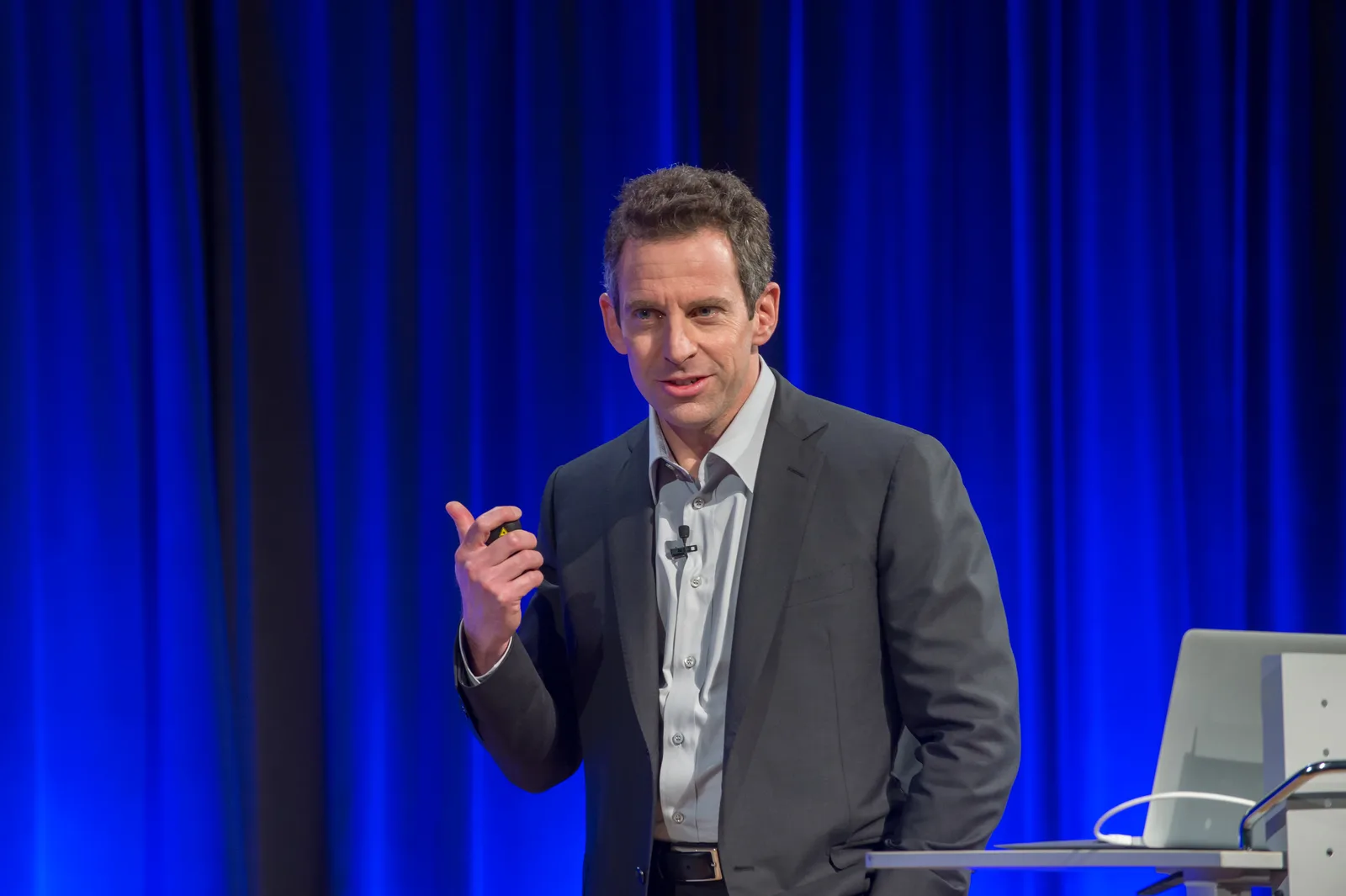
Meditation never left his work. In March 2006, in a Buddhist magazine, he argued that the wisdom of the Buddha was trapped inside the religion of Buddhism, and that its methods of ethics and meditation could ground a contemplative science of well-being.44 In 2007 he said he parted company with many atheists in being interested in spiritual experience, and in the contemplative literature, which he found riddled with superstition and dogma.35 He said dogma had always turned him off, but that spiritual experience could be pursued in the spirit of science.45
In September 2014 he published Waking Up: A Guide to Spirituality Without Religion, which he described as a seeker's memoir, an introduction to the brain, a manual of meditation and a philosophical unravelling of the sense of self. The ordinary sense of a self, it argued, is an illusion, and spirituality largely consists in seeing through it. He had been waiting more than a decade to write it, he said, and his interest in consciousness and spiritual experience came long before his criticism of religion.46 He accepted the word "spirituality" for that experience of self-transcendence, though uncomfortably.47 A podcast and, in 2018, a meditation app with the same name followed.48
On the timeline, this is his revision, but it is a change of emphasis, not a reversal: the contemplative interest that had come first, before any argument with religion, came back to the centre of his public work.
Did his unbelief change shape?
Harris never had a faith to lose. His unbelief was a starting point, and what he went looking for, from the death of a friend at thirteen through years of meditation in Asia, was experience without a creed. The attacks of 2001 turned that private seeking into a public argument against religious certainty, and for a decade the argument was what the world knew of him. Waking Up did not undo it. It made public the half of his life that had come first, and it kept the same rule throughout: no belief without evidence, including belief about the mind.
Christopher Hitchens, another of the four "New Atheists," for whom no contemplative turn came, has his own chapter in this book.
Footnotes
-
Lewis I. Rice, "The Iconoclast: Sam Harris wants believers to stop believing," Stanford magazine, July/Aug. 2005; Andrew Anthony, "Sam Harris, the new atheist with a spiritual side," The Observer/Guardian, 16 Feb. 2019; "Sam Harris – Extended Interview," PBS Religion & Ethics Newsweekly, 5 Jan. 2007. ↩ ↩2
-
Wikipedia (map) citing Current Biography Jan. 2012 p. 37. Consistent with Stanford Mag 2005 ("returning at age 30") and Guardian 2019 (parents' divorce when he was two) but neither gives the date.. Not verified. ↩
-
Anthony, Observer/Guardian (2019), (parents and divorce); David Samuels, "Q&A: Sam Harris," Tablet, 29 May 2012 (Wayback copy of 27 Jan. 2023 of, intro (Samuels: "son of a Jewish mother and Quaker father"). ↩
-
Samuels, Tablet (2012), Harris's answer. ↩
-
Samuels, Tablet (2012), Harris's answer. ↩
-
Religion & Ethics Newsweekly (2007), answer to the question on his history. ↩
-
Samuels, Tablet (2012), (Harris's answer and intro). ↩
-
Patt Morrison, "No God? No problem, says god-free thinker Sam Harris," Los Angeles Times, 24 Sept. 2014 (with the printed correction on Nepal), answer on Ecstasy. ↩
-
"Taming the Mind: A Conversation with Dan Harris," samharris.org, 17 Sept. 2014 (
research/texts/taming-mind.txt). Copyright; paraphrase only. ↩ -
Sam Harris, "Drugs and the Meaning of Life," samharris.org (4 July 2011 per the site's own list). Wayback snapshot of 24 Sept. 2015 of. ↩ ↩2
-
Rice, Stanford (2005); Anthony, Observer/Guardian (2019); Wikipedia (map) for the Newsweek claim. ↩
-
Sam Harris, "Science on the Brink of Death," samharris.org, 11 Nov. 2012 (Wayback snapshot of 2014). Copyright; read in full (
research/texts/brink-of-death.txt); paraphrase only. Later reused in Waking Up, (Khyentse in Nepal, Harris's own account); Morrison, Los Angeles Times (2014), (Nepal, from the printed correction; "India"); Anthony, Observer/Guardian (2019), (India and Nepal); About page (many Tibetan, Indian, Burmese and Western teachers); Samuels, Tablet (2012), (twenties spent going to India and Nepal). ↩ -
Religion & Ethics Newsweekly (2007); Anthony, Observer/Guardian (2019). ↩
-
Rice, Stanford (2005), ("returning at age 30"); Anthony, Observer/Guardian (2019), ("an 11-year break from an English degree"); 1997 is computed from the age and the birth date, and is also in Wikipedia. ↩
-
Rice, Stanford (2005), ("graduated in 2000 after stopping out"); Moral Landscape author note (degree in philosophy from Stanford). ↩
-
Rice, Stanford (2005), (journalist's paraphrase and brief quotation). ↩
-
samharris.org book page (Aug. 2004; "winner of the 2005 PEN Award for Nonfiction"); Rice, Stanford (2005), ("2005 PEN award for first nonfiction"); Edge.org member biography (
research/texts/edge-bio.txt). ↩ -
Stephanie Merritt, "Faith no more," The Observer, 5 Feb. 2005 (
research/texts/observer-2005.txt). Review of The End of Faith. ↩ -
samharris.org book page (publisher's text, Sept. 2006). ↩
-
Sam Harris, "10 myths — and 10 Truths — About Atheism," samharris.org, dated 24 Dec. 2006 (
research/texts/ten-myths.txt). Copyright; paraphrase only. ↩ -
Religion & Ethics Newsweekly (2007). ↩
-
Anthony, Observer/Guardian (2019). ↩
-
Sam Harris, "Letter to a Christian Nation: Afterword," samharris.org, dated 22 Sept. 2007 (
research/texts/letter-afterword.txt). Copyright; paraphrase only. ↩ -
Harris S, Sheth SA, Cohen MS, "Functional neuroimaging of belief, disbelief, and uncertainty," Annals of Neurology 63(2):141–147 (Feb. 2008), abstract via Europe PMC PMID 18072236. ↩
-
Harris S, Kaplan JT, Curiel A, Bookheimer SY, Iacoboni M, Cohen MS, "The Neural Correlates of Religious and Nonreligious Belief," PLoS ONE 4(10): e7272 (1 Oct. 2009), Introduction. ↩
-
S, PLoS ONE (2009), Discussion. ↩
-
S, PLoS ONE (2009), Discussion. ↩
-
Sam Harris, The Moral Landscape: How Science Can Determine Human Values (Free Press, export edition, Oct. 2010; copyright 2010). Full text read from a user-uploaded scan: Internet Archive identifiers
the-moral-landscape-how-science-can-determine-human-values(research/texts/landscape.txt) andthe-moral-landscape-how-science-can-determine-human-values-harris-sam(research/texts/landscape2.txt; used for page numbers from the running heads). Copyright; this upload is not authorised, but the text was read for checking only (David's rule of 2026-10-14); nothing from it is quoted, acknowledgements and author note (scan); Rice, Stanford (2005); LA Times review quoted on the samharris.org book page; Anthony, Observer/Guardian (2019); Wikipedia (map) for 2009. ↩ -
Harris, Moral Landscape, Introduction and p. 12 (scan); Jaimie N. Wall and Todd K. Shackelford, review of The Moral Landscape, Evolutionary Psychology 9(3), 2011 (PMC10480935). Licence stated: CC BY-NC 3.0, so not quotable on a monetised channel; paraphrase and cite only (
research/texts/review-walking-moral-landscape.txt). ↩ -
Wall, Moral Landscape (2011); Harris, Moral Landscape, notes (scan). Reported at second hand; the original has not been seen. ↩
-
Kaplan, Gimbel, Harris: Kaplan JT, Gimbel SI, Harris S, "Neural correlates of maintaining one's political beliefs in the face of counterevidence," Scientific Reports 6:39589 (23 Dec. 2016), opening paragraph. ↩
-
JT, Scientific Reports (2016), Abstract. ↩
-
Los Angeles Times staff writer (byline name not in the saved text), report on the Harris–Wolpe debate, 29 Dec. 2007. ↩ ↩2
-
Charly Wilder, "I don't believe in atheists," Salon, 13 March 2008 (
research/texts/salon-hedges-2008.txt). Interview with Chris Hedges, (13 March 2008); Sam Harris, "Dear Angry Lunatic: A Response to Chris Hedges," 26 July 2011 (https://www.samharris.org/blog/response-to-chris-hedges;research/texts/harris-resp-hedges.txt). Copyright; paraphrase only. ↩ -
Harris, Moral Landscape, pp. 155–156 (scan; page confirmed by the running head and the index entry "Atran, Scott, 155–56"); Sam Harris, "Response to Controversy," samharris.org (page revised after 2019; the text refers to "the year 2019") (
research/texts/resp-controversy.txt). Copyright; paraphrase only. Contains the long passages Harris cites from The End of Faith with the page numbers he gives (pp. 52–53, 128–129, 192–199); Wall, Moral Landscape (2011). ↩ -
Ronald Purser and Andrew Cooper, "Mindfulness' 'truthiness' problem: Sam Harris, science and the truth about Buddhist tradition," Salon, 6 Dec. 2014 (
research/texts/salon-2014-mindfulness.txt). ↩ -
"Ben Affleck: Sam Harris and Bill Maher 'racist' and 'gross' in views of Islam," The Guardian, 6 Oct. 2014 (
research/texts/guardian-affleck-2014.txt); Anthony, Observer/Guardian (2019); Harris, End of Faith, (Chomsky, Greenwald named); Harris, "Dear Angry Lunatic: A Response to Chris Hedges,". ↩ -
Anthony, Observer/Guardian (2019); Katherine Don, "'The Moral Landscape': Why science should shape morality," Salon, 17 Oct. 2010 (
research/texts/salon-2010.txt), (Harris: "religion" is a word like "sports"; Jainism vs Islam); Harris, End of Faith. ↩ -
Harris, End of Faith, (page numbers and passage as given by Harris). ↩
-
Harris, End of Faith; Harris, "Dear Angry Lunatic: A Response to Chris Hedges,", (Harris's quotation of Hedges, with dates 2008). ↩
-
Harris, End of Faith. ↩
-
Sam Harris, "Killing the Buddha," Shambhala Sun, March 2006; page on samharris.org dated 19 March 2006 (https://www.samharris.org/blog/killing-the-buddha). Copyright; read in full (
research/texts/killing-buddha.txt); paraphrase only. ↩ -
Religion & Ethics Newsweekly (2007). ↩
-
samharris.org pages for The End of Faith (Aug. 2004; PEN 2005), Letter to a Christian Nation (Sept. 2006) and Waking Up (Sept. 2014, with Harris's "Dear Reader" note), saved in
research/notes/sh-*-page.txt; and the About page (research/texts/about.txt). Copyright; paraphrase only, (Waking Up, Sept. 2014); Kirkus review of Waking Up (research/texts/kirkus-waking.txt); [NR 2014] The New Republic review (research/texts/newrepublic-waking.txt); [WIR] Washington Independent Review of Books review (research/texts/wir-waking.txt); NR 2014; WIR; Google Books common terms. ↩ -
Morrison, Los Angeles Times (2014). ↩
-
Wikipedia (map) for both dates; Anthony, Observer/Guardian (2019), confirms the app was newly released in Feb. 2019 and the podcast's rename ("previously called Waking Up"). ↩
research/texts/taming-mind.txt). Copyright; paraphrase only.; Sam Harris, "Drugs and the Meaning of Life," samharris.org (4 July 2011 per the site's own list). Wayback snapshot of 24 Sept. 2015 of.; Sam Harris, "Science on the Brink of Death," samharris.org, 11 Nov. 2012 (Wayback snapshot of 2014). Copyright; read in full (research/texts/brink-of-death.txt); paraphrase only. Later reused in Waking Up.; Edge.org member biography (research/texts/edge-bio.txt).; Stephanie Merritt, "Faith no more," The Observer, 5 Feb. 2005 (research/texts/observer-2005.txt). Review of The End of Faith.; Sam Harris, "10 myths — and 10 Truths — About Atheism," samharris.org, dated 24 Dec. 2006 (research/texts/ten-myths.txt). Copyright; paraphrase only.; Sam Harris, "Letter to a Christian Nation: Afterword," samharris.org, dated 22 Sept. 2007 (research/texts/letter-afterword.txt). Copyright; paraphrase only.; Harris S, Sheth SA, Cohen MS, "Functional neuroimaging of belief, disbelief, and uncertainty," Annals of Neurology 63(2):141–147 (Feb. 2008).; Harris S, Kaplan JT, Curiel A, Bookheimer SY, Iacoboni M, Cohen MS, "The Neural Correlates of Religious and Nonreligious Belief," PLoS ONE 4(10): e7272 (1 Oct. 2009).; Sam Harris, The Moral Landscape: How Science Can Determine Human Values (Free Press, export edition, Oct. 2010; copyright 2010). Full text read from a user-uploaded scan: Internet Archive identifiers the-moral-landscape-how-science-can-determine-human-values (research/texts/landscape.txt) and the-moral-landscape-how-science-can-determine-human-values-harris-sam (research/texts/landscape2.txt; used for page numbers from the running heads). Copyright; this upload is not authorised, but the text was read for checking only (David's rule of 2026-10-14); nothing from it is quoted.; Jaimie N. Wall and Todd K. Shackelford, review of The Moral Landscape, Evolutionary Psychology 9(3), 2011 (PMC10480935). Licence stated: CC BY-NC 3.0, so not quotable on a monetised channel; paraphrase and cite only (research/texts/review-walking-moral-landscape.txt).; Kaplan JT, Gimbel SI, Harris S, "Neural correlates of maintaining one's political beliefs in the face of counterevidence," Scientific Reports 6:39589 (23 Dec. 2016).; Los Angeles Times staff writer (byline name not in the saved text), report on the Harris–Wolpe debate, 29 Dec. 2007.; Charly Wilder, "I don't believe in atheists," Salon, 13 March 2008 (research/texts/salon-hedges-2008.txt). Interview with Chris Hedges.; Sam Harris, "Dear Angry Lunatic: A Response to Chris Hedges," 26 July 2011 (https://www.samharris.org/blog/response-to-chris-hedges; research/texts/harris-resp-hedges.txt). Copyright; paraphrase only.; Sam Harris, "Response to Controversy," samharris.org (page revised after 2019; the text refers to "the year 2019") (research/texts/resp-controversy.txt). Copyright; paraphrase only. Contains the long passages Harris cites from The End of Faith with the page numbers he gives (pp. 52–53, 128–129, 192–199).; Ronald Purser and Andrew Cooper, "Mindfulness' 'truthiness' problem: Sam Harris, science and the truth about Buddhist tradition," Salon, 6 Dec. 2014 (research/texts/salon-2014-mindfulness.txt).; "Ben Affleck: Sam Harris and Bill Maher 'racist' and 'gross' in views of Islam," The Guardian, 6 Oct. 2014 (research/texts/guardian-affleck-2014.txt).; Katherine Don, "'The Moral Landscape': Why science should shape morality," Salon, 17 Oct. 2010 (research/texts/salon-2010.txt).; Sam Harris, "Killing the Buddha," Shambhala Sun, March 2006; page on samharris.org dated 19 March 2006 (https://www.samharris.org/blog/killing-the-buddha). Copyright; read in full (research/texts/killing-buddha.txt); paraphrase only.; samharris.org pages for The End of Faith (Aug. 2004; PEN 2005), Letter to a Christian Nation (Sept. 2006) and Waking Up (Sept. 2014, with Harris's "Dear Reader" note), saved in research/notes/sh-*-page.txt; and the About page (research/texts/about.txt). Copyright; paraphrase only.; Kirkus review of Waking Up (research/texts/kirkus-waking.txt); [NR 2014] The New Republic review (research/texts/newrepublic-waking.txt); [WIR] Washington Independent Review of Books review (research/texts/wir-waking.txt).In their own words
Given the importance of religion in human life, surprisingly little is known about its basis in the brain.
The failure to subject such beliefs to rational criticism may be one reason for their survival.
Nearly a century of opinion polling attests that 70–85 percent of Americans profess not merely a belief in a generic God, but a belief in highly specific, religious propositions
Sam Harris (joint first author) is the Co-founder and CEO of The Reason Project (www.reasonproject.org).
the inability to change another person’s mind through evidence and argument, or to have one’s own mind changed in turn, stands out as a problem of great societal importance.
The other side
See above (no lawfully free text of a critic; Wolpe, Hedges, Atran, Purser and Cooper, Bunting, Sullivan, Aslan, Blackford and Nagel are paraphrased in claims 23, 24, 29, 41, 45–48, 51, each from a copyrighted source)
Where accounts differ
| Point | One account | Another | How the page handles it |
|---|---|---|---|
| When *The End of Faith* was begun | "Immediately after" the attacks (Wikipedia, Tier 4); "the day after" (roster, unsourced) | "The next day" (Stanford Mag 2005); "9/12 or 9/13" (Harris to the Guardian 2019) | Settled: say "the next day, or the one after." Harris's own later account allows two days. |
| Where he studied | "Tibet" (LA Times column intro, 2014) | Nepal (the same paper's printed correction); Nepal confirmed by Harris's 2012 essay and 2011 essay | Say India and Nepal; Khyentse is now confirmed in Harris's own 2012 essay. |
| Years abroad | "After eleven years overseas," return 1997 (Wikipedia) | "A few weeks in the early 1990s" as Dalai Lama guard (journalist); retreats "probably two years" (PBS 2007); 11-year break from English degree and return at 30 (Guardian 2019; Stanford Mag 2005) | The eleven years is the span from leaving Stanford to returning, not time on retreat; narration must not imply he meditated for eleven years. |
| Which drug, and when | MDMA at eighteen "probably indispensable" (LAT 2014); Wikipedia, citing Newsweek 2010 and a 2008 video, says MDMA at Stanford | "Psilocybin and LSD" were "indispensable tools" in his early twenties; first Nepal trip at twenty with LSD (Drugs 2011) | Say "psychedelic drugs from about eighteen" and name MDMA only with the LA Times 2014 attribution. |
| Is the meditation "revision"? | The roster frames his turn to meditation as a later revision (*Waking Up*, 2014) | He says he had been interested in consciousness and spiritual experience long before criticising religion ([25] Dear Reader note), published "Killing the Buddha" in March 2006, and said in Nov. 2007 that he parts company with atheists in this interest ([40] [41]) | The interest runs through his whole life; 2014 is the book that finally makes it central, not a reversal. The thesis must say so. |
| Atran's argument | Religion is not a main cause of suicide bombing (Atran, as quoted by Harris) | Interviews with would-be bombers show religious motives (Harris, *Moral Landscape* pp. 155–156) | Present both; use Atran's own text when found. |
| What the *End of Faith* "nuclear first strike" passage says | Hedges: Harris asks us to consider a nuclear first strike on the Arab world (Hedges, 2008, as quoted by Harris) | Harris: the passage is conditional, on a hypothetical Islamist regime armed with long-range weapons, and calls such a strike an "unthinkable crime" (pp. 128–129, as reproduced by Harris) | Do not state either as fact; say the passage is disputed and cite pp. 128–129. Needs the book itself before the script characterises it. |
List of illustrations
This page uses only public-domain and Creative Commons images; each is credited with its source and licence.
- Sam Harris-20100211 — Steve Jurvetson, 2010-02-11 · Steve Jurvetson, via Wikimedia Commons, CC BY 2.0 · CC BY 2.0 (Wikimedia Commons file page; https://creativecommons.org/licenses/by/2.0)
- Pokhara, Phewa Lake, Nepal — Vyacheslav Argenberg, 2007-11-23 15:16:54 · Vyacheslav Argenberg, via Wikimedia Commons, CC BY 4.0 · CC BY 4.0 (Wikimedia Commons file page; https://creativecommons.org/licenses/by/4.0)
- His Holiness Dilgo Khyentse Rinpoche's broad smile, Seattle, Washington, USA 1976 — Wonderlane, Taken in June 1976 · Wonderlane, via Wikimedia Commons, CC BY 2.0 · CC BY 2.0 (Wikimedia Commons file page; https://creativecommons.org/licenses/by/2.0)
- Stanford University campus in 2016 — Frank Schulenburg, 2016-12-16 11:01:51 · Frank Schulenburg, via Wikimedia Commons, CC BY-SA 4.0 · CC BY-SA 4.0 (Wikimedia Commons file page; https://creativecommons.org/licenses/by-sa/4.0)
- World Trade Center collapsed following the Sept. 11 terrorist attack September 16 2001 — Chief Photographer's Mate Eric J. TIlford., September 2001 (17 September 2001 (according to Exif data)) · Chief Photographer's Mate Eric J. TIlford., via Wikimedia Commons, Public domain · Public domain (Wikimedia Commons file page)
- Christopher Hitchens, Sam Harris y Daniel Dennett en CDI 2009.jpg — Werther mx, 2009 · Werther mx, via Wikimedia Commons, CC BY-SA 3.0 · CC BY-SA 3.0 (Wikimedia Commons file page; https://creativecommons.org/licenses/by-sa/3.0)
- Know Your City No.94 View of stairs and Royce Hall — Los Angeles Times, 1956-02-19 · Los Angeles Times, via Wikimedia Commons, CC BY 4.0 · CC BY 4.0 (Wikimedia Commons file page; https://creativecommons.org/licenses/by/4.0)
- Reza Aslan - April 2012 — roanokecollege, 2012-04-18 20:55 · roanokecollege, via Wikimedia Commons, CC BY 2.0 · CC BY 2.0 (Wikimedia Commons file page; https://creativecommons.org/licenses/by/2.0)
- Scott Atran at the Miller Center Forum (5856437161) — Miller Center, 2011-01-24 12:29 · Miller Center, via Wikimedia Commons, CC BY 2.0 · CC BY 2.0 (Wikimedia Commons file page; https://creativecommons.org/licenses/by/2.0)
- TT4 7461-3566886837-O (15211273319) — Sam Harris, 2014-09-17 19:13 · Sam Harris, via Wikimedia Commons, CC BY 2.0 · CC BY 2.0 (Wikimedia Commons file page; https://creativecommons.org/licenses/by/2.0)
- Sam Harris 2016 — Cmichel67 (Christopher Michel), Taken on 18 March 2016 · Cmichel67 (Christopher Michel), via Wikimedia Commons, CC BY-SA 4.0 · CC BY-SA 4.0 (Wikimedia Commons file page; https://creativecommons.org/licenses/by-sa/4.0)
Sources
Tier 1 — the subject's own words
- [PLOS 2009] Harris S, Kaplan JT, Curiel A, Bookheimer SY, Iacoboni M, Cohen MS, "The Neural Correlates of Religious and Nonreligious Belief," PLoS ONE 4(10): e7272 (1 Oct. 2009). https://doi.org/10.1371/journal.pone.0007272 (Europe PMC PMC2748718). Licence stated on the article: Creative Commons Attribution (CC BY); quotable with credit. Text saved as
research/texts/plos2009.txt. Co-authored: wording is the team's, not Harris alone. - [SciRep 2016] Kaplan JT, Gimbel SI, Harris S, "Neural correlates of maintaining one's political beliefs in the face of counterevidence," Scientific Reports 6:39589 (23 Dec. 2016). https://doi.org/10.1038/srep39589 (PMC5180221). Licence stated: CC BY 4.0. Text saved as
research/texts/scirep2016.txt. Co-authored. - [AnnNeurol 2008] Harris S, Sheth SA, Cohen MS, "Functional neuroimaging of belief, disbelief, and uncertainty," Annals of Neurology 63(2):141–147 (Feb. 2008). https://doi.org/10.1002/ana.21301. Only the Europe PMC abstract record was read. Not quotable.
- [PBS 2007] "Sam Harris – Extended Interview," PBS Religion & Ethics Newsweekly, 5 Jan. 2007. https://www.pbs.org/wnet/religionandethics/2007/01/05/january-5-2007-sam-harris-extended-interview/3736/ . Copyright; read in full as a transcript (
research/notes/pbs-2007-extended-interview.txt); paraphrase only. - [LAT 2014] Patt Morrison, "No God? No problem, says god-free thinker Sam Harris," Los Angeles Times, 24 Sept. 2014 (with the printed correction on Nepal). https://www.latimes.com/opinion/op-ed/la-oe-morrison-sam-harris-spirituality-without-religion-20140924-column.html . Copyright; read in full (
research/notes/latimes-2014-morrison.txt); paraphrase only. - [Tablet 2012] David Samuels, "Q&A: Sam Harris," Tablet, 29 May 2012 (Wayback copy of 27 Jan. 2023 of https://www.tabletmag.com/sections/belief/articles/qa-sam-harris). Copyright; read in full (
research/texts/tablet-2012.txt); paraphrase only. CAUTION: in this interview several remarks about growing up Orthodox and a Marxist father are the interviewer's own (Samuels's), not Harris's. - [Stanford Mag 2005] Lewis I. Rice, "The Iconoclast: Sam Harris wants believers to stop believing," Stanford magazine, July/Aug. 2005. https://stanfordmag.org/contents/the-iconoclast . Copyright; read in full (
research/texts/stanford-mag-2005.txt); paraphrase only. Journalist's account with a few direct quotes from Harris. - [Guardian 2019] Andrew Anthony, "Sam Harris, the new atheist with a spiritual side," The Observer/Guardian, 16 Feb. 2019. https://www.theguardian.com/books/2019/feb/16/sam-harris-interview-new-atheism-four-horsemen-faith-science-religion-rationalism . Copyright; read in full (
research/texts/guardian-2019.txt); paraphrase only. - [LAT 2007] Los Angeles Times staff writer (byline name not in the saved text), report on the Harris–Wolpe debate, 29 Dec. 2007. https://www.latimes.com/archives/la-xpm-2007-dec-29-me-beliefs29-story.html . Copyright; read in full (
research/texts/latimes-2007.txt); paraphrase only. - [Drugs 2011] Sam Harris, "Drugs and the Meaning of Life," samharris.org (4 July 2011 per the site's own list). Wayback snapshot of 24 Sept. 2015 of http://www.samharris.org/blog/item/drugs-and-the-meaning-of-life . Copyright; read in full (
research/texts/drugs-meaning.txt); paraphrase only. - [Brink 2012] Sam Harris, "Science on the Brink of Death," samharris.org, 11 Nov. 2012 (Wayback snapshot of 2014). Copyright; read in full (
research/texts/brink-of-death.txt); paraphrase only. Later reused in Waking Up. - [Killing 2006] Sam Harris, "Killing the Buddha," Shambhala Sun, March 2006; page on samharris.org dated 19 March 2006 (https://www.samharris.org/blog/killing-the-buddha). Copyright; read in full (
research/texts/killing-buddha.txt); paraphrase only. - [Myths 2006] Sam Harris, "10 myths — and 10 Truths — About Atheism," samharris.org, dated 24 Dec. 2006 (
research/texts/ten-myths.txt). Copyright; paraphrase only. - [Resp] Sam Harris, "Response to Controversy," samharris.org (page revised after 2019; the text refers to "the year 2019") (
research/texts/resp-controversy.txt). Copyright; paraphrase only. Contains the long passages Harris cites from The End of Faith with the page numbers he gives (pp. 52–53, 128–129, 192–199). - [Hedges reply] Sam Harris, "Dear Angry Lunatic: A Response to Chris Hedges," 26 July 2011 (https://www.samharris.org/blog/response-to-chris-hedges;
research/texts/harris-resp-hedges.txt). Copyright; paraphrase only. - [Taming 2014] "Taming the Mind: A Conversation with Dan Harris," samharris.org, 17 Sept. 2014 (
research/texts/taming-mind.txt). Copyright; paraphrase only. - [Letter afterword] Sam Harris, "Letter to a Christian Nation: Afterword," samharris.org, dated 22 Sept. 2007 (
research/texts/letter-afterword.txt). Copyright; paraphrase only. - [Book pages] samharris.org pages for The End of Faith (Aug. 2004; PEN 2005), Letter to a Christian Nation (Sept. 2006) and Waking Up (Sept. 2014, with Harris's "Dear Reader" note), saved in
research/notes/sh-*-page.txt; and the About page (research/texts/about.txt). Copyright; paraphrase only. - [Landscape] Sam Harris, The Moral Landscape: How Science Can Determine Human Values (Free Press, export edition, Oct. 2010; copyright 2010). Full text read from a user-uploaded scan: Internet Archive identifiers
the-moral-landscape-how-science-can-determine-human-values(research/texts/landscape.txt) andthe-moral-landscape-how-science-can-determine-human-values-harris-sam(research/texts/landscape2.txt; used for page numbers from the running heads). Copyright; this upload is not authorised, but the text was read for checking only (David's rule of 2026-10-14); nothing from it is quoted. - [EoF] Sam Harris, The End of Faith (W. W. Norton, 2004). Copyrighted; full text NOT reachable (Internet Archive lending items
endoffaithreligi0000harr,endoffaithreligi00harr,endoffaith00samh,isbn_9780739453797return 401). Known only through the passages Harris himself reproduces in [Resp] and the reviews below. BORROW for the 9/11 preface and the dedication. - [Letter] Sam Harris, Letter to a Christian Nation (Knopf, 2006). Not reachable (
lettertochristia00harr,lettertochristia0000harr: 401). Known through the publisher's blurb and the Afterword. - [Waking] Sam Harris, Waking Up: A Guide to Spirituality Without Religion (Simon & Schuster, 2014). Not reachable (
wakingupguidetos0000harr_r9a5,wakingupsearchin0000harr: 401; Google Books ID SpJqBAAAQBAJ gives only the cover, publisher note and index terms). Known through [Book pages], reviews, and [Brink] and [Taming].
Tier 2 — scholarly biographies and encyclopedias
- None found that is free. No scholarly biography of Harris exists. The research record is: Europe PMC abstract of AnnNeurol 2008; NIH grant acknowledgements in PLOS 2009.
- [Douglas 2011] Douglas PK, Harris S, Yuille A, Cohen MS, "Performance comparison of machine learning algorithms ... fMRI decoding of belief vs. disbelief," NeuroImage 56(2):544–553 (2011). Europe PMC PMC3099263; abstract only.
Tier 3 — popular biographies and journalism
- [Current Biography] Current Biography, Jan. 2012, vol. 73 no. 1, p. 37. Cited by Wikipedia for the birth date and parents; not seen. BORROW (library).
- [Segal 2006] David Segal, "Atheist Evangelist," Washington Post, 26 Oct. 2006 (https://www.washingtonpost.com/wp-dyn/content/article/2006/10/25/AR2006102501998_pf.html). Fetch failed (connection closed); not seen.
- [Newsweek 2010] Lisa Miller, "Sam Harris Believes in God," Newsweek, 2010. HTTP 406 on fetch; not seen. Wikipedia cites it for "leaving Stanford a quarter after the MDMA experience."
- [Observer 2005] Stephanie Merritt, "Faith no more," The Observer, 5 Feb. 2005 (
research/texts/observer-2005.txt). Review of The End of Faith. - [Salon 2010] Katherine Don, "'The Moral Landscape': Why science should shape morality," Salon, 17 Oct. 2010 (
research/texts/salon-2010.txt). - [Salon Hedges 2008] Charly Wilder, "I don't believe in atheists," Salon, 13 March 2008 (
research/texts/salon-hedges-2008.txt). Interview with Chris Hedges. - [Salon 2014] Ronald Purser and Andrew Cooper, "Mindfulness' 'truthiness' problem: Sam Harris, science and the truth about Buddhist tradition," Salon, 6 Dec. 2014 (
research/texts/salon-2014-mindfulness.txt). - [Guardian Affleck 2014] "Ben Affleck: Sam Harris and Bill Maher 'racist' and 'gross' in views of Islam," The Guardian, 6 Oct. 2014 (
research/texts/guardian-affleck-2014.txt). - [Kirkus 2014] Kirkus review of Waking Up (
research/texts/kirkus-waking.txt); [NR 2014] The New Republic review (research/texts/newrepublic-waking.txt); [WIR] Washington Independent Review of Books review (research/texts/wir-waking.txt). - [Edge bio] Edge.org member biography (
research/texts/edge-bio.txt).
Tier 4 — maps to other sources only. Never cited in the script.
- Wikipedia, "Sam Harris" (raw wikitext saved as
research/texts/wp-sam-harris.txt): used only to locate the sources above. The Wikipedia text is CC BY-SA and is not reproduced.
Opposition sources — contemporary critics and religious responses
- [Wall & Shackelford 2011] Jaimie N. Wall and Todd K. Shackelford, review of The Moral Landscape, Evolutionary Psychology 9(3), 2011 (PMC10480935). Licence stated: CC BY-NC 3.0, so not quotable on a monetised channel; paraphrase and cite only (
research/texts/review-walking-moral-landscape.txt). - [Atran] Scott Atran, as quoted by Harris at Moral Landscape pp. 155–156 (scan seen). Harris's notes cite Atran 2006a (Edge, "Beyond Belief: Further Discussion"), Atran 2007 (Beyond Belief paper) and Atran 2006b ("What Would Gandhi Do Today?"). Atran's own texts not found (Edge URLs 404; Talking to the Enemy, 2010, is a lending-only IA item
talkingtoenemyfa0000atra). - [Hedges] Chris Hedges, I Don't Believe in Atheists (Free Press, 2008): lending-only on IA (
idontbelieveinat00hedg, 401); his views read through [Salon Hedges 2008] and [Hedges reply]. His Truthdig essay of 2011 not read directly (quoted at length in [Hedges reply]). - [Wolpe] Rabbi David Wolpe's side of the 2007 debate, read through [LAT 2007] only.
- [Aslan] Reza Aslan on CNN (Oct. 2014), quoted in [Guardian Affleck 2014]; HBO footage not licensed; not seen.
Related lives
Christopher Hitchens (82) — another of the four New Atheists, and the contrast of a subject for whom no contemplative turn came; or Richard Dawkins.
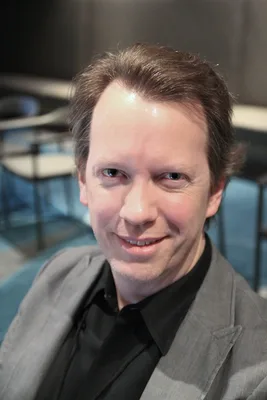
Sean Carroll
Sean Carroll was raised Episcopalian near Philadelphia, and the family's church-going ended when his grandmother died, when he was about ten. He drifted from belief gradually, with no crisis, and first called himself an atheist aloud at Villanova, a Catholic university, after hearing a rock song that treated unbelief as something to be happy about. His first public argument was a 2003 Notre Dame paper, published in 2005, that treated God as a hypothesis to be rejected on scientific grounds; his blog, his refusal of Templeton money (2013) and his 2014 debate with William Lane Craig followed. From about 2009 he changed his method rather than his conclusion: he gave up arguing that God does not exist in favour of "poetic naturalism" (2016), saying he had no interest in attacking religion and preferred the constructive work of following naturalism through.
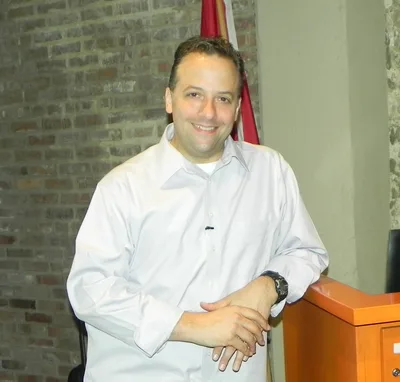
Seth Andrews
Seth Andrews was a Tulsa boy raised on a literal Bible, and became a Christian radio host. He put the doubts raised by Rich Mullins's death and 9/11 into storage for years. In his late thirties, after a Hitchens video and an unfiltered reading of the Bible, he let them out, and in 2008 he told his parents he was an atheist. Since then he has widened his unbelief into politics, while looking back more gently on the believer he was.
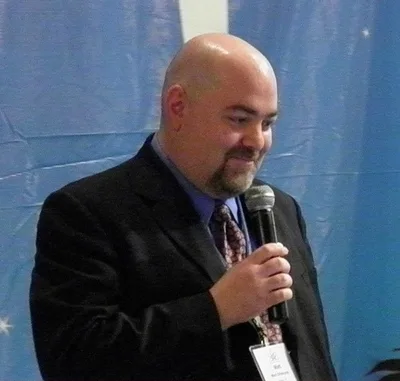
Matt Dillahunty
Matt Dillahunty was a Southern Baptist who had meant to become a minister. He lost his job in 2001 and set out to rebuild his faith by study, and the study destroyed it in stages, beginning with a Bible story he found immoral. By 2006 he was hosting a weekly television argument with believers. His unbelief has widened since into a self-described skepticism, but has not reversed.
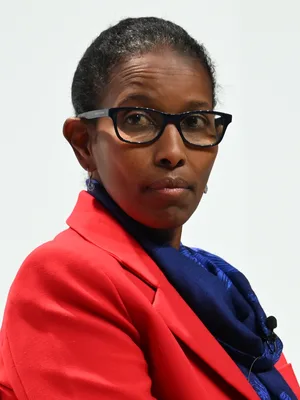
Ayaan Hirsi Ali
Ayaan Hirsi Ali's childhood Islam was built on fear of Hell, and then on Brotherhood zeal in Nairobi. She kept her doubts behind a "shutter" through her Leiden years, let it fall after 11 September 2001, and said "I don't believe in God" on Corfu in May 2002. She paid for her public unbelief with a murdered collaborator, armed protection and a lost parliamentary seat. In 2023, after a decade of despair, and with civilisational as well as personal reasons, she called herself a lapsed atheist and a Christian.