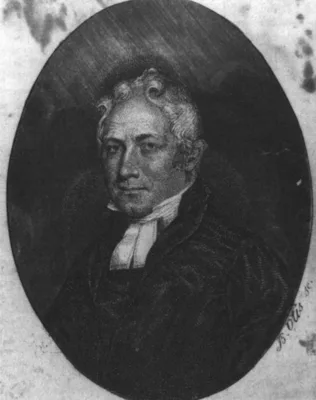
Abner Kneeland was a Baptist lay preacher turned Universalist minister. He put his first doubts about the Bible to Hosea Ballou in 1814 and was reassured. Through Priestley, Owen and his own reading he lost his faith in a future life and a personal God, and the Universalists suspended him in 1829. In 1833 he declared himself "not an Atheist, but a Pantheist". He spent four years in the courts and sixty days in a Boston jail (1838) for a letter saying the Universalists' god was a chimera, never recanted, and ended his life in a freethinkers' colony in Iowa.
The belief timeline
- Faith (1801 to 1805) — Baptist lay preacher, converted by Winchester's books to Universalism, then Ballou's; ordained 1804 [3][4][6][7]
- First crack (1814) — Doubts about the Scriptures put to Ballou in letters (Daniel and the lions, Remus and Romulus); he leaves the ministry for the shop, but Ballou's answers satisfy him and he returns in 1816 [11][12][8]
- Doubt (c. 1816 to 1827) — Materialism from Priestley (Stacy), Owen's lectures (Stacy, DUUB), then the open disclosure at Prince Street in 1827; the adult doubt is dated here because the 1814 letters ended in reassurance and the 1816 to 1827 reading did not [14][17][19]
- Declaration (1829 and 1833) — The Broadway Hall lectures and their preface ("persecution" prompted them), 1829; the Philosophical Creed, 28 May 1833, and the letter of 20 Dec 1833 [22][7][28][29]
- Cost (1834 to 1838) — Four years of trials; the full court upholds the conviction in 1838; sixty days in the common jail [32][43]
- Revision (1833 to 1844) — None recorded: he never recanted; what changes is the label (not atheist, pantheist) and the effort (a community at Salubria) [28][49][51]
Notes to the timeline (17)
- [3] In 1801, after joining the Baptist church at Putney, he began to preach; he "had publicly improved in that church for a season" but was never regularly ordained by the Baptists — Stephan Papa and Peter Hughes, "Abner Kneeland," Unitarian Universalist Biographical Dictionary (UUHS, 1999 to 2006), captured by the Wayback Machine 9 June 2006; Richard Eddy, Universalism in America: A History, vol. II (Boston: Universalist Publishing House, 1886), vol. II p. 41.
- [4] Converted to Universalism by reading Elhanan Winchester ("a perfect Winchesterian") before he had heard a Universalist preacher — Eddy, Universalism in America, vol. II p. 41 (quoting Stacy p. 89); Papa, "Abner Kneeland,".
- [6] At that convention he met Ballou and "it was not six months" before he "became a complete Ballouite" — Eddy, Universalism in America, vol. II p. 41 (Stacy p. 89); Papa, "Abner Kneeland,".
- [7] Ordained at Sturbridge (19 Sept, in the 1804 session of the Convention); DUUB: minister-at-large 1804 with John Murray preaching, settled at Langdon, N.H. in 1805 with Ballou preaching, seven years there — Eddy, Universalism in America, vol. II p. 64; Papa, "Abner Kneeland,".
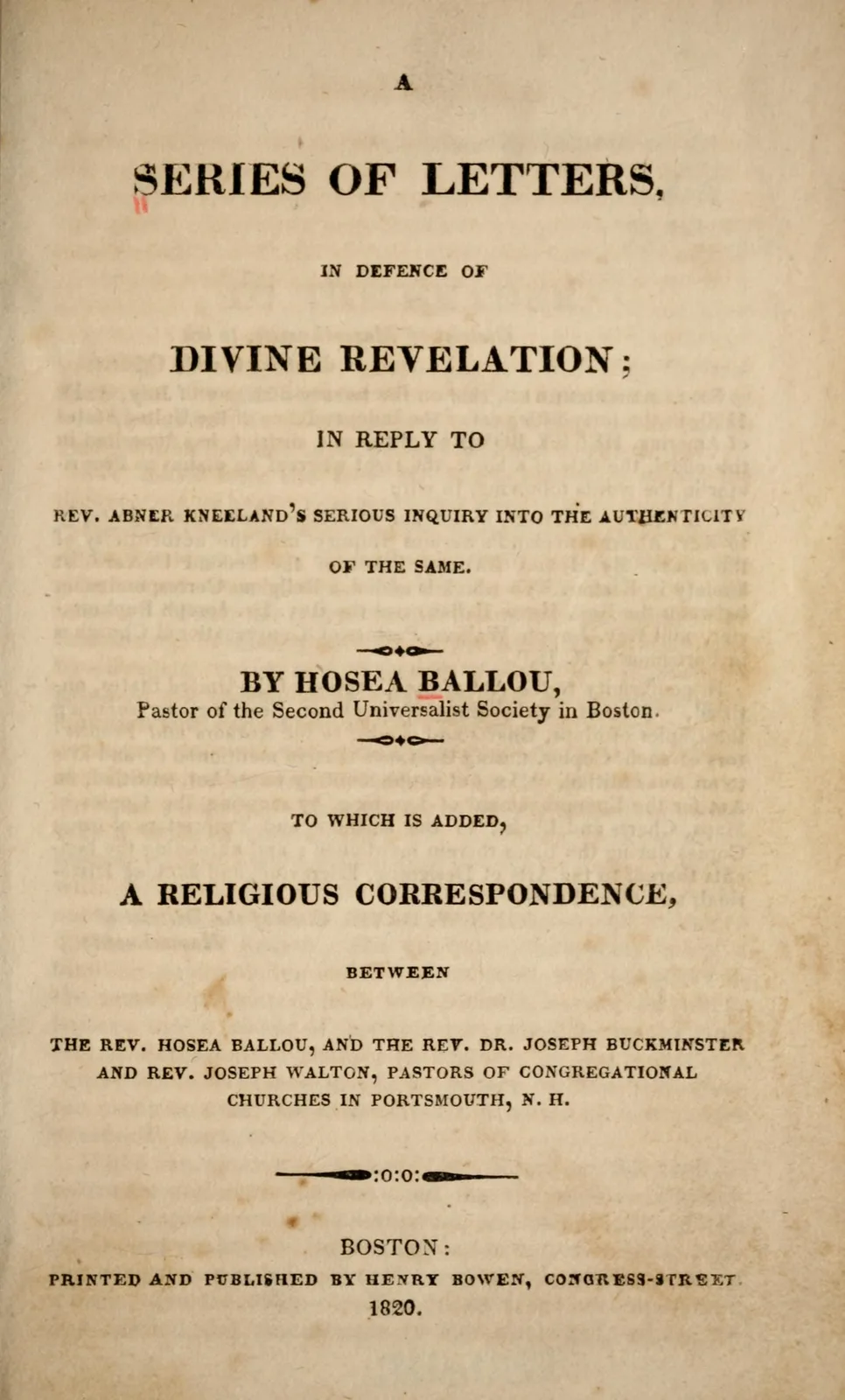
- [11] He turned to Ballou, and the two argued the authenticity of Scripture by letter, printed in 1820 as Ballou's Series of Letters — Papa, "Abner Kneeland,"; Hosea Ballou, A Series of Letters, in Defence of Divine Revelation; in Reply to Rev. Abner Kneeland's Serious Inquiry (Boston, 1820), which prints extracts of Kneeland's letters. Project Gutenberg ebook 8225, title page.
- [12] His opening letter asks why Daniel's lions or Jonah's fish should matter to his happiness any more than "the story of Remus and Romulus' being nursed by a she wolf," and says the Bible's truth must finally be judged by each person's own reason. The 1820 publisher's preface says he "assumed the character of a real opponent" and that after the exchange he felt "an entire satisfaction" that his objections were answered. — Ballou, Series of Letters, "To the Reader" and Extracts No. 1.
- [8] Treasurer of the Convention 1809 to 1815; standing clerk from 1811 (office held to 1815) — Eddy, Universalism in America, vol. II ch. I note on treasurers (page header not legible in the OCR); p. 54 note; p. 145.
- [14] At New Hartford "he was so unfortunate as to fall in with Dr. Joseph Priestly's writings on Materialism" and "became a most zealous Materialist" (Stacy's account, a hostile colleague writing in 1850) — Nathaniel Stacy, Memoirs of the Life of Nathaniel Stacy (Columbus, Pa., 1850), a Universalist colleague's account, p. 89 to 90; Papa, "Abner Kneeland,", (he read Priestley and other sceptics).
- [17] Stacy says Kneeland attended Robert Owen's Philadelphia lectures, became "a convert to his system of social community" and, "no doubt," "tinctured with his Atheistical sentiments"; DUUB says that about 1824 Owen became a mentor whose ideas "supplanted the remaining influence of Hosea Ballou" — Stacy, Memoirs of the Life of…, p. 90; Papa, "Abner Kneeland,".
- [19] He kept the extent of his change from the congregation until early 1827, when the church divided; his supporters formed the Second Universalist Society (meeting in Masonic Hall from 11 Nov 1827); he edited the Olive Branch from May 1827 and took it over in May 1828 — Papa, "Abner Kneeland,"; Abel C. Thomas, A Century of Universalism in Philadelphia and New York (Philadelphia, 1872), p. 275 to 276.
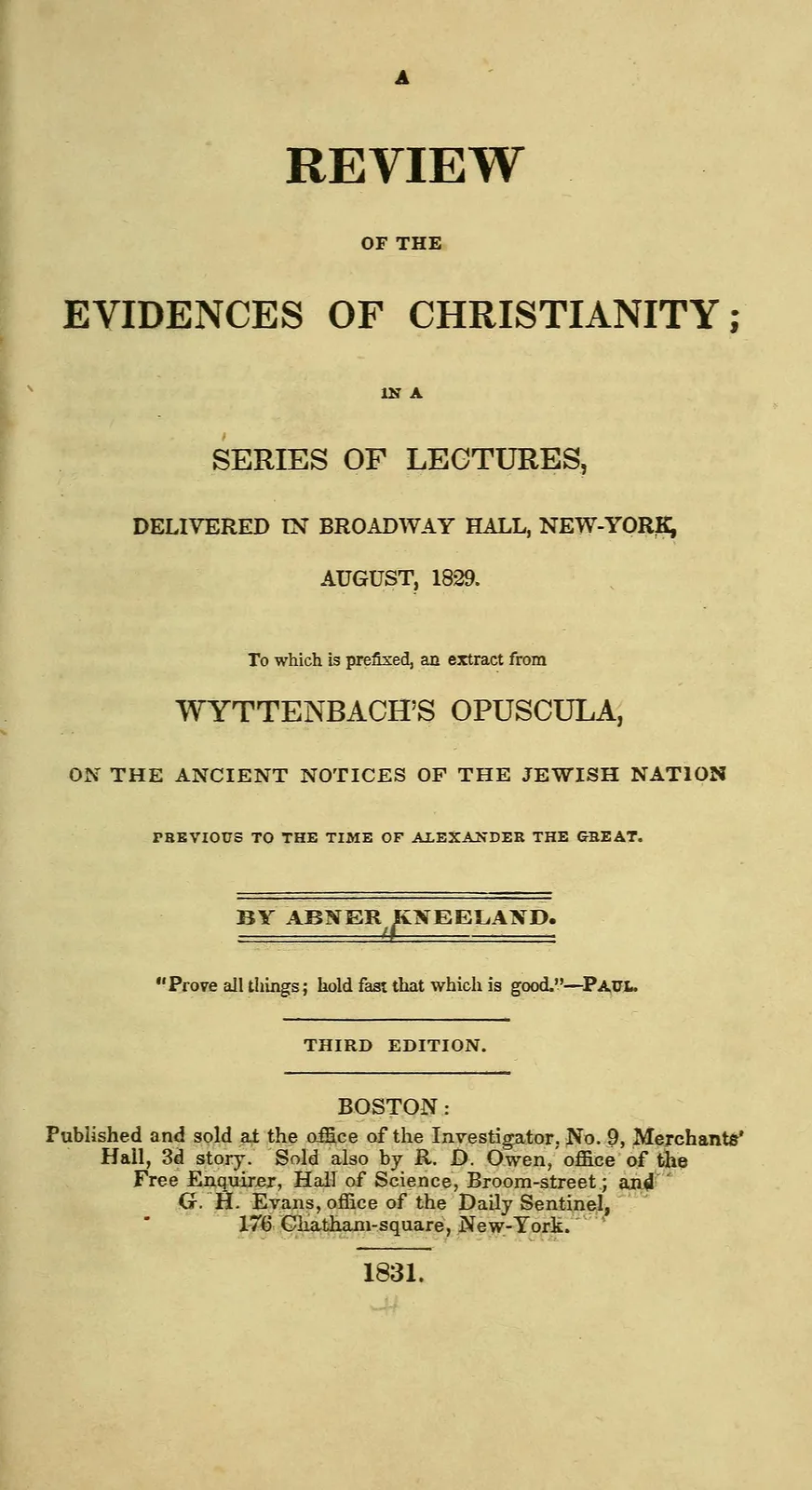
- [22] Delivered seven lectures at Broadway Hall in Aug 1829; published them 2 Nov 1829 as A Review of the Evidences of Christianity (3rd ed. Boston 1831 from the Investigator office) — Kneeland, A Review of the Evidences of Christianity (lectures of Aug 1829), 3rd ed. (Boston: office of the Investigator, 1831), title page and p. 8.
- [28] The Philosophical Creed was written at Hebron, N.H., 28 May 1833 and printed in the Investigator of 12 July 1833; it says "I am not an Atheist, but a Pantheist" — Abner Kneeland, An Introduction to the Defence of Abner Kneeland, Charged with Blasphemy (Boston, 1834; a Google scan whose binding also contains Dunlap's speech of Jan 1834, Kneeland's own speeches of Nov 1834 and later, and notes). Internet Archive anintroductiont00kneegoog, p. 39; Nov 1834 speech in Intro.
- [29] On 20 Dec 1833 the Investigator printed his letter to Thomas Whittemore, editor of the Universalist Trumpet (the 1878 county history misnames it the "Tempest"), who had said he would publish an acknowledgment that Kneeland was no Universalist; the letter lists four things Universalists believe and he does not (God, Christ, miracles, resurrection and immortality) — Kneeland, Introduction to the Defence of…, pp. 36 to 38; Commonwealth v. Kneeland, 20 Pick. (37 Mass.) 206 (1838), the report including Kneeland's argument as summarised by the reporter, Shaw C. J. for the majority and Morton J. dissenting in part. Wikisource transcription, with star-page numbers, p. 207; The History of Van Buren County, Iowa (Chicago: Western Historical Co., 1878), p. 464.
- [32] Tried and convicted in the Municipal Court in Jan 1834 (Andrew Dunlap defended) and sentenced to three months in the common jail; he appealed — Commonwealth v. Kneeland, p. 207; Kneeland, Introduction to the Defence of…, (Dunlap speech, Jan term 1834); History of Van Buren County, p. 464.
- [43] The Boston Morning Post said he was first put in criminal cell No. 13 and then moved to the debtors' tier "where his friends can see him"; the Evening News placed him in Leverett Street Jail — Hand transcription of the New Hampshire Gazette, 3 July 1838, p. 1, and the Alexandria Gazette, 23 June 1838, p. 2 (Chronicling America, public domain), p. 1.
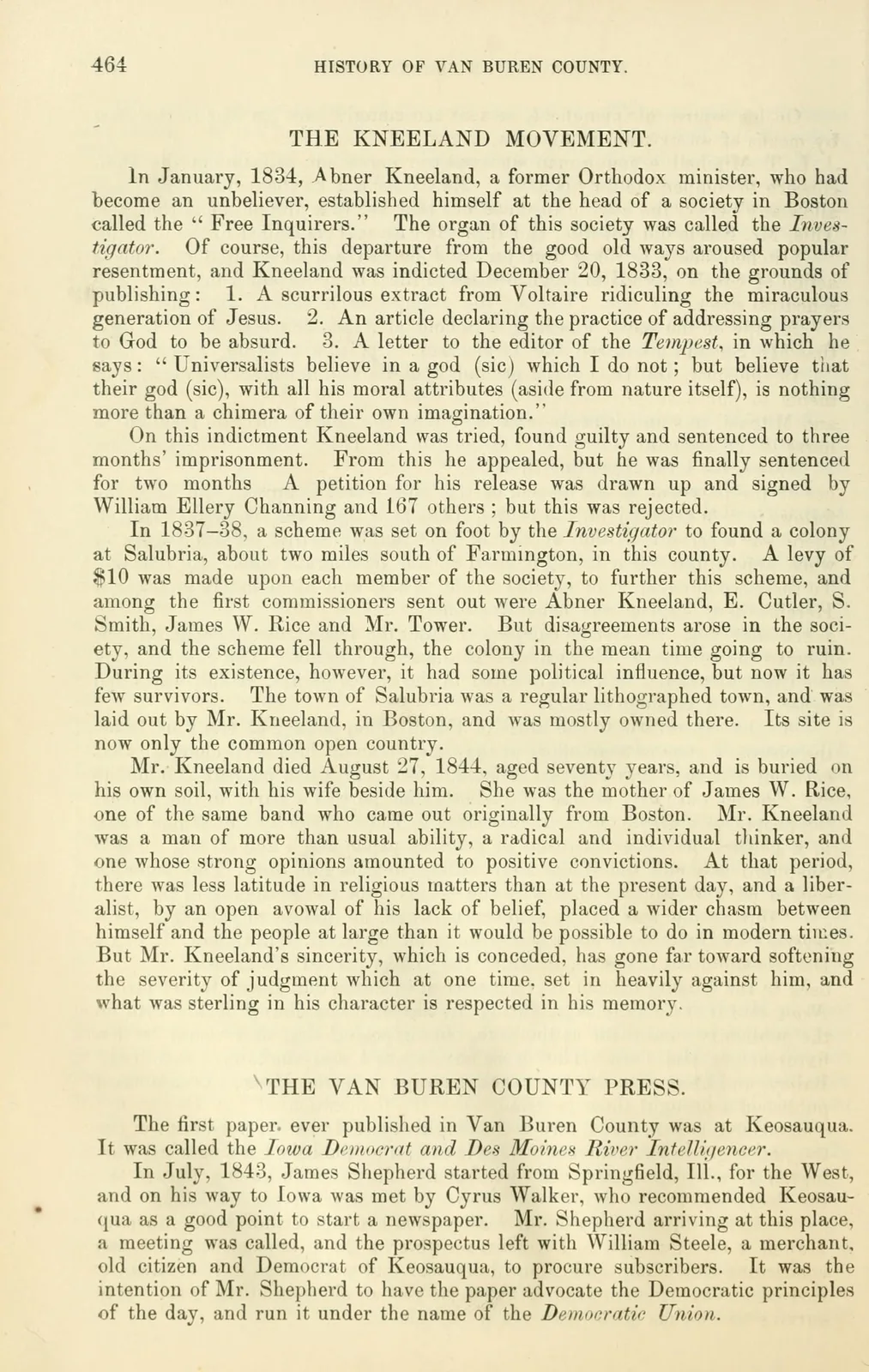
- [49] In 1837 to 1838 the Investigator launched a colony scheme at Salubria, two miles south of Farmington, Van Buren County; each member was levied $10; Kneeland, E. Cutler, S. Smith, James W. Rice and Mr Tower were among the first commissioners; the town was a lithographed plat laid out in Boston; disagreements ended it — History of Van Buren County, p. 464.
- [51] Died at Salubria on 27 Aug 1844, in his 71st year, buried on his own land with his wife beside him; she was the mother of James W. Rice — Eddy, Universalism in America, vol. II p. 42; History of Van Buren County, p. 464.
Not an Atheist, but a Pantheist
On a Monday in June 1838, in a crowded courtroom in Boston, a clerk read a sentence to a white-haired man of sixty-four with his wife and family beside him. Abner Kneeland was to spend sixty days in the common jail for blasphemy. He made no remarks, and was taken at once to the Leverett Street jail.12 A friendly paper told its readers: "There is an aged and strictly moral man at this moment confined in Leverett st. Jail for his sentiments on the subject of religion."34
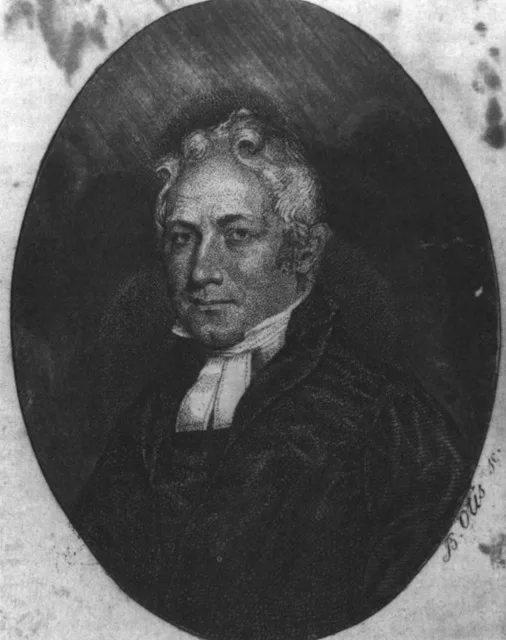
The words that put him there were in a letter to a Universalist editor: "Universalists believe in a god which I do not."56 Four years of trials turned on what he meant by it. He said he meant the Universalists' god, not God, and he wrote that he was "not an Atheist, but a Pantheist".789 This chapter follows a minister who preached for a quarter of a century, doubted, reassured himself, doubted again, and was punished for saying so in print; and it asks whether the label his judges chose was the right one. Accounts call him the last man jailed for blasphemy in the United States, but a later case in Arkansas may contradict that; he was at least among the last, and the last in Massachusetts.10
A preacher of universal salvation
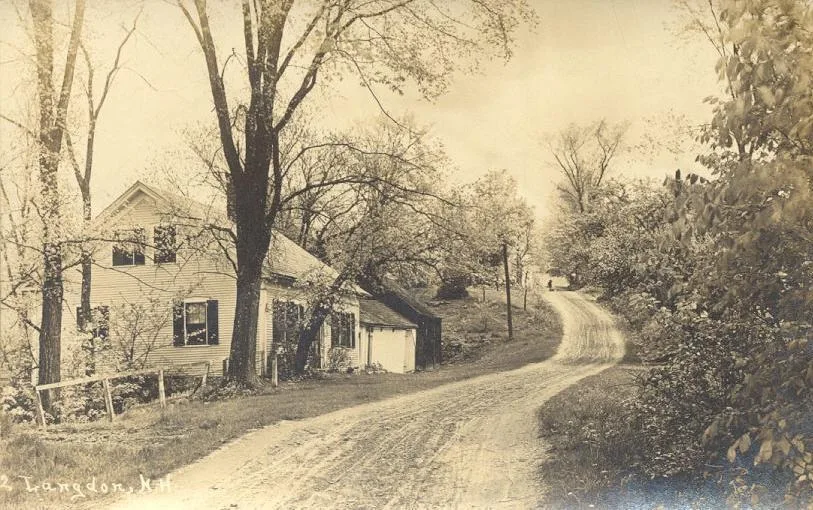
He was born in Gardner, Massachusetts, in April 1774, the sixth of ten children of a carpenter's family.11 After one year at an academy he followed his father's trade, moved to Vermont, taught school and compiled spelling books.12 In 1801 he joined the Baptist church at Putney and began to preach, though the Baptists never ordained him.13 Then he read the Universalist Elhanan Winchester, who taught that God would in the end save everyone, and became "a perfect Winchesterian" before he had ever heard a Universalist preach.14 At the Universalist convention of 1803 he received a letter of fellowship and met Hosea Ballou, and within six months he had taken Ballou's theology instead of Winchester's.1516 He was ordained in 1804 and settled as minister at Langdon, New Hampshire, in 1805.17 On the belief timeline, that is his faith.
Daniel, Jonah, Romulus
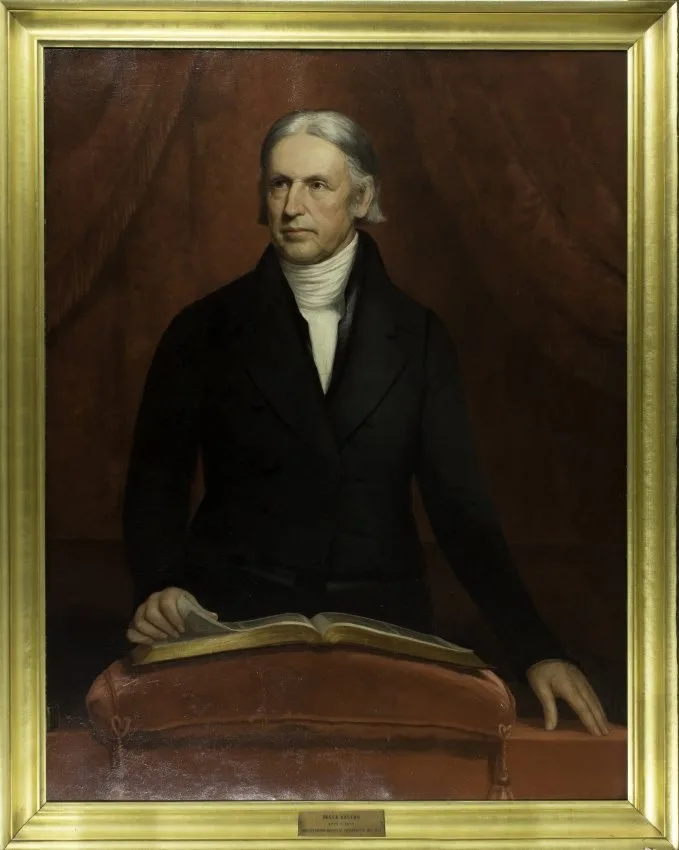
In 1814, as minister at Charlestown, he suddenly resigned his pulpit and went into the dry-goods trade. He gave money as the reason, but he was also struggling with doubts about the Bible.18 He wrote them out to Ballou. "I do not see how my happiness is at all connected with the story of Daniel's being cast into the den of lions," he began, "or of Jonah's being swallowed by a fish! any more than it is with the story of Remus and Romulus' being nursed by a she wolf!"192021 Ballou answered him, and when the letters were printed in 1820 the publisher said that Kneeland had felt "an entire satisfaction" with the answers; he also said Kneeland had "assumed the character of a real opponent", which leaves open how real the doubt was.20 In 1816 he was readmitted to fellowship.22 On the timeline, this is his first crack, and it closed.
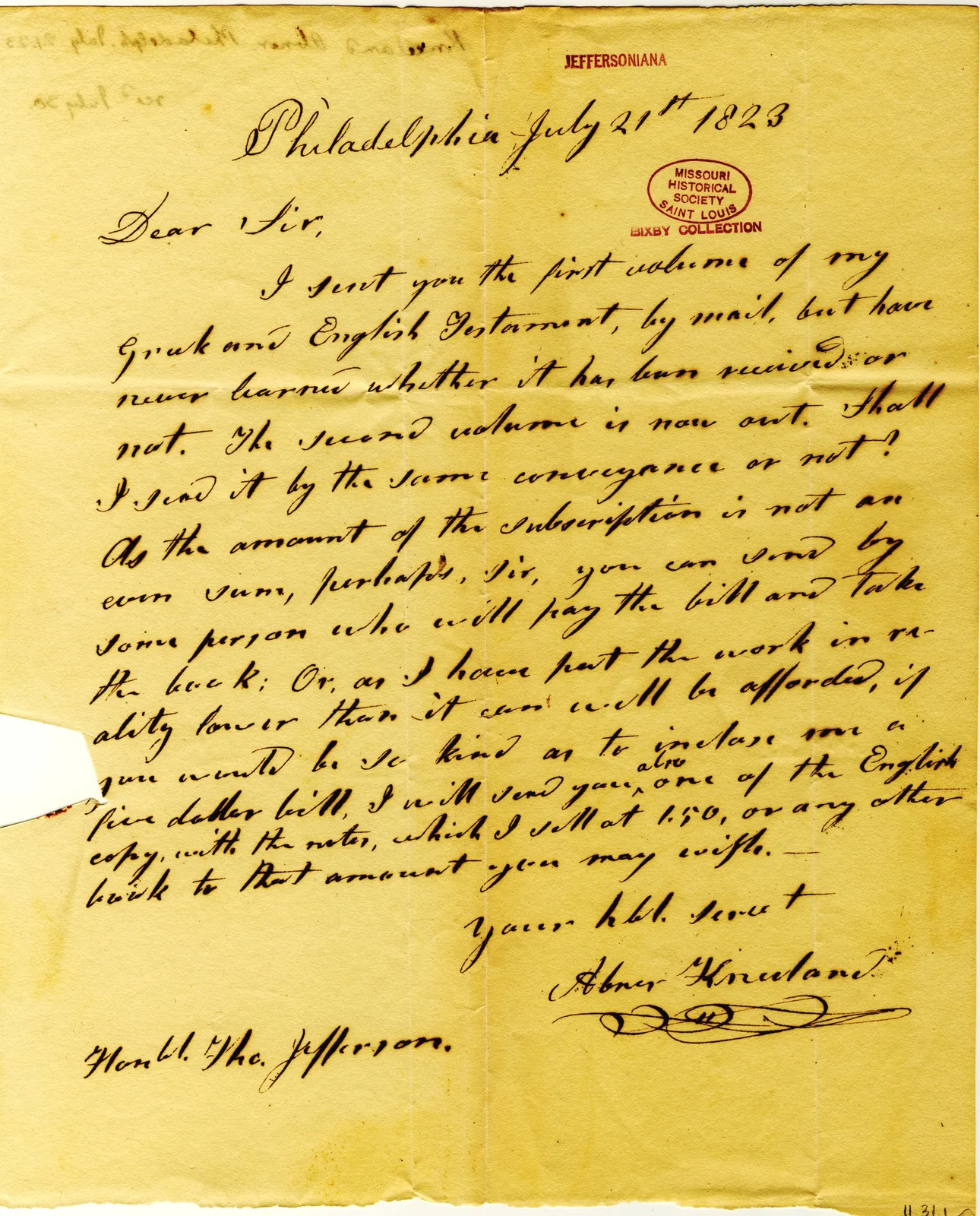
The doubt that lasted came later, and it came from reading and listening. At New Hartford in New York, according to his hostile colleague Nathaniel Stacy, he fell in with Joseph Priestley's writings on materialism and "became a most zealous Materialist".23 In Philadelphia, where he led the Lombard Street church from 1818, he denied any punishment after death, reserved the right to read the church's articles for himself, debated the Presbyterian W. L. McCalla for four days on endless punishment, and went to hear Robert Owen lecture. Stacy thought he became, "no doubt", "tinctured with his Atheistical sentiments".242526 That is why the timeline places his doubt in the years from 1816 to 1827: the letters of 1814 ended in reassurance, and this reading did not.
In 1825 he took the Prince Street church in New York, and in 1827 he let his congregation see how far he had moved; it split.2728 In January 1829 he gave his pulpit to Frances Wright, the freethinking lecturer, and that ended his career as a Universalist. He still called himself a Christian minister on 2 March 1829; in May he was refused a seat at the council in Hartford and suspended. To friends who protested he said, "I have left stepping-stones behind me."293031
The declaration
That August he gave seven lectures at Broadway Hall, published in November 1829 as A Review of the Evidences of Christianity. "Like many others, I once thought that a belief in future existence was absolutely necessary to present happiness. I have discovered my mistake." And what had prompted the inquiry? "I answer, persecution!"32333435
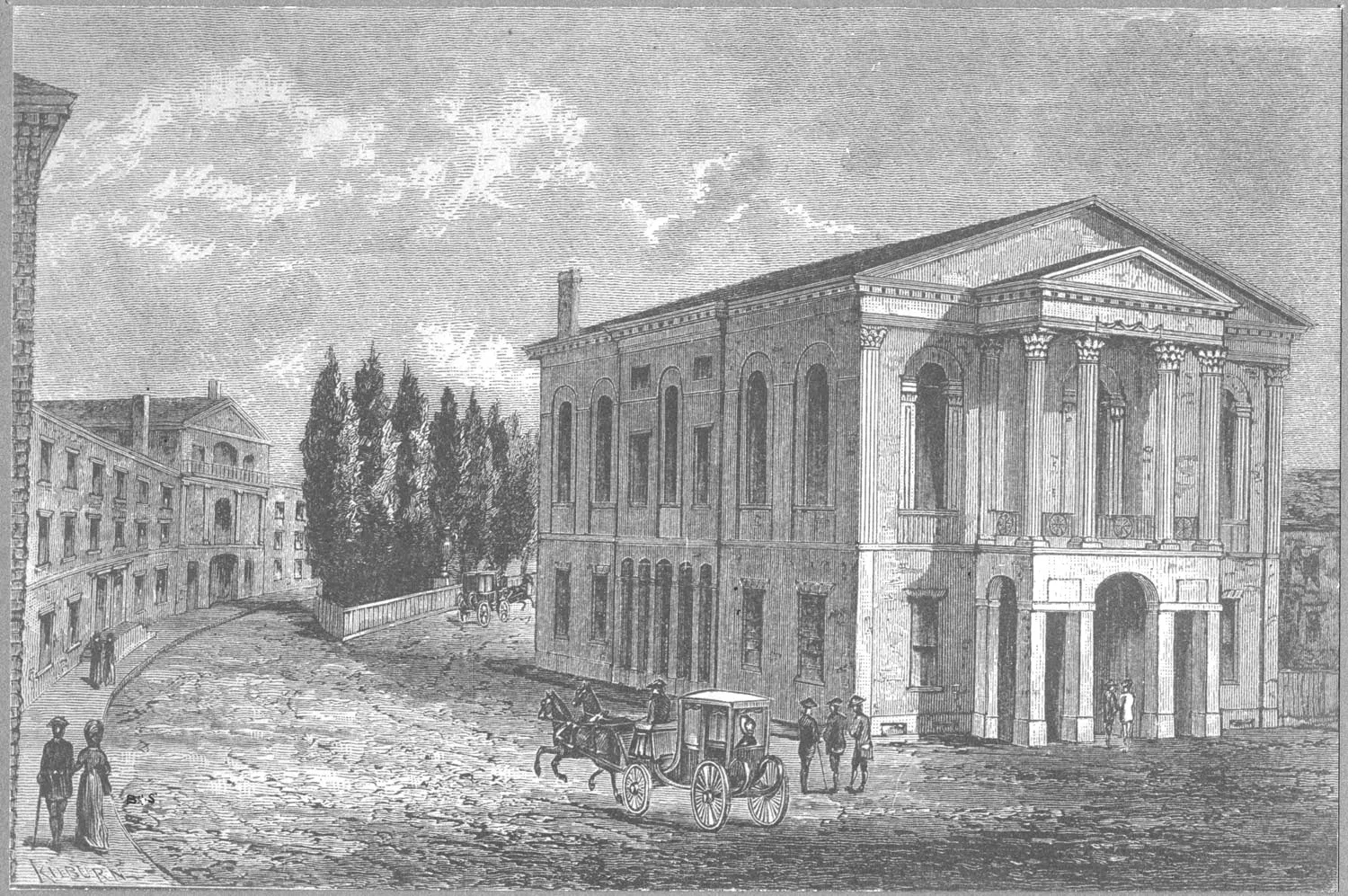
By 1830 he was in Boston, leading a society of freethinkers; when no church would let William Lloyd Garrison speak against slavery, Kneeland's "infidels" lent him Julien Hall.36 His Sunday lectures at the Federal Street Theatre drew more than two thousand people, and in 1831 he founded the Boston Investigator.3637
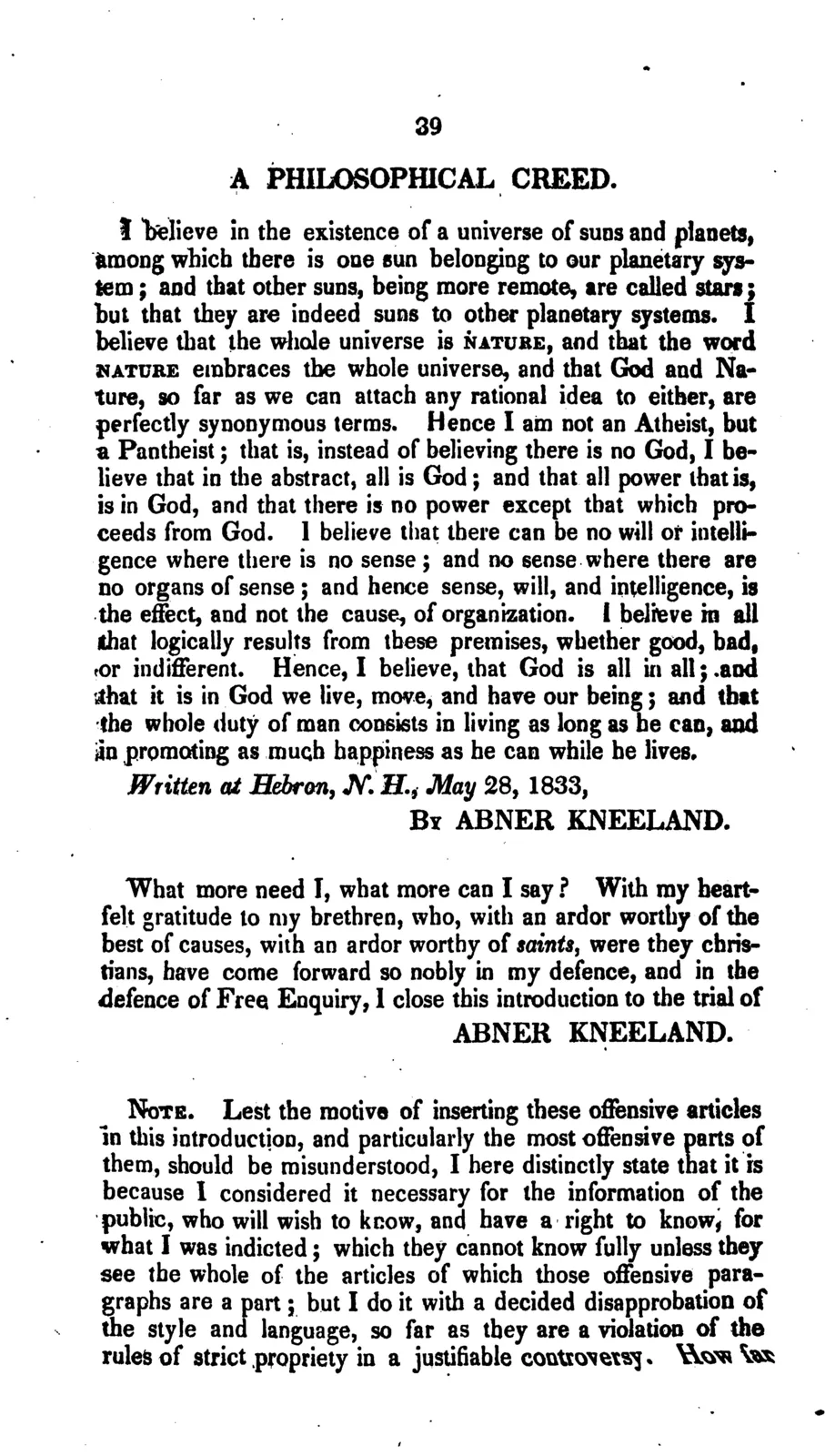
On 28 May 1833 he wrote out his creed. "I believe that the whole universe is nature, and that the word nature embraces the whole universe, and that God and Nature, so far as we can attach any rational idea to either, are perfectly synonymous terms. Hence I am not an Atheist, but a Pantheist; that is, instead of believing there is no God, I believe that in the abstract, all is God." Intelligence, he added, is "the effect, and not the cause, of organization".7938
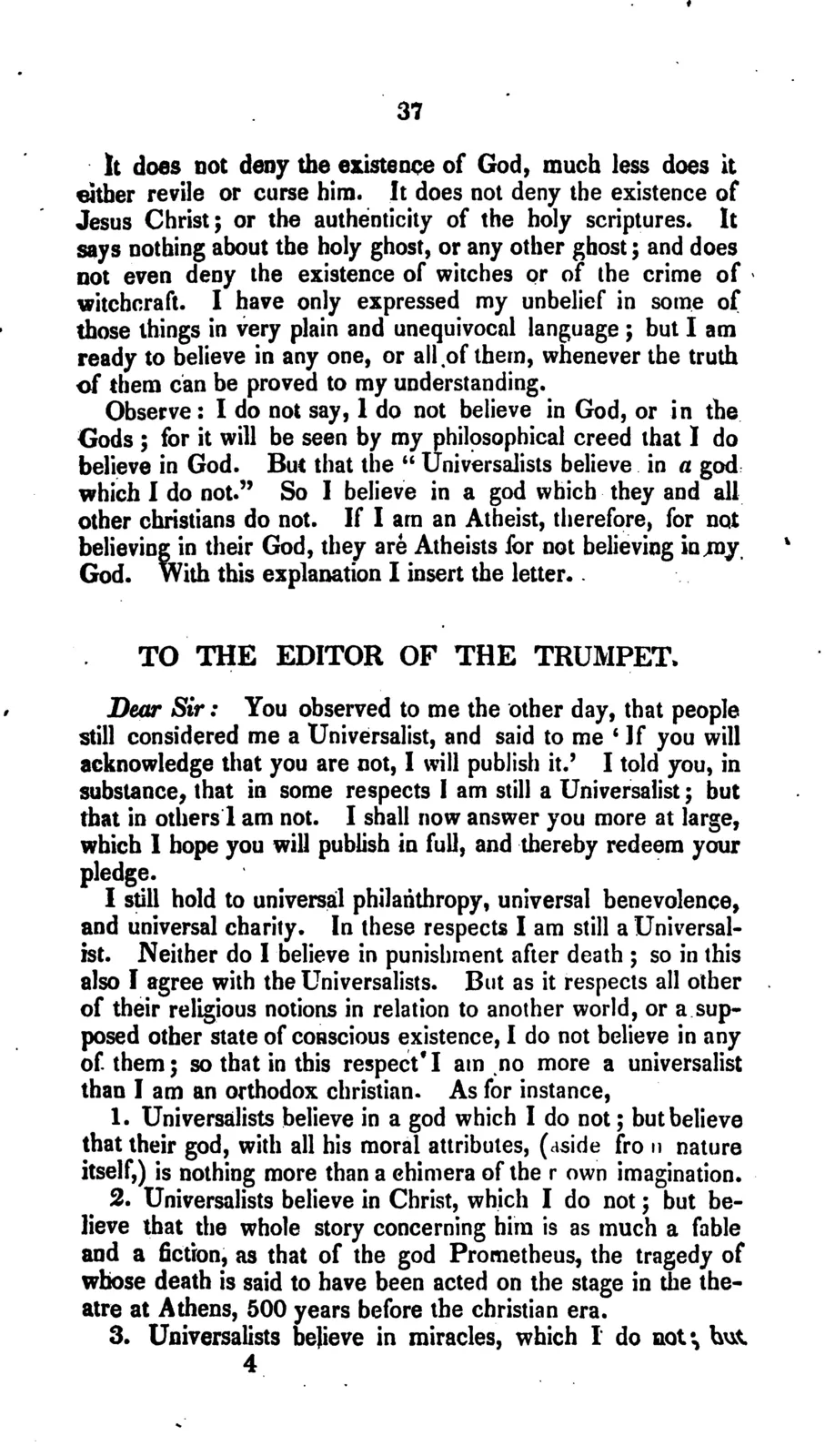
That December the Universalist editor Thomas Whittemore offered to print an acknowledgment that Kneeland was no Universalist. Kneeland sent him a list of four beliefs he did not share. "Universalists believe in a god which I do not; but believe that their god, with all his moral attributes, (aside from nature itself,) is nothing more than a chimera of their own imagination." They believed in Christ and miracles and a resurrection; he believed "that death is an eternal extinction of life to the individual". Yet "I still hold to universal philanthropy, universal benevolence, and universal charity. In these respects I am still a Universalist."563940 The Investigator printed the letter on 20 December 1833, in the same weeks as three borrowed articles, one with a coarse passage about Jesus that Kneeland said he did not approve. Those pieces and the letter became the indictment.4142 On the timeline, the creed and the letter are his declaration.
Four years in court
He was convicted in the Municipal Court in January 1834 and sentenced to three months.43 When his counsel argued that he was no atheist, the judge broke in: "But what is his God? If the defendant disclaims atheism, he must believe in some God, and I should like to know, what the God is that he believes in."44 He appealed. A jury in May 1834 could not agree; he was tried again, convicted in November 1835, and argued his own case before the full Supreme Judicial Court. He said he had declared that he did not believe the Universalists' creed, "and no more", and that "a god" with a small letter meant theirs.454647848 Accounts differ on how many trials there were.
He had written before the first trial that if it should be necessary for him to be "flung into that breach to make a bridge for others to march over my back, for the sake of storming that citadel, I cheerfully offer myself as the victim".49
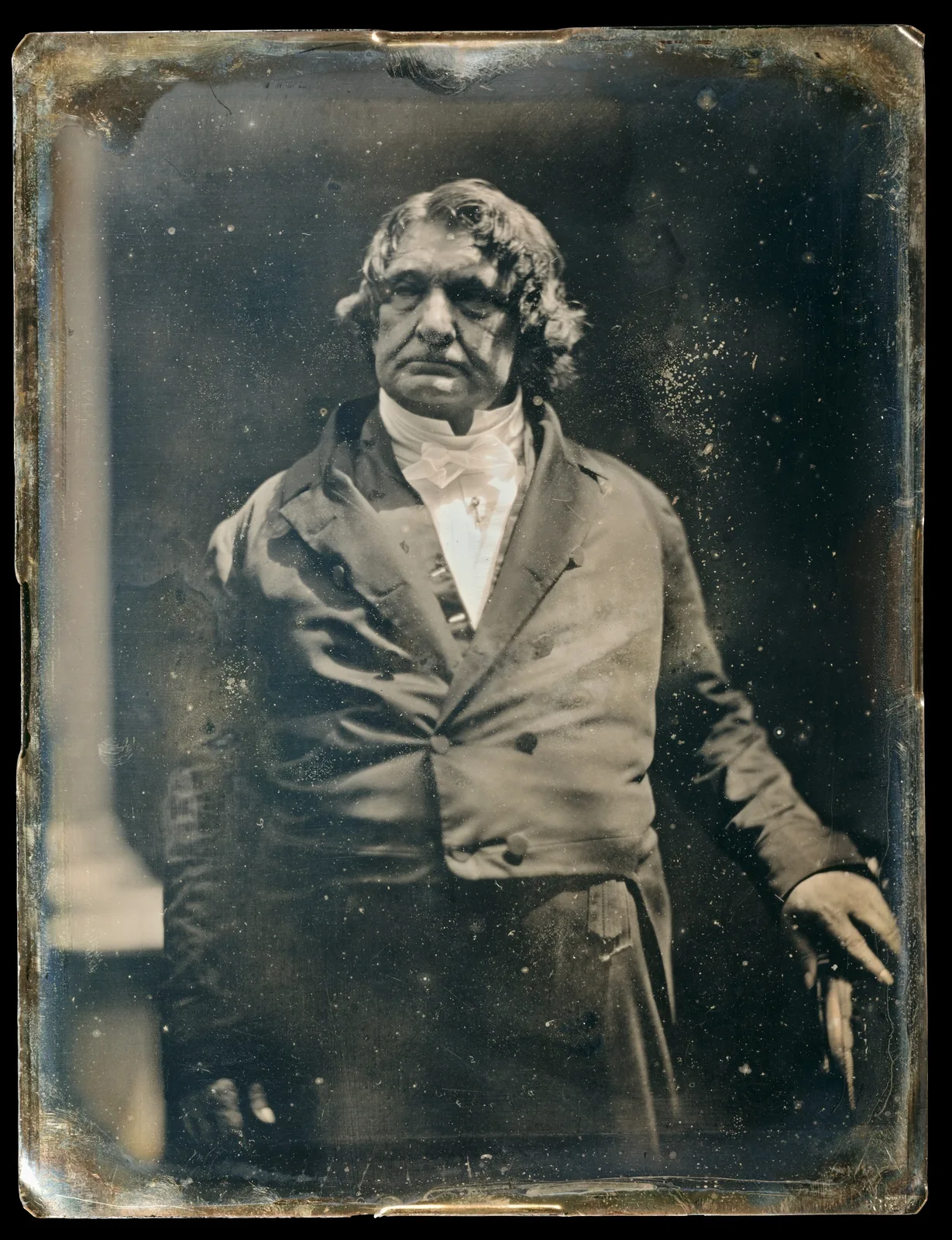
The Attorney General answered that the word God in the statute meant "that Supreme, Intelligent Being who is alike revered by Christians, Jews and Mahometans, and not the material universe, which the defendant would substitute".50 In 1838 Chief Justice Lemuel Shaw, for the majority, upheld the conviction. Blasphemy, he wrote, is speaking evil of God "with an impious purpose"; the law did not forbid "the simple and sincere avowal of a disbelief in the existence and attributes of a supreme, intelligent being, upon suitable and proper occasions", but it did punish a denial made with unlawful intent.51525354 Justice Morton dissented on the jury's instructions: "Every person has a constitutional right to discuss the subject of a God, and to affirm or deny his existence."5155
A petition for his pardon drawn up by the Unitarian William Ellery Channing, with 167 other names, was rejected.56 Garrison called the prosecution "a disgrace to the Commonwealth of Massachusetts and a proof of the corruption of modern Christianity".57 Even the Universalist Abel Thomas, no friend, called the jailing of "an old white-haired man, for a few fanatical-sceptical words" barbarous.58 Ballou visited him in jail.59
Salubria
There was no recantation and no revision of belief. What changed after the jail was his work. The Investigator had planned a freethinkers' colony at Salubria, on the Des Moines River in Iowa, and Kneeland was among its first commissioners.60 He moved there, lectured in the river towns, and helped an "infidel ticket" try and fail to carry the county.6162 A Congregational missionary who arrived in 1843 decided that "the fundamental truths of the Gospel" were what the people needed "more than any discussion upon infidelity".63 Kneeland died at Salubria on 27 August 1844, in his seventy-first year, and was buried on his own land.64
His old colleague Stacy said he never had an original idea and "was generally the echo of the last author he read".65 Thomas said he was "constitutionally a sceptic" who raised questions he could not answer.66 What he said of himself was smaller and plainer: not an atheist, but a man for whom God and nature meant the same thing, and who would not pretend otherwise in print. The lecturer whose visit to his pulpit in 1829 ended his ministry, Frances Wright, has her own chapter in this book.
Footnotes
-
Commonwealth v. Kneeland, 20 Pick. (37 Mass.) 206 (1838), the report including Kneeland's argument as summarised by the reporter, Shaw C. J. for the majority and Morton J. dissenting in part. Wikisource transcription, with star-page numbers, p. 246 note. ↩
-
Hand transcription of the New Hampshire Gazette, 3 July 1838, p. 1, and the Alexandria Gazette, 23 June 1838, p. 2 (Chronicling America, public domain), (Alexandria Gazette 23 June 1838, p. 2). ↩
-
NHG, p. 1. ↩
-
Boston Evening News, June 1838, reprinted in the New Hampshire Gazette 3 July 1838: NHG, p. 1 (transcription in research/texts). ↩
-
Abner Kneeland, An Introduction to the Defence of Abner Kneeland, Charged with Blasphemy (Boston, 1834; a Google scan whose binding also contains Dunlap's speech of Jan 1834, Kneeland's own speeches of Nov 1834 and later, and notes). Internet Archive anintroductiont00kneegoog, pp. 36 to 38; Commonwealth v. Kneeland, p. 207; The History of Van Buren County, Iowa (Chicago: Western Historical Co., 1878), p. 464. ↩ ↩2
-
Kneeland, Introduction to the Defence of…, p. 37; same wording in NHG p. 1 and VanBuren p. 464. ↩ ↩2
-
Kneeland, Introduction to the Defence of…, p. 39; Nov 1834 speech in Intro. ↩ ↩2
-
Commonwealth v. Kneeland, pp. 209 to 210 (reporter's summary). ↩ ↩2
-
Kneeland, Introduction to the Defence of…, p. 39 (printed twice in the volume, also in the Nov 1834 speech). ↩ ↩2
-
Wikipedia, "Commonwealth v. Kneeland," revision 1292762048 of 28 May 2025, "See also Charles Lee Smith". Accounts differ; see the disputed points. ↩
-
Stephan Papa and Peter Hughes, "Abner Kneeland," Unitarian Universalist Biographical Dictionary (UUHS, 1999 to 2006), captured by the Wayback Machine 9 June 2006; Wikipedia, "Abner Kneeland," revision 1342039715 of 6 March 2026; NHG, p. 1 footnote; "Kneeland, Abner," Encyclopedia Americana (1920), via Wikisource, gives 6 April. ↩
-
Papa, "Abner Kneeland,". Reported at second hand; the original has not been seen. ↩
-
Papa, "Abner Kneeland,"; Richard Eddy, Universalism in America: A History, vol. II (Boston: Universalist Publishing House, 1886), vol. II p. 41. ↩
-
Eddy, Universalism in America, vol. II p. 41 (quoting Stacy p. 89); Papa, "Abner Kneeland,". ↩
-
Eddy, Universalism in America, vol. II p. 40; Nathaniel Stacy, Memoirs of the Life of Nathaniel Stacy (Columbus, Pa., 1850), a Universalist colleague's account. ↩
-
Eddy, Universalism in America, vol. II p. 41 (Stacy p. 89); Papa, "Abner Kneeland,". ↩
-
Eddy, Universalism in America, vol. II p. 64; Papa, "Abner Kneeland,". ↩
-
Papa, "Abner Kneeland,"; Stacy, Memoirs of the Life of…, (he "left the ministry, went into the mercantile business, broke down, resumed his sacerdotal functions"). ↩
-
Papa, "Abner Kneeland,"; Hosea Ballou, A Series of Letters, in Defence of Divine Revelation; in Reply to Rev. Abner Kneeland's Serious Inquiry (Boston, 1820), which prints extracts of Kneeland's letters. Project Gutenberg ebook 8225, title page. ↩
-
Ballou, Series of Letters, "To the Reader" and Extracts No. 1. ↩ ↩2
-
Ballou, Series of Letters, Extracts No. 1 (e-text unpaginated). ↩
-
Papa, "Abner Kneeland,"; Stacy, Memoirs of the Life of…. ↩
-
Stacy, Memoirs of the Life of…, p. 89 to 90; Papa, "Abner Kneeland,", (he read Priestley and other sceptics). ↩
-
Abel C. Thomas, A Century of Universalism in Philadelphia and New York (Philadelphia, 1872), p. 72 to 73; Papa, "Abner Kneeland,". ↩
-
Thomas, Century of Universalism in Philadelphia…, p. 75 to 78; Papa, "Abner Kneeland,". ↩
-
Stacy, Memoirs of the Life of…, p. 90; Papa, "Abner Kneeland,". ↩
-
Thomas, Century of Universalism in Philadelphia…, p. 82 (DUUB: 1825 to 27). ↩
-
Papa, "Abner Kneeland,"; Thomas, Century of Universalism in Philadelphia…, p. 275 to 276. ↩
-
Thomas, Century of Universalism in Philadelphia…, p. 276 to 277; Papa, "Abner Kneeland,". ↩
-
Thomas, Century of Universalism in Philadelphia…, p. 277 to 279; Papa, "Abner Kneeland,". ↩
-
Thomas, Century of Universalism in Philadelphia…, p. 278. ↩
-
Kneeland, A Review of the Evidences of Christianity (lectures of Aug 1829), 3rd ed. (Boston: office of the Investigator, 1831), title page and p. 8. ↩
-
Kneeland, Review of the Evidences of Christianity, pp. 5 to 7. ↩
-
Kneeland, Review of the Evidences of Christianity, p. 5. ↩
-
Kneeland, Review of the Evidences of Christianity, p. 7. ↩
-
Kneeland, Review of the Evidences of Christianity, title page; Papa, "Abner Kneeland,"; "Kneeland, Abner,"; Garrison II p. 142 note; WP. ↩
-
Kneeland, Introduction to the Defence of…, p. 39. ↩
-
Kneeland, Introduction to the Defence of…, p. 38; Commonwealth v. Kneeland, p. 207. ↩
-
Kneeland, Introduction to the Defence of…, p. 37. ↩
-
Kneeland, Introduction to the Defence of…, pp. 3 to 5 (printed). ↩
-
Commonwealth v. Kneeland, pp. 206 to 207. ↩
-
Commonwealth v. Kneeland, p. 207; Kneeland, Introduction to the Defence of…, (Dunlap speech, Jan term 1834); History of Van Buren County, p. 464. ↩
-
Judge Thacher, Municipal Court, Jan 1834, interrupting defence counsel: Kneeland, Introduction to the Defence of…, Dunlap's speech p. 33. ↩
-
Kneeland, Introduction to the Defence of…, (preface note to the Nov 1834 speech). ↩
-
Kneeland, Introduction to the Defence of…, (Nov 1834 speech heading). ↩
-
Commonwealth v. Kneeland, p. 207. ↩
-
Kneeland, Introduction to the Defence of…, later speech by Kneeland (printed p. about 21 of that speech). ↩
-
Kneeland, Introduction to the Defence of…, p. 38. ↩
-
Austin, Attorney General, for the Commonwealth, before the full court: Commonwealth v. Kneeland, p. 211. ↩
-
Commonwealth v. Kneeland, pp. 212, 220, 222 to 223. ↩
-
Lemuel Shaw, Chief Justice of the Supreme Judicial Court, for the majority: Commonwealth v. Kneeland, p. 213. ↩
-
Shaw, same opinion; the passage that distinguishes honest doubt from "wilful" blasphemy: Commonwealth v. Kneeland, p. 220. ↩
-
Morton J., dissenting on the jury instruction (he agreed the statute was constitutional): Commonwealth v. Kneeland, p. 244. ↩
-
History of Van Buren County, p. 464; Papa, "Abner Kneeland,"; Wikipedia, "Commonwealth v. Kneeland,". ↩
-
Garrison II p. 142 note. ↩
-
Thomas, the same critic, on the prosecution: Thomas, Century of Universalism in Philadelphia…, p. 280. ↩
-
Papa, "Abner Kneeland,". ↩
-
History of Van Buren County, p. 464. ↩
-
Papa, "Abner Kneeland,"; Wikipedia, "Abner Kneeland,"; Thomas, Century of Universalism in Philadelphia…, p. 280 ("migrated to the Des Moines River region of Iowa"). ↩
-
History of Van Buren County, p. 475 (Rev. Daniel Lane). ↩
-
Rev. Daniel Lane, Congregational missionary at Keosauqua from 1843, on Kneeland's Iowa lectures: History of Van Buren County, p. 475. ↩
-
Eddy, Universalism in America, vol. II p. 42; History of Van Buren County, p. 464. ↩
-
Nathaniel Stacy, Universalist preacher and former fellow minister, in his Memoirs (1850): Stacy, Memoirs of the Life of…, p. 89 (cited by Eddy II p. 41). ↩
-
Abel C. Thomas, Universalist minister in New York at the time, 1872: Thomas, Century of Universalism in Philadelphia…, p. 276. ↩
In their own words
Universalists believe in a god which I do not; but believe that their god, with all his moral attributes, (aside from nature itself,) is nothing more than a chimera of their own imagination.
Universalists believe in the resurrection of the dead, in immortality and eternal life, which I do not; but believe that all life is mortal, that death is an eternal extinction of life to the individual who possesses it, and that no individual life is, ever was, or ever will be eternal.
I still hold to universal philanthropy, universal benevolence, and universal charity. In these respects I am still a Universalist.
I believe that the whole universe is nature, and that the word nature embraces the whole universe, and that God and Nature, so far as we can attach any rational idea to either, are perfectly synonymous terms. Hence I am not an Atheist, but a Pantheist; that is, instead of believing there is no God, I believe that in the abstract, all is God
I believe that there can be no will or intelligence where there is no sense; and no sense where there are no organs of sense; and hence sense, will, and intelligence, is the effect, and not the cause, of organization.
Like many others, I once thought that a belief in future existence was absolutely necessary to present happiness. I have discovered my mistake.
If it be asked, what has prompted me to this investigation? I answer, persecution!
I do not see how my happiness is at all connected with the story of Daniel's being cast into the den of lions--or of Jonah's being swallowed by a fish! any more than it is with the story of Remus and Romulus' being nursed by a she wolf!
So, by a similar mode of expression, I intended to declare, and did declare, that I did not believe in the creed of the Universalists, and no more.
I know there is a breach made in the wall of the strong hold of bigotry, superstition and intolerance; the whole foundation of priestcraft shakes even to the very centre; and if it is, or should ever become necessary that I should be flung into that breach to make a bridge for others to march over my back, for the sake of storming that citadel, I cheerfully offer myself as the victim
I believe in a God that embraces all power, wisdom, justice, and goodness. Every thing is god. I am not an atheist, but a pantheist.
I have left stepping-stones behind me.
FELLOW-CITIZENS, there is an aged and strictly moral man at this moment confined in Leverett st. Jail for his sentiments on the subject of religion.
The other side
In general, blasphemy may be described, as consisting in speaking evil of the Deity with an impious purpose to derogate from the divine majesty, and to alienate the minds of others from the love and reverence of God.
It does not prevent the simple and sincere avowal of a disbelief in the existence and attributes of a supreme, intelligent being, upon suitable and proper occasions.
nothing can be plainer than that the word God was used by the legislature to denote that Supreme, Intelligent Being who is alike revered by Christians, Jews and Mahometans, and not the material universe, which the defendant would substitute.
Every person has a constitutional right to discuss the subject of a God, and to affirm or deny his existence.
But he never possessed the faculty of original thought, he never originated a single idea; it was all borrowed; and he was generally the echo of the last author he read.
Constitutionally a sceptic, and exulting in novel criticisms, he constantly evoked questionings which he could not answer.
Surely the imprisonment of an old white-haired man, for a few fanatical-sceptical words, was one of the most barbarian as well as impolitic expedients of the nineteenth century.
I very soon made up my mind that the fundamental truths of the Gospel, and their practical bearing and influence in society, were what the people needed more than any discussion upon infidelity.
But what is his God? If the defendant disclaims atheism, he must believe in some God, and I should like to know, what the God is that he believes in.
Where accounts differ
| Point | One account | Another | How the page handles it |
|---|---|---|---|
| Day of birth | 7 April 1774 (DUUB; Wikipedia; fits the 1838 footnote) | 6 April 1774 (Americana 1920) | Give "April 1774"; if a day is needed, 7 April and say sources differ by a day. |
| When the Investigator began | 1831 (DUUB, Americana, Review 1831 imprint) | 1832 (Garrison's children, vol. II p. 142) | Say "in 1831"; the 1831 imprint is the tiebreak. |
| When he reached Boston | 1831 (DUUB) | Already leading a society of "infidels" in Oct 1830 (Garrison I p. 212) | "By 1830 or 1831." |
| How many trials and with what result | Jan 1834 convicted (three months); May 1834 jury disagreed; 17 Nov 1834 hearing; Nov 1835 convicted; 1838 full court (Pick; Intro) | "Five trials" (DUUB); "four times" with a mistrial second (WP CvK) | Say "four trials over four years" only after a trial report is read; or "years of trials." |
| Whether the 1814 doubts were sincere | DUUB: a crisis of real doubt that Ballou's letters settled; Stacy and others later dated the real change to Priestley and Owen | Publisher's preface (1820): he "assumed the character of a real opponent" to make the debate interesting | Present the 1814 letters as the first crack, the doubt that lasted as the later one, and say the 1820 preface leaves his motive open. |
| Cause of the adult change | Priestley's materialism at New Hartford, 1816 to 1818 (Stacy) | Owen, c. 1824 (DUUB, Stacy) | Say both are named and that Stacy, who disliked the outcome, supplies the Priestley story. |
| Was he "the last man jailed for blasphemy" | "Last man jailed" in the United States (roster; WP Kneeland) | Charles Lee Smith later convicted (WP CvK "See also"); DUUB limits it to Massachusetts | Say "the last person jailed for blasphemy in Massachusetts" or "among the last in the United States" until Smith's case is read. |
| Whether he was an atheist | He insisted he was a pantheist, not an atheist (Intro p. 39) | Shaw read his words as denial of any God but the universe (Pick p. 224); Stacy and Eddy call it "atheism" | Give both; the court itself said "any God other than the material universe." |
| Name of the Universalist paper | Trumpet (Intro p. 37) | "Tempest" (VanBuren p. 464, an error) | Use "Trumpet." |
| Americana's account | "Boston Supreme Court (1836) ... short sentence" | Judgment 1838, 60 days (Pick) | Ignore Americana on this. |
List of illustrations
This page uses only public-domain and Creative Commons images; each is credited with its source and licence.
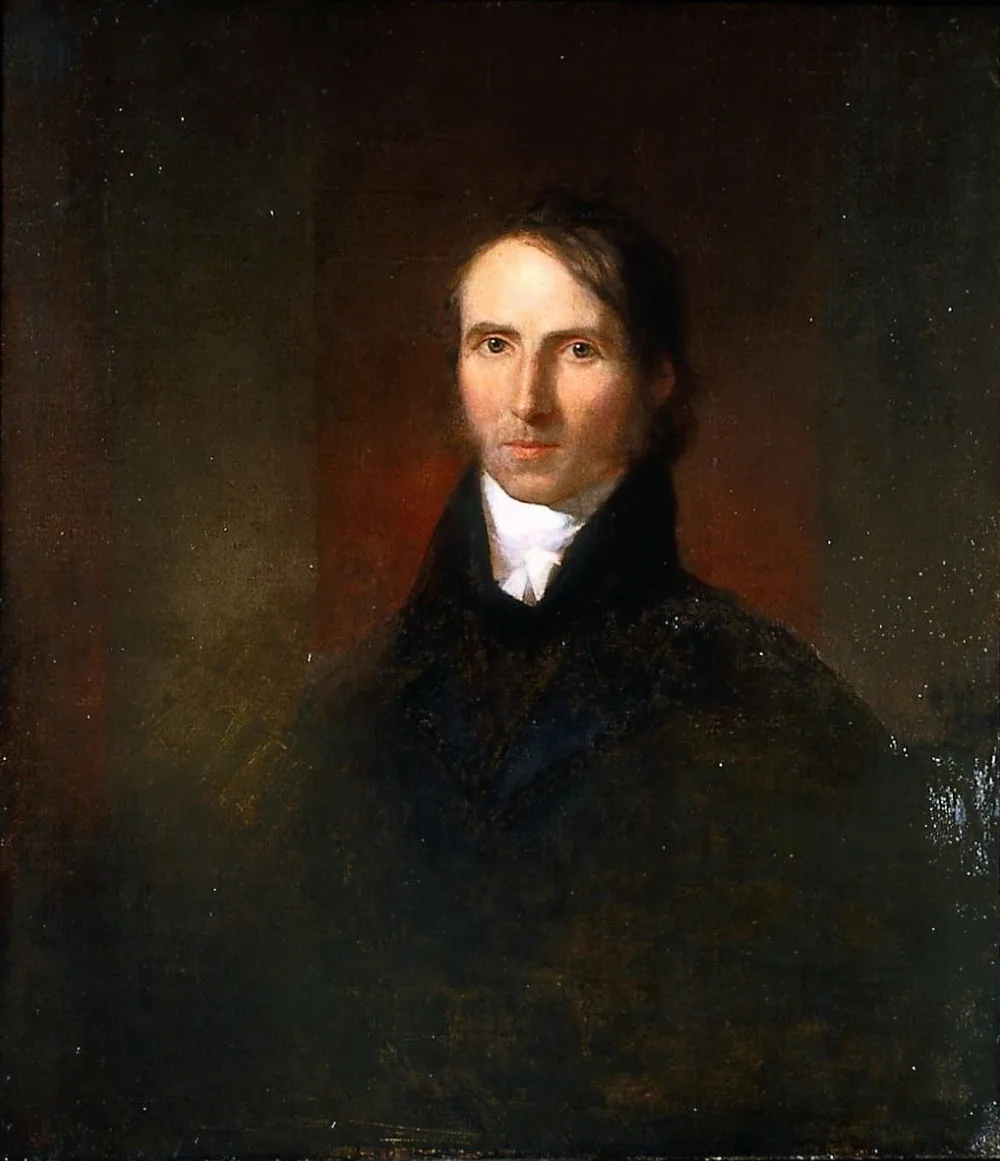
- Portrait of Abner Kneeland — Unknown artist, 19th century · New-York Historical Society (as reproduced in American Quarterly 52:4, 2000), via Wikimedia Commons · Public domain (Wikimedia Commons file page); Commons credit: New York Historical Society / Sarah Barringer Gordon, American Quarterly 52:4 (Dec 2000)
- Reverend Hosea Ballou I — Henry Cheever Pratt, 19th century · Tufts University Art Galleries, via Wikimedia Commons · Public domain (Wikimedia Commons file page); Commons credit: Tufts University Art Galleries, tuftsartgalleries.catalogaccess.com/objects/74
- Street Scene, Langdon, N.H. — Unknown (postcard), postmarked 1909 · Postcard, postmarked 1909, via Wikimedia Commons · Public domain (Wikimedia Commons file page); Commons description: from a postmarked 1909 postcard
- A Series of Letters, in Defence of Divine Revelation; in reply to Rev. Abner Kneeland's Serious Inquiry into the Authenticity of the Same (title page) — Hosea Ballou, 1820 · Internet Archive scan (Boston: Henry Bowen, 1820) · Public domain (published 1820, before 1931; Internet Archive rights field not stated)
- Letter signed Abner Kneeland, Philadelphia, to Thomas Jefferson, July 21, 1823 (page 1) — Abner Kneeland, 1823-07-21 · Missouri History Museum Archives (Jefferson Collection), via DPLA and Wikimedia Commons · Public domain (Wikimedia Commons file page); Commons credit: Missouri History Museum
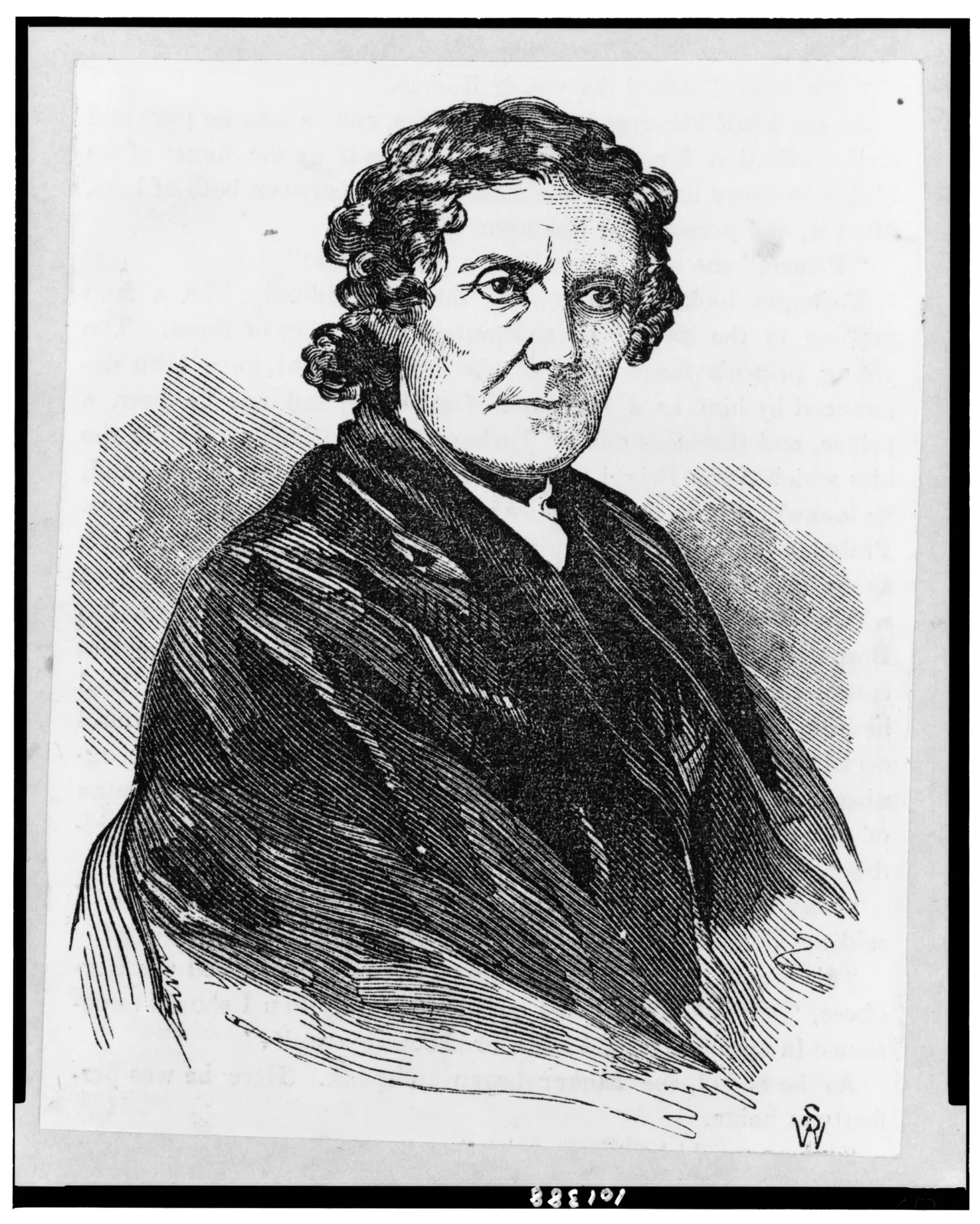
- Frances Wright d'Arusmont (engraving) — unknown engraver, 1854 · Library of Congress, Prints & Photographs Division, LC-USZ62 (Frances Wright d'Arusmont) · Public domain (published 1854; LoC rights statement: the Library does not own rights, no restrictions stated)
- A Review of the Evidences of Christianity, in a series of lectures delivered in Broadway Hall, New-York, August, 1829 (third edition, title page) — Abner Kneeland, 1831 · Internet Archive scan (Library of Congress copy, BL 2775 .K6 1831) · Public domain (published 1831, before 1931; Internet Archive rights field not stated)
- The First Boston Theatre (Federal Street Theatre) — Kilburn (wood engraving), copy photograph by Boston Public Library, approx. 1798 · Boston Public Library (BPL), accession 07_10_000101, via Wikimedia Commons; CC BY 2.0 · CC BY 2.0 (Wikimedia Commons file page)
- An Introduction to the Defence, p. 39: 'A Philosophical Creed' (Hebron, N.H., 28 May 1833) — Abner Kneeland, 1834 (creed of 28 May 1833) · Internet Archive scan (Google Books digitisation of the Andover-Harvard Theological Library copy) · Public domain (published 1834, before 1931; Internet Archive rights field not stated)
- An Introduction to the Defence, p. 37: letter 'To the Editor of the Trumpet' (to Thomas Whittemore) — Abner Kneeland, 1834 (letter of 20 Dec 1833) · Internet Archive scan (Google Books digitisation of the Andover-Harvard Theological Library copy) · Public domain (published 1834, before 1931; Internet Archive rights field not stated)
- Lemuel Shaw — Albert Southworth / Josiah Johnson Hawes (Southworth & Hawes), circa 1850 · The Metropolitan Museum of Art, Open Access (CC0), via Wikimedia Commons · CC0 (Wikimedia Commons file page; Metropolitan Museum of Art Open Access)
- William Ellery Channing — Washington Allston, 1811 · Museum of Fine Arts, Boston, via Wikimedia Commons · Public domain (Wikimedia Commons file page); Commons credit: Museum of Fine Arts, Boston, online database
- The History of Van Buren County, Iowa (Chicago: Western Historical Co., 1878), 'The Kneeland Movement' (printed p. 464 per fact sheet; leaf 460) — Western Historical Company, 1878 · Internet Archive scan · Public domain (published 1878, before 1931; Internet Archive rights field not stated)
Sources
Tier 1 — the subject's own words (writings, letters, diaries, trial records)
- [Intro] Abner Kneeland, An Introduction to the Defence of Abner Kneeland, Charged with Blasphemy (Boston, 1834; a Google scan whose binding also contains Dunlap's speech of Jan 1834, Kneeland's own speeches of Nov 1834 and later, and notes). Internet Archive anintroductiont00kneegoog. Text in research/texts/introduction-defence-1834.txt (OCR is rough; page numbers are the printed ones where legible).
- [Review] Kneeland, A Review of the Evidences of Christianity (lectures of Aug 1829), 3rd ed. (Boston: office of the Investigator, 1831). IA reviewofevidenc00knee. Text in research/texts/kneeland-review-evidences-1831.txt.
- [Letters] Hosea Ballou, A Series of Letters, in Defence of Divine Revelation; in Reply to Rev. Abner Kneeland's Serious Inquiry (Boston, 1820), which prints extracts of Kneeland's letters. Project Gutenberg ebook 8225. Text in research/texts/ballou-letters-gutenberg8225.txt (unpaginated e-text; cited by letter).
- [Pick] Commonwealth v. Kneeland, 20 Pick. (37 Mass.) 206 (1838), the report including Kneeland's argument as summarised by the reporter, Shaw C. J. for the majority and Morton J. dissenting in part. Wikisource transcription, with star-page numbers. Text in research/texts/ws-cvk.txt.
- [NHG] Hand transcription of the New Hampshire Gazette, 3 July 1838, p. 1, and the Alexandria Gazette, 23 June 1838, p. 2 (Chronicling America, public domain). Text in research/texts/newspapers-1838-transcribed.txt; page images in research/notes/. The two footnotes initialled "A. K." in the Gazette may be Kneeland's own; unconfirmed.
Tier 2 — scholarly biographies and encyclopedias
- [DUUB] Stephan Papa and Peter Hughes, "Abner Kneeland," Unitarian Universalist Biographical Dictionary (UUHS, 1999 to 2006), captured by the Wayback Machine 9 June 2006. Text in research/texts/duub-kneeland.txt. The fullest short life; modern but sourced; cites Levy (1973), Papa (1998), Whitcomb (Annals of Iowa 1904), Commager (1935).
- [Eddy] Richard Eddy, Universalism in America: A History, vol. II (Boston: Universalist Publishing House, 1886). IA universalisminam02eddy. Text in research/texts/eddy2.txt.
- [Thomas] Abel C. Thomas, A Century of Universalism in Philadelphia and New York (Philadelphia, 1872). IA centuryofunivers00thom. Text in research/texts/thomas-century-1872.txt. Thomas knew the New York events at first hand.
- [Garrison I and II] W. P. and F. J. Garrison, William Lloyd Garrison 1805 to 1879: The Story of His Life Told by His Children, vols. I and II (New York, 1885). IA willlloydgarr01garrrich; williamlloydgar02garr. Texts in research/texts/garrison-life-vol1.txt and vol2.txt.
- [VanBuren] The History of Van Buren County, Iowa (Chicago: Western Historical Co., 1878). IA historyofvanbure00west. Text in research/texts/vanburen-history-1878.txt.
- [Americana] "Kneeland, Abner," Encyclopedia Americana (1920), via Wikisource. Text in research/texts/americana-kneeland.txt (the entry misprints his death as 1884).
Tier 3 — popular biographies and journalism
- Not used. Not reached: Mary P. Whitcomb, "Abner Kneeland," Annals of Iowa (April 1904; the one fetch was blocked by the permission system, so it is left for David); Margaret Bonney, "The Salubria Story," Palimpsest (1975).
Tier 4 — Wikipedia and similar reference sites (citable; give the article and revision date; prefer a higher tier where one exists)
- [WP Kneeland] Wikipedia, "Abner Kneeland," revision 1342039715 of 6 March 2026.
- [WP CvK] Wikipedia, "Commonwealth v. Kneeland," revision 1292762048 of 28 May 2025.
Opposition sources — contemporary critics and religious responses
- [Stacy] Nathaniel Stacy, Memoirs of the Life of Nathaniel Stacy (Columbus, Pa., 1850), a Universalist colleague's account. IA memoirslifenath01stacgoog. Text in research/texts/stacy-memoirs-1850.txt (Google OCR; page numbers taken from Eddy's citation of p. 89).
- [Thomas] and [Eddy] as above, written by Universalists who regretted his "falling away."
- [Pick] Shaw C. J., Austin (Attorney General) and Morton J.
- [Intro] Judge Thacher's questions from the bench, as printed by the defence.
- [VanBuren] Rev. Daniel Lane, Congregational missionary, p. 475.
- Not reached: the Boston prosecutors' printed arguments (S. D. Parker, Report of the Arguments, 1834, in the Americana bibliography); Leonard Levy, Blasphemy in Massachusetts (1973, in copyright).
Related lives
Frances Wright (he gave her his pulpit in 1829 and it ended his Universalist ministry); alternatively George Holyoake (jailed for blasphemy in England four years after Kneeland's conviction). Decide whichever has its own episode by then.
Constantin-François Volney
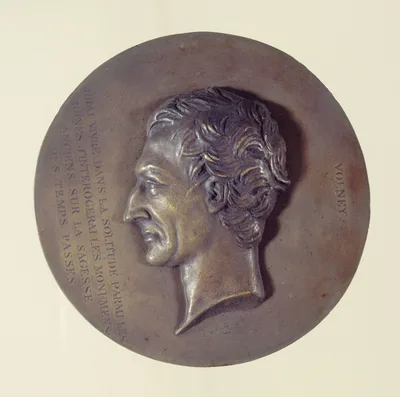
Constantin-François Volney was schooled by priests and met d'Holbach's circle in Paris. In 1782 he went east to see where the opinions that govern us were born, and came back to set the world's religions side by side in The Ruins of 1791, speaking only as a meditating traveller. He kept God as the name of nature's order. In 1797 he refused Priestley's demand for a creed, on the ground that no one had the right to ask it, and in old age he regretted provocation more than doubt.
Sylvain Maréchal
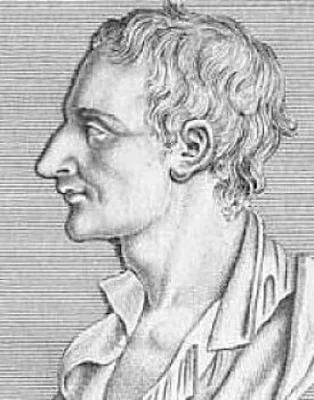
Sylvain Maréchal had no recorded faith to lose. The Paris poet declared himself "a peaceful atheist" in verse by 1781, and paid for a calendar without saints with a burned book and a cell in Saint-Lazare in 1788. He carried the same unbelief through the Revolution and Babeuf's conspiracy. In 1800 he made it into a list, the Dictionary of Atheists, whose preface defined the true atheist as one who says "I can be wise without a God". He never revised it, only narrowed it to "the virtuous man", and died at Montrouge without recanting.
Yamagata Bantō
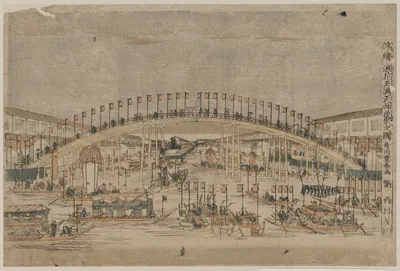
Yamagata Bantō was an Osaka merchant's clerk, schooled in the rational Confucianism of the Kaitokudō and in European astronomy learned through Dutch books. He had no creed to lose. In a private book begun at fifty-four and finished blind, he set down that there are no gods, buddhas or ghosts, because a teaching should say plainly what exists, and the measured globe held no paradise. He kept that conclusion to his death verses.
Jeremy Bentham
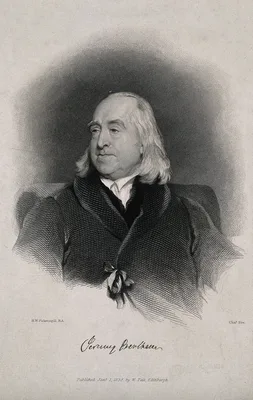
Jeremy Bentham was a Church of England child who "believed as hard as I could". At Oxford he signed the Thirty-nine Articles against his conscience, and never forgot it. He kept his doubts to private notes for decades. In his seventies he attacked the Church under his own name (1818), and natural religion and St Paul under invented ones (1822–23), never calling himself an atheist. He arranged his death so that his body served science, and his preserved figure stood in place of a religious rite.