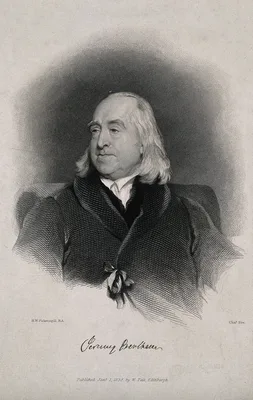
Jeremy Bentham was a Church of England child who "believed as hard as I could". At Oxford he signed the Thirty-nine Articles against his conscience, and never forgot it. He kept his doubts to private notes for decades. In his seventies he attacked the Church under his own name (1818), and natural religion and St Paul under invented ones (1822–23), never calling himself an atheist. He arranged his death so that his body served science, and his preserved figure stood in place of a religious rite.
The belief timeline
- Faith (childhood to c. 1760) — Confirmed Church of England child: "believed as hard as I could" [2][4][5]
- Crack (1760-63) — Signs the Thirty-nine Articles under protest; "an impression... that will never depart from me but with life" [9][10][11]
- Doubt (undated; c. 1770s scraps; decisive work 1809-1823) — Private scepticism in memoranda; an "exhaustive examination of religion" in the 1810s-20s. The date of his loss of belief is not stated by himself in any scan [17][37]
- Declaration (1818 (Church) and 1822-23 (pseudonymous)) — Attacks the Church under his own name (1818); the Analysis and Not Paul appear under invented names; never says "I am an atheist" in print [23][26][31]
- Revision / afterlife (1832 and after) — Dies directing dissection; auto-icon as a "secular substitute" for religious ritual; religious works left out of the Works [33][34][36]
Notes to the timeline (14)
- [2] Of his four great-grandfathers two were beneficed Church of England clergymen; he learned "for my first lesson" the catechism "in the lap" of one of their daughters; their devotions were daily and by the Established rites, he "an affectionate, reverential, and continual witness" — Bentham, Church-of-Englandism and its Catechism Examined (printed 1817, published 1818, Effingham Wilson, London), p. xii.
- [4] Confirmation by a bishop; "I believed as hard as I could; and if any thing was wanting to belief, it was made up by trembling" (date not given) — Bentham, Church-of-Englandism and its Catechism Examined, p. xiii.
- [5] Entered Westminster School (decided 1755); learned Archbishop Williams' Comments on the Catechism by heart, disliking the labour — Bowring (ed.), The Works of Jeremy Bentham vol. X (Memoirs, chs. I-XXII, with autobiographical conversations and correspondence) (William Tait, Edinburgh, 1843), p. 34; Leslie Stephen, The English Utilitarians, vol. I (Duckworth, 1900). Gutenberg #27597 (
stephen-utilitarians-v1.txt). The e-text carries no printed page numbers; cited by chapter and section (ch. V "Bentham's Life" §I Early Life, §II-IV; ch. VI §VII "Individualism" for religion; appendix note on Ford Abbey works), vol. I ch. V §I. - [9] Bentham's own account: at his entrance, immaturity of age "had excused me from the obligation of signature" and so "from the necessity of perjury"; "not long after came the time for the attaching my signature to the thirty-nine Articles" — Bentham, Church-of-Englandism and its Catechism Examined, p. xix.
- [10] He examined the Articles to see whether each was true; found some meaningless and others irreconcilable with reason or Scripture; shared his distress with fellow collegians; a Fellow whose office was to remove scruples answered coldly that youths must not set private judgment against a public one; he signed — Bentham, Church-of-Englandism and its Catechism Examined, pp. xix-xx; Bowring, Works of Jeremy Bentham, vol. X, p. 37; T. Southwood Smith, A lecture delivered over the remains of Jeremy Bentham, Esq., in the Webb-Street School of Anatomy and Medicine, on the 9th of June, 1832 (London, 1832), pp. 45-46.
- [11] He did not confess his scruples to his father, "in whom... I saw nothing but a tormenter": public disgrace would have blasted his father's hopes and wasted the expense of his education; "I signed", with an impression that "will never depart from me but with life" — Bentham, Church-of-Englandism and its Catechism Examined, p. xxi; Bowring, Works of Jeremy Bentham, vol. X, p. 37; Smith, lecture delivered over the remains… (1832), p. 46.
- [17] Bowring prints, from "fragments of blotting paper", undated sentences in a chapter covering ages 25-26: "When will men cease beholding in Almighty Benevolence a cruel tyrant, who (to no assignable end) commands them to be wretched?"; "Why should the names of Religion and Morality be employed for purposes by which, if accomplished, Religion and Morality must perish?" (OCR reads "Burnt"; unclear); "The grand catastrophe of our sacred history is itself an act of the most illustrious suicide" — Bowring, Works of Jeremy Bentham, vol. X, pp. 68-69.
- [37] Crimmins: "Between 1809 and 1823 Jeremy Bentham carried out an exhaustive examination of religion with the declared aim of extirpating religious beliefs, even the idea of religion itself, from the minds of men" — James E. Crimmins, "Bentham on Religion: Atheism and the Secular Society", Journal of the History of Ideas 47 (1986), p. 95. Not read; the sentence is quoted via Wikipedia (Tier 4). Copyrighted: paraphrase only, p. 95, via WP. Reported at second hand; the original has not been seen.
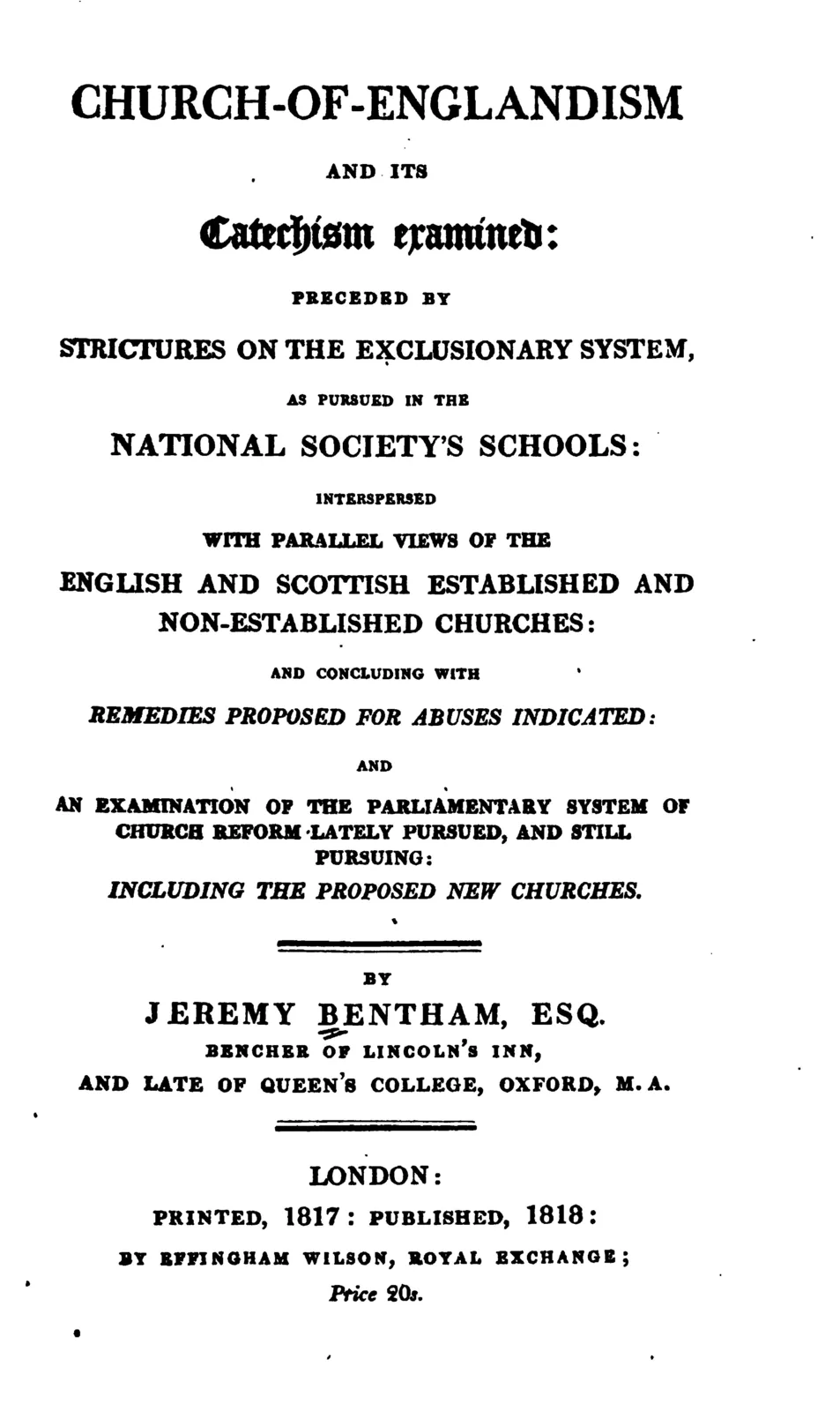
- [23] Church-of-Englandism and its Catechism Examined is by "Jeremy Bentham, Esq., Bencher of Lincoln's Inn, and late of Queen's College, Oxford, M.A."; "Printed, 1817: Published, 1818" by Effingham Wilson, Royal Exchange, price 20s — Bentham, Church-of-Englandism and its Catechism Examined, (title page).
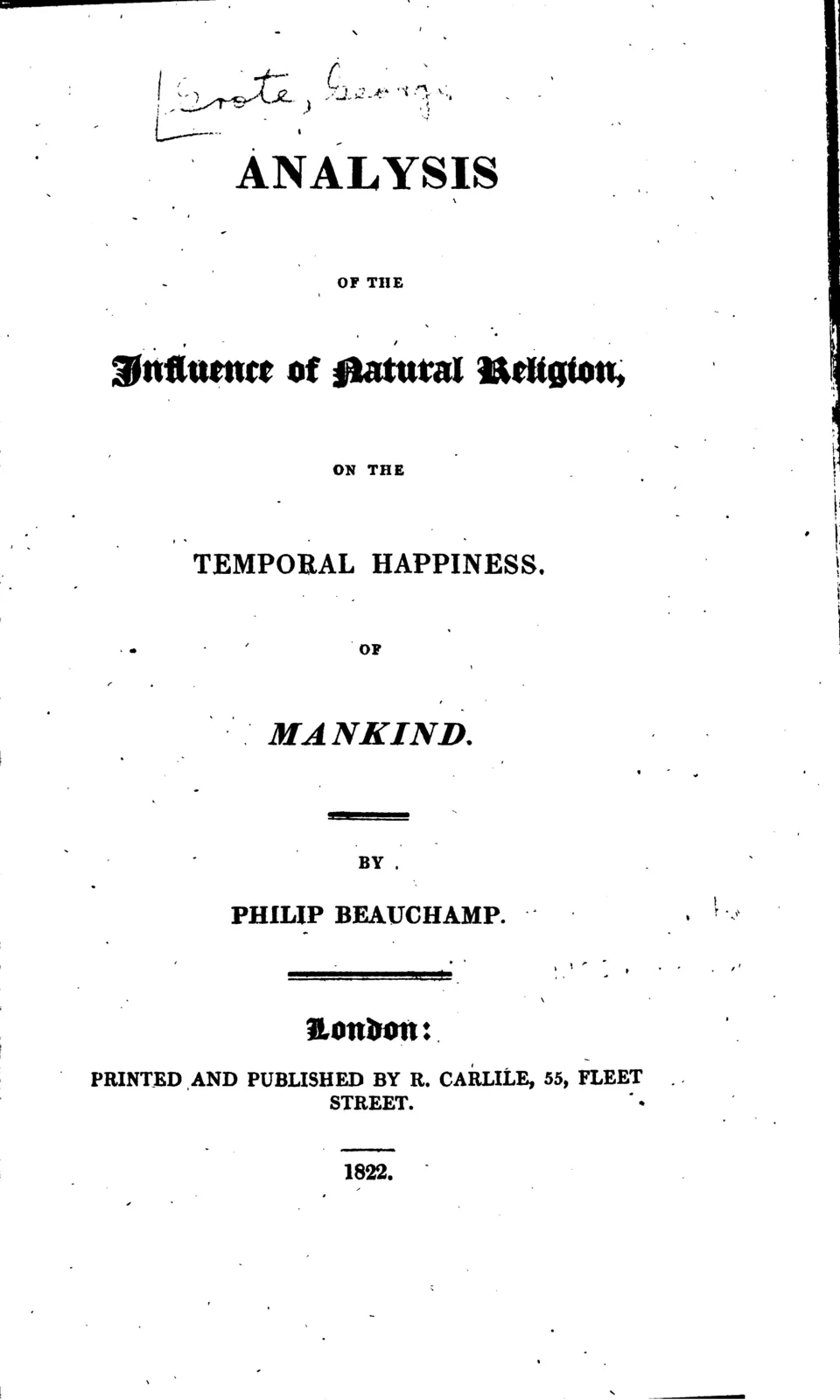
- [26] Analysis, "by Philip Beauchamp", printed and published by R. Carlile, 55 Fleet Street, 1822; preface dated December 1822; reprinted by E. Truelove 1875 — "Philip Beauchamp" (Bentham's manuscripts, ed. Grote), Analysis of the Influence of Natural Religion on the Temporal Happiness of Mankind (R. Carlile, London, 1822), (title page, preface); Analysis of the Influence of…, 1875 pp. 5-6.
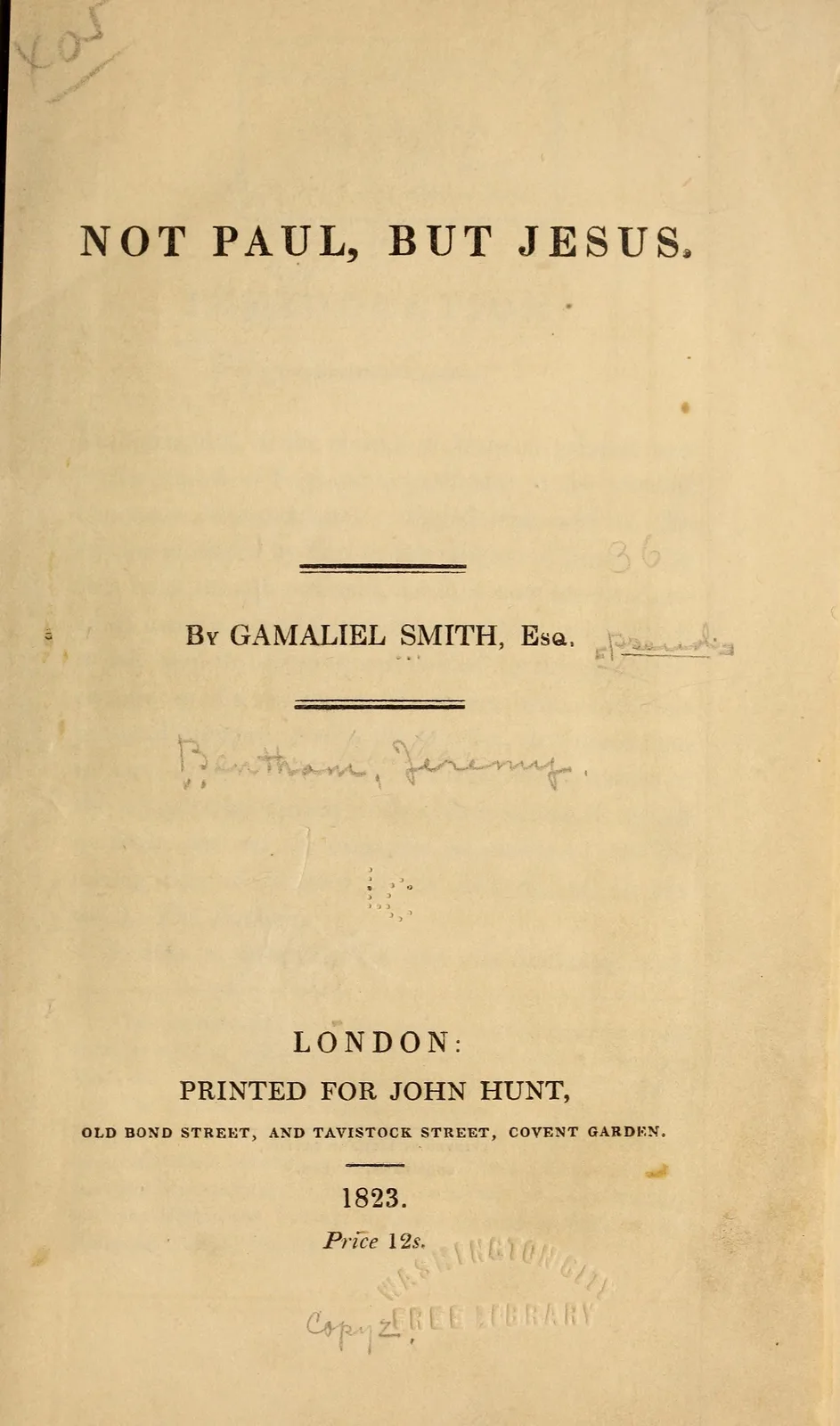
- [31] Not Paul, but Jesus, "By Gamaliel Smith, Esq.", printed for John Hunt, 1823, price 12s; the Introduction is "in the main, a reprint from the single sheet pamphlet, published A. 1821, under the title of Summary View"; its argument is that the religion of Paul is not part of the religion of Jesus; it praises Conyers Middleton, "a bold, though reverend, hand" — "Gamaliel Smith" (Bentham), Not Paul, but Jesus (John Hunt, London, 1823), pp. iii-vii and title page.
- [33] Bowring did not admit the religious works to his collection; Mill reported in 1838 that the collected edition "will not... include Bentham's religious writings"; Stephen notes a footnote that Bowring's "religious principles prevented him" — J. S. Mill, "Bentham" (London and Westminster Review, August 1838), in Dissertations and Discussions, Series I, vol. IV of The Works of J. S. Mill (Routledge, 1905 reprint), p. 298; Stephen, English Utilitarians, appendix note and note 335; "Jeremy Bentham", English Wikipedia, wikitext fetched 2026-10-14 (revision date not captured; the page carries a {{Use dmy dates|date=September 2026}} tag). Used for the auto-icon narrative (which it takes from ODNB) and the Crimmins sentence. "Wikipedia: ... Not Paul" link confusion noted: its bibliography lists the Analysis URL under the title "Not Paul".
- [34] Died 6 June 1832 (aged 84), head on Bowring's bosom; directed dissection "with a view to the advancement of anatomical science" — Same, vol. XI (1843), p. 76.
- [36] Auto-icon: in an unpublished pamphlet of 1831 (Auto-Icon; or Farther Uses of the Dead to the Living, printed 1842) he proposed displaying preserved bodies; he asked that his own mummified head and skeleton, dressed in his habitual clothes, be displayed; the head was replaced by wax; displayed at UCL; Crimmins reads auto-iconism as "an attempt to find a secular substitute for the rituals and practices of conventional religion". Wikipedia (from ODNB): given to UCL in 1850 by Southwood Smith via Brougham; moved to the Student Centre 2020 — James E. Crimmins, "Jeremy Bentham", Stanford Encyclopedia of Philosophy (first published 17 March 2015; modified 13 January 2026),, §1; "Jeremy Bentham", "Death and the auto-icon".
I Believed as Hard as I Could
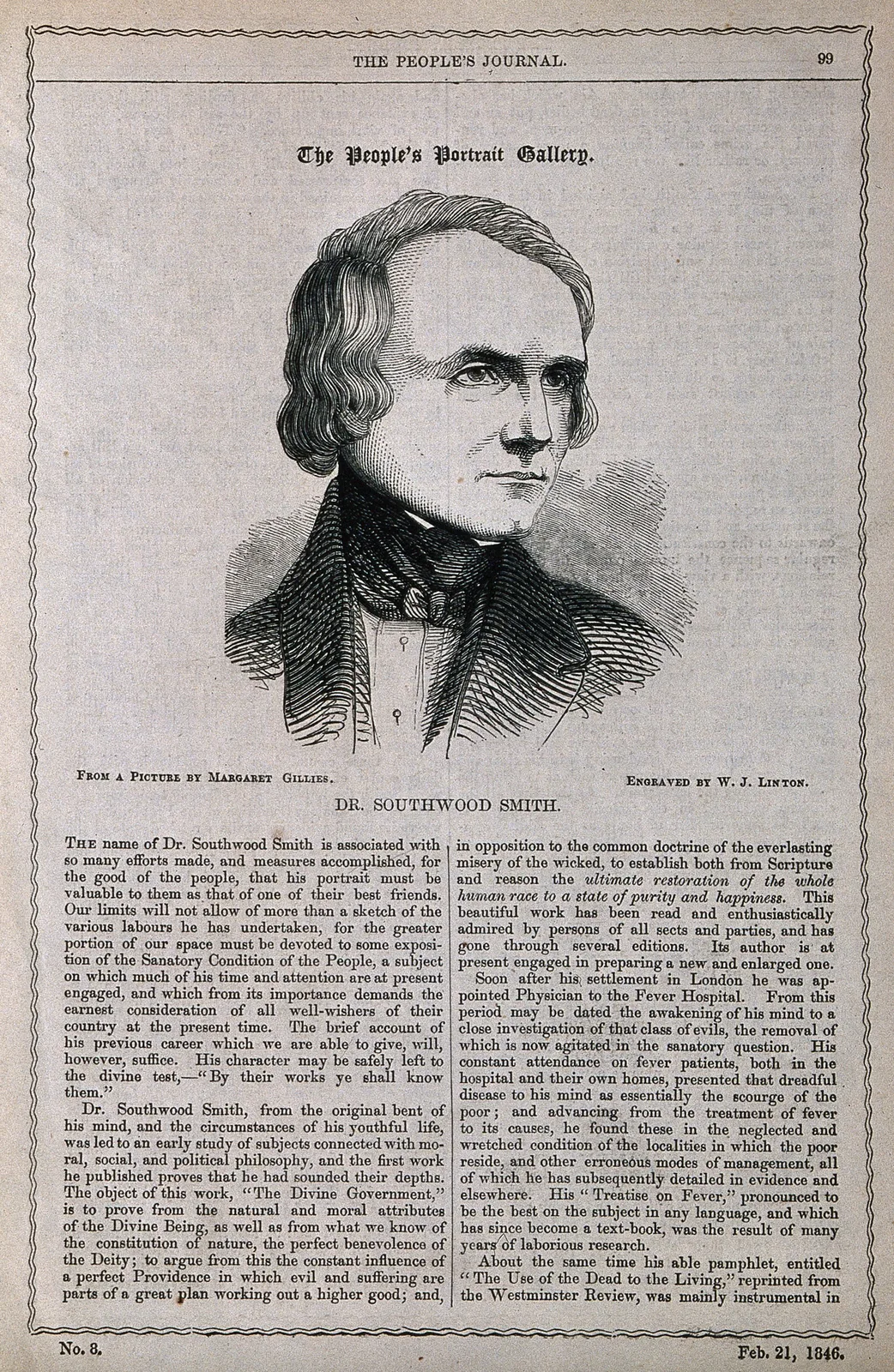
On 9 June 1832, three days after his death, the body of Jeremy Bentham was laid out on a table at the Webb Street School of Anatomy in Southwark, and his friend the physician Thomas Southwood Smith lectured over it. Bentham had asked for this. In his first will, made in 1769 when he was twenty-one, he had left his body for dissection "to the intent and with the desire that mankind may reap some small benefit in and by my decease, having hitherto had small opportunities to contribute thereto while living."123
Bentham, the philosopher of "the greatest happiness of the greatest number," spent the last twenty years of his life examining religion with what one modern scholar calls the declared aim of uprooting it. Yet he never called himself an atheist, and he put his own name to only one of his books on the subject. This chapter asks how a boy who believed as hard as he could came to that, and why he said so only in part.
A Church of England childhood
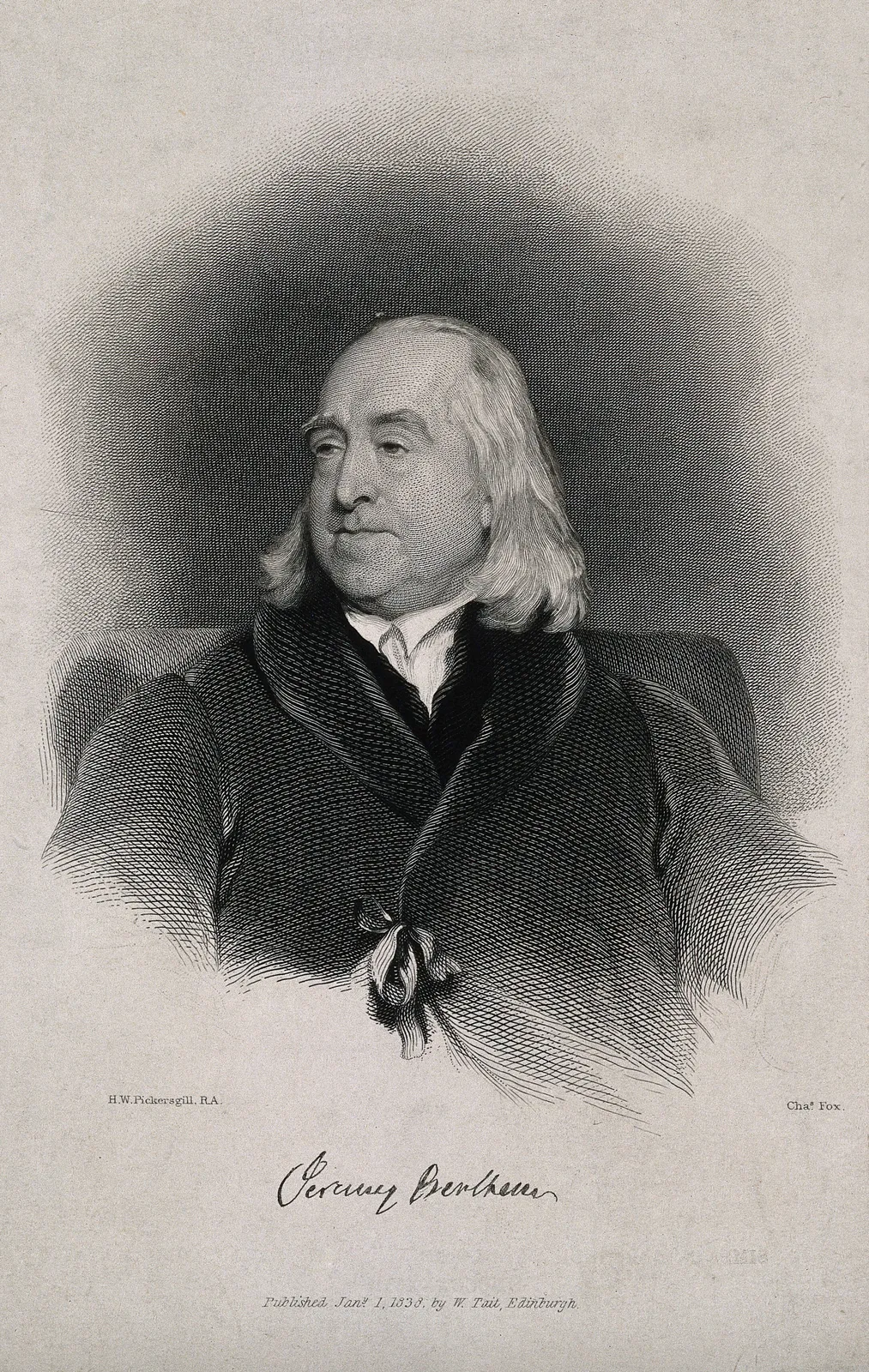
He was born in Houndsditch, in the City of London, on 15 February 1748, the son of Jeremiah Bentham, an attorney, and Alicia Grove.4 Two of his great-grandfathers had been Church of England clergymen, and his first lesson was the catechism, learned in the lap of one of their daughters; the household's devotions were daily and by the rites of the established Church.5 Taken once by his father to a Dissenting meeting house, he asked whether it was right to go in.6 At Westminster School, from 1755, he learned an archbishop's commentary on the catechism by heart.7 Of his confirmation he wrote: "I remembered as well as I could — I understood as much as I could — I believed as hard as I could — and if any thing was wanting to belief, it was made up by trembling."89 On the belief timeline, that childhood is his faith. His mother died in January 1759, when he was ten.10
The Thirty-nine Articles
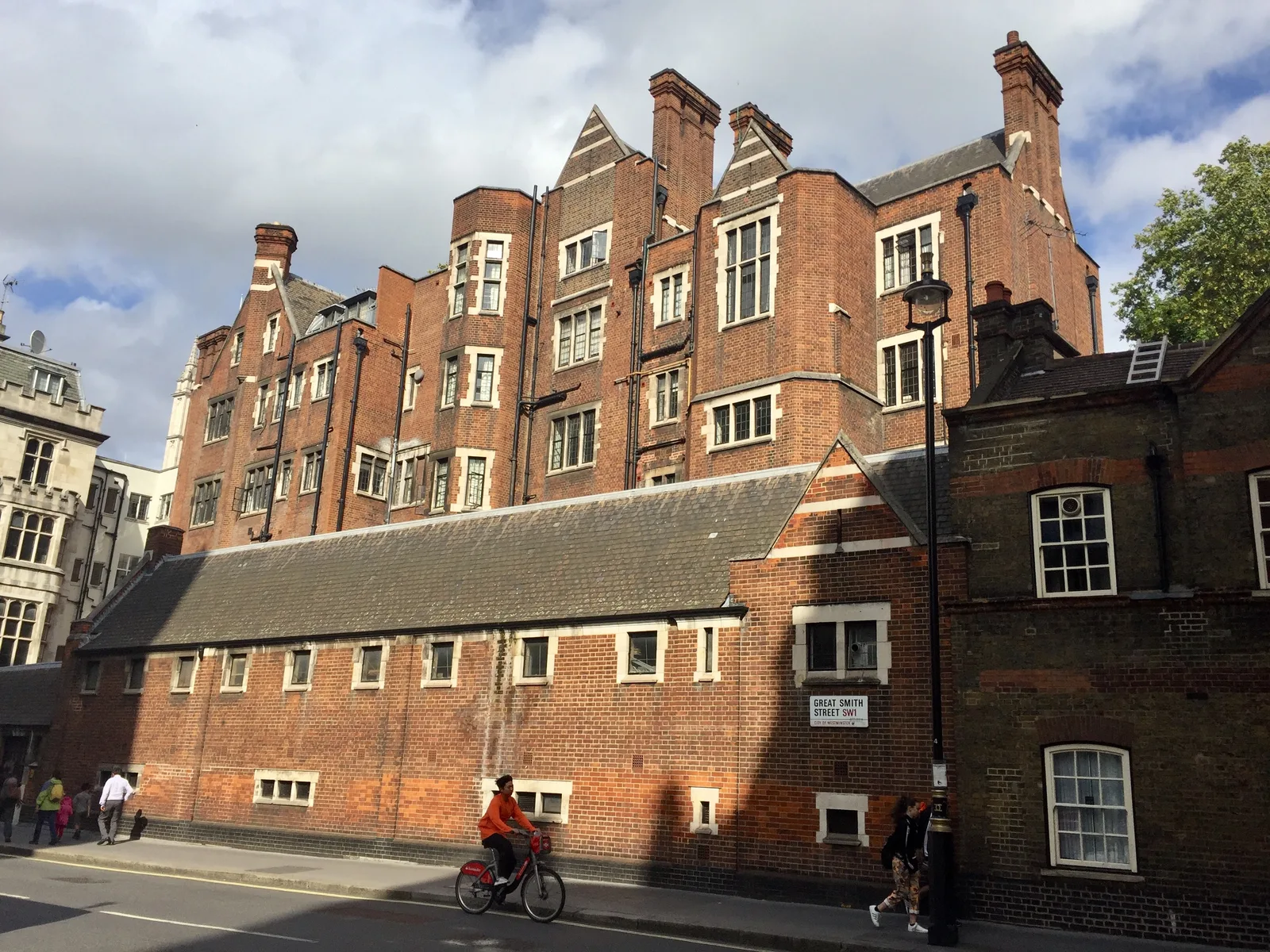
In June 1760, at twelve, his father entered him at Queen's College, Oxford.11 Every student had to sign the Thirty-nine Articles, the doctrinal statement of the Church of England. Accounts differ on when Bentham signed: the college certificate says he subscribed on admission at twelve, while Bentham himself says his age excused him then and that the signing came "not long after," and John Stuart Mill says fifteen.111213 What is not in doubt is his own account of it, written more than fifty years later. He examined each article to see whether it was true. "In some of them no meaning at all could I find: in others, no meaning but one which, in my eyes, was but too plainly irreconcilable either to reason or to Scripture." He took his doubts to the Fellow whose duty it was to remove scruples, and was told coldly that young men must not set their private judgement against the public one.1415
He could not go to his father, who hoped to see him Lord Chancellor and had paid for his education. "To him, I durst not so much as confess those scruples. I signed: — but, by the view I found myself forced to take of the whole business, such an impression was made, as will never depart from me but with life."1617 On the timeline, that signature is the crack. He also remembered that the expulsion of students called Methodists for reading the Bible together drove the last of his reverence for the Church "from my youthful breast"; the date he gives for it does not fit the expulsion usually meant, and accounts differ.1819 His biographer John Bowring adds that Oxford's hypocrisy disgusted him, and he spoke of the university with bitterness to the end of his days.20
Private doubt
He took his degrees, studied law at Lincoln's Inn, and turned to the reform of law and government.21 His doubt left only private traces. Bowring printed some undated notes found on scraps of blotting paper, in a chapter about Bentham in his mid-twenties: "When will men cease beholding in Almighty Benevolence a cruel tyrant, who (to no assignable end) commands them to be wretched?" and "The grand catastrophe of our sacred history is itself an act of the most illustrious suicide."222324 His first will, in 1769, already gave his body to science.1 In a political letter of the 1790s he set out a rule of prudence that explains much of his later conduct: a man is not bound to throw his opinions at the heads of those he needs to persuade, for "no man is bound to get his head broke to no use."2526 His doubt cannot be dated from his own words; these private notes are the only early evidence for it.
The attack on the Church
Religion came back into his work, as the historian Leslie Stephen observed, through education. Arguing over how the poor should be taught, he "fell foul of the Catechism," then of the Articles, then of St Paul, and finally of religion's usefulness itself.27 Stephen thought he had believed in no theology and been indifferent to the whole question until politics forced it on him; the modern scholar James Crimmins dates an exhaustive examination of religion to the years 1809 to 1823.2829 From 1814 he rented Forde Abbey, a country house on the Dorset border, and there wrote his religious works.30

The first, Church-of-Englandism and its Catechism Examined (printed 1817, published 1818), carried his own name on the title page: "Jeremy Bentham, Esq., Bencher of Lincoln's Inn, and late of Queen's College, Oxford, M.A." It was there that he told the story of the Articles.31 So the usual picture of an unbelief kept wholly anonymous is wrong. The attack on the Church as an institution he signed. What he did not sign were the two books that went further.
In 1821 he sent money to the radical publisher Richard Carlile, then in prison for blasphemy, while asking not to be understood as expressing any opinion "for, any more than against, any of the opinions, whatever they may be," that Carlile had published. Carlile's cause, he wrote, was the cause of all dissenters against "the corruptive and demoralizing, and stupifying tyranny of every established and persecuting church."3233 The next year Carlile printed Analysis of the Influence of Natural Religion on the Temporal Happiness of Mankind, "by Philip Beauchamp." It asked not whether religion was true but whether it was useful: "Whether the doctrines which this term involves be true or false, is a point on which I do not intend to touch." Its answer was that religion did more harm than good, and that those whose power rested on a supposed connection with God had an interest "incurably opposed to all human happiness."34353637 The book was built on Bentham's papers but edited, and perhaps largely written, by the banker and historian George Grote; accounts of its authorship differ.38 The sixteen-year-old John Stuart Mill read it in manuscript and counted it among the books that most affected him.39
In 1823 came Not Paul, but Jesus, "by Gamaliel Smith, Esq." It asked "whether the religion of Paul has any just title to be considered as forming a part of the religion of Jesus. The result was in the negative."4041 It argued from inside the Christian story, against Paul and for Jesus. On the timeline, the years from 1818 to 1823 are his declaration, but it is a declaration in three voices: his own name against the Church, invented names against religion's usefulness and against Paul, and nowhere a plain statement that he believed in no God.
The auto-icon
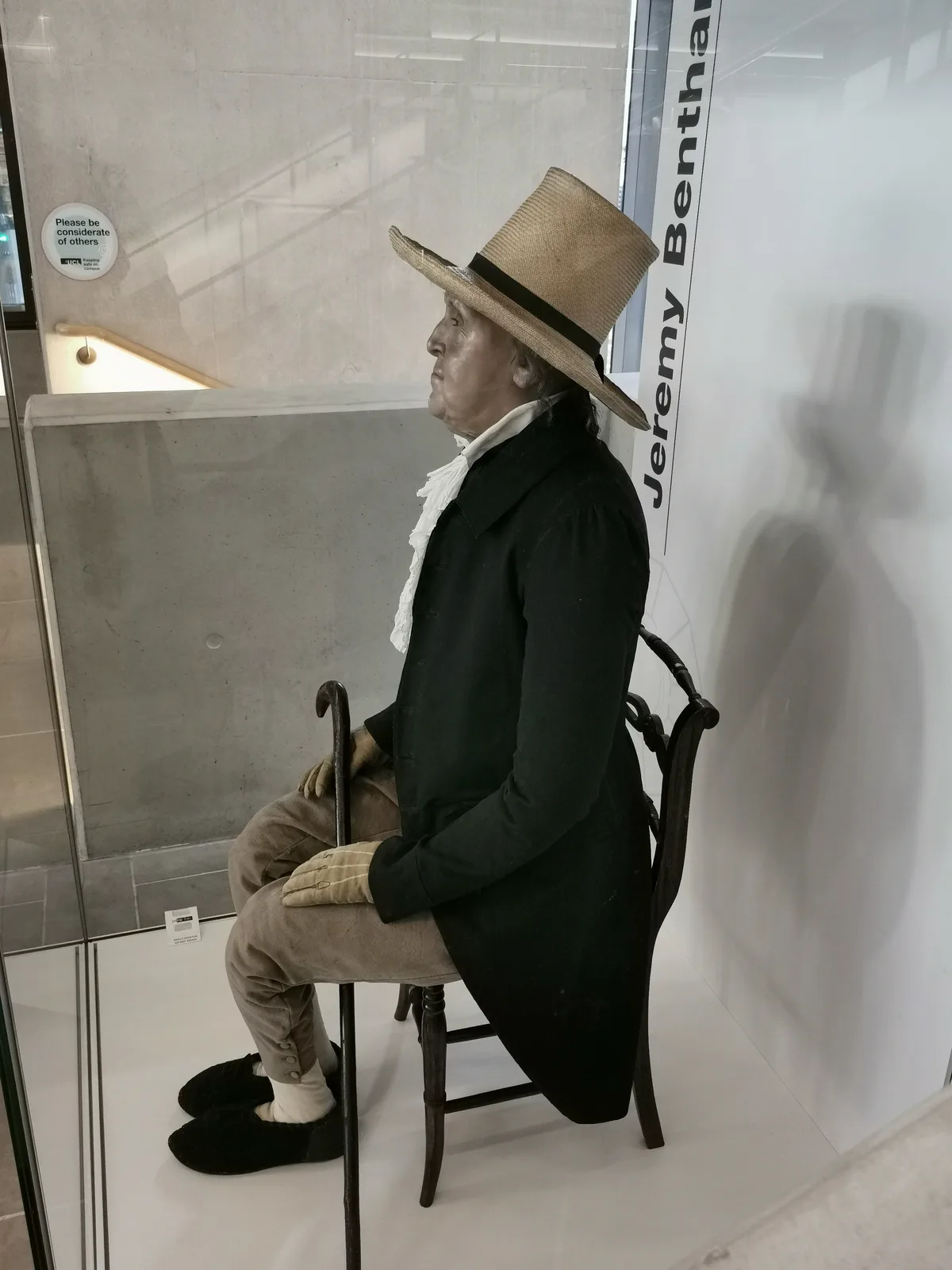
He died at his house in Queen's Square Place, Westminster, on 6 June 1832, aged eighty-four, having directed that his body be dissected for the advancement of anatomy.42 After Southwood Smith's lecture his skeleton was dressed in his clothes and seated in a case, with a wax head in place of the preserved one, as Bentham had proposed in a pamphlet he called Auto-Icon; or, Farther Uses of the Dead to the Living. It was given to University College London in 1850, where it is still displayed. Crimmins reads the auto-icon as an attempt to find a secular substitute for the rituals of religion.243 His literary executor, Bowring, whose own religious principles, a later note says, prevented him, left the religious writings out of the collected Works.44 On the timeline, these posthumous arrangements are his last mark: a revision not of his views but of how a body and a reputation are to be disposed of without the Church.
His critics in America spoke of his supposed atheism, and his former secretary, who later became a clergyman, disliked his religious levity.4546 His most searching critic was his own disciple. Mill wrote in 1838 that Bentham "had never been made alive to the unseen influences which were acting on himself," and, of his character, "He was a boy to the last."474849
Richard Carlile, the publisher who went to prison for printing what others would not sign, and who printed the Analysis in 1822, has his own chapter in this book.
Footnotes
-
T. Southwood Smith, A lecture delivered over the remains of Jeremy Bentham, Esq., in the Webb-Street School of Anatomy and Medicine, on the 9th of June, 1832 (London, 1832), p. 4 (note); "Jeremy Bentham", English Wikipedia, wikitext fetched 2026-10-14 (revision date not captured; the page carries a {{Use dmy dates|date=September 2026}} tag). Used for the auto-icon narrative (which it takes from ODNB) and the Crimmins sentence. "Wikipedia: ... Not Paul" link confusion noted: its bibliography lists the Analysis URL under the title "Not Paul". ↩ ↩2
-
Smith, lecture delivered over the remains… (1832), (title; pp. 45-46). ↩ ↩2
-
Smith, lecture delivered over the remains… (1832), p. 4 (note). ↩
-
Bowring (ed.), The Works of Jeremy Bentham vol. X (Memoirs, chs. I-XXII, with autobiographical conversations and correspondence) (William Tait, Edinburgh, 1843), p. 1; Leslie Stephen, The English Utilitarians, vol. I (Duckworth, 1900). Gutenberg #27597 (
stephen-utilitarians-v1.txt). The e-text carries no printed page numbers; cited by chapter and section (ch. V "Bentham's Life" §I Early Life, §II-IV; ch. VI §VII "Individualism" for religion; appendix note on Ford Abbey works), vol. I ch. V §I. ↩ -
Bentham, Church-of-Englandism and its Catechism Examined (printed 1817, published 1818, Effingham Wilson, London), p. xii. ↩
-
Bentham, Church-of-Englandism and its Catechism Examined, p. xii; Bowring, Works of Jeremy Bentham, vol. X, pp. 36-37. ↩
-
Bowring, Works of Jeremy Bentham, vol. X, p. 34; Stephen, English Utilitarians, vol. I ch. V §I. ↩
-
Bentham, Church-of-Englandism and its Catechism Examined, p. xiii. ↩
-
Bentham, Church-of-Englandism and its Catechism Examined, p. xiii (1818). ↩
-
Stephen, English Utilitarians, vol. I ch. V §I. Reported at second hand; the original has not been seen. ↩
-
Bowring, Works of Jeremy Bentham, vol. X, p. 36 (diary and footnote); Stephen, English Utilitarians, vol. I ch. V §I. ↩ ↩2
-
Bentham, Church-of-Englandism and its Catechism Examined, p. xix. ↩
-
J. S. Mill, "Bentham" (London and Westminster Review, August 1838), in Dissertations and Discussions, Series I, vol. IV of The Works of J. S. Mill (Routledge, 1905 reprint), p. 275. Accounts differ; see the disputed points. ↩
-
Bentham, Church-of-Englandism and its Catechism Examined, pp. xix-xx; Bowring, Works of Jeremy Bentham, vol. X, p. 37; Smith, lecture delivered over the remains… (1832), pp. 45-46. ↩
-
Bentham, Church-of-Englandism and its Catechism Examined, pp. xix-xx; also Works X p. 37. ↩
-
Bentham, Church-of-Englandism and its Catechism Examined, p. xxi; Bowring, Works of Jeremy Bentham, vol. X, p. 37; Smith, lecture delivered over the remains… (1832), p. 46. ↩
-
Bentham, Church-of-Englandism and its Catechism Examined, p. xxi; Bowring, Works of Jeremy Bentham, vol. X, p. 37; Smith, lecture delivered over the remains… (1832), p. 46. ↩
-
Bentham, Church-of-Englandism and its Catechism Examined, pp. xv-xix. ↩
-
Bentham, Church-of-Englandism and its Catechism Examined, p. xix. ↩
-
Bowring, Works of Jeremy Bentham, vol. X, p. 39. ↩
-
Stephen, English Utilitarians, vol. I ch. V §I. ↩
-
Bowring, Works of Jeremy Bentham, vol. X, pp. 68-69. ↩
-
Bowring, Works of Jeremy Bentham, vol. X, p. 68 (Bowring, undated blotting-paper fragment, chapter of ages 25-26). ↩
-
Bowring, Works of Jeremy Bentham, vol. X, p. 69. ↩
-
Bowring, Works of Jeremy Bentham, vol. X, pp. 316-317. ↩
-
Bowring, Works of Jeremy Bentham, vol. X, p. 317 (letter, "[179?]"). ↩
-
Stephen, English Utilitarians, vol. I ch. V §IV. ↩
-
Stephen, English Utilitarians, vol. I ch. VI §VII. ↩
-
James E. Crimmins, "Bentham on Religion: Atheism and the Secular Society", Journal of the History of Ideas 47 (1986), p. 95. Not read; the sentence is quoted via Wikipedia (Tier 4). Copyrighted: paraphrase only, p. 95, via WP. ↩
-
Bowring, Works of Jeremy Bentham, vol. X, p. 25 (recollection); p. 479 (1814); Stephen, English Utilitarians, vol. I ch. V §IV and appendix note. ↩
-
Bentham, Church-of-Englandism and its Catechism Examined, (title page). ↩
-
Bowring, Works of Jeremy Bentham, vol. X, pp. 527-528. ↩
-
Bowring, Works of Jeremy Bentham, vol. X, p. 527 (letter to Carlile, 1821). ↩
-
"Philip Beauchamp" (Bentham's manuscripts, ed. Grote), Analysis of the Influence of Natural Religion on the Temporal Happiness of Mankind (R. Carlile, London, 1822), (title page, preface); Analysis of the Influence of…, 1875 pp. 5-6. ↩
-
Analysis of the Influence of…, 1875 pp. 5-6; J. S. Mill, Autobiography (Longmans, 1873). Gutenberg #10378 (
mill-autobiography.txt), ch. III (1821-1823); p. 69 of the 1873 edition per the epigraph in [Analysis 1875], ch. III. ↩ -
"Philip Beauchamp": Analysis of the Influence of…, 1875 pp. 5-6; 1822 Preface p. iv. ↩
-
"Philip Beauchamp": Analysis of the Influence of…, 1875 p. 113. ↩
-
Mill, Autobiography, ch. III; Stephen, English Utilitarians, vol. I ch. V §IV, ch. VI §VII and appendix; Analysis of the Influence of…, 1875 (epigraphs). ↩
-
Mill, Autobiography, ch. III (p. 69 of 1873 ed. per Analysis 1875 epigraph). ↩
-
"Gamaliel Smith" (Bentham), Not Paul, but Jesus (John Hunt, London, 1823), pp. iii-vii and title page. ↩
-
"Gamaliel Smith": Not Paul, Introduction p. vi (1823). ↩
-
Same, vol. XI (1843), p. 76. ↩
-
James E. Crimmins, "Jeremy Bentham", Stanford Encyclopedia of Philosophy (first published 17 March 2015; modified 13 January 2026),, §1; "Jeremy Bentham", "Death and the auto-icon". ↩
-
Mill, Dissertations and Discussions, p. 298; Stephen, English Utilitarians, appendix note and note 335; "Jeremy Bentham". ↩
-
Crimmins, "Jeremy Bentham", §§ on reception. ↩
-
Stephen, English Utilitarians, vol. I ch. V (bibliographical note); Crimmins, "Jeremy Bentham", (describes Colls's book as popular among clergy). ↩
-
Mill, Dissertations and Discussions, p. 290. ↩
-
J. S. Mill, 1838 (critic of Bentham's range of mind): Mill, Dissertations and Discussions, p. 290. ↩
-
J. S. Mill: Mill, Dissertations and Discussions, p. 290. ↩
stephen-utilitarians-v1.txt). The e-text carries no printed page numbers; cited by chapter and section (ch. V "Bentham's Life" §I Early Life, §II-IV; ch. VI §VII "Individualism" for religion; appendix note on Ford Abbey works).; Bentham, Church-of-Englandism and its Catechism Examined (printed 1817, published 1818, Effingham Wilson, London); J. S. Mill, "Bentham" (London and Westminster Review, August 1838), in Dissertations and Discussions, Series I, vol. IV of The Works of J. S. Mill (Routledge, 1905 reprint); James E. Crimmins, "Bentham on Religion: Atheism and the Secular Society", Journal of the History of Ideas 47 (1986), p. 95. Not read; the sentence is quoted via Wikipedia (Tier 4). Copyrighted: paraphrase only.; "Philip Beauchamp" (Bentham's manuscripts, ed. Grote), Analysis of the Influence of Natural Religion on the Temporal Happiness of Mankind (R. Carlile, London, 1822); J. S. Mill, Autobiography (Longmans, 1873). Gutenberg #10378 (mill-autobiography.txt), ch. III (1821-1823); p. 69 of the 1873 edition per the epigraph in [Analysis 1875].; "Gamaliel Smith" (Bentham), Not Paul, but Jesus (John Hunt, London, 1823); Same, vol. XI (1843); James E. Crimmins, "Jeremy Bentham", Stanford Encyclopedia of Philosophy (first published 17 March 2015; modified 13 January 2026),.In their own words
I remembered as well as I could — I understood as much as I could — I believed as hard as I could — and if any thing was wanting to belief, it was made up by trembling.
my reverence for the Church of England — her doctrine, her discipline, her Universities, her ordinances — was expelled from my youthful breast.
In some of them no meaning at all could I find: in others, no meaning but one which, in my eyes, was but too plainly irreconcilable either to reason or to Scripture.
To him, I durst not so much as confess those scruples. I signed: — but, by the view I found myself forced to take of the whole business, such an impression was made, as will never depart from me but with life.
Whether the doctrines which this term involves be true or false, is a point on which I do not intend to touch
all those whose influence rests on an imputed connection with the Divine Being, cannot fail to be animated by an interest incurably opposed to all human happiness
whether the religion of Paul has any just title to be considered as forming a part of the religion of Jesus. The result was in the negative.
not to be understood as meaning to express any opinion for, any more than against, any of the opinions, whatever they may be, to which you have given expression in any of your works
When will men cease beholding in Almighty Benevolence a cruel tyrant, who (to no assignable end) commands them to be wretched?
The grand catastrophe of our sacred history is itself an act of the most illustrious suicide.
no man is bound to get his head broke to no use
This my will and special request I make, not out of affectation of singularity, but to the intent and with the desire that mankind may reap some small benefit in and by my decease, having hitherto had small opportunities to contribute thereto while living.
He was a boy to the last.
written on the foundation of some of Bentham's manuscripts and published under the pseudonyme of Philip Beauchamp
The other side
these, although we think most of them of exceedingly small value, are at least his, and the world has a right to whatever light they throw upon the constitution of his mind.
He had never been made alive to the unseen influences which were acting on himself, nor consequently on his fellow-creatures.
Where accounts differ
| Point | One account | Another | How the page handles it |
|---|---|---|---|
| D1. Age at which he signed the Articles | Twelve, in June 1760: the matriculation certificate of 28 June 1760 says he subscribed (Works X p. 36); Stephen follows Bowring | Bentham himself says age excused him at entrance and the signing came "not long after" (Church p. xix); Mill says fifteen (Mill 1859 p. 275) | "accounts differ": signed between twelve and fifteen; his own account is the crack, whatever the year |
| D2. Who wrote the Analysis | Bentham supplied the argument from manuscripts (Mill Auto; Stephen "supplied the argument in part") | Grote edited or wrote it: "published by Grote", "owes so much to the editor" (Stephen); "the late Mr. Grote was the author" (Athenaeum, 1873) | Say it was published as Beauchamp's, built on Bentham's papers and edited or largely written by Grote; do not say Bentham alone wrote it |
| D3. When the Methodist expulsion happened | Bentham: "I had not been long a member" of the University (Church p. xv), i.e. before 1763 | The expulsion of six Methodists from St Edmund Hall is dated to 1768 (Wikipedia, "Erasmus Middleton", May 1768); Bentham was by then M.A. and in London | Unresolved: either Bentham's memory telescoped or he refers to a separate case; quote his words, do not date the event |
| D4. How hidden was the unbelief | Roster: "wrote against the Church under pseudonyms": the Analysis and Not Paul are pseudonymous (title pages) | Church-of-Englandism of 1818 carries his name, rank and college (title page); Not Paul writes in praise of "the religion of Jesus"; Bowring and the Works omit the religious writings | Say he put his name to the Church attack and used invented names for the books on natural religion and St Paul; his unbelief is inferred, not declared |
| D5. Birth date | 4 February 1747/8 Old Style (Works X p. 1 "4th-15th") | 15 February 1748 New Style (Wikipedia, Stephen "4th February 1747-48 (o.s.)") | Both give the same day; use 15 February 1748 |
| D6. Date and pseudonym of Not Paul | 1823, Gamaliel Smith, John Hunt (title page; Stephen) | 1825, "Conyers Middleton" (Crandall's preface) | Use the title page; Crandall is wrong |
| D7. Age at death | 84 (born Feb 1748, died June 1832) | "eighty-five" (Mill 1859 p. 290) | 84 |
| D8. Date of the blotting-paper memoranda | Bowring files them under ages 25-26 (c. 1773-75) | Bowring says only that they are "scattered over fragments of blotting paper" | Say "undated notes that Bowring printed" |
List of illustrations
This page uses only public-domain and Creative Commons images; each is credited with its source and licence.
- Jeremy Bentham. Line engraving by C. Fox, 1838, after H. W. Pickersgill — C. Fox after Henry William Pickersgill, 1838 · Wellcome Collection (V0000462), Public Domain Mark · Public Domain Mark (Wellcome Collection)
- Westminster School — Alan Hughes (geograph), 2019-08-10 · Alan Hughes, CC BY-SA 2.0, via Wikimedia Commons (geograph.org.uk 6234981); attribution required in the video description · CC BY-SA 2.0 (Wikimedia Commons / geograph)
- The Queen's College, Oxford — Julian Herzog, 2018-03-07 · Julian Herzog, CC BY 4.0, via Wikimedia Commons; attribution required in the video description · CC BY 4.0 (Wikimedia Commons)
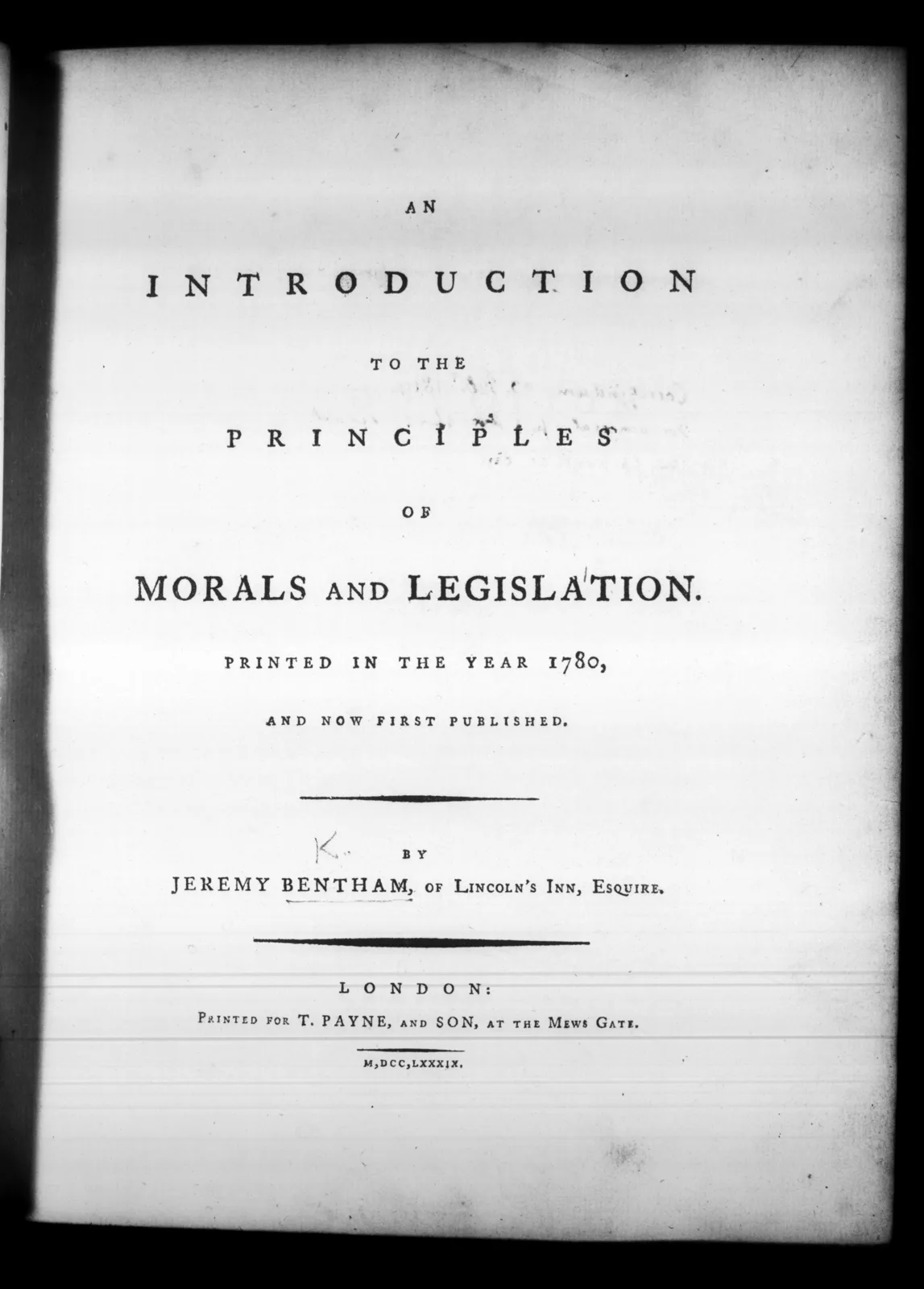
- An Introduction to the Principles of Morals and Legislation (title page; printed 1780, published 1789) — Jeremy Bentham; T. Payne and Son, London, 1789 · Internet Archive (bim_eighteenth-century_an-introduction-to-the-p_bentham-jeremy_1789), British Library, public domain · Public domain (published 1789; Internet Archive scan, British Library copy)
- Forde Abbey, Dorset — Pengannel, 2007-12-01 · Pengannel, CC BY 2.0, via Wikimedia Commons; attribution required in the video description · CC BY 2.0 (Wikimedia Commons)
- Church-of-Englandism and its Catechism examined (title page; printed 1817, published 1818) — Jeremy Bentham (Effingham Wilson, London), 1818 · Internet Archive (churchofengland00bentgoog), public domain · Public domain (published 1818; Internet Archive scan of University of Michigan copy)
- Analysis of the Influence of Natural Religion on the Temporal Happiness of Mankind, by Philip Beauchamp (title page) — 'Philip Beauchamp' (Bentham's manuscripts, ed. George Grote); R. Carlile, London, 1822 · Internet Archive (analysisinfluen00bentgoog), public domain · Public domain (published 1822; Internet Archive scan)
- Not Paul, but Jesus, by Gamaliel Smith, Esq. (title page) — 'Gamaliel Smith' (Jeremy Bentham); John Hunt, London, 1823 · Internet Archive (notpaulbutjesus00bent), public domain · Public domain (published 1823; Internet Archive scan of Library of Congress copy)
- Jeremy Bentham's auto-icon, University College London — Karmakolle, 2021-10-24 · Karmakolle, via Wikimedia Commons, CC0 · CC0 1.0 (Wikimedia Commons)
- Thomas Southwood Smith. Wood engraving by W. J. Linton after Margaret Gillies — William James Linton after Margaret Gillies Brown, undated · Wellcome Collection (V0005500), Public Domain Mark · Public Domain Mark (Wellcome Collection)
Sources
Tier 1 — the subject's own words
- [Church] Bentham, Church-of-Englandism and its Catechism Examined (printed 1817, published 1818, Effingham Wilson, London). IA
churchofengland00bentgoog; saved aschurchofenglandism-1818.txt. Page numbers are the printed Roman numerals of the Introduction (xii-xxi) as read from the OCR page-heads. - [Analysis] "Philip Beauchamp" (Bentham's manuscripts, ed. Grote), Analysis of the Influence of Natural Religion on the Temporal Happiness of Mankind (R. Carlile, London, 1822). IA
analysisinfluen00bentgoog(analysis-1822.txt, preface pp. iii-vi). Page numbers cited are those of the 1875 reprint, [Analysis 1875] (E. Truelove, London, 1875, IAanalysisofinflue00grot,analysis-1875.txt), which carries the Mill epigraph and the Athenaeum notice of 1873. - [NotPaul] "Gamaliel Smith" (Bentham), Not Paul, but Jesus (John Hunt, London, 1823). IA
notpaulbutjesus00bent(notpaul-1823.txt). Introduction pp. iii-viii. Gutenberg #42984 (Crandall's American edition,notpaul-gutenberg.txt) is NOT used: its preface contains errors [32]. - [Works X] Bowring (ed.), The Works of Jeremy Bentham vol. X (Memoirs, chs. I-XXII, with autobiographical conversations and correspondence) (William Tait, Edinburgh, 1843). IA
worksjeremybent01unkngoog(works-01unk.txt). Page numbers read from OCR page-heads; a few are inferred where the OCR dropped a head (noted). - [Works XI] Same, vol. XI (1843). IA
worksjeremybent07bowrgoog(works-07bowr.txt). Other Bowring volumes downloaded for orientation but not cited:works-v09,works-v10(actually vol. IV),works-v11(vol. IV duplicate),works-0009unse(vol. IX),works-12bowr(vol. VIII),works-06bowr(vol. V),works-dli11(unusable Sanskrit OCR; ignore). Bowring omits the religious works. - [Smith 1832] T. Southwood Smith, A lecture delivered over the remains of Jeremy Bentham, Esq., in the Webb-Street School of Anatomy and Medicine, on the 9th of June, 1832 (London, 1832). IA
b22378236(southwood-smith-lecture-1832.txt). Page numbers read from OCR heads.
Tier 2 — scholarly biographies and encyclopedias
- [Stephen] Leslie Stephen, The English Utilitarians, vol. I (Duckworth, 1900). Gutenberg #27597 (
stephen-utilitarians-v1.txt). The e-text carries no printed page numbers; cited by chapter and section (ch. V "Bentham's Life" §I Early Life, §II-IV; ch. VI §VII "Individualism" for religion; appendix note on Ford Abbey works). - [Mill 1859] J. S. Mill, "Bentham" (London and Westminster Review, August 1838), in Dissertations and Discussions, Series I, vol. IV of The Works of J. S. Mill (Routledge, 1905 reprint). IA
dissertationsdis00mill(mill-dissertations.txt), pp. 275, 290, 293, 298. - [Mill Auto] J. S. Mill, Autobiography (Longmans, 1873). Gutenberg #10378 (
mill-autobiography.txt), ch. III (1821-1823); p. 69 of the 1873 edition per the epigraph in [Analysis 1875]. - [SEP] James E. Crimmins, "Jeremy Bentham", Stanford Encyclopedia of Philosophy (first published 17 March 2015; modified 13 January 2026), https://plato.stanford.edu/entries/bentham/ (fetched 2026-10-14; Section 1 "Life and Works").
- [Grote] Harriet Grote, The Personal Life of George Grote (1873), IA
personallifegeo00grotgoog(grote-personal-life.txt): downloaded, contains no mention of Beauchamp or the Analysis (checked by search).
Tier 3 — popular and secondhand
- [Crimmins 1986] James E. Crimmins, "Bentham on Religion: Atheism and the Secular Society", Journal of the History of Ideas 47 (1986), p. 95. Not read; the sentence is quoted via Wikipedia (Tier 4). Copyrighted: paraphrase only.
- [Colls] J. F. Colls, Utilitarianism Unmasked (1844). Not found in any free scan; known only through [Stephen] (note to ch. V).
Tier 4 — Wikipedia (citable; prefer higher tier)
- [WP] "Jeremy Bentham", English Wikipedia, wikitext fetched 2026-10-14 (revision date not captured; the page carries a {{Use dmy dates|date=September 2026}} tag). Used for the auto-icon narrative (which it takes from ODNB) and the Crimmins sentence. "Wikipedia: ... Not Paul" link confusion noted: its bibliography lists the Analysis URL under the title "Not Paul".
Opposition sources — contemporary critics and religious responses
- [Mill 1859] (above), a sympathetic critic and himself an unbeliever; judges the religious writings of "exceedingly small value".
- [Colls] (above), clergyman and former secretary; secondhand only.
- No hostile contemporary clergyman is quoted from a scan. See Open questions.
Related lives
Richard Carlile (1790-1843) — Bentham sent money to Carlile in prison in 1821 and Carlile printed the 1822 Analysis; the publisher who put his name on what Bentham would not. Alternative: John Stuart Mill (on the roster), who read the Analysis in manuscript in 1822 and wrote the 1838 essay.
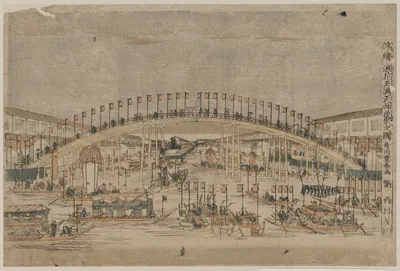
Yamagata Bantō
Yamagata Bantō was an Osaka merchant's clerk, schooled in the rational Confucianism of the Kaitokudō and in European astronomy learned through Dutch books. He had no creed to lose. In a private book begun at fifty-four and finished blind, he set down that there are no gods, buddhas or ghosts, because a teaching should say plainly what exists, and the measured globe held no paradise. He kept that conclusion to his death verses.
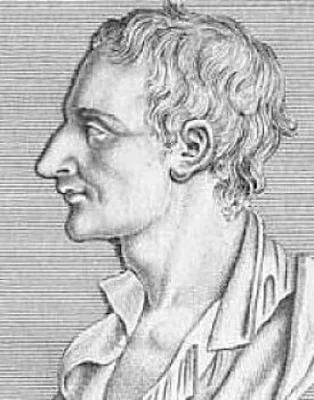
Sylvain Maréchal
Sylvain Maréchal had no recorded faith to lose. The Paris poet declared himself "a peaceful atheist" in verse by 1781, and paid for a calendar without saints with a burned book and a cell in Saint-Lazare in 1788. He carried the same unbelief through the Revolution and Babeuf's conspiracy. In 1800 he made it into a list, the Dictionary of Atheists, whose preface defined the true atheist as one who says "I can be wise without a God". He never revised it, only narrowed it to "the virtuous man", and died at Montrouge without recanting.
Constantin-François Volney
Constantin-François Volney was schooled by priests and met d'Holbach's circle in Paris. In 1782 he went east to see where the opinions that govern us were born, and came back to set the world's religions side by side in The Ruins of 1791, speaking only as a meditating traveller. He kept God as the name of nature's order. In 1797 he refused Priestley's demand for a creed, on the ground that no one had the right to ask it, and in old age he regretted provocation more than doubt.
Baron d'Holbach
The Baron d'Holbach was raised a Catholic, and his translations of earth science first set the evidence against Genesis. He taught atheism openly at his own table and published it only under dead men's names, from Christianity Unveiled in 1761 to the System of Nature in 1770, while the pedlars who sold his books were flogged and branded. Late in life he turned from destroying belief to building a secular morals and politics. He was named as the author only after his death.