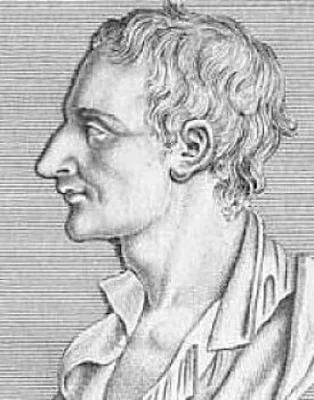
Sylvain Maréchal had no recorded faith to lose. The Paris poet declared himself "a peaceful atheist" in verse by 1781, and paid for a calendar without saints with a burned book and a cell in Saint-Lazare in 1788. He carried the same unbelief through the Revolution and Babeuf's conspiracy. In 1800 he made it into a list, the Dictionary of Atheists, whose preface defined the true atheist as one who says "I can be wise without a God". He never revised it, only narrowed it to "the virtuous man", and died at Montrouge without recanting.
The belief timeline
- Faith (before 1781 (no date)) — No religious faith is recorded. His 1781 epitaph says "happy" is the man whose father kept him from priests (a wish, not proof), and his job put him among books; Germond blames "érudition" and a thirst for fame [4][5][7]
- Doubt (1781 (text of 1798 edition)) — "Il est un Dieu, dit-on... Je n'en sais rien encor... Le mien, c'est la Vertu." The same poem already calls him "un paisible Athée" in the 1790 summary [7][8]
- Declaration (1788 (public, costly); 1800 (signed, systematic)) — The Almanach puts Jesus between Epicurus and Ninon and is burned (1788); the Dictionary lists some 800 names and defines the "véritable Athée" (1800) [13][15][35][38]
- Revision (1797-1803) — Not a change of mind: an unbelief narrowed to "l'homme vertueux seul", expressed anonymously, tolerant at home, with no recantation at death [11][23][38][41][42]
Notes to the timeline (12)
- [4] He held a place in the Collège Mazarin library, where, Germond says, he gained "cette érudition forte et variée" — J.-B.-L. Germond, "Notice nouvelle sur la vie et les ouvrages de Sylvain Maréchal", in the 1833 Dictionnaire, pp. 9-19. The fullest early life; by an editor who says he does not share Maréchal's principles. Same scans as [Dict. Discours], p. 9; Alfred Franklin, Histoire de la Bibliothèque Mazarine (Paris, 1860), IA
histoiredelabibl00franuoft; p. 140 checked on the page image, p. 140. - [5] Germond's explanation of his turn: erudition, then philosophy "le séduisit", and "le désir de célébrité qui le travaillait sans cesse" pushed him past reason; a hostile reading, not evidence of motive — Germond, "Notice nouvelle sur la vie et…", p. 9.
- [7] The 1790 review prints as "l'épitaphe de l'auteur" four lines beginning "Cy repose un paisible Athée"; Germond (p. 19) quotes a different 1781 "Épitaphe de l'auteur" ("Heureux ! qui né d'un père exempt de préjugés...") — Maréchal, Le Lucrèce français: fragmens d'un poème, nouvelle édition (Paris, l'an VI [1798]); IA
lelucrsefran00mar;lucrece-francais.txt. Includes a 1790 analysis reprinted from the Annales universelles et méthodiques of 28 Dec 1790, signed "B...N.", analysis p. 6; Germond, "Notice nouvelle sur la vie et…", p. 19. Accounts differ; see the disputed points. - [8] In the 1798 "nouvelle édition... considérablement augmentée" (Fragment XLIII) the speaker says of God "Je n'en sais rien encor" and takes Virtue for his god; whether that text is in the 1781 edition is not known — Lucrèce (1798), p. 78. Not verified.
- [13] Almanach des honnêtes gens (1788) replaced the saints with famous figures of all ages and placed Jesus Christ beside Epicurus and Ninon; it was "pour l'an premier du règne de la Raison"; it listed Moses beside Mahomet, Spinoza, Voltaire beside Bossuet, and proposed festivals of Profane Love, Hymen, Gratitude and Friendship — Germond, "Notice nouvelle sur la vie et…", p. 11; Arrêt de la Cour de Parlement, qui condamne un imprimé ... Almanach des honnêtes gens (Paris: N. H. Nyon, 1788), 7 pp. Internet Archive
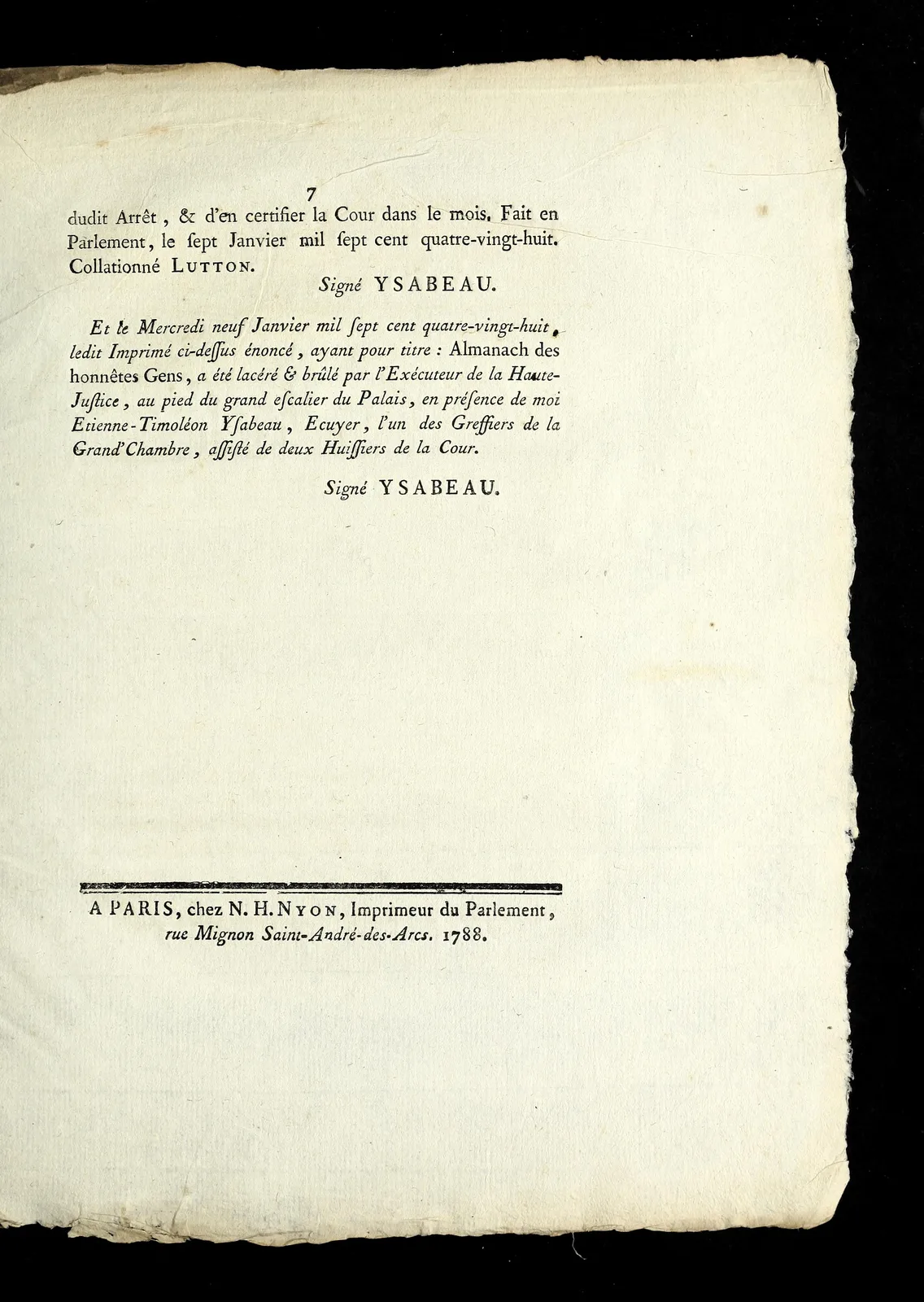
arrtdelacourdepa00fran_3; saved asarret-parlement-1788.txt. Contains Séguier's réquisitoire and the arrêt of 7 Jan 1788, pp. 3-4. - [15] On 7 Jan 1788 the Parlement, on the réquisitoire of Séguier, ordered the Almanach torn and burned by the executioner; the burning took place on Wed. 9 Jan 1788 at the foot of the great staircase — Arrêt (1788), pp. 1-7.
- [35] The Dictionnaire des athées anciens et modernes (1800) was written at the instigation, and partly under the direction, of Lalande, who supplied many notes; it holds about 800 names — Germond, "Notice nouvelle sur la vie et…", p. 15; J. de Lalande, First (1803) and Second (1805) Supplements, printed in the same 1833 volume, pp. 47-48.
- [38] In the Discours préliminaire he defines the "véritable Athée", rejects the libertine, the hypocrite statesman, the iconoclast and the timid philosopher who attends temples, and ends "Docteurs ! gardez votre Dieu, je puis m'en passer" — Maréchal, "Discours préliminaire, ou Réponse à la demande : Qu'est-ce qu'un Athée ?", in Dictionnaire des athées anciens et modernes, 2e éd. (Brussels: J. B. Balleroy, 1833), pp. i-xxvi (roman), pp. iii-viii.
- [11] Perroud (editor of Roland), Grimm's editor and Germond say Maréchal lost his Mazarine place over the Livre échappé; but Franklin lists a Maréchal among two "attachés" at the Mazarine in early 1792 and says he was replaced there on 25 Jan 1804 — Lettres de Madame Roland, vol. 1, ed. Claude Perroud (Paris, 1900), as transcribed on French Wikisource ("Lettres de Madame Roland de 1780 à 1793/Lettres/1784", rev. 9173794). Letter 171 to Bosc, 20 Dec 1784, p. 480, p. 480 n.; Germond, "Notice nouvelle sur la vie et…", p. 10; Correspondance littéraire, philosophique et critique, éd. Garnier, vol. 15, Jan 1788 (French Wikisource, rev. 15636983; no printed page numbers). Report by Meister; a note signed "(Ch.)" dated 14 Nov 1830 is an editor's addition from an earlier edition (not identified), n.; Franklin (1860), p. 140.
- [23] Germond: anti-Catholic, he encouraged the devotion of his wife and sister, kept Christian symbols in his study for them, sheltered persecuted nuns, and was tolerant of those who disagreed — Germond, "Notice nouvelle sur la vie et…", pp. 13-14.
- [41] He died at Montrouge on 18 January 1803, about midday, in the arms of Mme Gacon-Dufour, with his wife and sister-in-law near — Germond, "Notice nouvelle sur la vie et…", p. 19; "Sylvain Maréchal", French Wikipedia, rev. 239940950 (2026-09-30).
- [42] Germond reports a calm death, with the poem still being dictated, and says only that he died at an age when he "perhaps" might have repented his errors; no recantation is reported — Germond, "Notice nouvelle sur la vie et…", p. 19.
I Can Be Wise Without a God
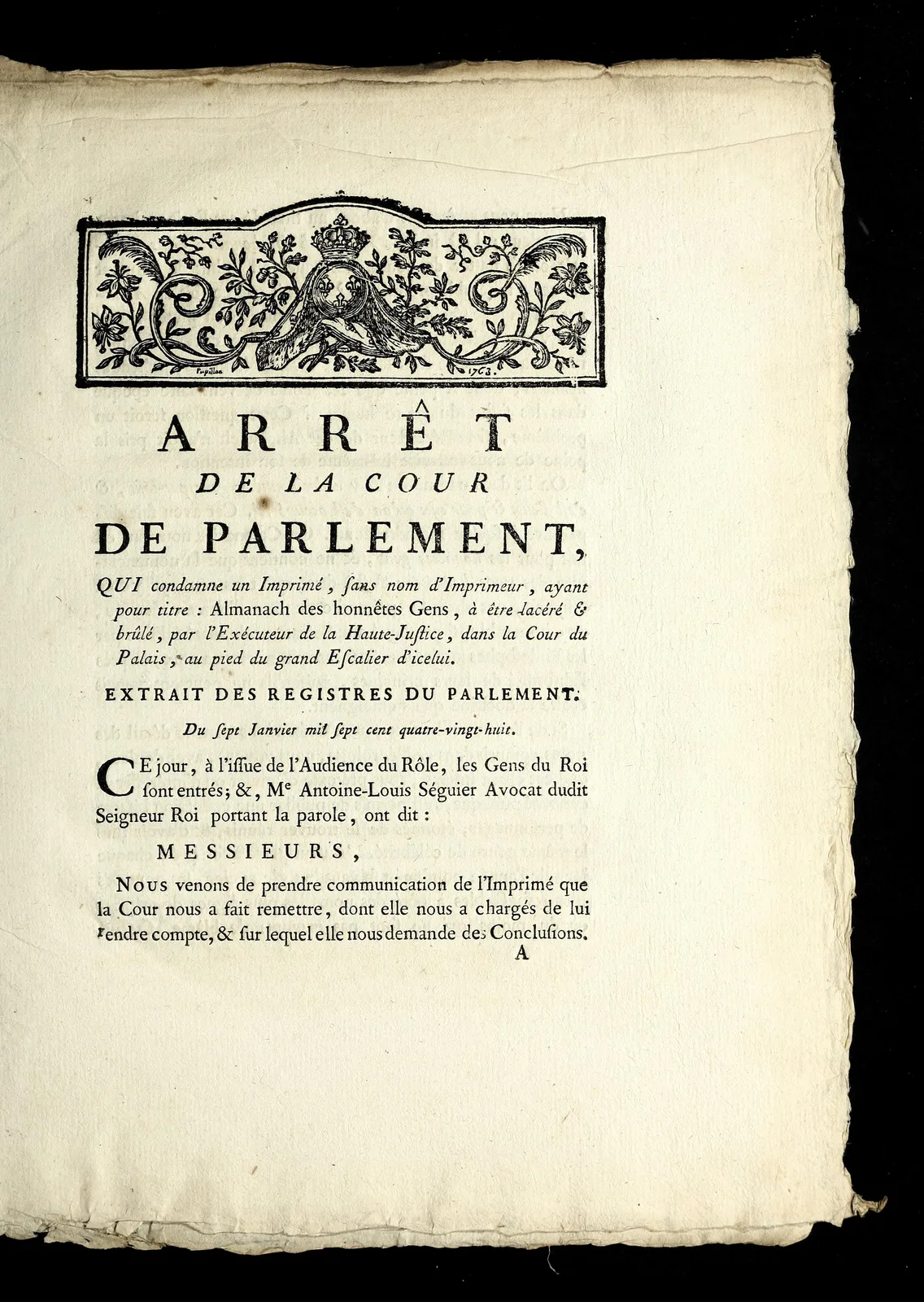
On Wednesday 9 January 1788, at the foot of the great staircase of the Palais de justice in Paris, the public executioner tore up a little book and burned it. The book was an almanac, a calendar for the year, and it had taken the saints off the days and put famous men and women of every age in their place: Moses beside Mahomet, Voltaire beside Bossuet, Jesus Christ between Epicurus and Ninon. It was dated "the first year of the reign of Reason".12 Two days before, the Parlement had ordered its author arrested. He was a thirty-seven-year-old poet and librarian named Sylvain Maréchal.3
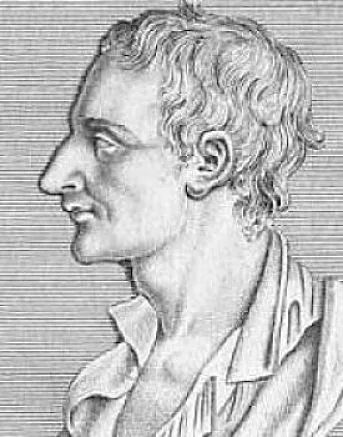
Twelve years later, in 1800, the same man published a Dictionary of Ancient and Modern Atheists, some eight hundred names long, and nobody prosecuted him at all.45 This chapter asks how a pastoral poet became the man who made unbelief into a list, and what his kind of atheism was: not a howl against God, as he put it himself, but the quiet claim that a person "can be wise without a God".6 The translations from the French in this chapter are this book's own.
The shepherd Sylvain
He was born in Paris on 15 August 1750. Wikipedia says his father was a wine merchant in the rue des Prêcheurs, near Les Halles.7 His father meant him for trade; he studied law instead and was admitted as an advocate at the Parlement, then left the bar, perhaps because he stammered.8 By about 1771 he was publishing pastoral poems, and his readers knew him as "Sylvain", the shepherd poet.9
He found a place in the library of the Collège Mazarin in Paris. There, his hostile but careful biographer Germond wrote in 1833, he gained a "strong and varied erudition", and then philosophy "seduced" him, pushed on by a "desire for fame that worked on him without cease".1011 That is an opponent's explanation of motive, not evidence of it. No childhood faith is recorded, and no crisis. On the belief timeline, his faith is an honest blank.
In 1781 he published, without his name, Fragments of a Moral Poem on God. A review of 1790 printed what it called the author's epitaph:
Cy repose un paisible Athée ; Il marcha toujours droit, sans regarder les cieux. Que sa cendre soit respectée ! L'ami de la vertu fut l'ennemi des Dieux.
Here lies a peaceful atheist; he always walked straight, without looking at the heavens. Let his ashes be respected! The friend of virtue was the enemy of the gods.121314 In another "epitaph of the author" of the same year he called that man happy whose father had raised him "far from the hired priests" who teach error and preach intolerance; it reads as a wish, not as a memory.1315 When the poem was reissued in 1798, much enlarged, as Le Lucrèce français, it held the lines that best mark his doubt: "There is a God, they say, my creator, my master! I do not know yet. Let him make himself known, this God, till now a stranger to my soul! Mine is Virtue; I will not change it."1617 Whether those lines were already in the 1781 text is not known, so the timeline places his doubt with the edition that can be read.
In 1784 he went further, with mock Psalms "newly discovered" and signed "S. Ar-Lamech", an anagram of his name. The critics fell on it. Manon Roland, the future heroine of the Girondins, wrote to a friend that "the shepherd Sylvain is badly treated for his book escaped from the flood", and that it was a shame for critics to arm themselves with the thunderbolt of Jupiter "against a few flowers of the field".181920 Several of his editors say he lost his post at the library over it. But a list of the Mazarine staff in 1792 still names a Maréchal as one of two attachés, and he was replaced there only in 1804; accounts differ, and he may have been demoted or taken back.212223
The almanac of honest people
The Almanac of Honest People appeared at the turn of 1788. The avocat général Antoine-Louis Séguier read it as a plan, "long formed", to destroy the Christian religion "by the ridicule one means to spread over its most zealous defenders". "Can one read without indignation," he asked the court, "that this almanac is given for the first year of the reign of Reason?"22425 Another account had him exclaim: "What blasphemy, to see ranked in the same class Moses and Mahomet, Titus and Cromwell, Sully and Machiavelli."26 On 7 January the Parlement ordered the book burned and the author held in the Conciergerie.23
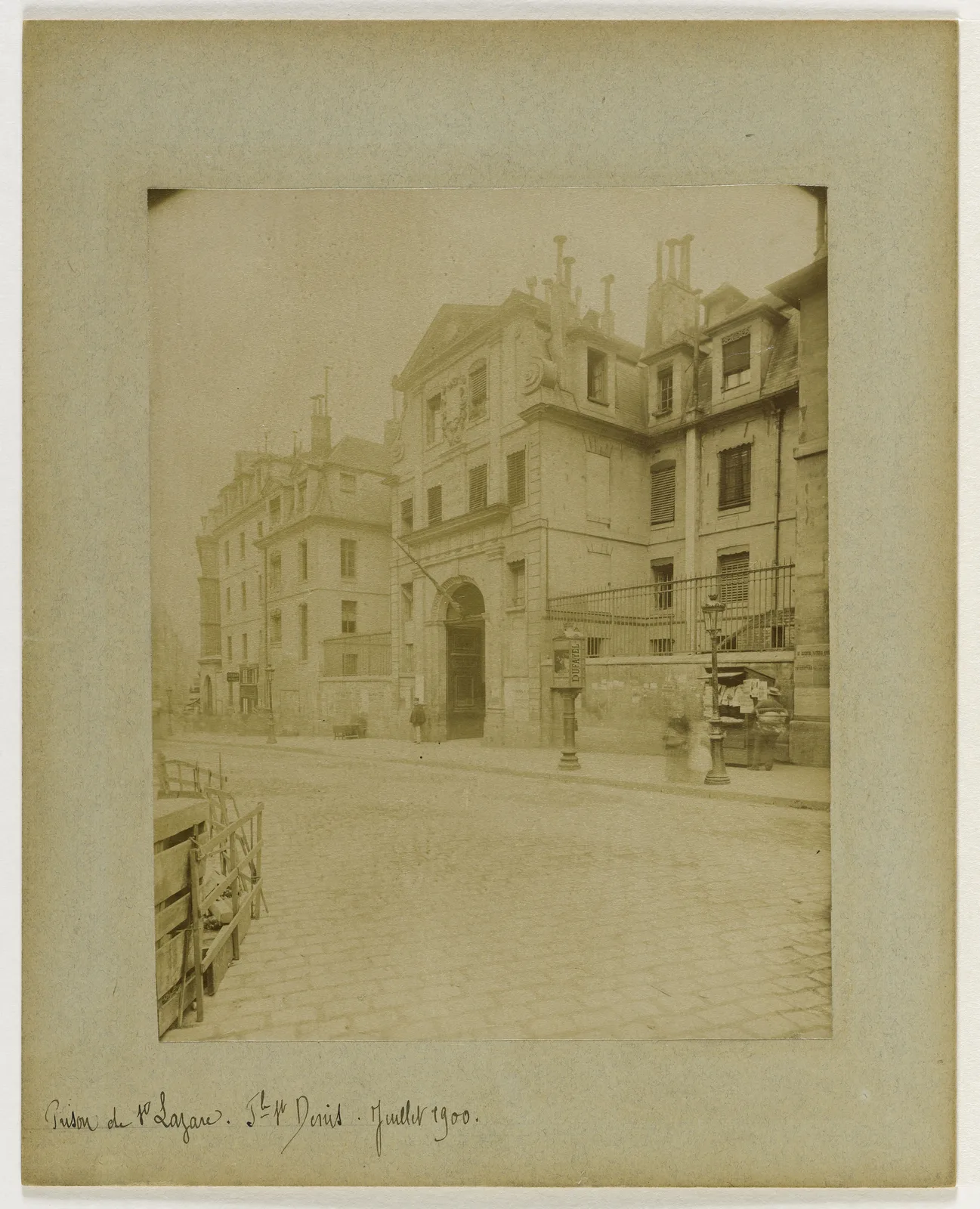
The king's government got to him first. It had him shut in Saint-Lazare by royal order, and exiled the censor who had passed the book thirty leagues from Paris.27 Saint-Lazare, Germond wrote, was a house where only people of bad morals were kept, and the months there embittered him; the length of his stay is given as three months or four.28 After that, almost everything he wrote appeared under initials or a pseudonym.29
Revolution and the Equals
The Revolution came the next year. Germond says Maréchal was a friend of Chaumette and Robespierre and wrote hymns and plays for the new republic, among them The Last Judgment of Kings (1793), but that he did not follow his friends into their atrocities.30 At home, the same biographer reports, this enemy of priests encouraged the devotion of his wife and her sister, kept Christian images in his study for their sake, and sheltered persecuted nuns. "Such tolerance," Germond wrote, "if it were found today in his detractors, ought to plead in his favour."3132
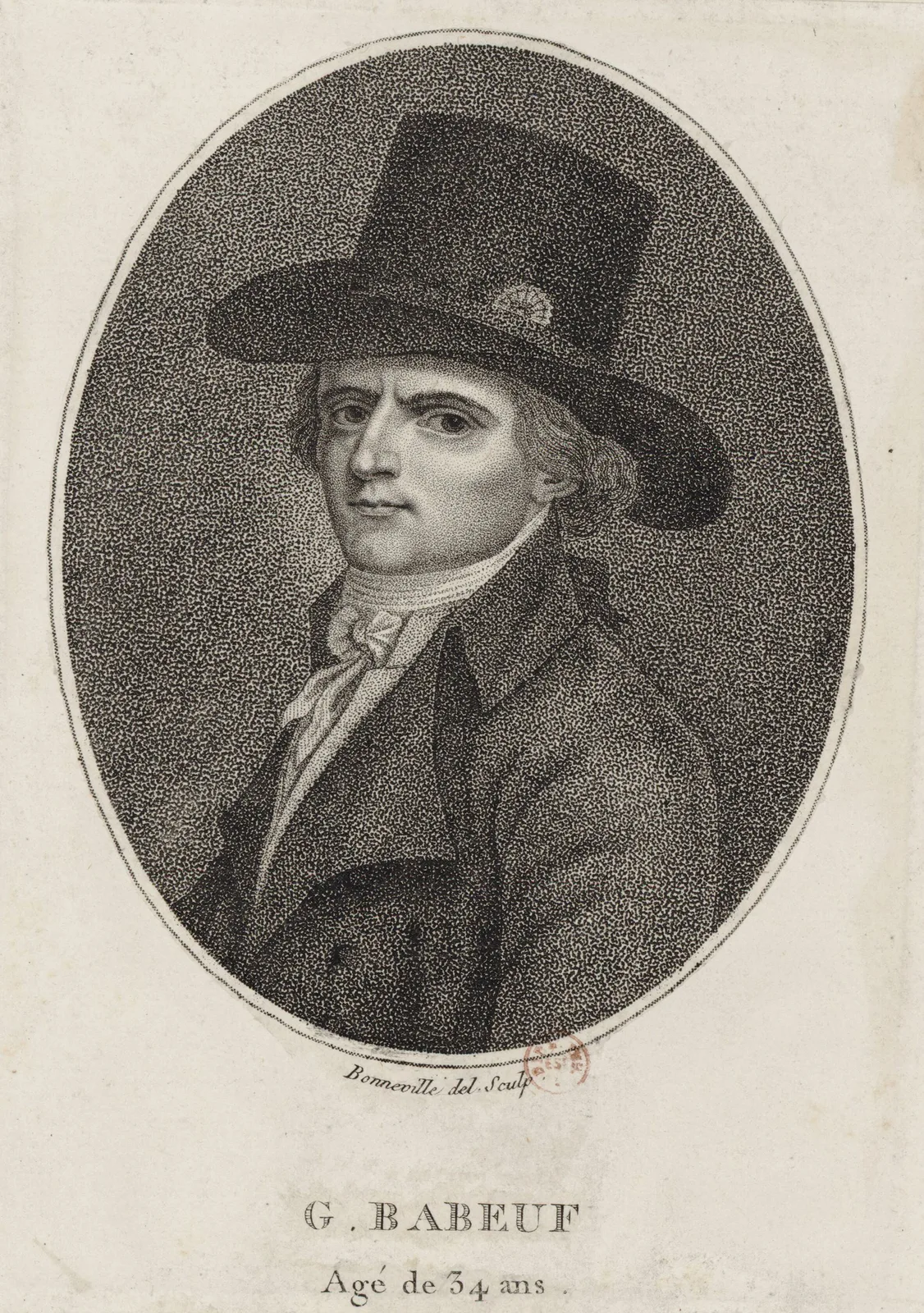
In the spring of 1796 he joined the secret directory of Gracchus Babeuf's Conspiracy of Equals, and drafted its manifesto.3334 "Equality! First wish of nature, first need of man, and chief bond of every lawful association!" it began.35 His comrades refused to publish it. They could not accept his line "Let all the arts perish, if need be, so long as real equality remains to us", nor his call for the hateful distinction of governors and governed to disappear.363738 When the conspirators were tried, Maréchal, for reasons no source explains, was not among them.39 In December 1797 he wrote to General Bonaparte reproaching him for his ambition and for his caution towards religion, and signed it "P. S. M. l'H. S. D.", read as Pierre Sylvain Maréchal, the man without God.40
The dictionary
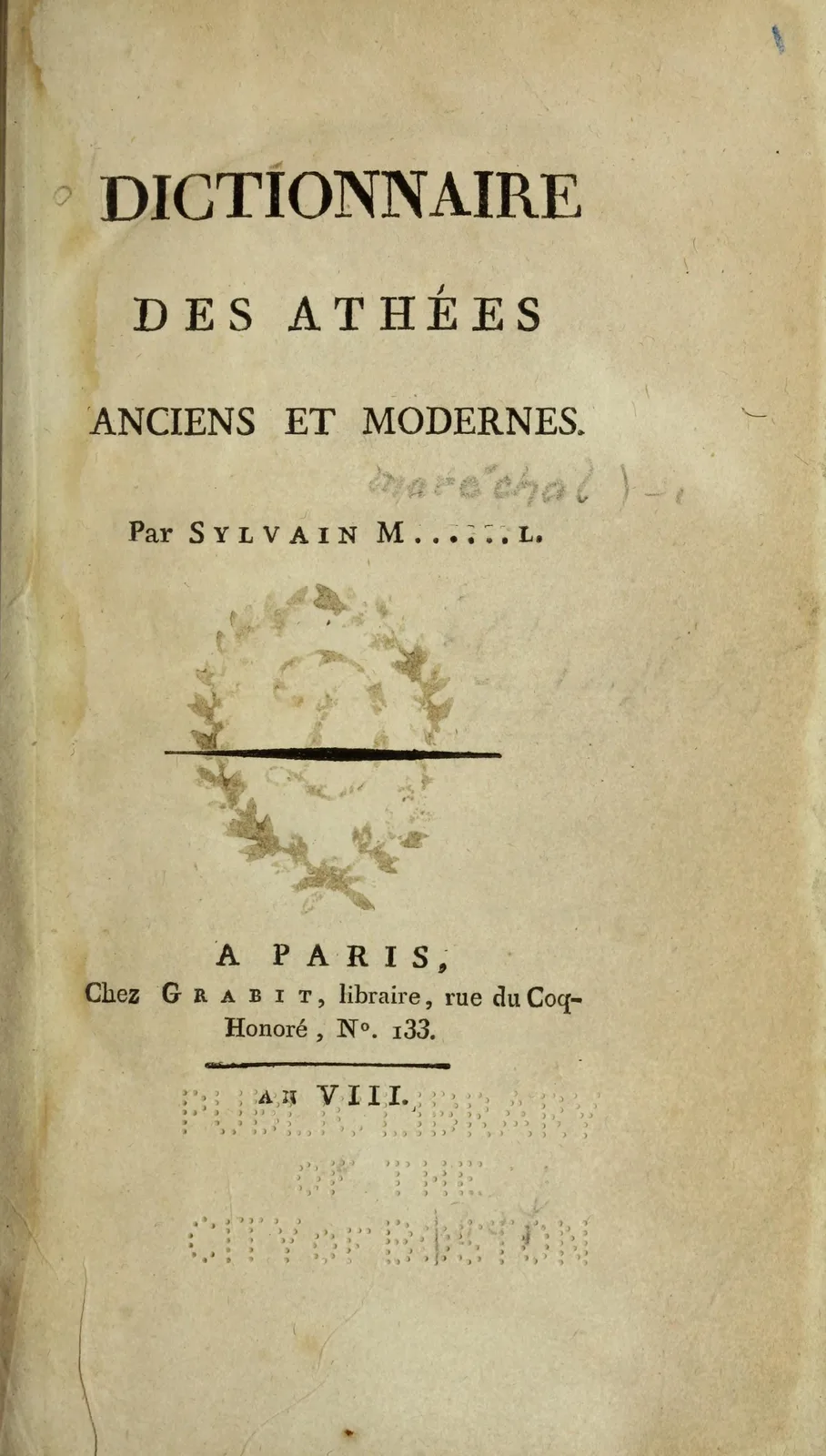
The Dictionary of Ancient and Modern Atheists was written at the urging, and partly under the direction, of his friend the astronomer Jérôme Lalande, who supplied many of its notes.4 Its preface answers the question "What is an atheist?" and is the clearest statement of what Maréchal believed. "The atheist is the man of Nature," it begins.4142 The true atheist is not the libertine, nor the statesman who mocks God in private and props up religion in public, nor the timid philosopher who blushes at his opinion and "haunts the temples" so that no one will suspect him.4143 "The true atheist is not so much he who says, 'No! I want no God,' as he who says, 'I can be wise without a God.'"6 And, signed "Sylvain, le Lucrèce français": "I have no more need of a God than he has of me."44 The deist, a footnote adds, differs from a Roman Catholic only by degree.45 "Doctors! keep your God; I can do without him."46
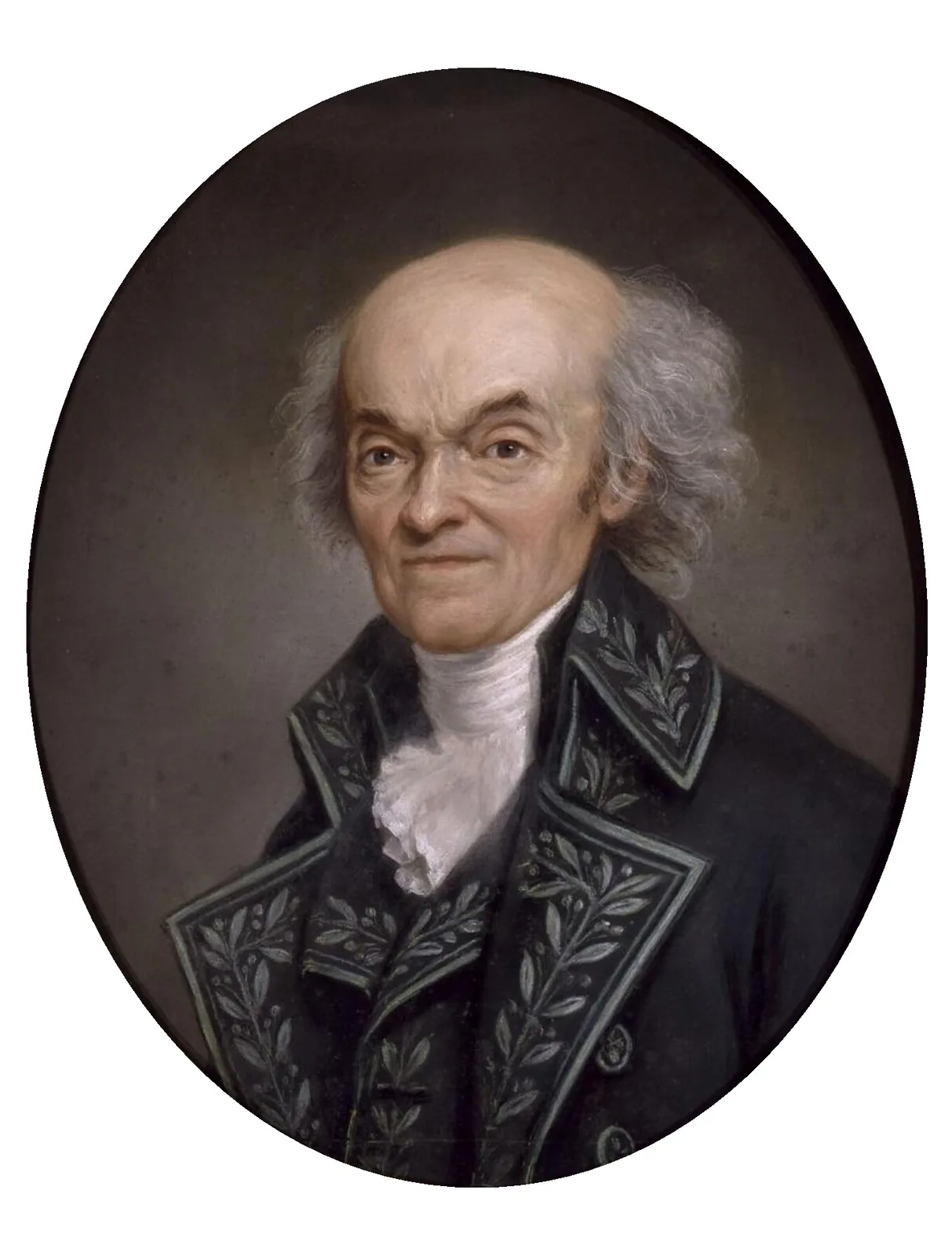
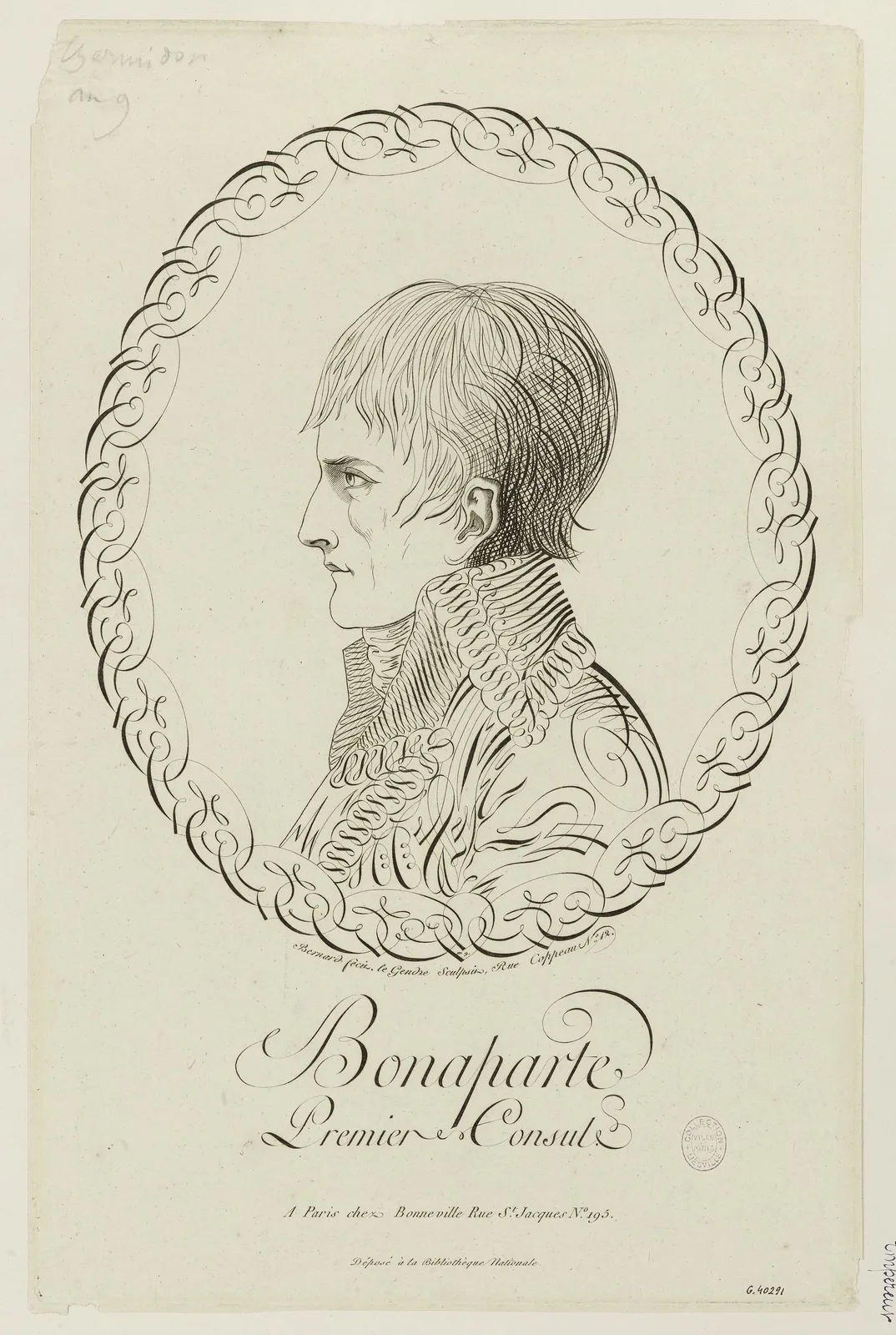
The list itself was generous to the point of mischief. He explained that "many honest citizens and educated men are atheists without believing themselves to be", and gathered testimony even from their adversaries.4748 So the dictionary named Saint Augustine and Saint John Chrysostom, Pascal and Bossuet, and "the Lawgiver of the Christians himself"; Lalande later admitted that some names had been added too lightly.49 The book caused a scandal and drew pamphlets and refutations, while the newspapers kept silent.5 Germond thought it might have wrecked at birth Napoleon's "work of repair", the return of the Church.50 Bonaparte himself had written to the consuls that June, after Marengo: "Whatever the atheists of Paris may say, I am going today, with great pleasure, to the Te Deum to be sung in the cathedral of Milan."5152
In the same years he published For and Against the Bible (1801), which went through the book "for and against" and asked that it be returned "to the class of ordinary books" and put to the examination of reason.535455 To the clergy of every faith he wrote that they should give up a profession they could no longer practise "without raising laughter, and without laughing yourselves behind your altars".56

A quiet end
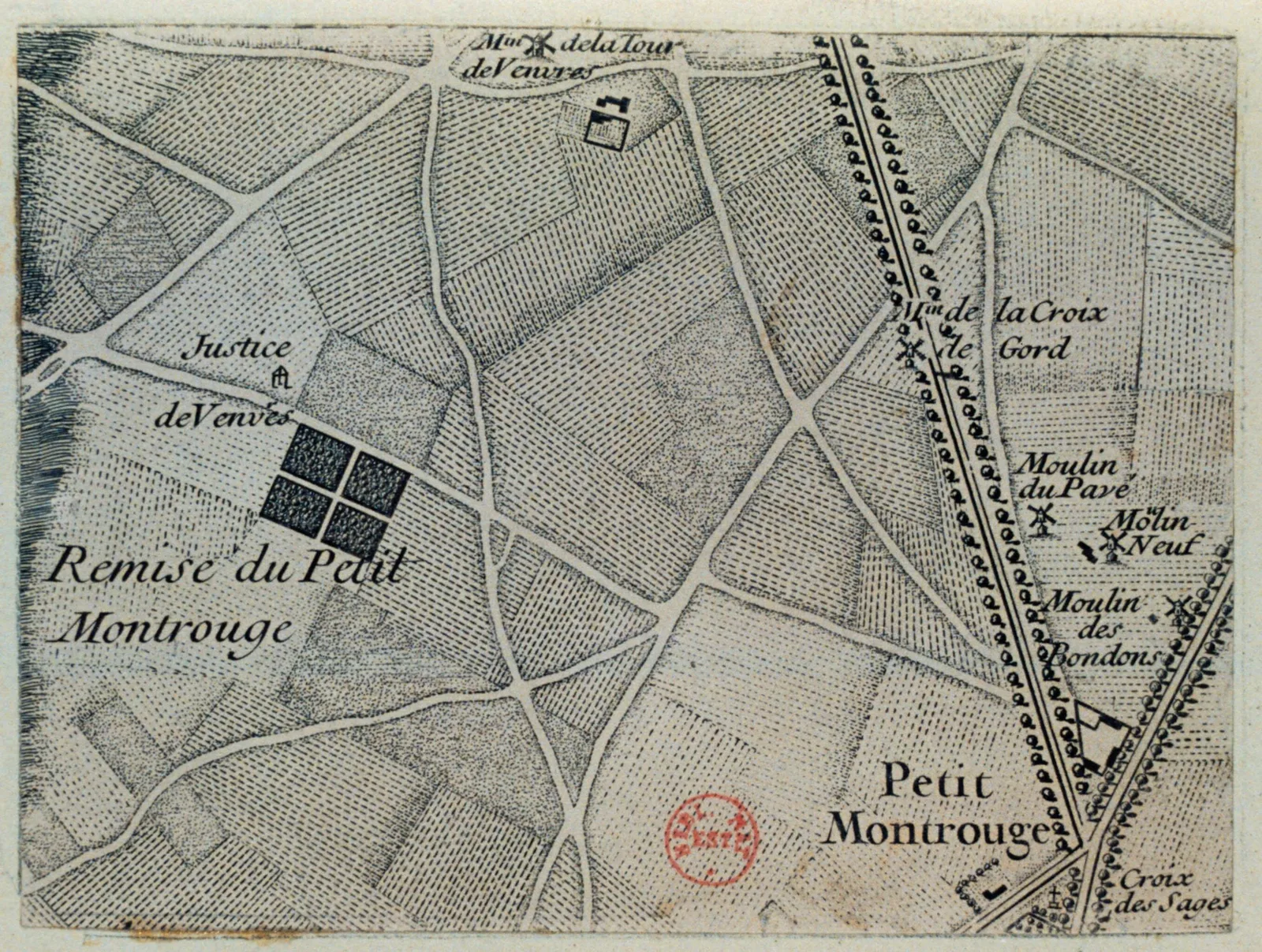
He withdrew to Montrouge, outside Paris.57 There was no revision of his unbelief, only a narrowing of it. In lines Germond quotes, he told the crowd that his morality was not for them: "I leave you to your gods; the virtuous man alone has the right to be an atheist."58 He died at Montrouge about midday on 18 January 1803, in the arms of his friend the writer Marie-Armande Gacon-Dufour, with his wife and her sister near. "I hear you," he said to those around him, "but I no longer see you; night has come for me." No recantation is reported.596061
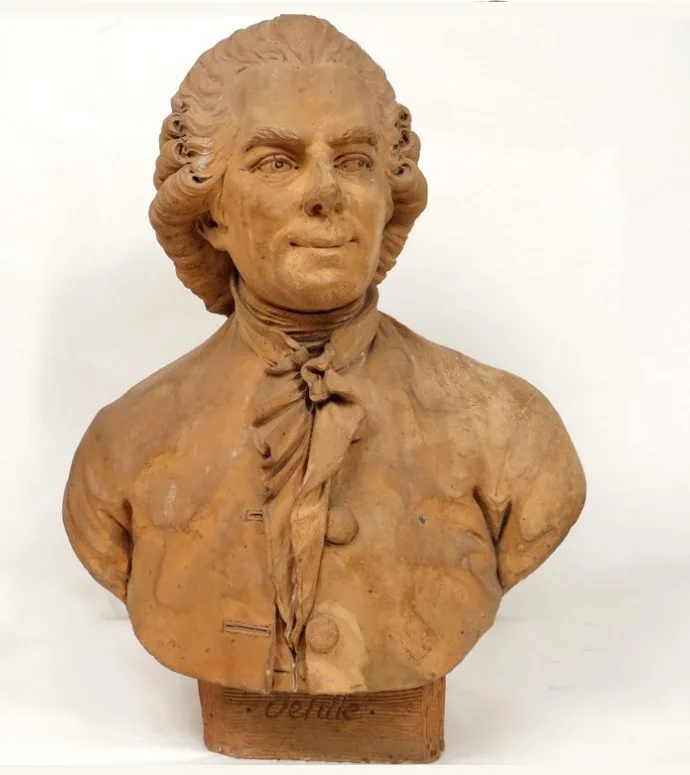
Lalande wrote that his death was a loss for philosophy, "for he had a courage one almost never finds".62 He published two supplements to the Dictionary, and when he tried to list the poet Jacques Delille, the abbé told him he was mad "to see in my verses what I did not put there, and not to see in the sky what strikes everyone's eyes". Napoleon, offended, had Lalande and his colleagues at the Institute rebuked.6364
Maréchal's unbelief was not a discovery made late or a faith lost with pain. It was a public position he held for twenty years at the price of a burned book and a prison cell, and he spent those years making a roll of honour for people who could be good without God, and naming as atheists many who would have denied it. One of the names on his list was a man who had kept his own atheism behind anonymous title pages and a famous dinner table: Baron d'Holbach, who has his own chapter in this book.
Footnotes
-
J.-B.-L. Germond, "Notice nouvelle sur la vie et les ouvrages de Sylvain Maréchal", in the 1833 Dictionnaire, pp. 9-19. The fullest early life; by an editor who says he does not share Maréchal's principles. Same scans as [Dict. Discours], p. 11; Arrêt de la Cour de Parlement, qui condamne un imprimé ... Almanach des honnêtes gens (Paris: N. H. Nyon, 1788), 7 pp. Internet Archive
arrtdelacourdepa00fran_3; saved asarret-parlement-1788.txt. Contains Séguier's réquisitoire and the arrêt of 7 Jan 1788, pp. 3-4. ↩ -
Germond, "Notice nouvelle sur la vie et…", p. 15; J. de Lalande, First (1803) and Second (1805) Supplements, printed in the same 1833 volume, pp. 47-48. ↩ ↩2
-
Maréchal, "Discours préliminaire, ou Réponse à la demande : Qu'est-ce qu'un Athée ?", in Dictionnaire des athées anciens et modernes, 2e éd. (Brussels: J. B. Balleroy, 1833), pp. i-xxvi (roman), p. vi. ↩ ↩2
-
Germond, "Notice nouvelle sur la vie et…", p. 9 (date, place); "Sylvain Maréchal", French Wikipedia, rev. 239940950 (2026-09-30), WP en (street, parents). Reported at second hand; the original has not been seen. ↩
-
Germond, "Notice nouvelle sur la vie et…", p. 9. ↩
-
Germond, "Notice nouvelle sur la vie et…", p. 9; "Sylvain Maréchal". Accounts differ; see the disputed points. ↩
-
Germond, "Notice nouvelle sur la vie et…", p. 9; Alfred Franklin, Histoire de la Bibliothèque Mazarine (Paris, 1860), IA
histoiredelabibl00franuoft; p. 140 checked on the page image, p. 140. ↩ -
Germond, "Notice nouvelle sur la vie et…", p. 9. ↩
-
Germond, "Notice nouvelle sur la vie et…", p. 10; Maréchal, Le Lucrèce français: fragmens d'un poème, nouvelle édition (Paris, l'an VI [1798]); IA
lelucrsefran00mar;lucrece-francais.txt. Includes a 1790 analysis reprinted from the Annales universelles et méthodiques of 28 Dec 1790, signed "B...N.", analysis p. 5. ↩ -
Lucrèce (1798), analysis p. 6; Germond, "Notice nouvelle sur la vie et…", p. 19. ↩ ↩2
-
Lucrèce (1798), analysis p. 6. ↩
-
Germond, "Notice nouvelle sur la vie et…", p. 19. ↩
-
Lucrèce (1798), p. 78. Not verified. ↩
-
Lucrèce (1798), p. 78 (Fragment XLIII). ↩
-
Germond, "Notice nouvelle sur la vie et…", p. 10; Google Books feed records j6dZAAAAcAAJ, kf830nAcHIIC (1784). ↩
-
Lettres de Madame Roland, vol. 1, ed. Claude Perroud (Paris, 1900), as transcribed on French Wikisource ("Lettres de Madame Roland de 1780 à 1793/Lettres/1784", rev. 9173794). Letter 171 to Bosc, 20 Dec 1784, p. 480, p. 480. ↩
-
Manon Roland, letter to Bosc, 20 Dec 1784: Roland, p. 480. ↩
-
Roland, p. 480 n.; Germond, "Notice nouvelle sur la vie et…", p. 10; Correspondance littéraire, philosophique et critique, éd. Garnier, vol. 15, Jan 1788 (French Wikisource, rev. 15636983; no printed page numbers). Report by Meister; a note signed "(Ch.)" dated 14 Nov 1830 is an editor's addition from an earlier edition (not identified), n.; Franklin (1860), p. 140. ↩
-
Franklin (1860), p. 140 n.. ↩
-
Franklin (1860), p. 140. ↩
-
Séguier, réquisitoire, 7 Jan 1788 (spelling of the print): Arrêt (1788), p. 3. ↩
-
Séguier, réquisitoire: Arrêt (1788), p. 3. ↩
-
Séguier, avocat général, as quoted by Meister, Jan 1788 (the writer calls the Almanach a "sottise" that need not have scandalised): Grimm (1788). ↩
-
Grimm (1788). ↩
-
Germond, "Notice nouvelle sur la vie et…", p. 12; "Sylvain Maréchal"; "Sylvain Maréchal", English Wikipedia, rev. 1372746471 (2026-09-02); "Précurseurs", Encyclopédie anarchiste (Sébastien Faure, 1925-34), Maréchal section (French Wikisource, rev. 9555272). Read for facts only (1930s; possibly still in copyright in the US); not quoted. ↩
-
Title pages in Pour et contre, Lucrèce 1798; Jaurès 17; "Sylvain Maréchal". ↩
-
Germond, "Notice nouvelle sur la vie et…", p. 13. ↩
-
Germond, "Notice nouvelle sur la vie et…", pp. 13-14. ↩
-
Germond, fairly, on Maréchal's tolerance: Germond, "Notice nouvelle sur la vie et…", p. 14. ↩
-
Ph. Buonarroti, Gracchus Babeuf et la conjuration des Égaux, preface and notes by A. Ranc (Paris: Armand Le Chevalier, 1869); IA
gracchusbabeufet00buonuoft. A reprint of Buonarroti's 1828 history, with the Manifeste of the Equals text, pp. 66-68. ↩ -
Buonarroti (1869), p. 68; Buonarroti's History of Babeuf's Conspiracy for Equality, English transl. (London, 1836); IA
BabeufsConspiracyForEquality_242, p. 90 n.; Jaurès 13. ↩ -
Buonarroti (1869), p. 69. ↩
-
Buonarroti (1869), p. 73; Buonarroti (1836), p. 90 n.. ↩
-
Buonarroti (1869), p. 70. ↩
-
Buonarroti, on his own comrades' refusal of Maréchal's Manifeste (an ally's criticism): Buonarroti (1869), p. 73. ↩
-
Buonarroti (1869), (absence); "Précurseurs". ↩
-
Jaurès 17 (citing Mathiez, Révolution française, 14 Mar 1903). ↩
-
Maréchal, "Discours préliminaire, ou Réponse à la…", pp. iii-viii. ↩ ↩2
-
Maréchal, "Discours préliminaire, ou Réponse à la…", p. iii (1833 reprint of 1800 text). ↩
-
Maréchal, "Discours préliminaire, ou Réponse à la…", p. v. ↩
-
Maréchal, "Discours préliminaire, ou Réponse à la…", p. vi. ↩
-
Maréchal, "Discours préliminaire, ou Réponse à la…", p. xii n.. ↩
-
Maréchal, "Discours préliminaire, ou Réponse à la…", p. viii. ↩
-
Maréchal, "Discours préliminaire, ou Réponse à la…", p. xx. ↩
-
Maréchal, "Discours préliminaire, ou Réponse à la…", p. xx. ↩
-
Germond, "Notice nouvelle sur la vie et…", p. 17; Lalande Suppl., p. 48. ↩
-
Germond, on the Dictionary in 1800: Germond, "Notice nouvelle sur la vie et…", p. 17. ↩
-
Dictionnaire 1833 p. 37 note. ↩
-
Napoleon Bonaparte, letter to the consuls, 14 June 1800 (quoted in an editor's note): Dictionnaire 1833 p. 37 note. ↩
-
Germond, "Notice nouvelle sur la vie et…", p. 14 and n.; Maréchal ("Sylvain M***"), Pour et contre la Bible ("A Jérusalem ... M. DCCCI", i.e. 1801); IA
pouretcontrelab00margoog;pour-contre-bible.txt, title page. ↩ -
(, "Sylvain M***", half-title, pp. v-xxxiv. ↩
-
(, "Sylvain M***", half-title note (unpaginated). Not checked against the original (partial (OCR poor, 70%; checked by eye, re-check on the scan)). ↩
-
(, "Sylvain M***", Épître aux ministres, p. vii. ↩
-
Germond, "Notice nouvelle sur la vie et…", pp. 18-19; "Sylvain Maréchal". ↩
-
Germond, "Notice nouvelle sur la vie et…", p. 16. ↩
-
Germond, "Notice nouvelle sur la vie et…", p. 19; "Sylvain Maréchal". ↩
-
Germond, "Notice nouvelle sur la vie et…", p. 19. ↩
-
Germond, "Notice nouvelle sur la vie et…", p. 19. ↩
-
Lalande: Lalande Suppl., p. 47. ↩
-
Lalande Suppl., pp. 47-48 and n.. ↩
-
Abbé Jacques Delille, poet, to Lalande who wished to list him (anecdote told by Germond): Lalande Suppl., p. 48 note. ↩
arrtdelacourdepa00fran_3; saved as arret-parlement-1788.txt. Contains Séguier's réquisitoire and the arrêt of 7 Jan 1788.; J. de Lalande, First (1803) and Second (1805) Supplements, printed in the same 1833 volume.; Maréchal, "Discours préliminaire, ou Réponse à la demande : Qu'est-ce qu'un Athée ?", in Dictionnaire des athées anciens et modernes, 2e éd. (Brussels: J. B. Balleroy, 1833), pp. i-xxvi (roman); "Sylvain Maréchal", French Wikipedia, rev. 239940950 (2026-09-30).; Alfred Franklin, Histoire de la Bibliothèque Mazarine (Paris, 1860), IA histoiredelabibl00franuoft; p. 140 checked on the page image.; Maréchal, Le Lucrèce français: fragmens d'un poème, nouvelle édition (Paris, l'an VI [1798]); IA lelucrsefran00mar; lucrece-francais.txt. Includes a 1790 analysis reprinted from the Annales universelles et méthodiques of 28 Dec 1790, signed "B...N.".; Lettres de Madame Roland, vol. 1, ed. Claude Perroud (Paris, 1900), as transcribed on French Wikisource ("Lettres de Madame Roland de 1780 à 1793/Lettres/1784", rev. 9173794). Letter 171 to Bosc, 20 Dec 1784, p. 480.; Correspondance littéraire, philosophique et critique, éd. Garnier, vol. 15, Jan 1788 (French Wikisource, rev. 15636983; no printed page numbers). Report by Meister; a note signed "(Ch.)" dated 14 Nov 1830 is an editor's addition from an earlier edition (not identified).; "Sylvain Maréchal", English Wikipedia, rev. 1372746471 (2026-09-02).; "Précurseurs", Encyclopédie anarchiste (Sébastien Faure, 1925-34), Maréchal section (French Wikisource, rev. 9555272). Read for facts only (1930s; possibly still in copyright in the US); not quoted.; Ph. Buonarroti, Gracchus Babeuf et la conjuration des Égaux, preface and notes by A. Ranc (Paris: Armand Le Chevalier, 1869); IA gracchusbabeufet00buonuoft. A reprint of Buonarroti's 1828 history, with the Manifeste of the Equals text.; Buonarroti's History of Babeuf's Conspiracy for Equality, English transl. (London, 1836); IA BabeufsConspiracyForEquality_242.; Maréchal ("Sylvain M***"), Pour et contre la Bible ("A Jérusalem ... M. DCCCI", i.e. 1801); IA pouretcontrelab00margoog; pour-contre-bible.txt.In their own words
L'Athée est l'homme de la Nature.
Le véritable Athée n'est pas tant celui qui dit : « Non ! je ne veux pas d'un Dieu », que celui qui dit : « Je puis être sage, sans un Dieu. »
Je n'ai pas plus besoin d'un Dieu, que lui de moi.
Docteurs ! gardez votre Dieu, je puis m'en passer.
Le véritable Athée n'est pas encore ce philosophiste timoré et sans énergie qui rougit de son opinion comme d'une mauvaise pensée ; lâche ami de la vérité, il la compromettra, plutôt que de se compromettre. On le voit hanter les temples afin d'écarter de sa personne le soupçon d'impiété
Disons aussi que beaucoup d'honnêtes citoyens et d'hommes instruits sont Athées, sans croire l'être.
Nous avons recueilli, non pas seulement les principaux sentimens des Athées connus, mais encore une infinité de témoignages en leur faveur ; d'autant moins suspects qu'ils sortent de la bouche, ou de la plume de leurs adversaires.
Il faut le répéter encore ici : Dieu est tout ou n'est rien.
Il est un Dieu, dit-on, mon créateur, mon maître ! Je n'en sais rien encor . . . Qu'il se fasse connaître, Ce Dieu, jusqu'à présent, à mon âme étranger ! Le mien, c'est la Vertu ; je n'en veux point changer.
Cy repose un paisible Athée ; Il marcha toujours droit, sans regarder les cieux. Que sa cendre soit respectée ! L'ami de la vertu fut l'ennemi des Dieux.
Je n'écris pas pour vous ; ma morale à vos yeux, Ô mortels abrutis, paraîtrait exaltée ; Pour votre châtiment je vous laisse à vos Dieux ; L'homme vertueux seul a le droit d'être Athée.
Heureux ! qui né d'un père exempt de préjugés, Fut élevé par lui loin des prêtres gagés Pour enseigner l'erreur, prêcher l'intolérance.
Hâtez-vous donc d'abjurer une profession que vous ne pouvez plus exercer sans exciter le rire, et sans en rire vous-mêmes derrière vos autels.
La religion chrétienne n'est pas le culte des républicains, ni la morale des hommes libres.
L'ÉGALITÉ ! premier vœu de la nature, premier besoin de l'homme, et principal nœud de toute association légitime !
Périssent, s'il le faut, tous les arts, pourvu qu'il nous reste l'égalité réelle !
La perte de Sylvain Maréchal en est une pour la philosophie, car il avait un courage qu'on ne trouve presque jamais.
Le berger Sylvain est bien maltraité pour son ouvrage échappé du déluge ; il est grossièrement étrillé dans l'Année littéraire ; c'est une honte pour les critiques que de s'armer ainsi du foudre de Jupiter contre quelques fleurs des champs.
Je vous entends, disait-il à ceux qui l'entouraient, mais je ne vous vois plus, la nuit est venue pour moi.
Il est temps de faire rentrer la Bible dans la classe des livres ordinaires ; et, abstraction faite de tout mot étranger, de lui faire subir l'examen de la raison.
The other side
Quel blasphème, dit-il, de voir ranger dans la même classe Moïse et Mahomet, Titus et Cromwell, Sully et Machiavel
annonce le projet formé depuis long-temps d'anéantir, s'il étoit possible, la Religion Chrétienne, par le ridicule qu'on veut répandre sur ses plus zélés défenseurs
Peut-on lire sans indignation, que cet Almanach est donné pour l'an premier du régne de la Raison
sa raison s'égarait dès qu'on le mettait sur le chapitre de la religion, comme celle du héros de Cervantes lorsqu'il était question de la chevalerie
Cet ouvrage pouvait donc anéantir tout-à-coup à sa naissance l'œuvre réparatrice de Napoléon.
Une pareille tolérance, si elle se rencontrait aujourd'hui dans ses détracteurs, devrait plaider en sa faveur et atténuer du moins les torts de son esprit.
Si le dogme d'un Dieu et de la Providence est nécessaire au maintien, à la prospérité de l'ordre social, ce dogme est vrai. L'homme est fait pour la vérité. Comment le genre humain, pour être heureux, aurait-il besoin du mensonge ?
Vous êtes fou, reprit l'abbé Delille, de voir dans mes vers ce que je n'y ai pas mis, et de ne pas voir dans le ciel ce qui frappe les yeux de tout le monde.
Quoi qu'en puissent dire les Athées de Paris, je vais aujourd'hui, avec grand plaisir, assister au Te Deum qui va être chanté dans la Cathédrale de Milan.
Le directoire secret ne voulut pas qu'on donnât aucune publicité à cette pièce, parce qu'il n'approuvait ni l'expression : Périssent, s'il le faut, tous les arts ... ni l'autre : Disparaissez enfin, révoltante distinction de gouvernants et de gouvernés
Where accounts differ
| Point | One account | Another | How the page handles it |
|---|---|---|---|
| Date of Livre échappé au déluge | 1784 (Google Books catalogue, Grässe; Mme Roland's letter of Dec 1784 shows it was out) | 1785 (the 1830 note in Grimm's Correspondance) | Say 1784; "reviewed in the press by the end of that year" [9][10] |
| Did he lose the Mazarine post over it? | Yes (Perroud's note to Roland; Germond; the Grimm note) | A Maréchal is still on the Mazarine staff in 1792 as an "attaché", and is replaced only on 25 Jan 1804 (Franklin p. 140) | Say "accounts differ"; he may have been demoted or reinstated; do not say "dismissed" flatly. The roster line ("dismissed in 1784") needs David's decision [11] |
| Length of the Saint-Lazare detention | Three months (WP fr) | Four months (WP en, Enc. anarchiste) | "A few months" [18] |
| Date of Pour et contre la Bible | 1798 (a reading of Germond's list, p. 14) | 1801 (title page) | 1801 [33] |
| Date of Bergeries | 1770 (WP fr) | 1771 (Germond, who names Bergeries and Temple de l'Hymen in 1771) | Avoid or say "about 1770" [3] |
| Which "epitaph" | "Cy repose un paisible Athée" (1790 review) | "Heureux ! qui né d'un père exempt de préjugés" (Germond: 1781) | Two poems of the same period; quote one with its source [7] |
| When "Je n'en sais rien encor" was written | In the 1798 augmented edition (seen) | Possibly in the 1781 text (not seen; 1790 review does not quote it) | Cite as "the 1798 edition" [8] |
| Date of the Culte et lois d'une société d'hommes sans Dieu | 1797 (Germond) | 1798, year VI (WP fr) | "1797 or 1798" [32] |
| Whether Maréchal "co-wrote" the Manifeste with Babeuf | Wikipedia (fr): "avec Gracchus Babeuf (1801)" | Buonarroti: Maréchal drafted it alone; the directory refused to publish it; known only from the trial and Buonarroti | Maréchal wrote it; it was never issued by the conspirators [26][27][28] |
List of illustrations
This page uses only public-domain and Creative Commons images; each is credited with its source and licence.
- Sylvain Maréchal (portrait from De la vertu, Paris 1807) — Unknown engraver, 1807 · Wikimedia Commons, from De la vertu (Paris, 1807); via International Institute of Social History (socialhistory.org Maréchal collection) · Public domain (published before 1931; Commons states 'Public domain')
- Arrêt de la cour de Parlement, qui condamne un imprimé ... ayant pour titre: Almanach des honnêtes gens, 7 January 1788, first page — Parlement de Paris (printer N. H. Nyon); the condemned work is by Maréchal, 1788 · Internet Archive (arrtdelacourdepa00fran_3), leaf 1 · Public domain (published before 1931; Internet Archive states no rights, so status rests on the publication date)
- Vue de l'intérieur des quatre nations (from Vues des plus beaux édifices publics et particuliers de la ville de Paris) — Jean-François Janinet after Jean-Nicolas-Louis Durand, between 1752 and 1814 · Musée Carnavalet - Histoire de Paris (Paris Musées collections), via Wikimedia Commons · CC0
- Arrêt of 7 January 1788, page 7: the clerk's record that the Almanach was torn and burned on 9 January — Parlement de Paris (printer N. H. Nyon), 1788 · Internet Archive (arrtdelacourdepa00fran_3), leaf 7 · Public domain (published before 1931; Internet Archive states no rights, so status rests on the publication date)
- Prison Saint-Lazare, Faubourg Saint-Denis, Paris (Atget, July 1900) — Eugène Atget, July 1900 · Musée Carnavalet - Histoire de Paris (Paris Musées collections), via Wikimedia Commons · CC0
- François-Noël (Gracchus) Babeuf — François Bonneville, 1794 · Bibliothèque nationale de France, Gallica (btv1b84127115), via Wikimedia Commons · Public domain (published before 1931; Commons states 'Public domain')
- Dictionnaire des athées anciens et modernes, par Sylvain M...L. (Paris, Grabit, an VIII), title page — Sylvain Maréchal, 1800 · Internet Archive, copy digitised from the library of Thomas Pennant Barton (dictionnairedesa00mare), leaf 7 · Public domain (published before 1931; Internet Archive states no rights, so status rests on the publication date)
- Jérôme Lalande (1732-1807), astronomer — Joseph Ducreux, 1802 · Château de Versailles (collections.chateauversailles.fr), via Wikimedia Commons · Public domain (published before 1931; Commons states 'Public domain')
- Bonaparte Premier Consul (G.40291) — Unknown engraver; publisher François Bonneville, c. 1800 · Musée Carnavalet - Histoire de Paris (Paris Musées collections), via Wikimedia Commons · CC0
- Pour et contre la Bible (1801), title page — Sylvain Maréchal, 1801 · Internet Archive, Google-digitised copy (pouretcontrelab00margoog), leaf 7 · Public domain (published before 1931; Internet Archive states no rights, so status rests on the publication date)
- Plan du Petit-Montrouge avec les moulins environnants — Unknown, 18th century (c. 1750) · Bibliothèque nationale de France, Estampes et photographie, EST RESERVE VE-26 (G) (btv1b7740309f), via Wikimedia Commons · Public domain (published before 1931; Commons states 'Public domain')
- Terracotta bust of the poet Jacques Delille — Unknown 18th-century sculptor, last quarter of the 18th century · Photograph via Wikimedia Commons (source: antiques-delaval.com); credit the photograph/Commons uploader per CC BY 4.0 in the description · CC BY 4.0
Sources
Tier 1 — the subject's own words, and official records
- [Arrêt 1788] Arrêt de la Cour de Parlement, qui condamne un imprimé ... Almanach des honnêtes gens (Paris: N. H. Nyon, 1788), 7 pp. Internet Archive
arrtdelacourdepa00fran_3; saved asarret-parlement-1788.txt. Contains Séguier's réquisitoire and the arrêt of 7 Jan 1788. OCR reads long s as f; quotations checked by eye. - [Dict. Discours] Maréchal, "Discours préliminaire, ou Réponse à la demande : Qu'est-ce qu'un Athée ?", in Dictionnaire des athées anciens et modernes, 2e éd. (Brussels: J. B. Balleroy, 1833), pp. i-xxvi (roman). IA
dictionnairedes00margoog(Google scan of the Harvard copy;dictionnaire.txt) and the BnF scan on IADictionnaireDesAthesAnciensEt...MarrchalSylvainBpt6k71824v1(dictionnaire-gallica.txt). Germond says the text of the 1800 first edition was kept; not compared with a 1800 copy. - [Lalande Suppl.] J. de Lalande, First (1803) and Second (1805) Supplements, printed in the same 1833 volume.
- [Lucrèce 1798] Maréchal, Le Lucrèce français: fragmens d'un poème, nouvelle édition (Paris, l'an VI [1798]); IA
lelucrsefran00mar;lucrece-francais.txt. Includes a 1790 analysis reprinted from the Annales universelles et méthodiques of 28 Dec 1790, signed "B...N.". - [Pour et contre] Maréchal ("Sylvain M***"), Pour et contre la Bible ("A Jérusalem ... M. DCCCI", i.e. 1801); IA
pouretcontrelab00margoog;pour-contre-bible.txt. - [Buonarroti 1869] Ph. Buonarroti, Gracchus Babeuf et la conjuration des Égaux, preface and notes by A. Ranc (Paris: Armand Le Chevalier, 1869); IA
gracchusbabeufet00buonuoft. A reprint of Buonarroti's 1828 history, with the Manifeste of the Equals text. - [Buonarroti 1836] Buonarroti's History of Babeuf's Conspiracy for Equality, English transl. (London, 1836); IA
BabeufsConspiracyForEquality_242. - [Roland] Lettres de Madame Roland, vol. 1, ed. Claude Perroud (Paris, 1900), as transcribed on French Wikisource ("Lettres de Madame Roland de 1780 à 1793/Lettres/1784", rev. 9173794). Letter 171 to Bosc, 20 Dec 1784, p. 480.
- [Grimm 1788] Correspondance littéraire, philosophique et critique, éd. Garnier, vol. 15, Jan 1788 (French Wikisource, rev. 15636983; no printed page numbers). Report by Meister; a note signed "(Ch.)" dated 14 Nov 1830 is an editor's addition from an earlier edition (not identified).
Tier 2 — scholarly and reference works
- [Dict. Notice] J.-B.-L. Germond, "Notice nouvelle sur la vie et les ouvrages de Sylvain Maréchal", in the 1833 Dictionnaire, pp. 9-19. The fullest early life; by an editor who says he does not share Maréchal's principles. Same scans as [Dict. Discours].
- [Franklin 1860] Alfred Franklin, Histoire de la Bibliothèque Mazarine (Paris, 1860), IA
histoiredelabibl00franuoft; p. 140 checked on the page image. - [Jaurès 13 / Jaurès 17] Jean Jaurès, Histoire socialiste, Thermidor et Directoire, chapters 13 and 17 (French Wikisource rev. 2464151 and 2525973). Jaurès cites Mathiez (1903) for the 1797 pamphlet.
Tier 3 — popular and older reference
- [Enc. anarchiste] "Précurseurs", Encyclopédie anarchiste (Sébastien Faure, 1925-34), Maréchal section (French Wikisource, rev. 9555272). Read for facts only (1930s; possibly still in copyright in the US); not quoted.
Tier 4 — Wikipedia (map to sources; citable)
- [WP fr] "Sylvain Maréchal", French Wikipedia, rev. 239940950 (2026-09-30).
- [WP en] "Sylvain Maréchal", English Wikipedia, rev. 1372746471 (2026-09-02).
Opposition sources — contemporary critics and religious responses
- [Séguier 1788] Séguier's réquisitoire, as printed in [Arrêt 1788] and quoted in [Grimm 1788].
- [Germond 1833] The Notice, a Catholic-leaning but even-handed hostile voice.
- [Débats] Journal des Débats attacks of 1803-05, seen only as quoted by Lalande [Lalande Suppl.].
- [Napoleon 1800] Napoleon's letter of 14 June 1800, quoted in an editor's note in the 1833 edition.
Related lives
Baron d'Holbach — the Dictionary names him and Naigeon among its atheists; he concealed his atheism where Maréchal listed his. (Close wording: "has their own episode in this series", no baked-in "next".)
Yamagata Bantō
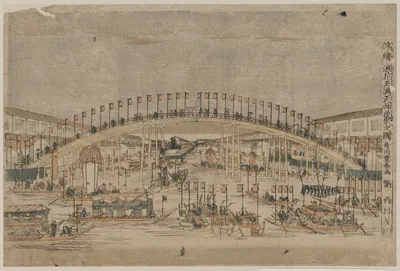
Yamagata Bantō was an Osaka merchant's clerk, schooled in the rational Confucianism of the Kaitokudō and in European astronomy learned through Dutch books. He had no creed to lose. In a private book begun at fifty-four and finished blind, he set down that there are no gods, buddhas or ghosts, because a teaching should say plainly what exists, and the measured globe held no paradise. He kept that conclusion to his death verses.
Jeremy Bentham
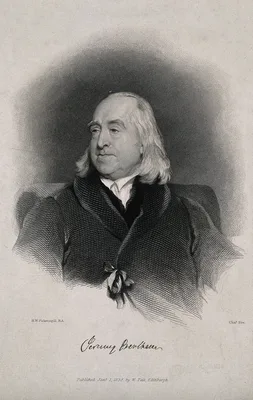
Jeremy Bentham was a Church of England child who "believed as hard as I could". At Oxford he signed the Thirty-nine Articles against his conscience, and never forgot it. He kept his doubts to private notes for decades. In his seventies he attacked the Church under his own name (1818), and natural religion and St Paul under invented ones (1822–23), never calling himself an atheist. He arranged his death so that his body served science, and his preserved figure stood in place of a religious rite.
Constantin-François Volney
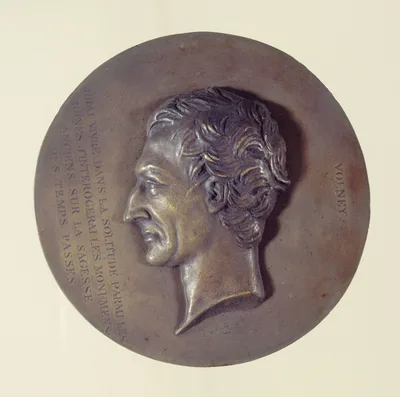
Constantin-François Volney was schooled by priests and met d'Holbach's circle in Paris. In 1782 he went east to see where the opinions that govern us were born, and came back to set the world's religions side by side in The Ruins of 1791, speaking only as a meditating traveller. He kept God as the name of nature's order. In 1797 he refused Priestley's demand for a creed, on the ground that no one had the right to ask it, and in old age he regretted provocation more than doubt.
Abner Kneeland
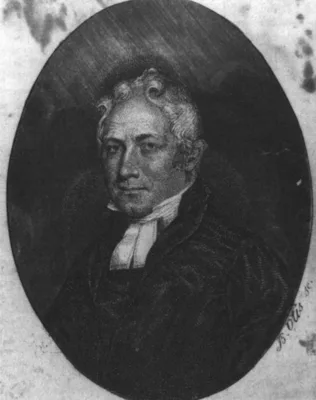
Abner Kneeland was a Baptist lay preacher turned Universalist minister. He put his first doubts about the Bible to Hosea Ballou in 1814 and was reassured. Through Priestley, Owen and his own reading he lost his faith in a future life and a personal God, and the Universalists suspended him in 1829. In 1833 he declared himself "not an Atheist, but a Pantheist". He spent four years in the courts and sixty days in a Boston jail (1838) for a letter saying the Universalists' god was a chimera, never recanted, and ended his life in a freethinkers' colony in Iowa.