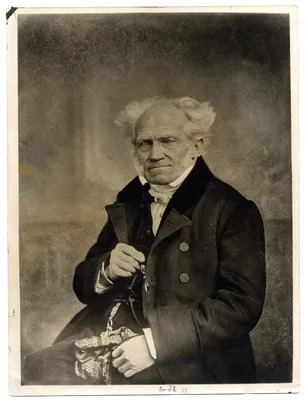
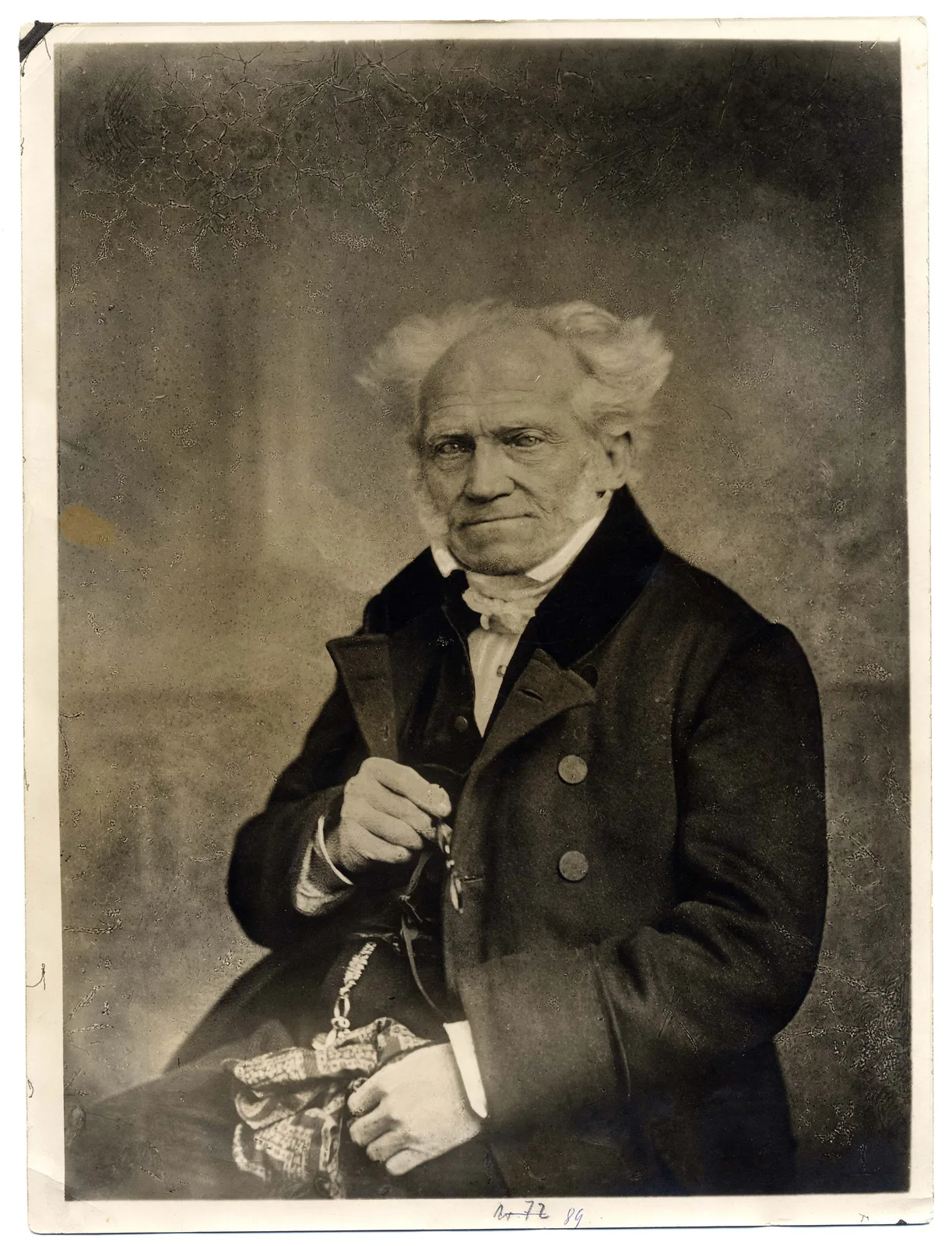
Arthur Schopenhauer was baptised and confirmed in a Danzig church by a family for whom religion was a formality. At fifteen he wrote against English bigotry, and at twenty-three that no one who really philosophizes is religious. From Kant and the Upanishads he built a philosophy with no creator in it (1818). He refused the name "atheist" as absurd and malicious, and proposed "Non-Judaism" in its place. In old age he made a truce with religion as a necessary evil, pleased that his irreligious teaching served some readers as a religion.
The belief timeline
- Faith (1788–1804) — Baptised 1788 and confirmed 1804 in the Marienkirche; but a worldly father "of the school of Voltaire" and a religion that "lay very much outside him" mean this is a nominal faith, not a faith lost. The script must say so [2][3][9][10]
- First crack (1803) — At fifteen, at an English clergyman's school, he writes of "the torch of truth" burning through the darkness of English bigotry; his mother says he gets plenty of Christianity [7][8]
- Doubt (1811–1812) — In Berlin, against Schleiermacher: "Nobody who really philosophizes is religious." A student's claim that philosophy and religion are opposed as such, not a boy's dislike of one school [19][20]
- Declaration (1818–1819) — The World as Will and Representation: a system with no creator, placed in the line of Plato, Kant and the Upanishads. No sentence says "I am an atheist" [26][27]
- Revision (1844–1860) — Philosophy "leaves the gods in peace" (1844), the word "atheism" refused (1847), religion as "a necessary evil" and an allegory the people need (1851), and in 1860 pleasure that his "irreligious" teaching serves "as a religion" [34][35][37][41][49]
Notes to the timeline (15)
- [2] Baptised 3 March 1788 in the Marienkirche, Danzig — Gwinner p. 27; Zimmern p. 14; Wallace p. 30.
- [3] His father Heinrich was a merchant and republican who, in his judgments on the deeper problems of life, was "a disciple of the school of Voltaire"; the son later wrote that he had thought with "the Voltaire whom you honoured" — Wallace p. 25; Zimmern pp. 22–23 (dedication to his father).
- [9] His upbringing left religion "very much outside him — a formal thing, which had never appropriated his whole soul"; he did not go through "inward contests of faith"; Beer: "orthodox religion had always been a mere form"; Wikipedia: both parents came from Protestant backgrounds but were "not very religious" — Wallace p. 17; Beer p. 13; Wikipedia rev. 1379986079 (citing Cartwright 2010 p. 79). Reported at second hand; the original has not been seen.
- [10] Confirmed in September 1804 in the Marienkirche, Danzig, by Deacon Blech; the scans call the church "Protestant" (Zimmern p. 247), "Evangelical" (Wallace p. 212) and "evangelische" (Gwinner p. 201); none of them says "Lutheran" — Gwinner p. 34; Zimmern p. 21; Wallace p. 46.
- [7] July to September 1803 he was boarded at the Wimbledon school of a clergyman named Lancaster and complained of the mechanical instruction and the long Sunday services; Zimmern says he was "greatly plagued by his master's orthodox theology" — Gwinner p. 31; Wallace p. 43; Beer p. 17; Zimmern p. 19.
- [8] In a letter to his parents at fifteen he wrote against English bigotry (Q1); his mother answered that he was getting his full share of Christianity and she could not blame him if it seemed too much (Q2) — Gwinner p. 32.
- [19] From late summer 1811 at Berlin he heard Fichte and Schleiermacher and soon thought himself a better philosopher than either; he took Schleiermacher's remark that philosophy and religion cannot exist apart as the occasion for a counter-note — Wallace pp. 68–69; Zimmern pp. 43–44.
- [20] His marginal note to Schleiermacher: no one religious takes to philosophy; no one who really philosophizes is religious (Q4, Q5) — Wallace p. 69; Zimmern p. 44.
- [26] The book appeared in the last months of 1818 (December, per Zimmern) with the date 1819 on the title page, 725 pages — Wallace p. 108; Zimmern p. 124; Whittaker ch. I.
- [27] The first-edition Preface, "Written at Dresden in August 1818", prepares the reader with Plato, the Vedas through the Upanishads and Kant, and says every Upanishad aphorism can be deduced from his thought but not conversely (Q6, Q7, Q8) — WWR1, Preface to the First Edition.
- [34] In that second volume, at the close of the supplements to Book 1, he writes that philosophy "leaves the gods in peace" (Q14); Wallace quotes it as a note of 1844 — WWR2 (end of the Supplements to Book 1, after ch. XVII); Wallace p. 63.
- [35] In ch. XVII he calls the reproach of atheism "in itself absurd, and for the most part malicious" (Q15), says the creed of the just and good is "I believe in metaphysics" (Q16), says people sacrifice the gods to their own immortality (so would "become zealous for Atheism") and rejects materialism as "absolute physics" without metaphysics; Wallace adds that he scorned materialism not for its atheism but because it leaves no other order of being — WWR2 ch. XVII; Wallace pp. 94–95.
- [37] In Fourfold Root §34 he calls Buddhism "as decidedly and explicitly atheistic, as it is idealistic and ascetic" (Q20), says the word "Atheism" takes theism for granted and proposes "Non-Judaism" (Q19), and says Christianity "has Indian blood in its veins"; Whittaker gives the second edition as 1847; the passage is not in Frauenstädt's list of additions for the third edition (1864) — Fourfold §34; Whittaker ch. I. Accounts differ; see the disputed points.
- [41] In the dialogue Philalethes argues that religion is allegory claiming literal truth, a "necessary evil" resting on the "pitiful imbecility" of the many, which has been paralysing to philosophy and has persecuted; Demopheles replies that religion is the metaphysics of the masses and the only consolation most can bear (Q19–Q25, OQ7–OQ9) — Religion ("Religion: a Dialogue").
- [49] At his last visit, 18 September 1860, Gwinner found him pleased that his writings were a "spring of religious peace and comfort" for unprejudiced non-academic readers; he said it would be a pure boon to attain Nirvana but death held out no prospect of it, and that "he had at least a pure intellectual conscience" (reported speech; Q33, Q34) — Gwinner pp. 199–200; Zimmern pp. 246–247; Wallace p. 212.
Philosophy Leaves the Gods in Peace
On 26 September 1860 Arthur Schopenhauer was buried in the main cemetery at Frankfurt. A Protestant pastor spoke first, in the spirit of the evangelical church. Then his friend and executor Wilhelm Gwinner gave an address, and observed that the state could now calmly let the doctrine be, so that no one would be surprised to see "the atheistic books of Schopenhauer" go unbanned.12
The philosopher himself had refused the word all his life. The charge of atheism, he had written, was "in itself absurd, and for the most part malicious."34 This chapter asks how a boy confirmed in a Danzig church came to write a philosophy with no God in it, why he would not accept the name his readers gave him, and why, at the end, he was pleased that his "irreligious" teaching was serving some of them as a religion.
A merchant's son
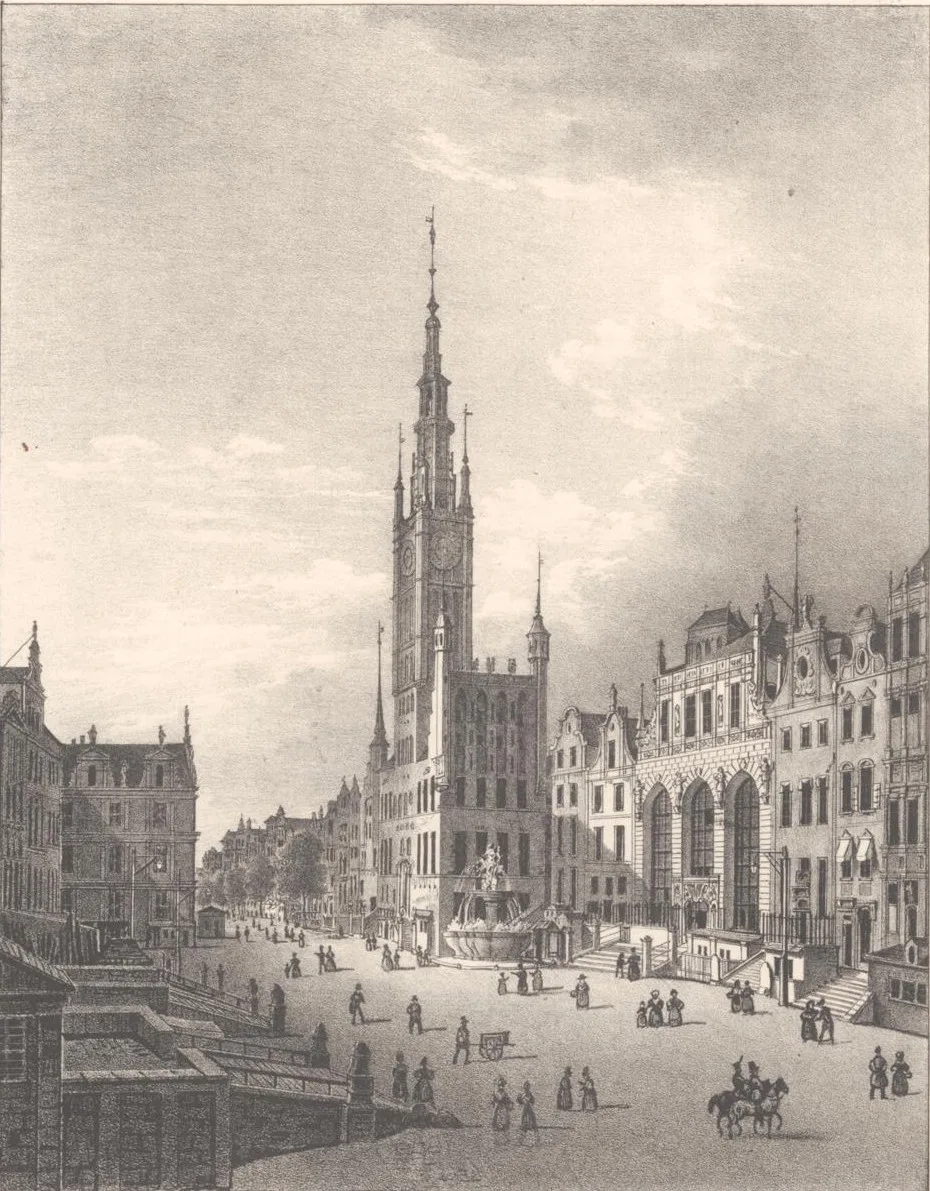
He was born in Danzig on 22 February 1788, the first child of the merchant Heinrich Floris Schopenhauer and Johanna Trosiener, and was baptised on 3 March in the city's great church, the Marienkirche.56 His father was a republican who, in his judgements on the deeper problems of life, was in his biographer's phrase "a disciple of the school of Voltaire"; when Prussia took Danzig in 1793 he moved the family to Hamburg within a day rather than live under the king.78 Religion, his early biographer William Wallace wrote, lay very much outside the boy, a formal thing that never took hold of his whole soul.9
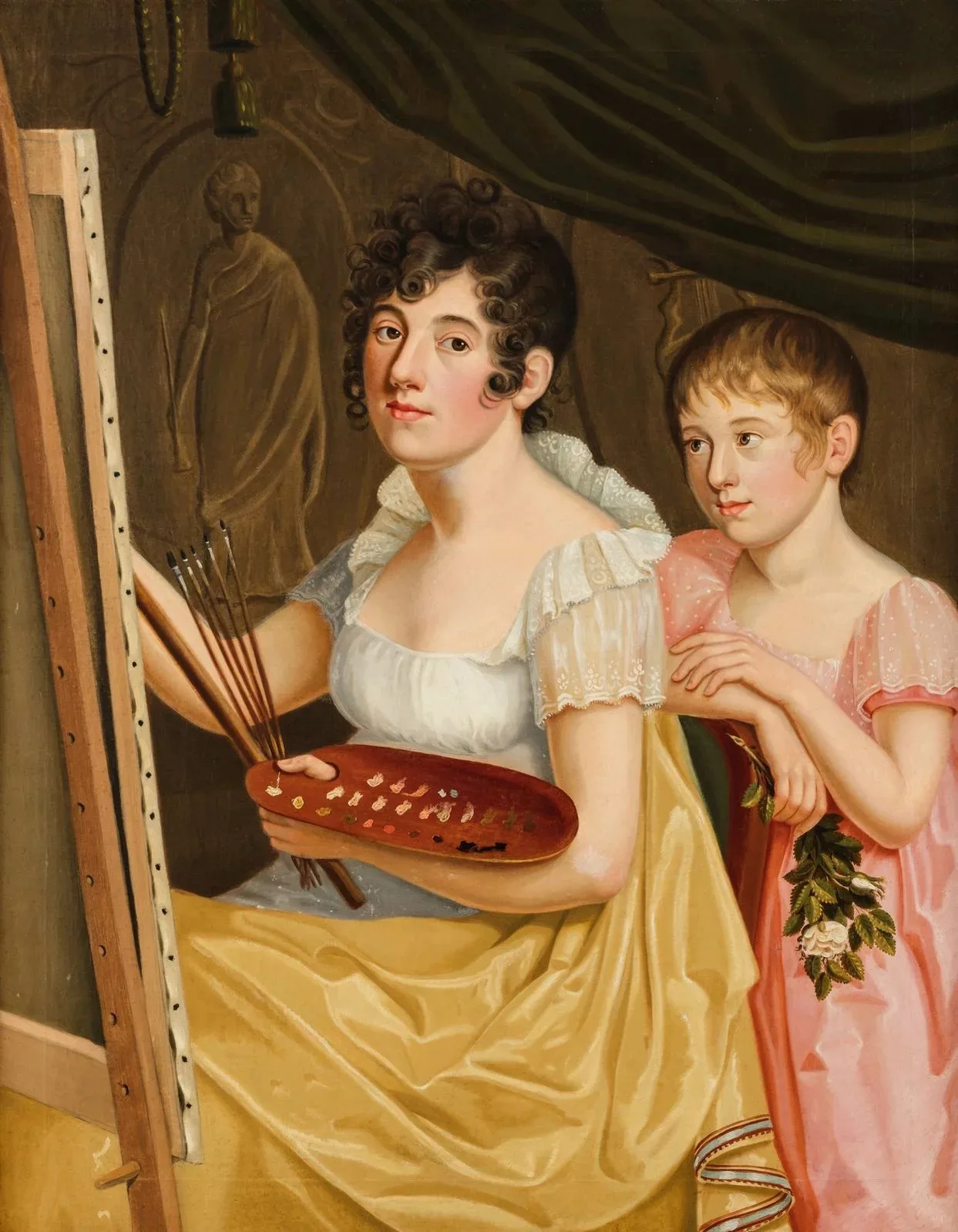
In 1803, at fifteen, he was offered a choice: grammar school and a learned career, or a long tour of Europe and then the counting-house. He chose the tour.10 That summer his parents left him at a clergyman's boarding school in Wimbledon, where he complained of the mechanical teaching and the long Sunday services. He wrote home against English bigotry: "Wenn doch die Fackel der Wahrheit diese Finsternis durchbrennen könnte" (If only the torch of truth could burn through this darkness). His mother answered that he was certainly getting his full share of Christianity, and that she could not blame him if it seemed a little too much.11121314 On the timeline, that is his first crack. The next year, in September 1804, he was confirmed in the Marienkirche where he had been baptised.15 On the belief timeline, the baptism and confirmation stand for his faith, but a nominal one: there is no sign of a felt faith to lose.
Against Schleiermacher
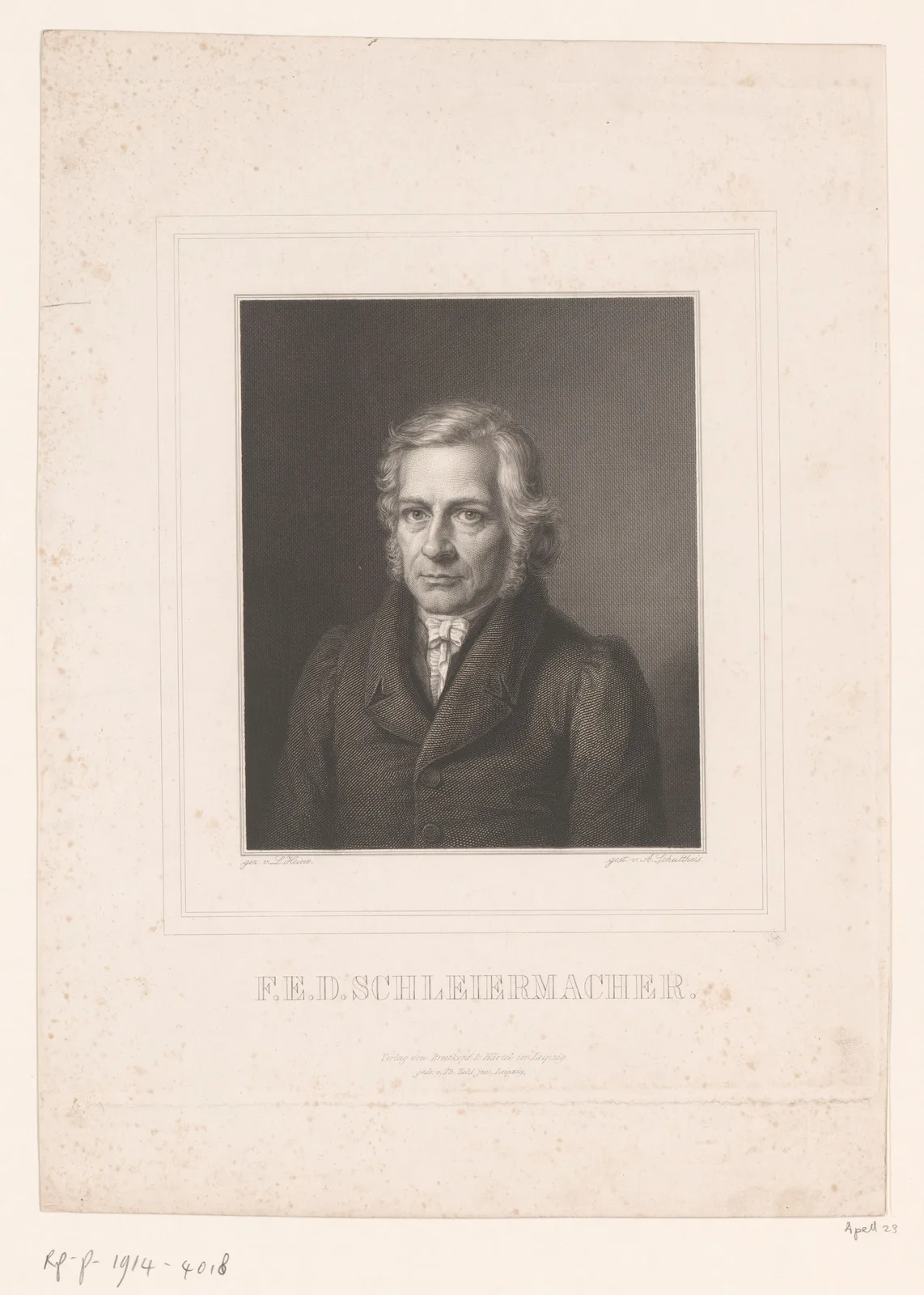
His father died in April 1805, found in the canal below his warehouse; whether it was an accident or suicide was never settled.1617 Arthur stayed two more years in the counting-house out of loyalty, then left to study, first at Göttingen, where the sceptic G. E. Schulze told him to read Plato and Kant before anyone else, and from 1811 in Berlin.18192021 There he heard the theologian Friedrich Schleiermacher lecture that no one could be a philosopher without being religious. In the margin of his notes Schopenhauer wrote the opposite: "No man who is religious takes to philosophy; he does not need it. Nobody who really philosophizes is religious; he walks without leading-strings, dangerous but free."212223 The timeline places his doubt at that note of 1811–12: not a boy's dislike of one school, but a young man's claim that philosophy and religion are opposed in kind.
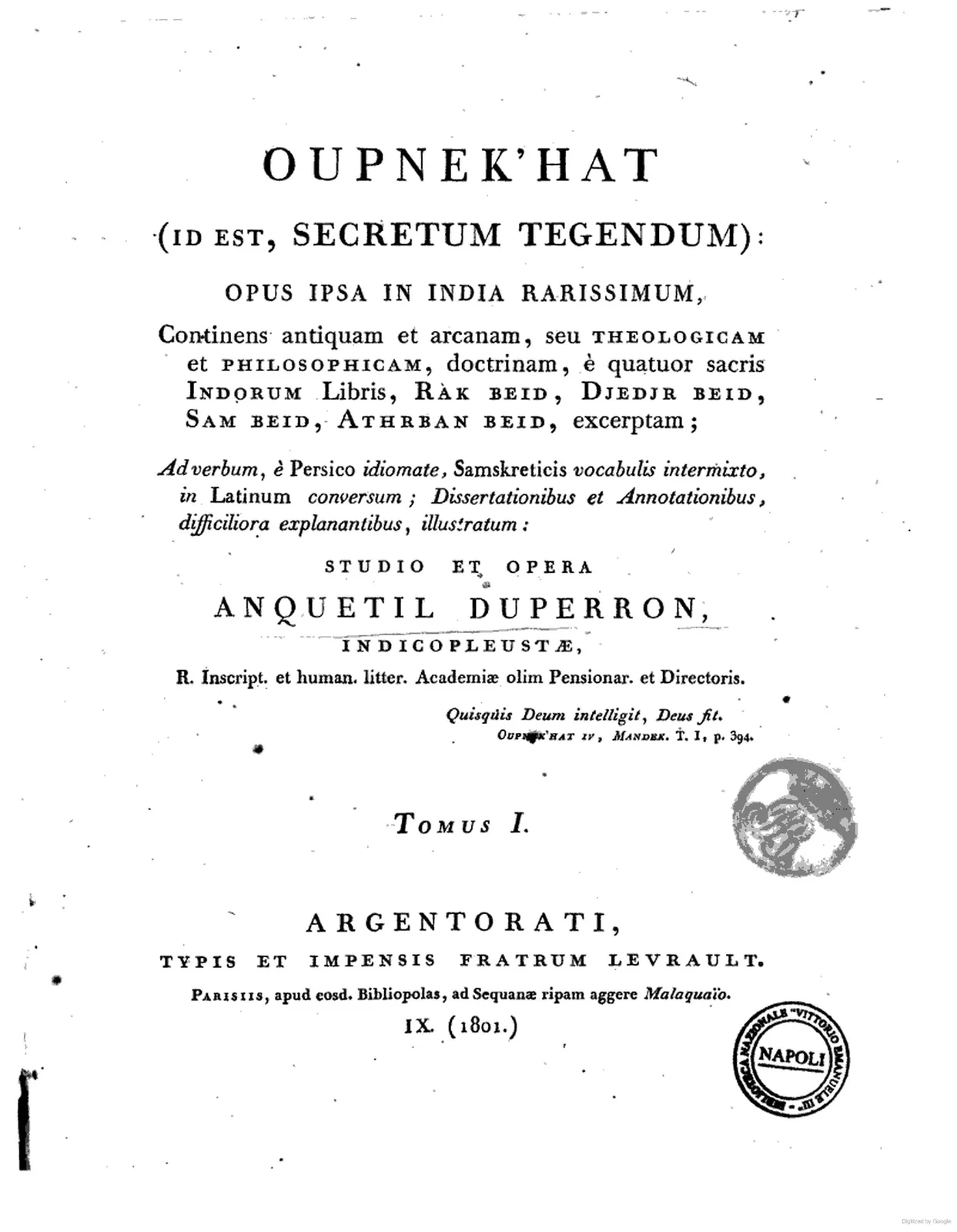
In the winter of 1813–14 at Weimar the orientalist Friedrich Majer introduced him to Indian literature, and he began reading the Upanishads in Anquetil-Duperron's Latin version, the Oupnek'hat. He kept it by his bed for the rest of his life.2425 In it, he wrote later, "the mind is here washed clean of all its early ingrafted Jewish superstition"; "it has been the consolation of my life, and will be the consolation of my death."26
The World as Will
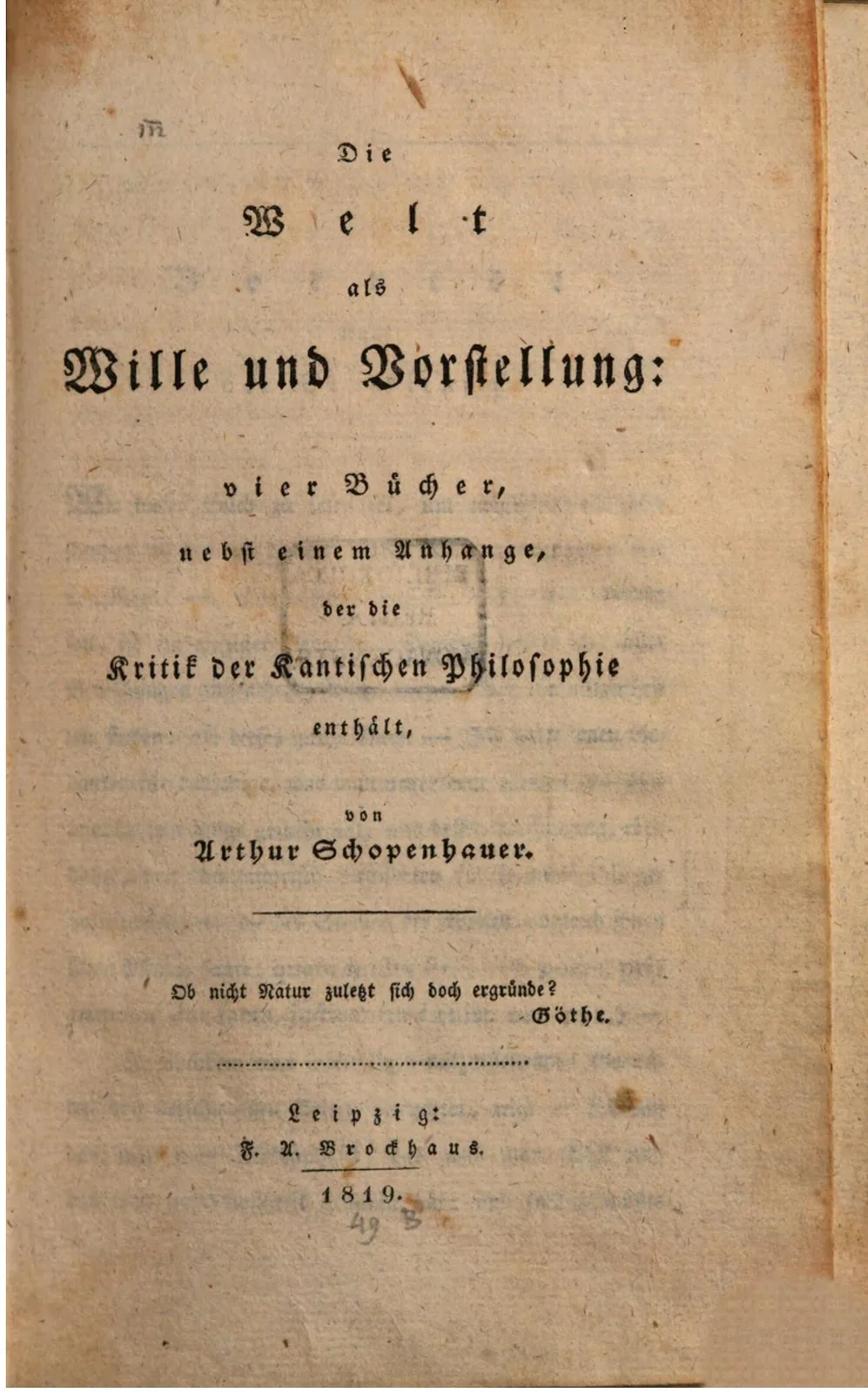
He wrote his great book at Dresden between 1814 and 1818. The World as Will and Representation came out at the end of 1818, its title page dated 1819.2728 Its preface told readers to come to it prepared by Plato, Kant and the Upanishads, and claimed that every aphorism of the Upanishads could be deduced from his thought, though not the other way round.293031 In his notebook in Italy that winter he wrote that "all positive religion is after all a usurper of the throne which belongs by right to philosophy," and that "naked truth is powerless to restrain coarse natures."323334 On the timeline, the book is his declaration: a whole system of the world in which there is no creator, though no sentence in it says "I am an atheist."
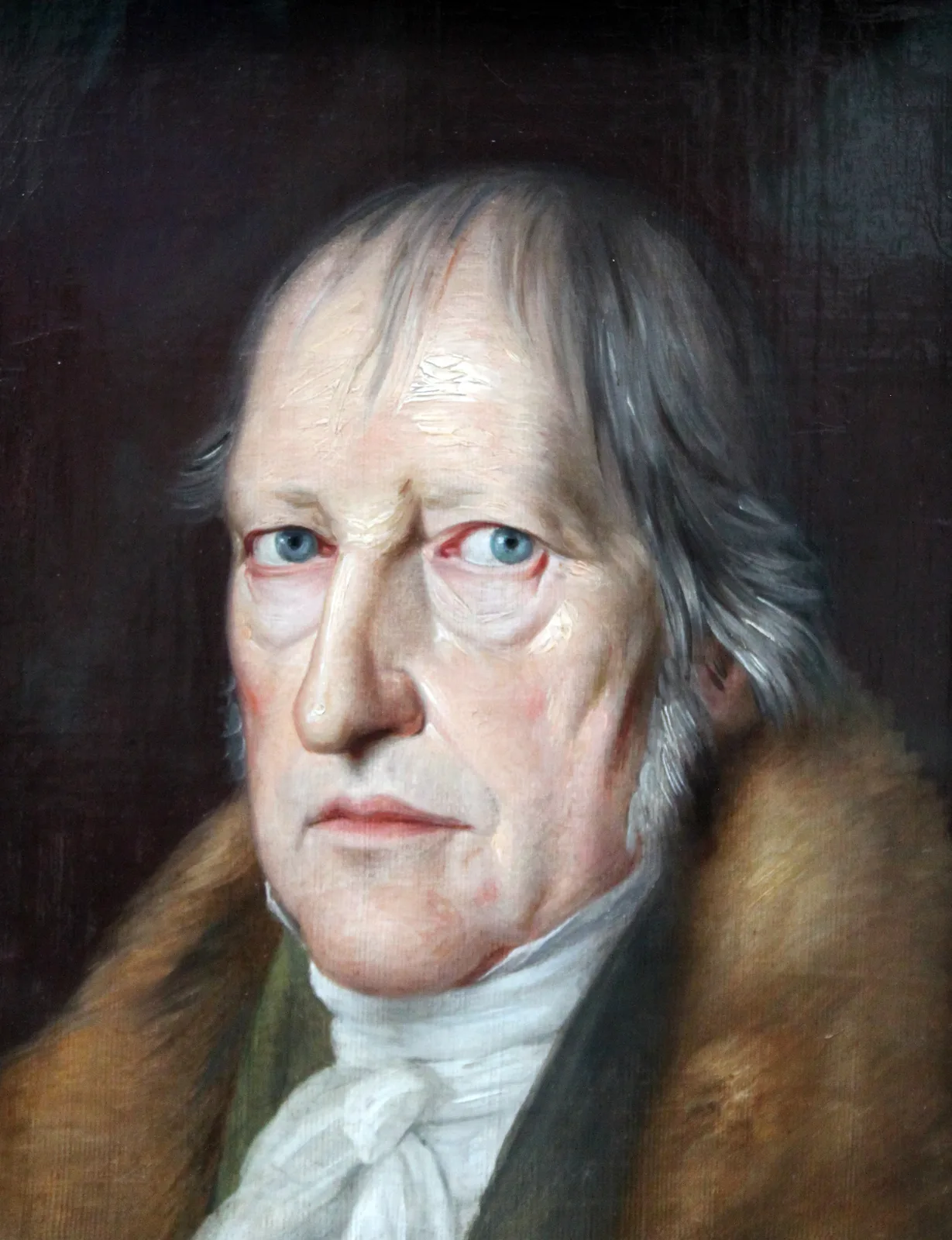
Almost no one read it. In 1820 he lectured in Berlin at the very hour of Hegel's main course, and his course collapsed within a term.35 He fled the cholera of 1831, which killed Hegel, and settled in Frankfurt for good in 1833.36 The next year his publisher told him that most of the first edition had been sold as waste paper.37
Refusing the word
The second edition of 1844 added a second volume, and in it he took up the charge his readers would make. Philosophy, he wrote, "leaves the gods in peace--expects, however, in return, to be left in peace by them."3839 The reproach of atheism was "absurd, and for the most part malicious"; behind it, he thought, lay the fear of a pure materialism, "physics without metaphysics," which he rejected too. The creed of all just and good men, he wrote, was "I believe in metaphysics," by which he meant only that the order of nature is not the only order of things.3440 If he took his own philosophy as the measure of truth, he added, he would have to give Buddhism "the pre-eminence over the rest," though he claimed he had known almost nothing of Buddhism when he wrote his book.414243
In 1847, revising his doctoral thesis, he went further and objected to the word itself. "Atheism," he wrote, takes theism for granted; "it would be more honest to say Non-Judaism instead of Atheism, and Non-Jew instead of Atheist." By "Judaism" he meant the creator-God of Judaism, Christianity and Islam alike, and he called Buddhism "decidedly and explicitly atheistic" as a description, not a charge.444546 His own philosophy, he insisted, said nothing about what lay beyond experience.4748
The necessary evil
In 1851 he published Parerga and Paralipomena, which included a dialogue on religion between Philalethes, the lover of truth, and Demopheles, the friend of the people. Philalethes called religion "a necessary evil, its necessity resting on the pitiful imbecility of the great majority of mankind," and compared it to a wooden leg.49505152 Demopheles gave the believer's case: "Religion is the metaphysics of the masses; by all means let them keep it," and to the philosopher, "Before you take anything away, you must have something better to put in its place."5354 The dialogue ends in a truce. Religion, Demopheles says, has two faces, like Janus, "one friendly, the other sullen. Each of us has kept his eye fixed on one alone," and Philalethes agrees.5556
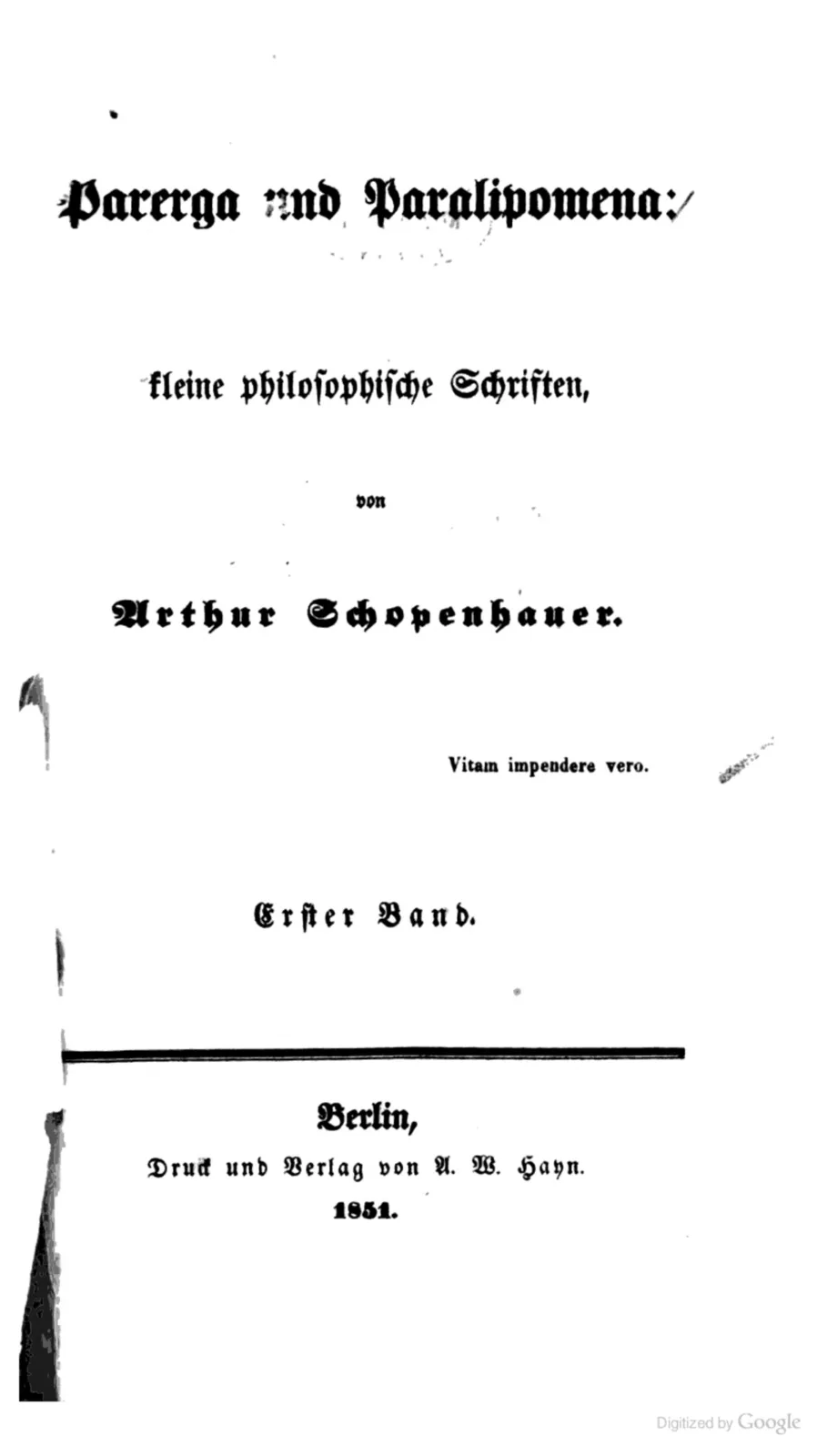
His critics were less generous. The Harvard professor of natural religion Francis Bowen wrote in 1877 that such gloomy views were held "only by avowed skeptics, like Bayle, Hume, and Voltaire, or by open atheists, like Schopenhauer," while believers preached the goodness of the Creator; yet he granted that Schopenhauer had "a positive genius for literature and metaphysics, though unquestionably it was an evil genius."575859 An English reviewer in 1853, praising his style, called the doctrine "the most disheartening, the most repulsive ... that the most ardent of Job's comforters could concoct."6061 The professors in Germany, Gwinner reported, said he owed his late fame to his atheism.62
A religion for the religionless
That fame came at last in the 1850s, after the English review was translated into German.60 From 1856 a gilt Buddha stood in his Frankfurt room beside a bust of Kant, and his poodle was named Atma, the Sanskrit word for the self.63 On the timeline, these years from 1844 to his death are his revision. They did not change his unbelief, but they did change its stance: from war on religion to a philosopher's truce with it, a necessary evil for most people and an allegory he would not take literally.
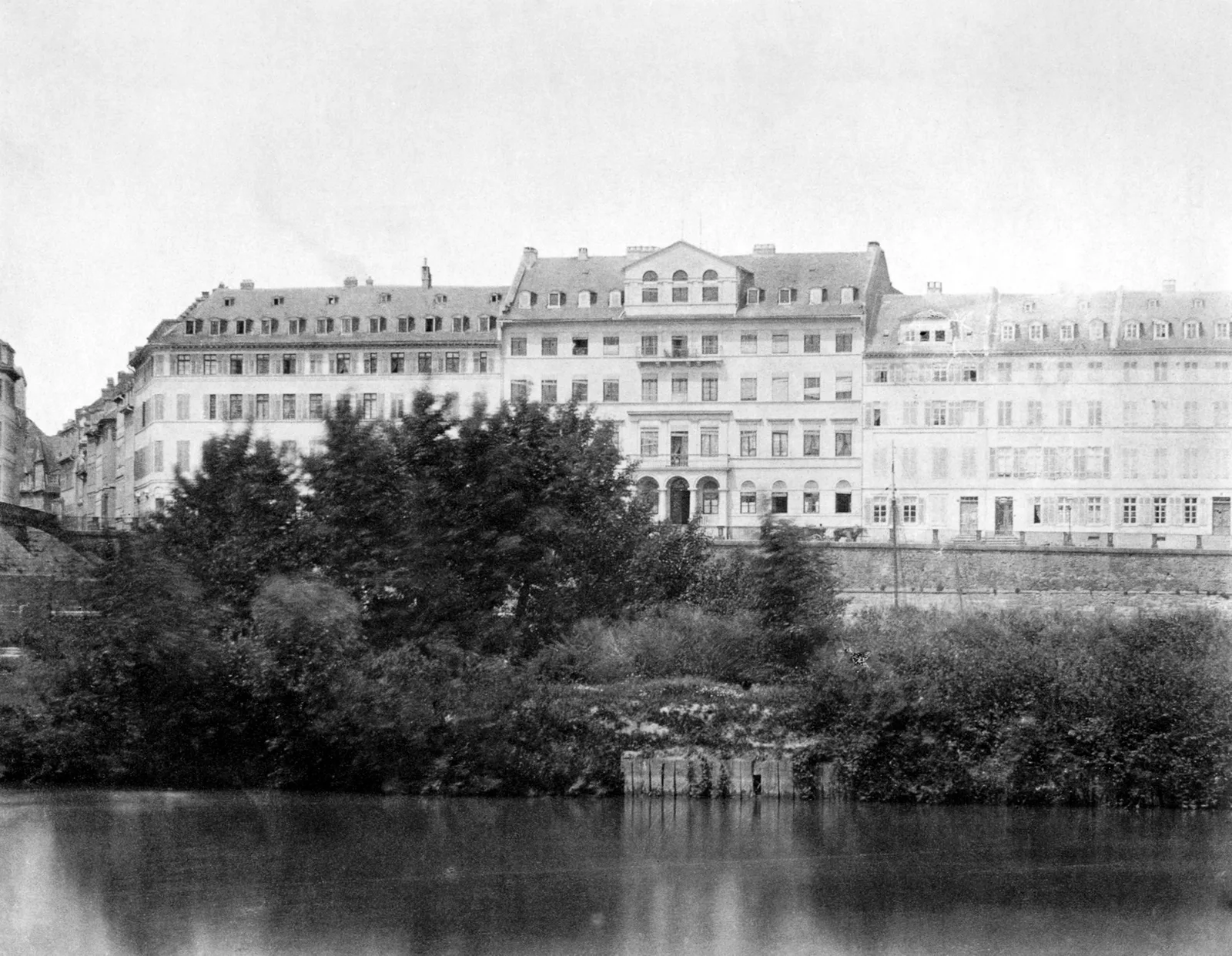
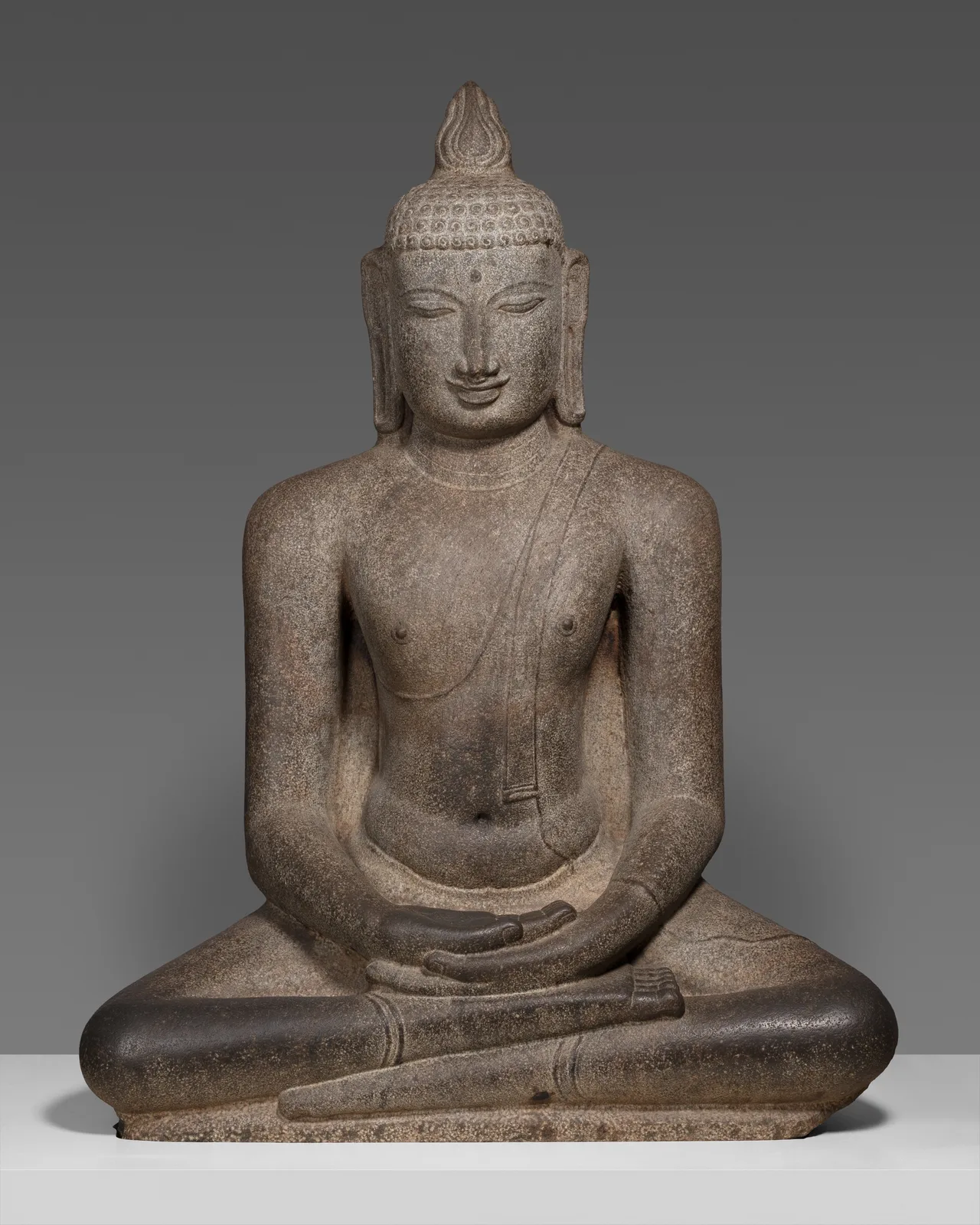
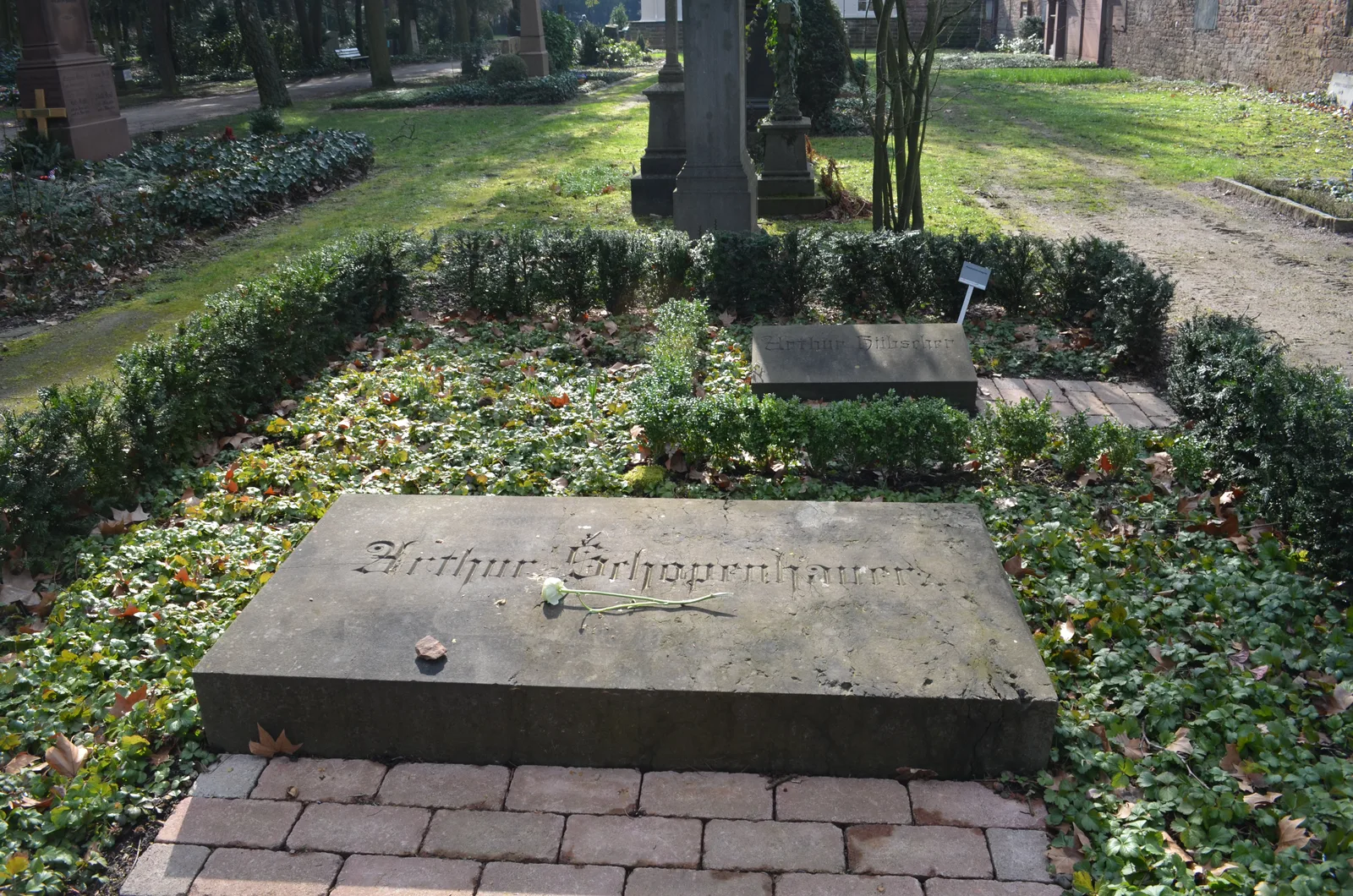
On 18 September 1860 Gwinner found him pleased, above all, that his seemingly wholly irreligious teaching "als Religion anschlugen," took hold as a religion, filling for some readers the place of a lost faith.646566 He said it would be a pure boon to reach Nirvana, but feared death held out no prospect of it; whatever came, he had at least a pure intellectual conscience.6567 Three days later he was found dead on his sofa after breakfast.68 His flat granite gravestone carries only his name.1
Friedrich Nietzsche, who read Schopenhauer as a student, wrote Schopenhauer as Educator, and later turned against his pessimism, has his own chapter in this book.
Footnotes
-
Gwinner p. 205. ↩
-
Gwinner p. 27; Zimmern p. 14; Wallace pp. 29–30. Accounts differ; see the disputed points. ↩
-
Gwinner p. 27; Zimmern p. 14; Wallace p. 30. ↩
-
Wallace p. 25; Zimmern pp. 22–23 (dedication to his father). ↩
-
Zimmern p. 15; Beer p. 17; Wallace p. 38. ↩
-
Wallace p. 17; Beer p. 13; Wikipedia rev. 1379986079 (citing Cartwright 2010 p. 79). Reported at second hand; the original has not been seen. ↩
-
Zimmern p. 19; Beer p. 17. ↩
-
Gwinner p. 31; Wallace p. 43; Beer p. 17; Zimmern p. 19. ↩
-
Gwinner p. 32. ↩
-
Arthur Schopenhauer, aged 15, letter to his parents from Wimbledon, July–September 1803: Gwinner p. 32. ↩
-
Johanna Schopenhauer, his mother, replying: Gwinner p. 32. ↩
-
Gwinner p. 34; Zimmern p. 21; Wallace p. 46. ↩
-
Wallace p. 47; Zimmern p. 21; Gwinner pp. 34–35; Beer p. 18. ↩
-
Wallace p. 47; Gwinner pp. 34–35; Zimmern p. 21; Beer p. 18. ↩
-
Wallace p. 47; Beer p. 18; Zimmern pp. 21–22; Whittaker ch. I. ↩
-
Wallace p. 64; Whittaker ch. I. ↩
-
Wallace p. 66; Whittaker ch. I. ↩
-
Wallace p. 69; Zimmern p. 44. ↩
-
Wallace p. 69. ↩
-
Wallace p. 106; Zimmern p. 69; Wikipedia rev. 1379986079. ↩
-
Wallace pp. 105–106; Beer pp. 13–14; Zimmern p. 166; Gwinner pp. 104, 192. ↩
-
Wallace p. 106 (Wallace's translation). ↩
-
Zimmern pp. 70, 84; Wallace p. 95. ↩
-
Wallace p. 108; Zimmern p. 124; Whittaker ch. I. ↩
-
WWR1, Preface to the First Edition. ↩
-
WWR1, Preface to the First Edition (Haldane–Kemp 1909). ↩
-
WWR1, Preface to the First Edition. ↩
-
Zimmern p. 124. ↩
-
Zimmern p. 124. ↩
-
Zimmern p. 124. ↩
-
Wallace pp. 149–150; Zimmern pp. 135–139; Beer. ↩
-
Wallace pp. 163–164, 167; Zimmern p. 146; Whittaker ch. I. ↩
-
Wallace p. 109; Gwinner pp. 51, 114. ↩
-
WWR2 (end of the Supplements to Book 1, after ch. XVII); Wallace p. 63. ↩
-
WWR2 (after ch. XVII). ↩
-
WWR2 ch. XVII. ↩
-
WWR2 ch. XVII. ↩
-
WWR2 ch. XVII "On Man's Need of Metaphysics" (Haldane–Kemp 1909). ↩
-
WWR2 ch. XVII. ↩
-
Fourfold §34; Whittaker ch. I. ↩
-
Fourfold §34 (Hillebrand). ↩
-
Fourfold §34. ↩
-
WWR3 ch. L. ↩
-
WWR3 ch. L. ↩
-
Zimmern p. 237; Wallace pp. 198–199; Whittaker ch. I. ↩
-
Religion ("Religion: a Dialogue"). ↩
-
Philalethes: Religion. ↩
-
Philalethes: Religion. ↩
-
Demopheles, the believer's voice in the "Religion" dialogue; written by Schopenhauer himself: Religion, first speech. ↩
-
Demopheles: Religion. ↩
-
Religion (end of dialogue; Saunders's Prefatory Note). ↩
-
Demopheles, last speech but one; Philalethes answers "You are right, old fellow.": Religion, close. ↩
-
Wallace pp. 63, 95; Gwinner p. 205; Bowen pp. 389, 418. ↩
-
Francis Bowen, Alford Professor of Natural Religion and Moral Philosophy, Harvard (1877; writing seventeen years after Schopenhauer's death): Bowen p. 418. ↩
-
Bowen, in the same chapter, crediting what he credits: Bowen p. 390. ↩
-
[John Oxenford], Westminster Review, April 1853: a liberal English reviewer who praised his style and clarity while rejecting the doctrine; not a believer: Oxenford p. 394. ↩
-
Wilhelm Gwinner, 1862, reporting what the professors of philosophy said of him after his death (my translation: "they now turn Schopenhauer's reproach that their theism goes after bread and makes a career back on him, and say that he owes his fame to his atheism"): Gwinner pp. 11–12. ↩
-
Wallace pp. 209–210; Gwinner pp. 192, 194; Zimmern p. 166. ↩
-
Wallace p. 203; Gwinner p. 199. ↩
-
Gwinner pp. 199–200; Zimmern pp. 246–247; Wallace p. 212. ↩ ↩2
-
Gwinner, reporting Schopenhauer's last days: Gwinner p. 199. ↩
-
Zimmern, reporting Schopenhauer to Gwinner, 18 September 1860: Zimmern pp. 246–247. ↩
-
Zimmern p. 247; Whittaker ch. I; Gwinner p. 200. ↩
In their own words
„Wenn doch die Fackel der Wahrheit diese Finsternis durchbrennen könnte."
„Von dem Christenthum kriegst du dein reichlich Theil und ich kann es dir nicht verdenken, wenn es dir etwas zuviel dünkt."
"If we take out of life its few moments of religion, of art, and of pure love, what is left but a long series of trivial thoughts?"
"No man who is religious takes to philosophy; he does not need it. Nobody who really philosophizes is religious; he walks without leading-strings, dangerous but free."
"No one who is religious arrives as far as philosophy; he does not require it. No one who really philosophizes is religious; he walks without leading strings; his course is hazardous but unfettered."
"And if, indeed, in addition to this he is a partaker of the benefit conferred by the Vedas, the access to which, opened to us through the Upanishads, is in my eyes the greatest advantage which this still young century enjoys over previous ones"
"if, I say, the reader has also already received and assimilated the sacred, primitive Indian wisdom, then is he best of all prepared to hear what I have to say to him."
"each one of the individual and disconnected aphorisms which make up the Upanishads may be deduced as a consequence from the thought I am going to impart, though the converse, that my thought is to be found in the Upanishads, is by no means the case."
"And, oh! how the mind is here washed clean of all its early ingrafted Jewish superstition, and all philosophy servile to that superstition! It is the most profitable and the most elevating reading, which, (the original text excepted) is possible in the world. It has been the consolation of my life, and will be the consolation of my death."
"If I were to take the results of my philosophy as the standard of truth, I would be obliged to concede to Buddhism the pre-eminence over the rest."
"This agreement, however, must be the more satisfactory to me because in my philosophising I have certainly not been under its influence. For up till 1818, when my work appeared, there were very few, exceedingly incomplete and scanty, accounts of Buddhism to be found in Europe"
"Religions are necessary for the people, and an inestimable benefit to them. But if they oppose themselves to the progress of mankind in the knowledge of the truth, they must with the utmost possible forbearance be set aside."
"Now my philosophy is by no means so constituted that any one can live by it. It lacks the first indispensable requisite of a well-paid professional philosophy, a speculative theology, which—in spite of the troublesome Kant with his Critique of Reason—should and must, it is supposed, be the chief theme of all philosophy"
"For the rest, philosophy is essentially world-wisdom: its problem is the world. It has to do with this alone, and leaves the gods in peace—expects, however, in return, to be left in peace by them."
"Indeed behind the reproach of atheism, in itself absurd, and for the most part malicious, there lies, as its inner meaning and truth, which gives it strength, the obscure conception of such an absolute system of physics without metaphysics."
"Therefore we may set up this as the necessary Credo of all just and good men: “I believe in metaphysics.”"
"My philosophy does not pretend to explain the existence of the world in its ultimate grounds: it rather sticks to the facts of external and internal experience as they are accessible to every one"
"It therefore arrives at no conclusions as to what lies beyond all possible experience, but affords merely an exposition of what is given in the external world and in self-consciousness"
"the word Atheism itself implies a surreptitious assumption, since it takes Theism for granted as a matter of course. It would be more honest to say Non-Judaism instead of Atheism, and Non-Jew instead of Atheist."
"it is as decidedly and explicitly atheistic, as it is idealistic and ascetic"
"I respect truth everywhere, and so I can't respect what is opposed to it."
"Hardly one in ten thousand will have the strength of mind to ask himself seriously and earnestly--is that true?"
"Religion must be regarded as a necessary evil, its necessity resting on the pitiful imbecility of the great majority of mankind, incapable of grasping the truth, and therefore requiring, in its pressing need, something to take its place."
"Ah! just as a wooden leg takes the place of a natural one; it supplies what is lacking, barely does duty for it, claims to be regarded as a natural leg, and is more or less artfully put together."
"Let us rather admit that religion, like Janus, or better still, like the Brahman god of death, Yama, has two faces, and like him, one friendly, the other sullen. Each of us has kept his eye fixed on one alone."
"Whoever seriously thinks that superhuman beings have ever given our race information as to the aim of its existence and that of the world, is still in his childhood. There is no other revelation than the thoughts of the wise, even though these thoughts, liable to error as is the lot of everything human, are often clothed in strange allegories and myths under the name of religion."
"Noble, beneficent spirit! to whom I owe all that I am, your protecting care has sheltered and guided me not only through helpless childhood and thoughtless youth, but in manhood and up to the present day."
"People like Fichte, Schelling, or Hegel, should be shut out from the ranks of philosophers, as of yore the dealers and money-changers were cast out of the Temple."
"Hegel's philosophy is just calculated for the specious wisdom pronounced ex cathedra, inasmuch as instead of thoughts it contains mere words, and the boys want words to copy and take home with them; they do not want thoughts. Added to this that their results do not differ from the axioms of the natural religion, which all have imbibed with their mother's milk"
"All positive religion is after all a usurper of the throne which belongs by right to philosophy; philosophers will therefore always oppose it, even if they should regard it as a necessary evil, a crutch for the sickly weakness of most minds."
"Naked truth is powerless to restrain coarse natures and keep them from wrong and cruelty, because they cannot grasp it. Hence the need of fallacies, stories, parables, and positive doctrines."
„Am meisten aber freute es Ihn, wenn er immer neue Beweise erhielt, dass seine scheinbar gänzlich irreligiösen Lehren „als Religion anschlugen" und, den leergewordenen Platz des verlorenen Glaubens ausfüllend, zur Quelle innerster Beruhigung und Befriedigung wurden."
"Still, he added, it would be a pure boon to him if he could attain Nirwana, but he feared death held out no prospect of that. In any case, come what might, he had at least a pure intellectual conscience."
"he ... expressed his joy that they had in the unbiassed minds of the non-academic world been found a spring of religious peace and comfort."
The other side
"these gloomy and misanthropic views of human life are held only by avowed skeptics, like Bayle, Hume, and Voltaire, or by open atheists, like Schopenhauer. Believers, such as Leibnitz, Barrow, Tucker, Paley, and others, either preach Optimism, or so great a preponderance of good over evil, even in this world, as amply to vindicate the goodness of its Creator."
"He forgets the declaration of the Saviour, that “I am come a light into the world, that whosoever believeth on me should not abide in darkness;” “for I came not to judge the world, but to save the world.”"
"In his books, he appears as a misanthrope, a pessimist, and an atheist; a hater of this world and of everybody in it, and one who believed in nothing except his own merits, and the injustice with which he was treated by his contemporaries."
"The man had a positive genius for literature and metaphysics, though unquestionably it was an evil genius."
"the doctrine taught is the most disheartening, the most repulsive, the most opposed to the aspirations of the present world, that the most ardent of Job’s comforters could concoct."
"Two articles in the last number of J. H. Fichte’s philosophical “Zeitschrift” still more clearly show that Schopenhauer, if he is not liked, is, at any rate, deemed formidable."
"Religion is the metaphysics of the masses; by all means let them keep it: let it therefore command external respect, for to discredit it is to take it away."
"Religion isn't a deception: it is true and the most important of all truths."
"Yes, if you had truth in your pocket, ready to favor us with it on demand. All you've got are metaphysical systems, in which nothing is certain but the headaches they cost. Before you take anything away, you must have something better to put in its place."
„Ja, sie kehren Schopenhauers Vorwurf: ihr Theismus gehe nach Brot und mache Karriere, nunmehr um und sagen: er verdanke seinen Ruhm seinem Atheismus"
Where accounts differ
| Point | One account | Another | How the page handles it |
|---|---|---|---|
| Father's death, April 1805 | Accident: he fell from the granary opening; it would be natural for him to inspect the warehouse (Zimmern p. 21; Wallace p. 47 "whether accident or frenzy ... uncertain"; Beer p. 18) | Suicide: Gwinner, from indirect remarks by the widow and son, says there is "hardly any doubt" the rumour of suicide "was well founded" (pp. 34–35); Wallace says "the balance of suspicion inclines" to it | "Accounts differ"; say it was never settled, and that his mother and he believed it was suicide on Gwinner's report |
| "Lutheran upbringing" | The roster angle: a Lutheran upbringing in Danzig and Hamburg. Wikipedia: Protestant parents "not very religious" (Cartwright 2010 p. 79) | The scans say only "Protestant", "Evangelical" and "evangelische Kirche" (Zimmern p. 247; Wallace p. 212; Gwinner p. 201), and describe a father of Voltaire's school and religion as "a formal thing" (Wallace pp. 17, 25) | Say "baptised and confirmed in the Protestant church"; do not call it a devout Lutheran home. Check for "Lutheran" in a scan before using the word |
| Was he an atheist? | Gwinner, Bowen and Wallace call the books or the philosophy atheistic (Gwinner p. 205; Bowen pp. 389, 418; Wallace p. 63) | He calls the charge "absurd, and for the most part malicious" (Q15) and the word "Atheism" a hidden assumption (Q19); he lets Buddhism be "atheistic" as a description (Q20); he says his philosophy says nothing about what lies beyond experience (Q17, Q18) | Present the label as other people's; give his own refusal; use "unbeliever" or "without God" for the series, not "atheist", for him |
| Was Buddhism an influence? | He says no: "in my philosophising I have certainly not been under its influence", since little was known of Buddhism before 1818 (Q11) | He read the Upanishads from 1813–14 (Majer, Wallace p. 106, Zimmern p. 69), and the preface of 1818 puts them beside Plato and Kant (Q6, Q7) | Say the Indian texts he read were the Upanishads, not Buddhist scripture; the Buddhist agreement came, in his own account, after. Whittaker (ch. I, ch. V) says calling his doctrine "a kind of Buddhism" is "in some ways a misapprehension" |
| Was he the dialogue's Philalethes? | Philalethes argues the case he argues elsewhere (religion as allegory, "necessary evil", Q23; Q30 notebook of 1818) | Saunders says he chose the dialogue form because he "could not side with either view to the exclusion of the other"; Philalethes concedes religion's two faces and "You are right, old fellow" (Q25) | Quote Philalethes as his case and Demopheles as the best case against it, and say the dialogue ends in truce |
| Date of the "Non-Judaism" sentence | Whittaker: Fourfold Root second edition 1847; the sentence is not in Frauenstädt's list of new passages for the third edition (1864), so it was in 1847 at the latest | The Haldane/Hillebrand texts are of later editions and do not date it | Say "in the 1847 revision of an early essay" only after checking the 1847 text; otherwise say "by the 1850s" |
| First edition year | Title page: 1819 (Wallace p. 108; Whittaker ch. I) | Published December 1818 (Zimmern p. 124); Wallace "last months of 1818" | "Published at the end of 1818; the title page says 1819" |
| Birth house | Wallace p. 29: No. 117, Heiligengeiststrasse | Gwinner p. 27: No. 112 (OCR unclear, later renumbered) | Do not give a number; "a house in the Heiligengeiststrasse" |
| Funeral minister's church | Wikipedia: "a Lutheran minister" (citing Zimmern 1932 and Lewis 2013) | Zimmern p. 247: "a Protestant clergyman"; Wallace p. 212: "Evangelical service"; Gwinner p. 201: "im Geiste der evangelischen Kirche" | "A Protestant pastor" |
List of illustrations
This page uses only public-domain and Creative Commons images; each is credited with its source and licence.
- Arthur Schopenhauer, portrait photograph, March 1859 — Johann Schäfer, March 1859 · Frankfurt am Main University Library (Universitätsbibliothek), via Wikimedia Commons · Public domain (Wikimedia Commons licence field: "Public domain"; work created before 1931)
- Danzig, the Long Market in 1838 — Heinrich Wilhelm Teichgräber, 1838 · Düsseldorf University and State Library (digital.ub.uni-duesseldorf.de), via Wikimedia Commons · Public domain (Wikimedia Commons licence field: "Public domain"; work created before 1931)
- Johanna and Adele Schopenhauer (detail) — Caroline Bardua, 1806 · Via Wikimedia Commons (source given as tlz.de) · Public domain (Wikimedia Commons licence field: "Public domain"; work created before 1931)
- Portrait of Friedrich Ernst Daniel Schleiermacher (print after a painting by Ludwig Heine) — Albrecht Schultheiss, after Ludwig Heine; printer Thomas Zehl, 1833 · Rijksmuseum, Amsterdam, RP-P-1914-4018 (CC0), via Wikimedia Commons · CC0 (Wikimedia Commons licence field: CC0 1.0; Rijksmuseum Open Data)
- Oupnek'hat (id est, secretum tegendum), vol. I, title page, ed. Anquetil-Duperron (Strasbourg: Levrault, 1801) — Anquetil-Duperron (translator), from a Persian version of the Upanishads, 1801 · Internet Archive, item bub_gb_W6rJKQZ3zmQC (copy with a Naples library stamp, digitised by Google) · Public Domain Mark 1.0 (http://creativecommons.org/publicdomain/mark/1.0/), as stated on the Internet Archive item
- Die Welt als Wille und Vorstellung, first edition (Leipzig: F. A. Brockhaus), title page — Arthur Schopenhauer, 1819 (title page date) · Internet Archive, item 10860419 (scan of a copy stamped Bibliotheca Regia Monacensis) · Public domain (published before 1931; the Internet Archive item states no rights)
- Georg Wilhelm Friedrich Hegel, oil portrait — Jakob Schlesinger, 1831 · Photograph of the painting by anagoria, via Wikimedia Commons · Public domain (Wikimedia Commons licence field: "Public domain"; work created before 1931)
- Parerga und Paralipomena, vol. I (Berlin: A. W. Hayn), title page — Arthur Schopenhauer, 1851 (title page date) · Internet Archive, item bub_gb__nERAAAAYAAJ (Harvard College Library copy, digitised by Google) · Public Domain Mark 1.0 (http://creativecommons.org/publicdomain/mark/1.0/), as stated on the Internet Archive item
- The Schopenhauer house on the Schöne Aussicht, Frankfurt am Main — Carl Friedrich Mylius, 1861 · Mayer-Wegelin, Frühe Photographie in Frankfurt am Main 1839-1870 (1982), via Wikimedia Commons · Public domain (Wikimedia Commons licence field: "Public domain"; work created before 1931)
- Buddha Shakyamuni Seated in Meditation (Dhyanamudra) — India, Nagapattinam, Tamil Nadu (Chola period), about 12th century · Art Institute of Chicago, 1964.556, purchased with funds provided by Mr. and Mrs. Robert Andrew Brown (CC0) · CC0 (public domain), as stated by the Art Institute of Chicago
- Grave of Arthur Schopenhauer, Frankfurt Hauptfriedhof (A 24) — Karsten Ratzke, 2016-02-26 · Karsten Ratzke, own work, CC0, via Wikimedia Commons · CC0 (Wikimedia Commons licence field: CC0 1.0, http://creativecommons.org/publicdomain/zero/1.0/deed.en)
Sources
Tier 1 — the subject's own words (writings, letters, diaries, trial records)
- WWR1 Schopenhauer, The World as Will and Idea, vol. I, tr. R. B. Haldane and J. Kemp (Kegan Paul, Trench, Trübner, seventh edition, 1909). Project Gutenberg #38427; file
research/texts/wwr1.txt. Contains the Preface to the First Edition (Dresden, August 1818) and the Preface to the Second Edition (Frankfurt, February 1844). - WWR2 The same, vol. II (sixth edition, 1909), Gutenberg #40097;
wwr2.txt. Contains the Criticism of Kant and the Supplements to Books 1 and 2, including Chapter XVII "On Man's Need of Metaphysics". - WWR3 The same, vol. III (Gutenberg #40868);
wwr3.txt. Supplements to Books 2–4, including Ch. XXXVIII "On History" and Ch. L "Epiphilosophy". - Fourfold Schopenhauer, On the Fourfold Root of the Principle of Sufficient Reason, and On the Will in Nature, tr. Mme Karl Hillebrand (Bell, Bohn's Library; revised edition; year not printed in the e-text). Gutenberg #50966;
will-in-nature.txt. The 1847 second-edition text of the Fourfold Root §34 holds the "Non-Judaism" passage. - Religion Schopenhauer, "Religion: a Dialogue" and "The Christian System", in The Essays of Arthur Schopenhauer: Religion, a Dialogue, Etc., tr. T. Bailey Saunders (imprint and year not printed in the e-text). Gutenberg #10833;
religion.txt. The dialogue is from Parerga and Paralipomena (1851), vol. II; "The Christian System" is Saunders's assembled extract, not a single chapter (see Open questions). Cited by section; the e-text has no page numbers. - Notebooks, letters and the Nachlass are known here only through the biographers below (Zimmern, Wallace, Gwinner).
Tier 2 — scholarly biographies and encyclopedias
- Zimmern Helen Zimmern, Arthur Schopenhauer: His Life and His Philosophy (London: Longmans, Green, 1876). Internet Archive
arthurschopenha00zimmuoft;zimmern.txt. OCR, double-spaced; page numbers from the running heads. - Wallace William Wallace, Life of Arthur Schopenhauer ("Great Writers" series, London: Walter Scott, 1890). Internet Archive
cu31924029078545;wallace.txt. Includes a bibliography of critical articles. - Gwinner Wilhelm Gwinner, Arthur Schopenhauer aus persönlichem Umgang dargestellt (first edition 1862; this scan is the 1922 reissue of the first edition, ed. Charlotte von Gwinner, Leipzig: Brockhaus). Internet Archive
arthurschopenhau00gwin;gwinner.txt. In German; translations are mine and flagged. Gwinner was the friend and executor; Tier 2 with eye-witness standing. - Whittaker Thomas Whittaker, Schopenhauer ("Philosophies Ancient and Modern", London: Archibald Constable, 1909). Gutenberg #38283;
whittaker.txt. No page numbers; cited by chapter. - Beer Margrieta Beer, Schopenhauer (London: T. C. & E. C. Jack, People's Books; the e-text is c. 1914, the series list printed in it is dated February 1914). Gutenberg #47136;
beer.txt. Cited by the {n} page markers.
Tier 3 — popular biographies and journalism
- None used. Cartwright, Schopenhauer: A Biography (Cambridge University Press, 2010), Safranski (1987/1989) and Clarke, Oriental Enlightenment (Routledge, 1997) are in copyright and were not read; they are cited only as they appear in the Wikipedia article below.
Tier 4 — Wikipedia and similar reference sites (citable; give the article and revision date; prefer a higher tier where one exists)
- Wikipedia "Arthur Schopenhauer", English Wikipedia, revision 1379986079 of 2026-10-13T02:33:43Z (saved as
research/texts/wikipedia-schopenhauer.json). Used only for the Majer date (citing Clarke 1997, pp. 67–68, and Safranski) and for the statement that his parents were Protestant but "not very religious" (citing Cartwright 2010, p. 79). Claims resting on it alone are marked.
Opposition sources — contemporary critics and religious responses
- Oxenford [John Oxenford], "Iconoclasm in German Philosophy", The Westminster Review, vol. 59 (new series vol. 3), April 1853, pp. 388 ff. (authorship "understood to be" Oxenford per Zimmern p. 1 n. 1, Wallace p. 197). Internet Archive
sim_westminster-review_1853-04-01_59_2;westminster-1853-04.txt. A liberal English reviewer, not a believer, but a critic of the doctrine. - Bowen Francis Bowen, Modern Philosophy from Descartes to Schopenhauer and Hartmann (New York: Charles Scribner's Sons, third edition, 1877). Internet Archive
modernphilosophy00boweuoft;bowen.txt. Bowen was Alford Professor of Natural Religion and Moral Philosophy at Harvard (title page). Chapter XXI, "Arthur Schopenhauer". - Religion (above): Demopheles, the believer's voice in the dialogue, written by Schopenhauer.
- Sully, Pessimism: a History and a Criticism (1877, IA
pessimismhistory00sull) was downloaded (sully.txt) but not yet used; Gwinner's preface and funeral address are also used as evidence of what his opponents said.
Related lives
Friedrich Nietzsche (episode 12) — he read Schopenhauer as a student, wrote "Schopenhauer as Educator", and later reacted against the pessimism (Beer pp. 49–50).
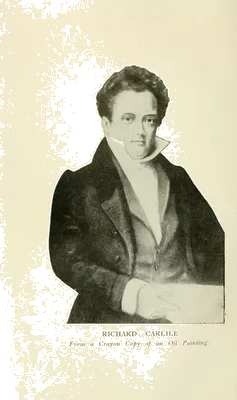
Richard Carlile
Richard Carlile was a Devon tinman who burned Paine in effigy as a boy. He turned to radical publishing in the hunger of 1816–17. The prosecutions he courted, and six years of study in Dorchester gaol, made him a Deist and then an atheist. After 1833 he recast his unbelief as an allegorical Christianity, while insisting he had not recanted a sentence.
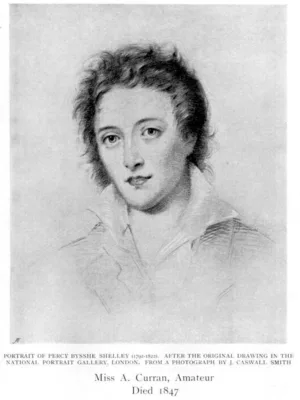
Percy Bysshe Shelley
Shelley hated the cruelty of believers before he doubted their God. He reasoned his way from Hume and Locke to The Necessity of Atheism at eighteen, was expelled from Oxford for it, and later lost his children partly on the same ground. In his last years he turned the word atheist from a creed into a gauntlet thrown down against superstition and oppression.
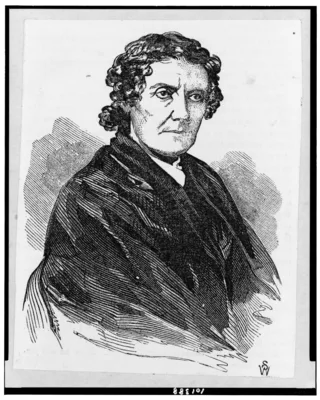
Frances Wright
Frances Wright was an orphan who lost a devout childhood faith to the libraries around her and to Epicurus. She kept her unbelief private for fifteen years while she worked for liberty and against slavery. She went public in 1828 because she believed the American churches were reaching for political power through women's minds. In middle age she took back the word "religion" for a human bond of union, while still declining to speak of God.
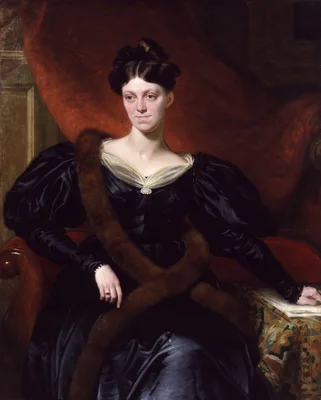
Harriet Martineau
Harriet Martineau was a devout Unitarian child. At twenty she took the doctrine of Necessity from her brother James, and watched it wear her faith away over many years. She let go of the last of it in five years of illness and bereavement at Tynemouth, and on her Eastern journey of 1846–47 she saw every religion as human history. In 1851 she said in print that she knew nothing whatever about God, an atheist only "in the vulgar sense", at the cost of her brother's lasting enmity and with no dread of the annihilation she expected.