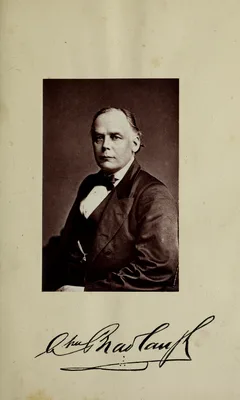
A Sunday-school teacher's honest question got Charles Bradlaugh called an atheist before he was one. Driven from home at sixteen for refusing to pretend, he thought his way from deism to a defined atheism alone in a barrack-room. He then spent forty years turning his unbelief into law: the right to testify, to publish, and to sit in Parliament without swearing to a God he found meaningless.
The belief timeline
- Faith (1847) — Sunday-school teacher at St Peter's, Hackney Road, chosen for confirmation; "I should have shuddered at the notion of becoming an Atheist" [5][6]
- Doubt (1848–49) — The Articles and the Gospels "differed"; suspended for asking; the Savage debate; three days to "change my opinions"; he leaves home instead [6][9][10]
- Declaration (1859) — The Bowes debate at Northampton: "As an Atheist he denied the God of the Bible, of the Koran, of the Vedas, but he could not deny that of which he had no knowledge" [25]
- The oath (1880–1886) — Six years, four elections, and a Clock Tower cell before the Commons let him sit [41][52]
- Last word (1890) — "For thirty-six years my position has been atheistic"; dies without a religious word spoken [17][58]
Notes to the timeline (9)
- [5] Sunday-school teacher at St Peter's, Hackney Road, under Rev. John Graham Packer, "fully occupied" on Sundays with church duties — Charles Bradlaugh, The Autobiography of C. Bradlaugh: A Page of his Life, written 1873 for the National Reformer, new edition (London: R. Forder, 1891), pp. 6–7; Hypatia Bradlaugh Bonner, Charles Bradlaugh: A Record of His Life and Work, vol. I (London: T. Fisher Unwin, 1894), p. 8.
- [6] Pressed by Packer to prepare for the Bishop of London's confirmation at Bethnal Green, he studied the Thirty-nine Articles and the four Gospels "and came to the conclusion that they differed"; wrote Packer "a respectful letter, asking him for aid and explanation"; Packer denounced the letter to his parents as atheistical "although at that time I should have shuddered at the notion of becoming an Atheist," and suspended him three months — Bradlaugh, Autobiography of C. Bradlaugh, p. 7; Bonner, Charles Bradlaugh, vol. I, pp. 8–9; Annie Besant, Charles Bradlaugh: A Character Sketch (1891), p. 8.
- [9] After a debate with Savage at Warner Place Hall in 1849 on "the Inspiration of the Bible," "I found that my views were getting very much tinged with Freethought" — Bradlaugh, Autobiography of C. Bradlaugh, p. 7; "My Heresy now and Thirty-six Years ago," National Reformer, 9 November 1890, quoted in full in [Bonner 1898], in Bonner 1898 p. 8.
- [10] Winter 1849: at Packer's instigation, after he had submitted Taylor's "Diegesis" and become a teetotaller, his employers, after consulting his father, gave him three days "to change my opinions or lose my situation"; "At that time I hardly knew what, if any, opinions I had, but the result was that, sooner than make a show of recanting, I left home and situation on the third day, and never returned to either"; he later thought the threat "was never intended to have been enforced, but was used to terrify me into submission" — Bradlaugh, Autobiography of C. Bradlaugh, pp. 7–8; Bonner, Charles Bradlaugh, vol. I, pp. 13–15.
- [25] Bowes debate, Northampton, March 1859: "He did not deny that there was 'a God', because to deny that which was unknown was as absurd as to affirm it. As an Atheist he denied the God of the Bible, of the Koran, of the Vedas, but he could not deny that of which he had no knowledge"; "the earliest explicit statement that I can find in print of his position as an Atheist" — Hypatia Bradlaugh Bonner, Did Charles Bradlaugh Die an Atheist? (London, 1898), p. 5; Bradlaugh, Autobiography of C. Bradlaugh, p. 16.
- [41] 2 April 1880 elected with Labouchere; his fourth Northampton contest — Hypatia Bradlaugh Bonner and John M. Robertson, Charles Bradlaugh: A Record of His Life and Work, vol. II, 3rd ed. (London: T. Fisher Unwin, 1902), with Part II "His Parliamentary Struggle, Politics and Teachings" by Robertson, p. 205 (chronological summary); Bonner, Charles Bradlaugh, vol. I, (1868, 1874 twice).
- [52] 13 January 1886: "The new Speaker (Mr Peel) permitted Bradlaugh to take the oath, refusing to allow any interference" — Bonner, Charles Bradlaugh, vol. II, p. 208.
- [17] "At the time of my enlistment in 1850, I was probably still a Theist, but had not very carefully reasoned out my attitude.... The three years break from public advocacy, spent by me in the army, was very useful in compelling me to think out my new views by myself.... In 1855-6 I was much influenced by the glimpse of the Ethics of Spinoza first presented by George Henry Lewes... For thirty-six years my position has been atheistic... I am essentially a Monist" — "My Heresy now and Thirty-six Years ago," (1890), in Bonner 1898 pp. 8–9.
- [58] Dr Alfred J. Bell, M.R.C.S.: "in constant professional attendance... from Tuesday, Jan. 13, until his death on Friday, Jan. 30, and during that time heard him say no word bearing directly or indirectly upon any religious subject. From Friday, Jan. 23rd, he was only occasionally partially conscious" — Bonner, Did Charles Bradlaugh Die an Atheist? (1898), p. 11.
One Man Against Six Hundred
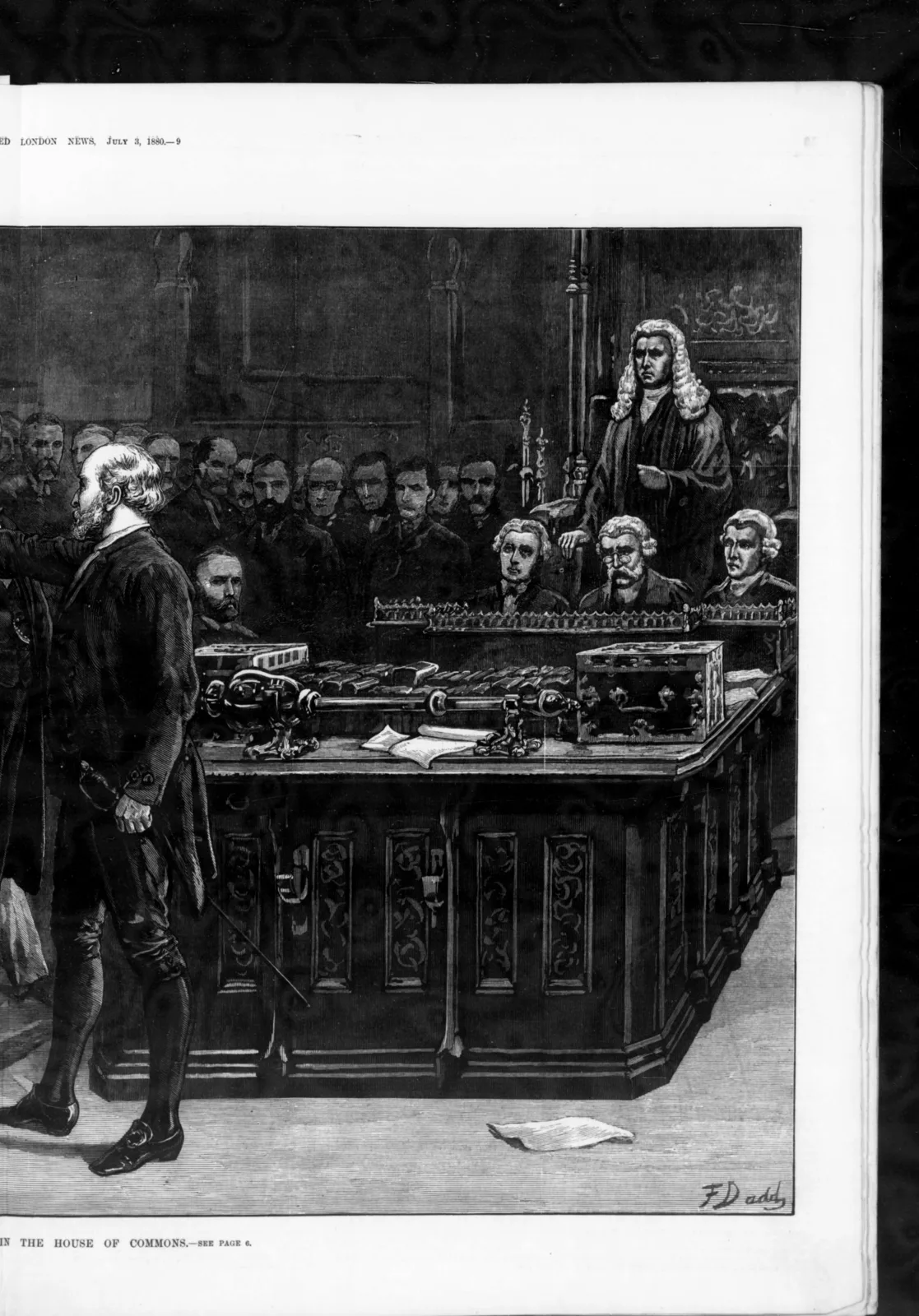
On 23 June 1880 a tall man of forty-six stood at the Bar of the House of Commons, the line on the floor that no one but a member may cross. He was not an intruder. Eleven weeks earlier the voters of Northampton had elected him. But the House had voted that he could not swear the oath of allegiance, and that he could not affirm instead of swearing, because he was an atheist, and it had agreed, before shutting him out, to hear him at the Bar. "I beg you," he told the members, "before the gauntlet is fatally thrown down — I beg you, not in any sort of menace, not in any sort of boast; but I beg you, as one man against six hundred, to give me that justice which on the other side of this Hall the Judges would give me were I pleading before them."1
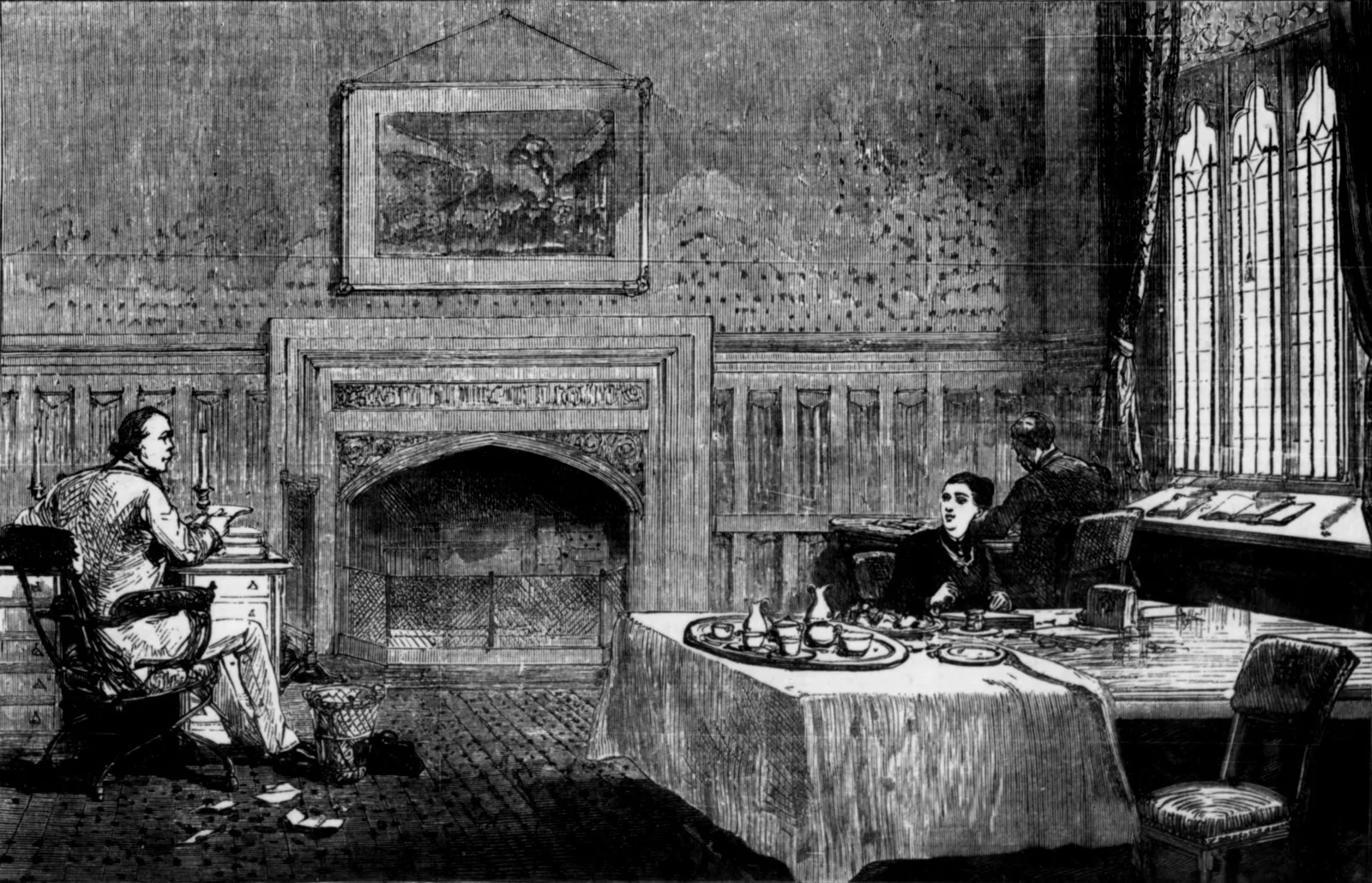
It did not work. That evening he walked up to the table to take the oath anyway, refused to withdraw when the Speaker told him to, and was taken into custody by the Serjeant-at-Arms. He spent the night in a room in the Clock Tower, a prisoner of the House of Commons.2 It would take him six more years and four more elections before he was allowed to sit.3 When he was fourteen he had been a Sunday-school teacher. This chapter is about how he got from that classroom to that cell: the question he asked, the answer he was given, what he worked out on his own, and why he spent the rest of his life making the law of England take unbelief seriously.
A boy told to prepare
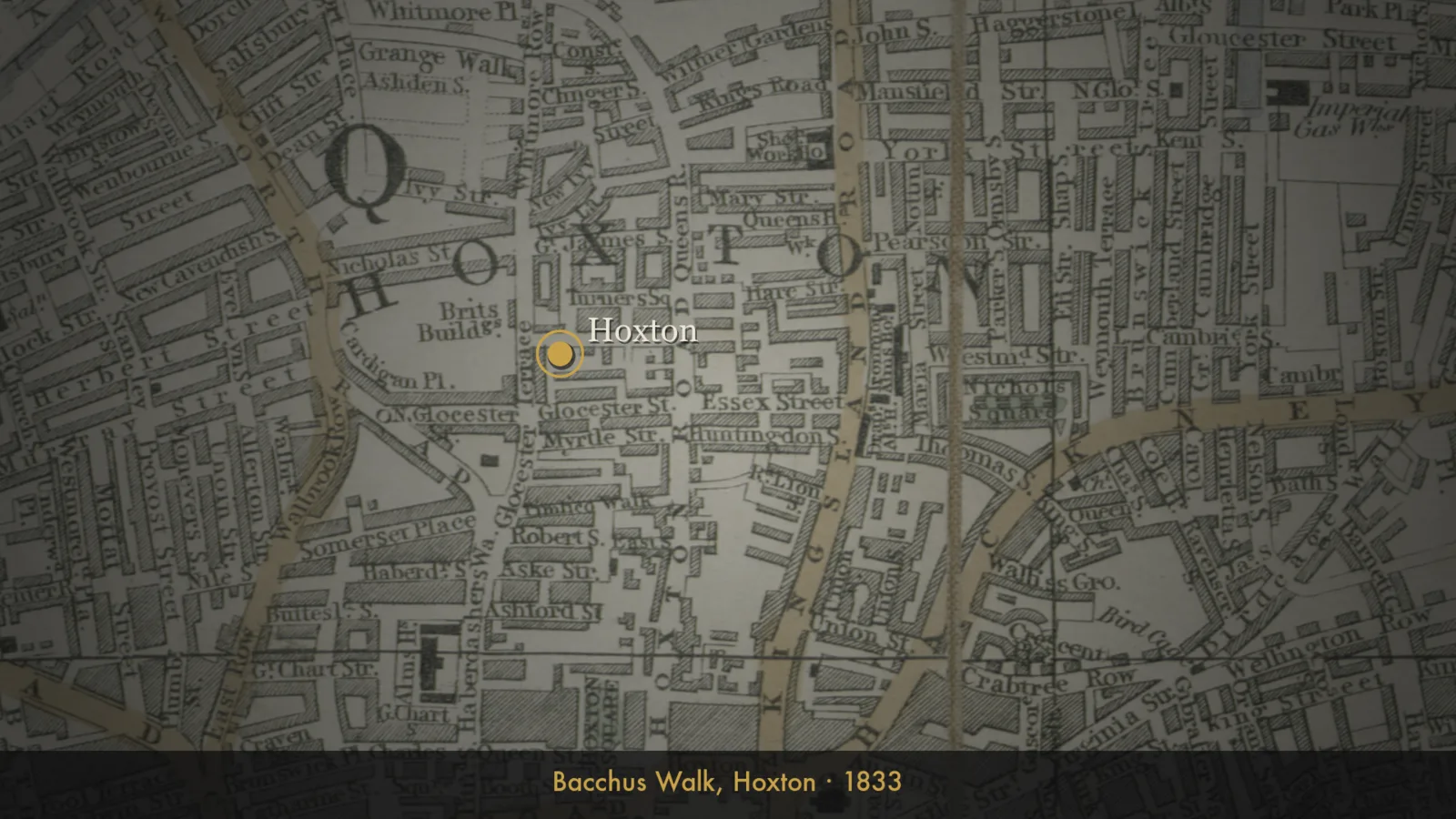
Charles Bradlaugh was born on 26 September 1833 in a four-roomed house in Bacchus Walk, Hoxton, on the poor eastern edge of London. His father was a solicitor's clerk on a very small salary, a man who sat at the same desk his whole life and spent his free hours fishing; his mother had been a nursemaid.4 There was no family creed for him to inherit. The father had his children baptized, and beyond that, his granddaughter wrote, he was indifferent to religion and "never went to church."5 Religion reached the boy from outside the house, through the parish and the Sunday school. His schooling was over before he was eleven; at twelve he was running errands in his father's office;6 at fourteen he was cashier at a coal wharf on the City Road, earning eleven shillings a week.7
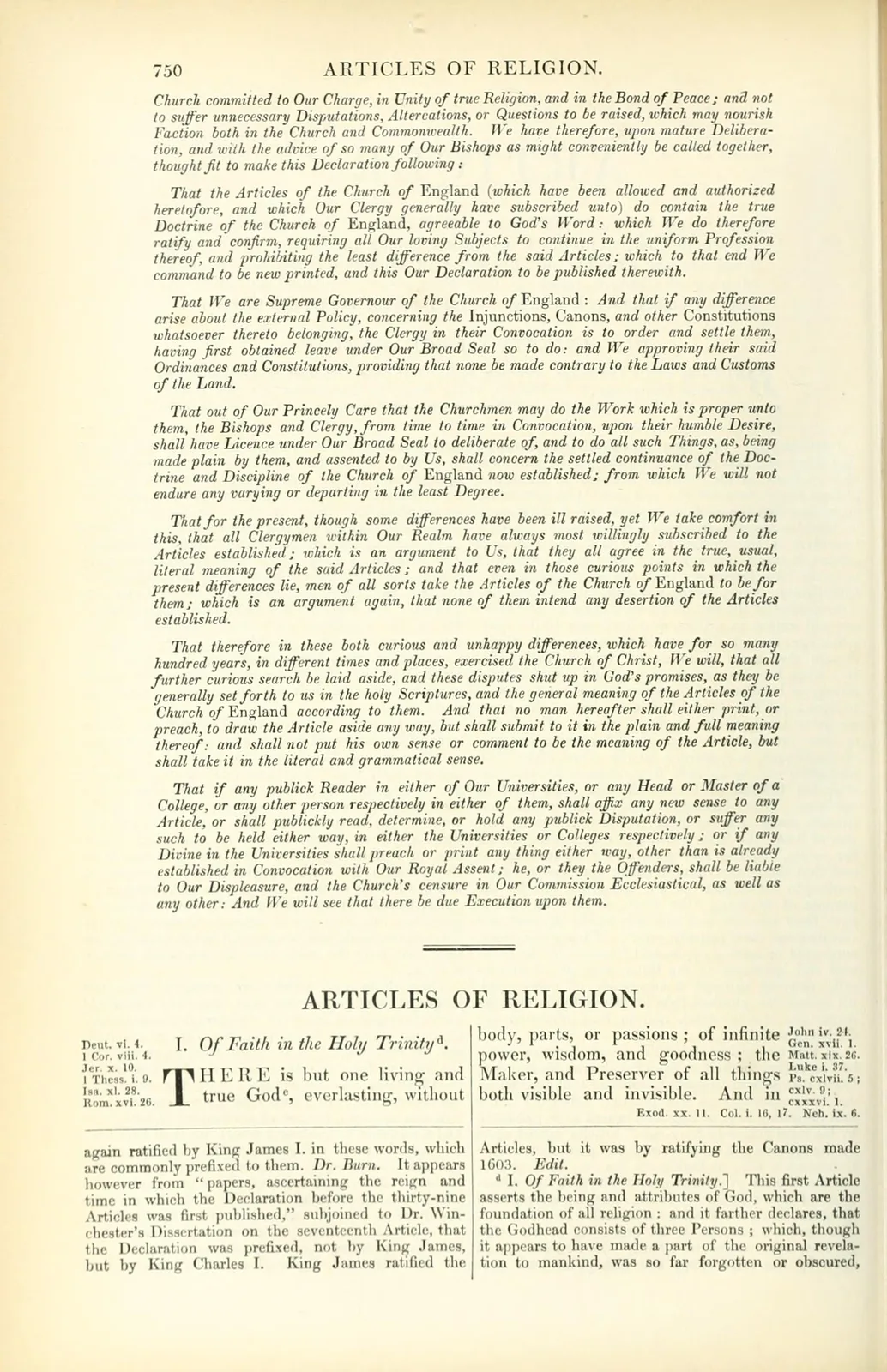
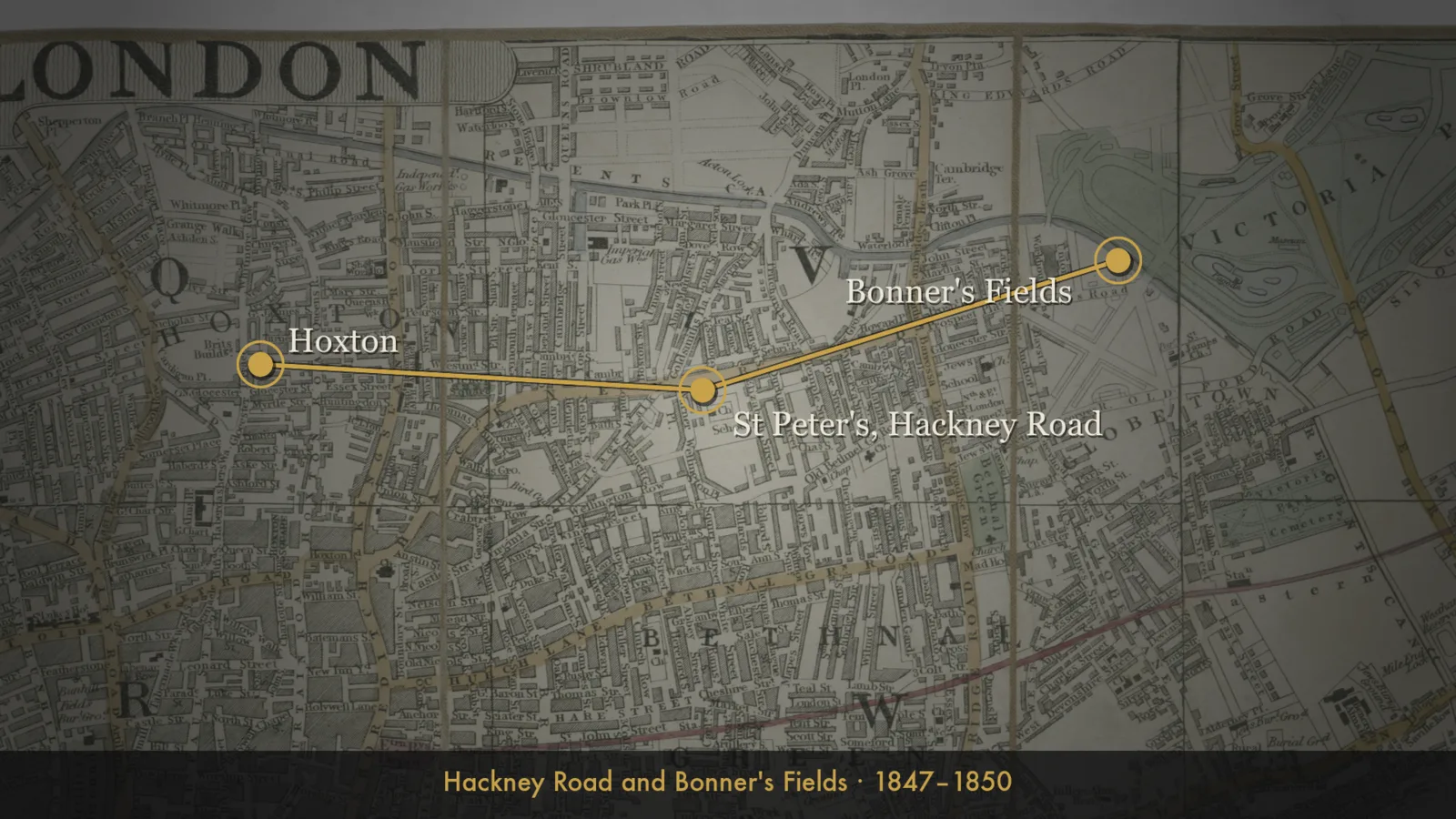
On Sundays he taught. At St Peter's, Hackney Road, he had been an eager scholar, and now, in his own words, he was fully occupied as a Sunday-school teacher under the incumbent, the Reverend John Graham Packer.8 When the Bishop of London announced a confirmation at Bethnal Green, Packer wanted his best boys ready for any question the Bishop might put to them, and Bradlaugh was one of the boys he chose. This is the first thing to understand about Bradlaugh's unbelief: it began as an act of obedience. The boy was told to prepare, and he prepared. Thirty years later he described what happened next. "I studied a little the Thirty-nine Articles of the Church of England, and the four Gospels, and came to the conclusion that they differed. I ventured to write the Rev. Mr. Packer a respectful letter, asking him for aid and explanation."9
It is worth noticing what he did not do. He did not announce that he had doubts. He found that the Church's own summary of its doctrine and the Church's own gospels did not agree with each other, and he asked his teacher to explain the difference. He was fourteen or fifteen. What changed him was the answer. Packer did not explain anything. He wrote to the boy's parents denouncing the letter as atheistical, and he suspended the boy from teaching for three months. Bradlaugh added, very carefully, that "at that time I should have shuddered at the notion of becoming an Atheist."10 The word was put on him before he had any claim to it.
The question answered with a threat
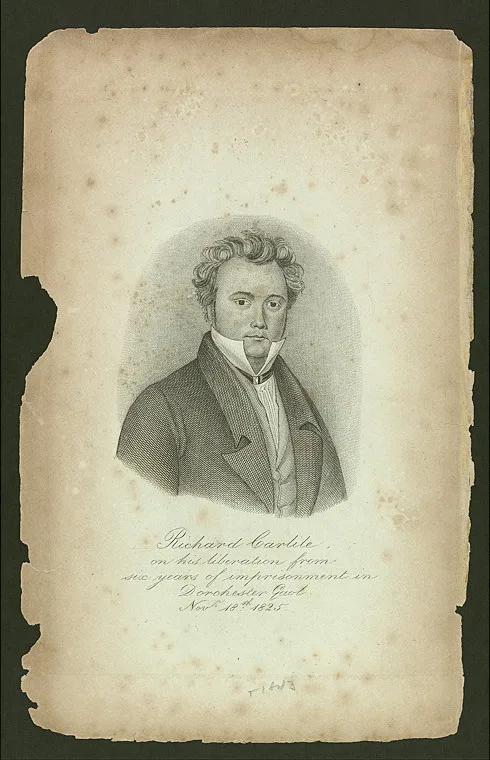
The suspension did something Packer cannot have intended. It gave the boy his Sundays back. He would not go to church while he was barred from teaching, so instead he went to Bonner's Fields, an open piece of ground in Bethnal Green where crowds argued about theology, politics and Chartism all day on Sunday, with any bystander taking part. He went, he said, "at first to listen, but soon to take part," and when he took part he spoke on the orthodox Christian side.11 The people he argued with were a small group of working men who met in a temperance hall at Warner Place, disciples of Richard Carlile, the publisher who had gone to prison for printing Thomas Paine. They brought the boy into their hall, his daughter wrote, as someone "enthusiastically determined to convert them all to the 'true religion' in which he had been brought up."12
He lost the argument, slowly. In 1849 he debated one of them, a self-taught scholar named James Savage, on the inspiration of the Bible, and afterwards, he said, "I found that my views were getting very much tinged with Freethought."13 He read Robert Taylor's Diegesis, a notorious book which argued that the gospel story was borrowed from older myths, and then he did one more honest thing: he sent the book to Packer and asked him to answer it. He also gave up drink and signed the teetotal pledge. That sounds harmless, but the hall where the freethinkers met was a temperance hall, and in that neighbourhood the pledge was the badge of the radical working men he had been arguing with, so Packer took it as one more sign that the boy was slipping away from the Church.14 This time Packer's answer came through the family. He visited the house, had the younger children sent to his Sunday school, and persuaded the parents to hang large printed scripture texts around the sitting-room. One of them, facing the chair where the boy ate his meals, read: "The fool hath said in his heart, There is no God."15 Then, late in 1849, after Packer had spoken to the father, the coal merchants who employed the boy gave him three days to change his opinions or lose his place. "At that time I hardly knew what, if any, opinions I had," he wrote, "but the result was that, sooner than make a show of recanting, I left home and situation on the third day, and never returned to either."16
He was sixteen, and that sentence explains the whole of his life. He did not leave home because he was an atheist. He left because he would not pretend to be a believer while he was still working out what he was. That refusal, to say something he did not mean in order to be let in, is the whole of the oath fight in Parliament, thirty years before it happened. His daughter Hypatia, who wrote his biography, was firm that Packer did not make him an atheist: "This harsh and blundering method of dealing with him no doubt hastened his progress towards Atheism, but it assuredly did not induce it."17 A hostile biographer of 1888 thought the whole story against Packer hard to credit.18 Bradlaugh's own account gives the sequence plainly: the reading came first, and the clergyman's answer came second.
Working it out alone
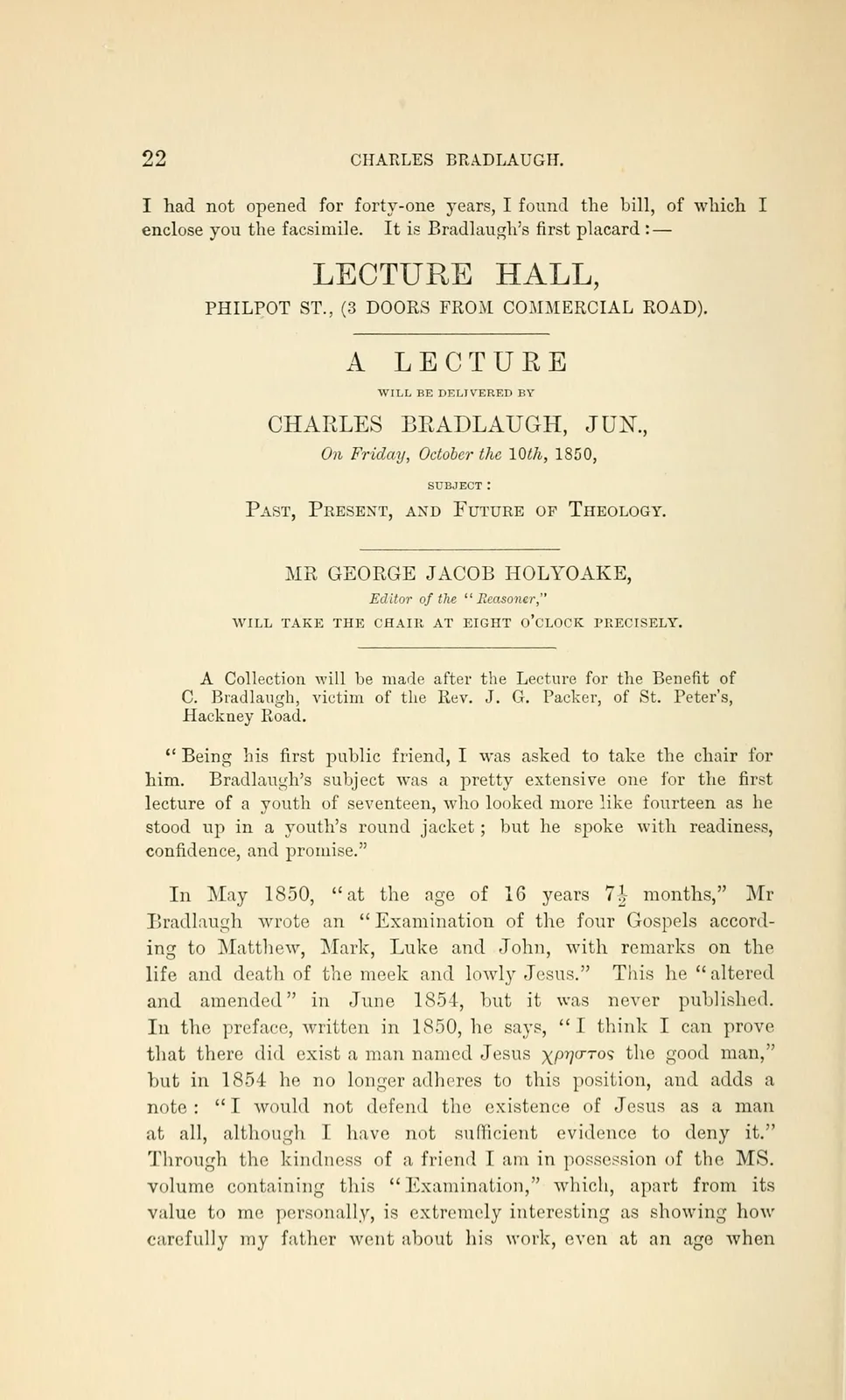
He was taken in by the widow of the very man whose disciples he had tried to convert. Eliza Sharples Carlile had three children, no money and a coffee-room to run at Warner Place, and she gave him a share of her son's bed and a place at her table. He later described exactly where his thinking stood: "My views were then Deistical, but rapidly tending to the more extreme phase into which they ultimately settled."19 At sixteen he published his first pamphlet, A Few Words on the Christian's Creed, and dedicated it to Packer.20 At seventeen he gave his first advertised lecture, in a small hall in Philpot Street, with George Jacob Holyoake, the leading freethinker of the day, in the chair; the handbill asked for a collection "for the Benefit of C. Bradlaugh, victim of the Rev. J. G. Packer." Holyoake remembered "a youth of seventeen, who looked more like fourteen as he stood up in a youth's round jacket; but he spoke with readiness, confidence, and promise."21 The religious press saw him differently. To a correspondent of the Congregationalist British Banner he was "an overgrown boy of seventeen, with such an uninformed mind, that it is really amusing to see him sometimes stammering and spluttering on in his ignorant eloquence."22
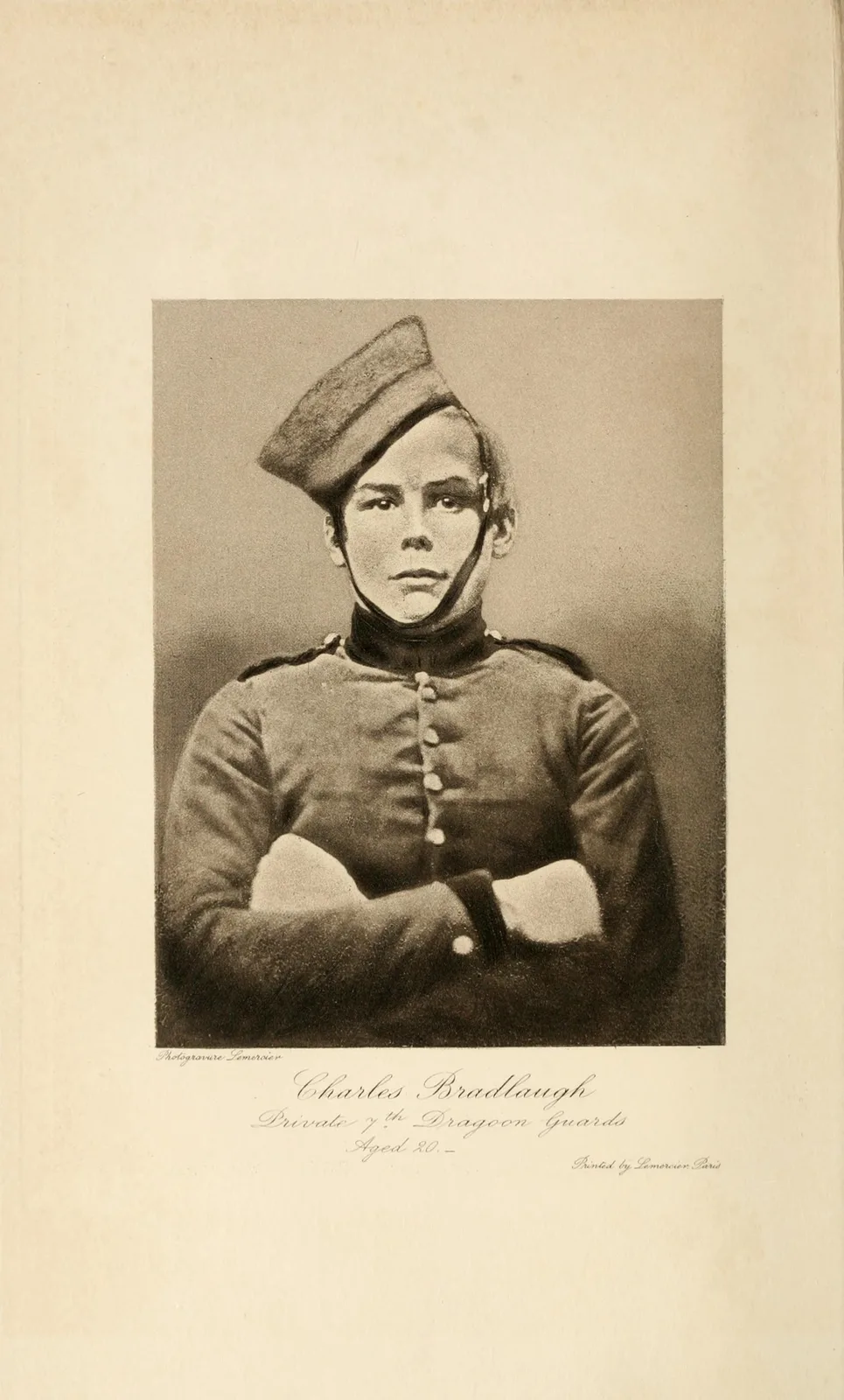
Then poverty ended this first chapter. By December 1850 he owed four pounds fifteen shillings, he was hungry, and he was too proud to accept the subscription his friends offered to raise. Without telling anyone, he enlisted in the Seventh Dragoon Guards, and the regiment sent him to Ireland for nearly three years.23 What he later said about those years tells us where his real thinking was done. "At the time of my enlistment in 1850, I was probably still a Theist, but had not very carefully reasoned out my attitude. The three years break from public advocacy, spent by me in the army, was very useful in compelling me to think out my new views by myself."24 His atheism, in other words, was not something he caught at Bonner's Fields. He worked it out in Ireland, as a private soldier with no platform, no audience and no one to argue with. His father died while he was away, at forty-one, and his daughter believed that the strain of hearing his son called an atheist had helped to kill him.25 In 1853 a small legacy bought his discharge, and he came home to support his mother and sisters.26
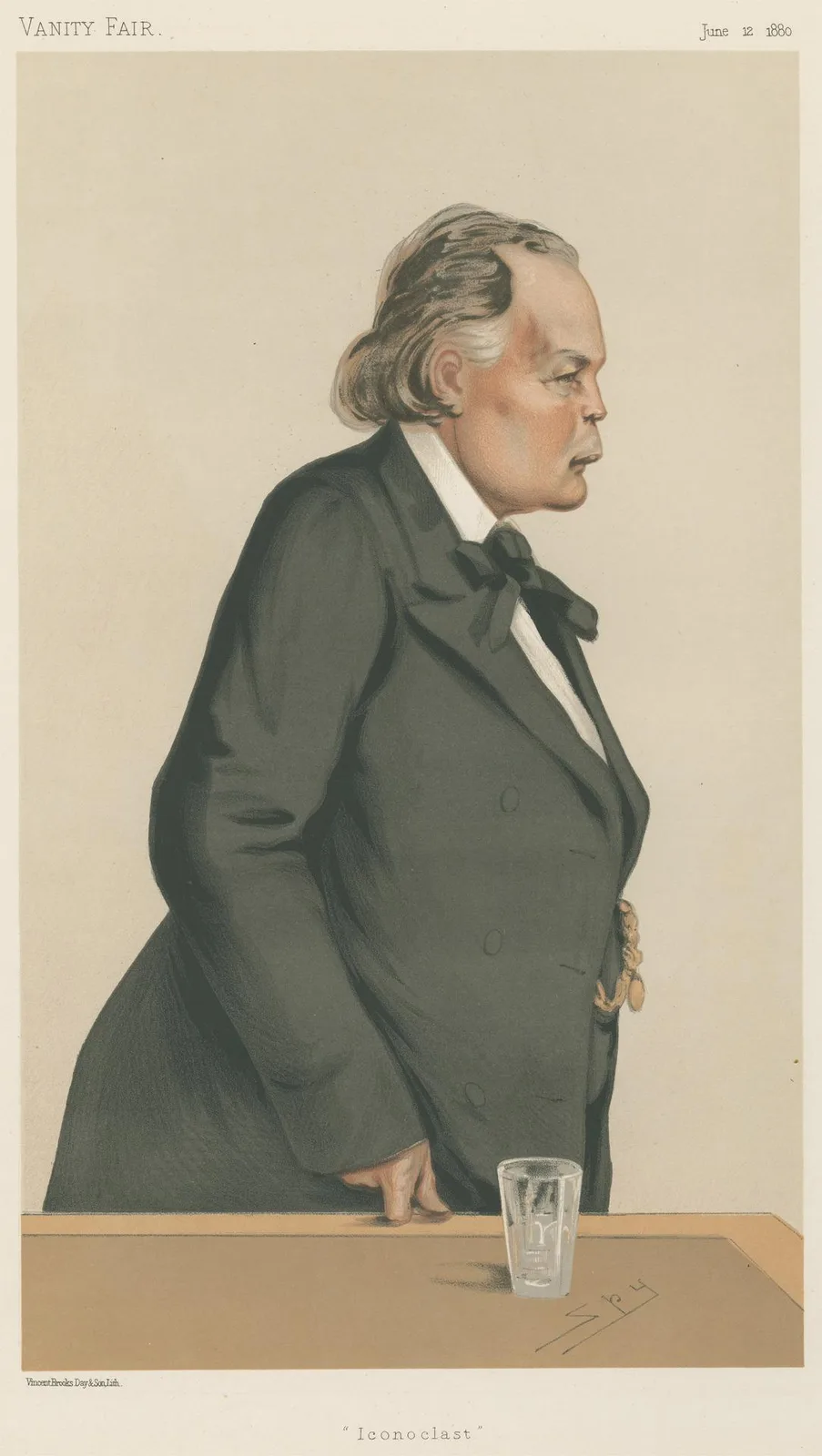
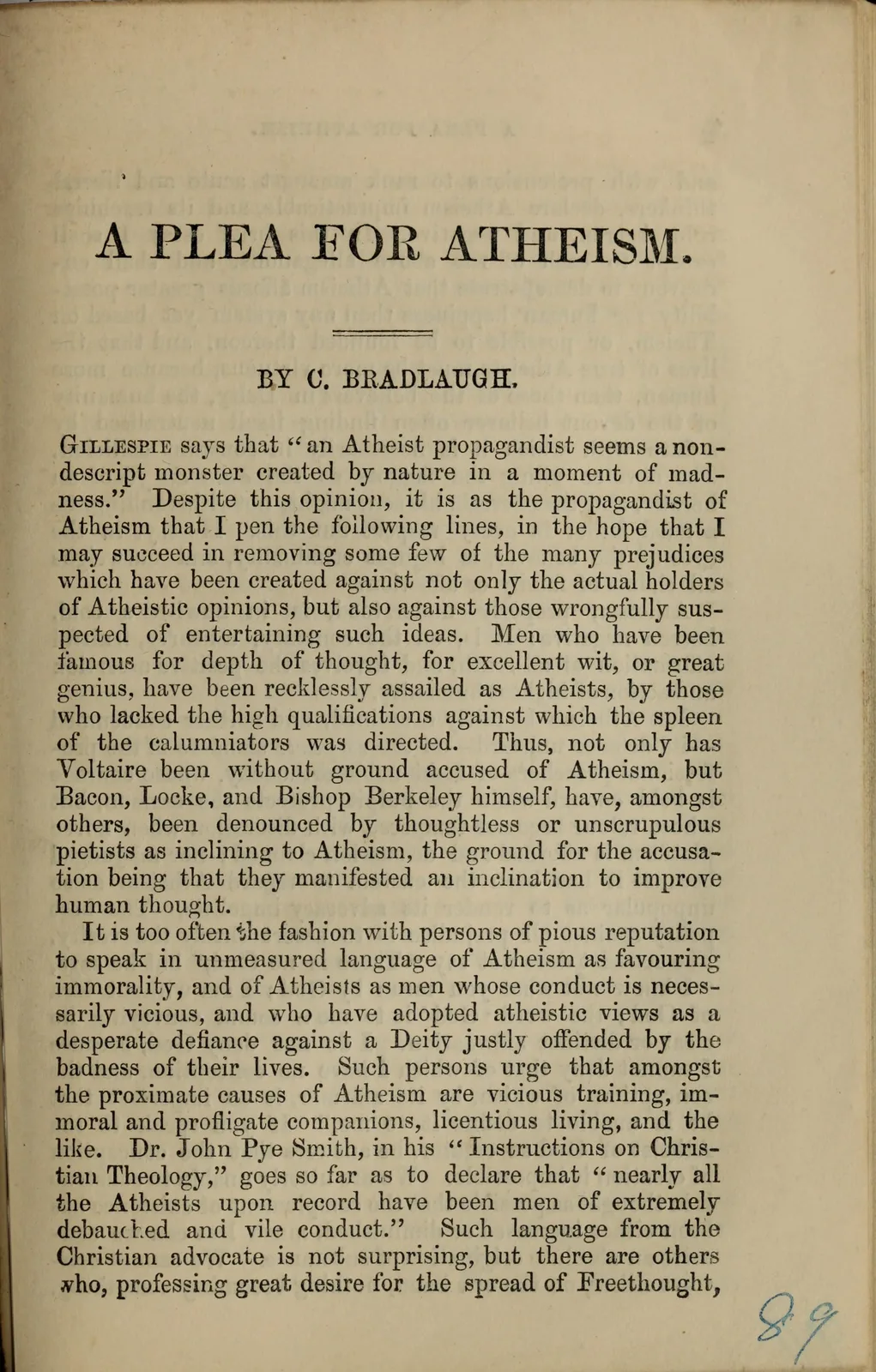
Home meant a clerk's job in a solicitor's office in Fenchurch Street, and anonymous letters to his employer about his opinions. So from 1854 he lectured and wrote under a platform name, "Iconoclast," the breaker of images, and kept it until he stood for Parliament in 1868.27 In those years two things fixed his position for good. One was a book: in 1855 and 1856, he said, "I was much influenced by the glimpse of the Ethics of Spinoza" that he got through the writer George Henry Lewes, the philosophy of a single substance, which makes a God separate from nature an empty idea.28 The other was a crowd. In Hyde Park in July 1855, at a protest against a bill to stop Sunday trading, he was struck by a police truncheon, and he then gave evidence against the police before a Royal Commission. "This was a first step," he wrote, "in a course in which I have never flinched or wavered."29 The thought and the action arrived in the same two years.
His public declaration came in Northampton, the shoemakers' town that would later send him to Parliament again and again. In March 1859 he debated a Christian lecturer there named John Bowes, and the report of that debate is the earliest statement of his atheism that his daughter could find in print. It already says what he would go on saying for the rest of his life: "He did not deny that there was 'a God', because to deny that which was unknown was as absurd as to affirm it. As an Atheist he denied the God of the Bible, of the Koran, of the Vedas, but he could not deny that of which he had no knowledge."30 He never claimed to prove that there was no God. His atheism was really a complaint about a word, and he put it this way in the pamphlet he called A Plea for Atheism: "The Atheist does not say 'There is no God,' but he says, 'I know not what you mean by God; I am without idea of God; the word "God" is to me a sound conveying no clear or distinct affirmation. I do not deny God, because I cannot deny that of which I have no conception.'"31 From this point his position never moved. What changed was what he did with it.
Unbelief into law
What he did with it was to go to law. From 1860 he had his own weekly paper, the National Reformer,32 and he treated every disability that English law placed on an unbeliever as a case to be fought in person, without a barrister, through every court that would hear him.
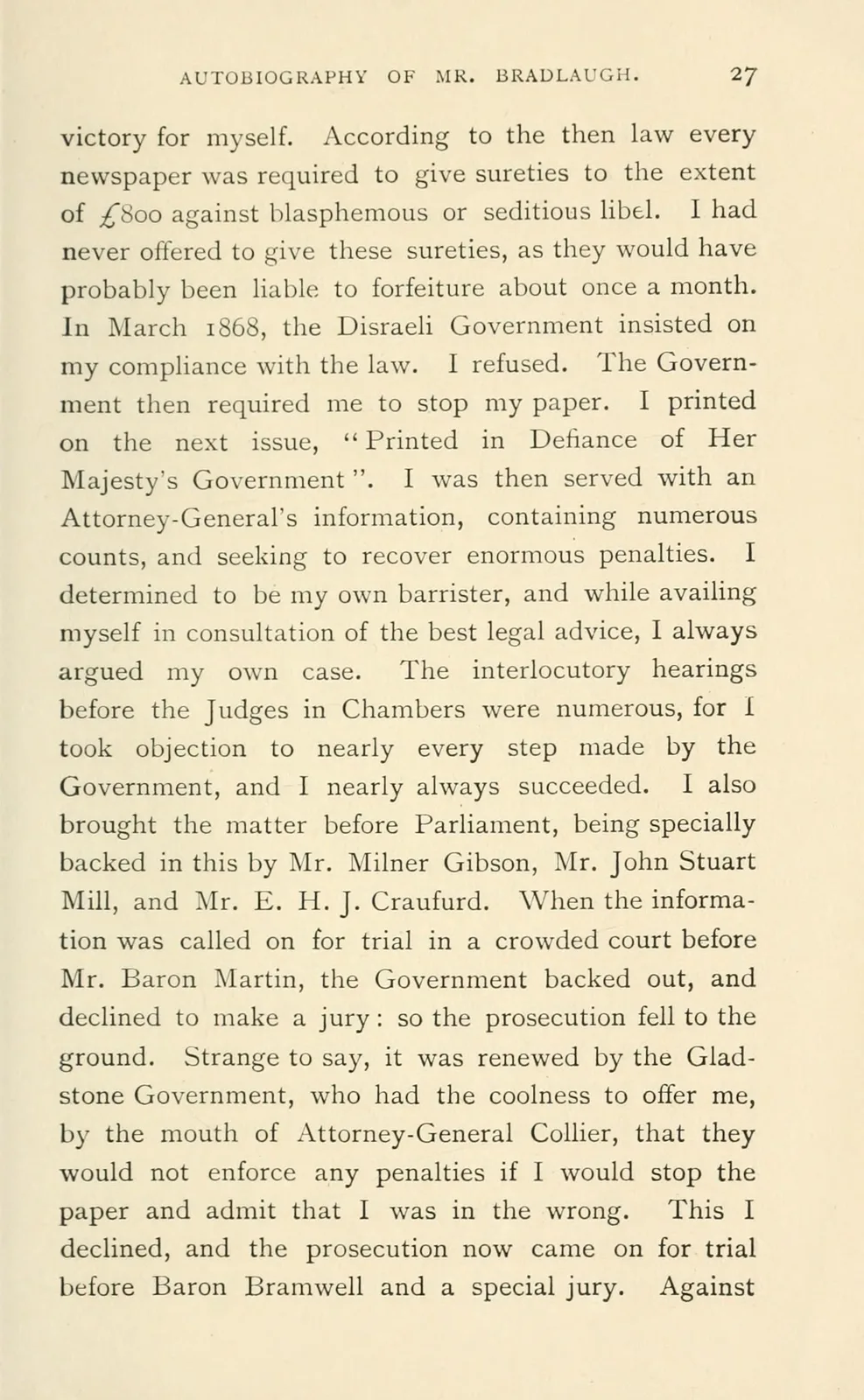
The first fight was over the witness box. In 1861 at Devonport he was arrested for beginning a lecture on the Bible, and when he defended himself he found that his witnesses could be objected to, because, as he put it, "unbelievers in hell were then incompetent as witnesses according to English law."33 A few years later his own evidence in a commercial lawsuit was thrown out for the same reason. He argued the point himself before the Lord Chief Justice, sent more than two hundred petitions to Parliament at his own expense, and in 1869 and 1870 the Evidence Amendment Acts gave unbelievers the right to testify. It cost him about fifteen hundred pounds, and in 1873 he called it "probably the most severe, and to me certainly the most costly, struggle" of his life.34 He did not know yet what was coming.
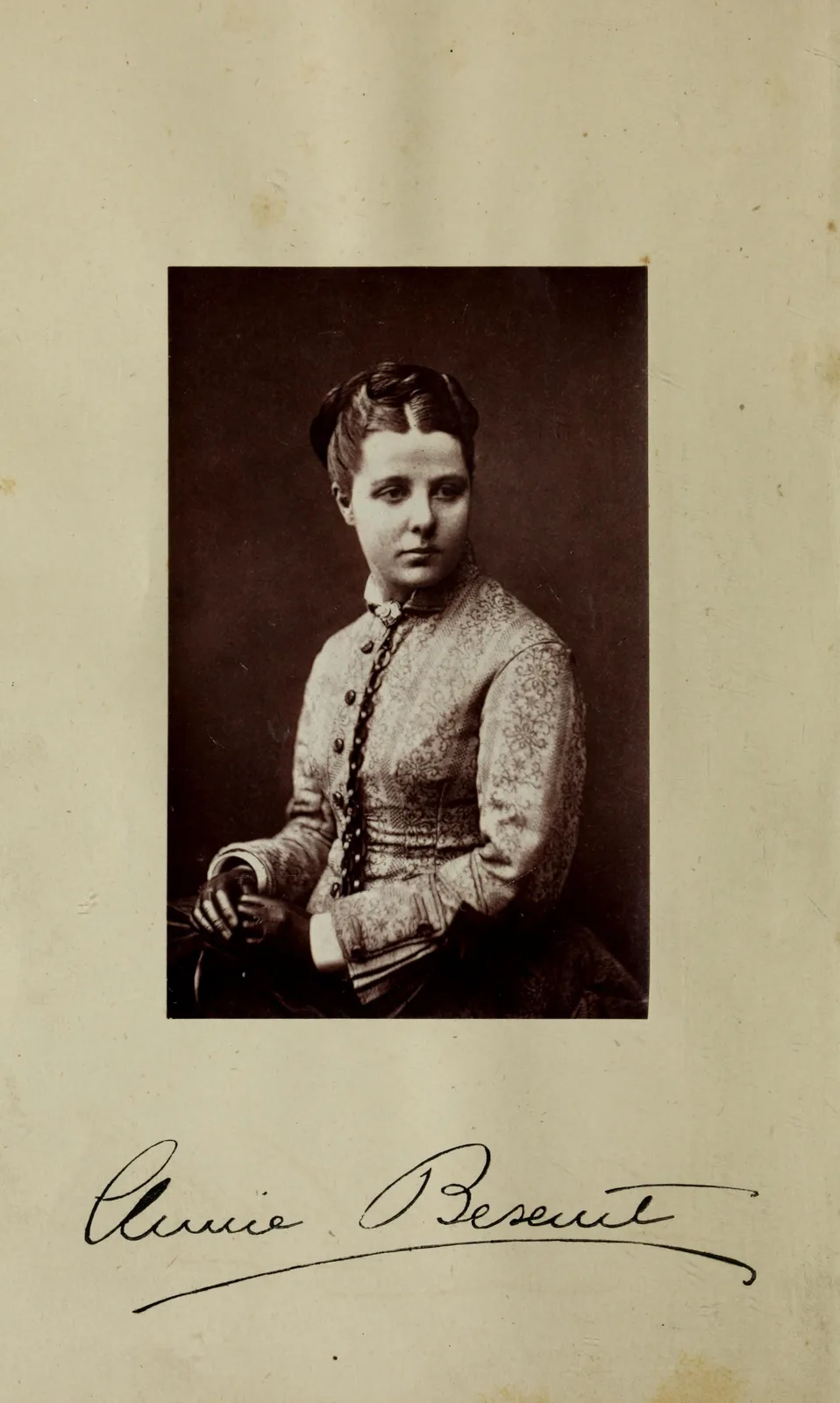
The second fight was over the press. In March 1868 the government demanded eight hundred pounds in sureties against blasphemy before his paper could go on appearing. He refused, and printed the next issue with the words "Printed in Defiance of Her Majesty's Government" across it. He beat the prosecution on a point of law, the statute was repealed, and John Stuart Mill wrote to congratulate him.35
The third fight was over the right to publish, and it cost him his respectability. In the winter of 1876 a Bristol bookseller was convicted for selling an old American pamphlet on birth control, Charles Knowlton's Fruits of Philosophy. Bradlaugh had never liked the book. But he and his co-editor Annie Besant, who had joined his paper in 1874,36 decided that a book which had been sold openly for forty years was either decent or indecent, and that if it was decent it had to be defended. They gave notice of the time and place, sold more than five hundred copies in twenty minutes from a shop in Stonecutter Street on 24 March 1877, and were arrested.37 The jury found that the book was "calculated to deprave public morals" while clearing the two of them of "any corrupt motives"; the Lord Chief Justice gave them six months in prison and a fine of two hundred pounds each.38 The sentence was quashed on appeal,39 but the slur stuck to him for the rest of his life.
The oath
Then, on 2 April 1880, on his fourth attempt, Northampton sent him to Parliament.40 Every member had to swear allegiance in words that ended "So help me God." Since 1866 anyone allowed by law to affirm in a court had been allowed to affirm in the House instead of swearing,41 and Bradlaugh had been affirming in the courts for nine years under the very Acts he had won. So he quietly told the Clerk that he would affirm. A committee of seventeen members decided, by the chairman's casting vote, that he could not.42 He then said that he would take the oath after all, and he explained why in a public letter: "The oath, although to me including words of idle and meaningless character, was and is regarded by a large number of my fellow-countrymen as an appeal to Deity to take cognizance of their swearing. It would have been an act of hypocrisy to voluntarily take this form if any other had been open to me, or to take it without protest."43
That letter gave his enemies their opening. By saying that the words meant nothing to him, he had given the House a reason to say that he could not swear them. A second committee reported that he could not properly take the oath.44 The Opposition, led in the Commons by Sir Stafford Northcote and pushed along from behind by a young Lord Randolph Churchill, moved that he be allowed neither to swear nor to affirm, and the motion was carried.2 A petition from the Tories of Northampton prayed that he "might not be permitted to take the holy name of God in vain."45 Churchill's own argument was at least an honest one: "if the words 'so help me God' were held to be a mere superstitious invocation, the idea or the faith which had for centuries animated the House of Commons that its proceedings were under the guidance of Providence would lose its force, and would very soon have to be abandoned altogether."46
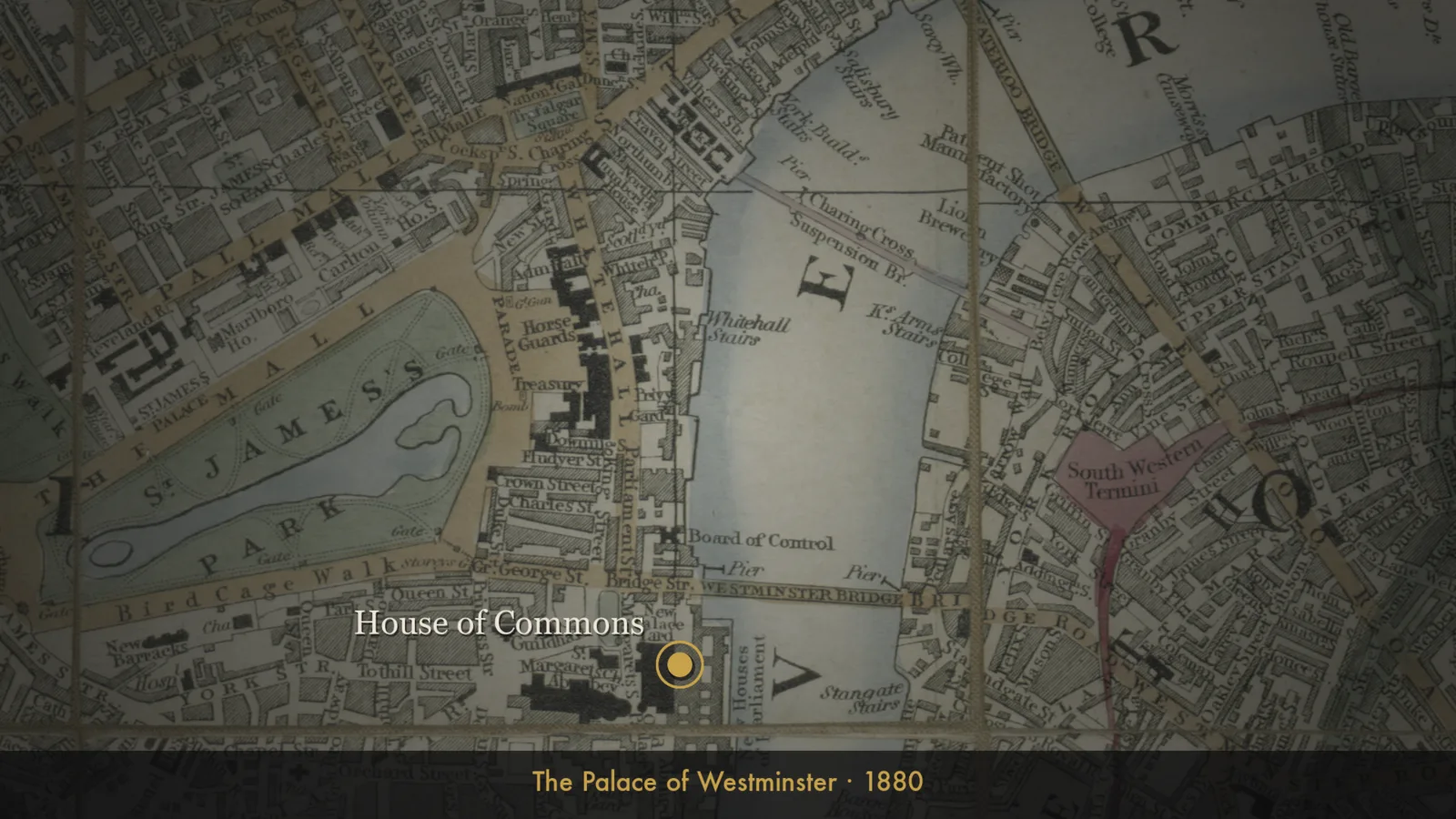
So came the speech at the Bar and the night in the Clock Tower. Gladstone, the prime minister, thought the exclusion illegal but would not make it a party question.44 In the speech Bradlaugh named the thing he was really being punished for: "I am no more ashamed of my opinions, into which I have grown, than any Member of this House is ashamed of his; and, much as I value the right to a seat in this House, I would rather relinquish it for ever than it should be thought that, upon any shadow of hypocrisy, I had tried to gain a feigned entrance here by pretending to be what I am not."47
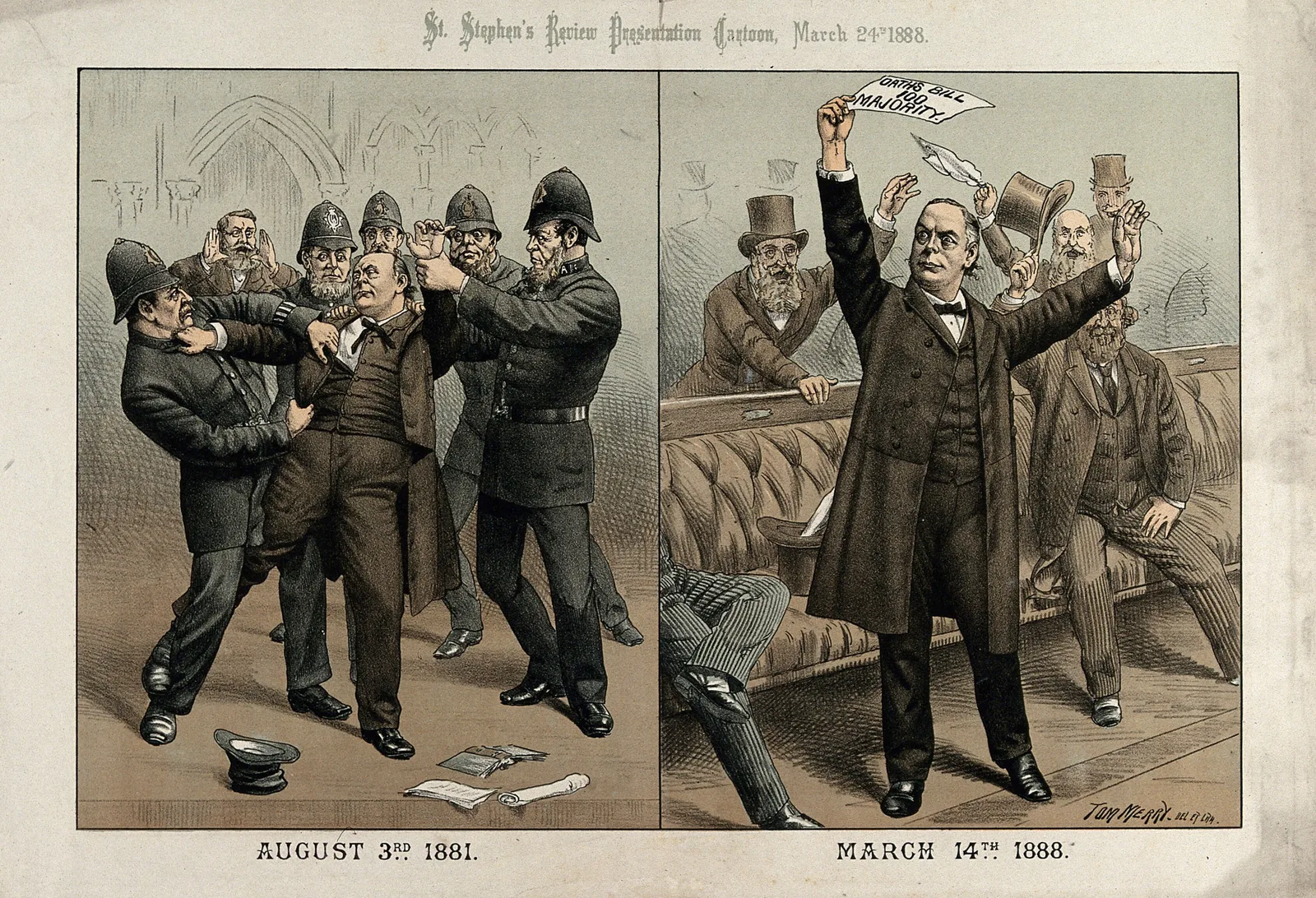
The six years that followed went round in a loop. A week after his night in the Clock Tower the House allowed him to affirm "at his legal peril,"48 and for eleven months he sat and voted like any other member. Then the peril duly arrived: a private prosecutor sued him for the five-hundred-pound penalty for voting without having been sworn, the courts held that he had never had the right to affirm, and his seat was declared vacant. Northampton re-elected him, and from then until 1886 he was kept out: the town had one member sitting in the House and one standing at the Bar.49 In August 1881 fourteen policemen and messengers carried him bodily out of the building.50 In February 1882 he walked up to the table, read the oath aloud to himself and signed the roll; the House expelled him, and Northampton re-elected him again.51 In 1883 Gladstone's bill to let any member affirm was lost by three votes, 292 to 289.52 In 1884 he swore himself in once more, was excluded once more, and was re-elected once more.53
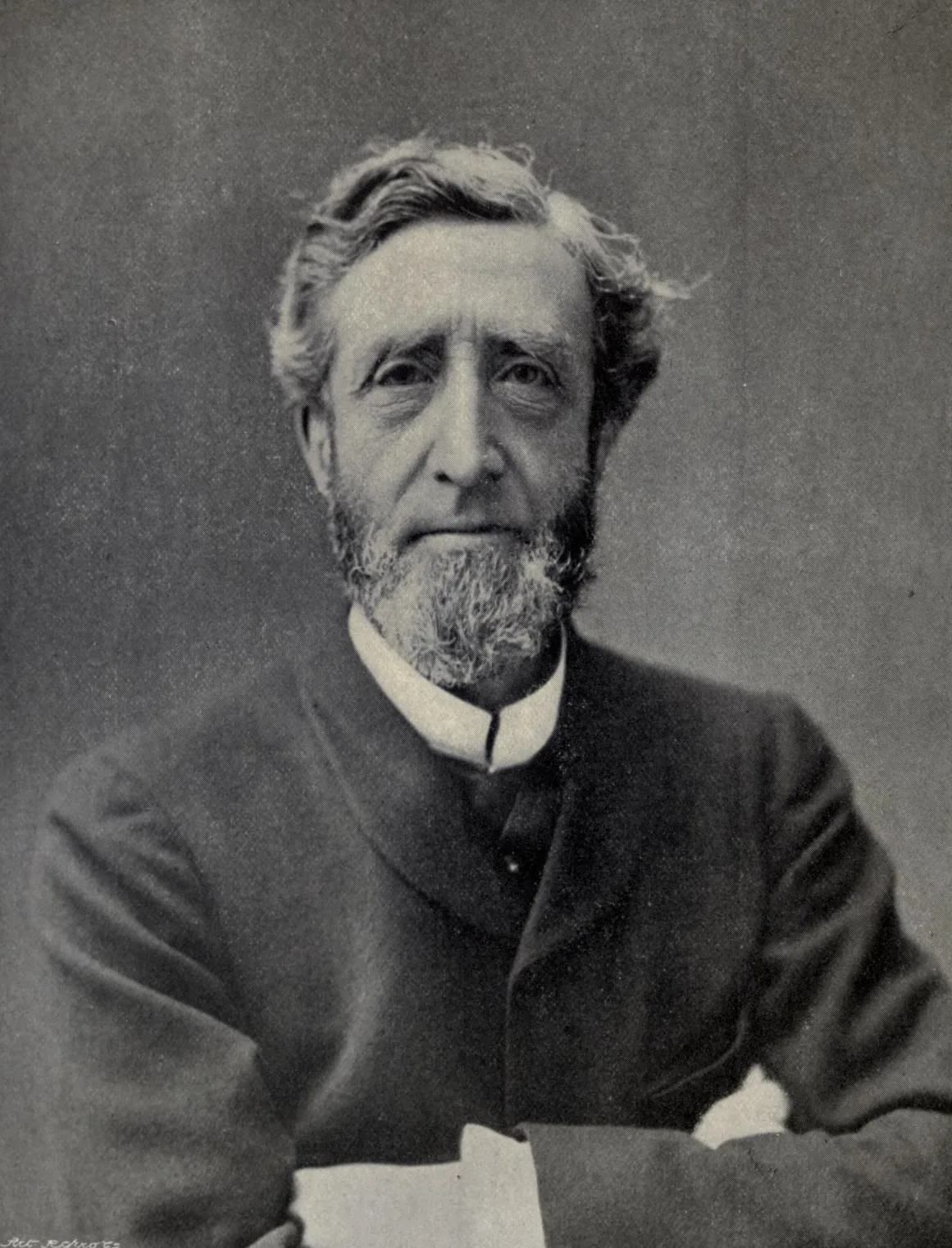
Through all of it he never softened a word. When a clergyman opened a three-night debate in 1881 by proposing that "Secularism is Atheism," Bradlaugh agreed with him.54 His own side, led by Holyoake, had long wanted a gentler name for what they believed, and he would not take one.55 In the end the loop was broken by exhaustion. After the general election of 1885 there was a new Speaker, Arthur Peel, and on the first day of the session he ruled that no one had any right to interfere with a member taking the oath. Bradlaugh swore, and he sat. He was fifty-two.3 Two years later he carried his own Oaths Act through both Houses, giving every member and every witness in the country the right to affirm,56 and the votes that carried it came from the very men who had kept him out.
The last word
Did his unbelief change shape at the end? With Bradlaugh the answer is no, and the proof had to be assembled on purpose. His last years were full of loss. His daughter Alice died of typhoid in December 1888.57 Annie Besant, his closest ally for fifteen years, moved first to socialism and then, in 1889, to Madame Blavatsky's Theosophy, and he learned of it from a newspaper article rather than from her.58 He was ill, he was in debt, and he was more honoured than he had ever been: "the Member for India," after five thousand people rose to cheer him at the Indian National Congress in Bombay.59
His last considered statement of his case was written for an American magazine in March 1889, and it is not a denial of anything. It is a claim. "As an unbeliever, I ask leave to plead that humanity has been real gainer from scepticism, and that the gradual and growing rejection of Christianity, like the rejection of the faiths which preceded it, has in fact added, and will add, to man's happiness and well being."60 Then the rumours began that he was softening, and in November 1890, twelve weeks before he died, he answered them with the only account of his own thinking he ever wrote, under the title "My Heresy now and Thirty-six Years ago." "For thirty-six years my position has been atheistic, and I am totally unaware of any foundation for the rumors, recently very industriously circulated, alleging modification by me of these views. My position has always been that the word 'God' is either undefined, or that the attempted definitions are self-contradictory, or incoherent."61
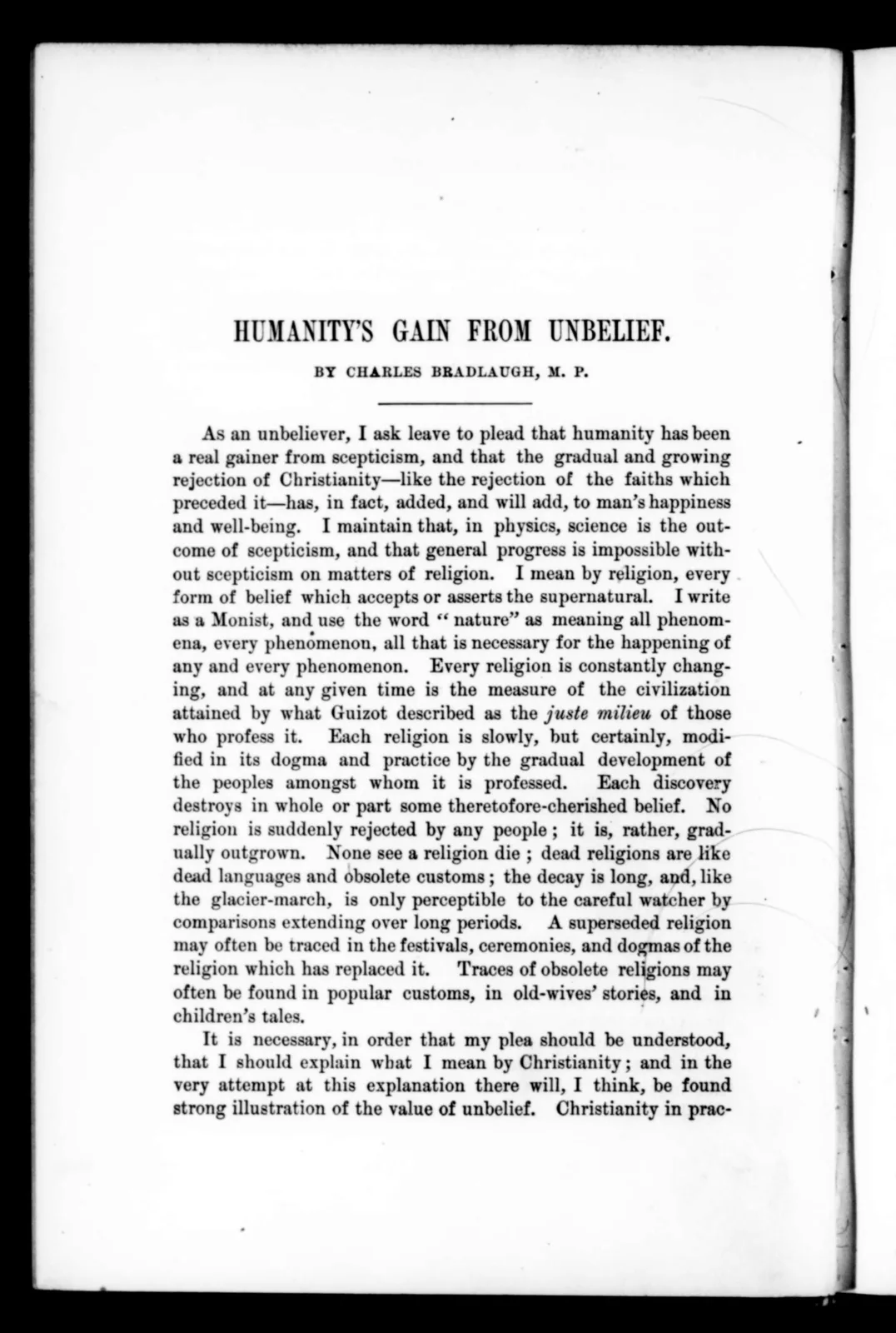
He fell ill in the second week of January 1891. On 27 January the House of Commons, without a dissenting voice, struck from its journals every resolution that had ever excluded him; by then he was too weak to be told.62 His daughter knew what was usually said about dead unbelievers, so she took a precaution and had his doctor sign a statement: "I was in constant professional attendance upon Mr. Charles Bradlaugh from Tuesday, Jan. 13, until his death on Friday, Jan. 30, and during that time heard him say no word bearing directly or indirectly upon any religious subject."63 He died on the morning of 30 January 1891, at fifty-seven.64 By his own written wish the burial at Brookwood was silent, with no speeches and no ceremony. Mourners came from every part of England, and one miner came down from Scotland.65 Seven years later his daughter still had to publish a pamphlet called Did Charles Bradlaugh Die an Atheist? The answer was yes, and the answer was the whole point.66
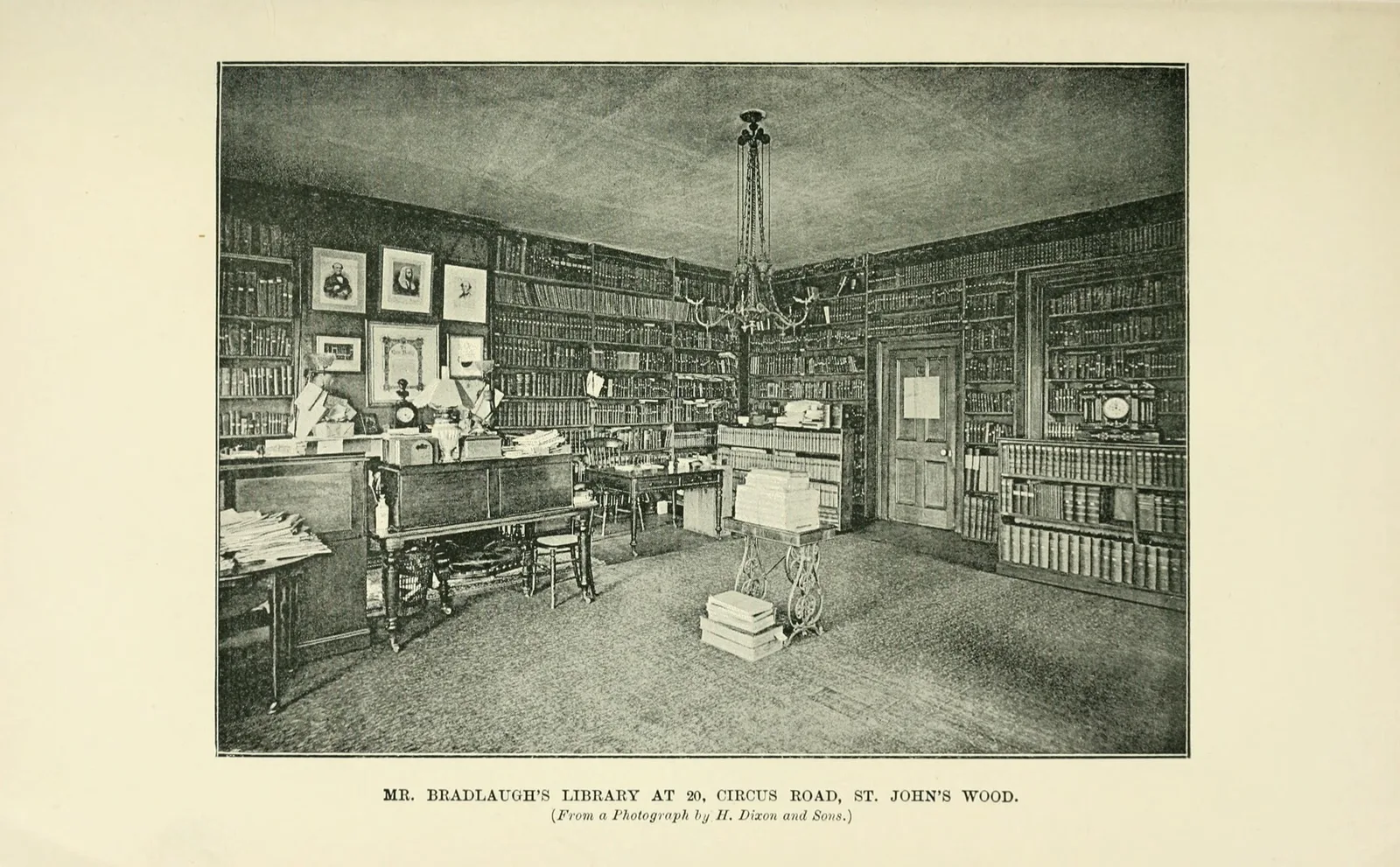
Afterwards
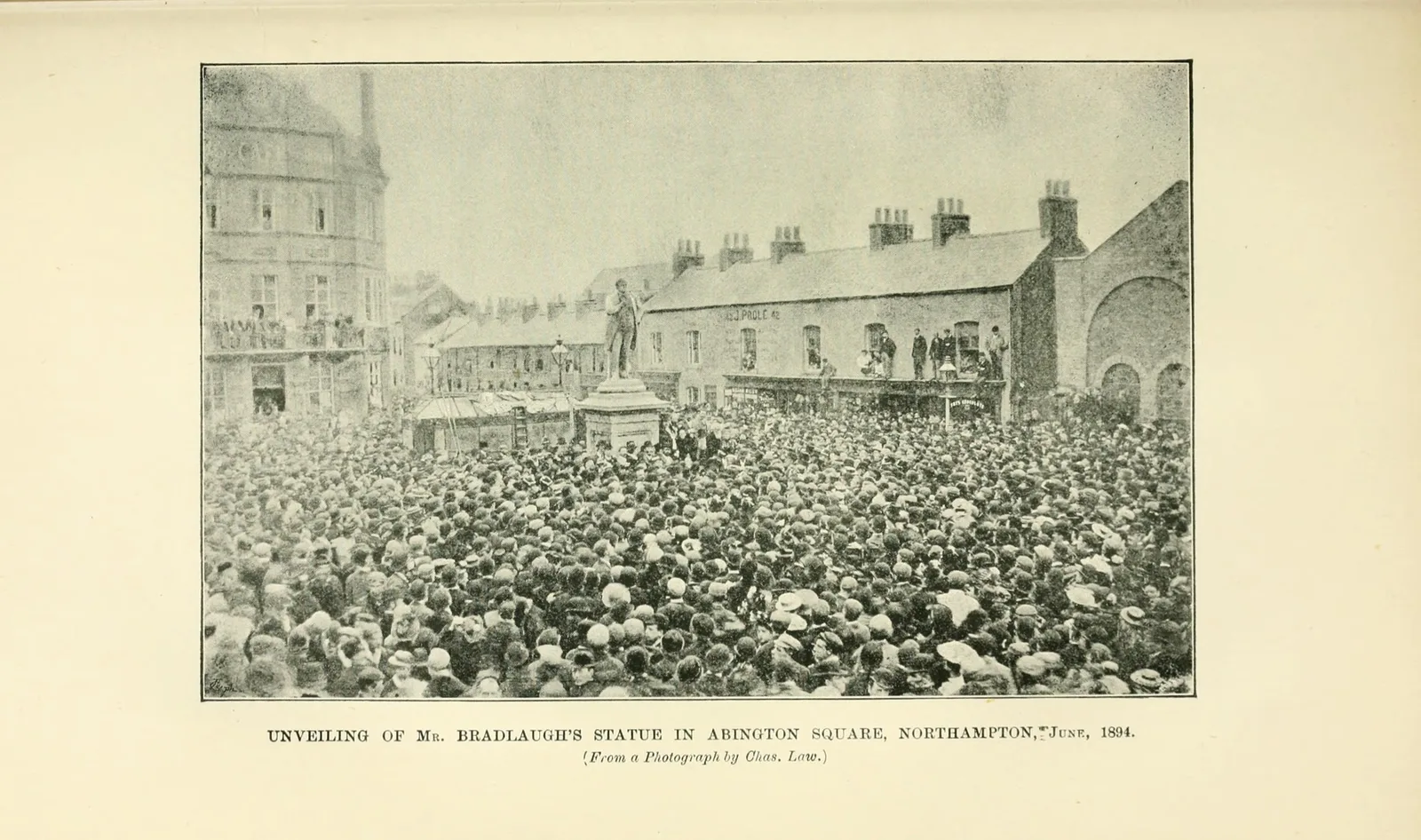
This book asks how unbelief is formed, what it costs, and how it changes. In Bradlaugh's case it was formed by a question that a clergyman would not answer, and by three years alone with that question in a barrack-room. It cost him his home, his father, four elections, and a name that was never clean again. And it did not change. What changed was the law of England, which he rewrote so that the next unbeliever could testify, publish and sit in Parliament without pretending. Northampton put up his statue in Abington Square in 1894.67 The woman who stood beside him in the dock in 1877 took the other road: Annie Besant left atheism as decisively as she had come to it, and her reversal belongs to a later chapter.58
Footnotes
-
House of Commons Debates, 23 June 1880, vol. 253, cc. 629–60, "Parliamentary Oath (Mr. Bradlaugh)": his speech at the Bar, col. 638. ↩
-
Hansard (1880), cols. 631–38; Hypatia Bradlaugh Bonner and John M. Robertson, Charles Bradlaugh: A Record of His Life and Work, vol. II, 3rd ed. (London: T. Fisher Unwin, 1902), with Part II "His Parliamentary Struggle, Politics and Teachings" by Robertson, pp. 205, 242–45. ↩ ↩2
-
Charles Bradlaugh, The Autobiography of C. Bradlaugh: A Page of his Life, written 1873 for the National Reformer, new edition (London: R. Forder, 1891), p. 5; Hypatia Bradlaugh Bonner, Charles Bradlaugh: A Record of His Life and Work, vol. I (London: T. Fisher Unwin, 1894), p. 3. ↩
-
Bonner, Charles Bradlaugh, vol. I, p. 4; Bradlaugh, Autobiography of C. Bradlaugh, p. 5. ↩
-
Bradlaugh, Autobiography of C. Bradlaugh, pp. 5–6. ↩
-
Bradlaugh, Autobiography of C. Bradlaugh, p. 6; Bonner, Charles Bradlaugh, vol. I, pp. 7–8. ↩
-
Bradlaugh, Autobiography of C. Bradlaugh, pp. 6–7; Bonner, Charles Bradlaugh, vol. I, p. 8. ↩
-
Bradlaugh, Autobiography of C. Bradlaugh, p. 7. ↩
-
Bradlaugh, Autobiography of C. Bradlaugh, p. 7; Bonner, Charles Bradlaugh, vol. I, pp. 8–9; Annie Besant, Charles Bradlaugh: A Character Sketch (1891), p. 8. ↩
-
Bradlaugh, Autobiography of C. Bradlaugh, p. 7. ↩
-
Bonner, Charles Bradlaugh, vol. I, pp. 9, 12. ↩
-
Bradlaugh, Autobiography of C. Bradlaugh, p. 7; "My Heresy now and Thirty-six Years ago," National Reformer, 9 November 1890, quoted in full in [Bonner 1898], in Bonner 1898 p. 8. ↩
-
Bradlaugh, Autobiography of C. Bradlaugh, pp. 7–8; Bonner, Charles Bradlaugh, vol. I, pp. 13–15. ↩
-
Bonner, Charles Bradlaugh, vol. I, pp. 13–14. ↩
-
Bradlaugh, Autobiography of C. Bradlaugh, p. 8. ↩
-
Hypatia Bradlaugh Bonner: Bonner, Charles Bradlaugh, vol. I, p. 16. ↩
-
Charles R. Mackay, hostile biographer, 1888: Charles R. Mackay, Life of Charles Bradlaugh, M.P. (London: D. J. Gunn, 1888), a hostile life written during the parliamentary struggle. ↩
-
Bradlaugh, Autobiography of C. Bradlaugh, p. 8. ↩
-
Bradlaugh, Autobiography of C. Bradlaugh, pp. 8–9; Bonner, Charles Bradlaugh, vol. I, p. 63 (dedication). ↩
-
George Jacob Holyoake, 1891, on the lecture of 10 October 1850: Bonner, Charles Bradlaugh, vol. I, p. 23. ↩
-
"J. E.," correspondent of the British Banner (Dr Campbell's Congregationalist paper), 1850: Bonner, Charles Bradlaugh, vol. I, pp. 20–21. ↩
-
Bradlaugh, Autobiography of C. Bradlaugh, p. 9; Bonner, Charles Bradlaugh, vol. I, pp. 25–27, 39 (discharge certificate). ↩
-
Hypatia Bradlaugh Bonner, Did Charles Bradlaugh Die an Atheist? (London, 1898), p. 8. ellipsis omits a sentence on revelation. ↩
-
Bonner, Charles Bradlaugh, vol. I, pp. 27–28; Bradlaugh, Autobiography of C. Bradlaugh, p. 9 ("While I was in the regiment my father died"). ↩
-
Bonner, Charles Bradlaugh, vol. I, p. 39; Bradlaugh, Autobiography of C. Bradlaugh, pp. 9–10. ↩
-
Bradlaugh, Autobiography of C. Bradlaugh, p. 10; Bonner, Charles Bradlaugh, vol. I, pp. 42–43. ↩
-
"My Heresy now and Thirty-six Years ago," (1890), in Bonner 1898 pp. 8–9. ↩
-
Bradlaugh, Autobiography of C. Bradlaugh, p. 12. ↩
-
Bonner, Did Charles Bradlaugh Die an Atheist? (1898), p. 5. reported in the third person. ↩
-
C. Bradlaugh, A Plea for Atheism (London: Freethought Publishing Co., 1870s pamphlet), p. 3. ↩
-
Bradlaugh, Autobiography of C. Bradlaugh, p. 17; Bonner, Charles Bradlaugh, vol. I, ch. XIII. ↩
-
Bradlaugh, Autobiography of C. Bradlaugh, pp. 20–22. ↩
-
Bradlaugh, Autobiography of C. Bradlaugh, pp. 29–30; Bonner, Charles Bradlaugh, vol. I. ↩
-
Bradlaugh, Autobiography of C. Bradlaugh, pp. 26–28; Charles Bradlaugh, Theological Essays (London: A. & H. Bradlaugh Bonner, 1895), containing "Humanity's Gain from Unbelief" (reprinted from the North American Review, March 1889), "A Plea for Atheism," "A Few Words on the Christian's Creed" (his 1850 pamphlet), ("I was the last person prosecuted in 1868"). ↩
-
Bonner, Charles Bradlaugh, vol. II, p. 15; Besant, Charles Bradlaugh (1891), p. 35. ↩
-
Bonner, Charles Bradlaugh, vol. II, pp. 16–21, 33. ↩
-
Bonner, Charles Bradlaugh, vol. II, pp. 23–24, 35, 175. ↩
-
Bonner, Charles Bradlaugh, vol. II, pp. 25–27. ↩
-
Bonner, Charles Bradlaugh, vol. II, p. 205 (chronological summary); Bonner, Charles Bradlaugh, vol. I, (1868, 1874 twice). ↩
-
Bonner, Charles Bradlaugh, vol. II, p. 213 (Robertson). ↩
-
Bonner, Charles Bradlaugh, vol. II, pp. 205, 216–17. ↩
-
Bonner, Charles Bradlaugh, vol. II, p. 221. ↩
-
Tory petition from Northampton electors, June 1880: Bonner, Charles Bradlaugh, vol. II, p. 235. ↩
-
Lord Randolph Churchill, M.P., leader of the "Fourth Party," Commons debate, May 1880: Bonner, Charles Bradlaugh, vol. II, p. 223 (reported speech). ↩
-
Hansard (1880), col. 634. ellipsis omits "much as I believe the justice of this House will accord it me before the struggle ceases". ↩
-
Bonner, Charles Bradlaugh, vol. II, p. 205. ↩
-
Bonner, Charles Bradlaugh, vol. II, pp. 206, 262–64. ↩
-
Bonner, Charles Bradlaugh, vol. I, , 511742. ↩
-
Bonner, Charles Bradlaugh, vol. II, pp. 205–06. ↩
-
Bonner, Charles Bradlaugh, vol. II, p. 207. ↩
-
Bonner, Charles Bradlaugh, vol. II, p. 208. ↩
-
*Secularism: Unphilosophical, Immoral, and Anti-Social, pp. 3–4. ↩
-
Bonner, Charles Bradlaugh, vol. I, ch. XXXIII. ↩
-
Bonner, Charles Bradlaugh, vol. II, p. 208. ↩
-
Bonner, Charles Bradlaugh, vol. II, p. 104. ↩
-
Bonner, Charles Bradlaugh, vol. II, pp. 106–08, 409–10. ↩
-
Bradlaugh, Theological Essays, (reprint p. 3). ↩
-
Bonner, Did Charles Bradlaugh Die an Atheist? (1898), p. 8. ↩
-
Bonner, Charles Bradlaugh, vol. II, pp. 208, 419. ↩
-
Alfred J. Bell, M.R.C.S., his doctor: Bonner, Did Charles Bradlaugh Die an Atheist? (1898), p. 11. ↩
-
Bonner, Charles Bradlaugh, vol. II, pp. 110, 420. ↩
-
Bonner, Charles Bradlaugh, vol. II, pp. 110–11, 420. ↩
-
Bonner, Did Charles Bradlaugh Die an Atheist? (1898), p. 11. ↩
-
Bonner, Charles Bradlaugh, vol. I, list of illustrations; OCR char 759181 (25 June 1894). ↩
In their own words
"I beg you, before the gauntlet is fatally thrown down — I beg you, not in any sort of menace, not in any sort of boast; but I beg you, as one man against 600, to give me that justice which on the other side of this Hall the Judges would give me were I pleading before them."
"I studied a little the Thirty-nine Articles of the Church of England, and the four Gospels, and came to the conclusion that they differed. I ventured to write the Rev. Mr. Packer a respectful letter, asking him for aid and explanation. All he did was to denounce my letter to my parents as Atheistical, although at that time I should have shuddered at the notion of becoming an Atheist; and he suspended me for three months from my office of Sunday-school teacher."
"At that time I hardly knew what, if any, opinions I had, but the result was that, sooner than make a show of recanting, I left home and situation on the third day, and never returned to either."
"My views were then Deistical, but rapidly tending to the more extreme phase into which they ultimately settled."
"At the time of my enlistment in 1850, I was probably still a Theist, but had not very carefully reasoned out my attitude. ... The three years break from public advocacy, spent by me in the army, was very useful in compelling me to think out my new views by myself."
"He did not deny that there was 'a God', because to deny that which was unknown was as absurd as to affirm it. As an Atheist he denied the God of the Bible, of the Koran, of the Vedas, but he could not deny that of which he had no knowledge."
"The Atheist does not say 'There is no God,' but he says, 'I know not what you mean by God; I am without idea of God; the word "God" is to me a sound conveying no clear or distinct affirmation. I do not deny God, because I cannot deny that of which I have no conception, and the conception of which, by its affirmer, is so imperfect that he is unable to define it to me.'"
"Every child is born into the world an Atheist; and if he grows into a Theist, his Deity differs with the country in which the believer may happen to be born."
"I do not say there is no God, but I am an Atheist without God. To me the word 'God' conveys no idea."
"This was a first step in a course in which I have never flinched or wavered."
"I printed on the next issue, 'Printed in Defiance of Her Majesty's Government'."
"Probably the most severe, and to me certainly the most costly, struggle has been that on the oath question."
"The Knowlton pamphlet is either decent or indecent. If decent, it ought to be defended; if indecent, it should never have been published."
"The oath, although to me including words of idle and meaningless character, was and is regarded by a large number of my fellow-countrymen as an appeal to Deity to take cognizance of their swearing. It would have been an act of hypocrisy to voluntarily take this form if any other had been open to me, or to take it without protest, as though it meant in my mouth any such appeal."
"I am no more ashamed of my own opinions — which I did not choose — I am no more ashamed of my opinions, into which I have grown, than any Member of this House is ashamed of his; and, much as I value the right to a seat in this House ... I would rather relinquish it for ever than it should be thought that, upon any shadow of hypocrisy, I had tried to gain a feigned entrance here by pretending to be what I am not."
"I beg respectfully to insist upon my right as a duly elected member for Northampton. I ask you to have the oath administered to me, in order that I may take my seat, and I respectfully refuse to withdraw."
"As an unbeliever, I ask leave to plead that humanity has been real gainer from scepticism, and that the gradual and growing rejection of Christianity — like the rejection of the faiths which preceded it — has in fact added, and will add, to man's happiness and well being."
"For thirty-six years my position has been atheistic, and I am totally unaware of any foundation for the rumors, recently very industriously circulated, alleging modification by me of these views. My position has always been that the word 'God' is either undefined, or that the attempted definitions are self-contradictory, or incoherent."
"At present, so far as I am concerned, the closest re-examination of my atheistic position does not enable me to detect any weak link in the chain, and I cannot conceive the possibility of my remaining sane and yet joining any of the many conflicting teachers of dualism."
"I was in constant professional attendance upon Mr. Charles Bradlaugh from Tuesday, Jan. 13, until his death on Friday, Jan. 30, and during that time heard him say no word bearing directly or indirectly upon any religious subject."
"a youth of seventeen, who looked more like fourteen as he stood up in a youth's round jacket; but he spoke with readiness, confidence, and promise."
"The notion that it was Mr Packer's treatment of him that drove my father into Atheism is, I am sure, absolutely baseless. ... This harsh and blundering method of dealing with him no doubt hastened his progress towards Atheism, but it assuredly did not induce it."
"If this House arrays itself against an isolated man — if it be its huge powers against one citizen that you are thinking to use — if it must be that, then the battle must be, too."
The other side
"The stump orator for the real scoffing party is an overgrown boy of seventeen, with such an uninformed mind, that it is really amusing to see him sometimes stammering and spluttering on in his ignorant eloquence, making the most ludicrous mistakes ... He is styled by the frequenters of the park as the 'baby'."
"that Mr Bradlaugh be not permitted to take the holy name of God in vain"
"if the words 'so help me God' were held to be a mere superstitious invocation, the idea or the faith which had for centuries animated the House of Commons that its proceedings were under the guidance of Providence would lose its force, and would very soon have to be abandoned altogether."
"My first proposition is that Secularism is Atheism. This, I fancy, Mr. Bradlaugh will not dispute."
"The world will be very slow to give credit to the accusation brought against Mr Packer by Mr Bradlaugh: that on account of his inability to understand the Thirty-nine Articles, or to reconcile the 'harmony' of the Gospels, his spiritual guide should seek an interview with his father, and that the two conspired together to threaten the youth..."
"The fool hath said in his heart, There is no God."
Where accounts differ
| Point | One account | Another | How the page handles it |
|---|---|---|---|
| Did Packer cause the atheism? | Popular freethought version and the 1850 placard: "victim of the Rev. J. G. Packer" | Bradlaugh himself: at the time of the letter "I should have shuddered at the notion of becoming an Atheist"; Hypatia: Packer "hastened" but did not "induce" it; Mackay: the story against Packer is not to be credited | The script gives Bradlaugh's own sequence (question → denunciation → Bonner's Fields → Savage debate → ultimatum) and says plainly that the boy's own reading came first and the clergyman's answer came second |
| Year of leaving home | Auto: "the winter of that year" (1849), three days, left on the third day | Bonner I: end of October or beginning of November 1849 (Mrs Norman's memory); Bonner's aside that the baker's wife deserted "the boy coal merchant in 1848" | "late in 1849, at sixteen" |
| First Northampton visit | Auto: autumn 1857 | Bonner I: probably early 1858 | "1857 or early 1858" or simply "1857" with Auto |
| Father's death | Auto: "While I was in the regiment my father died" | Bonner I: 24 August 1852, aged 41, and (her opinion) hastened by the son's denunciation | Stated as Hypatia's view, not fact |
| The Rathmines swords | Headingley's anecdote, repeated by Bonner and Besant | No independent record | Told as "the story his biographers tell" |
| Age at the Packer letter | Besant: "this boy of fourteen"; Mackay: "fourteen" | Auto gives no age; Bonner implies 1847–48 (14–15) | "at fourteen or fifteen" |
| The 1 July 1880 vote | Bonner's summary cut off in OCR: "303 votes to [249]" | — | the script gives no figure |
List of illustrations
This page uses only public-domain and Creative Commons images; each is credited with its source and licence.
- Mr Bradlaugh addressing the House from the Bar, with the Speaker and the Mace (Illustrated London News, 3 July 1880, full page) — Illustrated London News, 1880-07-03 · Internet Archive (sim_illustrated-london-news_1880-07-03_77_2144), public domain · Public domain (published before 1931; Internet Archive scan)
- Bacchus Walk, Hoxton · 1833 — Series map · Series map on a public-domain base map
- The Book of Common Prayer (1850 edition): the Articles of Religion (Thirty-nine Articles), first page — Church of England, 1850 · Internet Archive (thebookofcommonp00chur), public domain · Public domain (published before 1931; Internet Archive scan)
- Hackney Road and Bonner's Fields · 1847–1850 — Series map · Series map on a public-domain base map
- Richard Carlile, publisher (engraving) — Unknown authorUnknown author, before 1843 · Unknown author (http://digitalgallery.nypl.org/nypldigital/dgkeysearchresult.cfm?parent_id=47479), via Wikimedia Commons, public domain · Public domain (Wikimedia Commons: Public domain)
- Bradlaugh's first placard: lecture at the Lecture Hall, Philpot Street, 10 October 1850, as reprinted in Bonner, Record, vol. 1, p. 22 — Hypatia Bradlaugh Bonner (1894), reproducing the 1850 handbill, 1850 (printed 1894) · Internet Archive (charlesbradlaugh01bonn), public domain · Public domain (published before 1931; Internet Archive scan)
- Charles Bradlaugh, Private, 7th Dragoon Guards, aged 20 (frontispiece, Bonner, Charles Bradlaugh: A Record of His Life and Work, vol. 1, 1894) — Hypatia Bradlaugh Bonner (ed.); T. Fisher Unwin, 1853 (photograph); published 1894 · Internet Archive (charlesbradlaugh01bonn), public domain · Public domain (published before 1931; Internet Archive scan)
- 'Iconoclast' - Mr Charles Bradlaugh, Vanity Fair, 12 June 1880 — Leslie Ward ('Spy'), 1880-06-12 · Leslie Ward, Vanity Fair, 12 June 1880; Yale Center for British Art, CC0, via Wikimedia Commons · CC0 (Yale Center for British Art scan of an 1880 public-domain print)
- A Plea for Atheism, by C. Bradlaugh (Austin & Co. edition), first page — Charles Bradlaugh, 1870s · Internet Archive (pleaforatheism55brad), public domain · Public domain (published before 1931; Internet Archive scan)
- The Autobiography of C. Bradlaugh (1873; R. Forder edition), p. 27: 'I printed on the next issue, "Printed in Defiance of Her Majesty's Government"' (the 1868 prosecution of the National Reformer) — Charles Bradlaugh, 1873 (edition 1879/1891) · Internet Archive (autobiographyofc00brad), public domain · Public domain (published before 1931; Internet Archive scan)
- Annie Besant, photographic frontispiece with facsimile signature, from The Queen v. Bradlaugh and Besant (1877) — Unknown photographer; Freethought Publishing Company, 1877 · Internet Archive (queenvcharlesbra00brad), public domain · Public domain (published before 1931; Internet Archive scan)
- The Palace of Westminster · 1880 — Series map · Series map on a public-domain base map
- The prison in the Clock Tower of the Palace of Westminster (1880) — Illustrated London News, 3 July 1880, 1880-07-03 · Unknown author (The Illustrated London News, July 3 1880. Vol 77, № 2144 (cover)), via Wikimedia Commons, public domain · Public domain (Wikimedia Commons: Public domain)
- Charles Bradlaugh being arrested by the police in 1881 for refusing to take the oath, and then in Parliament. Colour lithograph by Tom Merry — Tom Merry (William Mecham), St Stephen's Review, 1881 (subject); published 1880s · Wellcome Collection, Public Domain Mark · Public Domain Mark (Wellcome Collection)
- Arthur Wellesley Peel, Speaker of the House of Commons 1884-1895 (Stereoscopic Co.) — London Stereoscopic Company, before 1897 · Stereoscopic Co. (Notables of Britain: https://archive.org/stream/notablesofbritai00londuoft#page/), via Wikimedia Commons, public domain · Public domain (Wikimedia Commons: Public domain)
- 'Humanity's Gain from Unbelief' by Charles Bradlaugh, first page, North American Review, March 1889 (vol. 148, p. 294) — Charles Bradlaugh; North American Review, 1889-03 · Internet Archive (sim_north-american-review_1889-03_148_388), public domain · Public domain (published before 1931; Internet Archive scan)
- Mr Bradlaugh's library at 20 Circus Road, plate turned upright (from place-c1890_bradlaugh-library-20-circus-road-st-johns-wood-bonner-vol2-plate_ia-PD.jpg) — Unknown photographer; plate in Bonner 1894, c. 1890 · Internet Archive (charlesbradlaugh02bonn), public domain · Public domain (published before 1931; Internet Archive scan)
- Unveiling of the Bradlaugh statue, Abington Square, June 1894, plate turned upright (from event-1894_unveiling-bradlaugh-statue-abington-square-northampton-bonner-plate_ia-PD.jpg) — Unknown photographer; plate in Bonner 1894, 1894-06 · Internet Archive (charlesbradlaugh01bonn), public domain · Public domain (published before 1931; Internet Archive scan)
Sources
Tier 1 — the subject's own words
- [Auto] Charles Bradlaugh, The Autobiography of C. Bradlaugh: A Page of his Life, written 1873 for the National Reformer, new edition (London: R. Forder, 1891). https://archive.org/details/autobiographyofc00brad . Text in research/texts/bradlaugh-1873-autobiography.txt.
- [Plea] C. Bradlaugh, A Plea for Atheism (London: Freethought Publishing Co., 1870s pamphlet). https://archive.org/details/pleaforatheism55brad . Same text in Theological Essays (1895).
- [Essays] Charles Bradlaugh, Theological Essays (London: A. & H. Bradlaugh Bonner, 1895), containing "Humanity's Gain from Unbelief" (reprinted from the North American Review, March 1889), "A Plea for Atheism," "A Few Words on the Christian's Creed" (his 1850 pamphlet). https://archive.org/details/theologicalessa00bradgoog
- [Hansard 1880] House of Commons Debates, 23 June 1880, vol. 253, cc. 629–60, "Parliamentary Oath (Mr. Bradlaugh)": his speech at the Bar. https://api.parliament.uk/historic-hansard/commons/1880/jun/23/parliamentary-oath-mr-bradlaugh . Text in research/texts/hansard-1880-06-23-oath.txt.
- [Queen v. Bradlaugh] The Queen v. Charles Bradlaugh and Annie Besant (London: Freethought Publishing Co., 1877), the trial report. https://archive.org/details/queenvcharlesbra00brad
- [McCann] Secularism: Unphilosophical, Immoral, and Anti-Social. Verbatim Report of a Three Nights' Debate between the Rev. Dr. McCann and Charles Bradlaugh (London, 1881). https://archive.org/details/secularismunphil00mccauoft
- [Heresy 1890] "My Heresy now and Thirty-six Years ago," National Reformer, 9 November 1890, quoted in full in [Bonner 1898].
Tier 2 — biographies
- [Bonner I] Hypatia Bradlaugh Bonner, Charles Bradlaugh: A Record of His Life and Work, vol. I (London: T. Fisher Unwin, 1894). https://archive.org/details/charlesbradlaugh01bonn . Text in research/texts/bonner-1894-record-vol1.txt (cited by character offset in the OCR where the page number is unreadable).
- [Bonner II] Hypatia Bradlaugh Bonner and John M. Robertson, Charles Bradlaugh: A Record of His Life and Work, vol. II, 3rd ed. (London: T. Fisher Unwin, 1902), with Part II "His Parliamentary Struggle, Politics and Teachings" by Robertson. https://archive.org/details/charlesbradlaugh02bonnuoft
- [Bonner 1898] Hypatia Bradlaugh Bonner, Did Charles Bradlaugh Die an Atheist? (London, 1898). https://archive.org/details/didcharlesbradla45bonn
- [Headingley] Adolphe S. Headingley, The Biography of Charles Bradlaugh (London: Freethought Publishing Co., 1880; 2nd ed. 1883). https://archive.org/details/TheBiographyOfCharlesBradlaugh
- [Besant 1891] Annie Besant, Charles Bradlaugh: A Character Sketch (1891). https://archive.org/details/charlesbradlaugh00besarich
- [Robertson 1920] J. M. Robertson, Charles Bradlaugh (London: Watts, 1920). https://archive.org/details/charlesbradlaugh00robe
Tier 4 — maps to other sources only
- Wikipedia, "Charles Bradlaugh"; "Bradlaugh case"; "Oaths Act 1888." Not cited.
Opposition sources
- [Mackay] Charles R. Mackay, Life of Charles Bradlaugh, M.P. (London: D. J. Gunn, 1888), a hostile life written during the parliamentary struggle. https://archive.org/details/lifeofcharlesbr00mack
- [British Banner 1850] Correspondent "J. E.," "Victoria Park on the Lord's Day," quoted in [Bonner I] ch. III.
- [Hansard 1880] Speeches of Sir Stafford Northcote, Lord Randolph Churchill and Sir Henry Drummond Wolff, May–June 1880, as above and as quoted in [Bonner II].
- [McCann] as above.
Related lives
Annie Besant (1847–1933), his co-defendant of 1877 and co-editor, whose unbelief reversed into Theosophy in 1889 while his did not move; or Robert G. Ingersoll (episode 01), born five weeks before him, who fought the same fight on the platform rather than in the law.
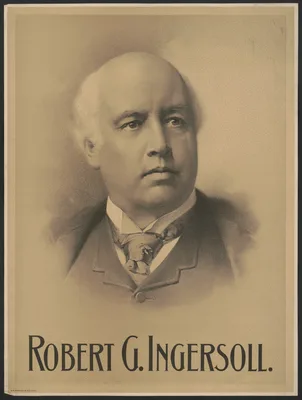
Robert G. Ingersoll
Robert Ingersoll was a preacher's son who kept the preacher's voice but not the creed. He turned unbelief into the most popular lecture ticket in America. In the end he let his agnosticism soften from attack into hope.
Leslie Stephen
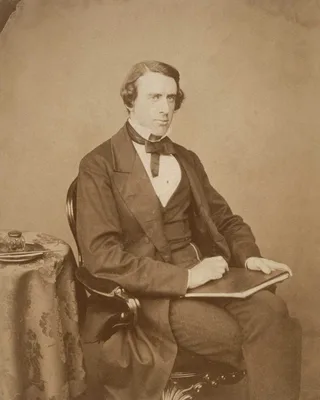
Leslie Stephen was an evangelical's grandson who took holy orders for a Cambridge tutorship rather than from conviction. He read his way out of the creed through Comte, Kant and Mill, gave up his teaching in 1862 rather than read services he did not believe, and renounced his orders as soon as the law allowed. In 1876 he gave English unbelief its modest public name, agnostic. He always insisted that he had not lost a faith but discovered he had never had one.
Ernst Haeckel
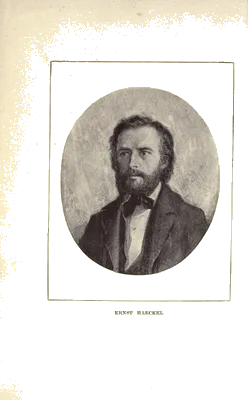
Ernst Haeckel's liberal Protestant faith, still defended in his letters at twenty-one, wore away between 1855 and 1857, under medicine, his teachers and what he saw of Catholic practice. Darwin (1860) and the death of his wife Anna (1864) drove him to build a "monistic" system in its place. He declared it as a pantheist's confession (1892) and as a "new monistic religion" that accepted atheism as its negative side (1899), organised it in the Monist League (1906), and made it outward only in 1910, when he left the church for political reasons. The creed did not change after that, and it carried his ranking of the races with it.
Mark Twain
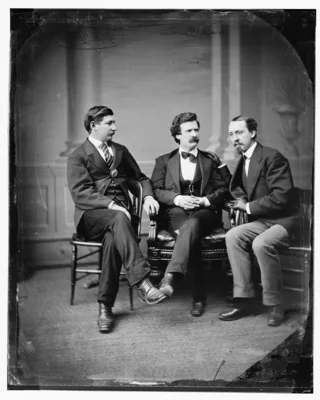
Mark Twain grew from a Hannibal boy terrified of hell into a man who could not sit through his wife's Bible readings without feeling a hypocrite. In private he denied every Christian doctrine while keeping a distant God. Out of love for his family and caution with his public, he put his sharpest writing on religion away for after his death.