Mark Twain grew from a Hannibal boy terrified of hell into a man who could not sit through his wife's Bible readings without feeling a hypocrite. In private he denied every Christian doctrine while keeping a distant God. Out of love for his family and caution with his public, he put his sharpest writing on religion away for after his death.
The belief timeline
- Faith (1840s) — A "trained Presbyterian conscience" in Hannibal: the Sunday school, the thunderstorm, the nightly repentance; the first small crack is the unanswered gingerbread prayer (c. 1841) [3][5][7][8]
- Doubt (1856–1858 and 1870s) — Two candidate dates the script must tell apart: the boy's objections (the childhood crack, c. 1841) and the adult case against the Bible (Macfarlane, 1856–57; Henry's death, 1858; the Bible readings that made him "a hypocrite," 1870s; Howells's "agnosticism") [5][12][14][30][38]
- Withholding (early 1880s) — The private credo and a life of church-going for Livy; "the Bible lie" letter of 1887 [38][39][44]
- Disclosure (1901–1906) — "To the Person Sitting in Darkness" (1901) in his own name; What Is Man? anonymous and privately printed (1906); the rest "for after death" [52][50][56]
- Revision (1896–1910) — The deaths of Susy, Livy and Jean; from the "Master Mind" to "Satan and Hell"; Stormfield's mockery of heaven; the possible "If we meet" [47][54][58][59][63][64]
Notes to the timeline (19)
- [3] His mother Jane joined the Presbyterian Church in Hannibal; her religion "regards as necessary institutions hell and Satan"; sister Pamela heard Sam's prayers, which he preferred to fill with tales — Albert Bigelow Paine, Mark Twain: A Biography, vol. I (New York: Harper & Brothers, 1912), pp. 1–561, p. 36.
- [5] The gingerbread prayer: he prayed for a schoolmate's gingerbread, got it once, then not at four more tries, and told his mother he did not believe in saying prayers any more; "a serious thing in that day openly to repudiate faith" (anecdote; Twain's own telling not located) — Paine, Mark Twain, vol. I, pp. 39–41. Reported at second hand; the original has not been seen.
- [7] In Hannibal he saw an old man shot with an open family Bible laid on his chest, a slave killed with a piece of slag, an emigrant stabbed, a would-be rapist shot; in his own telling the first and last "supplied me with some more dreams" — Paine, Mark Twain, vol. I, pp. 46–48; Mark Twain, Mark Twain's Autobiography, with an Introduction by Albert Bigelow Paine, vol. I (New York: Harper & Brothers, 1924), pp. 131–133.
- [8] He took these as "inventions of Providence to beguile me to a better life"; "I believed it in the daytime; but not in the night"; the thunderstorm that followed Injun Joe's death sent him praying in terror that Satan would take him too ("a raging hell of repentance") — Twain, Mark Twain's Autobiography, vol. I, pp. 133–135; Paine, Mark Twain, vol. I, pp. 61–62.
- [12] Winter 1856–57, boarding in Cincinnati, he spent evenings with Macfarlane, a self-taught Scotchman with a pre-Darwinian view that man was a failed development; Paine says the talks "left their impress upon him for life" (Paine is the only source) — Paine, Mark Twain, vol. I, pp. 113–116.
- [14] In mid-June 1858 the Pennsylvania's boilers exploded; his brother Henry, scalded, died in Memphis; Twain "unsparing in his self-blame, all his days carried the burden of it"; Paine says it deepened the "poor opinion" of "the human being as a divine invention" — Paine, Mark Twain, vol. I, pp. 139–144; Albert Bigelow Paine, ed., Mark Twain's Letters, vol. I (New York: Harper & Brothers, 1917), pp. 1–437, pp. 38–41.
- [30] At first Livy established "family prayers... grace before meals, and the morning reading of a Bible chapter"; Joe Goodman was "dumfounded to see Mark Twain ask a blessing"; the Bible readings ended it ("Livy... It is making me a hypocrite"); when is not recorded — Paine, Mark Twain, vol. I, pp. 410–411. Accounts differ; see the disputed points.
- [38] Howells: in a Hartford walk, "in the first fine flush of his agnosticism," Twain said Christianity had done nothing to improve morals; he called Ingersoll "an angelic orator"; stopped hearing Twichell preach; Livy said "Well, if you are to be lost, I want to be lost with you"; Livy grieved at his denial of immortality; "he never went back to anything like faith in the Christian theology, or in the notion of life after death, or in a conscious divinity" — William Dean Howells, My Mark Twain: Reminiscences and Criticisms (New York: Harper & Brothers, 1910), pp. 31–32.
- [39] Paine prints a credo of "the early eighties" (undated; judged by stationery and handwriting): "I believe in God the Almighty. I do not believe He has ever sent a message to man..."; Paine adds he "never destroyed it and never amended it" — Paine, Mark Twain: A Biography, vol. III (Harper, 1912), pp. 1110–1718, with the chapters "Mark Twain's Religion" (ch. CCXCV) and the 1906–07 table talk, pp. 1582–1584.
- [44] To Howells, 22 August 1887: "People pretend that the Bible means the same to them at 50 that it did at all former milestones in their journey. I wonder how they can lie so." — Albert Bigelow Paine, ed., Mark Twain's Letters, vol. II (New York: Harper & Brothers, 1917), pp. 439–854, p. 490.
- [52] "To the Person Sitting in Darkness," North American Review, February 1901, on the missionary Dr. Ament's Boxer indemnities; the American Board's Rev. Judson Smith defended Ament, and Twain replied in "To My Missionary Critics" (April 1901) — Paine, Mark Twain, vol. III, pp. 1127–1131.
- [50] What Is Man?: written at Vienna about eight years earlier ("the Gospel"), printed privately and anonymously in 1906, 250 numbered copies, copyrighted in the name of J. W. Bothwell of the De Vinne Press; critics did not suspect the author and thought it "a clever, and even brilliant, exposé of philosophies which were no longer startlingly new" — Paine, Mark Twain, vol. III, p. 1321.
- [56] Summer 1905: he wrote "Interpreting the Deity" and "The Privilege of the Grave," to be published after his death "without damage to his friends or family"; "Interpreting the Deity" is printed in WIM (1917) — Paine, Mark Twain, vol. III, p. 1244; Mark Twain, What Is Man? and Other Essays (New York: Harper & Brothers, May 1917), including "What Is Man?" (privately printed 1906), "The Death of Jean" (p. 110) and "As Concerns Interpreting the Deity" (p. 265), p. 265.
- [47] Susy died of cerebral fever in Hartford three days after her mother sailed to join her (18 August 1896); Twichell had stayed by her; Twain thanked him on 27 September — Paine, Mark Twain's Letters, vol. II, pp. 634–636.
- [54] Livy died on 5 June 1904 at the Villa di Quarto ("she that was the life of my life passed to the relief & the peace of death"); the funeral on 14 July at Elmira was conducted by Twichell; the stone bears "Gott sei dir gnädig, O meine Wonne!" — Paine, Mark Twain, vol. III, pp. 1217–1218, 1222–1223, 1311.
- [58] Paine's record of the 1906–07 table talk: "There is, of course, a great Master Mind, but it cares nothing for our happiness or our unhappiness"; "Blasphemy? No, it is not blasphemy..."; the Old Testament God "the most damnatory biography that ever found its way into print" — Paine, Mark Twain, vol. III, pp. 1352–1356.
- [59] Private letter, 28 August 1908: "the fear of Satan and Hell made 99 Christians where love of God and Heaven landed one"; he also added Thomas Paine to a list of the world's greatest statesmen — Paine, Mark Twain's Letters, vol. II, pp. 817–818.
- [63] Jean died on 24 December 1909 at Stormfield; Twain wrote "The Death of Jean"; two days later he said "For one who does not believe in spirits I have had a most peculiar experience" and "I have never greatly envied any one but the dead" — Twain, What Is Man? and Other Essays, pp. 110–116; Paine, Mark Twain, vol. III, pp. 1545–1552.
- [64] Twain died at Stormfield about half past six on 21 April 1910; his last word to Clara was "Good-by," and a physician thought he added "If we meet"; Howells says his expressions to him "were of a courageous renunciation" — Paine, Mark Twain, vol. III, pp. 1576–1578; Howells, My Mark Twain, p. 32.
For After Death
In the autumn of 1909, at his house in Connecticut, the most famous writer in America was working on a book he said would never be published. "This book will never be published," he told his biographer, "in fact it couldn't be, because it would be felony."1 He was seventy-three. He had written a good deal of this kind of thing in his last fifteen years, about the Bible, about Providence, about the God of the Old Testament, and he had put almost all of it away. Some of it he had printed anonymously, in two hundred and fifty numbered copies, so that critics reviewed it without guessing the author. Some of it he labelled for publication after his death, "without damage to his friends or family."2 The book he was writing that autumn, Letters from the Earth, was not published until 1962.3
Samuel Clemens, who wrote as Mark Twain, did not keep his unbelief hidden because he was ashamed of it. He kept it back for the people he loved, and for the public that loved him. This chapter is about where it came from, how it grew, and why so much of it waited.
A trained Presbyterian conscience
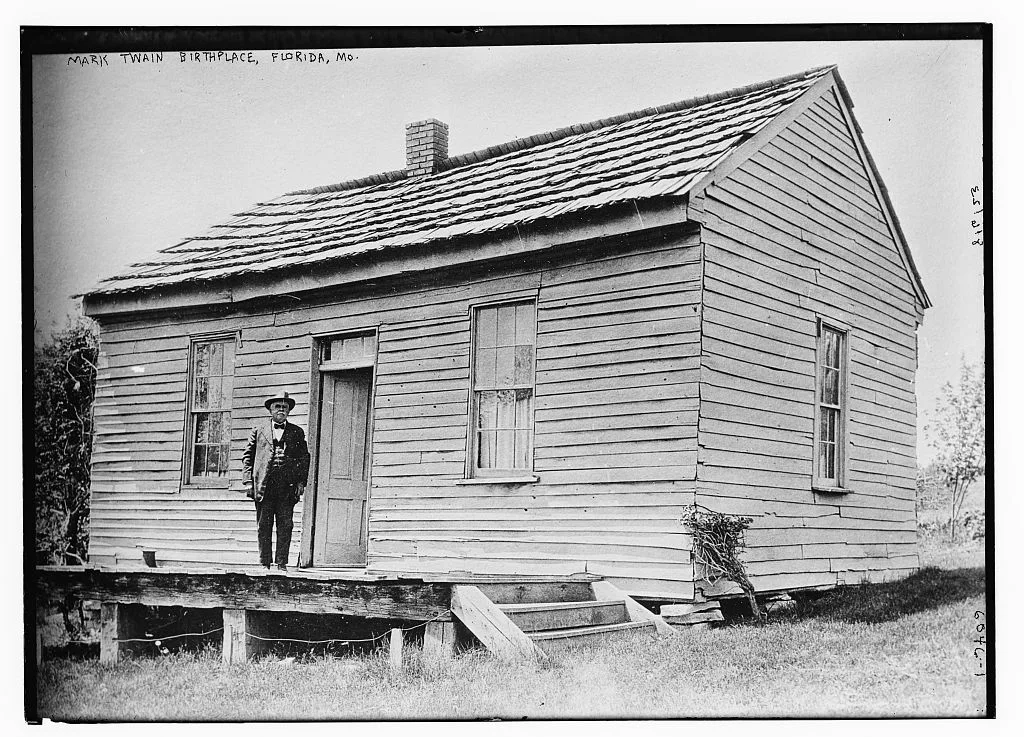
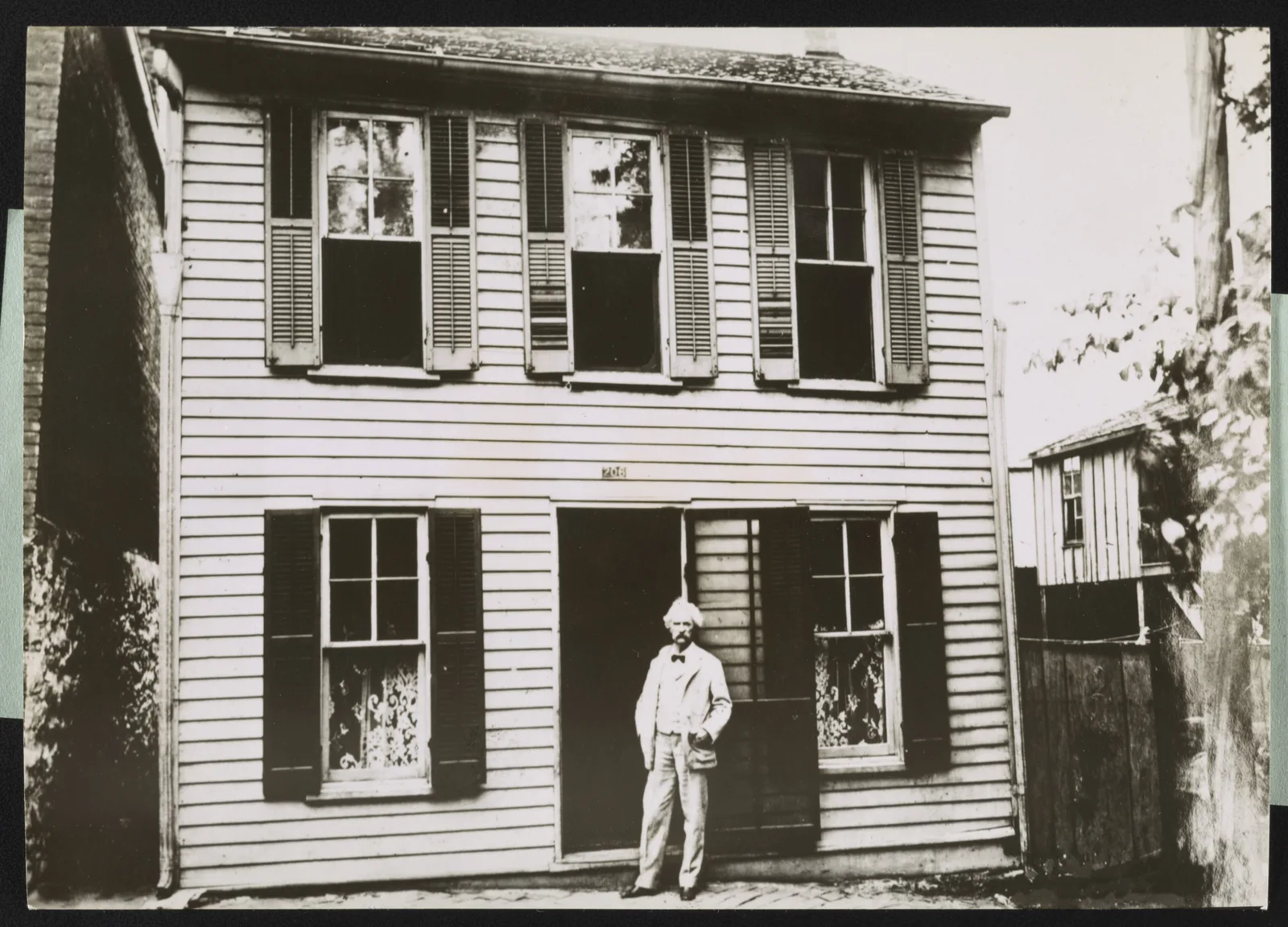
He was born on 30 November 1835 in a one-story frame house in the village of Florida, Missouri, in a year when Halley's comet was in the sky.4 In 1839 the family moved to Hannibal, a river town on the Mississippi.5 His mother, Jane, joined the Presbyterian church there, and her religion, his biographer wrote, regarded hell and Satan "as necessary institutions."6 School opened each day with a prayer and a chapter of the Bible, and the boy's home teaching convinced him that "flames were being kept brisk for little boys who were heedless of sacred matters."7
Hannibal was a violent place for a child to watch. He saw an old man shot in the street and laid out with the family Bible open on his chest; he saw a slave killed with a lump of slag, and other killings besides.8 Writing seventy years later, he described the conscience these sights produced in him: "mine was a trained Presbyterian conscience and knew but the one duty, to hunt and harry its slave upon all pretexts and on all occasions, particularly when there was no sense nor reason in it."9 He took the killings as signs meant for him. "They were inventions of Providence to beguile me to a better life." But the belief was not steady. "I believed it in the daytime; but not in the night. With the going down of the sun my faith failed and the clammy fears gathered about my heart."1011 After a night of thunder he would lie awake repenting, sure that Satan would come for him, and lose his repentance again with the daylight.12
There is a story, which comes from his biographer rather than from Clemens himself, of the first crack. As a small boy he prayed for a schoolmate's gingerbread, got it once, and then prayed four more times without result. He told his mother, "No, but I don't believe in saying prayers any more, and I'm never going to do it again."13 His biographer remarked that it was "a serious thing in that day openly to repudiate faith."14 It was a child's experiment, and it did not make him an unbeliever; for years afterwards he still woke in terror of hell. His father died in March 1847, and the eleven-year-old, "fairly broken down" with remorse, promised his mother to be a better boy.15 He thought for a while of becoming a preacher, "because it never occurred to me that a preacher could be damned. It looked like a safe job."16 And he was made, he said much later, to read the whole Bible through, unexpurgated, before he was fifteen.17
The river
He left Hannibal as a printer, and in 1857 he went down the Mississippi to learn to be a steamboat pilot.18 His biographer tells of a winter spent in a Cincinnati boarding-house beside a self-taught Scotsman named Macfarlane, who argued that man was a failed experiment of nature, and says these talks "left their impress upon him for life." Clemens's own account of Macfarlane has not been found, and the biographer is the only source.19
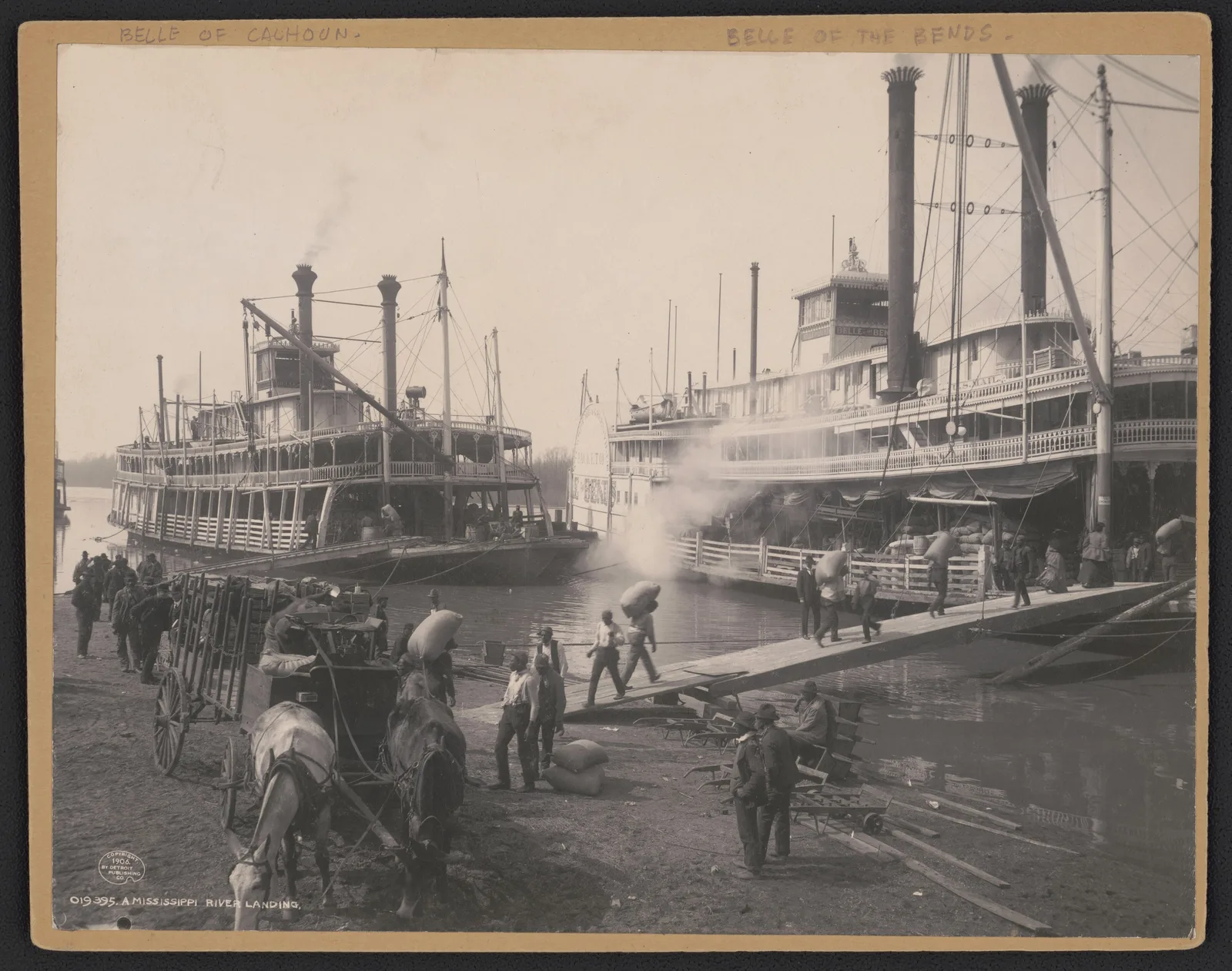
In June 1858 the steamboat Pennsylvania blew up her boilers near Memphis. His younger brother Henry, whom he had found a place on the boat, was terribly scalded and died. Clemens blamed himself for the rest of his life.20 The letter he wrote to his sister-in-law while Henry was dying contains a prayer: "Hardened, hopeless, aye, lost, lost, lost and ruined sinner as I am, I, even I, have humbled myself to the ground and prayed as never man prayed before, that the great God might let this cup pass from me, that he would strike me to the earth, but spare my brother."21 His biographer left that sentence out when he quoted the letter in 1912, and restored it when he printed the letters in 1917.22 It shows that at twenty-two, in the worst week of his life, he still prayed.
Two years later, writing to his brother Orion, he sounded different. "What a man wants with religion in these breadless times, surpasses my comprehension."23 In 1864, in Nevada, he told an audience, half joking, that he was "not a very dusty Christian myself."24
Innocents abroad
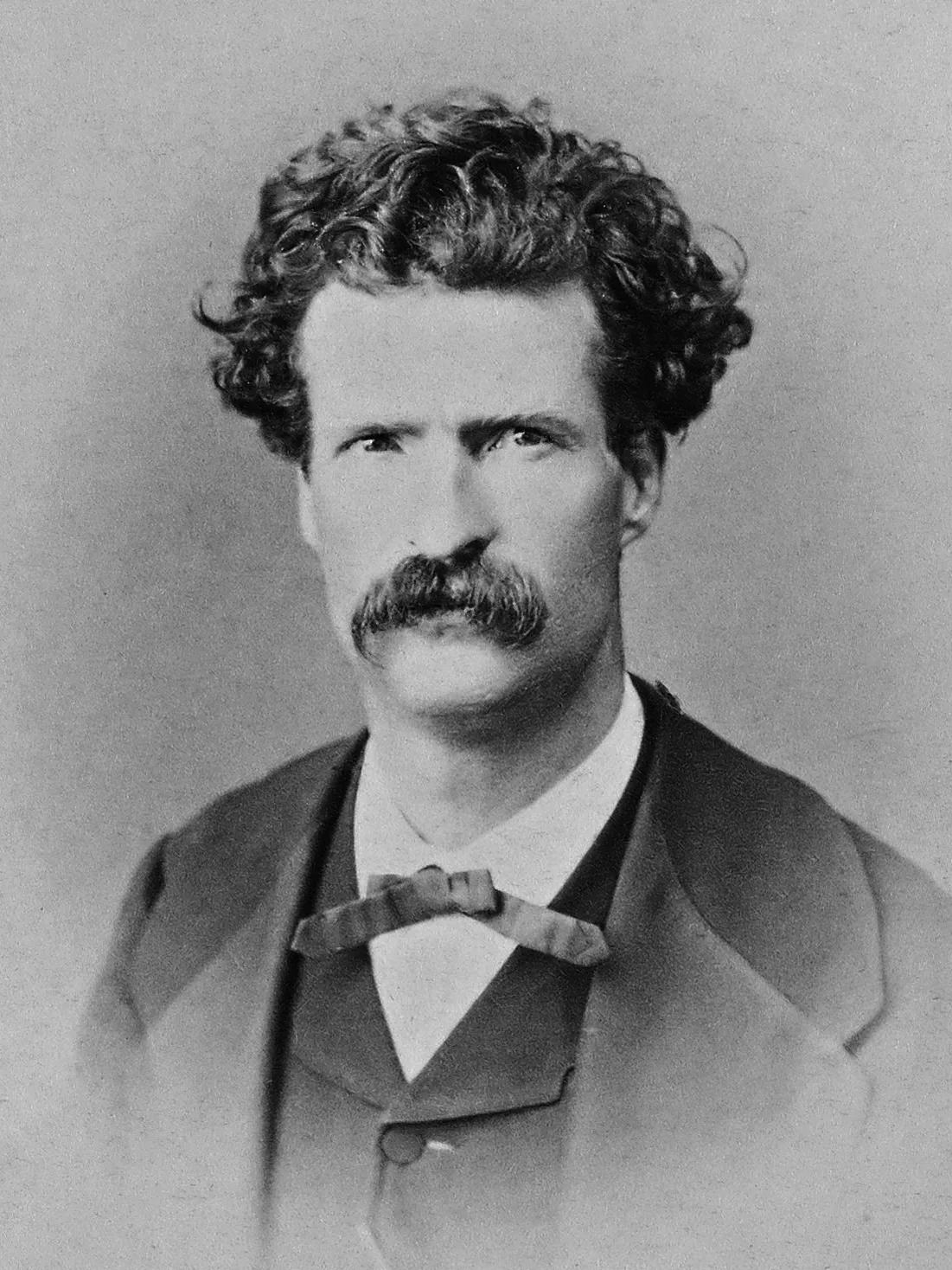
In June 1867, by now a well-known newspaper humorist, he sailed from New York on the Quaker City for a pleasure excursion to Europe and the Holy Land. The voyage had been advertised with the preacher Henry Ward Beecher among the passengers; Beecher did not go, but plenty of devout pilgrims did.25 A motherly fellow passenger made sure that Clemens and the younger men were "at church regularly on Sundays; at the 8-bells prayer meeting every night."26 A deacon from the same party thought him "sinful, irreverent, profane," and summed him up: "He was the worst man I ever knew." Then he added, "And the best."2728
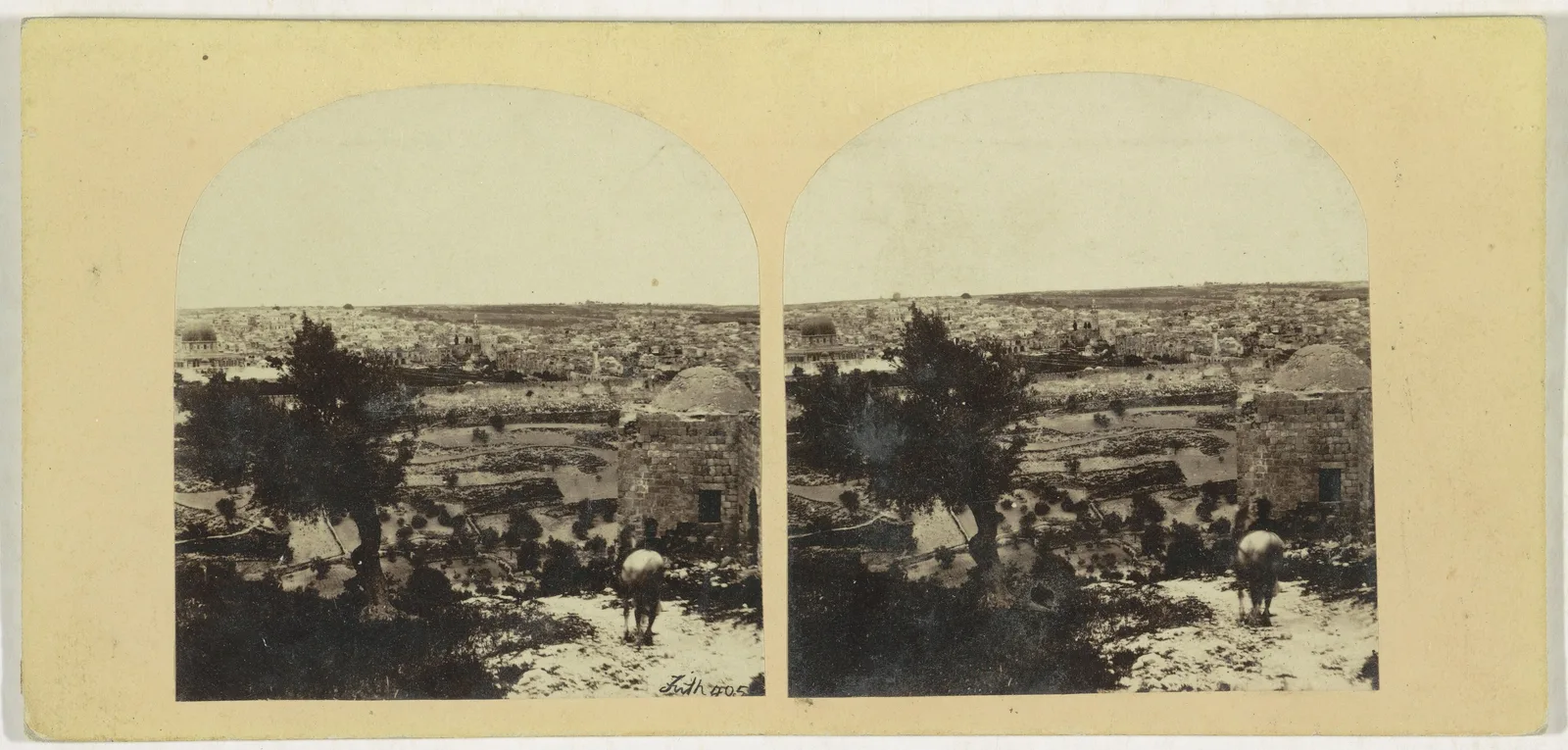
In Jerusalem he bought a Bible for his mother, and he read the King James version through the weeks in Palestine; his biographer thought its language shaped the style of the book he made from the trip.29 That book, The Innocents Abroad, laughed at the relics shown to tourists, "two of St. Paul's fingers ... a bone of Judas Iscariot, (it was black,)" and found that "Palestine sits in sackcloth and ashes."30 The orthodox directors of his publishing company feared it was heresy, and thought the subtitle, The New Pilgrims' Progress, a sacrilege in itself.31
Livy
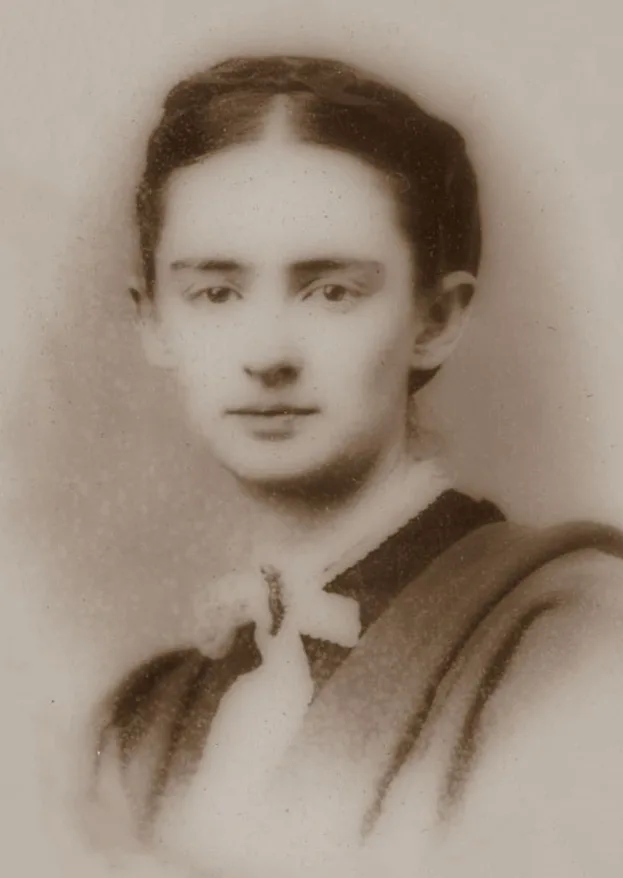
In the Bay of Smyrna that September a young passenger named Charles Langdon showed him a miniature of his sister Olivia.32 Clemens met her in New York two days before Christmas 1867, and courted her through the next year.33 She was devout, and on his first visit to her family in Elmira she suspected that he "might have unorthodox views on matters of religion."34 That autumn in Hartford he met the Reverend Joseph Twichell, pastor of the Asylum Hill church, who became his closest friend for forty years. "Ministers always loved Mark Twain," his biographer wrote. "They did not always approve of him, but they adored him."35 Clemens married Olivia Langdon at Elmira on 2 February 1870, with Twichell assisting at the service.36
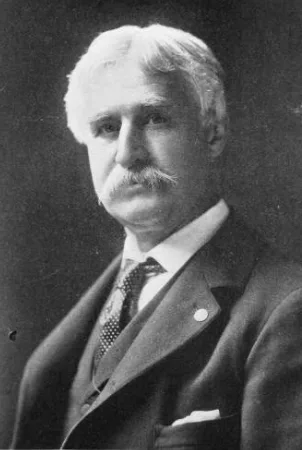
In their first home Livy established family prayers, grace before meals and a Bible chapter every morning, and an old friend, Joe Goodman, was astonished to see Mark Twain ask a blessing. It did not last. One morning, his biographer says, he put a stop to it. "Livy, you may keep this up if you want to, but I must ask you to excuse me from it. It is making me a hypocrite. I don't believe in this Bible. It contradicts my reason. I can't sit here and listen to it, letting you believe that I regard it, as you do, in the light of gospel, the word of God."37 No one remembered afterwards when it happened, only that it was early in the marriage.38
Why the doubt belongs here
This scene, rather than the gingerbread prayer, is where his adult doubt belongs on the timeline. The boy in Hannibal had questioned prayer and been frightened back into belief every night. The man in the 1870s read the Bible as a grown reader, every morning, beside a wife who believed it, and found that he could not pretend. His friend William Dean Howells remembered walks around Hartford in those years, "when he was in the first fine flush of his agnosticism," and Clemens telling him that Christianity had done nothing to improve morals.39 He stopped going to hear Twichell preach. He read Lecky's history of European morals at the family's summer farm, and wrote "Sound and true" in the margin beside the argument that every human action springs from the wish for happiness.40 In 1883 he read a paper on that idea, "What Is Happiness?," to a Hartford club of clergymen and professional men, who "scoffed and jeered at it; denounced it as a manifest falsity."4142 Proofreading his novel The Prince and the Pauper, set in the England of the Reformation, "cost me the last rags of my religion," he told Howells in 1884.43
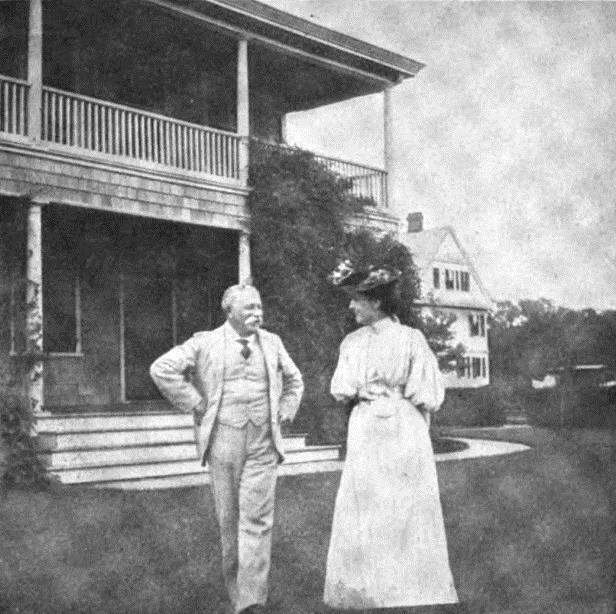
Howells also remembered what this cost Livy. She grieved at his denial of immortality. And she said to him, as he later told Howells, "Well, if you are to be lost, I want to be lost with you."44 Howells's verdict was that Clemens "never went back to anything like faith in the Christian theology, or in the notion of life after death, or in a conscious divinity."45
The private credo
Clemens wrote down what he believed in those years, on a few sheets that his biographer found after his death and dated, by the paper and the handwriting, to the early 1880s. It was never published in his lifetime. "I believe in God the Almighty," it begins. "I do not believe He has ever sent a message to man by anybody, or delivered one to him by word of mouth, or made Himself visible to mortal eyes at any time in any place. I believe that the Old and New Testaments were imagined and written by man, and that no line in them was authorized by God, much less inspired by Him."46 On hell: "I cannot see how eternal punishment hereafter could accomplish any good end, therefore I am not able to believe in it."47 On a fly-leaf of a book he wrote a shorter version of the same thought: "The easy confidence with which I know another man's religion is folly teaches me to suspect that my own is also."48
This is not atheism, and he never called it that. In no surviving sentence does he call himself either an atheist or an agnostic; "agnosticism" is Howells's word for him.49 What he denied was revelation: that God had ever spoken, that any book came from God, that anyone would be punished forever. What he kept, for a time, was a God too large to be described.
Huck
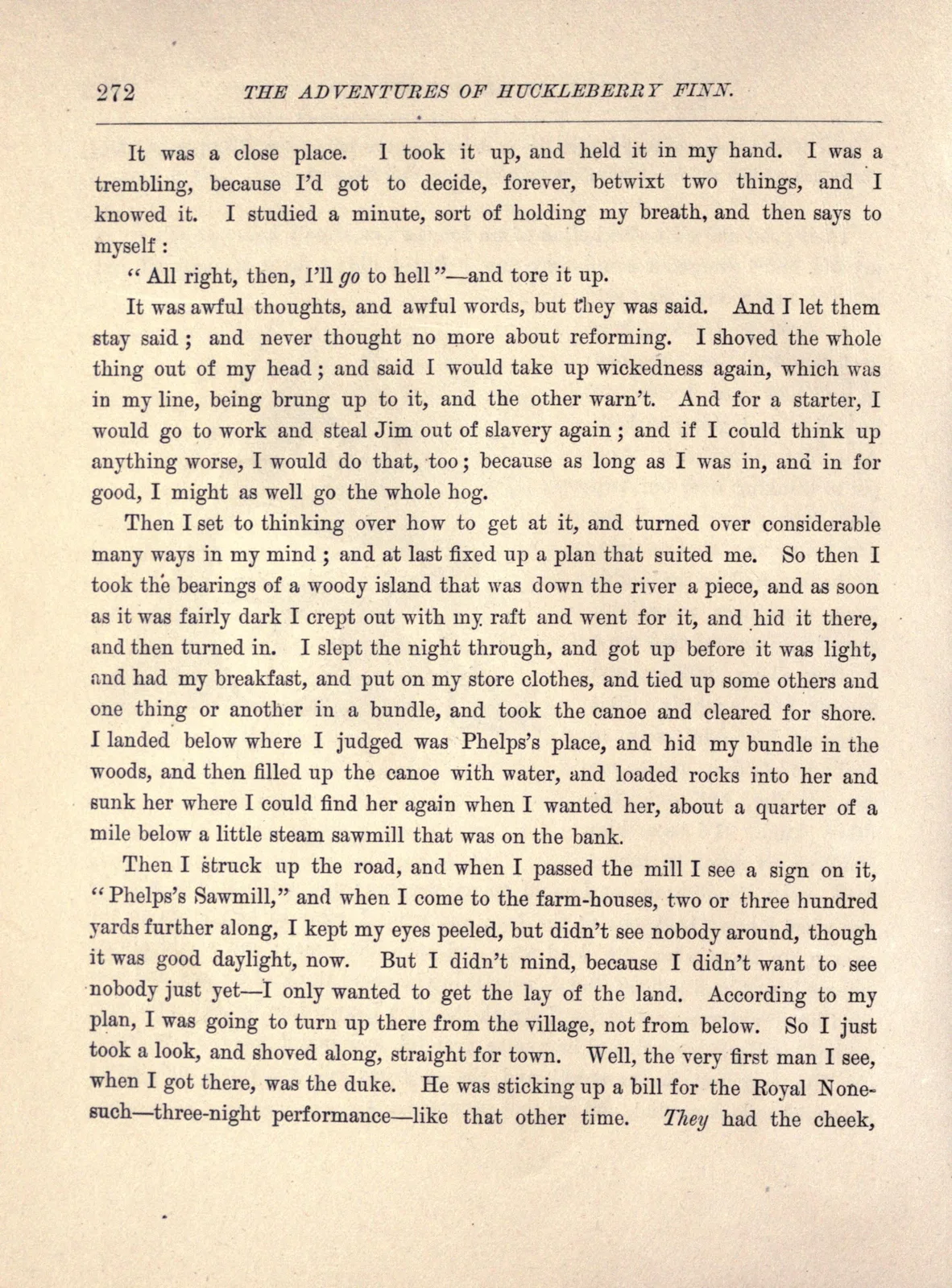
He put the argument into fiction, where it could be said by someone else. In Adventures of Huckleberry Finn, published in 1885, a boy raised on the same Sunday-school religion that had frightened Clemens decides to help a runaway slave escape, believing that God and his conscience both require him to turn Jim in. He writes the letter that would return Jim to his owner, looks at it, and tears it up. "All right, then, I'll go to hell."50 It is the most famous moral decision in American literature, and its meaning is that a boy's heart was better than the religion he had been taught.
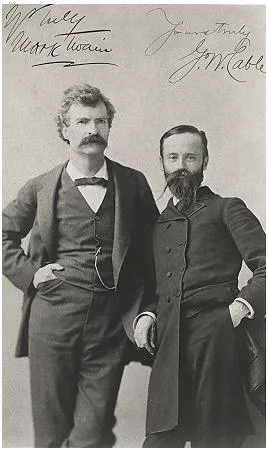
On a reading tour that winter his partner was the novelist George Washington Cable, a strict Presbyterian who read the Bible aloud every evening until Clemens asked him to stop. "In him and his person I have learned to hate all religions," he told Howells, joking and not joking. "He has taught me to abhor and detest the Sabbath-day."51 The two men stayed fast friends. In 1887 he wrote to Howells more soberly: "People pretend that the Bible means the same to them at 50 that it did at all former milestones in their journey. I wonder how they can lie so."52 After the Johnstown flood of 1889 he wrote, "I swear I was afraid to pray, for fear I should laugh."53
In public, the sharpest he allowed himself was a joke at the head of a chapter. Following the Equator, in 1897, carried maxims attributed to his character Pudd'nhead Wilson: "Faith is believing what you know ain't so," and "True irreverence is disrespect for another man's god."5455 The first of those is genuine; many of the other religious one-liners attributed to Mark Twain are not, and do not appear in anything he published.
The losses
In August 1896 his daughter Susy died of cerebral fever in Hartford while her parents were abroad, three days after her mother had sailed to join her.56 Twichell stayed with her to the end. Clemens's letters afterwards are the hardest things he ever wrote about Providence. "How am I to comprehend this? How am I to have it? Why am I robbed, and who is benefited?"57 A year later he wrote to Howells of "Susy and Winnie given us, in miserable sport, and then taken away."58 He remembered that Susy herself, at about eight, had stopped praying for a while after learning that the Indians had believed in their own gods. "By and by it can turn out that we are wrong," she told her mother. "So now I only pray that there may be a God and a heaven, or something better."59
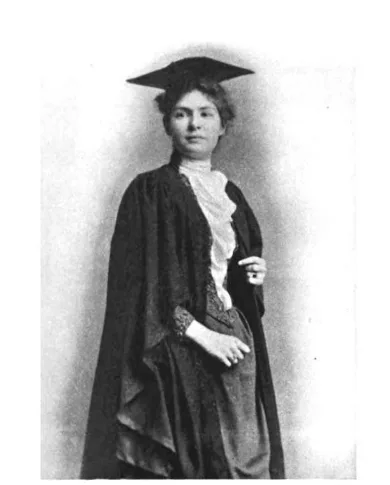
In Vienna he wrote what he called "the Gospel," a dialogue in which an Old Man argues that a human being is a machine: "Whatsoever a man is, is due to his make, and to the influences brought to bear upon it by his heredities, his habitat, his associations."60 He printed it in 1906, as What Is Man?, anonymously and privately, in two hundred and fifty copies; reviewers thought it a clever exposé of philosophies "no longer startlingly new," and did not guess who had written it.61
The Person Sitting in Darkness
He did publish one great attack under his own name, and it was aimed not at God but at missionaries. In February 1901 the North American Review printed "To the Person Sitting in Darkness," his attack on an American missionary in China who had collected heavy indemnities from Chinese villages after the Boxer rising. The Reverend Judson Smith of the American Board of Foreign Missions defended the missionary, and conceded that Clemens's "brilliant article ... would produce an effect quite beyond the reach of plain argument."6263
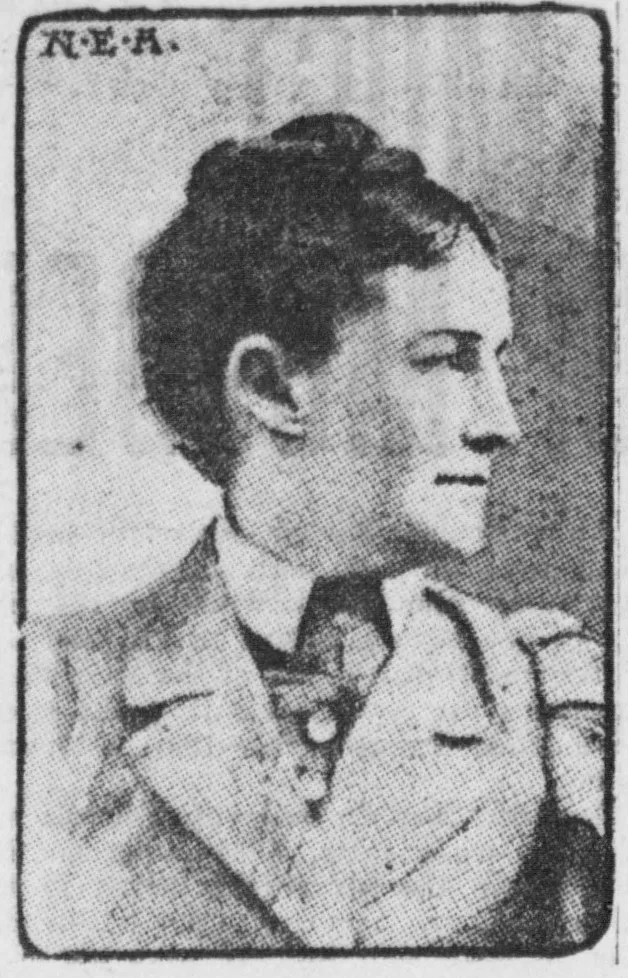
In June 1904 Livy died at a villa near Florence. "At a quarter past 9 this evening she that was the life of my life passed to the relief & the peace of death after 22 months of unjust & unearned suffering," he wrote in his notebook.64 Twichell conducted her funeral at Elmira, and spoke of death as something they did not believe in: "Robert Browning, when he was nearing the end of his earthly days, said that death was the thing that we did not believe in. Nor do we believe in it."6566
The Master Mind
His biographer, Albert Bigelow Paine, lived in his house during his last four years and wrote down what he said. "No one who thinks can imagine the universe made by chance. It is too nicely assembled and regulated. There is, of course, a great Master Mind, but it cares nothing for our happiness or our unhappiness."67 Of a charge of blasphemy he said, "If God is as vast as that, He is above blasphemy; if He is as little as that, He is beneath it."68 In a private letter of 1908 he wrote that through the centuries "the fear of Satan and Hell made 99 Christians where love of God and Heaven landed one."69 He let Captain Stormfield's Visit to Heaven, a comic story about a sea captain who reaches heaven and finds the harps and halos useless, be printed at last; it had lain in a drawer for forty years.70 And he wrote Letters from the Earth.
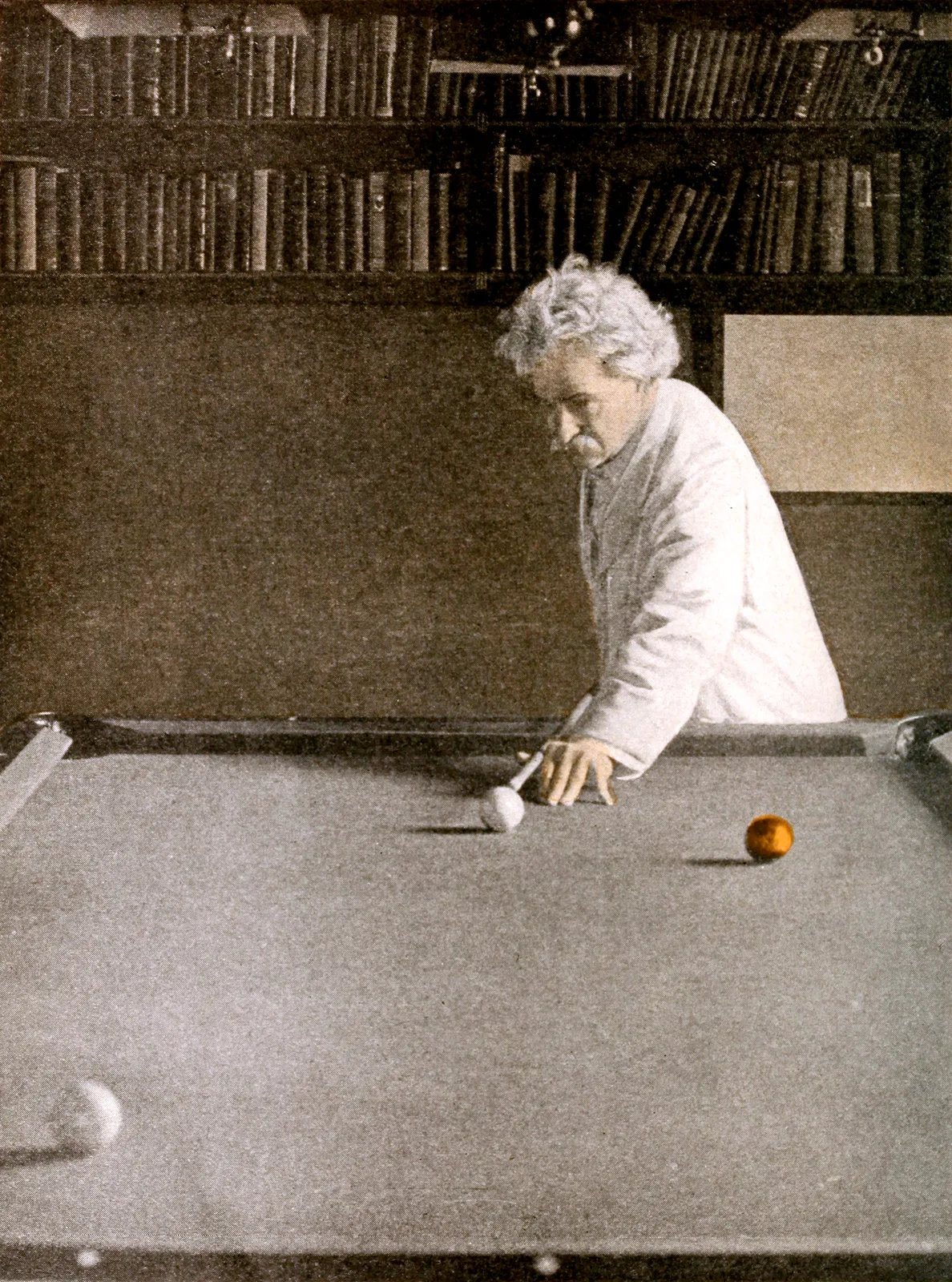
On 24 December 1909 his youngest daughter, Jean, died at Stormfield.71 Two days later he told Paine, "For one who does not believe in spirits I have had a most peculiar experience," and wrote that he had "never greatly envied any one but the dead."7271 He died there himself on 21 April 1910, in the year the comet came back. His last word to his daughter Clara was "Good-by," and a doctor thought he heard him add, "If we meet."73 He was buried at Elmira after a service at the Brick Presbyterian Church in New York, at which Twichell prayed; "pulpits forgot his heresies and paid him honor."74
Did his unbelief change shape?
His two closest witnesses disagreed about what he believed at the end, and both deserve to be heard. Paine wrote that "his belief in God, the Creator, was absolute," and that his disbelief and his pessimism "were of his mind; never of his heart."75 Howells wrote that he never went back to a conscious divinity, nor to any hope of life after death. The sources support something between them. The man who began as a boy afraid of hell came to deny every part of Christian teaching, most of all eternal punishment; he kept, for a long time, a God who had made the universe and did not speak; and in his last years, after the deaths of two daughters and his wife, he described that God as indifferent and wrote his angriest pages for a drawer.
The shape of his unbelief was the shape of his life: an ear for what people really meant, a heart that could not bear needless suffering, and a deep reluctance to hurt the people he loved. He kept most of it back, not because he doubted it, but because, as he said of Letters from the Earth, the world was not ready, and the people he loved would have been hurt.
Robert Ingersoll, the orator whose speech in Chicago in 1879 he said would "sing through my memory always," has his own chapter in this book.76
Footnotes
-
Paine, Mark Twain: A Biography, vol. III (Harper, 1912), pp. 1110–1718, with the chapters "Mark Twain's Religion" (ch. CCXCV) and the 1906–07 table talk, p. 1531. ↩
-
Paine, Mark Twain, vol. III, p. 1244; Mark Twain, What Is Man? and Other Essays (New York: Harper & Brothers, May 1917), including "What Is Man?" (privately printed 1906), "The Death of Jean" (p. 110) and "As Concerns Interpreting the Deity" (p. 265), p. 265. ↩
-
none in scan. Not verified. ↩
-
Albert Bigelow Paine, Mark Twain: A Biography, vol. I (New York: Harper & Brothers, 1912), pp. 1–561, p. 12; Paine, Mark Twain, vol. III, p. 1576 n.. ↩
-
Paine, Mark Twain, vol. I, p. 26. ↩
-
Paine, Mark Twain, vol. I, p. 36. ↩
-
Paine, Mark Twain, vol. I, pp. 38–39. ↩
-
Paine, Mark Twain, vol. I, pp. 46–48; Mark Twain, Mark Twain's Autobiography, with an Introduction by Albert Bigelow Paine, vol. I (New York: Harper & Brothers, 1924), pp. 131–133. ↩
-
Twain, Mark Twain's Autobiography, vol. I, p. 131. ↩
-
Twain, Mark Twain's Autobiography, vol. I, p. 133. ↩
-
Twain, Mark Twain's Autobiography, vol. I, p. 134. ↩
-
Twain, Mark Twain's Autobiography, vol. I, pp. 133–135; Paine, Mark Twain, vol. I, pp. 61–62. ↩
-
Little Sam, as reported by Paine: Paine, Mark Twain, vol. I, pp. 40–41. ↩
-
Paine, Mark Twain, vol. I, pp. 39–41. Reported at second hand; the original has not been seen. ↩
-
Paine, Mark Twain, vol. I, pp. 73–75. ↩
-
Paine, Mark Twain, vol. I, p. 83. ↩
-
Mark Twain's Autobiography, vol. II (Harper, 1924), pp. 335–336. ↩
-
Paine, Mark Twain, vol. I, pp. 116–117. ↩
-
Paine, Mark Twain, vol. I, pp. 113–116. ↩
-
Paine, Mark Twain, vol. I, pp. 139–144; Albert Bigelow Paine, ed., Mark Twain's Letters, vol. I (New York: Harper & Brothers, 1917), pp. 1–437, pp. 38–41. ↩
-
Paine, Mark Twain's Letters, vol. I, p. 40. ↩
-
Paine, Mark Twain's Letters, vol. I, p. 40; Paine, Mark Twain, vol. I, p. 141. Accounts differ; see the disputed points. ↩
-
Paine, Mark Twain's Letters, vol. I, p. 45. ↩
-
Paine, Mark Twain's Letters, vol. I, p. 96 (inferred). ↩
-
Paine, Mark Twain, vol. I, pp. 308–309, 324–325. ↩
-
Paine, Mark Twain's Letters, vol. I, p. 155. ↩
-
Deacon William F. Church, a fellow Quaker City pilgrim, orthodox, who "thought him sinful, irreverent, profane"; Paine adds that he then said, "And the best": Paine, Mark Twain, vol. I, p. 336. ↩
-
Paine, Mark Twain, vol. I, p. 336. ↩
-
Paine, Mark Twain, vol. I, pp. 337–338. ↩
-
Mark Twain, The Innocents Abroad; or, The New Pilgrims' Progress (Hartford: American Publishing Company, 1897 printing of the 1869 text), pp. 180, 607. ↩
-
Paine, Mark Twain, vol. I, pp. 365, 381–383. ↩
-
Paine, Mark Twain, vol. I, pp. 338–341. ↩
-
Paine, Mark Twain, vol. I, pp. 352–353. ↩
-
Paine, Mark Twain's Letters, vol. I, pp. 154–155; Paine, Mark Twain, vol. I, pp. 353–354. ↩
-
Paine, Mark Twain, vol. I, pp. 370–372. ↩
-
Paine, Mark Twain, vol. I, p. 391; Paine, Mark Twain's Letters, vol. I, p. 177. ↩
-
Paine, Mark Twain, vol. I, p. 411. ↩
-
Paine, Mark Twain, vol. I, pp. 410–411. ↩
-
Howells: William Dean Howells, My Mark Twain: Reminiscences and Criticisms (New York: Harper & Brothers, 1910), p. 31. ↩
-
Paine, Mark Twain, vol. I, pp. 510–511 (inferred). ↩
-
The Hartford Monday Evening Club on "What Is Happiness?" (February 1883), as Paine reports: Paine, Mark Twain: A Biography, vol. II (Harper, 1912), continuous pagination pp. 562–1109, p. 744. ↩
-
Paine, Mark Twain, vol. II, pp. 743–744. ↩
-
Albert Bigelow Paine, ed., Mark Twain's Letters, vol. II (New York: Harper & Brothers, 1917), pp. 439–854, p. 443. ↩
-
Olivia Clemens to her husband, as Twain told Howells: Howells, My Mark Twain, p. 32. ↩
-
Howells: Howells, My Mark Twain, p. 32. ↩
-
Paine, Mark Twain, vol. III, p. 1583. ↩
-
Paine, Mark Twain, vol. III, p. 1583. ↩
-
Paine, Mark Twain, vol. III, p. 1584. ↩
-
searched all of research/texts. ↩
-
Huck Finn (Twain): Mark Twain, Adventures of Huckleberry Finn (Tom Sawyer's Comrade) (New York: Charles L. Webster and Company, 1885; copyright 1884), p. 272. ↩
-
Paine, Mark Twain's Letters, vol. II, p. 450. ↩
-
Paine, Mark Twain's Letters, vol. II, p. 490. ↩
-
Paine, Mark Twain's Letters, vol. II, p. 511. ↩
-
Pudd'nhead Wilson's New Calendar, Following the Equator ch. XII epigraph: Mark Twain, Following the Equator (Hartford: American Publishing Company, 1897), with the "Pudd'nhead Wilson's New Calendar" chapter epigraphs, ch. XII. Authentic (frequently misquoted). ↩
-
Pudd'nhead Wilson's New Calendar: Twain, Following the Equator, ch. LIII. ↩
-
Paine, Mark Twain's Letters, vol. II, pp. 634–636. ↩
-
Paine, Mark Twain's Letters, vol. II, p. 641. ↩
-
Paine, Mark Twain's Letters, vol. II, p. 655. ↩
-
Susy Clemens, about 1880, as set down by Twain: Auto, vol. II, p. 31. ↩
-
The Old Man in What Is Man?: Twain, What Is Man? and Other Essays, p. 5. ↩
-
Paine, Mark Twain, vol. III, p. 1321. ↩
-
The Rev. Judson Smith, American Board of Foreign Missions, defending Dr. Ament (1901); he also called the thirteenfold indemnity "theft and extortion," as Twain's reply quotes: Paine, Mark Twain, vol. III, p. 1130. ↩
-
Paine, Mark Twain, vol. III, pp. 1127–1131. ↩
-
Paine, Mark Twain, vol. III, p. 1218. ↩
-
The Rev. Joseph H. Twichell, friend and pastor, at Livy Clemens's funeral, 14 July 1904: Paine, Mark Twain, vol. III, p. 1223. ↩
-
Paine, Mark Twain, vol. III, pp. 1217–1218, 1222–1223, 1311. ↩
-
Paine, Mark Twain, vol. III, p. 1353. ↩
-
Paine, Mark Twain, vol. III, p. 1354. ↩
-
Paine, Mark Twain's Letters, vol. II, p. 817. ↩
-
Paine, Mark Twain's Letters, vol. II, p. 488; Paine, Mark Twain, vol. III, p. 1428; Mark Twain, Extract from Captain Stormfield's Visit to Heaven (New York and London: Harper & Brothers, 1909), p. 26. ↩
-
Twain, What Is Man? and Other Essays, pp. 110–116; Paine, Mark Twain, vol. III, pp. 1545–1552. ↩ ↩2
-
Paine, Mark Twain, vol. III, p. 1551. ↩
-
Paine, Mark Twain, vol. III, pp. 1576–1578; Howells, My Mark Twain, p. 32. ↩
-
Paine, Mark Twain, vol. III, pp. 1578–1580. ↩
-
Paine, Mark Twain, vol. III, pp. 1581–1582. ↩
-
Paine, Mark Twain, vol. II, p. 655. ↩
In their own words
mine was a trained Presbyterian conscience and knew but the one duty—to hunt and harry its slave upon all pretexts and on all occasions, particularly when there was no sense nor reason in it.
In all the throng of gaping and sympathetic onlookers there was not one with common sense enough to perceive that an anvil would have been in better taste there than the Bible, less open to sarcastic criticism, and swifter in its atrocious work.
They were inventions of Providence to beguile me to a better life.
That is, I believed it in the daytime; but not in the night. With the going down of the sun my faith failed and the clammy fears gathered about my heart.
No, but I don't believe in saying prayers any more, and I'm never going to do it again.
Hardened, hopeless,—aye, lost—lost—lost and ruined sinner as I am—I, even I, have humbled myself to the ground and prayed as never man prayed before, that the great God might let this cup pass from me—that he would strike me to the earth, but spare my brother
What a man wants with religion in these breadless times, surpasses my comprehension.
Livy, you may keep this up if you want to, but I must ask you to excuse me from it. It is making me a hypocrite. I don't believe in this Bible. It contradicts my reason. I can't sit here and listen to it, letting you believe that I regard it, as you do, in the light of gospel, the word of God.
now he comes to the surface to rescue our "noble and beautiful religion" from the sacrilegious talons of Bob Ingersoll.
Bob Ingersoll's music will sing through my memory always as the divinest that ever enchanted my ears.
In one of our walks about Hartford, when he was in the first fine flush of his agnosticism, he declared that Christianity had done nothing to improve morals and conditions
he never went back to anything like faith in the Christian theology, or in the notion of life after death, or in a conscious divinity.
I believe in God the Almighty. I do not believe He has ever sent a message to man by anybody, or delivered one to him by word of mouth, or made Himself visible to mortal eyes at any time in any place. I believe that the Old and New Testaments were imagined and written by man, and that no line in them was authorized by God, much less inspired by Him.
I cannot see how eternal punishment hereafter could accomplish any good end, therefore I am not able to believe in it.
The easy confidence with which I know another man's religion is folly teaches me to suspect that my own is also.
The proof-reading on the P & P cost me the last rags of my religion.
in him and his person I have learned to hate all religions. He has taught me to abhor and detest the Sabbath-day and hunt up new and troublesome ways to dishonor it.
People pretend that the Bible means the same to them at 50 that it did at all former milestones in their journey. I wonder how they can lie so.
All right, then, I'll go to hell
Faith is believing what you know ain't so.
True irreverence is disrespect for another man's god.
How am I to comprehend this? How am I to have it? Why am I robbed, and who is benefited?
Well, mamma, the Indians believed they knew, but now we know they were wrong. By and by it can turn out that we are wrong. So now I only pray that there may be a God and a heaven—or something better.
At a quarter past 9 this evening she that was the life of my life passed to the relief & the peace of death after 22 months of unjust & unearned suffering.
compelled me to read an unexpurgated Bible through before I was 15 years old.
No one who thinks can imagine the universe made by chance. It is too nicely assembled and regulated. There is, of course, a great Master Mind, but it cares nothing for our happiness or our unhappiness.
Blasphemy? No, it is not blasphemy. If God is as vast as that, He is above blasphemy; if He is as little as that, He is beneath it.
Whatsoever a man is, is due to his make, and to the influences brought to bear upon it by his heredities, his habitat, his associations.
During those 1500 years the fear of Satan and Hell made 99 Christians where love of God and Heaven landed one.
This book will never be published — in fact it couldn't be, because it would be felony
Yes, but in spite of their religion, not because of it.
Lack ! Why, I lack my harp, and my wreath, and my halo, and my hymn-book, and my palm branch — I lack everything that a body naturally requires up here, my friend.
For one who does not believe in spirits I have had a most peculiar experience.
A man's temperament is born in him, and no circumstances can ever change it.
The other side
He was the worst man I ever knew
I have a good Christian friend who, if he sat in the front pew in church, and a workingman should enter the door at the other end, would smell him instantly. ... If you are going to kill the church thus with bad smells I will have nothing to do with this work of evangelization.
brilliant article ... would produce an effect quite beyond the reach of plain argument
Robert Browning, when he was nearing the end of his earthly days, said that death was the thing that we did not believe in. Nor do we believe in it.
Well, if you are to be lost, I want to be lost with you.
They scoffed and jeered at it; denounced it as a manifest falsity.
Where accounts differ
| Point | One account | Another | How the page handles it |
|---|---|---|---|
| Did Twain believe in a God at the end? | "His belief in God, the Creator, was absolute" and his disbelief "of his mind; never of his heart" (Paine III pp. 1581–1582); the 1880s credo opens "I believe in God the Almighty" (Paine III p. 1583); "a great Master Mind" (Paine III p. 1353) | Howells: he "never went back to ... a conscious divinity" and renounced any hope of life after death (Howells p. 32); the same credo denies that God has ever spoken | Say "accounts differ"; give Paine's "Master Mind" and Howells's "never went back," and let the 1908 letter on Satan and Hell stand beside them |
| The 1858 letter | Paine's biography prints the letter without the prayer (Paine I p. 141) | The 1917 Letters prints "Hardened, hopeless ... prayed as never man prayed before" (Letters I p. 40) | Quote the Letters text; check a manuscript image if the passage goes on screen |
| Date of the credo | "Early eighties" by "stationery used and the handwriting" (Paine III p. 1582) | No other date in the scans | Say "about the early 1880s, by Paine's reckoning" |
| When the family prayers ended | Paine: "the time of their abandonment has perished from the recollection of any one now living" (Paine I p. 411) | Howells: after both "ceased to be formal Christians" (Howells p. 32) | Say it ended in the early years of the marriage, without a date |
| Henry's death | Letter dated 18 June 1858 says he will die; Paine: died "the sixth night after the accident" (Paine I p. 142), the explosion on "that warm mid-June morning" (Paine I p. 139) | Reference works give 13 June (explosion) and 21 June (death); not in the scans | Say "in June 1858" |
| The Mysterious Stranger | Paine: "I found the notes for its conclusion" (Paine III p. 1515); published 1916 as a single "romance" by Harper | Modern scholarship (post-1931, not verified here) treats the 1916 book as spliced from several drafts with an ending Paine supplied | Do not quote the 1916 text as Twain's finished design; flag as an edited posthumous text |
| Macfarlane | Paine's account, pp. 113–116: a real Scotch lodger whose theories "left their impress upon him for life" | Twain's own telling not found in the scans; Paine himself notes that in Life on the Mississippi Twain "records incidents that were more or less inventions or that happened to others" (Paine I pp. 116–117) | Attribute to Paine; "as Paine tells it" |
| Date of the Johnstown letter | OCR reads "July 24, '80" (Letters II p. 511) | The Johnstown flood was 31 May 1889 (Tier 4) | Say "summer 1889" |
| Thomas Paine / The Age of Reason | The roster's brief says he read The Age of Reason as a pilot and told a biographer | Not found in any scan | Do not say it; see Open questions |
List of illustrations
This page uses only public-domain and Creative Commons images; each is credited with its source and licence.
- Mark Twain LCCN2004672770 — Miscellaneous Items in High Demand, PPOC, Library of Congress, 1907 · Miscellaneous Items in High Demand, PPOC, Library of Congress; Library of Congress Catalog: https://lccn.loc.gov/2004672770 Image download: https://cdn.l, via Wikimedia Commons (Public domain) · Public domain
- Mark Twain birthplace, Florida, Mo. LCCN2014716426 — Bain News Service, publisher, 1900 · Bain News Service, publisher; Library of Congress Catalog: https://lccn.loc.gov/2014716426 Image download: https://cdn.l, via Wikimedia Commons (Public domain) · Public domain
- The boyhood home of the American writer Mark Twain was this gray house on Hill Street, Missouri, the house described as Tom Sawyer's home in Mark Twain's best known story, "The Adventures of LCCN2007678786 — Miscellaneous Items in High Demand, PPOC, Library of Congress, 1890 · Miscellaneous Items in High Demand, PPOC, Library of Congress; Library of Congress Catalog: https://lccn.loc.gov/2007678786 Image download: https://cdn.l, via Wikimedia Commons (Public domain) · Public domain
- A Mississippi River landing LCCN2017658696 — Detroit Publishing Co., photographer, 1906 · Detroit Publishing Co., photographer; Library of Congress Catalog: https://lccn.loc.gov/2017658696 Image download: https://cdn.l, via Wikimedia Commons (Public domain) · Public domain
- Mark Twain by Abdullah Frères, 1867 — Abdullah frères, 1867 · Abdullah frères; Library of Congress, via Wikimedia Commons (Public domain) · Public domain
- Gezicht op Jeruzalem vanaf de Olijfberg Jerusalem, from the Mount of Olives (titel op object) Views in the Holy Land (serietitel op object), RP-F-F13007 — Rijksmuseum, 1860 · Rijksmuseum, via Wikimedia Commons (CC0) · CC0
- Olivia Langdon Clemens, 1869 — unattributed, 1869 · unattributed, via Wikimedia Commons (Public domain) · Public domain
- Joseph Hopkins Twichell — Unknown authorUnknown author, 1897 · Unknown author; The culture of Christian manhood; Sunday mornings in Battell chapel, Yale university / htt, via Wikimedia Commons (Public domain) · Public domain
- William Dean Howells at Cedarhurst — not stated, c1897 · not stated, via Wikimedia Commons (Public domain) · Public domain
- Adventures of Huckleberry Finn (Tom Sawyer's Comrade), Charles L. Webster and Company, New York, 1885 (first American edition scan) - leaf 282 — Mark Twain; Charles L. Webster and Company, 1885 · Mark Twain; Charles L. Webster and Company, Internet Archive item adventureshuckle00twaiiala, Internet Archive · Public domain (published 1885)
- ClemensCableAutographed — Photographer not credited, 1884 · Photographer not credited, via Wikimedia Commons (Public domain) · Public domain
- Susy Clemens at Byrn Mawr In 1890-91 — The Writings of Mark Twain, Volume 37 By Mark Twain, 1890 · The Writings of Mark Twain, Volume 37 By Mark Twain, via Wikimedia Commons (Public domain) · Public domain
- Olivia Langdon Clemens (profile) — Unknown authorUnknown author, 1904 · Unknown author, via Wikimedia Commons (Public domain) · Public domain
- Mark Twain - Jul 1908 PC — Underwood and Underwood, 1908 · Underwood and Underwood; Physical Culture (July 1908) on the Internet Archive, via Wikimedia Commons (Public domain) · Public domain
Sources
Tier 1 — the subject's own words (writings, letters, diaries, trial records)
- [Letters I] Albert Bigelow Paine, ed., Mark Twain's Letters, vol. I (New York: Harper & Brothers, 1917), pp. 1–437. https://archive.org/details/marksletters01twairich . Text in research/texts/letters1.txt. Continuous pagination with vol. II.
- [Letters II] Albert Bigelow Paine, ed., Mark Twain's Letters, vol. II (New York: Harper & Brothers, 1917), pp. 439–854. https://archive.org/details/marksletters02twairich . Text in research/texts/letters2.txt. OCR misreads some years (an 1889 letter prints as "'80").
- [Auto I] Mark Twain, Mark Twain's Autobiography, with an Introduction by Albert Bigelow Paine, vol. I (New York: Harper & Brothers, 1924). https://archive.org/details/marktwainsautobi0001albe . Text in research/texts/autobio1.txt. Page numbers are in the running heads.
- [Auto II] Mark Twain's Autobiography, vol. II (Harper, 1924). https://archive.org/details/marktwainsautobi0002albe . Text in research/texts/autobio2.txt. Contains Susy's biography and the 1905 Brooklyn library letter.
- [WIM] Mark Twain, What Is Man? and Other Essays (New York: Harper & Brothers, May 1917), including "What Is Man?" (privately printed 1906), "The Death of Jean" (p. 110) and "As Concerns Interpreting the Deity" (p. 265). https://archive.org/details/cu31924021152321 . Text in research/texts/whatisman.txt.
- [Innocents] Mark Twain, The Innocents Abroad; or, The New Pilgrims' Progress (Hartford: American Publishing Company, 1897 printing of the 1869 text). https://archive.org/details/innocentsabroad01twai . Text in research/texts/innocents.txt. Cited by page and chapter.
- [Equator] Mark Twain, Following the Equator (Hartford: American Publishing Company, 1897), with the "Pudd'nhead Wilson's New Calendar" chapter epigraphs. https://archive.org/details/followingequator00twaiuoft . Text in research/texts/equator.txt. Cited by chapter (page numbers not read).
- [Huck] Mark Twain, Adventures of Huckleberry Finn (Tom Sawyer's Comrade) (New York: Charles L. Webster and Company, 1885; copyright 1884). https://archive.org/details/adventureshuckle00twaiiala . Text in research/texts/huck.txt.
- [Stormfield] Mark Twain, Extract from Captain Stormfield's Visit to Heaven (New York and London: Harper & Brothers, 1909). https://archive.org/details/extractcaptain00twairich . Text in research/texts/stormfield1909.txt.
- [Stranger] Mark Twain, The Mysterious Stranger: A Romance (New York: Harper & Brothers, October 1916). https://archive.org/details/mysteriousstranger00twairich . Text in research/texts/stranger1916.txt. An edited text; see Disputed points.
Tier 2 — scholarly biographies and encyclopedias
- [Paine I] Albert Bigelow Paine, Mark Twain: A Biography, vol. I (New York: Harper & Brothers, 1912), pp. 1–561. https://archive.org/details/marktwainbio01painrich . Text in research/texts/paine1.txt. Paine had Twain's papers and his friendship; he is the official biographer, writing "history rather than eulogy" by his own dedication.
- [Paine II] Paine, Mark Twain: A Biography, vol. II (Harper, 1912), continuous pagination pp. 562–1109. https://archive.org/details/marktwainbio02painrich . Text in research/texts/paine2.txt.
- [Paine III] Paine, Mark Twain: A Biography, vol. III (Harper, 1912), pp. 1110–1718, with the chapters "Mark Twain's Religion" (ch. CCXCV) and the 1906–07 table talk. https://archive.org/details/marktwainbio03painrich . Text in research/texts/paine3.txt.
- [Howells] William Dean Howells, My Mark Twain: Reminiscences and Criticisms (New York: Harper & Brothers, 1910). https://archive.org/details/mymarktwainremin00howeuoft . Text in research/texts/howells.txt. The friend's testimony on his beliefs, pp. 30–33.
Tier 3 — popular biographies and journalism
- None used. Conway's Autobiography (1904) was searched for Twain and Paine (research/texts/conway1.txt, conway2.txt); it contains nothing on The Age of Reason and Twain.
Tier 4 — maps to other sources only (Wikipedia and similar). Never cited in the script.
- General reference for modern coordinates only. The 1962 publication of Letters from the Earth is a post-1931 fact not available in a scan [68].
Opposition sources — contemporary critics and religious responses
- [Church] Deacon William F. Church, of the Quaker City party, as quoted in [Paine I] p. 336.
- [Talmage] The Rev. T. De Witt Talmage's article on workingmen in church, as quoted in [Paine I] pp. 404–405 (Twain's Galaxy "Memoranda," 1870).
- [Smith] The Rev. Judson Smith, American Board of Foreign Missions, in 1901, as quoted in [Paine III] p. 1130.
- [Twichell] The Rev. Joseph H. Twichell, funeral address for Livy Clemens, 14 July 1904, as quoted in [Paine III] p. 1223.
- [Livy] Olivia Clemens's words as reported by Howells in [Howells] p. 32.
- [Club] The Hartford Monday Evening Club's reaction to "What Is Happiness?" (1883), as reported in [Paine II] p. 744.
Related lives
Robert G. Ingersoll (episode 01) — the "angelic orator" whom Twain admired and who is named in his letters of 1879; or Clarence Darrow, for the courtroom agnostic. (Series rule: the script says only "has their own episode in this series".)
Andrew Carnegie
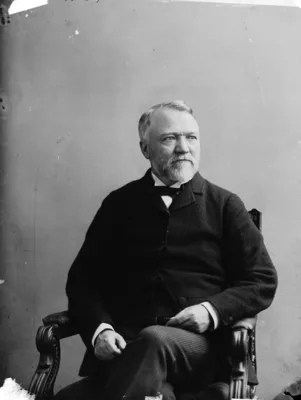
Andrew Carnegie was raised among Dunfermline radicals who had walked out of Calvinism over the damnation of infants. He kept a mild Swedenborgian faith into his teens, and lost it with a circle of Pittsburgh friends who "voted down" the dogmas in the 1850s. By the 1880s he had found "a philosophy at last" in Spencer and Darwin. In public he preached a gospel of wealth in Christ's name and gave organs to churches for the music. He said plainly that he "had got rid of theology and the supernatural" only in an autobiography published after his death, and hedged even there with a "hope of immortality".
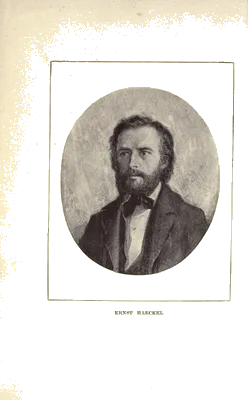
Ernst Haeckel
Ernst Haeckel's liberal Protestant faith, still defended in his letters at twenty-one, wore away between 1855 and 1857, under medicine, his teachers and what he saw of Catholic practice. Darwin (1860) and the death of his wife Anna (1864) drove him to build a "monistic" system in its place. He declared it as a pantheist's confession (1892) and as a "new monistic religion" that accepted atheism as its negative side (1899), organised it in the Monist League (1906), and made it outward only in 1910, when he left the church for political reasons. The creed did not change after that, and it carried his ranking of the races with it.
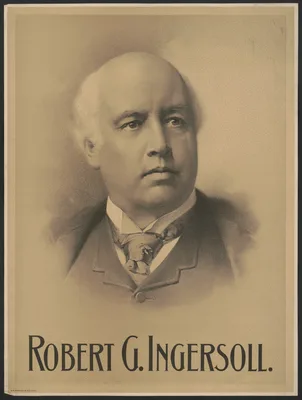
Robert G. Ingersoll
Robert Ingersoll was a preacher's son who kept the preacher's voice but not the creed. He turned unbelief into the most popular lecture ticket in America. In the end he let his agnosticism soften from attack into hope.
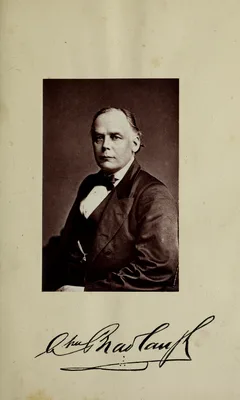
Charles Bradlaugh
A Sunday-school teacher's honest question got Charles Bradlaugh called an atheist before he was one. Driven from home at sixteen for refusing to pretend, he thought his way from deism to a defined atheism alone in a barrack-room. He then spent forty years turning his unbelief into law: the right to testify, to publish, and to sit in Parliament without swearing to a God he found meaningless.