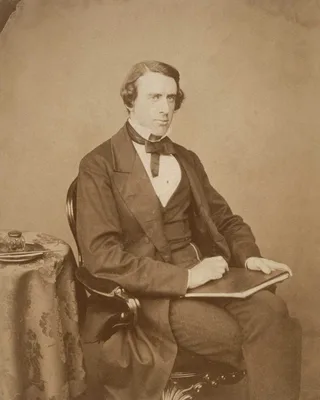
Leslie Stephen was an evangelical's grandson who took holy orders for a Cambridge tutorship rather than from conviction. He read his way out of the creed through Comte, Kant and Mill, gave up his teaching in 1862 rather than read services he did not believe, and renounced his orders as soon as the law allowed. In 1876 he gave English unbelief its modest public name, agnostic. He always insisted that he had not lost a faith but discovered he had never had one.
The belief timeline
- Faith (1855-12-21) — Ordained deacon, tutor of Trinity Hall; by his own later account the "faith" was a phraseology never really believed, taken on trust because Maurice was thought to be removing the difficulties [15][17][19][33]
- Doubt (1859-1862) — Reading Comte (May 1859), Kant (July 1860), Mill; priest's orders taken in 1859 though doubts "accumulated but slowly" [16][20][21]
- Declaration (1862 (summer)) — Tells the Master he can no longer take part in chapel services; resigns the tutorship; Jan 1865 note "I now believe in nothing" is private [26][31]
- Renunciation (1875-03-23) — Signs the deed relinquishing orders under the Act of 1870, witnessed by Hardy [42][43]
- Revision (1876-1895) — Takes the word "Agnostic" (1876), declines "Atheist"; later admits doubts about the "ring-fence" around the knowable [46][47][48][52]
Notes to the timeline (15)
- [15] He was ordained deacon on 21 December 1855 at Bishopsthorpe by the Archbishop of York; on 29 April 1856 he became presbyter fellow and junior tutor, aged twenty-three. — F. W. Maitland, The Life and Letters of Leslie Stephen (Duckworth, London, 1906), pp. 54, 130.
- [17] Motives for taking orders (his words, 1895): to relieve his father of the burden of supporting him, and attachment to Cambridge; also to please his father. Maitland: no "serious call" to the church, but for the tutorship. — Maitland, Life and Letters of Leslie Stephen, pp. 131-132.
- [19] Maitland: Stephen "took such things pretty easily in those days" and trusted that Maurice was removing the difficulties; he had heard Maurice lecture at King's and was impressed by his saintly character; Dr. Jelf taught him the Thirty-nine Articles. — Maitland, Life and Letters of Leslie Stephen, pp. 133-135.
- [33] Stephen (1903): leaving the creed was "relieved of a cumbrous burden"; "I was not discovering that my creed was false, but that I had never really believed it." Same statement in Freethinking (1873). — Leslie Stephen, "Some Early Impressions," National Review, Sept.-Dec. 1903; the text consulted is a periodical reprint with the pagination of that volume (Cornell copy, IA id
cu31924013553320; title "Some early impressions. Journalism. Editing"). Page numbers cited are those of the reprint; Maitland cites the National Review original as pp. 142 and 214, p. 532; Leslie Stephen, Essays on Freethinking and Plainspeaking (Longmans, Green, London, 1873), pp. 331-332; Maitland, Life and Letters of Leslie Stephen, p. 145. - [16] He was ordained priest at Ely on Trinity Sunday 1859; Maitland takes this second submission to bishops as "a proof that his doubts accumulated but slowly". — Maitland, Life and Letters of Leslie Stephen, pp. 130, 136.
- [20] Shorthand notebooks show he studied Maurice's Theological Essays, Butler's Analogy, Comte's Positive Philosophy (finished 28 May 1859), Kant's Kritik in German (finished 9 July 1860), and was "beginning to feel the influence of Mill" in the 1850s. — Maitland, Life and Letters of Leslie Stephen, pp. 53, 73.
- [21] In 1895 he said that after reading Comte he became convinced that Noah's flood was a fiction "(or rather convinced that I had never believed in it)", and that it was wrong to read the story as a sacred truth. — Maitland, Life and Letters of Leslie Stephen, pp. 134, 139.
- [26] In the summer of 1862, on stating that he could no longer take part in the chapel services, he resigned the tutorship at the request of the Master; F. L. Hopkins was appointed in his place. Maitland cannot determine his exact legal position. — Maitland, Life and Letters of Leslie Stephen, pp. 139-140.
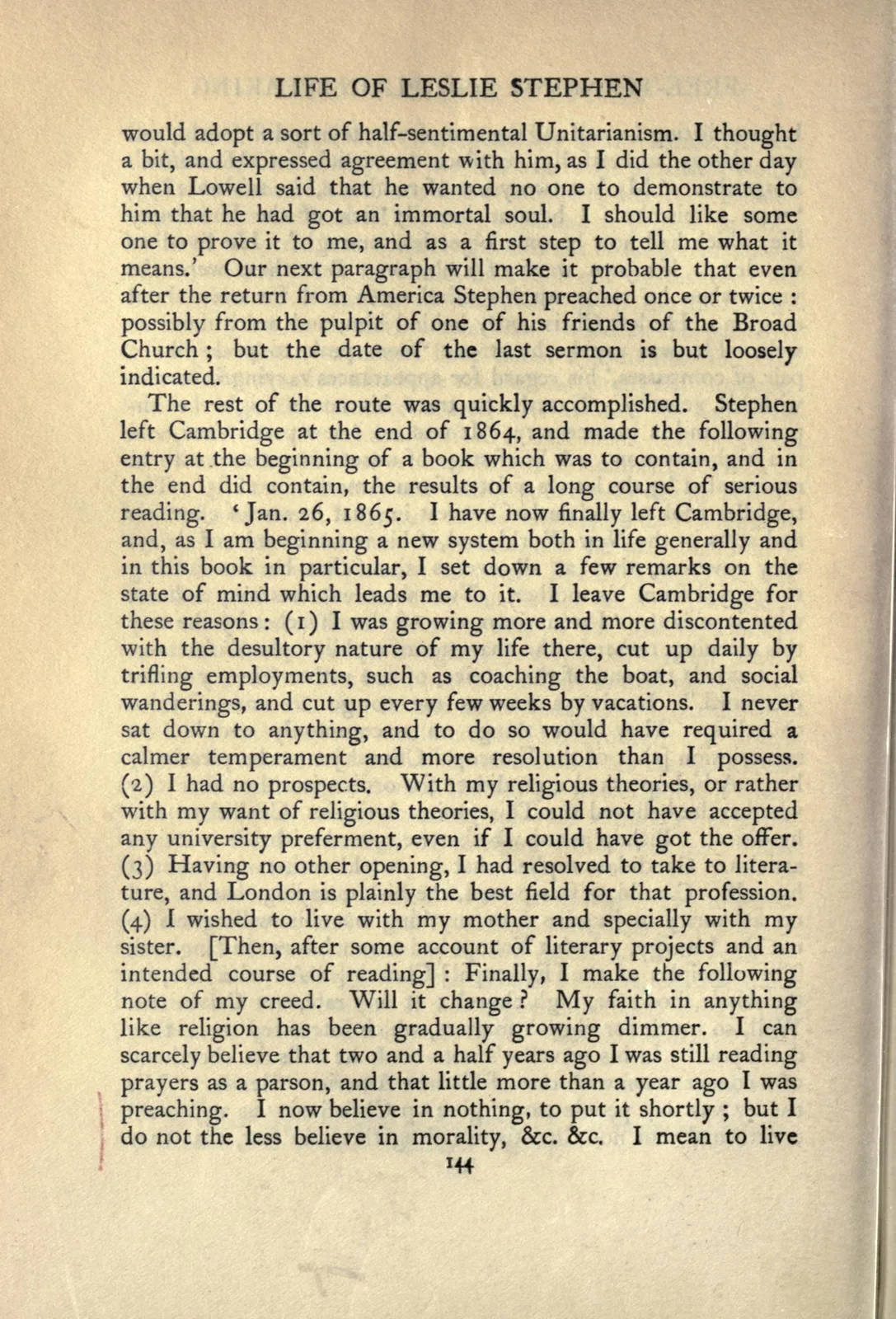
- [31] Shorthand notebook, 26 January 1865, written for his own eye only: "I now believe in nothing, to put it shortly; but I do not the less believe in morality." — Maitland, Life and Letters of Leslie Stephen, pp. 144-145.
- [42] Feb 1870 letter: "I have been to a committee to-day to arrange a Bill for enabling me to get rid of the last rags of my parsonhood"; the Clerical Disabilities Act 1870 allowed it; Maitland: Stephen was in no haste. — Maitland, Life and Letters of Leslie Stephen, pp. 172-174.
- [43] By a deed dated 23 March 1875 he relinquished all rights, privileges and exemptions of a priest of the Church of England; the witness was Thomas Hardy, who recalls being summoned by "a mysterious note" and finding Stephen in his library. — Maitland, Life and Letters of Leslie Stephen, pp. 174, 263-264.
- [46] "An Agnostic's Apology" appeared in the Fortnightly Review in June 1876; Stephen delayed it as a matter of "decorum", not feeling. — Maitland, Life and Letters of Leslie Stephen, pp. 286 n., 290.
- [47] Stephen: the name Agnostic "originally coined by Professor Huxley about 1869"; Benn (cited by Maitland): its success was due "neither to Spencer... nor to Huxley... but to Leslie Stephen". — Leslie Stephen, An Agnostic's Apology, and Other Essays (2nd ed., Smith, Elder, London, 1903; first edition 1893), p. 1; Maitland, Life and Letters of Leslie Stephen, p. 281.
- [48] Apology's argument: dogmatic atheism is rare; the agnostic asserts limits to human knowledge, which theologians (Mansel, Newman) themselves assert; "Trust your reason... and you will become Atheists or Agnostics. We take you at your word." — Stephen, Agnostic's Apology, pp. 1-13.
- [52] Maitland: Stephen never shrank from stating "in the plainest terms his rejection of Christian dogma. It seemed to him not only untrue, but harmful." A gradual change in philosophy: doubts "about the place and doubts about the reasons" for a ring-fence around the knowable. — Maitland, Life and Letters of Leslie Stephen, p. 406.
The Ancient Secret Is a Secret Still
On 23 March 1875 the novelist Thomas Hardy received "a mysterious note" from the editor of the Cornhill Magazine, asking him to call. He found Leslie Stephen in his library. Stephen, Hardy remembered, "said he wanted me to witness his signature to what, for a moment, I thought was his will; but it turned out to be a deed renunciatory of holy orders, under the Act of 1870." Stephen "said grimly that he was really a reverend gentleman still, little as he might look it, and that he thought it as well to cut himself adrift of a calling for which, to say the least, he had always been utterly unfit."123
He had been ordained twenty years before, as a young tutor at Cambridge. He had stopped believing about ten years before, and had given up his college teaching because of it. Only an Act of 1870 had made it possible for a clergyman to stop being one. The next year he published the essay that gave a new word its currency in English: "An Agnostic's Apology." This chapter follows the grandson of an evangelical abolitionist through the Church and out of it, and asks what he meant when he said, more than once, that he had never really believed at all.
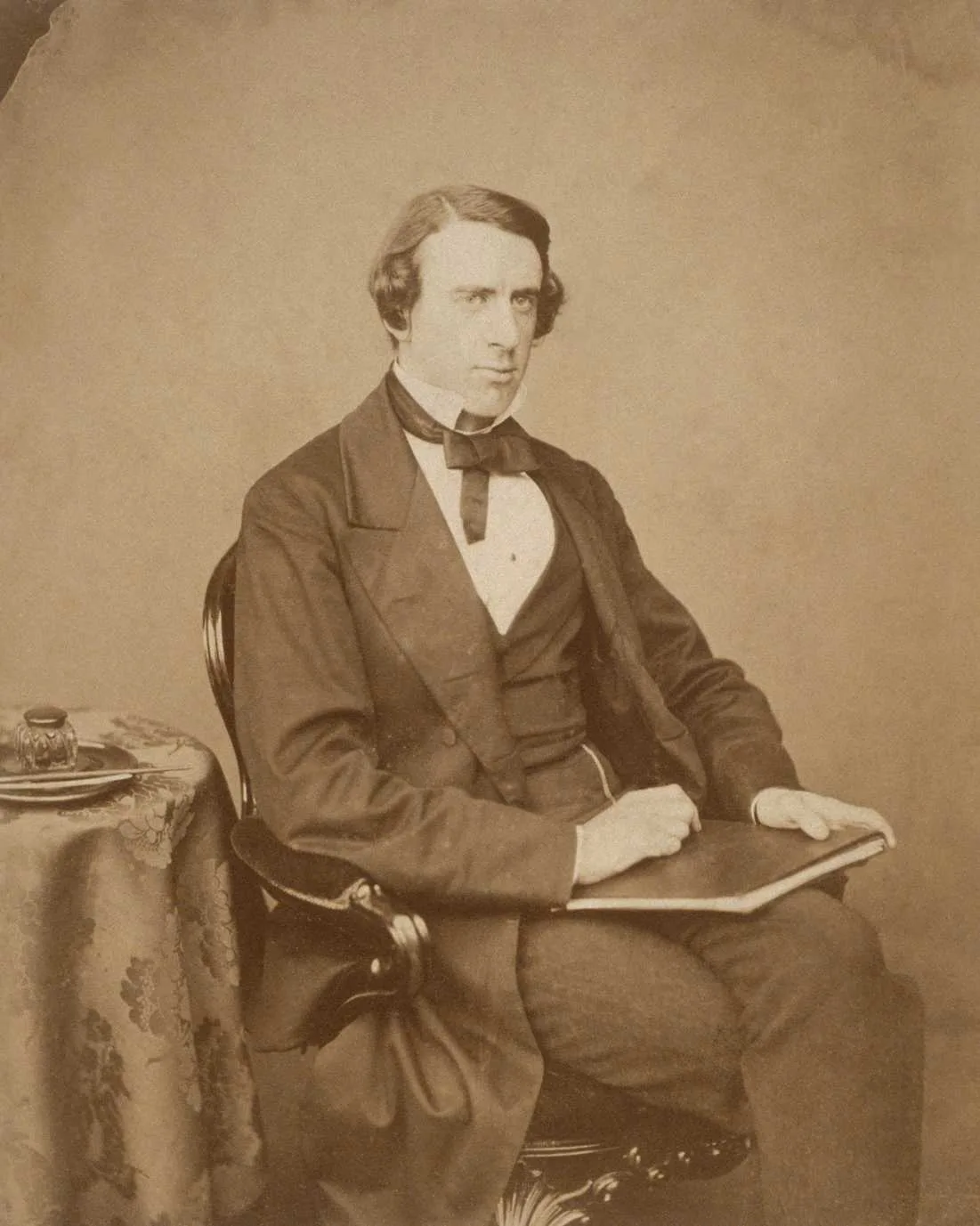
The Clapham inheritance
He was born on 28 November 1832 at his father's house in Kensington Gore, in London, the third son of James Stephen of the Colonial Office and Jane Catherine Venn.4 His grandfather, also James Stephen, had led the campaign against slavery in Parliament, married William Wilberforce's sister, and died a few weeks before Leslie was born; his mother was the daughter of the Rector of Clapham.56 "My family," he wrote, "belonged to the second generation of the so-called 'Clapham Sect.'" They "believed too implicitly in Noah's ark," but "they impressed me (very unintentionally) with the conviction that a man may be incomparably better than the creed which he honestly takes himself to believe."789
His father kept the faith in a looser way than his own father had. Leslie later described him as a man who "began life as a strong evangelical, and never avowedly changed," but who came to hold "the inherited doctrine in a latitudinarian sense."1011 Sir James had a particular fear for his sons. "My daily and nightly terror," he wrote in his journal, "is that they should be 'patent Christians' — formalists, praters, cheats, without meaning or even knowing it."1213
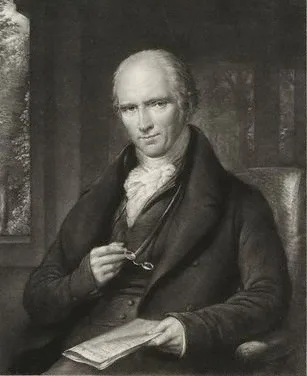
The boy was delicate and acutely sensitive. He was brought up on Watts's Catechism, and his mother noted in her diary that he would not read his prayers, because "he could not feel that he was praying to God if he read them."141516 His health sent him to a school at Brighton and then, as a day-boy, to Eton, which he left at fourteen; at Eton the Anglican catechism was "irritating."1517 At King's College London he heard the theologian F. D. Maurice and was impressed by his saintly character.1819
That childhood scruple was not yet doubt. It was a conscience about sincerity, the same conscience that would later make it impossible for him to read services he did not believe.
Orders
He went up to Trinity Hall, Cambridge, in 1850, where his father was Regius Professor of Modern History.20 After his degree he was offered a fellowship that required him to take holy orders within a year, and on 21 December 1855 the Archbishop of York ordained him deacon. In April 1856, at twenty-three, he became a junior tutor of the college.2122
Why did he do it? He said later that it was partly to free his father from supporting him and partly because he was attached to Cambridge. "By taking the tutorship I became independent, and after my degree I never cost my father anything."2324 His father dearly wanted one son in the Church, and the eldest surviving son, Fitzjames, had chosen the law.25 His biographer F. W. Maitland found no "serious call," and thought Stephen "took such things pretty easily in those days," trusting that Maurice was clearing away the difficulties.2319
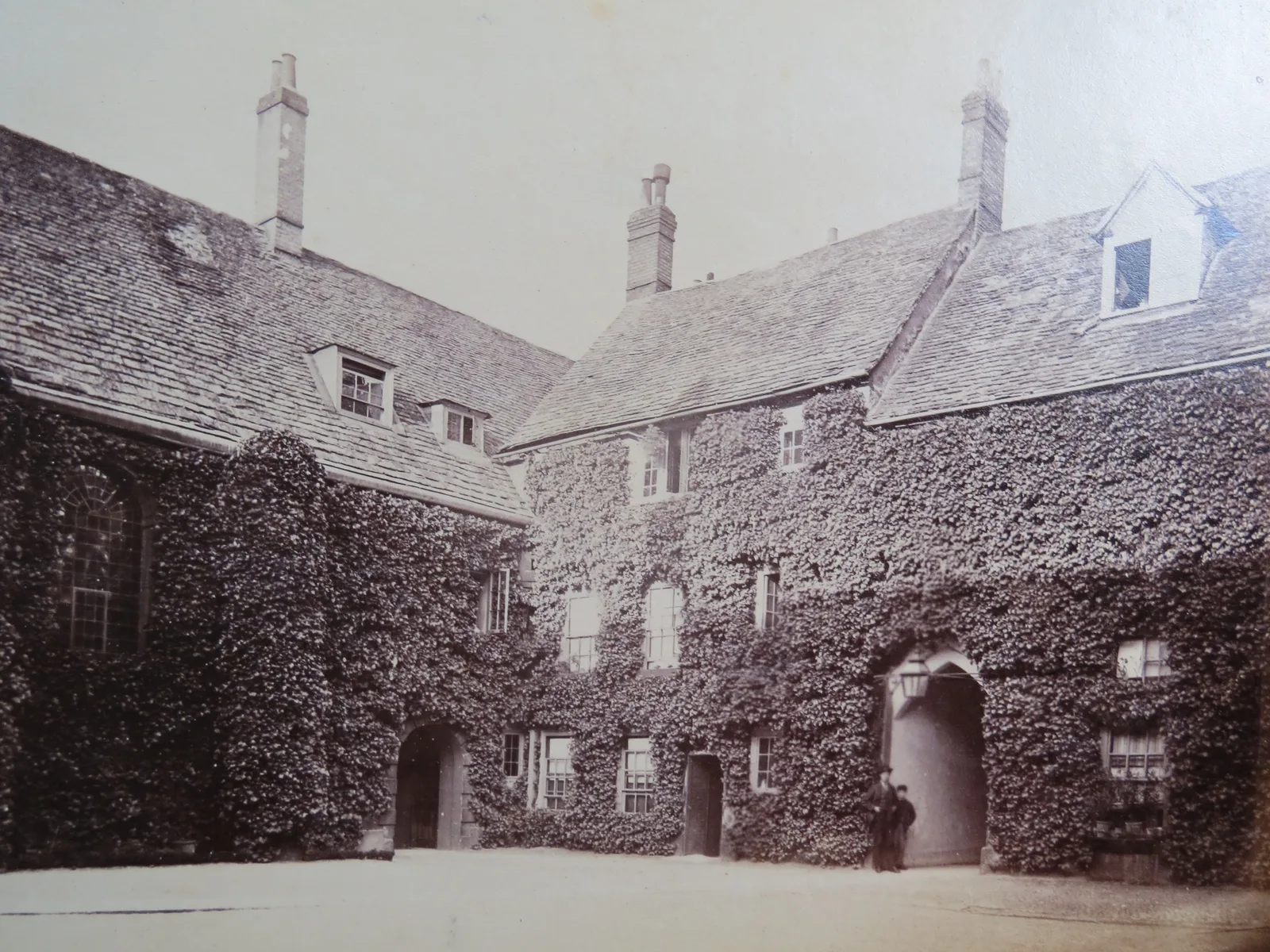
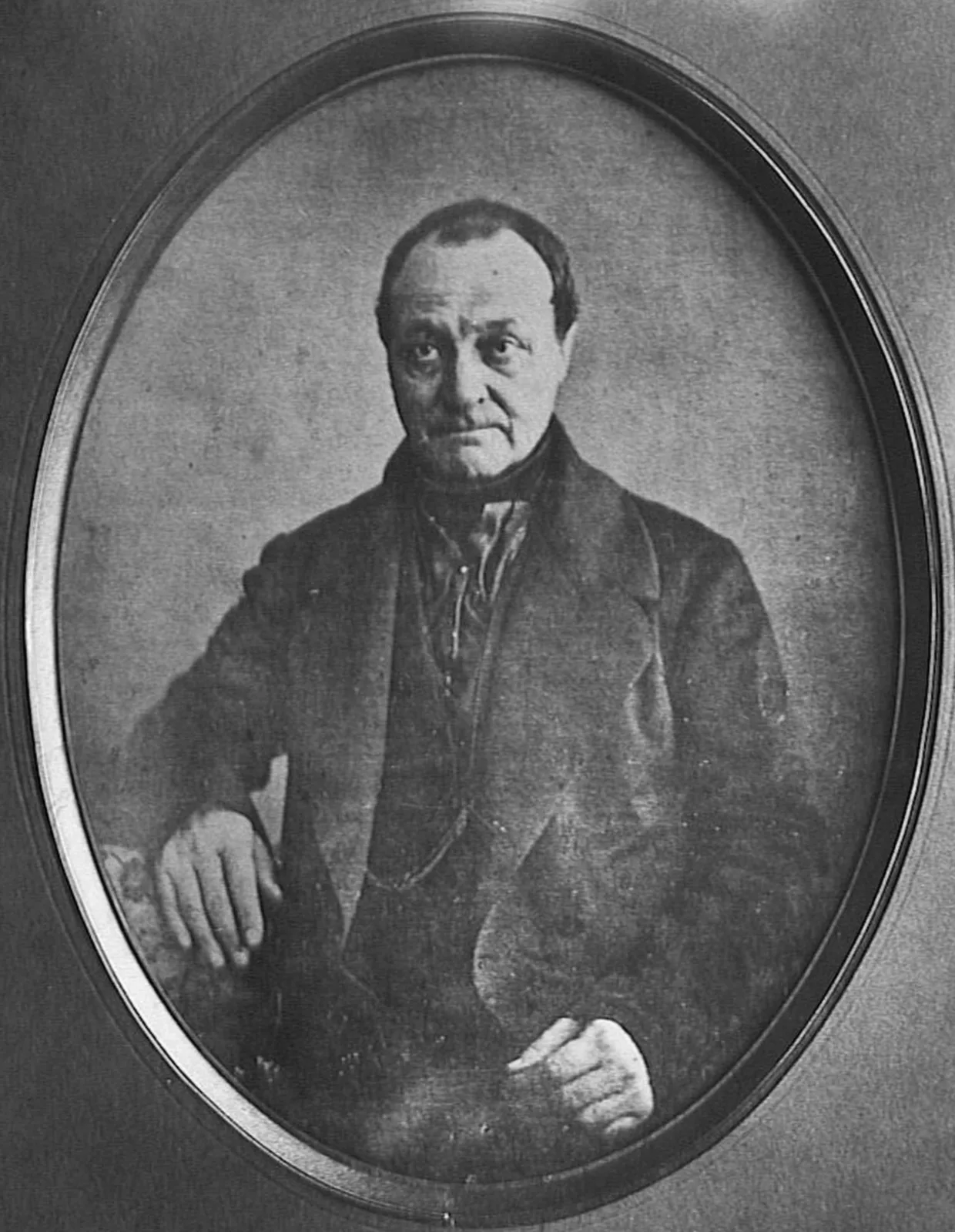
He was a "muscular Christian" who coached the college boat to the head of the river and won university races.26 His pupils remembered that he said little about religion; one thought he was "not an agnostic, but ... certainly going on towards agnosticism."27 Meanwhile his shorthand notebooks show him reading Maurice and Butler, then Comte's Positive Philosophy, finished on 28 May 1859, and Kant's Critique in German, finished on 9 July 1860, and coming under the influence of John Stuart Mill.28 "I read Comte, too," he wrote, "and became convinced, among other things, that Noah's flood was a fiction (or rather convinced that I had never believed in it) and that it was wrong for me to read the story as if it were a sacred truth."2930
Yet on Trinity Sunday 1859 he was ordained priest at Ely. Maitland took that second submission to the bishops as "a proof that his doubts accumulated but slowly."31
The chapel services
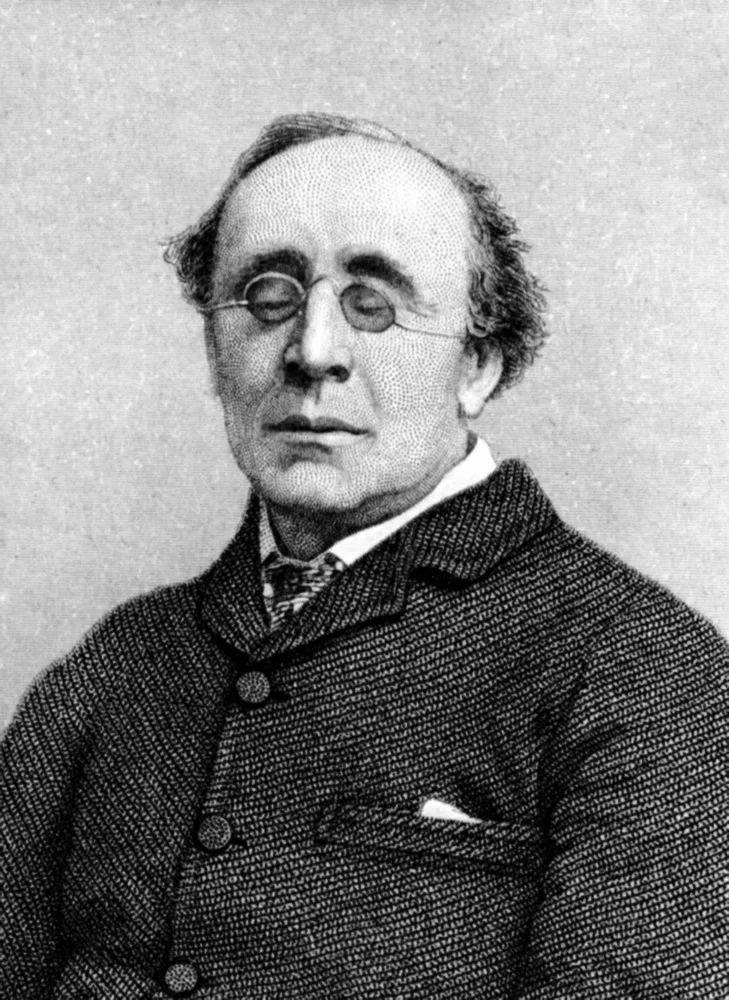
In the summer of 1862 he could not go on. "Upon my stating in the summer of 1862 that I could no longer take part in the chapel services," he wrote, "I resigned my tutorship at the request of the Master."3233 One senior fellow said he "could not stand an unorthodox tutor in the college for fear of the effect on the morals of the undergraduates."3435 Stephen was grateful to him afterwards: "In that he did me a great service as I should otherwise perhaps have been buried in Cambridge to this day."36 The college let him keep his fellowship, largely through the good offices of his friend Henry Fawcett, though what the rules allowed is unclear, and Maitland suspected the fellows "were desirous to be convinced."37
How painful was it? The two accounts differ. A friend who knew him from 1859 remembered "mental torture" while the doubts grew.38 Stephen himself always said the opposite: "In truth, I did not feel that the solid ground was giving way beneath my feet, but rather that I was being relieved of a cumbrous burden. I was not discovering that my creed was false, but that I had never really believed it."3940 Maitland's reconciliation was that the struggle came before the decision and the relief after it.38
In 1863 he went to America, where he made friends with Charles Eliot Norton and James Russell Lowell and saw a country at civil war. "At that time," he wrote, "I had given up Noah's ark and my old calling."41 At the end of 1864 he left Cambridge for London and journalism.42 On 26 January 1865 he wrote in shorthand, for his own eyes only: "My faith in anything like religion has been gradually growing dimmer. I can scarcely believe that two and a half years ago I was still reading prayers as a parson, and that little more than a year ago I was preaching. I now believe in nothing, to put it shortly; but I do not the less believe in morality."4344 Maitland said that the negative side of his creed never changed again.45
Plain speaking
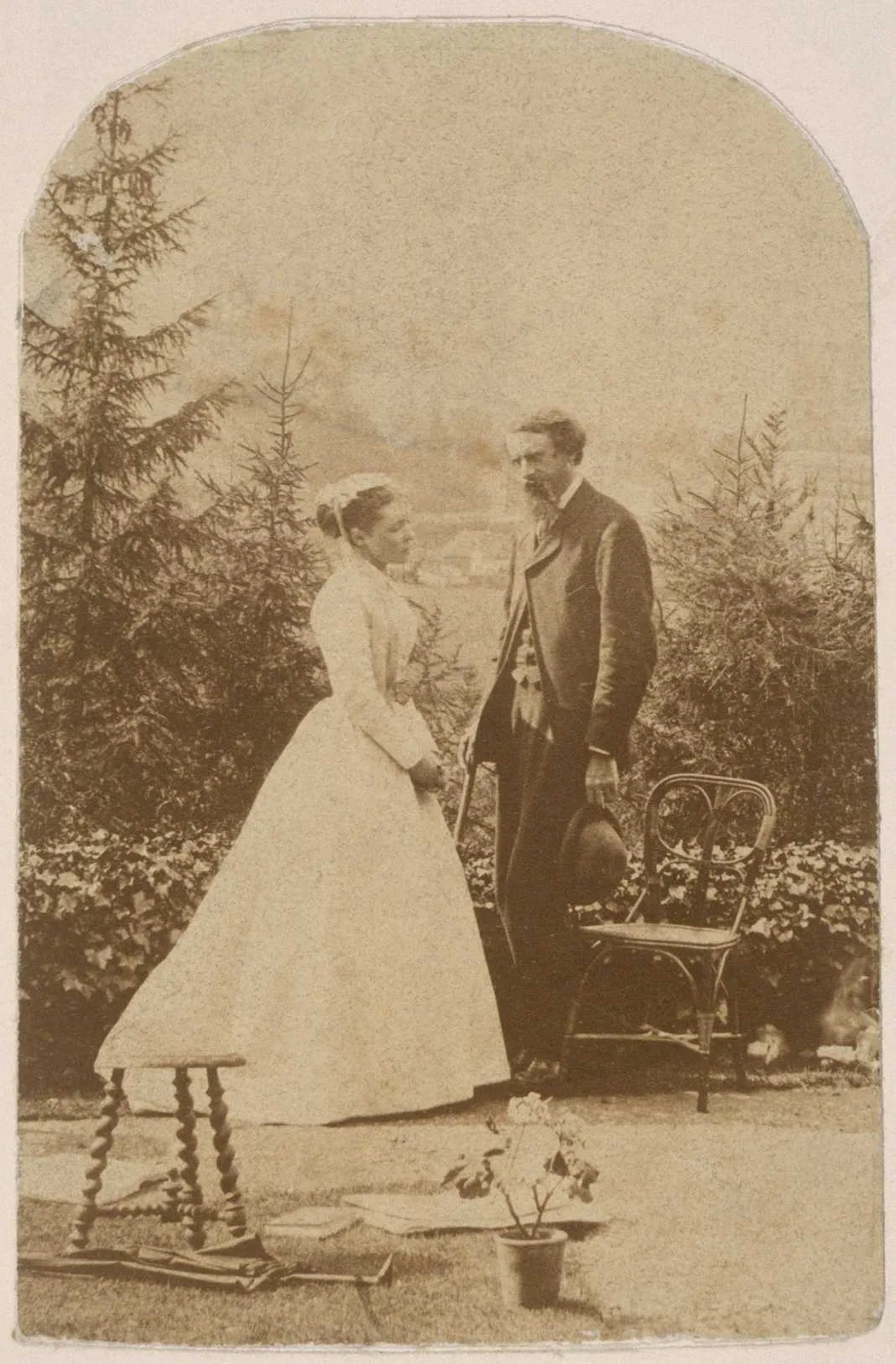
In London he lived by his pen, writing for the Saturday Review, the Pall Mall Gazette and a fortnightly letter to the New York Nation.46 In 1867 he married Minny Thackeray, and his fellowship lapsed with the marriage.47 In 1870 he was on a committee for a Bill "for enabling me to get rid of the last rags of my parsonhood," the Clerical Disabilities Act.4849
He began to write against the Church in the monthlies, and in 1873 collected the essays as Essays on Freethinking and Plainspeaking.50 The book's purpose, he said, was "an appeal to people who already agree in my conclusions to state their agreement in plain terms."51 What drove him was honesty. "Destroy credit, and you ruin commerce; destroy all faith in religious honesty and you ruin something of infinitely more importance than commerce."52 And he said, thirty years before his memoir said it again, that losing faith was "not, in fact, an abandonment of beliefs seriously held and firmly implanted in the mind, but a gradual recognition of the truth that you never really held them."3953 He named one moral motive above others: "the disgust excited by the doctrine of everlasting damnation is amongst the strongest motives to popular infidelity."5455
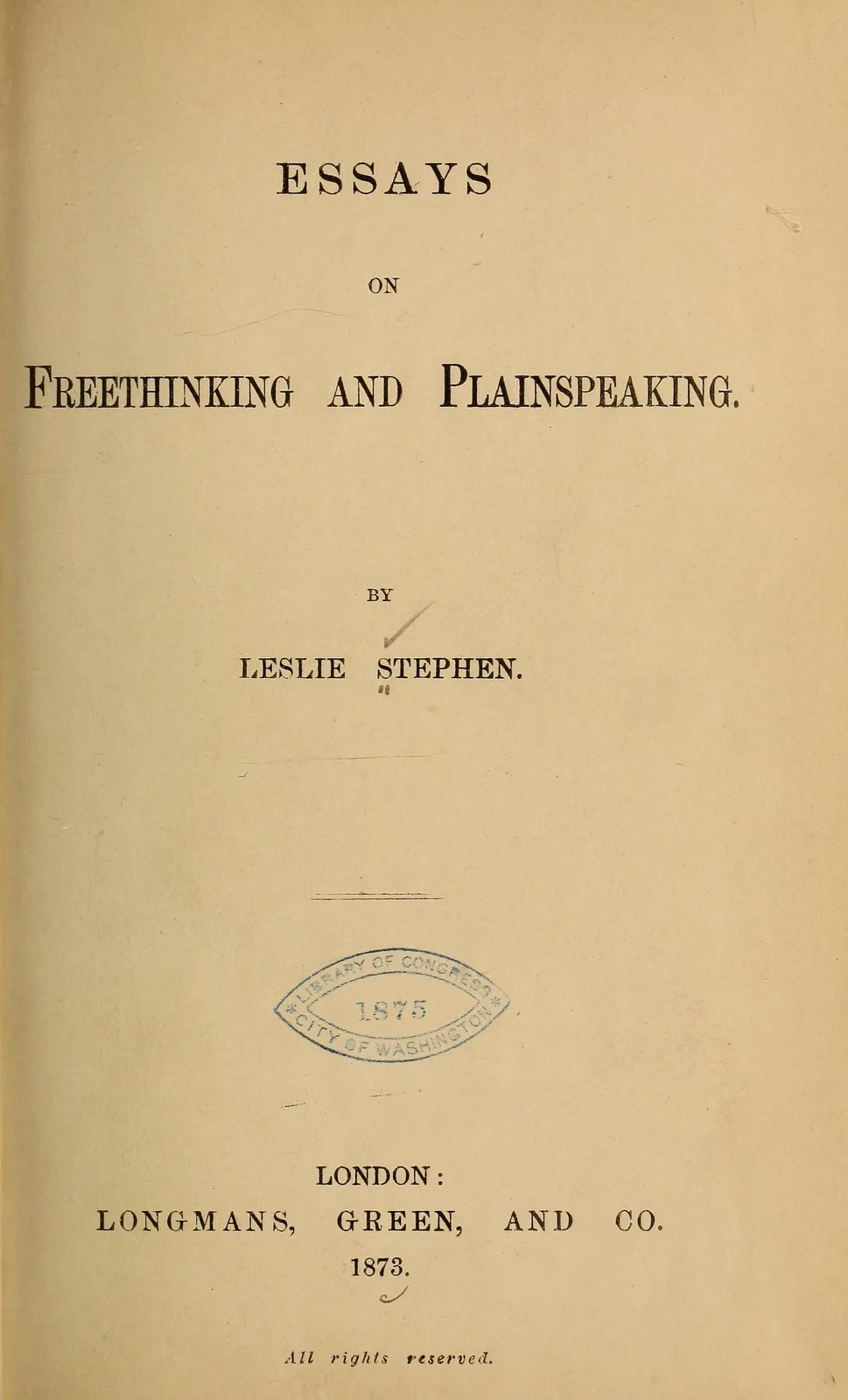
In March 1875, with Hardy as his witness, he signed away his orders.1
An Agnostic's Apology
Late in 1875 Minny died. In the weeks of grief that followed he wrote the essay that made his name as an unbeliever, and it appeared in the Fortnightly Review in June 1876.5657 He took his label from Huxley. "The name Agnostic, originally coined by Professor Huxley about 1869, has gained general acceptance," he began, and he rejected the other word: "Dogmatic Atheism — the doctrine that there is no God, whatever may be meant by God — is, to say the least, a rare phase of opinion."585960
His argument turned the theologians' own humility against them. Men like Newman had said that reason, left to itself, ends in unbelief. "Trust your reason, we have been told till we are tired of the phrase, and you will become Atheists or Agnostics. We take you at your word: we become Agnostics."6162 He quoted Newman's claim that there was "no medium, in true philosophy, between Atheism and Catholicity," and accepted half of it.63 The grief shows in one line: "Is there a more cutting piece of satire in the language than the reference in our funeral service to the 'sure and certain hope of a blessed resurrection'?"64 So does his moral charge against the creed. "If I were to assert that of every ten beings born into this world nine would be damned," he wrote, and he went on to apply it to those who would not believe what they did not hold to be proved. For him the doctrine of damnation was the creed's own case against itself.5465
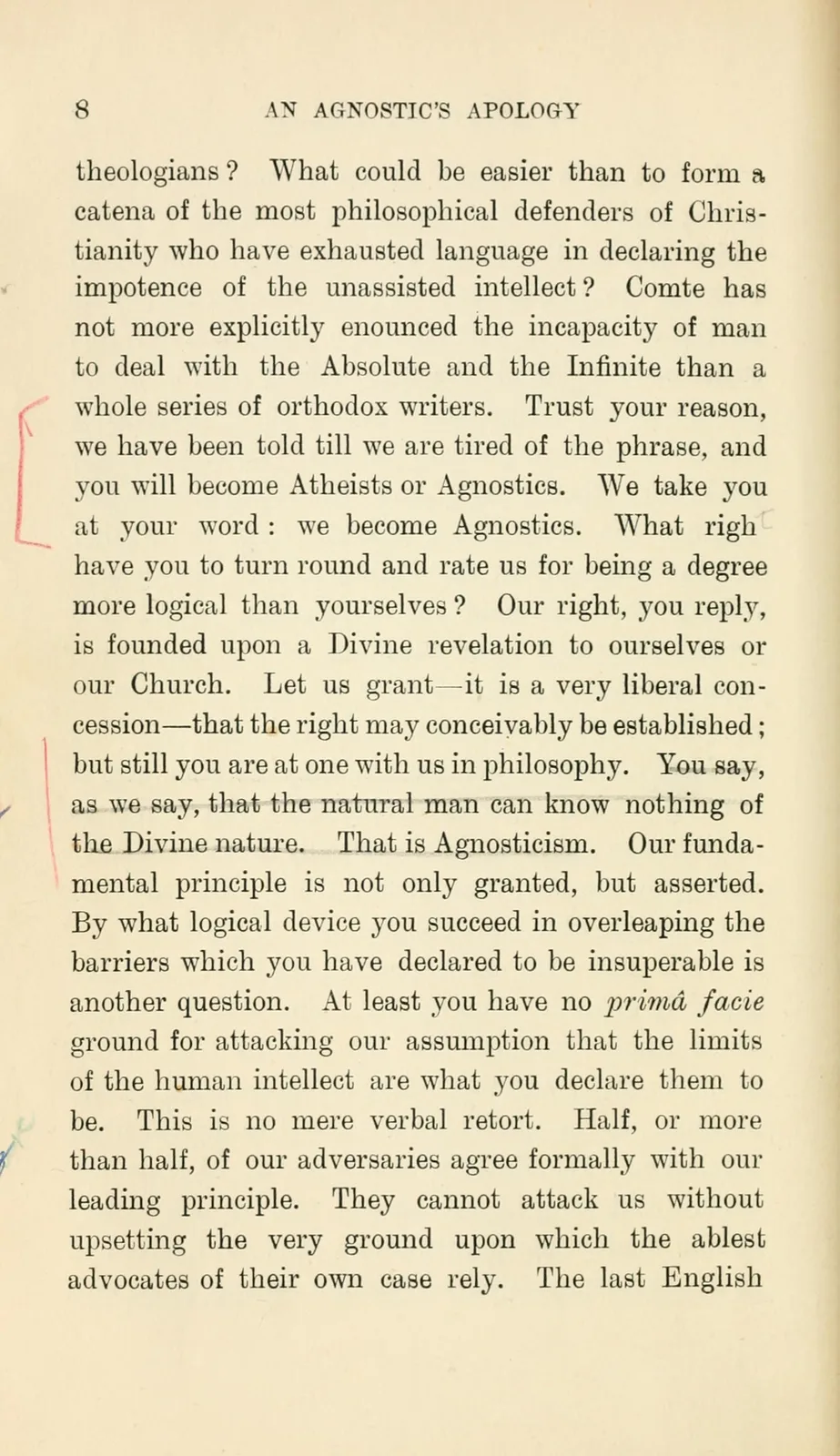
He ended with a challenge to the pulpit. "Why, when no honest man will deny in private that every ultimate problem is wrapped in the profoundest mystery, do honest men proclaim in pulpits that unhesitating certainty is the duty of the most foolish and ignorant?" Until the clergy could answer, "we shall be content to admit openly, what you whisper under your breath or hide in technical jargon, that the ancient secret is a secret still; that man knows nothing of the Infinite and Absolute; and that, knowing nothing, he had better not be dogmatic about his ignorance."6667 Huxley had coined the word, but a later historian, quoted by Maitland, judged that its success was due to Stephen.58
Critics
Some of his critics were churchmen of Maurice's school. In 1874 J. Llewelyn Davies, a disciple of Maurice, did him "the honour," as Stephen put it, of "coupling me with J. M. as the two devil's advocates."68 The Spectator thought him "a psychological curiosity" for calling Maurice "muddle-headed."69 Stephen had in fact written privately that "of all the muddle-headed, intricate, futile persons I ever studied, he was about the most utterly bewildering."70
The sharpest attack came in 1900, from a preacher in St Mary's, Cambridge, looking back on Stephen's Cambridge years: "It never occurred to him that his cynicism was the Medusa's head that petrified the company."71 Stephen replied in a letter. He had been reticent, not cynical, and almost too much so: "I have often thought that I pushed my reticence to cowardice." What had happened was simple: "I became gradually convinced, after the most serious reflection I could give, that the Christian position was untenable. I therefore gave up my profession and took to literature."427273 And the Broad Church compromise had never satisfied him, because "after abandoning the doctrine of verbal inspiration, there is no real stopping-place till you give up the supernatural character of the Bible altogether."74
The Dictionary and the family
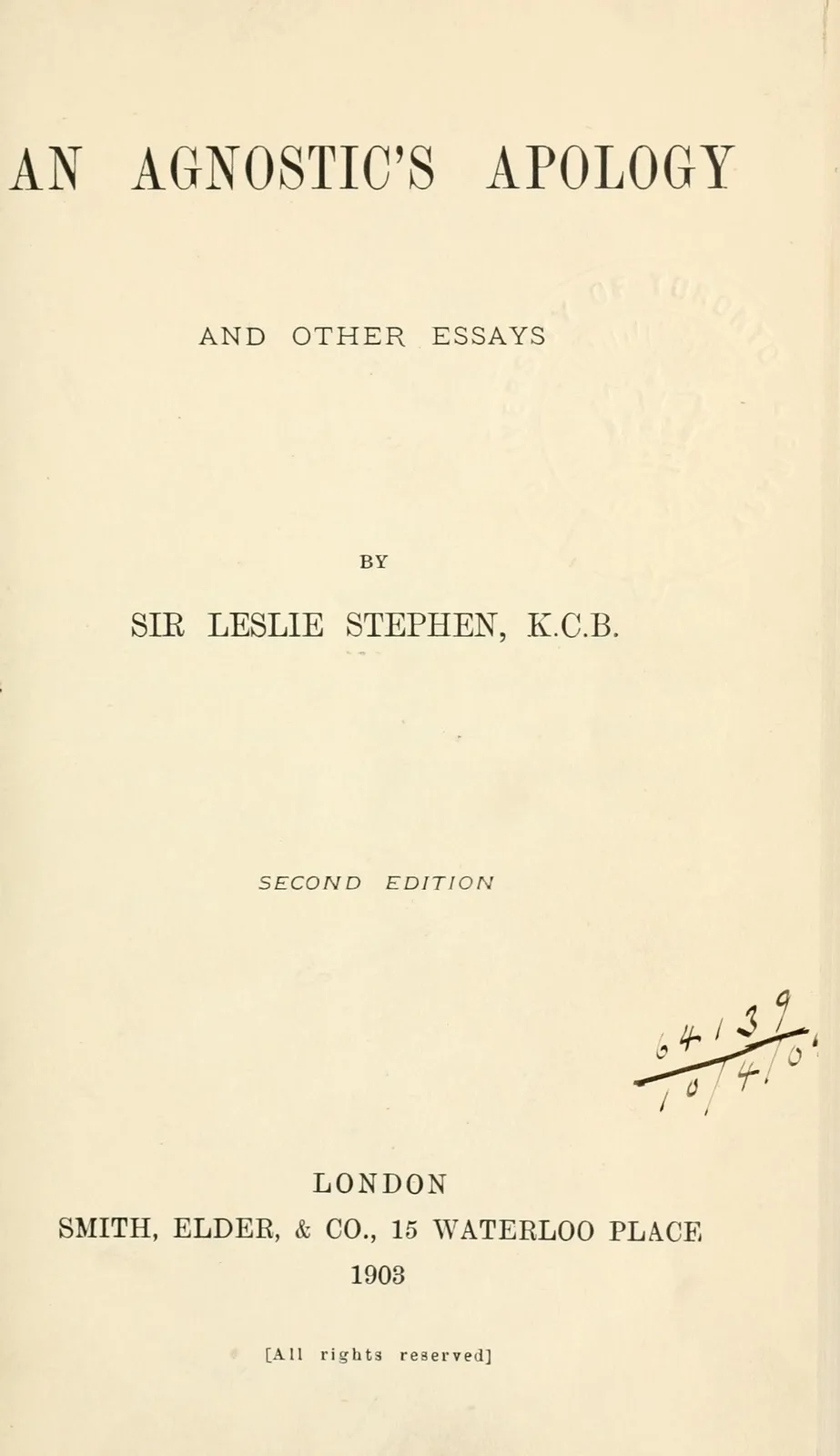
In 1878 he married Julia Duckworth, a widow and his neighbour in Hyde Park Gate.75 They had four children, Vanessa, Thoby, Virginia and Adrian, and the family lived at 22 Hyde Park Gate.76 He edited the Dictionary of National Biography from its first volume in 1885 until 1891.77 In 1893, at Norton's urging, he gathered his religious essays as An Agnostic's Apology and Other Essays.78
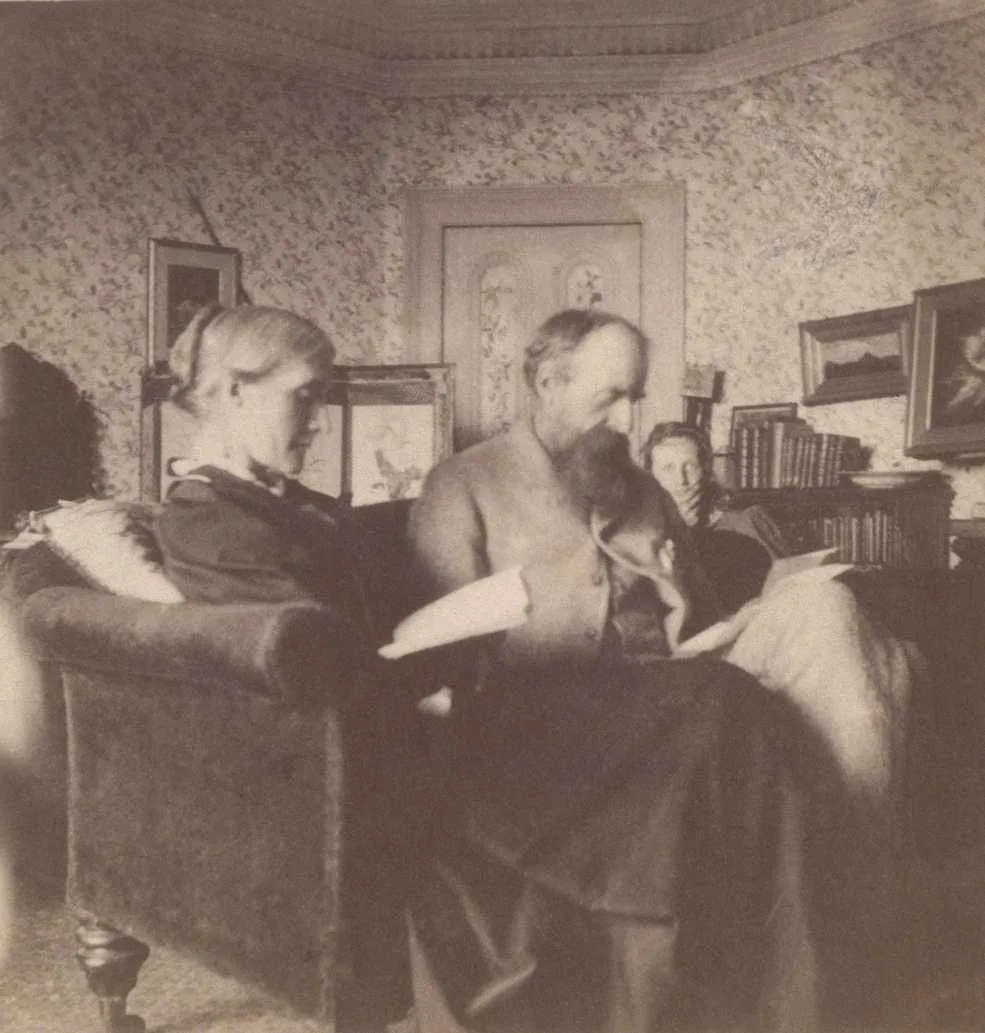
His views did change at the edges. He never stopped stating "in the plainest terms his rejection of Christian dogma," Maitland wrote, which "seemed to him not only untrue, but harmful," but late in life he came to have doubts about the "ring-fence" agnostics drew around the knowable, both where it stood and why.79 In 1895 he wrote a long letter to his children about his life and warned them that it held none of "those narratives of inward events, conversions, or spiritual crises which give interest to some autobiographies."8081
He died at 22 Hyde Park Gate shortly before seven in the morning of 22 February 1904.82 His last written words, on 5 February, began a list of the friends who had come to see him: "I must put down their names as I can remember them."83 The next day Richard Haldane wrote to his daughter that "he was like Socrates in the calmness of his wisdom."84
What he left
Stephen's unbelief was quiet in its making and plain in its statement. A child too honest to read prayers he did not feel, he took orders for a living and a college, read his way out of the creed in his late twenties, gave up his teaching rather than read the chapel services, and then spent years waiting for the law to let him stop being a priest. When he spoke in public he made a modest claim, not that there is no God, but that "the ancient secret is a secret still." His own judgement of the whole story was that he had not lost a faith, only discovered that he had never had one. The man who witnessed the deed that ended his orders, Thomas Hardy, had travelled a similar road with far more regret, and he has his own chapter in this book.
Footnotes
-
F. W. Maitland, The Life and Letters of Leslie Stephen (Duckworth, London, 1906), pp. 174, 263-264. ↩ ↩2
-
Thomas Hardy, recollection: Maitland, Life and Letters of Leslie Stephen, p. 263. ↩
-
Thomas Hardy, recollection: Maitland, Life and Letters of Leslie Stephen, pp. 263-264. ↩
-
Maitland, Life and Letters of Leslie Stephen, pp. 9, 22-23. ↩
-
Maitland, Life and Letters of Leslie Stephen, pp. 8-9. ↩
-
Maitland, Life and Letters of Leslie Stephen, pp. 9, 19-21. ↩
-
Leslie Stephen, "Some Early Impressions," National Review, Sept.-Dec. 1903; the text consulted is a periodical reprint with the pagination of that volume (Cornell copy, IA id
cu31924013553320; title "Some early impressions. Journalism. Editing"). Page numbers cited are those of the reprint; Maitland cites the National Review original as pp. 142 and 214, p. 307. ↩ -
Leslie Stephen, 1903: Stephen, "Some Early Impressions,", p. 307. ↩
-
Leslie Stephen, 1903, of the Clapham Sect: Stephen, "Some Early Impressions,", p. 307. ↩
-
Maitland, Life and Letters of Leslie Stephen, p. 17. ↩
-
Leslie Stephen, on his father (DNB): Maitland, Life and Letters of Leslie Stephen, p. 17. ↩
-
Maitland, Life and Letters of Leslie Stephen, p. 18. ↩
-
Sir James Stephen, journal 1846: Maitland, Life and Letters of Leslie Stephen, p. 18. ↩
-
Maitland, Life and Letters of Leslie Stephen, pp. 25, 27 (from Lady Stephen's diary). ↩
-
Maitland, Life and Letters of Leslie Stephen, pp. 25, 35. ↩ ↩2
-
Lady Stephen's diary (his mother), c. 1840: Maitland, Life and Letters of Leslie Stephen, p. 27. ↩
-
Maitland, Life and Letters of Leslie Stephen, pp. 27-34. ↩
-
Maitland, Life and Letters of Leslie Stephen, pp. 36-38. ↩
-
Maitland, Life and Letters of Leslie Stephen, pp. 133-135. ↩ ↩2
-
Maitland, Life and Letters of Leslie Stephen, pp. 38-39. ↩
-
Maitland, Life and Letters of Leslie Stephen, pp. 53, 130. ↩
-
Maitland, Life and Letters of Leslie Stephen, pp. 54, 130. ↩
-
Maitland, Life and Letters of Leslie Stephen, pp. 131-132. ↩ ↩2
-
Leslie Stephen, 1895: Maitland, Life and Letters of Leslie Stephen, p. 132. ↩
-
Maitland, Life and Letters of Leslie Stephen, p. 131. ↩
-
Maitland, Life and Letters of Leslie Stephen, pp. 56-62, 137-138. ↩
-
Maitland, Life and Letters of Leslie Stephen, p. 137. ↩
-
Maitland, Life and Letters of Leslie Stephen, pp. 53, 73. ↩
-
Maitland, Life and Letters of Leslie Stephen, pp. 134, 139. ↩
-
Leslie Stephen, 1895: Maitland, Life and Letters of Leslie Stephen, p. 134. ↩
-
Maitland, Life and Letters of Leslie Stephen, pp. 130, 136. ↩
-
Maitland, Life and Letters of Leslie Stephen, pp. 139-140. ↩
-
Leslie Stephen, 1895: Maitland, Life and Letters of Leslie Stephen, p. 139. ↩
-
Maitland, Life and Letters of Leslie Stephen, p. 140. ↩
-
A senior fellow of Trinity Hall, 1862, as reported by Stephen: Maitland, Life and Letters of Leslie Stephen, p. 140. ↩
-
Leslie Stephen, letter of a few years later: Maitland, Life and Letters of Leslie Stephen, p. 140. ↩
-
Maitland, Life and Letters of Leslie Stephen, pp. 139-141. ↩
-
Maitland, Life and Letters of Leslie Stephen, pp. 145-147. ↩ ↩2
-
Stephen, "Some Early Impressions,", p. 532; Leslie Stephen, Essays on Freethinking and Plainspeaking (Longmans, Green, London, 1873), pp. 331-332; Maitland, Life and Letters of Leslie Stephen, p. 145. ↩ ↩2
-
Leslie Stephen, 1903: Stephen, "Some Early Impressions,", p. 532 (also Maitland p. 145). ↩
-
Maitland, Life and Letters of Leslie Stephen, pp. 143-144; Stephen, "Some Early Impressions,", p. 537. ↩
-
Maitland, Life and Letters of Leslie Stephen, pp. 144, 150. ↩ ↩2
-
Maitland, Life and Letters of Leslie Stephen, pp. 144-145. ↩
-
Leslie Stephen, shorthand note, 26 Jan 1865: Maitland, Life and Letters of Leslie Stephen, p. 144. ↩
-
Maitland, Life and Letters of Leslie Stephen, p. 145. ↩
-
Maitland, Life and Letters of Leslie Stephen, pp. 160-171. ↩
-
Maitland, Life and Letters of Leslie Stephen, pp. 130, 187, 196. ↩
-
Maitland, Life and Letters of Leslie Stephen, pp. 172-174. ↩
-
Leslie Stephen, Feb 1870: Maitland, Life and Letters of Leslie Stephen, p. 173. ↩
-
Maitland, Life and Letters of Leslie Stephen, p. 171 n.; Stephen, Essays on Freethinking and Plainspeaking, Notice. ↩
-
Leslie Stephen: Stephen, Essays on Freethinking and Plainspeaking, p. 327. ↩
-
Leslie Stephen: Stephen, Essays on Freethinking and Plainspeaking, p. 328. ↩
-
Leslie Stephen: Stephen, Essays on Freethinking and Plainspeaking, pp. 331-332. ↩
-
Leslie Stephen, An Agnostic's Apology, and Other Essays (2nd ed., Smith, Elder, London, 1903; first edition 1893), pp. 31-35; Stephen, Essays on Freethinking and Plainspeaking, p. 335. ↩ ↩2
-
Leslie Stephen: Stephen, Essays on Freethinking and Plainspeaking, p. 335. ↩
-
Maitland, Life and Letters of Leslie Stephen, pp. 259, 281, 284. ↩
-
Maitland, Life and Letters of Leslie Stephen, pp. 286 n., 290. ↩
-
Stephen, Agnostic's Apology, p. 1; Maitland, Life and Letters of Leslie Stephen, p. 281. ↩ ↩2
-
Leslie Stephen: Stephen, Agnostic's Apology, p. 1. ↩
-
Leslie Stephen: Stephen, Agnostic's Apology, p. 1. ↩
-
Stephen, Agnostic's Apology, pp. 1-13. ↩
-
Leslie Stephen: Stephen, Agnostic's Apology, p. 8. ↩
-
J. H. Newman, as quoted by Stephen from the Apologia (Catholic convert; the theologian Stephen engages most respectfully): Stephen, Agnostic's Apology, p. 10 (Newman, Apologia pp. 322-3; original not seen). ↩
-
Leslie Stephen: Stephen, Agnostic's Apology, p. 4. ↩
-
Leslie Stephen: Stephen, Agnostic's Apology, p. 31. ↩
-
Leslie Stephen: Stephen, Agnostic's Apology, p. 39. ↩
-
Leslie Stephen: Stephen, Agnostic's Apology, p. 41. ↩
-
Maitland, Life and Letters of Leslie Stephen, p. 243. ↩
-
Maitland, Life and Letters of Leslie Stephen, p. 243. ↩
-
Leslie Stephen, 1874, of F. D. Maurice: Maitland, Life and Letters of Leslie Stephen, p. 240. ↩
-
A Cambridge preacher in St Mary's, 1900 (printed sermon with note; Maitland names him only as "B."): Maitland, Life and Letters of Leslie Stephen, p. 149. ↩
-
Leslie Stephen, letter of 30 Oct 1900: Maitland, Life and Letters of Leslie Stephen, p. 150. ↩
-
Leslie Stephen, letter of 30 Oct 1900: Maitland, Life and Letters of Leslie Stephen, p. 150. ↩
-
Leslie Stephen, letter of 30 Oct 1900: Maitland, Life and Letters of Leslie Stephen, p. 151. ↩
-
Maitland, Life and Letters of Leslie Stephen, pp. 310, 317. ↩
-
Maitland, Life and Letters of Leslie Stephen, p. 322. ↩
-
Maitland, Life and Letters of Leslie Stephen, pp. 365, 403-404. ↩
-
Maitland, Life and Letters of Leslie Stephen, pp. 404-405, 498. ↩
-
Maitland, Life and Letters of Leslie Stephen, p. 406. ↩
-
Maitland, Life and Letters of Leslie Stephen, pp. 3, 431. Not verified. ↩
-
Leslie Stephen, 1895 letter to his children: Maitland, Life and Letters of Leslie Stephen, p. 3. ↩
-
Maitland, Life and Letters of Leslie Stephen, pp. 489-491. ↩
-
Leslie Stephen, 5 Feb 1904 (last written words): Maitland, Life and Letters of Leslie Stephen, p. 489. ↩
-
R. B. Haldane, 23 Feb 1904: Maitland, Life and Letters of Leslie Stephen, p. 490. ↩
cu31924013553320; title "Some early impressions. Journalism. Editing"). Page numbers cited are those of the reprint; Maitland cites the National Review original as pp. 142 and 214.; Leslie Stephen, Essays on Freethinking and Plainspeaking (Longmans, Green, London, 1873).; Leslie Stephen, An Agnostic's Apology, and Other Essays (2nd ed., Smith, Elder, London, 1903; first edition 1893).In their own words
By taking the tutorship I became independent, and after my degree I never cost my father anything.
When I ceased to accept the teaching of my youth, it was not so much a process of giving up beliefs as of discovering that I had never really believed.
I read Comte, too [besides other books], and became convinced, among other things, that Noah's flood was a fiction (or rather convinced that I had never believed in it) and that it was wrong for me to read the story as if it were a sacred truth.
Upon my stating in the summer of 1862 that I could no longer take part in the chapel services, I resigned my tutorship at the request of the Master.
In that he did me a great service as I should otherwise perhaps have been buried in Cambridge to this day.
My faith in anything like religion has been gradually growing dimmer. I can scarcely believe that two and a half years ago I was still reading prayers as a parson, and that little more than a year ago I was preaching. I now believe in nothing, to put it shortly; but I do not the less believe in morality, &c. &c.
With my religious theories, or rather with my want of religious theories, I could not have accepted any university preferment, even if I could have got the offer.
In truth, I did not feel that the solid ground was giving way beneath my feet, but rather that I was being relieved of a cumbrous burden. I was not discovering that my creed was false, but that I had never really believed it.
I became gradually convinced, after the most serious reflection I could give, that the Christian position was untenable. I therefore gave up my profession and took to literature.
I have often thought that I pushed my reticence to cowardice.
after abandoning the doctrine of verbal inspiration, there is no real stopping-place till you give up the supernatural character of the Bible altogether.
I have been to a committee to-day to arrange a Bill for enabling me to get rid of the last rags of my parsonhood
he said he wanted me to witness his signature to what, for a moment, I thought was his will; but it turned out to be a deed renunciatory of holy orders, under the Act of 1870.
He said grimly that he was really a reverend gentleman still, little as he might look it, and that he thought it as well to cut himself adrift of a calling for which, to say the least, he had always been utterly unfit.
Dogmatic Atheism — the doctrine that there is no God, whatever may be meant by God — is, to say the least, a rare phase of opinion.
The name Agnostic, originally coined by Professor Huxley about 1869, has gained general acceptance.
Who would not be happy in accepting this belief, if he could accept it honestly?
Is there a more cutting piece of satire in the language than the reference in our funeral service to the 'sure and certain hope of a blessed resurrection'?
Trust your reason, we have been told till we are tired of the phrase, and you will become Atheists or Agnostics. We take you at your word: we become Agnostics.
Why, when no honest man will deny in private that every ultimate problem is wrapped in the profoundest mystery, do honest men proclaim in pulpits that unhesitating certainty is the duty of the most foolish and ignorant?
Till then we shall be content to admit openly, what you whisper under your breath or hide in technical jargon, that the ancient secret is a secret still; that man knows nothing of the Infinite and Absolute; and that, knowing nothing, he had better not be dogmatic about his ignorance.
The change which takes place is not, in fact, an abandonment of beliefs seriously held and firmly implanted in the mind, but a gradual recognition of the truth that you never really held them.
Whatever force there may be in its pages is only the force of an appeal to people who already agree in my conclusions to state their agreement in plain terms
Destroy credit, and you ruin commerce; destroy all faith in religious honesty and you ruin something of infinitely more importance than commerce
they impressed me (very unintentionally) with the conviction that a man may be incomparably better than the creed which he honestly takes himself to believe.
My family — as this indicates — belonged to the second generation of the so-called "Clapham Sect"
I could give you none of those narratives of inward events, conversions, or spiritual crises which give interest to some autobiographies.
My daily and nightly terror is that they should be "patent Christians" — formalists, praters, cheats, without meaning or even knowing it.
He began life as a strong evangelical, and never avowedly changed; but his experience of the world, his sympathy with other forms of belief, and his interest in the great churchmen of the Middle Ages, led to his holding the inherited doctrine in a latitudinarian sense.
Of all the muddle-headed, intricate, futile persons I ever studied, he was about the most utterly bewildering.
He was like Socrates in the calmness of his wisdom.
I must put down their names as I can remember them.
he could not feel that he was praying to God if he read them
If I were to assert that of every ten beings born into this world nine would be damned
at the present day, the disgust excited by the doctrine of everlasting damnation is amongst the strongest motives to popular infidelity
I found it easier simply to admit that the dogmas simply meant what the dogmatist supposed them to mean and to reject them "in a lump."
The other side
no medium, in true philosophy, between Atheism and Catholicity, and that a perfectly consistent mind, under those circumstances in which it finds itself here below, must embrace either the one or the other.
he could not stand an unorthodox tutor in the college for fear of the effect on the morals of the undergraduates
It never occurred to him that his cynicism was the Medusa's head that petrified the company.
If Mr. Stephen ever tried to draw Mr. Hopkins or Dr. Thompson into trial of tongue-fence on sacred themes, he recoiled, I am very sure, baffled from the sport.
did me the honour of coupling me with J. M. as the two devil's advocates, who actually say that many people now don't believe in Christianity.
[it was said] that I was a psychological curiosity, because I speak of poor old F. D. Maurice as muddle-headed.
Where accounts differ
| Point | One account | Another | How the page handles it |
|---|---|---|---|
| Agony or relief at leaving the faith | Stephen 1903 and 1873: "relieved of a cumbrous burden", never really believed (Impressions p. 532; Freethinking pp. 331-332) | A friend from 1859: "mental torture", "the misery endured by my friend" (Maitland pp. 145-146) | Say plainly that the two accounts differ and that Maitland reconciles them: the struggle came before the decision, relief after (Maitland p. 146-147). |
| How the resignation of 1862 came about | Stephen 1895: "I resigned my tutorship at the request of the Master" (Maitland p. 139) | Hopkins could not recall what was decided in his absence; Maitland cannot tell the legal position and doubts the fellows could "allow" him the fellowship (Maitland pp. 139-141) | Use Stephen's own words and say the college record is unclear. |
| The doubt's start | Boyhood: refused to read prayers, counted rings (Maitland pp. 25, 27) | Adult: Comte 1859, Kant 1860, resignation 1862; priest's orders in 1859 show doubts "accumulated but slowly" (Maitland p. 136) | Explain why the Doubt mark sits at 1859-62: the child's scruple was a conscience about sincerity, the adult's was a case against the creed; and Stephen himself said he had never believed it. |
| Who gave "agnostic" its currency | Stephen: coined by Huxley about 1869 (Apology p. 1) | Benn (via Maitland p. 281): success due to Stephen, not Spencer or Huxley | Say Huxley coined it; Stephen's essay brought it into general use (Benn's judgement). |
| Date of the Apology | Fortnightly Review, June 1876 (Maitland p. 286 n.) | Maitland p. 260 speaks of essays "by 1878", the book of 1893 | Cite the June 1876 article, the book of 1893; say quotations are from the book. |
List of illustrations
This page uses only public-domain and Creative Commons images; each is credited with its source and licence.
- Leslie Stephen c1860 — Unknown photographer, c1860 · Wikimedia Commons, Unknown photographer; Public domain · Public domain
- James Stephen cropped — John Linnell, 1834 · Wikimedia Commons, John Linnell; Public domain · Public domain
- Trinity Hall Chapel, Cambridge University — Photographer for William Winfield, c1870 · Wikimedia Commons, Photographer for William Winfield; Public domain · Public domain
- Auguste Comte daguerreotype — Unknown, c1850 · Wikimedia Commons, Unknown; Public domain · Public domain
- Henry Fawcett — Unknown, c1870s · Wikimedia Commons, Unknown; Public domain · Public domain
- Maitland, Life and Letters, p. 144 — F. W. Maitland, 1906 · Internet Archive, lifelettersofles00maituoft (University of Toronto / Cornell / UC copy); public domain · Public domain (published 1906; Internet Archive states no rights)
- Harriet and Leslie Stephen 1867 — Unknown photographer, 1867 · Wikimedia Commons, Unknown photographer; Public domain · Public domain
- Essays on Freethinking and Plainspeaking, title page — Leslie Stephen, 1873 · Internet Archive, essaysonfreethin00step (University of Toronto / Cornell / UC copy); public domain · Public domain (published 1873; Internet Archive states no rights)
- An Agnostic's Apology, p. 8 — Leslie Stephen, 1903 · Internet Archive, agnosticsapology00stepuoft (University of Toronto / Cornell / UC copy); public domain · Public domain (published 1903; Internet Archive states no rights)
- An Agnostic's Apology and Other Essays, title page (2nd ed.) — Leslie Stephen, 1903 · Internet Archive, agnosticsapology00stepuoft (University of Toronto / Cornell / UC copy); public domain · Public domain (published 1903; Internet Archive states no rights)
- Julia Leslie Virginia — Vanessa Bell, 1892 · Wikimedia Commons, Vanessa Bell; Public domain · Public domain
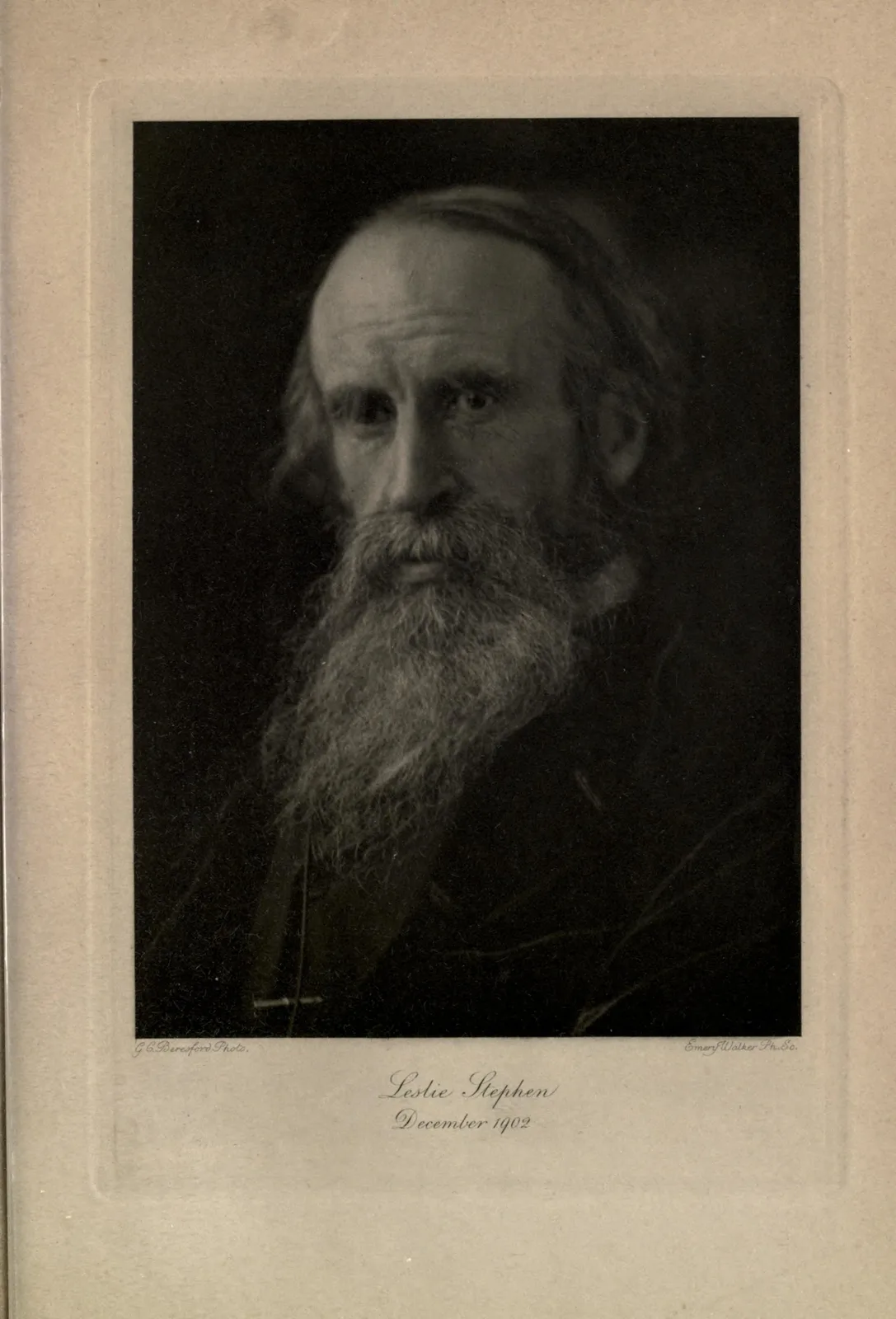
- Leslie Stephen, December 1902 (plate in Maitland) — Unknown photographer; F. W. Maitland (book), 1906 · Internet Archive, lifelettersofles00maituoft (University of Toronto / Cornell / UC copy); public domain · Public domain (published 1906; Internet Archive states no rights)
Sources
Tier 1 — the subject's own words (writings, letters, diaries, trial records)
- [Apology] Leslie Stephen, An Agnostic's Apology, and Other Essays (2nd ed., Smith, Elder, London, 1903; first edition 1893). https://archive.org/details/agnosticsapology00stepuoft (IA id
agnosticsapology00stepuoft). Text in research/texts/apology.txt. The author's note says four chapters are reprinted from the Fortnightly Review "with alterations"; the 1876 Fortnightly original of the title essay has not been seen, so quotations are from the 1893/1903 text. - [Freethinking] Leslie Stephen, Essays on Freethinking and Plainspeaking (Longmans, Green, London, 1873). https://archive.org/details/essaysonfreethin00step (IA id
essaysonfreethin00step). Text in research/texts/freethinking.txt. - [Impressions] Leslie Stephen, "Some Early Impressions," National Review, Sept.-Dec. 1903; the text consulted is a periodical reprint with the pagination of that volume (Cornell copy, IA id
cu31924013553320; title "Some early impressions. Journalism. Editing"). Page numbers cited are those of the reprint; Maitland cites the National Review original as pp. 142 and 214. Text in research/texts/early-impressions.txt. - [Letters] Stephen's letters and notebook entries as printed by Maitland (see Maitland): Jan 26 1865 shorthand note; 1870 letter; 1895 autobiographical letter to his children; 1900 letter; Dec 1903 letters. Quoted at second hand through Maitland; originals not seen.
- Not downloaded this session (lead only): Sketches from Cambridge by a Don (1865; the IA search found no scan; quoted in Maitland pp. 148-149); History of English Thought in the Eighteenth Century (1876; IA ids
historyofenglish01stepiala,historyofenglish02stepiala,thoughtintheeigh01stepuoft); The Mausoleum Book (written 1895, published 1977, copyrighted; Maitland pp. 2-3 and 431 quote the same 1895 letter without naming it).
Tier 2 — scholarly biographies and encyclopedias
- [Maitland] F. W. Maitland, The Life and Letters of Leslie Stephen (Duckworth, London, 1906). https://archive.org/details/lifelettersofles00maituoft (IA id
lifelettersofles00maituoft). Text in research/texts/maitland.txt. Page numbers are printed at the foot of each page in the scan; cited pages were located by tool and spot-checked. Maitland drew on Stephen's papers, shorthand notebooks, his mother's diary and letters from friends; his chapter VIII (pp. 130-153) is the account of the loss of faith.
Tier 3 — popular biographies and journalism
- Noel Annan, Leslie Stephen (1951; copyrighted, lead only). Hardy's Life of Thomas Hardy (1928, public domain in the US) not consulted yet; lead for the 1875 deed.
Tier 4 — maps to other sources only (Wikipedia and similar). Never cited in the script.
- Wikipedia and ODNB entries for Leslie Stephen were not consulted. Burial at Highgate and Talland House (St Ives) come from background knowledge and are not in the scanned sources.
Opposition sources — contemporary critics and religious responses
- [Newman] John Henry Newman, History of My Religious Opinions (Apologia), pp. 322-3, as quoted by Stephen in [Apology] p. 10. Original not seen.
- [Preacher 1900] Anonymous Cambridge preacher in St Mary's, 1900, printed sermon with note, as quoted by Maitland pp. 148-149 (Maitland names him only as "B.").
- [Trinity Hall fellow] A senior fellow of Trinity Hall (1862), reported by Stephen in a letter, Maitland p. 140.
- [Davies] J. Llewelyn Davies, "Secularism and Mr. Maurice's Theology," Contemporary Review, June 1874; the Spectator, 25 July 1874: both known only from Stephen's own report in Maitland p. 243 (articles not seen).
Related lives
Thomas Hardy (episode 39) — Hardy witnessed the deed by which Stephen renounced holy orders on 23 March 1875, and Stephen as editor of the Cornhill ran "Far from the Madding Crowd"; a second pointer, Virginia Woolf's father, is only a lead (post-1931 texts are copyrighted).
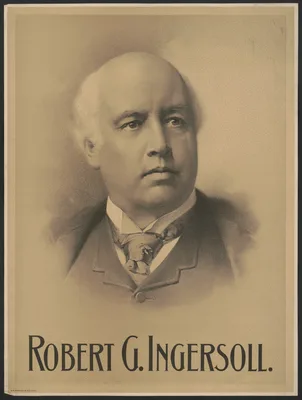
Robert G. Ingersoll
Robert Ingersoll was a preacher's son who kept the preacher's voice but not the creed. He turned unbelief into the most popular lecture ticket in America. In the end he let his agnosticism soften from attack into hope.
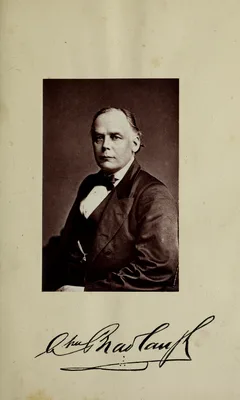
Charles Bradlaugh
A Sunday-school teacher's honest question got Charles Bradlaugh called an atheist before he was one. Driven from home at sixteen for refusing to pretend, he thought his way from deism to a defined atheism alone in a barrack-room. He then spent forty years turning his unbelief into law: the right to testify, to publish, and to sit in Parliament without swearing to a God he found meaningless.
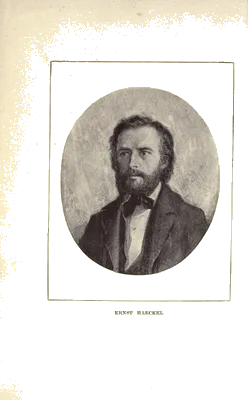
Ernst Haeckel
Ernst Haeckel's liberal Protestant faith, still defended in his letters at twenty-one, wore away between 1855 and 1857, under medicine, his teachers and what he saw of Catholic practice. Darwin (1860) and the death of his wife Anna (1864) drove him to build a "monistic" system in its place. He declared it as a pantheist's confession (1892) and as a "new monistic religion" that accepted atheism as its negative side (1899), organised it in the Monist League (1906), and made it outward only in 1910, when he left the church for political reasons. The creed did not change after that, and it carried his ranking of the races with it.
Mark Twain
Mark Twain grew from a Hannibal boy terrified of hell into a man who could not sit through his wife's Bible readings without feeling a hypocrite. In private he denied every Christian doctrine while keeping a distant God. Out of love for his family and caution with his public, he put his sharpest writing on religion away for after his death.