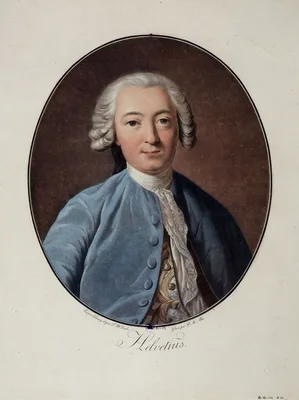
Claude Adrien Helvétius was schooled by Jesuits and turned by Locke into an empiricist. As a tax farmer he published in 1758 a licensed book that explained mind by the senses and morals by self-interest, without ever denying God. King, archbishop, Parlement, Pope and Sorbonne condemned him as a materialist friend of atheists, and he signed three retractions to protect his mother, his post and his censor. He kept his plainest words on priests, the soul and honest atheists for a manuscript book and private notes, printed after his death.
The belief timeline
- Faith (c. 1720–1730s) — Jesuit-taught childhood in a court physician's family; mother "un peu dévote"; no record of fervour, no recorded crisis [3][4][5][24]
- Doubt (c. 1730s (undated; "au collège") and the 1740s circle) — Locke's Essay "fit une révolution dans ses idées"; then Fontenelle, Montesquieu, Voltaire, and the tax-farm years of seeing the poor; the reason this and not childhood is the mark: the only dated cause in Saint-Lambert is a book that made him an empiricist, which led to the thesis that ideas come from the senses [6][9][10]
- Declaration (1758-07) — De l'esprit published with royal licence: sensation as the source of mind, self-interest as the source of morals, priests as enemies of enlightenment; the book does not deny God, but the authorities read it as materialism and a favouring of atheists [20][20][30][31]
- Revision (1758-08 to 1759-01) — Three retractions under pressure from his mother, the Queen, the Jesuit Plesse and fear for the censor Tercier; Saint-Lambert: "il signa ce qu'on voulut"; Helvétius to Chauvelin: he feared a trap [24][25][27][9]
- Posthumous voice (1773) — De l'homme, written in the 1760s and withheld, printed after death: "religion bienfaisante" to come only from legislators; priests persecute science; the unbeliever at the gates of paradise [16][17][18][26]
Notes to the timeline (16)
- [3] Before he was five his parents entrusted him to a tutor, M. Lambert, a "homme sage et sensible" — Jean-François de Saint-Lambert, "Essai sur la vie et les ouvrages de M. Helvétius" (1773), as reproduced in Keim1909, Appendice §1, pp. 295–316. Contemporary, by a friend; an apology, not a neutral life, (Keim1909 p. 296).
- [4] At the college he read the Iliad and Quintus Curtius, which made the timid boy bold; he rebelled against the "despotisme de ses régents" and made mediocre progress at first — Saint-Lambert, "Essai sur la vie et les…", (Keim1909 p. 296).
- [5] In rhetoric the Jesuit P. Porée noticed his sensitivity to praise, gave him private teaching and read the best authors with him — Saint-Lambert, "Essai sur la vie et les…", (Keim1909 p. 296).
- [24] First retraction: after the arrêt, in mid-August 1758, Helvétius sent the Jesuit Plesse a letter, made public, protesting the purity of his intentions; to his wife he wrote that his mother, after seeing the Queen, "a exigé que je fisse une rétractation. J'y ai consenti pour obliger ma mère" — Maurice Jusselin, Helvétius et Madame de Pompadour, à propos du livre et de l'affaire "De l'esprit", d'après des lettres inédites d'Helvétius et du père Plesse, 1758–1761 (Chartres, 1914; IA
helvetiusetmadam00jussuoft);research/texts/jusselin.txt. Scholarly, archival; gives the dated list of sanctions (pp. 12–13), the retractions, Collin's letters. Published 1914: public domain in the US, pp. 27–28 (letter to wife via Keim1907 p. 333). - [6] While still at the college he met Locke's Essay: "Ce livre fit une révolution dans ses idées. Il devint un zélé disciple de Locke" — Saint-Lambert, "Essai sur la vie et les…", (Keim1909 p. 297).
- [9] On the young farmers' circuits (Champagne, the two Burgundies, Bordeaux) he refused the money from confiscations, compensated the ruined, and at Bordeaux wrote to the company against a new wine duty and, back in Paris, got it suppressed — Saint-Lambert, "Essai sur la vie et les…", (Keim1909 pp. 299–300).
- [10] He cultivated Fontenelle ("comme un disciple qui venait proposer ses doutes avec modestie"), Montesquieu, Marivaux (pension of 2,000 francs), Saurin (1,000 écus), and visited Voltaire at Cirey with the plan and first two cantos of his poem Le Bonheur — Saint-Lambert, "Essai sur la vie et les…", (Keim1909 pp. 297–299).
- [20] In the preface to De l'esprit he writes that he warrants nothing in his work but "la pureté et la droiture des intentions" — Albert Keim (ed.), Helvétius: De l'esprit, De l'homme, notes, maximes et pensées, Le bonheur, lettres, appendice (Paris: Mercure de France, "Collection des plus belles pages", 1909). Internet Archive id
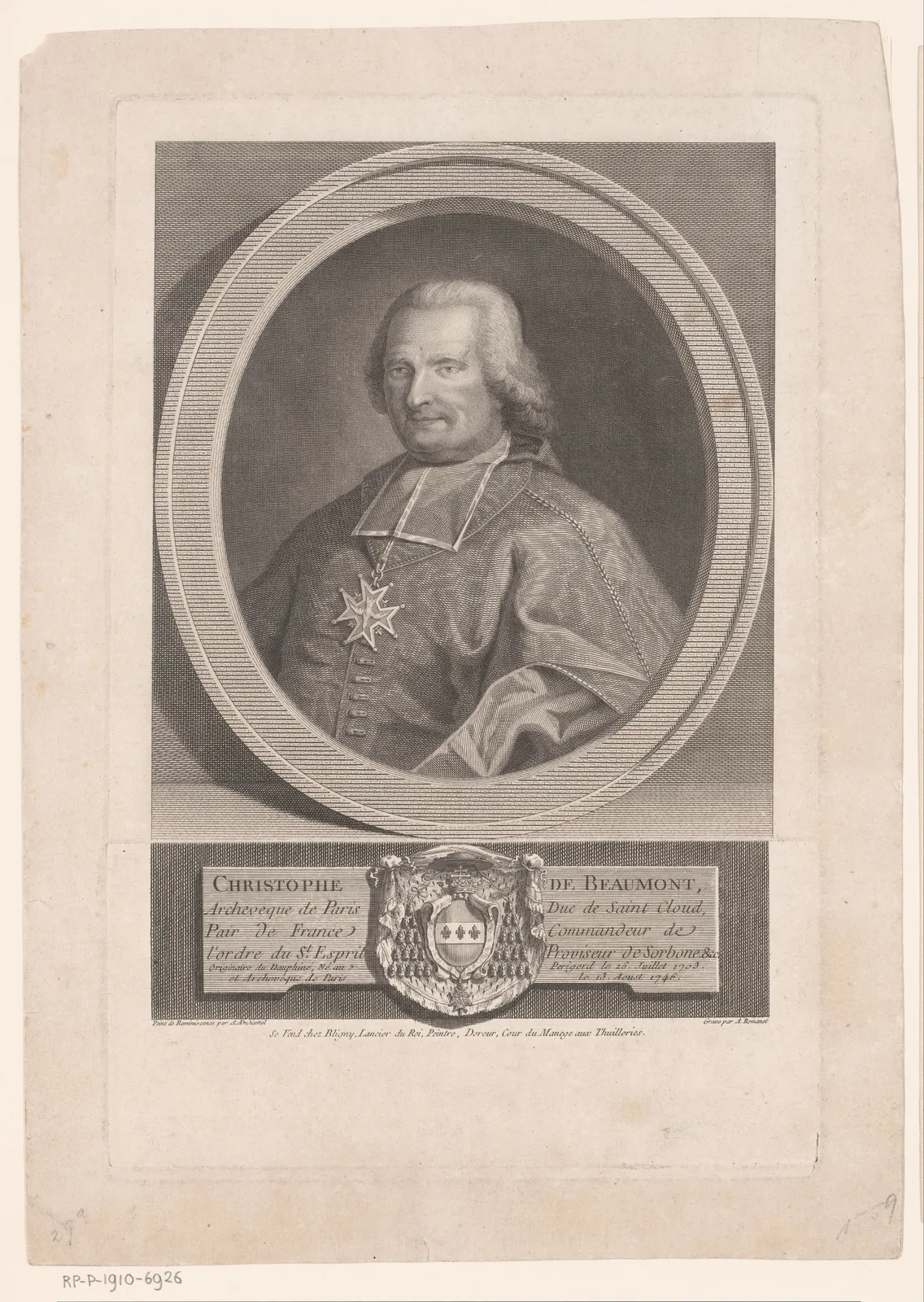
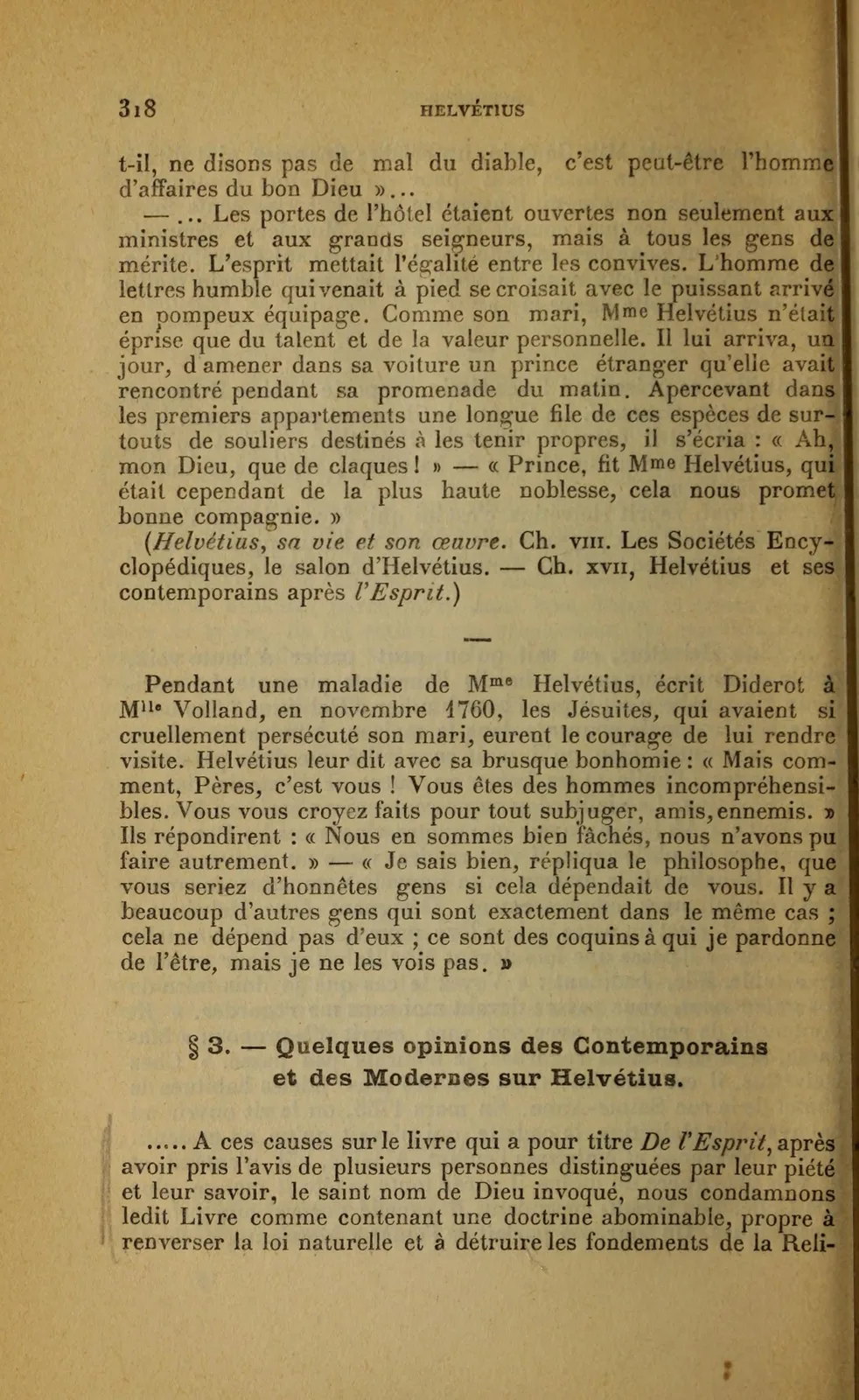
delespritdelhomm00helv; saved asresearch/texts/esprit-homme-1909.txt. Selections from De l'esprit and De l'homme in French, the private "Notes, maximes et pensées" (from the manuscript Keim published in 1907), letters, and an appendix reproducing Saint-Lambert's Essai, the Mandement and Sorbonne texts, and contemporary opinions. Page numbers are printed numbers inferred from the OCR headers; selections are abridged, so a passage not here may exist in the full work. Published 1909: public domain in the US, p. 14 (Préface); De l'esprit; or, Essays on the Mind and its several faculties (English translation by William Mudford, London, 1807), (Preface). - [30] The Archbishop's mandement condemned the book as "une doctrine abominable, propre à renverser la loi naturelle et à détruire les fondements de la Religion chrétienne", as accepting "la doctrine détestable du matérialisme" and as "favorisant les athées, les déistes, toutes les espèces d'incrédules" — Keim, Helvétius, pp. 318–319.
- [31] The Sorbonne's Détermination (9 April 1759) called the author one of the "conjurés" and prayed that "par une vie pénitente et exemplaire, il répare... le scandale"; it says the author "s'est déjà vu obligé de donner plusieurs rétractations" — Keim, Helvétius, p. 320; Jusselin, Helvétius et Madame de Pompadour, p. 15.
- [25] Second retraction, end of August 1758, "assez courte, mais très claire, complète, entière, absolue", beginning "Ayant appris que ma Lettre au Père XXX n'avait pas assez fait connaître mes vrais sentiments"; announced by the duc de Luynes on 4 September — Jusselin, Helvétius et Madame de Pompadour, p. 29.
- [27] Third retraction, a special one for the Parlement dated 21 Jan 1759, which he hoped would stay in the registry unprinted through Chauvelin's intervention — Jusselin, Helvétius et Madame de Pompadour, p. 38.
- [16] De l'homme (posthumous) tells a "parabole" in which an unbeliever at the gate of paradise, asked his sect by St Peter, answers "D'aucune, Monseigneur; j'ai cependant toujours été un honnête homme" and is told to sit with those who seem to him most reasonable — Keim, Helvétius, p. 214 (De l'homme, section IV).
- [17] De l'homme: "Qu'est-ce que le prêtre persécute ? la science", and "ils accusent encore d'athéisme et de matérialisme ceux qu'en qualité de sorciers ils eussent jadis fait brûler"; "Le soin du prêtre fut toujours d'éloigner la vérité du regard des hommes" — Keim, Helvétius, p. 215.
- [18] De l'homme: only from the legislature could be expected "une religion bienfaisante, et qui, d'ailleurs, peu coûteuse et tolérante, n'offrirait que des idées grandes et nobles de la divinité" — Keim, Helvétius, p. 184.
- [26] De l'homme was composed at Voré, not meant for publication in his lifetime ("Son dessein n'étant pas de le publier de son vivant"), originally begun as a defence against the critics, then reworked as a plan of education; published after his death (1773) — Saint-Lambert, "Essai sur la vie et les…", (Keim1909 p. 313); "Claude Adrien Helvétius", English Wikipedia, revision 1366857529 (2026-07-30). Used for the 26 January 1715 birth date, the "Deist, albeit a most indifferent one" label, and as a map to sources; its statement that "the Sorbonne publicly burned" the book is contradicted by Jusselin (the Parlement's order, executed by the hangman) and is not used.
An Error of the Mind, Not of the Heart
On 10 February 1759, at the foot of the great staircase of the Palais de justice in Paris, the executioner tore and burned a thick quarto called De l'esprit, On the Mind. In the six months before, the book had been condemned by the king's council, the archbishop of Paris, the Parlement and the Pope, and the Sorbonne would add its censure in April. The archbishop called it "an abominable doctrine, fit to overthrow natural law and destroy the foundations of the Christian religion", and said it favoured "the atheists, the deists, every kind of unbeliever".1234
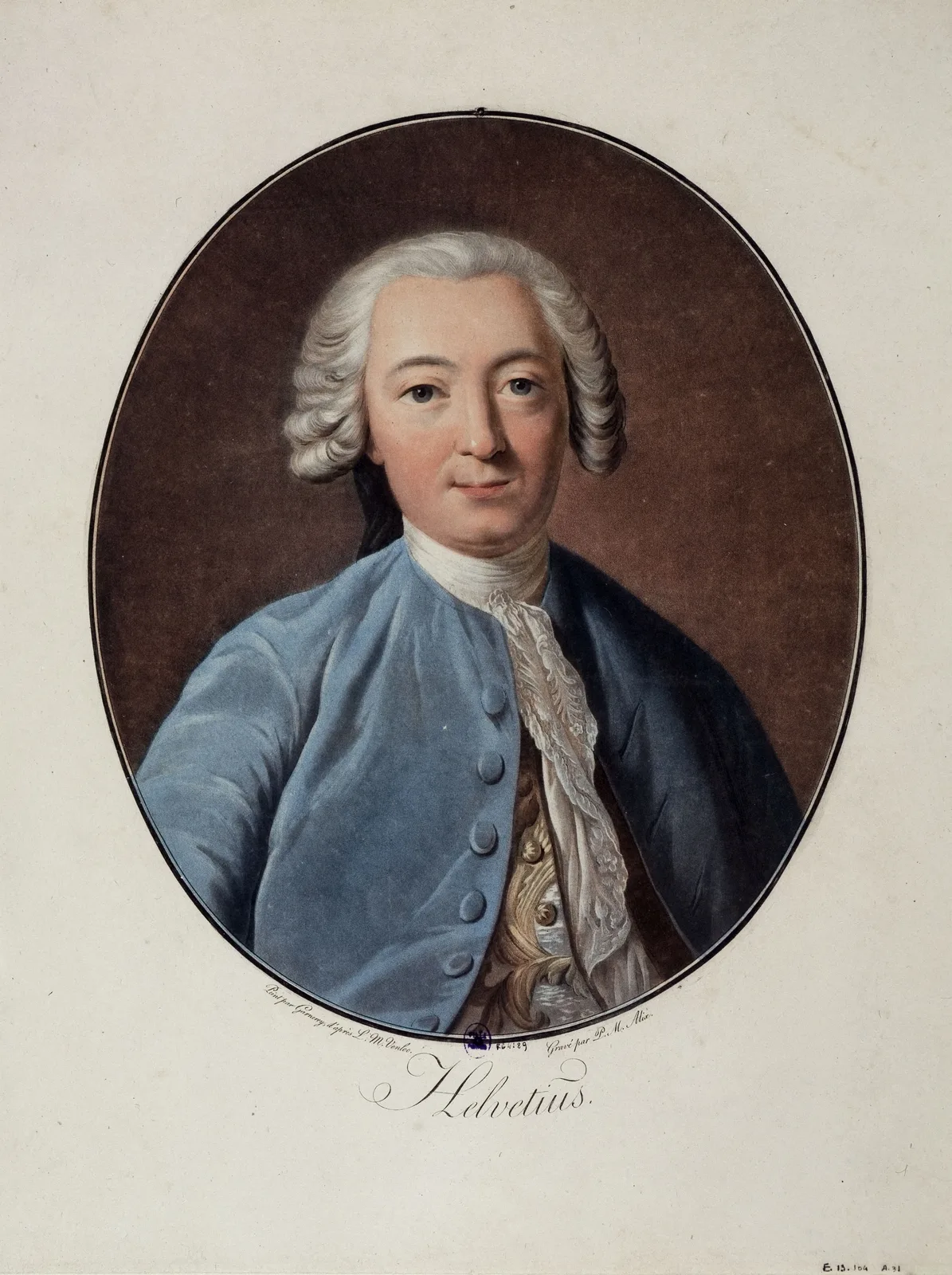
Its author, a rich former tax farmer named Claude Adrien Helvétius, was not punished. He had already signed three retractions.5678 This chapter asks what a man who never wrote "there is no God" had done to be treated as the century's model unbeliever, why he gave way, and what he kept back for a book that would appear only after his death. The translations from the French are this book's own.
Locke at school
He was born in Paris in January 1715. His family were physicians who had come from the Palatinate by way of Holland, and his father was first physician to Queen Marie Leszczyńska.910 Before he was five he was given to a tutor, and then sent to college, where he rebelled against "the despotism of his regents" until the Jesuit Father Porée noticed how hungry he was for praise and read the best authors with him.111213 His friend and first biographer, the poet Saint-Lambert, records no fervour and no crisis of faith; on the belief timeline, his faith is the inherited, Jesuit-taught religion of a court family.
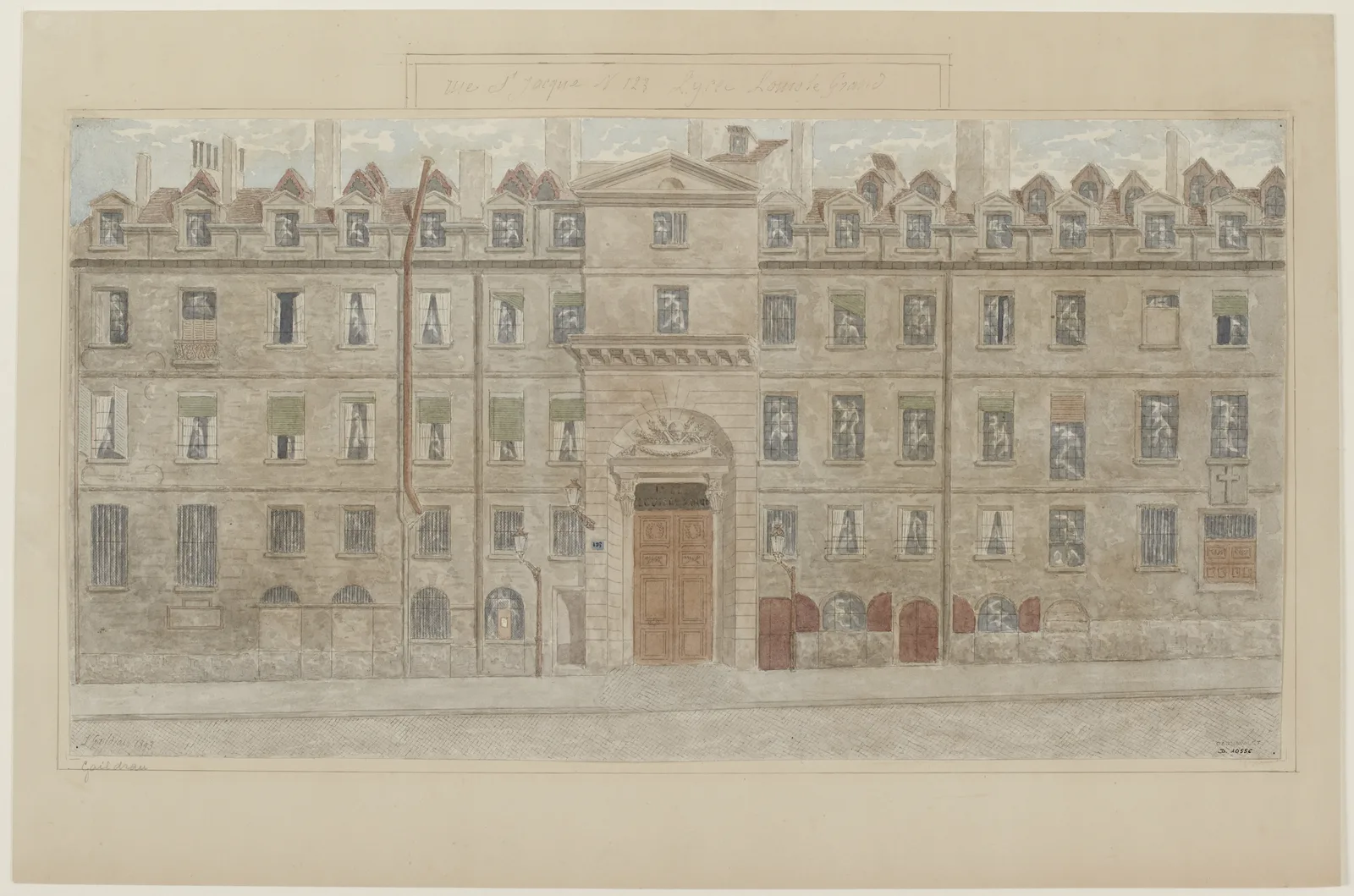
The one turning point Saint-Lambert dates is a book. While still at the college the boy read Locke's Essay concerning Human Understanding: "This book made a revolution in his ideas. He became a zealous disciple of Locke."14 If ideas come from the senses, the mind can be explained from below, and that was the thesis of everything he later wrote. That reading is where the timeline places his doubt, because it is the only dated cause the sources give.
His father meant him for finance and sent him to an uncle who directed the tax farms at Caen, where letters, philosophy and women occupied him more than accounts.15 At twenty-three, through the queen's favour, he became a fermier général, one of the financiers who collected the king's indirect taxes, with an income of a hundred thousand écus a year.16 Saint-Lambert, an admirer, says that on his tours of the provinces he refused his share of confiscations and got a new wine duty at Bordeaux suppressed.17 In Paris he sat at the feet of Fontenelle, "as a disciple who came to put forward his doubts modestly", befriended Montesquieu, pensioned Marivaux, and took the first cantos of a poem to Voltaire at Cirey.1819
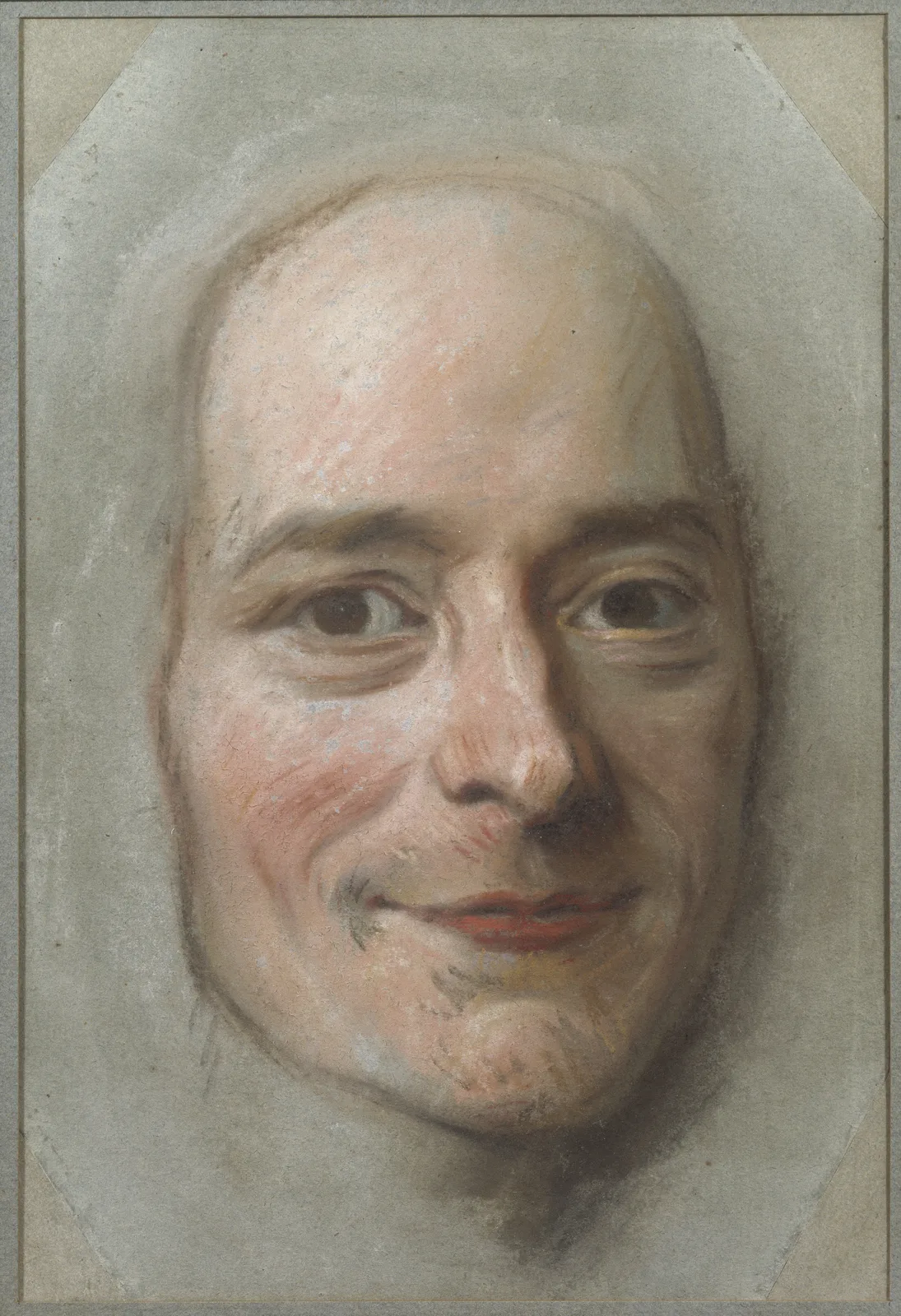
In July 1751 he gave up the tax farm, bought a post as maître d'hôtel to the queen, married Anne-Catherine de Ligniville, and left at once for his estate at Voré, where he wrote.20
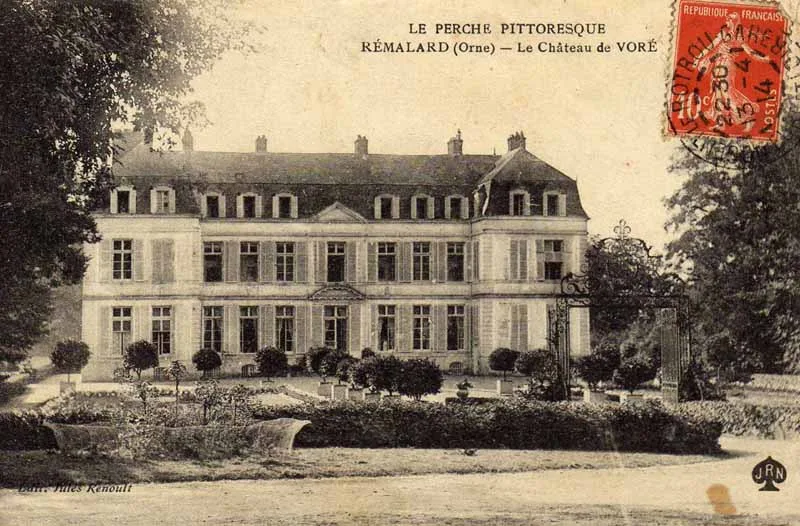
The book
De l'esprit came out in the summer of 1758, with a royal privilege and a censor's approval, anonymous on the title page though everyone knew who had written it.21 It argued that the mind is made from sensation and that what people call virtue is self-interest well understood, and it treated priests and despots as the enemies of enlightenment. It did not say that God does not exist; in the passages read for this chapter it never denies God at all.22 The preface was careful: "I warrant of my work only the purity and rectitude of my intentions." If any principle in it were against the general good, "it would be an error of my mind, and not of my heart; and I declare in advance that I disown them".23242526
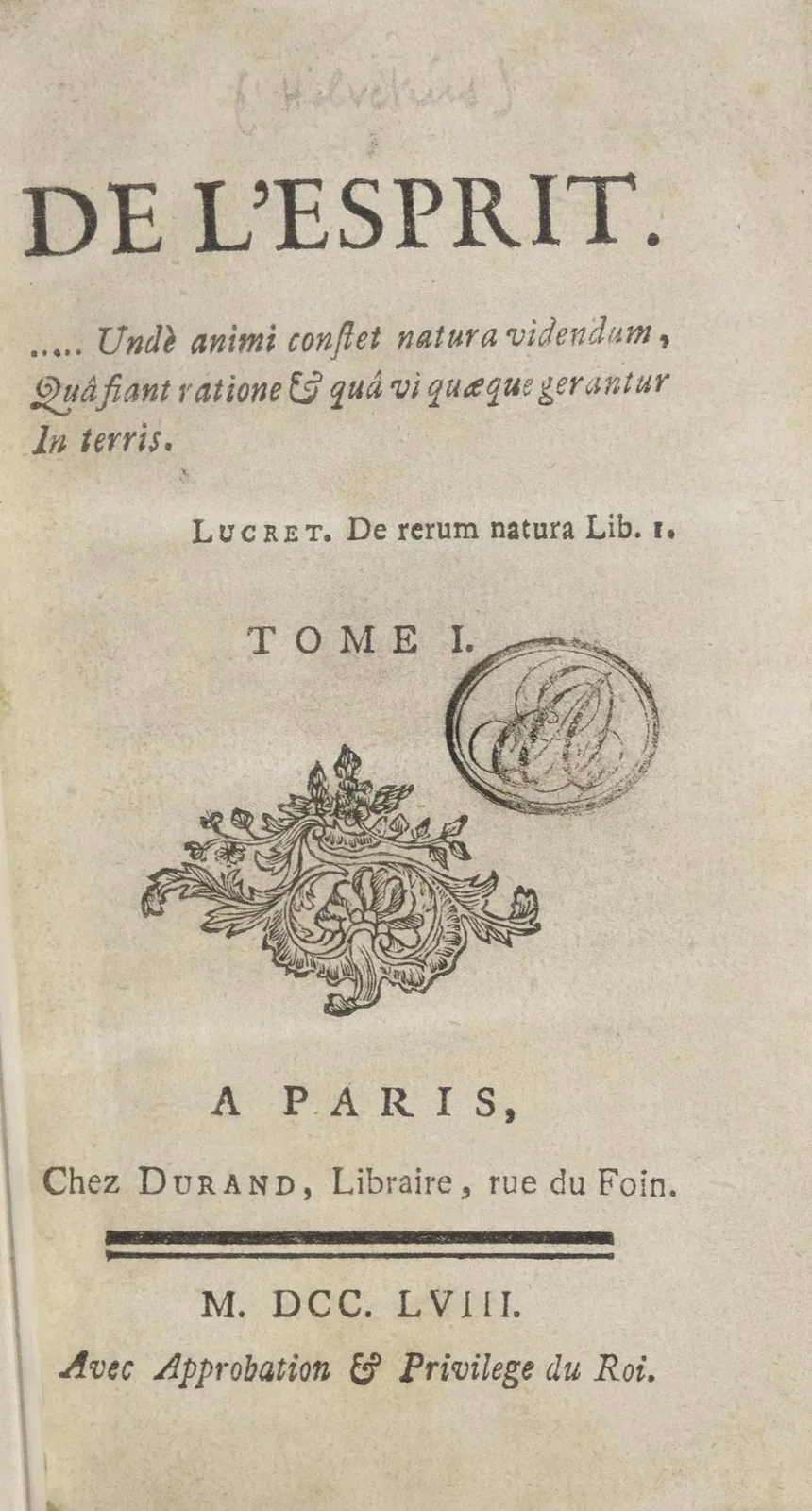
The timing was bad. After Damiens's attack on Louis XV in January 1757, a royal declaration had made the authors, printers and sellers of writings against religion liable to death.27 The historian Jusselin argued that the book's real offence was its long indictment of the two powers, Church and absolute monarchy.22 On 10 August the king's council revoked the privilege.1 Friends fell away. "Oh! how many friends I have seen turn their backs on me!" he wrote to his wife.28
Three retractions
The pressure came through the people closest to him. His mother saw the queen and came back with a demand. "She required that I make a retraction," he told his wife. "I consented, to oblige my mother."6 The first, a letter to the Jesuit Father Plesse, his friend of twenty years, was made public in mid-August; it protested the purity of his intentions. It was not enough, and at the end of August he signed a second, "complete, entire, absolute", which began: "Having learned that my Letter to Father XXX did not make my true feelings known enough..."6729 To a sympathetic councillor of the Parlement he wrote, "I fear that in making me sign a retraction they have set me a trap."30 In January 1759 he signed a third, for the Parlement's files. He lost his post in the queen's household, and the censor who had approved the book lost his.831 Madame de Pompadour, letters found later show, spoke for him to the king, and perhaps saved him from exile.32
On the timeline, these retractions stand for his revision, though they changed his public words, not his mind. Saint-Lambert wrote that he signed what they wanted.6 The Advocate General opened the case before the Parlement in January: "Gentlemen, Society, the State and Religion present themselves today before the Tribunal of Justice to lay their complaints."33 The Parlement condemned the book together with the Encyclopédie and Voltaire's poem on natural religion, and burned it; a lawyer of the day noted that it came down to a burning, "without any punishment for the author or the censor".5 The Sorbonne closed its censure with a prayer that the author, "who has already been obliged to give several retractions", would see how far he should have distrusted "those readings and those societies that spoiled his mind and corrupted his heart".3435
What he kept back
His allies were not all admirers. Voltaire thought the book's "jumble" had not deserved the noise it made.36 Rousseau wrote in 1762 that he was surprised the author lived "in peace in his country".37 But Helvétius went on writing at Voré, and the book that became De l'homme was, Saint-Lambert says, not meant to be published in his lifetime.38 He visited London in 1764, and in 1765 Frederick the Great kept him at his table in Berlin.3940 He died in Paris on 26 December 1771, after an attack of gout, at fifty-six.41
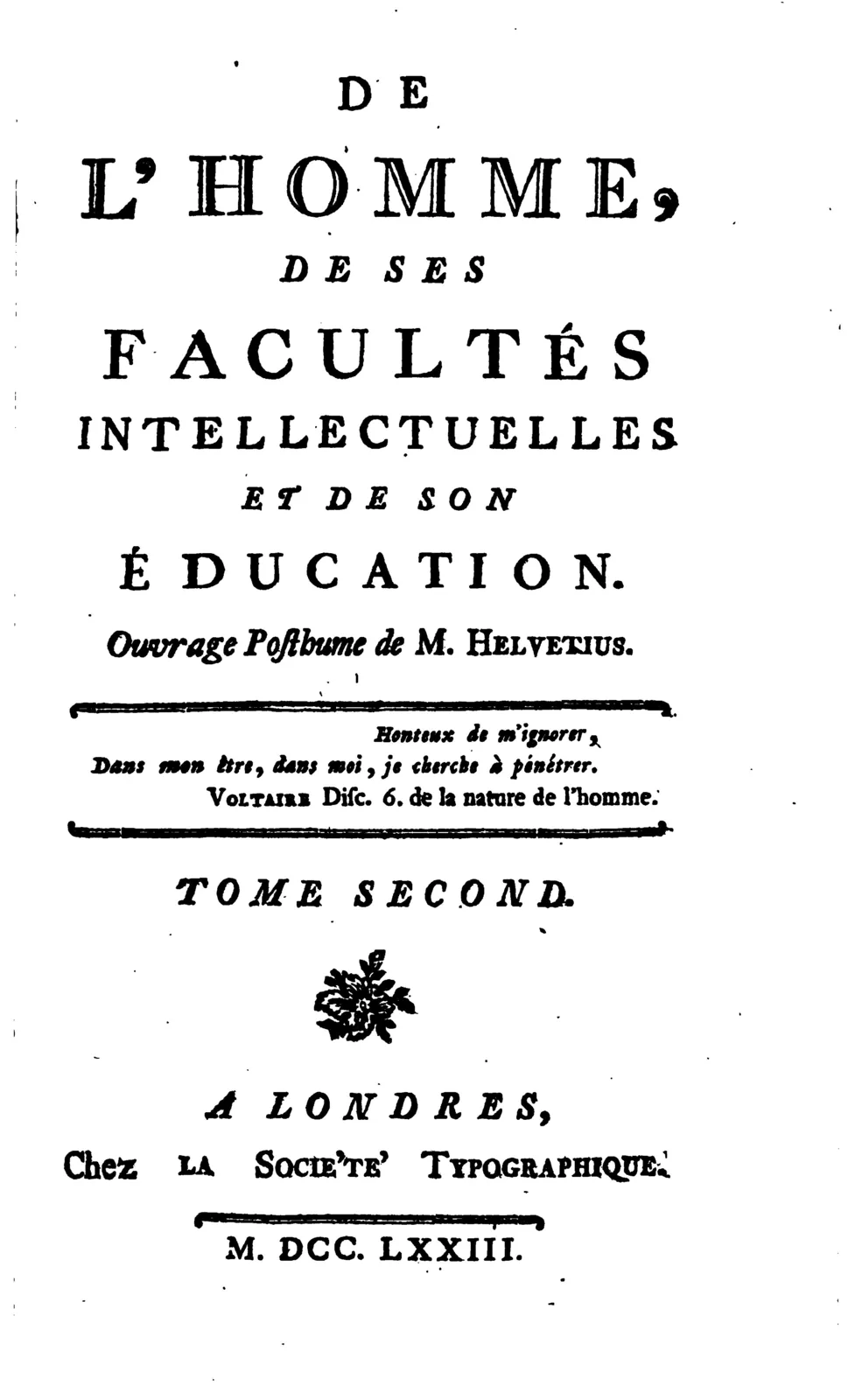
De l'homme appeared in 1773, and it says plainly what De l'esprit had not. "The priest's concern has always been to keep the truth from men's sight."4243 A beneficent religion, tolerant and cheap, offering "only great and noble ideas of the divinity", could be expected only from the legislator.4445 It tells a parable: an unbeliever arrives at the gate of paradise, and Saint Peter asks him which sect he belonged to. "None, my lord; yet I have always been an honest man." He is told to go and sit with whoever seems most reasonable.4647 That is a story, not a confession.
His private notebooks, printed only in the twentieth century, go furthest. "Like the body, it might well be matter," he wrote of the soul. "Religion has done great evils and few small goods." And: "There are so many believers who act badly, and so many atheists who act well!"484950515253 Even there the atheists are other people, and in one line the moving picture of the universe "shows the greatness of the machinist".5455 The posthumous book and the notes are his last word, and the plainest; whether they add up to atheism, the sources do not say, and he never said.
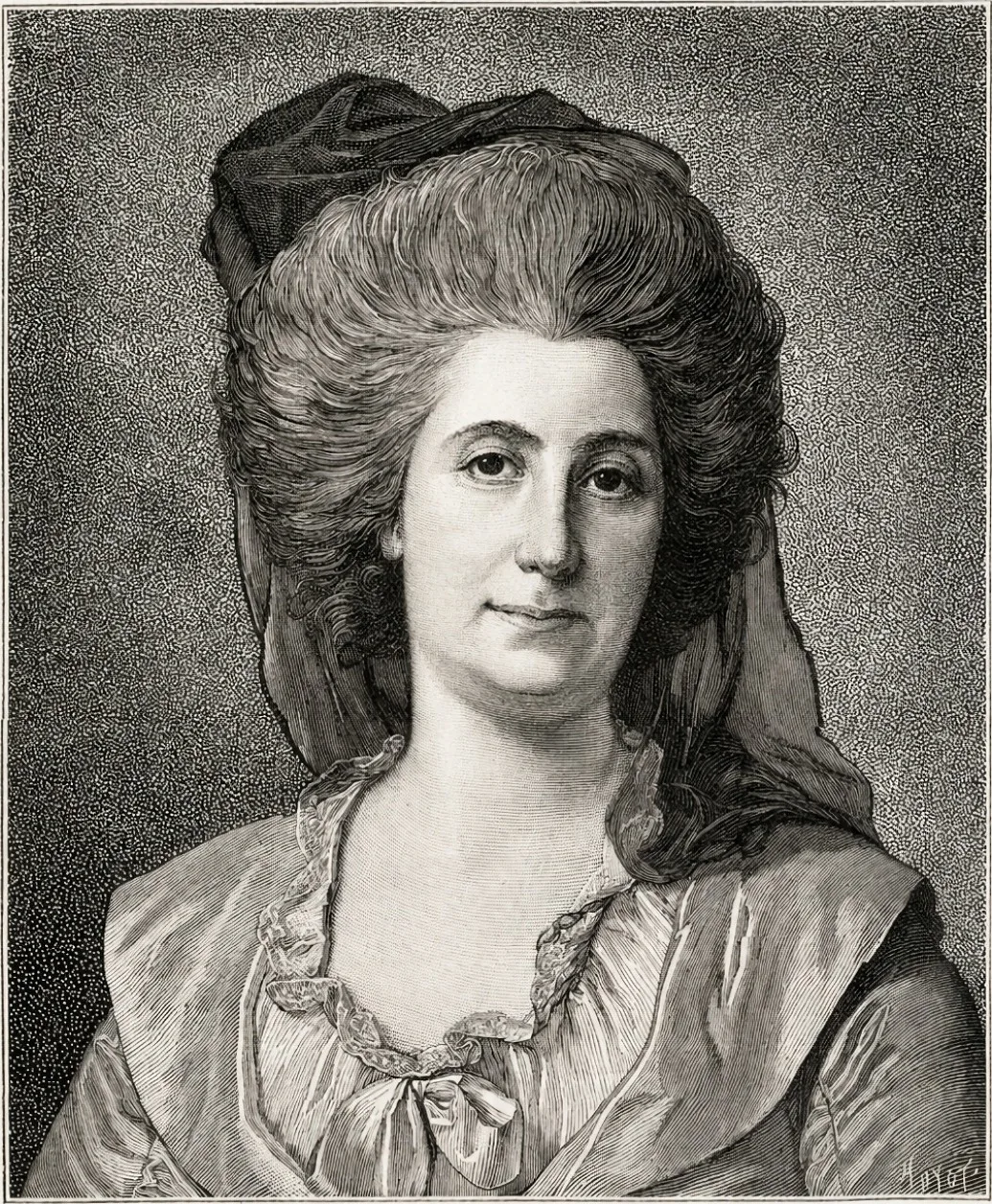
His widow's salon at Auteuil became famous; Franklin, it was said, wished to marry her.56 His friend Denis Diderot wrote a long refutation of De l'homme, telling him that his logic was not as rigorous as it might have been, but that he was nonetheless "a great moralist, a very subtle observer of human nature, a great thinker".57 Diderot has his own chapter in this book.
Footnotes
-
Maurice Jusselin, Helvétius et Madame de Pompadour, à propos du livre et de l'affaire "De l'esprit", d'après des lettres inédites d'Helvétius et du père Plesse, 1758–1761 (Chartres, 1914; IA
helvetiusetmadam00jussuoft);research/texts/jusselin.txt. Scholarly, archival; gives the dated list of sanctions (pp. 12–13), the retractions, Collin's letters. Published 1914: public domain in the US, pp. 12, 38. ↩ ↩2 -
Albert Keim (ed.), Helvétius: De l'esprit, De l'homme, notes, maximes et pensées, Le bonheur, lettres, appendice (Paris: Mercure de France, "Collection des plus belles pages", 1909). Internet Archive id
delespritdelhomm00helv; saved asresearch/texts/esprit-homme-1909.txt. Selections from De l'esprit and De l'homme in French, the private "Notes, maximes et pensées" (from the manuscript Keim published in 1907), letters, and an appendix reproducing Saint-Lambert's Essai, the Mandement and Sorbonne texts, and contemporary opinions. Page numbers are printed numbers inferred from the OCR headers; selections are abridged, so a passage not here may exist in the full work. Published 1909: public domain in the US, pp. 318–319. ↩ -
Christophe de Beaumont, Archbishop of Paris, mandement of 22 Nov 1758: Keim, Helvétius, p. 318. ↩
-
Christophe de Beaumont, same mandement: Keim, Helvétius, p. 319. ↩
-
Jusselin, Helvétius et Madame de Pompadour, pp. 27–28 (letter to wife via Keim1907 p. 333). ↩ ↩2 ↩3 ↩4
-
Jean-François de Saint-Lambert, "Essai sur la vie et les ouvrages de M. Helvétius" (1773), as reproduced in Keim1909, Appendice §1, pp. 295–316. Contemporary, by a friend; an apology, not a neutral life, (in Keim1909 p. 295). ↩
-
"Claude Adrien Helvétius", English Wikipedia, revision 1366857529 (2026-07-30). Used for the 26 January 1715 birth date, the "Deist, albeit a most indifferent one" label, and as a map to sources; its statement that "the Sorbonne publicly burned" the book is contradicted by Jusselin (the Parlement's order, executed by the hangman) and is not used, rev. 1366857529; "Claude-Adrien Helvétius", French Wikipedia, revision 239388361 (2026-09-10). Used for the tax-farm regions and dates (1738–1751), the 1715 birth date, and the father's dates (1685–1755), rev. 239388361; Keim, Helvétius, p. 5. Accounts differ; see the disputed points. ↩
-
Saint-Lambert, "Essai sur la vie et les…", (Keim1909 p. 296). ↩
-
Saint-Lambert, "Essai sur la vie et les…", (Keim1909 p. 296). ↩
-
Saint-Lambert, "Essai sur la vie et les…", (Keim1909 p. 296). ↩
-
Saint-Lambert, "Essai sur la vie et les…", (Keim1909 p. 297). ↩
-
Saint-Lambert, "Essai sur la vie et les…", (Keim1909 p. 297). ↩
-
Saint-Lambert, "Essai sur la vie et les…", (Keim1909 p. 297); "Claude-Adrien Helvétius", (1738). ↩
-
Saint-Lambert, "Essai sur la vie et les…", (Keim1909 pp. 299–300). ↩
-
Saint-Lambert, "Essai sur la vie et les…", (Keim1909 pp. 297–299). ↩
-
Saint-Lambert, "Essai sur la vie et les…", and Keim note (Keim1909 p. 298). Reported at second hand; the original has not been seen. ↩
-
Saint-Lambert, "Essai sur la vie et les…", (Keim1909 pp. 300–301); Keim, Helvétius, p. 5; "Claude-Adrien Helvétius". ↩
-
Jusselin, Helvétius et Madame de Pompadour, pp. 11–12. ↩
-
Keim, Helvétius, p. 14 (Préface); De l'esprit; or, Essays on the Mind and its several faculties (English translation by William Mudford, London, 1807), (Preface). ↩
-
Keim, Helvétius, p. 14. ↩
-
De l'esprit, Préface; Keim, Helvétius, p. 14. ↩
-
De l'esprit, Préface; Keim, Helvétius, p. 14. ↩
-
Jusselin, Helvétius et Madame de Pompadour, p. 13. ↩
-
Jusselin, Helvétius et Madame de Pompadour, p. 26, citing Keim1907 (page illegible in the OCR). ↩
-
Jusselin, Helvétius et Madame de Pompadour, p. 29. ↩
-
Letter in Keim1909 pp. 290–291. ↩
-
Jusselin, Helvétius et Madame de Pompadour, p. 39; Saint-Lambert, "Essai sur la vie et les…", (Keim1909 p. 304). ↩
-
Jusselin, Helvétius et Madame de Pompadour, pp. 30–37. ↩
-
Omer Joly de Fleury, avocat général, opening of the réquisitoire, 23 Jan 1759: Jusselin, Helvétius et Madame de Pompadour, p. 13. ↩
-
Keim, Helvétius, p. 320; Jusselin, Helvétius et Madame de Pompadour, p. 15. ↩
-
Faculty of Theology of Paris (Sorbonne), Détermination of 9 April 1759, closing prayer: Keim, Helvétius, p. 320. ↩
-
Voltaire, 1758 (ally who thought the book weak): Keim, Helvétius, p. 321 (secondhand). ↩
-
Jusselin, Helvétius et Madame de Pompadour, p. 16. ↩
-
Saint-Lambert, "Essai sur la vie et les…", (Keim1909 p. 313); "Claude Adrien Helvétius". ↩
-
Saint-Lambert, "Essai sur la vie et les…", (Keim1909 p. 311). ↩
-
Keim, Helvétius, p. 293 (letter); Saint-Lambert, "Essai sur la vie et les…", p. 312. ↩
-
Saint-Lambert, "Essai sur la vie et les…", (Keim1909 pp. 315–316); Grimm (Keim1909 p. 322). ↩
-
Keim, Helvétius, p. 215. ↩
-
De l'homme, section IV; Keim, Helvétius, p. 215. ↩
-
Keim, Helvétius, p. 184. ↩
-
De l'homme; Keim, Helvétius, p. 184. ↩
-
Keim, Helvétius, p. 214 (De l'homme, section IV). ↩
-
the unbeliever in Helvétius's parable: De l'homme, section IV; Keim, Helvétius, p. 214. ↩
-
Keim, Helvétius, p. 274 (Notes, maximes et pensées). ↩
-
Keim, Helvétius, p. 282. ↩
-
Keim, Helvétius, p. 279. ↩
-
Notes, maximes et pensées; Keim, Helvétius, p. 274. ↩
-
Notes, maximes et pensées; Keim, Helvétius, p. 282. ↩
-
Notes, maximes et pensées; Keim, Helvétius, p. 279. ↩
-
Keim, Helvétius, p. 275. ↩
-
Notes, maximes et pensées; Keim, Helvétius, p. 275. ↩
-
Keim, Helvétius, p. 323 n. 1. ↩
-
Diderot, same Réfutation: Keim, Helvétius, p. 326 (secondhand). ↩
helvetiusetmadam00jussuoft); research/texts/jusselin.txt. Scholarly, archival; gives the dated list of sanctions (pp. 12–13), the retractions, Collin's letters. Published 1914: public domain in the US.; Albert Keim (ed.), Helvétius: De l'esprit, De l'homme, notes, maximes et pensées, Le bonheur, lettres, appendice (Paris: Mercure de France, "Collection des plus belles pages", 1909). Internet Archive id delespritdelhomm00helv; saved as research/texts/esprit-homme-1909.txt. Selections from De l'esprit and De l'homme in French, the private "Notes, maximes et pensées" (from the manuscript Keim published in 1907), letters, and an appendix reproducing Saint-Lambert's Essai, the Mandement and Sorbonne texts, and contemporary opinions. Page numbers are printed numbers inferred from the OCR headers; selections are abridged, so a passage not here may exist in the full work. Published 1909: public domain in the US.; Jean-François de Saint-Lambert, "Essai sur la vie et les ouvrages de M. Helvétius" (1773), as reproduced in Keim1909, Appendice §1, pp. 295–316. Contemporary, by a friend; an apology, not a neutral life.; "Claude Adrien Helvétius", English Wikipedia, revision 1366857529 (2026-07-30). Used for the 26 January 1715 birth date, the "Deist, albeit a most indifferent one" label, and as a map to sources; its statement that "the Sorbonne publicly burned" the book is contradicted by Jusselin (the Parlement's order, executed by the hangman) and is not used.; "Claude-Adrien Helvétius", French Wikipedia, revision 239388361 (2026-09-10). Used for the tax-farm regions and dates (1738–1751), the 1715 birth date, and the father's dates (1685–1755).; De l'esprit; or, Essays on the Mind and its several faculties (English translation by William Mudford, London, 1807)In their own words
Je ne garantis de mon ouvrage que la pureté et la droiture des intentions.
I repeat then, that I shall warrant in my work nothing but the purity and rectitude of my intentions.
ce serait une erreur de mon esprit, et non pas de mon cœur ; et je déclare d'avance que je les désavoue.
Il y a tant de croyants qui agissent mal, et tant d'athées qui agissent bien !
La religion a fait de grands maux et peu de petits biens.
Le tableau mouvant de l'univers fait voir la grandeur du machiniste.
Ainsi que le corps il se pourrait bien faire qu'elle fût matière.
D'aucune, Monseigneur ; j'ai cependant toujours été un honnête homme.
Le soin du prêtre fut toujours d'éloigner la vérité du regard des hommes.
c'est uniquement du corps législatif qu'on peut attendre une religion bienfaisante, et qui, d'ailleurs, peu coûteuse et tolérante, n'offrirait que des idées grandes et nobles de la divinité
J'ai peur qu'en me faisant signer une rétractation on ne m'ait tendu un piège
Mandez moy donc s'il ne reste plus d'impressions contre moy dans l'esprit du Roy, et si je suis a l'abry des coups que peut porter la haine théologique.
Oh ! que j'ai vu d'amis me tourner le dos !
Mais vous combattez contre les Dieux. Il faudra qu'enfin la raison succombe.
Ayant appris que ma Lettre au Père XXX n'avait pas assez fait connaître mes vrais sentiments, je crois devoir lever les scrupules qui pourraient encore rester sur ce sujet
The other side
comme contenant une doctrine abominable, propre à renverser la loi naturelle et à détruire les fondements de la Religion chrétienne
favorisant les athées, les déistes, toutes les espèces d'incrédules et renouvelant presque tous leurs monstrueux systèmes
Fasse le Dieu de miséricorde que l'auteur, qui s'est déjà vu obligé de donner plusieurs rétractations, reconnaisse combien il aurait dû se défier de ces lectures et de ces sociétés qui lui ont gâté l'esprit et corrompu le cœur.
Messieurs, la Société, l'Etat et la Religion se présentent aujourd'hui au Tribunal de la Justice pour lui porter leurs plaintes
Rousseau croit l'homme de la nature bon : et vous le croyez mauvais.
Votre logique n'est pas aussi rigoureuse qu'elle pouvait l'être. Vous généralisez trop vos conclusions, mais vous n'en êtes pas moins un grand moraliste, un très subtil observateur de la nature humaine, un grand penseur, un excellent écrivain, et même un beau génie.
Helvétius avait l'âme tout le contraire de ce qu'il a dit.
Il n'y a pas de dialectique dans ce livre
Le fatras de l'Esprit d'Helvétius ne méritait pas le bruit qu'il a fait.
Where accounts differ
| Point | One account | Another | How the page handles it |
|---|---|---|---|
| Birth year | 26 January 1715 (Wiki-en, Wiki-fr; "janvier 1715" in Saint-Lambert, Keim1909 p. 295) | 1716 as printed in Keim's own front matter ("Claude-Adrien Helvétius (1716-1771)", Keim1909 p. 5) | Say 1715; no need to mention unless pictures carry 1716 |
| Dates of tax-farm tenure | 1738–1751 (Wiki-fr; Saint-Lambert: he gave up the farm before marrying in July 1751) | "fermier général (1738-1761)" (Keim1909 p. 5) | Say 1738 to about 1751; Saint-Lambert is explicit |
| Who burned the book | The Parlement's arrêt of 6 Feb 1759, executed by burning at the foot of the great staircase of the Palais on 10 Feb (Jusselin p. 38) | "the Sorbonne publicly burned it in 1759" (Wiki-en) | Follow Jusselin; the Sorbonne's censure was 9 April and burned nothing |
| Number of retractions | Three: letter to Plesse (mid-Aug 1758), "complète, entière, absolue" second (end Aug), special one for the Parlement (21 Jan 1759) (Jusselin pp. 27–29, 38); plus the 4 July protest to Malesherbes | "plusieurs rétractations" (Sorbonne prayer, Keim1909 p. 320); "three separate and humiliating retractions" (Wiki-en); Saint-Lambert speaks of a "petite rétractation" then a second "plus précise" | "He signed three retractions in six months" with a note that the first was mild |
| Year of the Berlin journey | 1765 (letter of 28 May 1765, Keim1909 p. 293) | "à la fin de l'hiver de 1766" (Saint-Lambert text as printed, Keim1909 p. 312) | Say 1765 (dated letter); mention London 1764 |
| Date of De l'homme | 1773 (title pages listed in IA: e.g. "1773, Vol 1") | "œuvres posthumes (1772)" (Keim1909 p. 5); fr. Wikipedia "De l'Homme (1772)" | Say 1773 for the edition; the writing was in the 1760s |
| Date of Voltaire's "Partez vite" verses | Keim prints "17 décembre 1768" (p. 320) | Context (the 1758 affair; Voltaire's 1766 letters) | Do not date the verses without a dated edition of Voltaire's correspondence |
| Whether the book "denied God" | Beaumont and Sorbonne: it renews "monstrueux systèmes" of atheists and deists (Keim1909 pp. 318–319) | Saint-Lambert, Jusselin and the Notes: his target was priests and despotism; preface professes good intentions; the printed book never says "there is no God" in any passage I located (but only Keim's selections were read) | Say plainly the authorities read it as materialism; do not call him an atheist without a text |
List of illustrations
This page uses only public-domain and Creative Commons images; each is credited with its source and licence.
- Portrait de Claude Adrien Helvetius, Collection des Grands Hommes (G.4189), aquatint — Pierre Michel Alix (engraver); Marie François Drouhin (publisher), between 1788 and 1798 · Musée Carnavalet - Histoire de Paris (G.4189), Paris Musées, via Wikimedia Commons, CC0 · CC0 (licence stated on the Wikimedia Commons file page)
- Rue Saint-Jacques nº123, lycée Louis-le-Grand, 5e arrondissement (D.10556) — Jules Gaildrau (draughtsman), 1893 · Musée Carnavalet - Histoire de Paris (D.10556), Paris Musées, via Wikimedia Commons, CC0 · CC0 (licence stated on the Wikimedia Commons file page)
- Portrait of Voltaire (pastel), Nationalmuseum NMB 25891 — Maurice Quentin de La Tour, c. 1735 · Nationalmuseum, Stockholm (NMB 25891; Public Domain Mark on Europeana), via Wikimedia Commons · Public domain (licence stated on the Wikimedia Commons file page; work published or painted before 1931)
- Le Chateau de Vore (1914 image) — Unknown, 1914 · Unknown author (1914), via Wikimedia Commons (source perche-gouet.net), public domain · Public domain (licence stated on the Wikimedia Commons file page; image dated 1914, published before 1931)
- De l'esprit, title page of vol. 1 (A Paris, chez Durand, M.DCC.LVIII) — Claude-Adrien Helvetius (author); Laurent Durand (bookseller; imprint, actually printed at Liege by Everard Kints), 1758 · Internet Archive (delesprit01helv), scan of the 1758 Durand edition of De l'esprit · Public domain (published 1758, before 1931); Internet Archive item states no rights, date governs
- Portret van Christoph de Beaumont (RP-P-1910-6926) — Antoine Louis Romanet after A.A. Duhamel (publisher Bligny), between 1752 and 1810 · Rijksmuseum (RP-P-1910-6926), via Wikimedia Commons, CC0 · CC0 (licence stated on the Wikimedia Commons file page)
- Printed page 318 of Keim 1909: opening of the Archbishop of Paris's Mandement of 22 Nov 1758 condemning De l'esprit (editor's transcription) — Albert Keim (ed.), Helvetius: De l'esprit, De l'homme, notes, maximes et pensees, Le bonheur, lettres, appendice (Paris: Mercure de France, 1909), 1909 (text of 1758/1759) · Internet Archive (delespritdelhomm00helv), Keim's 1909 Mercure de France edition · Public domain (published 1909, before 1931); Internet Archive item states no rights, date governs
- Lit de justice tenu le 12 septembre 1715 dans la Grand'Chambre du Parlement (D.7048) — Ferdinand Delamonce (draughtsman), between 1710 and 1720 · Musee Carnavalet - Histoire de Paris (D.7048), Paris Musees, via Wikimedia Commons, CC0 · CC0 (licence stated on the Wikimedia Commons file page)
- Portrait of Pope Clement XIII — Anton Raphael Mengs, Commons: 1775 (pope reigned 1758-69) · National Museum in Warsaw (156065), via Wikimedia Commons · Public domain (licence stated on the Wikimedia Commons file page; work published or painted before 1931)
- Portrait de Jean-Jacques Rousseau (1712-1778), écrivain et philosophe (P210) — Maurice Quentin de La Tour, 18th century (c. 1753) · Musée Carnavalet - Histoire de Paris (P210), Paris Musées, via Wikimedia Commons · Public domain (licence stated on the Wikimedia Commons file page; work published or painted before 1931)
- De l'homme, de ses facultes intellectuelles et de son education, title page of Tome second (Londres, Societe typographique, M.DCC.LXXIII) — Claude-Adrien Helvetius (posthumous work), 1773 · Internet Archive (delhommedesesfa01helvgoog), Google-digitised copy of De l'homme, 1773 · Public domain (published 1773, before 1931); Internet Archive item states no rights, date governs
- AnneCatherineHelvetius — Étienne Huyot, 18th century · Étienne Huyot, via Wikimedia Commons, Public domain · Public domain
Sources
Tier 1 — the subject's own words (writings, letters, diaries, trial records)
- [Keim1909] Albert Keim (ed.), Helvétius: De l'esprit, De l'homme, notes, maximes et pensées, Le bonheur, lettres, appendice (Paris: Mercure de France, "Collection des plus belles pages", 1909). Internet Archive id
delespritdelhomm00helv; saved asresearch/texts/esprit-homme-1909.txt. Selections from De l'esprit and De l'homme in French, the private "Notes, maximes et pensées" (from the manuscript Keim published in 1907), letters, and an appendix reproducing Saint-Lambert's Essai, the Mandement and Sorbonne texts, and contemporary opinions. Page numbers are printed numbers inferred from the OCR headers; selections are abridged, so a passage not here may exist in the full work. Published 1909: public domain in the US. - [Mudford] De l'esprit; or, Essays on the Mind and its several faculties (English translation by William Mudford, London, 1807). IA id
delespritoressa01helvgoog;research/texts/esprit-en1807.txt. OCR is poor in places. Used for the preface sentence on "purity and rectitude". Wikipedia names Mudford as the translator. - [Esprit1759-en] Anonymous English translation of De l'esprit, 1759 (IA
bim_eighteenth-century_de-lesprit-or-essays-_helvtius_1759);research/texts/esprit-en1759.txt. Long-s OCR; downloaded as a cross-check; not used for any quotation. - [Esprit1759-fr] De l'esprit, vol. 1 (1759; IA
delesprit01helvuoft);research/texts/esprit-fr1759-v1.txt. Downloaded; the Keim selections were used instead for the French quotations. Not used for any quotation. - [Oeuvres1818] Oeuvres complètes d'Helvétius, vol. 1 (Paris, Crapelet, 1818; IA
oeuvrescomplte01helvuoft);research/texts/oeuvres1818-v1.txt. Downloaded; the editor's "Avis" only has been read. - [Hooper] A Treatise on Man (English translation of De l'homme by William Hooper, 1777; IA
treatiseonmanhis01helv);research/texts/treatise-man-1777-v1.txt. Downloaded for the English of the De l'homme passages; not yet matched to the Keim passages (see Open questions).
Tier 2 — scholarly biographies and encyclopedias
- [StLambert] Jean-François de Saint-Lambert, "Essai sur la vie et les ouvrages de M. Helvétius" (1773), as reproduced in Keim1909, Appendice §1, pp. 295–316. Contemporary, by a friend; an apology, not a neutral life. Cited as the source for school, Locke, the farm, the marriage, the retractions and the death.
- [Jusselin] Maurice Jusselin, Helvétius et Madame de Pompadour, à propos du livre et de l'affaire "De l'esprit", d'après des lettres inédites d'Helvétius et du père Plesse, 1758–1761 (Chartres, 1914; IA
helvetiusetmadam00jussuoft);research/texts/jusselin.txt. Scholarly, archival; gives the dated list of sanctions (pp. 12–13), the retractions, Collin's letters. Published 1914: public domain in the US. OCR is rough, so French quotations from it are matched loosely. - [Keim1907] Albert Keim, Helvétius, sa vie et son œuvre (Alcan, 1907). Cited only as quoted in Jusselin and Keim1909; not seen directly (see Open questions).
- [Morley] John Morley, Diderot and the Encyclopaedists (1878), vol. 2 (IA
diderotandtheenc22797gut). Two download attempts failed with "fetch failed"; retry.
Tier 3 — popular biographies and journalism
- None used.
Tier 4 — Wikipedia and similar reference sites (citable; give the article and revision date; prefer a higher tier where one exists)
- [Wiki-en] "Claude Adrien Helvétius", English Wikipedia, revision 1366857529 (2026-07-30). Used for the 26 January 1715 birth date, the "Deist, albeit a most indifferent one" label, and as a map to sources; its statement that "the Sorbonne publicly burned" the book is contradicted by Jusselin (the Parlement's order, executed by the hangman) and is not used.
- [Wiki-fr] "Claude-Adrien Helvétius", French Wikipedia, revision 239388361 (2026-09-10). Used for the tax-farm regions and dates (1738–1751), the 1715 birth date, and the father's dates (1685–1755).
Opposition sources — contemporary critics and religious responses
- [Mandement] Christophe de Beaumont, Archbishop of Paris, Mandement portant condamnation d'un livre qui a pour titre l'Esprit, 22 Nov 1758; excerpt in Keim1909 pp. 318–319; description in Jusselin p. 15.
- [Sorbonne] Détermination de la Faculté de théologie de Paris contre le livre qui a pour titre De l'Esprit, 9 April 1759; excerpts in Keim1909 pp. 319–320 and Jusselin p. 15.
- [JolyFleury] Omer Joly de Fleury, avocat général, réquisitoire of 23 Jan 1759; Jusselin p. 13 and Keim1909 p. 319.
- [Others, via Keim1909 pp. 320–326] Voltaire (1758, 1766, 1771), Marmontel, Frederick II, Diderot (Réflexions; Réfutation de l'ouvrage d'Helvétius intitulé l'Homme), Grimm's Correspondance (January 1772), Chamfort, Marat, La Décade 1797. All secondhand through Keim; originals not seen.
- Not found in a free scan: Abraham Chaumeix, Préjugés légitimes contre l'Encyclopédie/ on De l'esprit; Rousseau's notes on De l'esprit (only mentioned in Keim1909 p. 325 n.); Diderot's Réfutation itself (the ia-search for it returned nothing).
Related lives
Baron d'Holbach — hosted the Paris salon where Helvétius's circle met and published his materialism anonymously, the opposite choice from Helvétius's signed, licensed book; or Denis Diderot, who wrote the Réfutation of De l'homme.
Denis Diderot
Denis Diderot was a tonsured Jesuit pupil who briefly wore a hair shirt. He argued for God as a deist in 1746, then in 1749 handed that argument to a blind man to destroy, while telling Voltaire that belief hardly mattered. Prison at Vincennes taught him to keep his boldest thoughts out of print, and he wrote his materialism into dialogues he would not publish. On his deathbed he refused a retraction as an impudent lie, saying that the first step towards philosophy is incredulity.
David Hume
David Hume lost the faith of his devout mother before he was twenty, gradually and, by his own account, against his will. He then spent fifty years deciding how much of his doubt to print: he cut the miracles essay from his first book, lost two professorships to the charge of atheism, withdrew his essays on suicide and immortality, and held back the Dialogues until after his death. He called himself only a sceptic. He died so calmly that his calm became the believers' argument.
Julien Offray de La Mettrie
Julien Offray de La Mettrie was destined for the Church and was briefly a Jansenist. He became a physician for money and learned the body under Boerhaave. As Frederick the Great told it, in his own fever at Freiburg in 1744 he saw that thought depends on the machine of the body. He said so veiled in 1745 and plainly in Man a Machine (1747–48), and lost his post, his country and his Dutch refuge for it. At Frederick's court he held to his materialism while declining to call himself an atheist, and refused the priest at his death in 1751.
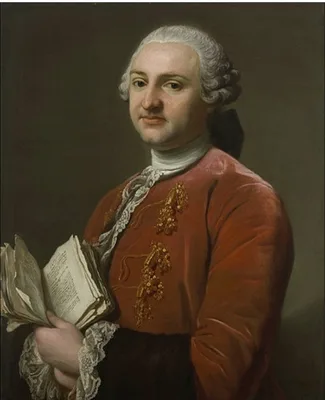
Baron d'Holbach
The Baron d'Holbach was raised a Catholic, and his translations of earth science first set the evidence against Genesis. He taught atheism openly at his own table and published it only under dead men's names, from Christianity Unveiled in 1761 to the System of Nature in 1770, while the pedlars who sold his books were flogged and branded. Late in life he turned from destroying belief to building a secular morals and politics. He was named as the author only after his death.