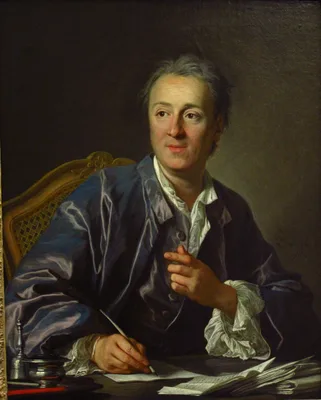
Denis Diderot was a tonsured Jesuit pupil who briefly wore a hair shirt. He argued for God as a deist in 1746, then in 1749 handed that argument to a blind man to destroy, while telling Voltaire that belief hardly mattered. Prison at Vincennes taught him to keep his boldest thoughts out of print, and he wrote his materialism into dialogues he would not publish. On his deathbed he refused a retraction as an impudent lie, saying that the first step towards philosophy is incredulity.
The belief timeline
- Faith (c. 1726) — Tonsured at twelve, destined for a canonry; wants to join the Jesuits and for four or five months fasts, wears a hair shirt and sleeps on straw [3][5][6][54]
- Deism (1745–1746) — Translates Shaftesbury; writes the Pensées philosophiques in a Easter weekend: a God distinct from the God of the devout, against superstition and atheism alike; burned by the Parlement [15][16][17][18][19]
- Doubt (1749) — The Lettre sur les aveugles gives the blind Saunderson the atheist's case; to Voltaire: "Je crois en Dieu" but the vapors that cloud it rise at night; arrested and interrogated at Vincennes [23][25][27][28]
- Secret writing (1769) — The Rêve de d'Alembert, matter that feels, "pas un mot de religion", kept from print; the Maréchale (1776) goes out under another man's name [50][52][53]
- Refusal to retract (1784) — The curé of Saint-Sulpice proposes a printed retraction; "je ferais un impudent mensonge"; the day before he dies he says the first step towards philosophy is incredulity [55][56]
Notes to the timeline (18)
- [3] As the eldest child he was destined for the Church; an uncle was to resign his canonry to him — Mme de Vandeul (Marie-Angélique Diderot), Mémoires pour servir à l'histoire de la vie et des ouvrages de Diderot, printed in [A-T 1] pp. xxix–lxii. The daughter-witness: she heard her father's stories and saw the last months; she is also his loyal protector (she says her mother would have given her life for his belief, but guarded him from the priest) and she makes mistakes of dates which the editors correct in notes, p. xxix.
- [5] He was tonsured at twelve — Diderot), Mémoires pour servir à l'histoire…, p. xxix ("à douze il fut tonsuré"); Jacques-André Naigeon, Mémoires historiques et philosophiques sur la vie et les ouvrages de D. Diderot (the 1821 Brière text), p. 3 ("déjà tonsuré"); the date 1726 is from the roster, not found in the texts. Not verified.
- [6] The Jesuits tried to enlist him; he agreed to leave for Paris "où je dois entrer aux Jésuites", but his father, warned by a cousin (Vandeul) or a friend (Naigeon), stopped him at midnight and took him to Paris himself — Diderot), Mémoires pour servir à l'histoire…, pp. xxx; Naigeon, Mémoires historiques et philosophiques sur…, pp. 3–4; John Morley, Diderot and the Encyclopaedists, vol. 1 (London: Macmillan, 1886 edition), p. 15.
- [54] Vandeul: "Je n'ai jamais vu les opinions de mon père ni varier, ni s'altérer"; he was devout "pendant quatre ou cinq mois" when he wanted to join the Jesuits, fasting, wearing a hair shirt and sleeping on straw — Diderot), Mémoires pour servir à l'histoire…, p. lx. Accounts differ; see the disputed points.
- [15] In 1745 he translated Shaftesbury's Inquiry concerning Virtue and Merit as the Essai sur le mérite et la vertu, with notes of his own, and gave the fifty louis to Mme de Puisieux — Diderot), Mémoires pour servir à l'histoire…, p. xlii; Margaret Jourdain (trans. and ed.), Diderot's Early Philosophical Works (Chicago and London: Open Court, 1916): the Philosophic Thoughts (pp. 27–67), Letter on the Blind (pp. 68–141), with her Introduction (pp. 1–26). Published translation of 1916; quoted from here for the Pensées and the Lettre, p. 2; Jules Assézat and Maurice Tourneux (eds.), Œuvres complètes de Diderot, vol. 1 (Paris: Garnier, 1875), Essai, Notice pp. 6–7.
- [16] The A-T editors: "En la traduisant Diderot s'est affirmé déiste ou théiste"; Naigeon: the notes were "en général plus chrétiennes que philosophiques", a "moment de ferveur ou plutôt cette espèce de fièvre religieuse" that "ne dura pas longtemps" — Assézat, Œuvres complètes de Diderot, (Essai, Notice) pp. 6–7, quoting Naigeon, Encyclopédie méthodique, Philosophie ancienne et moderne, vol. 2, p. 154. Reported at second hand; the original has not been seen.
- [17] The Pensées philosophiques were written between Good Friday and Easter (1746) to give his mistress fifty louis; published at The Hague, 1746 — Diderot), Mémoires pour servir à l'histoire…, p. xlii; Assézat, Œuvres complètes de Diderot, p. 125; (trans, Diderot's Early Philosophical Works, pp. 4–5.
- [18] The Parlement of Paris condemned the little book to be burned on 7 July 1746; burnings were done in effigy with old paper, so the 1746 edition is not rare — Assézat, Œuvres complètes de Diderot, p. 125; (trans, Diderot's Early Philosophical Works, p. 5.
- [19] In the Pensées Diderot "est toujours déiste; il a soin seulement de distinguer entre son Dieu et celui des dévots"; Thought LVIII is a profession of Catholic faith which did not disarm his judges; Jourdain: "ironical deference" (Morley) — Assézat, Œuvres complètes de Diderot, p. 126; (trans, Diderot's Early Philosophical Works, p. 5.
- [23] The Lettre sur les aveugles à l'usage de ceux qui voient (1749) contains the long speech of the dying Saunderson against the argument from design, ending "Ô Dieu de Clarke et de Newton, prends pitié de moi" — Assézat, Œuvres complètes de Diderot, pp. 275–311; (trans, Diderot's Early Philosophical Works, pp. 108–114.
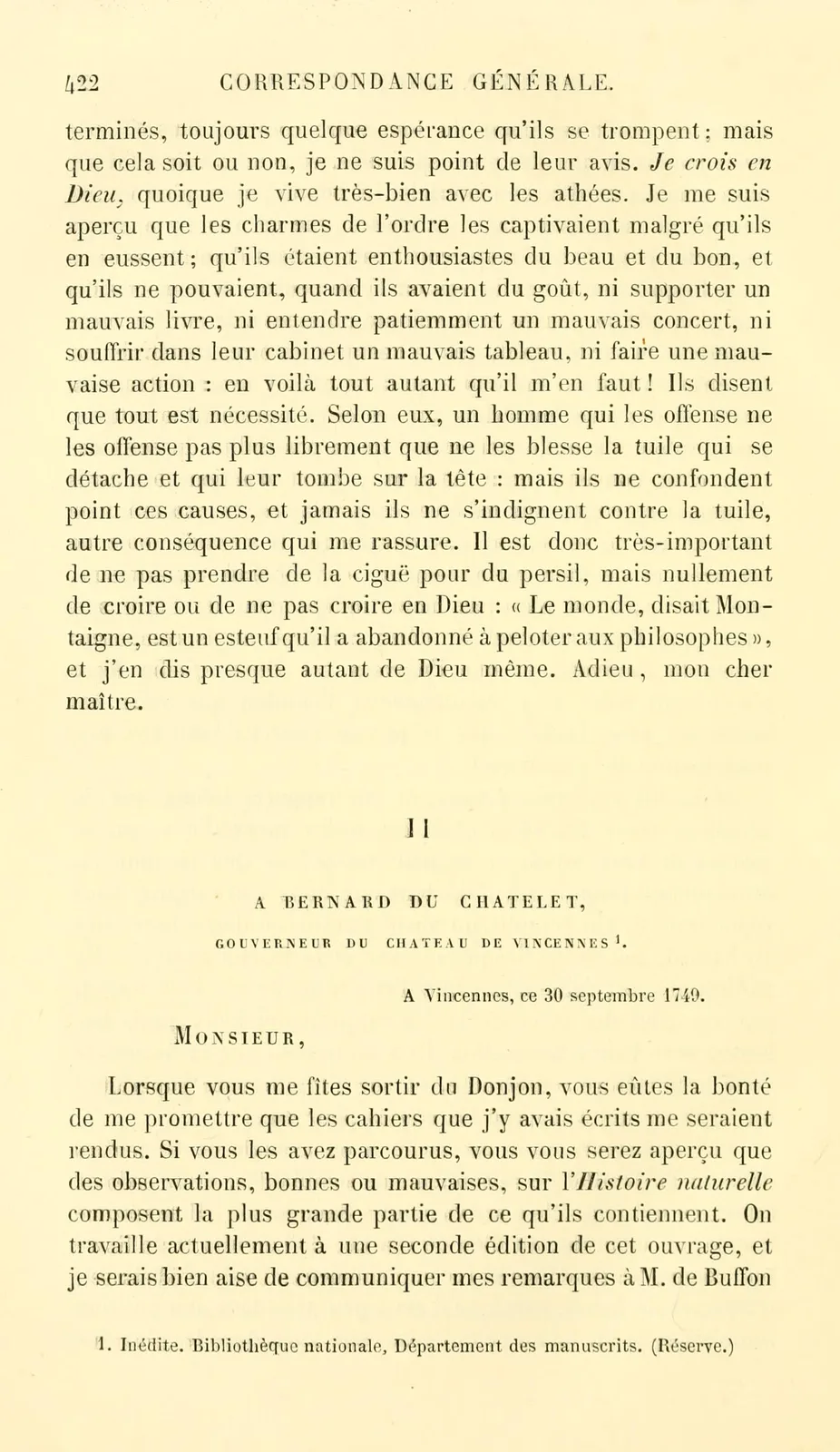
- [25] On 11 June 1749 Diderot told Voltaire that Saunderson's view is not his: "ce pourrait bien être parce que je vois"; that the vapors that obscure God for him rise at night and the sunrise dispels them; that he believes in God though he lives well with atheists; and that it matters little whether one believes — Assézat and Tourneux, vol. 19 (1876): Lettres à Mlle Volland (1760s) and the Correspondance générale (Voltaire 1749, Landois 1756, Le Breton 1764), pp. 419–422.
- [27] Diderot was arrested at nine in the morning on 24 July 1749 by a commissaire named Rochebrune and taken to Vincennes; Vandeul blames a quip about Mme Dupré de Saint-Maur; Morley gives "a casual sneer... at the mistress of a minister" as the real offence; the A-T editors and d'Argenson's note suggest a wider crackdown — Diderot), Mémoires pour servir à l'histoire…, pp. xliii–xliv; (trans, Diderot's Early Philosophical Works, p. 21; Morley, Diderot and the Encyclopaedists, vol. I, pp. 106–108; Assézat, Œuvres complètes de Diderot, pp. 277–278.
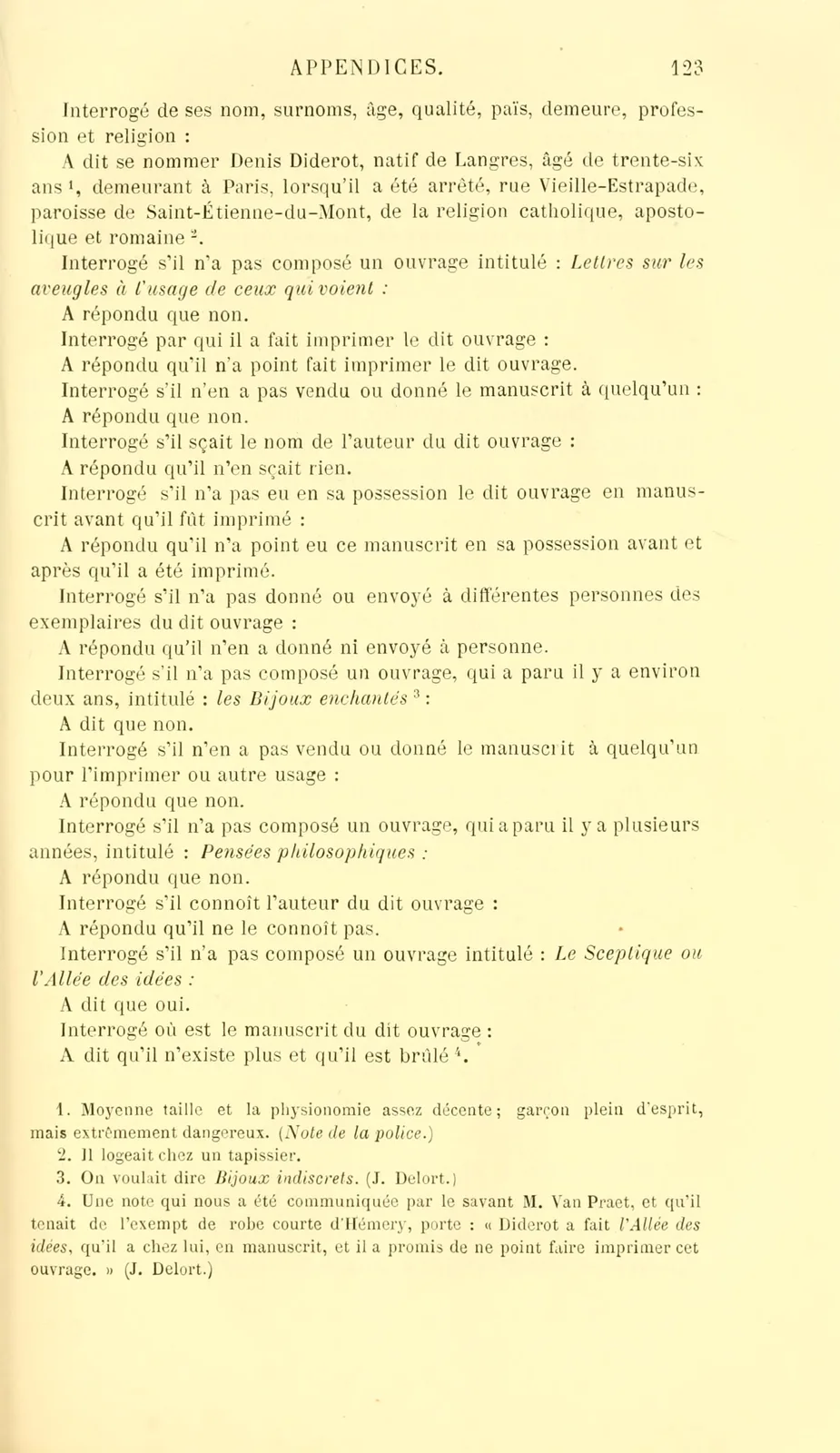
- [28] On 31 July 1749, after the oath to tell the truth, Diderot told Berryer he was a Catholic, denied writing the Lettre sur les aveugles, the Bijoux and the Pensées philosophiques, admitted the Promenade du sceptique and said it was burned; the police note describes him as "plein d'esprit, mais extrêmement dangereux" — Assézat and Tourneux, vol. 20 (1877): Correspondance générale (continued), appendices with the police reports and the Vincennes interrogation (pp. 121–125), pp. 122–124; Morley, Diderot and the Encyclopaedists, vol. I, pp. 108–109.
- [50] On 2 and 11 September 1769 he told Sophie Volland about the Rêve de d'Alembert: "Il n'est pas possible d'être plus profond et plus fou", with "pas un mot de religion"; he put his ideas in a dreamer's mouth because "il faut souvent donner à la sagesse l'air de la folie"; it was not published in his lifetime — Assézat and Tourneux, vol. 2 (1875), pp. 103–104.
- [52] Jourdain: in the Pensées sur l'interprétation de la nature Diderot is "not fully in sympathy with the materialistic thesis"; in d'Alembert's Dream "he figures definitely as a materialist" — (trans, Diderot's Early Philosophical Works, p. 4.
- [53] The Entretien d'un philosophe avec la maréchale de * circulated in Métra's Correspondance secrète on 23 July 1776 and was reprinted in 1777 attributed to Thomas Crudeli; tradition (via Naigeon) names the maréchale de Broglie — A-T 2, pp. 505–506.
- [55] In 1784, after an attack on 19 February, dropsy; the curé of Saint-Sulpice visited two or three times a week and, finding common ground on charity, suggested that a "petite rétractation" with maxims in print "ferait un fort bel effet"; Diderot answered it would be "un impudent mensonge"; Mme Diderot and her daughter never left him alone with the priest — Diderot), Mémoires pour servir à l'histoire…, pp. lv–lvii; John Morley, Diderot and the Encyclopaedists, vol. 2 (London: Chapman and Hall, 1878), p. 276.
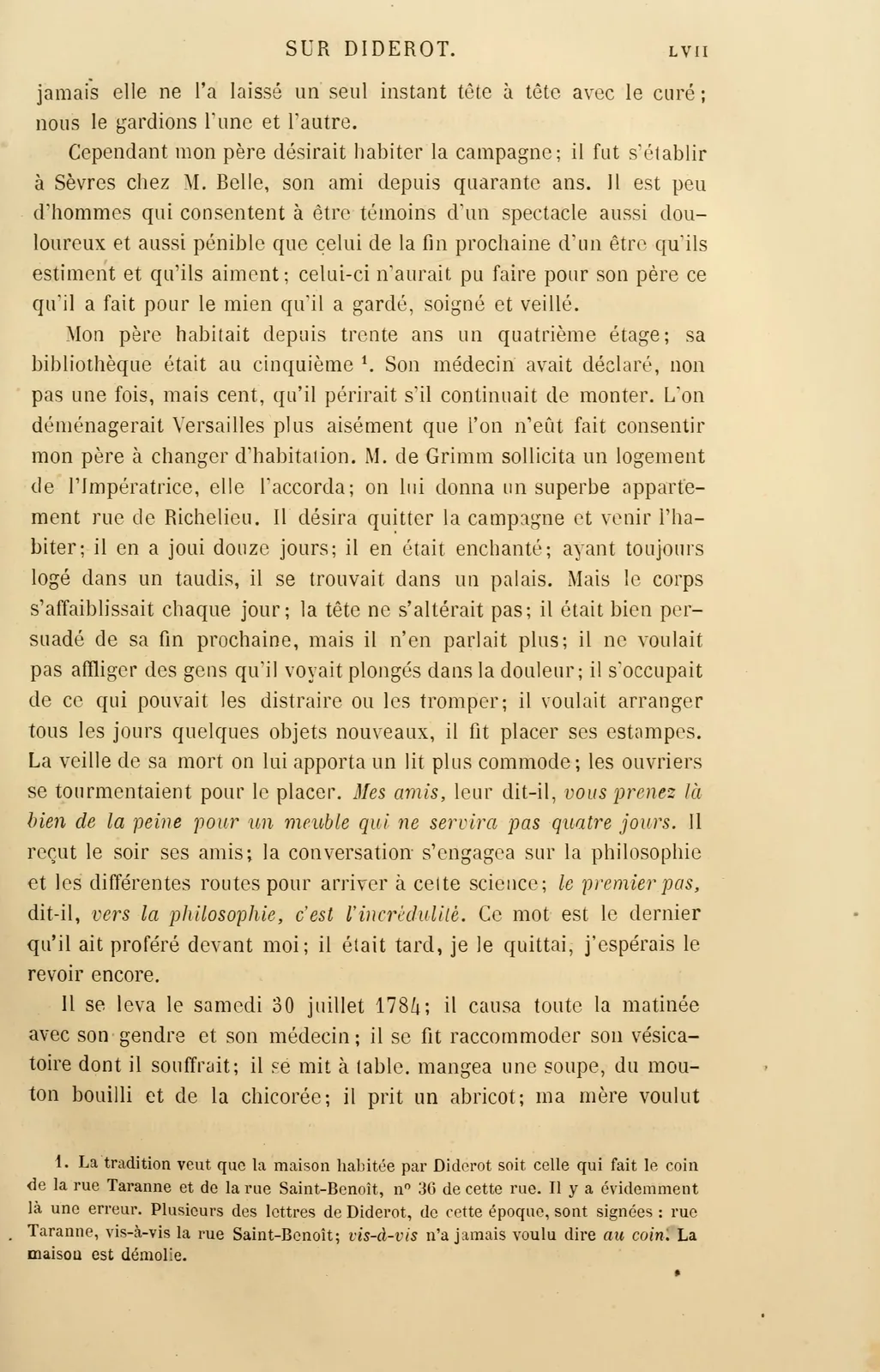
- [56] Twelve days before his death he moved to a palace of an apartment in the rue de Richelieu given by Catherine through Grimm; the evening before he died he said "le premier pas vers la philosophie, c'est l'incrédulité" — the last words his daughter heard — Diderot), Mémoires pour servir à l'histoire…, p. lvii; Morley, Diderot and the Encyclopaedists, vol. II, p. 277.
The First Step Towards Philosophy
In the spring of 1784 a parish priest climbed the stairs of a house in the rue Taranne in Paris two or three times a week to visit a dying man. Denis Diderot, the editor of the Encyclopédie, was seventy and ill with dropsy. The curé of Saint-Sulpice was a patient visitor, and he and the old philosopher found that they agreed about charity and good works. So the priest made a suggestion. A little retraction, published, with these good maxims in it, "would make a very fine effect." Diderot answered: "I believe it, monsieur le curé, but you must admit I should be telling an impudent lie." His wife and daughter, his daughter wrote, never left the priest alone with him.12
That refusal is the last firm thing Diderot ever said about religion, and it is the end of a long road. He had been a boy who fasted and wore a hair shirt, a young man who argued for God against the atheists, a prisoner who swore under oath that he was a Catholic, and an old man who wrote his materialism in dialogues he would not publish. This chapter follows that road and asks how often it turned.
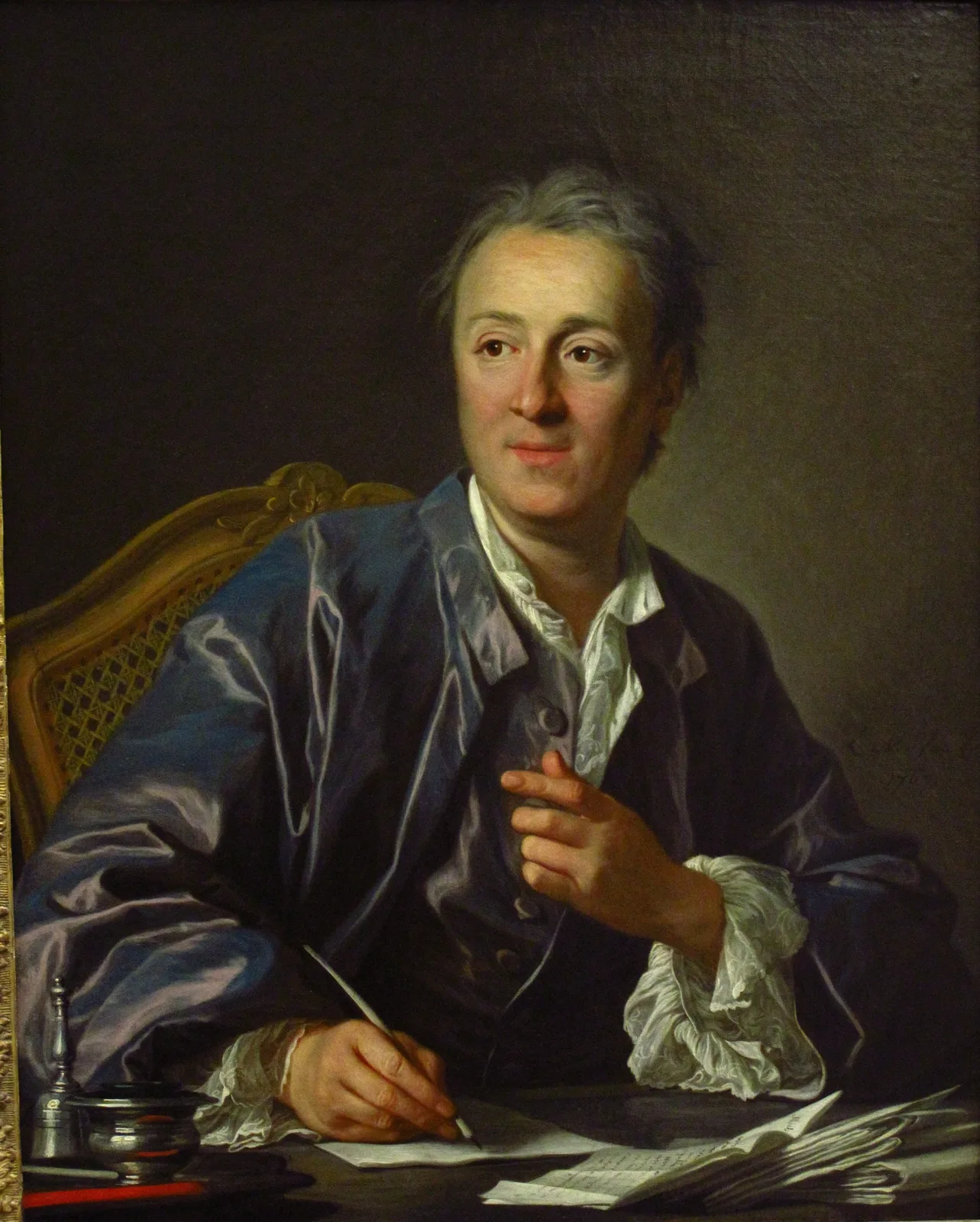
The hair shirt
He was born at Langres in Champagne on 5 October 1713, the eldest child of a master cutler, a man of "exact and scrupulous justice," as Diderot's daughter later described her grandfather; the family had followed no other trade for two hundred years.34 As the eldest son he was meant for the Church. An uncle who was a canon was to resign his place to him, and at twelve the boy was tonsured.567 He went to school with the Jesuits of Langres from the age of eight or nine.8 For a time he took it all to heart. His daughter, who heard the stories from him, wrote that "he was devout for four or five months; while he was studying and wanted to join the Jesuits he fasted, wore a hair shirt and slept on straw."910
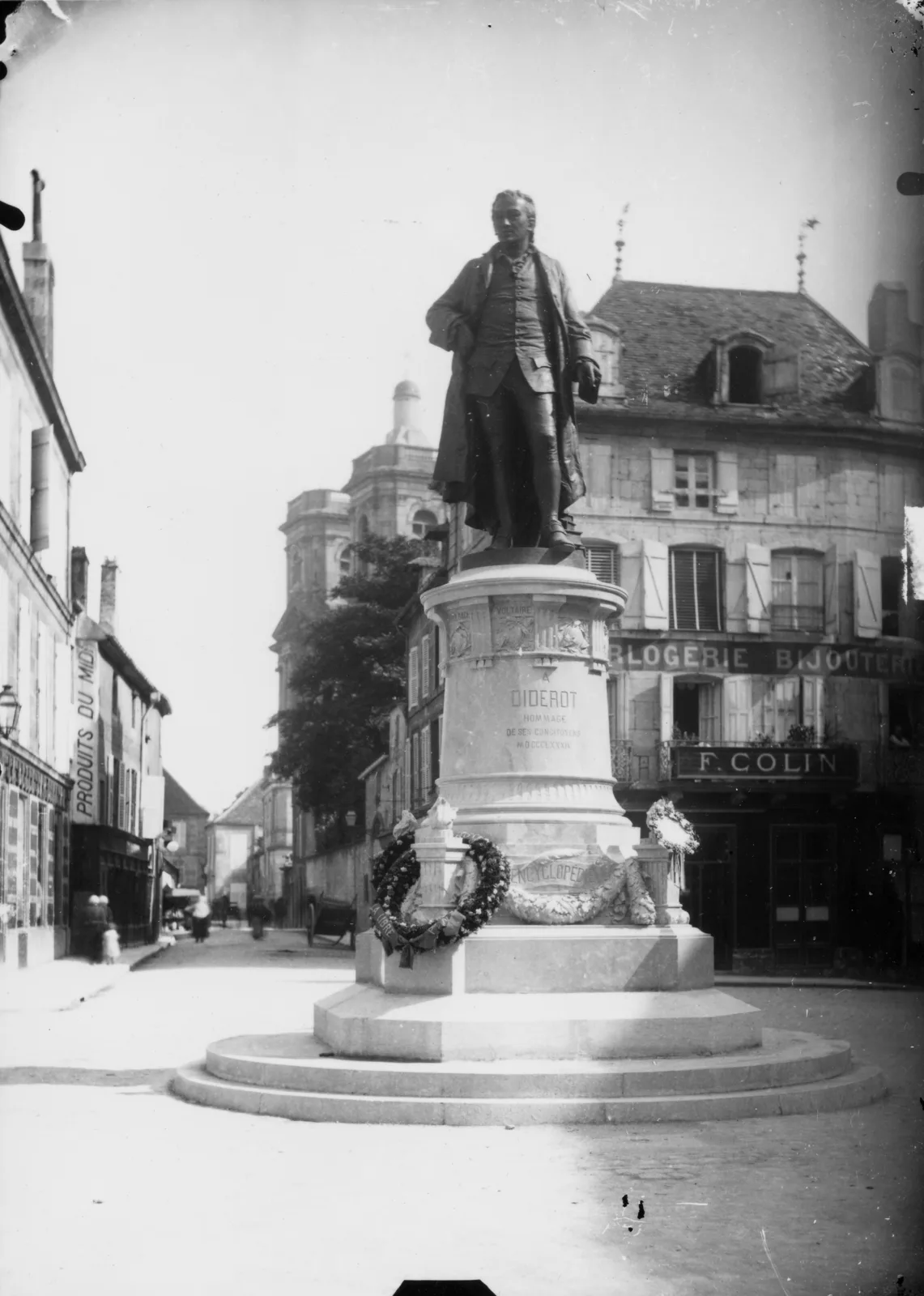
The Jesuits wanted him, and he agreed to slip away to Paris to join them. His father heard of it and stopped him at midnight; instead of the Jesuits he took the boy to Paris himself and put him in the Collège d'Harcourt to study logic, philosophy and physics in preparation for theology.1112 His disciple Naigeon, who wanted him an atheist from the start, said that in Paris mathematics, "whose inexorable precision pleased him greatly," soon inspired in him "disgust and even contempt for theology," and that he put off the clerical dress he had worn for years.1314 Naigeon was writing decades later and was a partisan; but the boy did not become a priest.
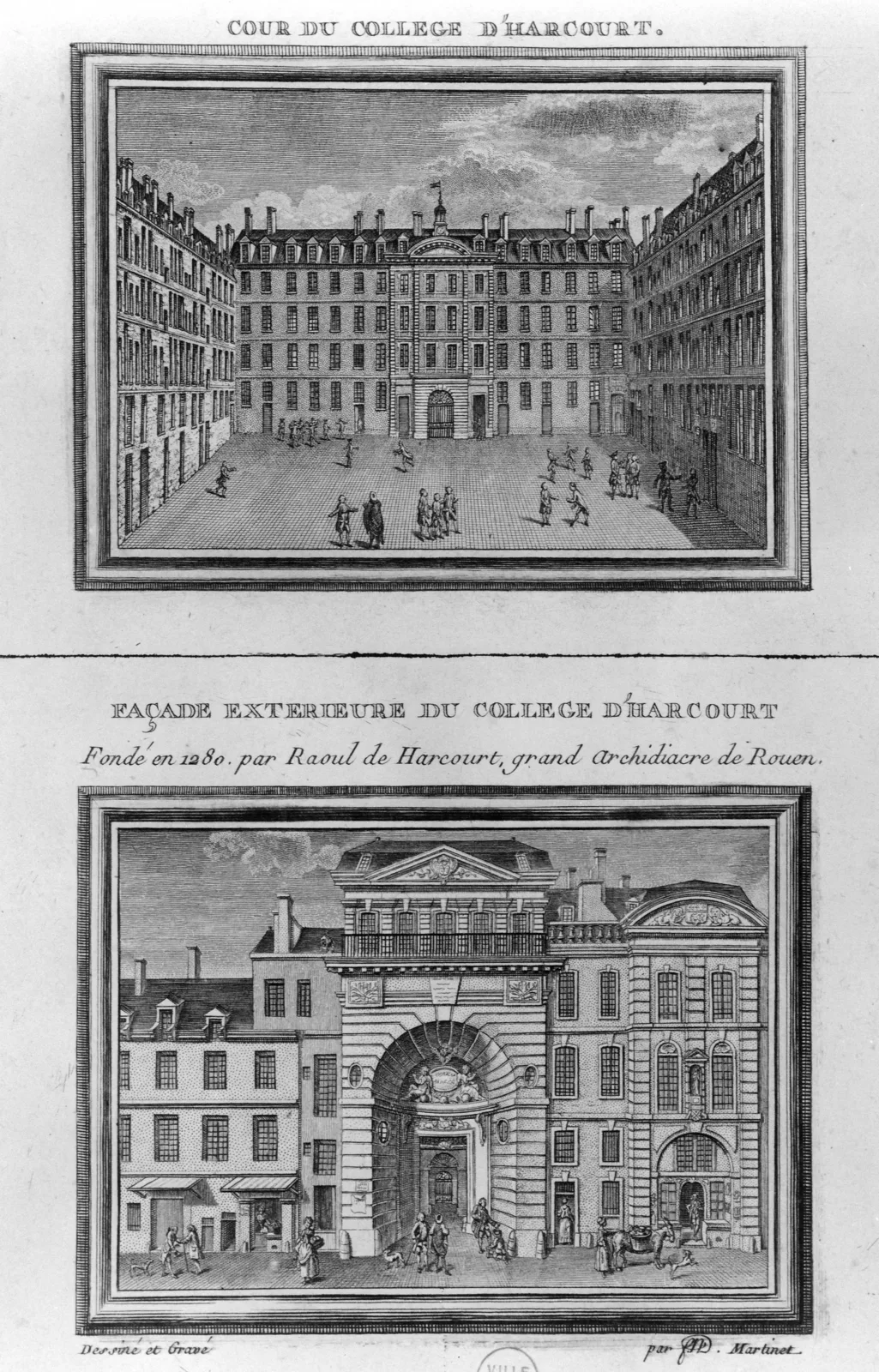
His father then put him with an attorney to learn the law. Two years later, asked what he wanted to be, he answered, as his daughter told it: "Truly, nothing, nothing at all. I love study; I am very happy, very content; I ask for nothing else."1516 His father cut off his money, and for ten years he lived on his wits, teaching mathematics and, by his daughter's account, writing six sermons for a missionary at fifty écus each.17 He married a pious lace-seller's daughter, Anne-Toinette Champion, at midnight in 1743, against his father's wishes.1819
The deist
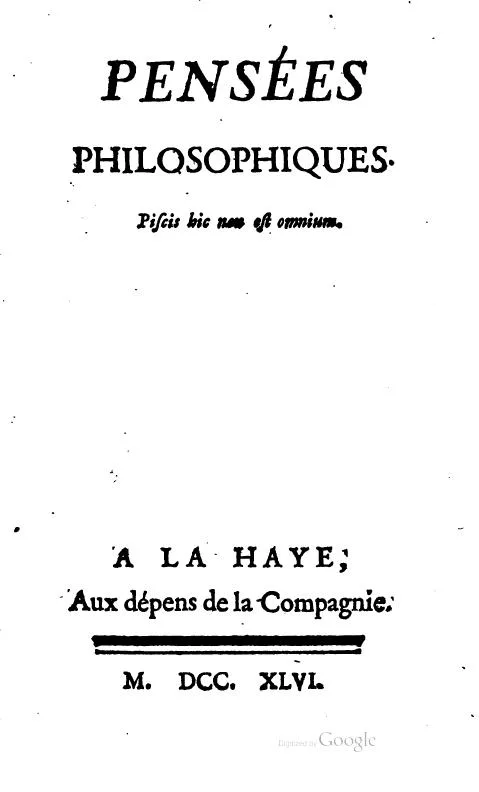
The first ideas he made public were a deist's. In 1745 he translated the English philosopher Shaftesbury's Inquiry concerning Virtue and Merit, with notes of his own; his modern editors say that in translating it he declared himself a deist, and even Naigeon admitted the notes were "in general more Christian than philosophical," though he called them "a sort of religious fever" that "did not last long."202122 The next spring, between Good Friday and Easter, he wrote the Pensées philosophiques (Philosophic Thoughts) to earn fifty louis for his mistress.23 "I write of God," it begins; "I count on few readers."24
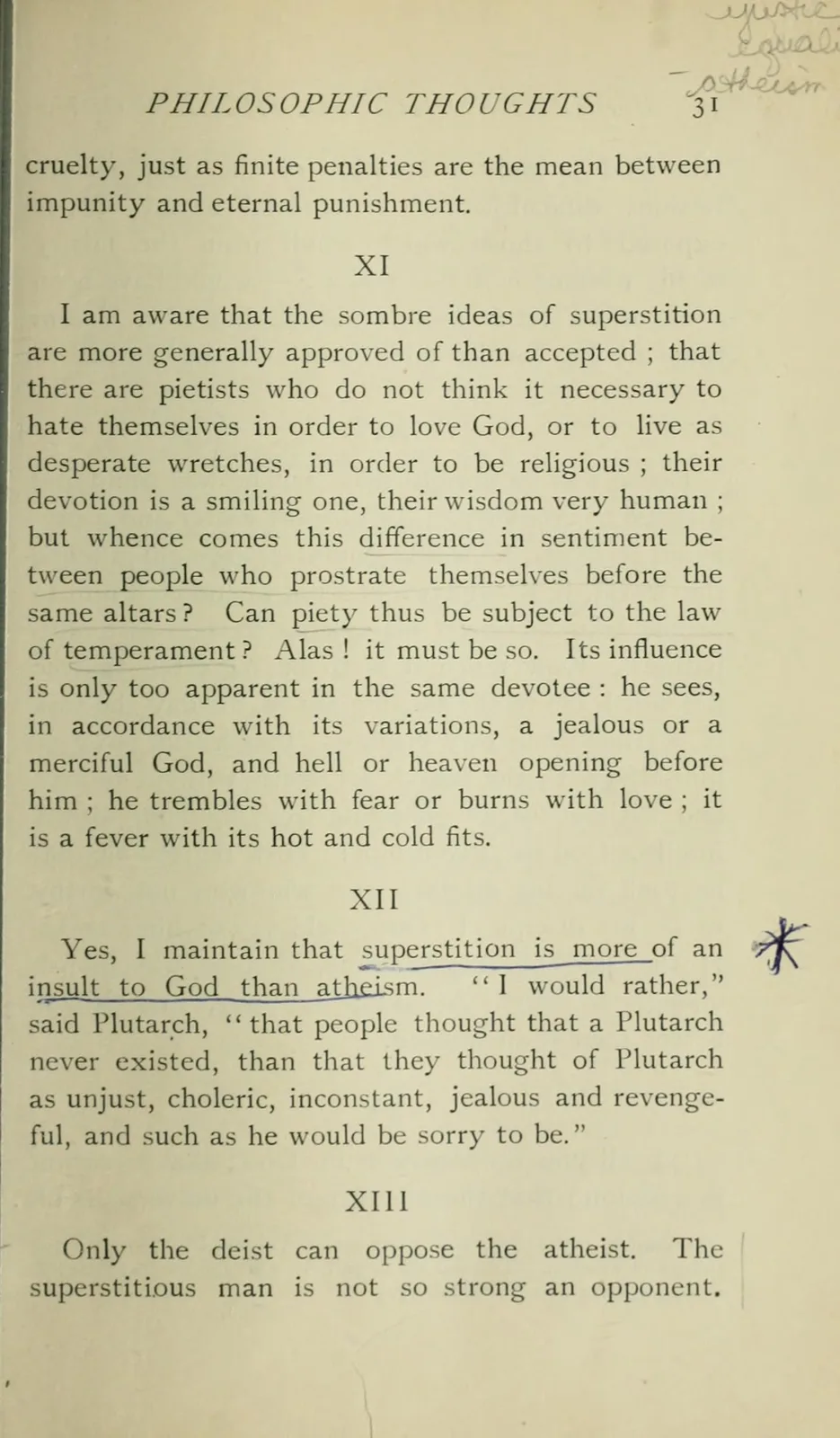
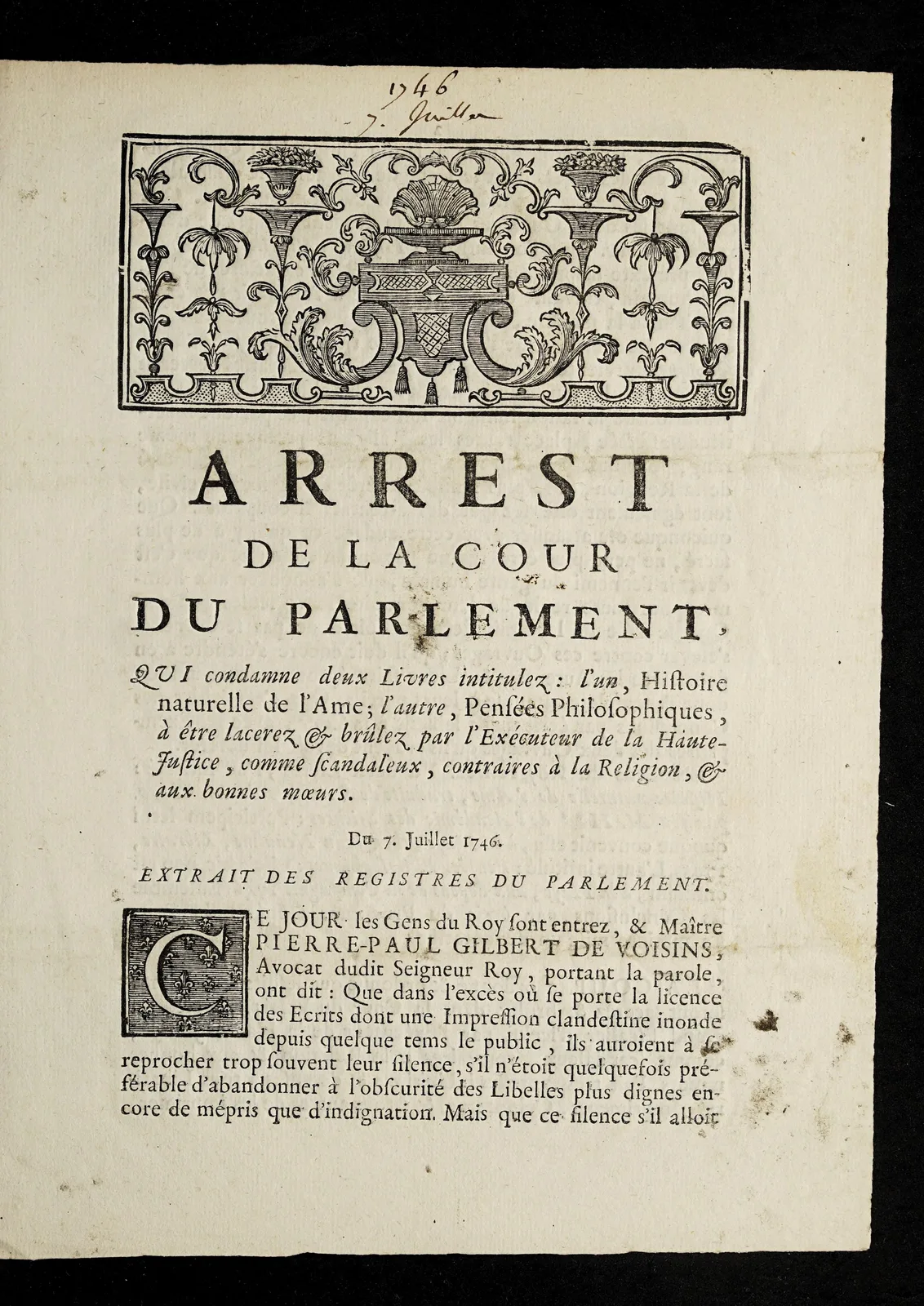
The Pensées argued for God against the atheists, but against the devout as well. "The thought that a God did not exist has never terrified humanity, but the idea that a God such as is represented exists." "Yes, I maintain that superstition is more of an insult to God than atheism."252627 He noticed that devotion followed the body more than the mind: "Can piety thus be subject to the law of temperament? Alas! it must be so."28 And he found God in nature: "Is not the Deity as clearly apparent in the eye of a flesh-worm as in the works of the great Newton?"29 He divided atheists into three kinds: "I detest braggarts; they are dishonest: I pity genuine atheists; all consolation is dead to them: and I pray God for the sceptics; they lack knowledge." And he wrote a sentence he would come back to on his deathbed: "Scepticism is thus the first step towards truth."3031 On 7 July 1746 the Parlement of Paris condemned the little book to be burned.32
The police were already watching. In June 1747 the curé of Saint-Médard reported him as "a young man who plays the wit and glories in impiety," and a police officer named Perrault called him "a very dangerous man, who speaks of the holy mysteries of our religion with contempt," and who said that at the end of his life he would do as the others did, confess and receive "what we call our God."333435 That year he wrote La Promenade du sceptique (The Sceptic's Walk); the police seized the manuscript, and it was not printed until 1830.36
The blind man
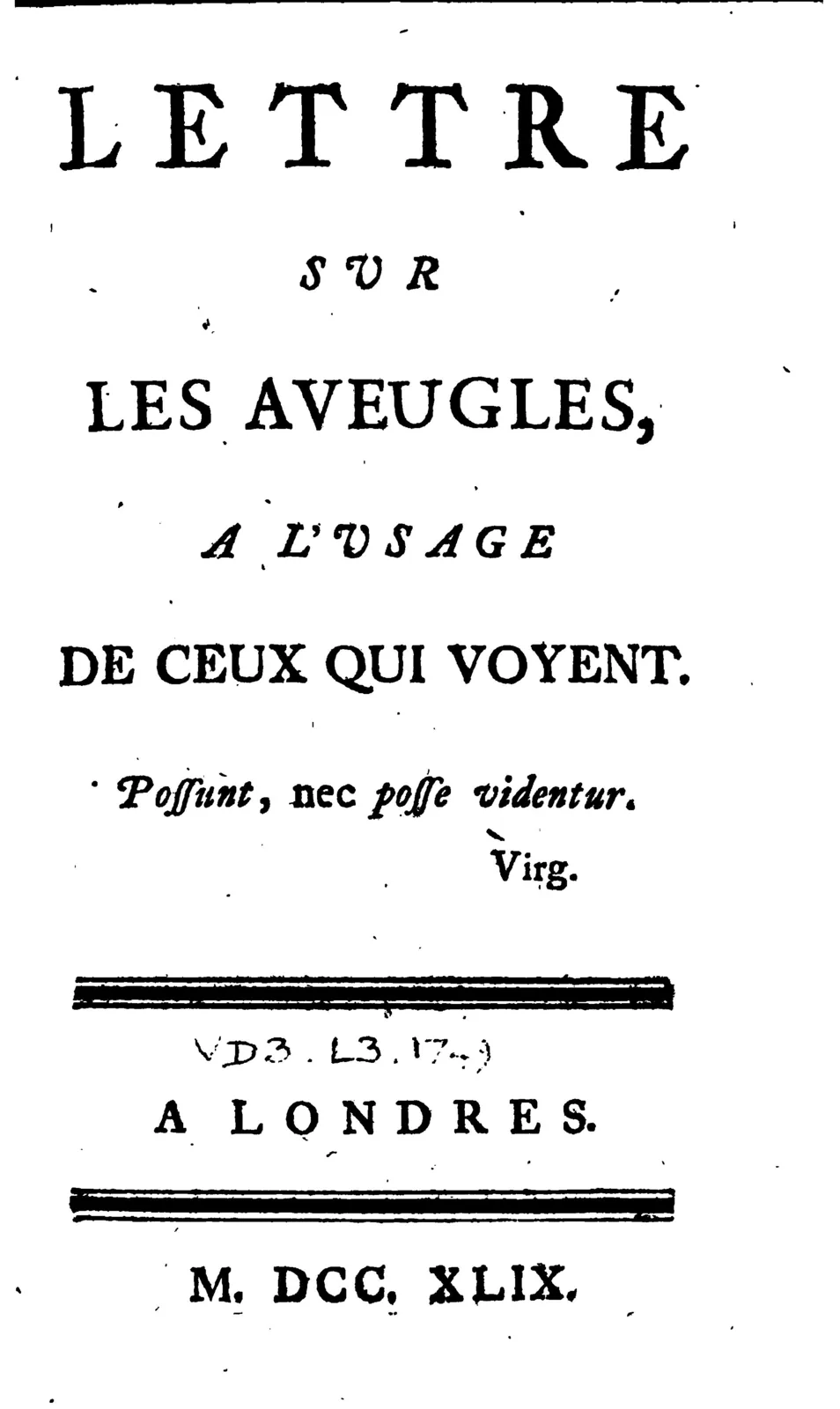
In June 1749 he published the book that changed his position, the Lettre sur les aveugles (Letter on the Blind). Its centre is a scene he invented: the deathbed of the blind Cambridge mathematician Nicholas Saunderson, who died in 1739, arguing with a clergyman named Holmes. The blind man will not accept the argument from design that the Pensées had made. "If you want to make me believe in God you must make me touch Him." "Look at me, Mr Holmes. I have no eyes. What have we done, you and I, to God, that one of us has this organ while the other has not?"373839 He imagines that the world made itself by trial and error, that "the monsters were destroyed one after another," and only the combinations that worked remained.40 And he dies saying, "O thou God of Clarke and Newton, have mercy on me!"41
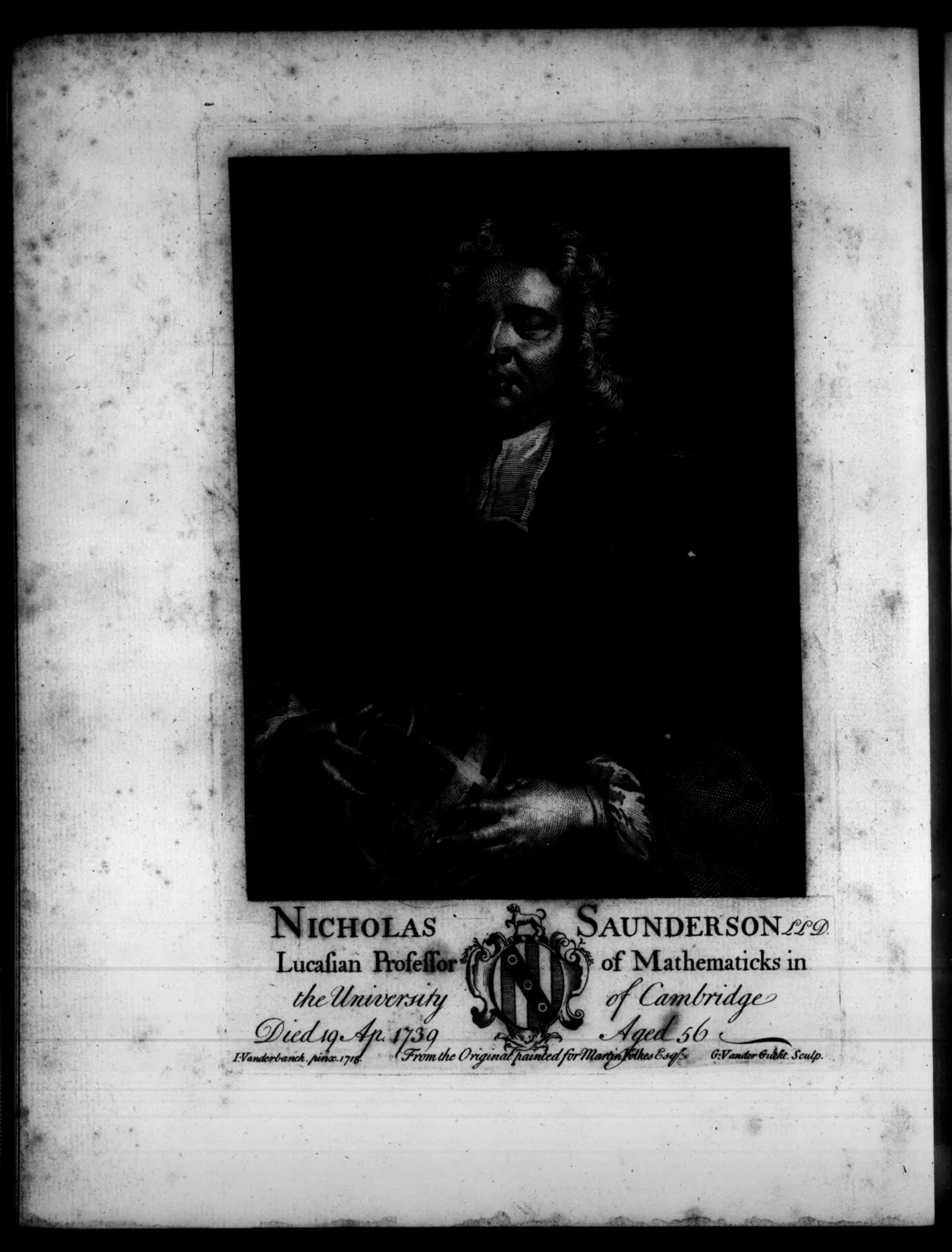
The real Saunderson was a devout Newtonian who, according to the memoir printed with his Algebra, meant to take the sacrament; Diderot had made him a mouthpiece, and a pamphlet signed with the name of Holmes soon gave him a pious deathbed instead.42 Voltaire wrote to Diderot that he did not share the opinion of "Saunderson, who denies a God because he was born blind," and that "it seems to me very bold to deny that he exists."434445
Diderot's reply, on 11 June 1749, is the best evidence we have of where he stood. The blind man's view was not his, he said, perhaps because he could see. "It is usually during the night that the vapours rise that cloud God's existence for me; the sunrise always disperses them." "I believe in God, though I live very well with atheists." And then a sentence that undid the reassurance: "So it is very important not to take hemlock for parsley, but not at all important to believe or not to believe in God."46474849 On the belief timeline, that letter marks his doubt. He still says he believes, but he no longer thinks it matters.
Vincennes
Six weeks later, in the last week of July 1749, he was arrested at his home and taken to the keep of the château of Vincennes. His daughter blamed a careless remark about a minister's mistress; others saw a wider sweep against unbelieving books, and the Marquis d'Argenson wrote that month of arrests for "having written and printed works advocating deism and immorality."505152 On 31 July the lieutenant of police, Berryer, questioned him under oath. He said he was of the Catholic, apostolic and Roman religion. Asked whether he had written the Pensées philosophiques, "answered no." He denied the Lettre as well, but admitted The Sceptic's Walk and said it had been burned.5354 The police note on him reads "full of wit, but extremely dangerous."53
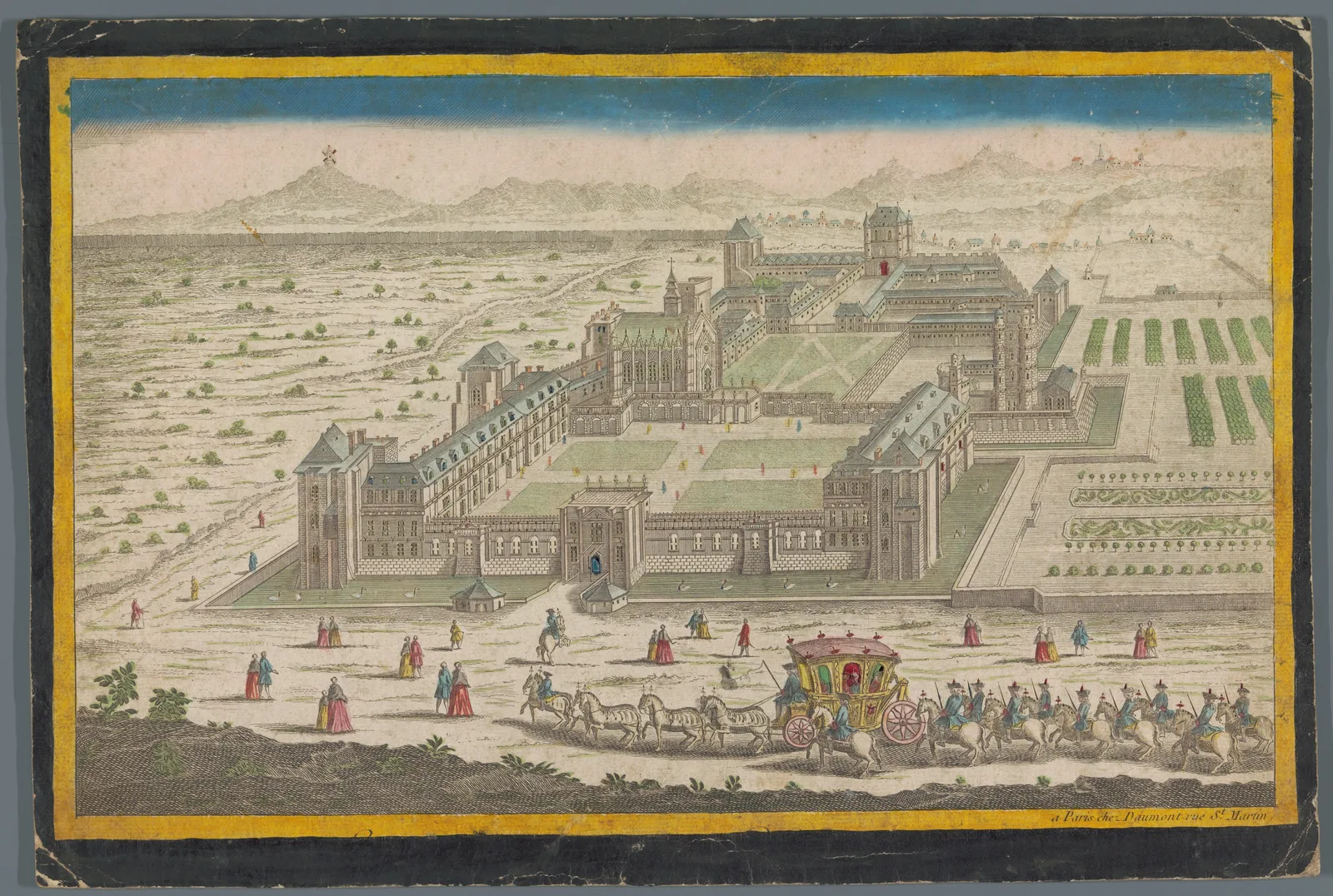
He spent about four weeks in the keep, making ink from slate and wine and a pen from a toothpick and writing in the margins of a Paradise Lost; then he was moved to the château on parole.55 In September he asked to be freed because he was the editor of the Encyclopédie, and promised "to do nothing in future that could be contrary in the slightest to religion and good morals"; the booksellers petitioned for him because the work could not go on without him. He was released after about three months.565758 He never again published his unbelief under his own name. Years later he reproached a correspondent, Landois, who had put him at risk: "You knew that I had a wife and child, that I was marked, that you were putting me at risk of a second offence."5960
The Encyclopédie
The first volume of the Encyclopédie appeared in 1751, and for the next twenty years the work was his life.61 Its aim, he wrote, was that "our grandchildren, becoming more learned, may become at the same time more virtuous and happier; and that we may not die without having deserved well of mankind."6263 The Jesuits attacked it, and in 1752 a royal decree suppressed the first two volumes.6164 In 1754 he published a book on the interpretation of nature which ended, prudently, "Always keep in mind that nature is not God; that a man is not a machine; that a hypothesis is not a fact"; his modern editors call such concessions courtesies advised by prudence.6566
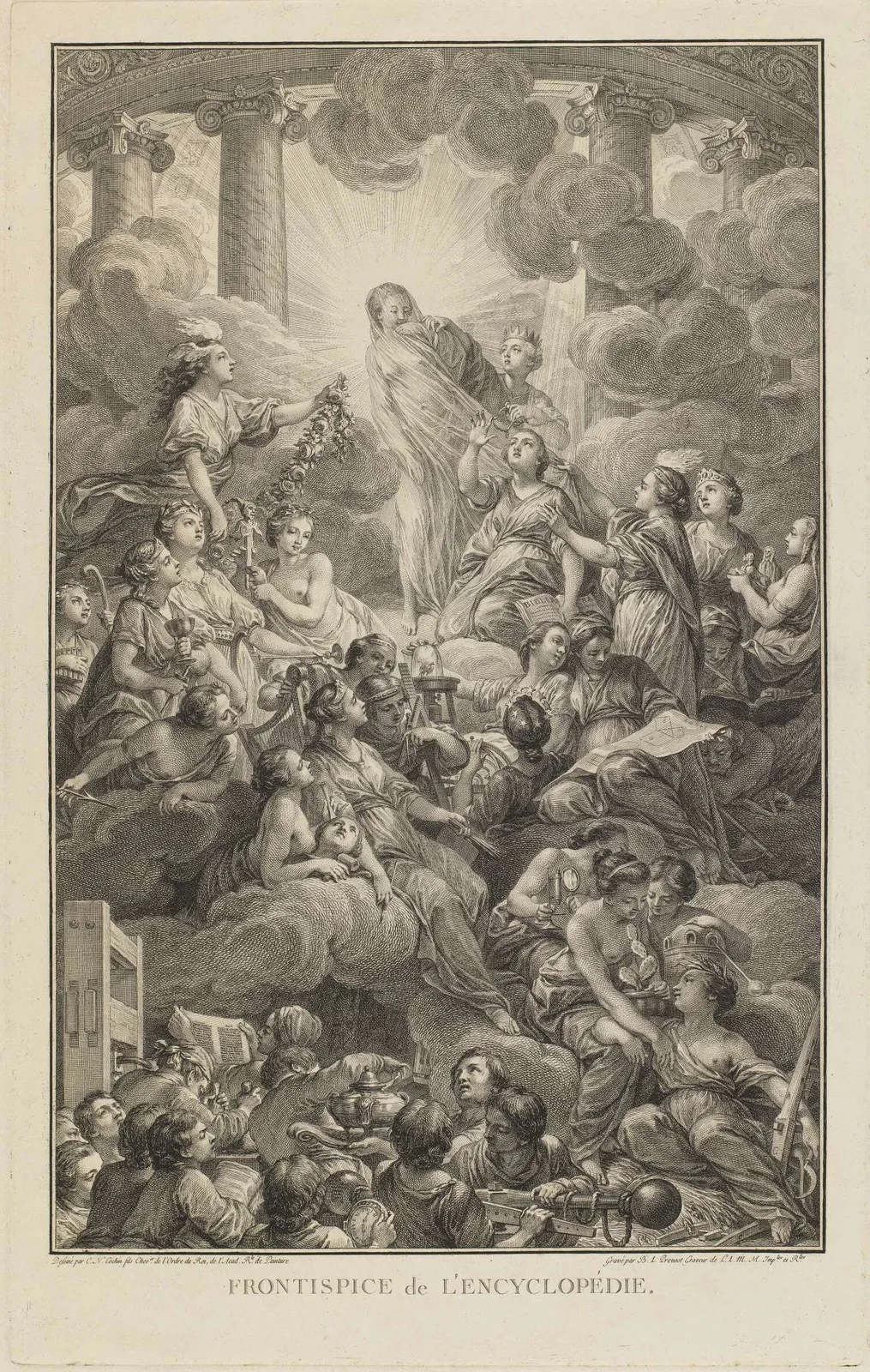
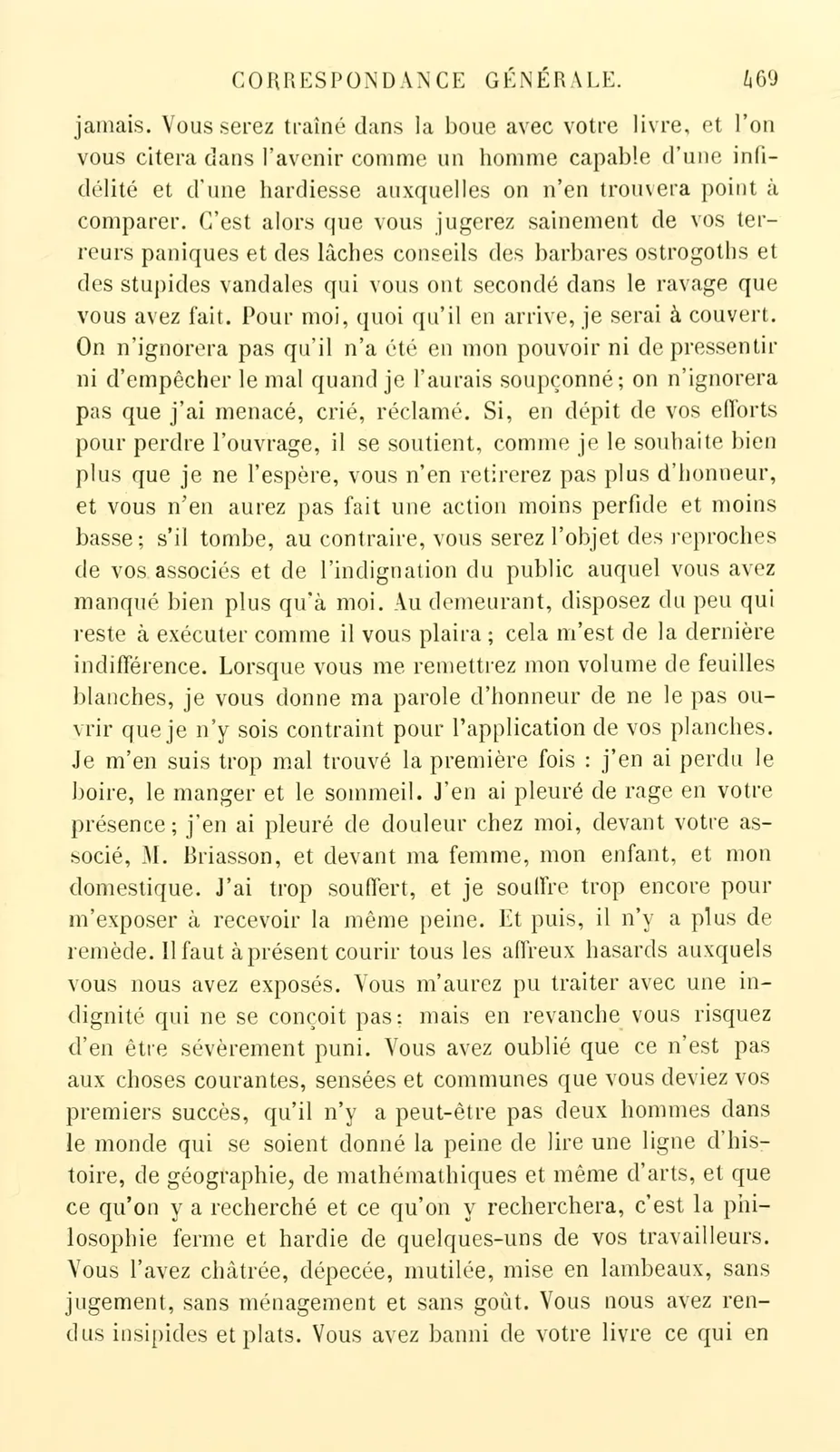
In 1759 the procureur général, Joly de Fleury, told the Parlement of "a project conceived, a society formed to support materialism, to destroy religion, to inspire independence and to feed the corruption of morals," and in March the King's Council revoked the Encyclopédie's privilege, saying that whatever it did for the sciences could "never balance the irreparable harm that results from it for morals and religion."676869 D'Alembert had already left. Diderot carried on in secret, protected by the director of the book trade, Malesherbes, who hid his papers in his own house.7071 The last ten volumes came out in 1765.72 Then he found that his publisher, Le Breton, afraid of the Bastille, had secretly cut the boldest philosophical articles after the final proofs. "You have castrated it, cut it up, mutilated it, torn it to shreds," he wrote, "without judgement, without care and without taste."7374
His family stayed believers. His brother became a canon of Langres and lived, his niece wrote, by the maxim "Outside the Church there is no salvation"; he broke with Diderot "because he was not a Christian." Diderot wrote of him in 1759: "He is a good Christian who proves to me every moment that it would be better to be a good man, and that what they call evangelical perfection is only the baneful art of stifling nature."75767778 One of his sisters, his daughter wrote, would gladly have given her life to destroy his works.79
Matter that feels
In the 1760s he wrote about death without hope of another life. To the sculptor Falconet he said that the esteem of posterity was "the only immortality within the power of a few men; the rest perish like the brute."8081 Standing before a painting of ruins in the Salon of 1767 he wrote: "I walk between two eternities ... I see the marble of the tombs fall to dust; and I do not want to die!"8283
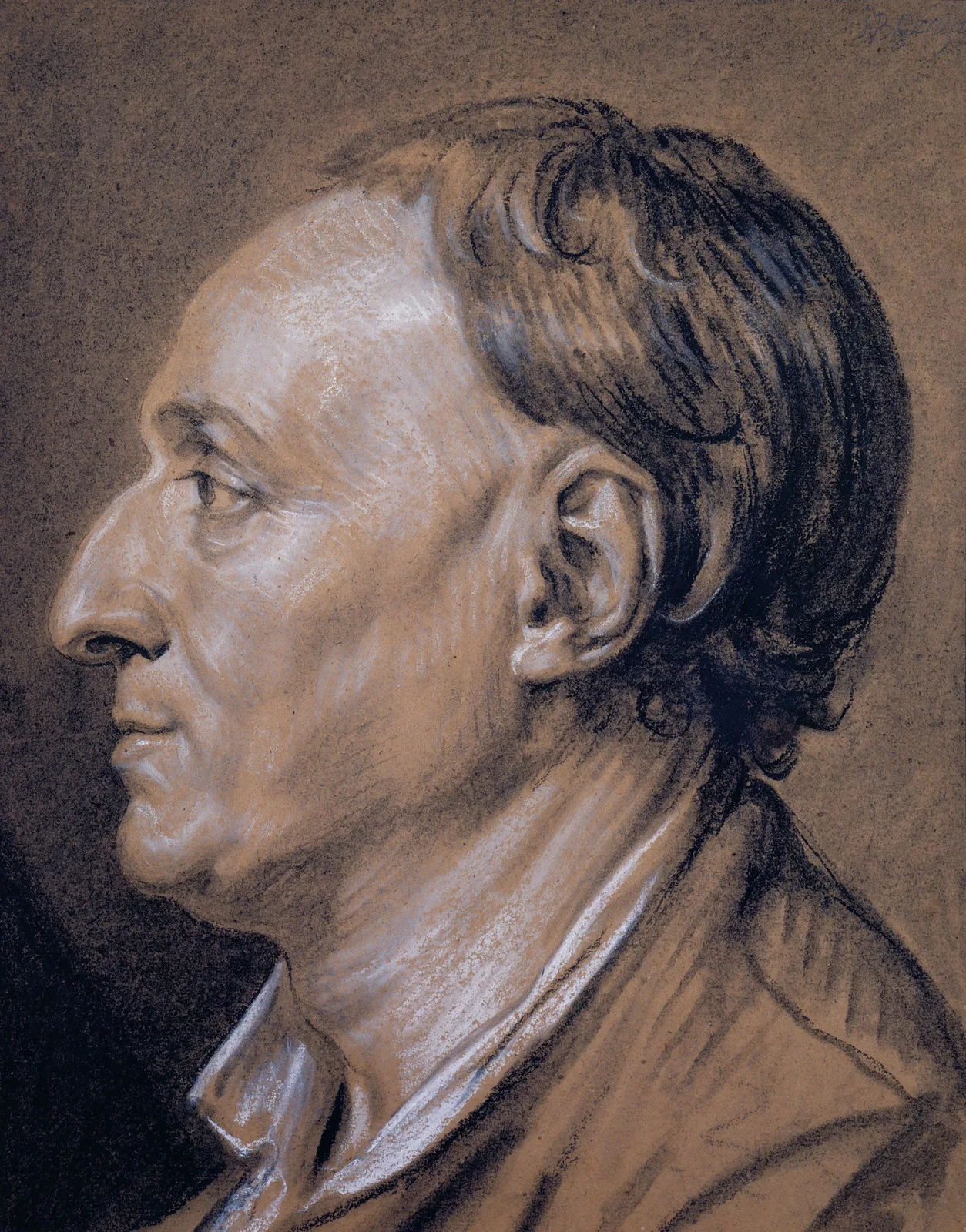
In September 1769 he wrote Le Rêve de d'Alembert, D'Alembert's Dream, a set of dialogues in which matter itself feels and thinks and living things arise without a maker. "It is not possible to be more profound and more mad," he told Sophie Volland, and there was "not a word of religion" in it; he put his ideas in the mouth of a dreamer because "one must often give wisdom the look of folly, to win it admission."848586 What is the difference between a man and a statue? "Very little. We make marble out of flesh, and flesh out of marble."87 His English editor of 1916 thought that here, for the first time, "he figures definitely as a materialist."88 The book was not printed until 1830; d'Alembert asked him to burn it, and it survived in copies.8990 In 1776 a short dialogue between a philosopher and a maréchale circulated, its speaker given the name of an Italian, Crudeli. "And without believing, one behaves much as if one believed." "If a misanthrope had set out to make mankind unhappy, what better could he have invented than belief in an incomprehensible being on whom men could never agree, and to whom they would attach more importance than to their lives?"919293
The last words
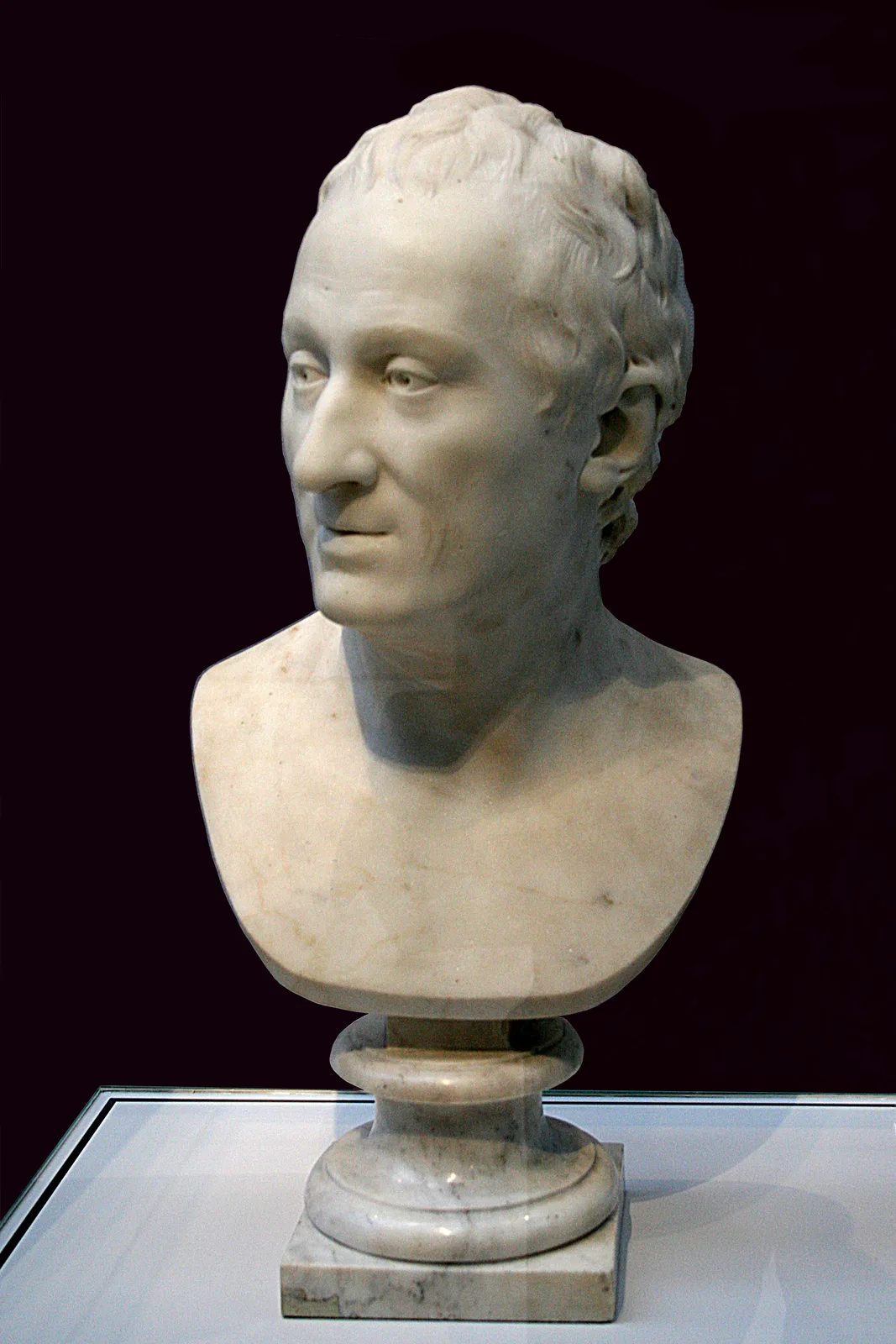
Catherine the Great bought his library in the mid-1760s, left it with him and paid him as its librarian, and in 1773 he travelled to St Petersburg to thank her.9495 In 1780 the town of Langres asked for his portrait, and he sent a bronze bust by Houdon.96 In February 1784 he fell ill, and the visits from Saint-Sulpice began.1 Twelve days before he died he moved to an apartment Catherine had taken for him in the rue de Richelieu.97 The evening before his death his daughter heard him say that "the first step towards philosophy is incredulity"; they were the last words of his she heard.9798 The next day he died at table, after eating an apricot, at the end of July 1784.99 The curé of Saint-Roch sent a priest to sit with the body, and he was buried in the chapel of the Virgin in that church.100
Did his unbelief change shape?
His daughter said she "never saw my father's opinions either vary or change."101 His editors said his philosophy was made by 1749 and never changed after; his English translator saw a deist in 1746, a doubter in 1749 and a materialist by 1769.6588 The record supports the second reading. The young man who argued for God from the eye of a worm gave the argument to a blind man to demolish three years later, and twenty years after that wrote dialogues in which matter needs no maker at all. What did not change was the distance between what he wrote and what he published. Vincennes taught him that he was "marked," and from then on his boldest thoughts went into letters, into the mouths of dreamers and Italians, and into manuscripts kept in a drawer. The one place where he would not dissemble was his deathbed. There, at the end of a lifetime of prudence, he refused to sign a retraction because it would have been a lie, and he said again what the young deist had written in 1746: that doubt is where philosophy begins.
The Baron d'Holbach, at whose table and country house Diderot spent so many evenings, and beside whom he is buried, has his own chapter in this book.
Footnotes
-
Mme de Vandeul (Marie-Angélique Diderot), Mémoires pour servir à l'histoire de la vie et des ouvrages de Diderot, printed in [A-T 1] pp. xxix–lxii. The daughter-witness: she heard her father's stories and saw the last months; she is also his loyal protector (she says her mother would have given her life for his belief, but guarded him from the priest) and she makes mistakes of dates which the editors correct in notes, pp. lv–lvii; John Morley, Diderot and the Encyclopaedists, vol. 2 (London: Chapman and Hall, 1878), p. 276. ↩ ↩2
-
Diderot), Mémoires pour servir à l'histoire…, in A-T 1 p. lvi; Morley, Diderot and the Encyclopaedists, vol. II, p. 276. ↩
-
Jacques-André Naigeon, Mémoires historiques et philosophiques sur la vie et les ouvrages de D. Diderot (the 1821 Brière text), p. 1; Margaret Jourdain (trans. and ed.), Diderot's Early Philosophical Works (Chicago and London: Open Court, 1916): the Philosophic Thoughts (pp. 27–67), Letter on the Blind (pp. 68–141), with her Introduction (pp. 1–26). Published translation of 1916; quoted from here for the Pensées and the Lettre, p. 3; Diderot), Mémoires pour servir à l'histoire…, (A-T 1) p. xxix ("au mois d'octobre 1713"). ↩
-
Diderot), Mémoires pour servir à l'histoire…, p. xxix; marriage record cited in a note, p. xxxix. ↩
-
Diderot), Mémoires pour servir à l'histoire…, p. xxix. ↩
-
Diderot), Mémoires pour servir à l'histoire…, p. xxix ("à douze il fut tonsuré"); Naigeon, Mémoires historiques et philosophiques sur…, p. 3 ("déjà tonsuré"); the date 1726 is from the roster, not found in the texts. Not verified. ↩
-
Mme de Vandeul on her father: Diderot), Mémoires pour servir à l'histoire…, in A-T 1 p. xxix. ↩
-
Diderot), Mémoires pour servir à l'histoire…, p. xxix; Naigeon, Mémoires historiques et philosophiques sur…, p. 2. ↩
-
Diderot), Mémoires pour servir à l'histoire…, p. lx. Accounts differ; see the disputed points. ↩
-
Mme de Vandeul on her father: Diderot), Mémoires pour servir à l'histoire…, in A-T 1 p. lx. ↩
-
Diderot), Mémoires pour servir à l'histoire…, pp. xxx; Naigeon, Mémoires historiques et philosophiques sur…, pp. 3–4; John Morley, Diderot and the Encyclopaedists, vol. 1 (London: Macmillan, 1886 edition), p. 15. ↩
-
Diderot), Mémoires pour servir à l'histoire…, pp. xxx–xxxi; Naigeon, Mémoires historiques et philosophiques sur…, p. 5; Morley, Diderot and the Encyclopaedists, vol. I, p. 15. ↩
-
Naigeon, Mémoires historiques et philosophiques sur…, pp. 5–8. Reported at second hand; the original has not been seen. ↩
-
Naigeon on Diderot's mathematics: Naigeon, Mémoires historiques et philosophiques sur…, (Mémoires, 1821) p. 5. ↩
-
Diderot), Mémoires pour servir à l'histoire…, pp. xxxi–xxxii; Morley, Diderot and the Encyclopaedists, vol. I, p. 16. ↩
-
Diderot), Mémoires pour servir à l'histoire…, in A-T 1 p. xxxii. ↩
-
Diderot), Mémoires pour servir à l'histoire…, pp. xxxii–xxxiv. ↩
-
Diderot), Mémoires pour servir à l'histoire…, pp. xxxvii–xxxviii. ↩
-
Diderot), Mémoires pour servir à l'histoire…, pp. xxxviii–xxxix and note on p. xxxix. ↩
-
Diderot), Mémoires pour servir à l'histoire…, p. xlii; (trans, Diderot's Early Philosophical Works, p. 2; Jules Assézat and Maurice Tourneux (eds.), Œuvres complètes de Diderot, vol. 1 (Paris: Garnier, 1875), Essai, Notice pp. 6–7. ↩
-
Assézat, Œuvres complètes de Diderot, (Essai, Notice) pp. 6–7, quoting Naigeon, Encyclopédie méthodique, Philosophie ancienne et moderne, vol. 2, p. 154. ↩
-
Naigeon on the 1745 Shaftesbury notes: Naigeon, Mémoires historiques et philosophiques sur…, quoted in A-T 1 (Essai, Notice) p. 7. ↩
-
Diderot), Mémoires pour servir à l'histoire…, p. xlii; Assézat, Œuvres complètes de Diderot, p. 125; (trans, Diderot's Early Philosophical Works, pp. 4–5. ↩
-
Assézat, Œuvres complètes de Diderot, p. 127; (trans, Diderot's Early Philosophical Works, p. 27. ↩
-
Assézat, Œuvres complètes de Diderot, pp. 127–141; (trans, Diderot's Early Philosophical Works, pp. 27–46. ↩
-
(trans, Diderot's Early Philosophical Works, p. 30; French in A-T 1 p. 130. ↩
-
(trans, Diderot's Early Philosophical Works, p. 31; Assézat, Œuvres complètes de Diderot, p. 130. ↩
-
(trans, Diderot's Early Philosophical Works, p. 31; Assézat, Œuvres complètes de Diderot, p. 130. ↩
-
(trans, Diderot's Early Philosophical Works, p. 38; Assézat, Œuvres complètes de Diderot, p. 135. ↩
-
(trans, Diderot's Early Philosophical Works, p. 40; Assézat, Œuvres complètes de Diderot, p. 136. ↩
-
(trans, Diderot's Early Philosophical Works, p. 45; Assézat, Œuvres complètes de Diderot, p. 140. ↩
-
Assézat, Œuvres complètes de Diderot, p. 125; (trans, Diderot's Early Philosophical Works, p. 5. ↩
-
Assézat and Tourneux, vol. 20 (1877): Correspondance générale (continued), appendices with the police reports and the Vincennes interrogation (pp. 121–125), pp. 121–122; Morley, Diderot and the Encyclopaedists, vol. I, pp. 109–110. ↩
-
Pierre Hardy, curé of Saint-Médard, report to the lieutenant of police, June 1747: A-T 20, p. 121. ↩
-
Perrault, exempt of the police, 20 June 1747: A-T 20, p. 122; Morley, Diderot and the Encyclopaedists, vol. I, p. 110 (English). ↩
-
Diderot), Mémoires pour servir à l'histoire…, p. xlvi and note; Assézat, Œuvres complètes de Diderot, pp. 173–175; Naigeon, Mémoires historiques et philosophiques sur…, pp. 44–45; (trans, Diderot's Early Philosophical Works, p. 23 n.. ↩
-
Assézat, Œuvres complètes de Diderot, pp. 275–311; (trans, Diderot's Early Philosophical Works, pp. 108–114. ↩
-
Saunderson, in Diderot's Lettre sur les aveugles (1749): Assézat, Œuvres complètes de Diderot, p. 307. ↩
-
Saunderson in the Lettre (Jourdain): (trans, Diderot's Early Philosophical Works, p. 112; Assézat, Œuvres complètes de Diderot, p. 310. ↩
-
Saunderson in the Lettre: Assézat, Œuvres complètes de Diderot, p. 309. ↩
-
Saunderson, last words in the Lettre (Jourdain): (trans, Diderot's Early Philosophical Works, p. 114; French in A-T 1 p. 311. ↩
-
(trans, Diderot's Early Philosophical Works, pp. 15–19; Assézat, Œuvres complètes de Diderot, pp. 277–278. ↩
-
Assézat and Tourneux, vol. 19 (1876): Lettres à Mlle Volland (1760s) and the Correspondance générale (Voltaire 1749, Landois 1756, Le Breton 1764), pp. 419–420 (note); Assézat, Œuvres complètes de Diderot, p. 278. ↩
-
Voltaire to Diderot, June 1749 (a friendly critic and the best-known unbeliever-in-print of the day, himself a deist): A-T 19, pp. 419–420 (note). ↩
-
Voltaire to Diderot, June 1749: A-T 19, p. 420 (note). ↩
-
A-T 19, pp. 419–422. ↩
-
A-T 19, p. 420. ↩
-
A-T 19, p. 422. ↩
-
A-T 19, p. 422. ↩
-
Diderot), Mémoires pour servir à l'histoire…, pp. xliii–xliv; (trans, Diderot's Early Philosophical Works, p. 21; Morley, Diderot and the Encyclopaedists, vol. I, pp. 106–108; Assézat, Œuvres complètes de Diderot, pp. 277–278. ↩
-
(trans, Diderot's Early Philosophical Works, pp. 22–23 (English; French in A-T 1 p. 278 in part). ↩
-
The Marquis d'Argenson, Mémoires, August 1749 (brother of the minister who signed the arrest): (trans, Diderot's Early Philosophical Works, p. 22 (English); Assézat, Œuvres complètes de Diderot, p. 278 (French). ↩
-
A-T 20, pp. 122–124; Morley, Diderot and the Encyclopaedists, vol. I, pp. 108–109. ↩ ↩2
-
Official record of the interrogation, Vincennes, 31 July 1749: A-T 20, p. 123. ↩
-
Diderot), Mémoires pour servir à l'histoire…, p. xliv; Naigeon, Mémoires historiques et philosophiques sur…, pp. 131–132; Assézat, Œuvres complètes de Diderot, p. 277; Morley, Diderot and the Encyclopaedists, vol. I, p. 110. ↩
-
A-T 20, p. 124. ↩
-
Assézat and Tourneux, vol. 13 (1876), the Encyclopédie: the editors' Notice préliminaire (pp. 99–124) with the arrêts of 1759 printed in full, and Diderot's Lettre au P. Berthier, pp. 113–114. ↩
-
A-T 20, p. 124. ↩
-
A-T 19, pp. 433–434. ↩
-
A-T 19, p. 434. ↩
-
A-T 13, pp. 114–115, 165–167; Diderot), Mémoires pour servir à l'histoire…, p. xlii. ↩ ↩2
-
Assézat and Tourneux, vol. 14 (1876), including the article ENCYCLOPÉDIE, p. 416. ↩
-
A-T 14, p. 416. ↩
-
A-T 13, p. 116; Morley, Diderot and the Encyclopaedists, vol. I, pp. 142–145. ↩
-
A-T 2, p. 7. ↩
-
A-T 13, pp. 117–120. ↩
-
Joly de Fleury, procureur général, to the Parlement, 23 January 1759 (as quoted by the A-T editors): A-T 13, pp. 117–118. ↩
-
Arrêt du Conseil d'État du roi, 8 March 1759, revoking the Encyclopédie's privilège: A-T 13, p. 119. ↩
-
Diderot), Mémoires pour servir à l'histoire…, pp. xlv–xlvi; A-T 13, pp. 120–121; (trans, Diderot's Early Philosophical Works, p. 3. ↩
-
A-T 13, pp. 121–122; Diderot), Mémoires pour servir à l'histoire…, p. xlv. ↩
-
A-T 13, p. 122 and note. ↩
-
A-T 19, pp. 467–472; Diderot), Mémoires pour servir à l'histoire…, p. xlv; A-T 13, p. 124. ↩
-
A-T 19, p. 469. ↩
-
Diderot), Mémoires pour servir à l'histoire…, pp. lviii–lix. ↩
-
Assézat and Tourneux, vol. 18 (1876): Lettres à Mlle Volland (1759 and after) and Lettres à Falconet, pp. 378–379; Morley, Diderot and the Encyclopaedists, vol. I, p. 14. ↩
-
Mme de Vandeul describing Diderot's brother, the canon of Langres: Diderot), Mémoires pour servir à l'histoire…, in A-T 1 pp. lviii–lix. ↩
-
A-T 18, p. 379; Morley, Diderot and the Encyclopaedists, vol. I, p. 14. ↩
-
Diderot), Mémoires pour servir à l'histoire…, p. lviii. ↩
-
A-T 18, pp. 89–91. ↩
-
A-T 18, p. 90. ↩
-
Assézat and Tourneux, vol. 11 (1876), Salons, incl. Salon de 1767, pp. 229–230; Morley, Diderot and the Encyclopaedists, vol. II, p. 278 (English). ↩
-
A-T 11, pp. 229–230. ↩
-
A-T 2, pp. 103–104. ↩
-
A-T 2, p. 103. ↩
-
A-T 2, p. 103. ↩
-
A-T 2, p. 105. ↩
-
A-T 2, p. 104. ↩
-
Assézat, Œuvres complètes de Diderot, p. 174; A-T 2, p. 104. ↩
-
A-T 2, pp. 505–506. ↩
-
"Crudeli" (Diderot), Entretien avec la maréchale (1776): A-T 2, p. 510. ↩
-
"Crudeli" (Diderot), Entretien avec la maréchale: A-T 2, p. 513. ↩
-
Diderot), Mémoires pour servir à l'histoire…, p. lii. ↩
-
Diderot), Mémoires pour servir à l'histoire…, pp. lii–liv; (trans, Diderot's Early Philosophical Works, p. 4. ↩
-
Diderot), Mémoires pour servir à l'histoire…, pp. lix–lx. ↩
-
Diderot), Mémoires pour servir à l'histoire…, p. lvii; Morley, Diderot and the Encyclopaedists, vol. II, p. 277. ↩ ↩2
-
Diderot), Mémoires pour servir à l'histoire…, in A-T 1 p. lvii; Morley, Diderot and the Encyclopaedists, vol. II, p. 277. ↩
-
Diderot), Mémoires pour servir à l'histoire…, pp. lvii–lviii; Morley, Diderot and the Encyclopaedists, vol. II, p. 277; (trans, Diderot's Early Philosophical Works, p. 4. ↩
-
Diderot), Mémoires pour servir à l'histoire…, p. lviii; Morley, Diderot and the Encyclopaedists, vol. II, p. 278. ↩
-
Mme de Vandeul on her father: Diderot), Mémoires pour servir à l'histoire…, in A-T 1 p. lx. ↩
In their own words
Denis, l'aîné de ses enfants, fut destiné à l'état ecclésiastique; un de ses oncles devait lui résigner son canonicat.
Il fut cependant dévot pendant quatre ou cinq mois; dans le temps qu'il faisait ses études et qu'il voulait entrer aux Jésuites, il jeûnait, portait un cilice et couchait sur la paille.
Ma foi, rien, mais rien du tout. J'aime l'étude; je suis fort heureux, fort content; je ne demande pas autre chose.
dont l'inexorable précision lui plut extrêmement, et lui inspira bientôt du dégoût et même du mépris pour la théologie
Ce moment de ferveur ou plutôt cette espèce de fièvre religieuse ne dura pas longtemps.
J'écris de Dieu; je compte sur peu de lecteurs, et n'aspire qu'à quelques suffrages.
The thought that a God did not exist has never terrified humanity, but the idea that a God such as is represented exists.
Can piety thus be subject to the law of temperament? Alas! it must be so.
Yes, I maintain that superstition is more of an insult to God than atheism.
It is only in religion that we take no account of his capacity.
Is not the Deity as clearly apparent in the eye of a flesh-worm as in the works of the great Newton?
I detest braggarts; they are dishonest: I pity genuine atheists; all consolation is dead to them: and I pray God for the sceptics; they lack knowledge.
Scepticism is thus the first step towards truth.
C'est ordinairement pendant la nuit que s'élèvent les vapeurs qui obscurcissent en moi l'existence de Dieu; le lever du soleil les dissipe toujours
Je crois en Dieu, quoique je vive très-bien avec les athées.
Il est donc très-important de ne pas prendre de la ciguë pour du persil, mais nullement de croire ou de ne pas croire en Dieu
Si vous voulez que je croie en Dieu, il faut que vous me le fassiez toucher.
Look at me, Mr Holmes. I have no eyes. What have we done, you and I, to God, that one of us has this organ while the other has not?
que les monstres se sont anéantis successivement; que toutes les combinaisons vicieuses de la matière ont disparu, et qu'il n'est resté que celles où le mécanisme n'impliquait aucune contradiction importante
O thou God of Clarke and Newton, have mercy on me!
Aie toujours présent à l'esprit que la nature n'est pas Dieu; qu'un homme n'est pas une machine; qu'une hypothèse n'est pas un fait
Vous n'ignoriez pas que j'avais femme et enfant, que j'étais noté, que vous me mettiez dans le cas des récidives
Vous l'avez châtrée, dépecée, mutilée, mise en lambeaux, sans jugement, sans ménagement et sans goût.
afin que nos neveux, devenant plus instruits, deviennent en même temps plus vertueux et plus heureux; et que nous ne mourions pas sans avoir bien mérité du genre humain
Cette espèce d'immortalité est la seule qui soit au pouvoir de quelques hommes, les autres périssent comme la brute.
Je vois le marbre des tombeaux tomber en poussière; et je ne veux pas mourir!
Il n'est pas possible d'être plus profond et plus fou.
il faut souvent donner à la sagesse l'air de la folie, afin de lui procurer ses entrées
Assez peu. On fait du marbre avec de la chair, et de la chair avec du marbre.
Et sans croire, on se conduit à peu près comme si l'on croyait.
si un misanthrope s'était proposé de faire le malheur du genre humain, qu'aurait-il pu inventer de mieux que la croyance en un être incompréhensible sur lequel les hommes n'auraient jamais pu s'entendre, et auquel ils auraient attaché plus d'importance qu'à leur vie
Je le crois, monsieur le curé, mais convenez que je ferais un impudent mensonge.
le premier pas, dit-il, vers la philosophie, c'est l'incrédulité
Je n'ai jamais vu les opinions de mon père ni varier, ni s'altérer
Interrogé s'il n'a pas composé un ouvrage, qui a paru il y a plusieurs années, intitulé : Pensées philosophiques : A répondu que non.
Promet de ne rien faire à l'avenir qui puisse être contraire en la moindre chose à la religion et aux bonnes mœurs.
C'est un bon chrétien qui me prouve à tout moment qu'il vaudrait mieux être un bon homme, et que ce qu'ils appellent la perfection évangélique n'est que l'art funeste d'étouffer la nature
The other side
est un jeune homme qui fait le bel esprit et trophée d'impiété. Il est l'auteur de plusieurs livres de philosophie, où il attaque la religion.
C'est un homme très-dangereux, et qui parle des saints mystères de notre religion avec mépris ; qui corrompt les mœurs et qui dit que, lorsqu'il viendra au dernier moment de sa vie, faudra bien qu'il fasse comme les autres, qu'il se confessera et qu'il recevra ce que nous apelons notre Dieu
Mais je vous avoue que je ne suis point du tout de l'avis de Saunderson, qui nie un Dieu parce qu'il est né aveugle.
il me paraît bien hardi de nier qu'il est
of having written and printed works advocating deism and immorality
que l'avantage qu'on peut retirer d'un ouvrage de ce genre, pour le progrès des sciences et des arts, ne peut jamais balancer le tort irréparable qui en résulte pour les mœurs et la religion
un projet conçu, une société formée pour soutenir le matérialisme, pour détruire la religion, pour inspirer l'indépendance et nourrir la corruption des mœurs
I wish I could say judicious.
il mit à la rigueur cette maxime de l'Apôtre : Hors l'Église point de salut. Il s'est brouillé avec mon père parce qu'il n'était pas chrétien
Where accounts differ
| Point | One account | Another | How the page handles it |
|---|---|---|---|
| Date of the arrest | 24 July 1749, 9 a.m., commissaire Rochebrune (Vandeul p. xliii; Jourdain p. 21) | 29 July 1749 (Naigeon p. 131 note; A-T 1 p. 277); the interrogation is dated 31 July (A-T 20 p. 123) | Say "in the last week of July 1749" or "on 24 July, according to his daughter" |
| Why he was arrested | A remark about Mme Dupré de Saint-Maur and her eyes (Vandeul p. xliii) | A wider police sweep against deism (d'Argenson note, Jourdain pp. 22–23); Morley I p. 107: "a casual sneer ... at the mistress of a minister" while "the atheistical substance of the essay" would have justified prosecution | Give the daughter's anecdote and the larger cause; both fit |
| Length of imprisonment | "Trois mois" in all, 28 days in the donjon (Vandeul p. xliv) | "Trois mois et dix jours", 29 days in the donjon (Naigeon pp. 131–132); "cent jours" (A-T 1 p. 277) | "About three months"; release date not confirmed in the texts (roster says November) |
| Death date | Saturday 30 July 1784 (Vandeul p. lvii; Morley II p. 277; Jourdain p. 4) | 31 July is the Saturday (calendar check: 30 July 1784 was a Friday); the roster says 31 July | Say "at the end of July 1784"; settle the date from a parish register before a card shows it |
| Age at tonsure and the Paris school | Tonsured at twelve; Collège d'Harcourt (Vandeul p. xxix–xxx; Naigeon p. 5; Morley I p. 15) | The roster has tonsure at 13 in 1726, and "Louis-le-Grand/Harcourt, accounts differ"; no text read supports Louis-le-Grand | Use "tonsured as a boy of twelve" and "a Paris college"; do not name Louis-le-Grand |
| When he became a materialist | The A-T editors: after the Lettre sur les aveugles "la philosophie de Diderot était faite"; later deism is prudence (A-T 2 p. 6) | Jourdain: not fully materialist in 1754, "definitely a materialist" in the Rêve of 1769 (p. 4); Vandeul: opinions never varied (p. lx); Naigeon: the 1745 fervour was a passing fever | The thesis choice. Safest: deist in 1746, doubting in 1749 (letter to Voltaire), writing materialism by 1769, never printing it under his name |
| Why d'Alembert left | Money: he kept demanding more (Vandeul pp. xlv–xlvi) | Fear of persecution in a country where the work could not be finished (letter to Voltaire, 28 Jan 1758, A-T 13 pp. 120–121); "worn out with affronts" (Jourdain p. 3) | Give both, or omit |
| Date Catherine bought his library | "Je crois, en 1763" (Vandeul p. lii) | About 1765 (Meister; A-T note, A-T 19 p. 156 n.; Vandeul's editors) | "In the mid-1760s" |
| Saunderson's deathbed | Diderot's long atheist speech and "Ô Dieu de Clarke et de Newton" (A-T 1 pp. 307–311) | The real man planned to take the sacrament; the Holmes pamphlet gives a pious speech (Jourdain pp. 17–19) | Say plainly that Diderot made up the speech for a real man and that believers answered it |
| Did Diderot destroy the Rêve? | Naigeon: he burned it at d'Alembert's demand (A-T 2 p. 104) | He wrote that he had gathered the fragments back into a "statue brisée"; copies survived and it was printed in 1830 (A-T 2 p. 104) | "He threatened it with the fire; it survived in copies" |
List of illustrations
This page uses only public-domain and Creative Commons images; each is credited with its source and licence.
- Louis-Michel van Loo, Portrait of Denis Diderot, 1767 — Louis-Michel van Loo, 1767 · Louis-Michel van Loo, Louis-Michel van Loo, Portrait of Denis Diderot, 1767; via Wikimedia Commons (Public domain) · Public domain (as stated on the Wikimedia Commons file page)
- The Diderot statue by Bartholdi, place Diderot, Langres, photographed in 1885 — Victor Petit, 1885 · Victor Petit, The Diderot statue by Bartholdi, place Diderot, Langres, photographed in 1885; via Wikimedia Commons (Public domain) · Public domain (as stated on the Wikimedia Commons file page)
- Cour du college d'Harcourt et Facade exterieure du college d'Harcourt (engraving, 1789) — Francois-Nicolas Martinet, En 1789 · Francois-Nicolas Martinet, Cour du college d'Harcourt et Facade exterieure du college d'Harcourt (engraving, 1789); via Wikimedia Commons (CC0) · CC0 (as stated on the Wikimedia Commons file page)
- Pensees philosophiques, A La Haye, 1746, title page — Denis Diderot, 1746 · Pensees philosophiques, A La Haye, 1746, title page, A La Haye: Aux depens de la Compagnie, 1746 (Google scan, Taylor Institution, Oxford); Internet Archive (pensesphilosoph01didegoog) · Public domain (published 1746; Internet Archive scan, leaf 10)
- Diderot's Early Philosophical Works (Jourdain), p. 31: Philosophic Thoughts XI-XII — Denis Diderot, tr. Margaret Jourdain, 1916 · Diderot's Early Philosophical Works (Jourdain), p. 31: Philosophic Thoughts XI-XII, Open Court, 1916; Internet Archive (earlyphilosophic00dide) · Public domain (published 1916; Internet Archive scan, leaf 37)
- Arrest de la cour du Parlement, qui condamne deux livres intitulez: l'un, Histoire naturelle de l'ame; l'autre, Pensees philosophiques (leaf 1) — Parlement de Paris; printed by Pierre-Guillaume Simon, 1746 · Arrest de la cour du Parlement ... Pensees philosophiques, Paris: P.-G. Simon, 1746; Internet Archive (arrestdelacour00fran_2) · Public domain (printed 1746; Internet Archive scan)
- Lettre sur les aveugles a l'usage de ceux qui voyent, Londres, 1749, title page — Denis Diderot, 1749 · Lettre sur les aveugles a l'usage de ceux qui voyent, Londres, 1749, title page, A Londres, 1749 (Google scan, Taylor Institution, Oxford); Internet Archive (lettresurlesave00didegoog) · Public domain (published 1749; Internet Archive scan, leaf 9)
- Nicholas Saunderson, frontispiece to The Elements of Algebra (1740) — Engraver not read from the plate, 1740 · Nicholas Saunderson, frontispiece to The Elements of Algebra (1740), Cambridge: University Press, 1740 (British Library copy via Internet Archive); Internet Archive (bim_eighteenth-century_the-elements-of-algebra-_saunderson-nicholas_1740_1) · Public domain (published 1740; Internet Archive scan, leaf 0)
- Jules Assezat and Maurice Tourneux (eds.), Oeuvres completes de Diderot, vol. 19, p. 422 — Denis Diderot (text); Assezat and Tourneux (eds.), 1876 · Jules Assezat and Maurice Tourneux (eds.), Oeuvres completes de Diderot, vol. 19, p. 422, Paris: Garnier, 1876; Internet Archive (oeuvrescomplte19dide) · Public domain (published 1876; Internet Archive scan, leaf 438)
- Gezicht op het Chateau de Vincennes (optical print), RP-P-1921-674 — Unknown (Rijksmuseum), between 1745 and 1775 · Unknown (Rijksmuseum), Gezicht op het Chateau de Vincennes (optical print), RP-P-1921-674; via Wikimedia Commons (CC0) · CC0 (as stated on the Wikimedia Commons file page)
- Jules Assezat and Maurice Tourneux (eds.), Oeuvres completes de Diderot, vol. 20, p. 123 — Denis Diderot (text); Assezat and Tourneux (eds.), 1877 · Jules Assezat and Maurice Tourneux (eds.), Oeuvres completes de Diderot, vol. 20, p. 123, Paris: Garnier, 1877; Internet Archive (oeuvrescomplte20dide) · Public domain (published 1877; Internet Archive scan, leaf 135)
- Encyclopedie, frontispiece (Cochin, engraved by Prevost) — Charles-Nicolas Cochin and Benoit-Louis Prevost, 1764 (pinx) & 1772 (sculp · Charles-Nicolas Cochin and Benoit-Louis Prevost, Encyclopedie, frontispiece (Cochin, engraved by Prevost); via Wikimedia Commons (Public domain) · Public domain (as stated on the Wikimedia Commons file page)
- Jules Assezat and Maurice Tourneux (eds.), Oeuvres completes de Diderot, vol. 19, p. 469 — Denis Diderot (text); Assezat and Tourneux (eds.), 1876 · Jules Assezat and Maurice Tourneux (eds.), Oeuvres completes de Diderot, vol. 19, p. 469, Paris: Garnier, 1876; Internet Archive (oeuvrescomplte19dide) · Public domain (published 1876; Internet Archive scan, leaf 485)
- Portrait of Denis Diderot, black and white chalk drawing — Jean-Baptiste Greuze, 1766 · Jean-Baptiste Greuze, Portrait of Denis Diderot, black and white chalk drawing; via Wikimedia Commons (Public domain) · Public domain (as stated on the Wikimedia Commons file page)
- Entretien d'Alembert et Diderot / Reve de d'Alembert / Suite de l'entretien (title page) — Denis Diderot, ed. Gilbert Maire, 1921 · Entretien d'Alembert et Diderot / Reve de d'Alembert / Suite de l'entretien (title page), Paris, 1921 (La Collection des Chefs-d'oeuvre meconnus); Internet Archive (entretienentreda00dideuoft) · Public domain (published 1921; Internet Archive scan, leaf 7)
- Denis Diderot, marble bust, Louvre RF 1520 — Jean-Antoine Houdon, 2013-05-12 · Jean-Antoine Houdon, Denis Diderot, marble bust, Louvre RF 1520; via Wikimedia Commons (CC BY 4.0) · CC BY 4.0 (as stated on the Wikimedia Commons file page)
- Jules Assezat and Maurice Tourneux (eds.), Oeuvres completes de Diderot, vol. 1, p. lvii (Vandeul, Memoires) — Mme de Vandeul, in Assezat and Tourneux, 1875 · Jules Assezat and Maurice Tourneux (eds.), Oeuvres completes de Diderot, vol. 1, p. lvii (Vandeul, Memoires), Paris: Garnier, 1875; Internet Archive (oeuvrescomplte01dide) · Public domain (published 1875; Internet Archive scan, leaf 59)
Sources
Tier 1 — the subject's own words (writings, letters, diaries, trial records)
- [A-T 1] Jules Assézat and Maurice Tourneux (eds.), Œuvres complètes de Diderot, vol. 1 (Paris: Garnier, 1875). https://archive.org/details/oeuvrescomplte01dide . Text in research/texts/at01.txt. Contains Mme de Vandeul's Mémoires (pp. xxix–lxii), the Essai sur le mérite et la vertu, the Pensées philosophiques (pp. 125 ff.), La Promenade du sceptique (pp. 173 ff.), the Lettre sur les aveugles (pp. 275 ff.), with the editors' notices. Page numbers are printed ones; the OCR carries them in the running heads.
- [A-T 2] Assézat and Tourneux, vol. 2 (1875). https://archive.org/details/oeuvrescomplte02dide . Text in research/texts/at02.txt. Pensées sur l'interprétation de la nature (pp. 1 ff.), Entretien d'Alembert et Diderot / Le Rêve de d'Alembert (pp. 103 ff.), Entretien d'un philosophe avec la maréchale (pp. 505 ff.).
- [A-T 11] Assézat and Tourneux, vol. 11 (1876), Salons, incl. Salon de 1767. https://archive.org/details/oeuvrescomplte11dide . Text in research/texts/at11.txt.
- [A-T 13] Assézat and Tourneux, vol. 13 (1876), the Encyclopédie: the editors' Notice préliminaire (pp. 99–124) with the arrêts of 1759 printed in full, and Diderot's Lettre au P. Berthier. https://archive.org/details/oeuvrescomplte13dide . Text in research/texts/at13.txt.
- [A-T 14] Assézat and Tourneux, vol. 14 (1876), including the article ENCYCLOPÉDIE. https://archive.org/details/oeuvrescomplte14dide . Text in research/texts/at14.txt.
- [A-T 18] Assézat and Tourneux, vol. 18 (1876): Lettres à Mlle Volland (1759 and after) and Lettres à Falconet. https://archive.org/details/oeuvrescomplte18dide . Text in research/texts/at18.txt.
- [A-T 19] Assézat and Tourneux, vol. 19 (1876): Lettres à Mlle Volland (1760s) and the Correspondance générale (Voltaire 1749, Landois 1756, Le Breton 1764). https://archive.org/details/oeuvrescomplte19dide . Text in research/texts/at19.txt.
- [A-T 20] Assézat and Tourneux, vol. 20 (1877): Correspondance générale (continued), appendices with the police reports and the Vincennes interrogation (pp. 121–125). https://archive.org/details/oeuvrescomplte20dide . Text in research/texts/at20.txt.
- [Jourdain] Margaret Jourdain (trans. and ed.), Diderot's Early Philosophical Works (Chicago and London: Open Court, 1916): the Philosophic Thoughts (pp. 27–67), Letter on the Blind (pp. 68–141), with her Introduction (pp. 1–26). Published translation of 1916; quoted from here for the Pensées and the Lettre. https://archive.org/details/earlyphilosophic00dide . Text in research/texts/jourdain1916.txt.
- [Vandeul] Mme de Vandeul (Marie-Angélique Diderot), Mémoires pour servir à l'histoire de la vie et des ouvrages de Diderot, printed in [A-T 1] pp. xxix–lxii. The daughter-witness: she heard her father's stories and saw the last months; she is also his loyal protector (she says her mother would have given her life for his belief, but guarded him from the priest) and she makes mistakes of dates which the editors correct in notes. Written after 1784, first printed 1830 (A-T note).
- [Vincennes records] The police denunciations of 1747, the interrogation of 31 July 1749, and the governor's note on Diderot's petition, printed in [A-T 20] pp. 121–124 from J. Delort's Histoire de la détention des philosophes (the original papers were not seen).
Tier 2 — scholarly biographies and encyclopedias
- [Morley I] John Morley, Diderot and the Encyclopaedists, vol. 1 (London: Macmillan, 1886 edition). https://archive.org/details/diderotencyclopa01morluoft . Text in research/texts/morley1886-v1.txt.
- [Morley II] John Morley, Diderot and the Encyclopaedists, vol. 2 (London: Chapman and Hall, 1878). https://archive.org/details/diderotencyclo02morl . Text in research/texts/morley1878-v2.txt.
- [Naigeon] Jacques-André Naigeon, Mémoires historiques et philosophiques sur la vie et les ouvrages de D. Diderot (the 1821 Brière text). https://archive.org/details/mmoireshistoriq00naiggoog . Text in research/texts/naigeon-memoires.txt. Tier 2 but a partisan: Naigeon was Diderot's disciple and editor and wanted him a thorough atheist from the start (A-T 1 p. 7 notes that others dispute this).
- [Rosenkranz] Karl Rosenkranz, Diderot's Leben und Werke, vol. 1 (Leipzig, 1866). https://archive.org/details/diderotslebenund00roseuoft . Downloaded to research/texts/rosenkranz-v1.txt; not yet mined for claims (German; see Open questions).
Tier 3 — popular biographies and journalism
- (none used)
Tier 4 — maps to other sources only (Wikipedia and similar). Never cited in the script.
- Wikipedia, "Denis Diderot"; "Encyclopédie". Not cited. The roster's tonsure year (1726), master-of-arts year (1732) and release date (3 November 1749) come from the plan and are not confirmed in the texts read.
Opposition sources — contemporary critics and religious responses
- [Hardy and Perrault 1747] Pierre Hardy, curé of Saint-Médard, and the exempt Perrault, reports to the lieutenant of police, June 1747, in [A-T 20] pp. 121–122.
- [Voltaire 1749] Voltaire's letter to Diderot on the Lettre sur les aveugles, June 1749, printed in an editor's note in [A-T 19] pp. 419–420; Diderot's answer on pp. 419–422.
- [Holmes 1749] The pamphlet Lettre de M. Gervase Holmes à l'auteur de la Lettre sur les aveugles (dated 14/25 Dec 1749, attributed to Formey), known only through [Jourdain] pp. 17–19 and [A-T 1] pp. 277–278; no copy seen.
- [d'Argenson] The Marquis d'Argenson's Mémoires, August 1749, as quoted in [Jourdain] pp. 22–23 (English, Jourdain's rendering) and [A-T 1] p. 278 (French).
- [Joly de Fleury 1759] The procureur général's réquisitoire of 23 January 1759 as quoted in [A-T 13] pp. 117–118.
- [Conseil 1759] Arrêt du Conseil d'État of 8 March 1759 revoking the Encyclopédie's privilège, printed in full in [A-T 13] pp. 118–119.
- [Journal de Trévoux; Chaumeix] The Jesuit Journal de Trévoux (attack on the Prospectus, January 1751; Père Berthier) and Abraham Chaumeix, Préjugés légitimes contre l'Encyclopédie (1758): known here only through [A-T 13] pp. 114–115, 121, [A-T 20] and [Morley I]. The primary texts could not be reached (Internet Archive search returns nothing; Google Books and Gallica refused the tool). See Open questions.
Related lives
Baron d'Holbach (roster no. 8), host of the circle Diderot belonged to and the man he refers to as "le Baron" in his letters; the close should say only "has his own episode in this series" (lessons.md).
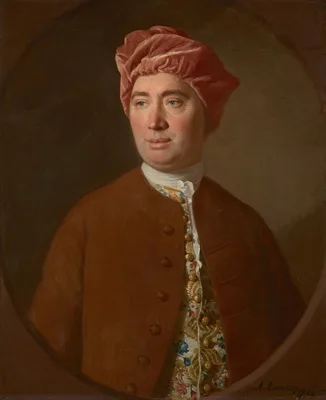
David Hume
David Hume lost the faith of his devout mother before he was twenty, gradually and, by his own account, against his will. He then spent fifty years deciding how much of his doubt to print: he cut the miracles essay from his first book, lost two professorships to the charge of atheism, withdrew his essays on suicide and immortality, and held back the Dialogues until after his death. He called himself only a sceptic. He died so calmly that his calm became the believers' argument.
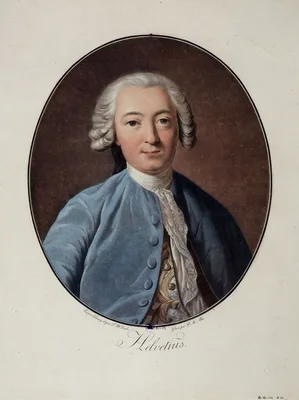
Claude Adrien Helvétius
Claude Adrien Helvétius was schooled by Jesuits and turned by Locke into an empiricist. As a tax farmer he published in 1758 a licensed book that explained mind by the senses and morals by self-interest, without ever denying God. King, archbishop, Parlement, Pope and Sorbonne condemned him as a materialist friend of atheists, and he signed three retractions to protect his mother, his post and his censor. He kept his plainest words on priests, the soul and honest atheists for a manuscript book and private notes, printed after his death.
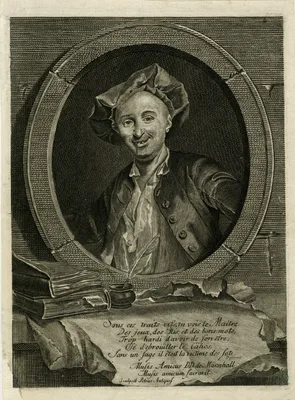
Julien Offray de La Mettrie
Julien Offray de La Mettrie was destined for the Church and was briefly a Jansenist. He became a physician for money and learned the body under Boerhaave. As Frederick the Great told it, in his own fever at Freiburg in 1744 he saw that thought depends on the machine of the body. He said so veiled in 1745 and plainly in Man a Machine (1747–48), and lost his post, his country and his Dutch refuge for it. At Frederick's court he held to his materialism while declining to call himself an atheist, and refused the priest at his death in 1751.
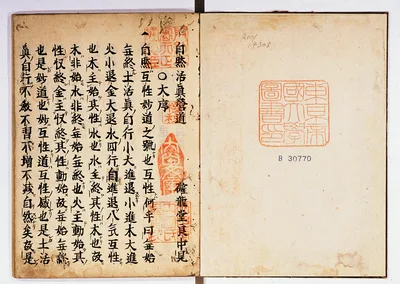
Andō Shōeki
Andō Shōeki was a country physician in Hachinohe who watched farmers starve while those who did not till ate their grain. He came to hold that the world is only self-moving nature, with no god or Buddha above it and no reward or punishment from beyond, and that sages and creeds were inventions of those who lived off the farmers. He judged this too dangerous to print in full. He published a softened version and left the rest for readers a hundred years later, who nearly lost it to fire.