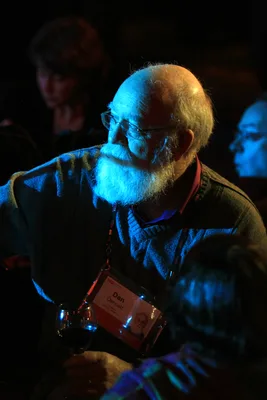
Daniel Dennett was raised in a mild New England Christianity and stopped believing as a teenager, without any crisis. Only in 2003, alarmed by theocratic talk after 11 September, did he declare himself a "bright" in public. He then turned from arguing against God to studying religion, and the unbelieving clergy who serve it, as natural phenomena. He met his own brush with death in 2006 by thanking goodness, not God.
The belief timeline
- Faith (1940s–50s (nominal)) — Sunday school and choir in a liberal New England Congregational church; belief as a social thing [9][10]
- Doubt (adolescence (undated)) — Curiosity about Christian Science, no conversion; then "I didn't believe a word of it"; he says it was not momentous [11]
- Declaration (2003) — Names himself a bright at a Seattle conference, then in the NYT (12 July 2003); motive: post-9/11 alarm at theocratic talk and Dawkins's draft on the brights [22][38][40]
- Revision (2006–2013) — From declaring to studying (motive: he did not want to argue the case for atheism, which seemed obvious; he wanted to know how religion works, and found his confidential informants did not hold the creed to be essential): *Breaking the Spell* (2006), the clergy interviews (2008–10), the Clergy Project (2011), *Caught in the Pulpit* (2013); thanks "goodness" rather than God after the 2006 surgery [24][26][27][32][33]
Notes to the timeline (11)
- [9] He describes his upbringing as "New England suburban liberal Christianity": a social thing; interviewer calls it Congregationalist and he does not correct that — Nick Spencer, interview with Dennett, 22 May 2013, published "Mounting Disbelief", Third Way, July/August 2013;.
- [10] Grandmother a churchgoer, mother never went, but sent the children to Sunday school; he sang in choirs, learned the hymns and the books of the Bible — Spencer, Third Way.
- [11] Adolescent curiosity about religion, Christian Science meetings and a night of prayer for healing, no conversion; his unbelief "was not a momentous thing in my life, I just realised I didn't believe a word of it"; seemed strange that anybody believed it — Spencer, Third Way.
- [22] "The Bright Stuff": a bright holds a naturalist rather than supernaturalist worldview; term coined by two brights in Sacramento; he tells of coming out at a Seattle conference before students, who thanked him for "liberating" them; cites a 2002 Pew figure of 27 million; asks readers not to "out" others; suspects many clergy are closet brights — Dennett, "The Bright Stuff", Edge.org, 22 July 2003 (an op-ed first printed in the NYT; original date not checked).
- [38] In *Breaking the Spell* he writes that he is "a godless philosopher" and "a bright", that his essay "The Bright Stuff" appeared in the New York Times on 12 July 2003, and that the large response to it helped persuade him to write the book; he suggests the believers call themselves "supers" (p. 21). The NYT date differs from the Edge repost date of 22 July — Daniel C. Dennett, Breaking the Spell: Religion as a Natural Phenomenon (New York: Viking, 2006; first printing per its copyright page, ISBN 0-670-03472-X). Read in full text, copyrighted, paraphrase only, p. 21.
- [40] Motive for the 2003 declaration, in his own account: after 11 September he became worried by the growth of theocratic talk and the religious right's threat to the separation of church and state; his earlier religion writing (against creationists in *Darwin's Dangerous Idea*) had made him a critic of fundamentalism but not yet an "enemy of religion"; that changed in 2003 when Richard Dawkins sent him a draft Guardian piece on the brights, a movement founded by retired Californian educators Paul Geisert and his wife Mynga Futrell; the aim was to get atheists/agnostics to "come out" like gay people; at the end of his own talk at a Seattle conference for gifted teenagers he identified himself as a bright, and many students thanked him, some in tears (they had thought they were alone); two Nobel laureates then said they were brights and got standing ovations; his op-ed was the most-shared NYT piece of the month — Daniel C. Dennett, He estado pensando (Barcelona: Arpa/Alfil, 2024; translation by Ferran Mateo of I've Been Thinking, 2023), IA identifier
dennett-d.-he-estado-pensando-barcelona-2024.. Read in full, copyrighted, paraphrase only; every sentence below is this book's translation back into English, and wording must be checked against the English original before anything is quoted (and it may not be quoted). The OCR has no page numbers, so locators are chapter numbers (the chapter titles are the Spanish table of contents: 1 Infancia; 3 Wesleyan, luego Harvard; 5 El descubrimiento del naturalismo; 27 Romper el hechizo; 36 ¿Y si me equivoco?) and the Prologue, ch. 27. - [24] Wieseltier's 2006 review: calls the book scientism, says Dennett casts himself as a hero, objects to the "brights" label and Dennett's claims about their morality, says Dennett gives a misleading impression of Hume, whose next sentence says nature bespeaks an intelligent author — Leon Wieseltier, "The God Genome", NYT Book Review, 19 February 2006 (archived; only page 1 of 3 retrieved). Copyright NYT: paraphrase only. Copyrighted; page 1 of 3 is the only source for this, as for the other details in this chapter cited to that source alone.
- [26] After an aortic dissection and nine-hour surgery (two weeks before writing) he writes that his "epiphany" was that "Thank goodness!" is not a euphemism for "Thank God"; credits doctors, researchers and the institutions of science; compares medicine's moral standards with religion's; forgives friends who prayed for him but thinks intercessory prayer does not work (citing the Benson study) — Dennett, "Thank Goodness!", Edge.org, 2 November 2006.
- [27] The pilot study: 18 people contacted Sept 2008–April 2009; five pastors (Southern Baptist, UCC, Presbyterian, Methodist, Church of Christ) interviewed confidentially by LaScola; two came from a Center for Progressive Christianity list, three via Dan Barker; Dennett mentioned the study at conferences; names fictitious; a sixth (Episcopal) participant withdrew — Dennett and Linda LaScola, "Preachers Who Are Not Believers", Evolutionary Psychology 8(1): 122–150 (2010), doi 10.1177/147470491000800113, PMC10426861. Licence CC BY-NC 3.0. Text kept in research/texts/evpsych-preachers-CC-BY-NC.txt.
- [32] Clergy Project: Dawkins and Dennett talked for years of a "halfway house" for nonbelieving clergy; Dennett and LaScola's pilot study published January 2010; interviews extended to thirty more; the project's forums drafted January 2011 (Barker, LaScola, Cornwell), launched 20 March 2011 with 52 members; ad hoc board April 2012 included Dennett; 2016 founders' panel; Dennett's predicted effects quoted from Dunphy's 2015 book, p. 47 — The Clergy Project, "Clergy Project History",.
- [33] *Caught in the Pulpit* (2013) came from the full interviews, expanded 2015 — TCPhist.
Thank Goodness
In October 2006 a philosopher was taken by ambulance from his office at Tufts University to a hospital emergency room, where doctors found a tear in the wall of his aorta. After many hours of surgery he recovered, and two weeks later he wrote an essay about it. Friends had wondered, he said, whether coming so close to death would shake his well-known atheism. It had not. What he felt was gratitude, and he wanted to be precise about where it went: to the surgeons, the nurses, the researchers and the institutions of science. "Thank goodness," he wrote, was not a polite way of saying "Thank God."12
The philosopher was Daniel Dennett, who spent the last twenty years of his life studying religion as a natural phenomenon. His own unbelief, he said, had never been a dramatic event. This chapter asks how a quiet loss of belief turned, in his sixties, into a public cause.
Sunday school
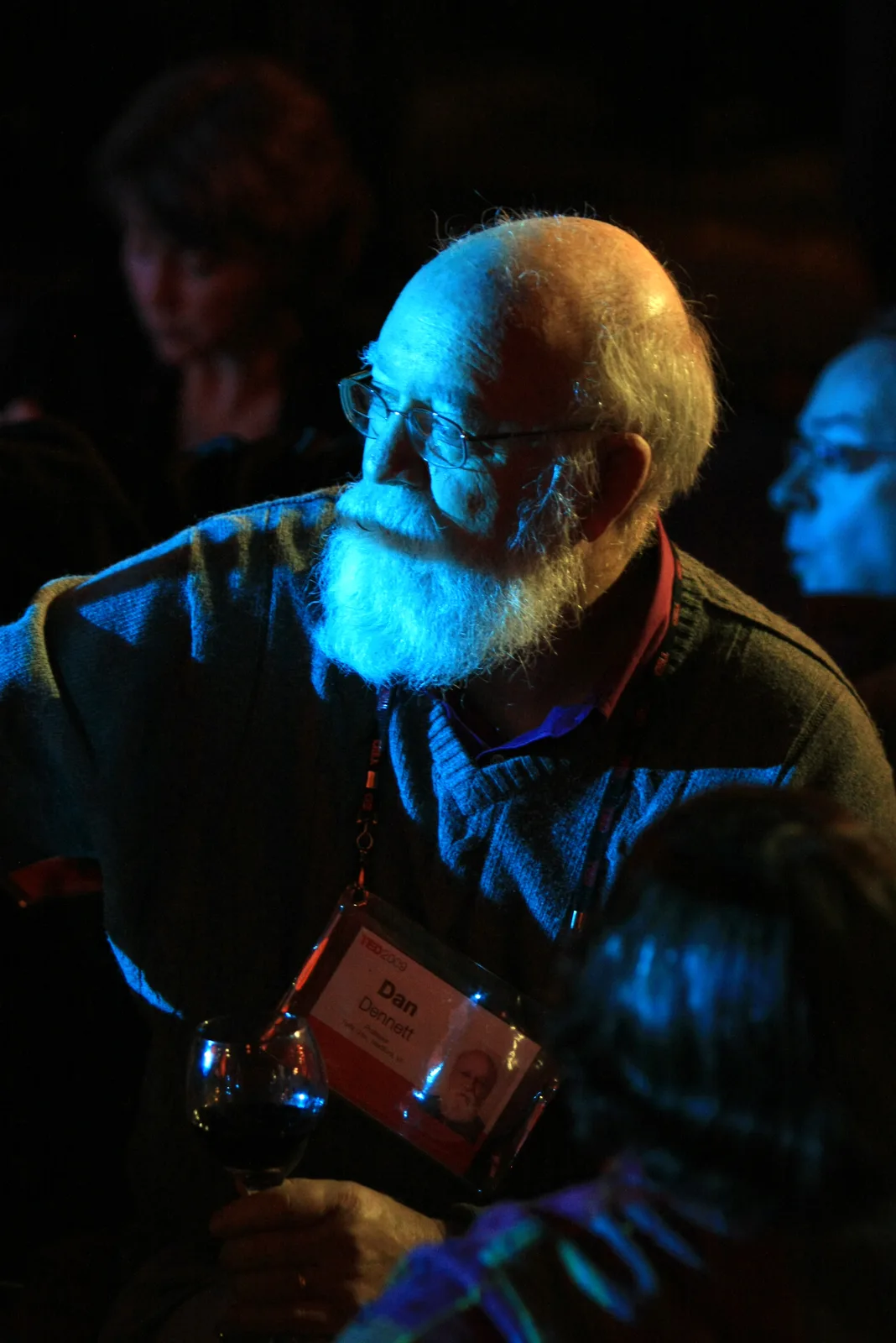
He was born in Boston in 1942. His father, a scholar of Islamic history, was posted to Beirut during the war as a cultural attaché and worked there as an intelligence officer; he was killed in a plane crash in Ethiopia in 1947, when his son was five. The family went home to Winchester, Massachusetts, and the boy grew up, he wrote, in the shadow of a legendary father he barely remembered.345678 No source connects that loss with his religious views.8
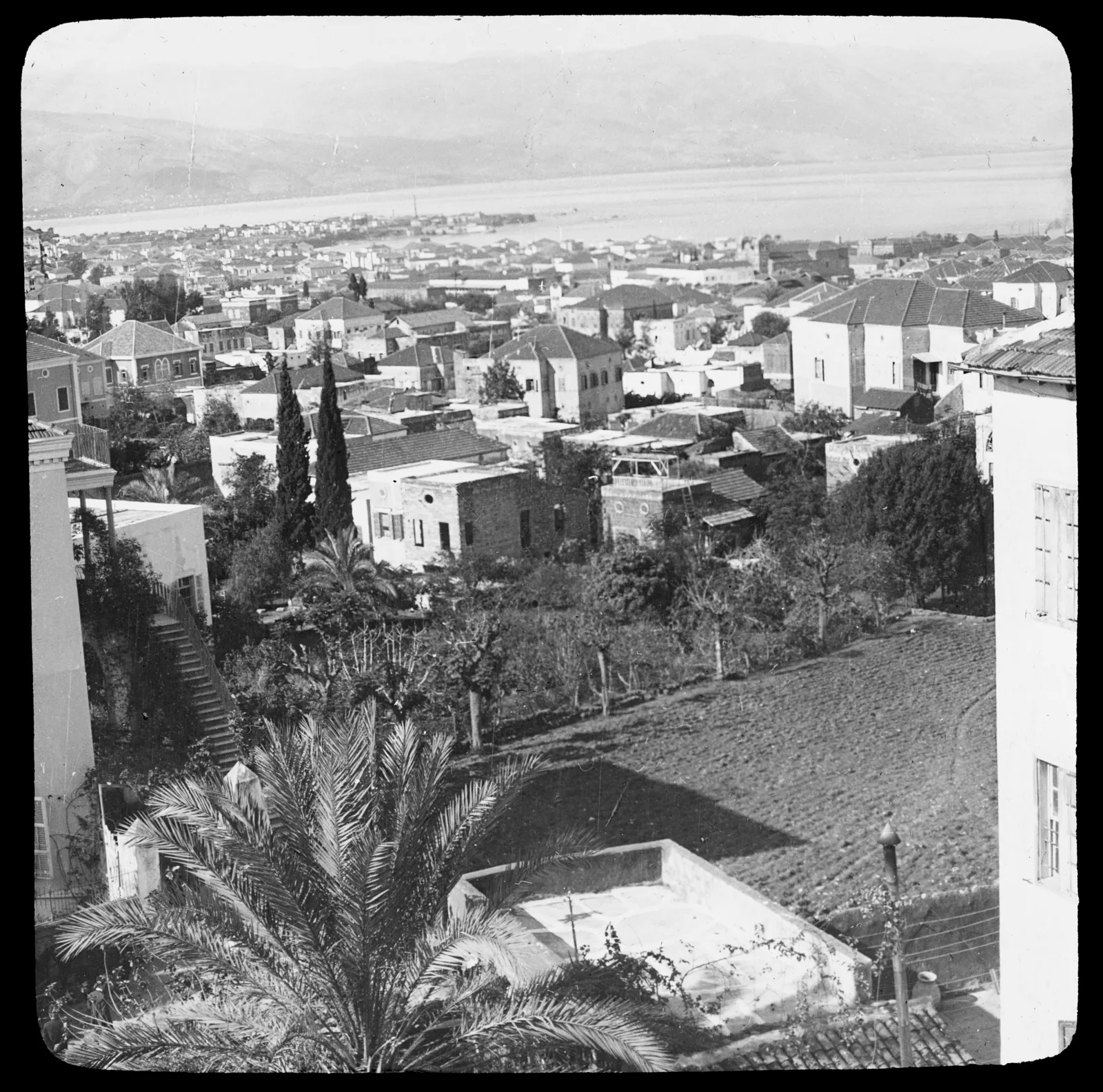
The religion he grew up with he called New England suburban liberal Christianity: a social thing. His grandmother was a churchgoer; his mother rarely went but sent the children to Sunday school, where he sang in the choir and learned the hymns, which he still enjoyed singing as an old man, and memorised the books of the Bible.9108 On the belief timeline, that is his faith, a belief that was more custom than conviction.
Not a momentous thing
As a teenager he went through a brief, intense curiosity about religion. He went to Christian Science meetings and spent a night with a friend praying for a healing. He did not convert. Then, as he told an interviewer in 2013, he simply realised that he did not believe a word of it, and found it strange that anyone did. It was, he said, not a momentous thing in his life.11 No source gives a year. The timeline places his doubt in those undated adolescent years.
At Wesleyan University, in 1959, a philosophy course gave him Nietzsche, Descartes and David Hume's Dialogues Concerning Natural Religion, and persuaded him to become a philosopher.12 He went on to Harvard under W. V. Quine and to Oxford under Gilbert Ryle, and from 1971 taught at Tufts.131415
A bright
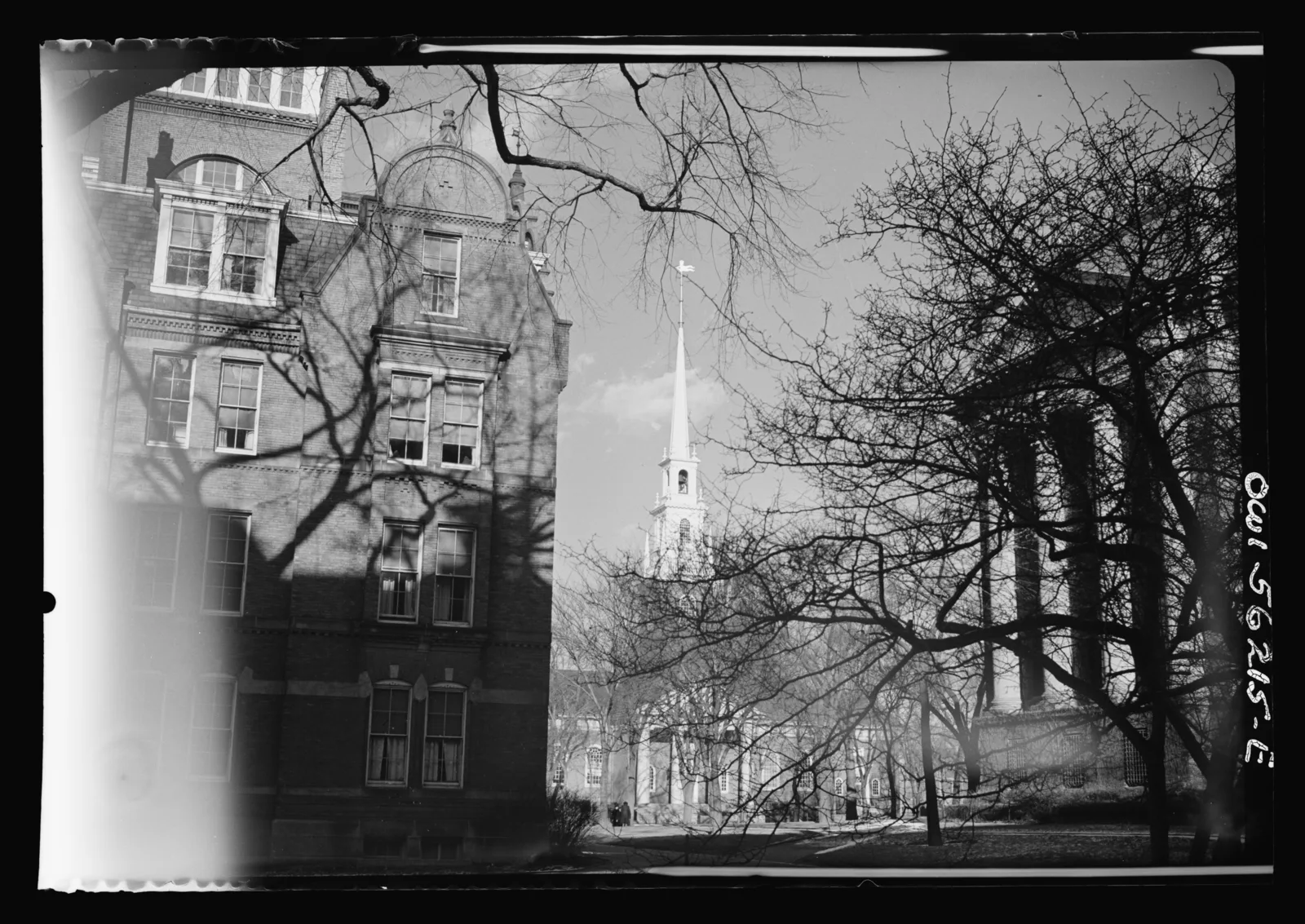
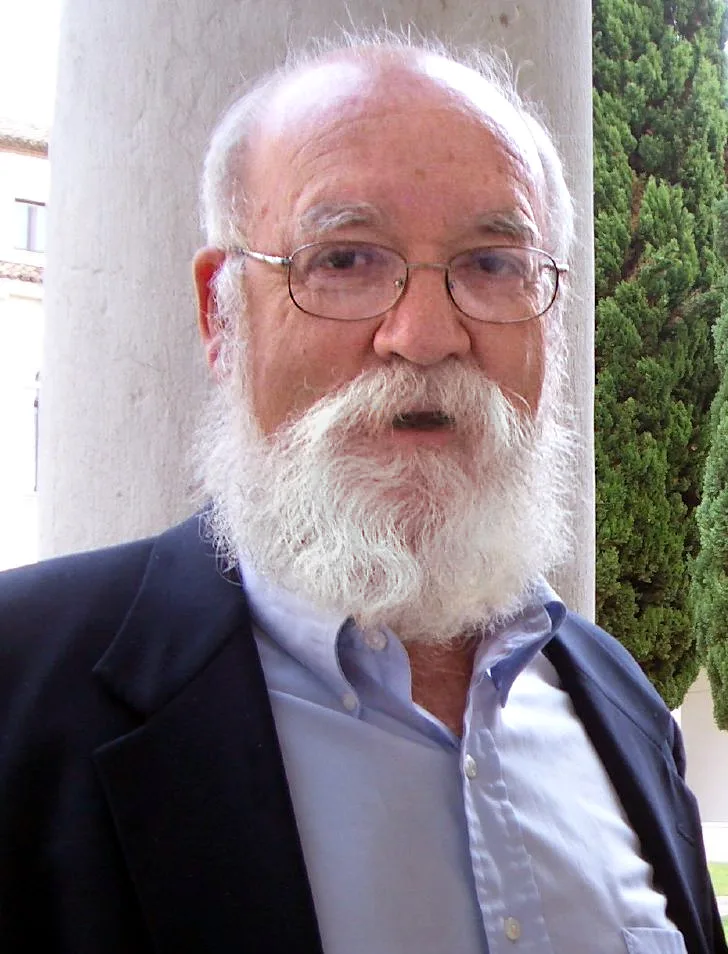
For most of his career he wrote about religion only in passing. His defence of Darwin against the creationists had made him, he said, a critic of fundamentalism, but not yet an enemy of religion.18 What changed his mind was the aftermath of 11 September 2001: he grew alarmed at theocratic talk in American politics and at the religious right's pressure on the separation of church and state. In 2003 Richard Dawkins sent him a draft article about the "brights," a word coined by two retired California educators, Paul Geisert and Mynga Futrell, for people with a naturalist rather than a supernaturalist view of the world. The idea was that unbelievers should come out, as gay people had.1819
At the end of a talk to gifted high-school students in Seattle, Dennett said that he was a bright. Many students thanked him afterwards, some in tears; they had thought they were alone.1819 On 12 July 2003 he declared himself in the New York Times in an essay called "The Bright Stuff."20 That is where the timeline places his declaration.
Hume's other path
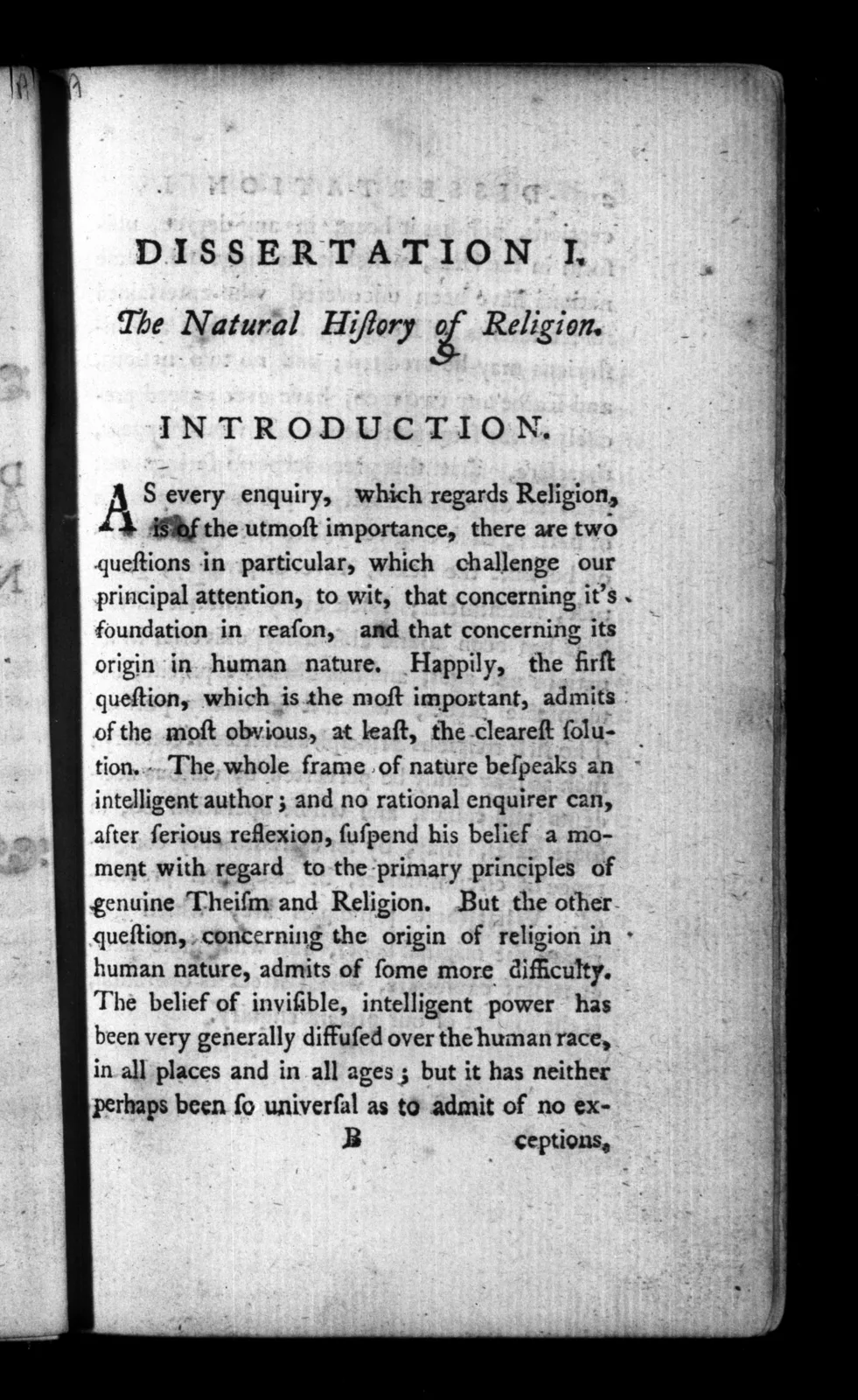
His book Breaking the Spell (2006) did not argue that God does not exist. He had decided, he wrote, that diminishing returns had set in on those arguments. He took the other path that David Hume had opened in The Natural History of Religion and treated religion as a natural phenomenon whose origins and workings could be studied like anything else.2223 He opened a chapter with Hume's sentence:
As every enquiry, which regards Religion, is of the utmost importance, there are two questions in particular, which challenge our principal attention, to wit, that concerning it's foundation in reason, and that concerning its origin in human nature.24
The "spell" of the title was the taboo against looking at religion that way.25 Was he an atheist, then? Yes, he wrote, in the obvious sense: anyone for whom the sacred was not a person one could pray to or thank was an atheist in his book.26
The critic Leon Wieseltier, reviewing the book in the New York Times, called it scientism, said it treated believers' sacred values unseriously while flattering the brights, and pointed out that the very next sentence of Hume's said the whole frame of nature bespeaks an intelligent author.2728 That sentence is Hume's: "The whole frame of nature bespeaks an intelligent author; and no rational enquirer can, after serious reflexion, suspend his belief a moment with regard to the primary principles of genuine Theism and Religion."29 Hume's own considered view, in the Dialogues, is still argued over.
The preachers who did not believe
Writing the book, he realised he knew few deeply religious people, so he sought out about a dozen serious churchgoers. To his surprise, most told him that believing the creed was not essential; religion for them was community, tradition, ritual and love.30 A clinical social worker, Linda LaScola, suggested that clergy must feel the same. With help from Dan Barker, a former minister, she interviewed in confidence pastors who no longer believed what they preached, and in 2010 she and Dennett published the results.3132 They found a nearly invisible class of unbelieving clergy, held in their pulpits by obligation, comfort and community, keeping their unbelief secret because revealing it would cost them everything.33 Out of those interviews came the Clergy Project, launched in 2011 as a confidential online community for clergy who had lost their faith, which Dennett helped to found, and the book Caught in the Pulpit.343135 On his timeline, the revision is this turn from declaring to studying.
What if I'm wrong?
In his memoir I've Been Thinking (2023) he wrote that good thinkers always ask themselves, "What if I'm wrong?" He once put the question to an evangelical pastor who was interviewing him; the pastor answered proudly that he had no need to. Dennett called faith a golden excuse to stop thinking, but said one could excuse believers from an argument without despising them.36 He called naturalism a working hypothesis that evidence could in principle overturn.37 He died in Portland, Maine, on 19 April 2024.38
Richard Dawkins, who sent him the article that made him a bright, has his own chapter in this book.
Footnotes
-
Dennett, "Thank Goodness!", Edge.org, 2 November 2006. ↩
-
Daniel C. Dennett, He estado pensando (Barcelona: Arpa/Alfil, 2024; translation by Ferran Mateo of I've Been Thinking, 2023), IA identifier
dennett-d.-he-estado-pensando-barcelona-2024.. Read in full, copyrighted, paraphrase only; every sentence below is this book's translation back into English, and wording must be checked against the English original before anything is quoted (and it may not be quoted). The OCR has no page numbers, so locators are chapter numbers (the chapter titles are the Spanish table of contents: 1 Infancia; 3 Wesleyan, luego Harvard; 5 El descubrimiento del naturalismo; 27 Romper el hechizo; 36 ¿Y si me equivoco?) and the Prologue, Prologue. ↩ -
Dennett, He estado pensando, ch. 1; Nick Spencer, interview with Dennett, 22 May 2013, published "Mounting Disbelief", Third Way, July/August 2013;, bio; Profile of Dennett, The Guardian, 17 April 2004 (archived: web.archive.org/web/20081011033918/http://books.guardian.co.uk/...story/0,6000,1193371,00.html); notes in research/notes/guardian2004.txt. ↩
-
Daniel C. Dennett, "Autobiography (Part 1)", Philosophy Now issue 68 (© Dennett 2008; written 2003). Archived:; Spencer, Third Way. ↩
-
Alan Feuer, "A Dead Spy, a Daughter's Questions and the C.I.A.", NYT, 23 October 2007 (archived). ↩
-
Dennett, Philosophy Now; Guardian04. ↩
-
Dennett, Philosophy Now. ↩
-
Spencer, Third Way. ↩
-
Spencer, Third Way. ↩
-
Spencer, Third Way. ↩
-
Dennett, He estado pensando, ch. 3. ↩
-
Dennett, Philosophy Now. ↩
-
Dennett, Philosophy Now. ↩
-
Spencer, Third Way, bio; Dennett, Philosophy Now, (1965 acceptance). ↩
-
Nicholas Prather, "Daniel Dennett ... passes away at 82", Tufts Daily, 15 May 2024 (archived). ↩
-
Spencer, Third Way; Dennett, Philosophy Now. ↩
-
Dennett, "The Bright Stuff", Edge.org, 22 July 2003 (an op-ed first printed in the NYT; original date not checked). ↩ ↩2
-
Daniel C. Dennett, Breaking the Spell: Religion as a Natural Phenomenon (New York: Viking, 2006; first printing per its copyright page, ISBN 0-670-03472-X). Read in full text, copyrighted, paraphrase only, p. 21. ↩
-
Hitchens; Mooney: Wikipedia "Brights movement". Not checked against the original (no). ↩
-
Dennett, Breaking the Spell, pp. 26–27 (chapter 2 epigraph on the opening page of the chapter). ↩
-
Leon Wieseltier, "The God Genome", NYT Book Review, 19 February 2006 (archived; only page 1 of 3 retrieved). Copyright NYT: paraphrase only; Dennett, Breaking the Spell, ch. 2 epigraph and pp. 26-27. ↩
-
David Hume: Four Dissertations (1757), Dissertation I, Introduction, p. 1 (IA leaf 14). ↩
-
Dennett, He estado pensando, ch. 27. ↩
-
Dennett, Breaking the Spell, p. 245. ↩
-
Wieseltier, "The God Genome". Copyrighted; page 1 of 3 is the only source for this, as for the other details in this chapter cited to that source alone. ↩
-
Leon Wieseltier, literary editor of The New Republic: NYT Book Review, 19 Feb 2006, p. 1 of 3 only. ↩
-
David Hume: same page. ↩
-
Dennett, He estado pensando, ch. 27. ↩
-
Dennett and Linda LaScola, "Preachers Who Are Not Believers", Evolutionary Psychology 8(1): 122–150 (2010), doi 10.1177/147470491000800113, PMC10426861. Licence CC BY-NC 3.0. Text kept in research/texts/evpsych-preachers-CC-BY-NC.txt. ↩
-
Dennett, Evolutionary Psychology. ↩
-
The Clergy Project, "Clergy Project History",. ↩
-
Dennett, He estado pensando, ch. 27. ↩
-
Dennett, He estado pensando, ch. 36. ↩
-
Spencer, Third Way. ↩
-
Prather, "Daniel Dennett ... passes away at 82". ↩
dennett-d.-he-estado-pensando-barcelona-2024.. Read in full, copyrighted, paraphrase only; every sentence below is this book's translation back into English, and wording must be checked against the English original before anything is quoted (and it may not be quoted). The OCR has no page numbers, so locators are chapter numbers (the chapter titles are the Spanish table of contents: 1 Infancia; 3 Wesleyan, luego Harvard; 5 El descubrimiento del naturalismo; 27 Romper el hechizo; 36 ¿Y si me equivoco?) and the Prologue.; Nick Spencer, interview with Dennett, 22 May 2013, published "Mounting Disbelief", Third Way, July/August 2013;.; Profile of Dennett, The Guardian, 17 April 2004 (archived: web.archive.org/web/20081011033918/http://books.guardian.co.uk/...story/0,6000,1193371,00.html); notes in research/notes/guardian2004.txt.; Daniel C. Dennett, "Autobiography (Part 1)", Philosophy Now issue 68 (© Dennett 2008; written 2003). Archived:.; Alan Feuer, "A Dead Spy, a Daughter's Questions and the C.I.A.", NYT, 23 October 2007 (archived); Nicholas Prather, "Daniel Dennett ... passes away at 82", Tufts Daily, 15 May 2024 (archived).; Dennett, "The Bright Stuff", Edge.org, 22 July 2003 (an op-ed first printed in the NYT; original date not checked).; Daniel C. Dennett, Breaking the Spell: Religion as a Natural Phenomenon (New York: Viking, 2006; first printing per its copyright page, ISBN 0-670-03472-X). Read in full text, copyrighted, paraphrase only.; Leon Wieseltier, "The God Genome", NYT Book Review, 19 February 2006 (archived; only page 1 of 3 retrieved). Copyright NYT: paraphrase only.; Dennett and Linda LaScola, "Preachers Who Are Not Believers", Evolutionary Psychology 8(1): 122–150 (2010), doi 10.1177/147470491000800113, PMC10426861. Licence CC BY-NC 3.0. Text kept in research/texts/evpsych-preachers-CC-BY-NC.txt.; The Clergy Project, "Clergy Project History",.In their own words
As every enquiry, which regards Religion, is of the utmost importance, there are two questions in particular, which challenge our principal attention, to wit, that concerning it's foundation in reason, and that concerning its origin in human nature.
Happily, the first question, which is the most important, admits of the most obvious, at least, the clearest solution. The whole frame of nature bespeaks an intelligent author; and no rational enquirer can, after serious reflexion, suspend his belief a moment with regard to the primary principles of genuine Theism and Religion.
The other side
See above (no cleared quotation; paraphrase: Dennett's book is scientism, a superstition of the day; it treats the sacred values of non-brights as unseriously as it flatters brights; and it misuses Hume, who answered his first question for theism)
See above (paraphrase: the clergy in the study who declined said they were still believers in a non-supernatural sense; two pastors in the study said they believed in "something")
See above (Hitchens called the "brights" proposal "cringe-making"; Chris Mooney of CSI said it needed rethinking: known only through Wikipedia; read the originals)
Where accounts differ
| Point | One account | Another | How the page handles it |
|---|---|---|---|
| Birthplace | Boston (Memoir-ES ch. 1; HighProfiles bio; Wikipedia) | Beirut (Guardian04) | Settled: Boston, per his own memoir; the Guardian line is an error or a loose phrase. No need for "accounts differ" |
| Father's death | Accident, per the accident report Charlotte Dennett obtained (NYT07) | Sabotage suspected by his best friend and a former spy, no evidence (NYT07) | State the accident; mention the suspicion only if the memoir does |
| Whether the father's death shaped his unbelief | No source says so; the memoir (ch. 1) mentions the father's death and the "shadow" of a legendary father but never links either to religion | The roster line implies it | Do not say it |
| Sisters | "Two sisters" (PhilNow; Guardian04; TuftsDaily) | Wikipedia names only Charlotte | Say "his mother and two sisters"; Charlotte was born weeks before the death (NYT07) |
| Was it a "deconversion"? | Interviewer asks about a shedding of "social clothes"; Dennett agrees it was not momentous (HighProfiles) | Roster frames a crack and a break | Follow Dennett |
| Hume's sentence | "challenge our principal attention" (1757) | "challenge our attention" (Wieseltier's quotation) | Quote the 1757 text; footnote |
| Brights coinage | Dennett in 2003: two brights in Sacramento (EdgeBright) | Dennett in 2022: Paul Geisert and his wife Mynga Futrell, retired educators in California (Memoir-ES ch. 27) | Settled: name Geisert and Futrell |
| NYT date of "The Bright Stuff" | 12 July 2003 (BtS p. 21) | Edge repost dated 22 July 2003 | Use 12 July as the NYT date; mention Edge only if needed |
| When "Caught in the Pulpit" appeared | Pitchstone 2013 (TCPhist) | Amazon 2013, expanded Pitchstone 2015 (Memoir-ES ch. 27) | Use the memoir's version |
List of illustrations
This page uses only public-domain and Creative Commons images; each is credited with its source and licence.
- Dan Dennett at TED.jpg — Erik Charlton from Menlo Park, USA, 2009-03-07 · Erik Charlton, via Wikimedia Commons, CC BY 2.0 · CC BY 2.0 (Wikimedia Commons file page; https://creativecommons.org/licenses/by/2.0)
- (Syrie et Sud Syrien Damas) Beyrouth. 1, Vue generale (BnF btv1b53258671p) — Albert Cintract (photographer, reproduction); Emile Piat (mission chief, presumed photographer), 1910-1911 · Bibliotheque nationale de France, via Wikimedia Commons · Public domain (Wikimedia Commons file page; Bibliotheque nationale de France, photograph of 1910-1911)
- Cambridge, Massachusetts. View across Harvard Yard — Paul Vanderbilt, photographer (Farm Security Administration/Office of War Information), 1939 · Library of Congress, Prints & Photographs Division, Farm Security Administration/Office of War Information Black-and-White Negatives · The contents of the Library of Congress Farm Security Administration/Office of War Information Black-and-White Negatives are in the public domain and are free to use and reuse.
- Daniel Dennett in Venice 2006.png — David Orban (davidorban on flickr.com); cropped and colour-adjusted by Wikipedia user Coelacan, 2006-09-23 · David Orban, via Wikimedia Commons, CC BY 2.0 · CC BY 2.0 (Wikimedia Commons file page; https://creativecommons.org/licenses/by/2.0)
- Four Dissertations (1757), Natural History of Religion, Introduction — David Hume, 1757 · Internet Archive, item bim_eighteenth-century_four-dissertations-i-t_hume-david_1757 · Public domain (published 1757; Internet Archive scan)
- Ballou Hall, Tufts University, Medford, Massachusetts (Detroit Publishing Co., LoC 4a08562) — Detroit Publishing Co., 1900-1906 · Library of Congress, Prints & Photographs Division, Detroit Publishing Company Collection, via Wikimedia Commons · Public domain (Wikimedia Commons file page; Detroit Publishing Co. photograph of 1900-1906, Library of Congress)
Sources
Tier 1 — the subject's own words
- [PhilNow] Daniel C. Dennett, "Autobiography (Part 1)", Philosophy Now issue 68 (© Dennett 2008; written 2003). Archived: https://web.archive.org/web/20100616233306/http://www.philosophynow.org/issue68/68dennett.htm . Read in full (research/notes/philnow-autobio1.txt). Silent on religion.
- [EdgeBright] Dennett, "The Bright Stuff", Edge.org, 22 July 2003 (an op-ed first printed in the NYT; original date not checked). https://www.edge.org/conversation/daniel_c_dennett-the-bright-stuff . Notes in research/notes/edge-brightstuff.txt.
- [EdgeThanks] Dennett, "Thank Goodness!", Edge.org, 2 November 2006. https://www.edge.org/conversation/daniel_c_dennett-thank-goodness . Notes in research/notes/edge-thankgoodness.txt.
- [EdgeOrr] Dennett, "Open Letter to H. Allen Orr", Edge.org, 12 February 2007 (peripheral).
- [EvPsych] Dennett and Linda LaScola, "Preachers Who Are Not Believers", Evolutionary Psychology 8(1): 122–150 (2010), doi 10.1177/147470491000800113, PMC10426861. Licence CC BY-NC 3.0. Text kept in research/texts/evpsych-preachers-CC-BY-NC.txt.
- [HighProfiles] Nick Spencer, interview with Dennett, 22 May 2013, published "Mounting Disbelief", Third Way, July/August 2013; https://highprofiles.info/interview/daniel-dennett/ (archived 2018-10-01). Notes in research/notes/highprofiles.txt. The best first-hand account of his religious upbringing found.
- [BtS] Daniel C. Dennett, Breaking the Spell: Religion as a Natural Phenomenon (New York: Viking, 2006; first printing per its copyright page, ISBN 0-670-03472-X). Read in full text, copyrighted, paraphrase only. IA identifier
breaking-the-spell-religion-as-a-natural-phenomenon-daniel-clement-dennett(a user upload; the library's own lending copiesbreakingspell00daniandbreakingspellrel0000dennreturn 401). Text in research/texts/breaking-the-spell-b.txt. Pages are taken from the running heads in the OCR. - [Memoir-ES] Daniel C. Dennett, He estado pensando (Barcelona: Arpa/Alfil, 2024; translation by Ferran Mateo of I've Been Thinking, 2023), IA identifier
dennett-d.-he-estado-pensando-barcelona-2024.. Read in full, copyrighted, paraphrase only; every sentence below is this book's translation back into English, and wording must be checked against the English original before anything is quoted (and it may not be quoted). The OCR has no page numbers, so locators are chapter numbers (the chapter titles are the Spanish table of contents: 1 Infancia; 3 Wesleyan, luego Harvard; 5 El descubrimiento del naturalismo; 27 Romper el hechizo; 36 ¿Y si me equivoco?) and the Prologue. Text in research/texts/he-estado-pensando-es.txt. - Not reached, in copyright: Caught in the Pulpit (Pitchstone 2013; 2015): no scan on the Internet Archive; From Apostle to Apostate (Dunphy, Pitchstone 2015, IA
fromapostletoapo0000dunp): lending copy, full text returns 401; Google Books API down on 2026-10-14. Science and Religion: Are They Compatible? (OUP 2010, with Plantinga) not searched.
Tier 2 — scholarly biographies and encyclopedias
- None freely available. SEP and IEP entries on Dennett exist (not fetched: they concern his philosophy of mind, not his religion).
Tier 3 — popular biographies and journalism
- [Guardian04] Profile of Dennett, The Guardian, 17 April 2004 (archived: web.archive.org/web/20081011033918/http://books.guardian.co.uk/...story/0,6000,1193371,00.html); notes in research/notes/guardian2004.txt.
- [NYT07] Alan Feuer, "A Dead Spy, a Daughter's Questions and the C.I.A.", NYT, 23 October 2007 (archived). Notes in research/notes/nyt-spydad.txt.
- [TuftsDaily] Nicholas Prather, "Daniel Dennett ... passes away at 82", Tufts Daily, 15 May 2024 (archived).
- [TCPhist] The Clergy Project, "Clergy Project History", https://clergyproject.org/clergy-project-history/ (the organisation's own account; Tier 3).
Tier 4 — maps to other sources only (Wikipedia and similar). Never cited in the script.
- Wikipedia "Daniel Dennett" (birth 28 March 1942, mother's dates, Camp Mowglis at age 11, Wesleyan, Exeter 1959, married 1962, death), "Brights movement" (Geisert and Futrell; Brights' Net launched 4 June 2003), "The Clergy Project". Wikiquote saved in research/notes/wikiquote.txt.
Opposition sources — contemporary critics and religious responses
- [Wieseltier] Leon Wieseltier, "The God Genome", NYT Book Review, 19 February 2006 (archived; only page 1 of 3 retrieved). Copyright NYT: paraphrase only.
- [Hume1757] David Hume, Four Dissertations (London: Millar, 1757), "The Natural History of Religion", Introduction, p. 1 (IA: bim_eighteenth-century_four-dissertations-i-t_hume-david_1757, leaf 14). Public domain. Text in research/texts/hume-four-dissertations-1757.txt; leaf image checked by eye.
- Chris Mooney, "Not Too 'Bright'" (Committee for Skeptical Inquiry) and Hitchens's remark on the Brights: known only through Wikipedia; not read.
Related lives
Richard Dawkins (b. 1941) — co-founder with Dennett of the plan that became the Clergy Project, fellow "bright", and the other half of the same public turn; or Christopher Hitchens, whom Dennett says saw more of religion's atrocities and less of its good works.
Stephen Hawking
Stephen Hawking was never a believer. He watched his schoolfriends' Christian enthusiasm with amused detachment, and asked from boyhood whether the universe needed a God to start it. For decades he kept "God" as a figure of speech for the laws of physics, the "mind of God" of 1988. From 2010 to 2011 he said plainly that God was unnecessary and heaven a fairy story, and in 2014 he called himself an atheist. In his posthumous book he still kept the word "God" as an impersonal name for the laws of nature.
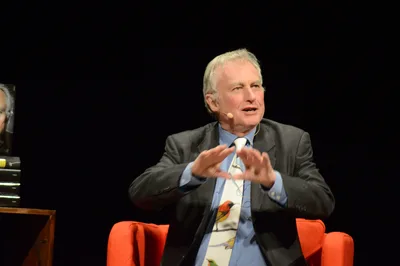
Richard Dawkins
Richard Dawkins was a devout Anglican schoolboy, confirmed at thirteen. He first doubted at nine, on hearing that religions contradict one another. He gave up the Church at fourteen or fifteen, and at about sixteen gave up the creator he had kept for the design of living things, when a friend showed him the full force of Darwin's idea. The God Delusion (2006) made that biology-based unbelief public. His later talk of being a "cultural Anglican" renamed a loyalty to the Church's music and language that was already in print in 2006.
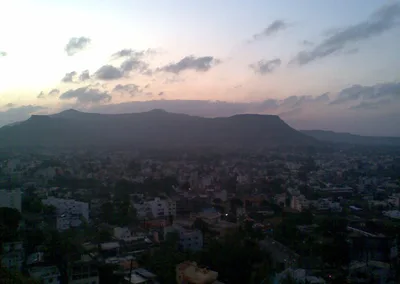
Narendra Dabholkar
Narendra Dabholkar was a Satara doctor who had long since stopped believing in God. In 1982 he gave up medicine to fight superstition, and built a movement that, against his first wish, stayed neutral on God and attacked only fraud and exploitation. He defended that compromise as right for the cause. He was shot dead in Pune in 2013, and the law he fought for, which protects worship and never mentions God, was issued within days of his death.
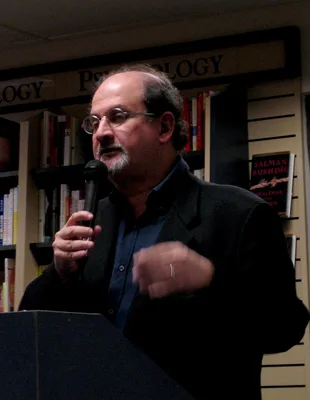
Salman Rushdie
Salman Rushdie was raised in a secular Muslim family with an atheist father. He left no record of a crisis of faith, only an undated drift from childhood belief in the stories. He made his unbelief public through The Satanic Verses (1988), a novel about revelation "from the point of view of an unbeliever", which brought the 1989 fatwa. Under that threat he signed the Muslim creed in December 1990 and disowned it by 1992. After that his unbelief hardened, through "hard-line atheist" in 2006 to a stabbing in 2022 that brought, he said, no revelation.