Diagoras of Melos was a poet whose lost hymns were thought pious. By 423 BCE he was the Athenian stage's byword for godlessness. In 415, in a city panicked by the mutilation of the herms, a year after it had crushed his island, he was condemned with a bounty on his head for profaning the Mysteries. No word of his own survives, and the sources leave open whether he denied the gods, mocked their rites, or was punished for being a Melian.
The belief timeline
- Faith (undated) — A poet of hymns, paeans, encomia and dithyrambs; Smith, relying on Philodemus's report of the poems, finds in them "evidence of the most profound religious feeling" [2][3][29]
- Doubt (undated (tradition only)) — The Suda's story: a poem stolen, a false oath sworn, the perjurer applauded; from that grief Diagoras writes the discourses that show he abandoned belief in god. Tenth-century, from a lexicon, over a thousand years after the events; treat as a tradition, not a fact [21]
- Declaration (by 423) — The Melian is already a byword on the Athenian stage; his unbelief is public enough for a joke that needs no explanation [5]
- Consequence (415/4) — Accused of impiety, flees Attica; decree and bounty; the Birds parody follows within a year [7][8][6]
Notes to the timeline (8)
- [2] He was the son of Telecleides or Teleclytus; the Suda, Hesychius Milesius and others report he composed hymns, paeans, encomia and dithyrambs, among them an encomium of Nicodorus of Mantinea and one of the Mantineians — William Smith (ed.), A Dictionary of Greek and Roman Biography and Mythology, vol. I (1844; the scan is a later printing), article "Diagoras (Διαγόρας)", signed [A. S.], pp. 997–99. Archive id
DictionaryOfGreekAndRomanBiographyAndMythology, pp. 997–98; Suidae Lexicon Graece et Latine, ed. Godofredus Bernhardy (Halle and Brunswick, 1853), with the Latin translation and apparatus. Archive idbub_gb_1is_AAAAcAAJ, s.v.. - [3] Smith: "all that we know of his writings, and especially of his poems, shews no trace of irreligion"; Smith cites Philodemus (Herculaneum) and a line from the eulogy on Arianthes of Argos (printed in Greek only, garbled in the OCR) as showing earnestness — Smith, Dictionary of Greek and Roman…, p. 998. Reported at second hand; the original has not been seen.
- [29] Smith: "though atheists, in the proper sense of the word, have never existed, and in that sense Diagoras was certainly not an atheist, yet as he did not believe in the personal existence of the Athenian gods and their human mode of acting, the Athenians could hardly have regarded him as other than an atheist"; he "ridiculed the common notions of the people respecting the actions of the gods, and their direct and personal interference with human affairs" — Smith, Dictionary of Greek and Roman…, p. 999.
- [21] The Suda (10th c. CE) as rendered in Küster's Latin in Bernhardy: Diagoras, son of Teleclides or Teleclytus, Melian, philosopher and lyric poet; a slave whom Democritus bought for ten thousand drachmas and took as a pupil; contemporary of Pindar and Bacchylides, older than Melanippides, floruit 78th Olympiad (468–465 BCE); surnamed the Atheist because he cast aside belief in god after a man he had trusted with a poem of his claimed it as his own, swore an oath that it was, and was nevertheless applauded when he recited it; from this grief he wrote the "Phrygian" discourses (the *apopyrgizontes logoi*) that show he had abandoned belief in god; he lived at Corinth and died there — Suidae Lexicon Graece et Latine, s.v. Διαγόρας (page not readable in the scan); Smith, Dictionary of Greek and Roman…, p. 997–99.
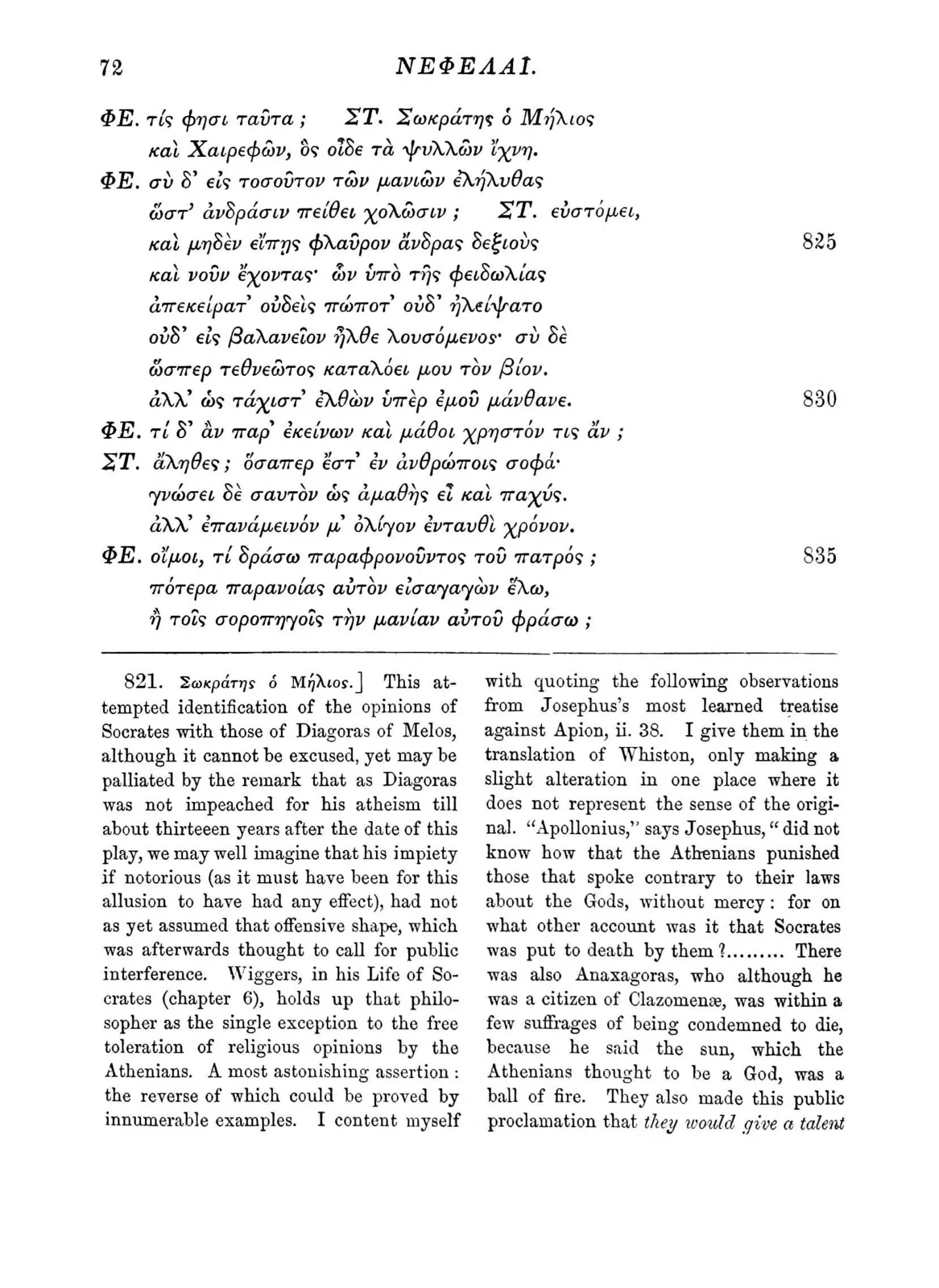
- [5] In *Clouds* (March 423), Strepsiades says there is no Zeus, that Vortex reigns, and when his son asks who says so answers "The Melian—Socrates, And Chaerephon"; the transmitted reading is "Socrates the Melian"; Rogers, Graves and Smith all read "Melian" as an allusion to Diagoras — Aristophanes, The Clouds, Greek text with translation into corresponding metres, introduction and commentary by Benjamin Bickley Rogers (London: Bell, scan identified as Cornell copy cu31924026466403; the catalogue gives 1852, the scan is a later printing; the page for the note on line 830 is p. 72–73). Archive id
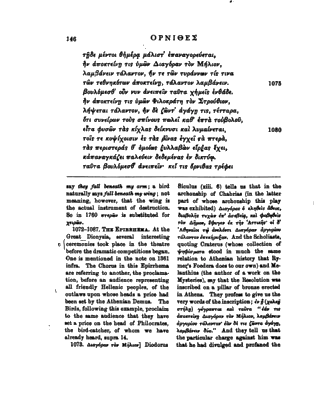
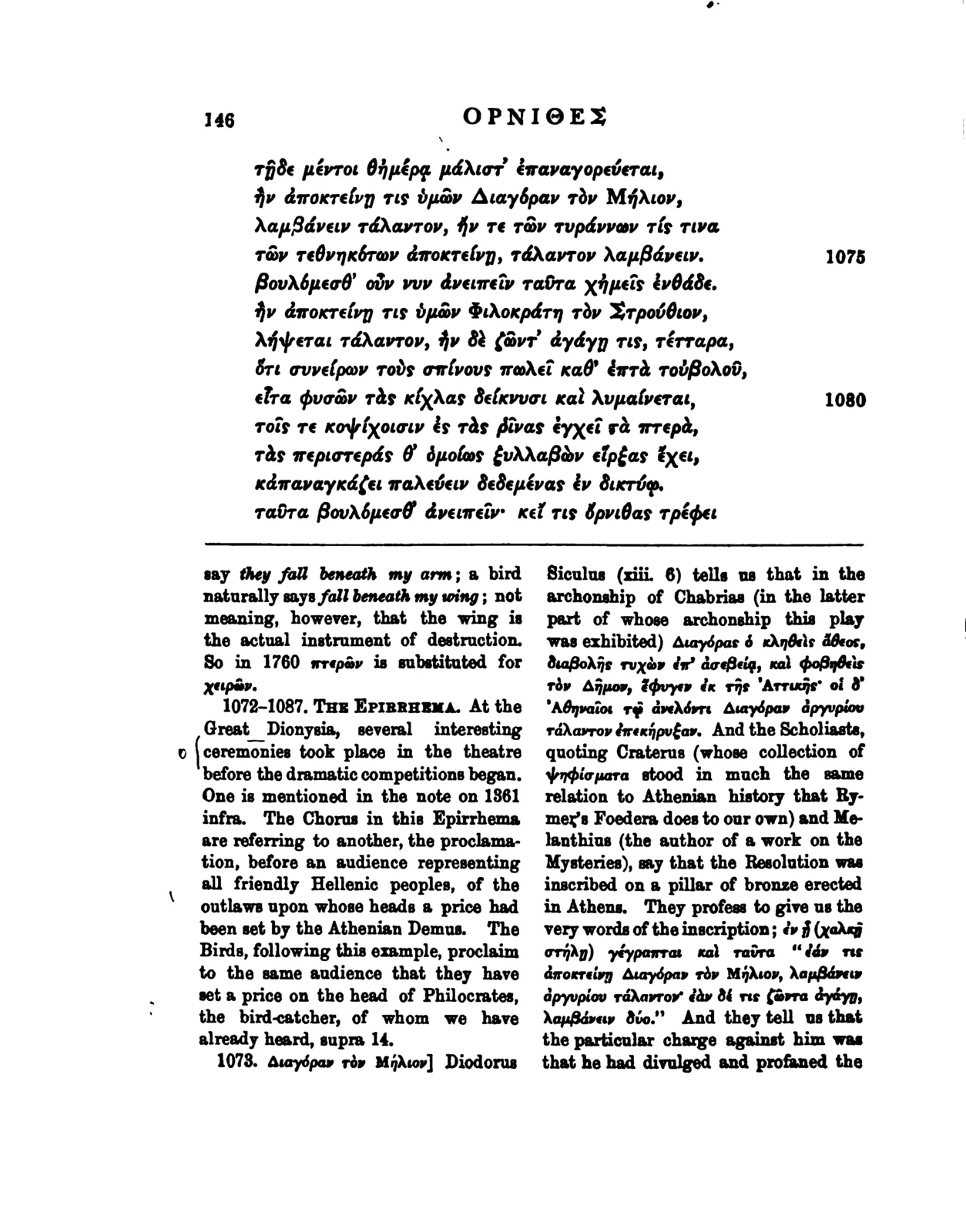
cu31924026466403, pp. 72–73, note on l. 830 (play date, note on l. 307); Aristophanes, with the English translation of Benjamin Bickley Rogers, vol. I (Loeb Classical Library, London: Heinemann; New York: Putnam, 1924). Archive idaristophaneswith01arisuoft, (translation and footnote); Aristophanes, The Clouds, ed. C. E. Graves (Cambridge Greek Testament / Pitt Press, 1898). Archive idcloudsofaristoph00arisrich, p. 136; Smith, Dictionary of Greek and Roman…, p. 998. - [7] The scholiast on Birds 1073, quoting Craterus and Melanthius, says the decree was inscribed on a bronze pillar and gives its words: a talent of silver to anyone who kills Diagoras the Melian, two if he is brought alive; and says the charge was that he had divulged and profaned the Mysteries, speaking slightingly of them, and preventing many from becoming initiated — Aristophanes, The Birds, "acted at Athens at the Great Dionysia, B.C. 414", Greek text with translation into corresponding metres, introduction and commentary by Benjamin Bickley Rogers (London: George Bell, 1906). Archive id
birdsaristophan02rogegoog(a second scan of the same book,cu31924026465751, would not download), pp. 146–47 (Greek and English); Smith, Dictionary of Greek and Roman…, p. 998–99. - [8] Diodorus XIII.6 records, in the archonship of Chabrias, that Diagoras "surnamed the Atheist", accused of impiety, fled Attica for fear of the people, and that a talent of silver was proclaimed for his killer by the common crier; Booth places the notice immediately after the escape of Alcibiades at Thurii and the generals' dispatch to Athens — The Historical Library of Diodorus the Sicilian, translated by George Booth (first published 1700; this is the 1814 edition), Book XIII. Archive id
historicallibra01diodgoog, Book XIII, pp. 493–94; Aristophanes, Birds, p. 146 (the Greek of Diodorus and the archon). - [6] In *Birds* (Great Dionysia, 414), lines 1072–73, the Chorus proclaims: whoever kills Diagoras the Melian shall receive a talent; and a talent for killing a long-dead tyrant; Rogers says the Chorus is mimicking the proclamation of outlaws made at the Great Dionysia before the audience — Aristophanes, Birds, text p. 145–46, commentary p. 146–47.
A Talent for His Head
In March 414 BCE, at the great spring festival of Dionysus, the audience in the theatre of Athens heard a chorus of actors dressed as birds make an announcement:
Listen to the City's notice, specially proclaimed to-day; Sirs, Diagoras the Melian whosoever of you slay, Shall receive, reward, one talent; and another we'll bestow If you slay some ancient tyrant, dead and buried long ago.12
It was a joke in Aristophanes's comedy The Birds, and the audience would have known what it mocked. A few months earlier the city had published a real proclamation, inscribed on a bronze pillar: a talent of silver to anyone who killed Diagoras of Melos, and two talents to anyone who brought him in alive.34 Diagoras had fled. The ancient world remembered him as "the Atheist," and almost everything about him, including what he believed, is disputed. This chapter asks what can be known of why Athens put a price on his head.
A poet from Melos
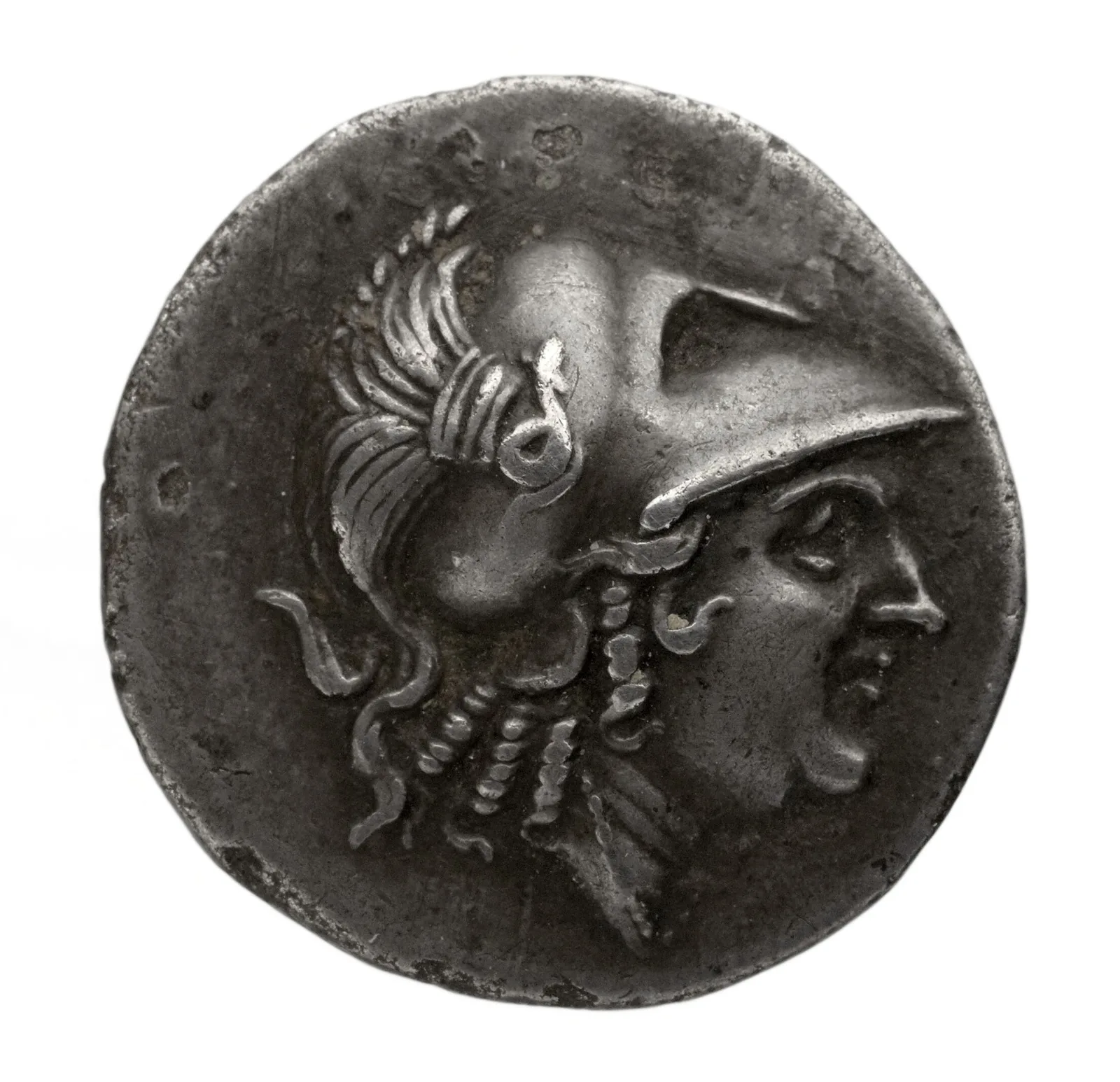
He came from Melos, an island in the Cyclades; almost every ancient writer agrees on that.5 He was the son of Telecleides, and he was a poet. He wrote hymns, paeans, praise-poems and dithyrambs, among them a poem in praise of Nicodorus of Mantinea, a lawgiver he is said to have helped.6 A Victorian scholar, writing for William Smith's Dictionary of Greek and Roman Biography in 1844, found that "all that we know of his writings, and especially of his poems, shews no trace of irreligion, but on the contrary contains evidence of the most profound religious feeling."78 On the belief timeline this is where his faith is placed, and it rests on reports of poems that are themselves lost.
A late tradition says that the philosopher Democritus of Abdera, who explained belief in the gods as fear of strange events in nature, bought or ransomed him and took him as a pupil. The 1844 scholar doubted the details.910 Another late story gives the only motive any source offers for his unbelief. According to the Suda, a Byzantine encyclopedia of the tenth century, a man to whom he had trusted a poem claimed it as his own, swore an oath that it was his, went unpunished and was applauded when he recited it; from that grief, the story goes, Diagoras wrote the discourses that showed he had given up belief in the gods.11 It is a story told some fourteen centuries after the events, and nothing earlier confirms it. The timeline's doubt mark rests on that story, as a tradition and no more.
The Melian
By 423 his name was already a joke in Athens. In Aristophanes's Clouds, a father tells his son that there is no Zeus, and when the son asks who says so, the father answers, "The Melian—Socrates."1213 The old commentators read "the Melian" as a hint at Diagoras, "a notorious sceptic," whose name could make an audience laugh without explanation.1314 The son's reply, "And are you come to such a pitch of madness As to put faith in brain-struck men?", was the believer's answer the play expected.15 On the timeline, his declaration is placed at this play. We do not have his words, only proof that by 423 his unbelief was famous.
The year of panic
In 416 Athens conquered Melos and treated its people cruelly.16 Early the next summer nearly all the stone herms that stood at the doors of Athenian houses were mutilated in a single night, and a rumour spread that the sacred Mysteries of Eleusis had been mocked in private houses.17 The city fell into a religious panic. In that year, by the historian Diodorus's account, "Diagoras, surnamed the Atheist, accused for his impiety, for fear of the people fled out of Attica; and a talent of silver was promised as a reward by the voice of the common crier."1819
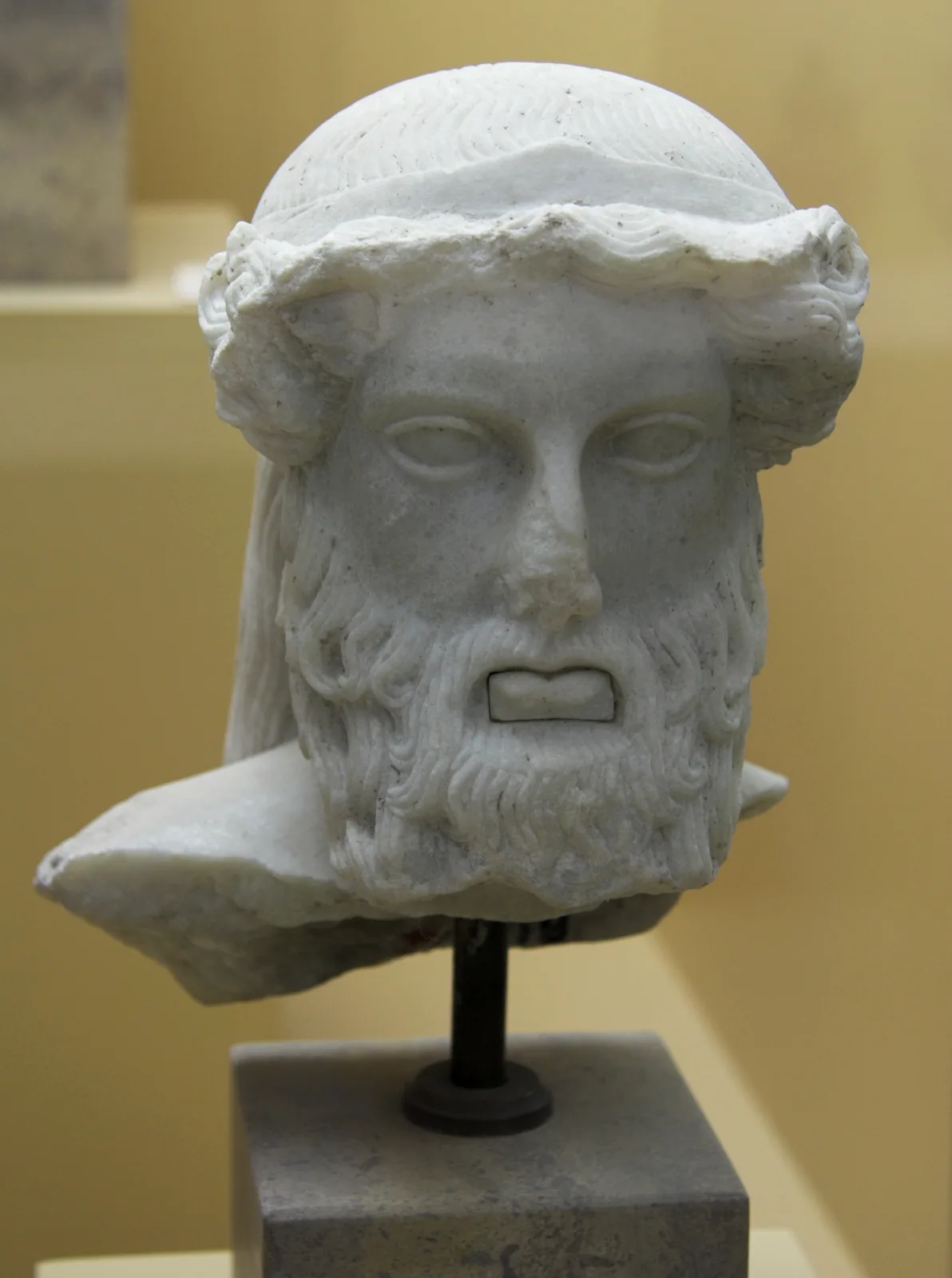
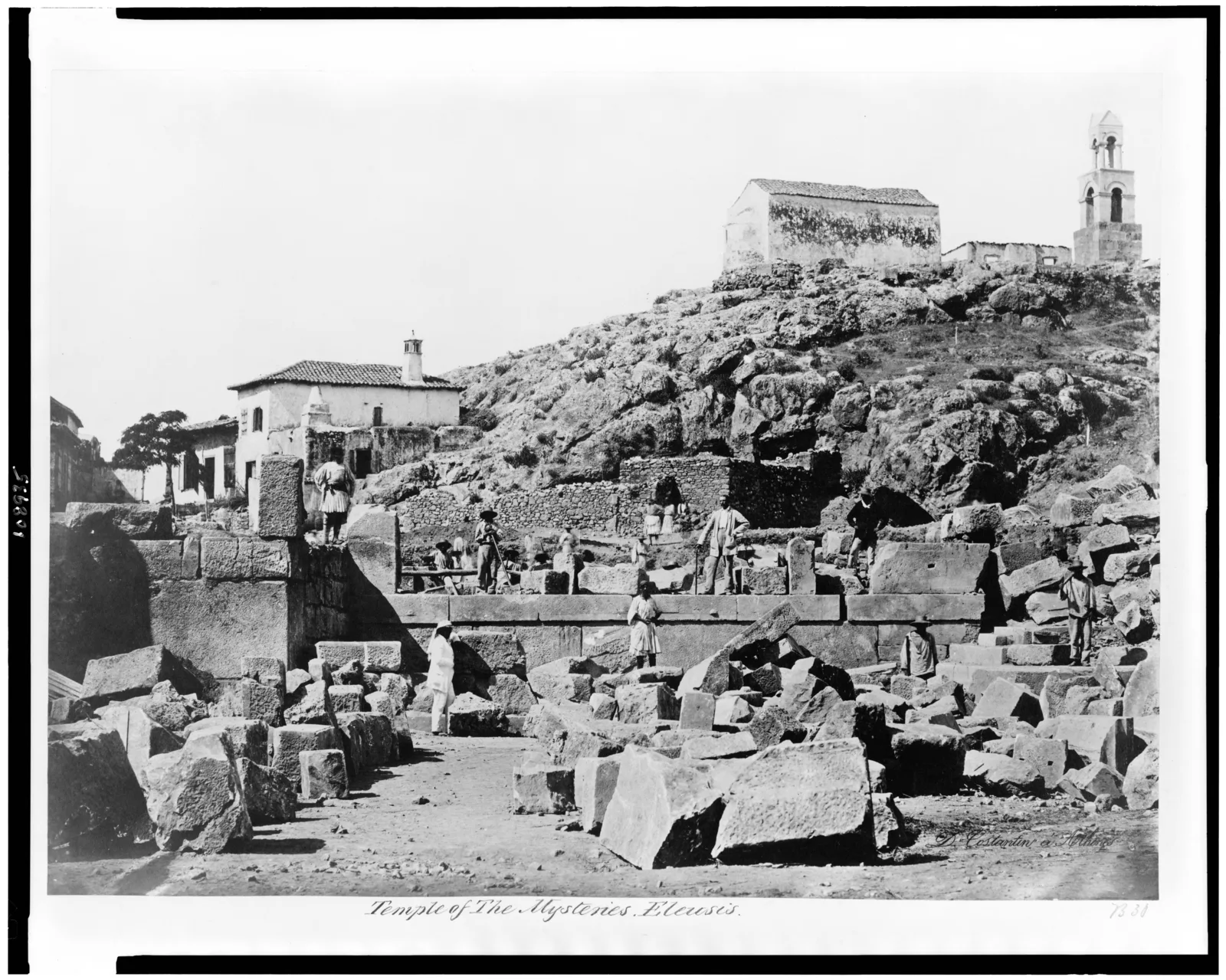
What exactly he had done is told several ways. The decree, as an ancient commentator reported it from collections of Athenian decrees, charged that he had divulged the Mysteries and spoken slightingly of them, and had deterred many people from being initiated.3 The Jewish historian Josephus, five centuries later, said only that "it Was reported of him that he laughed at their mysteries."2021 The Christian Athenagoras added that he "chopped up the wooden statue of Hercules to boil his turnips, but openly declared that there was no God at all."2223 Accounts differ, and the later the source, the more it knows. No source preserves what Diagoras actually said.
Scholars have argued over whether the charge was about religion at all. Smith's Dictionary thought "the accusation of Diagoras was altogether and essentially of a political nature": he was a Melian in Athens the year after Athens had destroyed his island, and a friend of Mantinea, a city Athens distrusted.2425 The editor of The Birds in 1906 thought instead that "his prosecution was due to the religious agitation which prevailed in Athens after the mutilation of the Hermae."2627 Both may be right. Smith also read Aristophanes's joke as a sign that not every Athenian approved of the decree.28 The timeline puts the consequence of his unbelief at 415.
Flight
He went first, by Smith's account, to Pallene in Achaea, whose people refused to hand him over and were named in the decree for it; then to Corinth, where, the Suda says, he died.2911 No date is given.
His name stayed in Athens as a measure. In 399 a speech against Andocides, accused of profaning the Mysteries, said that Andocides was far more impious than Diagoras the Melian, since Diagoras "was impious in speech regarding the sacred things and celebrations of a foreign place, whereas Andocides was impious in act regarding the sanctities of his own city."3031
The atheist of the anecdotes
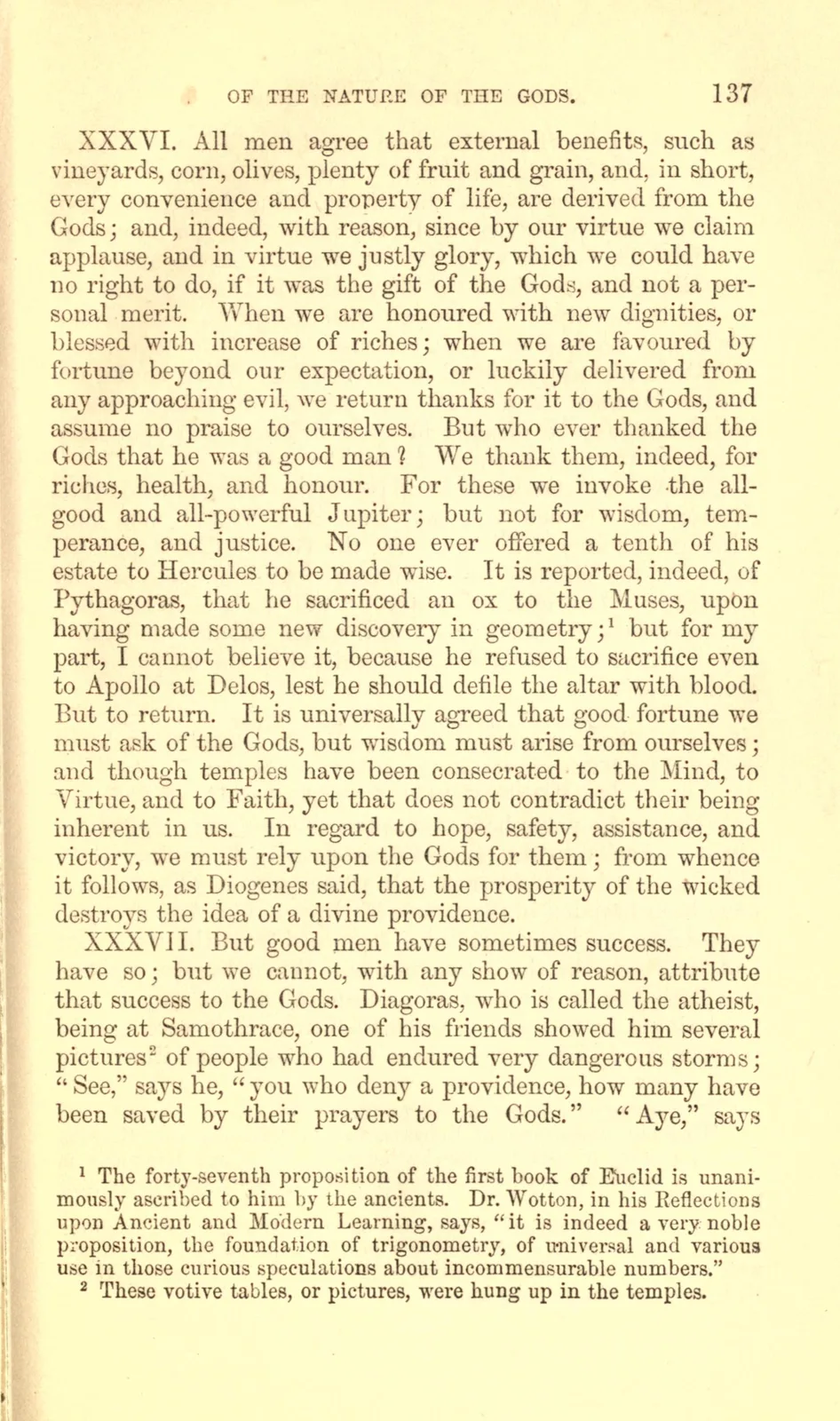
Later writers turned him into a type. Cicero, in his dialogue on the gods, set him beside Theodorus of Cyrene as men who "entirely believed there were no such beings," while Protagoras only "doubted whether there were any."3233 Cicero's speaker Cotta tells the story that has kept his name alive. At the shrine of Samothrace a friend showed him the paintings dedicated by sailors saved from storms: "See ... how many have been saved by their prayers to the Gods." "Aye," said Diagoras, "I see those who were saved, but where are those painted who were shipwrecked?"3435 Diogenes Laertius, in the third century, told the same retort of Diogenes the Cynic, and added only that "some attribute this speech to Diagoras."3637 It may not be his.
The believers who wrote about him did not agree on what he deserved. The pagan speaker in Minucius Felix's Octavius said that he and Theodorus, "by asseverating that there were no gods, took away all the fear by which humanity is ruled, and all veneration absolutely."38 The Christian Lactantius said simply that he "altogether denied the existence of God, and on account of this sentiment was called atheist," and counted him among those "who attacked providence."3940 The Christian Tatian turned him against the Greeks: "you punished him for divulging the Athenian mysteries; yet you who read his Phrygian discourses hate us."4142
What the word meant
Was he an atheist? The ancient testimony says so, from Diodorus onward.43 The same 1844 scholar who called the charge political also argued that "though atheists, in the proper sense of the word, have never existed, and in that sense Diagoras was certainly not an atheist, yet as he did not believe in the personal existence of the Athenian gods and their human mode of acting, the Athenians could hardly have regarded him as other than an atheist."4445 Accounts differ, and no sentence of his own survives to settle it.
What survives is the price on his head. Diagoras is remembered less for what he argued than for what a frightened city did to him, and the earliest evidence of his unbelief is a joke in a comedy and a bounty on a bronze pillar.
Protagoras, whom Cicero placed beside him as the man who only doubted, has his own chapter in this book.
Footnotes
-
The Chorus of Birds, Aristophanes, Birds 1072–73 (414 BCE): Aristophanes, The Birds, "acted at Athens at the Great Dionysia, B.C. 414", Greek text with translation into corresponding metres, introduction and commentary by Benjamin Bickley Rogers (London: George Bell, 1906). Archive id
birdsaristophan02rogegoog(a second scan of the same book,cu31924026465751, would not download), p. 147. ↩ -
Aristophanes, Birds, text p. 145–46, commentary p. 146–47. ↩
-
Aristophanes, Birds, pp. 146–47 (Greek and English); William Smith (ed.), A Dictionary of Greek and Roman Biography and Mythology, vol. I (1844; the scan is a later printing), article "Diagoras (Διαγόρας)", signed [A. S.], pp. 997–99. Archive id
DictionaryOfGreekAndRomanBiographyAndMythology, p. 998–99. ↩ ↩2 -
Smith's paraphrase of the Athenian decree of 415/4, as reported by the scholiast on Birds 1073 citing Craterus and Melanthius; the decree was inscribed "on a column" (Smith) or on a "pillar of bronze" (Rogers): Smith, Dictionary of Greek and Roman…, p. 998–99; Aristophanes, Birds, p. 146 (the Greek of the decree). ↩
-
Smith, Dictionary of Greek and Roman…, p. 997; The Ante-Nicene Fathers, vol. II (Fathers of the Second Century), ed. Roberts and Donaldson (this printing 1913; translations from the Ante-Nicene Christian Library of 1867). Archive id
antenicenefather02robe, (Tatian ch. 27, pp. 76–77). ↩ -
Smith, Dictionary of Greek and Roman…, pp. 997–98; Suidae Lexicon Graece et Latine, ed. Godofredus Bernhardy (Halle and Brunswick, 1853), with the Latin translation and apparatus. Archive id
bub_gb_1is_AAAAcAAJ, s.v.. ↩ -
[A. S.] in Smith's Dictionary of Greek and Roman Biography (1844): Smith, Dictionary of Greek and Roman…, p. 998. ↩
-
Smith, Dictionary of Greek and Roman…, p. 998. Reported at second hand; the original has not been seen. ↩
-
Smith, Dictionary of Greek and Roman…, p. 997; Suidae Lexicon Graece et Latine, s.v.. ↩
-
Smith, Dictionary of Greek and Roman…, p. 999. ↩
-
Suidae Lexicon Graece et Latine, s.v. Διαγόρας (page not readable in the scan); Smith, Dictionary of Greek and Roman…, p. 997–99. ↩ ↩2
-
Strepsiades, Aristophanes, Clouds 830 (423 BCE): Aristophanes, with the English translation of Benjamin Bickley Rogers, vol. I (Loeb Classical Library, London: Heinemann; New York: Putnam, 1924). Archive id
aristophaneswith01arisuoft, (1924) Clouds 811–834; Aristophanes, The Clouds, Greek text with translation into corresponding metres, introduction and commentary by Benjamin Bickley Rogers (London: Bell, scan identified as Cornell copy cu31924026466403; the catalogue gives 1852, the scan is a later printing; the page for the note on line 830 is p. 72–73). Archive idcu31924026466403, p. 73 (spelled "Cherephon" in the older printing). ↩ -
Aristophanes, Clouds, pp. 72–73, note on l. 830 (play date, note on l. 307); Loeb Rogers, vol. I, (translation and footnote); Aristophanes, The Clouds, ed. C. E. Graves (Cambridge Greek Testament / Pitt Press, 1898). Archive id
cloudsofaristoph00arisrich, p. 136; Smith, Dictionary of Greek and Roman…, p. 998. ↩ ↩2 -
Aristophanes, Clouds, p. 136. ↩
-
Pheidippides, the son in Aristophanes's Clouds (423), hearing his father repeat that "the Melian—Socrates" says there is no Zeus: Loeb Rogers, vol. I, (1924) Clouds 811–834; Aristophanes, Clouds, p. 73. ↩
-
Smith, Dictionary of Greek and Roman…, p. 998; The Historical Library of Diodorus the Sicilian, translated by George Booth (first published 1700; this is the 1814 edition), Book XIII. Archive id
historicallibra01diodgoog, pp. 493–94. ↩ -
Lysias, with an English translation by W. R. M. Lamb (Loeb Classical Library; London: Heinemann; Cambridge, Mass.: Harvard University Press, 1930). Archive id
lysiaslamb00lysiuoft, pp. 111–12. ↩ -
Diodorus Siculus, XIII.6: Historical Library of Diodorus the Sicilian, (1814 ed.) pp. 493–94. ↩
-
Historical Library of Diodorus the Sicilian, Book XIII, pp. 493–94; Aristophanes, Birds, p. 146 (the Greek of Diodorus and the archon). ↩
-
Josephus, Against Apion II (Whiston's translation): Complete Works of Josephus, translated by William Whiston (this printing 1800), vol. IV, Against Apion II (Whiston's section II.37). Archive id
completeworksofj04jose, vol. IV, Apion II, §38 in this printing (p. 520; corrected from II.37 by the gatherer, 2026-10-13); same passage quoted in Rogers Clouds p. 72–73. ↩ -
Complete Works of Josephus, vol. IV; Aristophanes, Clouds, p. 72–73 (same passage quoted). ↩
-
Athenagoras, A Plea for the Christians ch. 4 (translation in the Ante-Nicene Fathers): Ante-Nicene Fathers, p. 131. ↩
-
Ante-Nicene Fathers, p. 131. ↩
-
[A. S.] in Smith's Dictionary (1844): Smith, Dictionary of Greek and Roman…, p. 998. ↩
-
Smith, Dictionary of Greek and Roman…, p. 998–99. ↩
-
B. B. Rogers, commentary on Birds 1073 (1906): Aristophanes, Birds, p. 147. ↩
-
Aristophanes, Birds, p. 147. ↩
-
Smith, Dictionary of Greek and Roman…, p. 999. ↩
-
Smith, Dictionary of Greek and Roman…, p. 999. ↩
-
The unnamed author of the speech transmitted as Lysias VI, §17: Lamb, (Loeb, 1930) p. 124. ↩
-
Lamb, p. 124 (§17); intro pp. 111–12. ↩
-
Cicero, De natura deorum I.2, in Yonge's translation: Cicero, Treatises ... On the Nature of the Gods, literally translated by C. D. Yonge (London: Bell, 1878; "Bohn's Classical Library"). Archive id
treatisesofcicer00ciceuoft, pp. 1–2. ↩ -
Cicero, Treatises ... On the Nature…, pp. 1–2. ↩
-
Cotta in Cicero, De natura deorum III.89 (Yonge ch. XXXVII): Cicero, Treatises ... On the Nature…, pp. 137–38. ↩
-
Cicero, Treatises ... On the Nature…, pp. 137–38 (ch. XXXVII). An anecdote in the biography, not a documented event. ↩
-
Diogenes Laertius VI.59, Yonge's translation: Diogenes Laertius, The Lives and Opinions of Eminent Philosophers, translated by C. D. Yonge (London: Bohn, 1853). Archive id
livesandopinions00dioguoft, p. 239. ↩ -
Laertius, Lives and Opinions of Eminent Philosophers, p. 239. ↩
-
Minucius Felix (speaker Caecilius), Octavius ch. 8 (translation in the Ante-Nicene Fathers): The Ante-Nicene Fathers, vol. IV (1913 printing). Archive id
antenicenefather04robe, p. 177. ↩ -
Lactantius, On the Anger of God ch. 9 (translation in the Ante-Nicene Fathers): The Ante-Nicene Fathers, vol. VII (1890). Archive id
antenicenefather007robe, p. 264. ↩ -
Lactantius, Christian apologist (c. 305–320 CE), on Diagoras and Theodorus, in On the Anger of God ch. 9: Ante-Nicene Fathers, p. 265. ↩
-
Tatian, Address to the Greeks ch. 27 (translation in the Ante-Nicene Fathers): Ante-Nicene Fathers, pp. 76–77. ↩
-
Ante-Nicene Fathers, pp. 76–77. ↩
-
Aristophanes, Clouds, p. 72; Lamb, p. 124. ↩
-
[A. S.] in Smith's Dictionary (1844): Smith, Dictionary of Greek and Roman…, p. 999. ↩
-
Smith, Dictionary of Greek and Roman…, p. 999. ↩
birdsaristophan02rogegoog (a second scan of the same book, cu31924026465751, would not download); William Smith (ed.), A Dictionary of Greek and Roman Biography and Mythology, vol. I (1844; the scan is a later printing), article "Diagoras (Διαγόρας)", signed [A. S.], pp. 997–99. Archive id DictionaryOfGreekAndRomanBiographyAndMythology.; The Ante-Nicene Fathers, vol. II (Fathers of the Second Century), ed. Roberts and Donaldson (this printing 1913; translations from the Ante-Nicene Christian Library of 1867). Archive id antenicenefather02robe.; Suidae Lexicon Graece et Latine, ed. Godofredus Bernhardy (Halle and Brunswick, 1853), with the Latin translation and apparatus. Archive id bub_gb_1is_AAAAcAAJ.; Aristophanes, with the English translation of Benjamin Bickley Rogers, vol. I (Loeb Classical Library, London: Heinemann; New York: Putnam, 1924). Archive id aristophaneswith01arisuoft.; Aristophanes, The Clouds, Greek text with translation into corresponding metres, introduction and commentary by Benjamin Bickley Rogers (London: Bell, scan identified as Cornell copy cu31924026466403; the catalogue gives 1852, the scan is a later printing; the page for the note on line 830 is p. 72–73). Archive id cu31924026466403.; Aristophanes, The Clouds, ed. C. E. Graves (Cambridge Greek Testament / Pitt Press, 1898). Archive id cloudsofaristoph00arisrich.; The Historical Library of Diodorus the Sicilian, translated by George Booth (first published 1700; this is the 1814 edition), Book XIII. Archive id historicallibra01diodgoog.; Lysias, with an English translation by W. R. M. Lamb (Loeb Classical Library; London: Heinemann; Cambridge, Mass.: Harvard University Press, 1930). Archive id lysiaslamb00lysiuoft.; Complete Works of Josephus, translated by William Whiston (this printing 1800), vol. IV, Against Apion II (Whiston's section II.37). Archive id completeworksofj04jose.; Cicero, Treatises ... On the Nature of the Gods, literally translated by C. D. Yonge (London: Bell, 1878; "Bohn's Classical Library"). Archive id treatisesofcicer00ciceuoft.; Diogenes Laertius, The Lives and Opinions of Eminent Philosophers, translated by C. D. Yonge (London: Bohn, 1853). Archive id livesandopinions00dioguoft.; The Ante-Nicene Fathers, vol. IV (1913 printing). Archive id antenicenefather04robe.; The Ante-Nicene Fathers, vol. VII (1890). Archive id antenicenefather007robe.In their own words
"Listen to the City's notice, specially proclaimed to-day; Sirs, Diagoras the Melian whosoever of you slay, Shall receive, reward, one talent; and another we'll bestow If you slay some ancient tyrant, dead and buried long ago."
"The Melian—Socrates, And Chaerephon, who knows about the flea-tracks."
"And mark how far more impious this man has shown himself than Diagoras the Melian; for he was impious in speech regarding the sacred things and celebrations of a foreign place, whereas Andocides was impious in act regarding the sanctities of his own city."
"During these things Diagoras, surnamed the Atheist, accused for his impiety, for fear of the people fled out of Attica; and a talent of silver was promised as a reward by the voice of the common crier"
"Protagoras doubted whether there were any. Diagoras the Melian and Theodorus of Cyrene entirely believed there were no such beings."
"What think you of Diagoras, who was called the atheist; and of Theodoras, after him? Did not they plainly deny the very essence of a Deity?"
"Diagoras, who is called the atheist, being at Samothrace, one of his friends showed him several pictures of people who had endured very dangerous storms; \"See,\" says he, \"you who deny a providence, how many have been saved by their prayers to the Gods.\" \"Aye,\" says Diagoras, \"I see those who were saved, but where are those painted who were shipwrecked?\""
"They would have been much more numerous, if those who were lost had offered them instead of those who were saved; but some attribute this speech to Diagoras the Thelian."
"They also made this public proclamation, That they would give a talent to any one that would kill Diagoras of Melos, because it Was reported of him that he laughed at their mysteries"
"with reason did the Athenians adjudge Diagoras guilty of atheism, in that he not only divulged the Orphic doctrine, and published the mysteries of Eleusis and of the Cabiri, and chopped up the wooden statue of Hercules to boil his turnips, but openly declared that there was no God at all."
"Diagoras was an Athenian, but you punished him for divulging the Athenian mysteries; yet you who read his Phrygian discourses hate us."
"another, taking an image of Hercules made of wood (for he happened most likely to be cooking something at home), said, \"Come now, Hercules; now is the time to undergo for us this thirteenth labour, as you did the twelve for Eurystheus, and make this ready for Diagoras,\" and so cast it into the fire as a log of wood."
"there lived a certain Diagoras of Melos, who altogether denied the existence of God, and on account of this sentiment was called atheist"
"Theodorus of Cyrene, or one who is before him, Diagoras the Melian, to whom antiquity applied the surname of Atheist, — both of whom, by asseverating that there were no gods, took away all the fear by which humanity is ruled, and all veneration absolutely"
"All that we know of his writings, and especially of his poems, shews no trace of irreligion, but on the contrary contains evidence of the most profound religious feeling."
"though atheists, in the proper sense of the word, have never existed, and in that sense Diagoras was certainly not an atheist, yet as he did not believe in the personal existence of the Athenian gods and their human mode of acting, the Athenians could hardly have regarded him as other than an atheist."
"All the circumstances of the case lead us to the conclusion, that the accusation of Diagoras was altogether and essentially of a political nature."
"Doubtless his prosecution was due to the religious agitation which prevailed in Athens after the mutilation of the Hermae"
The other side
"promising a prize for his head, and one talent to the person who should bring his dead body to Athens, and two talents to him who should deliver him up alive to the Athenians"
"And are you come to such a pitch of madness As to put faith in brain-struck men?"
"These are they who attacked providence, which had been asserted and defended through so many ages by so many intellects."
"Therefore, since the consent of all nations concerning the existence of the immortal gods remains established, although their nature or their origin remains uncertain, I suffer nobody swelling with such boldness, and with I know not what irreligious wisdom, who would strive to undermine or weaken this religion, so ancient, so useful, so wholesome, even although he may be Theodorus of Cyrene, or one who is before him, Diagoras the Melian"
"Apollonius did not know how that the Athenians punished those that spoke contrary to their laws about the Gods, without mercy"
Where accounts differ
| Point | One account | Another | How the page handles it |
|---|---|---|---|
| Was Diagoras an atheist? | Yes, "openly declared that there was no God at all" (Athenagoras), "altogether denied the existence of God" (Lactantius), "entirely believed there were no such beings" (Yonge's Cicero); the Athenians treated him so | Smith (1844, after Meier and Bernhardy): his poems show "most profound religious feeling" and the charge was "essentially of a political nature"; he "was certainly not an atheist" in the proper sense, only a scoffer at the anthropomorphic gods | Say "accounts differ"; give Cicero and Athenagoras, then Smith's argument as a nineteenth-century scholar's reading; do not call him an atheist in the narrator's own voice without the qualification. The script must not invent his reasons: none survive in a lawful source except the Suda's late story |
| When was he condemned? | 415/4, in the archonship of Chabrias, before the *Birds* of March 414 (Diodorus in Booth; Rogers Birds) | 411 (Smith, wrongly adding Diodorus to a date after the Hermae); "about thirteen years after" 423 (Rogers, in his Clouds note, an internal inconsistency with his own Birds date) | Give 415/4 with the Birds as the terminus ante quem; say nothing about 411 |
| Is the "Melian" of *Clouds* 830 Diagoras? | The scholia and Rogers, Graves, Smith all say so (the epithet "Melian" is a joke on Diagoras the godless) | The transmitted text reads "Socrates the Melian"; Smith notes that Socrates and Diagoras are "described in the scholia as if he had been a teacher of Socrates" | Say "the old commentators took the word 'Melian' as a hint at Diagoras"; do not claim certainty |
| What was the crime? | "Divulged and profaned the Mysteries, speaking slightingly of them, and preventing many from becoming initiated" (scholion via Rogers) | "Laughed at their mysteries" (Josephus); "divulged the Orphic doctrine, ... the mysteries of Eleusis and of the Cabiri" (Athenagoras); "divulging the Athenian mysteries" (Tatian); "impious in speech" (Lysias VI); religious agitation after the Herms (Rogers) | Quote the decree's reported charge and Josephus's "laughed at"; the roster's "mocking the Mysteries" rests only on the Josephus word; Eleusis is given by Athenagoras and the scholiast |
| Where was he from? | Melos (nearly all authorities; Smith) | Athens (Tatian); Miletus (Plutarch's *Placita*, Theodoret, per Bernhardy); Thelos (Diogenes Laertius, "the Thelian") | Melos; one clause on the variants at most |
| The wooden Heracles | Burned to cook turnips (Athenagoras) or lentils (Smith's version of the story) | Clement says "another" among those called atheists did it; no contemporary source; Smith: "if there is any truth in it" | Tell as "a story told two centuries later"; never as fact |
| Samothrace tablets | Diagoras at Samothrace (Cicero III.89) | The same line given to Diogenes the Cynic; "some" attribute it to Diagoras (Diogenes Laertius VI.59) | Tell with the doubt |
| His dates | Suda: floruit 468–465 | Arnobius's editors: "about B.C. 430"; the evidence of Clouds (423) and the decree (415/4) puts his public career in the 420s–410s; Smith: a disciple of Democritus (teaching "about B.C. 436") | Give his public career by the dated events and say his birth is unrecorded |
| The motive for his unbelief | The Suda's story: a stolen poem and a false oath that went unpunished | No contemporary or early source; Smith does not repeat it; Smith offers Democritus's atomism as his background | Present the Suda story as a tradition, with its date, if the script uses it at all; the angle of "what motivated them" is poorly served here and the script should say so |
| Date and play of the Clouds line | March 423 (Rogers's note on l. 307); the surviving text is a later revision (Rogers refers to "a late edition"; not checked) | 424 (Smith) | "In 423, in the year the Clouds was first staged"; avoid claiming 830 is in the first version |
List of illustrations
This page uses only public-domain and Creative Commons images; each is credited with its source and licence.
- The Birds of Aristophanes, ed. B. B. Rogers, Rogers Birds p. 146 — Aristophanes; Benjamin Bickley Rogers, 1906 · The Birds of Aristophanes, ed. B. B. Rogers, Rogers Birds p. 146, Aristophanes; Benjamin Bickley Rogers, via the Internet Archive (public domain) · Public domain (published before 1931)
- Monnaie - Argent, Cyclades, Mélos, Mélos - btv1b10316831k (1 of 2) — unknown, c-5th-c-BCE · Monnaie - Argent, Cyclades, Mélos, Mélos - btv1b10316831k (1 of 2), unknown, via Wikimedia Commons (Public domain) · Public domain
- The Clouds of Aristophanes, ed. B. B. Rogers (Rogers Clouds), Rogers Clouds p. 72 — Aristophanes; Benjamin Bickley Rogers, 1852 · The Clouds of Aristophanes, ed. B. B. Rogers (Rogers Clouds), Rogers Clouds p. 72, Aristophanes; Benjamin Bickley Rogers, via the Internet Archive (public domain) · Public domain (published before 1931)
- Head of Hermes, marble, 425 BC, Agora Museum Athens, 080640 — Zde, c-425-BCE · Head of Hermes, marble, 425 BC, Agora Museum Athens, 080640, Zde, via Wikimedia Commons (CC BY-SA 4.0) · CC BY-SA 4.0
- Temple of the Mysteries, Eleusis — Dimitrios Constantin (Constantine), photographer, 1850s · Temple of the Mysteries, Eleusis, Dimitrios Constantin, c.1850s, Library of Congress Prints and Photographs Division (public domain by date) · Public domain (photograph c.1850s; LoC rights field blank)
- Temple at ancient Corinth and the acro-Corinth, Greece — H.C. White Co., publisher, 1901 · Temple at ancient Corinth and the acro-Corinth, H.C. White Co., 1901, Library of Congress Prints and Photographs Division (public domain) · Public domain (published 1901; LoC states it does not own rights)
- Cicero on the Nature of the Gods, Divination, Fate, the Republic, Laws, tr. C. D. Yonge (Bohn), Yonge Cicero p. 137 — Cicero; C. D. Yonge, 1878 · Cicero on the Nature of the Gods, Divination, Fate, the Republic, Laws, tr. C. D. Yonge (Bohn), Yonge Cicero p. 137, Cicero; C. D. Yonge, via the Internet Archive (public domain) · Public domain (published before 1931)
Sources
Tier 1 — the subject's own words (writings, letters, diaries, trial records)
- None survives in the editions read. The ancient reports that Diagoras wrote Phrygian discourses (also called the Apopyrgizontes logoi), hymns, paeans, encomia and dithyrambs, and that a line of his is quoted (Smith, in Greek only, with a quotation from the eulogy on Arianthes), rest on Tatian, the Suda and Smith [3] [16] [21]. No text of Diagoras was found in a pre-1931 English translation. The anecdotes put into his mouth below are reports by others, written between 400 and 700 years after the events, and are marked as such.
Contemporary testimony (Tier 1 for the fact of the charge, not for Diagoras's views)
- [Rogers Clouds] Aristophanes, The Clouds, Greek text with translation into corresponding metres, introduction and commentary by Benjamin Bickley Rogers (London: Bell, scan identified as Cornell copy cu31924026466403; the catalogue gives 1852, the scan is a later printing; the page for the note on line 830 is p. 72–73). Archive id
cu31924026466403. Text in research/texts/rogers-clouds.txt. Verse translation Rogers's own. Play produced March 423 (note on l. 307). - [Loeb Rogers I] Aristophanes, with the English translation of Benjamin Bickley Rogers, vol. I (Loeb Classical Library, London: Heinemann; New York: Putnam, 1924). Archive id
aristophaneswith01arisuoft. Text in research/texts/rogers-loeb-vol1-1924.txt. Used for the same Clouds passage in the Loeb printing and its footnote: "The reference is to Diagoras the Melian, a notorious sceptic". - [Rogers Birds] Aristophanes, The Birds, "acted at Athens at the Great Dionysia, B.C. 414", Greek text with translation into corresponding metres, introduction and commentary by Benjamin Bickley Rogers (London: George Bell, 1906). Archive id
birdsaristophan02rogegoog(a second scan of the same book,cu31924026465751, would not download). Text in research/texts/rogers-birds-1906b.txt. Verse translation Rogers's own. The commentary on 1073 (pp. 146–47) quotes the Greek of Diodorus XIII.6 and of the scholiast reporting Craterus and Melanthius. - [Lamb] Lysias, with an English translation by W. R. M. Lamb (Loeb Classical Library; London: Heinemann; Cambridge, Mass.: Harvard University Press, 1930). Archive id
lysiaslamb00lysiuoft. Text in research/texts/lamb-lysias-1930.txt. Speech VI, "Against Andocides: for impiety", §17, p. 124; Lamb's introduction on authorship, pp. 111–12. Published 1930, so public domain in the US as of 2026.
Tier 2 — scholarly biographies and encyclopedias
- [Smith] William Smith (ed.), A Dictionary of Greek and Roman Biography and Mythology, vol. I (1844; the scan is a later printing), article "Diagoras (Διαγόρας)", signed [A. S.], pp. 997–99. Archive id
DictionaryOfGreekAndRomanBiographyAndMythology. Text in research/texts/smith-dict-1867.txt. Smith summarises M. H. E. Meier in Ersch and Gruber's Allgemeine Encyclopädie (1835), Lobeck's Aglaophamus (1829), Bernhardy's Geschichte der griechischen Literatur, and Wachsmuth; I have not read those. The article gives some dates that later scholarship corrects (it places the prosecution in 411 and the Clouds in 424; see Disputed points). - [Graves] Aristophanes, The Clouds, ed. C. E. Graves (Cambridge Greek Testament / Pitt Press, 1898). Archive id
cloudsofaristoph00arisrich. Text in research/texts/graves-clouds-1898.txt. Note on line 830, p. 136. - [Bernhardy] Suidae Lexicon Graece et Latine, ed. Godofredus Bernhardy (Halle and Brunswick, 1853), with the Latin translation and apparatus. Archive id
bub_gb_1is_AAAAcAAJ. Text in research/texts/suidas-bernhardy-1853.txt (OCR much damaged in the Greek; the Latin rendering of the Diagoras entry is legible in places). No English translation of the Suda entry older than 1931 was found, so the Suda is paraphrased, never quoted. - [Dübner] Scholia Graeca in Aristophanem, ed. Fr. Dübner (Paris: Didot, 1855). Archive id
scholiagraecaina00dbuoft. Text in research/texts/dubner-scholia-1855.txt (Greek OCR too corrupt to read the Diagoras scholia; not cited for any claim).
Tier 3 — ancient authors in pre-1931 translation (testimony, with date of the author)
- [Booth] The Historical Library of Diodorus the Sicilian, translated by George Booth (first published 1700; this is the 1814 edition), Book XIII. Archive id
historicallibra01diodgoog. Text in research/texts/booth-diodorus-1814c.txt. Diodorus wrote c. 60–30 BCE. - [Yonge ND] Cicero, Treatises ... On the Nature of the Gods, literally translated by C. D. Yonge (London: Bell, 1878; "Bohn's Classical Library"). Archive id
treatisesofcicer00ciceuoft. Text in research/texts/yonge-cicero-1878.txt. Cicero wrote 45 BCE. Yonge's chapter numbers (XXIII, XXXVII, XLII) are the older divisions; the modern section numbers are I.63, III.89, I.117. Yonge's OCR prints "Theodoras" and "Gyrene" for "Theodorus" and "Cyrene". - [Whiston] Complete Works of Josephus, translated by William Whiston (this printing 1800), vol. IV, Against Apion II (Whiston's section II.37). Archive id
completeworksofj04jose. Text in research/texts/whiston-josephus-1800-v4.txt. Josephus wrote c. 95–100 CE. B. B. Rogers quotes the same passage in the same translation in his Clouds commentary. - [ANF2] The Ante-Nicene Fathers, vol. II (Fathers of the Second Century), ed. Roberts and Donaldson (this printing 1913; translations from the Ante-Nicene Christian Library of 1867). Archive id
antenicenefather02robe. Text in research/texts/anf-vol2-1913.txt. Contains: Tatian, Address to the Greeks, ch. 27 (translator J. E. Ryland; c. 165 CE); Athenagoras, A Plea for the Christians, ch. 4 (translator B. P. Pratten; c. 177 CE); Clement of Alexandria, Exhortation to the Heathen, ch. 2 (translator William Wilson; c. 195 CE). Translators' names are from the series, not read in the scan. - [ANF4] The Ante-Nicene Fathers, vol. IV (1913 printing). Archive id
antenicenefather04robe. Text in research/texts/anf-vol4-1913.txt. Minucius Felix, Octavius, ch. 8 (translator Robert Ernest Wallis; probably early-to-mid 3rd c. CE, the date is disputed). - [ANF6] The Ante-Nicene Fathers, vol. VI (1885). Archive id
antenicenefather06robeuoft. Text in research/texts/anf-vol6-1885.txt. Arnobius, Against the Heathen (translators Bryce and Campbell; c. 300 CE), I.31 (p. 421 and note) and IV.29 (p. 486). The editors' note says Diagoras "flourished about B.C. 430". - [ANF7] The Ante-Nicene Fathers, vol. VII (1890). Archive id
antenicenefather007robe. Text in research/texts/anf-vol7-1890.txt. Lactantius, Divine Institutes I.2 (p. 11) and On the Anger of God ch. 9 (p. 264, and again p. 268), translator William Fletcher; c. 305–320 CE. - [Yonge DL] Diogenes Laertius, The Lives and Opinions of Eminent Philosophers, translated by C. D. Yonge (London: Bohn, 1853). Archive id
livesandopinions00dioguoft. Text in research/texts/yonge-diogenes-laertius-1853.txt. Life of Diogenes, p. 239 (VI.59). Diogenes Laertius wrote in the 3rd c. CE.
Tier 4 — maps to other sources only (Wikipedia and similar). Never cited in the script.
- Not consulted. Pointers recorded from the reading: the standard modern work is S. Winiarczyk, Diagorae Melii et Theodori Cyrenaei reliquiae (Leipzig, 1981), and L. Woodbury, "The Date and Atheism of Diagoras of Melos", Phoenix 19 (1965); both in copyright, neither read, to be borrowed if the episode needs the modern consensus on dating and on whether Diagoras was an atheist.
Opposition sources — contemporary critics and religious responses
- [Decree] The Athenian decree of 415/4, known only as reported by the scholiast on Birds 1073, who cites Craterus and Melanthius; wording in Greek in [Rogers Birds] p. 146, summarised in English in [Smith] p. 998–99.
- [Aristophanes] Clouds (423) and Birds (414) as above.
- [Lysias VI] [Lamb], Speech VI (399, pamphlet by an unnamed writer).
- [Josephus], [Lactantius], [Minucius] as above: later believers' arguments against his denial.
Related lives
Theodorus the Atheist (episode 58) — Cicero, Lactantius, Minucius Felix and Arnobius pair the two names every time they appear, and Theodorus is the Cyrenaic of North Africa, the next plain denier. (Alternative: Protagoras, who in Cicero's telling was exiled and had his books burned for doubting rather than denying.) The close says "has their own episode in this series"; never "Next:".

Protagoras
Protagoras, the first professed sophist and a friend of Pericles, opened his book On the Gods by saying he could not know whether they exist, because the question is obscure and life is short. He doubted rather than denied. Late writers say Athens burned the book and drove him to his death at sea; Plato's Socrates says he kept his good name to the end. The sources cannot settle it.
Prodicus of Ceos
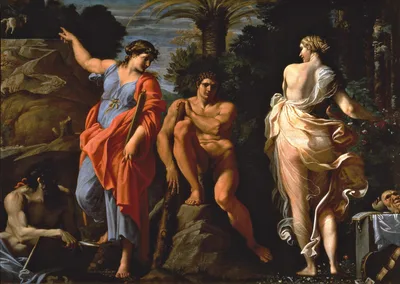
Prodicus of Ceos was the fee-taking sophist famous for fine distinctions and for the fable of the Choice of Heracles. He left no surviving word on the gods. Later writers report that he explained them as the ancients' names for what fed and helped them: bread as Demeter, wine as Dionysus, the Nile as a god. From the third century BCE they listed him among the "so-called atheists". His unbelief is a reported theory and a label others fixed on him, not a declaration of his own.
Ajita Kesakambali
Ajita Kesakambali was a wandering teacher of the Ganges valley around 500 BCE. He taught that a person is four elements and nothing more, that gifts and sacrifices earn nothing, and that the wise and the foolish alike are annihilated at death. No motive, life or writing of his survives. We know the doctrine only because the Buddhist and Jain schools that wanted to refute it wrote it down; the later Cārvāka school, often made his heir, was in large part described by its enemies too.
Critias
Critias was Plato's aristocratic kinsman and the hardest of the Thirty who ruled Athens in blood in 404–403 BCE. He left no word about his own belief. His name as an unbeliever rests on one verse speech, quoted by Sextus Empiricus six centuries later, in which the trickster Sisyphus says a clever man invented the fear of gods to police secret crimes. Ancient and modern readers give that speech either to Critias or to Euripides, so his unbelief is an attribution, not a confession.