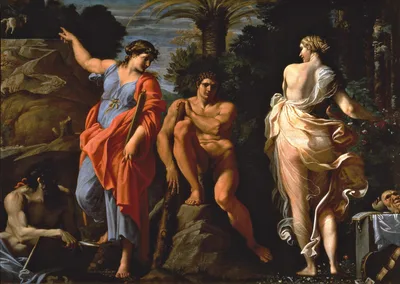
Prodicus of Ceos was the fee-taking sophist famous for fine distinctions and for the fable of the Choice of Heracles. He left no surviving word on the gods. Later writers report that he explained them as the ancients' names for what fed and helped them: bread as Demeter, wine as Dionysus, the Nile as a god. From the third century BCE they listed him among the "so-called atheists". His unbelief is a reported theory and a label others fixed on him, not a declaration of his own.
The belief timeline
- Faith (no source) — Nothing records his childhood religion. The only signs of his own piety are Xenophon's retelling, where Virtue says the gods give nothing good without toil and that to win their favour "you must pay these same gods service" (Q13), and Gomperz's inference from Xenophon's respect [16][29]
- Theory (undated; reported by c. 300 BCE) — He explains the origin of belief in gods: the ancients named as gods what fed and helped them (sun, moon, rivers, springs, bread as Demeter, wine as Dionysus), and in a second strand the men who found food and crafts [19][20][23][25]
- Label (from the 3rd c. BCE (Hellenistic atheist lists; Cicero; Sextus)) — Others name him with Diagoras and Theodorus; Cotta says his view leaves no religion; Sextus calls him one of the "so-called atheists" [21][22]
- Charge (doubtful) (c. 396-395 BCE) — The Suda says Athens put him to death by hemlock for corrupting youth; scholars doubt it [12][13]
- Revision (no source) — No change of mind is recorded; the afterlife views in the Axiochus are of doubtful attribution [32]
Notes to the timeline (11)
- [16] Xenophon has Socrates tell Prodicus's story of the Choice of Heracles, from "that composition of his about Heracles"; he says Prodicus used "far more magnificent phrases". No fragment of the original survives. — Xenophon, Memorabilia, trans. H. G. Dakyns (1897-1900), Project Gutenberg #1177, 2.1.21-34; "Prodicus," by Christian August Brandis, in William Smith (ed.), Dictionary of Greek and Roman Biography and Mythology, vol. III (Boston: Little, Brown, 1864), pp. 541-543, vol. III p. 543.
- [29] Gomperz: Prodicus was not an atheist, because Xenophon, a man of orthodox views, spoke of him with respect, and Persaeus, a pupil of the pantheist Zeno, approved the explanation in On the Gods; the polemic aimed at the gods of popular belief, not at divinity as such. Gomperz also calls the theory "fetishistic" and notes the second strand, the deified inventors. — Theodor Gomperz, Greek Thinkers, vol. I, trans. L. Magnus (London: Murray, 1901; 1920 printing scanned), pp. 424-430 (ch. on Prodicus of Ceos), pp. 429-430.
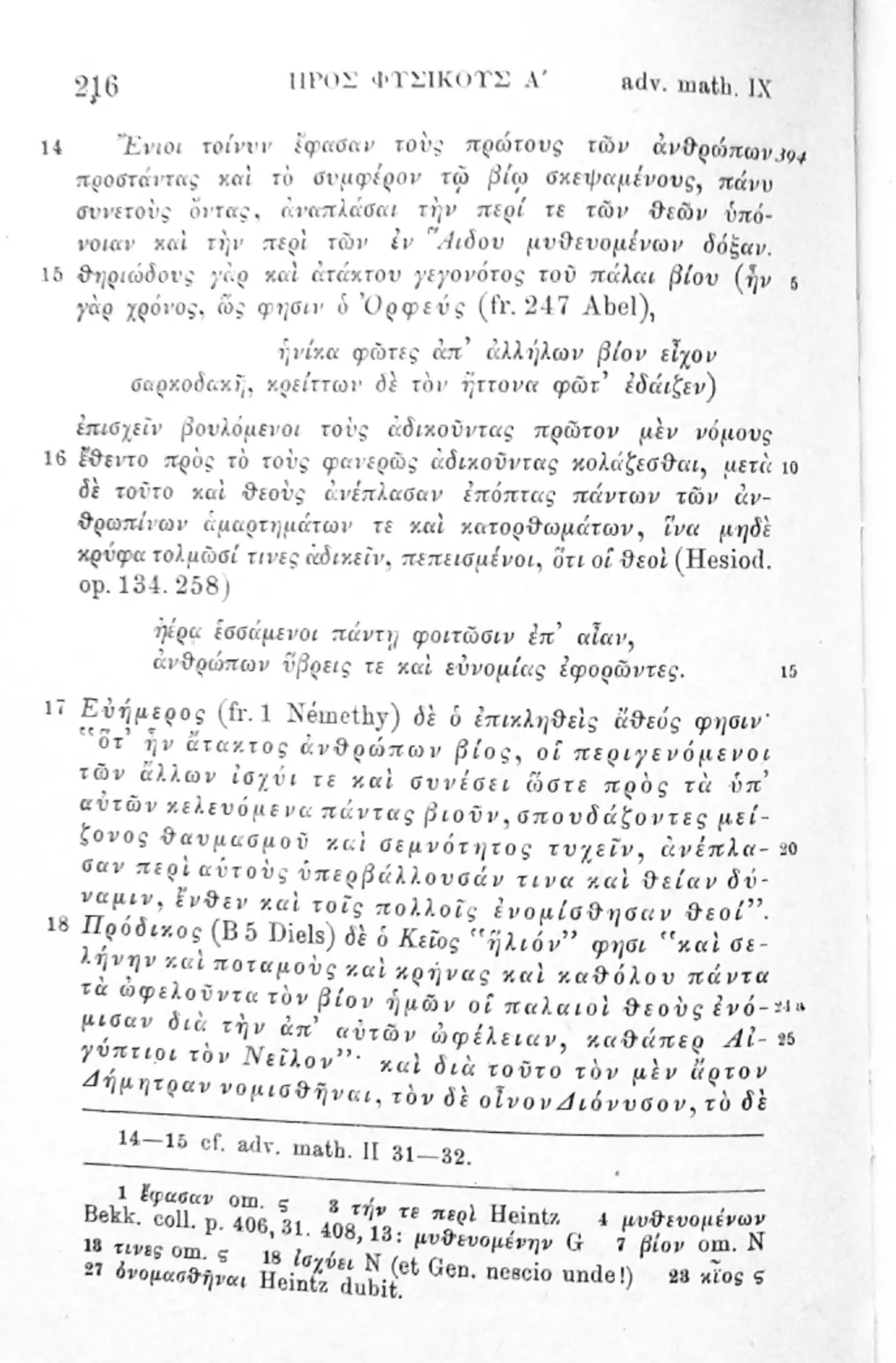
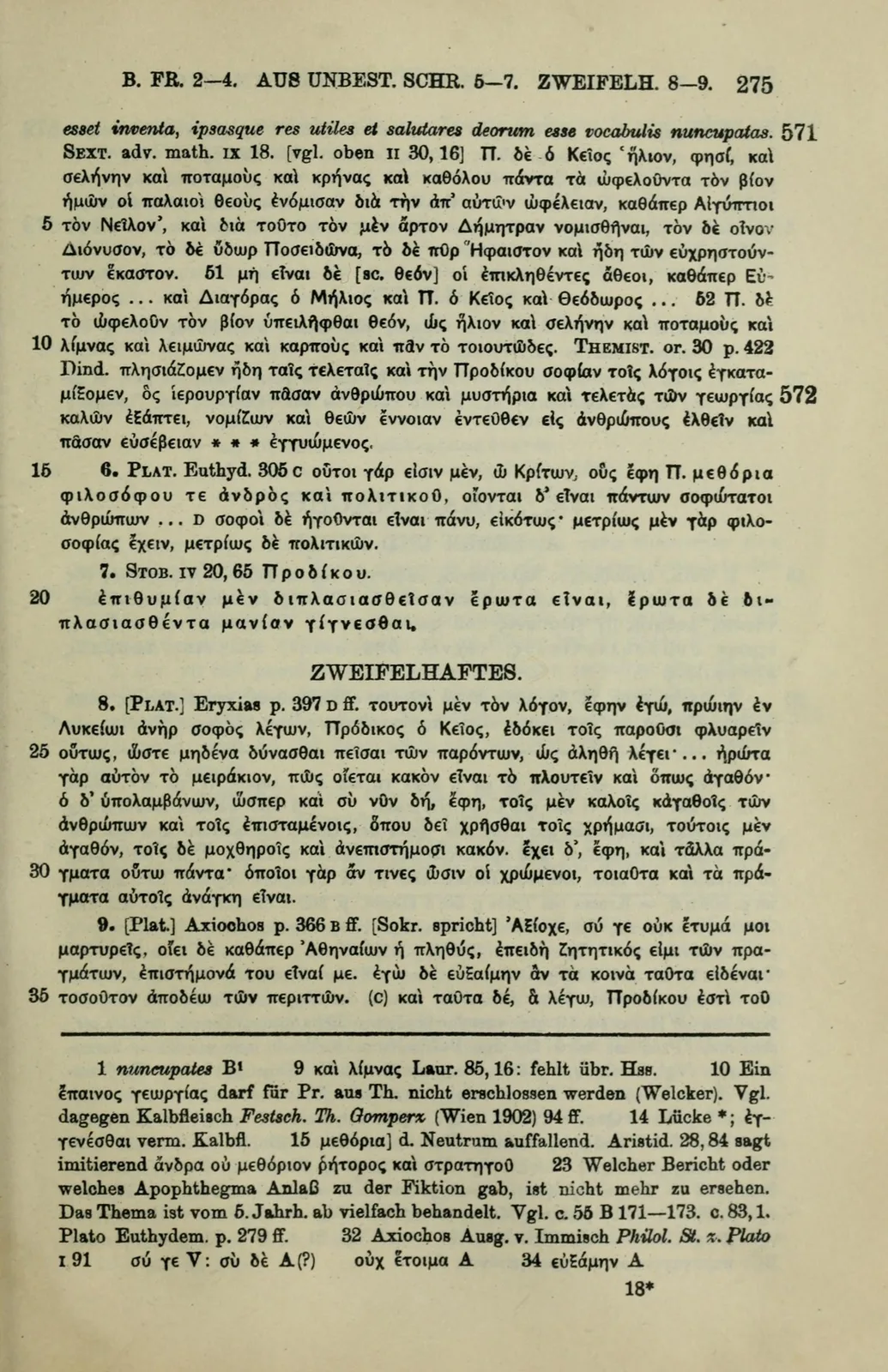
- [19] Sextus 9.18: the ancients held sun, moon, rivers, springs and everything that benefits life to be gods because of the benefit, as the Egyptians held the Nile, and so bread was thought Demeter, wine Dionysus, water Poseidon, fire Hephaestus, and each useful thing a god. Sextus presents it as one of several accounts of how belief in gods arose, between Euhemerus and Democritus. — Sextus Empiricus, Adversus dogmaticos (= Adv. math. 7-11), ed. Hermann Mutschmann, Sexti Empirici Opera, vol. II (Leipzig: Teubner, 1914), pp. 216-217 (Adv. math. 9.18), page image checked.
- [20] Sextus 9.52: Prodicus held that what benefits life is taken to be a god, as sun, moon, rivers, lakes, meadows, fruits and all such things. — Empiricus, Adversus dogmaticos, p. 225 (Adv. math. 9.52), page image checked.
- [23] Philodemus, On Piety, reports that the Stoic Persaeus, in his On the Gods, found it plausible that what feeds and benefits was first held divine and honoured by Prodicus, and next those who found foods, shelters or other arts (Demeter, Dionysus and so on); Cicero's passage is adduced in the same note. — Hermann Diels, Die Fragmente der Vorsokratiker griechisch und deutsch (Berlin: Weidmann, 1903; first edition), p. 540 B 5 (Greek, OCR garbled); Hermann Diels, Doxographi Graeci (Berlin: Reimer, 1879), p. 544; Gomperz, Greek Thinkers, p. 430. Reported at second hand; the original has not been seen.
- [25] Themistius, Orations 30: Prodicus ties every sacred rite, mystery, festival and initiation to the good things of farming, believing that the idea of gods came to men from there and that he thereby guarantees all piety. — Diels, Die Fragmente der Vorsokratiker griechisch…, p. 540 B 5 (Greek, OCR); Dictionary of Greek and Roman…, p. 543 ("Praise of Agriculture", Themist. Or. 30).
- [21] Sextus 9.51: those "so-called atheists" who said the gods do not exist include Euhemerus, Diagoras of Melos, Prodicus of Ceos, Theodorus and "a great many others"; the common preconception and most dogmatists say they do. — Empiricus, Adversus dogmaticos, p. 225 (9.51).
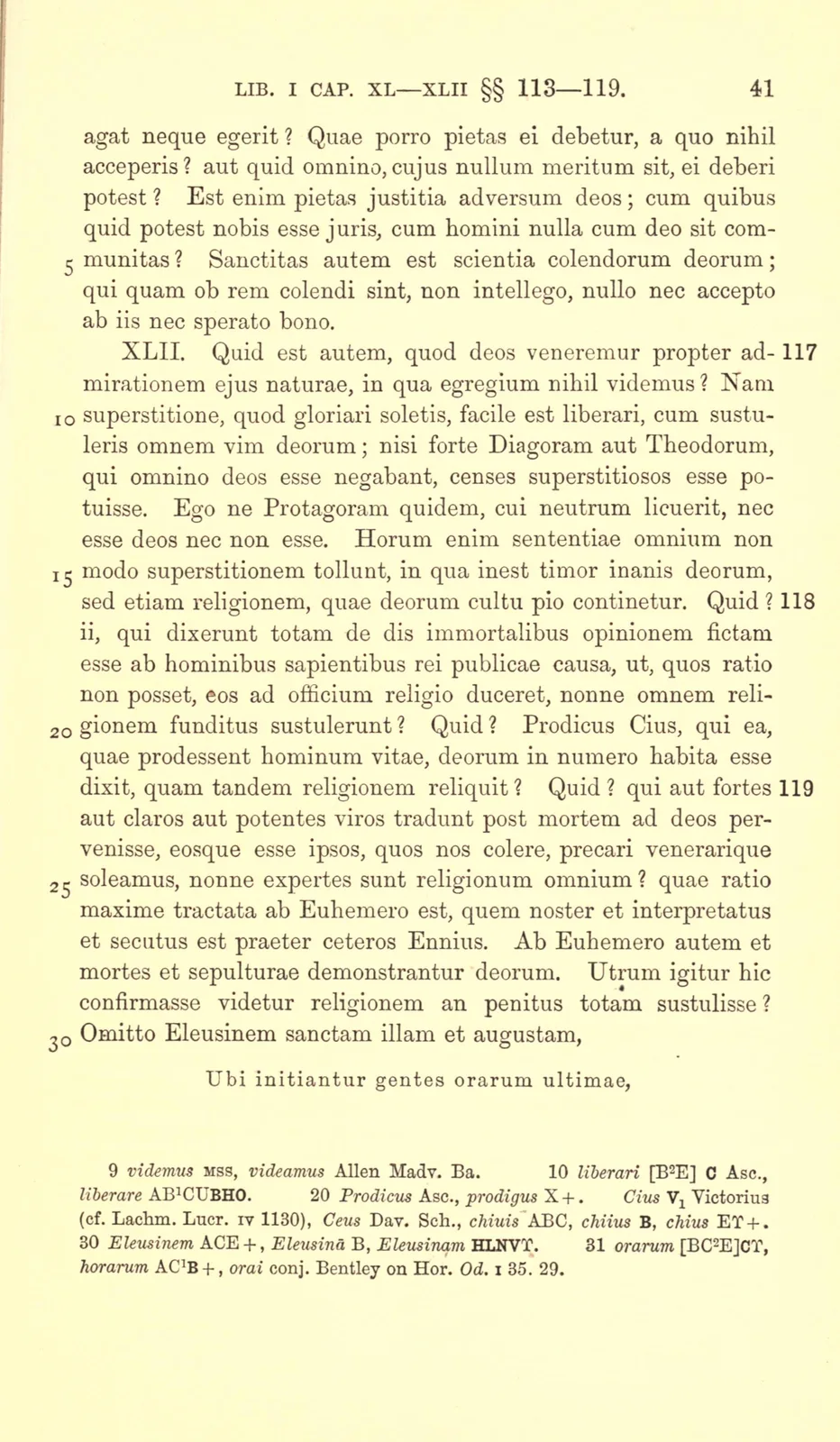
- [22] Cicero's Cotta asks what religion Prodicus left to men, "who held that everything beneficial to human life should be numbered among the Gods", and ranks him with Diagoras, Theodorus, Protagoras and Euhemerus as subverting religion. — Cicero, De natura deorum I 118 (Cotta speaking), trans. C. D. Yonge in Cicero's Tusculan Disputations; also Treatises on the Nature of the Gods (Bohn, 1877 printing), Gutenberg #14988; cited as Book I chapter XLII (modern numbering 1.117-118; SEP gives I.42.117). texts/cicero-nd.txt, vol. I ch. XLII (Yonge).
- [12] The Suda says Athens put him to death with hemlock for corrupting the young. Scholars call this very suspicious; a Gutenberg footnote to Birds repeats it with the year 396. — Diels, Die Fragmente der Vorsokratiker griechisch…, p. 535 A 1 (Greek); Dictionary of Greek and Roman…, vol. III p. 542 ("sounds very suspicious"); Aristophanes, The Birds, translator uncredited, Gutenberg #3013 (line 692). texts/birds.txt. A footnote in this edition says the Athenians condemned Prodicus to death in 396 BCE (see claim 12), footnote to line 692. Accounts differ; see the disputed points.
- [13] No source contemporary with Prodicus reports a trial; in 399 Plato's Socrates names him as a living, free-travelling teacher. A comic line (Aristophanes' Banqueters) jokes that someone "escaped corruption by a book, Prodicus did it", and the Socratic Aeschines ranked him with Anaxagoras in a charge of educating the unprincipled Theramenes. — Gomperz, Greek Thinkers, p. 426; Plato, Apology, Jowett, Gutenberg #1656 (19e-20a). texts/plato-apology.txt, 19e. Not verified.
- [32] A consolation attributed to him that death concerns neither the living nor the dead survives in the pseudo-Platonic Axiochus; Gomperz compares Epicurus. The same dialogue gives him a view of the soul's release into the aether, which Smith says may not be his. — Diels, Die Fragmente der Vorsokratiker griechisch…, p. 540 fr. 9 (Greek); Gomperz, Greek Thinkers, p. 428; Dictionary of Greek and Roman…, vol. III p. 543.
Bread Was Called Demeter
In Xenophon's Memorabilia, Socrates tells a young man a story he says he has borrowed from "that wise man Prodicus". The hero Heracles, just grown up, sits at a place where two roads part, and two women come to him. One is dressed to please and promises him every pleasure without effort; the other promises nothing without toil. "Would you obtain the favour of the gods," she says, "then must you pay these same gods service."1234 Painters from Dürer and Carracci to Batoni and Delacroix took up the Choice of Heracles. Its author, Prodicus of Ceos, is also remembered for something quite different: an explanation of where the gods came from, which later writers took to mean that there were none.
Nothing Prodicus wrote about the gods survives. What we have are reports, the earliest about a century after his time and the fullest about six centuries after, and they disagree about what he meant.5 This chapter tells what is known of the man, then reads the reports carefully. The English of the Greek is this book's own.
The sophist from Ceos
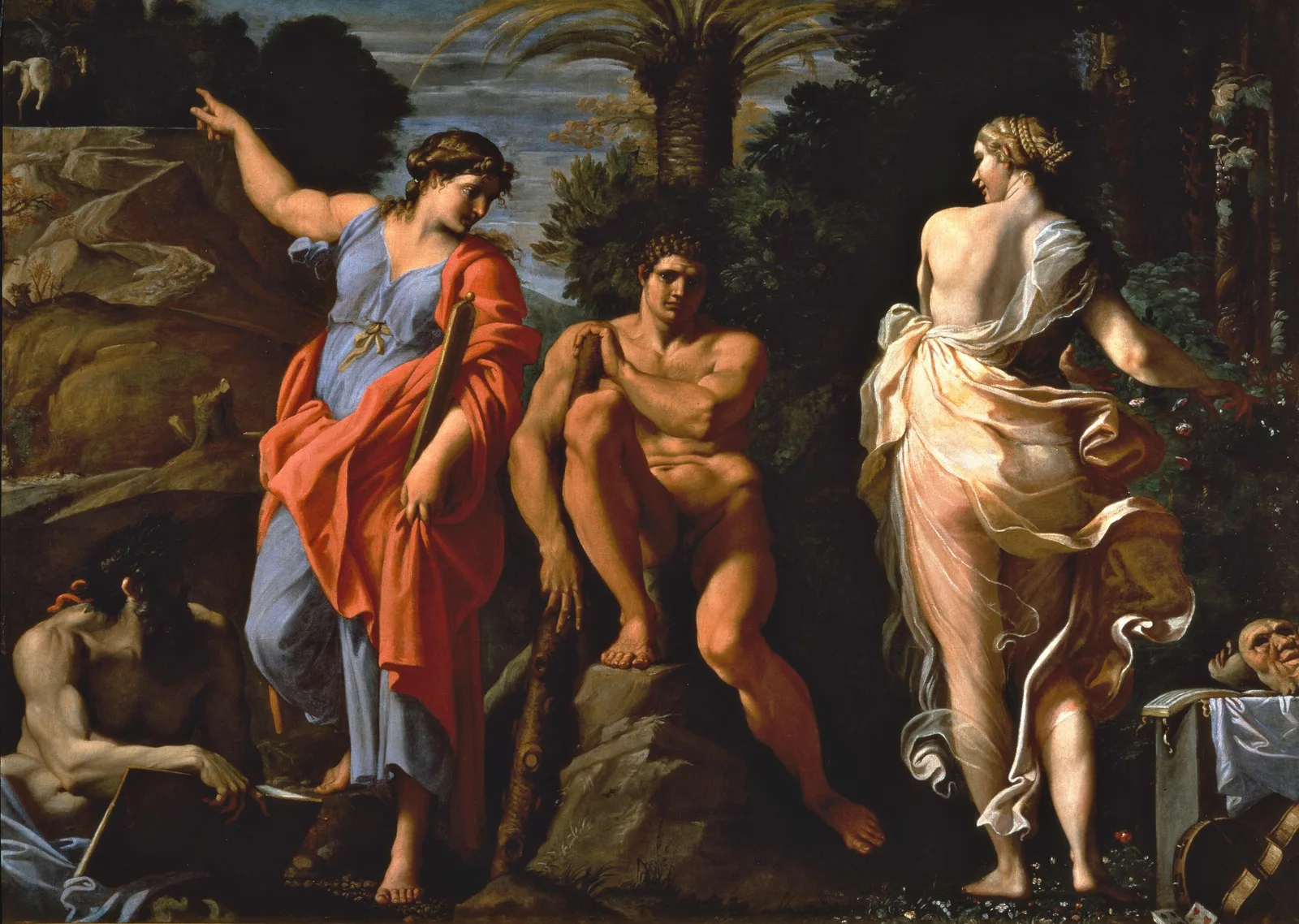
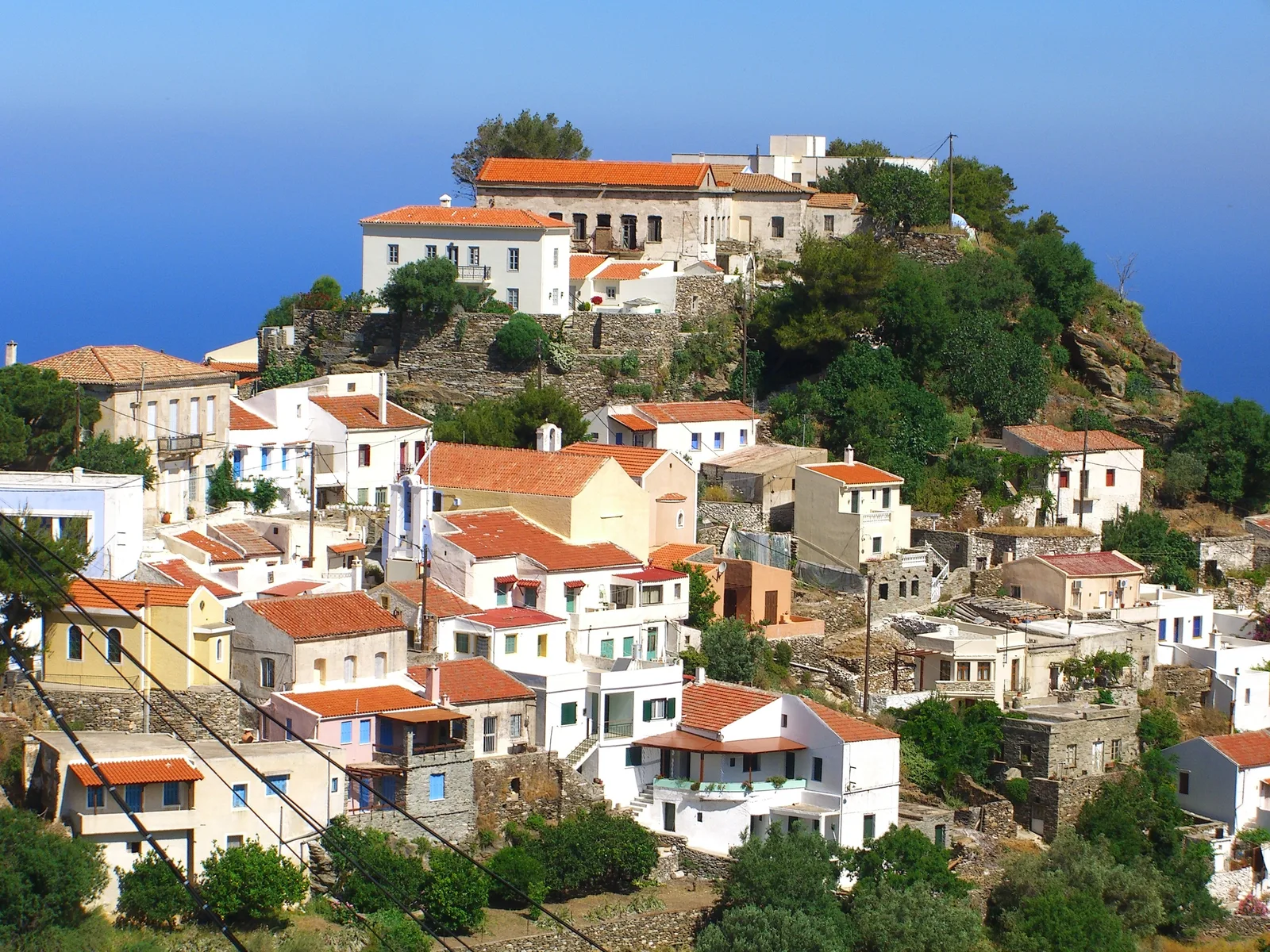
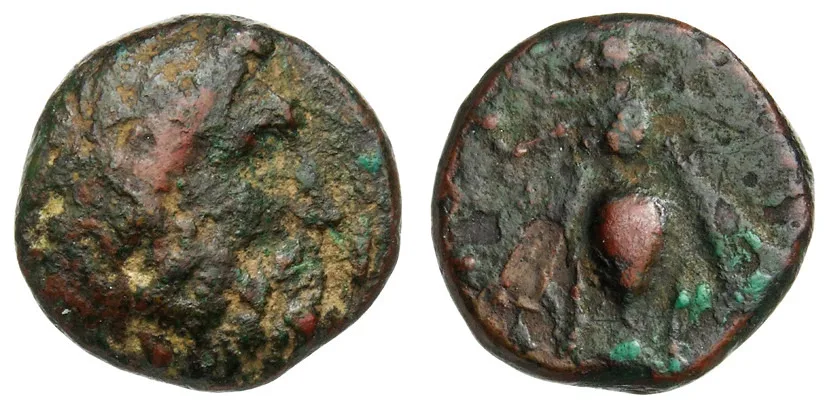
He came from Ioulis, on the island of Ceos, the birthplace of the poet Simonides.6 His dates are not known; "about 465" for his birth is a convention, and he was alive in 399.78 He first appears in Athens as an envoy on his island's business, and he stayed to teach.9 He was a sophist, one of the travelling teachers who took fees, and his fees were famous: Plato's Socrates jokes that he could afford only the one-drachma lecture, not "the fifty-drachma course of the great Prodicus, which is a complete education in grammar and language—these are his own words".1011 At his trial Socrates named him with Gorgias and Hippias as men who "go the round of the cities" and persuade the young to pay them.812
His speciality was words. He drew fine distinctions between near-synonyms, and Plato teased him for it in dialogue after dialogue. In the Protagoras, set around 430 BCE, Socrates finds him still in bed in the house of the rich Callias, wrapped in sheepskins, and cannot hear what he is saying because "his fine deep voice made an echo in the room"; he calls him, perhaps ironically, "an all-wise and inspired man".13141516 Aristophanes was gentler with him than with Socrates. In the Clouds of 423 the chorus says it would listen to no other "meteorological sophist" except Prodicus, "on account of his wisdom and intelligence".1718 In the Birds of 414 it promises to teach the origin of the gods so well that "even Prodicus will envy you your knowledge".1920
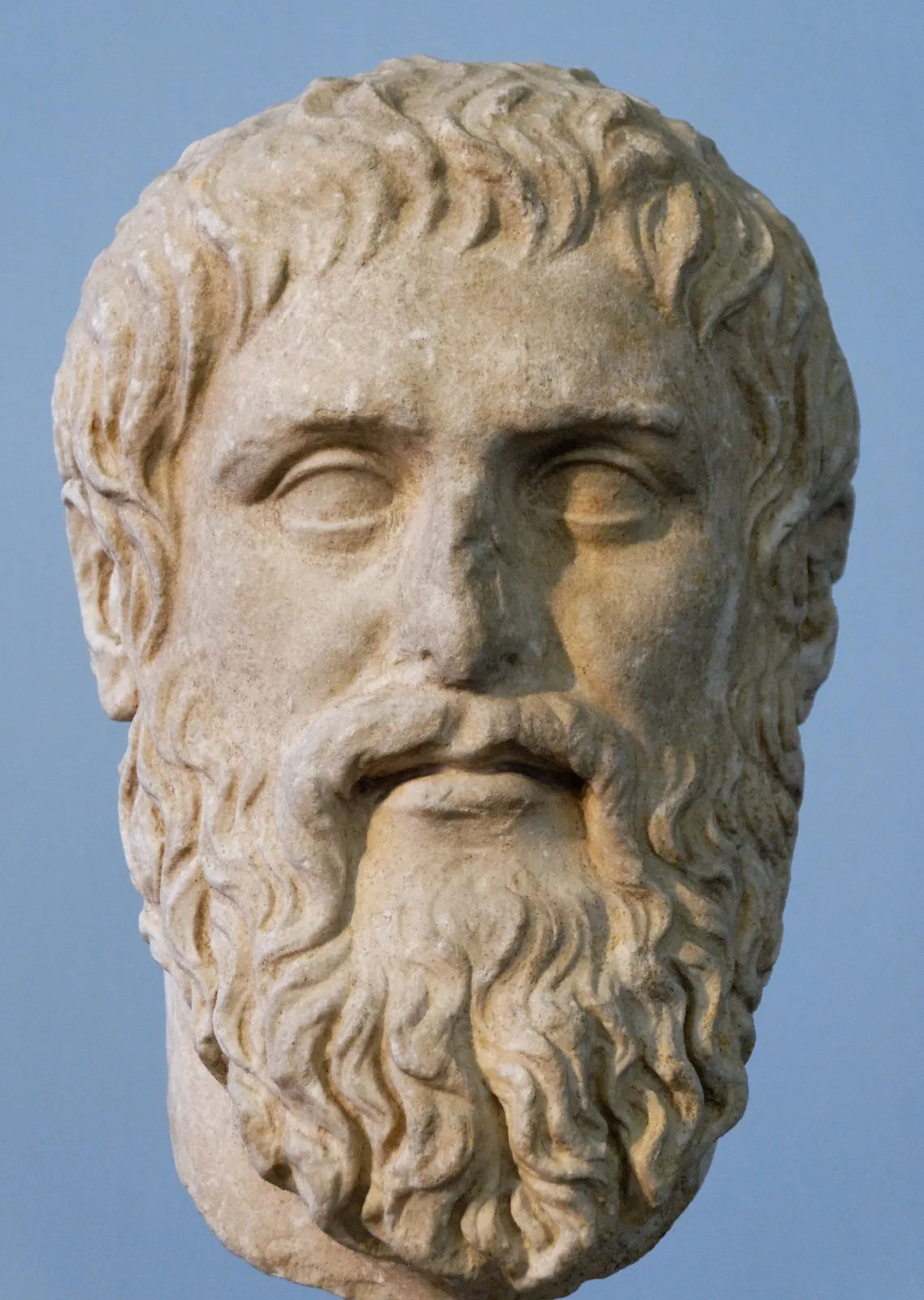
Nothing records what he believed as a young man, and nothing records a change of mind. The usual marks on this book's belief timeline cannot be filled from evidence; his timeline records only a theory, a label and a story about his death.
The theory
The fullest report is in Sextus Empiricus, a sceptic of about 200 CE. "Prodicus of Ceos says: 'The ancients held the sun and moon and rivers and springs, and in general everything that benefits our life, to be gods, because of the benefit that comes from them, as the Egyptians did the Nile'; and for this reason bread was thought to be Demeter, wine Dionysus, water Poseidon, fire Hephaestus, and in the end each of the things that serve us well."2122 Only the first part is in quotation marks as Prodicus's own words; the rest is Sextus's summary. Elsewhere Sextus puts it more briefly: what benefits life "has been taken to be a god".2324
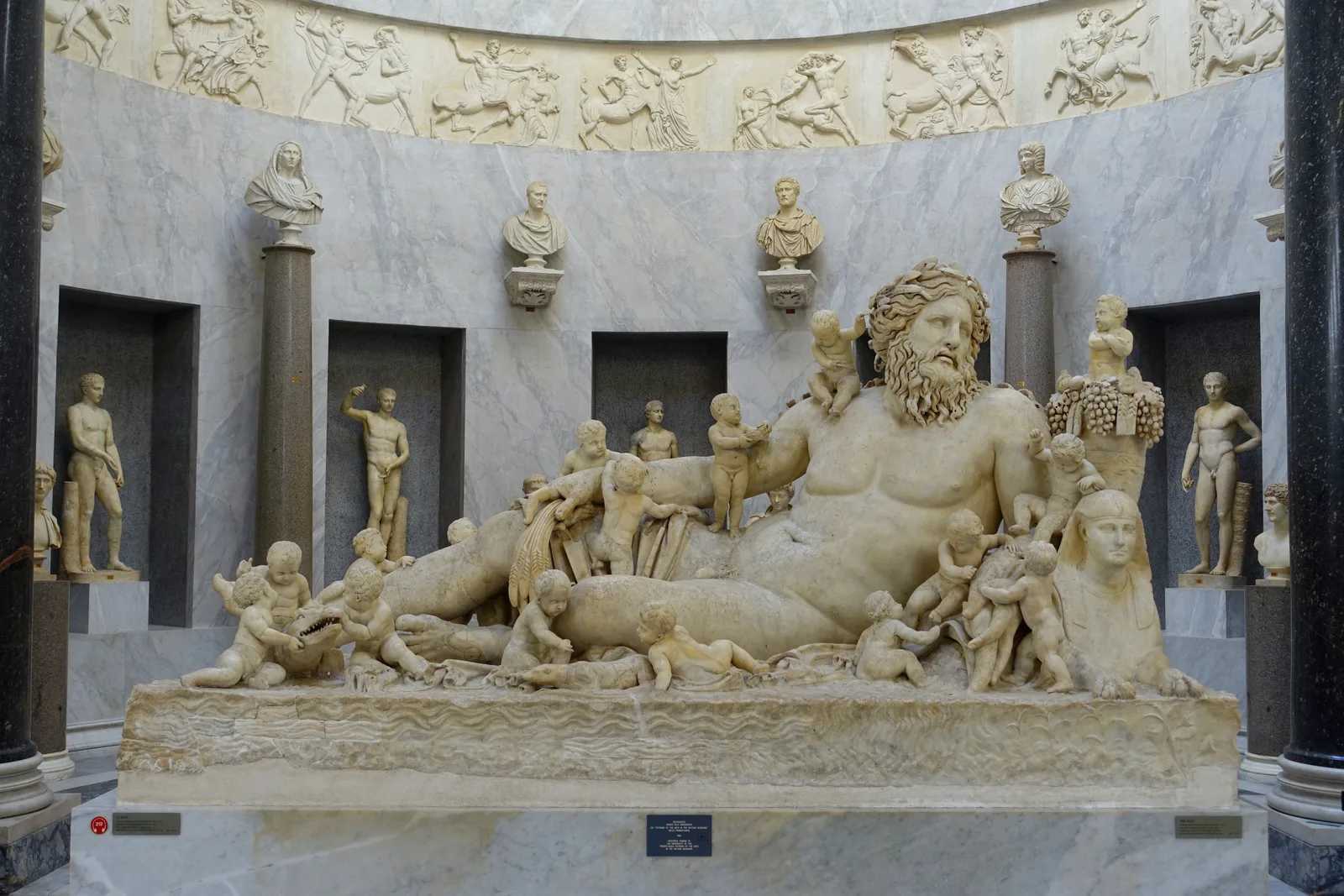
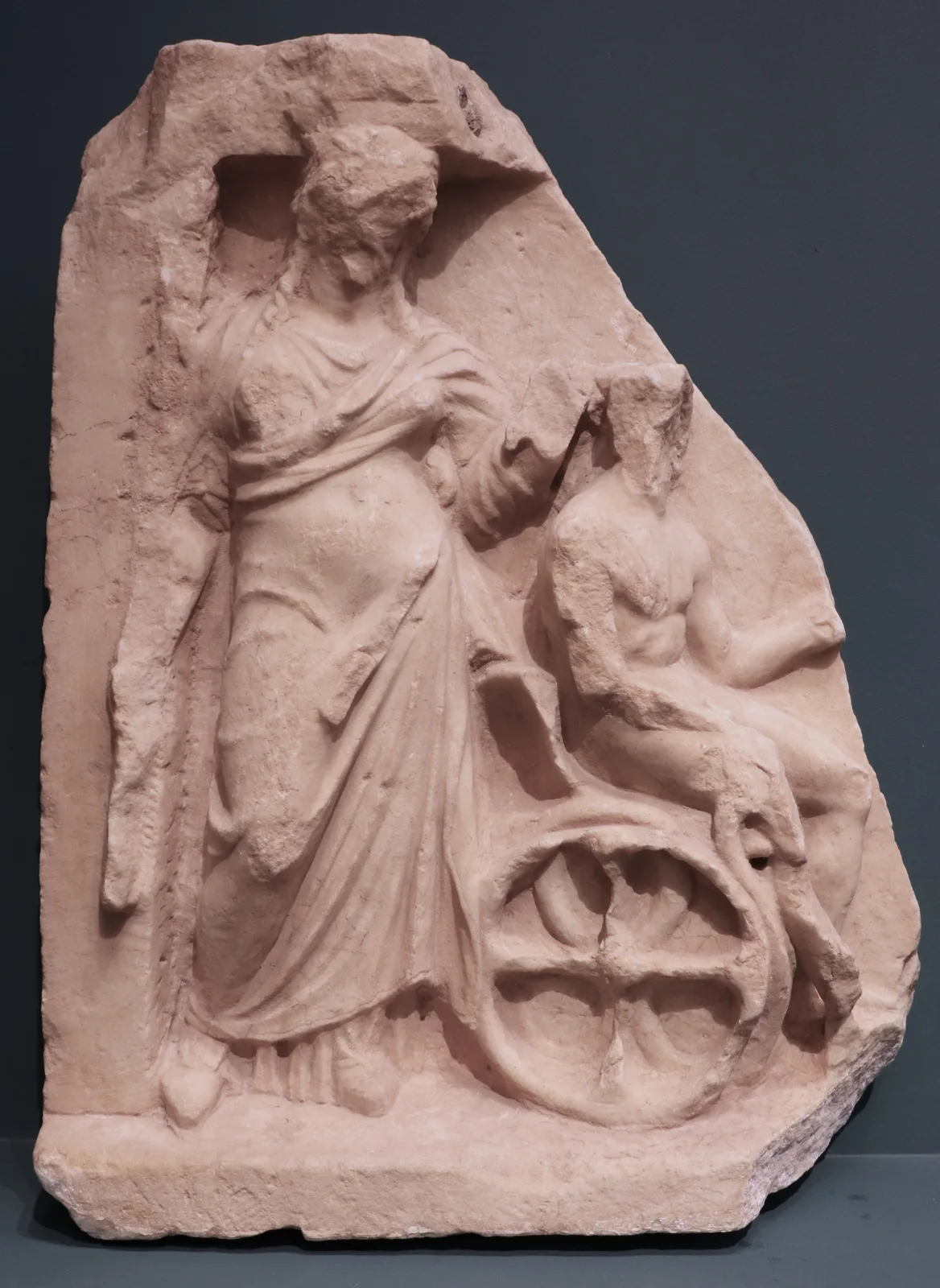
An older witness adds a second strand. The Stoic Persaeus, about a century after Prodicus, is reported to have thought it plausible that people first honoured as divine what fed and helped them, and next the men who discovered foods, shelter and crafts, as Demeter and Dionysus.25 A later orator linked Prodicus to the rites of farming, and said he tied every mystery and festival to the good things of the earth.26 Which of his books held the theory is not known.27
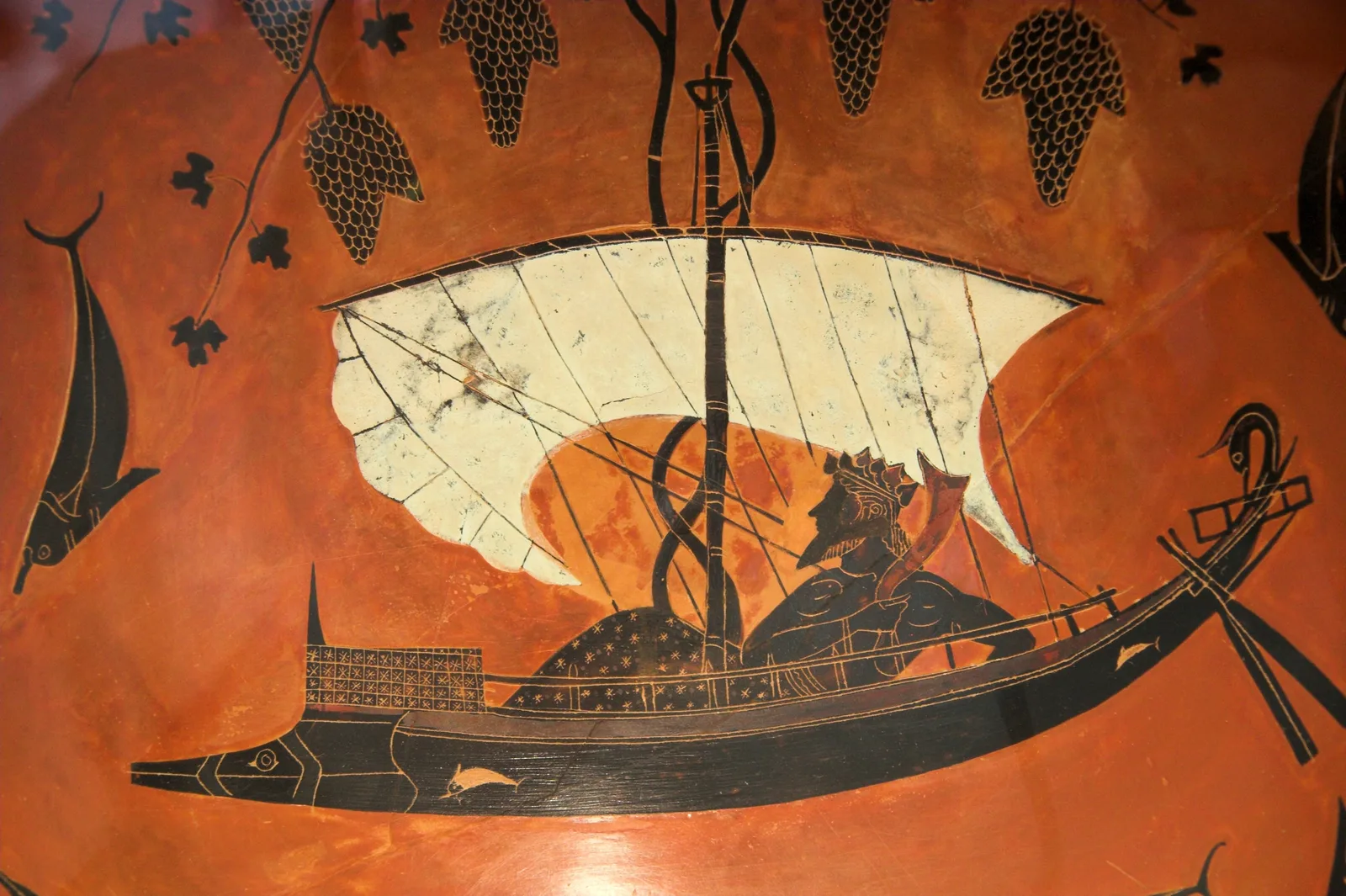
That is a theory of how belief arose. Whether it is also a denial is the question. The word Sextus uses means "held to be gods", which does not by itself say they were nothing more.
The label
Others decided for him. Sextus listed "Diagoras of Melos and Prodicus of Ceos and Theodorus and a great many others" among the "so-called atheists".2829 In Cicero's dialogue On the Nature of the Gods, the Roman pontiff Cotta asks: "what religion did Prodicus ... leave to men, who held that everything beneficial to human life should be numbered among the Gods?"3031 Most modern scholars, the Stanford Encyclopedia reports, agree that he was an atheist of some kind, and argue only over how far he went.32 The historian Theodor Gomperz disagreed: Xenophon, a conventional believer, spoke of him with respect, and a Stoic approved his explanation, so his target was the gods of popular belief, not the divine itself.33 A Victorian dictionary put it more simply: he was "therefore, though hastily, charged with atheism".34 Accounts differ, and no sentence that there are no gods is ever put in his mouth.
The story of the hemlock
A Byzantine encyclopedia, the Suda, says the Athenians put him to death with hemlock for corrupting the young. Scholars have called that "very suspicious".35 No one of his own time reports a trial, and in 399, the year Socrates drank the hemlock, Plato's Socrates names Prodicus as a teacher still travelling freely from city to city.36 The late biographer Philostratus added that he loved money and pleasure, and that Gorgias mocked his Heracles as stale; no earlier source says so.37383940
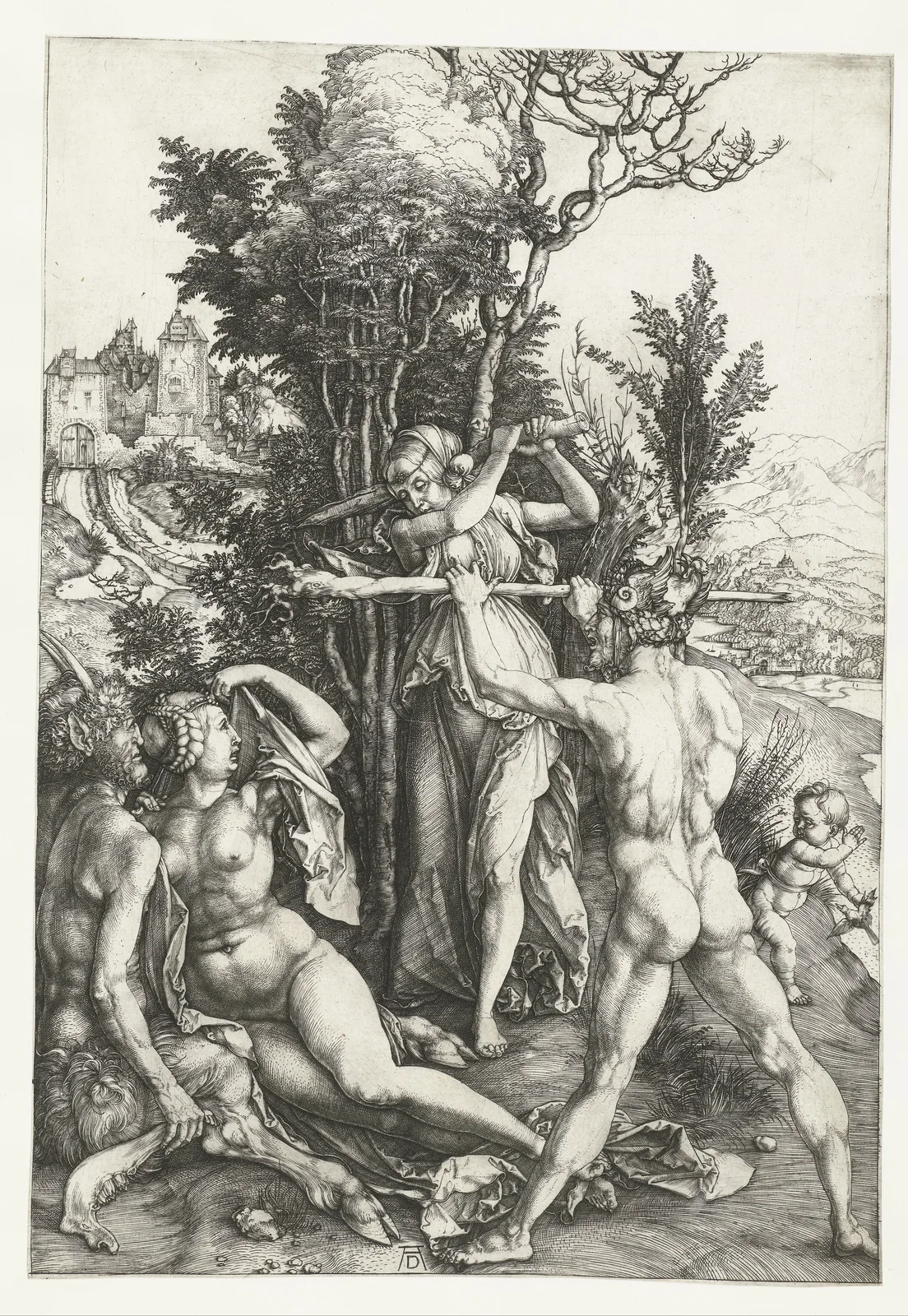
Prodicus left two things: a fable in which virtue pays the gods their due, and an account of the gods in which they began as bread and wine, rivers and sun, the good things people depended on. Whether he saw a contradiction between them, no one can now say. The ancient writer most often named beside him in these lists was Euhemerus, who had a different theory of the same question, that the gods had once been kings, and who has his own chapter in this book.
Footnotes
-
Xenophon, Memorabilia, trans. H. G. Dakyns (1897-1900), Project Gutenberg #1177, 2.1.21-34; "Prodicus," by Christian August Brandis, in William Smith (ed.), Dictionary of Greek and Roman Biography and Mythology, vol. III (Boston: Little, Brown, 1864), pp. 541-543, vol. III p. 543. ↩
-
Xenophon, Memorabilia, 2.1.28 (Dakyns). ↩
-
Socrates, in Xenophon: Xenophon, Memorabilia, 2.1.21 (Dakyns, Gutenberg #1177). ↩
-
Virtue, in Xenophon's retelling of Prodicus's Choice of Heracles: Xenophon, Memorabilia, 2.1.28 (Dakyns). ↩
-
Hermann Diels, Die Fragmente der Vorsokratiker griechisch und deutsch (Berlin: Weidmann, 1903; first edition), p. 540; Sextus Empiricus, Adversus dogmaticos (= Adv. math. 7-11), ed. Hermann Mutschmann, Sexti Empirici Opera, vol. II (Leipzig: Teubner, 1914), pp. 216-217, 225. ↩
-
Dictionary of Greek and Roman…, vol. III, pp. 541-542; Plato, Apology, Jowett, Gutenberg #1656 (19e-20a). texts/plato-apology.txt, 19e; Plato, Protagoras, trans. Benjamin Jowett (3rd ed. 1892), Gutenberg #1591. texts/plato-protagoras.txt. Stephanus numbers (315c-316a, 337a-c, 341a-c) are from Smith and SEP; the Gutenberg text carries none, (Prodicus "of Ceos"). ↩
-
Dictionary of Greek and Roman…, vol. III, p. 542 ("cannot be determined"); "Prodicus," English Wikipedia, revision 1311073332 of 13 Sept 2025 (notes/wikipedia-prodicus.json). Used only as a map: its life section is adapted from Smith (1870 reprint); the dates "c. 465 BC - c. 395 BC" are its own convention. Accounts differ; see the disputed points. ↩
-
Dictionary of Greek and Roman…, vol. III p. 542 (citing Hippias Major 282); Theodor Gomperz, Greek Thinkers, vol. I, trans. L. Magnus (London: Murray, 1901; 1920 printing scanned), pp. 424-430 (ch. on Prodicus of Ceos), p. 425, p. 428. Reported at second hand; the original has not been seen. ↩
-
Plato, Cratylus, Jowett, Gutenberg #1616 (384b). texts/plato-cratylus.txt, 384b; Dictionary of Greek and Roman…, vol. III pp. 542-543; C. C. W. Taylor and Mi-Kyoung Lee, "The Sophists," Stanford Encyclopedia of Philosophy (first published 30 Sept 2011; substantive revision, last modified 10 March 2025 per the page metadata), sections 3 and 4, sec. 4. ↩
-
Socrates, in Plato's Cratylus (384b): Plato, Cratylus, (Jowett, Gutenberg #1616). ↩
-
Socrates, at his trial, in Plato's Apology (19e): Plato, Apology, (Jowett, Gutenberg #1656). ↩
-
Plato, Protagoras, (Jowett, Socrates' narration at Callias's door); Dictionary of Greek and Roman…, p. 542 (87th Olympiad). ↩
-
Plato, Protagoras; Dictionary of Greek and Roman…, p. 542. ↩
-
Plato-Charm 163d; Plato-Laches 197d; , [Plato-Charm], [Plato-Laches], [Plato-Theaet], [Plato-Euthyd] Plato, Meno (#1643; 75e, 96d), Charmides (#1580; 163d), Laches (#1584; 197d), Theaetetus (#1726; 151b), Euthydemus (#1598; 277e, 305c), all Jowett. texts/plato-meno.txt etc, 75e; Plato, Cratylus, 384b; Plato-Euthyd 277e, 305c; Gomperz, Greek Thinkers, pp. 426-427. ↩
-
Socrates, narrating, in Plato: Plato, Protagoras, (Jowett, Gutenberg #1591), at Callias's house (315d-316a). ↩
-
Aristophanes, The Clouds, trans. W. J. Hickie, Gutenberg #2562 (line 360-361). texts/clouds.txt, (Hickie), the Chorus's reply to Strepsiades, line 360-361; date: Smith p. 542 (Ol. 89), Wiki. ↩
-
Chorus of the Clouds, in Aristophanes' Clouds: Aristophanes, Clouds, (Hickie, Gutenberg #2562), the Chorus's reply to Strepsiades (line 360-361). ↩
-
Aristophanes, The Birds, translator uncredited, Gutenberg #3013 (line 692). texts/birds.txt. A footnote in this edition says the Athenians condemned Prodicus to death in 396 BCE (see claim 12), the parabasis (line 692); Dictionary of Greek and Roman…, p. 542 (Ol. 91). ↩
-
Chorus of Birds, in Aristophanes' Birds: Aristophanes, Birds, (Gutenberg #3013), the parabasis (line 692). ↩
-
Empiricus, Adversus dogmaticos, pp. 216-217 (Adv. math. 9.18), page image checked. ↩
-
Prodicus, as reported by Sextus Empiricus: Empiricus, Adversus dogmaticos, Adv. math. 9.18, vol. II pp. 216-217 (Diels-Kranz 84 B 5). Own translation: "Prodicus of Ceos says: 'The ancients held the sun and moon and rivers and springs, and in general everything that benefits our life, to be gods, because of the benefit that comes from them, as the Egyptians did the Nile'; and for this reason bread was thought to be Demeter, wine Dionysus, water Poseidon, fire Hephaestus, and in the end each of the things that serve us well." The quotation marks are Sextus's: only "the ancients ... Nile" is given as Prodicus's own words, the rest is Sextus's report. Often quoted in English as "bread is Demeter, wine is Dionysus" without that qualification. ↩
-
Empiricus, Adversus dogmaticos, p. 225 (Adv. math. 9.52), page image checked. ↩
-
Sextus Empiricus on Prodicus: Empiricus, Adversus dogmaticos, Adv. math. 9.52, vol. II p. 225 (DK 84 B 5). ↩
-
Diels, Die Fragmente der Vorsokratiker griechisch…, p. 540 B 5 (Greek, OCR garbled); Hermann Diels, Doxographi Graeci (Berlin: Reimer, 1879), p. 544; Gomperz, Greek Thinkers, p. 430. ↩
-
Diels, Die Fragmente der Vorsokratiker griechisch…, p. 540 B 5 (Greek, OCR); Dictionary of Greek and Roman…, p. 543 ("Praise of Agriculture", Themist. Or. 30). ↩
-
Gomperz, Greek Thinkers, p. 426, p. 429; Diels, Die Fragmente der Vorsokratiker griechisch…, pp. 539-540; SEP, sec. 3. ↩
-
Empiricus, Adversus dogmaticos, p. 225 (9.51). ↩
-
Sextus Empiricus (2nd c. CE), sceptic doctor, listing the "so-called atheists" (οἱ ἐπικληθέντες ἄθεοι): Empiricus, Adversus dogmaticos, Adv. math. 9.51, vol. II p. 225. ↩
-
Cicero, De natura deorum I 118 (Cotta speaking), trans. C. D. Yonge in Cicero's Tusculan Disputations; also Treatises on the Nature of the Gods (Bohn, 1877 printing), Gutenberg #14988; cited as Book I chapter XLII (modern numbering 1.117-118; SEP gives I.42.117). texts/cicero-nd.txt, vol. I ch. XLII (Yonge). ↩
-
Cotta, Roman Academic sceptic and pontifex, in Cicero's dialogue (dramatic date c. 77 BCE), arguing against the Epicurean Velleius; Yonge's text prints "the Chian" (Cicero's Latin is usually read as "of Ceos"; I have not seen the Latin): Cicero, De natura deorum, vol. I ch. XLII, Yonge (Gutenberg #14988). ↩
-
SEP, sec. 3 (not reproduced; paraphrase). ↩
-
Gomperz, Greek Thinkers, pp. 429-430. ↩
-
Dictionary of Greek and Roman…, vol. III p. 543; Eduard Zeller, Outlines of the History of Greek Philosophy, trans. Alleyne and Abbott (London: Longmans, 1890), p. 97, p. 97. ↩
-
Diels, Die Fragmente der Vorsokratiker griechisch…, p. 535 A 1 (Greek); Dictionary of Greek and Roman…, vol. III p. 542 ("sounds very suspicious"); Aristophanes, Birds, footnote to line 692. ↩
-
Gomperz, Greek Thinkers, p. 426; Plato, Apology, 19e. Not verified. ↩
-
Philostratus, Lives of the Sophists 1.9 (482-483 Kayser) and 1.12 (496-497), trans. W. C. Wright, Loeb (London: Heinemann, 1922), p. 9, p. 11; Dictionary of Greek and Roman…, vol. III p. 542. ↩
-
Philostratus, Lives of the Sophists, p. 39 (VS 1.12, 497); Dictionary of Greek and Roman…, vol. III p. 542. ↩
-
Philostratus (c. 170-250 CE), biographer of the sophists, on Prodicus; hostile and late: Philostratus, Lives of the Sophists, Wright, p. 39 (VS 1.12, 497). ↩
-
Philostratus, reporting a rivalry between sophists: Philostratus, Lives of the Sophists, Wright, p. 11 (VS 1.9, 483). ↩
In their own words
Πρόδικος δὲ ὁ Κεῖος "ἥλιόν" φησι "καὶ σελήνην καὶ ποταμοὺς καὶ κρήνας καὶ καθόλου πάντα τὰ ὠφελοῦντα τὸν βίον ἡμῶν οἱ παλαιοὶ θεοὺς ἐνόμισαν διὰ τὴν ἀπ᾿ αὐτῶν ὠφέλειαν, καθάπερ Αἰγύπτιοι τὸν Νεῖλον" καὶ διὰ τοῦτο τὸν μὲν ἄρτον Δήμητραν νομισθῆναι, τὸν δὲ οἶνον Διόνυσον, τὸ δὲ ὕδωρ Ποσειδῶνα, τὸ δὲ πῦρ Ἥφαιστον καὶ ἤδη τῶν εὐχρηστούντων ἕκαστον.
Πρόδικος δὲ τὸ ὠφελοῦν τὸν βίον ὑπειλῆφθαι θεόν, ὡς ἥλιον καὶ σελήνην καὶ ποταμοὺς καὶ λίμνας καὶ λειμῶνας καὶ καρποὺς καὶ πᾶν τὸ τοιουτῶδες.
And that wise man Prodicus delivers himself in a like strain concerning virtue in that composition of his about Heracles, which crowds have listened to.
I was very anxious to hear what Prodicus was saying, for he seems to me to be an all-wise and inspired man; but I was not able to get into the inner circle, and his fine deep voice made an echo in the room which rendered his words inaudible.
for gratification is of the mind when receiving wisdom and knowledge, but pleasure is of the body when eating or experiencing some other bodily delight.
If I had not been poor, I might have heard the fifty-drachma course of the great Prodicus, which is a complete education in grammar and language—these are his own words—and then I should have been at once able to answer your question about the correctness of names.
There is Gorgias of Leontium, and Prodicus of Ceos, and Hippias of Elis, who go the round of the cities, and are able to persuade the young men to leave their own citizens by whom they might be taught for nothing, and come to them whom they not only pay, but are thankful if they may be allowed to pay them.
For we would not hearken to any other of the recent meteorological sophists, except to Prodicus; to him, on account of his wisdom and intelligence
thanks to us, even Prodicus will envy you your knowledge
I am afraid, Meno, that you and I are not good for much, and that Gorgias has been as poor an educator of you as Prodicus has been of me.
one of those whom Prodicus describes as on the border-ground between philosophers and statesmen
Prodicus of Ceos had composed a certain pleasant fable in which Virtue and Vice came to Heracles in the shape of women, one of them dressed in seductive and many-coloured attire, the other with no care for effect
Would you obtain the favour of the gods, then must you pay these same gods service
Damon is always with Prodicus, who, of all the Sophists, is considered to be the best puller to pieces of words of this sort.
The other side
Or what religion did Prodicus the Chian leave to men, who held that everything beneficial to human life should be numbered among the Gods?
καὶ Διαγόρας ὁ Μήλιος καὶ Πρόδικος ὁ Κεῖος καὶ Θεόδωρος καὶ ἄλλοι παμπληθεῖς
for he had a weakness for making money and was addicted to pleasure
Thereupon Gorgias ridiculed Prodicus for handling a theme that was stale and hackneyed
Where accounts differ
| Point | One account | Another | How the page handles it |
|---|---|---|---|
| Was Prodicus an atheist? | Yes, of some kind: Sextus lists him among the "so-called atheists" (claim 21); Cotta says he left no religion (claim 22); most modern commentators agree (SEP, claim 28). | No: he explained the origin of belief but did not deny the divine; Xenophon honoured him and the Stoic Persaeus approved (Gomperz, claim 29); Sedley dissents (SEP, claim 28, not read). | Say plainly that no sentence "there are no gods" is attributed to him; say what he explained, then give both readings and who held each. |
| Radical or moderate? (if atheist) | Radical: Demeter is only grain and Dionysus only wine (SEP's reading of the "probably right" ancient view). | Moderate: sun, moon, water remain divine; only the gods of poets and cults are explained away (SEP, citing Mayhew 2011). | State that "bread, wine and rivers" is Sextus's report; the verb is "held to be gods" (nomizein), which does not say they are nothing more. |
| One theory or two | Natural things that help life are called gods (Sextus 9.18, 9.52, claims 19-20; Epiphanius, claim 26). | A second strand: after these, the men who discovered foods, shelter and crafts were honoured as Demeter, Dionysus and so on (Philodemus via Persaeus, Cicero's note, claim 23; Gomperz, claim 29). | Present as two attested strands; the second is in Philodemus only. |
| Birth and death dates | c. 465-c. 395 BCE (Wikipedia, claim 2). | "cannot be determined" (Smith, claim 2); alive in 399 (claim 10). | Use "born about 465" only with "about" and say that he is first seen as a grown man in the 430s. |
| Death by hemlock | The Suda: condemned by Athens for corrupting youth (claim 12); the Birds footnote adds 396 BCE. | Smith: "sounds very suspicious"; no contemporary reports it; Plato's Socrates names him as a free teacher in 399 (claims 12, 13). | Report as a late story, not a fact; never say Athens killed him. |
| His character | Avaricious and given to pleasure (Philostratus, claim 31). | Serious and morally earnest (Xenophon, Plato's mixed respect, Gomperz p. 426); Smith says no earlier source calls him avaricious. | Mention both; do not rest anything on Philostratus. |
| Which work held the theory | Possibly the Horai (the Heracles speech, tied to farming and seasons; Themistius links him to agriculture and rites, claim 25). | On Nature or a work On the Gods; unknown (claim 24); Persaeus's On the Gods is the source of the report, not Prodicus's own title. | Say the book is unknown. |
| Axiochus attribution | The Axiochus preserves a lecture of Prodicus on life and death (Smith; Gomperz). | The attribution to Prodicus is conjecture; Smith calls the immortality arguments doubtful. | Do not use as evidence of his view of the afterlife. |
| "of Ceos" or "the Chian" | Cicero in Yonge: "Prodicus the Chian". | Every other source: "of Ceos" (Plato, Sextus, Xenophon). | Use "of Ceos"; footnote only if the Cicero quotation is read out. |
List of illustrations
This page uses only public-domain and Creative Commons images; each is credited with its source and licence.
- Annibale Carracci - The Choice of Heracles - WGA4416 — Annibale Carracci, 1596 · Wikimedia Commons, Annibale Carracci - The Choice of Heracles - WGA4416.jpg; Annibale Carracci; Public domain · Public domain
- Ioulis 840 02, Greece - panoramio (4) — Kevin Stroup, Taken on 30 May 2006 · Wikimedia Commons, Ioulis 840 02, Greece - panoramio (4).jpg; Kevin Stroup; CC BY 3.0 · CC BY 3.0
- Ioulis - Münzkabinett, Berlin - 5506252 — Reinhard Saczewski, 4th-c-bce · Wikimedia Commons, Ioulis - Münzkabinett, Berlin - 5506252.jpg; Reinhard Saczewski; Public domain · Public domain
- Plato Silanion Musei Capitolini MC1377 (cropped) — Marie-Lan Nguyen, 2009 · Wikimedia Commons, Plato Silanion Musei Capitolini MC1377 (cropped).jpg; Marie-Lan Nguyen; Public domain · Public domain
- Sexti Empirici Opera omnia, vol. II, Adversus dogmaticos libri quinque: p. 216, Adv. math. IX 18 (Prodicus: the sun, moon, rivers and springs; bread is Demeter, wine Dionysus) — Sextus Empiricus, ed. J. Mutschmann, 1914 (Teubner; IA record gives no year, 1914 per standard bibliography) · Internet Archive, sexti-empirici (Leipzig, Teubner, 1914); scan of a pre-1931 book; public domain · Public domain (published before 1931; the Internet Archive record states no licence)
- The Nile, inv. 2300 - Braccio Nuovo, Museo Chiaramonti - Vatican Museums - DSC00913 — Daderot, 2019-04-06 03:53:59 · Wikimedia Commons, The Nile, inv. 2300 - Braccio Nuovo, Museo Chiaramonti - Vatican Museums - DSC00913.jpg; Daderot; Public domain · Public domain
- Votive relief showing Demeter and Triptolemos, Eleusis, 4th c BC — Furius, 2022-08-29 12:36:03 · Wikimedia Commons, Votive relief showing Demeter and Triptolemos, Eleusis, 4th c BC.jpg; Furius; CC0 · CC0
- Kylix Dionysus on a ship between dolphins 530 BC, Staatliche Antikensammlungen Munich 120637 — Zde, 2014-03-15 17:08:43 · Wikimedia Commons, Kylix Dionysus on a ship between dolphins 530 BC, Staatliche Antikensammlungen Munich 120637.jpg; Zde; Public domain · Public domain
- Die Fragmente der Vorsokratiker, griechisch und deutsch, vol. II (4th ed.): p. 275, Prodikos B 5 (Sextus IX 18; Cicero, De natura deorum I 118) — Hermann Diels, 1922 · Internet Archive, diefragmentederv02dieluoft (Berlin, Weidmann, 1922); scan of a pre-1931 book; public domain · Public domain (published before 1931; the Internet Archive record states no licence)
- M. Tulli Ciceronis De natura deorum libri tres, ed. J. B. Mayor (Cambridge, 1880), vol. I: p. 41, I. 118 (Prodicus Cius ...) — Cicero, ed. Joseph B. Mayor and J. H. Swainson, 1880 · Internet Archive, denaturadeorum01ciceuoft (Cambridge, 1880); scan of a pre-1931 book; public domain · Public domain (published before 1931; the Internet Archive record states no licence)
- Hercules op de tweesprong, RP-P-OB-1236 — Rijksmuseum, between 1496 and 1500 · Wikimedia Commons, Hercules op de tweesprong, RP-P-OB-1236.jpg; Rijksmuseum; CC0 · CC0
Sources
Tier 1 — the subject's own words (writings, letters, diaries, trial records)
- [Sextus-T] Sextus Empiricus, Adversus dogmaticos (= Adv. math. 7-11), ed. Hermann Mutschmann, Sexti Empirici Opera, vol. II (Leipzig: Teubner, 1914). Scan: https://archive.org/details/sexti-empirici . Text saved as texts/sextus-teubner-v2-1914.txt. Page numbers are the Teubner printed pages, confirmed on the page images (leaf = page + 21). Adv. math. 9.18 is on pp. 216-217, 9.51-52 on p. 225.
- [Diels03] Hermann Diels, Die Fragmente der Vorsokratiker griechisch und deutsch (Berlin: Weidmann, 1903; first edition). https://archive.org/details/diefragmenteder01krangoog . texts/diels-1903.txt. The Prodicus chapter (fragment numbers A and B as in later DK 84) is on printed pp. 535-541; page numbers read from OCR running heads (535/536, 540, 541); the Greek OCR is noisy. Not seen as an image.
- [Diels79] Hermann Diels, Doxographi Graeci (Berlin: Reimer, 1879). https://archive.org/details/doxographigraec00dielgoog . texts/diels-doxographi-1879.txt. Epiphanius, Adv. haer. III 2, 9 at p. 591 (section 21); Philodemus, De pietate excerpts at p. 544.
- [Xen-Mem] Xenophon, Memorabilia, trans. H. G. Dakyns (1897-1900), Project Gutenberg #1177. https://www.gutenberg.org/ebooks/1177 . texts/xenophon-mem.txt. No page numbers in the Gutenberg text; cited by book, chapter, section (Mem. 2.1.21-34).
- [Xen-Symp] Xenophon, Symposium, Dakyns translation, Gutenberg #1181. texts/xenophon-symposium.txt.
- [Plato-Prot] Plato, Protagoras, trans. Benjamin Jowett (3rd ed. 1892), Gutenberg #1591. texts/plato-protagoras.txt. Stephanus numbers (315c-316a, 337a-c, 341a-c) are from Smith and SEP; the Gutenberg text carries none.
- [Plato-Apol] Plato, Apology, Jowett, Gutenberg #1656 (19e-20a). texts/plato-apology.txt.
- [Plato-Crat] Plato, Cratylus, Jowett, Gutenberg #1616 (384b). texts/plato-cratylus.txt.
- [Plato-Meno], [Plato-Charm], [Plato-Laches], [Plato-Theaet], [Plato-Euthyd] Plato, Meno (#1643; 75e, 96d), Charmides (#1580; 163d), Laches (#1584; 197d), Theaetetus (#1726; 151b), Euthydemus (#1598; 277e, 305c), all Jowett. texts/plato-meno.txt etc.
- [Clouds] Aristophanes, The Clouds, trans. W. J. Hickie, Gutenberg #2562 (line 360-361). texts/clouds.txt.
- [Birds] Aristophanes, The Birds, translator uncredited, Gutenberg #3013 (line 692). texts/birds.txt. A footnote in this edition says the Athenians condemned Prodicus to death in 396 BCE (see claim 12).
- [Cic-ND] Cicero, De natura deorum I 118 (Cotta speaking), trans. C. D. Yonge in Cicero's Tusculan Disputations; also Treatises on the Nature of the Gods (Bohn, 1877 printing), Gutenberg #14988; cited as Book I chapter XLII (modern numbering 1.117-118; SEP gives I.42.117). texts/cicero-nd.txt.
- [Philostr] Philostratus, Lives of the Sophists 1.9 (482-483 Kayser) and 1.12 (496-497), trans. W. C. Wright, Loeb (London: Heinemann, 1922). https://archive.org/details/philostratuseuna00phil . texts/philostratus-wright-1922.txt. Page numbers confirmed on page images (English pp. 9-11 and 39).
Tier 2 — scholarly biographies and encyclopedias
- [Smith] "Prodicus," by Christian August Brandis, in William Smith (ed.), Dictionary of Greek and Roman Biography and Mythology, vol. III (Boston: Little, Brown, 1864), pp. 541-543. https://archive.org/details/in.ernet.dli.2015.236206 . texts/smith-dgrbm-v3-1864.txt.
- [Gomperz] Theodor Gomperz, Greek Thinkers, vol. I, trans. L. Magnus (London: Murray, 1901; 1920 printing scanned), pp. 424-430 (ch. on Prodicus of Ceos). https://archive.org/details/greekthinkersahi005782mbp . texts/gomperz-greek-thinkers-v1.txt.
- [Zeller] Eduard Zeller, Outlines of the History of Greek Philosophy, trans. Alleyne and Abbott (London: Longmans, 1890), p. 97. https://archive.org/details/outlinesofhistor01zell . texts/zeller-outlines-1890.txt.
- [SEP] C. C. W. Taylor and Mi-Kyoung Lee, "The Sophists," Stanford Encyclopedia of Philosophy (first published 30 Sept 2011; substantive revision, last modified 10 March 2025 per the page metadata), sections 3 and 4. https://plato.stanford.edu/entries/sophists/ . Saved page: notes/sep-sophists.html. Copyrighted; read and paraphrased only, no quotation from it in the table. It cites R. Mayhew, Prodicus the Sophist (OUP 2011, texts and commentary) and D. Sedley 2013, Kouloumentas 2018, Lebedev 2019 and Vassallo 2018, none of which I could read.
Tier 3 — popular biographies and journalism
- None used.
Tier 4 — Wikipedia and similar reference sites (citable; give the article and revision date; prefer a higher tier where one exists)
- [Wiki] "Prodicus," English Wikipedia, revision 1311073332 of 13 Sept 2025 (notes/wikipedia-prodicus.json). Used only as a map: its life section is adapted from Smith (1870 reprint); the dates "c. 465 BC - c. 395 BC" are its own convention.
Opposition sources — contemporary critics and religious responses
- [Cic-ND] (above): Cotta, a Roman pontifex arguing as an Academic, is the believer who says Prodicus left no religion. Cicero's own view in the dialogue is not Cotta's; Book III ends with Cicero finding the Stoic case "nearer the truth", not checked here.
- [Sextus-T] (above): classifies him with the atheists in a doxography (not an enemy; a sceptic recording the view).
- [Philostr] (above): the only ancient source to charge him with avarice and luxury, written some six centuries after his death.
Related lives
Euhemerus (fl. c. 300 BCE): Sextus names the two together as the ancient world's two theories of where the gods came from, one from what helps us, one from kings we honoured (claims 19 to 21).
Critias
Critias was Plato's aristocratic kinsman and the hardest of the Thirty who ruled Athens in blood in 404–403 BCE. He left no word about his own belief. His name as an unbeliever rests on one verse speech, quoted by Sextus Empiricus six centuries later, in which the trickster Sisyphus says a clever man invented the fear of gods to police secret crimes. Ancient and modern readers give that speech either to Critias or to Euripides, so his unbelief is an attribution, not a confession.
Diagoras of Melos
Diagoras of Melos was a poet whose lost hymns were thought pious. By 423 BCE he was the Athenian stage's byword for godlessness. In 415, in a city panicked by the mutilation of the herms, a year after it had crushed his island, he was condemned with a bounty on his head for profaning the Mysteries. No word of his own survives, and the sources leave open whether he denied the gods, mocked their rites, or was punished for being a Melian.

Protagoras
Protagoras, the first professed sophist and a friend of Pericles, opened his book On the Gods by saying he could not know whether they exist, because the question is obscure and life is short. He doubted rather than denied. Late writers say Athens burned the book and drove him to his death at sea; Plato's Socrates says he kept his good name to the end. The sources cannot settle it.
Ajita Kesakambali
Ajita Kesakambali was a wandering teacher of the Ganges valley around 500 BCE. He taught that a person is four elements and nothing more, that gifts and sacrifices earn nothing, and that the wise and the foolish alike are annihilated at death. No motive, life or writing of his survives. We know the doctrine only because the Buddhist and Jain schools that wanted to refute it wrote it down; the later Cārvāka school, often made his heir, was in large part described by its enemies too.