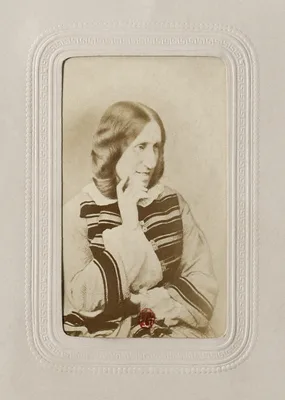
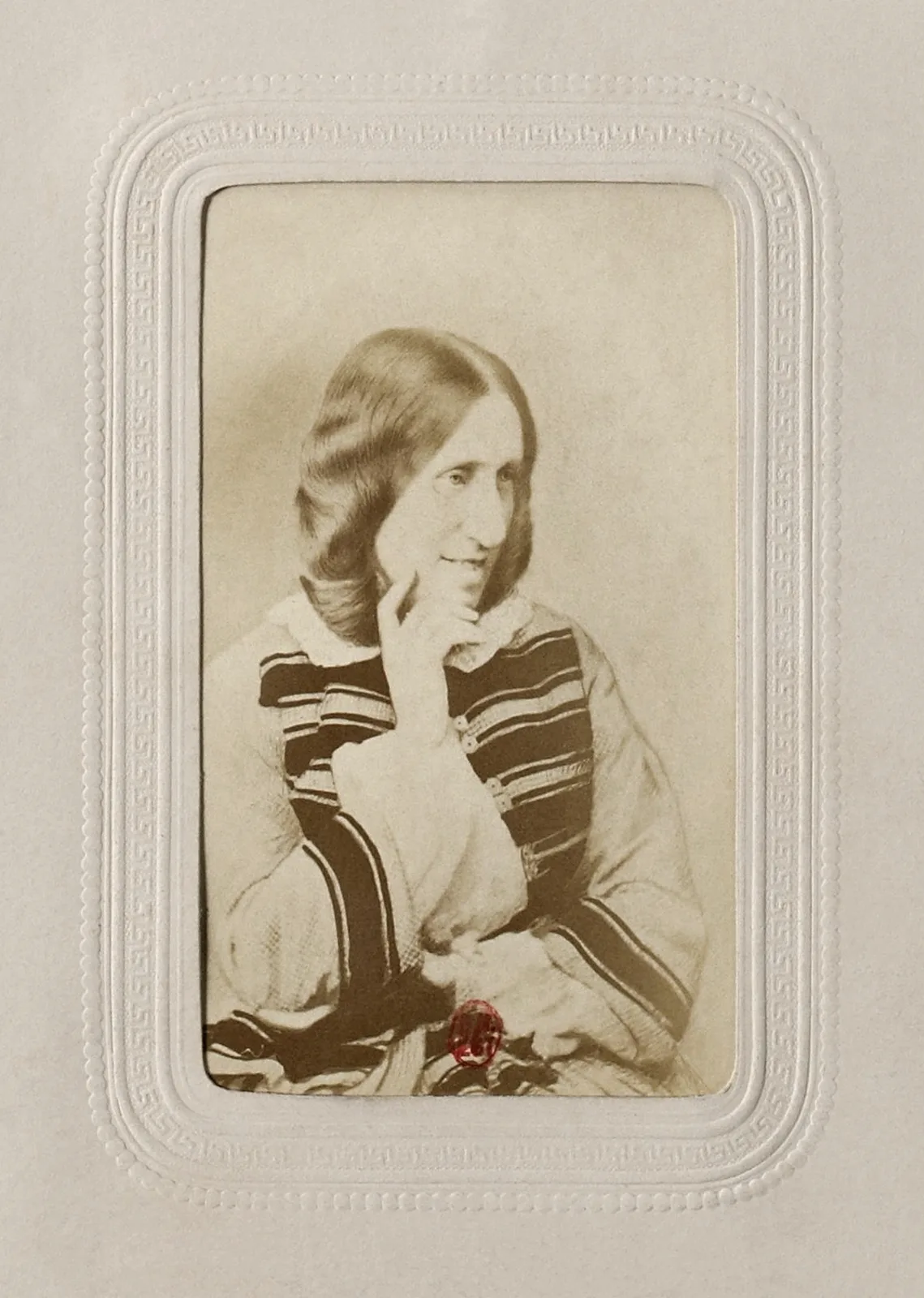
George Eliot was an ultra-Evangelical girl who lost the creed in 1841, reading Hennell among the Brays. She quarrelled with her father over church and regretted it all her life. In 1843 she gave up proselytising as "the quackery of infidelity", and she put her name only to Feuerbach's argument that God is human nature. She ended reverent toward the great religions, holding the idea of God to be "the ideal of a goodness entirely human" and unbelief to be the discipline of doing without opium.
The belief timeline
- Faith (1832–1841 (documented by her letters from 18 Aug 1838)) — Ardent Evangelical: prayer leader at school, refuses theatre and novels, "O that we could live only for eternity" [5][6][1]
- Doubt (1841-11-13) — After Hennell's *Inquiry* and the Bray circle, writes to Maria Lewis that her inquiries may lead to a result "that will startle you" [12][13][6]
- Declaration (1842-01 (private) / 1854-07 (in print under her own name)) — Refuses to attend church, quarrel with her father; later puts her name to the Feuerbach translation [14][23]
- Revision (1843-10-09 and 1873–1874) — Gives up proselytising and accepts conformity out of sympathy (1843); in 1873–74 states the "religion of humanity" position and "reverence" for the old religions [18][49][51]
Notes to the timeline (10)
- [5] At Miss Wallington's school Miss Lewis, "an ardent Evangelical Churchwoman," strongly influenced her; at Miss Franklin's in Coventry from her thirteenth year she "adopted their religious views with intense eagerness and conviction, although she never formally joined the Baptists or any other communion than the Church of England" and became "a leader of prayer-meetings"; came home "with ultra-Evangelical tendencies" — J. W. Cross, ed., George Eliot's Life as Related in Her Letters and Journals, vol. I (New York: Harper & Brothers, 1885). Internet Archive
georgeeliotslife01eliouoft. Text filecross1.txt. Cross prints extracts, not whole letters, and says so (p. 28). Letters to Maria Lewis, Mrs. Pears, the Brays, Sara Hennell, and journals, pp. 17–19, 23; Mathilde Blind, George Eliot (Eminent Women Series; London: W. H. Allen, 1883).georgeeliot00bliniala(good OCR; the other scangeorgeeliotblind00blinmisshas garbled OCR and was discarded). Text fileblind-b.txt. Blind met Isaac Evans, the Brays and Miss Hennell (Preface), p. 32. - [6] In August 1838, on her first visit to London with Isaac, she would not go to the theatres and spent her evenings reading; she wrote "O that we could live only for eternity" — Cross, George Eliot's Life as Related…, vol. I, pp. 29–30.
- [1] Born Mary Ann Evans at 5 a.m. on 22 November 1819 at Arbury Farm (the roster says South Farm), recorded in her father's diary; she called herself Marian — Leslie Stephen, George Eliot (English Men of Letters; London and New York: Macmillan, 1902).
georgeeliot00step. Text filestephen.txt. Uses and sometimes extends Cross; quotes Mrs. Cash's recollections, p. 1. - [12] Cross: the letter of 13 November 1841 "accurately fixes the date of the first acknowledgment by herself that her opinions were undergoing so momentous a change"; the reading of Hennell "marks an epoch in George Eliot's development" but with "a good deal of half-unconscious preparation" — Cross, George Eliot's Life as Related…, vol. I, p. 74.
- [13] Her letters to Maria Lewis are printed through 19 February 1842, the last of the series; Cross prints nothing later to her (the later fate of the friendship is not in Cross) — Cross, George Eliot's Life as Related…, vol. I, pp. 77–78. Absence is the only source for this, as for the other details in this chapter cited to that source alone.
- [14] Cross: she "determined to give up going to church," "an unforgivable offence" to her father, who put the lease in an agent's hands meaning to live with his married daughter; she then planned to take lodgings at Leamington and live by teaching; Stephen dates the refusal "by January 1842" — Cross, George Eliot's Life as Related…, vol. I, p. 75; Stephen, George Eliot, p. 25.
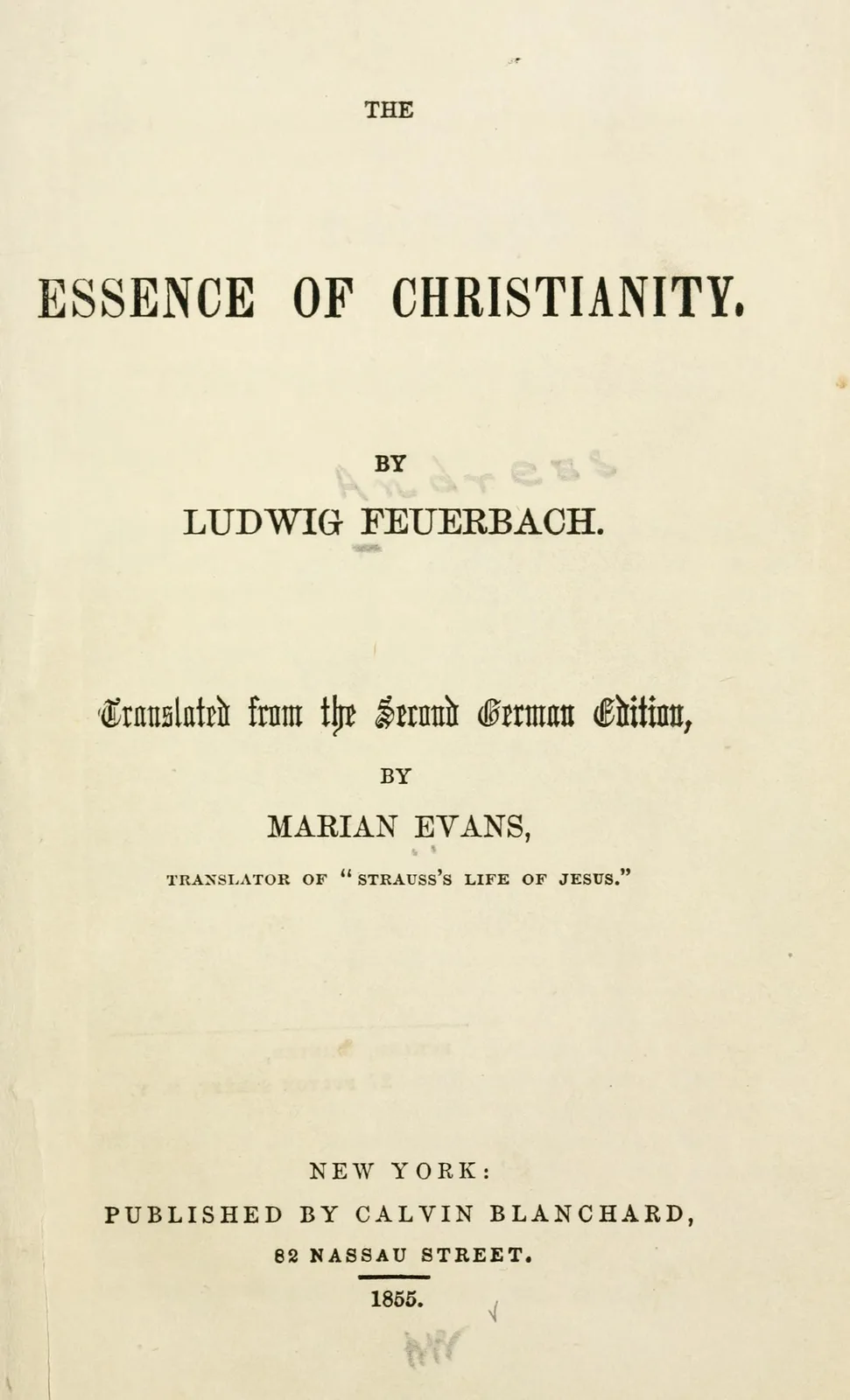
- [23] The Feuerbach translation (published July 1854, Chapman's Quarterly Series) carried "Miss Evans's name on the titlepage as the translator, the first and only time her real name appeared in print"; the 1855 New York printing calls her "Marian Evans, translator of Strauss's Life of Jesus." This implies the 1846 Strauss was published without her name — Cross, George Eliot's Life as Related…, vol. I, p. 233 (note); Ludwig Feuerbach, The Essence of Christianity, translated from the second German edition by Marian Evans, translator of Strauss's Life of Jesus (New York: Calvin Blanchard, 1855, an American printing of the 1854 translation).
essenceofchristi00feue. Text filefeuerbach.txt, title page; Stephen, George Eliot, p. 43. - [18] On 9 October 1843 she wrote to Sara Hennell that her present opinion on conformity was "contrary to the one I held in the first instance": proselytising is "the quackery of infidelity," and one should seek feelings "in harmony, though not in union" with believers — Cross, George Eliot's Life as Related…, vol. I, pp. 87–90; Stephen, George Eliot, pp. 30–31.
- [49] 10 Dec. 1874, to the Hon. Mrs. Ponsonby (who had lost belief in immortality and felt less pity): "the idea of God... is the ideal of a goodness entirely human"; asks whether she has "quite fairly represented" herself — Same, vol. III (New York: Harper, 1903 printing, apparently from the same plates; index covers all three volumes).
georgeeliotslife03elioiala. Text filecross3.txt. Cross's page numbers agree between the two printings where checked (e.g. his index entry "gives up going to church, 75"), pp. 176–178. - [51] 26 Oct. 1873 (Cross prints "2oth," OCR; the Sunday was the 26th), to Cross: she takes the view that conformity is the higher rule where one has no "protesting faith," declares "no antagonism towards any religious belief, but a strong outflow of sympathy," and says the highest lot is to have definite beliefs one is bound to declare — Cross, vol. III, pp. 155–156.
To Do Without Opium
In January 1842 a young woman in Coventry told her father that she would no longer go to church with him. Robert Evans was a land agent of the old school, a sturdy Tory and a churchman, and to him it was, in the words of her husband many years later, "an unforgivable offence." He put the lease of their house in an agent's hands and made plans to go and live with his married daughter. She made plans to take lodgings at Leamington and live by teaching.12 Mary Ann Evans was twenty-two. She would become, under the name George Eliot, one of the most admired English novelists of her century, and she never stopped regretting that quarrel. Near the end of her life she told her husband that "few things had occasioned her more regret than this temporary collision with her father, which might, she thought, have been avoided with a little management."3
This chapter follows her from an Evangelical girlhood to that refusal, and from there to an unbelief that ended not in attack but in a kind of reverence. It asks why the woman who translated two of the most radical books on religion of her age came to think that the worst intolerance of all was "the intolerance calling itself philosophical."4
Live only for eternity
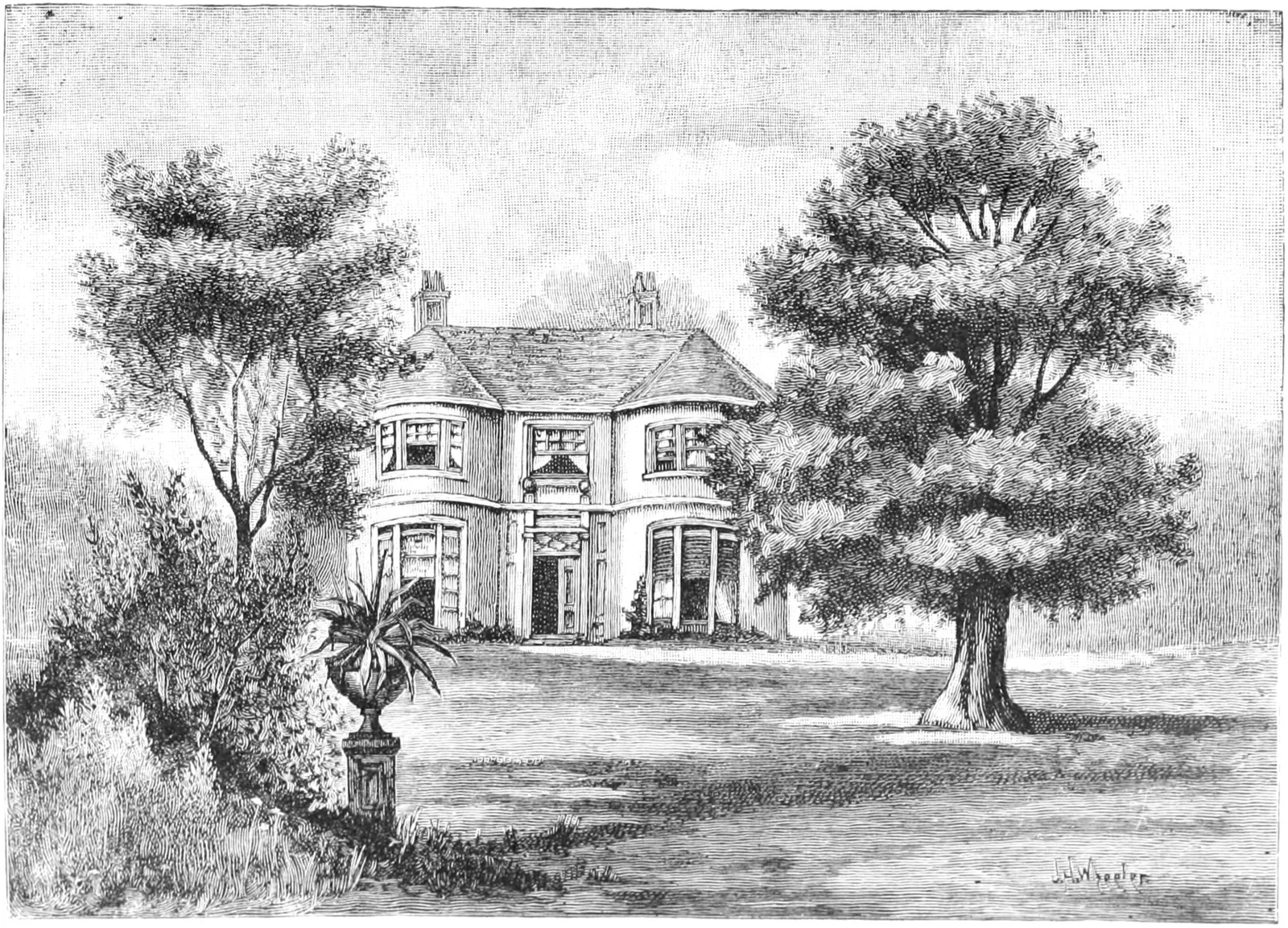
She was born on 22 November 1819 on a farm of the Arbury estate in Warwickshire, and grew up at Griff House near Nuneaton, where her father managed the estate.56 At school she came under the influence of an ardent Evangelical teacher, Maria Lewis, and then, at a Baptist-run school in Coventry, "adopted their religious views with intense eagerness and conviction," and led prayer meetings; she came home, her husband wrote, "with ultra-Evangelical tendencies."7 Her mother died in 1836, and at sixteen she ran her father's house.8

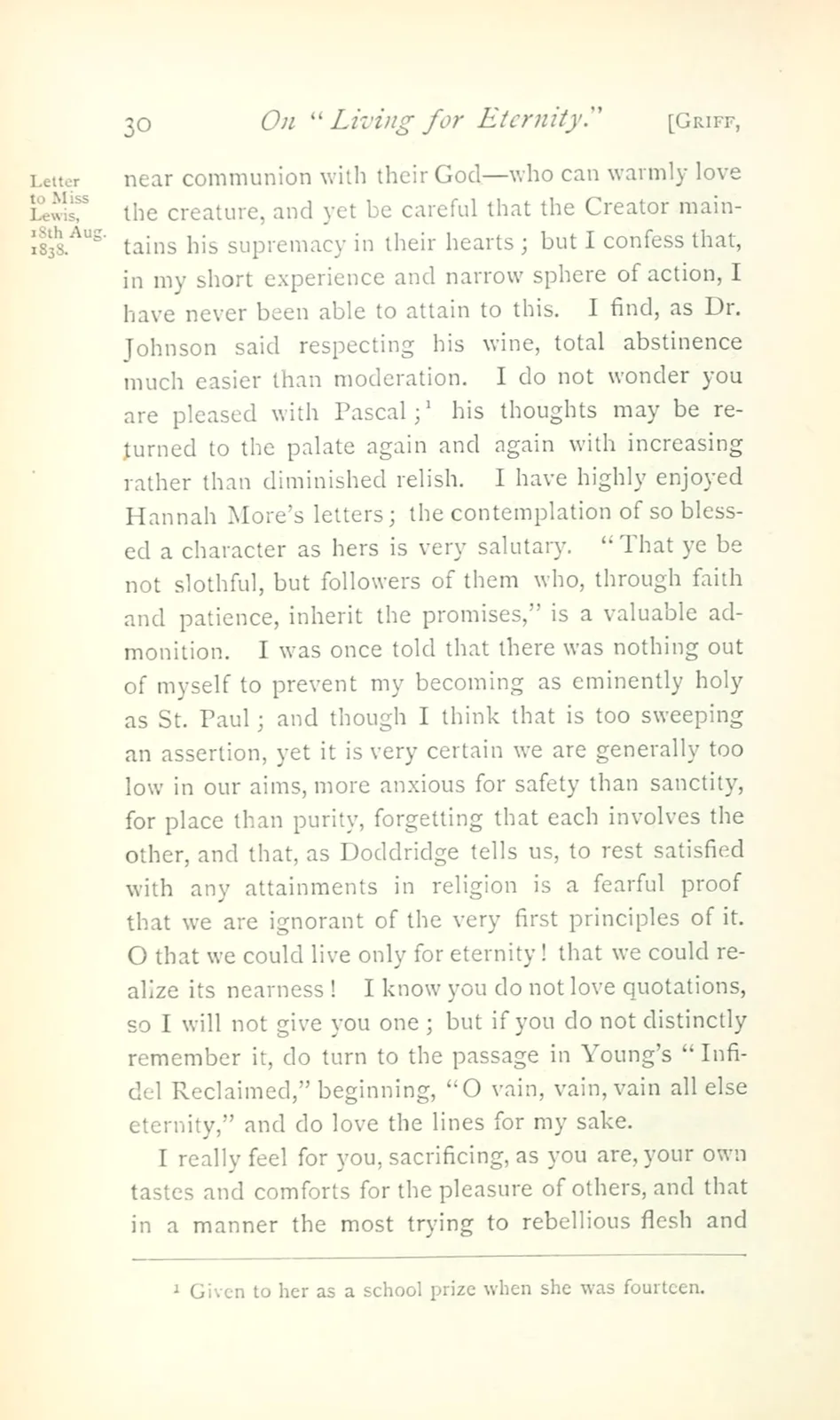
Her letters to Maria Lewis from these years are full of an ascetic piety. On a visit to London in 1838 she would not go to the theatres. "O that we could live only for eternity! that we could realize its nearness!"910 She prayed not to make "Christianity a mere addendum to my pursuits."11 She confessed to her Methodist aunt that her "besetting sin" was "ambition, a desire insatiable for the esteem of my fellow-creatures."1213 And, with an irony she could not have seen, she thought novels "pernicious."14
There were early cracks. In 1840 she admitted that Bulwer's novel Devereux, with its "very amiable atheist," had once "considerably shaken" her belief that religion was needed for moral excellence.15 She read a learned Evangelical book on the early Church, which a friend later thought had "its influence in unsettling her views of Christianity."16
The Brays
In 1841 her brother Isaac married and took over Griff, and she moved with her father to Foleshill Road, Coventry.17 There a neighbour introduced her to Charles and Cara Bray of Rosehill, freethinkers, and she read Cara's brother Charles Hennell's Inquiry Concerning the Origin of Christianity. Her husband thought the book and the Bray circle together "no doubt hastened the change," and that reading Hennell "marks an epoch" in her development.1819 On 13 November 1841 she wrote to Maria Lewis: "My whole soul has been engrossed in the most interesting of all inquiries for the last few days, and to what result my thoughts may lead, I know not — possibly to one that will startle you; but my only desire is to know the truth, my only fear to cling to error."1920 On the belief timeline, that letter is where her doubt begins.
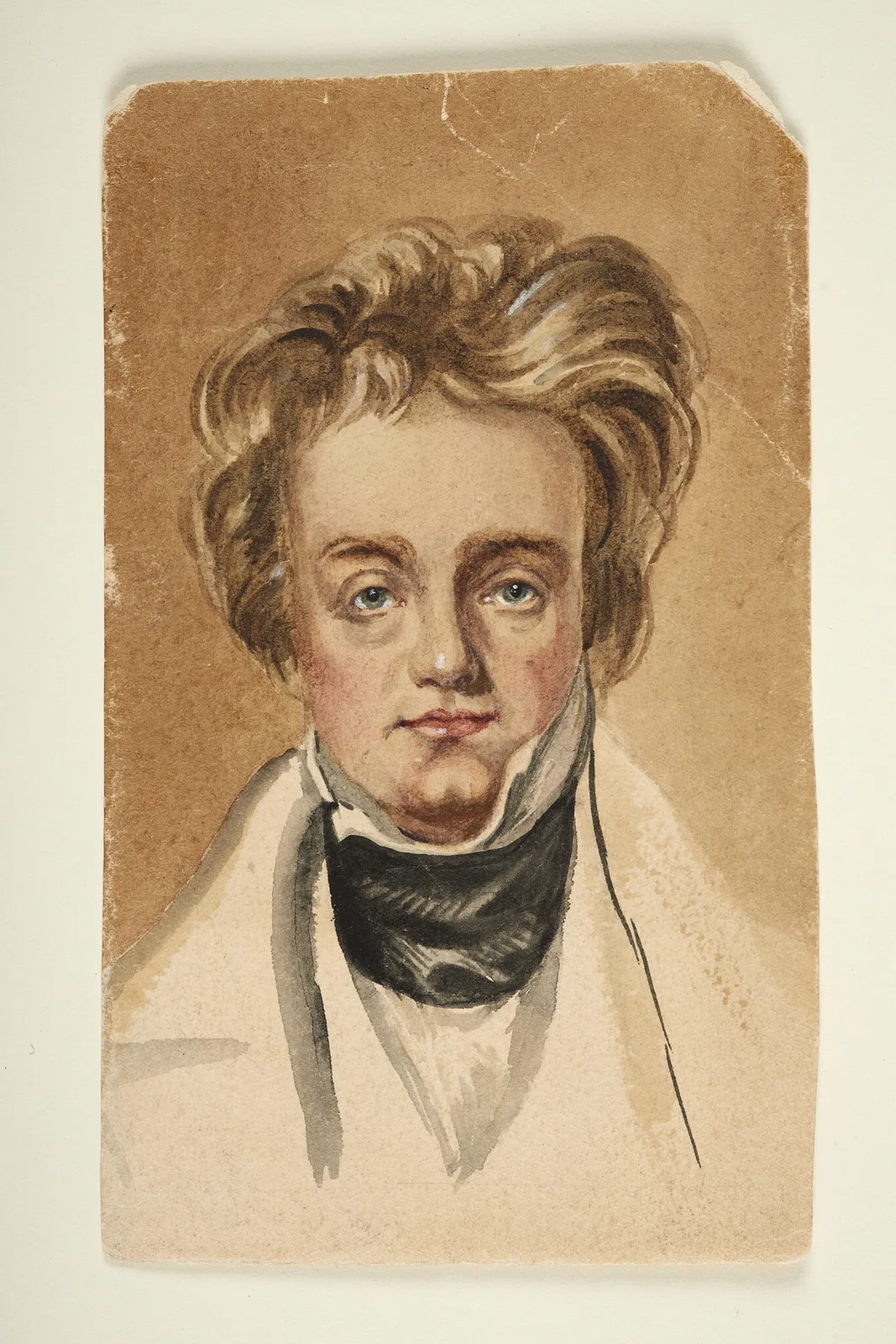
Within weeks she was writing of doctrines "buried in a charnel-heap of bones over which nothing is heard but the barks and growls of contention."21 To a friend she explained, early in 1842: "although I cannot rank among my principles of action a fear of vengeance eternal, gratitude for predestined salvation, or a revelation of future glories as a reward, I fully participate in the belief that the only heaven here, or hereafter, is to be found in conformity with the will of the Supreme."22 She had given up the creed, not the moral seriousness.
The holy war
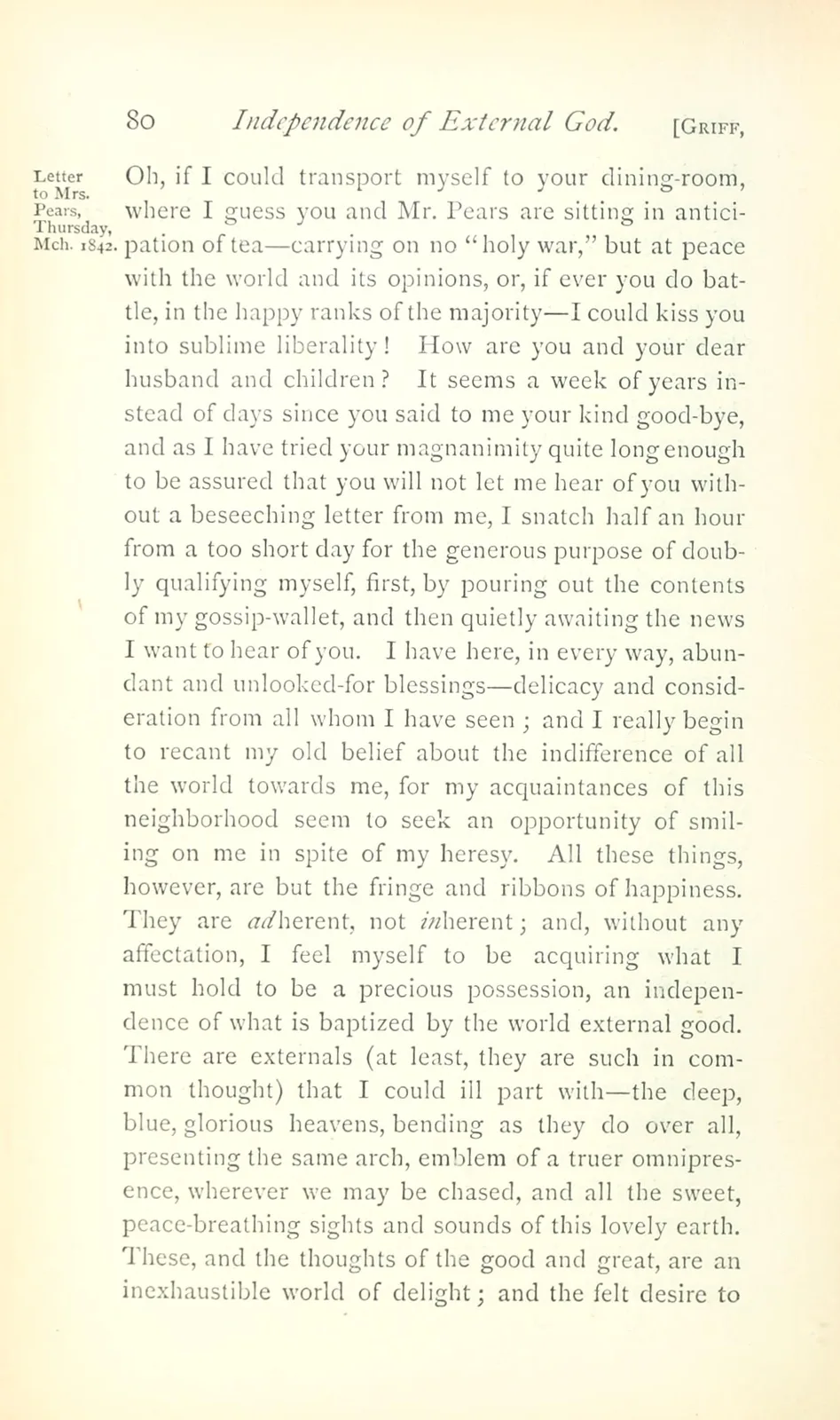
Then came the refusal, and her father's anger. The quarrel ended after she spent three weeks at Griff with Isaac and his wife; she came home, her father "was very glad to receive her again," and she went back to church with him.23 From Griff she wrote that she was carrying on "no 'holy war,' but at peace with the world and its opinions."2425 And she wrote, of herself, "I regret nothing so much as my own impetuosity both of feeling and judging."26
An Evangelical neighbour, Mrs. Sibree, heard of the change with great grief and "thought argument and expostulation might do much."2728 A Baptist minister sent to argue with her came away saying, as one biographer reports, that she "must have had the devil at her elbow to suggest doubts, for there was not a book that I recommended to her in support of Christian evidences that she had not read."29 Mrs. Sibree's daughter, whom Mary Ann taught German, remembered something different: no attempt to unsettle her beliefs, only a steady protest against the Evangelicals' claim to "an exclusive possession of higher motives to morality." And she remembered Mary Ann saying: "I am influenced in my own conduct at the present time by far higher considerations, and by a nobler idea of duty, than I ever was while I held the evangelical beliefs."3031
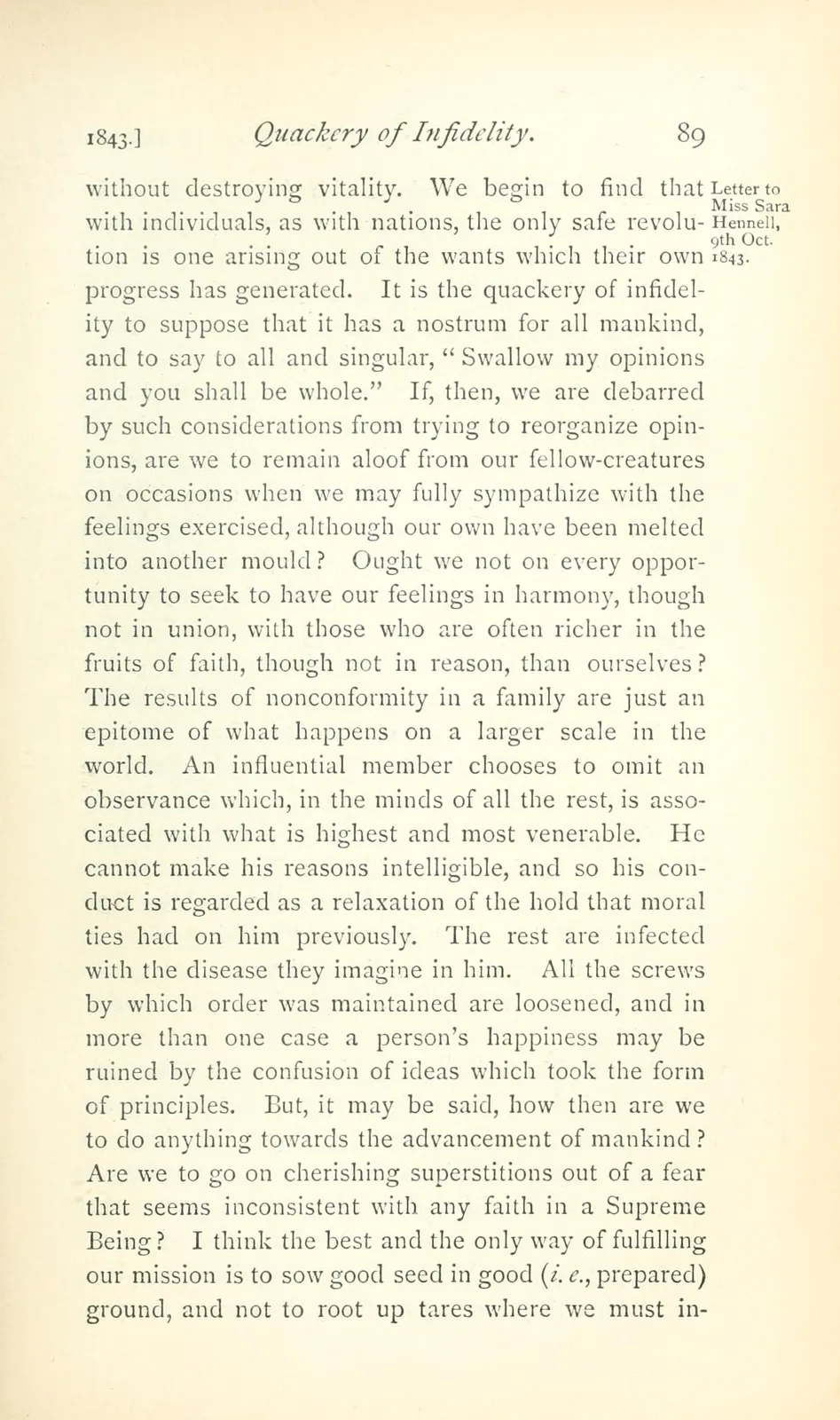
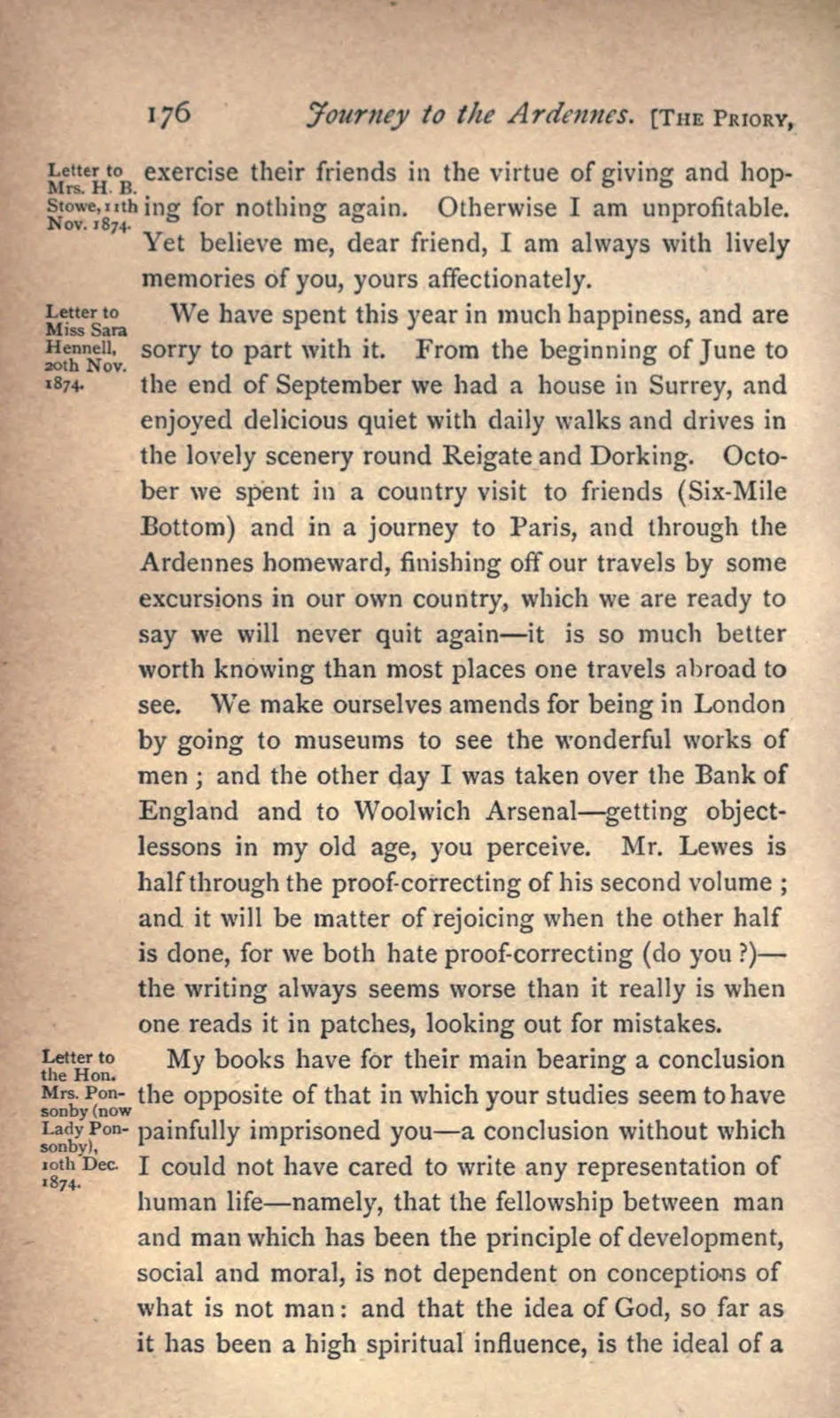
In October 1843 she put that experience into a principle. When the soul is first freed from "the wretched giant's bed of dogmas," she wrote to Sara Hennell, there is "exultation and strong hope." But "It is the quackery of infidelity to suppose that it has a nostrum for all mankind, and to say to all and singular, 'Swallow my opinions and you shall be whole.'" Better to have one's feelings "in harmony, though not in union," with believers who are "often richer in the fruits of faith, though not in reason, than ourselves."32333435 On the timeline, that is her first revision: she gave up converting anyone.
Strauss and Feuerbach
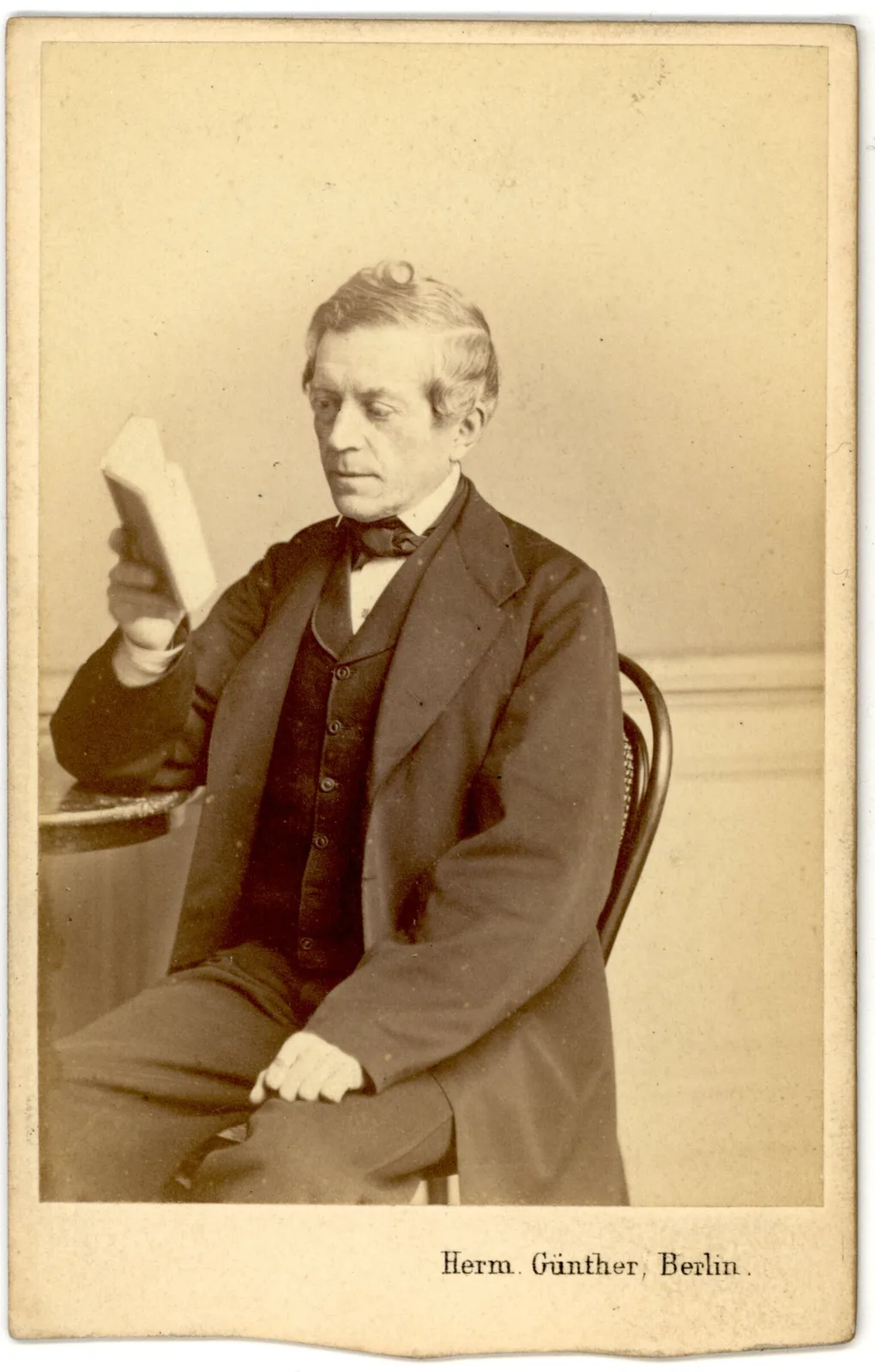
She was given a large task. From 1844 she translated David Friedrich Strauss's Life of Jesus, working "six pages a day." It made her ill: Cara Bray reported that she was "Strauss-sick," and that only an ivory crucifix above her desk let her endure "dissecting the beautiful story of the Crucifixion." It appeared in 1846 without her name.363738 Even then she did not mock. To Sara Hennell she wrote about the Emmaus story and then added: "But I am not become a Methodist, dear Sara; on the contrary, if I am pious one day, you may be sure I was very wicked the day before, and shall be so again the next."3940 She planned an essay on "The superiority of the consolations of philosophy to those of (so-called) religion."4142
Her father died in 1849, after she had nursed him through a long illness. "What shall I be without my father? It will seem as if a part of my moral nature were gone."4344 She went to Geneva, then to London, where she worked as assistant editor of the Westminster Review.4546 In 1854 she translated Ludwig Feuerbach's Essence of Christianity, which argued that God is human nature projected and worshipped, and this time her name, "Marian Evans," was on the title page: "the first and only time her real name appeared in print."3847 Its preface says: "Religion is the dream of the human mind."48 The timeline treats this as her declaration, though it was made in someone else's words.
Mr. Lewes
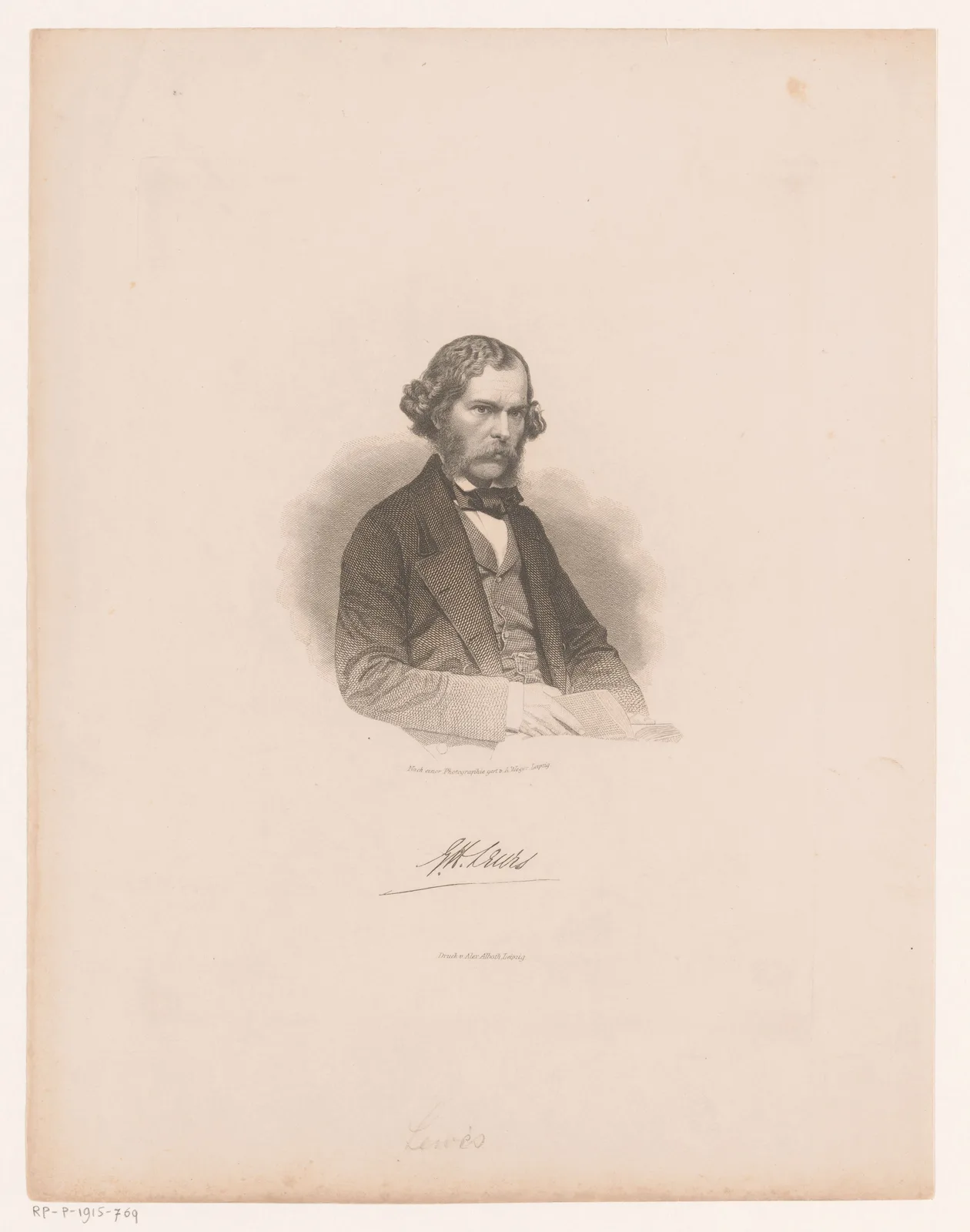
In July 1854 she left for Germany with the critic George Henry Lewes, who was separated from his wife but could not divorce her.495051 Her friends at Rosehill were dismayed; Sara Hennell, a theist, held that a conventional form of marriage was "essentially attached to all religion."5052 She answered Cara Bray: "If there is any one action or relation of my life which is, and always has been, profoundly serious, it is my relation to Mr. Lewes."53 Her brother Isaac fell silent for many years.54
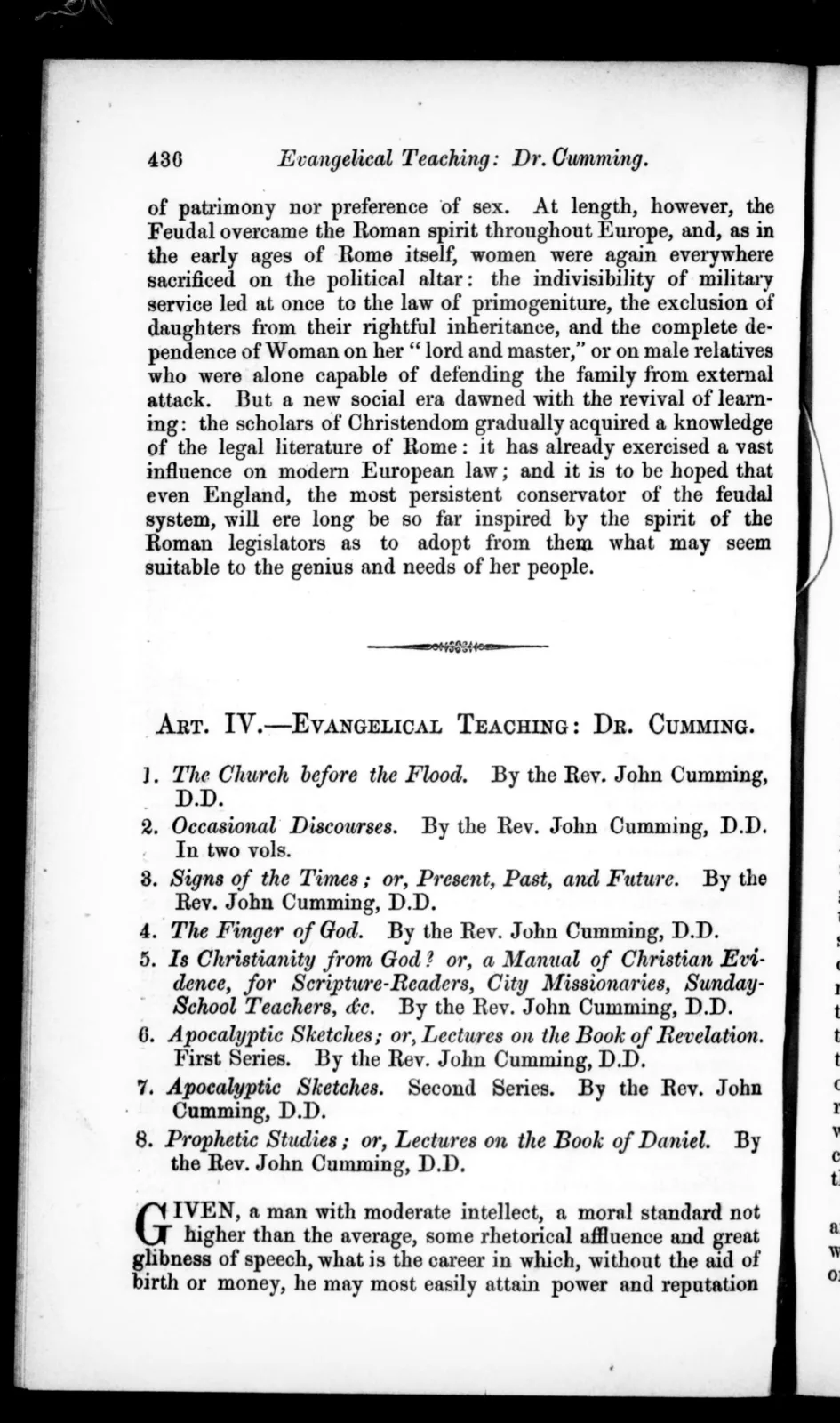
In 1855 she published an anonymous attack on a famous London preacher, Dr. John Cumming, in the Westminster Review. Cumming had written that "the rejection of Christianity ... is always, in my judgment, the symptom of a diseased heart." Her answer was that "So long as a belief in propositions is regarded as indispensable to salvation, the pursuit of truth as such is not possible."555657 A year later, writing about the poet Young, she suggested that for some minds "the deep pathos lying in the thought of human mortality — that we are here for a little while and then vanish away" lies nearer the springs of moral feeling than the hope of another life.58
George Eliot
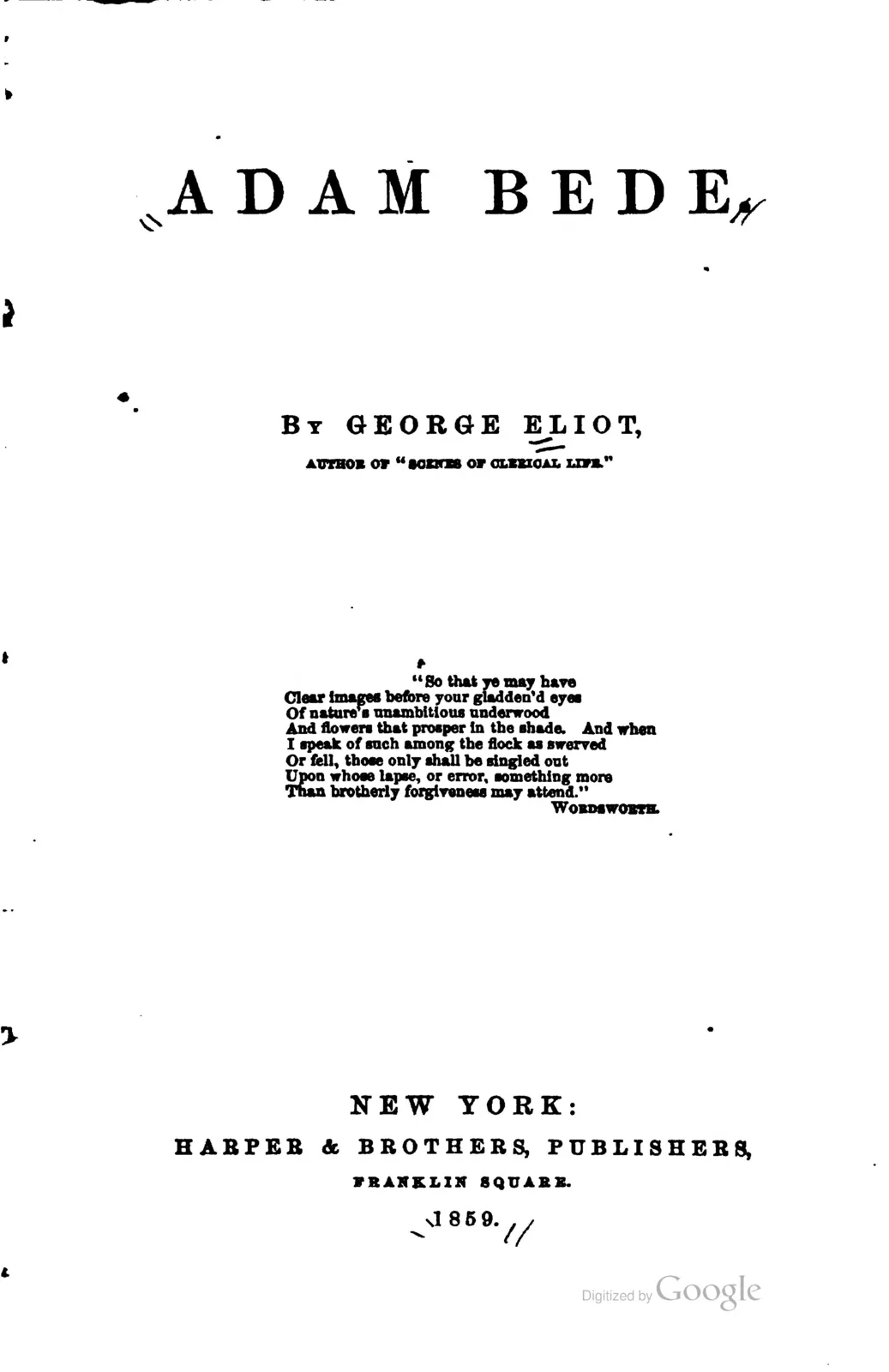
Encouraged by Lewes, she began her first story in September 1856, and from January 1857 Scenes of Clerical Life appeared in Blackwood's Magazine under a man's name, George Eliot.596061 The novels were full of believers, and she wrote about them without contempt. Her aim, she told her publisher, was "the presentation of mixed human beings in such a way as to call forth tolerant judgment, pity, and sympathy."62 Of an Evangelical curate in one story the narrator says: "I am on the level and in the press with him, as he struggles his way along the stony road."6364 And to Sara Hennell she wrote: "of all intolerance the intolerance calling itself philosophical is the most odious to me."4 Adam Bede grew from a story her Methodist aunt had told her at Griff.6566
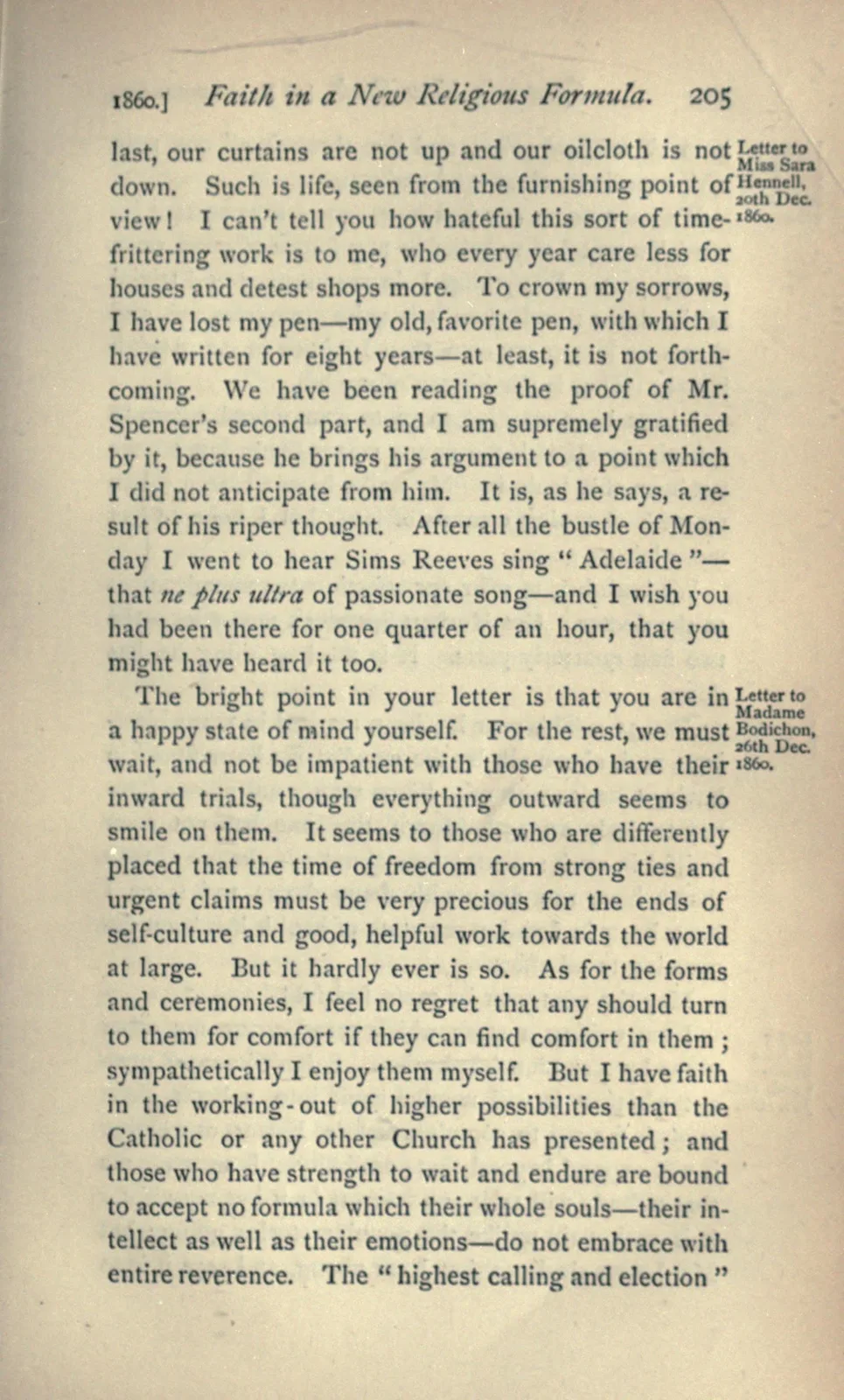
What she offered instead of consolation was endurance. "The 'highest calling and election' is to do without opium, and live through all our pain with conscious, clear-eyed endurance," she wrote to a friend in 1860.6768
The religion of humanity
In her last decade she wrote her clearest statements of what she believed. To Harriet Beecher Stowe, who asked in 1869, she wrote: "I believe that religion, too, has to be modified ... and that a religion more perfect than any yet prevalent must express less care for personal consolation, and a more deeply-awing sense of responsibility to man."6970 To John Cross in 1873 she wrote: "All the great religions of the world, historically considered, are rightly the objects of deep reverence and sympathy — they are the record of spiritual struggles, which are the types of our own." Those without a protesting faith, she thought, might do better by conformity than by "a nonconformity which has nothing but negatives to utter."717273 And in 1874 she wrote to a woman who had lost her faith and feared losing her pity: "the idea of God, so far as it has been a high spiritual influence, is the ideal of a goodness entirely human."7475 That is her second revision on the timeline: not a return to belief, but a reverence for it.
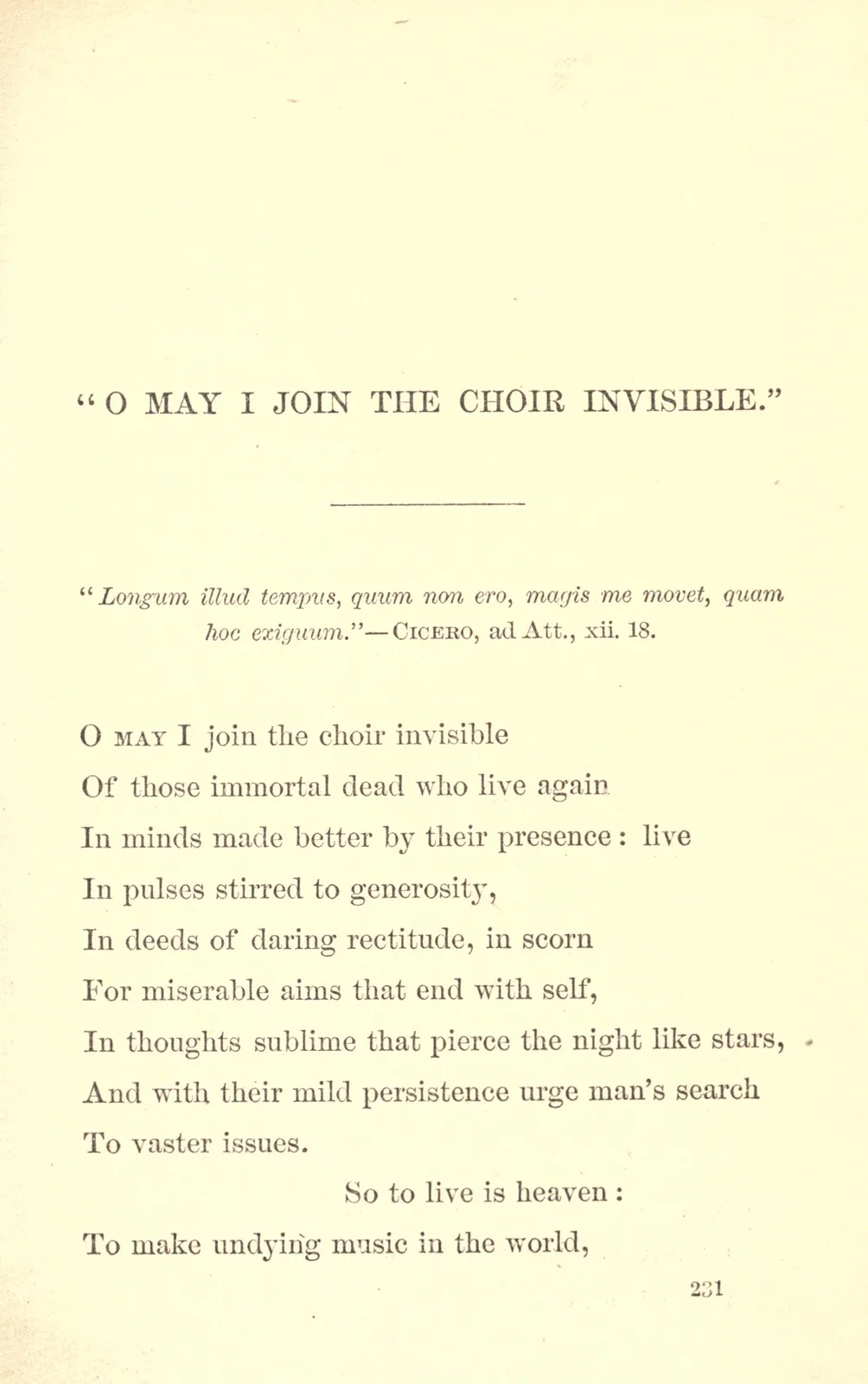
The Cambridge writer F. W. H. Myers remembered walking with her in the Fellows' Garden of Trinity on "an evening of rainy May," probably in 1873, as she spoke of God, Immortality and Duty: "how inconceivable was the first, how unbelievable the second, and yet how peremptory and absolute the third."7677 Her poem "O may I join the choir invisible" put the same faith in verse: the hope of living on only "in minds made better by their presence."7879
The end
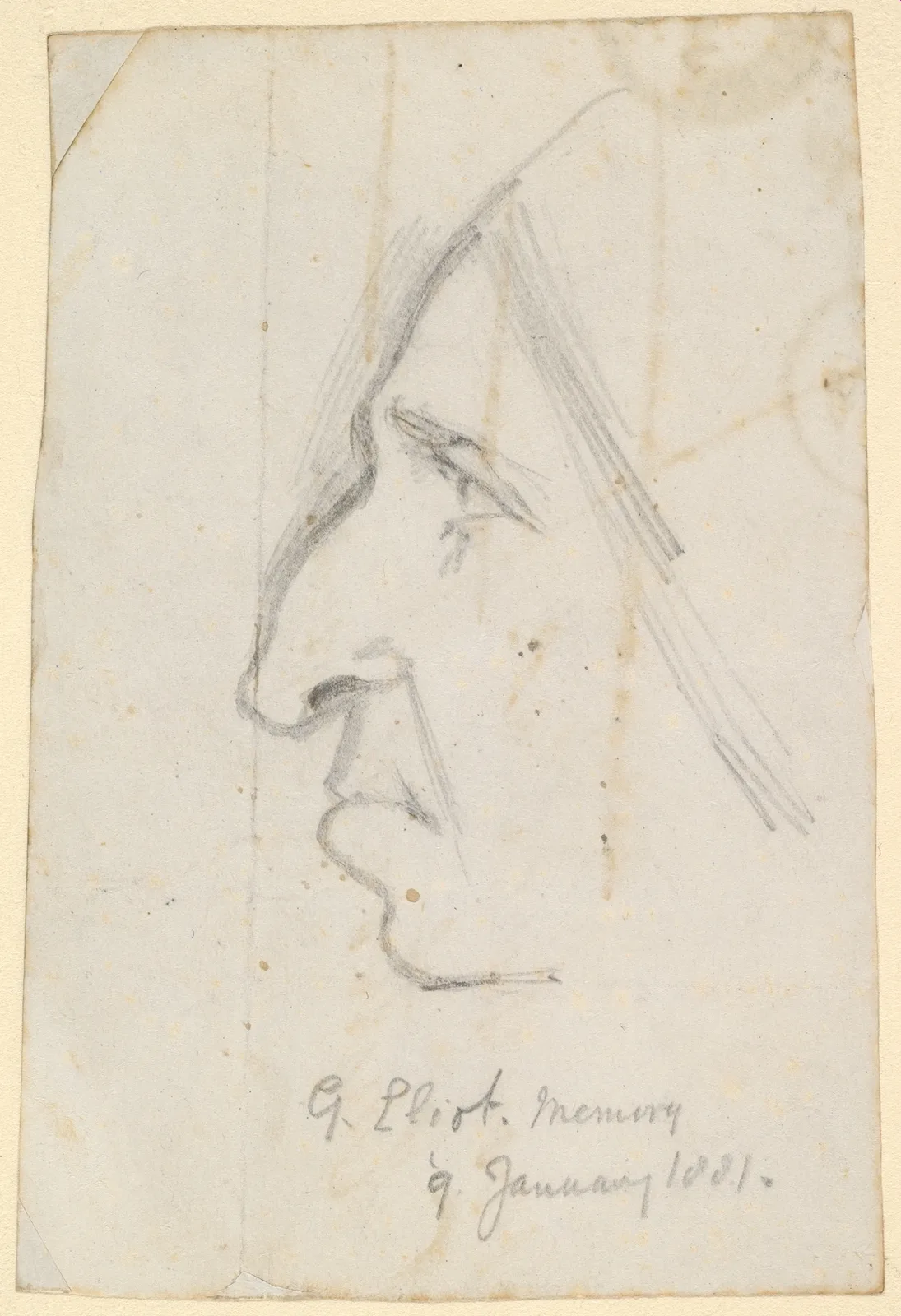
Lewes died in November 1878. In May 1880 she married John Cross, and her brother Isaac wrote at last; she answered that "our long silence has never broken the affection for you which began when we were little ones."80815482 In the evenings at their country house they read from the Bible, which was to her, Cross wrote, "a very precious and sacred book," for its place "in the development of the religious life of man."83 She died at 4 Cheyne Walk, Chelsea, on 22 December 1880, and was buried at Highgate next to Lewes.84
Did her unbelief change shape?
It changed more in tone than in substance. The creed went in 1841, when she read Hennell among the Brays and wrote that her inquiries might startle her old teacher, and it never came back. What changed was what she thought unbelief should do. At twenty-two she defied her father and regretted it for the rest of her life. At twenty-three she decided that converting others was "the quackery of infidelity." In her thirties she translated the most radical books of her time and attacked a preacher who called doubt a diseased heart. In her fifties she spoke of the great religions with "deep reverence" and of God as the best of human goodness. She never called herself an atheist. Her unbelief kept the moral seriousness of the Evangelical girl and lost only the eternity, and she offered it, in the end, as a harder discipline than faith: to do without opium.
Ludwig Feuerbach, whose Essence of Christianity she translated and whose argument her late letters restate in her own words, has his own chapter in this book.
Footnotes
-
J. W. Cross, ed., George Eliot's Life as Related in Her Letters and Journals, vol. I (New York: Harper & Brothers, 1885). Internet Archive
georgeeliotslife01eliouoft. Text filecross1.txt. Cross prints extracts, not whole letters, and says so (p. 28). Letters to Maria Lewis, Mrs. Pears, the Brays, Sara Hennell, and journals, p. 75; Leslie Stephen, George Eliot (English Men of Letters; London and New York: Macmillan, 1902).georgeeliot00step. Text filestephen.txt. Uses and sometimes extends Cross; quotes Mrs. Cash's recollections, pp. 2–3. ↩ -
Cross, George Eliot's Life as Related…, vol. I, p. 75; Stephen, George Eliot, p. 25. ↩
-
Cross, George Eliot's Life as Related…, vol. I, p. 82. ↩
-
George Eliot, to Sara Hennell, 24 Feb. 1857: Cross, George Eliot's Life as Related…, vol. I, p. 311. ↩ ↩2
-
Stephen, George Eliot, p. 1. ↩
-
Stephen, George Eliot, p. 4. ↩
-
Cross, George Eliot's Life as Related…, vol. I, pp. 17–19, 23; Mathilde Blind, George Eliot (Eminent Women Series; London: W. H. Allen, 1883).
georgeeliot00bliniala(good OCR; the other scangeorgeeliotblind00blinmisshas garbled OCR and was discarded). Text fileblind-b.txt. Blind met Isaac Evans, the Brays and Miss Hennell (Preface), p. 32. ↩ -
Cross, George Eliot's Life as Related…, vol. I, p. 22; Stephen, George Eliot, p. 12. ↩
-
Cross, George Eliot's Life as Related…, vol. I, pp. 29–30. ↩
-
Mary Ann Evans, to Maria Lewis, 18 Aug. 1838: Cross, George Eliot's Life as Related…, vol. I, p. 30. ↩
-
Mary Ann Evans, to Maria Lewis, 6 Nov. 1838: Cross, George Eliot's Life as Related…, vol. I, p. 31. ↩
-
Cross, George Eliot's Life as Related…, vol. I, p. 35; Stephen, George Eliot, p. 21. ↩
-
Mary Ann Evans, to Mrs. Samuel Evans, 5 Mar. 1839: Cross, George Eliot's Life as Related…, vol. I, p. 35. ↩
-
Mary Ann Evans, to Maria Lewis, 16 Mar. 1839: Cross, George Eliot's Life as Related…, vol. I, p. 37. ↩
-
Cross, George Eliot's Life as Related…, vol. I, p. 47. ↩
-
Cross, George Eliot's Life as Related…, vol. I, pp. 51–52; Stephen, George Eliot, pp. 18, 26. ↩
-
Cross, George Eliot's Life as Related…, vol. I, p. 61; Stephen, George Eliot, p. 21. ↩
-
Cross, George Eliot's Life as Related…, vol. I, pp. 67–68; Stephen, George Eliot, pp. 22–24. ↩
-
Mary Ann Evans, to Maria Lewis, 13 Nov. 1841: Cross, George Eliot's Life as Related…, vol. I, p. 74. ↩
-
Mary Ann Evans, to Maria Lewis, 5 Dec. 1841: Cross, George Eliot's Life as Related…, vol. I, p. 75. ↩
-
Mary Ann Evans, to Mrs. Pears, early 1842 (a Friday evening): Cross, George Eliot's Life as Related…, vol. I, p. 77. ↩
-
Cross, George Eliot's Life as Related…, vol. I, pp. 79–82; Stephen, George Eliot, pp. 29–30. ↩
-
Cross, George Eliot's Life as Related…, vol. I, pp. 76–80. ↩
-
Mary Ann Evans, to Mrs. Pears, Mar. 1842: Cross, George Eliot's Life as Related…, vol. I, p. 80. ↩
-
Mary Ann Evans, to Mrs. Pears, Mar. 1842: Cross, George Eliot's Life as Related…, vol. I, p. 81. ↩
-
Cross, George Eliot's Life as Related…, vol. I, pp. 113–114. ↩
-
Mrs. John Cash (Mary Sibree), recalling her Evangelical mother's reaction: Cross, George Eliot's Life as Related…, vol. I, p. 114. ↩
-
A Baptist minister sent by Miss Franklin, as reported by Leslie Stephen: Stephen, George Eliot, p. 29. ↩
-
Cross, George Eliot's Life as Related…, vol. I, p. 115. ↩
-
Mary Ann Evans, at Rosehill, reported by Mrs. John Cash: Cross, George Eliot's Life as Related…, vol. I, p. 115. ↩
-
Cross, George Eliot's Life as Related…, vol. I, pp. 87–90; Stephen, George Eliot, pp. 30–31. ↩
-
Mary Ann Evans, to Sara Hennell, 9 Oct. 1843: Cross, George Eliot's Life as Related…, vol. I, p. 88. ↩
-
Mary Ann Evans, to Sara Hennell, 9 Oct. 1843: Cross, George Eliot's Life as Related…, vol. I, p. 89. ↩
-
Mary Ann Evans, to Sara Hennell, 9 Oct. 1843: Cross, George Eliot's Life as Related…, vol. I, p. 89. ↩
-
Cross, George Eliot's Life as Related…, vol. I, pp. 85–86, 90, 107. ↩
-
Cross, George Eliot's Life as Related…, vol. I, p. 100. ↩
-
Cross, George Eliot's Life as Related…, vol. I, p. 233 (note); Ludwig Feuerbach, The Essence of Christianity, translated from the second German edition by Marian Evans, translator of Strauss's Life of Jesus (New York: Calvin Blanchard, 1855, an American printing of the 1854 translation).
essenceofchristi00feue. Text filefeuerbach.txt, title page; Stephen, George Eliot, p. 43. ↩ ↩2 -
Cross, George Eliot's Life as Related…, vol. I, pp. 110–111. ↩
-
Mary Ann Evans, to Sara Hennell, end of Nov. 1846: Cross, George Eliot's Life as Related…, vol. I, p. 111. ↩
-
Cross, George Eliot's Life as Related…, vol. I, p. 121. ↩
-
Mary Ann Evans, to Sara Hennell, 13 Oct. 1847: Cross, George Eliot's Life as Related…, vol. I, p. 121. ↩
-
Cross, George Eliot's Life as Related…, vol. I, p. 148; Stephen, George Eliot, p. 35. ↩
-
Mary Ann Evans, to Mrs. Pears, May 1849: Cross, George Eliot's Life as Related…, vol. I, p. 148. ↩
-
Cross, George Eliot's Life as Related…, vol. I, p. 150; Stephen, George Eliot, p. 35. ↩
-
Cross, George Eliot's Life as Related…, vol. I, p. 187. ↩
-
Cross, George Eliot's Life as Related…, vol. I, pp. 228–233; Stephen, George Eliot, p. 43. ↩
-
Ludwig Feuerbach, translated by Marian Evans: Feuerbach, Essence of Christianity, Preface to the 2nd ed., p. 10. ↩
-
Cross, George Eliot's Life as Related…, vol. I, pp. 234–237. ↩
-
Blind, George Eliot, pp. 85–87. Reported at second hand; the original has not been seen. ↩ ↩2
-
Cross, George Eliot's Life as Related…, vol. I, pp. 239, 273–277. ↩
-
Sara Hennell, Eliot's closest friend and a theist, as quoted by Mathilde Blind, on the Lewes union: Blind, George Eliot, p. 87. ↩
-
Marian Evans (Lewes), to Cara Bray, 4 Sept. 1855: Cross, George Eliot's Life as Related…, vol. I, p. 235. ↩
-
Same, vol. III (New York: Harper, 1903 printing, apparently from the same plates; index covers all three volumes).
georgeeliotslife03elioiala. Text filecross3.txt. Cross's page numbers agree between the two printings where checked (e.g. his index entry "gives up going to church, 75"), pp. 286–287. ↩ ↩2 -
Cross, George Eliot's Life as Related…, vol. I, pp. 275–278. ↩
-
Rev. John Cumming (1807–1881), Scottish Presbyterian minister in London, popular author, the subject of her 1855 essay: John Cumming, Apocalyptic Sketches; or, Lectures on the Book of Revelation, first series (London: Hall, Virtue; 1854 printing).
apocalypticsketc00cummuoft. Text filecumming-apoc1.txt. The page Eliot cites as "Apoc. Sketches, p. 405" is p. 384 in this printing (Eliot cites another printing). Cumming's Manual of Christian Evidences, from which Eliot quotes the "Creed of the Infidel," was not found on the Internet Archive; her quotations of it are secondhand through [Essays], Apocalyptic Sketches, 1st series (1854 printing), p. 384. ↩ -
George Eliot, "Evangelical Teaching: Dr. Cumming": George Eliot, Essays and Leaves from a Note-book (Edinburgh and London: Blackwood, 1883; ed. C. L. Lewes).
essaysleavesfrom00elio. Text fileessays.txt. Contains "Worldliness and Other-Worldliness: The Poet Young" (pp. 1–66) and "Evangelical Teaching: Dr. Cumming" (pp. 121–165). Publication in the Westminster Review (Oct. 1855; Jan. 1857) is from Cross and the roster, not stated in this volume, p. 132. ↩ -
George Eliot, "Worldliness and Other-Worldliness: The Poet Young": Eliot, Essays and Leaves from a Note-book, p. 54. ↩
-
Cross, George Eliot's Life as Related…, vol. I, pp. 298–300. ↩
-
Cross, George Eliot's Life as Related…, vol. I, pp. 346–347. Not verified. ↩
-
Cross, George Eliot's Life as Related…, vol. I, p. 347 (summary). ↩
-
George Eliot, to John Blackwood, 18 Feb. 1857: Cross, George Eliot's Life as Related…, vol. I, pp. 310–311. ↩
-
George Eliot, Scenes of Clerical Life (New York: Walter Scott Publishing Co., 1902 printing).
scenesofclerical00eliouoft. Text filescenes.txt. [Adam Bede (1859)adambede07eliogoogis also downloaded asadambede.txt; no Adam Bede claim depends on it.], pp. 270–271. ↩ -
George Eliot, narrator of "Janet's Repentance": Eliot, Scenes of Clerical Life, pp. 270–271. ↩
-
Same, vol. II.
georgeeliotslife02eliouoft. Text filecross2.txt, p. 48; Cross, vol. II, journal Feb. 1859. ↩ -
George Eliot, "History of Adam Bede," journal 1859: Cross, vol. II, p. 48. ↩
-
Cross, vol. II, pp. 205–206 (checked on the scan, leaf 221–222). ↩
-
George Eliot, to Madame Bodichon, 26 Dec. 1860: Cross, vol. II, pp. 205–206. ↩
-
Cross, vol. III, pp. 62–63. ↩
-
George Eliot, to Mrs. H. B. Stowe, 5 May 1869: Cross, vol. III, p. 62. ↩
-
Cross, vol. III, pp. 155–156. ↩
-
George Eliot, to J. W. Cross, Sunday 26 Oct. 1873: Cross, vol. III, p. 155. ↩
-
George Eliot, to J. W. Cross, 26 Oct. 1873: Cross, vol. III, p. 156. ↩
-
Cross, vol. III, pp. 176–178. ↩
-
George Eliot, to the Hon. Mrs. Ponsonby, 10 Dec. 1874: Cross, vol. III, pp. 176–177. ↩
-
Cross, vol. III, pp. 147–148; F. W. H. Myers, "George Eliot," in Essays—Modern (London: Macmillan, 1883), pp. 255ff.
essaysmodern00myergoog. Text filemyers-modern.txt. The lead says it first appeared in the Century Magazine, 1881; the book scan does not say so, pp. 268–269. ↩ -
F. W. H. Myers, reporting George Eliot on "God, Immortality, Duty": Myers, Essays—Modern, pp. 268–269. ↩
-
George Eliot, The Legend of Jubal and Other Poems (Boston: Osgood, 1874, Author's Edition).
legendjubai00eliorich. Text filejubal.txt, pp. 231–232. ↩ -
George Eliot, "O May I Join the Choir Invisible": Eliot, Legend of Jubal and Other Poems, p. 231. ↩
-
Cross, vol. III, p. 247; Stephen, George Eliot, p. 193. ↩
-
Cross, vol. III, p. 283. ↩
-
George Eliot (Cross), to Isaac P. Evans, 25 May 1880: Cross, vol. III, p. 287. ↩
-
Cross, vol. III, p. 302. ↩
-
Cross, vol. III, p. 316. ↩
georgeeliotslife01eliouoft. Text file cross1.txt. Cross prints extracts, not whole letters, and says so (p. 28). Letters to Maria Lewis, Mrs. Pears, the Brays, Sara Hennell, and journals.; Leslie Stephen, George Eliot (English Men of Letters; London and New York: Macmillan, 1902). georgeeliot00step. Text file stephen.txt. Uses and sometimes extends Cross; quotes Mrs. Cash's recollections.; Mathilde Blind, George Eliot (Eminent Women Series; London: W. H. Allen, 1883). georgeeliot00bliniala (good OCR; the other scan georgeeliotblind00blinmiss has garbled OCR and was discarded). Text file blind-b.txt. Blind met Isaac Evans, the Brays and Miss Hennell (Preface).; Ludwig Feuerbach, The Essence of Christianity, translated from the second German edition by Marian Evans, translator of Strauss's Life of Jesus (New York: Calvin Blanchard, 1855, an American printing of the 1854 translation). essenceofchristi00feue. Text file feuerbach.txt.; Same, vol. III (New York: Harper, 1903 printing, apparently from the same plates; index covers all three volumes). georgeeliotslife03elioiala. Text file cross3.txt. Cross's page numbers agree between the two printings where checked (e.g. his index entry "gives up going to church, 75").; John Cumming, Apocalyptic Sketches; or, Lectures on the Book of Revelation, first series (London: Hall, Virtue; 1854 printing). apocalypticsketc00cummuoft. Text file cumming-apoc1.txt. The page Eliot cites as "Apoc. Sketches, p. 405" is p. 384 in this printing (Eliot cites another printing). Cumming's Manual of Christian Evidences, from which Eliot quotes the "Creed of the Infidel," was not found on the Internet Archive; her quotations of it are secondhand through [Essays].; George Eliot, Essays and Leaves from a Note-book (Edinburgh and London: Blackwood, 1883; ed. C. L. Lewes). essaysleavesfrom00elio. Text file essays.txt. Contains "Worldliness and Other-Worldliness: The Poet Young" (pp. 1–66) and "Evangelical Teaching: Dr. Cumming" (pp. 121–165). Publication in the Westminster Review (Oct. 1855; Jan. 1857) is from Cross and the roster, not stated in this volume.; George Eliot, Scenes of Clerical Life (New York: Walter Scott Publishing Co., 1902 printing). scenesofclerical00eliouoft. Text file scenes.txt. [Adam Bede (1859) adambede07eliogoog is also downloaded as adambede.txt; no Adam Bede claim depends on it.].; Same, vol. II. georgeeliotslife02eliouoft. Text file cross2.txt.; F. W. H. Myers, "George Eliot," in Essays—Modern (London: Macmillan, 1883), pp. 255ff. essaysmodern00myergoog. Text file myers-modern.txt. The lead says it first appeared in the Century Magazine, 1881; the book scan does not say so.; George Eliot, The Legend of Jubal and Other Poems (Boston: Osgood, 1874, Author's Edition). legendjubai00eliorich. Text file jubal.txt.In their own words
O that we could live only for eternity! that we could realize its nearness!
May the Lord give me such an insight into what is truly good that I may not rest contented with making Christianity a mere addendum to my pursuits, or with tacking it as a fringe to my garments!
it would not cost me any regrets if the only music heard in our land were that of strict worship
my besetting sin is the one of all others most destroying, as it is the fruitful parent of them all — ambition, a desire insatiable for the esteem of my fellow-creatures.
the same causes which exist in my own breast to render novels and romances pernicious have their counterpart in that of every fellow-creature
My whole soul has been engrossed in the most interesting of all inquiries for the last few days, and to what result my thoughts may lead, I know not — possibly to one that will startle you; but my only desire is to know the truth, my only fear to cling to error.
doctrines infinitely important to man are buried in a charnel-heap of bones over which nothing is heard but the barks and growls of contention!
Meanwhile, although I cannot rank among my principles of action a fear of vengeance eternal, gratitude for predestined salvation, or a revelation of future glories as a reward, I fully participate in the belief that the only heaven here, or hereafter, is to be found in conformity with the will of the Supreme
carrying on no "holy war," but at peace with the world and its opinions
I feel myself to be acquiring what I must hold to be a precious possession, an independence of what is baptized by the world external good.
It is the quackery of infidelity to suppose that it has a nostrum for all mankind, and to say to all and singular, "Swallow my opinions and you shall be whole."
When the soul is just liberated from the wretched giant's bed of dogmas on which it has been racked and stretched ever since it began to think, there is a feeling of exultation and strong hope.
Ought we not on every opportunity to seek to have our feelings in harmony, though not in union, with those who are often richer in the fruits of faith, though not in reason, than ourselves?
But I am not become a Methodist, dear Sara; on the contrary, if I am pious one day, you may be sure I was very wicked the day before, and shall be so again the next.
there is nothing in its whole tone, from beginning to end, that jars on my moral sense
The superiority of the consolations of philosophy to those of (so-called) religion.
I say it now, and I say it once for all, that I am influenced in my own conduct at the present time by far higher considerations, and by a nobler idea of duty, than I ever was while I held the evangelical beliefs.
Those extinct volcanoes of one's spiritual life — those eruptions of the intellect and the passions which have scattered the lava of doubt and negation over our early faith — are only a glorious Himalayan chain, beneath which new valleys of undreamed richness and beauty will spread themselves.
What shall I be without my father? It will seem as if a part of my moral nature were gone.
If there is any one action or relation of my life which is, and always has been, profoundly serious, it is my relation to Mr. Lewes.
That any unworldly, unsuperstitious person who is sufficiently acquainted with the realities of life can pronounce my relation to Mr. Lewes immoral, I can only understand by remembering how subtile and complex are the influences that mould opinion.
of all intolerance the intolerance calling itself philosophical is the most odious to me
The "highest calling and election" is to do without opium, and live through all our pain with conscious, clear-eyed endurance.
So long as a belief in propositions is regarded as indispensable to salvation, the pursuit of truth as such is not possible
it is conceivable that in some minds the deep pathos lying in the thought of human mortality — that we are here for a little while and then vanish away, that this earthly life is all that is given to our loved ones and to our many suffering fellow-men — lies nearer the fountains of moral emotion than the conception of extended existence
Religion is the dream of the human mind.
This is the key to the whole of Christology, that, as subject of the predicate which the Church assigns to Christ, we place, instead of an individual, an idea
I believe that religion, too, has to be modified — "developed," according to the dominant phrase — and that a religion more perfect than any yet prevalent must express less care for personal consolation, and a more deeply-awing sense of responsibility to man
the idea of God, so far as it has been a high spiritual influence, is the ideal of a goodness entirely human
All the great religions of the world, historically considered, are rightly the objects of deep reverence and sympathy — they are the record of spiritual struggles, which are the types of our own.
those who have no definite conviction which constitutes a protesting faith may often more beneficially cherish the good within them and be better members of society by a conformity, based on the recognized good in the public belief, than by a nonconformity which has nothing but negatives to utter.
how inconceivable was the first, how unbelievable the second, and yet how peremptory and absolute the third
O may I join the choir invisible Of those immortal dead who live again In minds made better by their presence
I am on the level and in the press with him, as he struggles his way along the stony road, through the crowd of unloving fellow-men.
The germ of "Adam Bede" was an anecdote told me by my Methodist Aunt Samuel
our long silence has never broken the affection for you which began when we were little ones
the presentation of mixed human beings in such a way as to call forth tolerant judgment, pity, and sympathy
I particularly wish not to be known as the translator of the "Ethics," for reasons which it would be "too tedious to mention."
I regret nothing so much as my own impetuosity both of feeling and judging.
I do not find my temple in Pantheism, which, whatever might be its value speculatively, could not yield a practical religion
The other side
Instead of the rejection of Christianity being the evidence of a gifted mind, it is always, in my judgment, the symptom of a diseased heart.
I was tainted while at the university by this spirit of skepticism. I thought Christianity might not be true. The very possibility of its being true was the thought I felt I must meet and settle.
My mother's grief, on hearing of this change in one whom she had begun to love, was very great; but she thought argument and expostulation might do much
That young lady must have had the devil at her elbow to suggest doubts, for there was not a book that I recommended to her in support of Christian evidences that she had not read.
swerved nothing from her own principles that the maintenance of a conventional form of marriage (remoulded to the demands of the present age) is essentially attached to all religion, and pre-eminently so to the religion of the future
the backsliding of so exemplary a member should afford matter for scandal in many a clerical circle and evangelical tea-meeting
Where accounts differ
| Point | One account | Another | How the page handles it |
|---|---|---|---|
| Date of the conformity letter to Sara Hennell | 9 October 1843 (margin of the letter, Cross I p. 88) | 19 October 1843 (Cross's own prose, Cross I p. 82) | Say "October 1843" |
| When she met the Brays | At Mrs. Pears's in May 1841; first visit to Rosehill autumn 1841 (Cross I p. 67) | Introduced "in November 1841" (Stephen p. 24) | Say "in 1841" |
| Date of moving to 4 Cheyne Walk | 3 December 1880 (Cross III p. 313, journal and letter: "Only on Friday evening") | 4 December 1880 (Stephen p. 196) | Do not give the day; Cross is her own journal |
| Birthplace name | "Arbury Farm" (Stephen p. 1) | "South Farm," as in the roster line | Say "a farm on the Arbury estate" |
| Cause and length of Isaac's silence | Cross shows letters to Isaac in April 1857 and her reply of May 1880 acknowledging a "long silence" (Cross I p. 318, III p. 287); no cause given | Later biographers (Haight) tie the silence to the Lewes union; copyrighted, not checked | Say "her brother did not write to her for years after she began living with Lewes" only after the expensive model confirms from a second source; otherwise say only "a long silence" |
| Which letter holds "do without opium" | Cross II pp. 205–206: margin note "Letter to Madame Bodichon, 26th Dec. 1860" on the scan | The OCR places it under Sara Hennell's 20 Dec. letter | Attribute to the Bodichon letter, 26 Dec. 1860 (scan checked) |
| Dating of the Myers conversation | Myers: "an evening of rainy May" in the Fellows' Garden, no year (Myers p. 268) | Cross's journal gives one Cambridge visit, 19 May 1873 (Cross III p. 147) | Say "in May 1873, as Myers remembered it years later" |
List of illustrations
This page uses only public-domain and Creative Commons images; each is credited with its source and licence.
- George Eliot (photograph, c. 1865) — UnknownUnknown . Upload, stitch and restoration by Jebulon, circa 1865 · UnknownUnknown . Upload, stitch and restoration by Jebulon (Bibliothèque nationale de France), via Wikimedia Commons, Public domain · Public domain (Wikimedia Commons: Public domain)
- Griff House, Griff, near Nuneaton — A J Paxton, 2019-08-25 · A J Paxton (Geograph Britain and Ireland), via Wikimedia Commons, CC BY-SA 2.0 · CC BY-SA 2.0 (Wikimedia Commons: CC BY-SA 2.0)
- J. W. Cross, ed., George Eliot's Life as Related in Her Letters and Journals, vol. I, p. 30: letter of Aug 1838 'O that we could live only for eternity' (Q1) — J. W. Cross, 1885 · Harper & Brothers, New York, 1885, via the Internet Archive (georgeeliotslife01eliouoft), public domain · Public domain (published before 1931; Internet Archive scan)
- Rosehill, Coventry (illustration, Complete Works of George Eliot, 1884) — J. Wheeler, 1884 · J. Wheeler (https://en.wikisource.org/wiki/Page:The_Complete_Works_Of_George_Eliot.djvu/249), via Wikimedia Commons, Public domain · Public domain (Wikimedia Commons: Public domain)
- Charles Bray c. 1840 — By Sara Hennell (1812 to 1889) or Caroline Hennell (Cara Bray) (1814 to 1905), 1840-01-02 · By Sara Hennell (1812 to 1889) or Caroline Hennell (Cara Bray) (1814 to 1905) (https://www.flickr.com/photos/theherbert/36058362094/), via Wikimedia Commons, Public domain · Public domain (Wikimedia Commons: Public domain)
- J. W. Cross, ed., George Eliot's Life as Related in Her Letters and Journals, vol. I, p. 80: letter to Mrs Pears, Mar 1842 (Q9, Q10) — J. W. Cross, 1885 · Harper & Brothers, New York, 1885, via the Internet Archive (georgeeliotslife01eliouoft), public domain · Public domain (published before 1931; Internet Archive scan)
- J. W. Cross, ed., George Eliot's Life as Related in Her Letters and Journals, vol. I, p. 89: letter to Sara Hennell, 9 Oct 1843 (Q11, Q13) — J. W. Cross, 1885 · Harper & Brothers, New York, 1885, via the Internet Archive (georgeeliotslife01eliouoft), public domain · Public domain (published before 1931; Internet Archive scan)
- David Friedrich Strauss (Hermann Gunther, c. 1865-1874) — Hermann Gnther, Hof-Photograph Seiner Majestt des Knigs u. Sr. Kgl. H. d. Prinzen Friedrich Carl, Berlin, Werderscher Ma, between circa 1865 and circa 1874 · Hermann Gnther, Hof-Photograph Seiner Majestt des Knigs u. Sr. Kgl. H. d. Prinzen Friedrich Carl, Berlin, Werderscher Ma (Tufts Digital Library.), via Wikimedia Commons, Public domain · Public domain (Wikimedia Commons: Public domain)
- Ludwig Feuerbach, The Essence of Christianity, trans. Marian Evans, Title page of Feuerbach's Essence of Christianity, translated by Marian Evans — Ludwig Feuerbach, translated by Marian Evans, 1855 (American printing of the 1854 translation) · Calvin Blanchard, New York, 1855, via the Internet Archive (essenceofchristi00feue), public domain · Public domain (published before 1931; Internet Archive scan)
- Portret van George Henry Lewes (Rijksmuseum RP-P-1915-769) — Rijksmuseum, between 1849 and 1892 · Rijksmuseum (http://hdl.handle.net/10934/RM0001.COLLECT.194408), via Wikimedia Commons, CC0 · CC0 (Wikimedia Commons: CC0)
- The Westminster and Foreign Quarterly Review, October 1855 (vol. 64, no. 126), Westminster Review, Oct 1855, p. 436: 'Art. IV. Evangelical Teaching: Dr. Cumming' — Various (John Chapman, publisher), 1855-10-01 · John Chapman, London, 1855, via the Internet Archive (sim_westminster-review_1855-10-01_64_126), public domain · Public domain (published before 1931; Internet Archive scan)
- George Eliot, Adam Bede, Title page, Adam Bede (Harper, 1859) — George Eliot, 1859 · Harper & Brothers, New York, 1859, via the Internet Archive (adambede07eliogoog), public domain · Public domain (published before 1931; Internet Archive scan)
- J. W. Cross, ed., George Eliot's Life as Related in Her Letters and Journals, vol. II, p. 205-206: letter to Madame Bodichon, 26 Dec 1860 (Q23) — J. W. Cross, 1885 · Harper & Brothers, New York, 1885, via the Internet Archive (georgeeliotslife02eliouoft), public domain · Public domain (published before 1931; Internet Archive scan)
- J. W. Cross, ed., George Eliot's Life as Related in Her Letters and Journals, vol. III, p. 176: letter to Mrs Ponsonby, 10 Dec 1874 (Q29) — J. W. Cross, 1885 · Harper & Brothers, New York, 1885, via the Internet Archive (georgeeliotslife03elioiala), public domain · Public domain (published before 1931; Internet Archive scan)
- George Eliot, The Legend of Jubal and Other Poems, p. 231: 'O may I join the choir invisible' (Q33) — George Eliot, 1874 · James R. Osgood and Company, Boston, 1874, via the Internet Archive (legendjubai00eliorich), public domain · Public domain (published before 1931; Internet Archive scan)
- Portrait of George Eliot, seen in profile to the left (George Richmond) — George Richmond / George Eliot, 1881 · George Richmond / George Eliot (This file was donated to Wikimedia Commons as part of a project by the Metropoli), via Wikimedia Commons, CC0 · CC0 (Wikimedia Commons: CC0)
Sources
Tier 1 — the subject's own words (writings, letters, diaries, trial records)
- [Cross I] J. W. Cross, ed., George Eliot's Life as Related in Her Letters and Journals, vol. I (New York: Harper & Brothers, 1885). Internet Archive
georgeeliotslife01eliouoft. Text filecross1.txt. Cross prints extracts, not whole letters, and says so (p. 28). Letters to Maria Lewis, Mrs. Pears, the Brays, Sara Hennell, and journals. - [Cross II] Same, vol. II.
georgeeliotslife02eliouoft. Text filecross2.txt. - [Cross III] Same, vol. III (New York: Harper, 1903 printing, apparently from the same plates; index covers all three volumes).
georgeeliotslife03elioiala. Text filecross3.txt. Cross's page numbers agree between the two printings where checked (e.g. his index entry "gives up going to church, 75"). - [Essays] George Eliot, Essays and Leaves from a Note-book (Edinburgh and London: Blackwood, 1883; ed. C. L. Lewes).
essaysleavesfrom00elio. Text fileessays.txt. Contains "Worldliness and Other-Worldliness: The Poet Young" (pp. 1–66) and "Evangelical Teaching: Dr. Cumming" (pp. 121–165). Publication in the Westminster Review (Oct. 1855; Jan. 1857) is from Cross and the roster, not stated in this volume. - [Strauss III] D. F. Strauss, The Life of Jesus Critically Examined, translated by Marian Evans, vol. III (London: Chapman, 1846).
lifejesuscritic01eliogoog. Text filestrauss3.txt. Vol. I also downloaded (strauss1.txt). - [Feuerbach] Ludwig Feuerbach, The Essence of Christianity, translated from the second German edition by Marian Evans, translator of Strauss's Life of Jesus (New York: Calvin Blanchard, 1855, an American printing of the 1854 translation).
essenceofchristi00feue. Text filefeuerbach.txt. - [Jubal] George Eliot, The Legend of Jubal and Other Poems (Boston: Osgood, 1874, Author's Edition).
legendjubai00eliorich. Text filejubal.txt. - [Scenes] George Eliot, Scenes of Clerical Life (New York: Walter Scott Publishing Co., 1902 printing).
scenesofclerical00eliouoft. Text filescenes.txt. [Adam Bede (1859)adambede07eliogoogis also downloaded asadambede.txt; no Adam Bede claim depends on it.] - [Hennell] Charles C. Hennell, An Inquiry Concerning the Origin of Christianity (London, 1841 edition).
aninquiryconcer00henngoog. Text filehennell.txt. Used only to check the passage Eliot quotes in 1847 (p. 242).
Tier 2 — scholarly biographies and encyclopedias
- [Stephen] Leslie Stephen, George Eliot (English Men of Letters; London and New York: Macmillan, 1902).
georgeeliot00step. Text filestephen.txt. Uses and sometimes extends Cross; quotes Mrs. Cash's recollections. - [Blind] Mathilde Blind, George Eliot (Eminent Women Series; London: W. H. Allen, 1883).
georgeeliot00bliniala(good OCR; the other scangeorgeeliotblind00blinmisshas garbled OCR and was discarded). Text fileblind-b.txt. Blind met Isaac Evans, the Brays and Miss Hennell (Preface). - [Myers] F. W. H. Myers, "George Eliot," in Essays—Modern (London: Macmillan, 1883), pp. 255ff.
essaysmodern00myergoog. Text filemyers-modern.txt. The lead says it first appeared in the Century Magazine, 1881; the book scan does not say so. - Not located: Oscar Browning, Life of George Eliot (Great Writers, 1890) (the Internet Archive "Great writers" items searched did not contain it; retry with a specific identifier). Haight's George Eliot: A Biography (1968) and Letters (1954–78) are copyrighted; lead only.
Tier 3 — popular biographies and journalism
- None used.
Tier 4 — maps to other sources only (Wikipedia and similar). Never cited in the script.
- Wikipedia "George Eliot" was not consulted for any claim.
Opposition sources — contemporary critics and religious responses
- [Cumming] John Cumming, Apocalyptic Sketches; or, Lectures on the Book of Revelation, first series (London: Hall, Virtue; 1854 printing).
apocalypticsketc00cummuoft. Text filecumming-apoc1.txt. The page Eliot cites as "Apoc. Sketches, p. 405" is p. 384 in this printing (Eliot cites another printing). Cumming's Manual of Christian Evidences, from which Eliot quotes the "Creed of the Infidel," was not found on the Internet Archive; her quotations of it are secondhand through [Essays]. - [Cash recollections] Mrs. John Cash (Mary Sibree), printed in [Cross I] pp. 113–116.
- Reviewers who attacked the Lewes union or her unbelief by name: not found in Cross, Stephen or Blind (they report social shunning, not named reviews). Open question.
Related lives
Ludwig Feuerbach (episode 11), whose *Essence of Christianity* she translated in 1854 and whose argument (God as the projection of human nature) her 1874 letter to Mrs. Ponsonby restates in her own terms; alternative: Annie Besant or Charles Bradlaugh (the other nineteenth-century English route out of belief), but the Feuerbach link is documented.
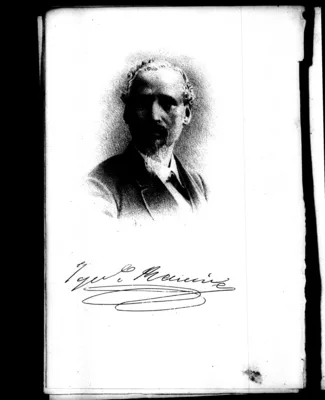
Ignacio Ramírez
Ignacio Ramírez was the son of a liberal family driven out by a clerical government. He read his way through the friars' and the cathedral's forbidden books, and at eighteen read a paper headed "No hay Dios" to the Academia de Letrán. He never retreated from it, but turned it from provocation into law: he fought "divine right" in the 1856 Congress and closed the convents as Juárez's minister. He held that a government should be neither Catholic nor atheist, and belief left to each conscience.
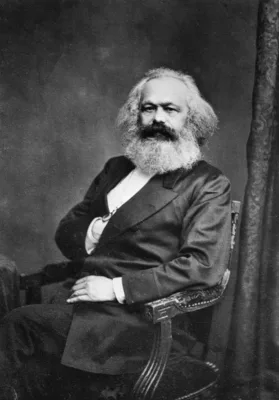
Karl Marx
Karl Marx, the grandson of rabbis, was baptised a Lutheran at six into his father's Enlightenment deism. He lost his idealist "gods" at nineteen and took Prometheus for his motto at twenty-three. By twenty-five, after Feuerbach, he held the criticism of religion finished: religion was the sigh of the oppressed and the heart of a heartless world, a symptom that would fade only when the world stopped needing it. So he spent his life on economics, and had little time for atheist campaigners.
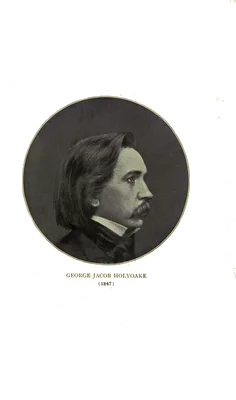
George Holyoake
George Jacob Holyoake was a devout Birmingham Sunday-school teacher whose sister died over a church-rate. He lost his belief in God when his friend Southwell was jailed for blasphemy in 1842, and went to prison himself that year professing "disbelief" rather than denial. He then spent sixty years renaming the absence, from atheism to Secularism in 1851 to agnosticism, so that unbelief would be judged by the good it did rather than by the quarrel over God.
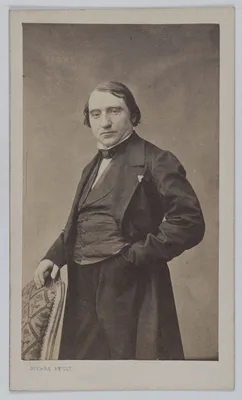
Ernest Renan
Ernest Renan was a Breton boy who never doubted his priests. He lost his faith not to a woman or to politics but to Hebrew philology at Saint-Sulpice, and walked out of the seminary in 1845 because he could not become a priest without hypocrisy. He told the life of Jesus as the life of an incomparable man (1863), and lost his chair for it. He ended neither believer nor atheist, writing that atheism is logical in this universe but that we may be atheists for not seeing far enough, and addressing "a hidden God".