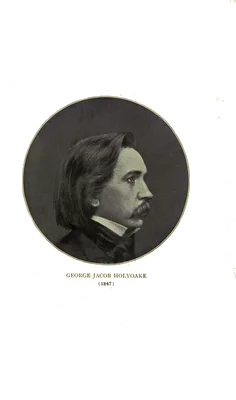
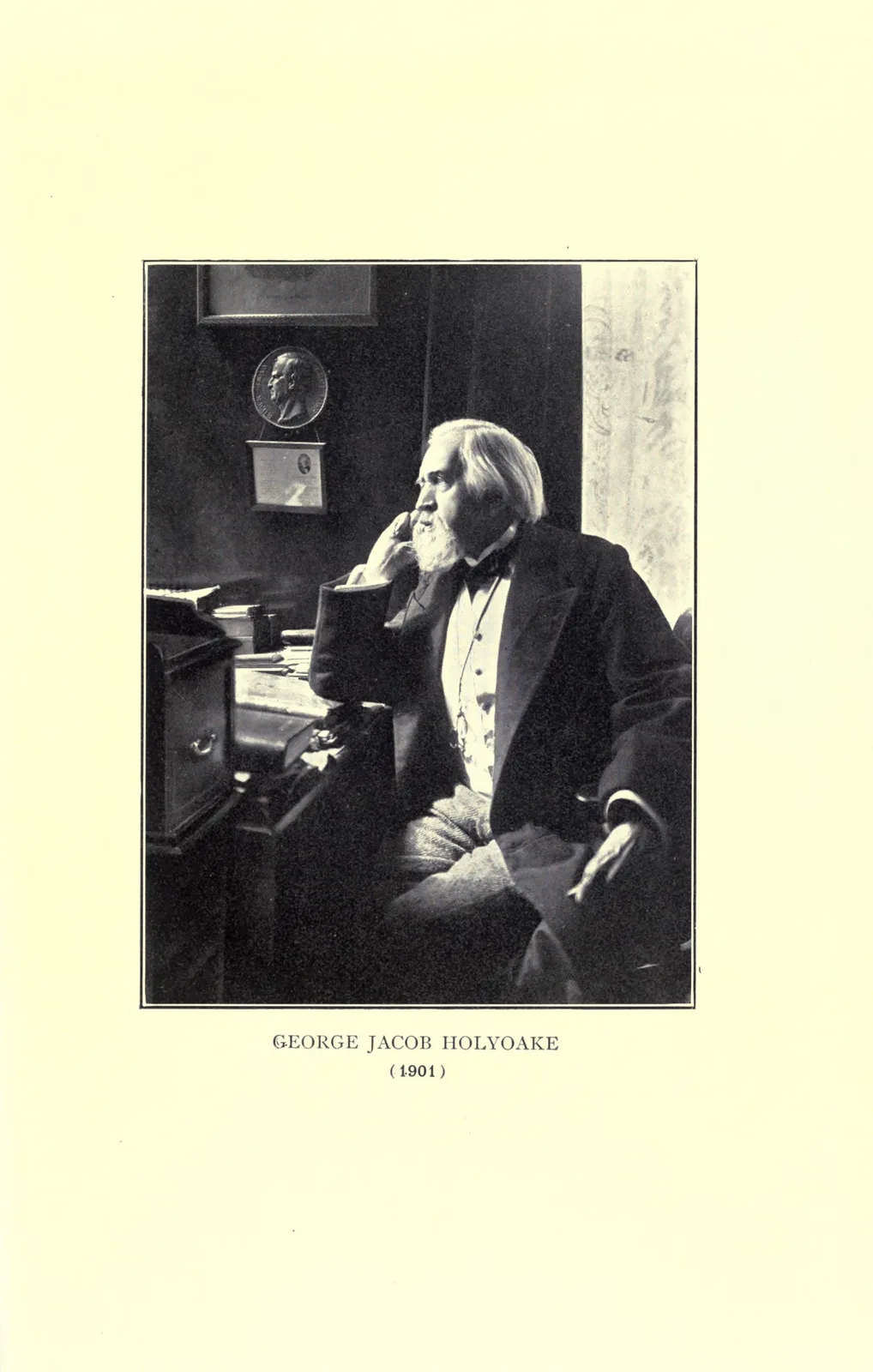
George Jacob Holyoake was a devout Birmingham Sunday-school teacher whose sister died over a church-rate. He lost his belief in God when his friend Southwell was jailed for blasphemy in 1842, and went to prison himself that year professing "disbelief" rather than denial. He then spent sixty years renaming the absence, from atheism to Secularism in 1851 to agnosticism, so that unbelief would be judged by the good it did rather than by the quarrel over God.
The belief timeline
- Faith (c. 1828–1841) — Chapel and Sunday-school boyhood in Birmingham; a Trinitarian into his late twenties, a theist like Owen until the end of 1841; the first crack is his sister's death over a church-rate in c. 1829, but he keeps his belief [5][6][11][17]
- Doubt (Jan 1842) — Southwell's conviction (15 Jan 1842) and Holyoake's lecture of 9 Jan; "the cradle of my doubts and grave of my religion". The sister's death (1829), Brindley (1838) and the Owenite oath crisis (1841) loosened his ties to the churches, but McCabe and his own later statements place the loss of belief itself in early 1842 [6][11][16][17][19]
- Declaration (24 May 1842) — The Cheltenham answer, the arrest of 2 June, and the trial of 15 Aug 1842: "Disbelief is all I profess" [22][24][29][16]
- Revision (3 Dec 1851) — Gives up "atheist" for "Secularist" and "Secularism" (10 Dec 1851): a positive programme of duty "which belongs to this life", with theism and atheism left open [38][39][40]
- Restatement (1896) — "Secularism does conflict with theology"; calls his position agnostic or limitationist; dies in 1906 without any belief in a future life [56][57][62]
Notes to the timeline (15)
- [5] He attended the Carr's Lane Sunday school under the Rev. John Angell James for about five years from c. 1828, and his mother also took him to a Baptist chapel where the Rev. Mr Cheadle "expressed comforting doubts whether there was any hell at all". McCabe calls Carr's Lane "Wesleyan"; Holyoake's own pages show it as Independent — Joseph McCabe, Life and Letters of George Jacob Holyoake, 2 vols (London: Watts & Co., for the Rationalist Press Association, 1908), with the bibliography compiled by C. W. F. Goss (vol. II, pp. 329–340), vol. I p. 9; George Jacob Holyoake, Sixty Years of an Agitator's Life, 2 vols (London: T. Fisher Unwin; scan is the sixth impression, 1909, from the first edition of 1892; pagination checked against running heads), vol. I p. 13. Reported at second hand; the original has not been seen.
- [6] In his twelfth year (c. 1829) his younger sister fell ill during a commercial panic; the rector of St Martin's demanded a church-rate of fourpence, then 2s 10d with costs; his mother was kept five to six hours at the office and the child died before she came home; Holyoake took rheumatic fever at the grave. He told the Gloucester jury this made him doubt "the utility of church establishments" — George Jacob Holyoake, The History of the Last Trial by Jury for Atheism in England: a fragment of autobiography (London: J. Watson, 1850 per McCabe's bibliography; the Google scan on the Internet Archive is catalogued 1851). Contains his own account of the lecture, the depositions, Mr Justice Erskine's summing-up, the sentence, his defence speech and the prison chapters, pp. 38–39; McCabe, Life and Letters of George…, vol. I pp. 9–10.
- [11] In 1838 George Combe lectured in Birmingham and Holyoake assisted; the Rev. Dr Brindley's attacks on phrenology and on Hawkes Smith, and his twisting on his seat and making faces, "made me less proud than I had been to be counted on their side" — Holyoake, Sixty Years of an Agitator's Life, vol. I pp. 48–50; McCabe, Life and Letters of George…, vol. I pp. 27–28.
- [17] At the end of 1841 Holyoake was still a theist (McCabe: "as Owen always was"), with "a vague belief in God"; he "retained his general religious belief until his twenty-fourth year" — McCabe, Life and Letters of George…, vol. I pp. 26, 54–56.
- [16] In 1841 the Owenite Central Board, hit by the Bishop of Exeter's attack, made the missionaries swear as "Rational Religionists"; Lloyd Jones and Buchanan swore; Holyoake and Southwell "protested against and refused to swear to the thing which was not"; Holyoake circulated a pamphlet charging the Board with sacrificing principle to expediency — McCabe, Life and Letters of George…, vol. I pp. 53–54; Holyoake, Sixty Years of an Agitator's Life, vol. I pp. 109, 142.
- [19] On 9 January 1842, at Sheffield, Holyoake lectured on "The Spirit of Bonner in the Disciples of Jesus"; he said Southwell's treatment was "the cradle of my doubts and grave of my religion". The date of the lecture precedes the sentence, so McCabe means the prosecution; the pamphlet appeared in 1842 — McCabe, Life and Letters of George…, vol. I p. 57; McCabe, Life and Letters of George…, vol. II p. 329.
- [22] On 24 May 1842 in Cheltenham's Mechanics' Institution he lectured on home colonisation; a teetotaller named Maitland asked about duty to God; Holyoake replied that the people were "too poor to have a God" and that he would put the deity "upon half-pay". He gives the reply in 1850 with a footnote saying he does not remember the phrase "I do not believe there is such a thing as a God" — Holyoake, History of the Last Trial…, pp. 4–5 and n.; McCabe, Life and Letters of George…, vol. I pp. 61–65. Accounts differ; see the disputed points.
- [24] On 2 June 1842 he spoke again at the Mechanics' Institution on free speech; the police superintendent arrested him without a warrant; before the magistrates (two of them clergymen) the prosecutor Mr Bubb said "any person who denies the existence or providence of God is guilty of blasphemy"; the witnesses were a prizefighter and a printer from the Chronicle office; he was committed on 3 June, handcuffed, walked through Cheltenham and taken by rail to Gloucester — Holyoake, History of the Last Trial…, pp. 9, 34; Holyoake, Sixty Years of an Agitator's Life, vol. I pp. 148–150; McCabe, Life and Letters of George…, vol. I pp. 67–69.
- [29] The assizes were held in the Shire Hall at Gloucester; Holyoake's own 1850 account gives opening on 6 August and his case on 15 August, the Oracle's masthead says sentenced "on August 15, 1842"; SY and McCabe say the assizes opened 2 August; prosecuting counsel was Mr Alexander; the jury were "seven farmers, one grocer, one poulterer, one miller, one nondescript shopkeeper, and one maltster"; the indictment called him a "labourer" — Holyoake, History of the Last Trial…, p. 20; The Oracle of Reason, or Philosophy Vindicated (Bristol and London, 1841–43), mastheads naming Southwell and Holyoake, masthead; Holyoake, Sixty Years of an Agitator's Life, vol. I pp. 157–159; McCabe, Life and Letters of George…, vol. I pp. 74–75.
- [38] In 1850 the Reasoner was still an "atheistical" journal and he published "The Logic of Death; or, why should the Atheist fear to die?"; in 1852 a debate with the Rev. Henry Townley was published as "Atheistic controversy"; "Holyoake was never happy under the name 'atheist'" because it suggested dogmatism and coarseness — McCabe, Life and Letters of George…, vol. II pp. 330–331; McCabe, Life and Letters of George…, vol. I p. 201.
- [39] He first used "Secular" as a general test on 19 November 1851, "Secularist" on 3 December 1851 and "Secularism" on 10 December 1851, all in the Reasoner. McCabe finds in his diary "first 'Secular' number of the Reasoner" on 21 March 1849 — George Jacob Holyoake, English Secularism: A Confession of Belief (Chicago: Open Court, 1896), pp. 46–47; McCabe, Life and Letters of George…, vol. I p. 202.
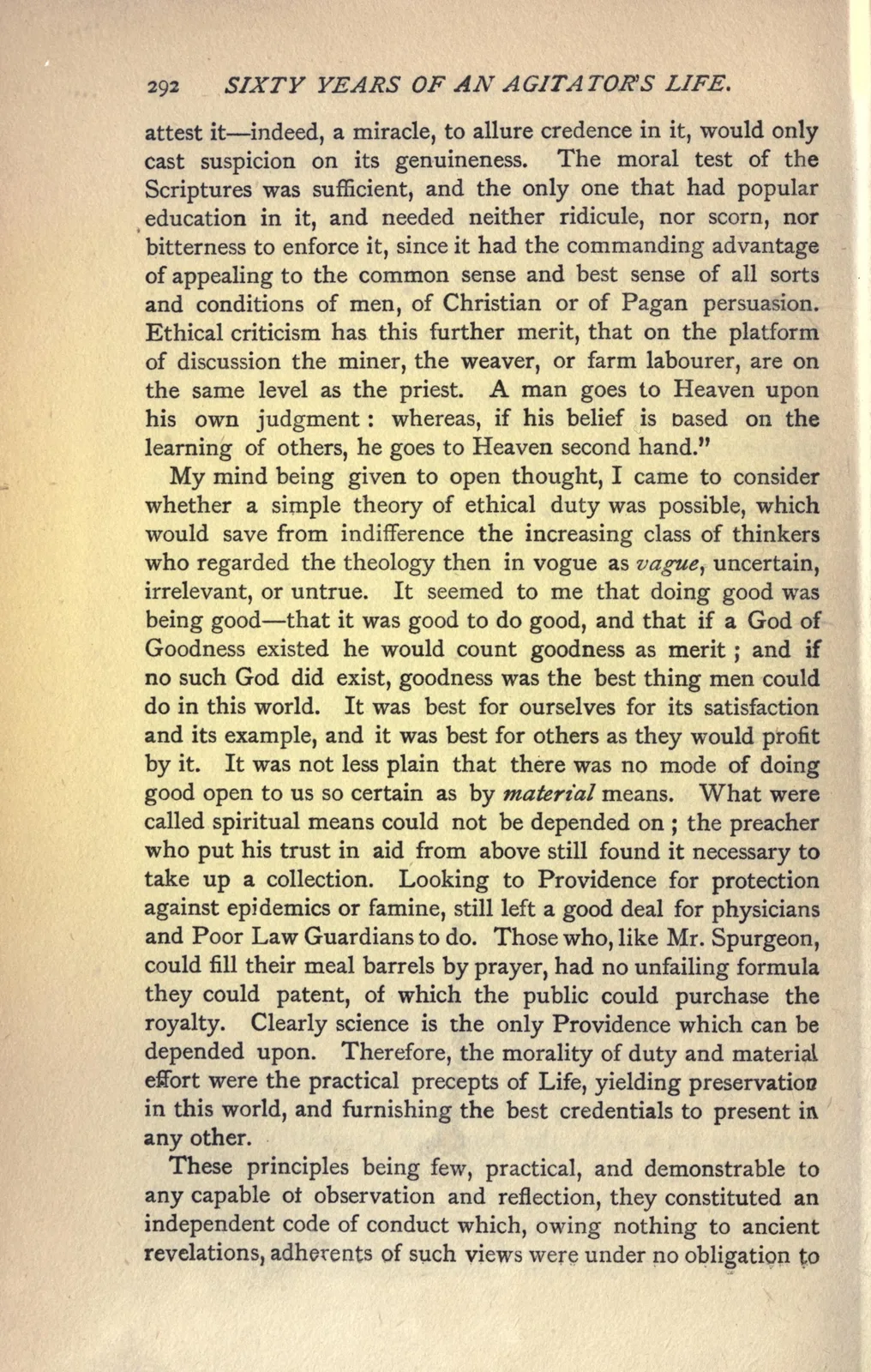
- [40] His stated reasons: the old names ("Atheist", "Infidel") were "pirate flags" put on by opponents; free thought's second stage, criticism of theology, becomes "a profession... pursued as an end instead of a means"; a positive code of life was needed "to those who find Theology indefinite, or inadequate, or deem it unreliable"; he tried "Netheism" and "Limitationism" first — George Jacob Holyoake, The Principles of Secularism (the scan is a new edition with a preface dated 1870; first text 1854 and 1859), pp. 9, 11; Holyoake, English Secularism, pp. 2–3; Holyoake, Sixty Years of an Agitator's Life, vol. II pp. 292–294; McCabe, Life and Letters of George…, vol. I pp. 201, 208.
- [56] His 1896 book said "Secularism does conflict with theology" and subtitled itself "where Freethought commonly ends Secularism begins"; McCabe says he "accepted no Christian dogma, and not even the most attenuated shade of theism" and was "a pure Agnostic" who "resented the term Atheist" because it implied dogmatic denial — Holyoake, English Secularism, pp. 1–3; McCabe, Life and Letters of George…, vol. II pp. 265–266.
- [57] In 1905 Holyoake wrote: "It was Huxley who first raised the question of intellectual veracity, and he devised the term Agnostic (which merely means limitation) to express it"; he adds that Limitationism "does not mean disbelief" — George Jacob Holyoake, Bygones Worth Remembering, 2 vols (London: T. Fisher Unwin, 1905), vol. II pp. 98–99.
- [62] He died on 22 January 1906, in the presence of his wife and daughter; his doctor, Dr Ryle, never heard him express belief in a future life and McCabe saw that his last pencilled notes repeated his creed in The Origin and Nature of Secularism — McCabe, Life and Letters of George…, vol. I p. 1; McCabe, Life and Letters of George…, vol. II pp. 308–312.
Disbelief Is All I Profess
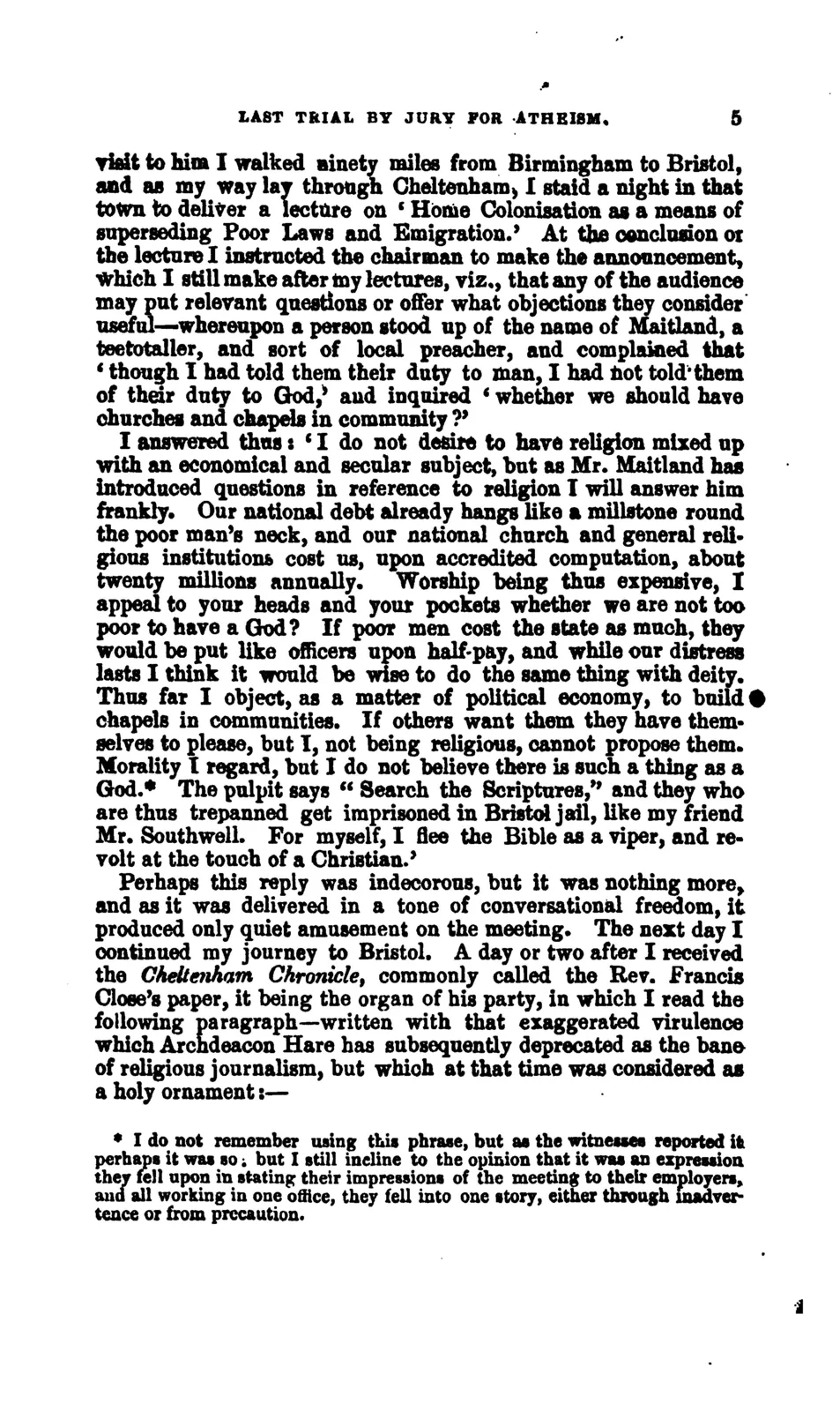
On 24 May 1842 a young lecturer for Robert Owen's socialists spoke at the Mechanics' Institution in Cheltenham on a subject that had nothing to do with religion: home colonisation. When he finished, a man in the audience asked about the people's duty to God. George Holyoake was twenty-five, poor, and months away from a friend's conviction for blasphemy. His answer, as he printed it eight years later, was this: "I appeal to your heads and your pockets whether we are not too poor to have a God? If poor men cost the state as much, they would be put like officers upon half-pay, and while our distress lasts I think it would be wise to do the same thing with deity."12
The local Evangelical paper called it "ATHEISM AND BLASPHEMY" and demanded action. On 2 June he was arrested without a warrant, walked through the town in handcuffs, and taken to Gloucester gaol.34 He served six months, and while he was in prison his small daughter died.56 Then he spent the rest of a very long life trying to give unbelief a different name and a better reputation. This chapter follows him from a Birmingham Sunday school to that gaol, and asks why the man who went to prison for atheism spent the next sixty years refusing to be called an atheist.
A Birmingham boyhood
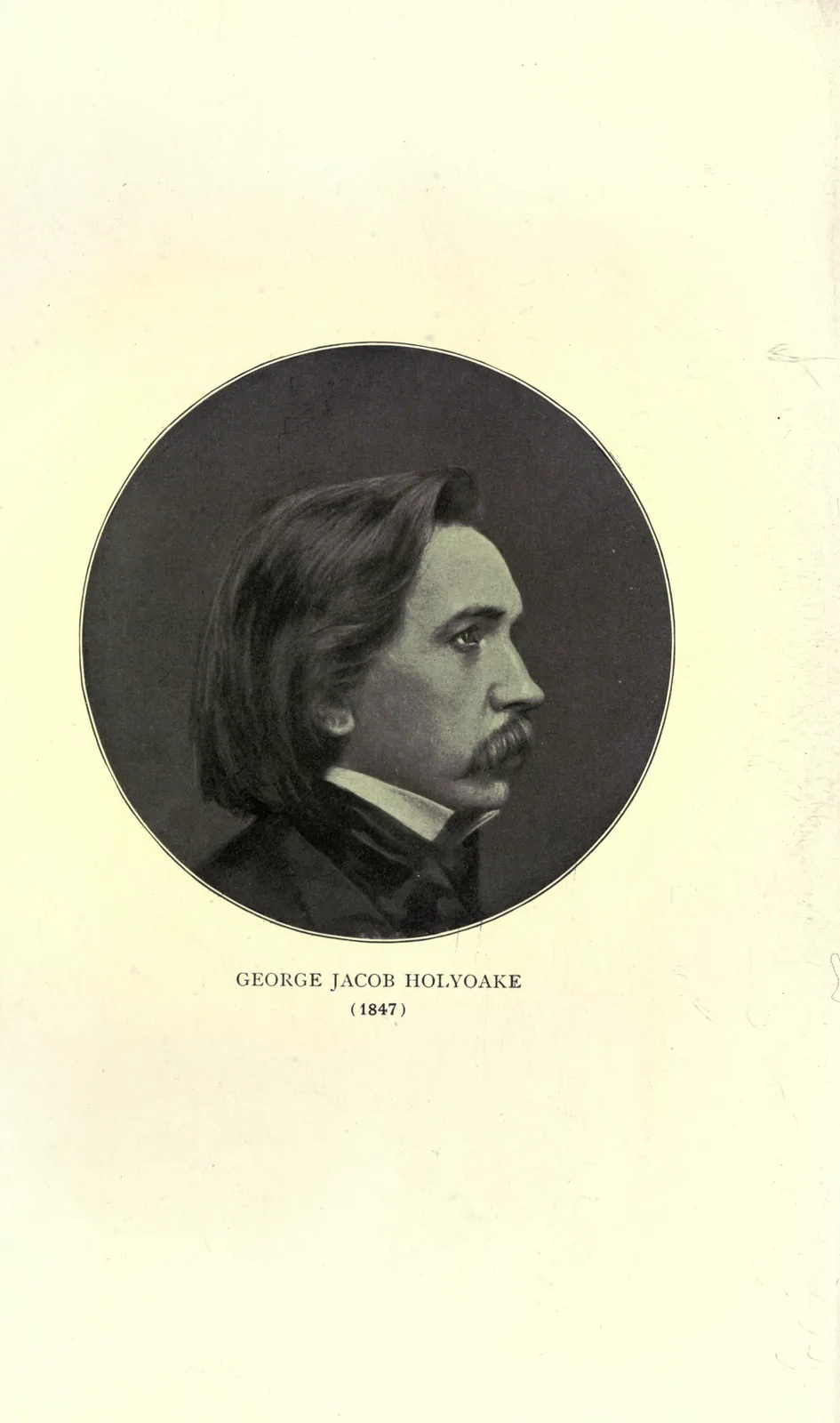
He was born on 13 April 1817 at No. 1 Inge Street, Birmingham, the eldest son of thirteen children.7 His mother, a horn-button maker, was "Puritan-minded" and "never had any doubts"; his father, a foundry worker, had "a pagan mind" and simply never mentioned religion: "During all the years of my youth I never remember to have heard my father use an expression which implied that he had ever heard of religion."89 His first idea of God came from the baker in Inge Street, a pale, kind, silent man: "The first idea my mother gave me of God made me think He was like that miller, who never smiled or spoke, but was always kind and gentle to me."1011 From about the age of nine he worked beside his father at the Eagle Foundry.12
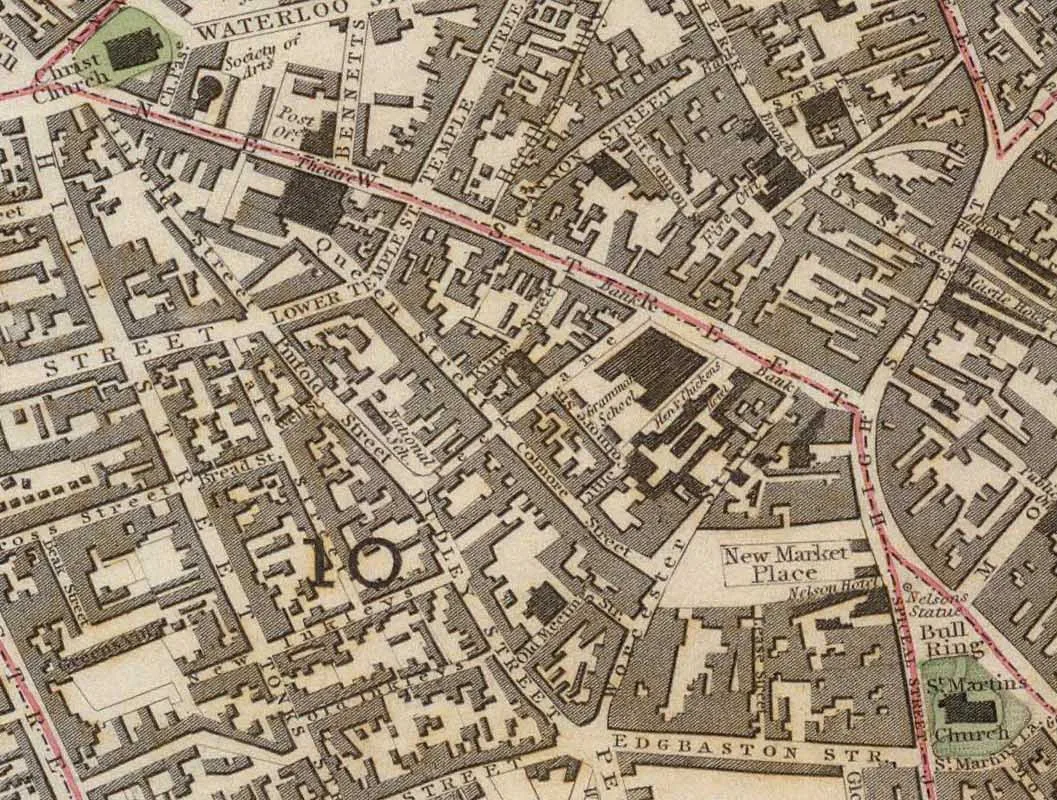
He was a devout boy. He went to the Sunday school of the Carr's Lane chapel, taught Sunday school himself for many hours, and wrote verses for a Baptist tract magazine. "In early youth I was religious," he told his jury in 1842. "I question whether there is any here who have spent more time than I did as a Sunday school teacher."131415
The first crack came when he was about twelve. In a time of commercial panic his little sister fell ill, and the rector of St Martin's demanded a church-rate from the family, first fourpence and then, with costs, 2s 10d. His mother was kept waiting five or six hours at the office, and the child died before she got home; the boy caught rheumatic fever standing at the grave. "Gentlemen," he asked the jury thirteen years later, "will you wonder if, after this, I doubted a little the utility of church establishments?"1617 It was the Church he doubted then, not God.
Three gods and Robert Owen
At seventeen he entered the Birmingham Mechanics' Institution, where Unitarian tutors taught him that "all opinion should be tested by reason." He taught in their Sunday school too, and they never interfered with his beliefs: "I retained all the time my Trinitarian belief," he wrote. "A vague impression existed in my mind that three Gods were not too many to attend to the affairs of this vast universe."18192021 He heard Robert Owen, the socialist reformer, and took up Owen's teaching that "a man's character is made for him, not by him."22 "Thus, in addition to the persuasion I had of the usefulness of piety, was added the conviction of the piety of usefulness."23
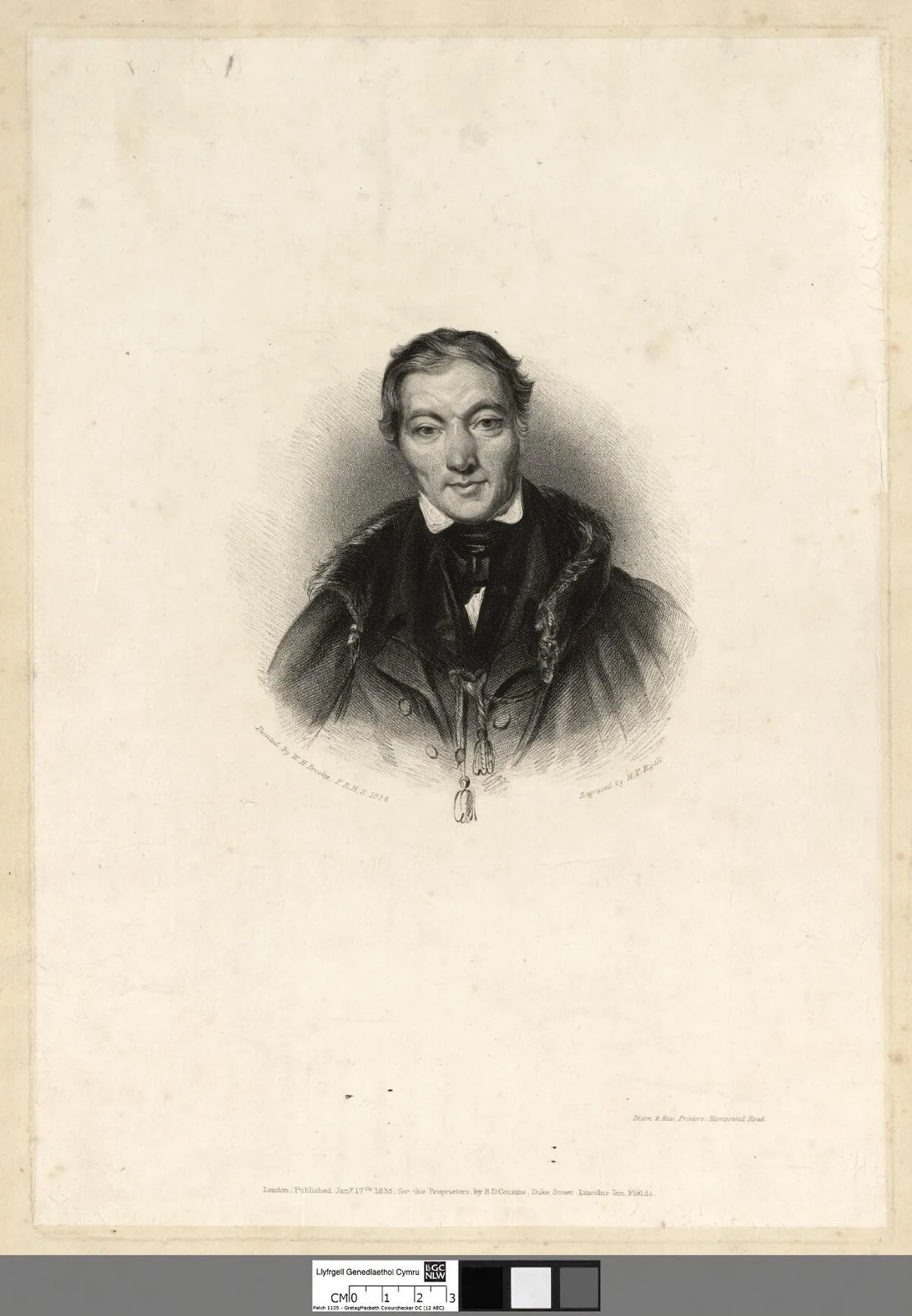
He married Eleanor in 1839 at a registry office; their daughter Madeline was born the next year. Eleanor never fully shared his views, but she told him to "do what you think right."24 In 1840 he became a paid Owenite lecturer, a "social missionary," first at Worcester and then at Sheffield.25 When the Owenite leaders, under attack from a bishop, required their missionaries to swear an oath as "Rational Religionists," Holyoake and a fellow missionary, Charles Southwell, refused.26 At the end of 1841 he still believed in God, as Owen always did.27
The grave of my religion
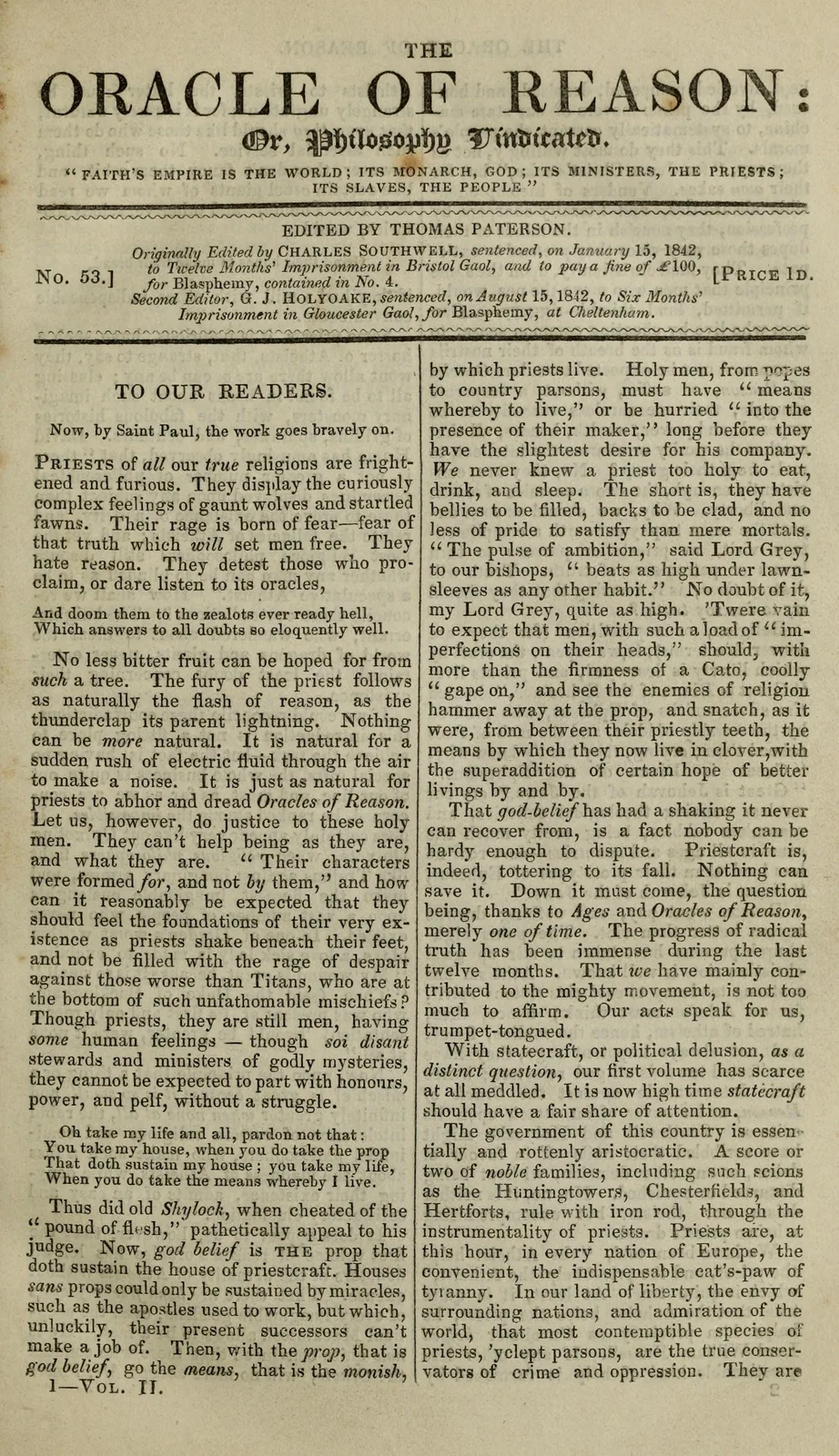
The change came in January 1842. Southwell, now editing a freethinking paper, The Oracle of Reason, at Bristol, was prosecuted for blasphemy over its fourth number and on 15 January was sentenced to a year in prison and a fine of £100.28 Holyoake lectured at Sheffield on "The Spirit of Bonner in the Disciples of Jesus," and his biographer quotes him as calling Southwell's treatment "the cradle of my doubts and grave of my religion."2930 In February he took over the Oracle himself.31 The belief timeline places his doubt there rather than at his sister's grave because, by his own account and his biographer's, it was his friend's prosecution, not the church-rate, that ended his belief. For some years afterwards he called himself an atheist, meaning, his biographer says, "I know nothing of Gods," not that he knew there were none.32
Cheltenham and Gloucester
Then came Cheltenham. The words he spoke there survive in three versions: his own of 1850, a report in the Oracle that his biographer prints, and the sworn evidence of the witnesses. All three agree on the half-pay line. In 1850 he added a sentence the witnesses swore to, "I do not believe there is such a thing as a God," with a footnote: "I do not remember using this phrase, but as the witnesses reported it perhaps it was so."13334 The Cheltenham Chronicle, the paper of the town's Evangelical vicar, Francis Close, reported that "With many similar blasphemous and awful remarks, which we cannot sully our columns by repeating, the poor misguided wretch continued to address the audience."335
When he came back on 2 June to speak about free speech, the police arrested him. Two of the magistrates were clergymen, and the prosecutor told them that "any person who denies the existence or providence of God is guilty of blasphemy."4 Asked to swear to his bail, he refused. The governor of the gaol asked, "What does it matter, Holyoake, how many gods you swear by, since you do not appear to believe in any?" He answered: "It certainly did not matter to the gods, but it mattered very much to me to pretend to a belief I do not hold."3637 The Home Secretary later told Parliament that the magistrates had acted with "unnecessary harshness."38
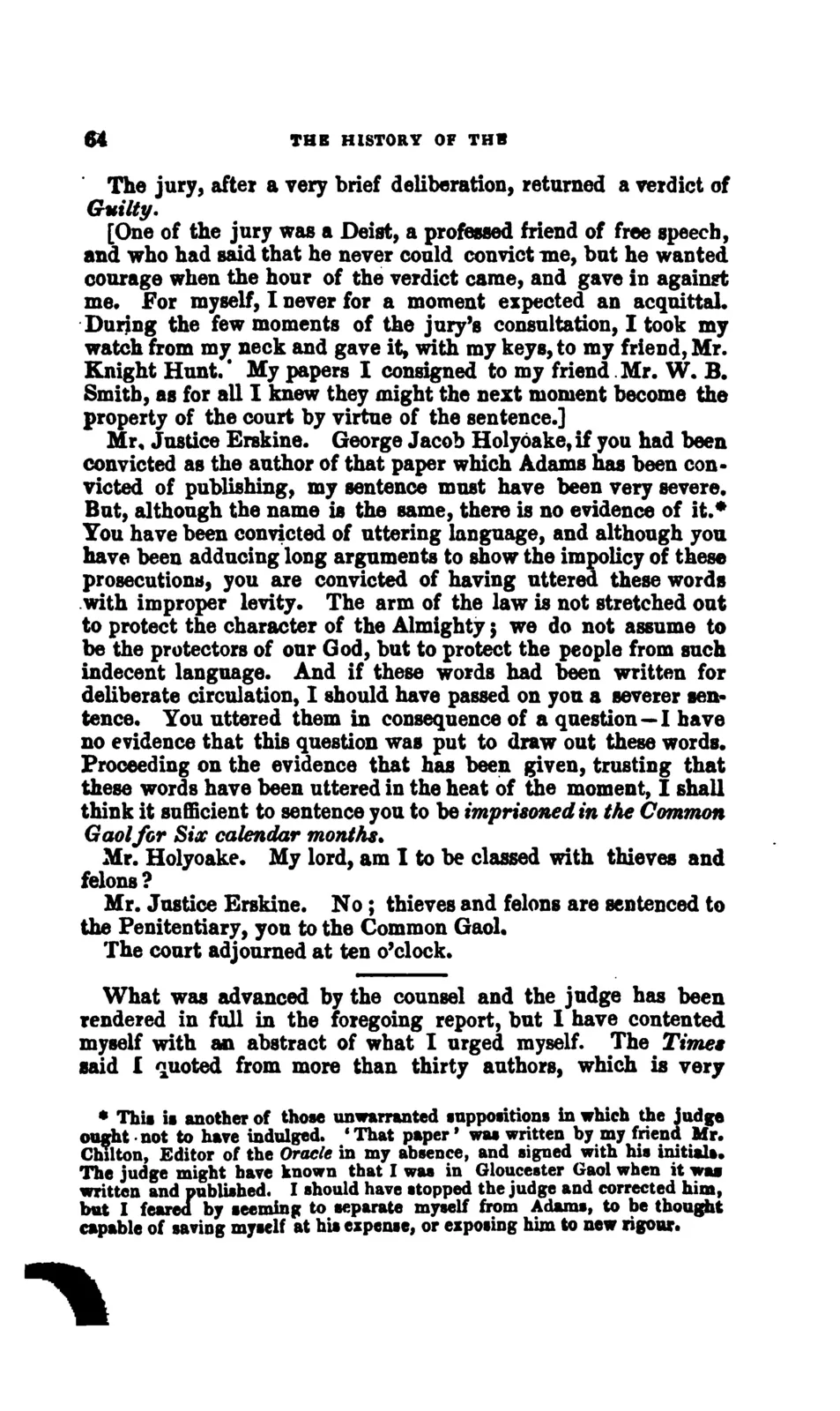
He was tried at the Gloucester assizes in August 1842 and defended himself for about nine hours.3940 He drew a careful line. "There is a great difference between denial and disbelief. If I had said distinctly 'there is no God,' it would have been stating that I was quite sure of it. I could not have said that, because I am not sure of it. ... I saw reasons for disbelief, but did not assert denial. Disbelief is all I profess."4142 The judge, Mr Justice Erskine, offered him a way out: if Holyoake would convince the jury that he had meant only that the clergy were overpaid, he would tell them not to convict. Holyoake would not.40 The jury found him guilty, and Erskine sentenced him to six months for words spoken "with improper levity." The law, the judge said, "is not stretched out to protect the character of the Almighty; we do not assume to be the protectors of our God, but to protect the people from such indecent language."543 Holyoake always spoke of Erskine's fairness.5
Madeline
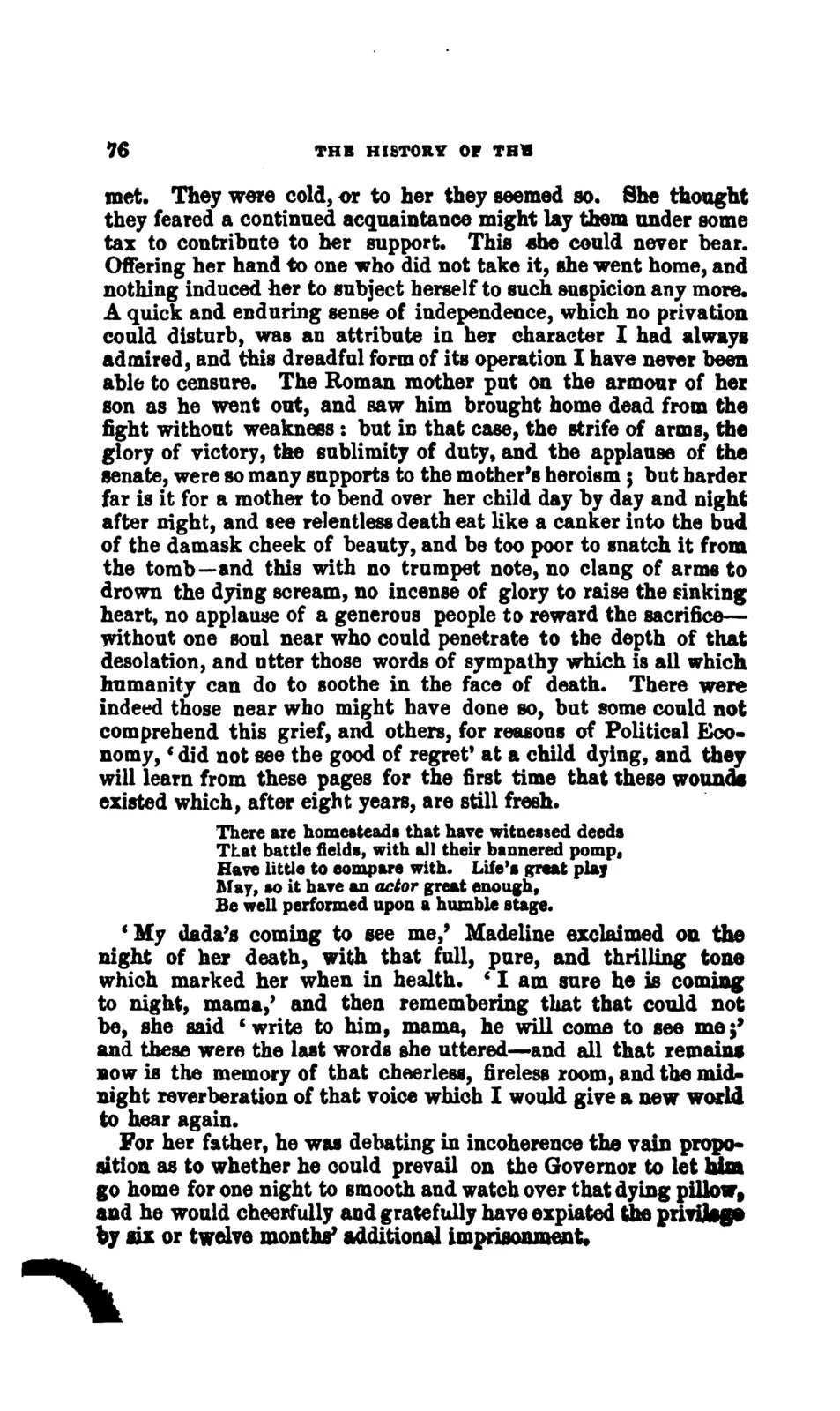
When he left home for the trial, his daughter Madeline "ran from her mother's knee to the door," he wrote. "I never met her glance again, nor heard her voice any more."44 In October, while he was in prison, she died of a fever after months of hunger; her last words were that her father was coming. She was buried without a minister.6 He was offered his freedom if he would petition and give up his lecturing, and a school for himself and his wife; he refused. "My wife would have resented it had I done it on her account. So when I was free I took the warpath again."4546 In the account he published in 1850 he wrote, addressing Liberty: "Thou hast trodden on the grave of my child, and I worship thee still, although thou mayst yet tread on my own."47 He called the book The History of the Last Trial by Jury for Atheism in England.
Secularism
He was released in February 1843 and went to London. For years the name "the Liberated Blasphemer" kept him out of work.4548 He started a paper, The Reasoner, in 1846.49 But the quarrels of the atheist journalists around him disgusted him, and his biographer says he became "more determined than ever to discourage criticism of theology apart from positive moral and social culture."50 He was never happy, the same biographer writes, under the name "atheist," because it suggested dogmatism and coarseness.51
In December 1851, in The Reasoner, he offered a new word. "We should use the word Secularist as best indicating that province of human duty which belongs to this life." A week later he wrote "Secularism."5253 He explained why. To go on calling himself an atheist, a name chosen by his enemies, was "as though a merchant vessel should consent to carry a pirate flag."5455 Secularism was "the study of promoting human welfare by material means; measuring human welfare by the utilitarian rule, and making the service of others a duty of life." "Science is the available Providence of life."565758 And it did not settle the question of God at all: "That this secular form of opinion implies Atheism is an error into which many fall. Secularism, like mathematics, is independent of theistical or other doctrine."59 That is where the timeline places his revision.
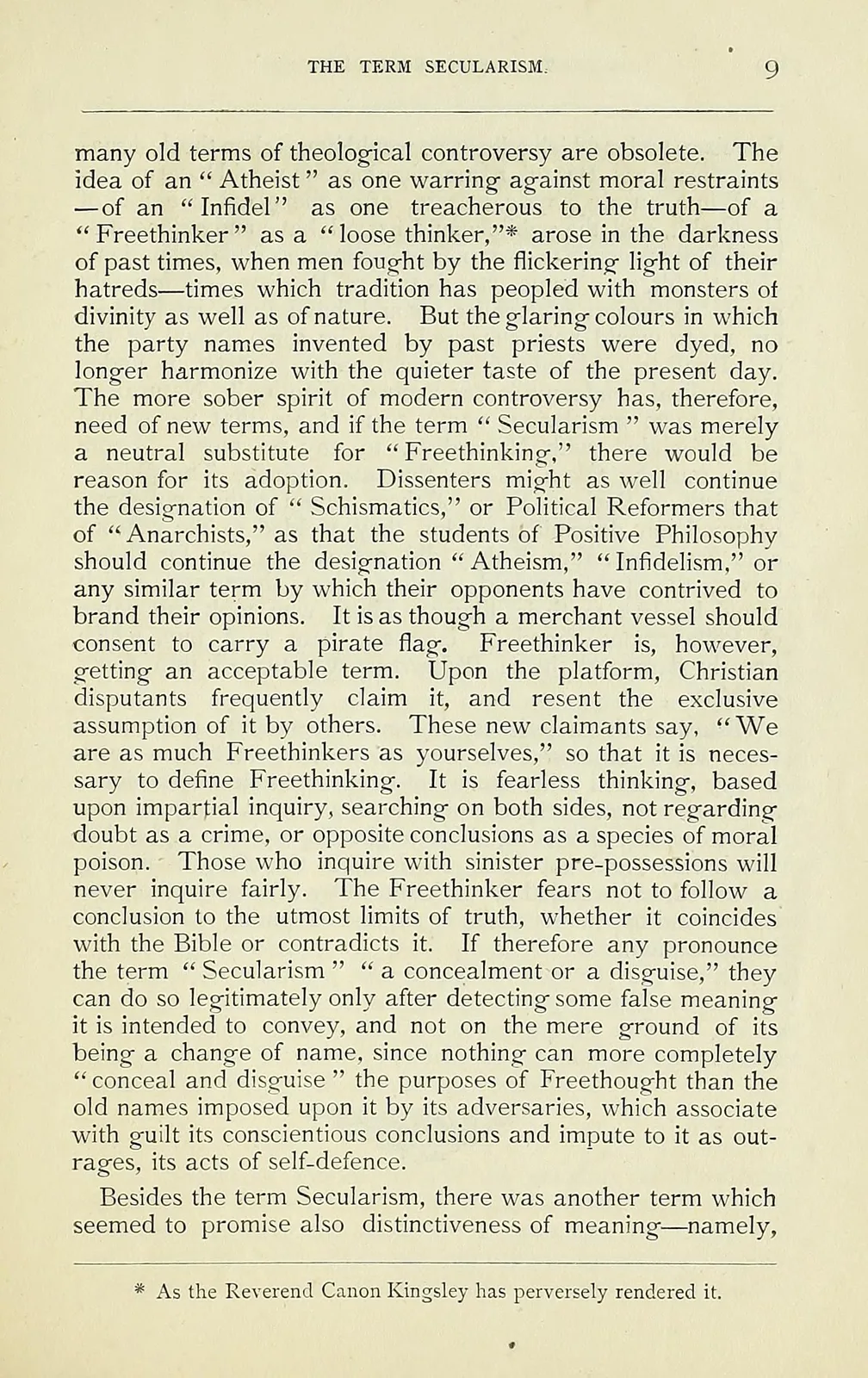
His reasoning was simple and personal. "It seemed to me that doing good was being good — that it was good to do good, and that if a God of Goodness existed he would count goodness as merit; and if no such God did exist, goodness was the best thing men could do in this world." "In my youth I had borne the burden of theologic hopes and fears until my mind ached, and if I could lead others into a simpler, surer, and brighter way, I was wishful to do so."6061 Harriet Martineau welcomed the word because it included "a large number of persons who are not Atheists."62
Critics on both sides
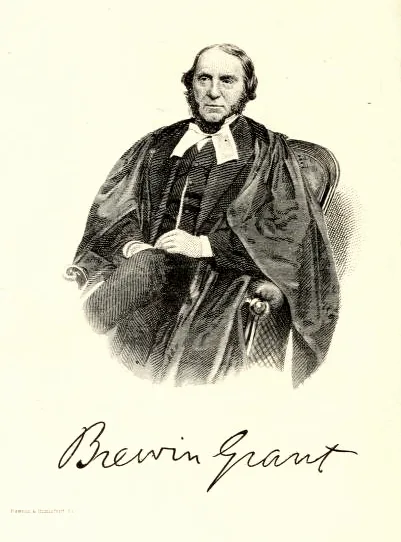
The believers were not convinced by the new name. In a six-night public debate in 1853, the Congregational minister Brewin Grant told the audience that "It is positively some months since the term Atheist became obsolete as Mr. Holyoake's watchword," and that "Charles Southwell's imprisonment opened the eyes of Mr. Holyoake to the glaring fact that there is no God; but he has shut his eyes again to leave the question open."636465 The Unitarian theologian James Martineau declined to debate him at all, "simply because I do not see that you have any views, beyond critical objections to other people's arguments."66
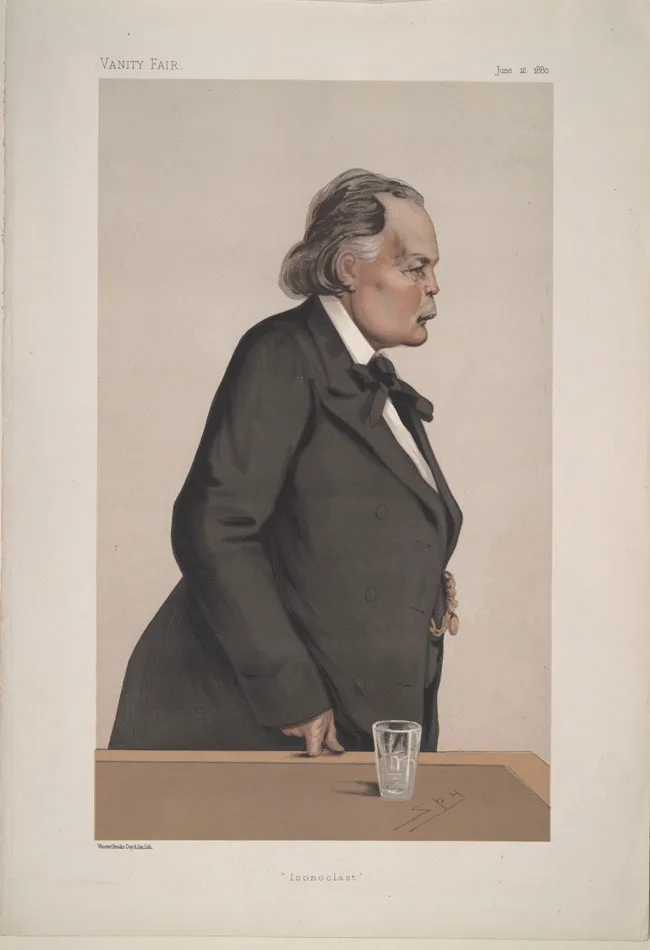
The atheists were not convinced either. In 1850 Holyoake had taken the chair at the first public lecture of a seventeen-year-old named Charles Bradlaugh, and in 1858 Bradlaugh succeeded him as leader of the London secularists.67 Bradlaugh took the name Holyoake had put down: "I happen to think that the consequence of Secularism is Atheism, and I have always said so. Clearly all Secularists are not Atheists."6869 Bradlaugh's ally J. M. Robertson called Holyoake "himself an Atheist" who had defined Secularism so as to empty it of meaning.70 In 1870 the two men debated whether the principles of Secularism include atheism, and Holyoake declined to be a vice-president of Bradlaugh's National Secular Society.7172 When Bradlaugh fought to take his seat in Parliament in 1880, Holyoake, who had "never taken an oath" and had been "an outlaw, until I was fifty-two years of age" because an atheist could not give evidence, said that Bradlaugh would take the oath, and then disapproved when he offered to: "If an Atheist may, for the sake of some advantage before him, make a Christian profession, there is no reason why a Christian should not make an Atheistical profession."737475 They were reconciled a year or two later.76
Co-operation and old age
What he cared about most, by his own late account, was not theology but the co-operative movement. His history of the Rochdale Pioneers' store, Self-Help by the People, was translated into five languages, and he became "the grand old man" of the movement. "I have cared more for Co-operation than for any other public movement," he said near the end.777879 In 1896 he published a last statement, English Secularism, which said plainly that "Secularism does conflict with theology."8081 He took up Huxley's word "agnostic," which "merely means limitation."8283 Gladstone wrote to him that Secularism "owes all its materials to Christianity, which it represents by amputation, and never would have existed without the Gospel."8485
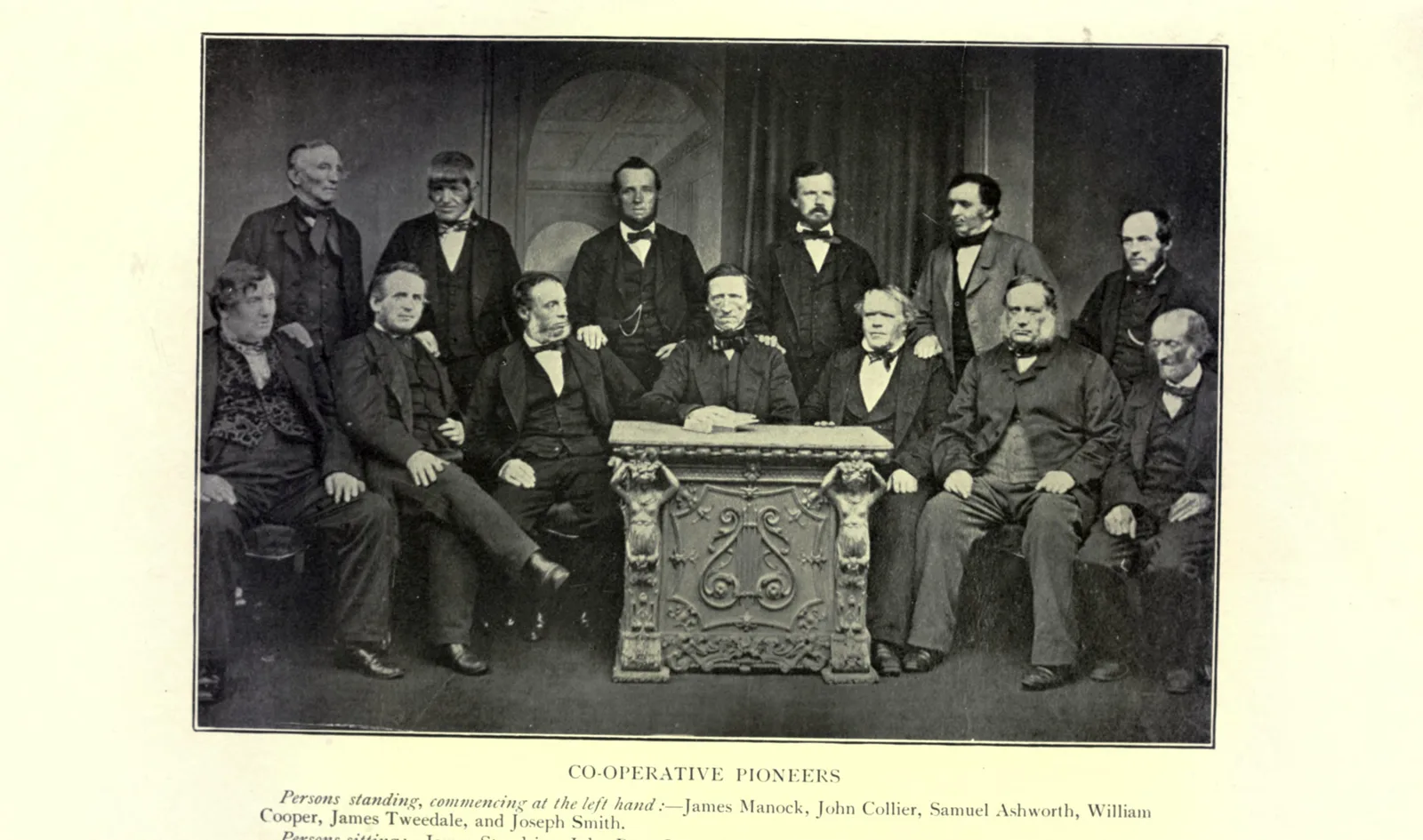
He died at Brighton on 22 January 1906, aged eighty-eight, and his doctor never heard him express belief in a future life.86 He was cremated without a religious service, in a white coffin wrapped in the flag of Garibaldi's volunteers, and his ashes were buried at Highgate, near George Eliot.87 The co-operators put up a monument over them.87
Did his unbelief change shape?
The belief went once, in 1842, and never came back; what changed, again and again, was the name he gave the absence. In prison he called it disbelief, not denial. For a few years he called it atheism. From 1851 he called it Secularism, a programme for this life that left the question of God open, and in old age he called it agnosticism. His motive for the renaming was not cowardice: he had already gone to prison for the word "God." He had seen what the fight over theology did to the people who made it their trade, and he wanted unbelief to be judged by the good it did. Both sides thought he was evading the question. He thought he was answering a different one.
Charles Bradlaugh, whose first lecture Holyoake chaired and who took up the atheist name Holyoake had put down, has his own chapter in this book.
Footnotes
-
George Jacob Holyoake, The History of the Last Trial by Jury for Atheism in England: a fragment of autobiography (London: J. Watson, 1850 per McCabe's bibliography; the Google scan on the Internet Archive is catalogued 1851). Contains his own account of the lecture, the depositions, Mr Justice Erskine's summing-up, the sentence, his defence speech and the prison chapters, pp. 4–5 and n.; Joseph McCabe, Life and Letters of George Jacob Holyoake, 2 vols (London: Watts & Co., for the Rationalist Press Association, 1908), with the bibliography compiled by C. W. F. Goss (vol. II, pp. 329–340), vol. I pp. 61–65. Accounts differ; see the disputed points. ↩ ↩2
-
Holyoake, History of the Last Trial…, p. 5 (his 1850 version of the Cheltenham reply). ↩
-
Holyoake, History of the Last Trial…, pp. 5–6; McCabe, Life and Letters of George…, vol. I pp. 65–66; George Jacob Holyoake, Sixty Years of an Agitator's Life, 2 vols (London: T. Fisher Unwin; scan is the sixth impression, 1909, from the first edition of 1892; pagination checked against running heads), vol. I p. 148. ↩ ↩2
-
Holyoake, History of the Last Trial…, pp. 9, 34; Holyoake, Sixty Years of an Agitator's Life, vol. I pp. 148–150; McCabe, Life and Letters of George…, vol. I pp. 67–69. ↩ ↩2
-
Holyoake, History of the Last Trial…, pp. 62–65; Holyoake, Sixty Years of an Agitator's Life, vol. I pp. 161–162; McCabe, Life and Letters of George…, vol. I pp. 77–78. ↩ ↩2 ↩3
-
Holyoake, Sixty Years of an Agitator's Life, vol. I pp. 169–170; Holyoake, History of the Last Trial…, pp. 76–78; McCabe, Life and Letters of George…, vol. I p. 86. Month from mccabe is the only source for this, as for the other details in this chapter cited to that source alone. ↩ ↩2
-
McCabe, Life and Letters of George…, vol. I p. 1, p. 5 n.1; Holyoake, Sixty Years of an Agitator's Life, vol. I pp. 15, 15–16. ↩
-
Holyoake, Sixty Years of an Agitator's Life, vol. I pp. 10–12; McCabe, Life and Letters of George…, vol. I pp. 5–6. ↩
-
Holyoake, Sixty Years of an Agitator's Life, vol. I p. 12. ↩
-
Holyoake, Sixty Years of an Agitator's Life, vol. I p. 16. ↩
-
Holyoake, Sixty Years of an Agitator's Life, vol. I p. 16. ↩
-
McCabe, Life and Letters of George…, vol. I p. 8; Holyoake, Sixty Years of an Agitator's Life, vol. I pp. 11, 19–20. ↩
-
McCabe, Life and Letters of George…, vol. I p. 9; Holyoake, Sixty Years of an Agitator's Life, vol. I p. 13. Reported at second hand; the original has not been seen. ↩
-
Holyoake, History of the Last Trial…, pp. 40–41; McCabe, Life and Letters of George…, vol. I pp. 10–11. ↩
-
Holyoake, History of the Last Trial…, p. 40. ↩
-
Holyoake, History of the Last Trial…, pp. 38–39; McCabe, Life and Letters of George…, vol. I pp. 9–10. ↩
-
Holyoake, History of the Last Trial…, p. 39. ↩
-
McCabe, Life and Letters of George…, vol. I pp. 11–12; Holyoake, Sixty Years of an Agitator's Life, vol. I pp. 44–46, 48. ↩
-
Holyoake, Sixty Years of an Agitator's Life, vol. I pp. 47–48; McCabe, Life and Letters of George…, vol. I p. 12. ↩
-
Holyoake, Sixty Years of an Agitator's Life, vol. I p. 48. ↩
-
Holyoake, Sixty Years of an Agitator's Life, vol. I p. 48. ↩
-
McCabe, Life and Letters of George…, vol. I pp. 2, 28, 37–38; Holyoake, Sixty Years of an Agitator's Life, vol. I pp. 49–50. ↩
-
Holyoake, Sixty Years of an Agitator's Life, vol. I p. 50. ↩
-
McCabe, Life and Letters of George…, vol. I pp. 32–33, 36. ↩
-
McCabe, Life and Letters of George…, vol. I pp. 45–46, 49–50; Holyoake, Sixty Years of an Agitator's Life, vol. I p. 145. ↩
-
McCabe, Life and Letters of George…, vol. I pp. 53–54; Holyoake, Sixty Years of an Agitator's Life, vol. I pp. 109, 142. ↩
-
McCabe, Life and Letters of George…, vol. I pp. 26, 54–56. ↩
-
The Oracle of Reason, or Philosophy Vindicated (Bristol and London, 1841–43), mastheads naming Southwell and Holyoake, masthead (e.g. No. 56); Holyoake, Sixty Years of an Agitator's Life, vol. I p. 142. ↩
-
McCabe, Life and Letters of George…, vol. I p. 57; McCabe, Life and Letters of George…, vol. II p. 329. ↩
-
McCabe, Life and Letters of George…, vol. I p. 57, quoting the lecture "The Spirit of Bonner" (Jan 1842). Not checked against the original (no). ↩
-
McCabe, Life and Letters of George…, vol. I p. 58; Oracle of Reason, mastheads. ↩
-
McCabe, Life and Letters of George…, vol. I p. 57; Holyoake, Sixty Years of an Agitator's Life, vol. I p. 142. ↩
-
Holyoake, History of the Last Trial…, p. 5. ↩
-
Holyoake, History of the Last Trial…, p. 5 n.. ↩
-
The Cheltenham Chronicle, Rev. Francis Close's paper, Cheltenham, June 1842: Holyoake, History of the Last Trial…, p. 6. ↩
-
Holyoake, Sixty Years of an Agitator's Life, vol. I pp. 152–153; Holyoake, History of the Last Trial…, p. 15; McCabe, Life and Letters of George…, vol. I p. 71 n.1. ↩
-
Holyoake, Sixty Years of an Agitator's Life, vol. I p. 153. ↩
-
Holyoake, Sixty Years of an Agitator's Life, vol. I pp. 150, 153–154; McCabe, Life and Letters of George…, vol. I pp. 69–71. ↩
-
Holyoake, History of the Last Trial…, p. 20; Oracle of Reason, masthead; Holyoake, Sixty Years of an Agitator's Life, vol. I pp. 157–159; McCabe, Life and Letters of George…, vol. I pp. 74–75. ↩
-
Holyoake, Sixty Years of an Agitator's Life, vol. I pp. 160–161; McCabe, Life and Letters of George…, vol. I pp. 76–77. ↩ ↩2
-
Holyoake, History of the Last Trial…, p. 41 (defence speech). ↩
-
Holyoake, History of the Last Trial…, p. 41 (defence speech). ↩
-
Mr Justice Erskine, passing sentence at Gloucester, August 1842: Holyoake, History of the Last Trial…, p. 64. ↩
-
Holyoake, Sixty Years of an Agitator's Life, vol. I p. 156; McCabe, Life and Letters of George…, vol. I p. 74. ↩
-
Holyoake, History of the Last Trial…, pp. 81–83, 85; Holyoake, Sixty Years of an Agitator's Life, vol. I p. 176; McCabe, Life and Letters of George…, vol. I pp. 86–87. ↩ ↩2
-
Holyoake, Sixty Years of an Agitator's Life, vol. I p. 176. ↩
-
Holyoake, History of the Last Trial…, pp. 76–77. ↩
-
McCabe, Life and Letters of George…, vol. I p. 92; Holyoake, Sixty Years of an Agitator's Life, vol. I pp. 176–180. ↩
-
George Jacob Holyoake, English Secularism: A Confession of Belief (Chicago: Open Court, 1896), p. 46; McCabe, Life and Letters of George…, vol. I p. 185. ↩
-
McCabe, Life and Letters of George…, vol. I pp. 108–110. ↩
-
McCabe, Life and Letters of George…, vol. II pp. 330–331; McCabe, Life and Letters of George…, vol. I p. 201. ↩
-
Holyoake, English Secularism, pp. 46–47; McCabe, Life and Letters of George…, vol. I p. 202. ↩
-
The Reasoner, 3 Dec 1851, p. 34, as quoted in EngSec p. 47. ↩
-
George Jacob Holyoake, The Principles of Secularism (the scan is a new edition with a preface dated 1870; first text 1854 and 1859), pp. 9, 11; Holyoake, English Secularism, pp. 2–3; Holyoake, Sixty Years of an Agitator's Life, vol. II pp. 292–294; McCabe, Life and Letters of George…, vol. I pp. 201, 208. ↩
-
Holyoake, Principles of Secularism, p. 9. ↩
-
Holyoake, Principles of Secularism, pp. 11–12; McCabe, Life and Letters of George…, vol. II pp. 331, 334. ↩
-
Holyoake, Principles of Secularism, p. 11. ↩
-
Holyoake, Principles of Secularism, p. 12. ↩
-
Holyoake, Sixty Years of an Agitator's Life, vol. II p. 293. ↩
-
Holyoake, Sixty Years of an Agitator's Life, vol. II p. 292. ↩
-
Holyoake, Sixty Years of an Agitator's Life, vol. II p. 293. ↩
-
Holyoake, Principles of Secularism, p. 8; Holyoake, English Secularism, p. 35. ↩
-
Christianity and Secularism: Report of a public discussion between Brewin Grant and George Jacob Holyoake, held in the Royal British Institution, London, 20 January to 24 February 1853 (London: Ward & Co., 1853), title page; McCabe, Life and Letters of George…, vol. I pp. 225–226. ↩
-
Rev. Brewin Grant, Congregational minister, opening speech, 20 January 1853: Christianity and Secularism, pp. 13–14. ↩
-
Rev. Brewin Grant, same speech: Christianity and Secularism, p. 14. ↩
-
Rev. James Martineau, Unitarian theologian, letter to Holyoake: McCabe, Life and Letters of George…, vol. I p. 203 n.1. Not checked against the original (no). ↩
-
Hypatia Bradlaugh Bonner, Charles Bradlaugh: A Record of His Life and Work, vol. I (London: T. Fisher Unwin, 1894), pp. 21–22, 78; Charles Bradlaugh, "Autobiography" (1873), as printed in the National Reformer series, pp. 8, 14; McCabe, Life and Letters of George…, vol. I p. 206. ↩
-
Charles Bradlaugh and Dr Joseph McCann, Debate on Secularism and atheism (1881), p. 17; Hypatia Bradlaugh Bonner, with an account of his parliamentary struggle, politics and teachings by John M. Robertson, Charles Bradlaugh, vol. II (London: T. Fisher Unwin, fifth edition, 1902), pp. 142–143. ↩
-
Charles Bradlaugh, debate with Dr McCann, 1881: Bradlaugh, Debate on Secularism and atheism, p. 17. ↩
-
John M. Robertson, Bradlaugh's biographer and ally: Bonner, Charles Bradlaugh, vol. II, p. 142. ↩
-
Holyoake, Sixty Years of an Agitator's Life, vol. II p. 293; McCabe, Life and Letters of George…, vol. II p. 57. ↩
-
McCabe, Life and Letters of George…, vol. II pp. 57–59. ↩
-
Bonner, Charles Bradlaugh, vol. II, pp. 223–224; McCabe, Life and Letters of George…, vol. II pp. 86–88; George Jacob Holyoake, Bygones Worth Remembering, 2 vols (London: T. Fisher Unwin, 1905), vol. II pp. 81–82. ↩
-
Holyoake, Bygones Worth Remembering, vol. II p. 81. ↩
-
Holyoake, Bygones Worth Remembering, vol. II p. 82. ↩
-
McCabe, Life and Letters of George…, vol. II pp. 87–88. ↩
-
McCabe, Life and Letters of George…, vol. II pp. 185, 333; McCabe, Life and Letters of George…, vol. I p. 185. ↩
-
McCabe, Life and Letters of George…, vol. II pp. 310–311, 317. ↩
-
McCabe, Life and Letters of George…, vol. II pp. 310–311. Not checked against the original (no). ↩
-
Holyoake, English Secularism, pp. 1–3; McCabe, Life and Letters of George…, vol. II pp. 265–266. ↩
-
Holyoake, English Secularism, p. 1. ↩
-
Holyoake, Bygones Worth Remembering, vol. II pp. 98–99. ↩
-
Holyoake, Bygones Worth Remembering, vol. II p. 98. ↩
-
McCabe, Life and Letters of George…, vol. II pp. 172–173. ↩
-
W. E. Gladstone, letter to Holyoake, 1897: McCabe, Life and Letters of George…, vol. II p. 173. Not checked against the original (no). ↩
-
McCabe, Life and Letters of George…, vol. I p. 1; McCabe, Life and Letters of George…, vol. II pp. 308–312. ↩
-
McCabe, Life and Letters of George…, vol. II pp. 319–321. ↩ ↩2
In their own words
The first idea my mother gave me of God made me think He was like that miller, who never smiled or spoke, but was always kind and gentle to me — when I took pies to be baked.
During all the years of my youth I never remember to have heard my father use an expression which implied that he had ever heard of religion.
I retained all the time my Trinitarian belief with which they never interfered.
A vague impression existed in my mind that three Gods were not too many to attend to the affairs of this vast universe.
Thus, in addition to the persuasion I had of the usefulness of piety, was added the conviction of the piety of usefulness.
Gentlemen, will you wonder if, after this, I doubted a little the utility of church establishments?
In early youth I was religious. I question whether there is any here who have spent more time than I did as a Sunday school teacher.
It is not without giving to Christianity time and attention—without knowing what it was—that I have given it up.
the cradle of my doubts and grave of my religion
I appeal to your heads and your pockets whether we are not too poor to have a God? If poor men cost the state as much, they would be put like officers upon half-pay, and while our distress lasts I think it would be wise to do the same thing with deity.
I, not being religious, cannot propose them. Morality I regard, but I do not believe there is such a thing as a God.
I do not remember using this phrase, but as the witnesses reported it perhaps it was so
I am not religious — my creed is to have no creed.
There is a great difference between denial and disbelief. If I had said distinctly 'there is no God,' it would have been stating that I was quite sure of it. I could not have said that, because I am not sure of it.
I saw reasons for disbelief, but did not assert denial. Disbelief is all I profess.
Disbelief is all I profess.
Thou hast trodden on the grave of my child, and I worship thee still, although thou mayst yet tread on my own.
my steps will falter and my face will pale, because my path will lie over the grave of my child.
The opinions I defended are also my convictions; and thinking them useful, it seems my duty to propagate them
It certainly did not matter to the gods, but it mattered very much to me to pretend to a belief I do not hold.
I never knew a case of an atheistic denial in which there was not more reverence in the mind of the heretic than the prosecutor.
At that time I was in the custody of the clergy, and this language of theirs was so unexpected and untrue, that it created in my mind a dislike and distrust of them I had never felt before.
My wife would have resented it had I done it on her account. So when I was free I took the warpath again.
Chilton was a cogent, solid writer, ready for any risk, and the only absolute atheist I have known.
Giving an account of ourselves in the whole extent of opinion, we should use the word Secularist as best indicating that province of human duty which belongs to this life.
It is as though a merchant vessel should consent to carry a pirate flag.
Secularism is the study of promoting human welfare by material means; measuring human welfare by the utilitarian rule, and making the service of others a duty of life.
Science is the available Providence of life.
It seemed to me that doing good was being good — that it was good to do good, and that if a God of Goodness existed he would count goodness as merit; and if no such God did exist, goodness was the best thing men could do in this world.
In my youth I had borne the burden of theologic hopes and fears until my mind ached, and if I could lead others into a simpler, surer, and brighter way, I was wishful to do so.
That this secular form of opinion implies Atheism is an error into which many fall. Secularism, like mathematics, is independent of theistical or other doctrine.
The second stage is that in which the right of self-thought is applied to the criticism of theology, with a view to clear the way for life according to reason.
Disputation becomes a passion and the higher state of life, of which criticism is the necessary precursor, is lost sight of
Secularism does conflict with theology
I never had done so, and objected that it would give the impression that Secularism was atheistic.
I was myself an outlaw, until I was fifty-two years of age, without the power of obtaining redress where I was wronged
If an Atheist may, for the sake of some advantage before him, make a Christian profession, there is no reason why a Christian should not make an Atheistical profession if it answered his purpose.
It was Huxley who first raised the question of intellectual veracity, and he devised the term Agnostic (which merely means limitation) to express it.
I have cared more for Co-operation than for any other public movement
You may remember that so far back as the days of the Leader Mr. G. H. Lewes invented the term 'Suspensive Atheist' by which he described me.
The other side
With many similar blasphemous and awful remarks, which we cannot sully our columns by repeating, the poor misguided wretch continued to address the audience.
The arm of the law is not stretched out to protect the character of the Almighty; we do not assume to be the protectors of our God, but to protect the people from such indecent language.
It is positively some months since the term Atheist became obsolete as Mr. Holyoake's watchword.
Charles Southwell's imprisonment opened the eyes of Mr. Holyoake to the glaring fact that there is no God; but he has shut his eyes again to leave the question open.
simply because I do not see that you have any views, beyond critical objections to other people's arguments
Mr Holyoake — himself an Atheist — argues, in effect, that Secularism properly consists in simply attending to secular things
It seems to me that Secularism owes all its materials to Christianity, which it represents by amputation, and never would have existed without the Gospel.
I happen to think that the consequence of Secularism is Atheism, and I have always said so. Clearly all Secularists are not Atheists.
Where accounts differ
| Point | One account | Another | How the page handles it |
|---|---|---|---|
| Length of the pre-trial imprisonment | "three weeks" (SY I p. 152) | "sixteen days" (Trial p. 15); "two" weeks, not three (McCabe I p. 71 n.1) | Say "about a fortnight"; do not give a precise figure |
| Dates of the Gloucester assizes and of the trial | Assizes opened 2 August 1842 (SY I p. 157; McCabe I p. 74) | Opened 6 August, his case came on 15 August (Trial p. 20); the Oracle masthead says "sentenced, on August 15, 1842" | Use "in August 1842"; if a date is wanted use 15 August (two Tier 1 sources) |
| When Southwell was imprisoned | "imprisoned in 1840" (SY I p. 108) and a visit to Bristol "in 1841" (SY I p. 200) | Sentenced 15 January 1842 (Oracle masthead) | Use the masthead date: 15 January 1842 |
| What he said at Cheltenham | Oracle report of 4 June 1842 per McCabe: "I am not religious — my creed is to have no creed" and a longer speech (McCabe I pp. 64–65) | His 1850 version adds "I do not believe there is such a thing as a God" with a footnote that he does not remember it (Trial p. 5); the witnesses swore to "I am of no religion at all — I do not believe in such a thing as a God" (Trial p. 25) | Say the words were reported in three forms; give the half-pay line, which all agree on |
| When "secular" entered his vocabulary | Diary entry 21 March 1849: "Issued the first 'Secular' number of the Reasoner" (McCabe I p. 202) | First printed use of "Secular" 19 November 1851, "Secularist" 3 December 1851, "Secularism" 10 December 1851 (EngSec pp. 46–47) | Date the word to December 1851 and the idea to the late 1840s |
| When he debated the existence of God | Report of the Townley discussion listed under 1852 (McCabe II p. 331) | "followed me to the Leader office (1853–1854)" (EngSec p. 91) | Say "in the early 1850s" |
| Bradlaugh's first lecture | Handbill: "Friday, October the 10th, 1850" (Bonner I p. 22, reproduced by Holyoake in 1891) | "On October 16th" (McCabe I p. 206) | Use 10 October, the printed handbill |
| Date of the 1850 book on his trial | 1850 (McCabe II p. 331; "after eight years" in the text, Trial p. 76) | 1851 (Internet Archive catalogue of the Google scan) | Say "in 1850" and check a title page |
| Self-Help by the People | 1858 (McCabe II p. 333) | 1857 (the episode brief, not checked against a title page) | Say "in the late 1850s" |
| Whether Holyoake was an atheist | "himself an Atheist" (Robertson, Bonner II p. 142) | "He resented the term Atheist" and was a "pure Agnostic" (McCabe II p. 266); "Disbelief is all I profess" (Trial p. 41) | Let each speak; say his label changed with the decade |
| Who was at fault in the Holyoake–Bradlaugh quarrels (1877, 1880) | Holyoake's letter to The Times damaged the defendants (Bonner II pp. 57–58); his oath remarks were an "injurious attack" (Bonner II p. 223) | He disagreed in principle, as he had "for forty years" (McCabe II p. 87); "no serious quarrel between the two men" (McCabe II p. 86) | "Accounts differ"; name both biographers' sides |
| Carr's Lane Sunday school | "Wesleyan" (McCabe I p. 9) | Independent chapel of J. A. James (SY I p. 13) | Say "Carr's Lane chapel", name no denomination |
List of illustrations
This page uses only public-domain and Creative Commons images; each is credited with its source and licence.
- Life and Letters of George Jacob Holyoake, vol. I, scan leaf 84 — Joseph McCabe, 1847 · Internet Archive, University of Toronto copy; Life and Letters of George Jacob Holyoake, vol. I, London: Watts & Co. for the Rationalist Press Association, 1908 · Public domain (London: Watts & Co. for the Rationalist Press Association, 1908)
- Birmingham England 1839 (cropped - New Street Station area) — Unknown authorUnknown author, 1839 · Wikimedia Commons, Unknown author; Public domain · Public domain
- Portrait of Robert Owen (4674544) — Henry Thomas Ryall, 1835 · Wikimedia Commons, Henry Thomas Ryall; Public domain · Public domain
- The Oracle of Reason, or Philosophy Vindicated, vol. II, scan leaf 13 — Charles Southwell, G. J. Holyoake and others, 1842 · Internet Archive; The Oracle of Reason, or Philosophy Vindicated, vol. II, Bristol and London, 1842-43 · Public domain (Bristol and London, 1842-43)
- The History of the Last Trial by Jury for Atheism in England, scan leaf 12 — George Jacob Holyoake, 1850 · Internet Archive, Google-digitised copy; The History of the Last Trial by Jury for Atheism in England, London: J. Watson, 1850 (Google scan catalogued 1851) · Public domain (London: J. Watson, 1850 (Google scan catalogued 1851))
- The History of the Last Trial by Jury for Atheism in England, scan leaf 71 — George Jacob Holyoake, 1850 · Internet Archive, Google-digitised copy; The History of the Last Trial by Jury for Atheism in England, London: J. Watson, 1850 (Google scan catalogued 1851) · Public domain (London: J. Watson, 1850 (Google scan catalogued 1851))
- The History of the Last Trial by Jury for Atheism in England, scan leaf 83 — George Jacob Holyoake, 1850 · Internet Archive, Google-digitised copy; The History of the Last Trial by Jury for Atheism in England, London: J. Watson, 1850 (Google scan catalogued 1851) · Public domain (London: J. Watson, 1850 (Google scan catalogued 1851))
- The Principles of Secularism, scan leaf 13 — George Jacob Holyoake, 1870 · Internet Archive; The Principles of Secularism, London: Austin & Co., 1870 edition (first text 1854) · Public domain (London: Austin & Co., 1870 edition (first text 1854))
- Sixty Years of an Agitator's Life, vol. II, scan leaf 306 — George Jacob Holyoake, 1892 · Internet Archive, University of Toronto copy; Sixty Years of an Agitator's Life, vol. II, London: T. Fisher Unwin, 1892 (6th impression 1909) · Public domain (London: T. Fisher Unwin, 1892 (6th impression 1909))
- Brewin Grant 1869 — unknown photographers (not legible), 1869 · Wikimedia Commons, unknown photographers (not legible); Public domain · Public domain
- Charles Bradlaugh, Vanity Fair, 1880-06-12 — Leslie Ward, 1880 · Wikimedia Commons, Leslie Ward; Public domain · Public domain
- Life and Letters of George Jacob Holyoake, vol. I, scan leaf 329 — Joseph McCabe, c1865 · Internet Archive, University of Toronto copy; Life and Letters of George Jacob Holyoake, vol. I, London: Watts & Co. for the Rationalist Press Association, 1908 · Public domain (London: Watts & Co. for the Rationalist Press Association, 1908)
- Life and Letters of George Jacob Holyoake, vol. II, scan leaf 179 — Joseph McCabe, 1901 · Internet Archive, University of Toronto copy; Life and Letters of George Jacob Holyoake, vol. II, London: Watts & Co. for the Rationalist Press Association, 1908 · Public domain (London: Watts & Co. for the Rationalist Press Association, 1908)
Sources
Tier 1 — the subject's own words (writings, letters, diaries, trial records)
- [SY] George Jacob Holyoake, Sixty Years of an Agitator's Life, 2 vols (London: T. Fisher Unwin; scan is the sixth impression, 1909, from the first edition of 1892; pagination checked against running heads). Cited as SY vol. I or II, p. N. https://archive.org/details/sixtyyearsofagit01holyuoft and https://archive.org/details/sixtyyearsofagit02holyuoft. Text in research/texts/sixty-1.txt and sixty-2.txt.
- [Bygones] George Jacob Holyoake, Bygones Worth Remembering, 2 vols (London: T. Fisher Unwin, 1905). https://archive.org/details/bygonesworthreme01holyuoft and https://archive.org/details/bygonesworthreme02holyuoft. Text in research/texts/bygones-1.txt and bygones-2.txt.
- [Trial] George Jacob Holyoake, The History of the Last Trial by Jury for Atheism in England: a fragment of autobiography (London: J. Watson, 1850 per McCabe's bibliography; the Google scan on the Internet Archive is catalogued 1851). Contains his own account of the lecture, the depositions, Mr Justice Erskine's summing-up, the sentence, his defence speech and the prison chapters. https://archive.org/details/historylasttria00holygoog. Text in research/texts/trial1851.txt; the scan's running heads are partly garbled, pages given are read from them.
- [EngSec] George Jacob Holyoake, English Secularism: A Confession of Belief (Chicago: Open Court, 1896). https://archive.org/details/englishsecularis00holyiala. Text in research/texts/english-secularism.txt. McCabe cites the British edition as The Origin and Nature of Secularism (1896); the wording of the passages McCabe quotes appears in this text.
- [Principles] George Jacob Holyoake, The Principles of Secularism (the scan is a new edition with a preface dated 1870; first text 1854 and 1859). https://archive.org/details/principlesofsecu00holy. Text in research/texts/principles.txt.
- [Oracle] The Oracle of Reason, or Philosophy Vindicated (Bristol and London, 1841–43), mastheads naming Southwell and Holyoake. https://archive.org/details/oracleofreasonor01lond and https://archive.org/details/oracleofreasonor02lond; also oraclereasonorp00pategoog. Text in research/texts/oracle-1841-v1.txt, oracle-1841-v2.txt, oracle-1842.txt (poor OCR).
- [GrantDebate] Christianity and Secularism: Report of a public discussion between Brewin Grant and George Jacob Holyoake, held in the Royal British Institution, London, 20 January to 24 February 1853 (London: Ward & Co., 1853). https://archive.org/details/christianityand00holygoog. Text in research/texts/grant-debate-1853.txt.
- [BradAuto] Charles Bradlaugh, "Autobiography" (1873), as printed in the National Reformer series. Text in research/texts/bradlaugh-1873-autobiography.txt, copied from the Bradlaugh episode's texts.
- [McCann] Charles Bradlaugh and Dr Joseph McCann, Debate on Secularism and atheism (1881). Text in research/texts/mccann-debate-1881.txt, copied from the Bradlaugh episode's texts.
Tier 2 — scholarly biographies and encyclopedias
- [McCabe] Joseph McCabe, Life and Letters of George Jacob Holyoake, 2 vols (London: Watts & Co., for the Rationalist Press Association, 1908), with the bibliography compiled by C. W. F. Goss (vol. II, pp. 329–340). Cited as McCabe vol. I or II, p. N; page numbers counted from running heads (some heads lack numbers in the scan, counted by sequence). https://archive.org/details/lifelettersofgeo01mccauoft and https://archive.org/details/lifelettersofgeo02mccauoft. Text in research/texts/mccabe-1.txt and mccabe-2.txt. McCabe was a Rationalist writer sympathetic to Holyoake, with access to his papers; he marks "slight slips" in Holyoake's own autobiography.
- [Bonner I] Hypatia Bradlaugh Bonner, Charles Bradlaugh: A Record of His Life and Work, vol. I (London: T. Fisher Unwin, 1894). Text in research/texts/bonner-1894-record-vol1.txt. Partisan for Bradlaugh.
- [Bonner II] Hypatia Bradlaugh Bonner, with an account of his parliamentary struggle, politics and teachings by John M. Robertson, Charles Bradlaugh, vol. II (London: T. Fisher Unwin, fifth edition, 1902). Text in research/texts/bonner-1902-record-vol2.txt. Pages 142–143 and 223–224 are Robertson's part; pp. 57–58 are Bonner's. Partisan for Bradlaugh.
- [Coop] George Jacob Holyoake, The History of Co-operation in England: Its Literature and Its Advocates, vol. II (London: Trübner, 1879). https://archive.org/details/historyofcoopera02holy. Text in research/texts/coop-history.txt (downloaded; used for context on Rochdale, no claim depends on it).
Tier 3 — popular biographies and journalism
- None used. Obituary notices are read only through McCabe vol. II pp. 313–318.
Tier 4 — maps to other sources only (Wikipedia and similar). Never cited in the script.
- None consulted. The Oxford DNB entry on Holyoake and the parish register are the next checks for the birth date.
Opposition sources — contemporary critics and religious responses
- [Trial] (above): the Cheltenham Chronicle's article, the prosecuting counsel's opening and Mr Justice Erskine's summing-up are printed in the 1850/51 book.
- [GrantDebate] (above): the Rev. Brewin Grant's opening speech.
- [McCabe] (above): the Rev. James Martineau's letter, W. E. Gladstone's letter of 1897, the Newcastle Journal of 1850.
- [McCann], [Bonner II] (above): Bradlaugh's own words and his biographers' case against Holyoake.
Related lives
Charles Bradlaugh (episode 02), whom Holyoake chaired at his first lecture in 1850 and who took the atheist label Holyoake put down; alternative: Annie Besant (the 1877 Knowlton trial touched Holyoake's old shop).
Ignacio Ramírez
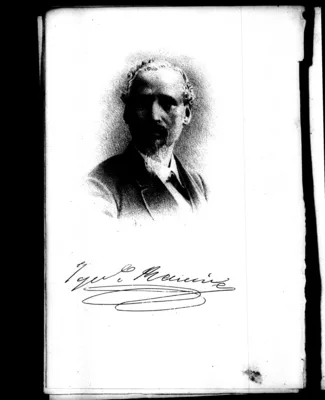
Ignacio Ramírez was the son of a liberal family driven out by a clerical government. He read his way through the friars' and the cathedral's forbidden books, and at eighteen read a paper headed "No hay Dios" to the Academia de Letrán. He never retreated from it, but turned it from provocation into law: he fought "divine right" in the 1856 Congress and closed the convents as Juárez's minister. He held that a government should be neither Catholic nor atheist, and belief left to each conscience.
Karl Marx
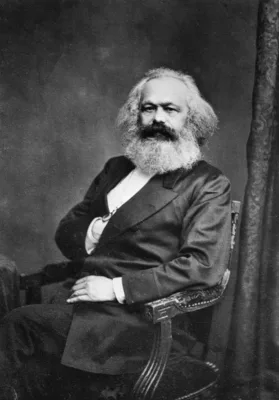
Karl Marx, the grandson of rabbis, was baptised a Lutheran at six into his father's Enlightenment deism. He lost his idealist "gods" at nineteen and took Prometheus for his motto at twenty-three. By twenty-five, after Feuerbach, he held the criticism of religion finished: religion was the sigh of the oppressed and the heart of a heartless world, a symptom that would fade only when the world stopped needing it. So he spent his life on economics, and had little time for atheist campaigners.
George Eliot
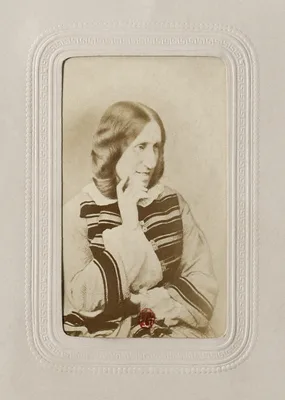
George Eliot was an ultra-Evangelical girl who lost the creed in 1841, reading Hennell among the Brays. She quarrelled with her father over church and regretted it all her life. In 1843 she gave up proselytising as "the quackery of infidelity", and she put her name only to Feuerbach's argument that God is human nature. She ended reverent toward the great religions, holding the idea of God to be "the ideal of a goodness entirely human" and unbelief to be the discipline of doing without opium.
Mikhail Bakunin
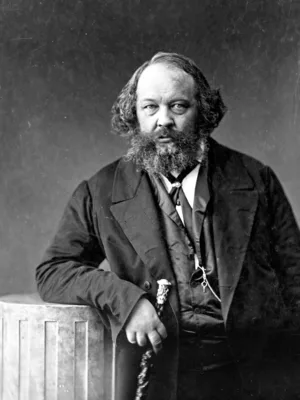
Mikhail Bakunin's Orthodox boyhood cooled at cadet school, and his early philosophy was a religion he used to defend the state. He became a revolutionary in Dresden in 1842 while still speaking of "a new religion", and believed in a personal God into his late forties. He turned to open atheism only in the 1860s, in his fight with Mazzini's religious republicanism. After that, God, the state and every master stood or fell together for him.