Ibn al-Rawandi was a gifted Mu'tazili theologian of ninth-century Baghdad. He broke with his school, by his enemies' account out of wounded pride and ambition, and went on to argue that prophecy and revelation were unnecessary. His books perished. His unbelief, like the story that he repented, survives only in the words of the men who refuted him.
The belief timeline
- Faith (undated (youth and early career, before c. 245–300 AH)) — A promising Mu'tazili theologian in Baghdad, "of good conduct" and modest in his early years (al-Balkhi) [5][6]
- Doubt (undated) — He "turned to unbelief in his religion" among the Mu'tazila and was expelled; motives disputed (D3) [7][9]
- Declaration (undated) — The *Fadihat*, then the *Taj*, *Zumurrud*, *Damigh* and *Farid*; he is hunted and flees [11][12][14]
- Revision (undated, disputed) — A reported repentance at death, denied by others (D4) [17]
Notes to the timeline (8)
- [5] Al-Balkhi: "He was among the theologians and none in his time was more skilled in kalam, or knew its subtle and its plain points better. At the beginning of his career he was of good conduct and praiseworthy doctrine, and very modest; then he stripped himself of all that for reasons that befell him." — H. S. Nyberg, "Mukaddimat al-nashir" (publisher's introduction, in Arabic) and notes to [Intisar]. In it Nyberg collects and discusses every report on Ibn al-Rawandi's life: al-Balkhi (via al-'Ibasi, Ma'ahid al-tansis, i, 77–79, Bulaq), Ibn al-Murtada (Tabaqat al-Mu'tazila, p. 35 of the edition he used), Ibn Khallikan (Wafayat al-a'yan, i, 38–39, Bulaq 1275 AH), al-Mas'udi (Muruj al-dhahab, vii), Kashf al-zunun, the Fihrist fragment and the Mu'tazili tabaqat, leaf 30 (al-Balkhi via Ma'ahid, i, 77–79). Reported at second hand; the original has not been seen.
- [6] Ibn al-Murtada places him in the eighth class of the Mu'tazila, with al-Jubba'i, al-Khayyat and al-Ka'bi; his early works (*al-Asma' wa'l-ahkam*, *al-Ibtida' wa'l-i'ada*, *Khalq al-Qur'an*, *al-Baqa' wa'l-fana'*, *La shay' illa mawjud*, *al-Tabai'*, *al-Lu'lu'a*) belong to his Mu'tazili period, which al-Balkhi's Fihrist fragment calls "books of his righteousness". — Nyberg, Ma'ahid al-tansis, leaves 32–34, 36–37.
- [7] Al-Khayyat: Ibn al-Rawandi was for a time a follower of the Mu'tazila and "a youth among their youth", attending their sessions and learning from their elders, until he turned to unbelief in his religion and denied his Creator; the Mu'tazila expelled him. — Abu'l-Husayn 'Abd al-Rahim b. Muhammad al-Khayyat, Kitab al-intisar wa'l-radd 'ala Ibn al-Rawandi al-mulhid ("The Triumph, a Reply to Ibn al-Rawandi the Heretic"), ed. H. S. Nyberg, Cairo: Dar al-Kutub al-Misriyya, 1925 (title page: with introduction and notes by Dr Nyberg, Uppsala; 1343 AH / 1925). Two Internet Archive scans of the same edition: scan A
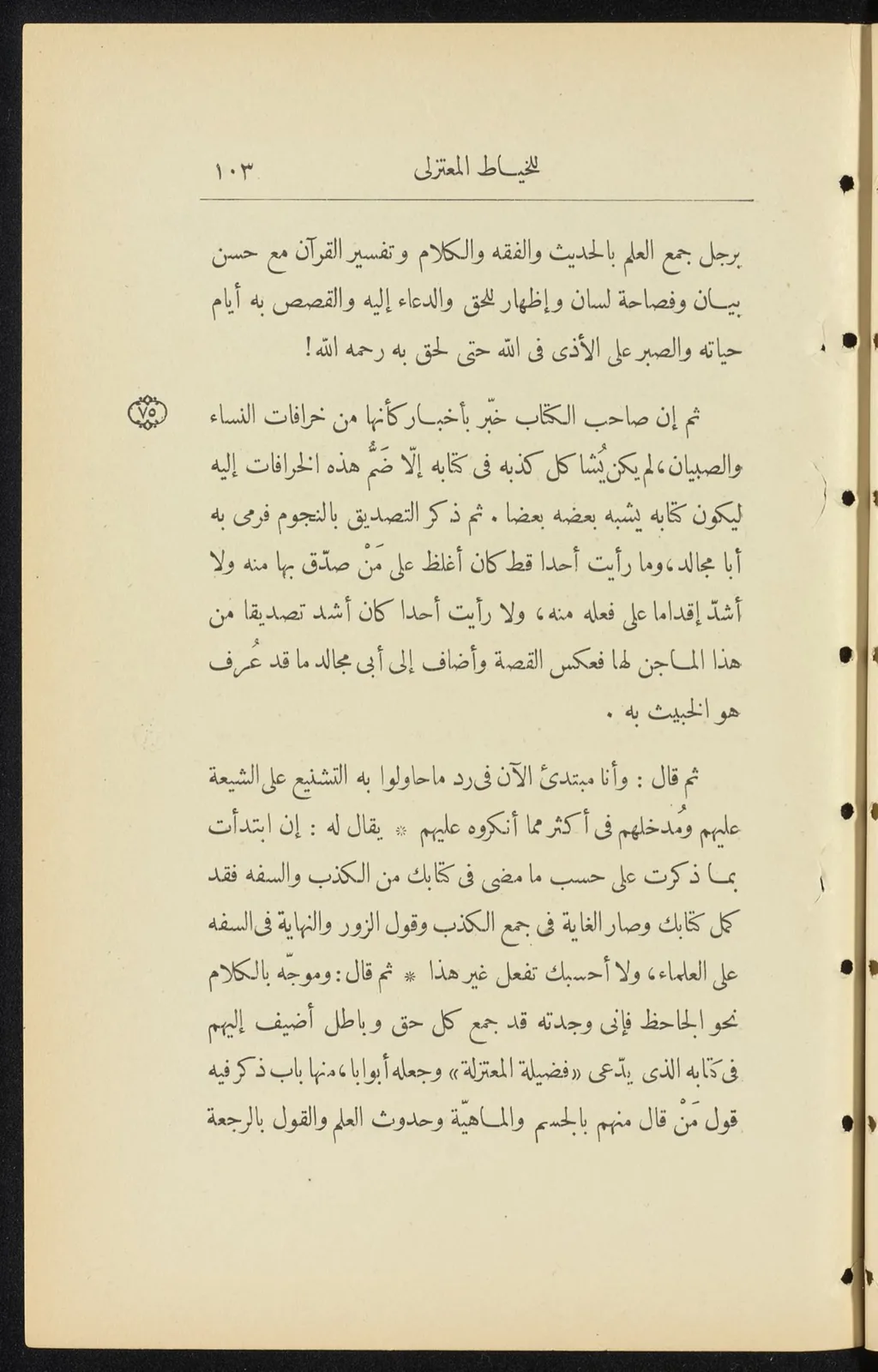
2023-data-mouhsine-0036(file 2; leaf numbers below are its PDF leaves) and scan B107_20201223. Local OCR:research/texts/intisar-ia-scan.txtandintisar-ia-scan-b.txt. The OCR of the Arabic is poor in places; every Arabic passage below is reconstructed from the two readings where they agree and is marked. Printed page numbers are from the running heads of the OCR where legible. The edition is a 1925 publication, public domain in the US. The text proper is al-Khayyat's own prose, quoting passages of the Fadihat al-Mu'tazila so as to refute them, opening letter (printed p. 2 or so), leaf 47–48. - [9] Al-Khayyat on the aftermath: the Mu'tazila "were the hardest of people on him", most of them cut him off, and he was left "an outcast, alone"; rage drove him to the Rafida, since "he found no sect of the community that would take him", and he wrote them a book on the Imamate, "winning their favour by lying against the Mu'tazila". — Kitab al-intisar wa'l-radd 'ala Ibn…, pp. 102–03 (running head 103), leaf 174; Nyberg, Ma'ahid al-tansis, leaf 34.
- [11] The *Fadihat al-Mu'tazila* answered Jahiz's *Fadilat al-Mu'tazila* ("The Excellence of the Mu'tazila"); it gave the Mu'tazila's enemies (Rafida, then Sunni heresiographers such as al-Baghdadi and al-Shahrastani) most of what they repeated about the Mu'tazila; al-Baghdadi's *al-Farq bayn al-firaq* takes most of its Mu'tazili material from it. — Nyberg, Ma'ahid al-tansis, leaves 29, 44–46.
- [12] Titles reported: *al-Taj* (eternity of the world, refuted by al-Nawbakhti, al-Jubba'i and al-Khayyat); *al-Zumurrud*/*al-Zamarrud* (against prophets); *al-Farid*/*al-Farand* (against the Prophet; refuted by Abu Hashim); *al-Damigh* (on the Qur'an; refuted by al-Khayyat, al-Jubba'i, and by Ibn al-Rawandi himself); *al-Qadib* ("The Rod"); *al-Basira* (written for Jews, per al-Tabari); *al-Ta'dil wa'l-tajwir*; *Kitab al-Imama*; Ibn Khallikan counts about 114 books. — Nyberg, Ma'ahid al-tansis, leaves 32–40; R. A. Nicholson, "The Risalatu'l-Ghufran by Abu'l-'Ala al-Ma'arri", Journal of the Royal Asiatic Society 1900 (pp. 637 ff., Part I) and 1902 (Part II: pp. 75–101, 337–362, 813–847), English translation and notes, p. 354 n..
- [14] Accounts of his flight and death: (a) al-Jubba'i: the Sultan sought Ibn al-Rawandi and Abu 'Isa al-Warraq; Abu 'Isa was imprisoned until he died, Ibn al-Rawandi fled to Ibn Lawi the Jew and wrote the *Damigh* for him, then died a few days later; (b) al-Balkhi: died in the house of Abu 'Isa the Jew at Ahwaz; (c) al-Tabari: he wrote *al-Basira* for the Jews for money, a few dirhams, and stopped refuting it only when paid another hundred dirhams; (d) Ibn 'Aqil: a sultan sought him and he died aged 36; (e) Ibn al-Murtada: the Mu'tazila enlisted the Sultan to kill him, so he took refuge with a Jew in Kufa; "it is said he died in his house". — Nyberg, Ma'ahid al-tansis, leaves 33, 37–40, 43–44.
- [17] Reported repentance: al-Balkhi: "a group related that he repented at his death what he had done, showed remorse, and confessed that he had come to it out of pique and pride at the harshness of his companions to him and their driving him from their circles"; Ibn al-Murtada: "it is said he repented at the end of his life", with a reported denial of that from Abu'l-Husayn (al-Khayyat). — Nyberg, Ma'ahid al-tansis, leaves 30 and 34.
The Book That Would Melt Its Reader
Some time in the ninth century, in Baghdad, a theologian met another on the bridge over the Tigris. The older man was Abu Ali al-Jubbai, a master of the rationalist school of Islamic theology called the Mu'tazila. The younger was Ibn al-Rawandi, who had once been the brightest student of that school and had since written a book meant to rival the Qur'an. He offered to read it aloud. Al-Jubbai declined, and asked him one question instead: did he find in his own composition the sweetness, the grace and the order of the Qur'an's words? "No, by God," Ibn al-Rawandi said. "Then you have settled it for me," al-Jubbai answered. "Go where you please."12
The story was told by his enemies, like every story about him. None of his books survives. What we know of the man who argued that prophets were unnecessary comes from the men who wrote to refute him, and from the passages of his own they copied out in order to answer them. This chapter asks what can be known of why a gifted theologian turned against revelation itself, and how much of it is only what his opponents said.
A youth among their youth
His name was Abu'l-Husayn Ahmad ibn Yahya ibn Ishaq al-Rawandi.3 The family name points to a village called Rawand, which one medieval writer placed near Kashan in Persia; the same writer also called him a man of Marw al-Rudh, further east, and accounts differ.4 He was born, by every account, in the first decades of the ninth century, between about 820 and 831, and he lived in Baghdad, the capital of the Abbasid caliphs.54
He came up among the Mu'tazila, the school of theologians who taught that God is just and one, and that human reason can judge questions of faith. His chief refuter, the Mu'tazili al-Khayyat, remembered him as "one of their followers, a youth among their youth, attending their sessions and learning from their elders."67 Another Mu'tazili, al-Balkhi, who had no reason to flatter him, said that in his day "none was more skilled in kalam," the art of theological argument, and that at the start of his career he was "of good conduct and praiseworthy doctrine and very modest."89 His early books were the ordinary work of a rising theologian: on the creation of the Qur'an, on the beginning and return of things, on the nature of motion. Al-Balkhi called them "books of his righteousness."10
No childhood faith or early crisis is recorded. On the belief timeline, his faith stands for these Mu'tazili years, and like every mark in this life it carries no date, because the sources give none.
The break
Then, in al-Balkhi's words, "he stripped himself of all this for reasons that befell him."9 Al-Khayyat said simply that he "turned to unbelief in his religion and denied his Creator," and that the Mu'tazila cast him out.67 Already, by al-Khayyat's account, he was afraid: he wrote a book on the unity of God "to win favour with the people of Islam when he feared for himself and a watch was set for him."11
Why he turned is the oldest question about him, and only his enemies answered it. Al-Balkhi said that his knowledge "was greater than his intellect."9 Al-Khayyat said the Mu'tazila were "the hardest of people on him," that most of them cut him off, and that he was left "an outcast, alone," until rage carried him to the Shi'a, "since he found no sect of the community that would take him."1213 Ibn al-Murtada, a much later chronicler of the school, wrote that he took thirty dinars from the Shi'a for a book on the imamate.14 One report gives an answer in his own voice. When he was blamed for keeping company with unbelievers, he is said to have replied, "I only want to know their doctrines."15 Since none of his books survives, no one can now say for certain which of these is true, or whether his later books were the work of a convinced unbeliever or of a brilliant debater testing how far an argument would go. The sources reached for this book do not settle it.
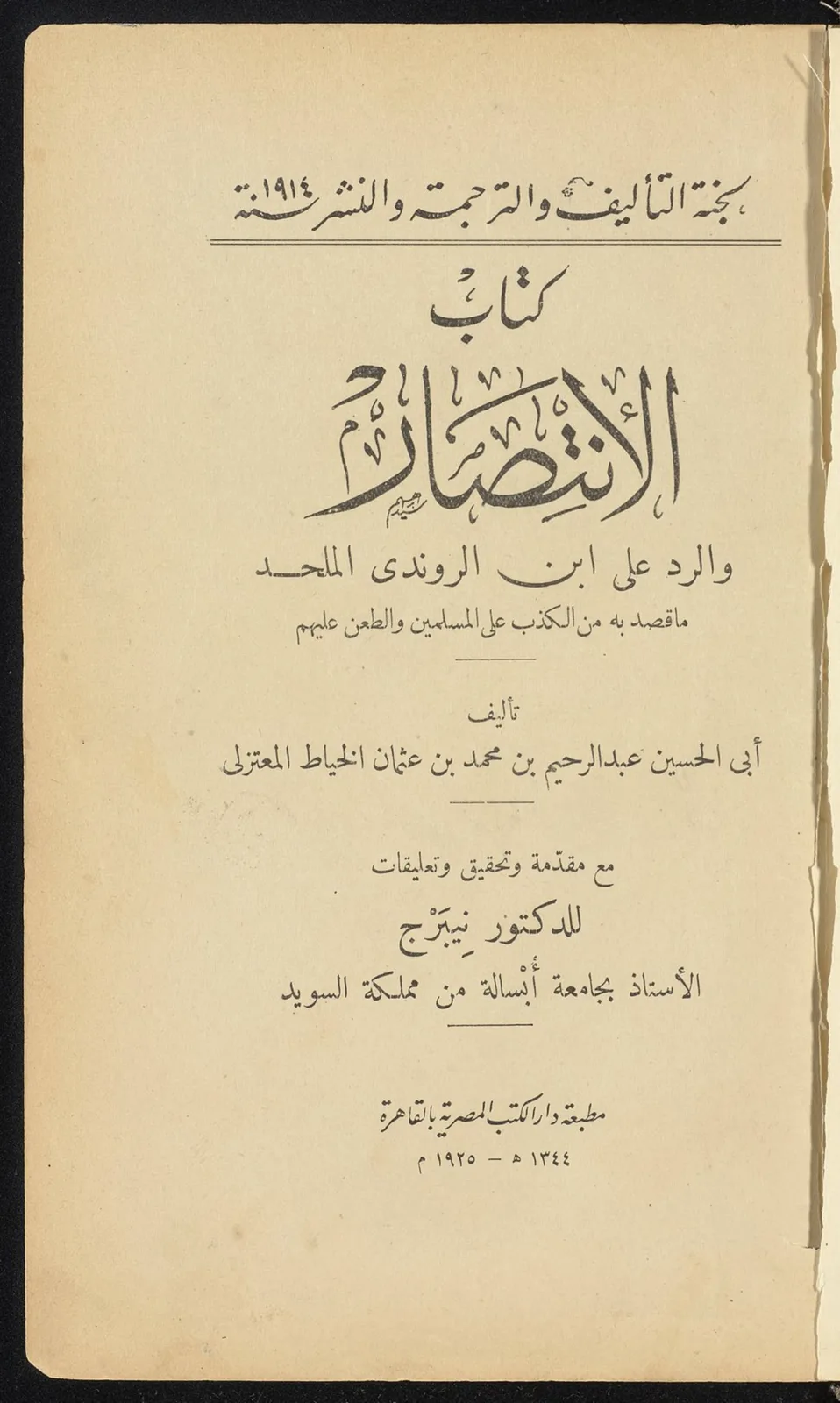
The first book of the break was an attack on his old school. The Mu'tazili writer al-Jahiz had written The Excellence of the Mu'tazila; Ibn al-Rawandi answered it with The Disgrace of the Mu'tazila.16 It was a damaging book. The school's other enemies drew on it for centuries, and much of what later heresy-hunters said about the Mu'tazila came from it.16 It survives only because al-Khayyat, writing around the turn of the tenth century, quoted it section by section in order to refute it, and from his reply the Uppsala scholar H. S. Nyberg, who printed it at Cairo in 1925, could reconstruct long passages.171819 On the timeline, his doubt is placed at this break.
Against the prophets
Then came the books that made his name a byword. The medieval reports list The Crown, arguing that the world is eternal; The Emerald, against the prophets; The Unique, against the Prophet Muhammad; and The Refutation, against the Qur'an; about 114 books in all, one biographer said.2021 At the end of his reply al-Khayyat put the charge to him directly: "your doctrine is dahr and the eternity of the world," the doctrine that the world was never created.22 His declaration is placed with these books.
The fragments that survive come through his opponents, and they are sharp. He explained, by al-Balkhi's account, why he called his book The Emerald: "it is a property of the emerald that when snakes look at it they melt and run; so too with this book, when an adversary reads it he melts away."23 In it, al-Balkhi reported, he wrote that "we find in the speech of Aktham ibn Sayfi," a sage of Arabia before Islam, "something better than 'We have given you the Kawthar,'" a short chapter of the Qur'an.24 He said the prophets had worked on people with talismans; the printed word is uncertain, and Nyberg thought it meant that they performed conjuring tricks.25 Al-Balkhi also reported his argument that a God whose only remedy is killing, like an enraged enemy, has no need of a book or a messenger.26 And he pointed to what he called contradictions in the Qur'an, setting the verse that says God knows every leaf that falls beside one in which God says He changed the direction of prayer "only that We might know" who would follow.27
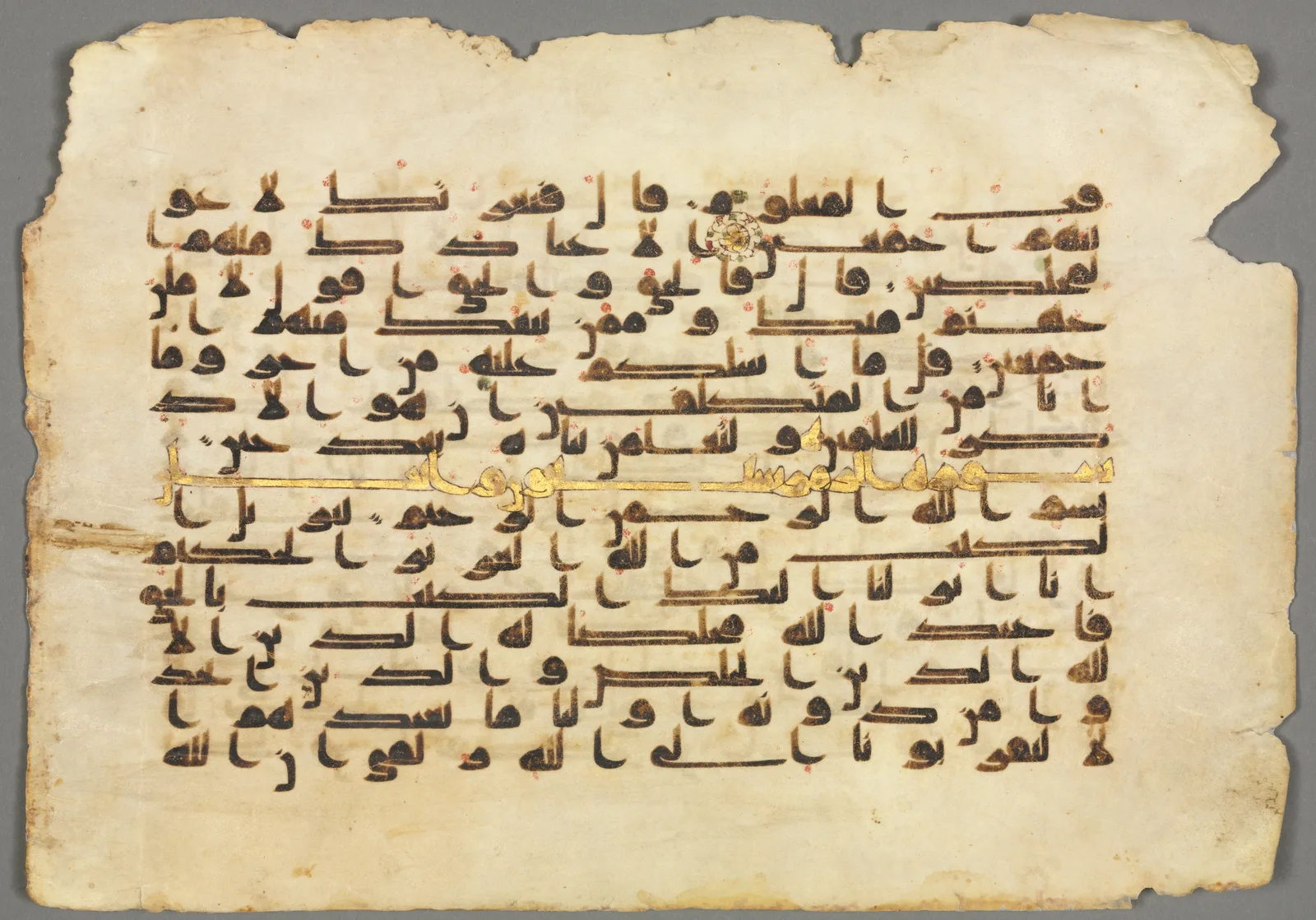
The Refutation went furthest. By the account of the Fihrist, Ibn al-Nadim's catalogue of Arabic books, its purpose was to prove, by writing better, that the Qur'an's style was not the miracle Muslims held it to be.28 That is the book he offered to read to al-Jubbai on the bridge, and on the bridge, by al-Jubbai's account, he admitted that it fell short.12
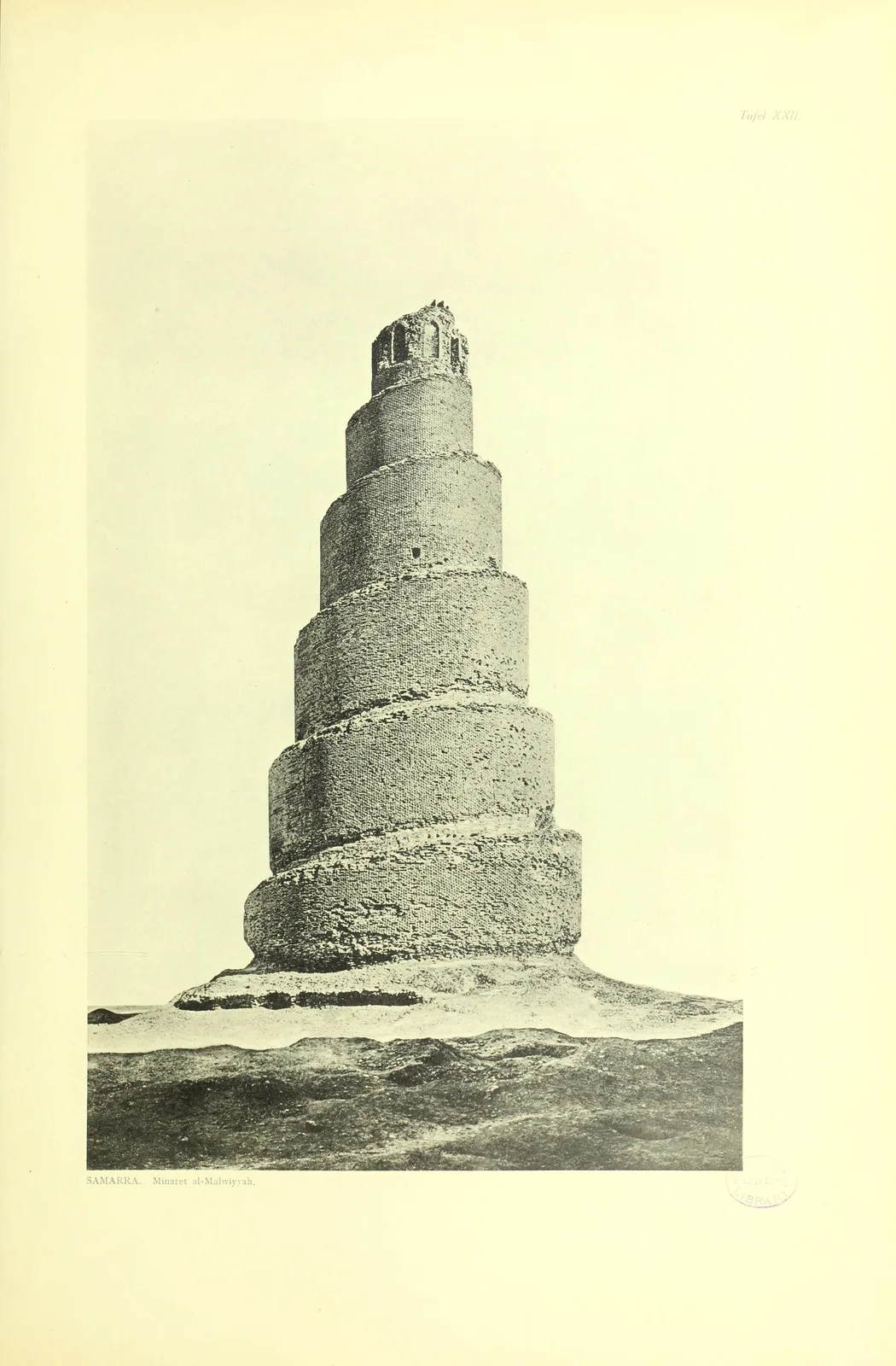
His old school had lost its standing too. The caliph al-Mutawakkil, who came to power in 847, ended the official favour the Mu'tazila had enjoyed under his predecessors.29 Several reports say that Ibn al-Rawandi himself was hunted by the authorities.30
Flight
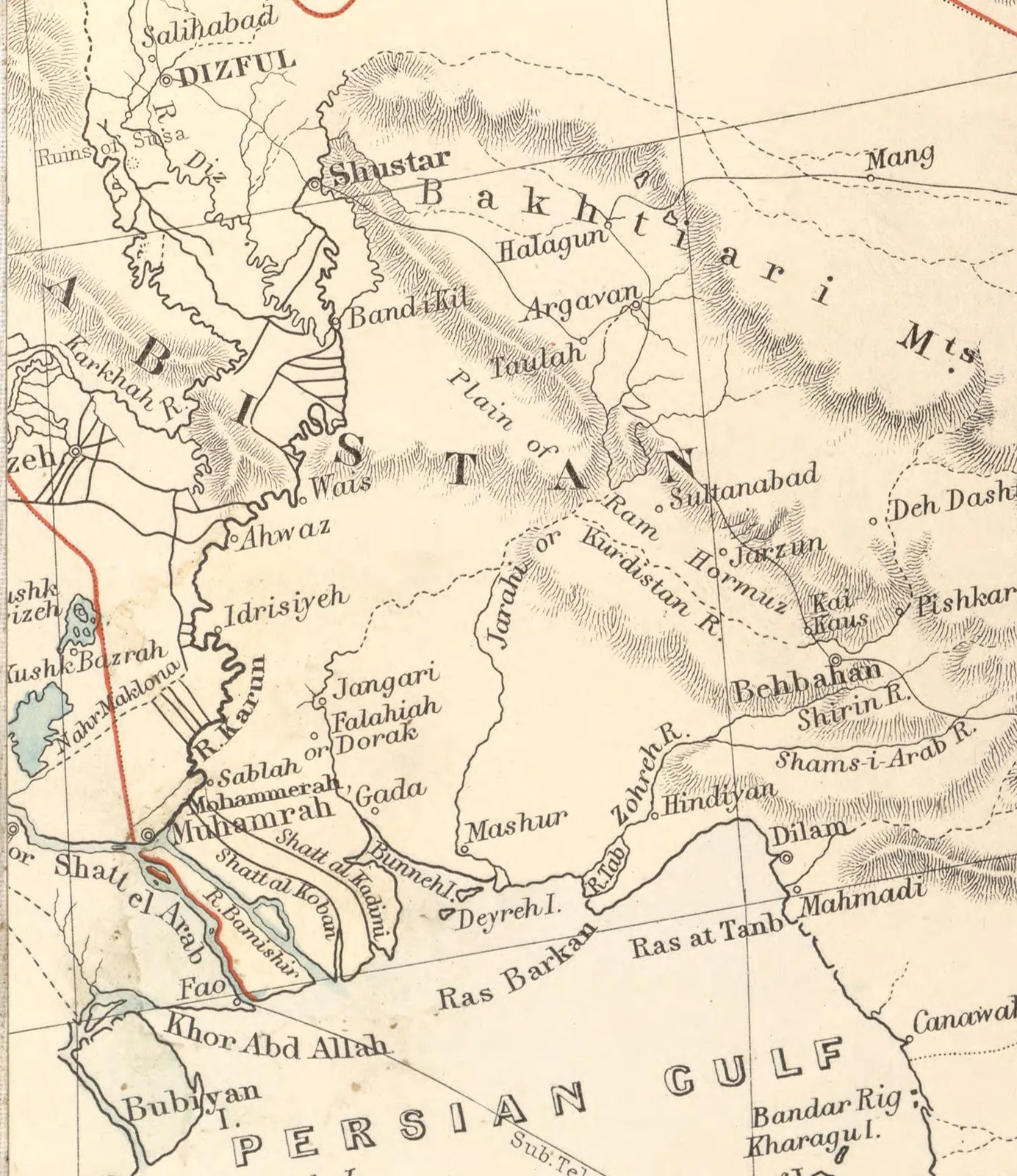
How he ended is told several ways. Al-Jubbai said the authorities sought both Ibn al-Rawandi and the freethinker Abu Isa al-Warraq; Abu Isa was imprisoned until he died, and Ibn al-Rawandi fled to a Jewish patron, wrote The Refutation for him, and died a few days later. Al-Balkhi said he died in the house of Abu Isa the Jew at Ahwaz, in south-western Persia, and that most of his books were written for that man. Another chronicler put the Jewish patron at Kufa. A hostile reporter said he wrote a book for the Jews for a few dirhams and agreed to stop refuting it only when they paid him a hundred more.2130 Another report said his father had been a Jew who converted to Islam.15
The date of his death is just as uncertain. The historian al-Masudi placed it in 245 of the Islamic calendar, about 860, when he would have been about forty; others gave 250, and others 298 or 301, about 910 to 914. Nyberg argued that he must have lived into the later period, since he answered al-Jahiz, who died in 868, but the question is not closed.3132
The repentance
A story was told that he repented. Al-Balkhi wrote that "a group have related that at his death he repented of what he had done, showed regret and admitted that he had arrived at it out of pique and pride at the harshness of his companions."3334 Other reports recorded that al-Khayyat denied it.33 On the timeline, his revision stands for this dispute, not for a known change of mind.
The poet's verdict
More than a century after his death, the blind poet Abu al-Ala al-Maarri, himself suspected of unbelief, wrote an epistle about heaven and hell and gave Ibn al-Rawandi a place among the heretics.35 Al-Maarri said that "heretic and churchman, conformist and nonconformist, are agreed" that the Qur'an "overcame and disabled and caused his enemies to shiver when confronted with it."36 He had heard that some of Ibn al-Rawandi's followers called him "the abode of deity," "divinely inspired with knowledge," and he dismissed it: "for all this, he is an infidel."3738 Then he quoted a couplet attributed to him, addressed to God: "Thou didst apportion the means of livelihood to Thy creatures like a drunkard who shows himself churlish."39
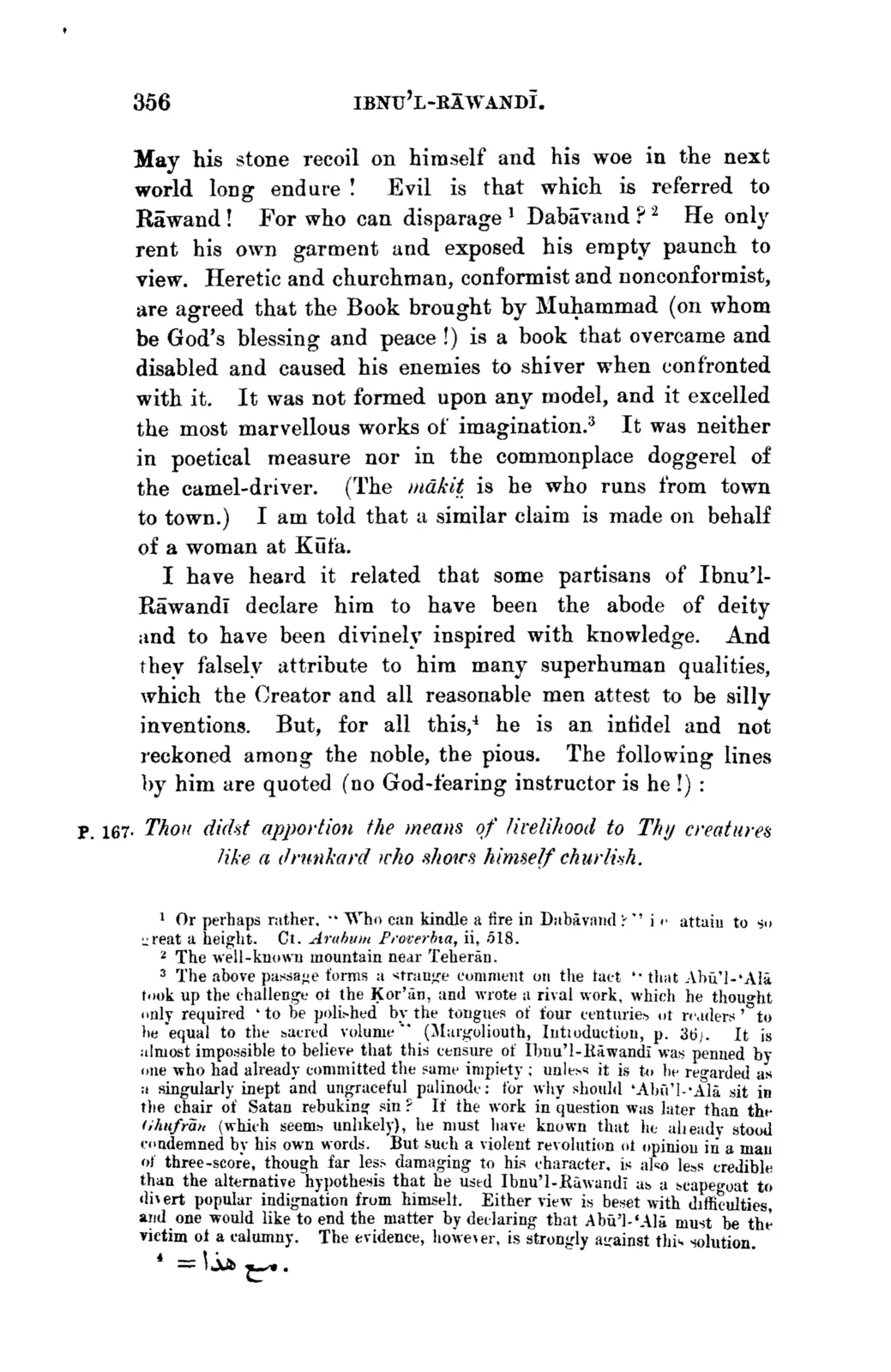
Nicholson, the poet's English translator, found the rebuke hard to take at face value, since al-Maarri had written an imitation of the Qur'an himself. He wondered whether the poet had used Ibn al-Rawandi as a scapegoat to turn suspicion away from himself.40 Even the condemnation, then, may have been a disguise.
What is left
Ibn al-Rawandi's arguments outlived his books because his enemies could not stop answering them. Al-Khayyat, al-Jubbai, Abu Hashim, and the Shi'i theologian al-Nawbakhti each wrote refutations, and he is said to have written one of his own Refutation.20 A biographer of the thirteenth century, Ibn Khallikan, who did not share his views, still called him "one of the learned men of his age."41 What made him stop believing, if he did, is known only in his opponents' words: wounded pride, ambition, money, or the plain pursuit of an argument. What he argued is clearer. A God who can do anything has no need of messengers, and a book is not proved divine by its style. He made both arguments in Baghdad more than a thousand years ago, and they survive only because other men copied them out in order to refute them.
Ajita Kesakambali, another unbeliever known only through the opponents who recorded his teaching, has his own chapter in this book.
Footnotes
-
H. S. Nyberg, "Mukaddimat al-nashir" (publisher's introduction, in Arabic) and notes to [Intisar]. In it Nyberg collects and discusses every report on Ibn al-Rawandi's life: al-Balkhi (via al-'Ibasi, Ma'ahid al-tansis, i, 77–79, Bulaq), Ibn al-Murtada (Tabaqat al-Mu'tazila, p. 35 of the edition he used), Ibn Khallikan (Wafayat al-a'yan, i, 38–39, Bulaq 1275 AH), al-Mas'udi (Muruj al-dhahab, vii), Kashf al-zunun, the Fihrist fragment and the Mu'tazili tabaqat, leaf 41 (via Ma'ahid). Reported at second hand; the original has not been seen. ↩ ↩2
-
al-Jubba'i (Mu'tazili master, d. 303 AH), on the Baghdad bridge, to Ibn al-Rawandi, via al-'Ibasi. Our translation: "I know your learning and that of the people of your age better than you, but I appeal to your own judgement: do you find in your counter-composition the sweetness, the grace, the likeness, the coherence, the sequence and the charm of its words?" He said, "No, by God." "Then you have settled it for me; go where you please." (The anecdote itself is secondhand and Nyberg doubts the dating, D1.): Nyberg, Ma'ahid al-tansis, leaf 41. Not checked against the original (partly). ↩ ↩2
-
Nyberg, Ma'ahid al-tansis, leaf 29 and leaf 34 (quoting al-'Ibasi and Ibn al-Murtada); Abu'l-Husayn 'Abd al-Rahim b. Muhammad al-Khayyat, Kitab al-intisar wa'l-radd 'ala Ibn al-Rawandi al-mulhid ("The Triumph, a Reply to Ibn al-Rawandi the Heretic"), ed. H. S. Nyberg, Cairo: Dar al-Kutub al-Misriyya, 1925 (title page: with introduction and notes by Dr Nyberg, Uppsala; 1343 AH / 1925). Two Internet Archive scans of the same edition: scan A
2023-data-mouhsine-0036(file 2; leaf numbers below are its PDF leaves) and scan B107_20201223. Local OCR:research/texts/intisar-ia-scan.txtandintisar-ia-scan-b.txt. The OCR of the Arabic is poor in places; every Arabic passage below is reconstructed from the two readings where they agree and is marked. Printed page numbers are from the running heads of the OCR where legible. The edition is a 1925 publication, public domain in the US. The text proper is al-Khayyat's own prose, quoting passages of the Fadihat al-Mu'tazila so as to refute them, leaf 29. ↩ -
Nyberg, Ma'ahid al-tansis, leaf 44 (digits partly illegible in both OCRs; "between 205 and 215" is the reading in both). ↩
-
Kitab al-intisar wa'l-radd 'ala Ibn…, opening letter (printed p. 2 or so), leaf 47–48. ↩ ↩2
-
al-Khayyat, Mu'tazili theologian, Baghdad (d. shortly after 300 AH): the main surviving refuter. Our translation: "He was for a time one of their followers, a youth among their youth, attending their sessions and learning from their elders, until he turned to unbelief in his religion and denied his Creator; and the Mu'tazila cast him out and put him at a distance from their company.": Kitab al-intisar wa'l-radd 'ala Ibn…, opening letter (printed pp. 2–3), leaf 47–48. Not checked against the original (partly (two OCR readings; page image not viewed)). ↩ ↩2
-
Nyberg, Ma'ahid al-tansis, leaf 30 (al-Balkhi via Ma'ahid, i, 77–79). ↩
-
al-Balkhi (Abu'l-Qasim al-Ka'bi), Mu'tazili, pupil of al-Khayyat, via al-'Ibasi. Our translation: "This Ibn al-Rawandi was one of the theologians, and in his day none was more skilled in kalam or knew its fine and its plain points better. At the start of his career he was of good conduct and praiseworthy doctrine and very modest; then he stripped himself of all this for reasons that befell him, and his knowledge was greater than his intellect.": Nyberg, Ma'ahid al-tansis, leaf 30 (via Ma'ahid al-tansis, i, 77). Not checked against the original (partly (second-hand; the "knowledge greater than his intellect" clause is a line of verse in the source)). ↩ ↩2 ↩3
-
Nyberg, Ma'ahid al-tansis, leaves 32–34, 36–37. ↩
-
Kitab al-intisar wa'l-radd 'ala Ibn…, p. 13, leaf 85; Nyberg, Ma'ahid al-tansis, leaf 40 and leaf 44. ↩
-
Kitab al-intisar wa'l-radd 'ala Ibn…, pp. 102–03 (running head 103), leaf 174; Nyberg, Ma'ahid al-tansis, leaf 34. ↩
-
al-Khayyat, same. Our translation: "They were the hardest of people on him, so that most of them cut him off and he remained an outcast, alone; the rage that had entered him carried him to the Rafida, since he found no sect of the community that would take him." (The word "جره" is uncertain in OCR; sense as given.): Kitab al-intisar wa'l-radd 'ala Ibn…, pp. 102–03, leaf 174. Not checked against the original (partly). ↩
-
Nyberg, Ma'ahid al-tansis, leaf 33–34. ↩
-
Kitab al-intisar wa'l-radd 'ala Ibn…, title page, leaves 1–4; Nyberg, Ma'ahid al-tansis, leaf 29. ↩
-
Nyberg, Ma'ahid al-tansis, leaf 23 (al-Khayyat, "after 300 AH by a little"), leaf 44 (al-Jubba'i, 303); R. A. Nicholson, A Literary History of the Arabs (London, 1907), IA
literaryhistoryo00nichrich. "The Zindiqs", pp. 375 ff, p. 375 (Jahiz, 868). ↩ -
Nyberg, Ma'ahid al-tansis, leaf 29–30. ↩
-
Nyberg, Ma'ahid al-tansis, leaves 32–40; R. A. Nicholson, "The Risalatu'l-Ghufran by Abu'l-'Ala al-Ma'arri", Journal of the Royal Asiatic Society 1900 (pp. 637 ff., Part I) and 1902 (Part II: pp. 75–101, 337–362, 813–847), English translation and notes, p. 354 n.. ↩ ↩2
-
Kitab al-intisar wa'l-radd 'ala Ibn…, end of text (printed p. 173), leaf 245. ↩
-
Ibn al-Rawandi, on why he called his book al-Zumurrud, as reported by al-Balkhi: Nyberg, Ma'ahid al-tansis, leaf 30 (via Ma'ahid, i, 77–79). Not checked against the original (partly (two OCR readings agree; Nyberg's quotation of a quotation)). ↩
-
Ibn al-Rawandi in the Zumurrud, as reported by al-Balkhi: Nyberg, Ma'ahid al-tansis, leaf 30. Not checked against the original (partly (OCR of the key words is damaged in scan A; scan B reads "أكثم بن صيفى شيئا أحسن من"; the Quran quotation (108:1) restored)). ↩
-
Ibn al-Rawandi in the Zumurrud, as reported by al-Balkhi: Nyberg, Ma'ahid al-tansis, leaf 30. Not checked against the original (partly; checked on the page image (Nyberg printed p. 27): Nyberg's footnote 1 says the printed original reads so but he thinks the correct reading is «يشعبذون» ("they perform conjuring tricks"), matching al-Khayyat's quotation of the Zumurrud (Intisar pp. 2–3); use only with that caveat). ↩
-
Ibn al-Rawandi in the Damigh, as reported by al-Balkhi: Nyberg, Ma'ahid al-tansis, leaves 31–32 (scan B text, preface). Not checked against the original (partly (OCR damaged, scan B clearer; word "القتل" and "الحنق" to be confirmed on the page)). ↩
-
Ibn al-Rawandi in the Damigh, as reported by al-Balkhi: Nyberg, Ma'ahid al-tansis, leaves 31–32. Not checked against the original (partly (OCR damaged; the two Quran verses are 6:59 and 2:143, restored)). ↩
-
Nicholson, Journal of the Royal Asiatic Society (1902), p. 355 n. 1. ↩
-
Nicholson, Literary History of the Arabs, p. 375. ↩
-
Nyberg, Ma'ahid al-tansis, leaves 42–44 (digits for 245 and 298 illegible in one OCR; 245/250 and 298/301 are Nyberg's own words). Accounts differ; see the disputed points. ↩
-
Nyberg, Ma'ahid al-tansis, leaves 42–45. ↩
-
al-Balkhi, same, reporting that "a group related" a deathbed repentance. Our translation: "A group have related that at his death he repented of what he had done, showed regret and admitted that he had arrived at it out of pique and pride at the harshness of his companions and their removing him from their sessions.": Nyberg, Ma'ahid al-tansis, leaf 30. Not checked against the original (partly). ↩
-
Nicholson, Journal of the Royal Asiatic Society (1902), pp. 75–79, 354–57. ↩
-
al-Maarri (973–1057), poet, Maarrat al-Numan, in the Risalat al-ghufran (c. 1033), translated by R. A. Nicholson: Nicholson, Journal of the Royal Asiatic Society (1902), p. 356. ↩
-
al-Maarri (reporting a rumour among Ibn al-Rawandi's followers): Nicholson, Journal of the Royal Asiatic Society (1902), p. 356. ↩
-
al-Maarri, same: Nicholson, Journal of the Royal Asiatic Society (1902), p. 356. ↩
-
Verse attributed to Ibn al-Rawandi, quoted by al-Maarri: Nicholson, Journal of the Royal Asiatic Society (1902), p. 356 (translation of Risalat al-ghufran; "P. 167" of the text); the second couplet is at the head of p. 357. ↩
-
Nicholson, Journal of the Royal Asiatic Society (1902), pp. 77 and 356 n. 3; R. A. Nicholson, Studies in Islamic Poetry (Cambridge, 1921), IA
studiesinislamic00nichuoft. Ibn al-Rawandi at p. 166, p. 166. ↩ -
Ibn Khallikan (1211–82), biographer, as cited by Nyberg; a fair-minded biographical note. Our translation: "He was one of the learned men of his age.": Nyberg, Ma'ahid al-tansis, leaves 35–36 (Ibn Khallikan, Wafayat, i, 38–39). Not checked against the original (partly). ↩
2023-data-mouhsine-0036 (file 2; leaf numbers below are its PDF leaves) and scan B 107_20201223. Local OCR: research/texts/intisar-ia-scan.txt and intisar-ia-scan-b.txt. The OCR of the Arabic is poor in places; every Arabic passage below is reconstructed from the two readings where they agree and is marked. Printed page numbers are from the running heads of the OCR where legible. The edition is a 1925 publication, public domain in the US. The text proper is al-Khayyat's own prose, quoting passages of the Fadihat al-Mu'tazila so as to refute them.; R. A. Nicholson, A Literary History of the Arabs (London, 1907), IA literaryhistoryo00nichrich. "The Zindiqs", pp. 375 ff.; R. A. Nicholson, "The Risalatu'l-Ghufran by Abu'l-'Ala al-Ma'arri", Journal of the Royal Asiatic Society 1900 (pp. 637 ff., Part I) and 1902 (Part II: pp. 75–101, 337–362, 813–847), English translation and notes.; R. A. Nicholson, Studies in Islamic Poetry (Cambridge, 1921), IA studiesinislamic00nichuoft. Ibn al-Rawandi at p. 166.In their own words
إنما سماه بالزمردة لأن من خاصية الزمرد أن الحيات إذا نظرت إليه ذابت وسالت، فكذلك هذا الكتاب إذا طالعه الخصم ذاب
إنا نجد في كلام أكثم بن صيفى شيئا أحسن من «إنا أعطيناك الكوثر»
وإن الأنبياء كانوا يستعبدون الناس بالطلاسم
إن الخالق سبحانه وتعالى ليس عنده من الدواء إلا القتل، فعل العدو الحنق الغضوب، فما حاجته إلى كتاب ورسول
وقال في كتاب الدامغ يزعم أنه يعلم الغيب فيقول «وما تسقط من ورقة إلا يعلمها» ثم يقول «وما جعلنا القبلة التي كنت عليها إلا لنعلم»
Thou didst apportion the means of livelihood to Thy creatures like a drunkard who shows himself churlish.
I have heard it related that some partisans of Ibnu'l-Rawandi declare him to have been the abode of deity and to have been divinely inspired with knowledge.
The other side
وإنه كان زمانا تابعا من أتباعهم وحدثا من أحداثهم يختلف إلى مجالسهم ويتعلم من أشياخهم إلى أن ألحد في دينه وجحد خالقه ونفته المعتزلة عنها وباعدته من حالها
فكانت هي أشد الناس عليه حتى لقد جره أكثرها فبقي طريدا وحيدا، حمله الغيظ الذي دخله على أن مال إلى الرافضة إذ لم يجد فرقة من فرق الأمة تقبله
فهذا مذهبك وهو قولك، ومن أجله نفتك المعتزلة وطردتك عن مجالسها وباعدتك عن أنفسها حتى حملك الغيظ عليها على أن صرت تنبح كالكلب بإزائها وتكذب على أشياخها، وما ضررت بذلك غير نفسك
كان ابن الراوندي هذا من المتكلمين ولم يكن في زمانه أحذق منه بالكلام ولا أعرف بدقيقه وجليله، وكان في أول أمره حسن السيرة حميد المذهب كثير الحياء، ثم انسلخ من ذلك كله لأسباب عرضت له، وكان علمه أكثر من عقله
قد حكى جماعة أنه تاب عند موته مما كان منه وأظهر الندم واعترف بأنه إنما صار إليه حمية وأنفة من جفاء أصحابه له وتنحيتهم إياه من مجالسهم
وأنا أحاكمك إلى نفسك فهل تجد في معارضتك له عذوبة وهشاشة وتشاكلا وتلازما ونظما كنظمه وحلاوة كلامه؟ قال: لا والله. قال: قد كفيتني فانصرف حيث شئت
Heretic and churchman, conformist and nonconformist, are agreed that the Book brought by Muhammad (on whom be God's blessing and peace !) is a book that overcame and disabled and caused his enemies to shiver when confronted with it.
And they falsely attribute to him many superhuman qualities, which the Creator and all reasonable men attest to be silly inventions. But, for all this, he is an infidel and not reckoned among the noble, the pious.
وكان من الفضلاء في عصره
Where accounts differ
| Point | One account | Another | How the page handles it |
|---|---|---|---|
| D1. Dates of birth and death | Born c. 205–215 AH; died 245 AH (c. 859–60) aged about 40, or c. 250 AH (al-Mas'udi; the Bustan via Ibn Khallikan) [18]; Ibn 'Aqil says aged 36 | Died 298 or 301 AH (c. 910–14), which Nyberg judges "clearer"; others say he lived over 80 (Nyberg 1925, leaves 42–45) | Say "he died, accounts differ, sometime between the 860s and about 910". Never print a single year. The roster's "c. 827–c. 911" is a modern convention. Nyberg's argument (Jahiz c. 868 and the eighth-class Mu'tazila) favours the later date. |
| D2. How and where he died | In the house of Abu 'Isa the Jew of Ahwaz (al-Balkhi); days after fleeing to Ibn Lawi the Jew (al-Jubba'i); in a Kufa house (Ibn al-Murtada) | At Rahbat Malik b. Tawq, or Baghdad (al-Mas'udi); nothing certain (Nyberg) | "Accounts differ about where; all agree that he died among Jewish patrons or on the run, and the earliest say, young." |
| D3. Why he turned, and whether he truly disbelieved | Pique and rage after the Mu'tazila's harshness (al-Balkhi; al-Khayyat); thwarted ambition for leadership (Ibn al-Murtada "he sought a headship and did not get it, so he apostatised"); money (thirty dinars for the Imama, per Ibn al-Murtada; dirhams for the *Basira*, per al-Tabari); his own words, "I only want to know their doctrines" (al-Tanukhi) | He truly came to deny prophecy and revelation (al-Khayyat's address, [16]); al-Maarri calls him an infidel; later specialists argue the *Zumurrud* and *Damigh* may have been dialectical exercises or provocations, which the sources reached here do not settle (Kraus 1934, Stroumsa and van Ess are leads only) | Present the motives as the enemies' explanations and say that, since none of his books survives, no one can say with certainty what he believed; keep the arguments themselves (Q1–Q5) and let the motives be the refuters'. |
| D4. Repentance | A group says he repented at death, admitting he had acted out of pique (al-Balkhi; Qadi 'Abd al-Jabbar via Ibn al-Murtada) | Ibn al-Murtada's source records al-Khayyat's denial; Nyberg judges al-Khayyat's text consistent with no repentance | "A story is told that he repented at the end, others deny it." Treat the Revision marker as the dispute, not as a fact. |
| D5. Al-Maarri's rebuke: sincere or a mask | Nicholson: al-Maarri's censure is that of an orthodox Muslim (p. 77) | Nicholson also suspects the censure was a scapegoat or palinode, since al-Maarri attempted a rival Qur'an himself (p. 356 n. 3; Margoliouth, introduction, p. 36) | One line at most: "even the poet who wrote the epistle that condemns him has been suspected of writing it for his own protection." |
| D6. Origin of the nisba | Rawand, village of Qasan (Kashan) near Isfahan (al-'Ibasi) | Marw al-Rudh (al-'Ibasi's other phrase); Browne notes two villages named Rawand (near Kashan and near Nishapur) | Say "family name from a village called Rawand"; do not name a province. |
| D7. Book titles | *Zumurrud* / *Zamarrud*; *Farid* / *Farand* / *Fariq*; *al-Qadib* / *al-Qasab* (Intisar and Nyberg) | Nicholson's notes on the Leiden MS of the Fihrist (1902, p. 354 n.) | Use *Emerald* and *The Crown* in English; transliterate once. |
List of illustrations
This page uses only public-domain and Creative Commons images; each is credited with its source and licence.
- The Round City of Baghdad in the time of Caliph al-Mansur, with enlarged plan of the gates (Le Strange, 1900) — Guy Le Strange, 1900 · Wikimedia Commons, after Guy Le Strange, Baghdad during the Abbasid Caliphate (Oxford, 1900), Map II · Public domain (Wikimedia Commons: Public domain; Le Strange, 1900)
- Title page of al-Khayyat, Kitab al-intisar wa'l-radd 'ala Ibn al-Rawandi al-mulhid, ed. Nyberg (Cairo, 1343 AH / 1925) — Abu'l-Husayn al-Khayyat; edited by H. S. Nyberg, 1925 · Internet Archive (2023-data-mouhsine-0036, second file), Columbia University Libraries copy; al-Khayyat, Kitab al-intisar, ed. H. S. Nyberg (Cairo: Dar al-Kutub al-Misriyya, 1925) · Public domain (published Cairo 1925, before 1931; the Internet Archive item states no rights)
- al-Khayyat, Kitab al-intisar, p. 103 (the Mu'tazila turned on him; 'an outcast, alone') — Abu'l-Husayn al-Khayyat; edited by H. S. Nyberg, 1925 · Internet Archive (2023-data-mouhsine-0036, second file), Columbia University Libraries copy; al-Khayyat, Kitab al-intisar, ed. H. S. Nyberg (Cairo: Dar al-Kutub al-Misriyya, 1925) · Public domain (published Cairo 1925, before 1931; the Internet Archive item states no rights)
- Qur'an manuscript folio (recto), Iraq or Iran, Abbasid period, 9th-10th century (Cleveland Museum of Art 1933.494.a) — Unknown calligrapher, 9th-10th century · The Cleveland Museum of Art, Open Access, accession 1933.494.a · CC0 (Cleveland Museum of Art Open Access)
- Samarra: the spiral minaret (Malwiya) of the Great Mosque of al-Mutawakkil, photograph of 1907-08 — Friedrich Sarre and Ernst Herzfeld, 1911 · Internet Archive, Sarre and Herzfeld, Archäologische Reise im Euphrat- und Tigris-Gebiet, vol. III (Tafelband), Berlin: Dietrich Reimer, 1911 (archaologischere03sarr) · Public domain (published Berlin 1911, before 1931; no rights statement on the Internet Archive item)
- Detail of the Euphrates Valley map (Stanford, 1900): the Karun river with Ahwaz and Shushtar — Edward Stanford Ltd (map), 1900 · Wikimedia Commons crop of a map in the Library of Congress Geography and Map Division, Edward Stanford, 1900 · Public domain (Wikimedia Commons: Public domain; Stanford map of 1900, Library of Congress Geography and Map Division item 2013593032)
- R. A. Nicholson, Risalatu'l-Ghufran, JRAS 1902, p. 356 (running head IBNU'L-RAWANDI: 'the Book brought by Muhammad ... caused his enemies to shiver') — Reynold A. Nicholson, 1902 · Internet Archive, Digital Library of India copy, Journal of the Royal Asiatic Society of Great Britain and Ireland for 1902 (in.ernet.dli.2015.70552) · Public domain (published London 1902, before 1931; no rights statement on the scan)
Sources
Tier 1 — the subject's own words (survive only inside refutations; none of his books is extant)
- [Intisar] Abu'l-Husayn 'Abd al-Rahim b. Muhammad al-Khayyat, Kitab al-intisar wa'l-radd 'ala Ibn al-Rawandi al-mulhid ("The Triumph, a Reply to Ibn al-Rawandi the Heretic"), ed. H. S. Nyberg, Cairo: Dar al-Kutub al-Misriyya, 1925 (title page: with introduction and notes by Dr Nyberg, Uppsala; 1343 AH / 1925). Two Internet Archive scans of the same edition: scan A
2023-data-mouhsine-0036(file 2; leaf numbers below are its PDF leaves) and scan B107_20201223. Local OCR:research/texts/intisar-ia-scan.txtandintisar-ia-scan-b.txt. The OCR of the Arabic is poor in places; every Arabic passage below is reconstructed from the two readings where they agree and is marked. Printed page numbers are from the running heads of the OCR where legible. The edition is a 1925 publication, public domain in the US. The text proper is al-Khayyat's own prose, quoting passages of the Fadihat al-Mu'tazila so as to refute them.
Tier 2 — scholarly editions and reference works
- [Nyberg 1925] H. S. Nyberg, "Mukaddimat al-nashir" (publisher's introduction, in Arabic) and notes to [Intisar]. In it Nyberg collects and discusses every report on Ibn al-Rawandi's life: al-Balkhi (via al-'Ibasi, Ma'ahid al-tansis, i, 77–79, Bulaq), Ibn al-Murtada (Tabaqat al-Mu'tazila, p. 35 of the edition he used), Ibn Khallikan (Wafayat al-a'yan, i, 38–39, Bulaq 1275 AH), al-Mas'udi (Muruj al-dhahab, vii), Kashf al-zunun, the Fihrist fragment and the Mu'tazili tabaqat. Scan A leaves 29–46. Cited here as "Nyberg 1925, leaf N". It is Tier 2 (a 1925 scholarly reconstruction), not Tier 1.
- [Nicholson 1902] R. A. Nicholson, "The Risalatu'l-Ghufran by Abu'l-'Ala al-Ma'arri", Journal of the Royal Asiatic Society 1900 (pp. 637 ff., Part I) and 1902 (Part II: pp. 75–101, 337–362, 813–847), English translation and notes. IA
in.ernet.dli.2015.70552(1902) andin.ernet.dli.2015.459108(1900). Local OCR:research/texts/jras-1902.txt,jras-1900.txt. The passage on Ibn al-Rawandi is at 1902, pp. 355–57. - [Nicholson Poetry] R. A. Nicholson, Studies in Islamic Poetry (Cambridge, 1921), IA
studiesinislamic00nichuoft. Ibn al-Rawandi at p. 166. - [Nicholson LHA] R. A. Nicholson, A Literary History of the Arabs (London, 1907), IA
literaryhistoryo00nichrich. "The Zindiqs", pp. 375 ff. - [Browne] E. G. Browne, A Literary History of Persia vol. 1 (London, 1902/1908), IA
literaryhistoryo01browiala. Only for the namesake Rawandiyya sect (pp. 315–16) and the toponym. - [Fihrist] Ibn al-Nadim, Kitab al-Fihrist, ed. Flügel (Leipzig, 1871–72), IA
KitabAlFihrist,KitabAlFihristMitAnmerkungen. Downloaded (research/texts/fihrist-fluegel1.txt,-2.txt) but the OCR of the Arabic cannot be searched; Flügel's German notes at vol. 2 p. 204 are about a different Rawandi (the sect). The Fihrist's account of Ibn al-Rawandi is known here only through Nyberg 1925 and Nicholson 1902 (who cites Houtsma's edition of the Fihrist fragment, Wiener Zeitschrift für die Kunde des Morgenlandes iv, 1890, 222–24). Dodge's 1970 English translation is in copyright and not used.
Tier 3 — popular biographies and journalism
- None used.
Tier 4 — maps to other sources only (Wikipedia and similar). Never cited in the script.
- Leads only, not read and not to be cited from memory: Paul Kraus, "Beiträge zur islamischen Ketzergeschichte: Das Kitab az-Zumurrud des Ibn ar-Rawandi", Rivista degli Studi Orientali 14 (1934), too late for a US public-domain quotation (paraphrase only if a copy is borrowed); Nyberg's article "Ibn al-Rawandi" in the Encyclopaedia of Islam (first edition, vol. 2, probably 1927; year to be checked); Sarah Stroumsa, Freethinkers of Medieval Islam (1999) and Josef van Ess on the Rawandi tradition (leads for the "provocation" question, D3); the Majalis of al-Mu'ayyad fi'l-Din al-Shirazi (Ismaili; quotes the Zumurrud) and Ibn al-Jawzi's al-Muntazam (modern Hyderabad edition, 1938–40, too late); none reached.
Opposition sources — contemporary critics and religious responses
- [Intisar] (above): al-Khayyat, Mu'tazili, writing c. 300 AH.
- [Nicholson 1902]: al-Maarri's rebuke, 1902 pp. 355–57.
- [Ma'ahid via Nyberg]: al-Balkhi (a Mu'tazili), al-Jubba'i, al-Tabari, Ibn al-Murtada, Ibn Khallikan, as reported in Nyberg 1925.
Related lives
Abu al-Ala al-Maarri (suggested) — he rebukes Ibn al-Rawandi by name in the *Risalat al-ghufran* and his own piety has been argued over ever since. (Never "Next:"; the close says "has their own episode in this series".)

Jayarāśi Bhaṭṭa
Jayarāśi is known only from one book that survived in one manuscript. He began as an heir of the materialist Bṛhaspati, who denied the other world and the soul that would go to it. He then turned the materialists' own weapons on every school's means of knowledge, perception included, leaving no ground for a God who watches and judges, and promising only that life is delightful once nothing has to be proved. His readers have been relabelling his unbelief ever since.
Fan Zhen
Fan Zhen was a poor Confucian scholar among carriage-riding classmates. He answered a Buddhist prince's karma with a fallen flower, and wrote that the spirit is the body's working as sharpness is the knife's, because he saw a court draining its wealth, and its pity for the poor, into monasteries. He was pressed by a prince, a bribe, an emperor and sixty-two courtiers. He was never punished for the argument, was exiled for something else, and is not recorded as giving it up.
Christopher Marlowe
Christopher Marlowe was sent to Cambridge on a scholarship meant for future clergy. He took his degrees and never took orders, and wrote stage heroes who dared God and mocked hell. In May 1593 he was named an atheist by a tortured fellow playwright and an unsworn informer, days before he was killed at Deptford. He left no word of his own on what he believed, so his unbelief survives only as an accusation that his enemies, after his death, turned into a sermon.
Uriel da Costa
Uriel da Costa was a Portuguese New Christian who despaired of salvation by the Church's rules. He crossed Europe to live by the one revelation Jews and Christians shared, and found, on reading it strictly, that it promised nothing after death. He was banned, jailed and scourged for saying so. He ended by holding every revealed law a human invention and calling himself only a man: a search for certainty that left him outside every community, and that his editor saw as the place where Spinoza began.