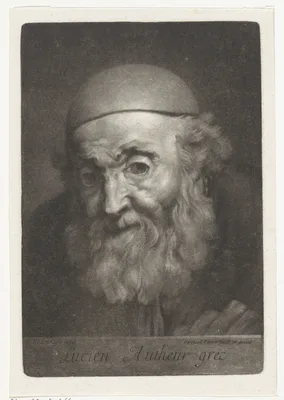
Lucian was a Syrian who escaped a sculptor's workshop for rhetoric, and then gave up on philosophy. In his forties he laughed at the gods of Olympus, their oracles, their sacrifices and their prophets, through comic characters whose masks he never removed. Only late in life did he declare for Epicurus. He never called himself an atheist, and what the surviving texts show is less a denial of the gods than a refusal to be frightened by them.
The belief timeline
- Faith (in his youth) — The Syrian boy offers his hair at the temple of the Syrian goddess, as young men did; the home religion is taken for granted [8]
- Doubt (c. 150–165) — He reaches for philosophy (Nigrinus, c. 150), then breaks with it: the Hermotimus ends with the pupil's confession "I am sober again after a debauch"; Menippus is let down by the philosophers who disagree and "expected me to believe them" [12][19][8][9]
- Declaration (c. 165–175) — About forty he leaves the law-courts for Dialogue and writes the satires of Zeus, the oracles, sacrifice and the philosophers; at Olympia (169, Fowler) he laughs at Peregrinus's pyre in front of the Cynics [17][20][21][22]
- Revision (after 180) — In Alexander he drops the mask and says he writes "to strike a blow for Epicurus"; he praises Epicurus's book as the protection against "terrors, phantoms, and marvels" (a restatement, not a reversal; no reversal is recorded) [37][22][26]
Notes to the timeline (10)
- [8] In the tract on the Syrian goddess, in a passage on the custom of young men dedicating their hair at Hierapolis, he says: "I performed this act myself when a youth, and my hair remains still in the temple, with my name on the vessel." — The Syrian Goddess, being a translation of Lucian's De dea Syria, with a life of Lucian by Herbert A. Strong, ed. John Garstang (London: Constable, 1913). Internet Archive
syriangoddessbei00luciuoft;research/texts/strong-syrian-goddess.txt. Used for Lucian's own sentence about his hair (§ 60, p. 89) and as the second Tier 2 life (pp. 29–36), ] § 60, p. 89; reported by [Fowler I, Intro] p. ix ("a casual mention of his offering a lock of his hair to the Syrian goddess in his youth"). Accounts differ; see the disputed points. - [12] The Nigrinus, with its contrast between Rome's noise and Athens's peace and an "enthusiastic picture of the charm of philosophy," was probably written in 150, "or at any rate described an incident that occurred in that year." — The translators' Introduction (pp. v–xxxviii): "1. Life. 2. Probable Order of Writings. 3. Circumstances of the Time. 4. Lucian as a Writer." Says it follows Croiset's Essai sur la vie et les œuvres de Lucien, "on which the first two sections of this introduction are very largely based," and that it gives "the account that commends itself to us, without discussion" (p. v). A Tier 2 source that is itself a summary of a Tier 2 source, ] p. xi.
- [19] In the Hermotimus the pupil, after seventy-odd sections of questioning and the story of a philosopher dunning his student for fees, admits: "I am sober again after a debauch, I see what the object of my maudlin affection is like." — vol. II (same).
worksoflucianofs02luci;research/texts/fowler2.txt. Contains Hermotimus (pp. 41–), Alexander the Oracle-monger (pp. 212–238), ] Hermotimus §83, p. 89. - [9] After leaving school he went to Ionia, where cities like Smyrna and Ephesus were full of famous teachers of rhetoric; Fowler thinks he could not afford them and learned largely by reading the old Attic orators, poets and historians. — Fowler I, Intro, ] p. ix.
- [17] He himself gives his fortieth year as the date he left rhetoric for Dialogue: the Syrian says "my age (I was then nearly forty years old) called upon me to withdraw from the turmoil of the law-courts." — vol. III (same).
worksoflucianofs03luci;research/texts/fowler3.txt. Contains Zeus Cross-examined (p. 71), Zeus Tragoedus (pp. 80–104), The Liar / Philopseudes (p. 230–), Icaromenippus (pp. 126–144), The Double Indictment (pp. 144–166), Demonax, ] The Double Indictment §32, p. 164; Fowler I, Intro, ] p. xi. - [20] In The Double Indictment, Dialogue complains that the Syrian dragged him from his philosophical heaven, gave him a comic mask, and set him among "persons with a horrible knack of making light of sacred things," including Menippus. — Fowler, vol. III, ] The Double Indictment §33, p. 165.
- [21] Fowler groups the great dialogues by influence — Menippean satire (Dialogues of the Dead and Gods, Menippus, Icaromenippus, Zeus Cross-examined, The Cynic, Of Sacrifice), then Old Comedy (Prometheus, Zeus Tragoedus, The Gods in Council, The Sale of Creeds, The Fisher) — all written "perhaps between 165 and 175." — Fowler I, Intro, ] pp. xii–xiii, xvi–xvii.
- [22] At the Olympic Games Lucian listened to the Cynic Theagenes praise Peregrinus Proteus, who had announced he would burn himself; Lucian says he "was within an ace of being torn limb from limb by the Cynics" after speaking against the stunt. — vol. IV (same).
worksoflucianofs04luci;research/texts/fowler4.txt. Contains The Death of Peregrine (pp. 79–95), The Gods in Council (pp. 165–171), Notes Explanatory of Allusions to Persons (pp. 191–244), ] The Death of Peregrine §§1–7, pp. 79–81. - [37] Lucian closes Alexander by saying he wrote it, besides obliging a friend, "to strike a blow for Epicurus, that great man whose holiness and divinity of nature were not shams, who alone had and imparted true insight into the good, and who brought deliverance to all that consorted with him." — Fowler, vol. II, ] Alexander §61, pp. 237–238.
- [26] Alexander (and Demonax) belong to the period "after 180," according to Fowler's table. — Fowler I, Intro, ] p. xvii.
I Will Answer When I Have Done Laughing
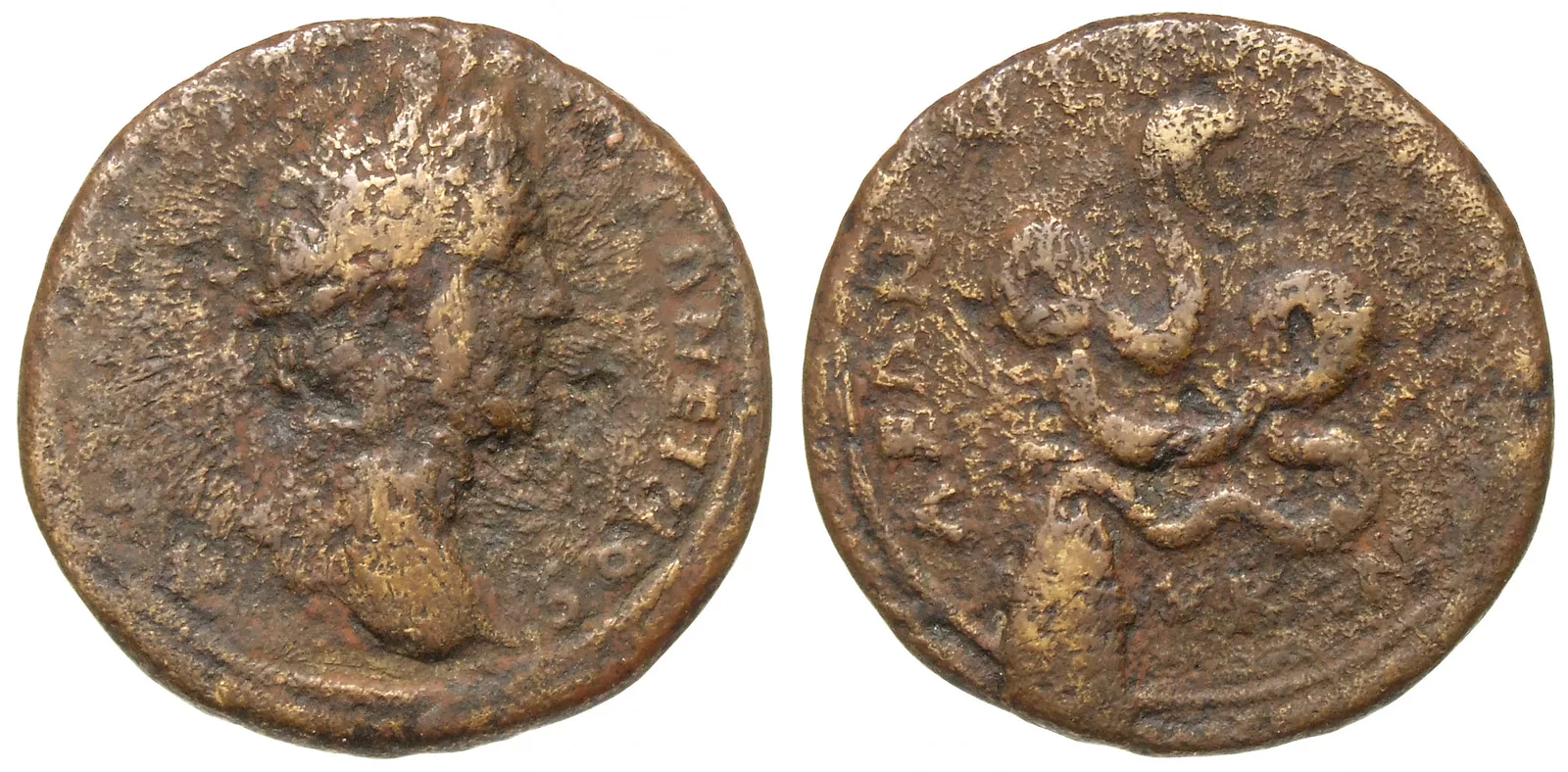
At the opening of his mysteries in the town of Abonoteichos, on the Black Sea coast, the prophet Alexander had a herald proclaim: "If there be any atheist or Christian or Epicurean here spying upon our rites, let him depart in haste; and let all such as have faith in the God be initiated."12 The god was Glycon, a serpent with a human head, and Alexander's oracle grew rich answering questions at a fixed fee.34 One of the men who would not be initiated was a Syrian writer named Lucian, who later visited the prophet, was offered his hand to kiss, and "instead bestowed on it a sound bite that must have come near disabling it."56
Lucian wrote the story down, and with it a whole shelf of comedies about the gods of Olympus, their oracles, their sacrifices and the philosophers who explained them. He never called himself an atheist, and it is not clear that he was one. This chapter asks what turned a sculptor's apprentice from the Euphrates into one of the ancient world's sharpest mockers of religion, and how much of what he mocked he actually disbelieved.
The boy and the chisel
Almost everything known about him comes from his own writings.7 He was born about 125 at Samosata on the Euphrates, the capital of Commagene, and he called himself a Syrian; in one of his dialogues Rhetoric remembers finding him as a boy still speaking "with his native accent."89 His family had little money. "When my childhood was over, and I had just left school," he wrote, "my father called a council to decide upon my profession."10 Because the boy was good at modelling figures out of the wax from his school tablets, he was apprenticed to his mother's brother, a sculptor. On the first day he broke a marble slab, his uncle beat him with a stick, and he ran home to his mother.111213 That night, he said, he dreamed of two women, Statuary and Culture, each pulling him her way. He chose Culture, "the more when I thought upon the stick."1415

The religion he grew up with was the ordinary religion of his region. In a tract that goes under his name, on the goddess of Hierapolis in Syria, the author says that young men dedicated their hair at her temple, and adds, "I performed this act myself when a youth, and my hair remains still in the temple, with my name on the vessel."1617 Some scholars doubt that the tract is his.18 If it is, it is where his faith appears on the belief timeline, and the only place it does.
A lawyer who lost faith in philosophy
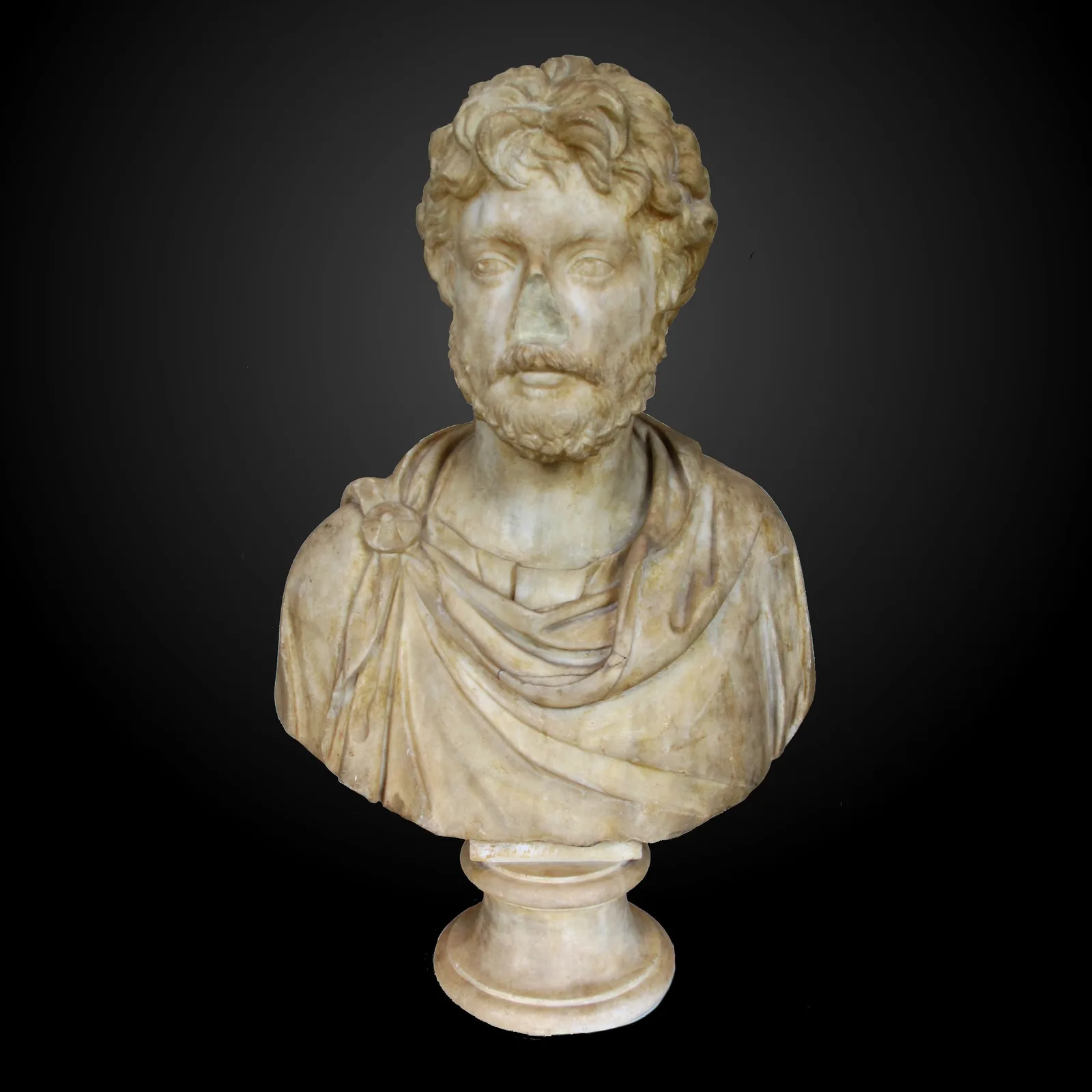
He trained as a rhetorician, a professional speaker and advocate, probably by reading the old Athenian orators because he could not afford the famous teachers of Ionia, and he earned high fees in Greece, Italy and Gaul.1920 Around 150 he wrote the Nigrinus, an admiring picture of a philosopher he had met at Rome and of "the charm of philosophy."21 By the early 160s he was back in the East, a distinguished man; at Antioch he wrote a panegyric for the mistress of the co-emperor Lucius Verus.2223
Then he gave up on philosophy. In the Hermotimus, a long dialogue in which Lucian's stand-in Lycinus cross-examines a devoted student of philosophy, the student at last admits: "I am sober again after a debauch."2425 His translators read it as Lucian's "farewell to philosophy," after which he mentioned it only "to expose its false professors."26 In another dialogue his hero Menippus goes looking for the truth about the heavens among the philosophers and finds that "though they differed among themselves, and all they said was full of inconsistency and contradiction, they expected me to believe them, each pulling me in his own direction."2728 On the timeline, his doubt falls in these years, about 150 to 165.
Forty, and laughing
"My age (I was then nearly forty years old)," he wrote, "called upon me to withdraw from the turmoil of the law-courts."2930 He settled at Athens with his father and family, and turned the philosophical dialogue into comedy.31 In one of his pieces, Dialogue herself complains that "this Syrian" had dragged her down from her philosophical heaven and set her among "persons with a horrible knack of making light of sacred things."323334 On the timeline, his declaration is placed at the comedies of the next ten years.35
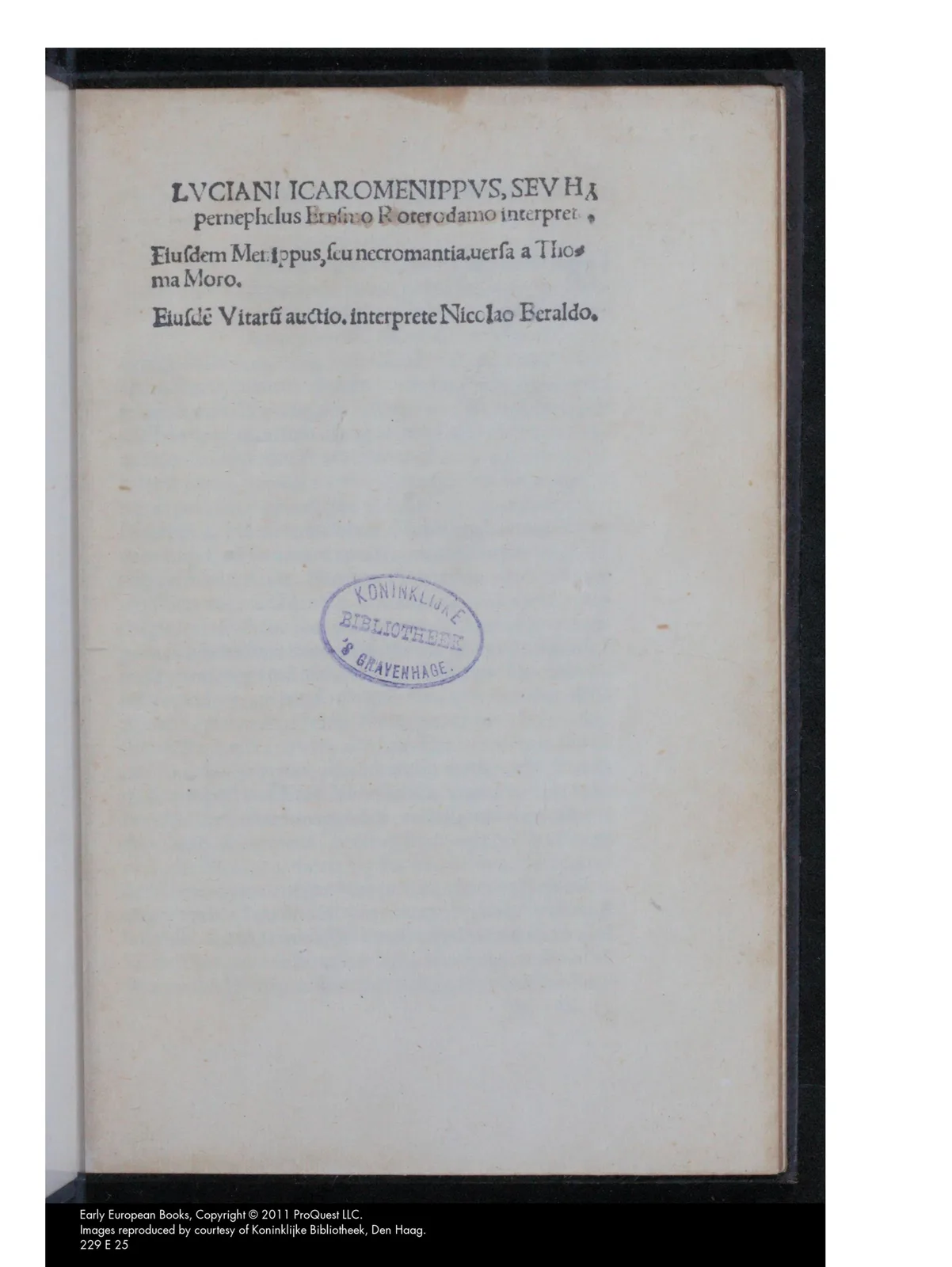
His gods are vain, quarrelsome and anxious. In the Icaromenippus Zeus complains that men offer him a victim at Olympia only every four years: "My altars are cold as Plato's Laws."36 He sits listening to the prayers that rise to heaven, "'O Zeus, that I might be king!' 'O Zeus, that my onions and garlic might thrive!' 'Ye Gods, a speedy death for my father!'" and worries about the Epicureans: "Who will sacrifice to you, if he does not expect to profit by it?"3738 In The Gods in Council the gods' own critic Momus says that "men do not care two straws about us; nor can I blame them."3940 In Of Sacrifice, speaking in his own voice, Lucian remarked that Zeus "is a Cretan born and bred — and buried, as any native of that island will show you."4142
The sharpest of the comedies is Zeus Tragoedus, in which the gods anxiously watch a debate on earth between Timocles, a Stoic who believes in providence, and Damis, who does not. Timocles asks whether "this great universe drifts unsteered and uncontrolled," and Zeus himself is pleased: "a cogent illustration, that."43 Damis argues that the variety of the world's cults shows "how vague religious theory is. Confusion is endless, and beliefs as many as believers."4445 When Timocles produces a final proof from the existence of altars, Damis replies: "Ha, ha, ha! I will answer as soon as I can get done with laughing."46 At the end Zeus says he would rather have had one ally like Damis than rule a thousand Babylons.45 The arguments are given to characters, and Lucian never says which of them he is.
Peregrinus at Olympia
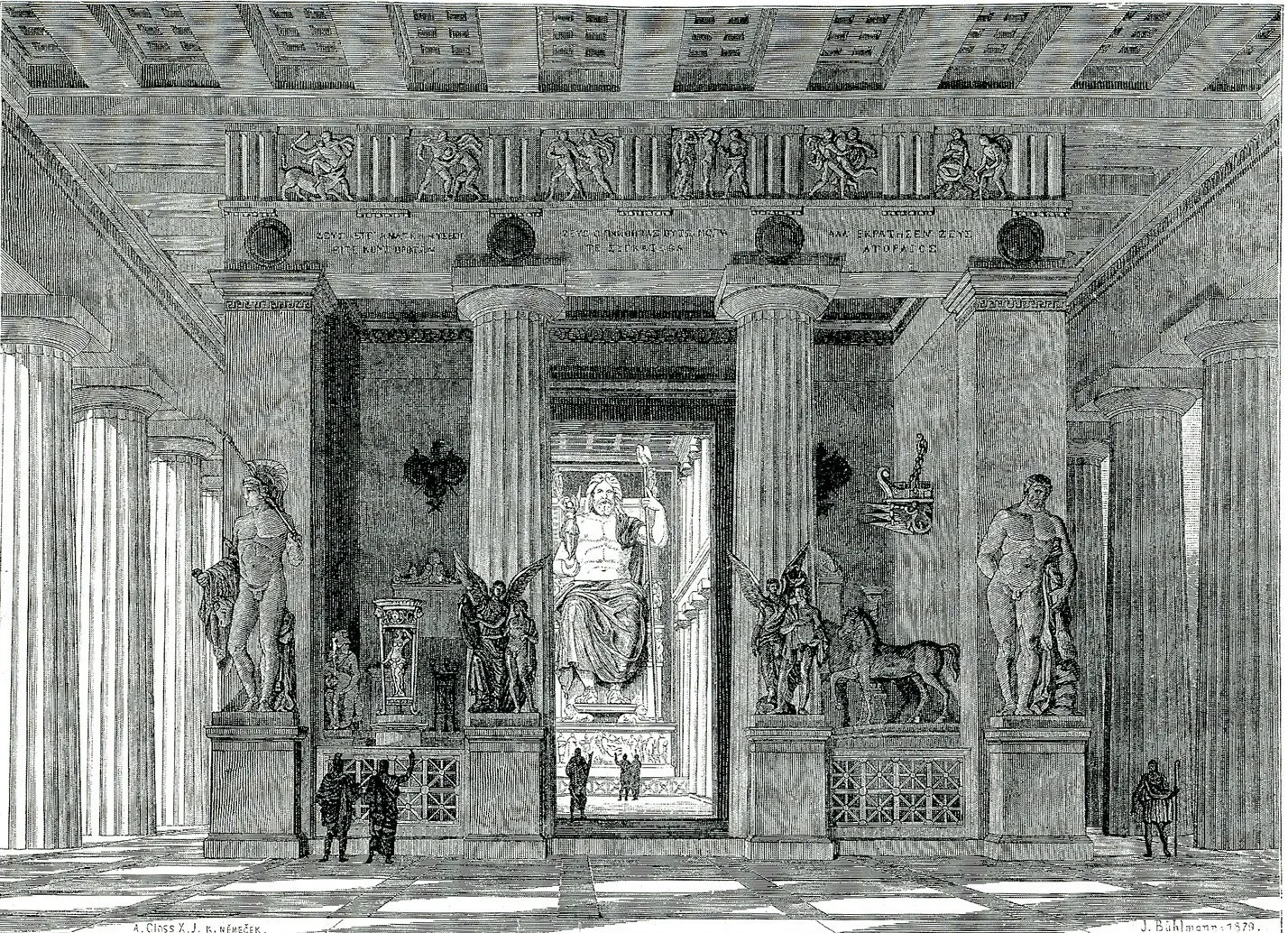
At the Olympic Games, in 169 by his translators' reckoning, Lucian watched a Cynic philosopher, Peregrinus, prepare to burn himself alive for glory. A Cynic orator told the crowd that "the world has seen but two works of surpassing excellence, the Olympian Zeus, and — Proteus," Peregrinus's other name.474849 Lucian laughed at the whole performance in front of the crowd and "was within an ace of being torn limb from limb by the Cynics."50 In his account of the day a heckler mocks the Christians as people who "worship a man to this day," who are convinced "that they are immortal for all time," and who are easily fleeced; Lucian reports the speech without saying it in his own voice.515253
The prophet and the bite
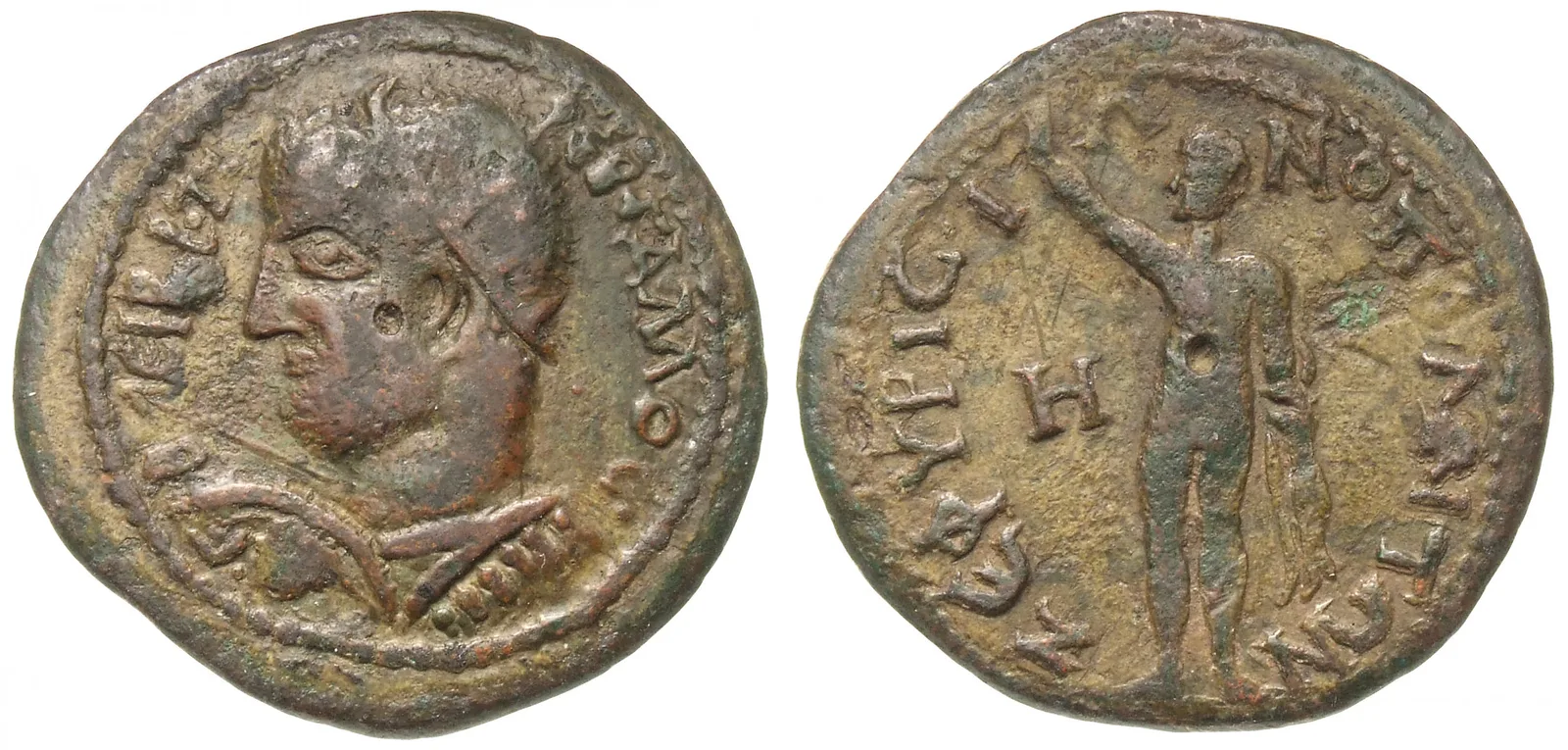
The story he told with the most anger was about Alexander of Abonoteichos. In Lucian's account, Alexander had seen that "human life is under the absolute dominion of two mighty principles, fear and hope, and that any one who can make these serve his ends may be sure of a rapid fortune."5455 He buried bronze tablets announcing that Asclepius was coming, staged the god's birth from a goose egg, and produced a tame snake with a linen head as the god Glycon.3 When the Epicureans of the region began to expose him, he proclaimed that Pontus was "overrun with atheists and Christians" and told the people to stone them; he burned Epicurus's Accepted Maxims in the market-place "and cast its ashes into the sea."56575859
Lucian, travelling to Athens, was invited to meet the prophet and bit his hand. Alexander, he wrote, then ordered a ship's master to throw him overboard, and the man refused in tears; when Lucian wanted to prosecute, the Roman governor begged him not to.606 "From that time it was war between Alexander and me."61 It is Lucian's account alone, from a man who admits his bitterness; only the coins of Glycon confirm that the cult existed.3
A blow for Epicurus
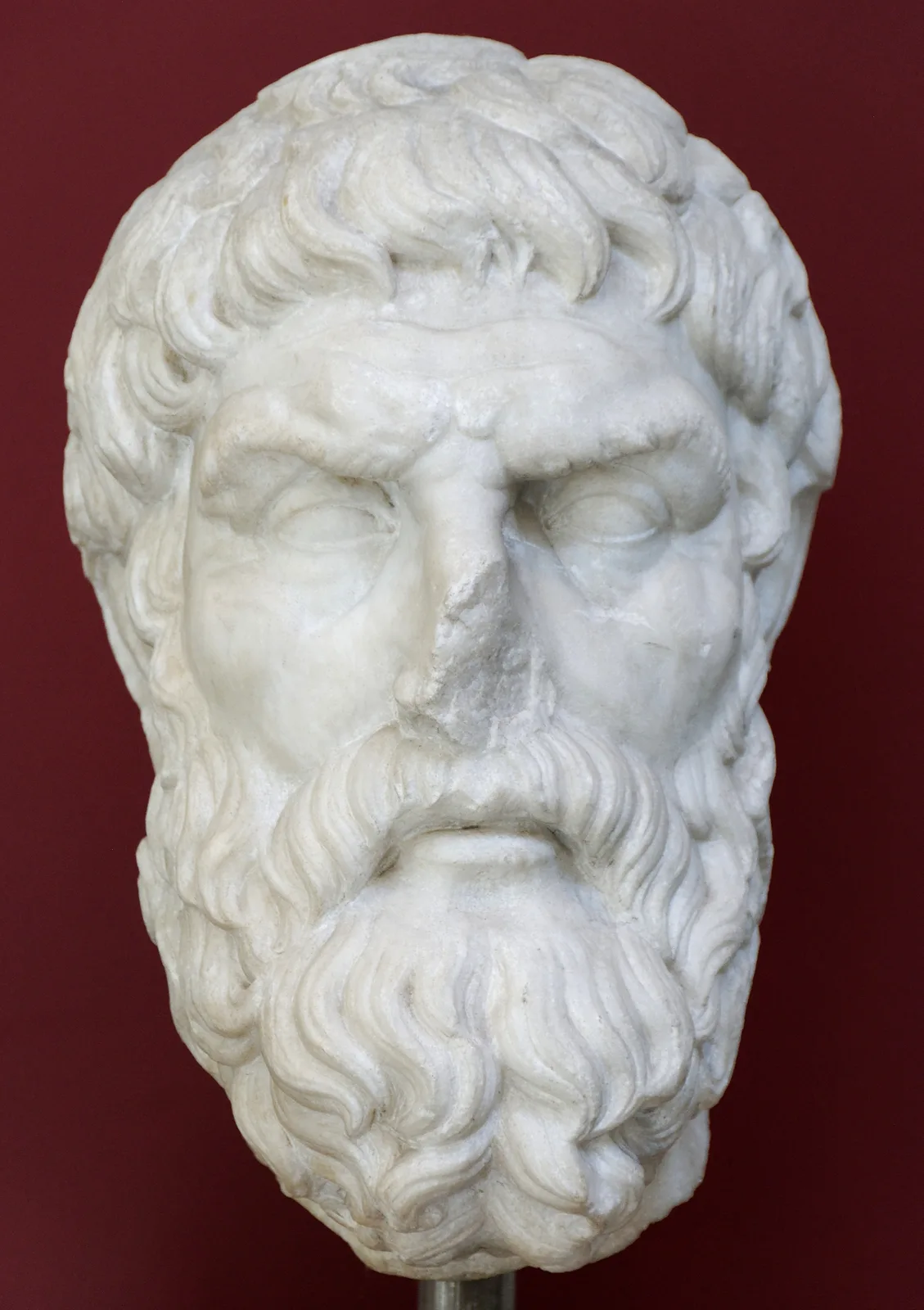
He wrote the account after 180, late in life, and at its end he dropped his comic masks. He had written it, he said, "to strike a blow for Epicurus, that great man whose holiness and divinity of nature were not shams, who alone had and imparted true insight into the good."6263 He praised the book Alexander had burned for "the peace, tranquillity, and independence of mind it produces," and "the protection it gives against terrors, phantoms, and marvels."64 A man like Epicurus, he wrote, faced with a miracle he could not explain, would still be "perfectly certain that, though this escaped him, the whole thing was a lie and an impossibility."65 Epicurus taught that gods exist but take no part in human affairs. Lucian's allegiance, which is where the timeline places his revision, was not to atheism but to the one philosopher whose teaching freed people from fear of the gods.
In old age, by his translators' account, he took a well-paid legal post in Egypt. No one knows when or how he died. A Byzantine dictionary said he was torn to pieces by dogs, a story his translators thought was "the Christian revenge for Lucian's imaginary hostility to Christianity."666768
What he believed
His English translators of 1905 called him "the most vehement of the questioners" of his age, a man who applied "the test of results" alike to religion and to the philosophy that tried to replace it, and found both wanting. "He may be a materialist, so far as he is anything, in philosophy."697071 Another scholar called him "an interested sceptic."72 He mocked Zeus, the oracles, the sacrifices, the Stoics, the Cynics and the prophets with equal energy, and defended only Epicurus. Whether he disbelieved in the gods, or only in the uses people made of them, he never said in his own voice. His characters say everything else.
Epicurus, whom he praised as the only philosopher who freed men from fear, has his own chapter in this book.
Footnotes
-
Alexander of Abonoteichos, prophet of Glycon, in the proclamation opening his mysteries; reported by Lucian, so this is the enemy's hostile witness: vol. II (same).
worksoflucianofs02luci;research/texts/fowler2.txt. Contains Hermotimus (pp. 41–), Alexander the Oracle-monger (pp. 212–238), ] Alexander §38, p. 229. ↩ -
Fowler, vol. II, ] Alexander §38, p. 229. ↩
-
Fowler, vol. II, ] Alexander §§19–26, pp. 221–227. ↩
-
Lucian (Alexander): Fowler, vol. II, ] Alexander §55, p. 235. ↩
-
The translators' Introduction (pp. v–xxxviii): "1. Life. 2. Probable Order of Writings. 3. Circumstances of the Time. 4. Lucian as a Writer." Says it follows Croiset's Essai sur la vie et les œuvres de Lucien, "on which the first two sections of this introduction are very largely based," and that it gives "the account that commends itself to us, without discussion" (p. v). A Tier 2 source that is itself a summary of a Tier 2 source, ] p. vii; The Syrian Goddess, being a translation of Lucian's De dea Syria, with a life of Lucian by Herbert A. Strong, ed. John Garstang (London: Constable, 1913). Internet Archive
syriangoddessbei00luciuoft;research/texts/strong-syrian-goddess.txt. Used for Lucian's own sentence about his hair (§ 60, p. 89) and as the second Tier 2 life (pp. 29–36), ] p. 29 ("no ancient biography ... excepting an unsatisfactory sketch by Suidas"). ↩ -
Fowler I, Intro, ] p. viii; Syrian Goddess, ] p. 29. ↩
-
vol. III (same).
worksoflucianofs03luci;research/texts/fowler3.txt. Contains Zeus Cross-examined (p. 71), Zeus Tragoedus (pp. 80–104), The Liar / Philopseudes (p. 230–), Icaromenippus (pp. 126–144), The Double Indictment (pp. 144–166), Demonax, ] The Double Indictment §27, p. 161; Fowler I, Intro, ] p. xxii; vol. IV (same).worksoflucianofs04luci;research/texts/fowler4.txt. Contains The Death of Peregrine (pp. 79–95), The Gods in Council (pp. 165–171), Notes Explanatory of Allusions to Persons (pp. 191–244), ] Notes p. xxii. ↩ -
Lucian (The Vision, autobiographical address): H. W. Fowler and F. G. Fowler, trans., The Works of Lucian of Samosata, complete with exceptions specified in the preface, vol. I (Oxford: Clarendon Press, 1905). Internet Archive
worksoflucianofs01luci, ] The Vision §1, p. 1. ↩ -
Fowler, Works of Lucian of Samosata, vol. I, ] The Vision §1, p. 1. ↩
-
Fowler, Works of Lucian of Samosata, vol. I, ] The Vision §2–3, pp. 1–2; Fowler I, Intro, ] p. viii. ↩
-
Fowler, Works of Lucian of Samosata, vol. I, ] The Vision §3–4, p. 2. ↩
-
Fowler, Works of Lucian of Samosata, vol. I, ] The Vision §5–14, pp. 2–6. ↩
-
Lucian (The Vision): Fowler, Works of Lucian of Samosata, vol. I, ] The Vision §14, pp. 5–6. ↩
-
Lucian (On the Syrian Goddess, if his): Syrian Goddess, ] § 60, p. 89. ↩
-
Syrian Goddess, ] § 60, p. 89; reported by [Fowler I, Intro] p. ix ("a casual mention of his offering a lock of his hair to the Syrian goddess in his youth"). Accounts differ; see the disputed points. ↩
-
Syrian Goddess, ] pp. 31–32. ↩
-
Fowler I, Intro, ] p. ix. ↩
-
Fowler I, Intro, ] p. x; Syrian Goddess, ] p. 30 (Rome about 150; Gaul for about ten years). ↩
-
Fowler I, Intro, ] p. xi. ↩
-
Fowler I, Intro, ] p. x; Syrian Goddess, ] p. 30. ↩
-
Fowler I, Intro, ] p. x. ↩
-
Hermotimus, the pupil (Hermotimus): Fowler, vol. II, ] Hermotimus §83, p. 89. ↩
-
Fowler, vol. II, ] Hermotimus §83, p. 89. ↩
-
Fowler I, Intro, ] p. xii. ↩
-
Menippus (Icaromenippus): Fowler, vol. III, ] Icaromenippus §5, p. 129. ↩
-
Fowler, vol. III, ] Icaromenippus §§5, 24–25, pp. 129, 140. ↩
-
Lucian as "the Syrian" (The Double Indictment): Fowler, vol. III, ] The Double Indictment §32, p. 164. ↩
-
Fowler, vol. III, ] The Double Indictment §32, p. 164; Fowler I, Intro, ] p. xi. ↩
-
Fowler I, Intro, ] pp. x–xi; Syrian Goddess, ] pp. 30–31. ↩
-
Dialogue (personified; The Double Indictment): Fowler, vol. III, ] The Double Indictment §33, p. 165. ↩
-
Dialogue (The Double Indictment): Fowler, vol. III, ] The Double Indictment §33, p. 165. ↩
-
Fowler, vol. III, ] The Double Indictment §33, p. 165. ↩
-
Fowler I, Intro, ] pp. xii–xiii, xvi–xvii. ↩
-
Zeus (Icaromenippus): Fowler, vol. III, ] Icaromenippus §24, p. 140. ↩
-
Prayers overheard by Menippus (Icaromenippus): Fowler, vol. III, ] Icaromenippus §25, p. 140. ↩
-
Zeus, on the Epicureans (Icaromenippus): Fowler, vol. III, ] Icaromenippus §32, p. 143. ↩
-
Momus (The Gods in Council): Fowler, vol. IV, ] The Gods in Council §12, p. 170. ↩
-
Fowler, vol. IV, ] The Gods in Council §§2–13, pp. 165–170. ↩
-
The essayist (Of Sacrifice): Fowler, Works of Lucian of Samosata, vol. I, ] Of Sacrifice §10, p. 187. ↩
-
Fowler, Works of Lucian of Samosata, vol. I, ] Of Sacrifice §§9–10, pp. 187–188. ↩
-
Timocles (Zeus Tragoedus); Zeus himself answers "Good, this time, Timocles ; a cogent illustration, that.": Fowler, vol. III, ] Zeus Tragoedus §46, p. 102. ↩
-
Damis (Zeus Tragoedus / Zeus Rants): Fowler, vol. III, ] Zeus Tragoedus §42, p. 100. ↩
-
Fowler, vol. III, ] Zeus Tragoedus §§41–53, pp. 100–104. ↩ ↩2
-
Damis (Zeus Tragoedus), on Timocles's altar syllogism: Fowler, vol. III, ] Zeus Tragoedus §51, p. 104. ↩
-
Theagenes, Cynic orator at Olympia, praising Peregrinus (Death of Peregrine); a real Cynic speech as Lucian reports it: Fowler, vol. IV, ] Death of Peregrine §6, p. 80. ↩
-
Fowler, vol. IV, ] The Death of Peregrine §§1–7, pp. 79–81. ↩
-
Fowler I, Intro, ] p. xiii; Syrian Goddess, ] p. 31. ↩
-
Lucian (The Death of Peregrine): Fowler, vol. IV, ] Death of Peregrine §3, p. 79. ↩
-
A heckler at Olympia, quoted by Lucian (Death of Peregrine): Fowler, vol. IV, ] Death of Peregrine §11, p. 82. ↩
-
The same heckler (Death of Peregrine): Fowler, vol. IV, ] Death of Peregrine §13, p. 83. ↩
-
Fowler, vol. IV, ] Death of Peregrine §§11–13, pp. 82–83. ↩
-
Lucian (Alexander): Fowler, vol. II, ] Alexander §8, p. 215. ↩
-
Fowler, vol. II, ] Alexander §8, p. 215. ↩
-
Lucian reporting Alexander (Alexander): Fowler, vol. II, ] Alexander §25, p. 224. ↩
-
Fowler, vol. II, ] Alexander §25, pp. 223–224. ↩
-
Lucian reporting Alexander (Alexander): Fowler, vol. II, ] Alexander §47, p. 232. ↩
-
Fowler, vol. II, ] Alexander §§44–47, pp. 230–232. ↩
-
Lucian (Alexander): Fowler, vol. II, ] Alexander §56, p. 236. ↩
-
Lucian (Alexander): Fowler, vol. II, ] Alexander §57, p. 236. ↩
-
Lucian (Alexander): Fowler, vol. II, ] Alexander §61, pp. 237–238. ↩
-
Fowler, vol. II, ] Alexander §61, pp. 237–238. ↩
-
Lucian (Alexander): Fowler, vol. II, ] Alexander §47, p. 232. ↩
-
Lucian (Alexander): Fowler, vol. II, ] Alexander §17, p. 220. ↩
-
Fowler I, Intro, ] p. xiv; Syrian Goddess, ] p. 31. ↩
-
H. W. and F. G. Fowler (translators), reporting the late Suidas on Lucian's end; secondhand and the translators' own doubt: Fowler I, Intro, ] p. xiv. ↩
-
Fowler I, Intro, ] p. xiv; Syrian Goddess, ] p. 31. Reported at second hand; the original has not been seen. ↩
-
H. W. and F. G. Fowler: Fowler I, Intro, ] p. xix. ↩
-
Fowler I, Intro, ] pp. xix–xx. ↩
-
H. W. and F. G. Fowler: Fowler I, Intro, ] p. xxii. ↩
-
Herbert A. Strong: Syrian Goddess, ] p. 33. ↩
worksoflucianofs02luci; research/texts/fowler2.txt. Contains Hermotimus (pp. 41–), Alexander the Oracle-monger (pp. 212–238).; The translators' Introduction (pp. v–xxxviii): "1. Life. 2. Probable Order of Writings. 3. Circumstances of the Time. 4. Lucian as a Writer." Says it follows Croiset's Essai sur la vie et les œuvres de Lucien, "on which the first two sections of this introduction are very largely based," and that it gives "the account that commends itself to us, without discussion" (p. v). A Tier 2 source that is itself a summary of a Tier 2 source.; The Syrian Goddess, being a translation of Lucian's De dea Syria, with a life of Lucian by Herbert A. Strong, ed. John Garstang (London: Constable, 1913). Internet Archive syriangoddessbei00luciuoft; research/texts/strong-syrian-goddess.txt. Used for Lucian's own sentence about his hair (§ 60, p. 89) and as the second Tier 2 life (pp. 29–36).; vol. III (same). worksoflucianofs03luci; research/texts/fowler3.txt. Contains Zeus Cross-examined (p. 71), Zeus Tragoedus (pp. 80–104), The Liar / Philopseudes (p. 230–), Icaromenippus (pp. 126–144), The Double Indictment (pp. 144–166), Demonax.; vol. IV (same). worksoflucianofs04luci; research/texts/fowler4.txt. Contains The Death of Peregrine (pp. 79–95), The Gods in Council (pp. 165–171), Notes Explanatory of Allusions to Persons (pp. 191–244).; H. W. Fowler and F. G. Fowler, trans., The Works of Lucian of Samosata, complete with exceptions specified in the preface, vol. I (Oxford: Clarendon Press, 1905). Internet Archive worksoflucianofs01luci.In their own words
When my childhood was over, and I had just left school, my father called a council to decide upon my profession.
I waited not for her to bring her words to an end, but rose up and spoke my mind ; I turned from that clumsy mechanic woman, and went rejoicing to lady Culture, the more when I thought upon the stick, and all the blows my yesterday's apprenticeship had brought me.
Similarly I have had an object in telling you my dream. It is that the young may be guided to the better way and set themselves to Culture, especially any among them who is recreant for fear of poverty
my age (I was then nearly forty years old) called upon me to withdraw from the turmoil of the law-courts
this Syrian took it upon himself to drag me down, break my wings, and reduce me to the common level of humanity.
persons with a horrible knack of making light of sacred things, and girding at all that is as it should be
my first step was to accustom him to walk upon the common ground like the rest of mankind; my next, to make him presentable, by giving him a good bath and teaching him to smile.
I am sober again after a debauch, I see what the object of my maudlin affection is like, and what it has brought upon me.
though they differed among themselves, and all they said was full of inconsistency and contradiction, they expected me to believe them, each pulling me in his own direction.
As for me, I am superannuated ; they think themselves very generous if they offer me a victim at Olympia at four-year intervals. My altars are cold as Plato's Laws or Chrysippus's Syllogisms.
'O Zeus, that I might be king!' 'O Zeus, that my onions and garlic might thrive!' 'Ye Gods, a speedy death for my father!'
if once they infect their generation with this view, you will learn what hunger means. Who will sacrifice to you, if he does not expect to profit by it ?
national observances show better than anything else how vague religious theory is. Confusion is endless, and beliefs as many as believers.
Travellers from Crete tell another story : there is a tomb there with an inscribed pillar, stating that Zeus is long dead, and not going to thunder any more.
Ha, ha, ha ! I will answer as soon as I can get done with laughing.
In short, men do not care two straws about us ; nor can I blame them.
As for Zeus, he is a Cretan born and bred — and buried, as any native of that island will show you.
human life is under the absolute dominion of two mighty principles, fear and hope, and that any one who can make these serve his ends may be sure of a rapid fortune.
nay, for an Epicurus or a Metrodorus, perhaps, a man whose intelligence was steeled against such assaults by scepticism and insight, one who, if he could not detect the precise imposture, would at any rate have been perfectly certain that, though this escaped him, the whole thing was a lie and an impossibility.
atheists and Christians, who presumed to spread the most scandalous reports concerning him ; he exhorted Pontus, as it valued the God's favour, to stone these men.
he brought it into the middle of the market-place, there burned it on a fig-wood fire for the sins of its author, and cast its ashes into the sea.
The fellow had no conception of the blessings conferred by that book upon its readers, of the peace, tranquillity, and independence of mind it produces, of the protection it gives against terrors, phantoms, and marvels, vain hopes and inordinate desires
I took hold of it as if to kiss, but instead bestowed on it a sound bite that must have come near disabling it.
Alexander's orders were to seize and fling us overboard ; in that case his war with me would have been lightly won.
From that time it was war between Alexander and me, and I left no stone unturned to get my revenge.
to strike a blow for Epicurus, that great man whose holiness and divinity of nature were not shams, who alone had and imparted true insight into the good, and who brought deliverance to all that consorted with him.
I was within an ace of being torn limb from limb by the Cynics, like Actaeon among the dogs, or his cousin Pentheus among the Maenads.
The Christians, you know, worship a man to this day, — the distinguished personage who introduced their novel rites, and was crucified on that account.
these misguided creatures start with the general conviction that they are immortal for all time, which explains the contempt of death and voluntary self-devotion which are so common among them
a man has no business to run away from life : he ought to wait till his time comes.
all that we know of Lucian is derived from his own writings.
He may be a materialist, so far as he is anything, in philosophy ; but in practice he puts the things of the mind before the things of the body.
Lucian was the most vehement of the questioners.
His attitude is that of an interested sceptic, but he confesses himself unable to explain all the miracles which he witnessed at Hierapolis
I performed this act myself when a youth, and my hair remains still in the temple, with my name on the vessel.
The other side
If there be any atheist or Christian or Epicurean here spying upon our rites, let him depart in haste ; and let all such as have faith in the God be initiated and all blessing attend them.
Infidel ! where do you find the source of oracles and prophecies, if not in the Gods and their Providence ?
Now that ship would not have sailed, without a steersman ; and do you suppose that this great universe drifts unsteered and uncontrolled ?
The world has seen but two works of surpassing excellence, the Olympian Zeus, and — Proteus.
I was an unbeliever myself once — worse than you ; in fact I considered it absolutely impossible to give credit to such things.
they scorn the human and travesty the divine
It is stated in Suidas that he was torn to pieces by dogs ; but, as other statements in the article are discredited, it is supposed that this is the Christian revenge for Lucian's imaginary hostility to Christianity.
Where accounts differ
| Point | One account | Another | How the page handles it |
|---|---|---|---|
| Year he returned east | About 160, "a distinguished man at thirty-five" ([Fowler I, Intro] p. x) | Reached Samosata in 164 ([Strong] p. 30) | Say "in the early 160s"; birth year (c. 125) is itself a reconstruction |
| Date of the burning of Peregrinus | The Olympic Games of 169 ([Fowler I, Intro] p. xiii) | Strong has Lucian travelling to Greece "with Peregrinus Proteus" and present at the burning in the same sequence as his move to Greece c. 165, without a year ([Strong] pp. 30–31) | Say "at the Olympic Games in the later 160s" unless a Loeb introduction (Harmon) settles it; the standard modern date is outside the sources read |
| Which emperor gave him the Egyptian post | Commodus ([Fowler I, Intro] p. xiv) | Severus ([Strong] p. 31) | Say "an emperor" or "a late appointment in Egypt" |
| How and when he died | Torn apart by dogs, per Suidas, a legend Fowler calls Christian revenge ([Fowler I, Intro] p. xiv) | Unknown ([Strong] p. 31: "Of the date of his death we know nothing") | Say we do not know; tell the dog story only as a later legend, with the reason scholars doubt it |
| Whether De dea Syria is Lucian's | Strong: probably his, an early work in Ionic Greek in imitation of Herodotus ([Strong] pp. 31–32) | Fowler's "complete works ... with exceptions" volumes do not include it in the volumes read; some scholars doubt it, as Strong notes | Use the hair-offering sentence only if the script says "the tract that goes under his name" |
| What Lucian believed | "A materialist, so far as he is anything" ([Fowler I, Intro] p. xxii); "the most vehement of the questioners" (p. xix) | Strong: "an interested sceptic," who "approaches very nearly to the view of human life which was preached by the men whom he derides" ([Strong] pp. 33–35) | The episode's honest answer is that the surviving text mocks gods, oracles, philosophers and the Cynics with equal vigour and defends only Epicurus; say so, and do not call him an atheist in his own voice |
| Reliability of Alexander | Lucian's account is the only narrative; Fowler's note says it would seem "a mere romance" were it not confirmed by medals of Antoninus and Marcus Aurelius ([Fowler IV] Notes s.v. Alexander (3)) | A hostile witness who admits his own bitterness ([Fowler II] §57) | Name Lucian as the source for each incident and mention the coin evidence once |
| Celsus the Epicurean | Fowler's note: the Celsus addressed in Alexander has been identified with the Celsus Origen answered, "but ... there is reason to doubt" ([Fowler IV] Notes) | — | Do not identify them |
List of illustrations
This page uses only public-domain and Creative Commons images; each is credited with its source and licence.
- Abonuteichos - Münzkabinett, Berlin - 5501599 — Reinhard Saczewski, (see source page) · Wikimedia Commons, Abonuteichos - Münzkabinett, Berlin - 5501599.jpg; Reinhard Saczewski; Public domain · Public domain
- Samsat Turkey — Radosław Botev, 2022-07-23 15:55:38 · Wikimedia Commons, Samsat Turkey.jpg; Radosław Botev; CC BY 3.0 pl · CC BY 3.0 pl
- Ritratto di lucio vero, atelier di roma, 150-160 dc ca-gradient — Sailko, 2014-05-20 11:35:08 · Wikimedia Commons, Ritratto di lucio vero, atelier di roma, 150-160 dc ca-gradient.jpg; Sailko; Public domain · Public domain
- Lvciani Icaromenippvs ... Erasmo Roterodamo interprete; Menippus seu necromantia, uersa a Thom. Moro (leaf 11) — Lucian (tr. Erasmus, Thomas More, Nicolaus Beraldus); printer Dirk Martens, 1519 · Koninklijke Bibliotheek, The Hague, scan via the Internet Archive (ned-kbn-all-00003238-001) · Public domain (printed 1519; Internet Archive item states no rights)
- Το εσωτερικό του Δία στην Ολυμπία, όπως ήταν στην αρχαιότητα - Falke Jacob Von - 1887 — Jacob von Falke, 1887 · Wikimedia Commons, Το εσωτερικό του Δία στην Ολυμπία, όπως ήταν στην αρχαιότητα - Falke Jacob Von - 1887.jpg; Jacob von Falke; Public domain · Public domain
- Abonuteichos (Ionopolis) - Münzkabinett, Berlin - 5501671 — Reinhard Saczewski, (see source page) · Wikimedia Commons, Abonuteichos (Ionopolis) - Münzkabinett, Berlin - 5501671.jpg; Reinhard Saczewski; Public domain · Public domain
- Epicurus Massimo Inv197306 — unknown, (see source page) · Wikimedia Commons, Epicurus Massimo Inv197306.jpg; Marie-Lan Nguyen (2010); Public domain · Public domain
Sources
Tier 1 — the subject's own words (Fowler's 1905 English translation; Lucian's Greek is the original)
- [Fowler I] H. W. Fowler and F. G. Fowler, trans., The Works of Lucian of Samosata, complete with exceptions specified in the preface, vol. I (Oxford: Clarendon Press, 1905). Internet Archive
worksoflucianofs01luci. OCR inresearch/texts/fowler1.txt. Contains the Introduction (Life, probable order of writings), The Vision (pp. 1–7), A Literary Prometheus, Timon, Dialogues of the Dead and of the Gods, Menippus, Charon, Of Sacrifice (pp. 183–), The Sale of Creeds, The Fisher. - [Fowler II] vol. II (same).
worksoflucianofs02luci;research/texts/fowler2.txt. Contains Hermotimus (pp. 41–), Alexander the Oracle-monger (pp. 212–238). - [Fowler III] vol. III (same).
worksoflucianofs03luci;research/texts/fowler3.txt. Contains Zeus Cross-examined (p. 71), Zeus Tragoedus (pp. 80–104), The Liar / Philopseudes (p. 230–), Icaromenippus (pp. 126–144), The Double Indictment (pp. 144–166), Demonax. - [Fowler IV] vol. IV (same).
worksoflucianofs04luci;research/texts/fowler4.txt. Contains The Death of Peregrine (pp. 79–95), The Gods in Council (pp. 165–171), Notes Explanatory of Allusions to Persons (pp. 191–244). - [Strong] The Syrian Goddess, being a translation of Lucian's De dea Syria, with a life of Lucian by Herbert A. Strong, ed. John Garstang (London: Constable, 1913). Internet Archive
syriangoddessbei00luciuoft;research/texts/strong-syrian-goddess.txt. Used for Lucian's own sentence about his hair (§ 60, p. 89) and as the second Tier 2 life (pp. 29–36).
Tier 2 — scholarly biographies and encyclopedias
- [Fowler I, Intro] The translators' Introduction (pp. v–xxxviii): "1. Life. 2. Probable Order of Writings. 3. Circumstances of the Time. 4. Lucian as a Writer." Says it follows Croiset's Essai sur la vie et les œuvres de Lucien, "on which the first two sections of this introduction are very largely based," and that it gives "the account that commends itself to us, without discussion" (p. v). A Tier 2 source that is itself a summary of a Tier 2 source.
- [Strong] Herbert A. Strong, "Life of Lucian," pp. 29–36 in [Strong].
- [Fowler IV, Notes] Fowler's notes in vol. IV, e.g. s.v. Alexander (3) (cites Smith's Dictionary of Biography and Mythology for medals of Antoninus and Marcus Aurelius that confirm the prophet), Celsus, Epicureans, Peregrine.
Tier 3 — popular biographies and journalism
- None used.
Tier 4 — maps to other sources only (Wikipedia and similar). Never cited in the script.
- Wikipedia, "Lucian"; "Alexander of Abonoteichus"; "Peregrinus Proteus"; "Glycon." Not read; named only as a map. The Suda (Adler lambda 683) is the primary source for the "torn by dogs" story and for the Suda's life of Lucian; not reached.
Opposition sources — contemporary critics and religious responses
- No independent contemporary reply to Lucian survives in the sources read. The opposition voices below are speeches that Lucian himself writes for believers, Cynics and the oracle's prophet, so they are quoted with that caveat (see OQ section). The only real independent opposition is the late and secondhand reception recorded by Fowler (the Suidas story, OQ7), and the stated hostility of Alexander and the Cynics in Lucian's own report.
Related lives
Epicurus (341–270 BCE) — the philosopher Lucian names as the only man whose "intelligence was steeled" against the oracle-monger's frauds and whom he defends in Alexander; Lucretius is the other candidate. (Internal note only; the script's close says "has their own episode in this series", with no "next" pointer.)
Wang Chong
Wang Chong was a poor Confucian scholar of Kuaiji who read his way through the Luoyang bookstalls and could not accept what he found. He wrote the Lunheng to weigh the orthodox claims of his age against observation: Heaven has no mouth to rebuke rulers, thunder is a clash of natural forces, and the dead do not become conscious ghosts. He kept fate and omens as natural signs, and wrote partly to stop ruinous funerals. He never recanted, and ended his life accepting that people, like animals, live a while and die.
Lucretius
Almost nothing is known of Lucretius. He took Epicurus as his master for reasons no source records, and wrote a single unfinished poem to free its reader from religio, the fear of the gods and of death, keeping the gods only as remote and indifferent. His view never changes in the poem. His life was replaced by a Christian legend of madness, his text survived in one monastery copy, and it came back in 1417 to be read, imitated and answered as the oracle of atheists.
Euhemerus
Euhemerus, a friend of King Cassander, wrote a Sacred Record claiming that the gods had been early kings, whose deeds were found on a golden pillar on an island no one else ever reached. The book is lost, and nothing records what he himself believed. He survives only as each later reader needed him: a liar to the Greek geographers, an atheist to Plutarch and Theophilus, and to the Christian apologists the best witness that the pagan gods had been men.
Theodorus the Atheist
Theodorus of Cyrene was trained in the Cyrenaic school of pleasure and in the art of argument. He was remembered as the ancient world's plainest denier of the city's gods, and was driven out of Athens and of Cyrene for it. Nothing he wrote survives, and no source records why he stopped believing. "Atheist" meant something different to each of the writers who called him one.