Almost nothing is known of Lucretius. He took Epicurus as his master for reasons no source records, and wrote a single unfinished poem to free its reader from religio, the fear of the gods and of death, keeping the gods only as remote and indifferent. His view never changes in the poem. His life was replaced by a Christian legend of madness, his text survived in one monastery copy, and it came back in 1417 to be read, imitated and answered as the oracle of atheists.
The belief timeline
- Commitment (undated, before c. 55 BCE) — Lucretius takes Epicurus as his master, the one who first lifted his eyes against religion; no source says when or why [25][8]
- Declaration (c. 60s–55 BCE) — The poem sets out, in Latin verse for Memmius, that the gods are remote, the world not made for us, death nothing to us [17][20][21][23]
- Silence (55–54 BCE onward) — He dies with the poem unfinished; Cicero's cool note; Jerome's legend of madness and suicide takes the place of a biography [27][30][1]
- Rediscovery (winter 1416–17) — Poggio finds the copy in a German monastery; Niccoli keeps it for twenty years; the poem is read again [43][46][47]
Notes to the timeline (12)
- [25] He calls Epicurus the one who first raised a light on the true interests of life ("thee I follow") and, in Book V, "a god he was, a god" — H. A. J. Munro, Lucretius on the Nature of Things, translated with an analysis of the six books (Routledge/Dutton reprint, 1920 date on the record; the translation of Munro's 4th ed., 1886). Internet Archive
onnatureofthing00lucr, 3.1–6; 5.1–8. - [8] Nothing is known of Lucretius's family or birthplace; the poem is wholly silent about its author's history and no other Lucretius Carus is securely known — John Masson, Lucretius, Epicurean and Poet (Murray, 1907), p. 34; H. A. J. Munro, T. Lucreti Cari De rerum natura libri sex, vol. II, Explanatory Notes (Bell, 4th ed., 1900), p. 2.
- [17] The poem's declared enemy is fear: Epicurus is the Greek who first dared lift his eyes against Religion, which lay on human life like a weight — Munro, Lucretius on the Nature of Things, 1.62–79.
- [20] The gods exist but live in perfect peace, untouched by us: "neither gained by favours nor moved by anger" — Munro, Lucretius on the Nature of Things, 2.646–651.
- [21] The world was not made for us by divine power: its defects are too great — Munro, Lucretius on the Nature of Things, 2.180–181.
- [23] Death is nothing to us ("nil igitur mors est ad nos"); we felt no distress before our birth, in the Punic wars, and shall feel none after — Munro, Lucretius on the Nature of Things, 3.830–869; H. A. J. Munro, T. Lucreti Cari De rerum natura libri sex, vol. I, text and critical notes, with the history of the text (Bell, 1908 reprint of the 4th ed., 1886). Internet Archive
titilucreticarid02lucruoft/titilucreticarid01lucruoft(the file downloaded istitilucreticarid01lucruoft). Latin text and "Notes I on the formation of the text".texts/munro-1908-v1.txt, (Latin). - [27] The poem breaks off unfinished at the end of Book VI with the plague of Athens, the temples full of corpses and the gods' worship neglected — Munro, Lucretius on the Nature of Things, 6.1250–1286; Masson, Lucretius, p. 47.
- [30] Cicero's letter to his brother of Feb. 54 BCE is the only place he names Lucretius, written about four months after the poet's death — Munro, T. Lucreti Cari De rerum…, vol. II, p. 3; Masson, Lucretius, p. 36; E. S. Shuckburgh, The Letters of Cicero, vols. I and II (Bell, 1899–1905): footnotes on Memmius, vol. I p. 266.
- [1] Jerome's Chronicle entry under 94 BCE says Lucretius was born, was later driven mad by a love potion, wrote some books in the intervals of insanity (which Cicero afterwards emended) and killed himself in his 44th year — Masson, Lucretius, p. 35 and n. 1; Munro, T. Lucreti Cari De rerum…, vol. II, p. 1.
- [43] Gaisser dates the find to the winter of 1416–17 after Poggio's visit to St Gall; the first mention is a letter from Francesco Barbaro of July 1417 listing it with other finds — Julia Haig Gaisser, "Poggio and Other Book Hunters", in Book Hunters (Firenze University Press, 2020), pp. 173–188, CC BY 4.0, doi:10.36253/978-88-6453-968-3.13. OAPEN
oapen-20.500.12657-56235.texts/poggio-chapter.txt. A modern, openly licensed account of the discovery with the Latin of Poggio's letters (from Clark 1899 and Bracciolini 1984), p. 183. - [46] Poggio sent the manuscript to Niccoli, who made his own copy; it survives in the Laurentian Library, Florence (MS 35.30) — Munro, T. Lucreti Cari De rerum…, vol. I, pp. 2–3, 21; William Shepherd, The Life of Poggio Bracciolini (1837), (list of Poggio's recoveries and note on the Lucretius transcript, page not read); Gaisser, Book Hunters, p. 184 n. 48.
- [47] From 1425 to 1430 Poggio repeatedly asks Niccoli for the manuscript, saying in 1429 he has had it twelve years and in 1430 fourteen; he also says he has never read the whole poem — Gaisser, Book Hunters, pp. 183–184 and nn. 46–47; Munro, T. Lucreti Cari De rerum…, vol. I, pp. 2–3.
The Poem That Came Back
In the winter of 1416 or early 1417 a papal secretary named Poggio Bracciolini, in Germany for the Council of Constance, went looking for old books in its monasteries. Somewhere, in a house so remote, he wrote, that "few travellers come from it," he found a copy of a Latin poem that almost no one had read for a thousand years. He had it copied on the spot and sent to his friend Niccolò Niccoli in Florence. Twelve years later he was still asking for it back: "You have had Lucretius twelve years now," he wrote in 1429, and he added that he had never yet been able to read the whole poem.123456
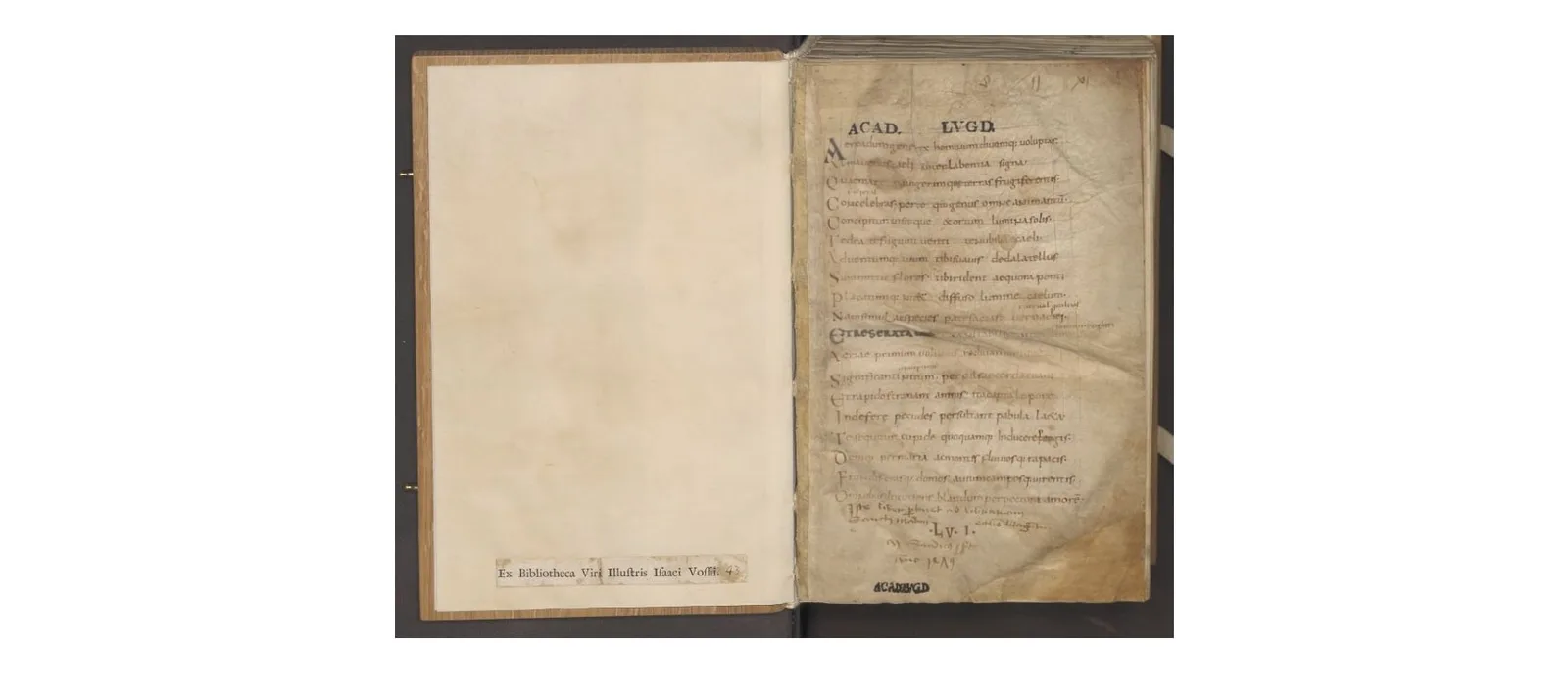
The poem was De rerum natura, On the Nature of Things, by Titus Lucretius Carus, and its subject was the freedom of human beings from the fear of the gods. Every complete copy we have descends from one lost manuscript.78 This chapter asks what we can know about the man who wrote it, why he wrote it, and how his unbelief survived the long silence.
A man without a biography
Almost nothing is known of Lucretius. The poem says nothing about its author's history, and no ancient source names his family or his town.9 His dates come from two notes written long after him. A Life of Virgil, which scholars trace to the lost biographies of Suetonius, says that Virgil took the toga of manhood on the very day that "Lucretius the poet died"; the great Victorian editor H. A. J. Munro took that day to be 15 October 55 BCE, and reckoned that Lucretius was born in 99 or 98.1011121314 The other note is in the Christian chronicle of Jerome, written centuries later: "Titus Lucretius, the poet, was born; afterwards, having been driven mad by a philtre, after he had written, in the intervals of his mental ailment, a number of books which Cicero afterwards corrected, he slew himself by his own hand in his forty-fourth year." Jerome put the birth in 94 BCE, which does not fit the other dates.151617
That single sentence is the whole of his ancient biography, and scholars have long argued over it. Some thought it might be true; others called it a legend that grew from the poem's own passages on love and death; one pointed out that a poem showing such "supreme control of reason" is hard to imagine written between fits of madness.1819 It comes from a Christian who disliked what Lucretius taught, it was written centuries after the fact, and nothing can confirm it, so this chapter does not claim to.
Nor do we know when or why Lucretius became an Epicurean. No source says. The poem shows only that he had: "Thee, who first wast able from amid such thick darkness to raise on high so bright a beacon and shed a light on the true interests of life, thee I follow, glory of the Greek race."2021 On the belief timeline, his first mark is therefore a commitment with no date, and the record gives no earlier faith to set it against.
Honey on the cup
He addressed the poem to a Roman politician, Gaius Memmius, who was aedile in 60 BCE and praetor in 58, and was later convicted of electoral bribery and went into exile at Athens.222324 Memmius is spoken to by name throughout.25 Lucretius admits the difficulty of his task: "Nor does my mind fail to perceive how hard it is to make clear in Latin verses the dark discoveries of the Greeks," but friendship drives him on, "and leads me on to watch the clear night through."262728 He knew his doctrine was bitter, and he wrote it in verse for the reason a doctor sweetens medicine: "even as physicians when they purpose to give nauseous wormwood to children, first smear the rim round the bowl with the sweet yellow juice of honey."2930
The weight of religion
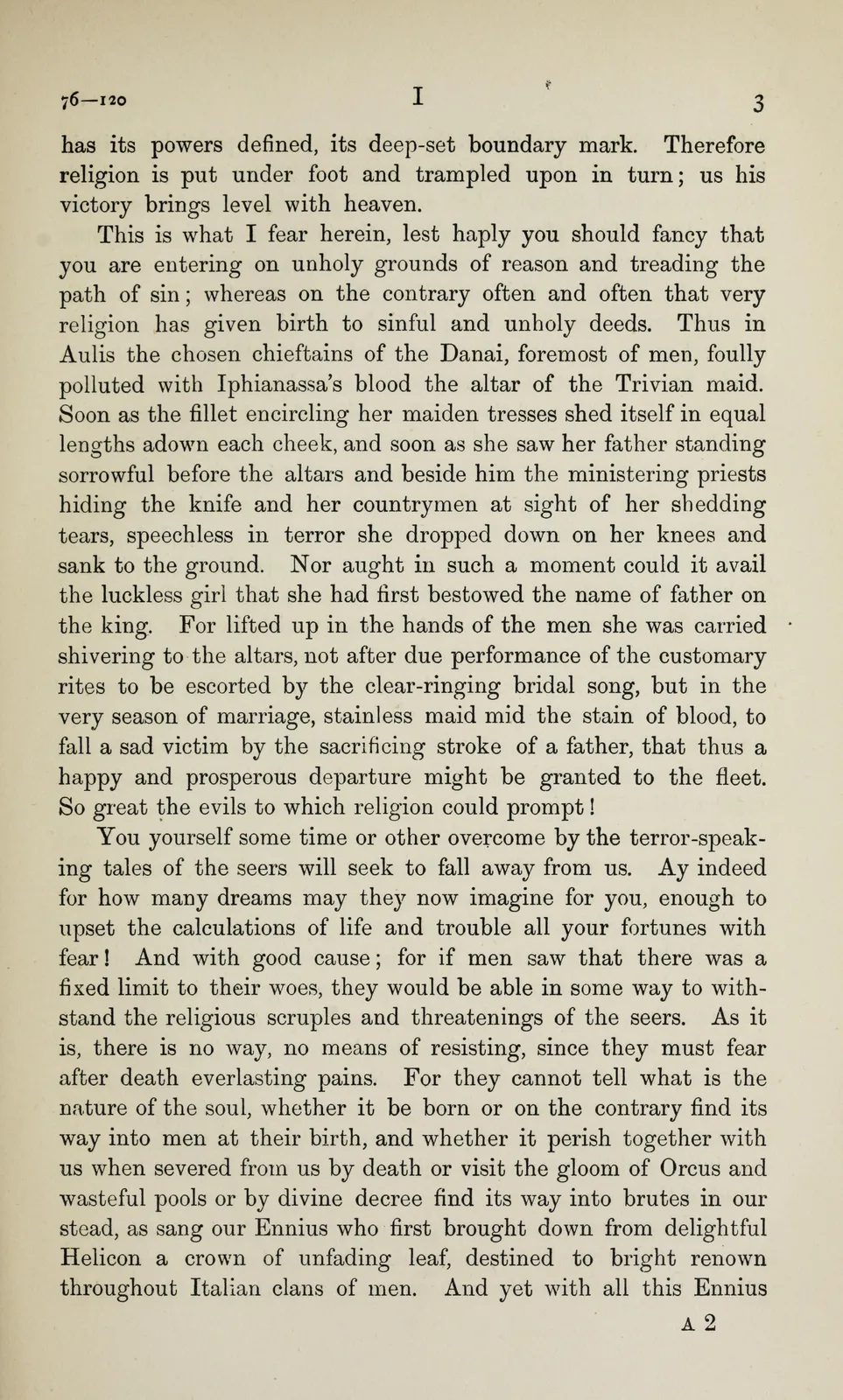
The poem names its enemy at once. "When human life to view lay foully prostrate upon earth crushed down under the weight of religion, who shewed her head from the quarters of heaven with hideous aspect lowering upon mortals, a man of Greece ventured first to lift up his mortal eyes to her face and first to withstand her to her face."3132 The man of Greece is Epicurus. Then Lucretius tells the story of Agamemnon sacrificing his own daughter Iphigenia at Aulis so that the Greek fleet could sail, and ends with the most famous line he wrote: "Tantum religio potuit suadere malorum," "So great the evils to which religion could prompt!"333435
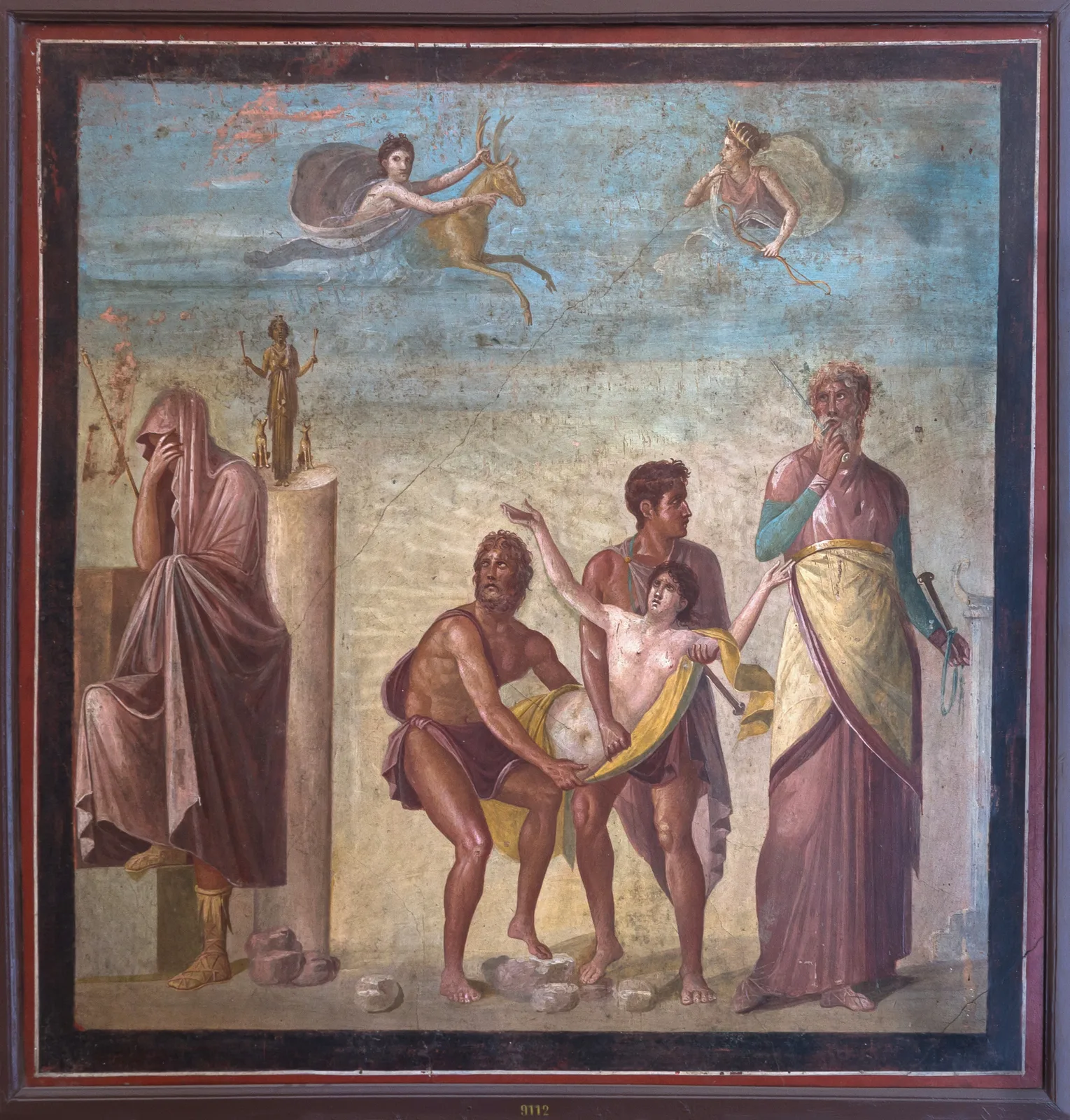
His word religio meant something nearer to "fear of the gods" than to belief in them, and his cure for it was physics. People fear because they see things whose causes they cannot understand and so put them down to the gods; but "nothing is ever gotten out of nothing by divine power."3637 The world is made of atoms, which "swerve a little" so that they can collide.38 "The nature of the world has by no means been made for us by divine power: so great are the defects with which it stands encumbered."3940 Understand that, and "nature free at once and rid of her haughty lords is seen to do all things spontaneously of herself without the meddling of the gods."4142
He did not deny that the gods exist. Like his master, he set them far off: "the nature of gods must ever in itself of necessity enjoy immortality together with supreme repose, far removed and withdrawn from our concerns; ... it is neither gained by favours nor moved by anger."4344 People first imagined gods, he thought, from the "glorious forms" they saw in dreams.45 And true piety was not the ritual of the temples: "Nor is it any act of piety to be often seen with veiled head to turn to a stone and approach every altar ... but rather to be able to look on all things with a mind at peace."4647
Nothing to us
The third book is about death. "Nil igitur mors est ad nos," death is nothing to us. We felt no distress in the ages before we were born, when Rome fought Carthage, and we will feel none after we are gone.4849 The punishments of the underworld, Tantalus and Sisyphus and the rest, are pictures of the torments people make for themselves in this life.50 And in Book V he gives Epicurus the highest praise a Roman could give: "a god he was, a god, most noble Memmius, who first found out that plan of life which is now termed wisdom."2051
The poem was never finished. It breaks off in the sixth book with the plague of Athens, in a scene of temples so full of corpses that "no longer the worship of the gods ... were greatly regarded."5253
The first readers
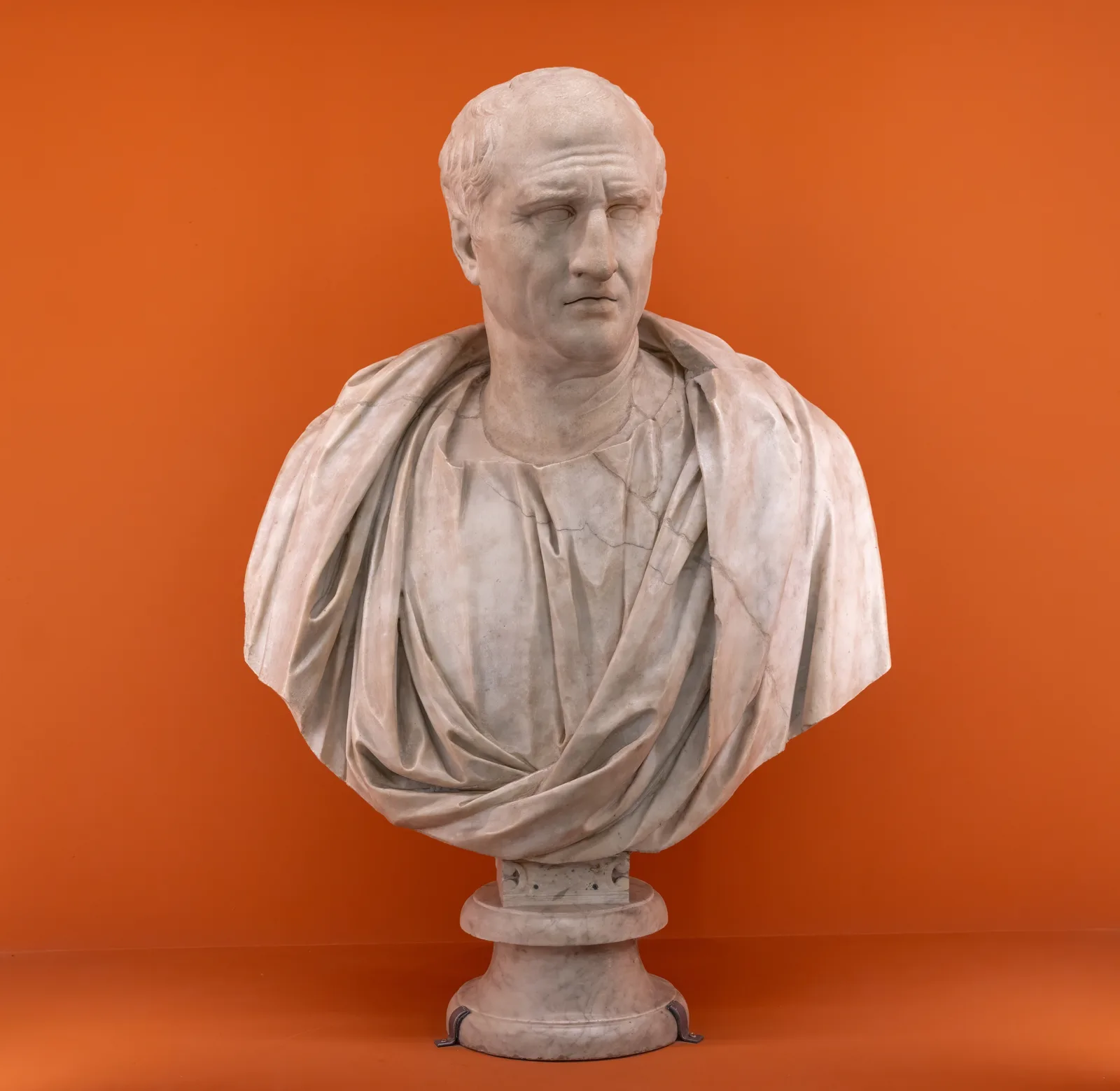
Cicero is the only contemporary who names him, once, in a letter to his brother in February 54 BCE, a few months after the poet's death. "The poems of Lucretius are, as you say, with many flashes of genius, yet very technical," in one translation; but a word is missing from the Latin, and other editors read it as "great brilliance of genius, but not much art." What Cicero thought of the poetry cannot be settled.545556 Jerome said that Cicero "corrected" the books, and scholars cannot agree which Cicero he meant.57 In another work Cicero wondered at the presumption of philosophers who worship the founder of their system "as a God" and say "that by Him they have been delivered from the most grievous tyrants, from a perpetual terror and fear both by night and by day"; one modern scholar reads that as aimed at Lucretius's school.5859
The poets read him closely. Virgil, the scholars say, imitates him "from one end to the other," and many take his line "Blessed is the man who was able to learn the causes of things" as a tribute.606162 Ovid wrote that "the poems of lofty Lucretius will perish only when one day gives the earth to ruin."6364 Someone scratched the poem's first words on a wall of the basilica at Pompeii.65
The Christians read him too. Lactantius, the apologist, quoted him often, sometimes as an ally against pagan idol-worship, and sometimes against Epicurus: "For if God confers nothing good on any one, ... what is so senseless, what so foolish, as to build temples, to offer sacrifices?" "All the ravings of Lucretius," he wrote, "belong to him," meaning Epicurus.666768697071
The silence and the return
Then the poem nearly vanished. Through the Middle Ages it was hardly quoted at first hand; a few lines passed from grammar book to grammar book, and a tenth-century library catalogue at Bobbio lists a copy.72 Two manuscripts written in the ninth and tenth centuries survived and are now at Leiden.7 And one more copy waited in a German monastery, perhaps Fulda or Murbach, until Poggio found it.73
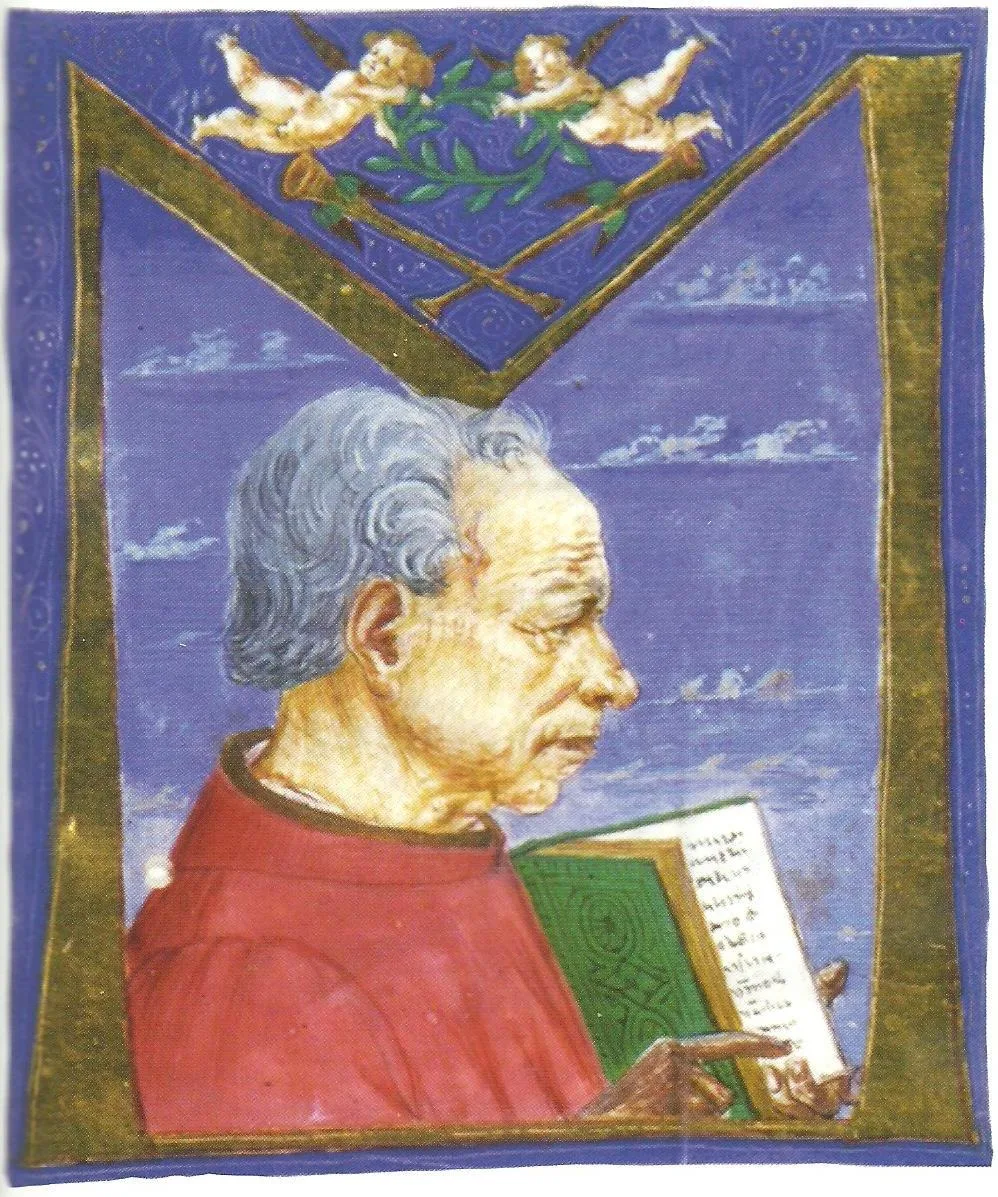
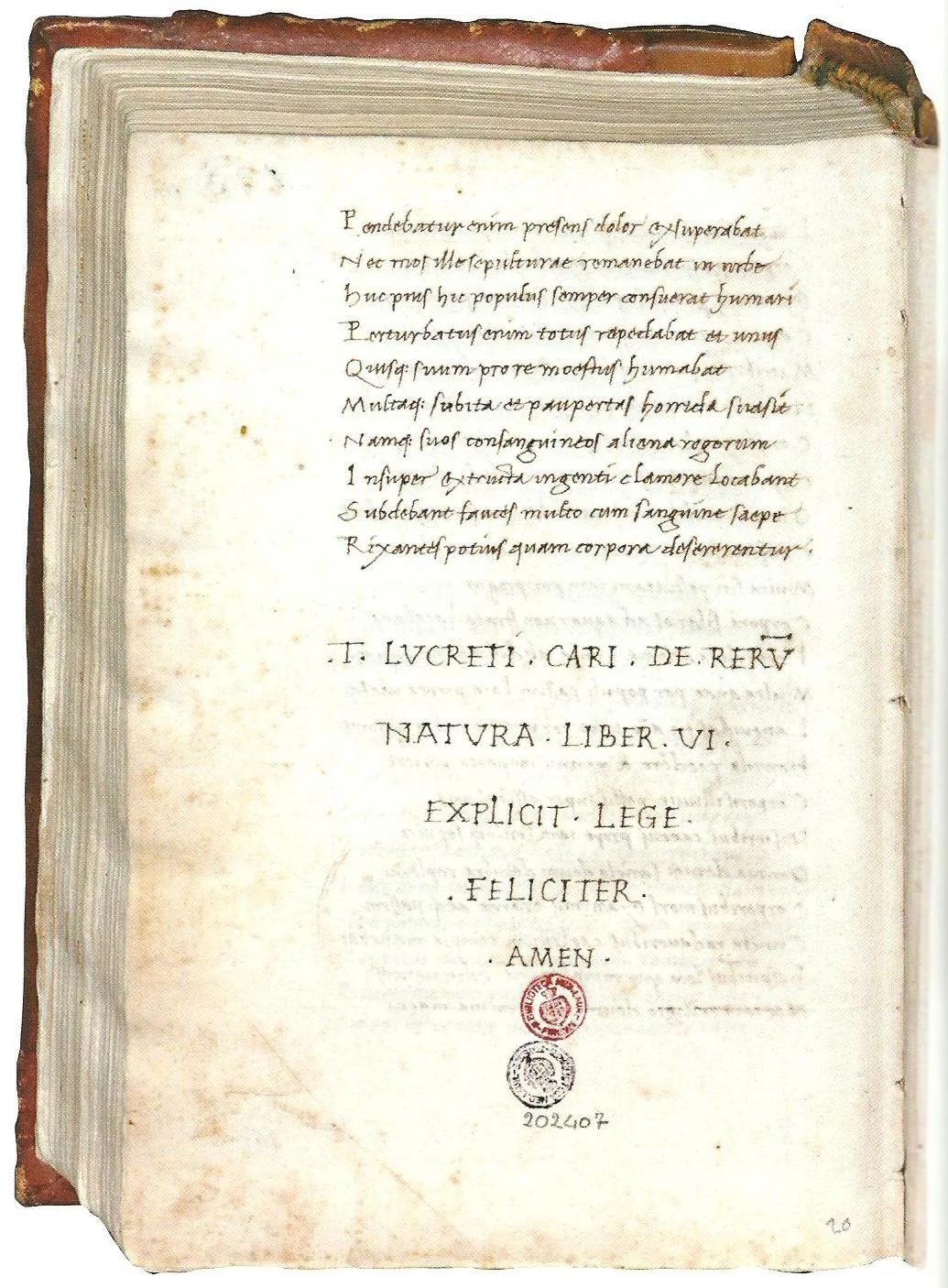
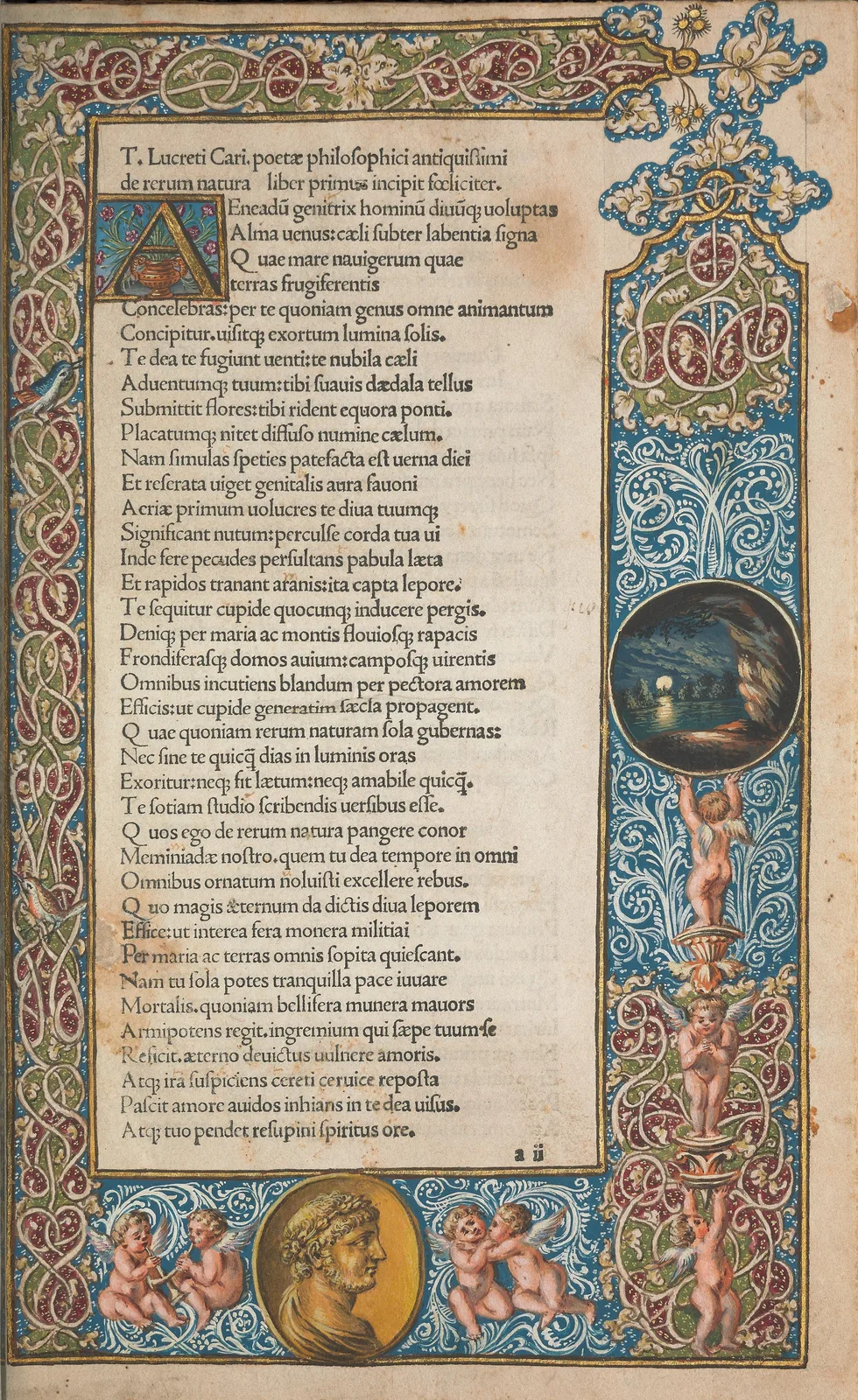
Niccoli kept Poggio's manuscript for twenty years, and when he died in 1437 his own transcript passed to Florence, where it remains. Nearly every fifteenth-century copy descends from it.74758 A fifteenth-century poet, Landino, praised Poggio for giving Lucretius back, "after a long time," to his fellow citizens and his country.76 The poem was first printed at Brescia about 1473, then at Verona in 1486 and by Aldus at Venice in 1500.7778 The French scholar Lambinus's great edition followed in the 1560s.79
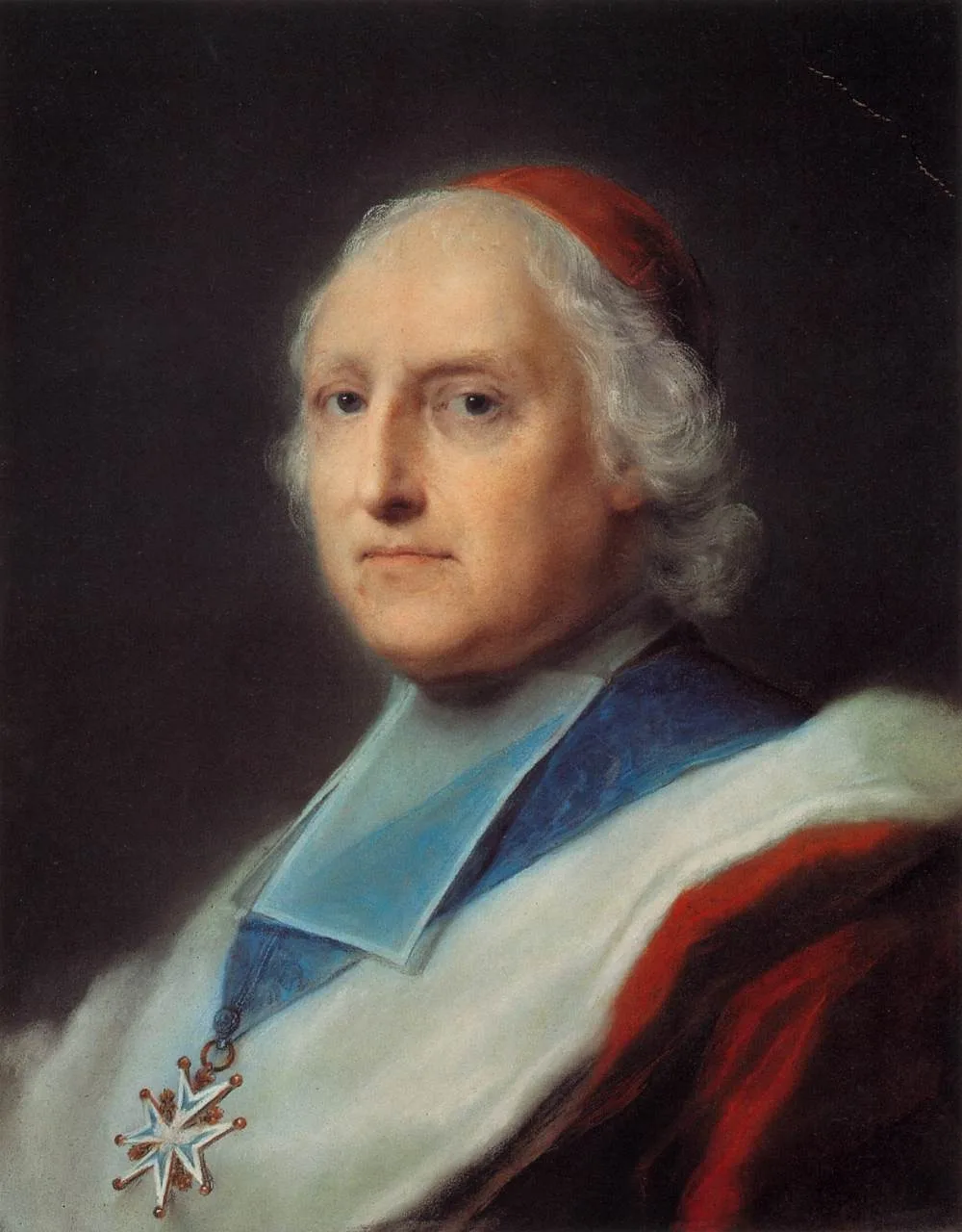
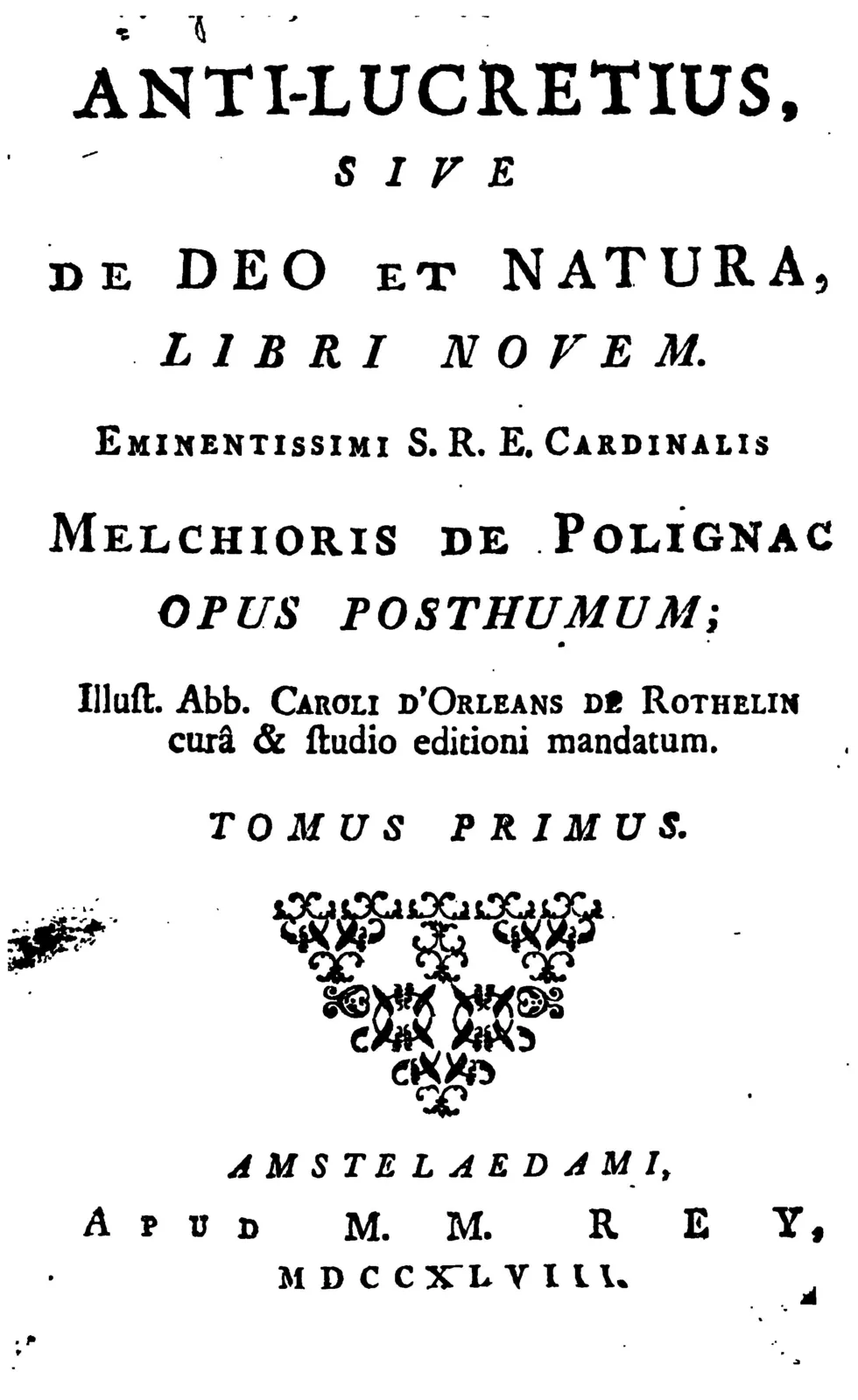
Its enemies came back with it. In 1697, in talk with Pierre Bayle, the French cardinal Melchior de Polignac conceived a long Latin poem, the Anti-Lucretius, "to put to flight Lucretius, the high priest and oracle of atheists"; it was published after his death, in nine books.80 In its English translation of 1766 it warns of "some youth, who draughts from your black fountain drains, ... Spurning religion, loos'd from every fear."8182 And Tennyson, in a poem printed in 1870, turned Jerome's sentence into a Victorian poem, inventing a wife who went to a witch for a love potion that drove her husband to his death.838485
Did his unbelief change shape?
We cannot see Lucretius change his mind, because we cannot see Lucretius at all. What the record shows is a poem that holds a single view from beginning to end. The gods exist, far off and indifferent. The world is atoms and void, made by no one. Death is nothing to us, and the worst evil is the fear that religion breeds. What changed was the poem's fate. Its author's life was replaced by a Christian's story of madness and suicide, its text survived in one copy in a German monastery, and when it came back it found readers ready for it. The man called "the high priest and oracle of atheists" never used the word himself. He thought he was setting people free from fear, and the honey he spread on the cup is still there.
Epicurus, the "man of Greece" whom Lucretius followed and called a god, has his own chapter in this book.
Footnotes
-
H. A. J. Munro, T. Lucreti Cari De rerum natura libri sex, vol. I, text and critical notes, with the history of the text (Bell, 1908 reprint of the 4th ed., 1886). Internet Archive
titilucreticarid02lucruoft/titilucreticarid01lucruoft(the file downloaded istitilucreticarid01lucruoft). Latin text and "Notes I on the formation of the text".texts/munro-1908-v1.txt, p. 2. ↩ -
Julia Haig Gaisser, "Poggio and Other Book Hunters", in Book Hunters (Firenze University Press, 2020), pp. 173–188, CC BY 4.0, doi:10.36253/978-88-6453-968-3.13. OAPEN
oapen-20.500.12657-56235.texts/poggio-chapter.txt. A modern, openly licensed account of the discovery with the Latin of Poggio's letters (from Clark 1899 and Bracciolini 1984), p. 183. ↩ -
Gaisser, Book Hunters, p. 183 and n. 45 (Clark 1899, p. 125). ↩
-
Gaisser, Book Hunters, pp. 183–184 and nn. 46–47; Munro, T. Lucreti Cari De rerum…, vol. I, pp. 2–3. ↩
-
Poggio Bracciolini: Letter to Francesco Barbaro, end 1417 or early 1418, in Gaisser p. 183 n. 45 (from Clark 1899, p. 125). ↩
-
Poggio Bracciolini: Letter to Niccoli, 13 Dec. 1429, in Gaisser p. 184 n. 46 (Bracciolini 1984, 1.89). ↩
-
Munro, T. Lucreti Cari De rerum…, vol. I, p. 1; Gaisser, Book Hunters, p. 184 n. 49 (Voss. Lat. F. 30). ↩ ↩2
-
John Masson, Lucretius, Epicurean and Poet (Murray, 1907), p. 34; H. A. J. Munro, T. Lucreti Cari De rerum natura libri sex, vol. II, Explanatory Notes (Bell, 4th ed., 1900), p. 2. ↩
-
Munro, T. Lucreti Cari De rerum…, vol. II, p. 2; Masson, Lucretius, p. 35 n. 1–2. ↩
-
Munro, T. Lucreti Cari De rerum…, vol. II, p. 1; Masson, Lucretius, p. 35. ↩
-
Munro, T. Lucreti Cari De rerum…, vol. II, p. 1. ↩
-
Munro, T. Lucreti Cari De rerum…, vol. II, p. 2. ↩
-
Suetonius/Donatus: Life of Virgil, as quoted in Munro Notes II p. 1. ↩
-
Masson, Lucretius, p. 35 and n. 1; Munro, T. Lucreti Cari De rerum…, vol. II, p. 1. ↩
-
Munro, T. Lucreti Cari De rerum…, vol. II, p. 1–2. Accounts differ; see the disputed points. ↩
-
Jerome: Chronicle, translated in Masson p. 35. ↩
-
Masson, Lucretius, pp. 44–49. ↩
-
Masson, Lucretius, pp. 47–48 (quoting Sellar). Reported at second hand; the original has not been seen. ↩
-
H. A. J. Munro, Lucretius on the Nature of Things, translated with an analysis of the six books (Routledge/Dutton reprint, 1920 date on the record; the translation of Munro's 4th ed., 1886). Internet Archive
onnatureofthing00lucr, 3.1–6; 5.1–8. ↩ ↩2 -
Lucretius: De rerum natura 3.1–4, tr. Munro. ↩
-
E. S. Shuckburgh, The Letters of Cicero, vols. I and II (Bell, 1899–1905): footnotes on Memmius, vol. II p. 27 n. 1. ↩
-
Shuckburgh, Letters of Cicero, vol. II p. 27 n. 1 (cross-ref. vol. I p. 304). ↩
-
Shuckburgh, Letters of Cicero, vol. I, note to the letter to Culleolus (Illyricum) (page not read). ↩
-
Munro, Lucretius on the Nature of Things, Book I (lines 140ff., 411), II, V. ↩
-
Munro, Lucretius on the Nature of Things, 1.136–145. ↩
-
Lucretius: De rerum natura 1.136–139, tr. Munro. ↩
-
Lucretius: De rerum natura 1.140–142, tr. Munro. ↩
-
Munro, Lucretius on the Nature of Things, 1.936–950 (repeated 4.11–25). ↩
-
Lucretius: De rerum natura 1.936–940, tr. Munro. ↩
-
Munro, Lucretius on the Nature of Things, 1.62–79. ↩
-
Lucretius: De rerum natura 1.62–66, tr. Munro. ↩
-
Munro, Lucretius on the Nature of Things, 1.80–101; Munro, T. Lucreti Cari De rerum…, vol. I, (Latin). ↩
-
Lucretius: De rerum natura 1.101, Latin text in Munro Notes I. ↩
-
Lucretius: De rerum natura 1.101, tr. Munro. ↩
-
Munro, Lucretius on the Nature of Things, 1.146–158. ↩
-
Lucretius: De rerum natura 1.150, tr. Munro. ↩
-
Munro, Lucretius on the Nature of Things, 2.216–224 (text at 2.181–243). ↩
-
Munro, Lucretius on the Nature of Things, 2.180–181. ↩
-
Lucretius: De rerum natura 2.180–181, tr. Munro. ↩
-
Munro, Lucretius on the Nature of Things, 2.1090–1092. ↩
-
Lucretius: De rerum natura 2.1090–1092, tr. Munro. ↩
-
Munro, Lucretius on the Nature of Things, 2.646–651. ↩
-
Lucretius: De rerum natura 2.646–651, tr. Munro. ↩
-
Munro, Lucretius on the Nature of Things, 5.1161ff.. ↩
-
Munro, Lucretius on the Nature of Things, 5.1198–1203. ↩
-
Lucretius: De rerum natura 5.1198–1203, tr. Munro. ↩
-
Munro, Lucretius on the Nature of Things, 3.830–869; Munro, T. Lucreti Cari De rerum…, vol. I, (Latin). ↩
-
Lucretius: De rerum natura 3.830, Latin text in Munro Notes I. ↩
-
Munro, Lucretius on the Nature of Things, Argument to Book III 978–1023. ↩
-
Lucretius: De rerum natura 5.8–10, tr. Munro. ↩
-
Munro, Lucretius on the Nature of Things, 6.1250–1286; Masson, Lucretius, p. 47. ↩
-
Lucretius: De rerum natura 6.1272–1274, tr. Munro. ↩
-
Munro, T. Lucreti Cari De rerum…, vol. II, p. 3; Masson, Lucretius, p. 36; Shuckburgh, Letters of Cicero, vol. I p. 266. ↩
-
Munro, T. Lucreti Cari De rerum…, vol. II, p. 13–15 (page numbers from running heads); Masson, Lucretius, p. 37 n. 1. ↩
-
Cicero: Shuckburgh, Letters of Cicero, Letters of Cicero vol. I (1899), p. 266 (letter CXXXI, Q. fr. II 9). ↩
-
Munro, T. Lucreti Cari De rerum…, vol. II, p. 3–4; Masson, Lucretius, p. 36. ↩
-
Masson, Lucretius, pp. 37–38 and n.. ↩
-
Cicero (c. 45 BCE), statesman and critic of Epicureanism, in Masson's translation of Tusculan Disputations 1.21; Masson reads it as aimed at Lucretius: Masson, Lucretius, p. 37–38. ↩
-
Masson, Lucretius, p. 410 (running head). ↩
-
Munro, T. Lucreti Cari De rerum…, vol. II, Introduction (section on the poem's influence, c. p. 19–20). ↩
-
Virgil: Georgics 2.490, as printed in Masson p. 410. ↩
-
Masson, Lucretius, p. 74 n. 1. ↩
-
Ovid: Amores 1.15, as printed in Masson p. 74 n. 1. ↩
-
Munro, T. Lucreti Cari De rerum…, vol. II, p. 21. ↩
-
Lactantius, Anger of God, Workmanship of God, Epitome of the Divine Institutes, in The Works of Lactantius, vol. II, tr. William Fletcher (Ante-Nicene Christian Library vol. XXII, T. & T. Clark, 1871), vol. II index; Anger of God p. 16. ↩
-
Lactantius, Anger of God, Anger of God ch. 8. ↩
-
Lactantius, Anger of God, p. 106. ↩
-
Lactantius, Christian apologist (dated by the brief to the 4th century); the passage follows his quotation of Lucretius's lines on the gods (Q5): Lactantius, Anger of God, Anger of God ch. 8, tr. Fletcher (1871). ↩
-
Lactantius, Workmanship of God ch. 6, p. 62: Lactantius, Anger of God, vol. II p. 62, tr. Fletcher. ↩
-
Lactantius, Epitome of the Divine Institutes ch. 25: using Lucretius as an ally against pagan idol-worship; Fletcher's text is the 1871 translation: Lactantius, Anger of God, vol. II p. 106, tr. Fletcher. ↩
-
Munro, T. Lucreti Cari De rerum…, vol. I, pp. 1–2. ↩
-
Gaisser, Book Hunters, p. 183 and n. 46. ↩
-
Munro, T. Lucreti Cari De rerum…, vol. I, pp. 2–3, 21; William Shepherd, The Life of Poggio Bracciolini (1837), (list of Poggio's recoveries and note on the Lucretius transcript, page not read); Gaisser, Book Hunters, p. 184 n. 48. ↩
-
Munro, T. Lucreti Cari De rerum…, vol. I, p. 3; Gaisser, Book Hunters, p. 184. ↩
-
Landinus (Landino; first name not given in Munro): Poem in praise of Poggio, as quoted in Munro Notes I p. 2. ↩
-
Munro, T. Lucreti Cari De rerum…, vol. I, p. 3. ↩
-
Munro, T. Lucreti Cari De rerum…, vol. I, pp. 3–4. ↩
-
Munro, T. Lucreti Cari De rerum…, vol. I, preface; Munro, T. Lucreti Cari De rerum…, vol. II, p. 20. ↩
-
Melchior de Polignac, Anti-Lucretius, sive De Deo et natura (Amsterdam, Rey, 1748; Latin) IA
antilucretiussi00poligoog,texts/polignac-latin-1748.txt; George Canning's English translation of Books 1–5, A Translation of Anti-Lucretius (1766), IAbim_eighteenth-century_anti-lucretius-books-1_polignac-melchior-de-c_1766,texts/polignac-canning.txt. The OCR keeps the long s, which the quotation below reproduces, (Latin, 1748), preface pp. xiv–xv. ↩ -
Polignac, Anti-Lucretius, (Canning 1766); IA record
bim_eighteenth-century_anti-lucretius-of-god-an_polignac-melchior-de_1757. Titles is the only source for this, as for the other details in this chapter cited to that source alone. ↩ -
Cardinal Melchior de Polignac (1661–1741), diplomat and poet; his Anti-Lucretius answers Lucretius in Latin hexameters, unfinished at his death: Polignac, Anti-Lucretius, Anti-Lucretius Book I, tr. Canning (1766), c. pp. 8–9. ↩
-
Alfred Tennyson, "Lucretius", in The Holy Grail and Other Poems (Strahan, 1870), 1870, pp. 166–167. ↩
-
Tennyson, Holy Grail and Other Poems, 1870 p. 166; Masson, Lucretius, p. 35. ↩
-
Tennyson: "Lucretius", The Holy Grail and Other Poems (1870), p. 167. ↩
titilucreticarid02lucruoft/titilucreticarid01lucruoft (the file downloaded is titilucreticarid01lucruoft). Latin text and "Notes I on the formation of the text". texts/munro-1908-v1.txt.; Julia Haig Gaisser, "Poggio and Other Book Hunters", in Book Hunters (Firenze University Press, 2020), pp. 173–188, CC BY 4.0, doi:10.36253/978-88-6453-968-3.13. OAPEN oapen-20.500.12657-56235. texts/poggio-chapter.txt. A modern, openly licensed account of the discovery with the Latin of Poggio's letters (from Clark 1899 and Bracciolini 1984).; John Masson, Lucretius, Epicurean and Poet (Murray, 1907); H. A. J. Munro, T. Lucreti Cari De rerum natura libri sex, vol. II, Explanatory Notes (Bell, 4th ed., 1900); H. A. J. Munro, Lucretius on the Nature of Things, translated with an analysis of the six books (Routledge/Dutton reprint, 1920 date on the record; the translation of Munro's 4th ed., 1886). Internet Archive onnatureofthing00lucr.; E. S. Shuckburgh, The Letters of Cicero, vols. I and II (Bell, 1899–1905): footnotes on Memmius.; Lactantius, Anger of God, Workmanship of God, Epitome of the Divine Institutes, in The Works of Lactantius, vol. II, tr. William Fletcher (Ante-Nicene Christian Library vol. XXII, T. & T. Clark, 1871); William Shepherd, The Life of Poggio Bracciolini (1837); Melchior de Polignac, Anti-Lucretius, sive De Deo et natura (Amsterdam, Rey, 1748; Latin) IA antilucretiussi00poligoog, texts/polignac-latin-1748.txt; George Canning's English translation of Books 1–5, A Translation of Anti-Lucretius (1766), IA bim_eighteenth-century_anti-lucretius-books-1_polignac-melchior-de-c_1766, texts/polignac-canning.txt. The OCR keeps the long s, which the quotation below reproduces.; Alfred Tennyson, "Lucretius", in The Holy Grail and Other Poems (Strahan, 1870)In their own words
tantum religio potuit suadere malorum
So great the evils to which religion could prompt!
When human life to view lay foully prostrate upon earth crushed down under the weight of religion, who shewed her head from the quarters of heaven with hideous aspect lowering upon mortals, a man of Greece ventured first to lift up his mortal eyes to her face and first to withstand her to her face.
nothing is ever gotten out of nothing by divine power
For the nature of gods must ever in itself of necessity enjoy immortality together with supreme repose, far removed and withdrawn from our concerns; for exempt from every pain, exempt from all dangers, strong in its own resources, not wanting aught of us, it is neither gained by favours nor moved by anger.
the nature of the world has by no means been made for us by divine power: so great are the defects with which it stands encumbered
Nil igitur mors est ad nos neque pertinet hilum
nature free at once and rid of her haughty lords is seen to do all things spontaneously of herself without the meddling of the gods
Nor is it any act of piety to be often seen with veiled head to turn to a stone and approach every altar and fall prostrate on the ground and to spread out the palms before the statues of the gods and sprinkle the altars with much blood of beasts and nail up vow after vow, but rather to be able to look on all things with a mind at peace.
Thee, who first wast able from amid such thick darkness to raise on high so bright a beacon and shed a light on the true interests of life, thee I follow, glory of the Greek race
a god he was, a god, most noble Memmius, who first found out that plan of life which is now termed wisdom
Nor does my mind fail to perceive how hard it is to make clear in Latin verses the dark discoveries of the Greeks, especially as many points must be dealt with in new terms on account of the poverty of the language and the novelty of the questions.
But yet your worth and the looked for pleasure of sweet friendship prompts me to undergo any labour and leads me on to watch the clear night through
even as physicians when they purpose to give nauseous wormwood to children, first smear the rim round the bowl with the sweet yellow juice of honey, that the unthinking age of children may be fooled as far as the lips
when immortal death has taken away his mortal life
All the holy sanctuaries of the gods too, death had filled with lifeless bodies, and all the temples of the heavenly powers in all parts stood burdened with carcasses
It is sweet, when on the great sea the winds trouble its waters, to behold from land another's deep distress; not that it is a pleasure and delight that any should be afflicted, but because it is sweet to see from what evils you are yourself exempt.
Lucretii poemata, ut scribis, ita sunt, multis luminibus ingenii, (non) multae tamen artis
with many flashes of genius, yet very technical
Titus Lucretius poeta nascitur; postea amatorio poculo in furorem versus cum aliquot libros per intervalla insaniae conscripsisset, quos postea Cicero emendavit, propria se manu interfecit anno aetatis XLiiii.
Titus Lucretius, the poet, was born; afterwards, having been driven mad by a philtre, after he had written, in the intervals of his mental ailment, a number of books which Cicero afterwards corrected, he slew himself by his own hand in his forty-fourth year.
evenitque ut eo ipso die Lucretius poeta decederet
Felix qui potuit rerum cognoscere causas
Carmina tum sublimis sunt peritura Lucreti Exitio terras cum dabit una dies
Lucretius mihi nondum redditus est, cum sit scriptus: locus est satis longinquus, neque unde aliqui veniant
Tenuisti iam Lucretium duodecim annis [...] Cura ut habeam Lucretium, si fieri potest; non enim adhuc potui universum librum legere, cum semper fuerit peregrinus
Et te, Lucreti, longo post tempore tandem Civibus et patriae reddit habere suae
sought and found a witch Who brew'd the philter which had power, they said, To lead an errant passion home again.
In lays that will outlast thy Deity?
The other side
I am accustomed often to wonder at the presumption of certain philosophers who admire the knowledge of nature and exultantly give thanks to the Inventor and Founder of it, and worship Him as a God; for they declare that by Him they have been delivered from the most grievous tyrants, from a perpetual terror and fear both by night and by day.
For if God confers nothing good on any one, if He repays the obedience of His worshipper with no favour, what is so senseless, what so foolish, as to build temples, to offer sacrifices, to present gifts
I cannot here be prevented from again showing the folly of Epicurus. For all the ravings of Lucretius belong to him
whose folly Lucretius severely rebukes, saying: "And they abase their souls with fear of the gods, and weigh and press them down to the earth."
Some youth, who draughts from your black fountain drains, And feels the potent poiſon in his veins, Spurning religion, loos'd from every fear
Where accounts differ
| Point | One account | Another | How the page handles it |
|---|---|---|---|
| Year of birth | 94 BCE (Jerome's Chronicle, as quoted by Munro Notes II p. 1) | Late 99 or early 98 BCE (Munro, following Usener, Notes II p. 2); Masson suggests he may have lived only about forty years (p. 36) | "Born about 99 or 98 BCE; the one ancient source says 94." |
| Death: day, age and cause | 15 October 55 BCE, the day Virgil took the toga virilis (Donatus/Suetonius, via Munro Notes II p. 1) | Jerome's 44th year implies death in 50 BCE if the birth is taken as 94 (Masson p. 35); "XVII anno" in the Life of Virgil emended to XV by Reifferscheid (Masson p. 35 n. 3) | Use the 55 BCE death, say the date rests on a note about Virgil's coming of age. |
| The love potion and suicide | Jerome: driven mad by a love potion, wrote in lucid intervals, killed himself (Masson p. 35); Lachmann: "nothing whatever in Jerome's account which cannot be believed" (Masson p. 45) | Giri (1895): a legend that grew out of the poem's passages on love and death; Brieger: Jerome has no authority except on Cicero's revision (Masson p. 44–45 n.); Sellar: the poem shows "supreme control of reason" (Masson p. 47) | "A single report, written four centuries later by a Christian who disliked him, says ..." and let the poem's control of reason answer it; make clear no one can check it. |
| Who "emended" the poem | Marcus Cicero (Munro Notes II pp. 3–4) | Quintus Cicero (Lachmann, Bernays: Munro Notes II p. 3) | State that Jerome says Cicero edited it and that scholars cannot agree which Cicero or what "emended" meant. |
| Cicero's judgment | "full of flashes of genius, yet very technical" (Shuckburgh p. 266, reading "multa tamen artis") | "great brilliance of genius, but not by much art" (Masson p. 37, supplying "non") | Quote one translation, say the Latin is corrupt, and say what each reading would mean. |
| The monastery where Poggio found the manuscript | Fulda (suggested, Gaisser p. 183 n. 46) | Murbach (suggested, Gaisser p. 183 n. 46) | "A monastery in Germany or the Rhineland, probably Fulda or Murbach"; Poggio never says. |
| Date of the find | "about 1417" (Munro Notes I p. 2, from Poggio's letters) | Winter 1416–17, after the St Gall trip and before Barbaro's letter of July 1417 (Gaisser p. 183) | "Early in 1417." |
| Greenblatt's reconstruction of the find | A dramatised account of Poggio's journey (Greenblatt 2011, not read) | Gaisser calls this "an imaginative reconstruction" (p. 183 n. 40) and notes that Poggio's letter to Niccoli announcing the find does not survive | Tell the story only from the letters and Gaisser; do not borrow Greenblatt's scenes. |
| Date of Lambinus's edition | 1564 (Munro Notes I preface: "three centuries" before 1864) | 1563 (the coordinator's brief; Lambinus's dedication date not checked) | Open question; avoid the year or confirm from a title page scan. |
| Virgil's allusion at Georgics 2.490 | Almost certainly a reference to Lucretius, whom Virgil "dared not" name (Masson p. 410) | Masson: "The interpretation may be disputed" (p. 74 n.) | Say "many take it as a tribute to Lucretius". |
List of illustrations
This page uses only public-domain and Creative Commons images; each is credited with its source and licence.
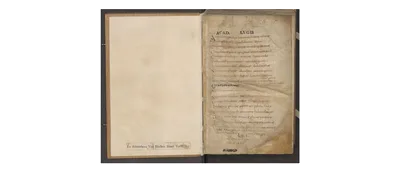
- Lucretius, De rerum natura, first page (Leiden, Voss. Lat. F. 30, the Oblongus) — Scribe unknown; text by Lucretius, 9th century · Leiden University Libraries, Voss. Lat. F. 30, via Wikimedia Commons (Public domain; the Leiden item page was not fetched, so its own licence statement is unchecked) · Public domain
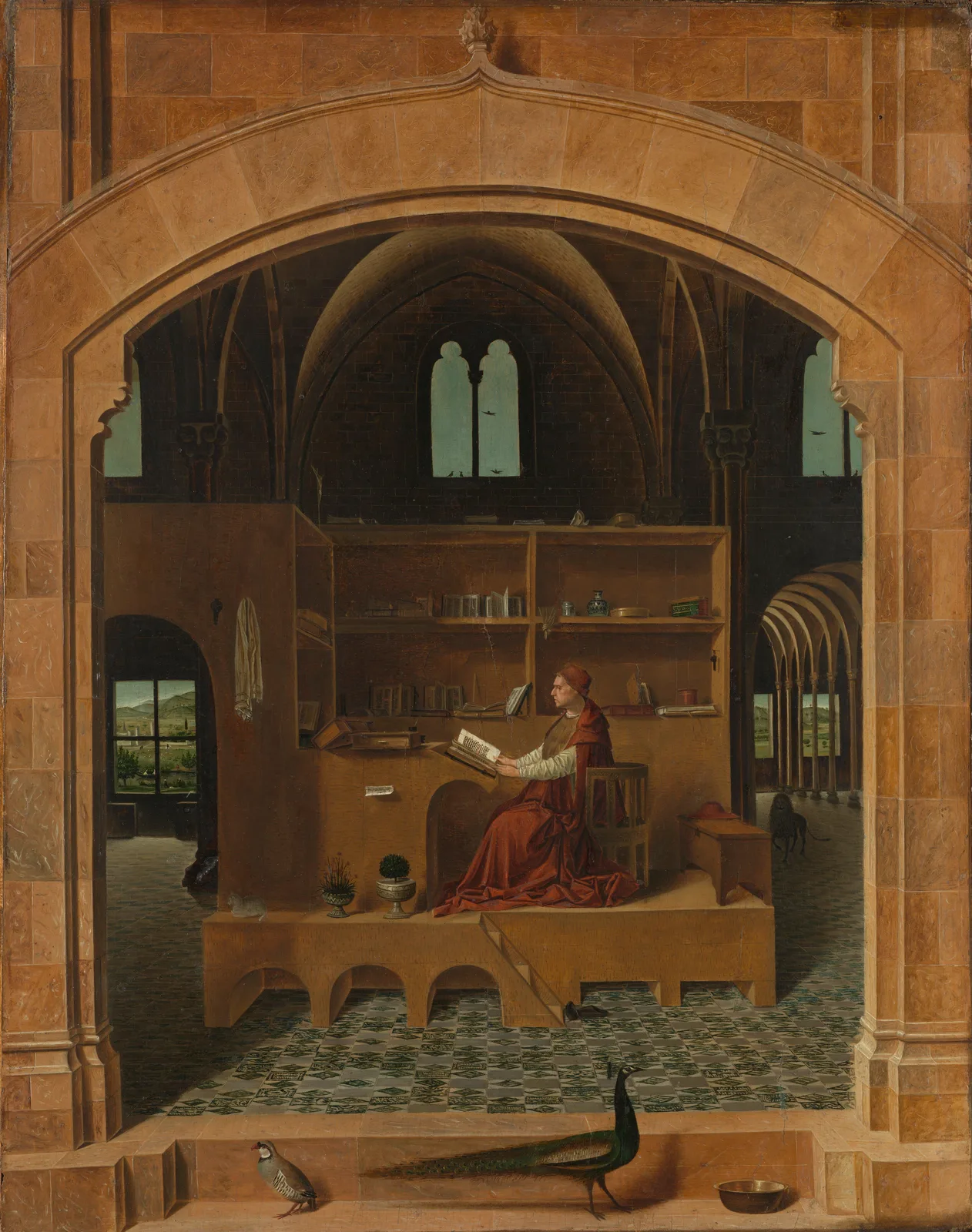
- Saint Jerome in his Study — Antonello da Messina, c. 1474 · Antonello da Messina, National Gallery, London, via Wikimedia Commons (Public domain, 15th-century painting; National Gallery's own image licence not checked) · Public domain
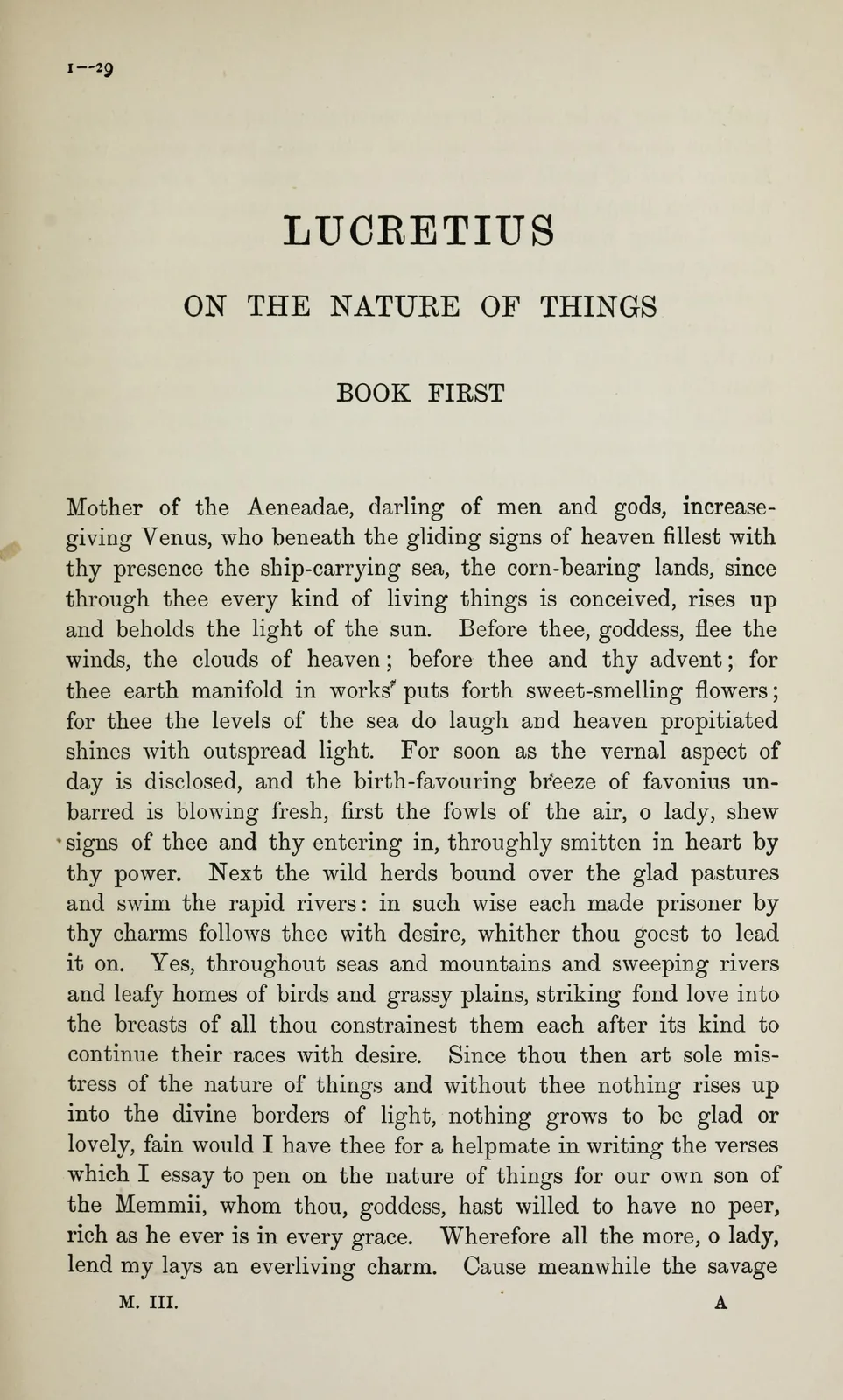
- Lucretius, On the Nature of Things, Book First, opening hymn to Venus (Munro's translation, 4th ed., 1900) — H. A. J. Munro (translator), 1900 · Getty Research Institute copy, via the Internet Archive, tlucreticaridere03lucr · Public domain (published 1900)
- Sacrifice of Iphigenia, fresco from the House of the Tragic Poet, Pompeii (Naples MAN 9112) — Roman painter unknown; photograph by Jebulon, 1st century AD · Museo Archeologico Nazionale, Naples, MAN 9112, photograph by Jebulon, via Wikimedia Commons (Public domain / CC0 by the photographer) · Public domain
- Lucretius, On the Nature of Things, Book First, the Iphigenia passage (Munro's translation, 1900) — H. A. J. Munro (translator), 1900 · Getty Research Institute copy, via the Internet Archive, tlucreticaridere03lucr · Public domain (published 1900)
- Bust of Cicero, Musei Capitolini, Rome — Roman sculptor unknown; photograph by Wilfredor, 1st century AD copy; photographed 2024 · Bust of Cicero, Musei Capitolini, photograph by Wilfredor, via Wikimedia Commons (CC0) · CC0
- Poggio Bracciolini, portrait in an illuminated manuscript of De varietate fortunae (Vatican, Urb. lat. 224) — Unknown 15th-century illuminator, 15th century · Biblioteca Apostolica Vaticana, Urb. lat. 224, via Wikimedia Commons (Public domain) · Public domain
- Last page of Niccolo Niccoli's transcript of De rerum natura (Laurentian Library, Florence, Plut. 35.30) — Niccolo Niccoli (scribe), c. 1417-1418 · Biblioteca Medicea Laurenziana, Florence, via Wikimedia Commons (Public domain as a reproduction of a 15th-century manuscript; the Commons file page names no photographer and the Laurentian's own site licence was not checked) · Public domain
- T. Lucreti Cari De rerum natura, Verona edition, illuminated opening page (Book 1) — Lucretius; printer Paulus Fridenperger, 1486 · Dibner Library of the History of Science and Technology, Smithsonian Libraries, via the Internet Archive (TLucretiCaripoe00Lucr) · Public domain (Internet Archive: 'The Library considers that this work is no longer under copyright protection')
- Cardinal Melchior de Polignac — Rosalba Carriera, c. 1732 · Rosalba Carriera, Web Gallery of Art, via Wikimedia Commons (Public domain) · Public domain
- Anti-Lucretius, sive De Deo et natura, libri novem, title page (Amsterdam, Rey, 1748) — Melchior de Polignac; ed. Carolus d'Orleans de Rothelin, 1748 · University of Michigan copy, Google Books scan, via the Internet Archive, antilucretiussi00poligoog · Public domain (printed 1748; Google Books scan)
Sources
Tier 1 — the subject's own words (writings, letters, diaries, trial records)
- [Munro tr.] H. A. J. Munro, Lucretius on the Nature of Things, translated with an analysis of the six books (Routledge/Dutton reprint, 1920 date on the record; the translation of Munro's 4th ed., 1886). Internet Archive
onnatureofthing00lucr. Text intexts/munro-tr.txt. The English quotations from the poem cite book and line, with Munro's Argument for summaries. - [Munro Notes I] H. A. J. Munro, T. Lucreti Cari De rerum natura libri sex, vol. I, text and critical notes, with the history of the text (Bell, 1908 reprint of the 4th ed., 1886). Internet Archive
titilucreticarid02lucruoft/titilucreticarid01lucruoft(the file downloaded istitilucreticarid01lucruoft). Latin text and "Notes I on the formation of the text".texts/munro-1908-v1.txt. - [Munro Notes II] H. A. J. Munro, T. Lucreti Cari De rerum natura libri sex, vol. II, Explanatory Notes (Bell, 4th ed., 1900). IA
lucreticariderer02lucruoft. Introduction quotes Jerome, Donatus and Cicero's sentence, and Munro's discussion.texts/munro-1900-v2.txt. - [Bailey] Cyril Bailey, Lucretius on the Nature of Things (Oxford, 1910). IA
lucretiusonthena00lucruoft. Second translation used for cross-checks.texts/bailey-1910.txt. - [Leonard] W. E. Leonard, Of the Nature of Things, a metrical translation (Dutton, 1916). IA
ofnatureofthings00lucrrich.texts/leonard-1916.txt. Not yet quoted. - [Cicero Q.fr.] Cicero, letter to his brother Quintus, Feb. 54 BCE (Q. fr. 2.9 in Shuckburgh; 2.10 in later numberings; Munro cites it as "II 11"): in Shuckburgh's translation, The Letters of Cicero, vol. I (Bell, 1899/1905 printing), letter CXXXI, p. 266. IA
cu31924012541433.texts/shuckburgh-v1.txt. The Latin sentence as given by the manuscripts is quoted in Munro Notes II. - [Jerome] Jerome, additions to Eusebius's Chronicle, entry under 94 BCE. Not seen in an edition; the Latin is quoted in Munro Notes II p. 1 and Masson p. 35 (note 1).
- [Donatus] Life of Virgil (ascribed to Donatus, shown by Nettleship to be mostly Suetonius), as quoted in Munro Notes II p. 1 and Masson p. 35.
- [Tennyson] Alfred Tennyson, "Lucretius", in The Holy Grail and Other Poems (Strahan, 1870). IA
theholygrailpoem00tennrich.texts/tennyson-1870.txt.
Tier 2 — scholarly biographies and encyclopedias
- [Masson] John Masson, Lucretius, Epicurean and Poet (Murray, 1907). IA
lucretiusepicure01massuoft.texts/masson.txt. Chapter II, "The Life of Lucretius", pp. 34–49, is the model summary of the Jerome debate. - [Sellar] W. Y. Sellar, The Roman Poets of the Republic (3rd ed., 1889; the 1881 printing seen). IA
romanpoetsrepublic00selluoft.texts/sellar.txt. Consulted; cited at second hand through Munro and Masson. - [Gaisser] Julia Haig Gaisser, "Poggio and Other Book Hunters", in Book Hunters (Firenze University Press, 2020), pp. 173–188, CC BY 4.0, doi:10.36253/978-88-6453-968-3.13. OAPEN
oapen-20.500.12657-56235.texts/poggio-chapter.txt. A modern, openly licensed account of the discovery with the Latin of Poggio's letters (from Clark 1899 and Bracciolini 1984). - [Shepherd] William Shepherd, The Life of Poggio Bracciolini (1837). IA
lifeofpoggiobrac00shepiala.texts/poggio-shepherd.txt. Poggio sent his Lucretius to Niccoli who transcribed it. - [Shuckburgh] E. S. Shuckburgh, The Letters of Cicero, vols. I and II (Bell, 1899–1905): footnotes on Memmius. IA
cu31924012541433(vol. I),cu31924012541441(vol. II).texts/shuckburgh-v1.txt,texts/shuckburgh-v2.txt.
Tier 3 — popular biographies and journalism
- None used. Greenblatt, The Swerve (2011) is copyrighted and its account of the discovery is called "an imaginative reconstruction" by Gaisser (p. 183, n. 40); lead only, not cited.
Tier 4 — maps to other sources only (Wikipedia and similar). Never cited in the script.
- Wikipedia articles on Lucretius, Poggio, the Villa of the Papyri (not consulted this session). Britannica 1911 not retrieved.
Opposition sources — contemporary critics and religious responses
- [Lactantius] Lactantius, Anger of God, Workmanship of God, Epitome of the Divine Institutes, in The Works of Lactantius, vol. II, tr. William Fletcher (Ante-Nicene Christian Library vol. XXII, T. & T. Clark, 1871). IA
theworksoflactan00lactuoft.texts/lactantius.txt. Divine Institutes proper (vol. I) not downloaded; the index of vol. II lists Lucretius quoted at i. 65, 80, 168, 178–180, 183, 284, 399. - [Polignac] Melchior de Polignac, Anti-Lucretius, sive De Deo et natura (Amsterdam, Rey, 1748; Latin) IA
antilucretiussi00poligoog,texts/polignac-latin-1748.txt; George Canning's English translation of Books 1–5, A Translation of Anti-Lucretius (1766), IAbim_eighteenth-century_anti-lucretius-books-1_polignac-melchior-de-c_1766,texts/polignac-canning.txt. The OCR keeps the long s, which the quotation below reproduces. - [Cicero Tusc.] Cicero, Tusculan Disputations 1.21, cited and translated in Masson pp. 37–38 (original not seen).
Related lives
Epicurus (episode 21) — the teacher whose system the poem sets to verse and the "man of Greece" of line 1.66; or Jean Meslier (episode 18), whose hidden atheist Testament also survived by being copied and published after the author's death. The expensive model chooses; the close names no "next" episode.
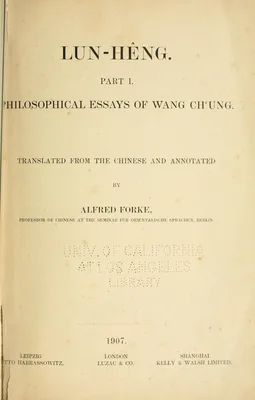
Wang Chong
Wang Chong was a poor Confucian scholar of Kuaiji who read his way through the Luoyang bookstalls and could not accept what he found. He wrote the Lunheng to weigh the orthodox claims of his age against observation: Heaven has no mouth to rebuke rulers, thunder is a clash of natural forces, and the dead do not become conscious ghosts. He kept fate and omens as natural signs, and wrote partly to stop ruinous funerals. He never recanted, and ended his life accepting that people, like animals, live a while and die.
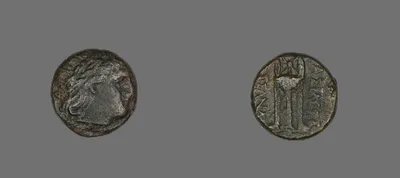
Euhemerus
Euhemerus, a friend of King Cassander, wrote a Sacred Record claiming that the gods had been early kings, whose deeds were found on a golden pillar on an island no one else ever reached. The book is lost, and nothing records what he himself believed. He survives only as each later reader needed him: a liar to the Greek geographers, an atheist to Plutarch and Theophilus, and to the Christian apologists the best witness that the pagan gods had been men.
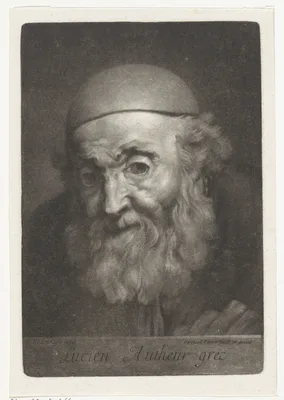
Lucian of Samosata
Lucian was a Syrian who escaped a sculptor's workshop for rhetoric, and then gave up on philosophy. In his forties he laughed at the gods of Olympus, their oracles, their sacrifices and their prophets, through comic characters whose masks he never removed. Only late in life did he declare for Epicurus. He never called himself an atheist, and what the surviving texts show is less a denial of the gods than a refusal to be frightened by them.
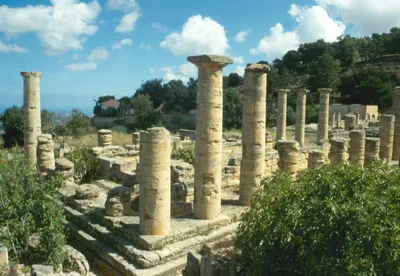
Theodorus the Atheist
Theodorus of Cyrene was trained in the Cyrenaic school of pleasure and in the art of argument. He was remembered as the ancient world's plainest denier of the city's gods, and was driven out of Athens and of Cyrene for it. Nothing he wrote survives, and no source records why he stopped believing. "Atheist" meant something different to each of the writers who called him one.