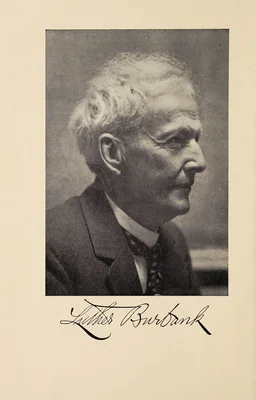
Luther Burbank was raised in a stern New England Baptist church. In his youth, as a friend told it, he lost its God of hell and judgement, and found in Darwin a new world. He spoke against "misleading theology" for forty years while keeping a reverence for nature he called God. In January 1926 he declared himself "an infidel" in the dictionary's sense, "a doubter, a questioner, a skeptic" who still recognised "a great universal power", and restated it from a pulpit. He died eleven weeks later without recanting.
The belief timeline
- Faith (1850s to c. 1865 (inferred)) — Member of the Baptist church at Lancaster, taught hell and depravity; piety still audible in the 1869 letter. No baptism or membership record found. [6][11]
- Doubt (c. 1866 (inferred, secondhand)) — Woodland experience ending the church's hold; Darwin's *Variation* and the 1875 move complete the break from family and church. Note for script: the boy's break with one picture of God (1866) is not yet the adult case, which comes with Darwin and independence (1868-75); and he kept God as Nature. [10][8][15]
- Declaration (1926-01-22) — "I am an infidel" to the San Francisco Bulletin; repeated from the pulpit 1926-01-31. Earlier expressions: the 1893 blasphemy storm, the 1907 book. [24][25][33]
- Revision (1926-02 to 1926-04-11 (inferred)) — Not a reversal: he restates the creed as the "Religion of Humanity" and "immortality of influence", refuses to recant, and writes that he does not ignore "the spiritual nature of man". [39][40][44]
Notes to the timeline (11)
- [6] Boyhood church: "a young member of the Baptist Church of Lancaster"; taught a stern God, hell, total depravity, "the New England religion of the 'sixties'" — Frederick W. Clampett, Luther Burbank, "Our Beloved Infidel": His Religion of Humanity (Macmillan, October 1926; foreword by David Starr Jordan).
testMN40078_9;texts/clampett2.txt(the archive itemMN40078ucmf_9is mislabelled and holds a different book;clampett.txtis a stub). Prints Burbank's 1869 letter and his 31 Jan 1926 address (Tier 1 for those); the rest is a friend's interpretation (Tier 3). Public domain, p. 65. Reported at second hand; the original has not been seen. - [11] 25 April 1869 letter from Worcester: "I have been to meeting to-day"; "a bountiful God"; "each of us poor sinful human beings"; "fitting for heaven" — Clampett, Luther Burbank, pp. 31-32.
- [10] "In his seventeenth year" a woodland vision ended the church's hold: "From that hour, the church had lost its power over him, and it was lost forever" — Clampett, Luther Burbank, pp. 66-67.
- [8] He read Darwin's *Variation of Animals and Plants under Domestication* at Lancaster: "it opened a new world to me" — Luther Burbank with Wilbur Hall, The Harvest of the Years (Houghton Mifflin, 1927; copyright Curtis Publishing 1926 and 1927).
harvestofyears00luth;texts/harvest.txt. Roman numerals are the "Biographical Sketch" by Hall. Public domain in the US (1927); the "I" voice was written with Hall, so treat as collaborative, not a diary, p. 22; Henry Smith Williams, Luther Burbank, His Life and Work (Hearst's International Library, 1915).lutherburbankhis00willrich;texts/williams.txt. Early popular biography; says nothing on his religion; names Chester as his birthplace (error, see Disputed). No modern scholarly biography has been read: Peter Dreyer, A Gardener Touched with Genius (1975), and Jane S. Smith, The Garden of Invention (2009), are in copyright and need borrowing, p. 24; Clampett, Luther Burbank, p. 20. - [15] Moved to Santa Rosa in 1875, aged 26; motives named: the West, Darwin, "an unconscious sense of restraint in New England", Mary, and a wish "to be my own man, unadvised by family or friends" — Hall, Harvest of the Years, pp. 23-26; Williams, Luther Burbank, p. 6; Clampett, Luther Burbank, p. 21.
- [24] The Bulletin published the interview at noon on Friday 22 January 1926 — Luther Burbank, Edgar Waite and Joseph McCabe, Why I Am an Infidel (Little Blue Book, Haldeman-Julius Co., Girard, Kansas, 1926). Internet Archive
whyiaminfidel1020burb; text inresearch/texts/why-infidel.txt. Burbank's essay pp. 5-9; Waite's "Luther Burbank, Infidel" pp. 9-25; McCabe's "Luther Burbank Speaks Out" pp. 25-32. Page numbers are printed pages taken from the OCR headers. The Little Blue Book number (1020) comes from the archive identifier only. Public domain in the US (published 1926), p. 10; "Burbank Declares Himself Infidel" and "Prominent Clergy Dismiss Burbank" (AP), Springfield Weekly Republican, 28 Jan 1926, p. 12 (sn83020847).texts/springfield-1926-01-28-p12.txt, p. 12 (AP, San Francisco, Jan. 22). - [25] In it he said he did not believe in personal resurrection or reincarnation, that all religions "are on a tottering foundation", and that "I am an infidel today" — Burbank, Why I Am an Infidel, pp. 14-16; Springfield Weekly Republican, p. 12; "Christ Was Infidel, Says Burbank," The Washington Times, 23 Jan 1926, p. 3 (Chronicling America, sn84026749).
texts/washtimes-1926-01-23-p3.txt, p. 3. - [33] In the address: "I nominated myself as an 'infidel' as a challenge to thought" and "I was not told to believe this or that or be damned" — Clampett, Luther Burbank, pp. 39-40.
- [39] No recantation: Haldeman-Julius ("did not recant") and Hall (recantation stories "apocryphal... impudent falsehood") — Burbank, Why I Am an Infidel, pp. 3-4; Hall, Harvest of the Years, p. xxii.
- [40] Last written words: "Do I ignore what is generally called the spiritual nature of man? No..." — Hall, Harvest of the Years, p. 296; "Luther Burbank Dies True to Creed" (AP), Evening Star (Washington), 12 Apr 1926, p. 1, continued p. 4 (sn83045462).
texts/evstar-1926-04-12-p1.txt,...-p4.txt, p. 1; "Burbank's Death Laid to Church Row," The Washington Times, 12 Apr 1926, p. 25 (continued from p. 1).texts/washtimes-1926-04-12-p25.txt, p. 25. - [44] Hall: his creed's centre was "the Immortality of Influence"; Burbank wrote "I believe in the immortality of influence" — Hall, Harvest of the Years, pp. xxi, 295.
An Infidel in the True Sense
On Friday 22 January 1926 the San Francisco Bulletin published an interview with Luther Burbank, the plant breeder of Santa Rosa. Burbank, seventy-six, the breeder of the Burbank potato and the spineless cactus, had been asked what he believed. "I am a lover of Christ as a man, and his work and all things that help humanity," he said, "but nevertheless just as he was an infidel then, I am an infidel today."123 When friends protested, he took down Webster's dictionary: "I am an infidel. I know what an infidel is, and that's what I am."45
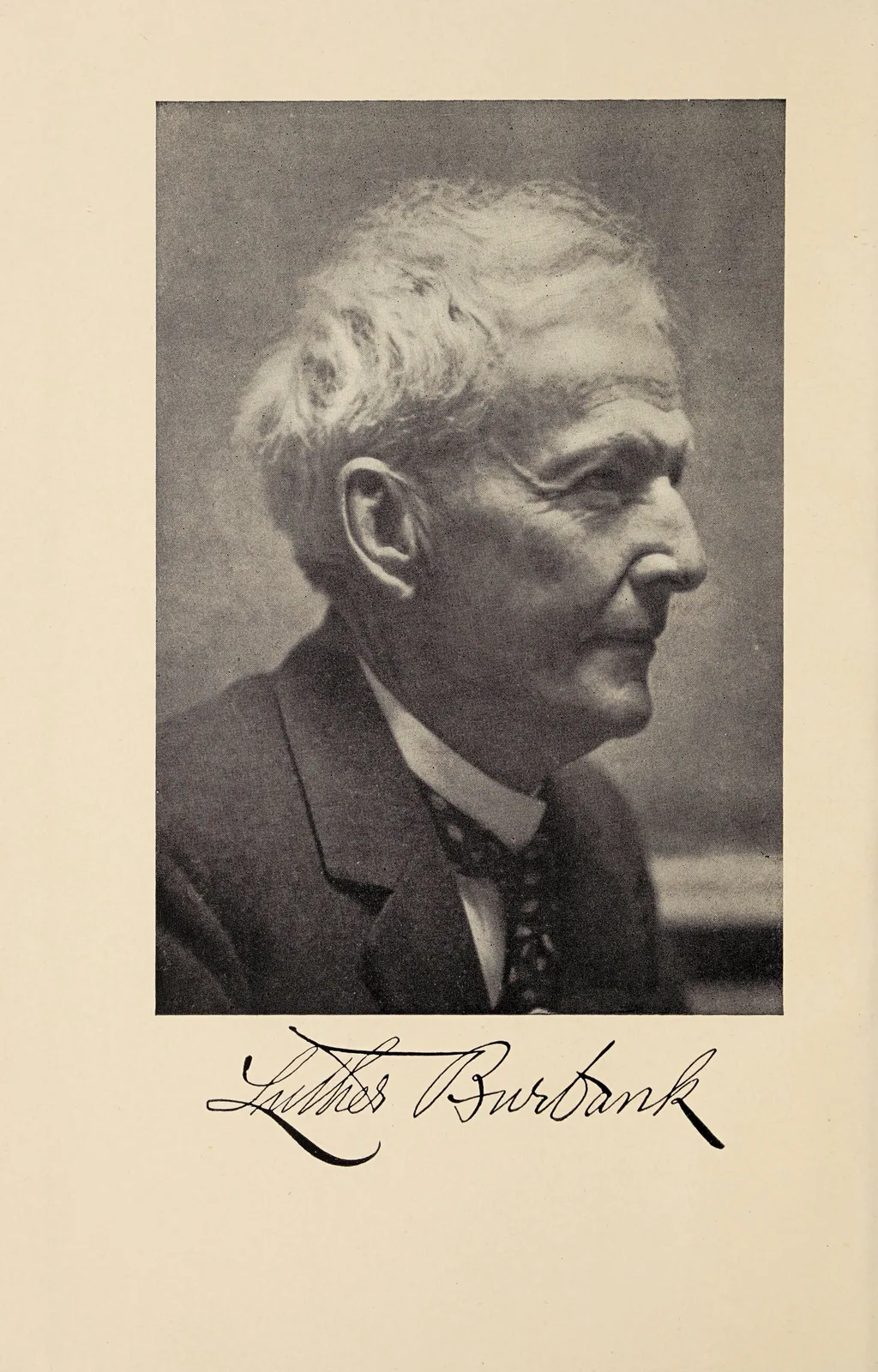
Letters poured in, five hundred and more a day; preachers answered from their pulpits, and women in his own town met to pray for him. Eleven weeks later he was dead.678 This chapter asks how a boy from a New England Baptist church came to say it, what exactly he meant by it, and what he kept.
The New England religion
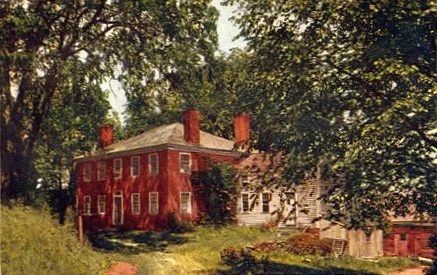
He was born at Lancaster, Massachusetts, on 7 March 1849, the thirteenth of fifteen children of Samuel and Olive Burbank.910 As his friend the Episcopal priest Frederick Clampett told it, the boy was "a young member of the Baptist Church of Lancaster", taught a stern God, hell and total depravity, "the New England religion of the 'sixties'"; his mother's spirit, Clampett wrote, "revolted against the puritanic gloom".1112 On the belief timeline, that is his faith; no record of his baptism or membership has been found.
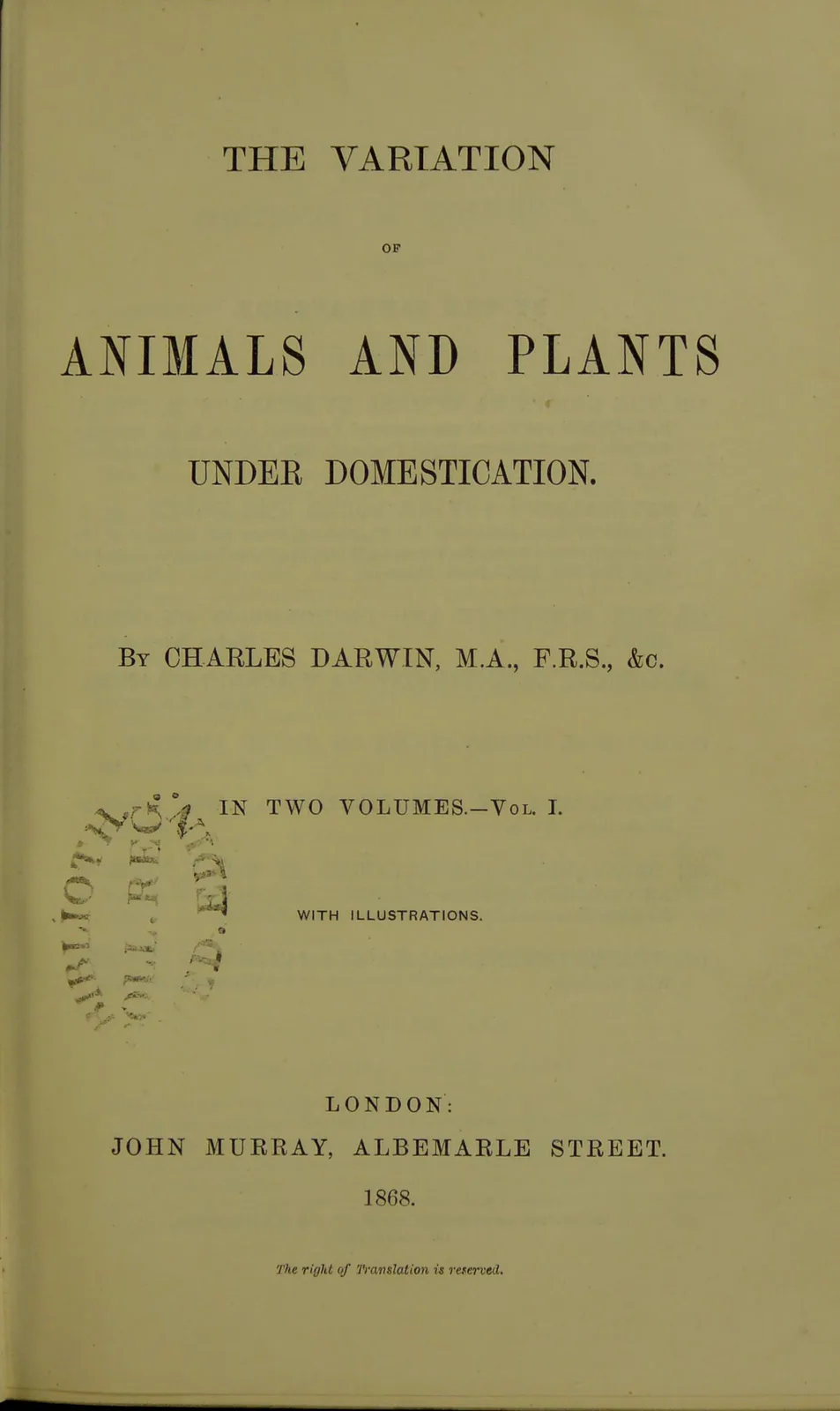
Clampett also tells of a day "in his seventeenth year", in the woods, after which "the church had lost its power over him, and it was lost forever".13 But a letter Burbank wrote to his mother at twenty, in 1869, still sounds devout: he had "been to meeting to-day", and wrote of "each of us poor sinful human beings" and of "fitting for heaven these immortal minds of ours".1415 Accounts differ, and on the timeline his doubt spans those years, from the boy's break with one picture of God to the young man's reading. At Lancaster he found Darwin's Variation of Animals and Plants under Domestication: "it opened a new world to me." The uproar against Darwin in New England churches and homes, he said later, only made Darwin more interesting, and "my New England heredity was outweighed by the pressure of my environment — the talk of California, the furor against Darwin, and his clear and illuminating book — and I pushed out and away."16171819
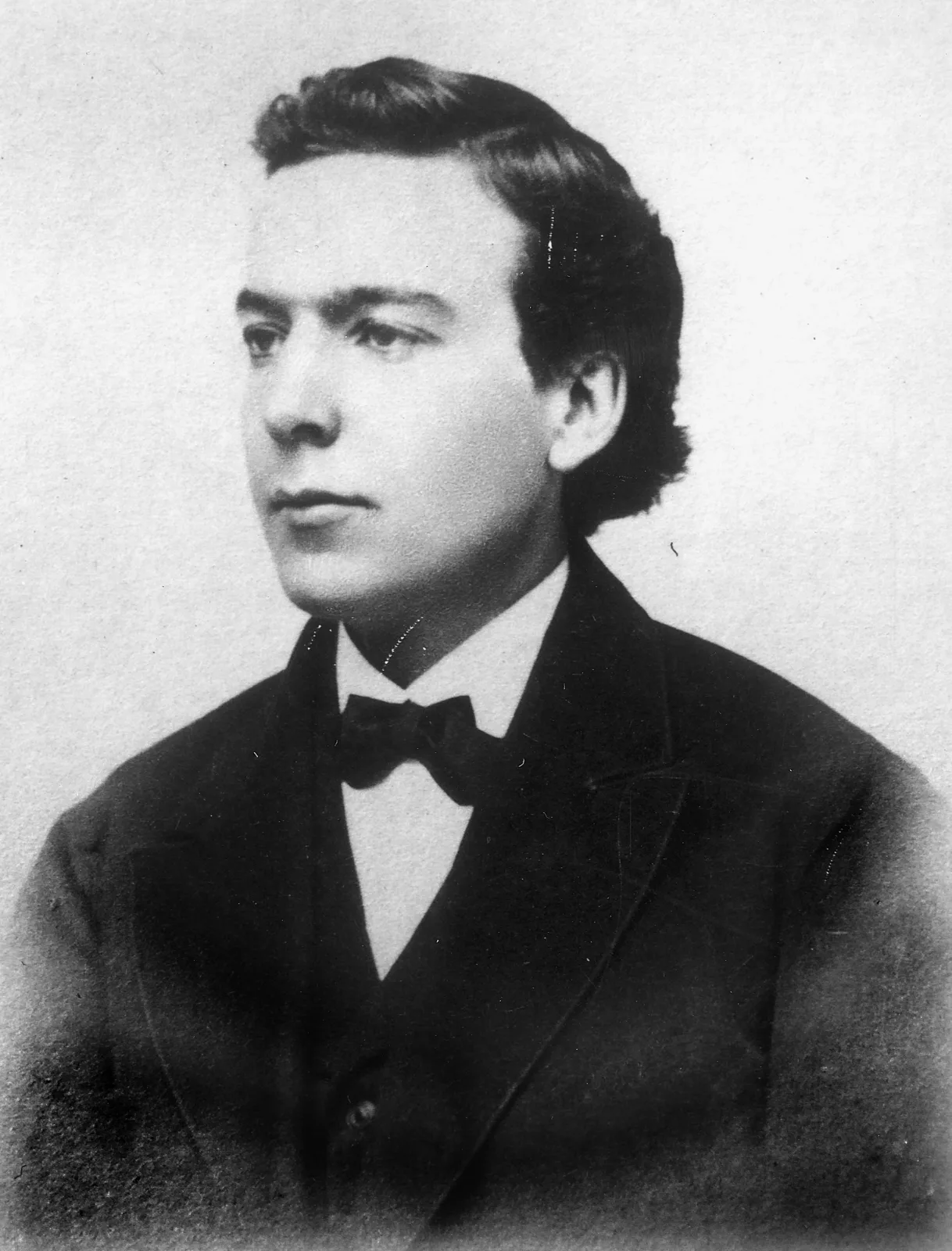
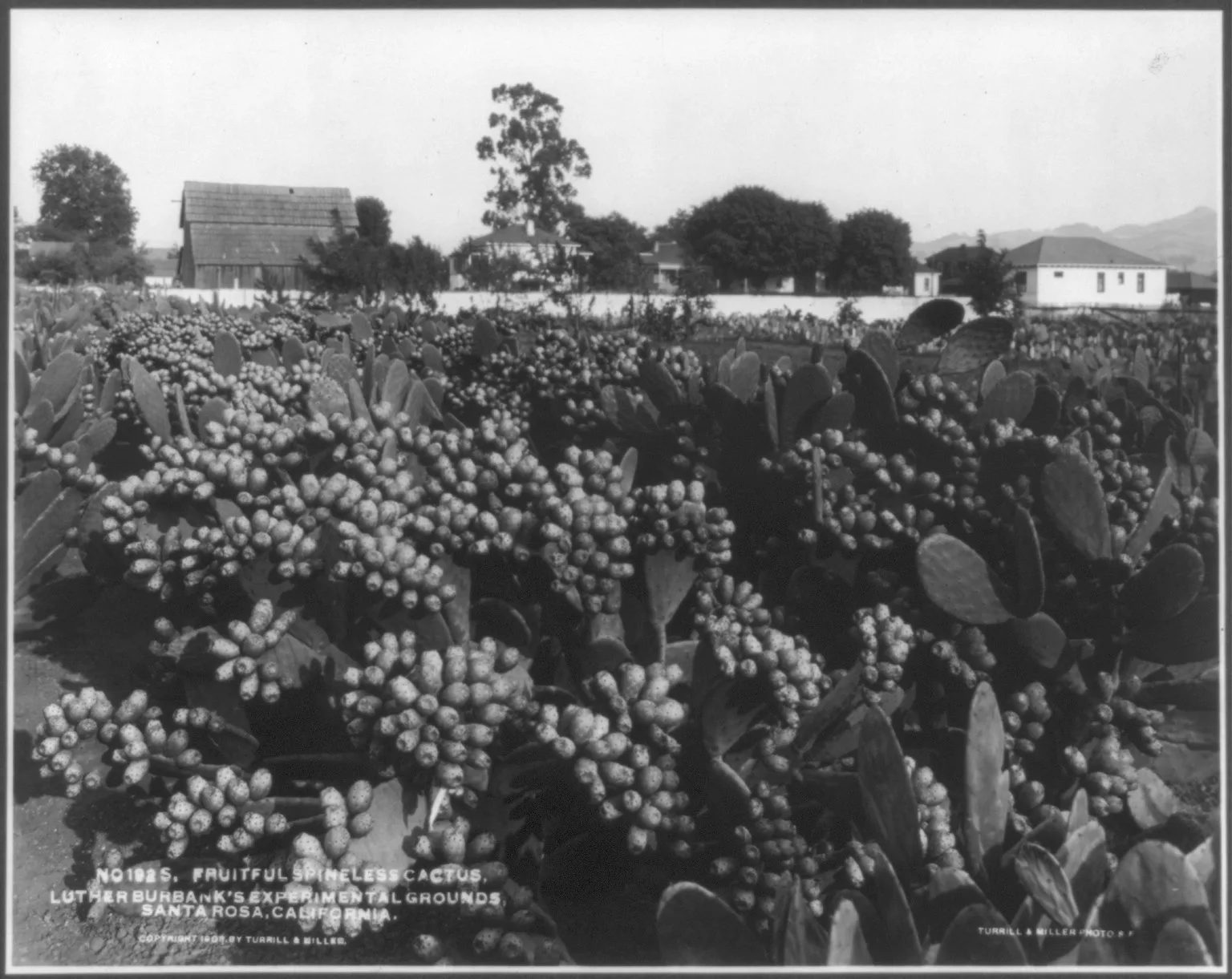
He bred the Burbank potato from a seed ball, sold it for $150, and in 1875, at twenty-six, used the money to go to California, wanting, among other things, "to be my own man, unadvised by family or friends".2021
Santa Rosa
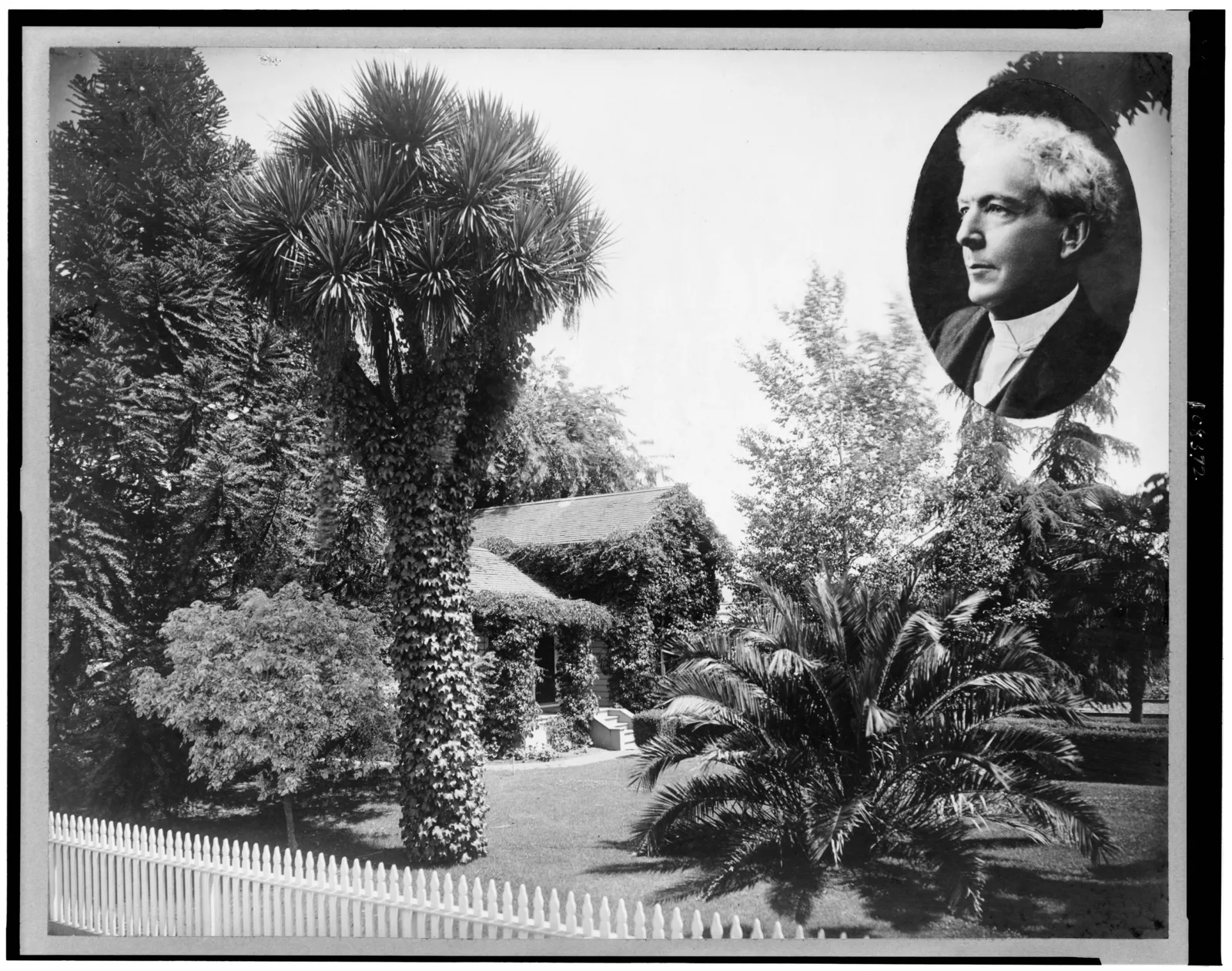
At Santa Rosa he built the nursery and experiment gardens that made him famous. He went to the town's churches "at times" and spoke in them about science, and he was an honorary life member of the Woman's Christian Temperance Union.2223 When his 1893 catalogue, New Creations in Fruits and Flowers, announced plants made by selection, he was "called a good many names stronger than blasphemer", and one preacher prayed for his "awakening".24
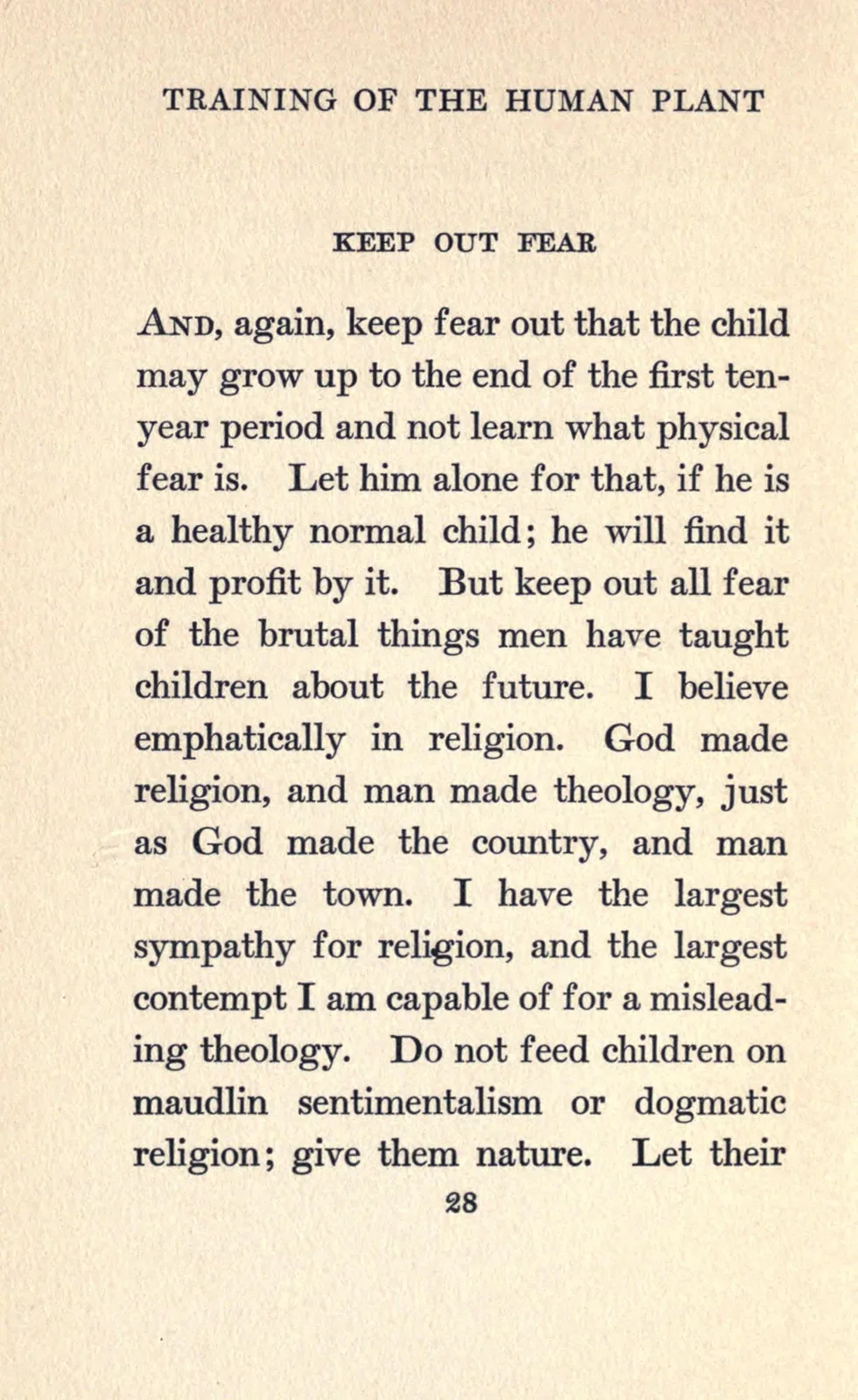
In The Training of the Human Plant (1907) he wrote: "I believe emphatically in religion. God made religion, and man made theology, just as God made the country, and man made the town. I have the largest sympathy for religion, and the largest contempt I am capable of for a misleading theology." And: "Never was a child made more noble and good by the fear of a hell."252627 The book also carried the eugenic ideas common among breeders of his day.
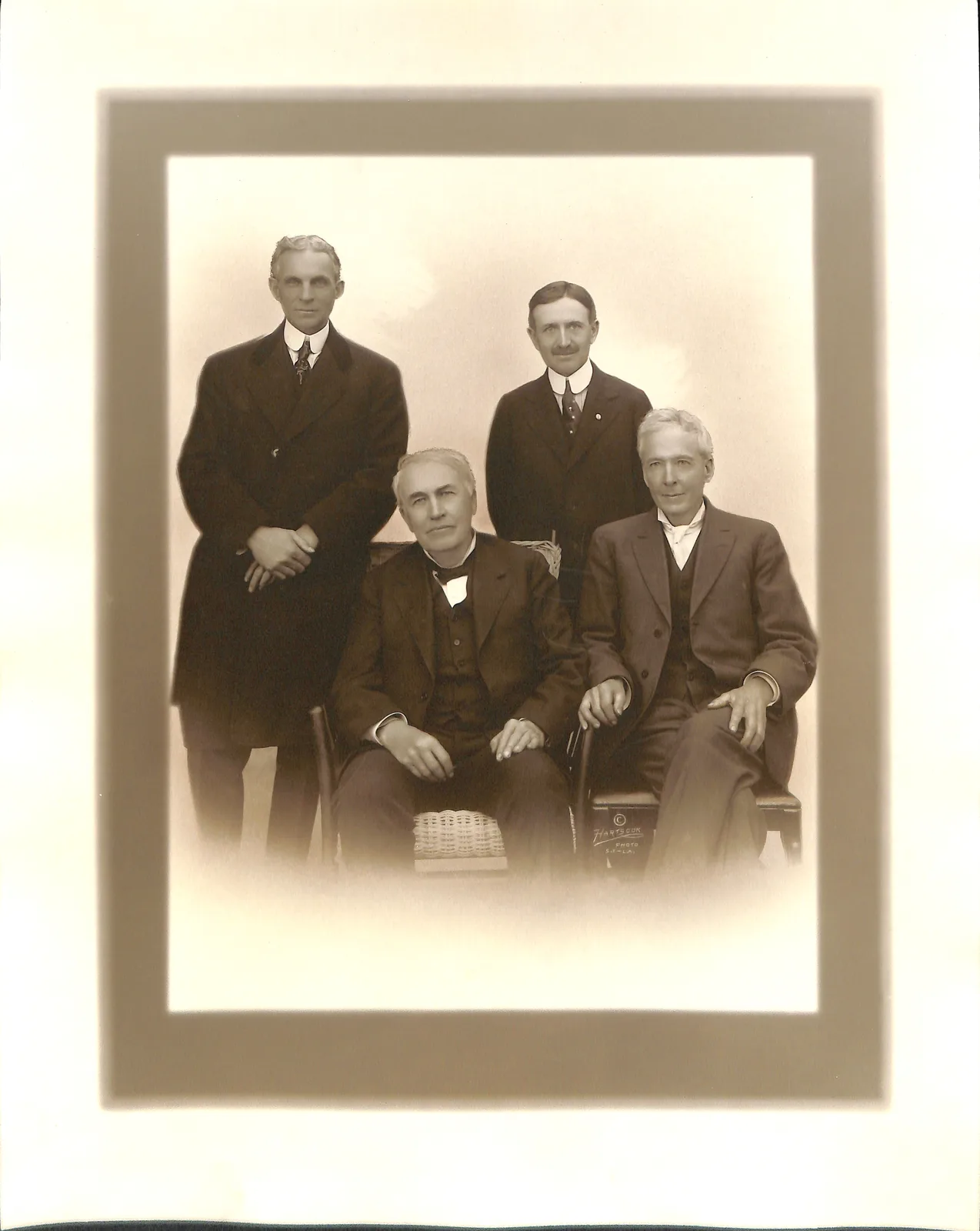
He was photographed with Thomas Edison and Henry Ford on their California trip of 1915.
The interview
In 1925 the trial of John Scopes in Tennessee moved him to side publicly with the evolutionists.28 In January 1926 the newspapers reported that Ford believed in reincarnation, and the Bulletin's editor sent his reporter Edgar Waite to ask Burbank what he believed.29 On the timeline, the answer is his declaration. "Most people's religion is what they would like to believe, not what they do believe." "The idea that a good God would send people to a burning hell is utterly damnable to me. I don't want to have anything to do with such a God." He did not believe in personal resurrection or reincarnation: "when it can be proved to me that there is immortality, that there is resurrection beyond the gates of death, then will I believe. Until then, no." "I am a doubter, a questioner, a skeptic." But: "while I cannot conceive of such a God, I do recognize the existence of a great universal power."2303132333435
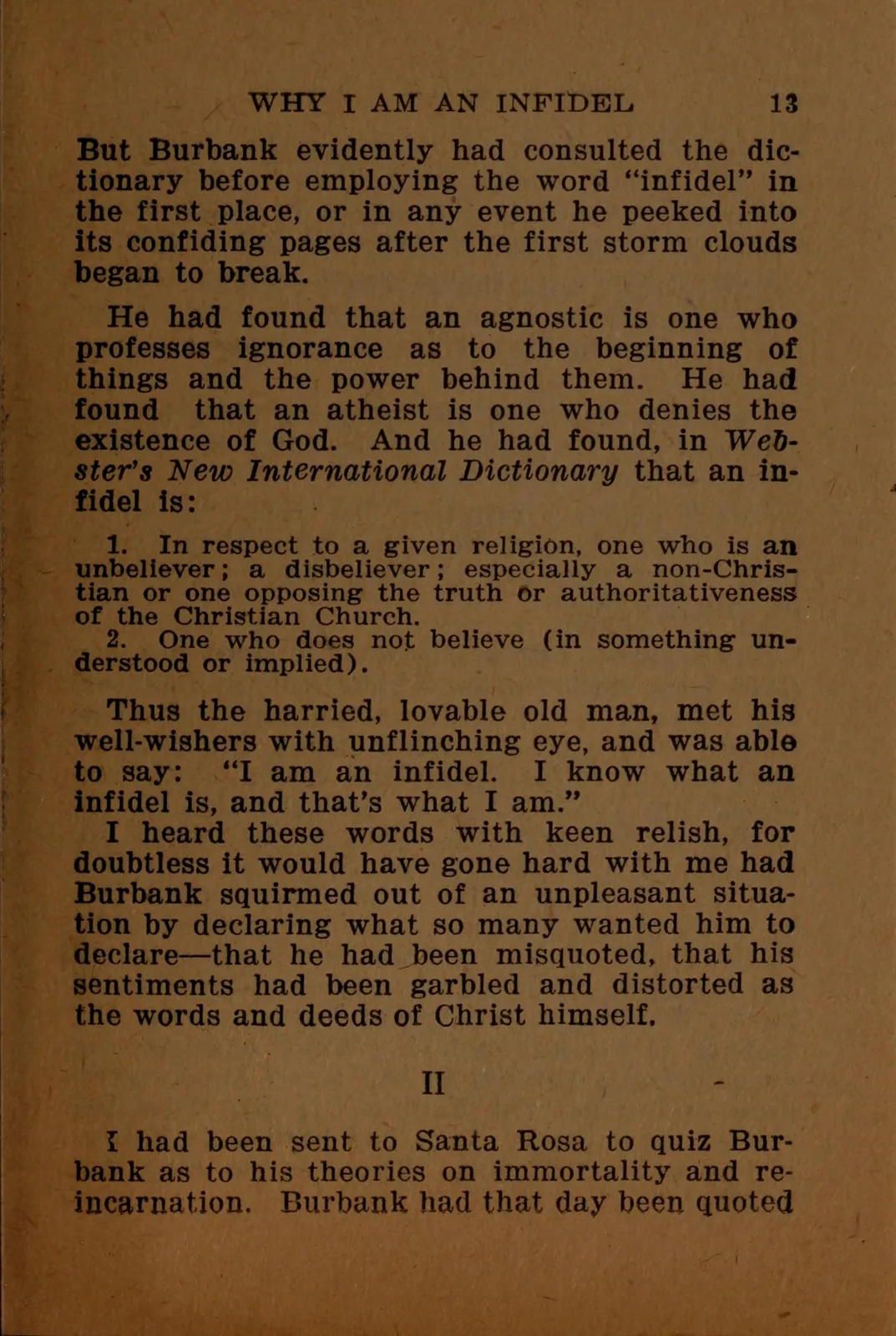
The replies came at once. A Methodist minister in Santa Rosa said that "in a time when the youth of the land are jazz crazed", Burbank had "voiced foolish utterances". A Presbyterian made the fairest argument, about the word itself: "If words can be made to mean anything that one wants them to mean, we are bordering on linguistic anarchy."73637 The local temperance union invited women to pray "that his eyes may be opened and our youth may not be led astray from the religion of their fathers".38 Strangers wrote that he had "made the God of the Bible a liar", and that "One Bryan is worth a million Burbanks".3940 A Congregational pastor wrote the other way: "Would to goodness all professed Christians were as religious as this heretic!"41 Burbank answered that he had said he was an infidel "in the true sense of that word. Look it up, if you don't believe it", and that he believed in "a supreme ruler of the universe, no matter what name one applies to it".44243
The pulpit
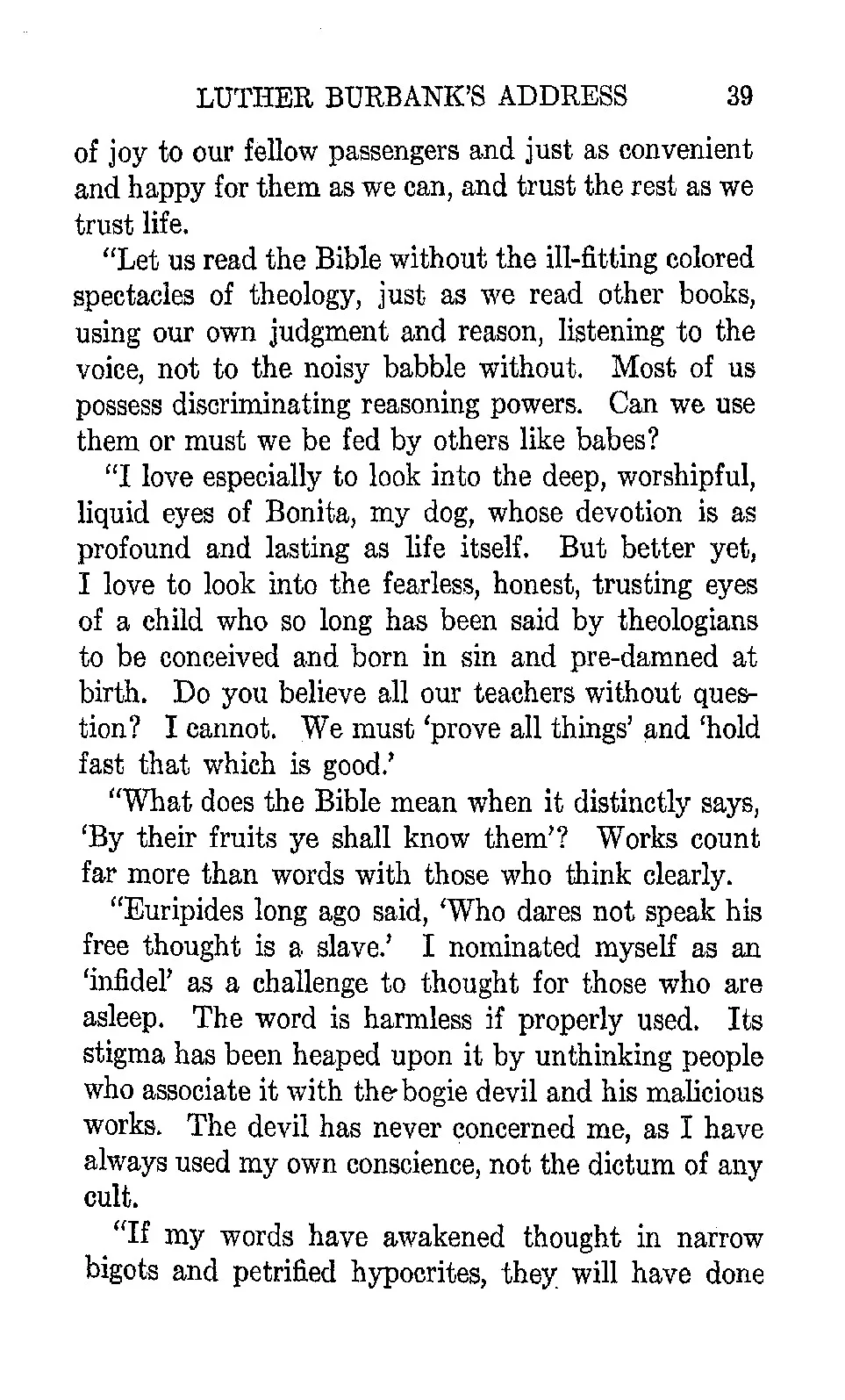
On the last Sunday in January he spoke from the pulpit of the First Congregational Church in San Francisco, to more than 2,500 people. "I nominated myself as an 'infidel' as a challenge to thought for those who are asleep." "I prefer and claim the right to worship the infinite, everlasting, almighty God of this vast universe as revealed to us gradually, step by step, by the demonstrable truths of our savior, science."44454647 He told the congregation what his mother had said to him: "Luther, I wish you to make this world a better place to live in than it was before you lived."48
That restatement is his revision on the timeline. It was not a retreat: he spoke of "the Religion of Humanity" and wrote, "I believe in the immortality of influence."495051 He fell ill in March and died on 11 April 1926, aged seventy-seven.8 The press asked whether the controversy had killed him, and some believers saw "the hand of retribution"; his doctor spoke of an overstrained nervous system, and other accounts of an intestinal illness.5253 Both his publisher and his co-author insisted that he never recanted, and they were his partisans.54 His last written words were an answer: "Do I ignore what is generally called the spiritual nature of man? No; it is the corona, the flower of life."5556 At his funeral, friends reported, he had wanted Robert Ingersoll's oration at his brother's grave read aloud; he was buried under a cedar in his own garden.57
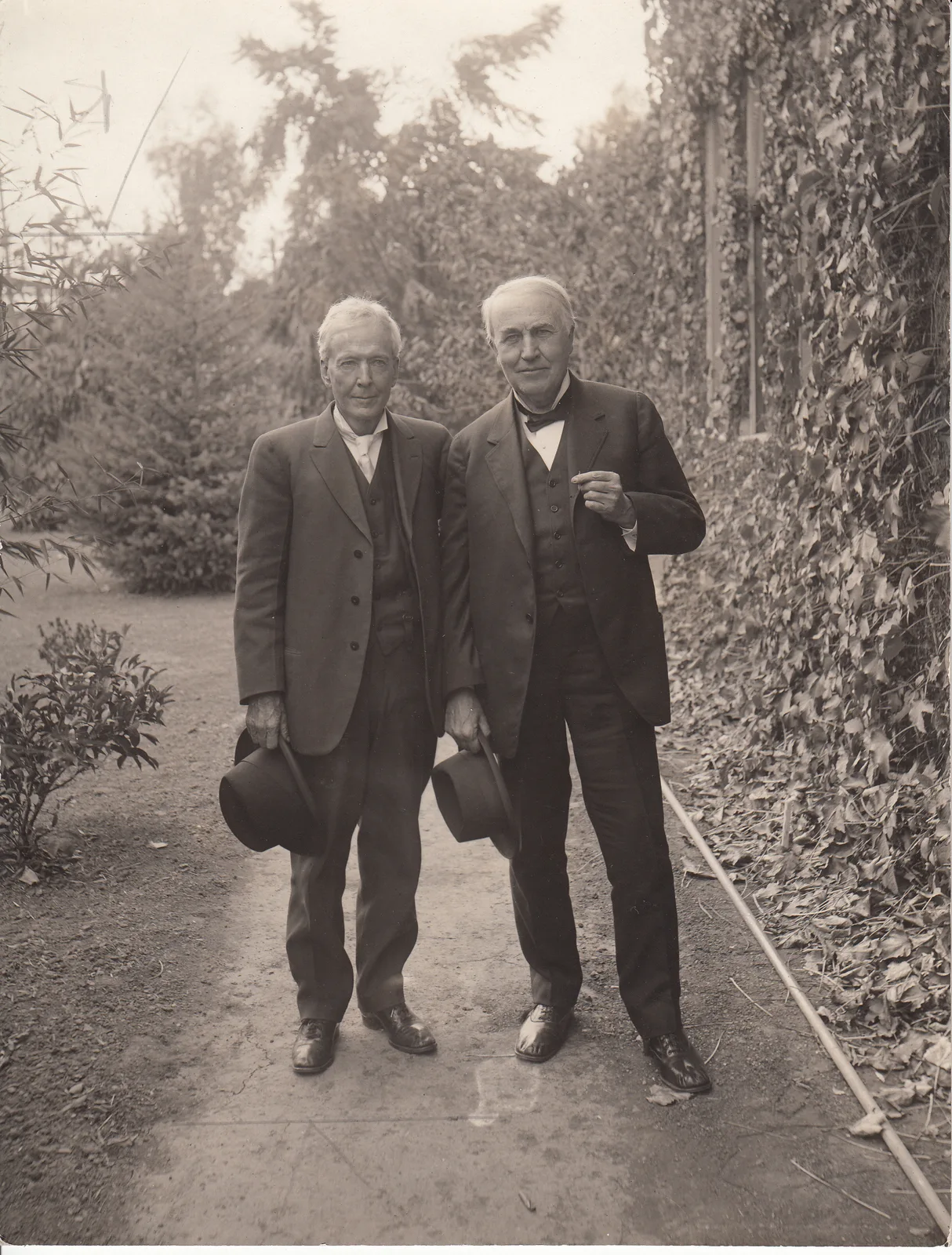
Burbank's unbelief was the rejection of a hell and a judging God that he had been taught as a boy, held for sixty years and spoken aloud at the end, with a reverence for nature that he would still call God. His friend Thomas Edison, who said much the same in 1910 and spent his later years on the same question, has his own chapter in this book.
Footnotes
-
Luther Burbank, Edgar Waite and Joseph McCabe, Why I Am an Infidel (Little Blue Book, Haldeman-Julius Co., Girard, Kansas, 1926). Internet Archive
whyiaminfidel1020burb; text inresearch/texts/why-infidel.txt. Burbank's essay pp. 5-9; Waite's "Luther Burbank, Infidel" pp. 9-25; McCabe's "Luther Burbank Speaks Out" pp. 25-32. Page numbers are printed pages taken from the OCR headers. The Little Blue Book number (1020) comes from the archive identifier only. Public domain in the US (published 1926), p. 10; "Burbank Declares Himself Infidel" and "Prominent Clergy Dismiss Burbank" (AP), Springfield Weekly Republican, 28 Jan 1926, p. 12 (sn83020847).texts/springfield-1926-01-28-p12.txt, p. 12 (AP, San Francisco, Jan. 22). ↩ -
Burbank, Why I Am an Infidel, pp. 14-16; Springfield Weekly Republican, p. 12; "Christ Was Infidel, Says Burbank," The Washington Times, 23 Jan 1926, p. 3 (Chronicling America, sn84026749).
texts/washtimes-1926-01-23-p3.txt, p. 3. ↩ ↩2 -
Burbank, Why I Am an Infidel, p. 16. ↩
-
Burbank, Why I Am an Infidel, p. 13. ↩
-
Burbank, Why I Am an Infidel, p. 21; Frederick W. Clampett, Luther Burbank, "Our Beloved Infidel": His Religion of Humanity (Macmillan, October 1926; foreword by David Starr Jordan).
testMN40078_9;texts/clampett2.txt(the archive itemMN40078ucmf_9is mislabelled and holds a different book;clampett.txtis a stub). Prints Burbank's 1869 letter and his 31 Jan 1926 address (Tier 1 for those); the rest is a friend's interpretation (Tier 3). Public domain, pp. 35, 44. ↩ -
Burbank, Why I Am an Infidel, pp. 12, 18-19, 21-23; Springfield Weekly Republican, p. 12. ↩ ↩2
-
Burbank, Why I Am an Infidel, p. 3; Clampett, Luther Burbank, p. 124; "Luther Burbank Dies True to Creed" (AP), Evening Star (Washington), 12 Apr 1926, p. 1, continued p. 4 (sn83045462).
texts/evstar-1926-04-12-p1.txt,...-p4.txt, p. 1. ↩ ↩2 -
Clampett, Luther Burbank, p. 17; "Burbank's Death Laid to Church Row," The Washington Times, 12 Apr 1926, p. 25 (continued from p. 1).
texts/washtimes-1926-04-12-p25.txt, p. 25; Evening Star, p. 4. ↩ -
Washington Times, p. 25; Evening Star, p. 4; Clampett, Luther Burbank, p. 17; Luther Burbank with Wilbur Hall, The Harvest of the Years (Houghton Mifflin, 1927; copyright Curtis Publishing 1926 and 1927).
harvestofyears00luth;texts/harvest.txt. Roman numerals are the "Biographical Sketch" by Hall. Public domain in the US (1927); the "I" voice was written with Hall, so treat as collaborative, not a diary, p. 2. ↩ -
Clampett, Luther Burbank, p. 66; Clampett, Luther Burbank, p. 40 (Burbank's address). Reported at second hand; the original has not been seen. ↩
-
Clampett, Luther Burbank, p. 65. ↩
-
Clampett, Luther Burbank, pp. 66-67. ↩
-
Clampett, Luther Burbank, pp. 31-32. ↩
-
Clampett, Luther Burbank, p. 32 (letter of 25 Apr 1869). ↩
-
Hall, Harvest of the Years, p. 22; Henry Smith Williams, Luther Burbank, His Life and Work (Hearst's International Library, 1915).
lutherburbankhis00willrich;texts/williams.txt. Early popular biography; says nothing on his religion; names Chester as his birthplace (error, see Disputed). No modern scholarly biography has been read: Peter Dreyer, A Gardener Touched with Genius (1975), and Jane S. Smith, The Garden of Invention (2009), are in copyright and need borrowing, p. 24; Clampett, Luther Burbank, p. 20. ↩ -
Hall, Harvest of the Years, p. 23. ↩
-
Hall, Harvest of the Years, p. 22. ↩
-
Hall, Harvest of the Years, p. 23. ↩
-
Williams, Luther Burbank, pp. 5-6; Clampett, Luther Burbank, pp. 20-21. ↩
-
Hall, Harvest of the Years, pp. 23-26; Williams, Luther Burbank, p. 6; Clampett, Luther Burbank, p. 21. ↩
-
Burbank, Why I Am an Infidel, p. 11; Burbank, Why I Am an Infidel, p. 21. ↩
-
Burbank, Why I Am an Infidel, pp. 12, 18. ↩
-
Hall, Harvest of the Years, pp. 72, 76-78. ↩
-
Luther Burbank, The Training of the Human Plant (Century Co., 1907).
trainingofhumanp00burbiala;texts/training.txt. Public domain, pp. 27-28. ↩ -
Burbank, Training of the Human Plant, p. 27. ↩
-
Burbank, Training of the Human Plant, p. 28. ↩
-
Hall, Harvest of the Years, p. xvi; Washington Times, p. 25; Burbank, Why I Am an Infidel, p. 9; Clampett, Luther Burbank, p. 63. ↩
-
Burbank, Why I Am an Infidel, pp. 10, 13-14; Washington Times, p. 3; Springfield Weekly Republican, p. 12. ↩
-
Burbank, Why I Am an Infidel, pp. 15-16. ↩
-
Burbank, Why I Am an Infidel, p. 14. ↩
-
Burbank, Why I Am an Infidel, p. 15; Springfield Weekly Republican, p. 12. ↩
-
Burbank, Why I Am an Infidel, p. 16; Springfield Weekly Republican, p. 12. ↩
-
Burbank, Why I Am an Infidel, p. 16. ↩
-
Burbank, Why I Am an Infidel, p. 15. ↩
-
Rev. Fred A. Keast, First Methodist Episcopal Church, Santa Rosa, where Burbank had attended sporadically: Burbank, Why I Am an Infidel, p. 21. ↩
-
Rev. E. E. Ingram, First Presbyterian Church, Santa Rosa: Burbank, Why I Am an Infidel, p. 22. ↩
-
Santa Rosa WCTU call; the woman who had proposed him as honorary life member joined it: Burbank, Why I Am an Infidel, pp. 18-19. ↩
-
Anonymous letter from Keokuk, Iowa, chosen by Clampett as typical: Clampett, Luther Burbank, pp. 46-47. ↩
-
Anonymous letter from Abilene, Kansas: Clampett, Luther Burbank, p. 46. ↩
-
Rev. E. Morgan Isaac, Congregational pastor, a believer who defended him: Clampett, Luther Burbank, p. 50. ↩
-
Burbank, Why I Am an Infidel, p. 22. ↩
-
Burbank, Why I Am an Infidel, p. 23. ↩
-
Clampett, Luther Burbank, pp. 35-37; Burbank, Why I Am an Infidel, pp. 19-20; Evening Star, p. 4 (photo caption). ↩
-
Clampett, Luther Burbank, pp. 39-40. ↩
-
Clampett, Luther Burbank, p. 39. ↩
-
Clampett, Luther Burbank, pp. 40-41. ↩
-
Clampett, Luther Burbank, p. 40. ↩
-
Burbank, Why I Am an Infidel, p. 29. ↩
-
Hall, Harvest of the Years, pp. xxi, 295. ↩
-
Hall, Harvest of the Years, p. 295. ↩
-
Washington Times, p. 25. Accounts differ; see the disputed points. ↩
-
Press account of religionists' reaction after his illness: Washington Times, p. 25. ↩
-
Burbank, Why I Am an Infidel, pp. 3-4; Hall, Harvest of the Years, p. xxii. ↩
-
Hall, Harvest of the Years, p. 296; Evening Star, p. 1; Washington Times, p. 25. ↩
-
Hall, Harvest of the Years, p. 296. ↩
-
Evening Star, p. 1; Washington Times, p. 25; Hall, Harvest of the Years, pp. xxv-xxvi. ↩
whyiaminfidel1020burb; text in research/texts/why-infidel.txt. Burbank's essay pp. 5-9; Waite's "Luther Burbank, Infidel" pp. 9-25; McCabe's "Luther Burbank Speaks Out" pp. 25-32. Page numbers are printed pages taken from the OCR headers. The Little Blue Book number (1020) comes from the archive identifier only. Public domain in the US (published 1926).; "Burbank Declares Himself Infidel" and "Prominent Clergy Dismiss Burbank" (AP), Springfield Weekly Republican, 28 Jan 1926, p. 12 (sn83020847). texts/springfield-1926-01-28-p12.txt.; "Christ Was Infidel, Says Burbank," The Washington Times, 23 Jan 1926, p. 3 (Chronicling America, sn84026749). texts/washtimes-1926-01-23-p3.txt.; Frederick W. Clampett, Luther Burbank, "Our Beloved Infidel": His Religion of Humanity (Macmillan, October 1926; foreword by David Starr Jordan). testMN40078_9; texts/clampett2.txt (the archive item MN40078ucmf_9 is mislabelled and holds a different book; clampett.txt is a stub). Prints Burbank's 1869 letter and his 31 Jan 1926 address (Tier 1 for those); the rest is a friend's interpretation (Tier 3). Public domain.; "Luther Burbank Dies True to Creed" (AP), Evening Star (Washington), 12 Apr 1926, p. 1, continued p. 4 (sn83045462). texts/evstar-1926-04-12-p1.txt, ...-p4.txt.; "Burbank's Death Laid to Church Row," The Washington Times, 12 Apr 1926, p. 25 (continued from p. 1). texts/washtimes-1926-04-12-p25.txt.; Luther Burbank with Wilbur Hall, The Harvest of the Years (Houghton Mifflin, 1927; copyright Curtis Publishing 1926 and 1927). harvestofyears00luth; texts/harvest.txt. Roman numerals are the "Biographical Sketch" by Hall. Public domain in the US (1927); the "I" voice was written with Hall, so treat as collaborative, not a diary.; Henry Smith Williams, Luther Burbank, His Life and Work (Hearst's International Library, 1915). lutherburbankhis00willrich; texts/williams.txt. Early popular biography; says nothing on his religion; names Chester as his birthplace (error, see Disputed). No modern scholarly biography has been read: Peter Dreyer, A Gardener Touched with Genius (1975), and Jane S. Smith, The Garden of Invention (2009), are in copyright and need borrowing.; Luther Burbank, The Training of the Human Plant (Century Co., 1907). trainingofhumanp00burbiala; texts/training.txt. Public domain.In their own words
I am an infidel. I know what an infidel is, and that's what I am.
Most people's religion is what they would like to believe, not what they do believe. And very few of them stop to examine its foundations.
The idea that a good God would send people to a burning hell is utterly damnable to me. I don't want to have anything to do with such a God.
But while I cannot conceive of such a God, I do recognize the existence of a great universal power
I am a lover of Christ as a man, and his work and all things that help humanity, but nevertheless just as he was an infidel then, I am an infidel today.
I do not believe what has been served to me to believe. I am a doubter, a questioner, a skeptic.
However, when it can be proved to me that there is immortality, that there is resurrection beyond the gates of death, then will I believe. Until then, no.
The universe is not big enough to contain perpetually all the human souls and the other living beings that have been here for their short spans.
we must look for survival only in the spirit of the good we have done in passing through.
I nominated myself as an 'infidel' as a challenge to thought for those who are asleep.
I prefer and claim the right to worship the infinite, everlasting, almighty God of this vast universe as revealed to us gradually, step by step, by the demonstrable truths of our savior, science.
I was not told to believe this or that or be damned.
My mother, who lived to the ripe old age of ninety-seven years, used very often in my boyhood and youthful days to say, 'Luther, I wish you to make this world a better place to live in than it was before you lived.'
I believe emphatically in religion. God made religion, and man made theology, just as God made the country, and man made the town. I have the largest sympathy for religion, and the largest contempt I am capable of for a misleading theology.
Never was a child made more noble and good by the fear of a hell.
The time has come for honest men to denounce false teachers and attack false gods.
I have learned from Nature that dependence on unnatural beliefs weakens us in the struggle and shortens our breath for the race
There is no reason for a quarrel between science and religion, if you get down to the facts of both. The science that concerns itself with the laws of life and the religion that concerns itself with the laws of love can meet on every point.
I believe in the immortality of influence.
Do I ignore what is generally called the spiritual nature of man? No; it is the corona, the flower of life, the fruit of which is Altruism
each of us poor sinful human beings have the privilege of elevating, improving, purifying and fitting for heaven these immortal minds of ours
In Lancaster I had got hold of a book of his: 'The Variation of Animals and Plants under Domestication'; it opened a new world to me.
my New England heredity was outweighed by the pressure of my environment — the talk of California, the furor against Darwin, and his clear and illuminating book — and I pushed out and away.
No avenging Jewish God, no Satanic devil, no fiery hell, is of any interest to me
Those who take refuge behind theological barbed wire fences, quite often wish they could have more freedom of thought, but fear the change to the great ocean of scientific truth as they would a cold bath plunge.
the God within us is the only available God we know and the clear light of science teaches us that we must be our own saviors, if we are to be found worth saving
I welcome a fair and square, open and above-board fight on any subject, including this, but I despise a man who sneaks around under a cloak or cover of any society or clique to strike his blows.
I said I am an infidel in the true sense of that word. Look it up, if you don't believe it.
I believe in a supreme ruler of the universe, no matter what name one applies to it.
To be sure, I have had my hands full the last few days, as I am receiving some five hundred or more letters a day, but the publication of our interview made my life happy, not miserable.
I think it not unlikely that there will come later an age when science will concentrate on the wonders of the mind of man and on the subjects that we now consider mystical and psychic.
The other side
Mr. Burbank, in a time when the youth of the land are jazz crazed and breaking away in large numbers from religious teachings, has voiced foolish utterances.
If words can be made to mean anything that one wants them to mean, we are bordering on linguistic anarchy. I regard Mr. Burbank's statement as most unfortunate and not worthy either of Mr. Burbank's head or heart.
All mothers and women who believe that irreparable injuries have been done to the cause of religion by the utterances of Luther Burbank, and who believe in the efficacy of prayer, are invited to join together for a season of prayer for Luther Burbank that his eyes may be opened and our youth may not be led astray from the religion of their fathers.
Mr. Burbank should stay in his own field, as a horticulturist. He is thoroughly at home and probably the best in the nation.
You have set aside the Bible, made the God of the Bible a liar, made Jesus Christ an impostor.
One Bryan is worth a million Burbanks to any world, and the Bible will be doing business when you and your flowers are blowing down the years.
It is true that the Bible has been edited and re-edited many times, in each case to suit the spirit of its particular age and occasion, but I would not say that Christ's words have been garbled.
Would to goodness all professed Christians were as religious as this heretic!
In fact, there were many who saw in his decline the hand of retribution.
Let the shoemaker stick to his last
Where accounts differ
| Point | One account | Another | How the page handles it |
|---|---|---|---|
| Birthplace | Lancaster (Harvest p. 2; Clampett p. 17; two 1926 wire stories) | "Chester" (Williams 1915 p. 3) | Lancaster; Williams is an error, not worth narrating |
| When he declared | 22 Jan 1926 (Waite p. 10; AP in SWR) | "Early in the spring of 1926" (Hall, Harvest p. xvi); a wire story datelined 23 Jan (WT-Jan23) | 22 January; note Hall's slip only in the notes |
| When the church lost its hold | c. 1866, "in his seventeenth year" (Clampett p. 66) and "sixty years" before 1926 (p. 67) | His 1869 letter is still devout (Clampett pp. 31-32); Clampett also says "more than fifty years ago" (p. 65); Hall says "forty years" of saying it (Harvest p. xvi) | "Accounts differ"; present the teenage crack as Clampett's story and the 1869 letter as the counter-evidence |
| Label | "Infidel" in Webster's sense (Waite p. 13), self-chosen | "Agnosticism" (Haldeman-Julius, Waite p. 3); "agnostic" (WT-Apr12); "religious" (Clampett p. 50, Isaac) | Use his word, explain the dictionary, say plainly he did not deny a "great universal power" |
| Why he died | Controversy and exhaustion (WT-Apr12 p. 25 reports the view; Clampett pp. 123-124) | "Gastro-intestinal complications" (Waite p. 3); friend says not the controversy but a "revolutionary change of thought" and a stomach upset (WT-Apr12); heart attack (Wikipedia, uncited) | Say the press and friends linked the strain to his death; doctors named an intestinal illness |
| Funeral oration | "At Burbank's request" (ES-Apr12 p. 1) | "Friends believe the scientist wished" (WT-Apr12 p. 25) | Say friends reported he wanted it; ES is stronger |
| Schooling | Academy only (Clampett p. 18; WT-Apr12) | His reply to Keast: "Although I went to college as a youth" (Waite p. 22) | Avoid the claim; note in open questions |
| What the "Why I Am an Infidel" essay is | Burbank's essay under his name (Waite pp. 5-9) | McCabe calls its contents sentiments from "a chapel at Santa Rosa" (Waite p. 28); third-person sentence at p. 8 vs first person at p. 28 | Quote the interview and the 31 Jan address first; treat the essay as a composite from his addresses |
List of illustrations
This page uses only public-domain and Creative Commons images; each is credited with its source and licence.
- Luther Burbank, frontispiece portrait with printed signature, The Harvest of the Years — Unknown photographer (frontispiece), 1926-1927 · Luther Burbank with Wilbur Hall, The Harvest of the Years (Boston: Houghton Mifflin, 1927; Internet Archive dates the scan 1926), Internet Archive, scan page 4, public domain · Public domain (published 1926-1927)
- Burbank's Birthplace, Lancaster, Mass. — Luther Burbank (plate in his Methods and Discoveries, 1914), 1914 · Luther Burbank: his methods and discoveries and their practical application (1914), via Wikimedia Commons · Public domain (Wikimedia Commons: Public domain)
- Luther Burbank at age 19, c. 1868-1869 — Unknown photographer, c. 1868-1869 · Digital Commonwealth (Massachusetts), via Wikimedia Commons · Public domain (Wikimedia Commons: Public domain)
- The Variation of Animals and Plants under Domestication, vol. I (title page) — Darwin, Charles, 1809-1882, 1868 · Darwin, The Variation of Animals and Plants under Domestication (London: John Murray, 1868), Royal College of Physicians of Edinburgh copy, digitised by Wellcome Library, via Internet Archive, scan page 7, Public Domain Mark · Creative Commons Public Domain Mark 1.0 (Internet Archive item rights field: "This work is available under the Creative Commons, Public Domain Mark")
- [Home of Luther Burbank, and insert of head-and-shoulders portrait of Luther Burbank] — Unknown (LoC Miscellaneous Items in High Demand), 1907 · Library of Congress, Prints and Photographs Division, via Wikimedia Commons (Miscellaneous Items in High Demand, LCCN 93511280) · Public domain (Wikimedia Commons: Public domain); FLAG: LoC rights page could not be fetched (loc.gov timing out); Commons states Public domain and LoC dates the print 1907
- Fruitful spineless cactus, Luther Burbank's experimental grounds, Santa Rose, California — Turrill & Miller, photographer, 1908 · Library of Congress, Prints and Photographs Division, via Wikimedia Commons (LCCN 2014645134) · Public domain (Wikimedia Commons: Public domain); LoC rights statement: "No known restrictions on publication. No renewal in Copyright office." Published and copyrighted 1908 (H117457), so public domain by date and non-renewal; FLAG only that LoC says no more than that
- The Training of the Human Plant, printed page 28 ('God made religion, and man made theology') — Burbank, Luther, 1849-1926, 1907 · Luther Burbank, The Training of the Human Plant (New York: The Century Co., 1907), Internet Archive, scan page 44, public domain · Public domain (published 1907)
- Thomas Edison with Luther Burbank (seated), Henry Ford (standing on left), and Harvey S. Firestone (standing on right) — Unknown photographer (Thomas Edison National Historical Park collection), 1915 · Thomas Edison National Historical Park (National Park Service), via NPGallery and Wikimedia Commons, public domain · Public domain (Wikimedia Commons: Public domain)
- Why I Am an Infidel, printed page 13 ('I am an infidel. I know what an infidel is') — Waite, Edgar, in Why I Am an Infidel (Haldeman-Julius, 1926), 1926 · Luther Burbank, Why I Am an Infidel (Little Blue Book no. 1020, Girard, Kansas: Haldeman-Julius Company, 1926), Internet Archive, scan page 15, public domain · Public domain (published 1926)
- Clampett, Our Beloved Infidel, printed page 39 ('I nominated myself as an infidel') — Clampett, Frederick W. (Frederick William), 1926-10 · Frederick W. Clampett, Luther Burbank, "Our Beloved Infidel": His Religion of Humanity (New York: Macmillan, October 1926), Internet Archive testMN40078_9, public domain (PDF page 44) · Public domain (published October 1926)
- Thomas Edison and Luther Burbank — Unknown photographer (Thomas Edison National Historical Park collection), 1915 · Thomas Edison National Historical Park (National Park Service), via NPGallery and Wikimedia Commons, public domain · Public domain (Wikimedia Commons: Public domain)
Sources
Tier 1 — the subject's own words
- [Waite] Luther Burbank, Edgar Waite and Joseph McCabe, Why I Am an Infidel (Little Blue Book, Haldeman-Julius Co., Girard, Kansas, 1926). Internet Archive
whyiaminfidel1020burb; text inresearch/texts/why-infidel.txt. Burbank's essay pp. 5-9; Waite's "Luther Burbank, Infidel" pp. 9-25; McCabe's "Luther Burbank Speaks Out" pp. 25-32. Page numbers are printed pages taken from the OCR headers. The Little Blue Book number (1020) comes from the archive identifier only. Public domain in the US (published 1926). - [Harvest] Luther Burbank with Wilbur Hall, The Harvest of the Years (Houghton Mifflin, 1927; copyright Curtis Publishing 1926 and 1927).
harvestofyears00luth;texts/harvest.txt. Roman numerals are the "Biographical Sketch" by Hall. Public domain in the US (1927); the "I" voice was written with Hall, so treat as collaborative, not a diary. - [Training] Luther Burbank, The Training of the Human Plant (Century Co., 1907).
trainingofhumanp00burbiala;texts/training.txt. Public domain. - [Clampett] Frederick W. Clampett, Luther Burbank, "Our Beloved Infidel": His Religion of Humanity (Macmillan, October 1926; foreword by David Starr Jordan).
testMN40078_9;texts/clampett2.txt(the archive itemMN40078ucmf_9is mislabelled and holds a different book;clampett.txtis a stub). Prints Burbank's 1869 letter and his 31 Jan 1926 address (Tier 1 for those); the rest is a friend's interpretation (Tier 3). Public domain. - [WT-Jan23] "Christ Was Infidel, Says Burbank," The Washington Times, 23 Jan 1926, p. 3 (Chronicling America, sn84026749).
texts/washtimes-1926-01-23-p3.txt. - [SWR] "Burbank Declares Himself Infidel" and "Prominent Clergy Dismiss Burbank" (AP), Springfield Weekly Republican, 28 Jan 1926, p. 12 (sn83020847).
texts/springfield-1926-01-28-p12.txt. OCR is rough in the clergy item. - [WT-Apr12] "Burbank's Death Laid to Church Row," The Washington Times, 12 Apr 1926, p. 25 (continued from p. 1).
texts/washtimes-1926-04-12-p25.txt. - [ES-Apr12] "Luther Burbank Dies True to Creed" (AP), Evening Star (Washington), 12 Apr 1926, p. 1, continued p. 4 (sn83045462).
texts/evstar-1926-04-12-p1.txt,...-p4.txt.
Tier 2 — scholarly biographies and encyclopedias
- [Williams] Henry Smith Williams, Luther Burbank, His Life and Work (Hearst's International Library, 1915).
lutherburbankhis00willrich;texts/williams.txt. Early popular biography; says nothing on his religion; names Chester as his birthplace (error, see Disputed). No modern scholarly biography has been read: Peter Dreyer, A Gardener Touched with Genius (1975), and Jane S. Smith, The Garden of Invention (2009), are in copyright and need borrowing.
Tier 3 — popular biographies and journalism
- Waite, McCabe, Hall and Clampett above are Tier 3 where they report Burbank rather than print him. The Bulletin's original 22 Jan 1926 text was not found; Waite's reprint and the AP excerpts stand in for it.
Tier 4 — Wikipedia (map only)
- "Luther Burbank," English Wikipedia, revision 1361091740 of 2026-06-25. Used for leads (father's death at his age 18, first marriage 1890-96, Yogananda link); nothing from it is relied on.
Opposition sources
- Waite pp. 12-24 (Keast, Ingram, Hanna, WCTU, Wilbur, Rabbi Nieto); [SWR] (Bishops McConnell and Anderson); Clampett pp. 46-50 (letters and the Pasadena minister, chosen by a friend); [WT-Apr12] ("retribution").
Related lives
Robert G. Ingersoll (ep. 01), because Burbank asked that Ingersoll's funeral oration be recited at his own funeral and the press linked his name with Ingersoll, Paine and Bradlaugh [41, 28]; alternative, Thomas Edison (ep. 113), a friend. Production decision, not for the script as "next".
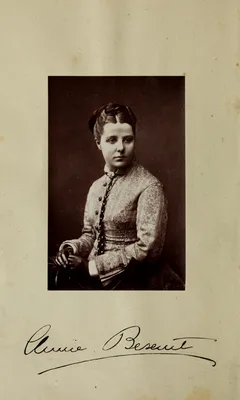
Annie Besant
Annie Besant left Christianity because she could not call good a God who let her baby suffer. She paid for her atheism with her marriage and her daughter. In 1889 she left atheism for Theosophy, because atheism gave her no motive strong enough to make people serve one another. She never unsaid her case against the supernatural.
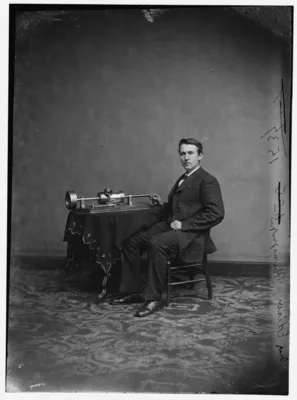
Thomas Edison
Thomas Edison was raised by a Baptist minister's daughter and set loose at thirteen on his father's shelf of Paine. He never lost a faith he is known to have held. In 1910 he told the New York Times that there were no gods of the religions, no soul and no use for a future life, while speaking in the same year of an Intelligence behind nature. In 1920 he revised the denial into a laboratory theory of indestructible "life entities" and an apparatus to test survival. He ended as Paine's defender and, like Paine, no atheist by his own word.
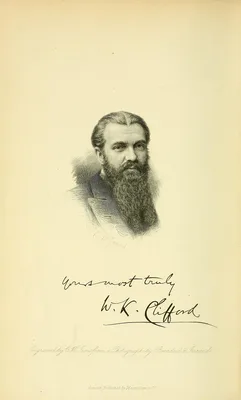
W. K. Clifford
W. K. Clifford was an ardent High Churchman at Trinity who tried to defend dogma with science. He gave up that faith in the late 1860s, under Darwin and Spencer, after a struggle his friend Pollock could not date. In "The Ethics of Belief" (1876–77) he turned his loss into a rule: it is wrong for anyone to believe on insufficient evidence. He never called himself an atheist in print, grieved openly for "the Great Companion", revered the believers he knew, and died at thirty-three without fear or retraction.
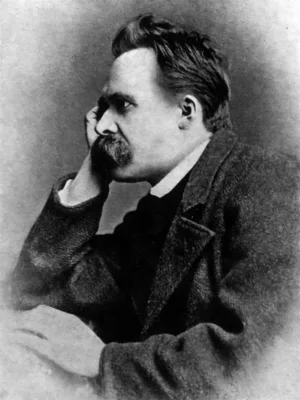
Friedrich Nietzsche
Nietzsche was a pastor's son who chose truth over peace at twenty. In 1882 he announced the death of God as a catastrophe Europe had not yet understood. He came to see his own unbelief not as the opposite of the faith he was raised in but as its last consequence: a Christian love of truth turned on Christianity itself.