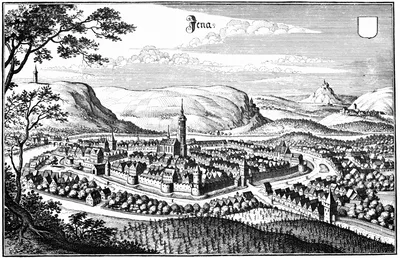
Matthias Knutzen was an orphaned organist's son from Holstein who trained in theology and preached until his superiors silenced him in 1673. He left no account of why he lost his faith. In September 1674 he scattered at Jena, Coburg and Altdorf a signed Latin letter denying God, magistrate, temples and priests, and putting conscience in their place, on behalf of a "sect" no one could find. He provoked a generation of refutations, and then vanished from the record without recanting.
The belief timeline
- Faith (training, not testimony) (c. 1664–1673) — Studied theology at Königsberg; preached Lutheran sermons in Holstein in 1673. No text of his own shows what he believed in these years; "faith" here means his place in the church, not an inner life. [6][10][11]
- Doubt (undated) (before Sept 1673 at the latest?) — Unknown. Möller (via Musaeus) offers three guesses: seduced by patrons or by followers of David Joris at home, or driven to despair by the failure of his plans; La Croze says his low view of marriage was older than his atheism and "perhaps one of its principal causes"; Mauthner suggests Socinian reading. Bayle puts the first impieties at Königsberg. None is evidence. [30][34][35][36]
- Declaration (5–6 Sept 1674) — The tracts are left in the Jena church and bookshop, the Latin letter denies God, magistrate, temples and priests [16][21][23]
- Disappearance (in place of Revision) (after Oct. 1674) — He drops out of the record; no recantation, no trial, no death date known [31]
Notes to the timeline (11)
- [6] Began philosophy and theology at Königsberg about 1664. — Moller vol. I, p. 304 ("circa A. 1664", image).
- [10] Returned to Holstein in 1673 with nothing; taught farm boys as assistant at Süderau and preached there and in nearby Krempe. — Moller vol. I, p. 304 (image).
- [11] His sermons attacked the faults of the clergy; Johann Hudemann, pastor of Krempe and royal superintendent, took offence; by the end of 1673 Knutzen was forbidden the pulpit and lost the school post. Mauthner (from Musaeus's witnesses) puts the pulpit ban at Christmas 1673 after a sermon in the Krempe fortress and says he claimed to have studied at Königsberg and Copenhagen and to be first a Master, then a Licentiate. — Moller vol. I, p. 304 (image); Mauthner vol. III, p. 163.
- [30] Möller, summarising Musaeus: Knutzen had been seduced into atheism by patrons or by followers of David Joris in his homeland, or driven to despair by the failure of his plans; Musaeus compared his doctrine in a "parallelism" with Joris's. — Moller vol. I, pp. 304-305 (image).
- [34] La Croze printed the Latin letter in 1711 (Entretiens, Fourth Dialogue on atheism) with a French translation, calling Knutzen "one of the most shameless atheists who ever was", and saying the marriage/fornication doctrine, which he repeated in the German dialogues, was older than his atheism "and perhaps one of its principal causes". — LaCroze pp. 400, 415-416; Moller vol. I, p. 305.
- [35] Bayle: the sect began about 1673; Knutzen first showed his impiety at Königsberg; "the follies of this German shew us that the ideas of natural religion... the light of conscience, may subsist in the mind of man" even after the belief in God is gone (text cut at page break); one must be "stark mad" to think mankind can live without magistrates. — Bayle vol. III, pp. 670-671 (image p. 670).
- [36] Mauthner: the letter shows no link to any predecessor; the English deists' biblical criticism was not yet in print in 1674, so the "Socinian" refugees from Poland in Prussia are the likelier source; Knutzen reached atheism not by science or philosophy but by being "infected by one of the drifting germs". — Mauthner vol. III, p. 167.
- [16] Content of the letter: the Bible contradicts itself (examples from Kings/Chronicles, Genesis, Matthew/Malachi, Resurrection, Proverbs, Habakkuk, Revelation, Luke, Ephesians, John, Exodus, Job, Acts, Isaiah); "we" deny God, mock the magistrate, reject temples and priests; conscience, joined with reason, replaces Bible, magistrate and priest; conscience is born and dies with us; the Christian articles of faith are for Christians, "we believe none of it". Bayle reduces it to six articles. — LaCroze pp. 402-415; Bayle vol. III, pp. 670-671.
- [21] Saturday 5 September 1674: two "tracts of shame and blasphemy" were found in the Jena church during confession, near the professors' seats; the bookseller Neuenhahn found the Altona dialogue wrapped in a letter in his shop. Möller dates the bookshop drop 6 September. — Mauthner vol. III, pp. 162-163; Moller vol. I, p. 304 (image).
- [23] The Latin letter, signed by Knutzen, was thrown into the house of the court preacher. — Mauthner vol. III, p. 163.
- [31] What became of him after 1674 is unknown: "Ubinam ille locorum post annum 1674 delituerit, quibusque deinceps fatis fuerit obnoxius, nec mihi nec aliis explorare licuit". English Wikipedia reports a claim that Möller said he died in an Italian monastery; not found in the Möller pages read; treat as unsupported. — Moller vol. I, p. 305 (image); Wikipedia-en. Accounts differ; see the disputed points.
Let Them Believe It, Not I
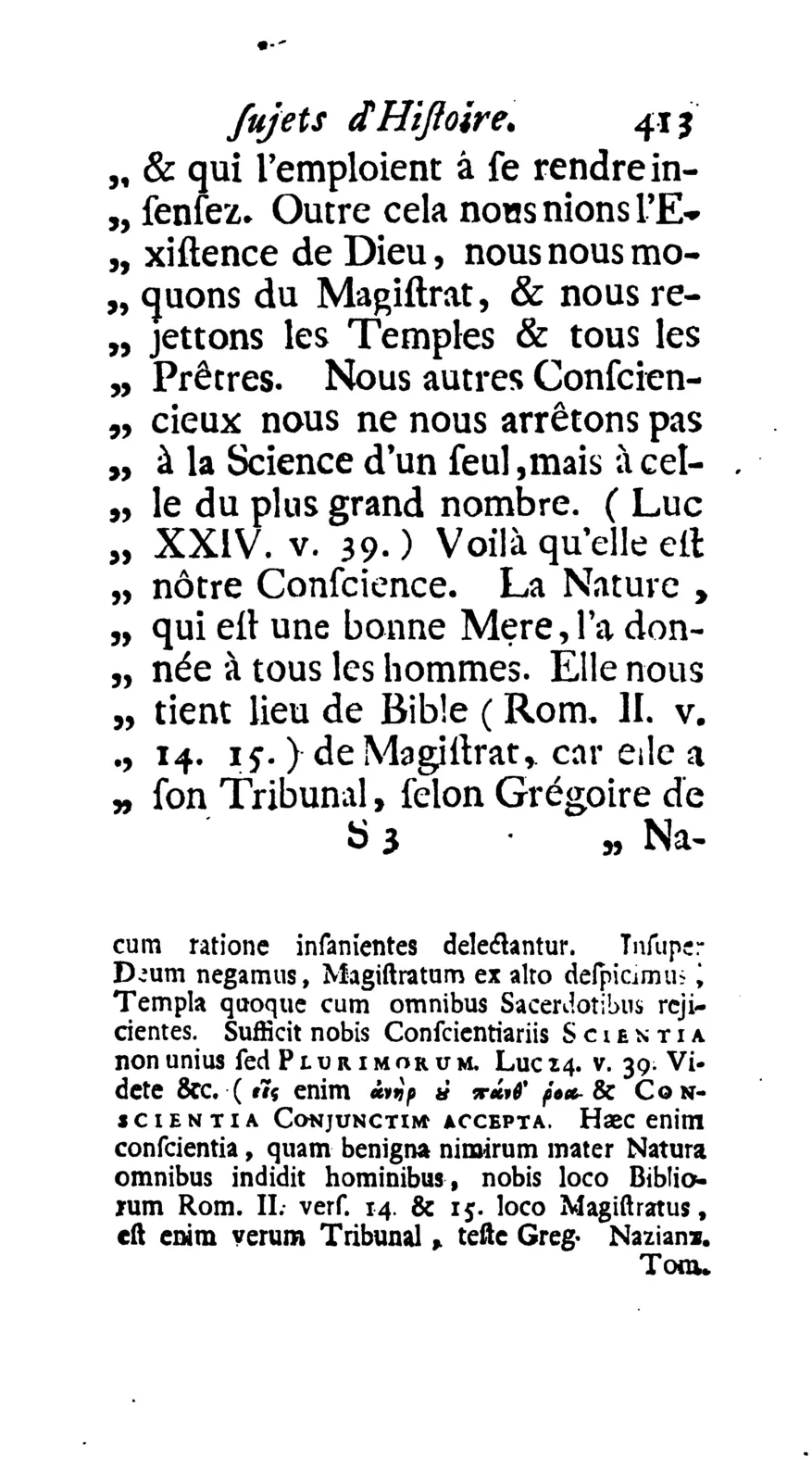
On Saturday 5 September 1674, during confession in the town church at Jena, someone found two papers near the seats of the university professors. The next day the bookseller Neuenhahn found a dialogue wrapped in a letter in his shop, with a note signed "Hans Friedrich von Vernunft", Hans Friedrich of Reason, ordering him to print it in the newspapers or be shot in the street.12 A Latin letter, signed, was thrown into the court preacher's house. "Moreover we deny God," it said, "we look down on the magistrate, and reject the temples together with all priests."34 The signature was "Matthias Cnuzen Holsatus", Matthias Knutzen of Holstein.5
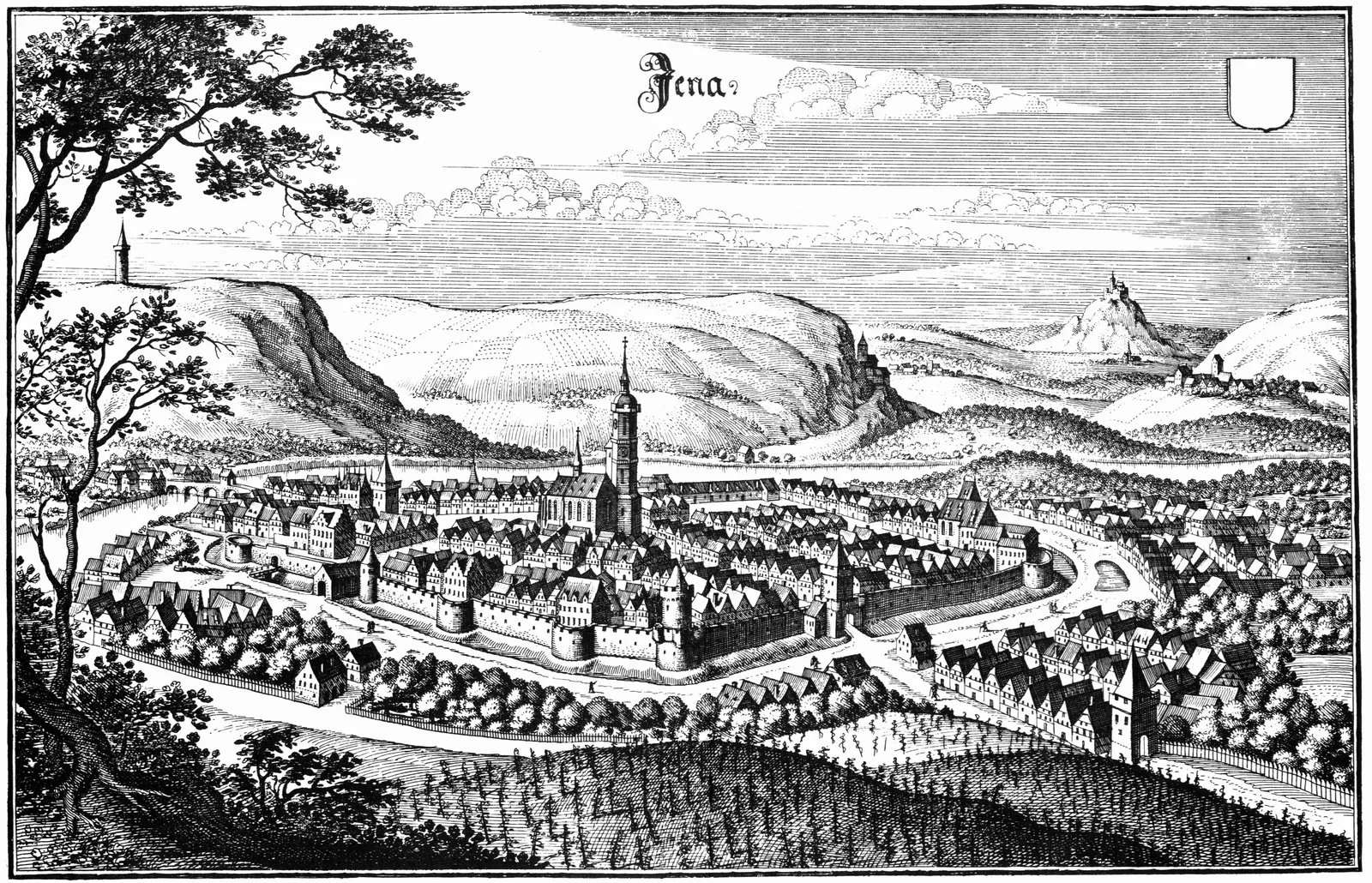
The same papers turned up at Coburg and at Altdorf, and in October at Jena again. Then Knutzen disappeared from the record, and no one has ever found where he went.67 What survives are his letter, his opponents' books, and a long argument over whether the "sect" he claimed to speak for ever existed. They have earned him the name of the first open atheist in Germany; it is fairer to say that his are the first openly atheist writings in Germany that we know of. The translations from the Latin are this book's own unless they are said to be Bayle's.
A preacher in Holstein
He was born about 1646 at Oldenswort in Eiderstedt, in Schleswig, where his father Bernhard was the church organist. His father died in March 1646, and Möller, the only real biographer, gives the father's death and not the son's birth.8910 An orphan, he was schooled at Oldenswort and then sent to the Altstadt school at Königsberg, where a brother was organist. At fifteen, because of his brother's harshness, he walked home with no money, begging on the way; his old teacher took him in and sent him back by sea.1112 From about 1664 he studied philosophy and theology at Königsberg.13
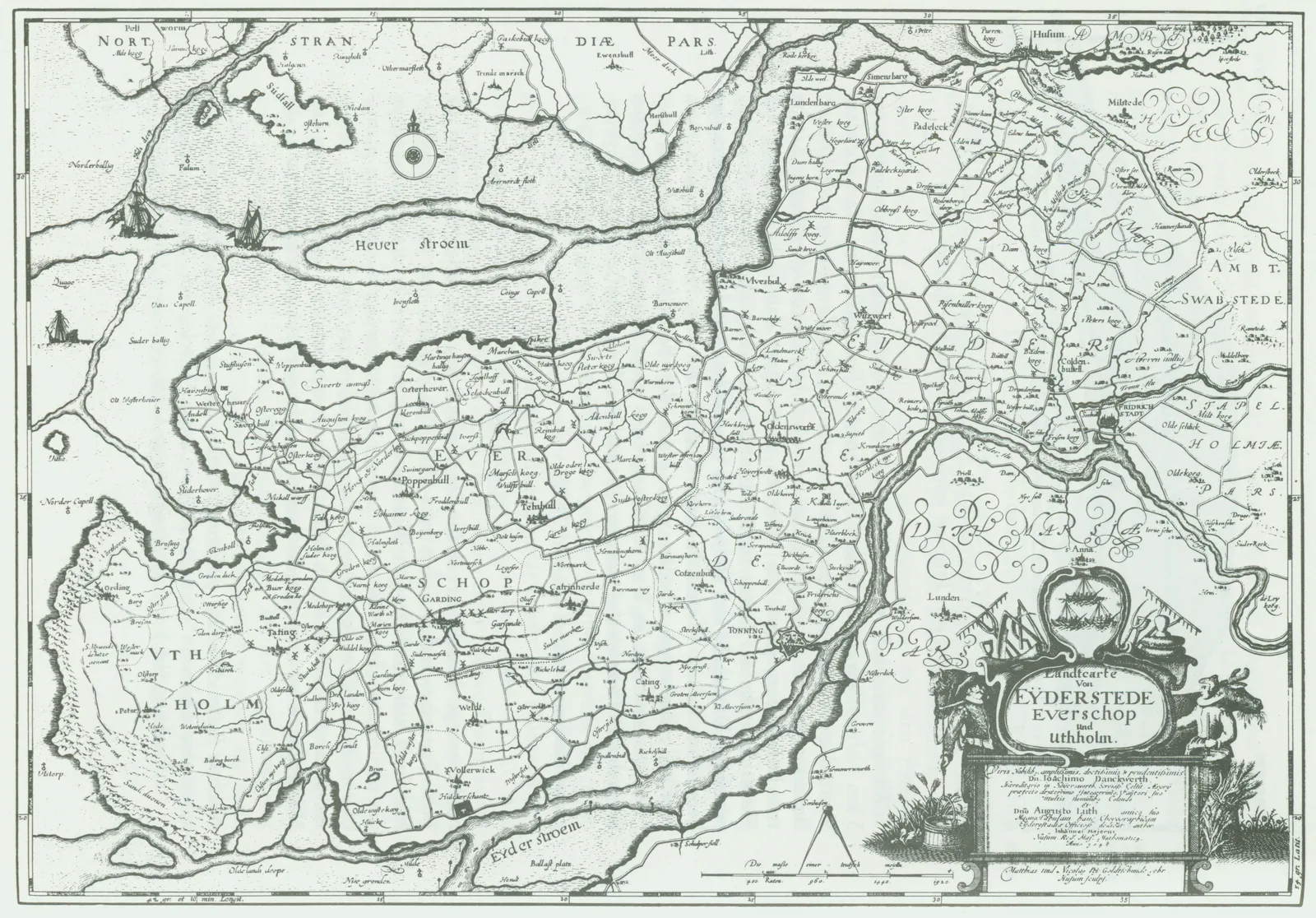
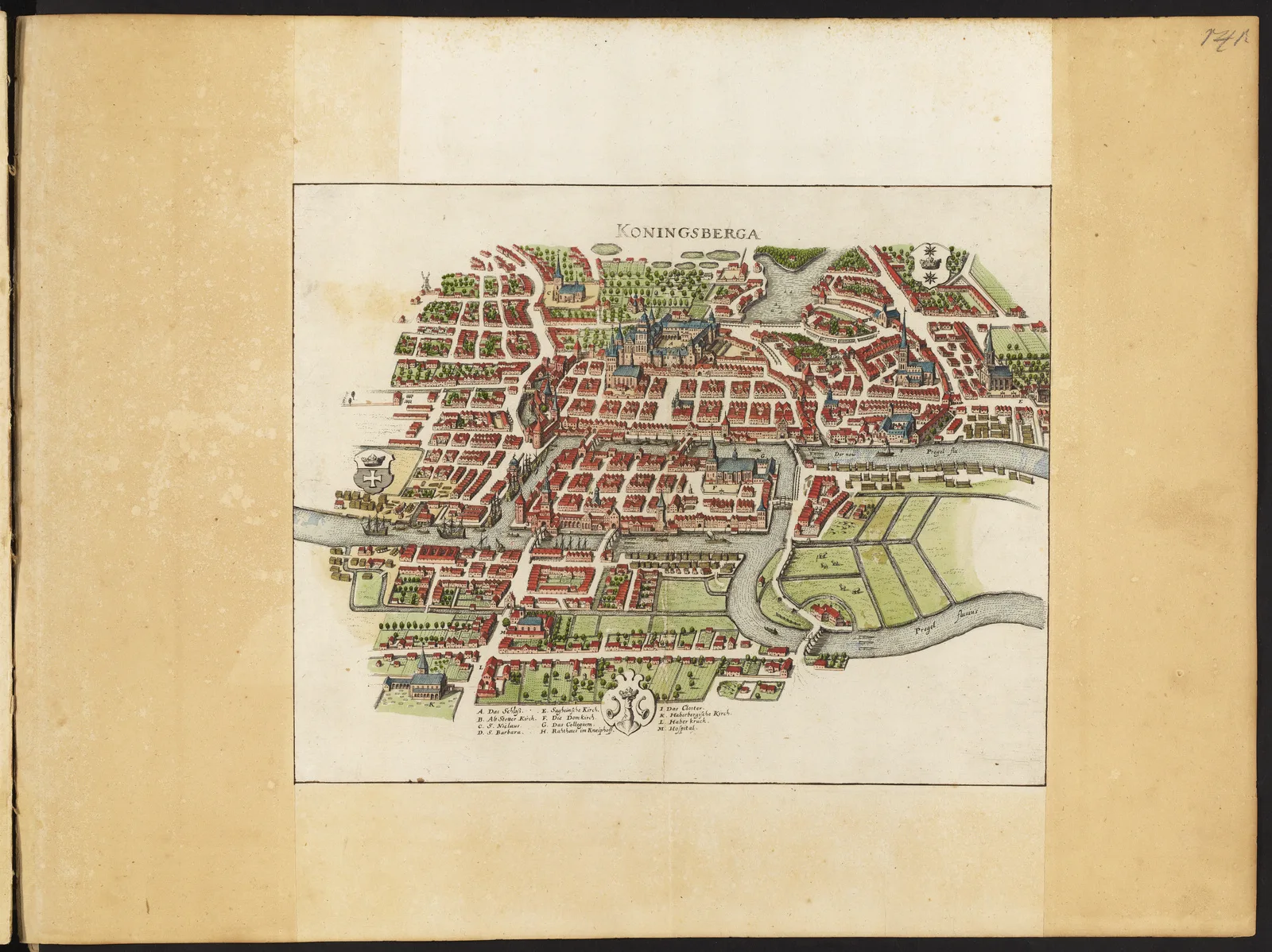
Then he wandered. He tutored in clergy households in Courland and Eiderstedt, went to Copenhagen, and spent years in Poland and elsewhere; Möller says he invented a master's degree from a Danish university and, when asked for papers, said they had been stolen.141516 In 1673 he came home with nothing and became assistant teacher at Süderau, preaching there and at nearby Krempe. His sermons attacked the faults of the clergy, and by the end of the year the superintendent had him barred from the pulpit and dismissed.1718 In early 1674, at Tönning, he was calling himself a licentiate of theology; when a pastor asked for the certificate, he said it had been lost in a shipwreck.19 On the belief timeline these years of training and preaching stand for his faith, though they record his place in the church, not his inner life.
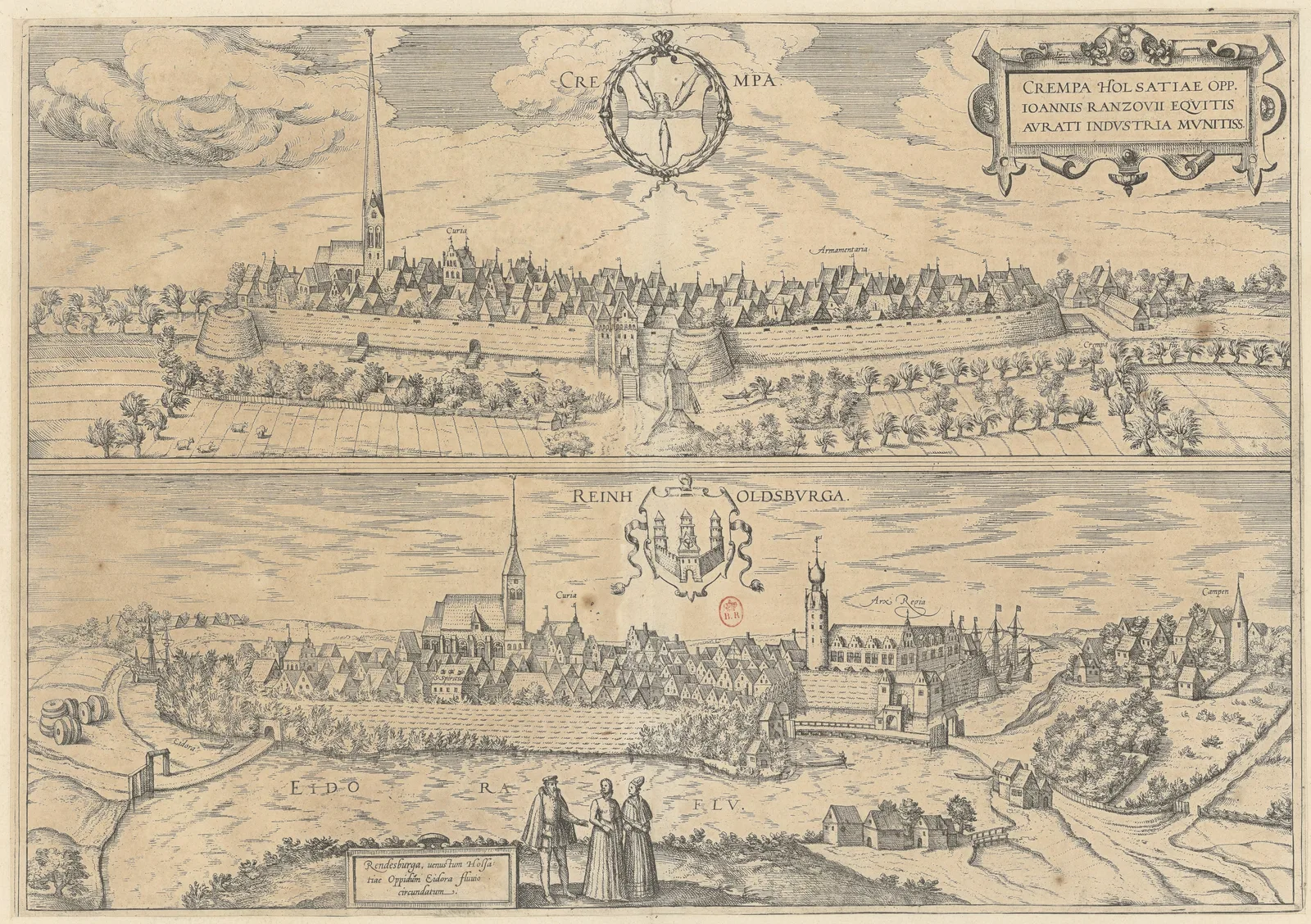
When did he stop believing, and why? Nothing survives to say. His enemies guessed: that patrons or followers of the radical David Joris had led him astray, or that the failure of his plans had driven him to despair. The French scholar La Croze thought his low view of marriage came first and was "perhaps one of its principal causes"; Pierre Bayle put the first impieties at Königsberg; the modern historian Fritz Mauthner suspected the Socinian refugees in Prussia.20212223 None of that is evidence. On the timeline, his doubt has no date.
The conscience people
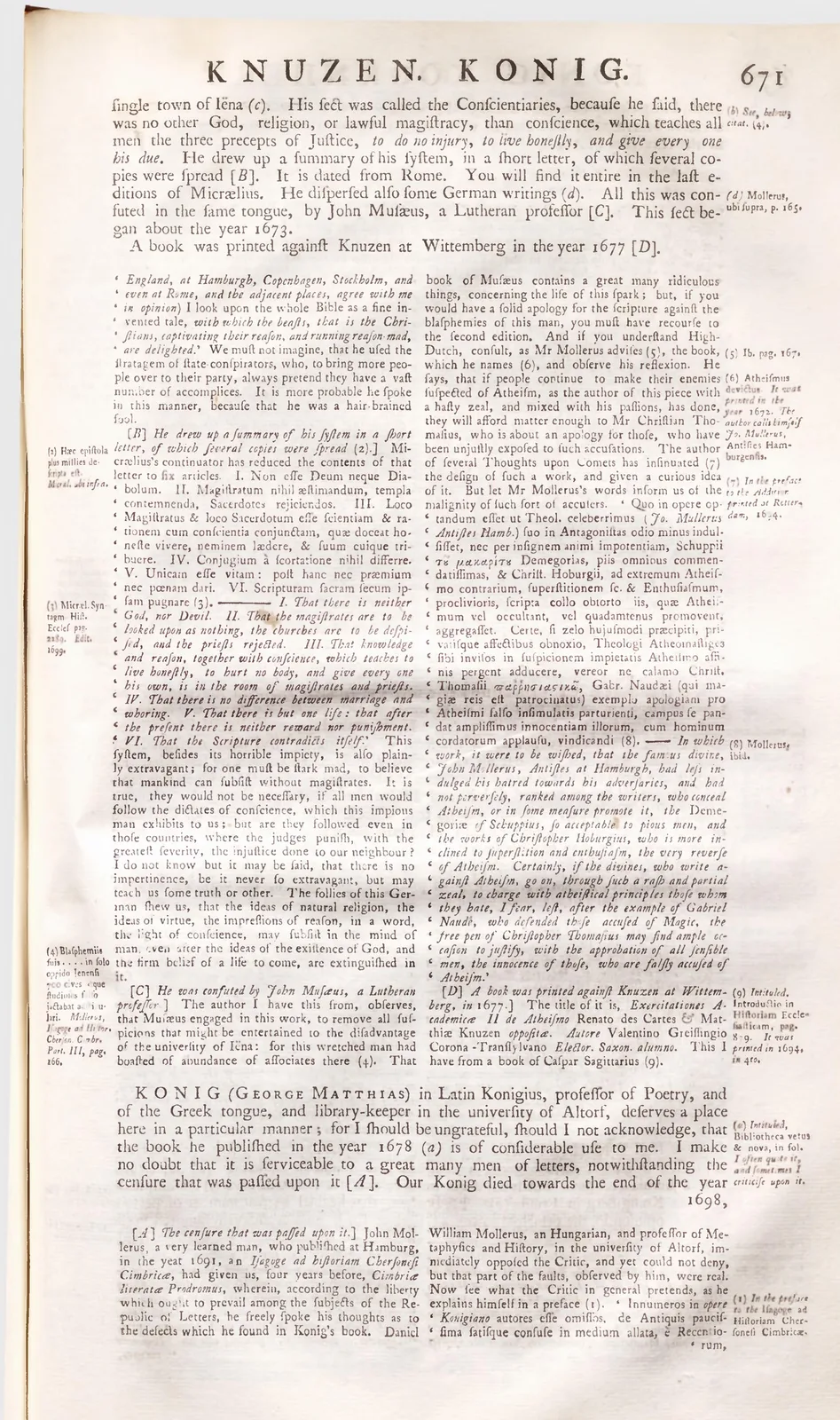
He left for Germany in January 1674. His letter is dated from Rome on 24 February, but he never went there; Musaeus, the Jena theologian who answered him, proved he had not left Germany.2425 The letter goes through the Bible looking for contradictions, from Kings and Chronicles to Revelation.26 Its conclusion is blunt: "I look upon the whole Bible," in the English of Bayle's translators, "as a fine invented tale, with which the beasts, that is the Christians, captivating their reason, and running reason-mad, are delighted."27 The Latin "beasts", belluae, plays on the "anointed" of the Christians.
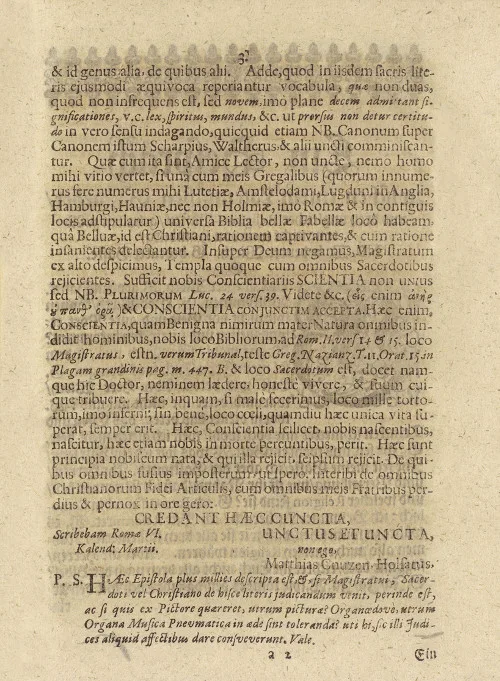
In place of Bible, magistrate and priest he put conscience. "This conscience, which kindly Mother Nature has put into all men, serves us in place of the Bible," and in place of magistrate and priest too.2829 It is born with us, he wrote, "and it perishes with us in death"; if we live badly it is a thousand torturers, if well, "our paradise in this life, the only one we know".30 Of the articles of Christian faith he wrote: "Christian men and Christian women may believe them; we believe none of it." And the letter ends: "Credant haec cuncta, Unctus & uncta, non ego", let the anointed man and the anointed woman believe all this; not I.3132 The timeline places his declaration at that letter and at the papers left in the church and the bookshop.
He claimed company. His "companions", he wrote, were innumerable in Paris, Amsterdam, Leiden, England, Hamburg, Copenhagen, Stockholm, "and even Rome"; to the bookseller he said there were seven hundred in Jena alone, among citizens and students. They called themselves Conscientiarii, in German Gewissener.33342835 No source confirms any of it. Musaeus called the Jena claim a calumny, Mauthner thought it a lie, and Bayle thought the boast not a conspirator's but that of "a hair-brained fool".333436
The replies
The Saxon government ordered proceedings against the author and distributors, and students spread the news by letter.37 To protect the university's name, Johannes Musaeus, professor of theology at Jena, published a reply; accounts differ on whether its first edition was 1674 or 1675.3839 He called Knutzen "Apostolus Satanae lucifuga", the light-shunning apostle of Satan, and a practical rather than a speculative atheist, since he wrote of God "like a fool".4041 He also answered the name: no conscience that holds the fear of God, the avenger of sins, can exist in an atheist.42 A Lutheran writer, Tobias Pfanner, called him "restless in manners, turbid in intellect", a man who "equalled and surpassed the wickedness of all atheists"; at Wittenberg and Leipzig there were learned refutations.434445
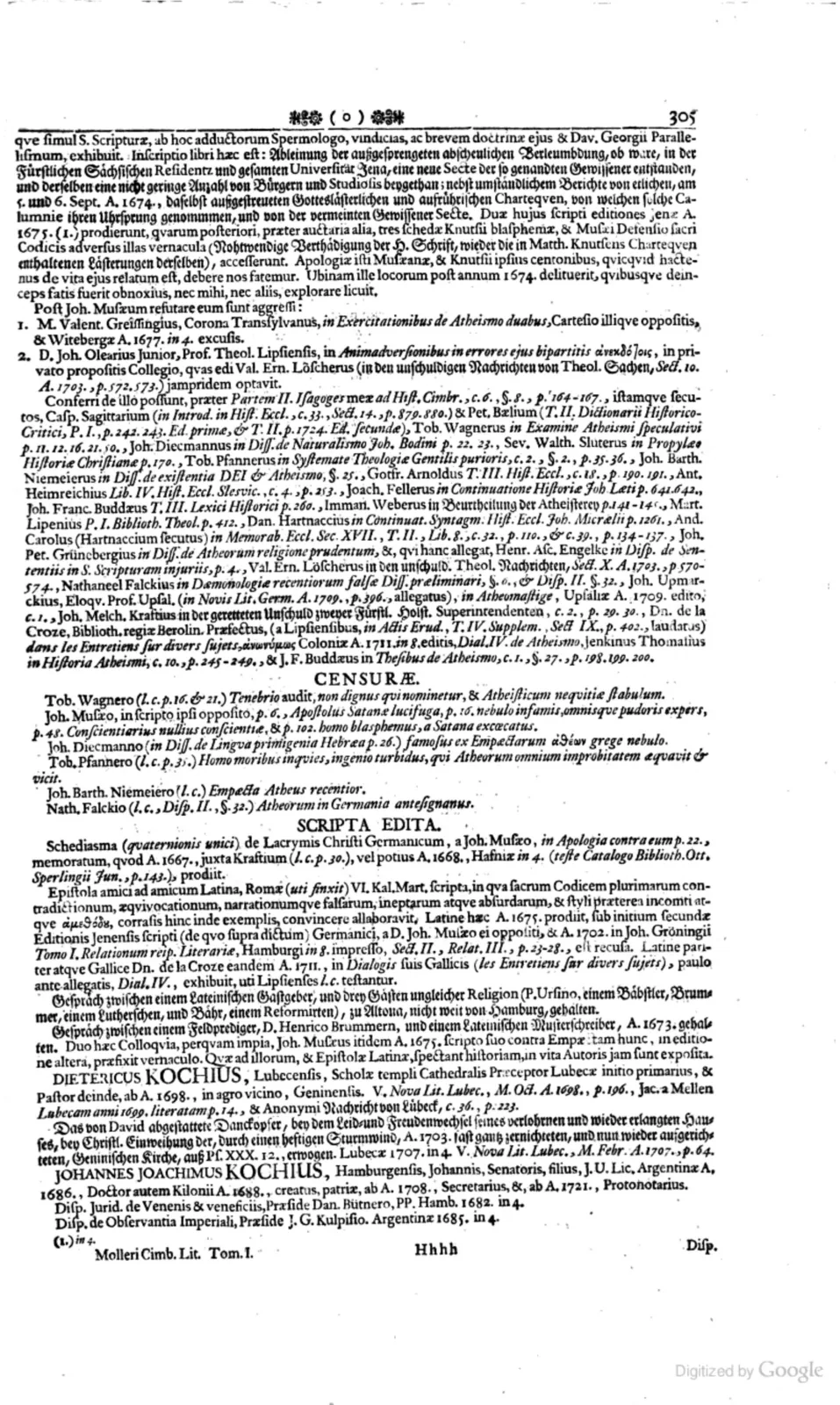
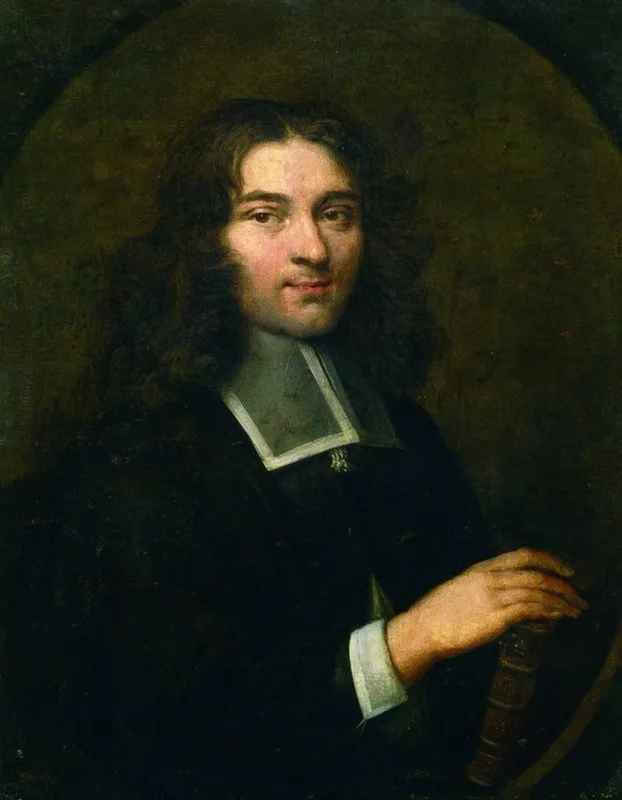
The later critics were more interesting. La Croze printed the whole letter in 1711, with a French translation, and decided that "this man had become an atheist by the corruption of his heart, and not by the lights of his mind". But in the same book he argued that when unbelief spreads it is for magistrates, not churchmen, to act, and asked: "Would prison not be enough?"214647 Pierre Bayle, in his great Dictionary, thought one must be "stark mad, to believe that mankind can subsist without magistrates". He also drew a lesson that went beyond Knutzen: the follies of this German, he wrote, show that the ideas of natural religion and the light of conscience can remain in the mind after belief in God is gone.2248
The record stops
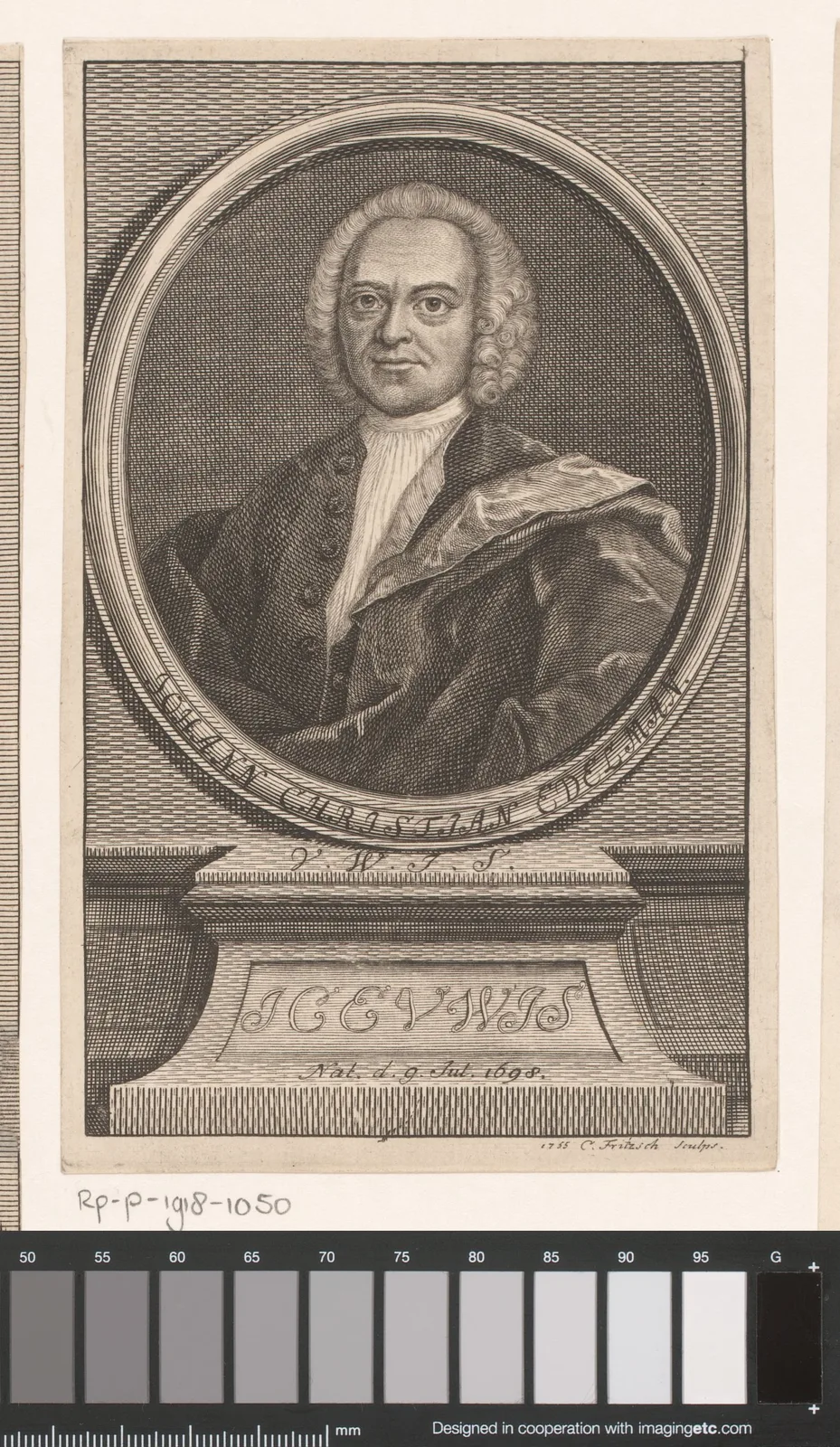
His timeline has no revision, because after 1674 there is no more of Knutzen to follow. "Where he hid after the year 1674, and what fate befell him afterwards," Möller wrote in 1744, "neither I nor others have been able to discover."7 A story that he died in an Italian monastery is not in Möller's pages, and this chapter does not repeat it as fact.7 In 1740 the radical Johann Christian Edelmann defended "the damned and silenced atheist Knutzen", and in the twentieth century Mauthner called him "the first and most thoroughgoing German atheist".4950
What he left is a single letter, written by a failed preacher who made up his degrees and perhaps his followers, and who still said something new: that conscience, without God, could do the work of Bible, magistrate and priest. La Croze put his case beside another of the same years, the Polish nobleman Kazimierz Łyszczyński, who was beheaded in Warsaw in 1689 for an atheist manuscript, and who has his own chapter in this book.
Footnotes
-
Mauthner vol. III, pp. 162-163; Moller vol. I, p. 304 (image). ↩
-
Mauthner vol. III, p. 163; Moller vol. I, p. 304. ↩
-
Mauthner vol. III, p. 163. ↩
-
Matthias Knutzen (Latin letter, 1674): LaCroze p. 413 (Latin note; image). ↩
-
LaCroze p. 415 (image). ↩
-
Mauthner vol. III, p. 163; Moller vol. I, p. 304 (image). ↩
-
Moller vol. I, p. 305 (image); Wikipedia-en. Accounts differ; see the disputed points. ↩ ↩2 ↩3
-
Moller vol. I, p. 304 (image). ↩
-
Moller vol. I, p. 304 (image). ↩
-
Wikipedia-en. Reported at second hand; the original has not been seen. ↩
-
Moller vol. I, p. 304 (image). ↩
-
Moller vol. I, p. 304 (image). ↩
-
Moller vol. I, p. 304 ("circa A. 1664", image). ↩
-
Moller vol. I, p. 304 (image). ↩
-
Wikipedia-en; Moller vol. I, p. 304. ↩
-
Moller vol. I, p. 304 (image). ↩
-
Moller vol. I, p. 304 (image). ↩
-
Moller vol. I, p. 304 (image); Mauthner vol. III, p. 163. ↩
-
Moller vol. I, p. 304 (image). ↩
-
Moller vol. I, pp. 304-305 (image). ↩
-
Mauthner vol. III, p. 167. ↩
-
Moller vol. I, p. 304 (image); LaCroze pp. 416-417 (image p. 417 for the "prouvé" sentence). ↩
-
LaCroze p. 415 (image); Moller vol. I, p. 305 (image). ↩
-
LaCroze pp. 402-415; Bayle vol. III, pp. 670-671. ↩
-
Bayle vol. III, pp. 670-671 (note [A], continued across the page break; image). ↩
-
Moller vol. I, p. 304 (image); LaCroze p. 400; Bayle vol. III, p. 671. ↩ ↩2
-
LaCroze p. 413 (Latin note; image). ↩
-
LaCroze p. 414. ↩
-
LaCroze p. 415 (image). ↩
-
LaCroze p. 415 (image). ↩
-
LaCroze p. 412 (Latin note); Bayle vol. III, p. 670 note [A] (image). ↩ ↩2
-
Moller vol. I, p. 304 (image); Mauthner vol. III, pp. 162-164; LaCroze p. 401. ↩ ↩2
-
LaCroze p. 412. ↩
-
Mauthner vol. III, pp. 162, 164, 166. ↩
-
Mauthner vol. III, p. 163; Moller vol. I, p. 304 (image). ↩
-
Moller vol. I, p. 305 (image); Mauthner vol. III, p. 162; LaCroze p. 401. ↩
-
Mauthner vol. III, p. 162. ↩
-
Mauthner vol. III, pp. 163-164. ↩
-
Johannes Musaeus, professor of theology, Jena (his own insult for Knutzen, p. 6 of his book, as listed by Möller): Moller vol. I, p. 305 (image). ↩
-
Johann Möller, 1744, reporting Musaeus's argument against the name "Conscientiarii": Moller vol. I, p. 304 (image). ↩
-
Bayle vol. III, p. 671 note [D; Moller vol. I, p. 305 (image). ↩
-
Moller vol. I, p. 305 (image). ↩
-
Tobias Pfanner, Lutheran writer (1679), as quoted by Möller: Moller vol. I, p. 305 (image). ↩
-
LaCroze p. 430 (OCR; header read as p. 430 by sequence). ↩
-
Maturin Veyssière La Croze, librarian to the King of Prussia, 1711: LaCroze p. 417 (image). ↩
-
Pierre Bayle (English translators), 1697/1734: criticism of the letter's politics, not a believer's defence: Bayle vol. III, p. 671. ↩
-
Mauthner vol. III, p. 221, note. ↩
-
Mauthner vol. III, pp. 161, 167. ↩
In their own words
Insuper Deum negamus, Magistratum ex alto despicimus, Templa quoque cum omnibus Sacerdotibus rejicientes.
Outre cela nous nions l'Existence de Dieu, nous nous moquons du Magistrat, & nous rejettons les Temples & tous les Prêtres.
Nemo homo mihi vitio vertet, si una cum meis gregalibus
I look upon the whole Bible as a fine invented tale, with which the beasts, that is the Christians, captivating their reason, and running reason-mad, are delighted.
Credant haec cuncta, Unctus & uncta, non ego.
Haec enim conscientia, quam benigna nimirum mater Natura omnibus indidit hominibus, nobis loco Bibliorum
Cette même Conscience naît avec nous, & elle périt avec nous par la mort.
Les Chrétiens & les Chrétiennes peuvent les croire ; nous n'en croions rien.
si moi & mes Confrères, qui sont en très-grand nombre à Paris, à Amsterdam, à Leide, en Angleterre, à Hambourg, à Coppenhague, à Stockholm, & même à Rome, & aux environs de cette Ville
The other side
& que cet homme étoit devenu Athée par la corruption de son cœur, & non pas par les lumiéres de son esprit.
Apostolus Satanæ lucifuga
nulla, uti a Joh. Musæo recte est monitum, conscientia, Dei, peccatorum vindicis, metum incutiens, in Atheis esse qveat
for one must be stark mad, to believe that mankind can subsist without magistrates.
Homo moribus inquies, ingenio turbidus, qui Atheorum omnium improbitatem æquavit & vicit.
Where accounts differ
| Point | One account | Another | How the page handles it |
|---|---|---|---|
| Year of Musaeus's reply | 1674 (title page as transcribed by Mauthner: "Anno 1674") | 1675 (La Croze p. 401: "l'an 1675"; Möller p. 305: two Jena editions in 1675) | "Accounts differ: the first edition may be 1674 or 1675." Never give a single date for the first edition. |
| Date the sect began | "about 1673" (Bayle p. 671) | the letter and dialogues are 1673-74; the distribution in Sept 1674 (Möller, Mauthner) | The sect is a claim in the pamphlets; its date is the pamphlets' date. |
| When he left Holstein | January 1674 (Möller p. 304) | Letter dated "Rome, 24 Feb" and says he was there (letter); Mauthner: "we do not know if Knutzen was ever there" (p. 166) | Say the letter's Roman dateline is a pretence (Möller, Musaeus), with Mauthner's caution. |
| Where Knutzen went | Möller p. 305: unknown after 1674 | Wikipedia-en: Möller wrote he died in an Italian monastery (not found on the pages read); "last seen Jena 22 Oct 1674" (no pre-1931 source seen) | Say plainly the record stops; do not give a death or a monastery. |
| Birth year | 1646 (Wikipedia-en, roster; Möller gives only the father's death, March 1646) | Möller: he left school "aged 15" and began the academy c. 1664, which fits 1646 but does not state it | Use "born about 1646" with the father's death as anchor. |
| The brothers | Möller: a brother, organist, at Königsberg | Möller: a brother, citizen of Tönning (1674) | One brother or two is not stated; "a brother" only. |
| Who the "first atheist" is | Mauthner and Wikipedia: first German atheist / first self-professed atheist known by name | He never uses the word of himself; other candidates exist for earlier unbelievers (Vanini, Bruno as accused) | Use "the first openly atheist writings in Germany that we know of", as the roster does. |
| Old Style dates | Sept 5 (O.S.) = Saturday (Mauthner, Möller) | N.S. = 15 Sept | Give the dates as the sources do and say they are Old Style once. |
List of illustrations
This page uses only public-domain and Creative Commons images; each is credited with its source and licence.
- Jena (view) — Matthäus Merian, Topographia Superioris Saxoniae, Thuringiae, Misniae et Lusatiae, c. 1650 · Wikimedia Commons, Merian engraving of Jena, public domain · Public domain (Wikimedia Commons file page: "Public domain"; engraving or print published before 1931)
- Landcarte von Eyderstede Evershop und Uthholm (map of Eiderstedt) — Johannes Mejer, in Caspar Danckwerth, Newe Landesbeschreibung der zwey Hertzogthümer Schleswich und Holstein, 1648 (printed 1652) · Wikimedia Commons, scan of Danckwerth's Newe Landesbeschreibung (1652), public domain · Public domain (Wikimedia Commons file page: "Public domain"; engraving or print published before 1931)
- Vogelschaukarte von Königsberg (bird's-eye plan of Königsberg), coloured copper engraving — Matthäus Merian the Elder, Johann Georg Starcke (as catalogued), c. 1641 · Deutsche Fotothek / SLUB Dresden (Kartensammlung, Geogr.A.230-3 Blatt 141), via Europeana, CC BY-SA 4.0 · CC BY-SA 4.0 (Europeana rights statement http://creativecommons.org/licenses/by-sa/4.0/). WEB ONLY: share-alike, not for the book.
- Crempa Holsatiae / Reinholdsburga (views of Krempe and Rendsburg) — Georg Braun and Franz Hogenberg (publisher as catalogued by BnF: Braun), 1635 (BnF date; views from Civitates orbis terrarum) · Bibliothèque nationale de France (btv1b532357773) via Wikimedia Commons, public domain · Public domain (Wikimedia Commons file page: "Public domain"; engraving or print published before 1931)
- Knutzen, Amicus amicis amica, the end of the Latin letter (as reprinted in Musaeus, Ableinung der ausgesprengten abscheulichen Verleumbdung, Jena 1675, pp. 1-3 after p. 170) — Matthias Knutzen, printed by Bielcke and Krebs, 1674 (printed 1675) · Forschungsbibliothek Gotha (VD17 39:134006G), via Wikimedia Commons from the Universität Erfurt exhibition catalogue, public domain · Public domain (Wikimedia Commons: "Public domain", PD-old-70-expired; Forschungsbibliothek Gotha copy)
- La Croze, Entretiens (1770 ed.), p. 413: 'nous nions l'Existence de Dieu ... les Temples & tous les Prêtres' — Maturin Veyssière de La Croze (letter by Matthias Knutzen), 1770 (letter 1674) · Internet Archive (entretienssurdi00crozgoog), public domain · Public domain (published before 1931; Internet Archive rights field not stated)
- Johannes Musaeus (1613-1681), theologian at Jena — Johann Jakob Schollenberger, c. 1680 · Wikimedia Commons (source: bildindex.de), public domain · Public domain (Wikimedia Commons file page: "Public domain"; engraving or print published before 1931)
- Cimbria literata I, p. 305: Knutsen entry, Musaeus's epithets and Pfanner's judgement — Johann Möller, 1744 · Internet Archive (bub_gb_DY5LAAAAcAAJ), Google Books scan, Public Domain Mark · Public Domain Mark 1.0 (Internet Archive rights field)
- Pierre Bayle (1647-1706) — Attributed to Louis Ferdinand Elle the Younger, c. 1675 · Wikimedia Commons (source: pierre-bayle.univ-st-etienne.fr iconography), public domain · Public domain (Wikimedia Commons file page: "Public domain"; engraving or print published before 1931)
- Bayle, Dictionary, vol. III, p. 671: 'I look upon the whole Bible as a fine invented tale' (Q4) and 'one must be stark mad' (OQ4) — Pierre Bayle, 1734-38 · Internet Archive (dictionaryhi_bayl_1738_03), Public Domain Mark · Public Domain Mark 1.0 (Internet Archive rights field)
- Portret van J.Chr. Edelman (Johann Christian Edelmann), RP-P-1918-1050 — Rijksmuseum, print dated 1755, 1755 · Rijksmuseum, Amsterdam (RP-P-1918-1050), CC0 · CC0 (Wikimedia Commons file page, from the Rijksmuseum Public Domain release)
Sources
Tier 1 — the subject's own words (as printed by his opponents)
- LaCroze Maturin Veyssière La Croze, Entretiens sur divers sujets d'histoire, de religion (the Fourth Dialogue prints Knutzen's Latin letter with a French translation; first Cologne 1711 per Möller; the copy here is the 1770 reprint "entre My Lord Bolingbroke, et Isaac d'Orobio"), pp. 400-430. IA
entretienssurdi00crozgoog; leaf = printed page minus 6 (image-checked at pp. 413, 415, 417, 424, 428); textlacroze1770.txt. The Latin letter is given as Musaeus printed it. Knutzen's two German dialogues are not reproduced there ("pleins de blasphèmes", La Croze says, p. 401 in the OCR sequence). - Moller Johann Möller, Cimbria literata (Copenhagen: Orphanotrophium, 1744), vol. I, pp. 304-306 (entry "Matthias Knutsen", with a list of his writings and the literature). IA
bub_gb_DY5LAAAAcAAJ(rights: Public Domain Mark); leaves 385-387; page images checked; textmoller-b.txt. This is the fullest biography and draws on Musaeus's book; it is Tier 2 for the life and the closest we get to Tier 1 for what the pamphlets said.
Tier 2 — scholarly biographies and encyclopedias
- Bayle Pierre Bayle, The Dictionary Historical and Critical, 2nd English ed. (London, 1734-38), vol. III, article KNUZEN, pp. 670-672 (image-checked p. 670). IA
dictionaryhi_bayl_1738_03; textbayle1738v3.txt. (The French original, article "Knuzen", is in vol. III of the 1740 ed.; not located here; see Open questions.) - Mauthner Fritz Mauthner, Der Atheismus und seine Geschichte im Abendlande, vol. III (Stuttgart/Berlin: Cotta, 1922; IA
deratheismusunds03mautuoft), pp. 161-167 (the section "Matthias Knutzen") and p. 221 note (Edelmann). Fraktur OCR, partly garbled; read by eye, so German quotations are not given in the Quotations table. Mauthner's account is a paraphrase of Musaeus. Textmauthner3.txt(alsomauthner2.txt,mauthner4.txt: no Knutzen passage found).
Tier 3 — popular biographies and journalism
- none used.
Tier 4 — Wikipedia and similar reference sites
- Wikipedia-en "Matthias Knutzen", English Wikipedia, retrieved through the MediaWiki extract API on 2026-10-14 (no revision id captured). Used as a map: it cites Winfried Schröder, Matthias Knutzen: Schriften und Materialien (Frommann-Holzboog, 2010), W. Pfoh (ed.), M. Knutzen (Akademie-Verlag, 1965), Lohmeier in NDB 12 (1980), pp. 232-33, Wagenmann in ADB 16 (1882), pp. 335-36, and Weber in BBKL 4. None of these was read. German Wikipedia has only a disambiguation entry.
Opposition sources — contemporary critics and religious responses
- Musaeus Johannes Musaeus, Ablehnung der ausgesprengten abscheulichen Verleumdung, ob wäre in der Fürstl. Sächsischen Residentz und gesamten Universität Jena eine neue Secte der so genanten Gewissener entstanden … (Jena: Johann Bielcken / J. J. Bauhofer, 1674 or 1675). Not seen. Reached only through Möller, La Croze and Mauthner. Title as Möller prints it and as Mauthner transcribes it.
- Pfanner Tobias Pfanner, Systema theologiae gentilis purioris (1679), c. 2 §2 pp. 35-36, as cited by Möller. Not seen.
- Not located (not on IA or Gutenberg; Google Books API down during this run): Kortholt, De tribus impostoribus magnis (1680); Reimann, Historia universalis atheismi (1725); Sagittarius; Micraelius, Syntagma historiae ecclesiasticae (1679); Greiffing's Exercitationes (Wittenberg 1677); Edelmann's Moses mit aufgedecktem Angesichte (1740); Naigeon in the Encyclopédie méthodique (1792).
Related lives
Kazimierz Łyszczyński (beheaded in 1689 for an unpublished atheist manuscript; La Croze's 1711 book puts the two cases side by side) — the pointer is for the script writer; do not name a "next" in the video (series rule).
Kazimierz Łyszczyński
Kazimierz Łyszczyński was a Brest nobleman who had spent eight years with the Jesuits. In private he wrote a manuscript arguing that man created God and that religion is a fraud of the powerful on the simple. Denounced by a debtor, he said it was a disputation meant to be refuted, and recanted on the church's script. He was beheaded and burned in Warsaw in 1689, so his unbelief survives only in the words of those who condemned him.
Baruch Spinoza
Baruch Spinoza was a promising Talmud pupil who came to think the rabbis rested only on their own authority. At twenty-three he was cast out of Amsterdam's Portuguese synagogue for heresies no one wrote down. He spent his life arguing that the Bible is a human book, that God acts only through the laws of nature, and that a free state lets people think what they like. He rejected the word atheist and never said there was no God, but his "God or Nature" sounded to nearly everyone like no God at all.
Jean Meslier
Jean Meslier was ordained to please his parents and, by his own account, was never a believer. He served a village parish for thirty-seven years while writing a Testament against all gods, kings and priests, for his parishioners to read after his death. His unbelief never changed, but after 1729 others remade it: Voltaire into a penitent deist's prayer, and d'Holbach's publishers into a name on another man's book.
Andō Shōeki
Andō Shōeki was a country physician in Hachinohe who watched farmers starve while those who did not till ate their grain. He came to hold that the world is only self-moving nature, with no god or Buddha above it and no reward or punishment from beyond, and that sages and creeds were inventions of those who lived off the farmers. He judged this too dangerous to print in full. He published a softened version and left the rest for readers a hundred years later, who nearly lost it to fire.