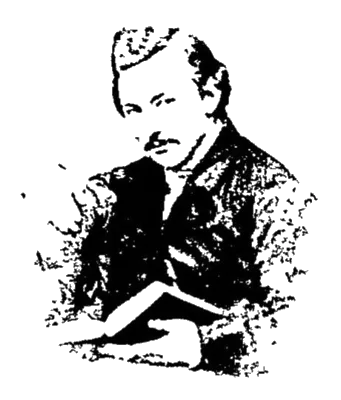
Thomas Hardy was a church-musician's son who dreamed of the pulpit. In his twenties he lost his faith to the new biblical criticism, to Darwin, and to Newman's Apologia, whose chain of reasoning, he wrote in his notebook, had "no first link". He kept the loss private for thirty years, and said it in public only after Jude the Obscure drove him from the novel to verse. He spoke it as grief rather than triumph, refused the word atheist, and never ceased to love the church he could not believe in.
The belief timeline
- Faith (c. 1848–1856) — A church-going, church-musician's boy who reads the services at home and teaches Sunday School; "to be a parson had been his dream" [4][6][7][51]
- Doubt (c. 1860–1867) — Moule gives him Essays and Reviews; Newman's argument fails ("no first link"); the curacy scheme falls through on conscience [12][16][17]
- Private break (1866) — "Hap": the universe is chance, not a vengeful god; kept in manuscript for thirty years [19]
- Declaration (1895–96) — Jude the Obscure; the Bishop of Wakefield; then verse: "The Impercipient" (1898) and "God's Funeral" (1914) [34][38][40][49]
- Revision (1907–1927) — The church-lover's complaint (1907); "The Oxen" (1915); the Apology (1922); the Abbey and Stinsford (1928) [46][50][53][57]
Notes to the timeline (16)
- [4] As a small boy he read the Morning Prayer standing in a chair in a tablecloth, a cousin playing the clerk; "Everybody said that Tommy would have to be a parson" — Florence Emily Hardy [with Thomas Hardy], The Early Life of Thomas Hardy, 1840–1891 (Macmillan, London, 1928), p. 19.
- [6] Though the village school's Catechism lapsed, he was "kept strictly at church on Sundays", knowing the Morning and Evening Services and rubrics by heart; the verses "Afternoon Service at Mellstock" (Moments of Vision) record that time — Early Life of Thomas Hardy, p. 23.
- [7] At about fifteen he taught in the Stinsford Sunday School with the vicar's sons — Early Life of Thomas Hardy, p. 32.
- [51] In 1917 Hardy said "To be a parson had been his dream" as a child, that his grandfather, father, uncle, brother, wife, cousin and two sisters had been church musicians for over a hundred years, that he had read the church lessons, and "had at one time as a young man begun reading for Cambridge with a view to taking Orders"; critics never called him "churchy" — Florence Emily Hardy [with Thomas Hardy], The Later Years of Thomas Hardy, 1892–1928 (Macmillan, London, 1930), p. 176.
- [12] Horace Moule of Queens' College, Cambridge, "just then beginning practice as author and reviewer", was a Dorchester friend; walks with Moule and Hooper Tolbort biassed Hardy towards books, two works impressing him much: the newly published Essays and Reviews and Bagehot's Estimates — Early Life of Thomas Hardy, p. 43.
- [16] On 2 July (1865) he worked at Newman's Apologia: "A great desire to be convinced by him, because Moule likes him so much", but "there is no first link to his excellent chain of reasoning" — Early Life of Thomas Hardy, pp. 63–64.
- [17] About this time he formed the scheme of "combining poetry and the Church", wrote to a friend at Cambridge about matriculation, and thought of a country curacy; it fell through from "a conscientious feeling, after some theological study, that he could hardly take the step with honour while holding the views which on examination he found himself to hold" — Early Life of Thomas Hardy, p. 66.
- [19] "Hap" was among the earliest poems, kept in manuscript and printed thirty to forty years later mainly in Wessex Poems; the poem is dated 1866 — Early Life of Thomas Hardy, p. 71; Thomas Hardy, Wessex Poems and Other Verses (1898; the IA copy is the 1899 printing), pp. 7–8.
- [34] Jude the Obscure was published on 1 November 1895; Hardy's Preface is dated August 1895 — Later Years of Thomas Hardy, p. 38; Thomas Hardy, Jude the Obscure (Harper, New York, 1896, copyright 1895; Preface Aug. 1895), Preface.
- [38] Bishop How wrote on 8 June 1896 to the Yorkshire Post that he had bought "one of Mr. Hardy's novels" and "threw it into the fire"; the Life reads this as Jude, was "mildly sceptical of the literal truth", and records the bishop also had W. H. Smith's library withdraw the book — Frederick Douglas How, Bishop Walsham How: A Memoir (Isbister, London, 1898), pp. 343–45; Later Years of Thomas Hardy, p. 48. Accounts differ; see the disputed points.
- [40] The 1895–96 attacks "well-nigh compelled him" to give up the novel and resume verse; he found it awkward at first to get back to "an easy expression in numbers" — Later Years of Thomas Hardy, pp. 65–66.
- [49] "God's Funeral" is dated "1908–10" and was printed in Satires of Circumstance (1914) — Thomas Hardy, Satires of Circumstance, Lyrics and Reveries, with Miscellaneous Pieces (Macmillan, 1914), pp. 47–51.
- [46] In January 1907 he noted an article, "The Hard Case of the Would-be-Religious", including "Required: services at which there are no affirmations and no supplications" — Later Years of Thomas Hardy, p. 121.
- [50] "The Oxen" appears in Moments of Vision (1917); Mrs Hardy sent its manuscript to the Red Cross Sale in February 1916 — Thomas Hardy, Moments of Vision and Miscellaneous Verses (Macmillan, 1917), (page not legible); Later Years of Thomas Hardy, p. 171. Not verified.
- [53] The Apology to Late Lyrics (February 1922) names "evolutionary meliorism", defends "questionings", and asks whether the Church is not "the English establishment" left "to keep the shreds of morality together" — Thomas Hardy, Late Lyrics and Earlier, with Many Other Verses (Macmillan, 1922), with the "Apology", pp. vi–xviii.
- [57] The Dean of Westminster consented on 12 January 1928; on 13 January the heart was removed; on 14 January the body was cremated at Woking and the ashes placed in St Faith's Chapel; on 15 January the heart casket lay on the altar steps at Stinsford — Later Years of Thomas Hardy, App. I pp. 267 (by H. C.).
What Was Mourned For, I, Too, Once Had Prized
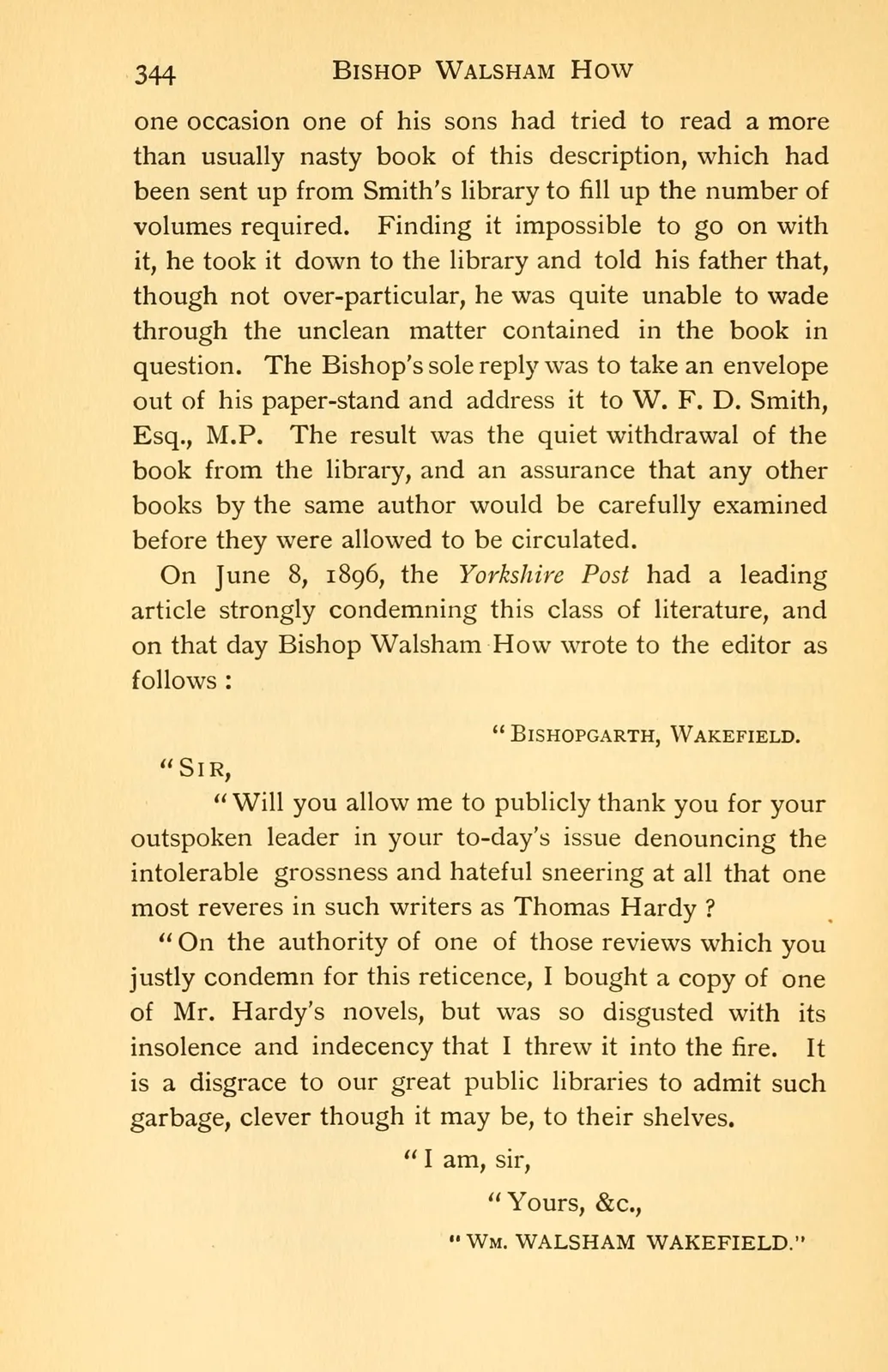
On 8 June 1896 the Bishop of Wakefield wrote a letter to the Yorkshire Post. He had bought, he said, "one of Mr. Hardy's novels, but was so disgusted with its insolence and indecency that I threw it into the fire."12 The novel was taken to be Jude the Obscure, published the November before, and the bishop was not alone. The press attack on the book was, the author thought, unequalled in violence since Swinburne's Poems and Ballads, and from America someone sent him a packet of ashes said to be those of his novel.3
Thomas Hardy was fifty-five. He had been a boy who read the Morning Prayer standing on a chair in a tablecloth, a young man who planned to be ordained, and for thirty years a writer whose doubts had stayed mostly in his notebooks. After Jude he wrote no more novels. He wrote poems instead, many of them about the loss of God, and he went on going to church. This chapter follows the boy who wanted to be a parson to the man who wrote "God's Funeral," and asks why he could neither believe nor let belief go.
A parson's dream
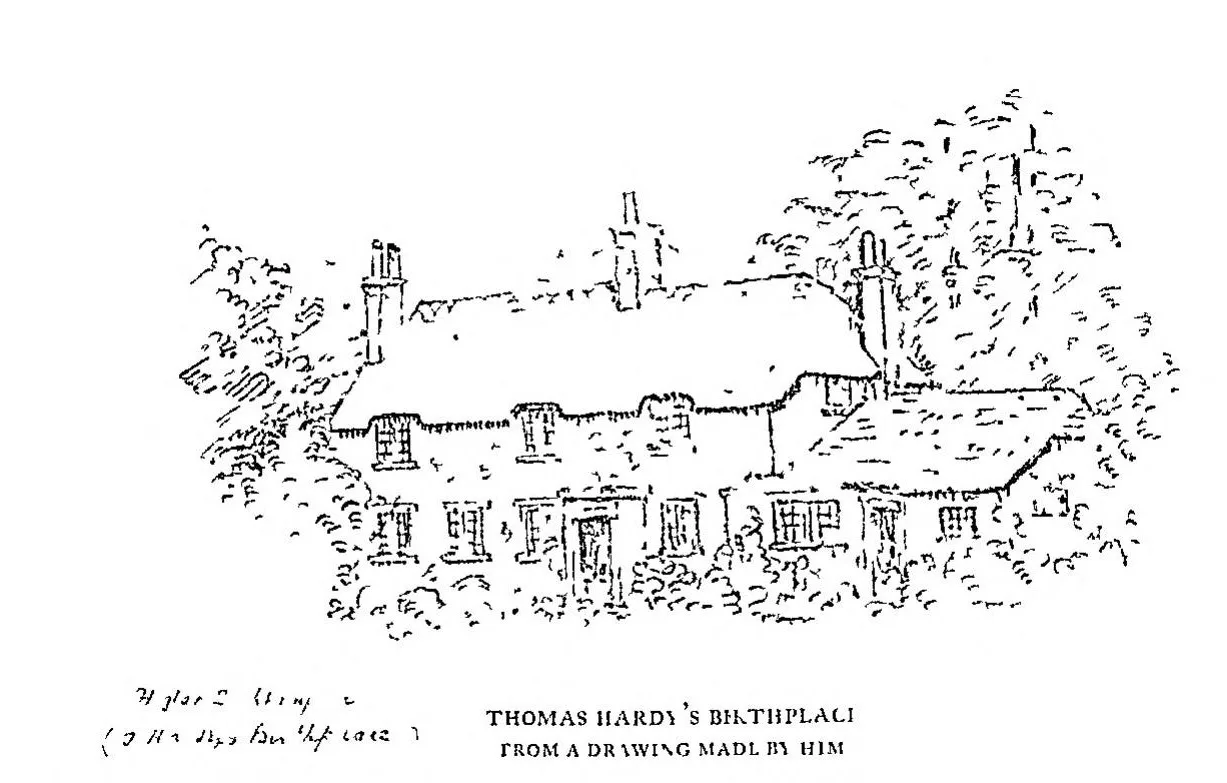
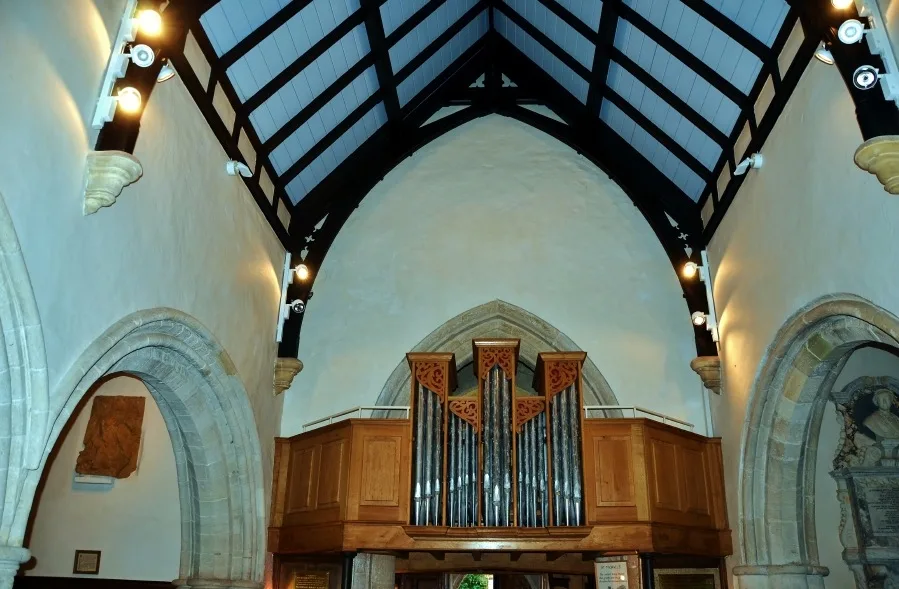
He was born about eight in the morning of 2 June 1840, in the last house at the east end of Higher Bockhampton, in the parish of Stinsford, Dorset.4 Church was the family's music. His grandfather played the bass viol in the west gallery of Stinsford church from about 1801, and his father and uncle played beside him; the three Hardys made the church's music for a little under forty years.5
As a small boy he would stand on a chair wrapped in a tablecloth and read the Morning Prayer, with a cousin as his clerk, and "everybody said that Tommy would have to be a parson, being obviously no good for any practical pursuit."67 He was "kept strictly at church on Sundays" and knew the morning and evening services and their rubrics by heart; at about fifteen he taught in the Stinsford Sunday school with the vicar's sons.89 Looking back in old age, he wrote that "to be a parson had been his dream."10
At sixteen, in July 1856, he was articled to John Hicks, a Dorchester architect who restored churches, and "he had sometimes, too, wished to enter the Church."11 Much of his account of these years comes from The Early Life of Thomas Hardy (1928), which carries his second wife Florence's name on the title page; her note says Hardy supplied the chapter headings and his memories, and later scholars say that he wrote most of it himself.12 It is his own story, told in the third person.
The Greek Testament and the new criticism
In Hicks's office he found a fellow pupil, Henry Bastow, who had become a Baptist, and the two argued about infant baptism. Hardy read the Greek Testament with him, sometimes sitting on a gate in the fields, and from six to eight in the morning before work. He could find "not a shred of evidence for infant baptism in the New Testament," but he decided that "Christianity did not hang on temporary details."1314 When Bastow emigrated to Tasmania, Hardy, "like St. Augustine, lapsed from the Greek New Testament back again to pagan writers."15
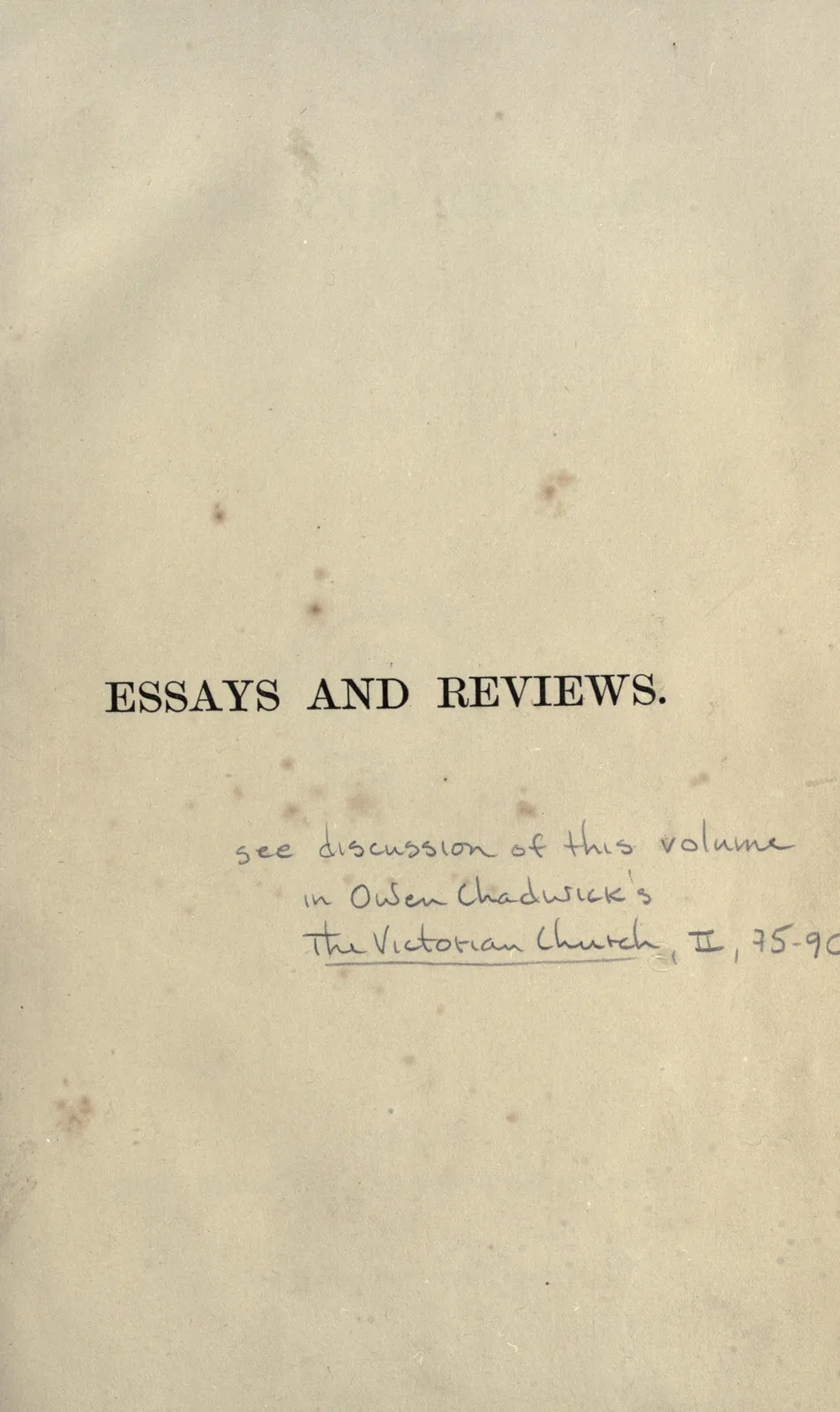
The friend who mattered most was Horace Moule of Queens' College, Cambridge, a Dorchester man who was just beginning to write and review. On walks with Moule Hardy met the books that shook his generation, and two impressed him most: Walter Bagehot's essays and "the newly published Essays and Reviews," the volume of 1860 in which seven liberal writers, nicknamed "the Seven against Christ," applied modern criticism to the Bible.16 Hardy wrote later that "as a young man he had been among the earliest acclaimers of The Origin of Species."17
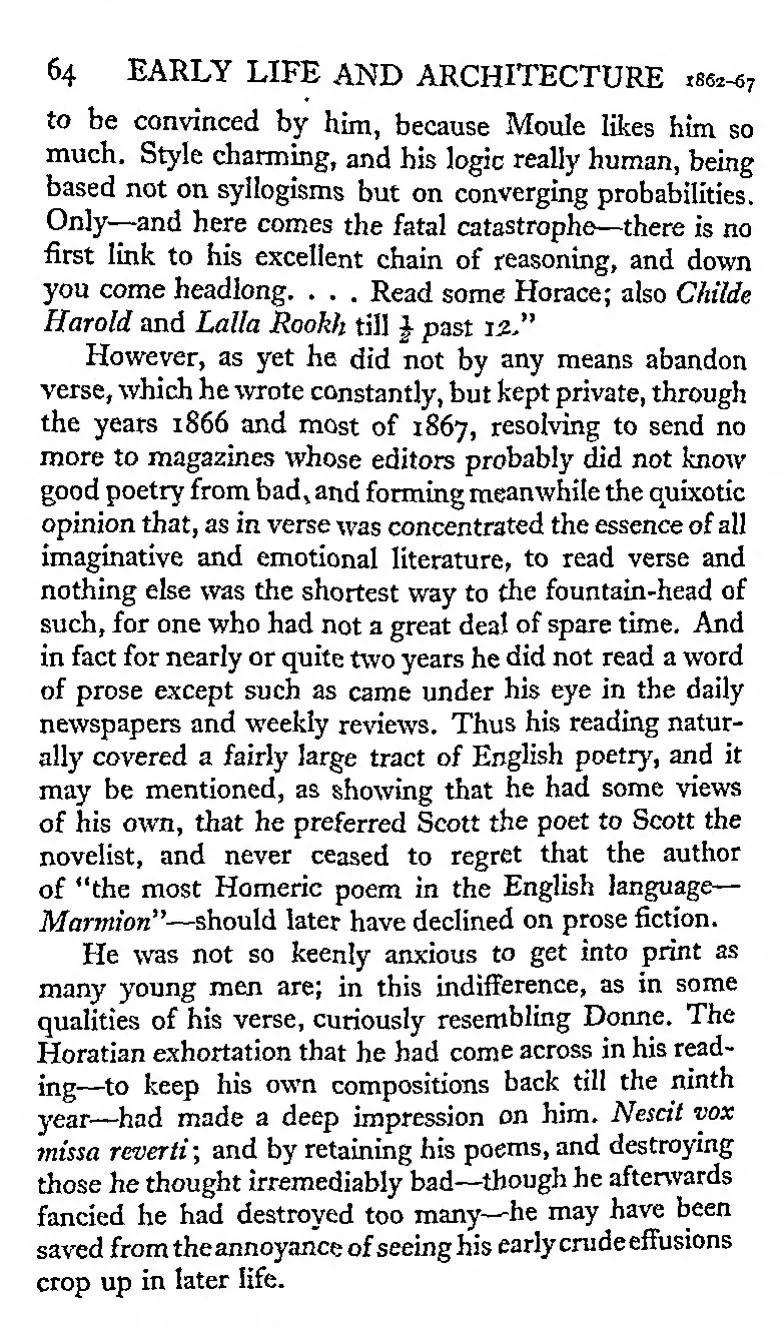
In May 1862 he went to London as an assistant in the office of Arthur Blomfield, a church architect and the son of the late Bishop of London.18 On 2 July 1865 he worked through Newman's Apologia, wanting to be convinced: "A great desire to be convinced by him, because Moule likes him so much." He was not. "Only — and here comes the fatal catastrophe — there is no first link to his excellent chain of reasoning, and down you come headlong."1920
He still hoped for a while to combine poetry and the Church. He wrote to a friend at Cambridge about matriculating, and thought of a country curacy. The scheme fell through, he wrote, "less because of its difficulty than from a conscientious feeling, after some theological study, that he could hardly take the step with honour while holding the views which on examination he found himself to hold."2122 Accounts differ a little on how far he went; late in life he said he had "begun reading for Cambridge with a view to taking Orders."10 In London he still went to the Abbey and stayed for the Sacrament.23
"Hap"
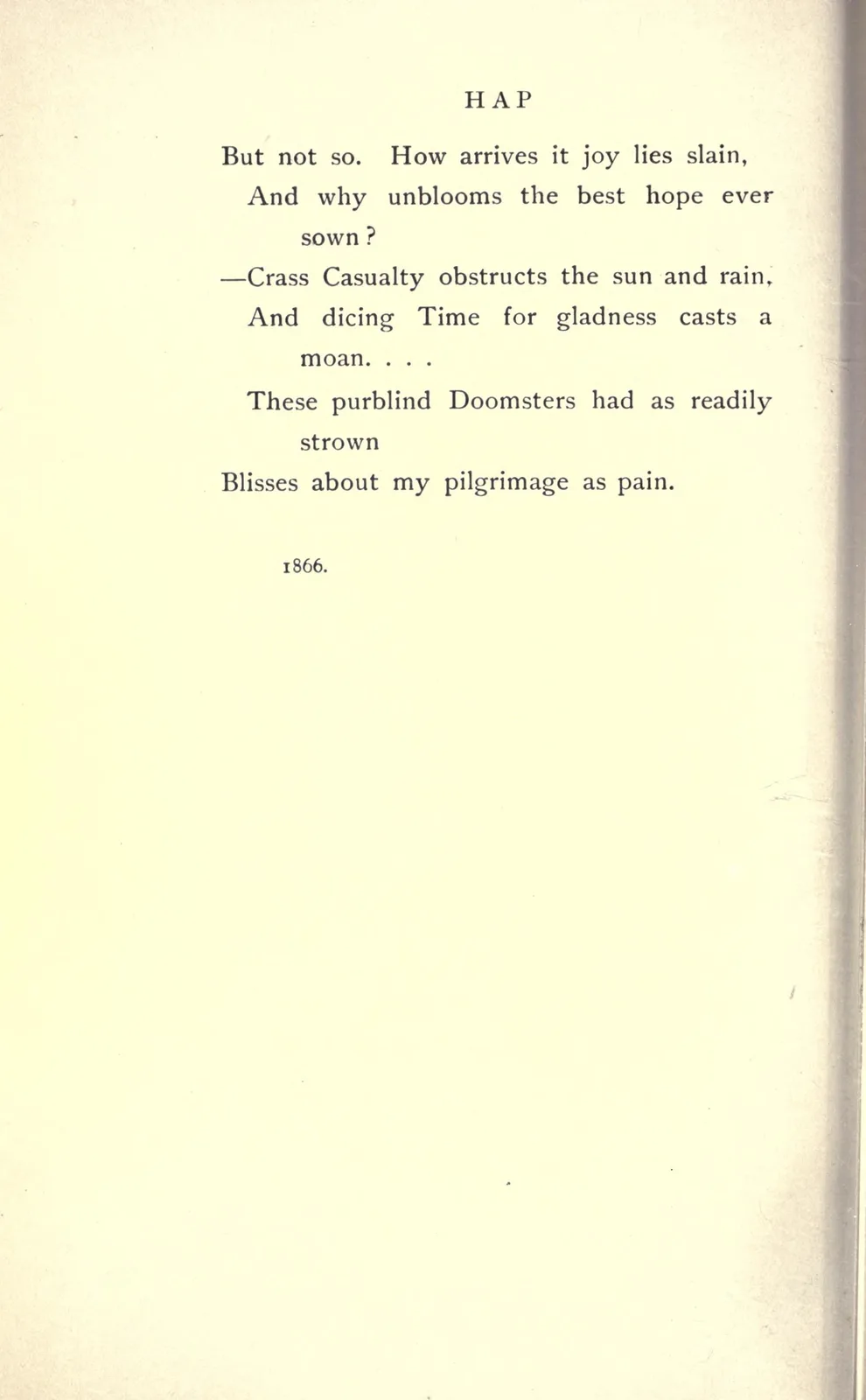
In 1866, at twenty-six, he wrote a sonnet he kept in manuscript for more than thirty years. It says that he could bear his suffering if some vengeful god would laugh at him from the sky: "Then would I bear, and clench myself, and die, / Steeled by the sense of ire unmerited." But there is no such god. "Crass Casualty obstructs the sun and rain, / And dicing Time for gladness casts a moan. . . . / These purblind Doomsters had as readily strown / Blisses about my pilgrimage as pain."242526 That was the private break: not a cruel God, but chance.
The next year he copied into his notebook a list of "cures for despair," among them Wordsworth and the chapter on individuality in John Stuart Mill's On Liberty, and went home to Dorchester to work for Hicks again.2728 In September 1873 Horace Moule died suddenly, three months after a cheerful parting at Cambridge, and Hardy went to his burial at Fordington; the Life calls it only a "tragic death."29
Leslie Stephen
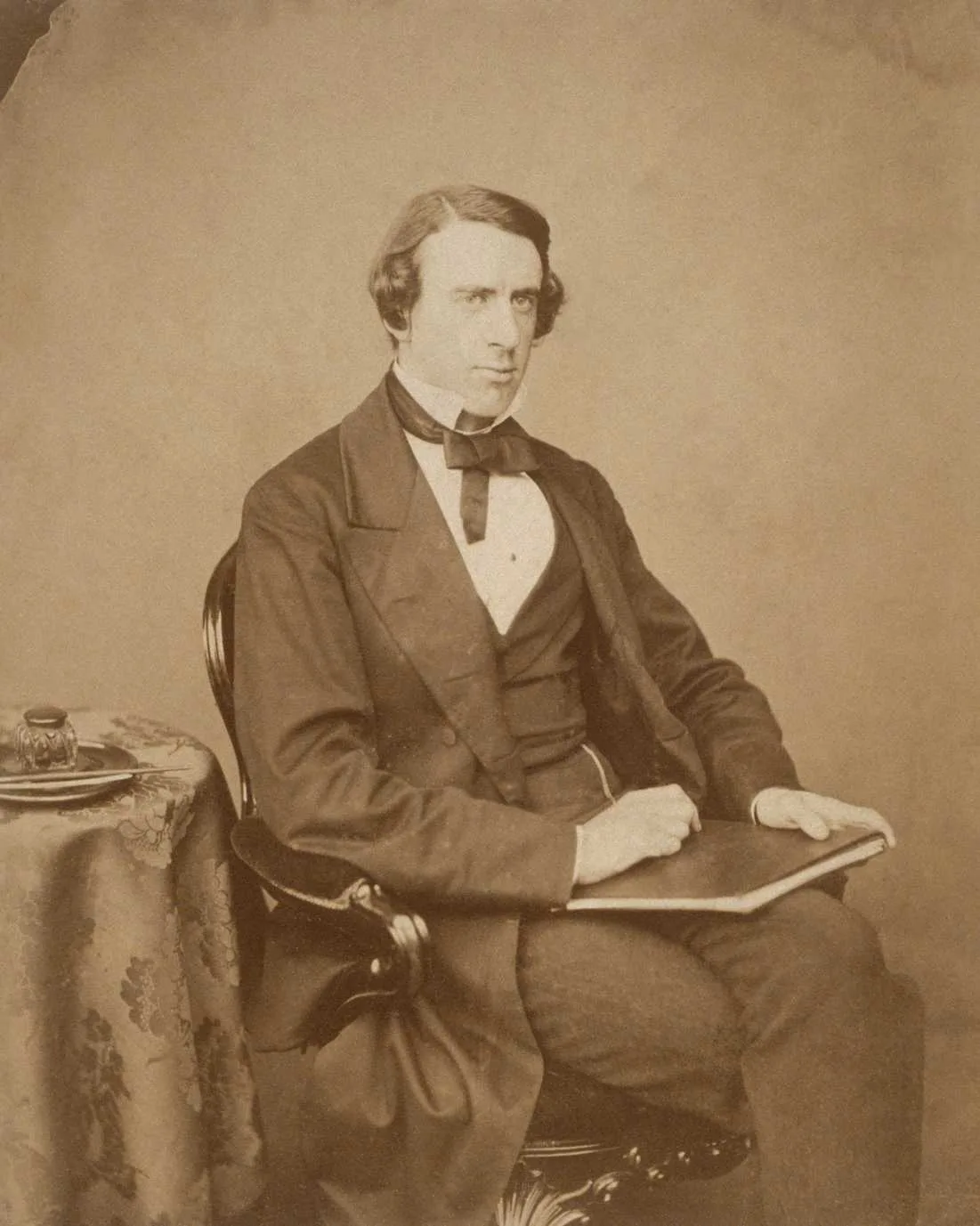
The man who did most to shape Hardy's thinking in the years that followed was Leslie Stephen, the editor of the Cornhill, who had been a clergyman and had lost his faith. Stephen asked Hardy for a serial in 1873, and Hardy said he came "to be mentally influenced by him so deeply."30 On 23 March 1875, Hardy remembered, "I received from Stephen a mysterious note asking me to call in the evening." When he got there, "he wanted me to witness his signature to what, for a moment, I thought was his will; but it turned out to be a deed renunciatory of holy-orders under the act of 1870."313233 Stephen told him that night that he had "wasted" much time on systems of religion and metaphysics.34
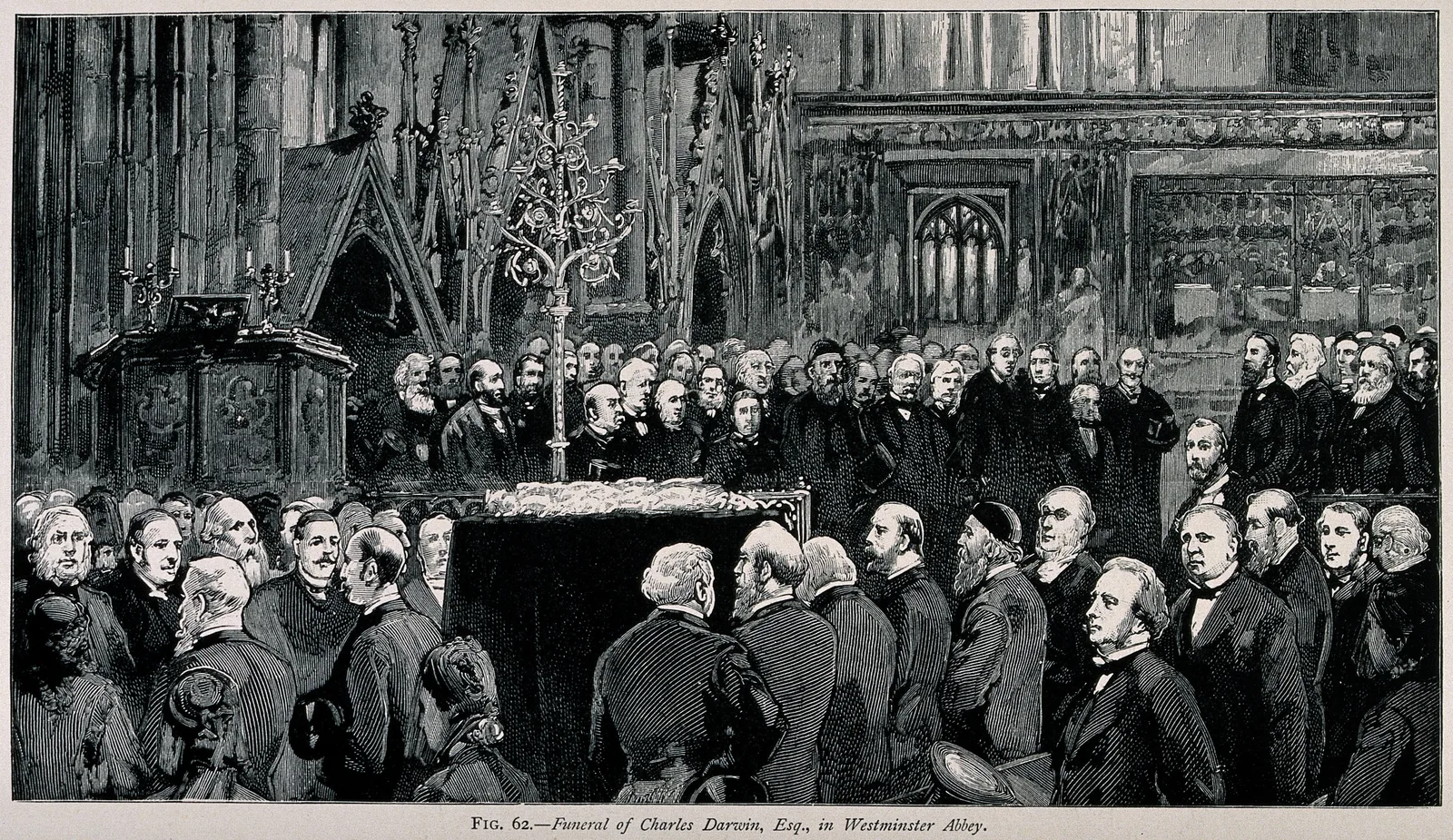
In April 1882 Hardy went to Darwin's funeral in Westminster Abbey.17 In January 1888 a clergyman, the Reverend Dr Grosart, wrote to him in good faith asking how to reconcile the horrors of nature "with the absolute goodness and non-limitation of God."35 Hardy's answer was brief and polite: "Mr. Hardy regrets that he is unable to suggest any hypothesis which would reconcile the existence of such evils as Dr. Grosart describes with the idea of omnipotent goodness." He pointed him to the life of Darwin and the works of Herbert Spencer "and other agnostics."3637
Tess and Jude
The novels carried the doubt into public. Tess of the d'Urbervilles (1891) ends with a hanging and a sentence that offended many readers: "'Justice' was done, and the President of the Immortals, in Aeschylean phrase, had ended his sport with Tess."38 When a critic complained, Hardy answered that "to exclaim illogically against the gods, singular or plural, is not such an original sin of mine as he seems to imagine," and added, "a novel is an impression, not an argument."394041 On Good Friday 1892, after reading a hostile review, he wrote: "no more novel-writing for me."42
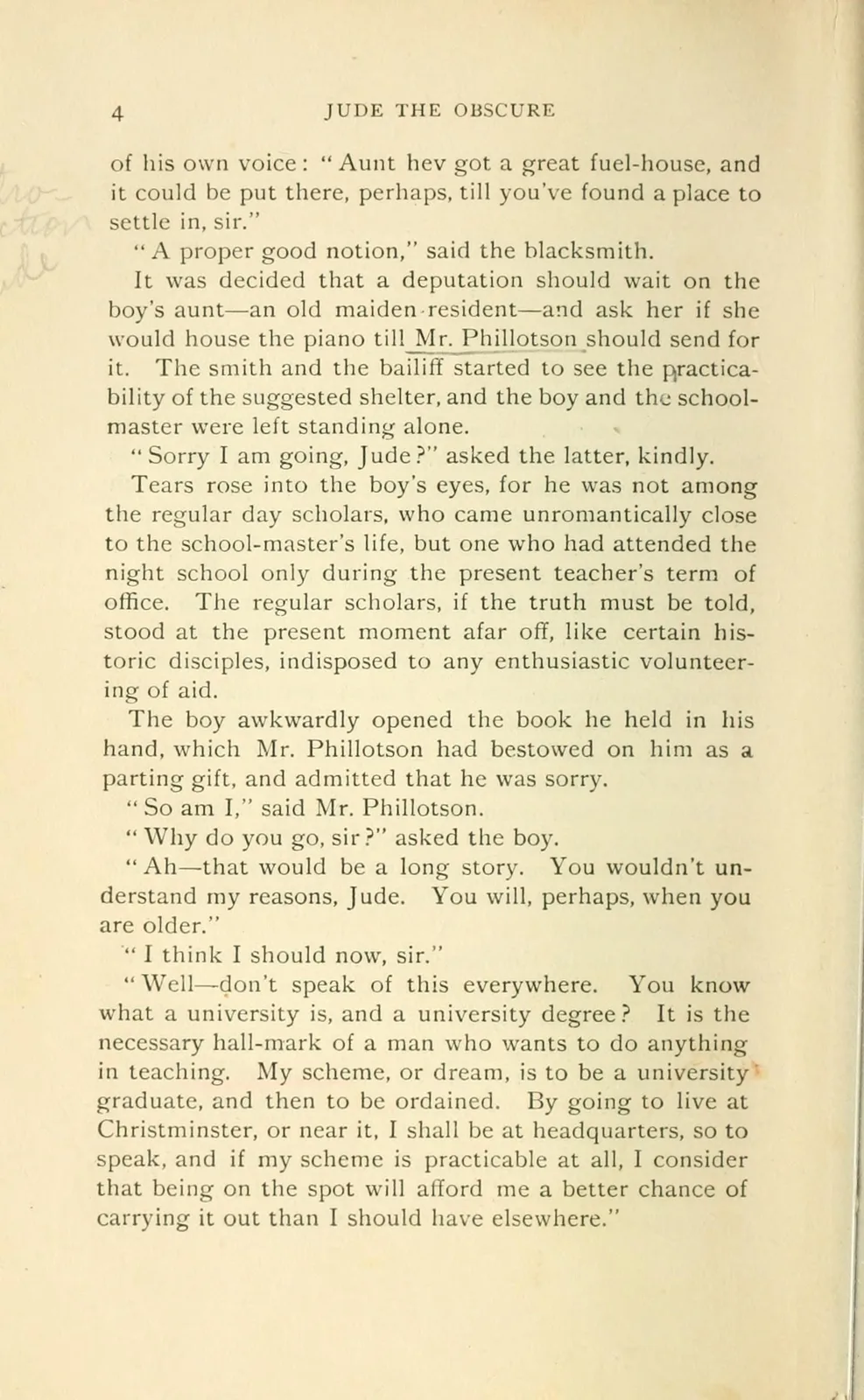
Jude the Obscure came out on 1 November 1895. It is the story of a working man who dreams of the university and the priesthood and loses both, and it ends with Jude dying alone with the words of Job: "Let the day perish wherein I was born."4344 Hardy called the book "simply an endeavor to give shape and coherence to a series of seemings, or personal impressions."45 Many reviewers read it as a manifesto against marriage, which Hardy denied.46 Margaret Oliphant, in "The Anti-Marriage League," an essay unsigned in Blackwood's that her own letter later acknowledged, condemned what she called "the curious development of shameless Innocence, more dangerous than folly, more appalling almost than vice," though she admitted she could not tell what Hardy's motive was.4748 Then came the bishop's letter. The letter itself names only "one of Mr. Hardy's novels"; the Life takes it to be Jude, and adds that he persuaded W. H. Smith's library to withdraw the book.1
Hardy thought that if the bishop had known him, he would have found a man whose "views of morality, and of the vital facts of religion, hardly differed from his own."49 He noted the trap he was in: "Tragedy may be created by an opposing environment either of things inherent in the universe, or of human institutions. If the former be the means exhibited and deplored, the writer is regarded as impious; if the latter, as subversive and dangerous."5051 The attacks, the Life says, "well-nigh compelled him" to give up the novel, and he went back to the verse he had been writing since 1865.5253
The impercipient
His first book of poems, Wessex Poems (1898), printed "Hap" at last, and beside it a poem set at a cathedral service. In "The Impercipient" he stands among worshippers whose faith he cannot share: "That from this bright believing band / An outcast I should be, / That faiths by which my comrades stand / Seem fantasies to me, / And mirage-mists their Shining Land, / Is a drear destiny."54 He does not mock them. He asks for their sympathy, and resents only their charge "that blessed things / I'd liefer have unbe."5556
At the very end of 1900 he wrote "The Darkling Thrush," in which an old bird sings into a dead winter landscape, and the poet wonders at "Some blessed Hope, whereof he knew / And I was unaware."5758 In The Dynasts (1904–08) he gave the universe a governing "Immanent Will" that "works unconsciously"; critics took it for a cruel God, and he answered that he had never held a "malignant and fiendish" God, only "an indifferent and unconscious force at the back of things 'that neither good nor evil knows.'"59606162
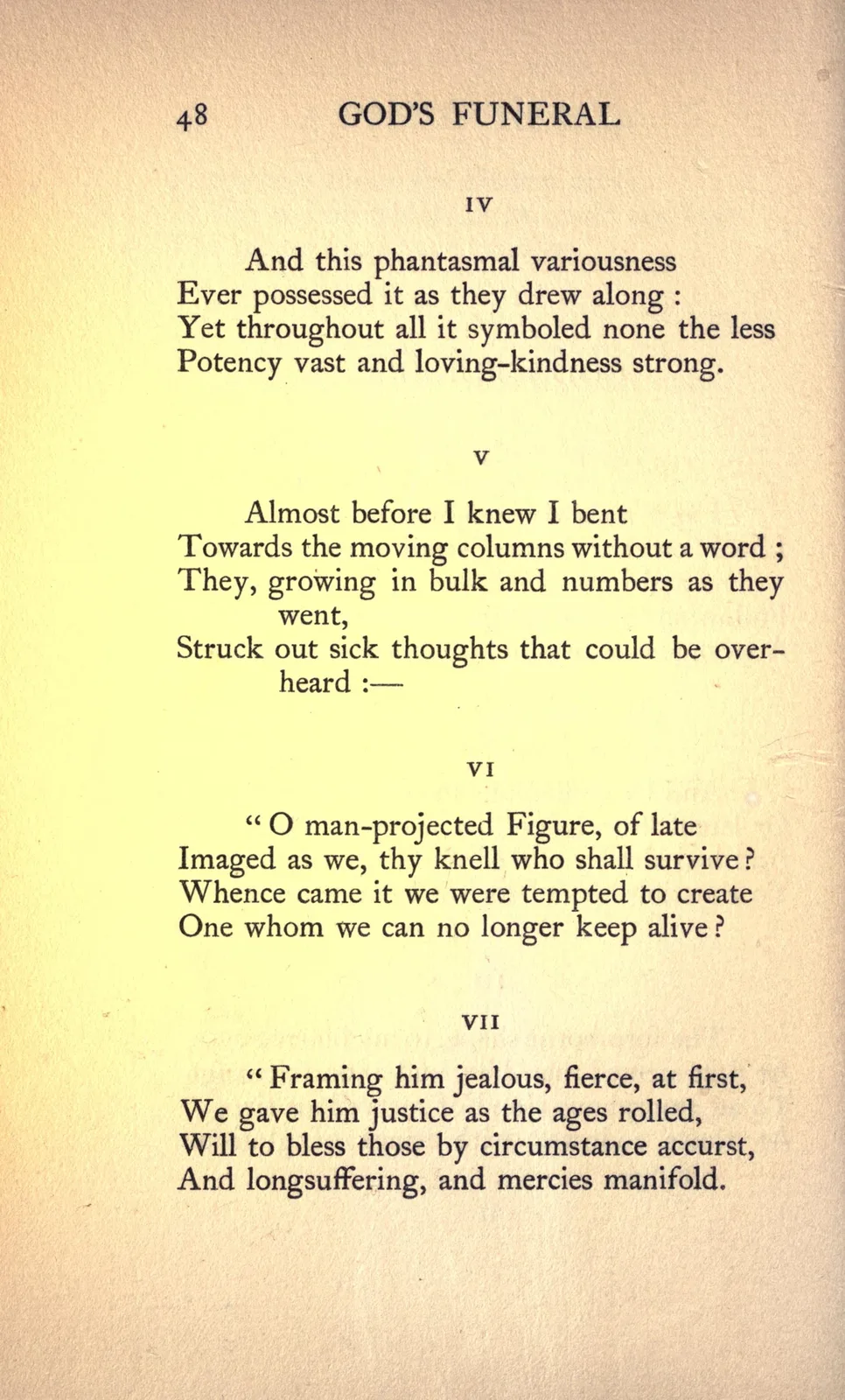
Between 1908 and 1910 he wrote "God's Funeral," printed in 1914. A procession of mourners carries the body of God, and they understand at last what they have been worshipping: "O man-projected Figure, of late / Imaged as we, thy knell who shall survive? / Whence came it we were tempted to create / One whom we can no longer keep alive?" and "Our making soon our maker did we deem, / And what we had imagined we believed."636465 The poet walks with them but is not one of them, and he closes in his own voice: "I could not prop their faith: and yet / Many I had known: with all I sympathized; / And though struck speechless, I did not forget / That what was mourned for, I, too, once had prized."66
Churchy
He did not stop going to church, and he kept saying why. In January 1907 he wrote a note on "the hard case of the would-be-religious": "We enter church, and we have to say, 'We have erred and strayed from Thy ways like lost sheep', when what we want to say is, 'Why are we made to err and stray like lost sheep?'" Then "we have to sing, 'My soul doth magnify the Lord'," when what he wanted was this: "O that my soul could find some Lord that it could magnify! Till it can, let us magnify good works." If the services could not change, "we must leave. And if we do, we reluctantly go to the door, and creep out as it creaks complainingly behind us."67686970
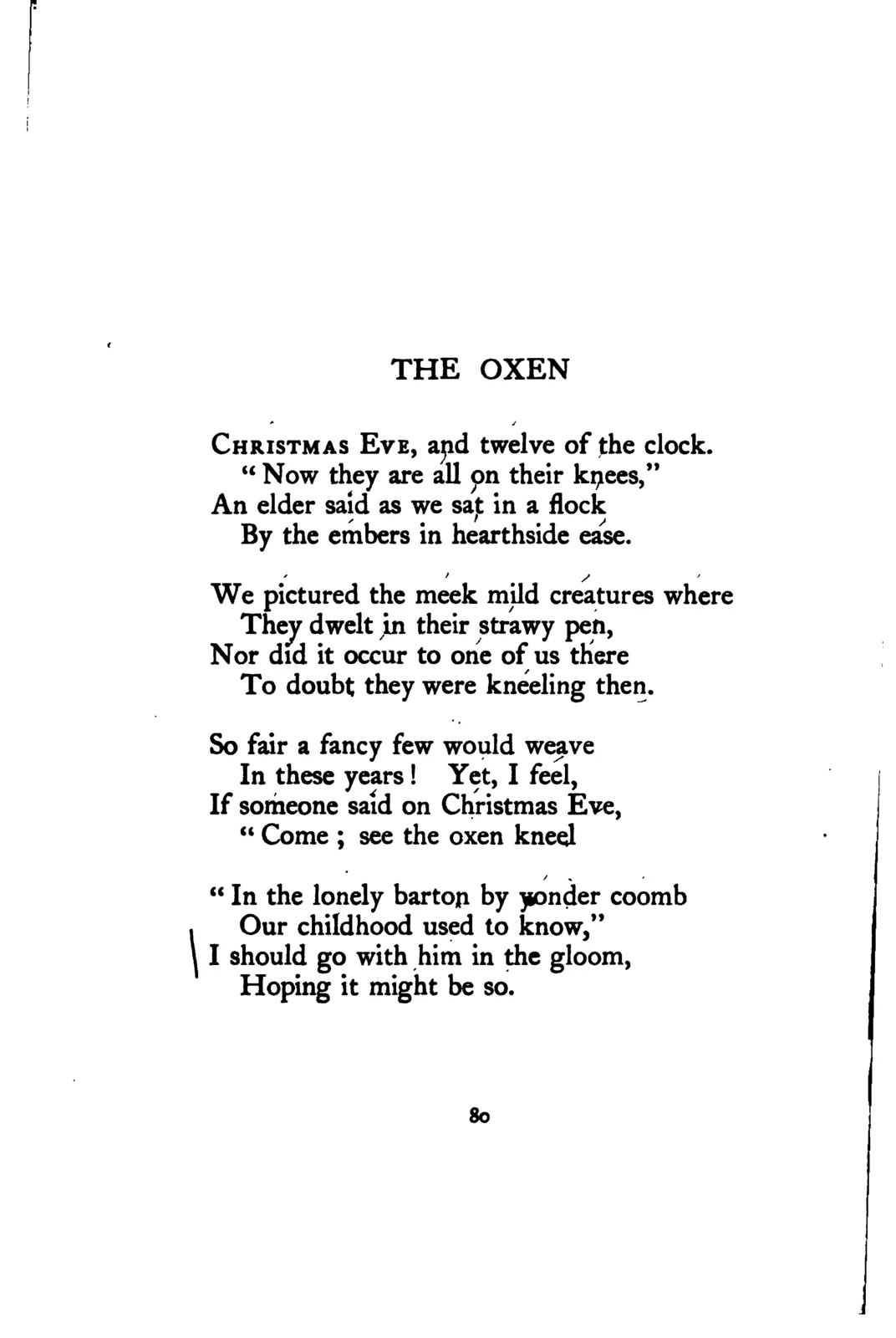
During the war he wrote "The Oxen," on the belief, which the poem calls a fancy, that the cattle kneel in their stalls on Christmas Eve: "If someone said on Christmas Eve, / 'Come; see the oxen kneel / In the lonely barton by yonder coomb / Our childhood used to know,' / I should go with him in the gloom, / Hoping it might be so."7172
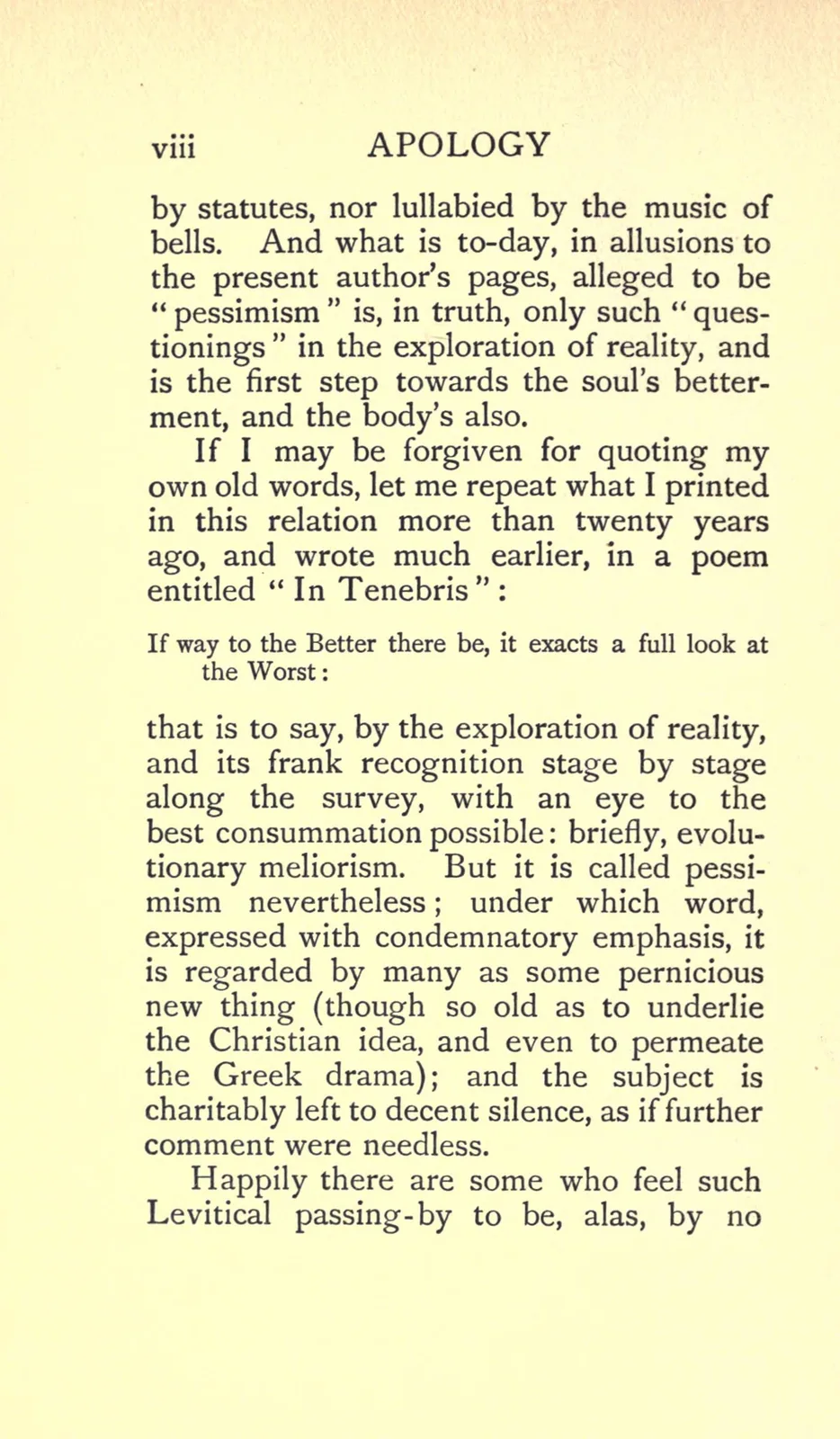
About the labels, he was exact. In 1917 he wrote that "no modern thinker can be an atheist in the modern sense, while all modern thinkers are atheists in the ancient and exploded sense." Critics had called him nonconformist, agnostic, atheist, infidel, immoralist, heretic and pessimist, but "they had never thought of calling him what they might have called him much more plausibly — churchy; not in an intellectual sense, but in so far as instincts and emotions ruled."107374 He was not a pessimist either, he insisted: his creed was "evolutionary meliorism," the belief that "if way to the Better there be, it exacts a full look at the Worst."757677 In the same 1922 preface he hoped the Church might yet open its doors to doubters, "with the gathering of many millions of waiting agnostics into its fold," and asked what other English institution was left "to keep the shreds of morality together."7879 Poetry and religion, he wrote, "touch each other, or rather modulate into each other; are, indeed, often but different names for the same thing."80
The critics
G. K. Chesterton, the critic and Christian apologist, was not persuaded. He wrote in 1913 that "Hardy became a sort of village atheist brooding and blaspheming over the village idiot," and that "Mr. Hardy is anthropomorphic out of sheer atheism. He personifies the universe in order to give it a piece of his mind."8182 Hardy's friend Frederic Harrison, a Positivist, said simply, "This view of life is not mine."83 A kinder judgment came after his death from a clergyman writing in the journal Theology, who said that from Hardy a reader "would learn the essential dignity of country people and what deep and often passionate interest belongs to every individual life."84
Two burials
On 23 December 1927 carol-singers from St Peter's, Dorchester came to Max Gate and sang "While Shepherds Watched" to the tune his father and grandfather had played in the Stinsford gallery.85 Three days later, hearing the Nativity read, he remarked "that there was not a grain of evidence that the gospel story was true in any detail."8687 He died at Max Gate shortly after nine in the evening of 11 January 1928.88
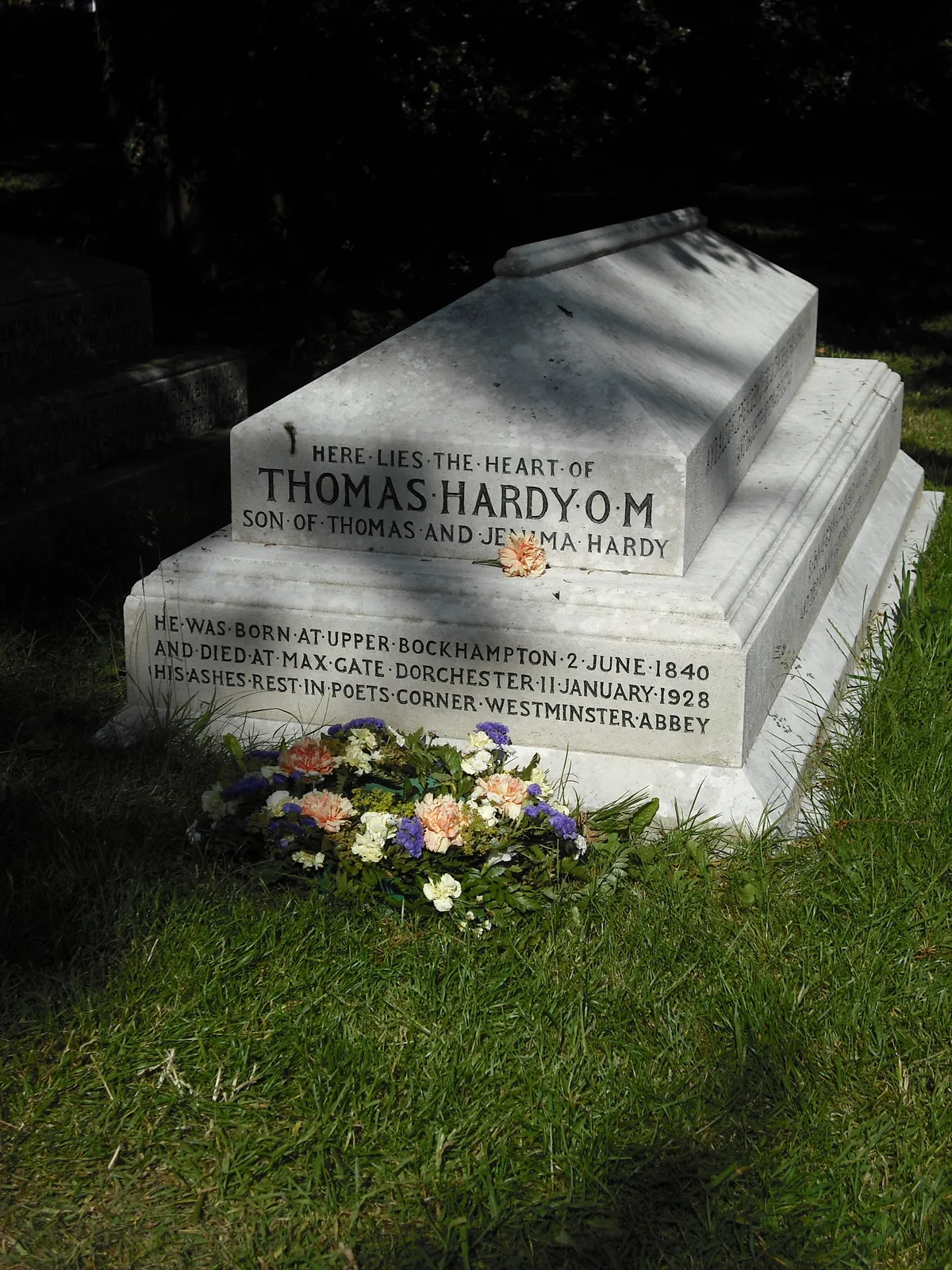
He had wished to be buried at Stinsford, among his family and beside his first wife.89 But the Dean of Westminster consented to a burial in the Abbey. So his heart was removed and his body cremated, and at two o'clock on 16 January there were services at once in the Abbey, at Stinsford and in Dorchester: his ashes went into Poets' Corner, with Stanley Baldwin, Ramsay MacDonald, Kipling, Barrie, Shaw and Housman among the pall-bearers, and his heart was buried at Stinsford, "where Hardy was baptized, and where as boy and man he had often worshipped," in the grave of his first wife.909192
What he left
Hardy's unbelief changed shape less than his reputation did. The boy lost the faith of the gallery and the Sunday school in his twenties, through the new criticism, Darwin, and a reading of Newman whose chain of reasoning, he found, had no first link; he kept the loss to himself for thirty years; and when he finally said it in public, first in a novel and then in poems, he said it as grief rather than triumph. He would not call himself an atheist, because he thought the word belonged to an older quarrel, and he would not stop loving the church he could not believe in. Leslie Stephen, whose deed renouncing holy orders Hardy witnessed, had taken the same road more quietly, and he has his own chapter in this book.
Footnotes
-
Frederick Douglas How, Bishop Walsham How: A Memoir (Isbister, London, 1898), pp. 343–45; Florence Emily Hardy [with Thomas Hardy], The Later Years of Thomas Hardy, 1892–1928 (Macmillan, London, 1930), p. 48. Accounts differ; see the disputed points. ↩ ↩2
-
William Walsham How, Bishop of Wakefield, letter to the Yorkshire Post, 8 June 1896: How, Bishop Walsham How, p. 344. ↩
-
Later Years of Thomas Hardy, p. 39. ↩
-
Florence Emily Hardy [with Thomas Hardy], The Early Life of Thomas Hardy, 1840–1891 (Macmillan, London, 1928), p. 1. ↩
-
Early Life of Thomas Hardy, pp. 10–11. ↩
-
Early Life of Thomas Hardy, p. 19. ↩
-
The Life (third person): Early Life of Thomas Hardy, p. 19. ↩
-
Early Life of Thomas Hardy, p. 23. ↩
-
Early Life of Thomas Hardy, p. 32. ↩
-
Early Life of Thomas Hardy, pp. 34–35. ↩
-
Early Life of Thomas Hardy, pp. vii–viii. ↩
-
Early Life of Thomas Hardy, pp. 38–40, 42. ↩
-
Early Life of Thomas Hardy, p. 39. ↩
-
Early Life of Thomas Hardy, p. 41. ↩
-
Early Life of Thomas Hardy, p. 43. ↩
-
Early Life of Thomas Hardy, pp. 47–48. ↩
-
Early Life of Thomas Hardy, pp. 63–64. ↩
-
Early Life of Thomas Hardy, p. 64. ↩
-
Early Life of Thomas Hardy, p. 66. ↩
-
The Life (third person, Hardy's memoranda): Early Life of Thomas Hardy, p. 66. Not checked against the original (partly). ↩
-
Early Life of Thomas Hardy, p. 66. Not verified. ↩
-
Early Life of Thomas Hardy, p. 71; Thomas Hardy, Wessex Poems and Other Verses (1898; the IA copy is the 1899 printing), pp. 7–8. ↩
-
Hardy, Wessex Poems and Other Verses, pp. 7–8. ↩
-
Hardy, Wessex Poems and Other Verses, (1899 printing) pp. 7–8; dated 1866. ↩
-
Early Life of Thomas Hardy, p. 76. ↩
-
Early Life of Thomas Hardy, pp. 70–71. ↩
-
Early Life of Thomas Hardy, p. 126. Reported at second hand; the original has not been seen. ↩
-
Early Life of Thomas Hardy, pp. 48, 125–26. ↩
-
Early Life of Thomas Hardy, p. 139 (Hardy's account as printed in Maitland's Life of Leslie Stephen). ↩
-
Early Life of Thomas Hardy, p. 139. ↩
-
Early Life of Thomas Hardy, p. 139. ↩
-
Early Life of Thomas Hardy, p. 139. ↩
-
The Rev. Dr A. B. Grosart, writing in good faith, January 1888: Early Life of Thomas Hardy, p. 269. ↩
-
Early Life of Thomas Hardy, p. 269. ↩
-
Early Life of Thomas Hardy, p. 269. ↩
-
Thomas Hardy, Tess of the d'Urbervilles: A Pure Woman Faithfully Presented (Osgood, McIlvaine, 1893 printing, with the Explanatory Note of Nov. 1891 and the Preface of July 1892), (1893 printing), Phase the Seventh, final chapter. Often quoted without "in Aeschylean phrase". ↩
-
Hardy, Tess of the d'Urbervilles, Preface pp. xi–xii. ↩
-
Hardy, Tess of the d'Urbervilles, Preface p. xi. ↩
-
Hardy, Tess of the d'Urbervilles, Preface p. x. ↩
-
Later Years of Thomas Hardy, p. 7. ↩
-
Later Years of Thomas Hardy, p. 38; Thomas Hardy, Jude the Obscure (Harper, New York, 1896, copyright 1895; Preface Aug. 1895), Preface. ↩
-
Jude Fawley, dying (Job 3:3): Hardy, Jude the Obscure, (Harper, 1896) p. 482. ↩
-
Hardy, Jude the Obscure, (Harper, 1896) p. iv. ↩
-
Later Years of Thomas Hardy, pp. 40–41. ↩
-
"The Anti-Marriage League" (same): "The Anti-Marriage League", Blackwood's Edinburgh Magazine, vol. 159, no. 963 (January 1896), pp. 135–49, p. 136. ↩
-
"The Anti-Marriage League", Blackwood's, January 1896 (Mrs M. O. W. Oliphant, novelist and reviewer; unsigned in the scan): Blackwood's Edinburgh Magazine, p. 139. ↩
-
Later Years of Thomas Hardy, p. 49. ↩
-
Later Years of Thomas Hardy, p. 44. ↩
-
Later Years of Thomas Hardy, p. 44. ↩
-
Later Years of Thomas Hardy, pp. 65–66. ↩
-
Later Years of Thomas Hardy, p. 66. ↩
-
Hardy, Wessex Poems and Other Verses, pp. 167–71. ↩
-
Hardy, Wessex Poems and Other Verses, pp. 167–71. ↩
-
Hardy, Wessex Poems and Other Verses, pp. 167–71. ↩
-
Thomas Hardy, Poems of the Past and the Present (1901; the IA copy is the 1903 printing), pp. 169–71; Later Years of Thomas Hardy, p. 87. ↩
-
Hardy, Poems of the Past and…, (1903) pp. 169–71; dated December 1900. ↩
-
Later Years of Thomas Hardy, App. II, pp. 269–70 (letter to Saleeby, 21 Dec 1914). ↩
-
Later Years of Thomas Hardy, p. 128. ↩
-
Shade of the Earth / Spirit of the Years, The Dynasts, Fore Scene: Thomas Hardy, The Dynasts (Macmillan, 1906 edition, with the Preface), p. 1. ↩
-
The Life (third person): Later Years of Thomas Hardy, p. 128. ↩
-
Thomas Hardy, Satires of Circumstance, Lyrics and Reveries, with Miscellaneous Pieces (Macmillan, 1914), pp. 47–51. ↩
-
The mourners in "God's Funeral" (1908–10): Hardy, Satires of Circumstance, (1914) p. 48. ↩
-
The mourners, "God's Funeral": Hardy, Satires of Circumstance, p. 49. ↩
-
The speaker, "God's Funeral": Hardy, Satires of Circumstance, p. 50. ↩
-
Later Years of Thomas Hardy, p. 121. ↩
-
Later Years of Thomas Hardy, p. 121. ↩
-
Later Years of Thomas Hardy, pp. 121–22. ↩
-
Later Years of Thomas Hardy, p. 122. ↩
-
Thomas Hardy, Moments of Vision and Miscellaneous Verses (Macmillan, 1917), (page not legible); Later Years of Thomas Hardy, p. 171. ↩
-
Hardy, Moments of Vision and Miscellaneous Verses, (1917), "The Oxen" (page not legible in OCR). ↩
-
Later Years of Thomas Hardy, p. 176. ↩
-
The Life (third person): Later Years of Thomas Hardy, p. 176. ↩
-
Thomas Hardy, Late Lyrics and Earlier, with Many Other Verses (Macmillan, 1922), with the "Apology", pp. vi–xviii. ↩
-
Hardy, Late Lyrics and Earlier, Apology p. viii. ↩
-
Hardy, Late Lyrics and Earlier, p. viii. ↩
-
Hardy, Late Lyrics and Earlier, p. xvii. ↩
-
Hardy, Late Lyrics and Earlier, p. xvii. ↩
-
Hardy, Late Lyrics and Earlier, p. xvi. ↩
-
G. K. Chesterton, critic and Christian apologist: G. K. Chesterton, The Victorian Age in Literature (Williams and Norgate / Holt, 1913), (1913) p. 143. ↩
-
G. K. Chesterton: Chesterton, Victorian Age in Literature, p. 144. ↩
-
Frederic Harrison, Positivist and friend of Hardy, as quoted in Hardy's Apology: Hardy, Late Lyrics and Earlier, p. x. ↩
-
A clergyman of the Church of England, article in Theology, August 1928, quoted by the Life: Later Years of Thomas Hardy, p. 49 n.. ↩
-
Later Years of Thomas Hardy, p. 250. ↩
-
Later Years of Thomas Hardy, p. 264. ↩
-
The Life (26 December 1927): Later Years of Thomas Hardy, p. 264. ↩
-
Later Years of Thomas Hardy, pp. 265–66. ↩
-
Later Years of Thomas Hardy, p. 267. ↩
-
Later Years of Thomas Hardy, App. I pp. 267 (by H. C.). ↩
-
Later Years of Thomas Hardy, App. I pp. 267–68. ↩
-
Later Years of Thomas Hardy, p. 268. ↩
In their own words
But not so. How arrives it joy lies slain, / And why unblooms the best hope ever sown? — / Crass Casualty obstructs the sun and rain, / And dicing Time for gladness casts a moan. . . . / These purblind Doomsters had as readily strown / Blisses about my pilgrimage as pain.
If but some vengeful god would call to me / From up the sky, and laugh: "Thou suffering thing, / Know that thy sorrow is my ecstasy, / That thy love's loss is my hate's profiting!" / Then would I bear, and clench myself, and die, / Steeled by the sense of ire unmerited; / Half-eased, too, that a Powerfuller than I / Had willed and meted me the tears I shed.
That from this bright believing band / An outcast I should be, / That faiths by which my comrades stand / Seem fantasies to me, / And mirage-mists their Shining Land, / Is a drear destiny.
Since heart of mine knows not that ease / Which they know; since it be / That He who breathes All's Well to these / Breathes no All's Well to me, / My lack might move their sympathies / And Christian charity!
Yet I would bear my shortcomings / With meet tranquillity, / But for the charge that blessed things / I'd liefer have unbe.
So fair a fancy few would weave / In these years! Yet, I feel, / If someone said on Christmas Eve, / "Come; see the oxen kneel / "In the lonely barton by yonder coomb / Our childhood used to know," / I should go with him in the gloom, / Hoping it might be so.
O man-projected Figure, of late / Imaged as we, thy knell who shall survive? / Whence came it we were tempted to create / One whom we can no longer keep alive?
Our making soon our maker did we deem, / And what we had imagined we believed.
I could not prop their faith: and yet / Many I had known: with all I sympathized; / And though struck speechless, I did not forget / That what was mourned for, I, too, once had prized.
So little cause for carollings / Of such ecstatic sound / Was written on terrestrial things / Afar or nigh around, / That I could think there trembled through / His happy good-night air / Some blessed Hope, whereof he knew / And I was unaware.
If way to the Better there be, it exacts a full look at the Worst
by the exploration of reality, and its frank recognition stage by stage along the survey, with an eye to the best consummation possible: briefly, evolutionary meliorism.
poetry, pure literature in general, religion — I include religion because poetry and religion touch each other, or rather modulate into each other; are, indeed, often but different names for the same thing
a flank march which I at the time quite expected to witness, with the gathering of many millions of waiting agnostics into its fold
what other purely English establishment than the Church, of sufficient dignity and footing, and with such strength of old association, such architectural spell, is left in this country to keep the shreds of morality together?
"Justice" was done, and the President of the Immortals, in Aeschylean phrase, had ended his sport with Tess.
I can assure this great critic that to exclaim illogically against the gods, singular or plural, is not such an original sin of mine as he seems to imagine.
Let me repeat that a novel is an impression, not an argument
simply an endeavor to give shape and coherence to a series of seemings, or personal impressions
Let the day perish wherein I was born, and the night in which it was said, There is a man child conceived.
Tragedy may be created by an opposing environment either of things inherent in the universe, or of human institutions. If the former be the means exhibited and deplored, the writer is regarded as impious; if the latter, as subversive and dangerous
This fell through less because of its difficulty than from a conscientious feeling, after some theological study, that he could hardly take the step with honour while holding the views which on examination he found himself to hold
One day (March 23, 1875) I received from Stephen a mysterious note asking me to call in the evening
he wanted me to witness his signature to what, for a moment, I thought was his will; but it turned out to be a deed renunciatory of holy-orders under the act of 1870
Mr. Hardy regrets that he is unable to suggest any hypothesis which would reconcile the existence of such evils as Dr. Grosart describes with the idea of omnipotent goodness.
We enter church, and we have to say, 'We have erred and strayed from Thy ways like lost sheep', when what we want to say is, 'Why are we made to err and stray like lost sheep?'
O that my soul could find some Lord that it could magnify! Till it can, let us magnify good works
This must not be; we must leave. And if we do, we reluctantly go to the door, and creep out as it creaks complainingly behind us.
Thus no modern thinker can be an atheist in the modern sense, while all modern thinkers are atheists in the ancient and exploded sense.
they had never thought of calling him what they might have called him much more plausibly — churchy; not in an intellectual sense, but in so far as instincts and emotions ruled
merely surmising an indifferent and unconscious force at the back of things "that neither good nor evil knows"
the abandonment of the masculine pronoun in allusions to the First or Fundamental Energy seemed a necessary and logical consequence of the long abandonment by thinkers of the anthropomorphic conception of the same
What of the Immanent Will and Its designs? / It works unconsciously, as heretofore, / Eternal artistries in Circumstance
He remarked that there was not a grain of evidence that the gospel story was true in any detail.
Only — and here comes the fatal catastrophe — there is no first link to his excellent chain of reasoning, and down you come headlong.
Pessimism (or rather what is called such) is, in brief, playing the sure game. You cannot lose at it; you may gain.
Half my time (particularly when I write verse) I believe — in the modern use of the word — not only in things that Bergson does, but in spectres, mysterious voices, intuitions, omens, dreams, haunted places
Everybody said that Tommy would have to be a parson, being obviously no good for any practical pursuit
The other side
On the authority of one of those reviews which you justly condemn for this reticence, I bought a copy of one of Mr. Hardy's novels, but was so disgusted with its insolence and indecency that I threw it into the fire.
We can with difficulty guess what is Mr Hardy's motive in portraying such a struggle. It can scarcely be said to be one of those attacks upon the institution of Marriage, which is the undisguised inspiration of some of the other books before us.
Indeed one of the things most conspicuous in this new method is the curious development of shameless Innocence, more dangerous than folly, more appalling almost than vice
Hardy became a sort of village atheist brooding and blaspheming over the village idiot.
But Mr. Hardy is anthropomorphic out of sheer atheism. He personifies the universe in order to give it a piece of his mind.
The problem is how to reconcile these with the absolute goodness and non-limitation of God.
I am shocked, appalled by this story!
This view of life is not mine.
From Thomas Hardy he would learn the essential dignity of country people and what deep and often passionate interest belongs to every individual life.
I suspect it is much more easy to make an example of the comparatively unknown than of a man like Hardy, who commands a great sale
Where accounts differ
| Point | One account | Another | How the page handles it |
|---|---|---|---|
| Who read the Greek Testament with Hardy | The brief says Horace Moule (assumption) | The Life says Bastow, the Baptist fellow-pupil; Moule brought Essays and Reviews (EL pp. 38–40, 43) | Follow the Life: Bastow for the Greek Testament, Moule for the new criticism |
| How far Hardy went towards ordination | He wrote to a Cambridge friend about matriculation and thought of a curacy, then dropped it on conscience (EL p. 66) | "had at one time as a young man begun reading for Cambridge with a view to taking Orders" (LY p. 176) | Say he planned it and abandoned it on conscience; "accounts differ" on how far he had gone |
| The bishop's book-burning | The bishop's letter says only "one of Mr. Hardy's novels" and "threw it into the fire" (How p. 344) | The Life reads it as Jude and links the Smith's-library story, whose book is unnamed in the memoir (LY p. 48; How pp. 343–44) | Say the bishop wrote that he burned a novel by Hardy; the Life takes it to be Jude |
| Authorship of the Life | Title page: Florence Emily Hardy; her Prefatory Note says Hardy put on paper chapter headings and memories (EL pp. vii–viii) | Later scholarship (Millgate, not seen): Hardy wrote it himself | State the dispute in the narration; use the Life as Hardy's own account |
| Date of "The Darkling Thrush" | "December 1900" in the 1901 volume (PPP p. 171) | The common "31 December 1900" (not in these sources) | Say "at the very end of 1900" |
| Moule's death | "tragic death", heard on 24 September (EL p. 126) | Suicide at Queens' College on 21 September (later scholarship, not seen) | Say "died suddenly"; do not state cause until a scholarly source is read |
| Who wrote "The Anti-Marriage League" | Unsigned in Blackwood's | Mrs Oliphant, by her own letter to the bishop ("my little paper"), as printed in How p. 345 | Attribute to Oliphant with that note |
| Hardy on the Immanent Will | Critics: a "malignant and fiendish God" | Hardy: only "an indifferent and unconscious force" (LY p. 128) | Give both |
List of illustrations
This page uses only public-domain and Creative Commons images; each is credited with its source and licence.
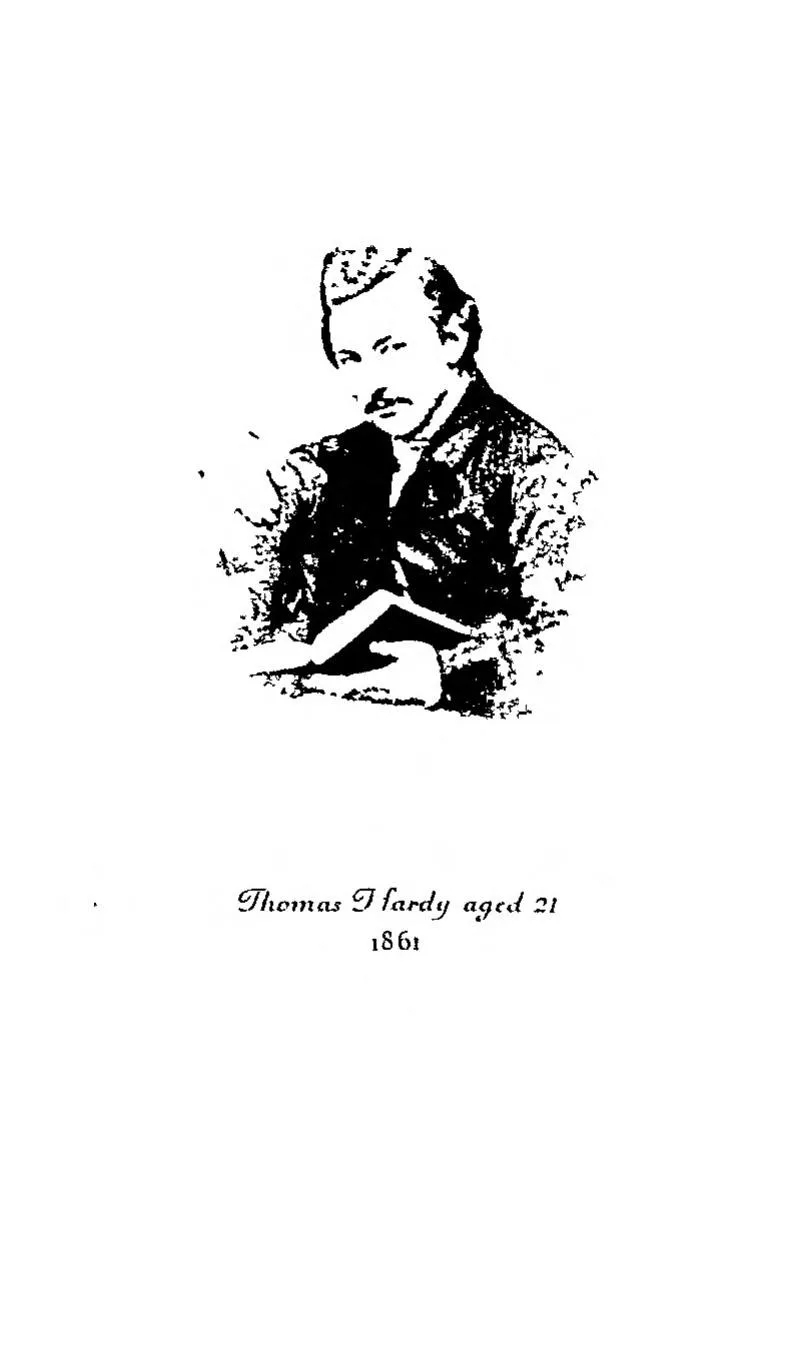
- Thomas Hardy, aged 21, 1861 (plate, Early Life) — Florence Emily Hardy (with Thomas Hardy), 1928 · Internet Archive, Early Life of Thomas Hardy (Macmillan, London, 1928); https://archive.org/details/in.ernet.dli.2015.128657 · Public domain (Macmillan, London, 1928; US publication before 1931)
- Thomas Hardy's birthplace, from a drawing made by him (plate, Early Life) — Florence Emily Hardy (with Thomas Hardy), 1928 · Internet Archive, Early Life of Thomas Hardy (Macmillan, London, 1928); https://archive.org/details/in.ernet.dli.2015.128657 · Public domain (Macmillan, London, 1928; US publication before 1931)
- Stinsford Church: The West Gallery — Mr Eugene Birchall, 2012-02-29 · Wikimedia Commons; Mr Eugene Birchall; Geograph Britain and Ireland; https://commons.wikimedia.org/wiki/File:Stinsford_Church,_The_West_Gallery_-_geograph.org.uk_-_2841109.jpg · CC BY-SA 2.0 (Wikimedia Commons)
- Essays and Reviews: essays and reviews title page — Various authors (London: John W. Parker and Son), 1860 · Internet Archive, Essays and Reviews (John W. Parker and Son, London, 1860); https://archive.org/details/ra578549600parkuoft · Public domain (John W. Parker and Son, London, 1860; US publication before 1931)
- Early Life of Thomas Hardy: early life no first link page — Florence Emily Hardy (with Thomas Hardy), 1928 · Internet Archive, Early Life of Thomas Hardy (Macmillan, London, 1928); https://archive.org/details/in.ernet.dli.2015.128657 · Public domain (Macmillan, London, 1928; US publication before 1931)
- Wessex Poems: wessex poems hap page — Thomas Hardy, 1898 · Internet Archive, Wessex Poems (Harper, 1899 printing); https://archive.org/details/wessexpoemsother00harduoft · Public domain (Harper, 1899 printing; US publication before 1931)
- Sir Leslie Stephen (1832–1904) father of Virginia Woolf and Vanessa Bell c. 1860 (photographer unknown) — Telrúnya 15:59, 22 January 2008 (UTC) (upload), circa 1860date QS:P,+1860-00-00T00:00:00Z/9,P1480,Q5727902 · Wikimedia Commons; Telrúnya 15:59, 22 January 2008 (UTC) (upload); Smith College [1]; https://commons.wikimedia.org/wiki/File:Leslie_Stephen_c1860.jpg · Public domain (Wikimedia Commons)
- The funeral ceremony of the Charles Darwin at Westminster Abbey, 26 April 1882. Wood engraving. Iconographic Collections Keywords: Thomas H. Huxley; James Russell Lowell; Alfred Russel Wallace; Charle — 1882 · Wikimedia Commons; unknown; https://wellcomeimages.org/indexplus/obf_images/0c/91/4c64b2a056d7809da00b5e929175.jpg Gallery: http; https://commons.wikimedia.org/wiki/File:The_funeral_ceremony_of_the_Charles_Darwin_at_Westminster_Ab_Wellcome_V0018693.jpg · CC BY 4.0 (Wikimedia Commons)
- Jude the Obscure: jude title page — Thomas Hardy, 1896 · Internet Archive, Jude the Obscure (Harper, New York, 1896); https://archive.org/details/judeobscure00hard · Public domain (Harper, New York, 1896; US publication before 1931)
- Bishop Walsham How: A Memoir: how memoir threw it into the fire — Frederick Douglas How, 1898 · Internet Archive, Bishop Walsham How: A Memoir (Isbister, London, 1898); https://archive.org/details/bishopwalshamhow00howf · Public domain (Isbister, London, 1898; US publication before 1931)
- Satires of Circumstance: gods funeral page 48 — Thomas Hardy, 1914 · Internet Archive, Satires of Circumstance (Macmillan, 1914); https://archive.org/details/satiresofcircums00harduoft · Public domain (Macmillan, 1914; US publication before 1931)
- Moments of Vision: the oxen page — Thomas Hardy, 1917 · Internet Archive, Moments of Vision (Macmillan, 1917); https://archive.org/details/momentsvisionan00hardgoog · Public domain (Macmillan, 1917; US publication before 1931)
- Late Lyrics and Earlier: apology meliorism page — Thomas Hardy, 1922 · Internet Archive, Late Lyrics and Earlier (Macmillan, 1922); https://archive.org/details/latelyricsearlie00hardiala · Public domain (Macmillan, 1922; US publication before 1931)
- Resting place of Thomas Hardy's heart, Stinsford — Martinevans123, 2009-06-15 · Wikimedia Commons; Martinevans123; Own work by the original uploader; https://commons.wikimedia.org/wiki/File:Thomas_Hardy%27s_heart.JPG · Public domain (Wikimedia Commons)
Sources
Tier 1 — the subject's own words (writings, letters, diaries, notebooks)
- [EL] Florence Emily Hardy [with Thomas Hardy], The Early Life of Thomas Hardy, 1840–1891 (Macmillan, London, 1928). IA in.ernet.dli.2015.128657. Text:
texts/early-life.txt. Includes Hardy's notebook entries and letters in his own words; the narrative is largely his (see Disputed points, authorship). - [LY] Florence Emily Hardy [with Thomas Hardy], The Later Years of Thomas Hardy, 1892–1928 (Macmillan, London, 1930). IA lateryearsofthom009186mbp. Text:
texts/later-years.txt. Appendix I (burial) is signed "H. C.". - [WP] Thomas Hardy, Wessex Poems and Other Verses (1898; the IA copy is the 1899 printing). IA wessexpoemsother00harduoft. Text:
texts/wessex-poems-1899.txt. - [PPP] Thomas Hardy, Poems of the Past and the Present (1901; the IA copy is the 1903 printing). IA poemsofpastandpr00harduoft. Text:
texts/poems-past-present-1903.txt. - [TL] Thomas Hardy, Time's Laughingstocks and Other Verses (1909). IA firsttimeslaughin00harduoft. Text:
texts/times-laughingstocks-1909.txt. Downloaded, not yet cited. - [SC] Thomas Hardy, Satires of Circumstance, Lyrics and Reveries, with Miscellaneous Pieces (Macmillan, 1914). IA satiresofcircums00harduoft. Text:
texts/satires-circumstance-1914.txt. Contains "God's Funeral". - [MV] Thomas Hardy, Moments of Vision and Miscellaneous Verses (Macmillan, 1917). IA momentsvisionan00hardgoog. Text:
texts/moments-of-vision-1917.txt. Contains "The Oxen". - [LL] Thomas Hardy, Late Lyrics and Earlier, with Many Other Verses (Macmillan, 1922), with the "Apology". IA latelyricsearlie00hardiala. Text:
texts/late-lyrics-1922.txt. - [Tess] Thomas Hardy, Tess of the d'Urbervilles: A Pure Woman Faithfully Presented (Osgood, McIlvaine, 1893 printing, with the Explanatory Note of Nov. 1891 and the Preface of July 1892). IA tessofdurbervill00hardrich. Text:
texts/tess-1893.txt; later Macmillan texttexts/tess-1913.txt(IA tessofdurbervill00harduoft). - [Jude] Thomas Hardy, Jude the Obscure (Harper, New York, 1896, copyright 1895; Preface Aug. 1895). IA judeobscure00hard. Text:
texts/jude-1895.txt. The 1912 Postscript is not in this edition. - [Dyn] Thomas Hardy, The Dynasts (Macmillan, 1906 edition, with the Preface). IA cu31924013477751. Text:
texts/dynasts-1906.txt.
Tier 2 — scholarly biographies and encyclopedias
- None freely scanned. Millgate, Thomas Hardy: A Biography (1982) and Gittings are in copyright and were not seen; the ghost-writing of the Life and Moule's suicide rest on them (see Disputed points).
Tier 3 — popular biographies and journalism
- [How] Frederick Douglas How, Bishop Walsham How: A Memoir (Isbister, London, 1898). IA bishopwalshamhow00howf. Text:
texts/how-memoir-1898.txt. Contains the bishop's letter of 8 June 1896.
Tier 4 — maps to other sources only (Wikipedia and similar). Never cited in the script.
- Wikipedia "Thomas Hardy" and "Jude the Obscure" (used only for the coordinates and the Pall Mall Gazette lead; nothing cited from them).
Opposition sources — contemporary critics and religious responses
- [BW] "The Anti-Marriage League", Blackwood's Edinburgh Magazine, vol. 159, no. 963 (January 1896), pp. 135–49. IA sim_blackwoods-magazine_1896-01_159_963. Text:
texts/blackwoods-1896-01.txt. Unsigned in the scan; attributed to Mrs Oliphant by the bishop's memoir (see Disputed points). - [Ches] G. K. Chesterton, The Victorian Age in Literature (Williams and Norgate / Holt, 1913). IA victorianageinli00chesuoft. Text:
texts/chesterton-1913.txt.
Related lives
Leslie Stephen (episode 38): Hardy witnessed Stephen's deed renouncing holy orders on 23 March 1875 and said Stephen influenced him deeply. (Alternatives: Darwin, if on the roster; Ingersoll, the public counterpart.)
Winwood Reade
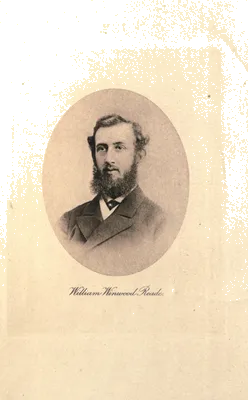
Winwood Reade was a failed Oxford novelist who wrote as a loyal Anglican in 1861. He went twice to West Africa and read Darwin and Spencer. In The Martyrdom of Man (1872), against his publisher's advice, he declared supernatural Christianity false and God-worship idolatry, while affirming a Supreme Power "higher than a Mind" and a religion of humanity. Reviewers called him an honest unbeliever. In the novel he wrote while dying, his narrator kept an incomprehensible God and allowed, of the afterlife, "I may be mistaken".
Ambrose Bierce
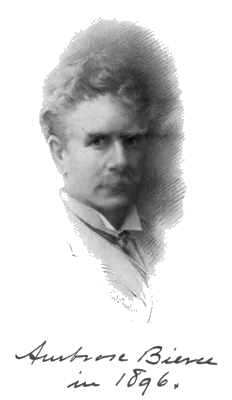
Ambrose Bierce was raised in a revivalist settlement whose religion he and his brother resented. He was wounded at Kennesaw, and his San Francisco colleagues remembered him as an author of atheistic tracts. He turned his unbelief into satire in The Devil's Dictionary (1881–1906), called himself an "infidel" who wished he were not one, and defended Ingersoll. In his last years, "not a Christian" but admiring Jesus next to Buddha, he asked a believing friend to pray for him before he vanished in Mexico at the end of 1913.
Friedrich Nietzsche
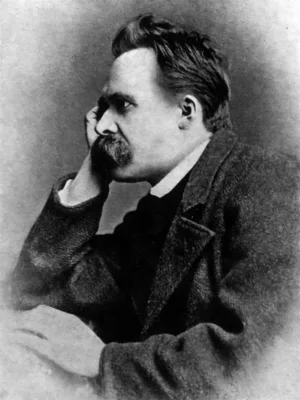
Nietzsche was a pastor's son who chose truth over peace at twenty. In 1882 he announced the death of God as a catastrophe Europe had not yet understood. He came to see his own unbelief not as the opposite of the faith he was raised in but as its last consequence: a Christian love of truth turned on Christianity itself.
Manuel González Prada
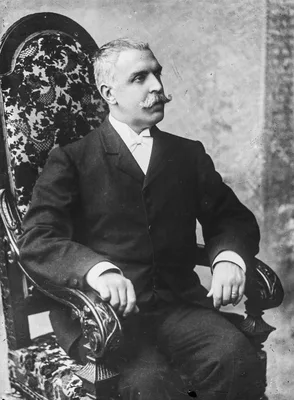
Manuel González Prada was the son of a noble and conservative Lima family, and his early beliefs are disputed: deist verses in 1871, a "resolute atheist" by his own late account. The lost War of the Pacific made him a public unbeliever, and he attacked the Church as a pillar of the order that had ruined Peru. He then told freethinkers that hating priests was not a philosophy, and moved on to anarchism. At the end he admitted doubts about his own disbelief, without returning to faith.