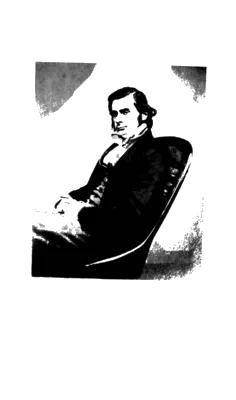
Thomas Henry Huxley was a self-taught boy who learned from Hamilton that some questions have no answers. He never had a creed to lose, but at his son's grave in 1860 he refused to pretend to one. In 1869 he named that refusal "agnostic", and defended the word against the bishops as a method rather than a sect. He ended by holding that morality runs against nature, and never once called himself an atheist.
The belief timeline
- Doubt (c. 1838–1850) — As a boy reads Hamilton and argues about church rates and the soul; by 1850 calls himself "too much of a heretic" [5][7][13]
- Confession (1860-09-23) — After Noel's death, tells Kingsley that he neither affirms nor denies immortality and will not lie about it [30]
- The name (1869) — Coins "agnostic" at the Metaphysical Society [37]
- Revision (1892–1893) — Prologue (naturalism does not deny Supernature) and "Evolution and Ethics" (the ethical process opposes the cosmic) [56][57]
Notes to the timeline (7)
- [5] As a boy he read Sir William Hamilton's essay on the unconditioned in an odd volume of the Edinburgh Review and Guizot; Hamilton gave him the conviction that some answers are "theoretically inconceivable" — Collected Essays, vol. V, Science and Christian Tradition (1894; the 1902 reprint scanned), with the Prologue (1892), "Agnosticism" (Nineteenth Century, Feb. 1889), "Agnosticism: A Rejoinder" (April 1889), "Agnosticism and Christianity" (June 1889), "The Keepers of the Herd of Swine" (Dec. 1890) and "Illustrations of Mr. Gladstone's Controversial Methods" (1891), p. 235–36; Leonard Huxley, Life and Letters of Thomas Henry Huxley, vol. I (New York: D. Appleton, 1900), with Huxley's letters, journal and the Autobiography extracts, p. 7, 234.
- [7] His boyhood journal "Thoughts and Doings" (begun 29 Sept 1840) records him arguing with his parents that Dissenters should not pay church rates, and with G. A. May about whether soul and matter are one substance — Huxley, Life and Letters of Thomas…, p. 9–11.
- [13] In a letter of 1850 to his sister he said he feared he was "too much of a heretic" to promise to bring a godson up a good son of the church — Huxley, Life and Letters of Thomas…, p. 67.
- [30] On 23 September 1860 Huxley answered Kingsley's letter of sympathy, saying he neither affirmed nor denied immortality, naming Carlyle, science and love as the agents of his moral life, and that all the younger men of science thought as he did — Huxley, Life and Letters of Thomas…, p. 233–39.
- [37] Huxley's account: after reasoning to a position that fitted none of the labels, he "invented" "agnostic" as antithetic to the "gnostic" of Church history and first "paraded" it at the Metaphysical Society — Collected Essays, vol. V, p. 237–39; Huxley, Life and Letters of Thomas…, p. 343–44.
- [56] In the 1892 Prologue he says scientific Naturalism leads not to denying Supernature but to denying the validity of the evidence for any extant supernaturalism, and takes refuge in "that agnostic confession" — Collected Essays, vol. V, p. 39–40.
- [57] In the Romanes Lecture of 1893 he argued that social progress checks the cosmic process and substitutes an ethical process — Collected Essays, vol. IX, Evolution and Ethics and other essays (1894), the Romanes Lecture of 1893, p. 81.
Still I Will Not Lie
In September 1860 a London scientist of thirty-five stood behind the coffin of his first son, Noel, who had died of scarlet fever at not quite four years old.1 The minister read the burial service, and one verse struck the father like a blow. "As I stood behind the coffin of my little son the other day, with my mind bent on anything but disputation," he wrote a week later, "the officiating minister read, as a part of his duty, the words, 'If the dead rise not again, let us eat and drink, for to-morrow we die.' I cannot tell you how inexpressibly they shocked me."23
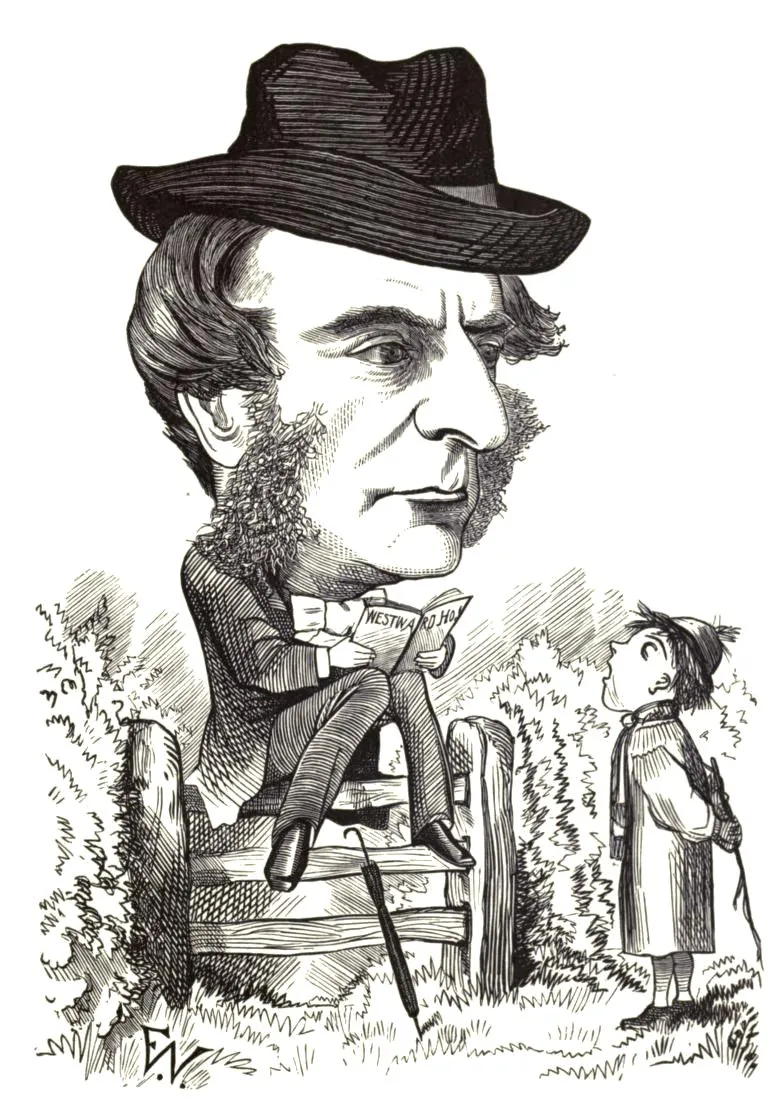
He was writing to Charles Kingsley, a clergyman and friend who had sent him a kind letter of sympathy. "I neither deny nor affirm the immortality of man. I see no reason for believing in it, but, on the other hand, I have no means of disproving it."24 Nine years later Thomas Henry Huxley found a name for that position, and the name stuck: agnostic. This chapter follows him from a boyhood of reading in Coventry to the coining of the word, and asks why a man so famous for fighting bishops refused, all his life, to call himself an atheist.
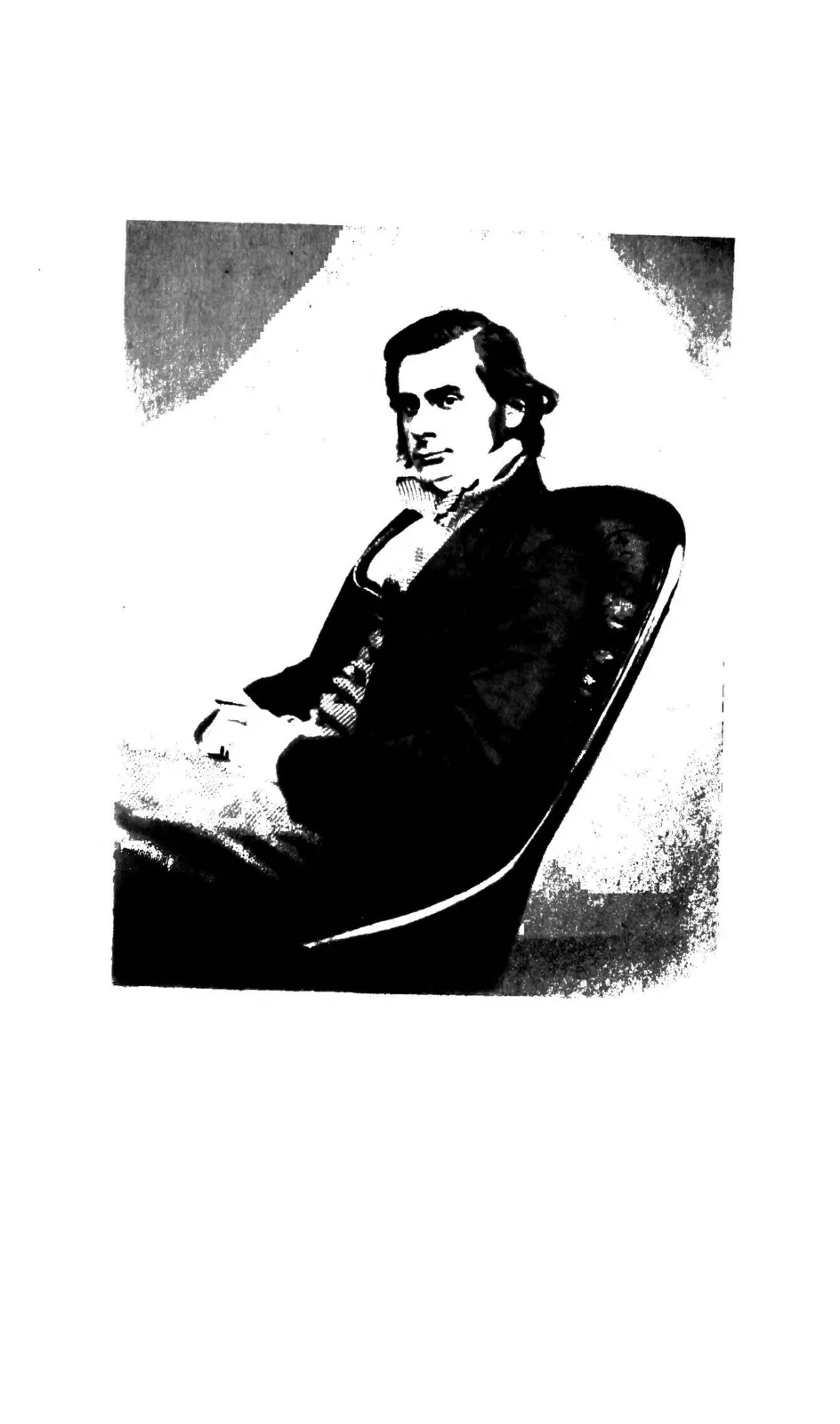
A self-taught boy
He was born at Ealing on 4 May 1825, the youngest surviving child of George Huxley, an assistant master at the school there, and Rachel Withers, a quick, emotional woman whom he loved passionately as a child.56 His schooling lasted two years, from eight to ten, at a school he called the worst society he ever knew; when it broke up the family moved to Coventry.7 After that he taught himself. At twelve he read Hutton's Geology by candlelight before dawn.8 Thomas Carlyle's Sartor Resartus became his handbook; Carlyle made him learn German and gave him "an intense hatred of shams."9
One essay mattered especially. As a boy he found, in an odd volume of the Edinburgh Review, Sir William Hamilton's essay on "the unconditioned," and it left him, he said, with "the strong conviction that, on even the most solemn and important of questions, men are apt to take cunning phrases for answers; and that the limitation of our faculties, in a great number of cases, renders real answers to such questions, not merely actually impossible, but theoretically inconceivable."1011 "From that time to this," he told Kingsley, "ontological speculation has been a folly to me."12
At fifteen he kept a journal called "Thoughts and Doings," in which he argued with his parents that Dissenters should not have to pay church rates, and with an older friend about whether soul and matter were one substance.13 He had no creed to lose in any dramatic way; his doubt was there from the start, and it grew with his reading.
The Rattlesnake
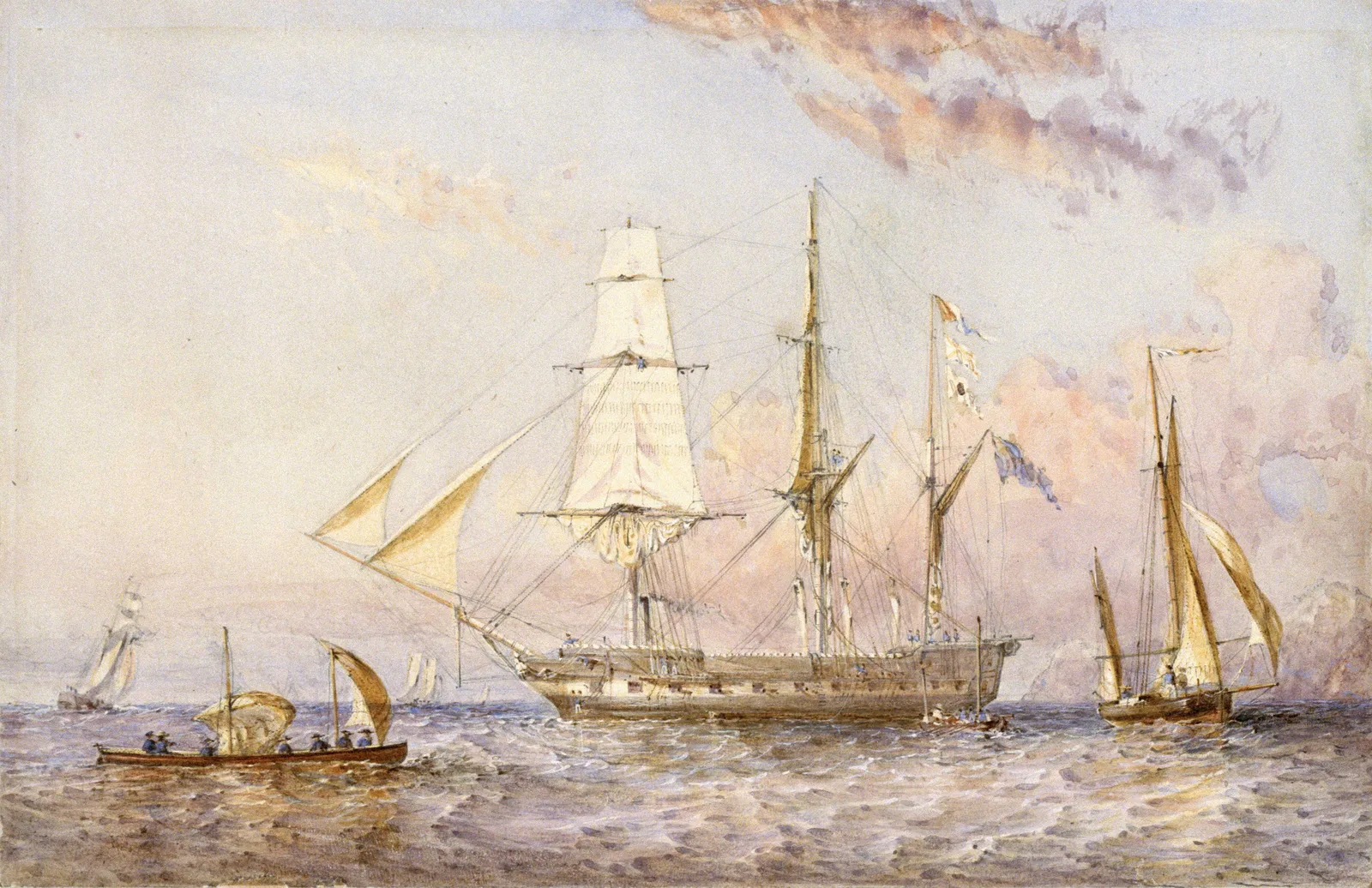
He studied medicine, first with his brother-in-law in Coventry and then among the dock poor of Rotherhithe as a doctor's assistant, and at the Charing Cross medical school, where one teacher, Wharton Jones, gave him a real education.1415 In 1846 he joined the navy as assistant surgeon on HMS Rattlesnake under Captain Owen Stanley.16 She sailed on 3 December 1846 and came home four years later.17
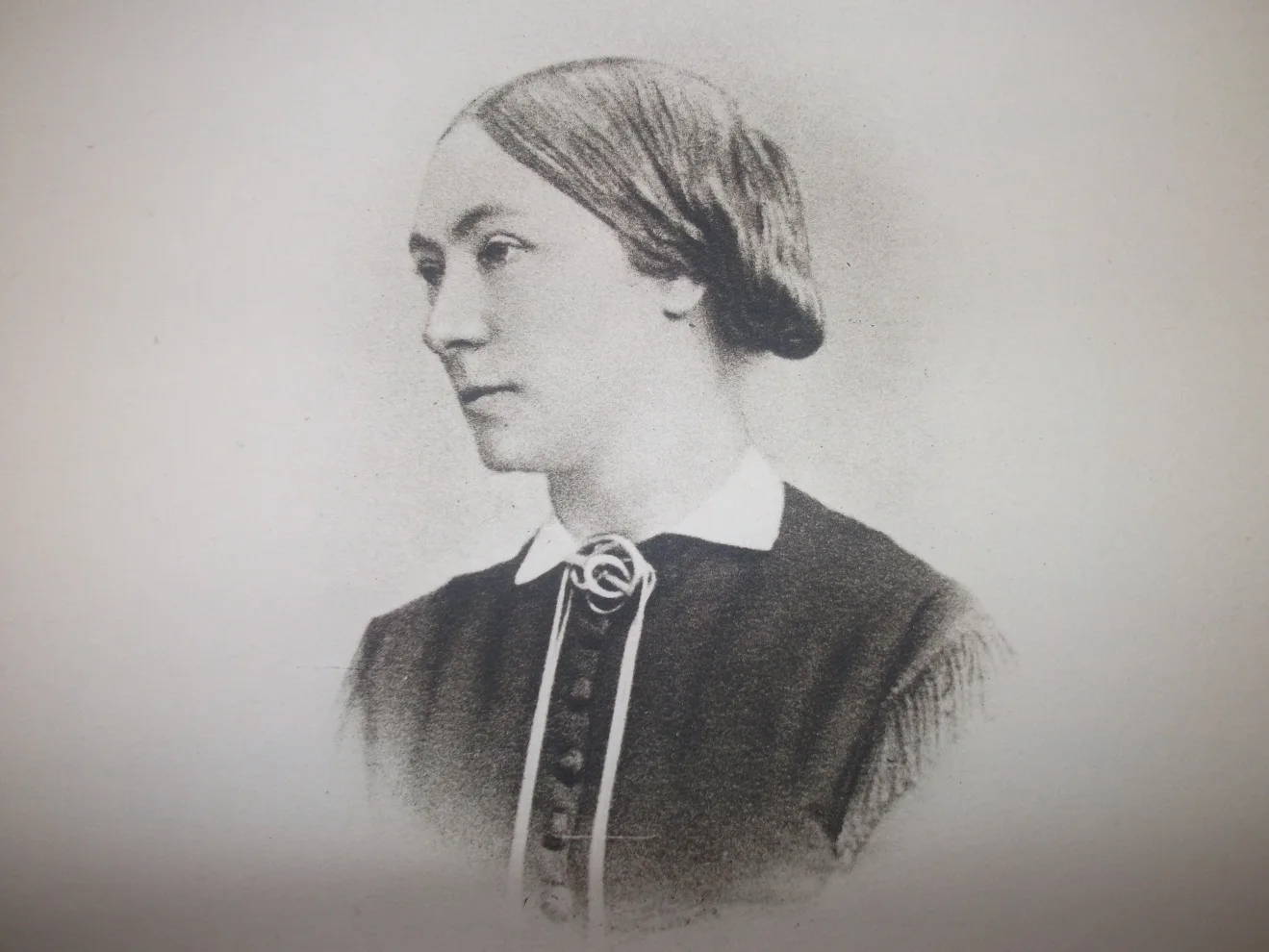
In Sydney he met Henrietta Heathorn, and in 1848 they became engaged, though the marriage had to wait for his promotion.18 In 1850 he wrote to his sister that he could not promise to bring up her son in the faith: "I fear I am too much of a heretic to promise to bring him up a good son of the church."1920 In 1854, now lecturing at the Government School of Mines in Jermyn Street, he described his outlook to a friend as "my scientific Calvinism"; he had, he said, no confidence in "the doctrine of ultimate happiness."212223 He married Henrietta in July 1855.24 On the last night of 1856 he set down his aims in his journal: "To smite all humbugs, however big; to give a nobler tone to science; to set an example of abstinence from petty personal controversies, and of toleration for everything but lying."2526 That same night his first son, Noel, was born.1
Oxford, 1860
In November 1859 he read Charles Darwin's Origin of Species. "My reflection, when I first made myself master of the central idea of the 'Origin,' was, 'How extremely stupid not to have thought of that!'"2728
The famous clash came at Oxford on Saturday 30 June 1860, at the meeting of the British Association in the library of the new University Museum, with seven hundred to a thousand people present.2930 Huxley had meant to leave that morning and stayed only because Robert Chambers told him not to desert them.31 The Bishop of Oxford, Samuel Wilberforce, spoke against Darwin, and, as one listener remembered it, turned to Huxley: "I should like to ask Professor Huxley ... as to his belief in being descended from an ape. Is it on his grandfather's or his grandmother's side that the ape ancestry comes in?"32 Huxley recalled thirty years later that he said in an undertone to Sir Benjamin beside him, "The Lord hath delivered him into mine hands."33
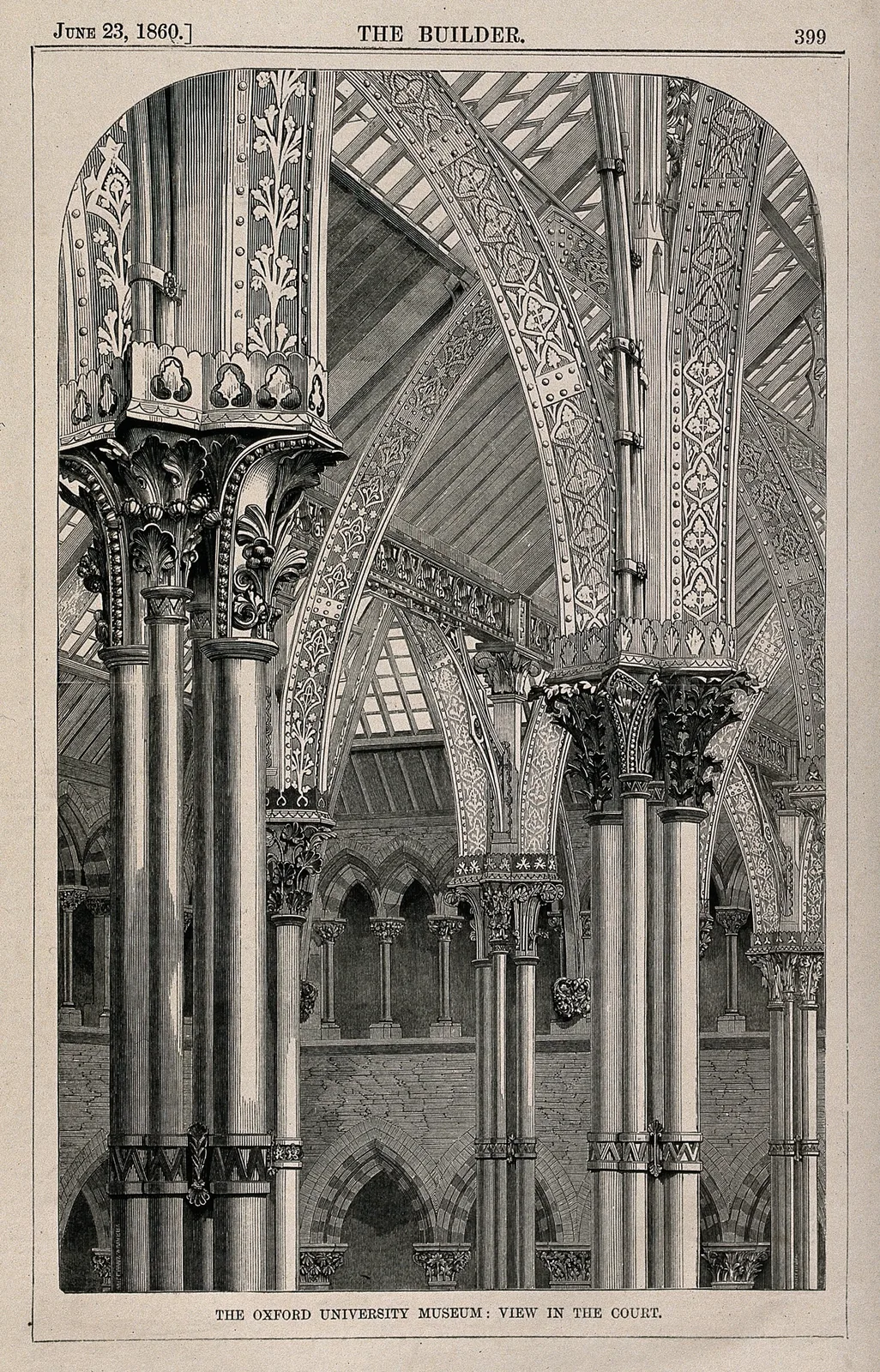
What he said in reply is not known for certain. There is no verbatim record, and the Athenaeum's report of the meeting has no exchange about apes at all.34 Four listeners later wrote down versions. In the one Huxley thought had "the substance" most accurately, he said that "a man has no reason to be ashamed of having an ape for his grandfather," but would be ashamed of a man who "plunges into scientific questions with which he has no real acquaintance, only to obscure them by an aimless rhetoric."3536 Another version, which Huxley called substantially correct, has him say he would feel ashamed of one "who prostituted the gifts of culture and eloquence to the service of prejudice and of falsehood."37 His friend Joseph Hooker, who also spoke, wrote to Darwin from Oxford that Huxley "answered admirably and turned the tables, but he could not throw his voice over so large an assembly, nor command the audience."3839 Accounts differ, too, on how the room received him.
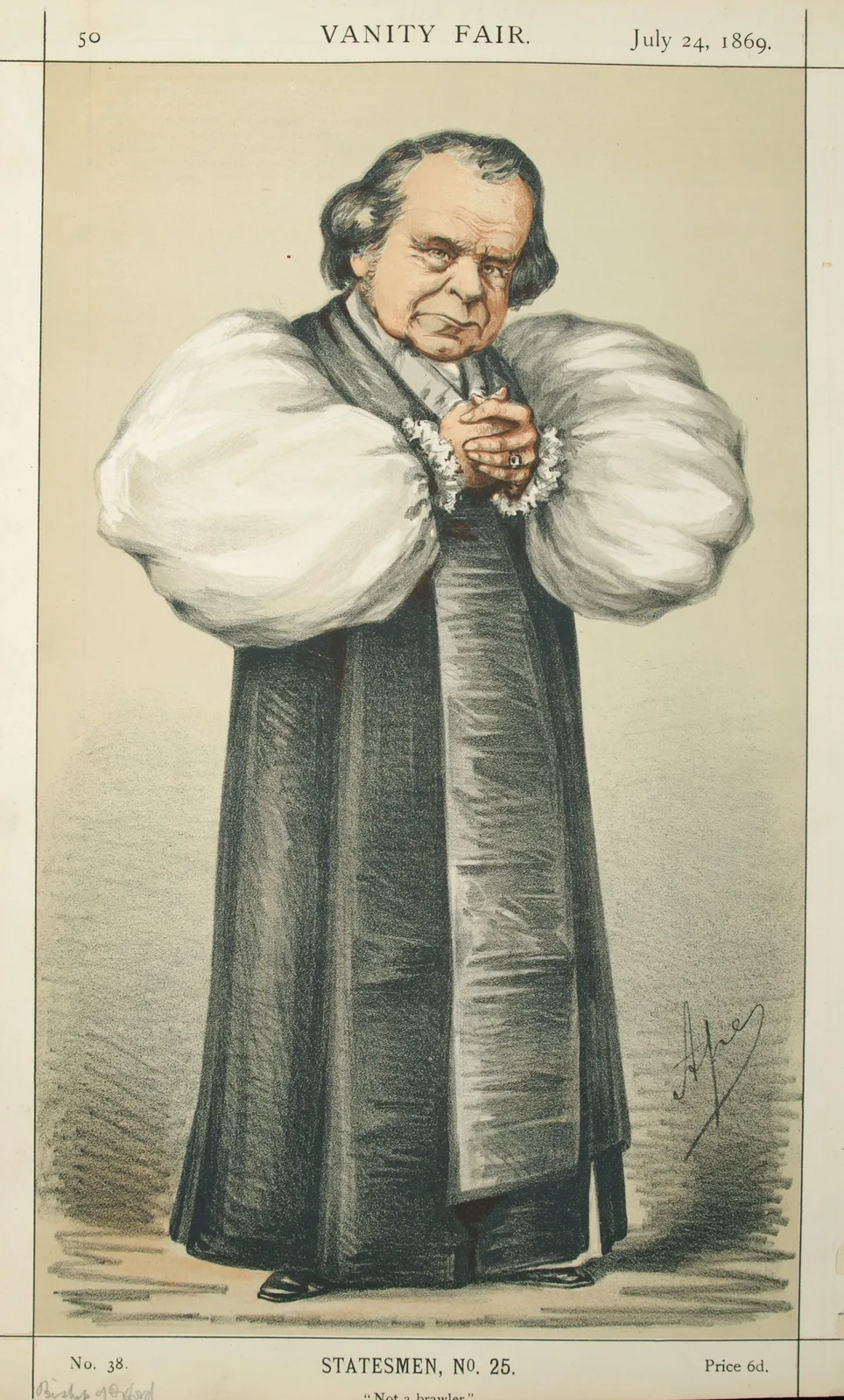
The bishop's real argument was in print. In the Quarterly Review that July he wrote that applying natural selection to man was "absolutely incompatible not only with single expressions in the word of God ... but ... with the whole representation of that moral and spiritual condition of man which is its proper subject-matter."404142 Huxley said afterwards that the bishop bore him no malice and was courtesy itself when they met.43
The letter to Kingsley
Eleven weeks later Noel died.1 The letter he wrote to Kingsley on 23 September is the centre of his life as an unbeliever. He would not lie to comfort himself: "I have searched over the grounds of my belief, and if wife and child and name and fame were all to be lost to me one after the other as the penalty, still I will not lie."244 He named the three things that had shaped his moral life: "Sartor Resartus led me to know that a deep sense of religion was compatible with the entire absence of theology. Secondly, science and her methods gave me a resting-place independent of authority and tradition. Thirdly, love opened up to me a view of the sanctity of human nature, and impressed me with a deep sense of responsibility."45 Science had a lesson that sounded almost religious: "Sit down before fact as a little child, be prepared to give up every preconceived notion, follow humbly wherever and to whatever abysses nature leads, or you shall learn nothing."46
He knew what he would be called. "I know right well that 99 out of 100 of my fellows would call me atheist, infidel, and all the other usual hard names." Under the law of the day, he added, his evidence in court would not even be accepted against a thief if his opinions were known.4748 "One thing people shall not call me with justice and that is — a liar."49 To Hooker that December he wrote: "The ground has gone from under my feet once, and I hardly know how to rest on anything again."5051 When another son was born, Henrietta had him christened; Huxley asked Hooker to be godfather and admitted he was "always in a bad temper from the time it is talked about until the ceremony is over."5253
Agnostic
In 1869 a group of thinkers of every persuasion, from Gladstone and Cardinal Manning to Huxley and John Tyndall, formed the Metaphysical Society to argue about first things.54 Huxley told the story of what happened twenty years later. "When I reached intellectual maturity and began to ask myself whether I was an atheist, a theist, or a pantheist; a materialist or an idealist; a Christian or a freethinker; I found that the more I learned and reflected, the less ready was the answer; until, at last, I came to the conclusion that I had neither art nor part with any of these denominations, except the last."55 The others "were quite sure they had attained a certain 'gnosis,'" he wrote, "while I was quite sure I had not, and had a pretty strong conviction that the problem was insoluble. So I took thought, and invented what I conceived to be the appropriate title of 'agnostic.' It came into my head as suggestively antithetic to the 'gnostic' of Church history, who professed to know so much about the very things of which I was ignorant; and I took the earliest opportunity of parading it at our Society, to show that I, too, had a tail, like the other foxes."565758
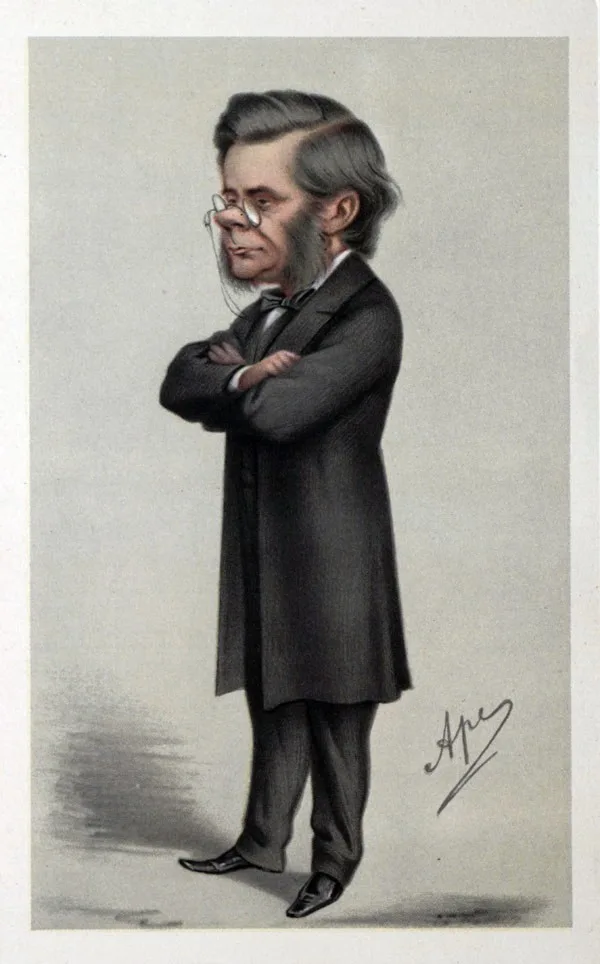
Accounts of the word's birth differ. The Spectator, edited by R. H. Hutton, a member of the Society, printed "Agnostics" on 29 May 1869, and Hutton later remembered Huxley suggesting the word at a party that year, taken from St Paul's altar to the Unknown God.5960 Huxley himself wrote that "the Spectator had stood godfather to it."6162 The paper soon called him "a great and even severe Agnostic, — who goes about exhorting all men to know how little they know."6364
Bible reading and bishops
He was no simple enemy of religion in public life. Elected to the new London School Board in 1870, he voted in 1871 for Bible reading in its schools, against the secularists, and warned that abolishing religious teaching to get rid of theology was "burning your ship to get rid of the cockroaches."656667
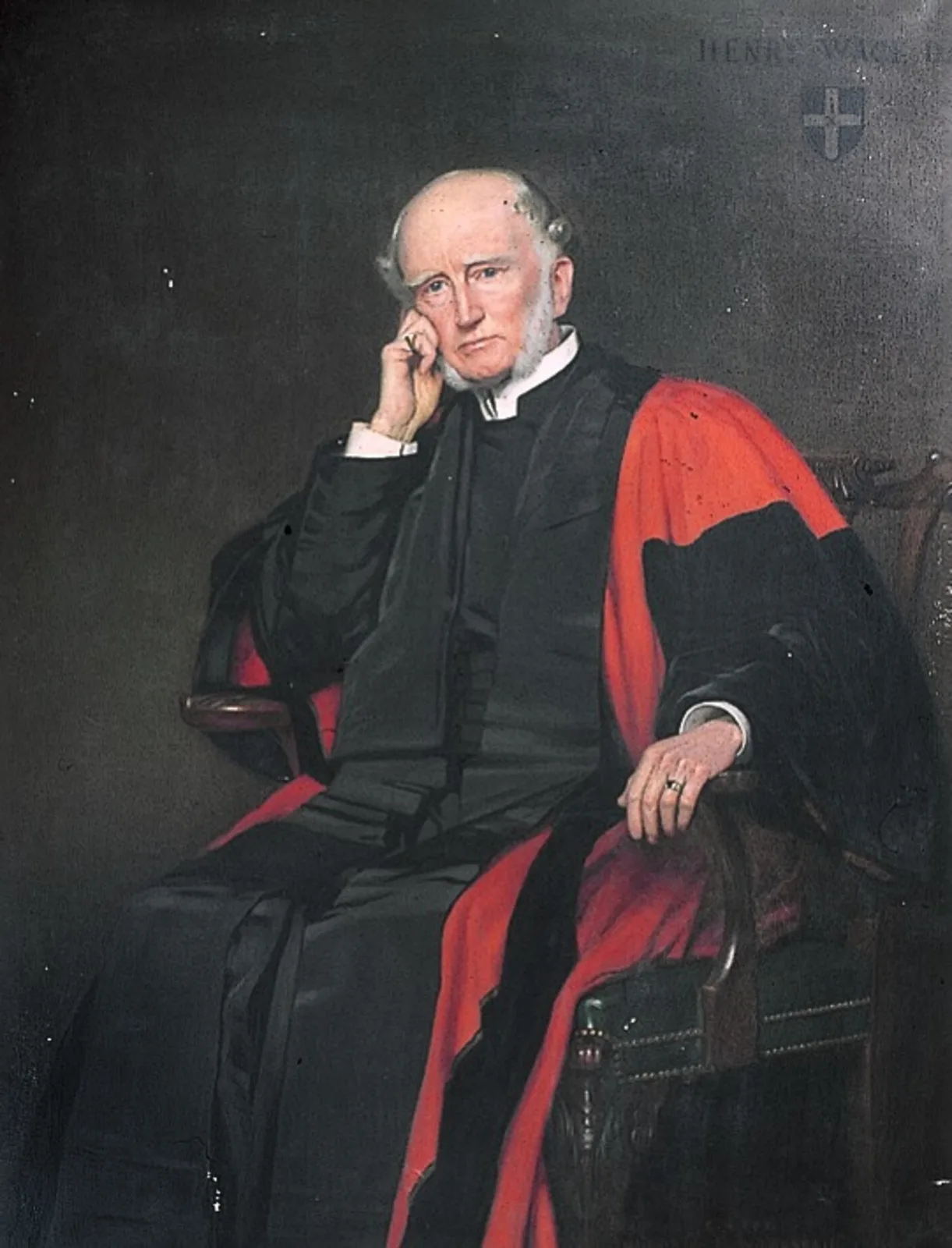
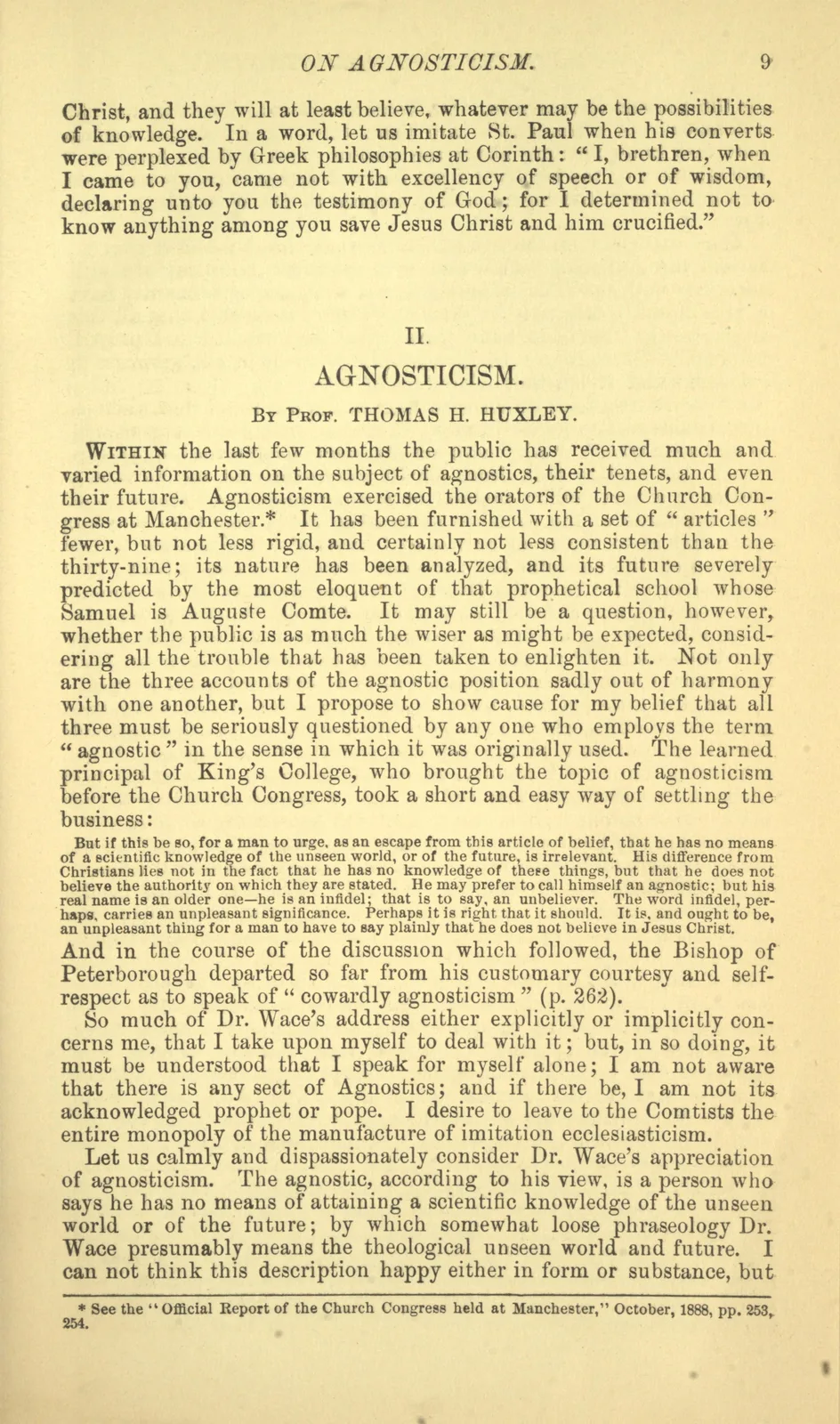
The word he had made was attacked in 1888. At the Church Congress in Manchester Henry Wace, the Principal of King's College London, said of the agnostic: "He may prefer to call himself an Agnostic; but his real name is an older one — he is an infidel; that is to say, an unbeliever." William Magee, Bishop of Peterborough, spoke of "cowardly agnosticism," and later explained that "there is an agnosticism which is cowardly."686970 Huxley replied in four essays in 1889. "I am not aware that there is any sect of Agnostics; and if there be, I am not its acknowledged prophet or pope," he wrote.7172 Agnosticism was not a creed but a method: "In matters of the intellect, follow your reason as far as it will take you, without regard to any other consideration. And negatively: In matters of the intellect do not pretend that conclusions are certain which are not demonstrated or demonstrable. That I take to be the agnostic faith, which if a man keep whole and undefiled, he shall not be ashamed to look the universe in the face."73 The Spectator, his old godfather, sided with him on one point: it could see "nothing cowardly in the term."74
He fought Gladstone twice, over Genesis in 1885–86 and over the Gadarene swine in 1890–91. The real question, Huxley said, was whether the nineteenth century should accept the demonology of the first as revealed truth.757677 Gladstone answered that "after eighteen centuries of worship ... it has been reserved to a scientific inquirer to discover that He was no better than a law-breaker and an evil-doer."78
Naturalism and ethics
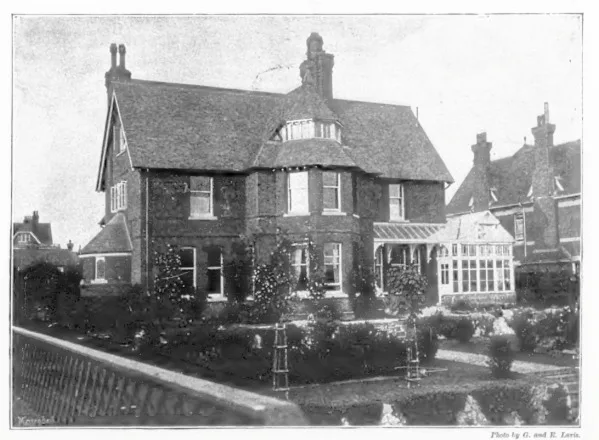
In his last years at Hodeslea, his house at Eastbourne, he refined the position rather than changed it.79 "So far as I know myself," he wrote to a clergyman in 1891, "my sole motive is to get at the truth in all things."8081 In 1892 he said that scientific naturalism did not deny that something beyond nature might exist; it denied that the evidence for any existing supernatural belief was any good, and so it ended in "that agnostic confession, which appears to me to be the only position for people who object to say that they know what they are quite aware they do not know."8283 And in his Romanes Lecture at Oxford in 1893, "Evolution and Ethics," he argued that morality runs against nature, not with it: "Social progress means a checking of the cosmic process at every step and the substitution for it of another, which may be called the ethical process."8485
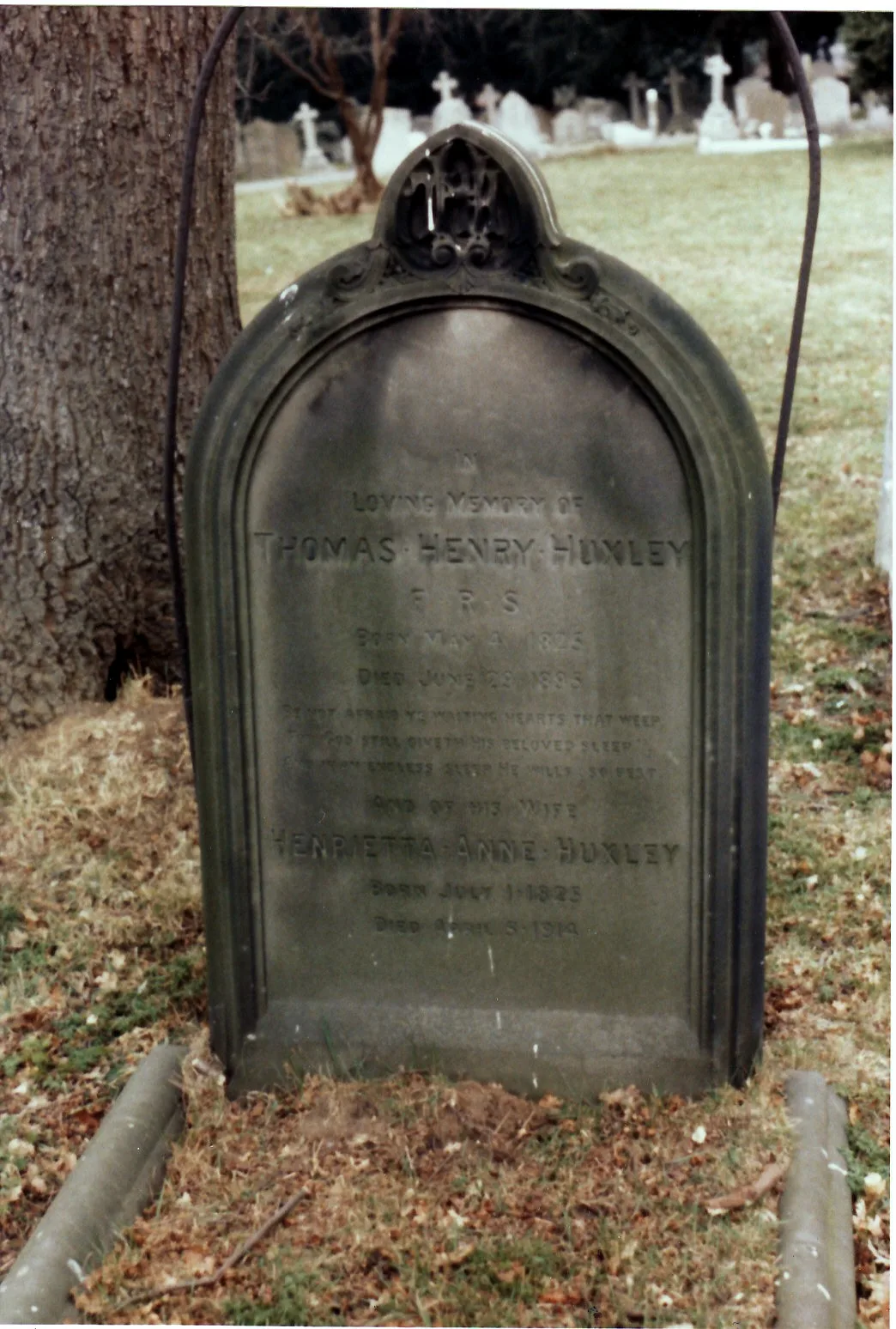
He died at Hodeslea at half-past three in the afternoon of 29 June 1895, after months of influenza and bronchitis.86 He was buried at Finchley beside his brother and his son Noel, with no official ceremony.87 On his tombstone, by his own direction, were three lines from a poem by his wife: "Be not afraid, ye waiting hearts that weep; / For still He giveth His beloved sleep, / And if an endless sleep He wills, so best."8889
What he left
Huxley's unbelief hardly changed in substance between the boy who read Hamilton and the old man who wrote "Evolution and Ethics." It changed in name, and he supplied the name. He came to agnosticism not through a lost faith but through a temperament that would not pretend to know, and he said it most clearly when grief tempted him most to pretend. He fought the bishops over evidence, voted for the Bible in schools, let his children be christened, and chose for his grave lines that could be read by believer and doubter alike. The friend whose book started the fight at Oxford, Charles Darwin, came to the same word more quietly, and he has his own chapter in this book.
Footnotes
-
Leonard Huxley, Life and Letters of Thomas Henry Huxley, vol. I (New York: D. Appleton, 1900), with Huxley's letters, journal and the Autobiography extracts, p. 162–63. ↩ ↩2 ↩3
-
Huxley, Life and Letters of Thomas…, p. 237. ↩
-
Huxley, Life and Letters of Thomas…, p. 234. ↩
-
Huxley, Life and Letters of Thomas…, p. 2–3. ↩
-
Huxley, Life and Letters of Thomas…, p. 1, 3–4; Huxley, Collected Essays, vol. I, Method and Results (London: Macmillan, 1893), containing the "Autobiography" (1889), p. 2–4. ↩
-
Huxley, Life and Letters of Thomas…, p. 5–6; Huxley, Collected Essays, vol. I, p. 5–6. ↩
-
Huxley, Life and Letters of Thomas…, p. 6. ↩
-
Huxley, Life and Letters of Thomas…, p. 9, 297. ↩
-
Collected Essays, vol. V, Science and Christian Tradition (1894; the 1902 reprint scanned), with the Prologue (1892), "Agnosticism" (Nineteenth Century, Feb. 1889), "Agnosticism: A Rejoinder" (April 1889), "Agnosticism and Christianity" (June 1889), "The Keepers of the Herd of Swine" (Dec. 1890) and "Illustrations of Mr. Gladstone's Controversial Methods" (1891), p. 235–36; Huxley, Life and Letters of Thomas…, p. 7, 234. ↩
-
Collected Essays, vol. V, p. 236. ↩
-
Huxley, Life and Letters of Thomas…, p. 234. ↩
-
Huxley, Life and Letters of Thomas…, p. 9–11. ↩
-
Huxley, Life and Letters of Thomas…, p. 6–7, 16. ↩
-
Huxley, Collected Essays, vol. I, p. 8–9. ↩
-
Huxley, Collected Essays, vol. I, p. 10–12. ↩
-
Huxley, Life and Letters of Thomas…, p. 32, 59. ↩
-
Huxley, Life and Letters of Thomas…, p. 38–39. ↩
-
Huxley, Life and Letters of Thomas…, p. 67. ↩
-
Huxley, Life and Letters of Thomas…, p. 67. ↩
-
Huxley, Collected Essays, vol. I, p. 14–15; Huxley, Life and Letters of Thomas…, p. 116. ↩
-
Huxley, Life and Letters of Thomas…, p. 122. ↩
-
Huxley, Life and Letters of Thomas…, p. 122. ↩
-
Huxley, Life and Letters of Thomas…, p. 139–40. ↩
-
Huxley, Life and Letters of Thomas…, p. 162. ↩
-
Huxley, Life and Letters of Thomas…, p. 162. Ellipsis-free excerpt. ↩
-
Huxley, Life and Letters of Thomas…, p. 182–83; Francis Darwin, ed., The Life and Letters of Charles Darwin, vol. II (London: Murray, 1887), including Huxley's "On the Reception of the Origin of Species" and the editor's account of Oxford, 1860, p. 196–97. ↩
-
Darwin, Life and Letters of Charles Darwin, p. 196–97; Huxley, Life and Letters of Thomas…, p. 182–83. ↩
-
Huxley, Life and Letters of Thomas…, p. 193–97; Darwin, Life and Letters of Charles Darwin, p. 320–21. ↩
-
Huxley, Life and Letters of Thomas…, p. 195; Darwin, Life and Letters of Charles Darwin, p. 321; Leonard Huxley, Life and Letters of Sir Joseph Dalton Hooker, vol. I (London: Murray, 1918), including Hooker's letter to Darwin from Oxford, 2 July 1860, p. 525–27, p. 526. ↩
-
Huxley, Life and Letters of Thomas…, p. 193, 202. ↩
-
Wilberforce at Oxford, 30 June 1860, as recalled by Rev. W. H. Freemantle: Huxley, Life and Letters of Thomas…, p. 200. ↩
-
Huxley, Life and Letters of Thomas…, p. 202. ↩
-
The Athenaeum, no. 1707, 14 July 1860, report of Section D, British Association, Oxford, p. 65. ↩
-
Huxley, Life and Letters of Thomas…, p. 198–201. ↩
-
J. R. Green's letter to Boyd Dawkins, reporting Huxley: Huxley, Life and Letters of Thomas…, p. 199. ↩
-
Freemantle's account of Huxley: Huxley, Life and Letters of Thomas…, p. 201. ↩
-
Huxley, Life and Letters of Sir…, p. 526. ↩
-
J. D. Hooker to Darwin, Oxford, 2 July 1860: Huxley, Life and Letters of Sir…, p. 526. ↩
-
Huxley, Life and Letters of Thomas…, p. 197; Huxley, Life and Letters of Sir…, p. 519–21 n.. ↩
-
Samuel Wilberforce, review of Darwin's Origin of Species, Quarterly Review, July 1860, reprinted in Essays Contributed to the Quarterly Review, vol. I (London: Murray, 1874), p. 51–103, p. 94. ↩
-
Samuel Wilberforce, Bishop of Oxford, Quarterly Review, July 1860: Wilberforce, Origin of Species, p. 94. ↩
-
Huxley, Life and Letters of Thomas…, p. 202. ↩
-
Huxley, Life and Letters of Thomas…, p. 233. ↩
-
Huxley, Life and Letters of Thomas…, p. 237. ↩
-
Huxley, Life and Letters of Thomas…, p. 235. ↩
-
Huxley, Life and Letters of Thomas…, p. 238 and note. ↩
-
Huxley, Life and Letters of Thomas…, p. 238. ↩
-
Huxley, Life and Letters of Thomas…, p. 238. ↩
-
Huxley, Life and Letters of Thomas…, p. 239. ↩
-
Huxley, Life and Letters of Thomas…, p. 239. ↩
-
Huxley, Life and Letters of Thomas…, p. 240. ↩
-
Huxley, Life and Letters of Thomas…, p. 240. ↩
-
Huxley, Life and Letters of Thomas…, p. 336–42. ↩
-
Collected Essays, vol. V, p. 237–38. ↩
-
Collected Essays, vol. V, p. 237–39; Huxley, Life and Letters of Thomas…, p. 343–44. ↩
-
Collected Essays, vol. V, p. 238. ↩
-
Collected Essays, vol. V, p. 239. ↩
-
The Spectator, 29 May 1869, leader "The Theological Statute at Oxford," p. 642, p. 642. ↩
-
Christianity and Agnosticism: A Controversy (New York: Humboldt Publishing, [1889]), reprinting Wace, Huxley, Magee, Mallock and Mrs Humphry Ward from the Nineteenth Century and Fortnightly Review, p. 5. Reported at second hand; the original has not been seen. ↩
-
Collected Essays, vol. V, p. 239. ↩
-
Collected Essays, vol. V, p. 239. ↩
-
The Spectator, 29 January 1870, p. 135–136, p. 135. ↩
-
The Spectator, 29 Jan 1870 (Hutton's journal): Spectator, p. 135. ↩
-
Huxley, Life and Letters of Thomas…, p. 362–64. ↩
-
Huxley, Life and Letters of Thomas…, p. 365–68. ↩
-
Huxley, Life and Letters of Thomas…, p. 364. ↩
-
Christianity and Agnosticism, p. 5; Collected Essays, vol. V, p. 210; Same, vol. II (1900), with Appendix III (bibliography, p. 484–85) and the index of both volumes, p. 235. ↩
-
Henry Wace, Principal of King's College London, Manchester Church Congress, 1888: Collected Essays, vol. V, p. 210 (quoting Wace); Christianity and Agnosticism, p. 5–6. ↩
-
W. C. Magee, Bishop of Peterborough, Nineteenth Century, March 1889: Christianity and Agnosticism, p. 44–45. ↩
-
LL2, p. 236, 240, 484–85; Collected Essays, vol. V, p. 210–11. ↩
-
Collected Essays, vol. V, p. 210–11. ↩
-
Collected Essays, vol. V, p. 246. ↩
-
R. H. Hutton (attribution via Huxley's letter), The Spectator, 9 Feb 1889: The Spectator, 9 February 1889, "Professor Huxley on Agnosticism," p. 193–194, p. 194. ↩
-
LL2, p. 122–23, 484. ↩
-
LL2, p. 286–88; Collected Essays, vol. V, p. 365–95. ↩
-
LL2, p. 286 (quoting CE V). ↩
-
W. E. Gladstone, The Impregnable Rock of Holy Scripture, 1890, p. 269 (as quoted by Huxley): Collected Essays, vol. V, p. 371–72. ↩
-
LL2, p. 235, 293. ↩
-
LL2, p. 299. ↩
-
LL2, p. 299. ↩
-
Collected Essays, vol. V, p. 39–40. ↩
-
Collected Essays, vol. V, p. 40. ↩
-
Collected Essays, vol. IX, Evolution and Ethics and other essays (1894), the Romanes Lecture of 1893, p. 81. ↩
-
Collected Essays, vol. IX, p. 81. ↩
-
LL2, p. 424–26. ↩
-
LL2, p. 426. ↩
-
LL2, p. 426–27 (page break unread). Accounts differ; see the disputed points. ↩
-
Henrietta Huxley, lines on the tombstone: LL2, p. 426–27. ↩
In their own words
I neither deny nor affirm the immortality of man. I see no reason for believing in it, but, on the other hand, I have no means of disproving it.
But the longer I live, the more obvious it is to me that the most sacred act of a man's life is to say and to feel, "I believe such and such to be true." All the greatest rewards and all the heaviest penalties of existence cling about that act.
Oh devil! truth is better than much profit. I have searched over the grounds of my belief, and if wife and child and name and fame were all to be lost to me one after the other as the penalty, still I will not lie.
Sartor Resartus led me to know that a deep sense of religion was compatible with the entire absence of theology. Secondly, science and her methods gave me a resting-place independent of authority and tradition. Thirdly, love opened up to me a view of the sanctity of human nature, and impressed me with a deep sense of responsibility.
As I stood behind the coffin of my little son the other day, with my mind bent on anything but disputation, the officiating minister read, as a part of his duty, the words, "If the dead rise not again, let us eat and drink, for to-morrow we die." I cannot tell you how inexpressibly they shocked me.
I know right well that 99 out of 100 of my fellows would call me atheist, infidel, and all the other usual hard names.
One thing people shall not call me with justice and that is — a liar.
Sit down before fact as a little child, be prepared to give up every preconceived notion, follow humbly wherever and to whatever abysses nature leads, or you shall learn nothing.
It must be twenty years since, a boy, I read Hamilton's essay on the unconditioned, and from that time to this, ontological speculation has been a folly to me.
The ground has gone from under my feet once, and I hardly know how to rest on anything again.
My boy is gone, but in a higher and a better sense than was in my mind when I wrote four years ago what stands above — I feel that my fancy has been fulfilled.
To smite all humbugs, however big; to give a nobler tone to science; to set an example of abstinence from petty personal controversies, and of toleration for everything but lying
I fear I am too much of a heretic to promise to bring him up a good son of the church
The rest of it is the product of my scientific Calvinism, which fell like a shell at your feet when we were talking over the fire. I doubt, or at least I have no confidence in, the doctrine of ultimate happiness
My wife will have the youngster christened, although I am always in a bad temper from the time it is talked about until the ceremony is over.
My reflection, when I first made myself master of the central idea of the "Origin," was, "How extremely stupid not to have thought of that!"
The Bishop began his speech, and to my astonishment very soon showed that he was so ignorant that he did not know how to manage his own case. My spirits rose proportionately, and when he turned to me with his insolent question, I said to Sir Benjamin, in an undertone, "The Lord hath delivered him into mine hands."
I asserted—and I repeat—that a man has no reason to be ashamed of having an ape for his grandfather. If there were an ancestor whom I should feel shame in recalling it would rather be a man—a man of restless and versatile intellect—who, not content with an equivocal success in his own sphere of activity, plunges into scientific questions with which he has no real acquaintance, only to obscure them by an aimless rhetoric, and distract the attention of his hearers from the real point at issue by eloquent digressions and skilled appeals to religious prejudice.
I should feel it no shame to have risen from such an origin; but I should feel it a shame to have sprung from one who prostituted the gifts of culture and eloquence to the service of prejudice and of falsehood.
He was not ashamed to have a monkey for his ancestor; but he would be ashamed to be connected with a man who used great gifts to obscure the truth.
Huxley answered admirably and turned the tables, but he could not throw his voice over so large an assembly, nor command the audience; and he did not allude to Sam's weak points nor put the matter in a form or way that carried the audience.
When I reached intellectual maturity and began to ask myself whether I was an atheist, a theist, or a pantheist; a materialist or an idealist; a Christian or a freethinker; I found that the more I learned and reflected, the less ready was the answer; until, at last, I came to the conclusion that I had neither art nor part with any of these denominations, except the last.
They were quite sure they had attained a certain "gnosis," — had, more or less successfully, solved the problem of existence; while I was quite sure I had not, and had a pretty strong conviction that the problem was insoluble.
So I took thought, and invented what I conceived to be the appropriate title of "agnostic." It came into my head as suggestively antithetic to the "gnostic" of Church history, who professed to know so much about the very things of which I was ignorant; and I took the earliest opportunity of parading it at our Society, to show that I, too, had a tail, like the other foxes.
To my great satisfaction, the term took; and when the Spectator had stood godfather to it, any suspicion in the minds of respectable people, that a knowledge of its parentage might have awakened was, of course, completely lulled.
Positively the principle may be expressed: In matters of the intellect, follow your reason as far as it will take you, without regard to any other consideration. And negatively: In matters of the intellect do not pretend that conclusions are certain which are not demonstrated or demonstrable. That I take to be the agnostic faith, which if a man keep whole and undefiled, he shall not be ashamed to look the universe in the face, whatever the future may have in store for him.
I am not aware that there is any sect of Agnostics; and if there be, I am not its acknowledged prophet or pope.
it stamped upon my mind the strong conviction that, on even the most solemn and important of questions, men are apt to take cunning phrases for answers; and that the limitation of our faculties, in a great number of cases, renders real answers to such questions, not merely actually impossible, but theoretically inconceivable.
So far as I know myself, after making due deduction for the ambition of youth and a fiery temper, which ought to (but unfortunately does not) get cooler with age, my sole motive is to get at the truth in all things.
they will probably agree to a verdict of "not proven" in respect of naturalistic theology, taking refuge in that agnostic confession, which appears to me to be the only position for people who object to say that they know what they are quite aware they do not know.
Social progress means a checking of the cosmic process at every step and the substitution for it of another, which may be called the ethical process; the end of which is not the survival of those who may happen to be the fittest, in respect of the whole of the conditions which obtain, but of those who are ethically the best.
Be not afraid, ye waiting hearts that weep; For still He giveth His beloved sleep, And if an endless sleep He wills, so best.
The other side
Now, we must say at once, and openly, that such a notion is absolutely incompatible not only with single expressions in the word of God on that subject of natural science with which it is not immediately concerned, but, which in our judgment is of far more importance, with the whole representation of that moral and spiritual condition of man which is its proper subject-matter.
I should like to ask Professor Huxley, who is sitting by me, and is about to tear me to pieces when I have sat down, as to his belief in being descended from an ape. Is it on his grandfather's or his grandmother's side that the ape ancestry comes in?
He may prefer to call himself an Agnostic; but his real name is an older one — he is an infidel; that is to say, an unbeliever.
What I intended to express, and what I think I did express by this phrase was, that there is an agnosticism which is cowardly.
So, then, after eighteen centuries of worship offered to our Lord by the most cultivated, the most developed, and the most progressive portion of the human race, it has been reserved to a scientific inquirer to discover that He was no better than a law-breaker and an evil-doer.
We cannot say that we see anything cowardly in the term. It seems to us to express very fairly a state of mind which "unbelief" would express equally well, but which "infidelity" does not express at all.
While acquiescing in this condition as a general rule, I think it cannot be expected that Christian thinkers shall give no sign of the horror with which they would view the spread of such extreme opinions as those advocated by Mr. Huxley.
In theory he is a great and even severe Agnostic,—who goes about exhorting all men to know how little they know.
Where accounts differ
| Point | One account | Another | How the page handles it |
|---|---|---|---|
| Words of Huxley's reply to Wilberforce, 30 June 1860 | Green: a man need not be ashamed of an ape grandfather, but of a man who misuses great gifts (LL1 p. 199); Freemantle: "I should feel it no shame to have risen from such an origin" (LL1 p. 201) | The Athenaeum report has no such exchange (Ath p. 65); Hooker's letter says Huxley did not carry the audience (HookerLL1 p. 526); the Macmillan's writer says no one is sure of the words (Mac98); Huxley in 1891 said Freemantle was substantially right and Green had the substance (LL1 p. 201) | Say there is no verbatim record, give the accounts, and say Huxley's own later view. Do not present one wording as exact |
| Whether Huxley carried the room | LL1 p. 203 (Foster): coldly received at first, applause grew until nearly the bishop's | Hooker, 2 July 1860: could not command the audience; Hooker's own speech was the decisive one | "Accounts differ" on how the room took it |
| Date of Hooker's Oxford letter | Printed as "July 2, 1860" (HookerLL1 p. 525) | Darwin's reply of 3 July speaks of a letter "written by Hooker late on Sunday night" (1 July) (DLL2 p. 324) | Cite as "his letter of 1 or 2 July" if at all |
| Origin of "agnostic" | Huxley: invented antithetic to "gnostic," first used at the Society (CE V p. 239) | Hutton: suggested by Huxley at a party in 1869, from Paul's altar to the Unknown God (Contro p. 5, via the OED, secondhand); the Spectator of 29 May 1869 already prints "Agnostics" (Spec69 p. 642) | Say accounts differ; give Huxley's own and Hutton's; note first printed use before the Society's first meeting, if the date is confirmed |
| Hutton's 1876 version | Spectator 17 June 1876 (p. 763): the name "demanded by Professor Huxley" for those who believed in an "Unknown and Unknowable" God | Huxley 1889: coined as the opposite of "gnostic," one who claims to know | Say that the two men described the word differently |
| Date quoted by Wace and the OED for the Spectator passage | "June 11, 1876" (Contro p. 5) | The passage is in the issue dated 17 June 1876 (Spec76 p. 763) | Cite 17 June 1876 |
| Hour of birth | Autobiography: about eight in the morning (LL1 p. 3) | Family Bible: 9.30 (LL1 p. 3 n.) | Say "on 4 May 1825" |
| Noel's birth date | Journal: "Born five minutes before twelve ... New Year's Day, 1857" (LL1 p. 163) | Same entry dated 31 Dec 1856 | Say "at the turn of 1856 to 1857" |
| Who chose the epitaph | Leonard Huxley: lines "inscribed upon his tombstone" "by his special direction," from a poem by his wife (LL2 p. 426–27) | Coordinator's brief: chosen by his wife Henrietta | Say the lines are from Henrietta's poem and Huxley directed their use; open question below |
List of illustrations
This page uses only public-domain and Creative Commons images; each is credited with its source and licence.
- T. H. Huxley, portrait from a photograph by Maull & Polyblank, 1857 (Life and Letters vol. I, facing p. 160) — Maull & Polyblank, 1857 · Internet Archive, Cornell University Library copy (cu31924024733960), Life and Letters vol. I · Public domain (published before 1931; Internet Archive scan)
- HMS 'Rattlesnake', 1853 — Sir Oswald Walters Brierly, 1853 · Wikimedia Commons; https://commons.wikimedia.org/wiki/File:HMS_'Rattlesnake',_1853_RMG_PW5620.tiff · Public domain (Wikimedia Commons)
- Henrietta Anne Huxley (née Heathorn; 1825 – 1914) — Unknown author, 1857 · Wikimedia Commons; https://commons.wikimedia.org/wiki/File:Henrietta_Anne_Huxley.jpg · Public domain (Wikimedia Commons)
- University Museum, Oxford: the interior court showing ornamental details. Wood engraving by Williams, 1860, after Williams and Warry. Engraving shows stone carving in background by O'Shea and Whelan. Iconographic Collections Keywords: Thomas Deane; Benjamin Woodward; University Museum (Oxford); Williams & Warry.; University of Oxford; Williams · Wellcome Collection, London (via Wikimedia Commons); https://commons.wikimedia.org/wiki/File:University_Museum,_Oxford;_the_interior_court_showing_orname_Wellcome_V0014199.jpg · CC BY 4.0 (Wikimedia Commons)
- Statesmen No.25: Caricature of The Bishop of Oxford. Caption reads: "Not a brawler." — Carlo Pelegrini, 1869-07-24 · Wikimedia Commons; https://commons.wikimedia.org/wiki/File:Samuel_Wilberforce,_Vanity_Fair,_1869-07-24.jpg · Public domain (Wikimedia Commons)
- Charles Kingsley. Modern History.from Cartoon portraits and biographical sketches of men of the day — Frederick Wady, 1872 · Wikimedia Commons; https://commons.wikimedia.org/wiki/File:Charles_Kingsley_(Waddy,_1872).jpg · Public domain (Wikimedia Commons)
- Caricature of Thomas Henry Huxley (1825 - 1895). Caption read "A great Med'cine-Man among the Inqui-ring Redskins". — Carlo Pelegrini, circa. 1870-1871 (published 28 January 1 · Wikimedia Commons; https://commons.wikimedia.org/wiki/File:Thomas_Henry_Huxley01.jpg · Public domain (Wikimedia Commons)
- The Very Reverend Henry Wace (10 December 1836 – 9 January 1924). Painted c. 1919 — Ernest R. Fox, 18 January 2012, 07:42:11 · Wikimedia Commons; https://commons.wikimedia.org/wiki/File:Henry_Wace.jpg · Public domain (Wikimedia Commons)
- T. H. Huxley, 'Agnosticism' (Nineteenth Century, February 1889), opening page in Christianity and Agnosticism — Thomas Henry Huxley, 1889 · Internet Archive, agnosticism00variuoft · Public domain (published before 1931; Internet Archive scan)
- Professor Huxley's Homes: Hodeslea, Staveley Road, Eastbourne, the last house in which Huxley lived and died — Unknown / G. & E. Lavis (Illustrated London News), 1895-07-06 · Wikimedia Commons; https://commons.wikimedia.org/wiki/File:HodesleaEastbourne.png · Public domain (Wikimedia Commons)
- Gravestone of Thomas Henry Huxley in East Finchley Cemetery, north London. Personal photo from 1986; no rights claimed — Astrochemist at English Wikipedia, 26 May 2007 (original upload date) · Wikimedia Commons; https://commons.wikimedia.org/wiki/File:Thomas_Huxley_grave.jpg · Public domain (Wikimedia Commons)
Sources
Tier 1 — the subject's own words (writings, letters, diaries, trial records)
- [LL1] Leonard Huxley, Life and Letters of Thomas Henry Huxley, vol. I (New York: D. Appleton, 1900), with Huxley's letters, journal and the Autobiography extracts. https://archive.org/details/cu31924024733960 . Text in research/texts/ll1.txt. Page numbers from running headers.
- [LL2] Same, vol. II (1900), with Appendix III (bibliography, p. 484–85) and the index of both volumes. https://archive.org/details/lifelettersoftho00huxl . Text in research/texts/ll2.txt (the OCR drops some page numbers; "c." marks those).
- [CE I] Huxley, Collected Essays, vol. I, Method and Results (London: Macmillan, 1893), containing the "Autobiography" (1889). https://archive.org/details/collectedessays01huxluoft . Text in research/texts/ce1-method.txt.
- [CE V] Collected Essays, vol. V, Science and Christian Tradition (1894; the 1902 reprint scanned), with the Prologue (1892), "Agnosticism" (Nineteenth Century, Feb. 1889), "Agnosticism: A Rejoinder" (April 1889), "Agnosticism and Christianity" (June 1889), "The Keepers of the Herd of Swine" (Dec. 1890) and "Illustrations of Mr. Gladstone's Controversial Methods" (1891). https://archive.org/details/sciencechristia00huxl . Text in research/texts/ce5-sct.txt.
- [CE IX] Collected Essays, vol. IX, Evolution and Ethics and other essays (1894), the Romanes Lecture of 1893. https://archive.org/details/collectedessays09huxluoft . Text in research/texts/ce9-ethics.txt.
- [Contro] Christianity and Agnosticism: A Controversy (New York: Humboldt Publishing, [1889]), reprinting Wace, Huxley, Magee, Mallock and Mrs Humphry Ward from the Nineteenth Century and Fortnightly Review. https://archive.org/details/agnosticism00variuoft . Text in research/texts/christianity-agnosticism-controversy.txt.
- [DLL2] Francis Darwin, ed., The Life and Letters of Charles Darwin, vol. II (London: Murray, 1887), including Huxley's "On the Reception of the Origin of Species" and the editor's account of Oxford, 1860. https://archive.org/details/lifelettersofcha02darw . Text in research/texts/darwin-ll-vol2.txt.
Tier 2 — scholarly biographies and encyclopedias
- [HookerLL1] Leonard Huxley, Life and Letters of Sir Joseph Dalton Hooker, vol. I (London: Murray, 1918), including Hooker's letter to Darwin from Oxford, 2 July 1860, p. 525–27. https://archive.org/details/lifelettersofsir01hookrich . Text in research/texts/hooker-ll1.txt.
- [Ath] The Athenaeum, no. 1707, 14 July 1860, report of Section D, British Association, Oxford. https://archive.org/details/sim_athenaeum-uk_1860-07-14_1707 . Text in research/texts/athenaeum-1860-07-14.txt.
- [Mac98] "A Grandmother's Tales," Macmillan's Magazine, October 1898 (vol. 78), the recollection quoted in LL1 p. 198. https://archive.org/details/sim_mcmillans-magazine_1898-10_78_468 . The OCR does not print the author's name; the coordinator's brief names Isabella Sidgwick (not confirmed in the scan). Text in research/texts/macmillans-1898-10.txt.
Tier 3 — popular biographies and journalism
- [Spec69] The Spectator, 29 May 1869, leader "The Theological Statute at Oxford," p. 642. https://archive.org/details/sim_spectator-uk_1869-05-29_42_2135 . Text in research/texts/spectator-1869-05-29.txt.
- [Spec70] The Spectator, 29 January 1870, p. 135–136. https://archive.org/details/sim_spectator-uk_1870-01-29_43_2170 . Text in research/texts/spectator-1870-01-29.txt. (Also 1 October 1870, p. 1170, scanned at sim_spectator-uk_1870-10-01_43_2205; two-column OCR interleaved, not used as a quotation.)
- [Spec76] The Spectator, 17 June 1876, leader "Militant Agnosticism," p. 763. https://archive.org/details/sim_spectator-uk_1876-06-17_49_2503 . Text in research/texts/spectator-1876-06-17.txt.
- [Spec89] The Spectator, 9 February 1889, "Professor Huxley on Agnosticism," p. 193–194. https://archive.org/details/sim_spectator-uk_1889-02-09_62_3163 . Text in research/texts/spectator-1889-02-09.txt. Unsigned; Huxley's letter to Clodd (LL2, April 1889) treats the Spectator article as Hutton's.
Tier 4 — maps to other sources only (Wikipedia and similar). Never cited in the script.
- Wikipedia, "Thomas Henry Huxley," "Agnosticism," "Richard Holt Hutton," read only as maps. Nothing cited.
Opposition sources — contemporary critics and religious responses
- [WilbEss] Samuel Wilberforce, review of Darwin's Origin of Species, Quarterly Review, July 1860, reprinted in Essays Contributed to the Quarterly Review, vol. I (London: Murray, 1874), p. 51–103. https://archive.org/details/essayscontribut01wilbgoog . Text in research/texts/wilberforce-essays-b.txt. The reprint is the scan; the original journal page numbers were not checked.
- [Contro] Wace, Church Congress paper (Manchester, 1888) and replies; Bishop Magee's replies (Nineteenth Century, March and May 1889), as above.
- [Gladstone] The Impregnable Rock of Holy Scripture (1890), seen only as quoted by Huxley in CE V p. 371–72.
Related lives
Charles Darwin (27-darwin) — the friend whose book set the Oxford argument going; to be confirmed by the lead.
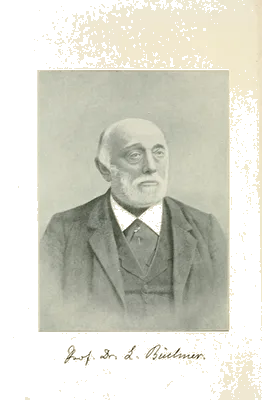
Ludwig Büchner
Ludwig Büchner was marked young by his brother Georg's death in exile, and set on his course by the 1848 thesis that the soul is unthinkable without matter. The Darmstadt physician wrote Force and Matter (1855) in a few weeks after the failed revolution, and lost his Tübingen post for it. He spent forty years defending and renaming his unbelief, from "atheistic" (1869) to "monism" (1891), founding a freethinkers' league and arguing atheism against Darwin's agnosticism. His brother saw a private pessimist who said he had missed his vocation.
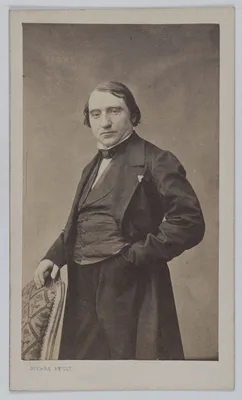
Ernest Renan
Ernest Renan was a Breton boy who never doubted his priests. He lost his faith not to a woman or to politics but to Hebrew philology at Saint-Sulpice, and walked out of the seminary in 1845 because he could not become a priest without hypocrisy. He told the life of Jesus as the life of an incomparable man (1863), and lost his chair for it. He ended neither believer nor atheist, writing that atheism is logical in this universe but that we may be atheists for not seeing far enough, and addressing "a hidden God".
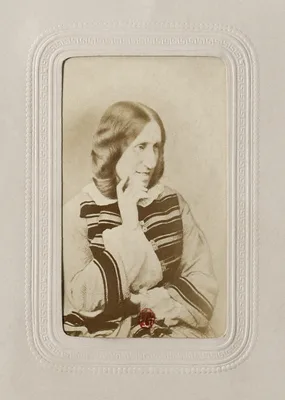
George Eliot
George Eliot was an ultra-Evangelical girl who lost the creed in 1841, reading Hennell among the Brays. She quarrelled with her father over church and regretted it all her life. In 1843 she gave up proselytising as "the quackery of infidelity", and she put her name only to Feuerbach's argument that God is human nature. She ended reverent toward the great religions, holding the idea of God to be "the ideal of a goodness entirely human" and unbelief to be the discipline of doing without opium.
Ignacio Ramírez
Ignacio Ramírez was the son of a liberal family driven out by a clerical government. He read his way through the friars' and the cathedral's forbidden books, and at eighteen read a paper headed "No hay Dios" to the Academia de Letrán. He never retreated from it, but turned it from provocation into law: he fought "divine right" in the 1856 Congress and closed the convents as Juárez's minister. He held that a government should be neither Catholic nor atheist, and belief left to each conscience.