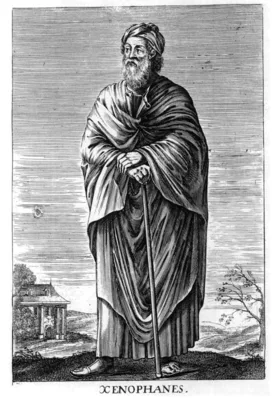
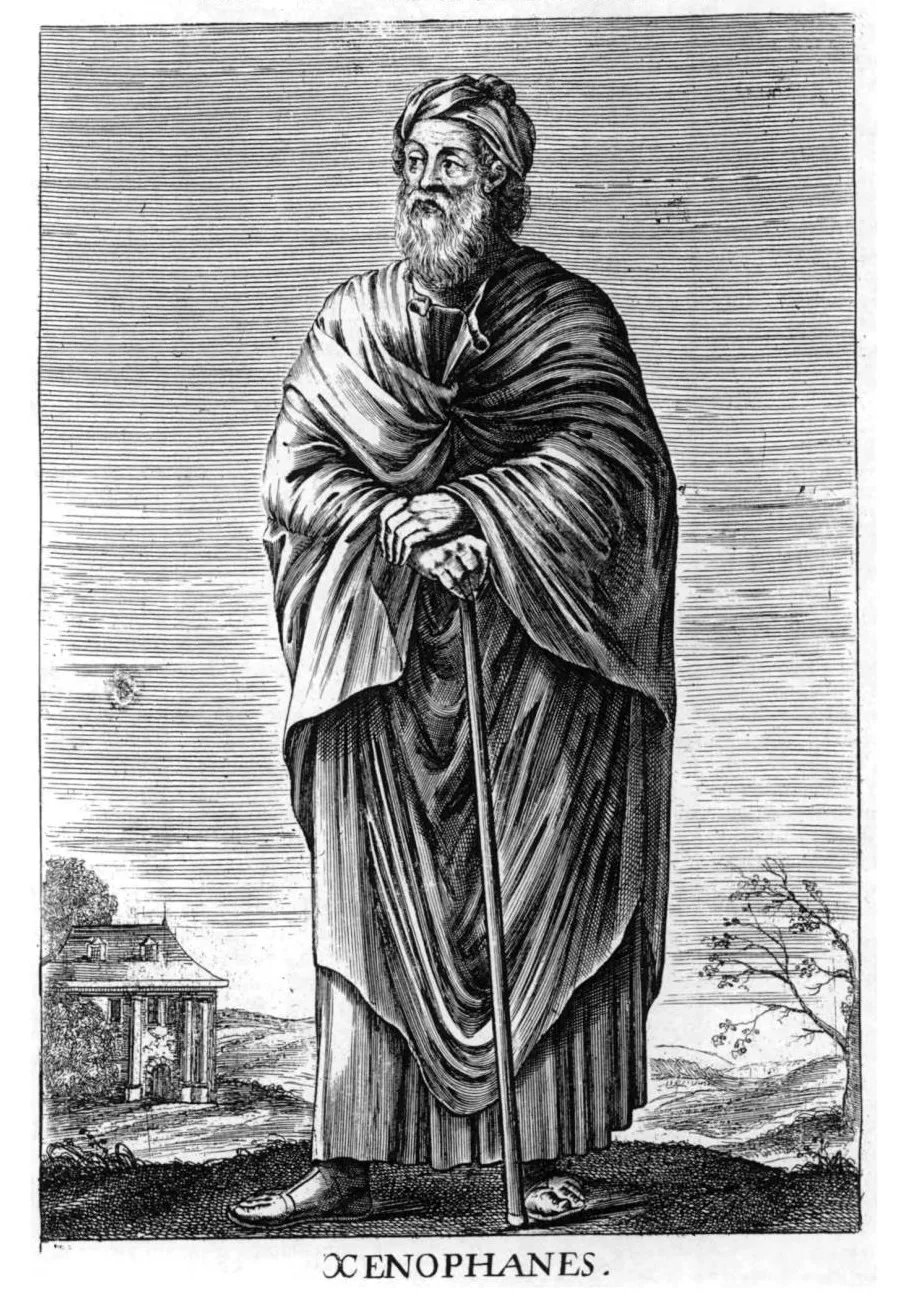
Xenophanes was exiled from Colophon at twenty-five, for reasons no source gives, and spent sixty-seven years as a wandering poet. He mocked the gods of Homer and Hesiod as thieves and adulterers, said that every people paints its gods in its own likeness, and proposed instead one god, unlike mortals in body or in thought. He never denied that gods exist, but he said no one could know the truth about them: his was the first critique of the gods, not yet atheism.
The belief timeline
- Exile (c. 546-540 BCE (age about 25)) — Leaves Colophon after the Persian conquest of Ionia and spends the rest of his life travelling; he never says why [4][5][6][7]
- Critique (undated (wandering years)) — Attacks Homer and Hesiod for giving the gods "stealings and adulteries and deceivings of one another", and shows that each people paints its gods in its own image [15][18][19][20]
- One god (undated) — Proposes "one god, the greatest among gods and men", unlike mortals in body or thought and moving nothing but by thought (B23-B26) [21][22][24]
- Limits (undated; the poem containing B8 was written at about 92) — Says no man has ever known, or will know, the truth about the gods or about the things he himself describes, and that the gods let humans find things out "in time" [27][29][4]
Notes to the timeline (13)
- [4] By his own words (B8) he had wandered "up and down the land of Hellas" for 67 years, and it was 25 years from his birth when he began, which makes him 92 when the poem was composed — John Burnet, Early Greek Philosophy, 3rd ed. (A. & C. Black, London, 1920), ch. II §§ 55-62, pp. 112-129, fragments in the order and numbering of Diels. Internet Archive
earlygreekphilos00burnrich. English translations of every fragment used here, with the commentary that carries most of the modern argument. Text file:burnet.txt, p. 114 (fr. 8); Diogenes Laertius, Lives of Eminent Philosophers, vol. 2, tr. R. D. Hicks (Loeb Classical Library, 1925), ix. 18-21 (Xenophanes), pp. 424-428; ix. 1 (Heraclitus), p. 408; viii. 36 (Pythagoras), p. c. 352. Internet Archivelivesofeminentph02dioguoft. Text file:dl-hicks-vol2.txt. English is on the even pages, Greek on the odd; the OCR puts each page number at the head of its page. Hicks prints "and having joined the colony planted at Elea taught there" in angle brackets, as an editorial supplement, ix. 19 (Hicks p. 426); Arthur Fairbanks, The First Philosophers of Greece (Kegan Paul, London, 1898), ch. V, pp. 65-80: Greek text, translation, and a note on the source of each fragment (Karsten numbering). Internet Archivefirstphilosopher00fairiala. This is where the preserving author is named for each fragment (Clement, Sextus, Simplicius, Athenaeus and so on). Text file:fairbanks.txt, p. 77 (fr. 24); preserved by Diogenes Laertius. - [5] He was "banished from his native city" and lived at Zancle in Sicily and at Catana; Burnet notes that the old name Zankle (not Messene) suggests an early source, "probably the elegies of Xenophanes himself" — Laertius, Lives of Eminent Philosophers, ix. 18 (Hicks p. 424); Burnet, Early Greek Philosophy, p. 114 and n. 5.
- [6] No fragment and no ancient source says why he was banished. That the cause was the Persian conquest is a modern guess: Burnet writes that "it is tempting to suppose" that B8 refers to the conquest of Ionia by Harpagos — Burnet, Early Greek Philosophy, p. 114. Not verified.
- [7] After the conquest of Lydia (Cyrus took Sardis in 546/5), the Ionian cities sent to Cyrus at Sardis; his general Harpagus "entered Ionia, and took the cities by means of" siege mounds, and the Phocaeans and Teians left their cities by ship rather than submit — Herodotus, Histories Book 1, tr. George Rawlinson (via Wikisource). Text file:
herodotus-1-rawlinson.txt. Used for the Persian conquest of Ionia; cited by section, no page numbers, 1.141, 1.162, 1.164-168; Burnet, Early Greek Philosophy, p. 51 n. 3 (fall of Sardis 546/5, Apollodorus's epoch). Reported at second hand; the original has not been seen. - [15] B11 and B12: Homer and Hesiod attributed to the gods "all things that are a shame and a disgrace among mortals, stealings and adulteries and deceivings of one another". Preserved by Sextus Empiricus (Adv. math. ix. 193 and i. 289, combined in Fairbanks's note) — Burnet, Early Greek Philosophy, p. 119 (frs. 11, 12); Fairbanks, First Philosophers of Greece, p. 68-69 (fr. 7).
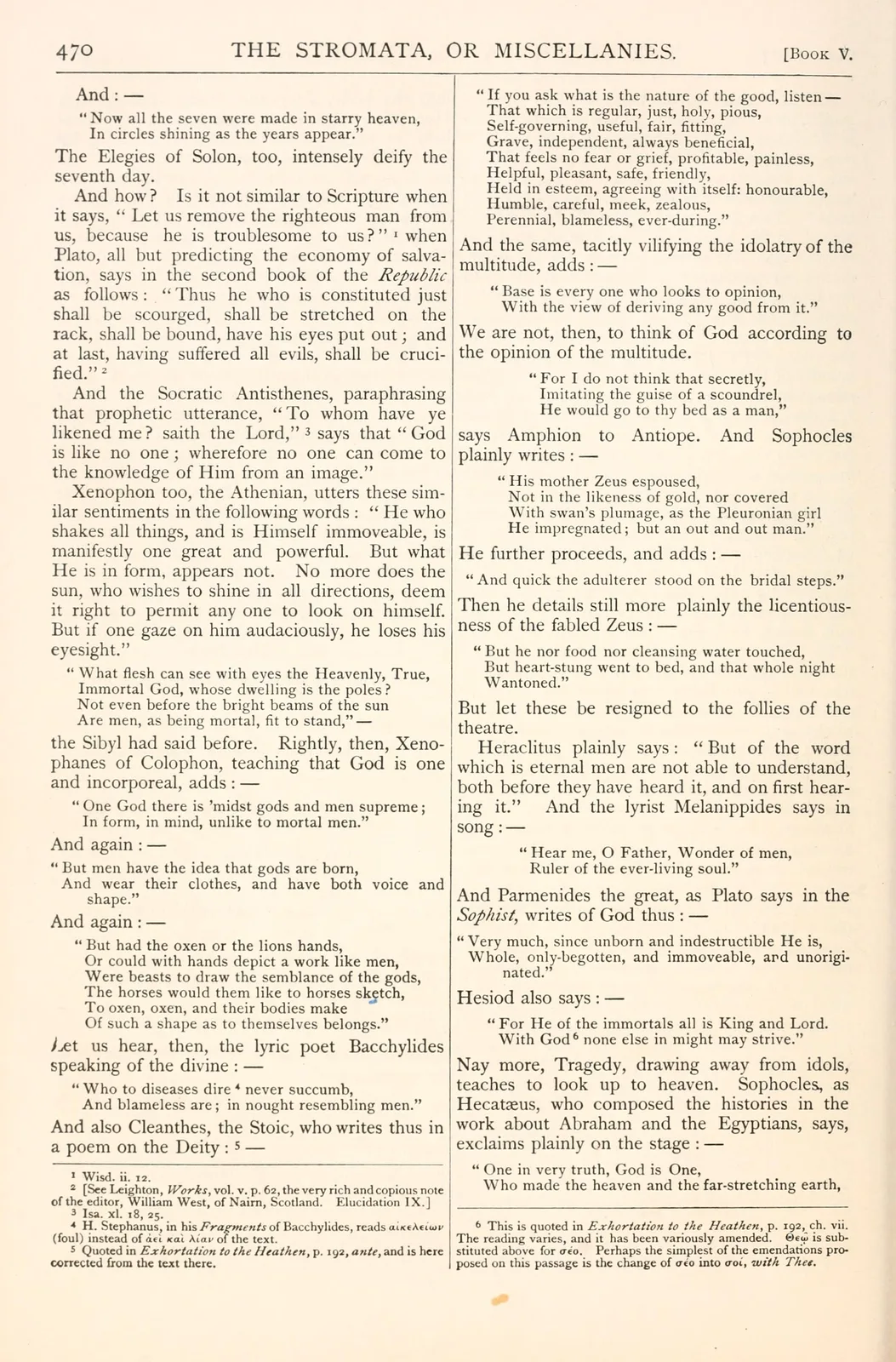
- [18] B14: "mortals deem that the gods are begotten as they are, and have clothes like theirs, and voice and form". Preserved by Clement, Strom. v. 109 — Burnet, Early Greek Philosophy, p. 119 (fr. 14); Clement of Alexandria, Stromata, tr. William Wilson, in The Ante-Nicene Fathers, vol. 2 (Buffalo/New York, 1885; scan of the 1913 printing). Internet Archive
antenicenefather02robe. Preserves B14, B15, B23 (Strom. v. xiv = 5.109, p. 470) and B16 (Strom. vii. iv = 7.22, p. 529); also Strom. i. xiv on Xenophanes's dates (pp. 314-15). Fairbanks cites the same passages by Potter's pagination (v. p. 714; vii. p. 841). Text file:anf-vol2-clement.txt, p. 470; Fairbanks, First Philosophers of Greece, p. 67 (fr. 5), source Clem. Strom. v. p. 714. - [19] B15: if oxen, horses or lions had hands they would paint their gods "like horses" and "like oxen". Preserved by Clement, Strom. v. 109; Clement quotes it as an example of "the idea of God" among the Greeks — Burnet, Early Greek Philosophy, p. 119 (fr. 15); Alexandria, Stromata, p. 470; Fairbanks, First Philosophers of Greece, p. 67 (fr. 6).
- [20] B16: the Ethiopians make their gods black and snub-nosed, the Thracians blue-eyed and red-haired. Preserved by Clement, Strom. vii. 22; Clement adds that the Greeks "assimilate their souls to those who form them" — Burnet, Early Greek Philosophy, p. 119 (fr. 16); Alexandria, Stromata, p. 529; Fairbanks, First Philosophers of Greece, p. 78.
- [21] B23: "One god, the greatest among gods and men, neither in form like unto mortals nor in thought". Preserved by Clement, Strom. v. 109, who introduces it with "teaching that God is one and incorporeal" — Burnet, Early Greek Philosophy, p. 119 (fr. 23); Alexandria, Stromata, p. 470; Fairbanks, First Philosophers of Greece, p. 67 (fr. 1).
- [22] B24-B26: the one god "sees all over, thinks all over, and hears all over", sways all things "without toil" by thought, and "abideth ever in the selfsame place, moving not at all". B24 preserved by Sextus (M. ix. 144); B25 and B26 by Simplicius, who took them from Alexander of Aphrodisias — Burnet, Early Greek Philosophy, pp. 119-20 (frs. 24-26), p. 116 n. 1 (the source of frs. 25, 26); Fairbanks, First Philosophers of Greece, p. 67 (frs. 2-4).
- [24] Modern readings of his "one god" differ: Burnet writes that "'One god' mean 'No god but the world'", that he "was really Goethe's Weltkind" and would have smiled to be called a theologian; he cites Wilamowitz ("the only real monotheism that has ever existed upon earth"), Diels ("a somewhat narrow pantheism") and Freudenthal (who found subordinate gods) — Burnet, Early Greek Philosophy, pp. 128-29. Accounts differ; see the disputed points.
- [27] B34: "There never was nor will be a man who has certain knowledge about the gods and about all the things I speak of. Even if he should chance to say the complete truth, yet he himself knows not that it is so. But all may have their fancy." Preserved by Sextus (M. vii. 49, 110; viii. 326) and Hippolytus (A33); the sense of its last word is disputed — Burnet, Early Greek Philosophy, p. 121 (fr. 34); Fairbanks, First Philosophers of Greece, p. 71 (fr. 14) and note on Burnet's alternate rendering; Hermann Diels, Die Fragmente der Vorsokratiker, griechisch und deutsch, 2nd ed., vol. 1 (Weidmann, Berlin, 1906), chapter 11 "Xenophanes". Internet Archive
diefragmentederv01dieluoft. Used for the A (testimony) and B (fragment) numbering and page references; the Greek OCR is too poor to quote. Text file:diels-1906-vol1.txt, p. 41 (A33 cites B34,3-4). - [29] B18: "The gods have not revealed all things to men from the beginning, but by seeking they find in time what is better". Preserved by Stobaeus — Burnet, Early Greek Philosophy, p. 119 (fr. 18); Fairbanks, First Philosophers of Greece, p. 71 (fr. 16).
If Horses Had Hands
At about the age of ninety-two a Greek poet looked back on his life in four lines of verse. "There are by this time threescore years and seven that have tossed my careworn soul up and down the land of Hellas; and there were then five-and-twenty years from my birth, if I can say aught truly about these matters."12 He had left his home city of Colophon, on the coast of what is now Turkey, at twenty-five, and spent the rest of a very long life wandering the Greek world, singing his own poems at dinner parties. Somewhere in those sixty-seven years he wrote some of the earliest surviving criticism of the gods of Greek religion, and the argument that human beings make their gods in their own image.
Almost all of it is lost. What survives are a few dozen short fragments, quoted by later writers for their own purposes, and a few stories about him told centuries after his death. This chapter asks what those fragments say, what made a wandering poet say it, and why he was not, whatever his later admirers said, an atheist.
The exile
He was born at Colophon, a rich Ionian city, the son of Dexius, or by another account Orthomenes, about 570 BCE; ancient writers give dates that range over fifty years, and the modern scholar John Burnet called one of them "a mere combination."345 He tells us himself that he left home at twenty-five, and an ancient biographer says that he was "banished from his native city."16 Why, no source says.
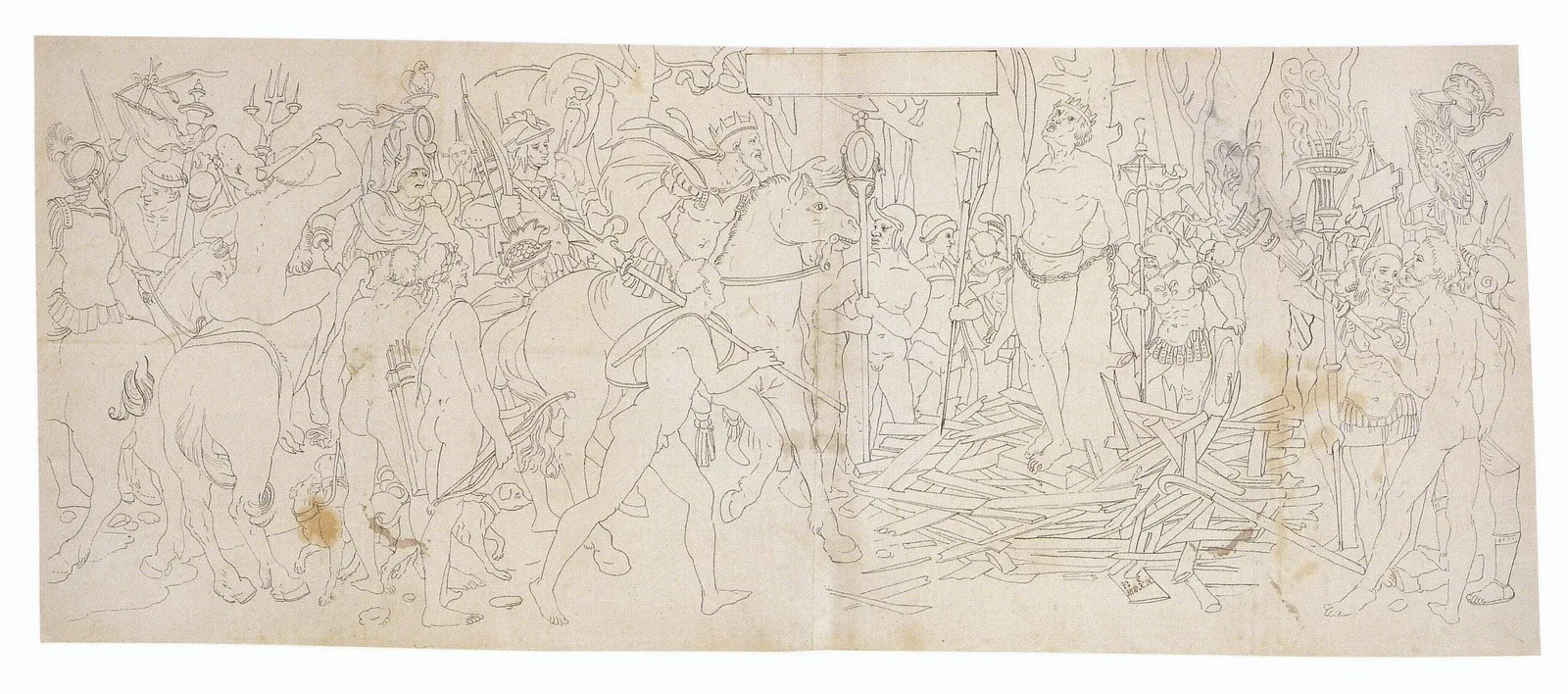
The guess modern scholars make is the Persian conquest. In 546 or 545 BCE Cyrus the Great took Sardis, the Lydian capital, and his general Harpagus moved down the Ionian coast taking the Greek cities one by one; the people of Phocaea and Teos took to their ships rather than submit.7 Xenophanes once suggested a question for a winter's evening: "Of what country are you, and how old are you, good sir? And how old were you when the Mede appeared?"89 It is "tempting to suppose," Burnet wrote, that his exile came with the Mede; but it is a supposition.10 He also remembered the luxury of his youth, when the men of Colophon "learnt dainty and unprofitable ways from the Lydians, so long as they were free from hateful tyranny," and paraded in purple cloaks, "a thousand of them all told."1112
The banquet singer
He lived, the biographer says, at Zancle and Catana in Sicily, and he "used to recite his own poems."613 He was not a professional reciter of Homer, as later stories sometimes make him; Burnet insisted that nothing says he ever recited Homer, and that a singer of elegies was "the social equal of his listeners."13 One of his poems describes the proper drinking party: clean cups, garlands, an altar, and then songs of the god "with holy tales and pure words." A man should not sing "of Titans and Giants (those fictions of the men of old) nor of turbulent civil broils ... but to give heedful reverence to the gods is ever good."1415 He thought wisdom was worth more than athletic glory: "Far better is our art than the strength of men and of horses!"1617
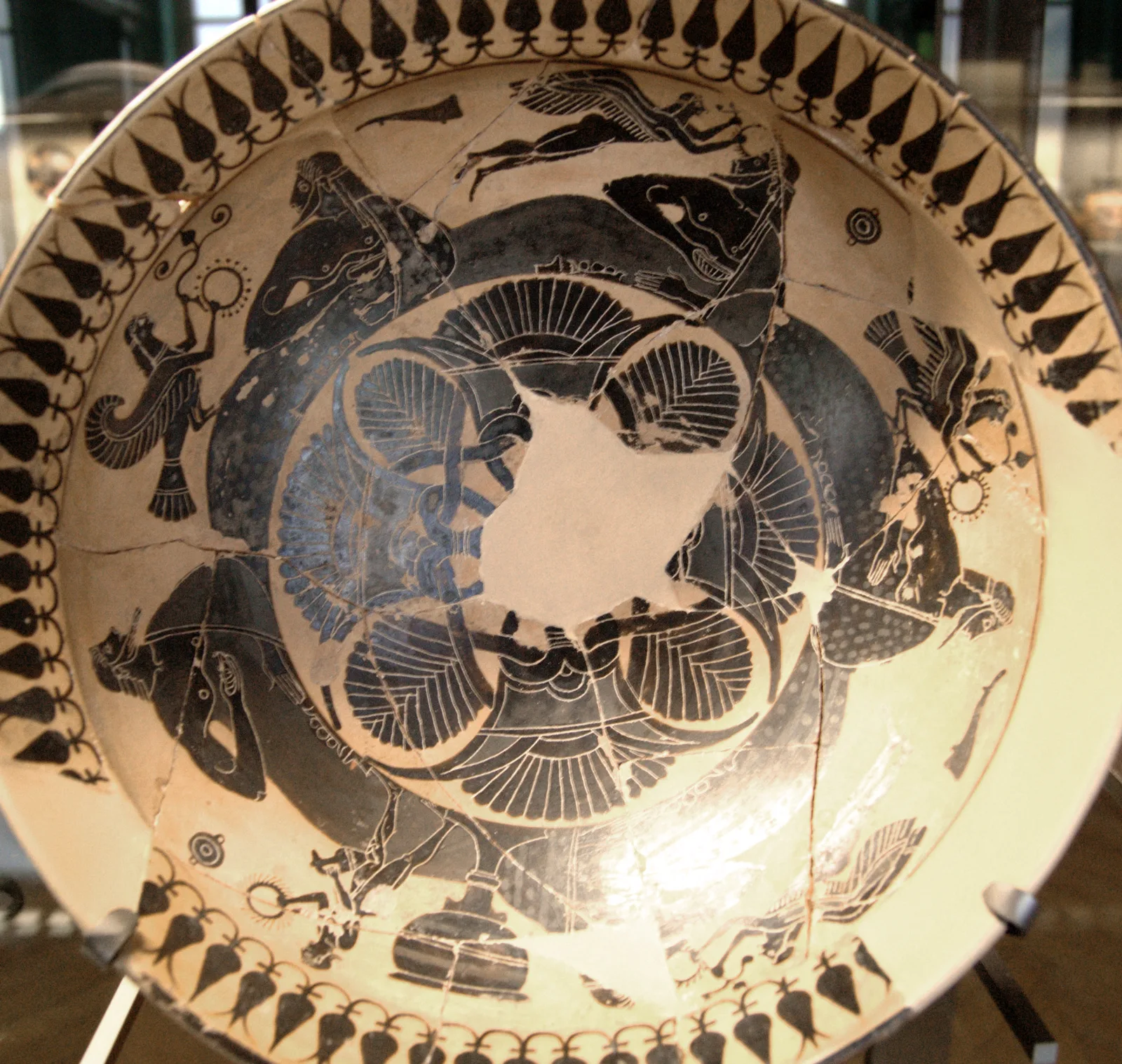
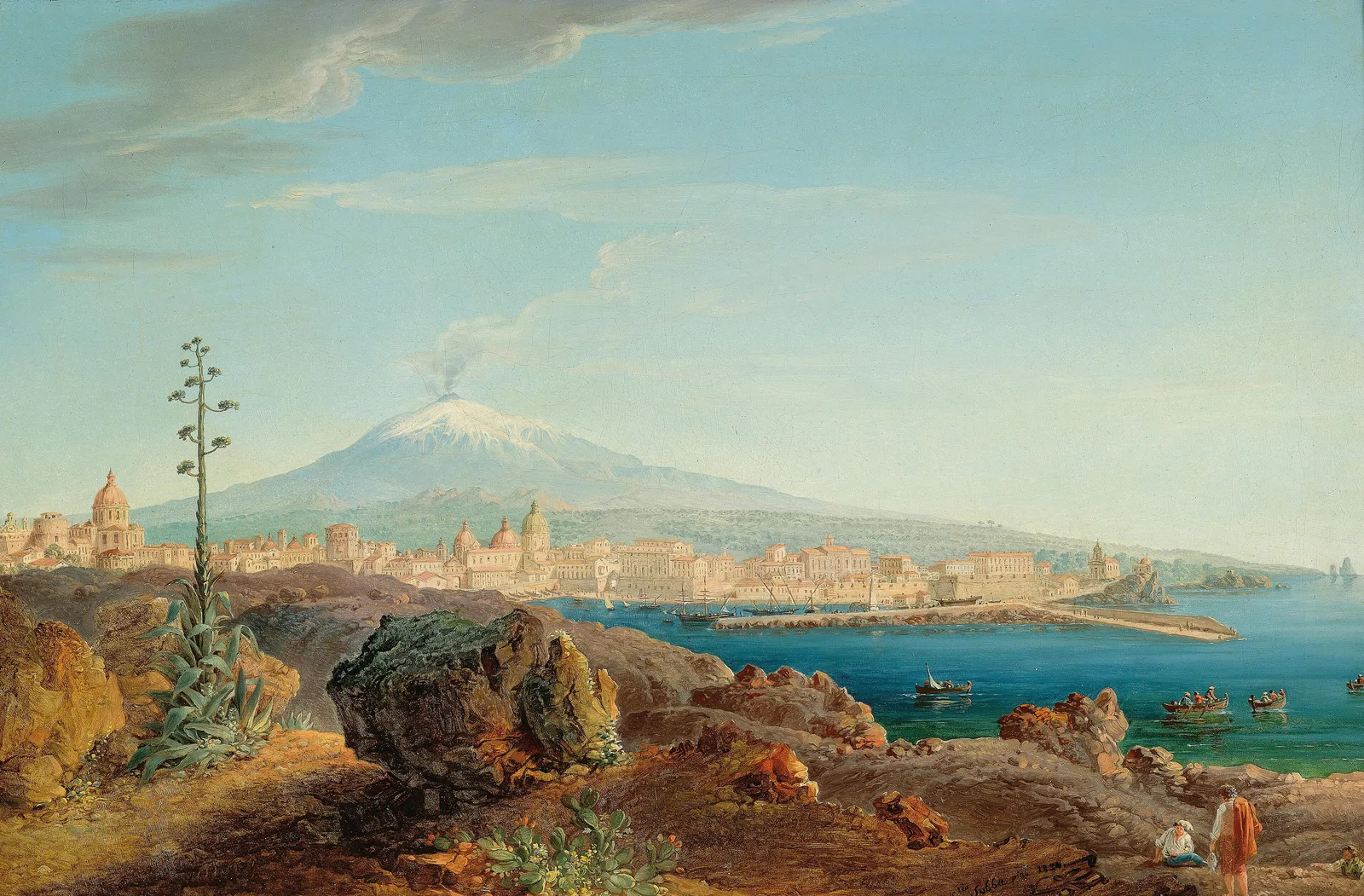
The first mark on his timeline is that exile, at twenty-five. There is no recorded faith before it to lose, and the fragments cannot be put in order, so the marks that follow are not dates but turns in what he said.
Stealings and adulteries
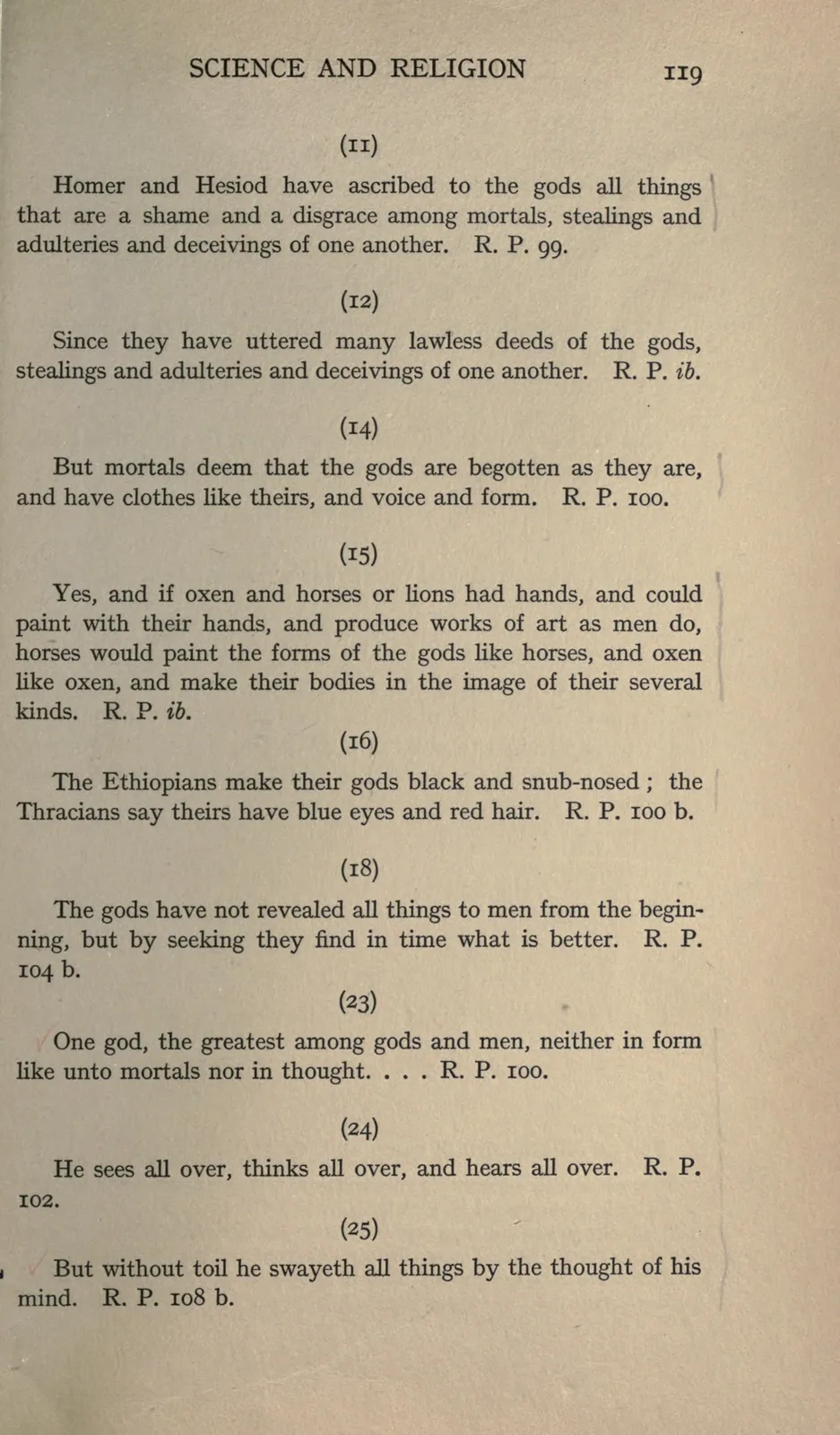
His quarrel was with the poets who had taught the Greeks their gods. "All at first have learnt according to Homer," he wrote.1819 And what had they learnt? "Homer and Hesiod have ascribed to the gods all things that are a shame and a disgrace among mortals, stealings and adulteries and deceivings of one another."2021 The stories were familiar to every Greek. In Hesiod's Theogony the god Cronos takes "the great long sickle with jagged teeth" and mutilates his own father, Heaven. In Homer's Iliad Agamemnon excuses his own folly by recalling that even Zeus, "he who they say is greatest among gods and men," was deceived by Hera "with female wile."22232425 Xenophanes thought a god who could be tricked or who stole and lied was no god.
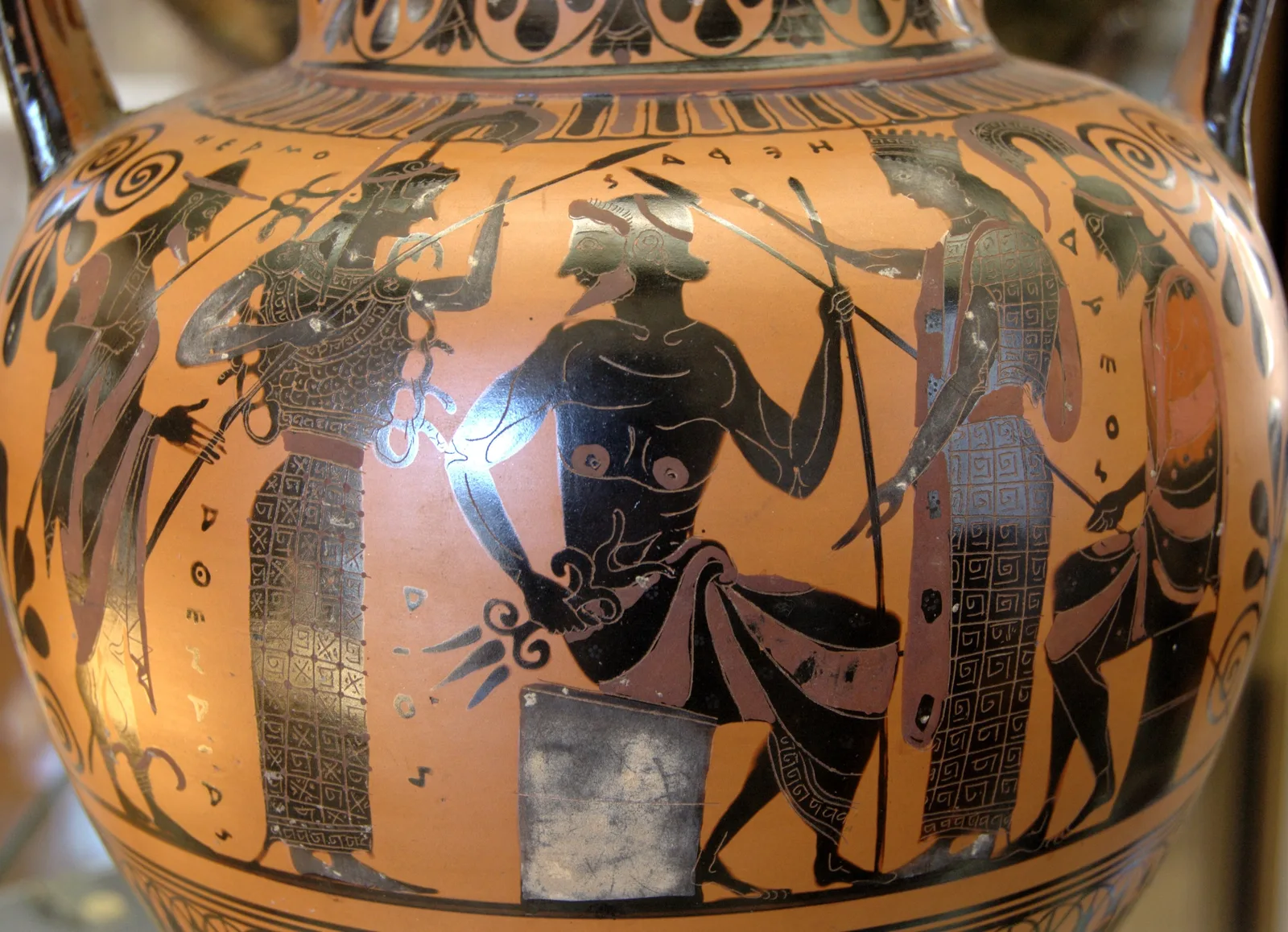
Then he went further, and asked where such gods came from. "Mortals deem that the gods are begotten as they are, and have clothes like theirs, and voice and form."2627 "The Ethiopians make their gods black and snub-nosed; the Thracians say theirs have blue eyes and red hair."2829 And the line for which he is remembered: "Yes, and if oxen and horses or lions had hands, and could paint with their hands, and produce works of art as men do, horses would paint the forms of the gods like horses, and oxen like oxen, and make their bodies in the image of their several kinds."3031 That is not a joke about animals. It is an argument about people: we picture the gods as we picture ourselves.
He explained some divine things away. The rainbow, which the Greeks called the goddess Iris, "is a cloud likewise, purple, scarlet and green to behold."3233 And he mocked a rival's religion: told that Pythagoras had stopped a man beating a dog because "it is the soul of a friend that I recognised when I heard its voice," he made the story a satire.3435
One god
What did he put in the gods' place? A single sentence survives: "One god, the greatest among gods and men, neither in form like unto mortals nor in thought."3637 This god "sees all over, thinks all over, and hears all over"; "without toil he swayeth all things by the thought of his mind"; "he abideth ever in the selfsame place, moving not at all; nor doth it befit him to go about now hither now thither."38394041 Aristotle reported him as saying that "those who say the gods are born are as impious as those who say that they die."4243
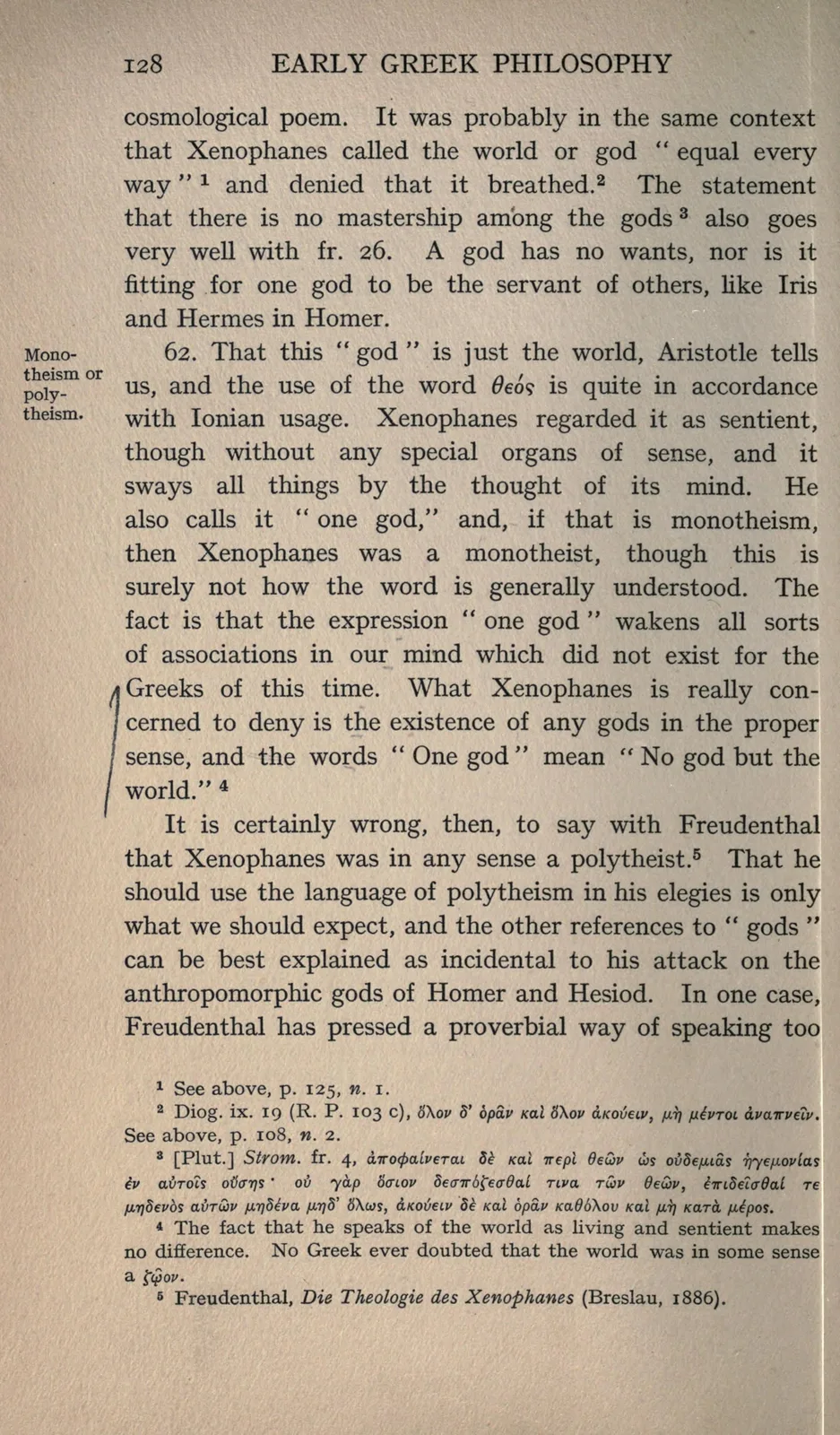
Scholars have never agreed what these lines mean. The great German classicist Wilamowitz called them "the only real monotheism that has ever existed upon earth"; Hermann Diels called them "a somewhat narrow pantheism"; another scholar found lesser gods still in place under the greatest. Burnet thought "one god" meant "no god but the world," and that Xenophanes would have smiled to be called a theologian.44 Notice that the sentence itself still speaks of "gods and men." The fragments never say that the gods do not exist.
No man knows
The last turn is the most modern. "There never was nor will be a man who has certain knowledge about the gods and about all the things I speak of. Even if he should chance to say the complete truth, yet he himself knows not that it is so. But all may have their fancy."4546 He offered his own views modestly: "Let these be taken as fancies something like the truth."4748 And he thought knowledge grew slowly, by effort rather than by revelation: "The gods have not revealed all things to men from the beginning, but by seeking they find in time what is better."4950
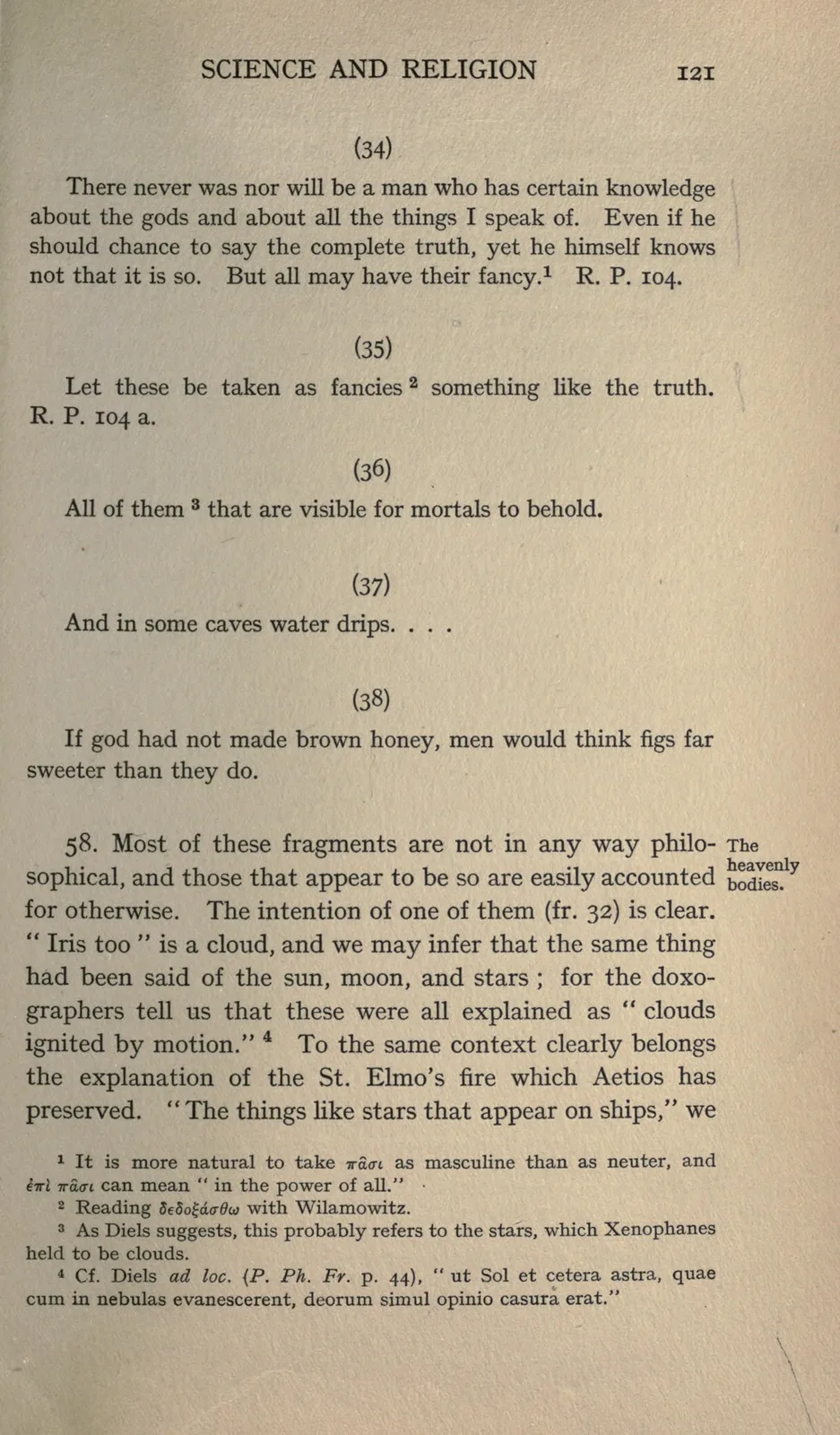
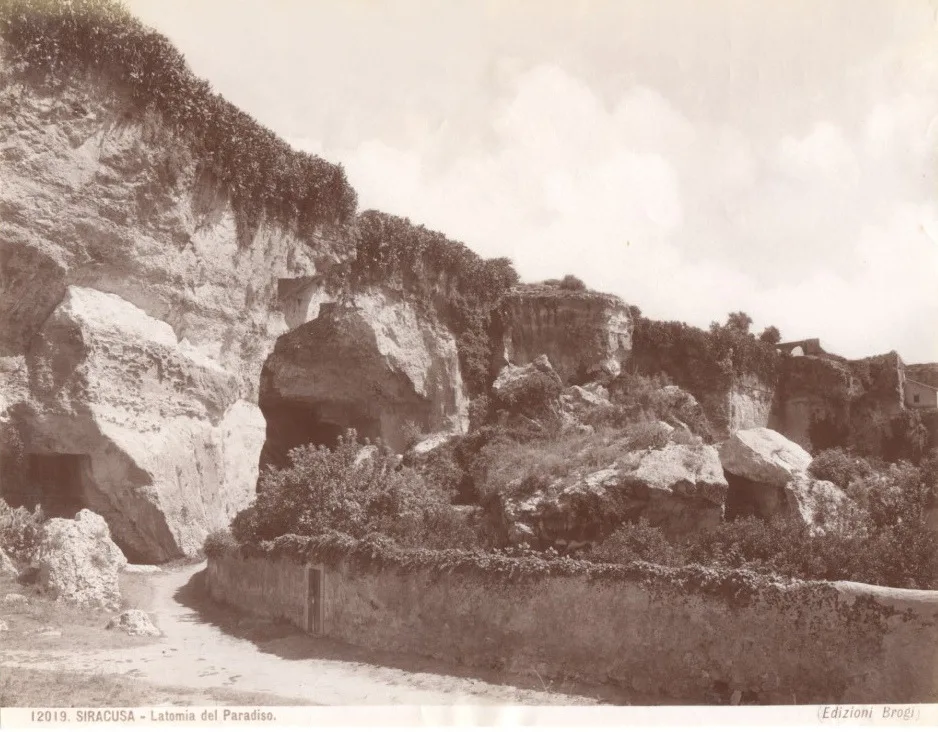
He also looked at the ground. A later report says he found shells inland and on hills, the imprint of a fish and of seaweed in the quarries at Syracuse, and flat impressions of sea creatures on Malta, and concluded that land and sea had once been mixed.5152 Burnet thought some of those observations may really have been Anaximander's.51
Who answered him
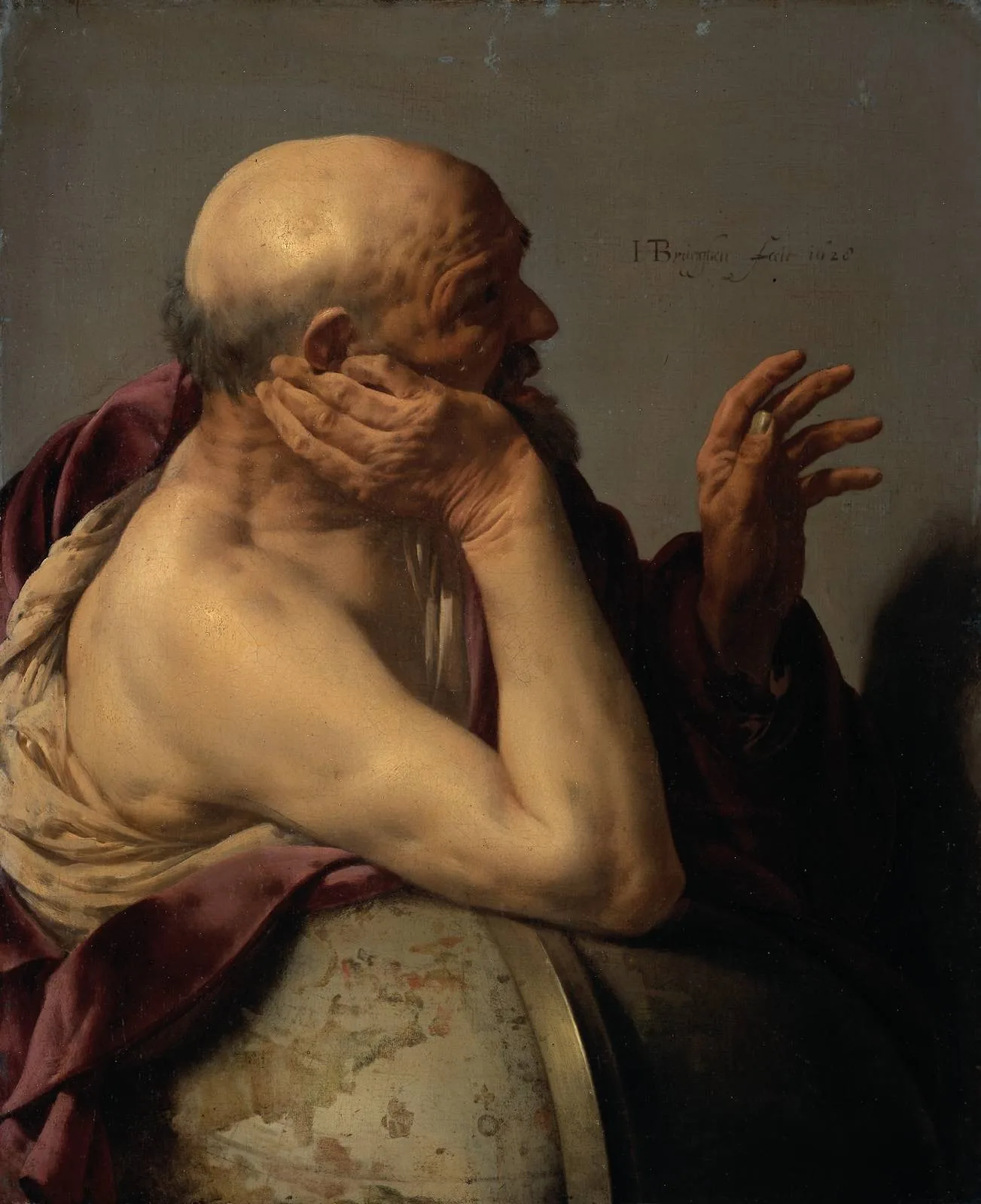
No believer of his own time is recorded answering him; he spoke against a tradition, not against a man, and the tradition's answer was that Homer and Hesiod went on being taught. One anecdote, late and probably invented, gives the tradition a reply. When Xenophanes complained to Hieron, the tyrant of Syracuse, that he could barely keep two servants, Hieron answered that Homer, whom Xenophanes disparaged, kept more than ten thousand, though he was dead.53 The next generation was not kind either. Heraclitus of Ephesus wrote that "the learning of many things teacheth not understanding, else would it have taught Hesiod and Pythagoras, and again Xenophanes and Hekataios."5455 Aristotle dismissed him as "rather more crude" than Parmenides.5657
Centuries later the Christians found him useful. Clement of Alexandria quoted the oxen and the horses and the one god against the pagans: "Rightly, then, Xenophanes of Colophon, teaching that God is one and incorporeal, adds ..."5859 Burnet warned that the words "one god" waken in a modern mind associations "which did not exist for the Greeks of this time."59
Did his unbelief change shape?
His was never unbelief in the modern sense, and we cannot watch it change, because the fragments cannot be dated. What they show is a man taking apart the gods of his own people with three tools. One was moral: a god who steals and lies is unworthy of the name. One was comparative: Ethiopians, Thracians and, if they could paint, horses all make gods in their own image. The third was the limit of knowledge: no one knows the truth about the gods, and if someone said it they could not know they had. He replaced the gods of Homer with something greater, stranger and less human, which later readers have called by every name from monotheism to pantheism. He still asked, at the dinner table, for reverence to the gods. The fragments do not say what made him do it. Perhaps it was sixty-seven years of travel among peoples whose gods did not look alike. Whatever the cause, he left what may be the earliest surviving critique of religion in the West, and it was not yet atheism.
Protagoras, the first person on record to say that he could not know whether the gods exist at all, has his own chapter in this book.
Footnotes
-
John Burnet, Early Greek Philosophy, 3rd ed. (A. & C. Black, London, 1920), ch. II §§ 55-62, pp. 112-129, fragments in the order and numbering of Diels. Internet Archive
earlygreekphilos00burnrich. English translations of every fragment used here, with the commentary that carries most of the modern argument. Text file:burnet.txt, p. 114 (fr. 8); Diogenes Laertius, Lives of Eminent Philosophers, vol. 2, tr. R. D. Hicks (Loeb Classical Library, 1925), ix. 18-21 (Xenophanes), pp. 424-428; ix. 1 (Heraclitus), p. 408; viii. 36 (Pythagoras), p. c. 352. Internet Archivelivesofeminentph02dioguoft. Text file:dl-hicks-vol2.txt. English is on the even pages, Greek on the odd; the OCR puts each page number at the head of its page. Hicks prints "and having joined the colony planted at Elea taught there" in angle brackets, as an editorial supplement, ix. 19 (Hicks p. 426); Arthur Fairbanks, The First Philosophers of Greece (Kegan Paul, London, 1898), ch. V, pp. 65-80: Greek text, translation, and a note on the source of each fragment (Karsten numbering). Internet Archivefirstphilosopher00fairiala. This is where the preserving author is named for each fragment (Clement, Sextus, Simplicius, Athenaeus and so on). Text file:fairbanks.txt, p. 77 (fr. 24); preserved by Diogenes Laertius. ↩ ↩2 -
Burnet, Early Greek Philosophy, p. 114 (fr. 8); preserved by Diogenes Laertius ix. 19 (Hicks p. 426). ↩
-
Laertius, Lives of Eminent Philosophers, ix. 18 (Hicks vol. 2, p. 424); Fairbanks, First Philosophers of Greece, p. 65. ↩
-
Clement of Alexandria, Stromata, tr. William Wilson, in The Ante-Nicene Fathers, vol. 2 (Buffalo/New York, 1885; scan of the 1913 printing). Internet Archive
antenicenefather02robe. Preserves B14, B15, B23 (Strom. v. xiv = 5.109, p. 470) and B16 (Strom. vii. iv = 7.22, p. 529); also Strom. i. xiv on Xenophanes's dates (pp. 314-15). Fairbanks cites the same passages by Potter's pagination (v. p. 714; vii. p. 841). Text file:anf-vol2-clement.txt, Strom. i. xiv, pp. 314-15; Laertius, Lives of Eminent Philosophers, ix. 20 (Hicks p. 428); Burnet, Early Greek Philosophy, pp. 113-14. Accounts differ; see the disputed points. ↩ -
Burnet, Early Greek Philosophy, p. 114. ↩
-
Laertius, Lives of Eminent Philosophers, ix. 18 (Hicks p. 424); Burnet, Early Greek Philosophy, p. 114 and n. 5. ↩ ↩2
-
Herodotus, Histories Book 1, tr. George Rawlinson (via Wikisource). Text file:
herodotus-1-rawlinson.txt. Used for the Persian conquest of Ionia; cited by section, no page numbers, 1.141, 1.162, 1.164-168; Burnet, Early Greek Philosophy, p. 51 n. 3 (fall of Sardis 546/5, Apollodorus's epoch). Reported at second hand; the original has not been seen. ↩ -
Burnet, Early Greek Philosophy, p. 51 and p. 114 (fr. 22); Fairbanks, First Philosophers of Greece, p. 71 (fr. 17), source Athenaeus ii. 54. ↩
-
Burnet, Early Greek Philosophy, p. 114 (fr. 22); preserved by Athenaeus ii. 54. ↩
-
Burnet, Early Greek Philosophy, p. 114. Not verified. ↩
-
Burnet, Early Greek Philosophy, p. 118 (fr. 3); Fairbanks, First Philosophers of Greece, p. 73 (fr. 20), source Athenaeus xii. 526. ↩
-
Burnet, Early Greek Philosophy, p. 118 (fr. 3); preserved by Athenaeus xii. 526. ↩
-
Laertius, Lives of Eminent Philosophers, ix. 18 (Hicks p. 426); Burnet, Early Greek Philosophy, p. 115 and n. 1. ↩ ↩2
-
Burnet, Early Greek Philosophy, pp. 116-17 (fr. 1); Fairbanks, First Philosophers of Greece, p. 75 (fr. 21), source Athenaeus xi. 462. ↩
-
Burnet, Early Greek Philosophy, p. 117 (fr. 1); preserved by Athenaeus xi. 462. ↩
-
Burnet, Early Greek Philosophy, p. 117 (fr. 2); Fairbanks, First Philosophers of Greece, p. 73 (fr. 19). ↩
-
Burnet, Early Greek Philosophy, p. 117 (fr. 2); preserved by Athenaeus x. 413 f. ↩
-
Burnet, Early Greek Philosophy, p. 118 (fr. 10); Fairbanks, First Philosophers of Greece, p. 77 (fr. 28), source Herodian. ↩
-
Burnet, Early Greek Philosophy, p. 118 (fr. 10); preserved by Herodian. ↩
-
Burnet, Early Greek Philosophy, p. 119 (frs. 11, 12); Fairbanks, First Philosophers of Greece, p. 68-69 (fr. 7). ↩
-
Burnet, Early Greek Philosophy, p. 119 (fr. 11); preserved by Sextus Empiricus, Adv. math. ix. 193 (through Fairbanks p. 69 note). ↩
-
Hesiod, Theogony, tr. Hugh G. Evelyn-White (Loeb, 1914; Internet Archive
hesiod-homeric-hymns-homerica-loeb-l-496, a later printing of the 1914 text). Text file:hesiod-evelyn-white.txt, Theogony 172-181 (Evelyn-White pp. 91-92); Burnet, Early Greek Philosophy, p. 125 n. 4 (conjecture about Tartarus). ↩ -
The Iliad of Homer, done into English prose by Lang, Leaf and Myers (Macmillan, 1883). Internet Archive
iliadofhomerdone00homeuoft. Text file:iliad-lang-leaf-myers.txt; no page numbers survive in the OCR, so cited by book, XIX (Lang, Leaf, Myers); Burnet, Early Greek Philosophy, p. 128 n. 1. ↩ -
Hesiod, Theogony, c. 700 BCE; the tradition Xenophanes attacked. In the poem Heaven is the one who "first thought of doing shameful things", so the poem itself calls the act a punishment, not a sin: Hesiod, Theogony, Theogony 178-181 (Evelyn-White p. 92); the "shameful things" line is at 172 (p. 91). ↩
-
Agamemnon in Homer's Iliad XIX, defending himself for taking Achilles's prize; the tradition Xenophanes attacked: the poem accepts that gods deceive each other and use "Ate" to blind both men and gods: Iliad of Homer, XIX (Lang, Leaf, Myers 1883); no page number in the OCR. ↩
-
Burnet, Early Greek Philosophy, p. 119 (fr. 14); Alexandria, Stromata, p. 470; Fairbanks, First Philosophers of Greece, p. 67 (fr. 5), source Clem. Strom. v. p. 714. ↩
-
Burnet, Early Greek Philosophy, p. 119 (fr. 14); preserved by Clement, Strom. v. 109 (Clement-ANF p. 470). ↩
-
Burnet, Early Greek Philosophy, p. 119 (fr. 16); Alexandria, Stromata, p. 529; Fairbanks, First Philosophers of Greece, p. 78. ↩
-
Burnet, Early Greek Philosophy, p. 119 (fr. 16); preserved by Clement, Strom. vii. 22 (Clement-ANF p. 529). ↩
-
Burnet, Early Greek Philosophy, p. 119 (fr. 15); Alexandria, Stromata, p. 470; Fairbanks, First Philosophers of Greece, p. 67 (fr. 6). ↩
-
Burnet, Early Greek Philosophy, p. 119 (fr. 15); preserved by Clement, Strom. v. 109 (Clement-ANF p. 470). Fairbanks p. 67 gives "cattle or lions" and the same sense; Wilson's version in ANF reads "had the oxen or the lions hands ... The horses would them like to horses sketch". Often misquoted as "if horses had hands they would draw gods like horses" and given as a joke about animals; the fragment is about human anthropomorphism. ↩
-
Burnet, Early Greek Philosophy, p. 120-22 (frs. 32, 38); Fairbanks, First Philosophers of Greece, pp. 69, 77. ↩
-
Burnet, Early Greek Philosophy, p. 120 (fr. 32); preserved by Eustathius and scholia on Homer. ↩
-
Burnet, Early Greek Philosophy, p. 118 (fr. 7) and n. 2; Fairbanks, First Philosophers of Greece, p. 71 (fr. 18); Laertius, Lives of Eminent Philosophers, viii. 36 (Hicks vol. 2, c. p. 352). ↩
-
Burnet, Early Greek Philosophy, p. 118 (fr. 7); preserved by Diogenes Laertius viii. 36. ↩
-
Burnet, Early Greek Philosophy, p. 119 (fr. 23); Alexandria, Stromata, p. 470; Fairbanks, First Philosophers of Greece, p. 67 (fr. 1). ↩
-
Burnet, Early Greek Philosophy, p. 119 (fr. 23); preserved by Clement, Strom. v. 109 (Clement-ANF p. 470). ↩
-
Burnet, Early Greek Philosophy, pp. 119-20 (frs. 24-26), p. 116 n. 1 (the source of frs. 25, 26); Fairbanks, First Philosophers of Greece, p. 67 (frs. 2-4). ↩
-
Burnet, Early Greek Philosophy, p. 119 (fr. 24); preserved by Sextus, Adv. math. ix. 144. ↩
-
Burnet, Early Greek Philosophy, p. 119 (fr. 25); preserved by Simplicius (from Alexander). ↩
-
Burnet, Early Greek Philosophy, p. 120 (fr. 26); preserved by Simplicius. ↩
-
Fairbanks, First Philosophers of Greece, p. 78 (Arist. Rhet. ii. 23, 1399b6). ↩
-
Aristotle, Rhetoric ii. 23 (1399b6), reporting Xenophanes: Fairbanks, First Philosophers of Greece, p. 78. ↩
-
Burnet, Early Greek Philosophy, pp. 128-29. ↩
-
Burnet, Early Greek Philosophy, p. 121 (fr. 34); Fairbanks, First Philosophers of Greece, p. 71 (fr. 14) and note on Burnet's alternate rendering; Hermann Diels, Die Fragmente der Vorsokratiker, griechisch und deutsch, 2nd ed., vol. 1 (Weidmann, Berlin, 1906), chapter 11 "Xenophanes". Internet Archive
diefragmentederv01dieluoft. Used for the A (testimony) and B (fragment) numbering and page references; the Greek OCR is too poor to quote. Text file:diels-1906-vol1.txt, p. 41 (A33 cites B34,3-4). ↩ -
Burnet, Early Greek Philosophy, p. 121 (fr. 34); preserved by Sextus, Adv. math. vii. 49, 110, viii. 326, and Hippolytus (A33). ↩
-
Burnet, Early Greek Philosophy, p. 121 (fr. 35); Fairbanks, First Philosophers of Greece, p. 71 (fr. 15). ↩
-
Burnet, Early Greek Philosophy, p. 121 (fr. 35); preserved by Plutarch. ↩
-
Burnet, Early Greek Philosophy, p. 119 (fr. 18); Fairbanks, First Philosophers of Greece, p. 71 (fr. 16). ↩
-
Burnet, Early Greek Philosophy, p. 119 (fr. 18); preserved by Stobaeus. ↩
-
Burnet, Early Greek Philosophy, pp. 123-24 and n. 1 (translation of Hipp. Ref. i. 14 = DK 21 A33); Diels, Die Fragmente der Vorsokratiker, p. 41. ↩ ↩2
-
Hippolytus, reporting Theophrastus on Xenophanes (A33): Burnet, Early Greek Philosophy, p. 123 (translation of Hipp. Ref. i. 14); Diels, Die Fragmente der Vorsokratiker, p. 41. ↩
-
Diels, Die Fragmente der Vorsokratiker, p. 35 (A11); Burnet, Early Greek Philosophy, p. 113 n. 2. ↩
-
Burnet, Early Greek Philosophy, p. 129 and p. 134 (fr. 16); Laertius, Lives of Eminent Philosophers, ix. 1 (Hicks p. 408); Diels, Die Fragmente der Vorsokratiker, A3 (B40). ↩
-
Heraclitus of Ephesus (flourished c. 504-501), the only contemporary-generation writer who names him; he too wished Homer "chased out of the lists and beaten with rods" (DL ix. 1), so he is more rival than opponent on the question of Homer: Burnet, Early Greek Philosophy, p. 134 (fr. 16 = DK 22 B40); Laertius, Lives of Eminent Philosophers, ix. 1 (Hicks p. 408). ↩
-
Fairbanks, First Philosophers of Greece, pp. 79-80 (Metaph. 986b10-27); Burnet, Early Greek Philosophy, p. 126. ↩
-
Aristotle, Metaphysics A 5 (986b), fourth century BCE; the standard ancient verdict, and the source of the "founder of the Eleatics" tradition: Fairbanks, First Philosophers of Greece, p. 80. ↩
-
Alexandria, Stromata, p. 470 (Strom. v. xiv), p. 529 (Strom. vii. iv). ↩
-
Clement of Alexandria, Christian teacher (c. 150-215 CE); an ally, not an opponent: he quotes Xenophanes against pagan polytheism and reads "one god" as his own God; Burnet (p. 128) warns that the word "one god" "wakens all sorts of associations in our mind which did not exist for the Greeks of this time": Alexandria, Stromata, p. 470 (Strom. v. xiv). ↩ ↩2
earlygreekphilos00burnrich. English translations of every fragment used here, with the commentary that carries most of the modern argument. Text file: burnet.txt.; Diogenes Laertius, Lives of Eminent Philosophers, vol. 2, tr. R. D. Hicks (Loeb Classical Library, 1925), ix. 18-21 (Xenophanes), pp. 424-428; ix. 1 (Heraclitus), p. 408; viii. 36 (Pythagoras), p. c. 352. Internet Archive livesofeminentph02dioguoft. Text file: dl-hicks-vol2.txt. English is on the even pages, Greek on the odd; the OCR puts each page number at the head of its page. Hicks prints "and having joined the colony planted at Elea taught there" in angle brackets, as an editorial supplement.; Arthur Fairbanks, The First Philosophers of Greece (Kegan Paul, London, 1898), ch. V, pp. 65-80: Greek text, translation, and a note on the source of each fragment (Karsten numbering). Internet Archive firstphilosopher00fairiala. This is where the preserving author is named for each fragment (Clement, Sextus, Simplicius, Athenaeus and so on). Text file: fairbanks.txt.; Clement of Alexandria, Stromata, tr. William Wilson, in The Ante-Nicene Fathers, vol. 2 (Buffalo/New York, 1885; scan of the 1913 printing). Internet Archive antenicenefather02robe. Preserves B14, B15, B23 (Strom. v. xiv = 5.109, p. 470) and B16 (Strom. vii. iv = 7.22, p. 529); also Strom. i. xiv on Xenophanes's dates (pp. 314-15). Fairbanks cites the same passages by Potter's pagination (v. p. 714; vii. p. 841). Text file: anf-vol2-clement.txt.; Herodotus, Histories Book 1, tr. George Rawlinson (via Wikisource). Text file: herodotus-1-rawlinson.txt. Used for the Persian conquest of Ionia; cited by section, no page numbers.; Hesiod, Theogony, tr. Hugh G. Evelyn-White (Loeb, 1914; Internet Archive hesiod-homeric-hymns-homerica-loeb-l-496, a later printing of the 1914 text). Text file: hesiod-evelyn-white.txt.; The Iliad of Homer, done into English prose by Lang, Leaf and Myers (Macmillan, 1883). Internet Archive iliadofhomerdone00homeuoft. Text file: iliad-lang-leaf-myers.txt; no page numbers survive in the OCR, so cited by book.; Hermann Diels, Die Fragmente der Vorsokratiker, griechisch und deutsch, 2nd ed., vol. 1 (Weidmann, Berlin, 1906), chapter 11 "Xenophanes". Internet Archive diefragmentederv01dieluoft. Used for the A (testimony) and B (fragment) numbering and page references; the Greek OCR is too poor to quote. Text file: diels-1906-vol1.txt.In their own words
Yes, and if oxen and horses or lions had hands, and could paint with their hands, and produce works of art as men do, horses would paint the forms of the gods like horses, and oxen like oxen, and make their bodies in the image of their several kinds.
The Ethiopians make their gods black and snub-nosed; the Thracians say theirs have blue eyes and red hair.
But mortals deem that the gods are begotten as they are, and have clothes like theirs, and voice and form.
Homer and Hesiod have ascribed to the gods all things that are a shame and a disgrace among mortals, stealings and adulteries and deceivings of one another.
Since they have uttered many lawless deeds of the gods, stealings and adulteries and deceivings of one another.
One god, the greatest among gods and men, neither in form like unto mortals nor in thought.
He sees all over, thinks all over, and hears all over.
But without toil he swayeth all things by the thought of his mind.
And he abideth ever in the selfsame place, moving not at all; nor doth it befit him to go about now hither now thither.
There never was nor will be a man who has certain knowledge about the gods and about all the things I speak of. Even if he should chance to say the complete truth, yet he himself knows not that it is so. But all may have their fancy.
Let these be taken as fancies something like the truth.
The gods have not revealed all things to men from the beginning, but by seeking they find in time what is better.
There are by this time threescore years and seven that have tossed my careworn soul up and down the land of Hellas; and there were then five-and-twenty years from my birth, if I can say aught truly about these matters.
This is the sort of thing we should say by the fireside in the winter-time, as we lie on soft couches after a good meal, drinking sweet wine and crunching chickpeas: "Of what country are you, and how old are you, good sir? And how old were you when the Mede appeared?"
Let him not sing of Titans and Giants (those fictions of the men of old) nor of turbulent civil broils in which is no good thing at all; but to give heedful reverence to the gods is ever good.
Since all at first have learnt according to Homer.
"Stop! don't beat it! For it is the soul of a friend that I recognised when I heard its voice."
They learnt dainty and unprofitable ways from the Lydians, so long as they were free from hateful tyranny; they went to the market-place with cloaks of purple dye, not less than a thousand of them all told, vainglorious and proud of their comely tresses, reeking with fragrance from cunning salves.
Far better is our art than the strength of men and of horses!
If god had not made brown honey, men would think figs far sweeter than they do.
She that they call Iris is a cloud likewise, purple, scarlet and green to behold.
Shells are found in midland districts and on hills, and he says that in the quarries at Syracuse has been found the imprint of a fish and of seaweed, at Paros the form of a bayleaf in the depth of the stone, and at Malta flat impressions of all marine animals.
Xenophanes asserts that those who say the gods are born are as impious as those who say that they die; for in both cases it amounts to this, that the gods do not exist at all.
"If you think her a goddess," he said, "do not lament her; if you do not, do not sacrifice to her"
Naturally, for it takes a wise man to recognize a wise man.
The other side
The learning of many things teacheth not understanding, else would it have taught Hesiod and Pythagoras, and again Xenophanes and Hekataios.
These, as we have said, are to be dismissed from the present investigation, two of them entirely as being rather more crude, Xenophanes and Melissos; but Parmenides seems to speak in some places with greater care.
Then the son from his ambush stretched forth his left hand and in his right took the great long sickle with jagged teeth, and swiftly lopped off his own father's members and cast them away to fall behind him.
Yea even Zeus was blinded upon a time, he who they say is greatest among gods and men; yet even him Hera with female wile deceived
Rightly, then, Xenophanes of Colophon, teaching that God is one and incorporeal, adds
Where accounts differ
| Point | One account | Another | How the page handles it |
|---|---|---|---|
| His dates | Apollodorus (via Clement): born Olympiad 40, 620-616 BCE, alive under Cyrus and Darius; Zeller (via Fairbanks p. 65): born c. 580 | Timaeus: contemporary of Hieron (478-467), so not born before c. 570 even at 100 (Burnet p. 113); Burnet: birth "in 565" if B8 refers to the Persian conquest (p. 114); Diogenes: floruit 540-537 (a "mere combination") | Say "about 570" and "accounts differ". Note that 570 minus 25 puts the departure at c. 545, the year of the conquest, while Burnet's 565 puts it at c. 540; settle before the script. The death date 478 is only conventional |
| Why he left Colophon | Diogenes: "banished from his native city" (DL ix. 18) | Modern guess: the Persian conquest, from B8 and B22 (Burnet p. 114: "tempting to suppose") | Say what the sources say (he left, and wandered 67 years) and mark the Persian conquest as the likely, unproven, cause; do not narrate him fleeing Harpagus |
| Was he a rhapsode who recited Homer? | Diogenes: "he used to recite his own poems" (ix. 18); the briefing: a rhapsode who recited Homer then turned on him | Burnet p. 115 and n. 1: "no foundation at all"; nothing says he recited Homer; elegy singers were social equals of their hearers | Do not say he recited Homer. Say he was a poet who sang his own verses at banquets and wrote that "all at first have learnt according to Homer" (B10) |
| Did he found the Eleatic school or teach Parmenides, or ever live at Elea? | Plato (Soph. 242d); Aristotle (Metaph. 986b); Clement; Diogenes (with the Elea clause bracketed by Hicks) | Burnet pp. 114-15, 127: no ancient writer says he was at Elea; Plato's remark was "playful"; Diogenes: Parmenides "was no follower of his" (ix. 21) | "Later writers call him the founder of a school at Elea; there is no evidence that he ever lived there" |
| What his "one god" was | Wilamowitz: "the only real monotheism that has ever existed upon earth"; Clement: God "one and incorporeal" | Burnet: "No god but the world"; Diels: "a somewhat narrow pantheism"; Freudenthal: subordinate gods remain (Burnet pp. 128-29) | Present as the live scholarly question; say the fragments never deny that gods exist and never name worship of the one god |
| Meaning of B34's last clause | Burnet: "all may have their fancy" | Fairbanks: "every one thinks he knows"; Burnett's earlier rendering "All are free to guess" (Fairbanks note, p. 71) | Quote one translation and say so on screen; do not use the brief's "clear truth" wording without a source |
| Did he write a poem "On Nature"? | The title "Peri physeos" appears in ancient lists; Diels assigns about 28 lines to it | Burnet pp. 115-16: no good authority; Simplicius had never met such a poem; titles are late | Never say "his poem On Nature"; say "in his verses" |
| Fossil observations | Hippolytus, from Theophrastus, attributes them to Xenophanes | Burnet p. 124: probably Anaximander's; the Parian leaf "no doubt imaginary" | Present as reported, not as his; at most one sentence |
| What "tyranny" B3 means | Persian (Burnet places B3 before the conquest through its tone, not stated) | Lydian or local tyrants | Quote B3 without naming the tyrant |
| Fragment numbering | Diels-Kranz B-numbers (the standard) | Fairbanks uses Karsten's numbering | All numbers in this sheet are Diels's; the concordance is in the Sources section |
List of illustrations
This page uses only public-domain and Creative Commons images; each is credited with its source and licence.
- Xenophanes in Thomas Stanley History of Philosophy — Thomas Stanley, 1655, The history of philosophy, 1655 · Xenophanes in Thomas Stanley History of Philosophy, Thomas Stanley, 1655, The history of philosophy, Public domain, via Wikimedia Commons · Public domain
- Croesus at the Stake, after Hans Holbein the Younger — After Hans Holbein the Younger, c. 1540 · Croesus at the Stake, after Hans Holbein the Younger, After Hans Holbein the Younger, Public domain, via Wikimedia Commons · Public domain
- Banqueters Louvre E667 — Naucratis Painter, c. 565 BCE · Banqueters Louvre E667, Naucratis Painter, Public domain, via Wikimedia Commons · Public domain
- Letterio Subba - The Bay of Catania, with Mount Etna in the Background — Letterio Subba, 1834 · Letterio Subba - The Bay of Catania, with Mount Etna in the Background, Letterio Subba, Public domain, via Wikimedia Commons · Public domain
- Theoi Cdm Paris 229 — Three-Line Group, c. 500 BCE · Theoi Cdm Paris 229, Three-Line Group, Public domain, via Wikimedia Commons · Public domain
- Early Greek Philosophy, 3rd ed., leaf 129 — John Burnet, 1920 · Burnet, Early Greek Philosophy (1920), Internet Archive scan from University of California Libraries · Public domain (published 1920; Internet Archive item flags not in copyright in the US)
- Early Greek Philosophy, 3rd ed., leaf 138 — John Burnet, 1920 · Burnet, Early Greek Philosophy (1920), Internet Archive scan from University of California Libraries · Public domain (published 1920; Internet Archive item flags not in copyright in the US)
- Early Greek Philosophy, 3rd ed., leaf 131 — John Burnet, 1920 · Burnet, Early Greek Philosophy (1920), Internet Archive scan from University of California Libraries · Public domain (published 1920; Internet Archive item flags not in copyright in the US)
- Brogi, Carlo (1850-1925) - n. 12019 - Siracusa - Latomia del Paradiso — Carlo Brogi, c. 1900 · Brogi, Carlo (1850-1925) - n. 12019 - Siracusa - Latomia del Paradiso, Carlo Brogi, Public domain, via Wikimedia Commons · Public domain
- Hendrik ter Brugghen - Heraclitus — Hendrick ter Brugghen, 1628 · Hendrik ter Brugghen - Heraclitus, Hendrick ter Brugghen, Public domain, via Wikimedia Commons · Public domain
- Ante-Nicene Fathers vol. 2, leaf 484 — Clement of Alexandria, tr. William Wilson, 1885 · Clement, Stromata, tr. Wilson, Ante-Nicene Fathers vol. 2, Internet Archive · Public domain (published 1885; Internet Archive item flags not in copyright in the US)
Sources
Tier 1 — the subject's own words (fragments, preserved by later authors)
- [Burnet] John Burnet, Early Greek Philosophy, 3rd ed. (A. & C. Black, London, 1920), ch. II §§ 55-62, pp. 112-129, fragments in the order and numbering of Diels. Internet Archive
earlygreekphilos00burnrich. English translations of every fragment used here, with the commentary that carries most of the modern argument. Text file:burnet.txt. - [Fairbanks] Arthur Fairbanks, The First Philosophers of Greece (Kegan Paul, London, 1898), ch. V, pp. 65-80: Greek text, translation, and a note on the source of each fragment (Karsten numbering). Internet Archive
firstphilosopher00fairiala. This is where the preserving author is named for each fragment (Clement, Sextus, Simplicius, Athenaeus and so on). Text file:fairbanks.txt. - [Diels2] Hermann Diels, Die Fragmente der Vorsokratiker, griechisch und deutsch, 2nd ed., vol. 1 (Weidmann, Berlin, 1906), chapter 11 "Xenophanes". Internet Archive
diefragmentederv01dieluoft. Used for the A (testimony) and B (fragment) numbering and page references; the Greek OCR is too poor to quote. Text file:diels-1906-vol1.txt. - [Clement-ANF] Clement of Alexandria, Stromata, tr. William Wilson, in The Ante-Nicene Fathers, vol. 2 (Buffalo/New York, 1885; scan of the 1913 printing). Internet Archive
antenicenefather02robe. Preserves B14, B15, B23 (Strom. v. xiv = 5.109, p. 470) and B16 (Strom. vii. iv = 7.22, p. 529); also Strom. i. xiv on Xenophanes's dates (pp. 314-15). Fairbanks cites the same passages by Potter's pagination (v. p. 714; vii. p. 841). Text file:anf-vol2-clement.txt. - [Sextus] Sextus Empiricus, Adversus mathematicos. Not seen directly: the Internet Archive scans of Bekker (1842) and Mutschmann (1912) have unusable Greek OCR, and Bury's Loeb (1933-49) is under copyright. B11 (M. ix. 193), B12 (M. i. 289), B24 (M. ix. 144) and B34 (M. vii. 49, 110; viii. 326) are therefore cited secondhand through Fairbanks's source notes. Text files saved but not used:
sextus-bekker-1842.txt,sextus-mutschmann-vol1.txt. - [Hdt] Herodotus, Histories Book 1, tr. George Rawlinson (via Wikisource). Text file:
herodotus-1-rawlinson.txt. Used for the Persian conquest of Ionia; cited by section, no page numbers. - [Hesiod] Hesiod, Theogony, tr. Hugh G. Evelyn-White (Loeb, 1914; Internet Archive
hesiod-homeric-hymns-homerica-loeb-l-496, a later printing of the 1914 text). Text file:hesiod-evelyn-white.txt. - [Iliad] The Iliad of Homer, done into English prose by Lang, Leaf and Myers (Macmillan, 1883). Internet Archive
iliadofhomerdone00homeuoft. Text file:iliad-lang-leaf-myers.txt; no page numbers survive in the OCR, so cited by book.
Tier 2 — scholarly biographies and encyclopedias (ancient and modern)
- [DL] Diogenes Laertius, Lives of Eminent Philosophers, vol. 2, tr. R. D. Hicks (Loeb Classical Library, 1925), ix. 18-21 (Xenophanes), pp. 424-428; ix. 1 (Heraclitus), p. 408; viii. 36 (Pythagoras), p. c. 352. Internet Archive
livesofeminentph02dioguoft. Text file:dl-hicks-vol2.txt. English is on the even pages, Greek on the odd; the OCR puts each page number at the head of its page. Hicks prints "and having joined the colony planted at Elea taught there" in angle brackets, as an editorial supplement. - [Hippolytus] Hippolytus, Refutation of All Heresies i. 14 (= DK 21 A33), not seen directly; the translation of the passage on fossils is Burnet's (pp. 123-24) and the Greek is listed at Diels2 vol. 1, p. 41.
- [Aristotle] Rhetoric ii. 23 (1399b6), ii. 26 (1400b5); Metaphysics A 5 (986b10-27); De caelo ii. 13 (294a21); cited through Fairbanks's translations (pp. 78-80) and Burnet's notes.
- [Plato] Sophist 242d, through Fairbanks p. 79 and Burnet p. 127.
Tier 3 — popular biographies and journalism
- None used.
Tier 4 — maps to other sources only (Wikipedia and similar). Never cited in the script.
- None used.
Opposition sources — contemporary critics and religious responses
- [Heraclitus] Fragment 16 in Burnet (= DK 22 B40), preserved by Diogenes Laertius ix. 1 and printed in Diels2 A3. Burnet p. 134; Hicks p. 408.
- [Aristotle] as above.
- [Hesiod], [Iliad]: the passages of the tradition he attacked, as above.
- [Clement-ANF]: an ally, not an opponent; quoted for how a Christian reader used him.
- No believer or critic contemporary with Xenophanes in his lifetime has left anything about him except Heraclitus's one line. The tradition's reply is the survival of Homer and Hesiod themselves, and Hiero's quip (claim [42]).
Related lives
Protagoras — the first person on record to say he could not know whether the gods exist; Xenophanes's B34 (no one can know the truth about the gods) is the earlier step. (Protagoras is "Idea" status in the roster; the close names no episode, per the lessons file.)
Ajita Kesakambali
Ajita Kesakambali was a wandering teacher of the Ganges valley around 500 BCE. He taught that a person is four elements and nothing more, that gifts and sacrifices earn nothing, and that the wise and the foolish alike are annihilated at death. No motive, life or writing of his survives. We know the doctrine only because the Buddhist and Jain schools that wanted to refute it wrote it down; the later Cārvāka school, often made his heir, was in large part described by its enemies too.

Protagoras
Protagoras, the first professed sophist and a friend of Pericles, opened his book On the Gods by saying he could not know whether they exist, because the question is obscure and life is short. He doubted rather than denied. Late writers say Athens burned the book and drove him to his death at sea; Plato's Socrates says he kept his good name to the end. The sources cannot settle it.
Diagoras of Melos
Diagoras of Melos was a poet whose lost hymns were thought pious. By 423 BCE he was the Athenian stage's byword for godlessness. In 415, in a city panicked by the mutilation of the herms, a year after it had crushed his island, he was condemned with a bounty on his head for profaning the Mysteries. No word of his own survives, and the sources leave open whether he denied the gods, mocked their rites, or was punished for being a Melian.
Prodicus of Ceos
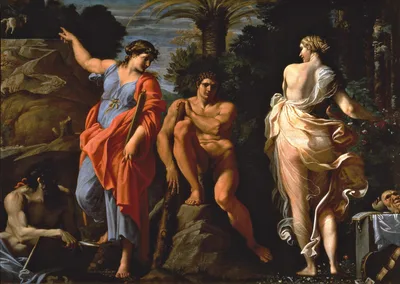
Prodicus of Ceos was the fee-taking sophist famous for fine distinctions and for the fable of the Choice of Heracles. He left no surviving word on the gods. Later writers report that he explained them as the ancients' names for what fed and helped them: bread as Demeter, wine as Dionysus, the Nile as a god. From the third century BCE they listed him among the "so-called atheists". His unbelief is a reported theory and a label others fixed on him, not a declaration of his own.